

 EN


1. Three takeaways from Climate Action 2027
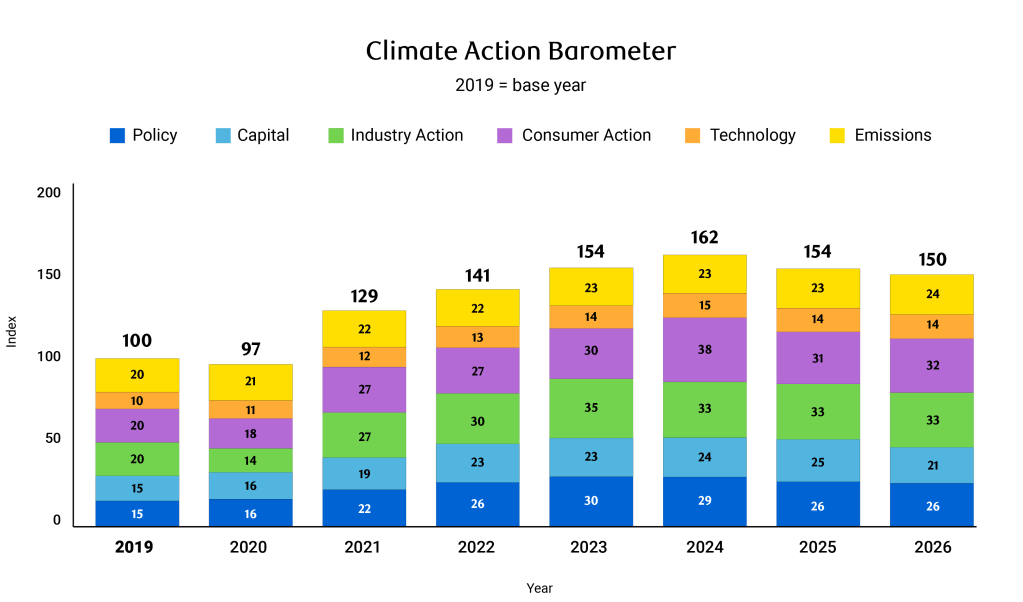
Our Climate Action 2027 report is out next week. We polled 2,000 Canadians, surveyed 150 business executives, conducted roundtables with 65 climate observers, and parsed through hundreds of policy documents and datapoints to assemble our proprietary Climate Action Barometer and Sector Indices—a measure of climate progress across various parts of the economy. It was an instructive six-month endeavour.
Here is a glimpse of what we discovered:
-
Climate action advanced, even as policy slipped. The Climate Action Barometer fell—again—from last year on policy pivots and a major project drive amid trade tensions with the U.S. Call it a reset, not a retreat, as we noted in last year’s survey: net-zero by 2050 remains a federal target. Action momentum continues through incentives around electric vehicles, provincial retrofitting programs, and renewables deployment progress on a landmark carbon capture and storage project proposal in Alberta.
-
Oil and gas decarbonization financing pulled back sharply. A 21% decline between 2023-25 to a five-year low suggests capital is waiting for more policy certainty. The Carbon Capture Investment Tax Credit (ITC) extension and Carbon Contracts for Difference, along with the carbon capture project, aim to reverse the slide.
-
Climate change is hitting Canadians unevenly. In our survey of 2,000 Canadians, women reported more health effects than men, and Gen Z and Millennials bear the heaviest financial burden, suggesting climate costs are deepening existing gender and generational gaps. Meanwhile, the cost of climate action may be overstated: only 11% of businesses in our 150-executive survey saw cost increases above 15% from sustainable policies, suggesting that many emissions-reduction technologies have reached cost parity. Yet, many of the 65 policy analysts we polled in a separate survey are gloomy. Nearly three in four believe federal policy is weaker than five years ago, and nine in 10 doubt Canada will meet its 2030 GHG targets.
For more, subscribe to our mailing list to receive the full report next week.
2. Ottawa proposes “credit multiplier” to support biofuel producers
Why? The concern is that U.S. policy, especially its Section 45Z Clean Fuel Production Credit, is undercutting Canadian biodiesel, renewable diesel and ethanol producers. Some plants have already shut down temporarily.
What’s Ottawa’s fix? A proposed change to the Clean Fuel Regulations providing a “credit multiplier.” Fuel made in Canada from North American feedstock would earn more compliance credits (1.3x to 1.8x) than the same volume of imported fuel. The aim is to level the playing field with US 45Z. Environment and Climate Change Canada (ECCC) will also publish monthly credit reports to improve transparency.
The trade-off? Bonus credits aren’t extra emission cuts, and Ottawa didn’t raise the number of credits that fuel suppliers must submit each year to make up for them. Suppliers can therefore meet their obligations with fewer real reductions—about 2.7 metric tonnes a year less by ECCC’s estimates.
Industry reaction? One trade group representing biofuel producers welcomed the changes but is pushing for 1.3x multiplier on ethanol to be at least 1.4x, as do numerous agricultural groups.
3. Canada’s $50B utility bill
Doubling Canada’s electricity grid will come with a $50-billion bill.It’s a central piece of Budget 2026, which weaves affordability, automotive strategy, energy security, Indigenous initiatives, high-end manufacturing and export expansion in one big Canadian quilt, laying the foundation of a climatecompetitive economy. Some takeaways:
-
The strategy will be funded primarily through clean electricity and clean technology investment tax credits.
-
Electricity producers will be allowed to offset more of their emissions through “verified reductions” elsewhere in the sector and economy.
-
Just over half a billion dollars are earmarked to advance the nuclear sector. It’s part of the $6.5 billion aimed at capturing a slice of at least $94 billion in global investments in nuclear build-out.
4. COP31: Less talk, more action
That’s a key message emerging from COP31, which kicked off in Ankara, Turkey this week. COP31 President Murat Kurum called on countries to turn promises into implementation. Here are the key summit themes, which dovetail with Canadian climate goals:
-
Electrification: It’s central to energy transition, but comes at a cost: as much as $10.6 trillion annually between 2026-2050, according to the International Renewable Energy Agency.
-
Methane reduction: Bad news: methane emissions are set to rise despite global pledges.
-
Climate resilient cities and buildings: Laying the foundation of resilient infrastructure will be critical to managing rising frequency of extreme weather events.
-
Low-carbon industrialization: Creation of sustainable value chains is vital as industries account for a third of all GHG emissions.
5. The sustainable finance taxonomy is still a work in progress
The Taxonomy and Transition Planning Council released their final methodology report, which could help unlock $115 billion annually in sustainable investments to build a net-zero economy by 2050. Here are some key takeaways:
-
The report identifies three investment categories: “green” (zero/near-zero emissions solutions), “transition” (steel, cement, chemicals production), and “abatement measures.”
-
While the first two categories are final, Sarah Thompson, RBC’s Global Head of Sustainable Finance, who is on the Taxonomy Council and the Financial Services Advisory Group, said that the abatement measures category—related to oil and natural gas production—will undergo feasibility research to determine if and/or how it will be added to the taxonomy’s framework.
6. What the political power shift in the U.S. mean for energy and climate policy
Here’s what Democrats’ control of both chambers and most states could mean for energy transition:
-
Slowdown, AI!: Big Tech stocks are spiraling in anticipation of a slower AI roll.
-
Energy renewable subsidies: Democrats plan to focus on grid development and clean energy, and have vowed to restore clean energy tax credits. However, President Donald Trump could veto them. States, majority led by Democrat governors, could boost renewables.
-
Permitting reforms: Wood Mackenzie expects the Bipartisan American Affordability and Jobs Act (BAAJA) will be central in accelerating utility-scale solar, battery energy storage systems (BESS), and high-voltage transmission lines.
7. How Canada could become a carbon removal exporter
Deep Sky’s CEO Alex Petre says the direct air capture engineering problem has to be solved first. If it works, Canada could sell carbon credits abroad under Article 6.2 of the Paris Agreement. Listen to Petre on the latest episode of Disruptors with host John Stackhouse.
Curated by Yadullah Hussain, Managing Editor, RBC Climate Action Institute.
Climate Crunch would not be possible without John Stackhouse, Jordan Brennan, John Intini, Farhad Panahov, Lisa Ashton, Shaz Merwat, Vivan Sorab, Caprice Biasoni, Lavanya Kaleeswaran, Joelle Schonberg and Alicja Siekierska.
Have a comment, commendation, or umm, criticism? Write to me here (yadullahhussain@rbc.com)
Climate Crunch Newsletter
This article is intended as general information only and is not to be relied upon as constituting legal, financial or other professional advice. The reader is solely liable for any use of the information contained in this document and Royal Bank of Canada (“RBC”) nor any of its affiliates nor any of their respective directors, officers, employees or agents shall be held responsible for any direct or indirect damages arising from the use of this document by the reader. A professional advisor should be consulted regarding your specific situation. Information presented is believed to be factual and up-to-date but we do not guarantee its accuracy and it should not be regarded as a complete analysis of the subjects discussed. All expressions of opinion reflect the judgment of the authors as of the date of publication and are subject to change. No endorsement of any third parties or their advice, opinions, information, products or services is expressly given or implied by Royal Bank of Canada or any of its affiliates. This document may contain forward-looking statements within the meaning of certain securities laws, which are subject to RBC’s caution regarding forward-looking statements. ESG (including climate) metrics, data and other information contained on this website are or may be based on assumptions, estimates and judgements. For cautionary statements relating to the information on this website, refer to the “Caution regarding forward-looking statements” and the “Important notice regarding this document” sections in our latest climate report or sustainability report, available at: https://www.rbc.com/our-impact/sustainability-reporting/index.html. Except as required by law, none of RBC nor any of its affiliates undertake to update any information in this document.