

 EN


Seven trends shaping energy transition
1. Climate Action 2027 launch event focuses on Canada’s electric future
Last week we launched the Climate Action 2027 report at our annual event, which gathers climate practitioners and thinkers to discuss key trending climate and energy transition topics.
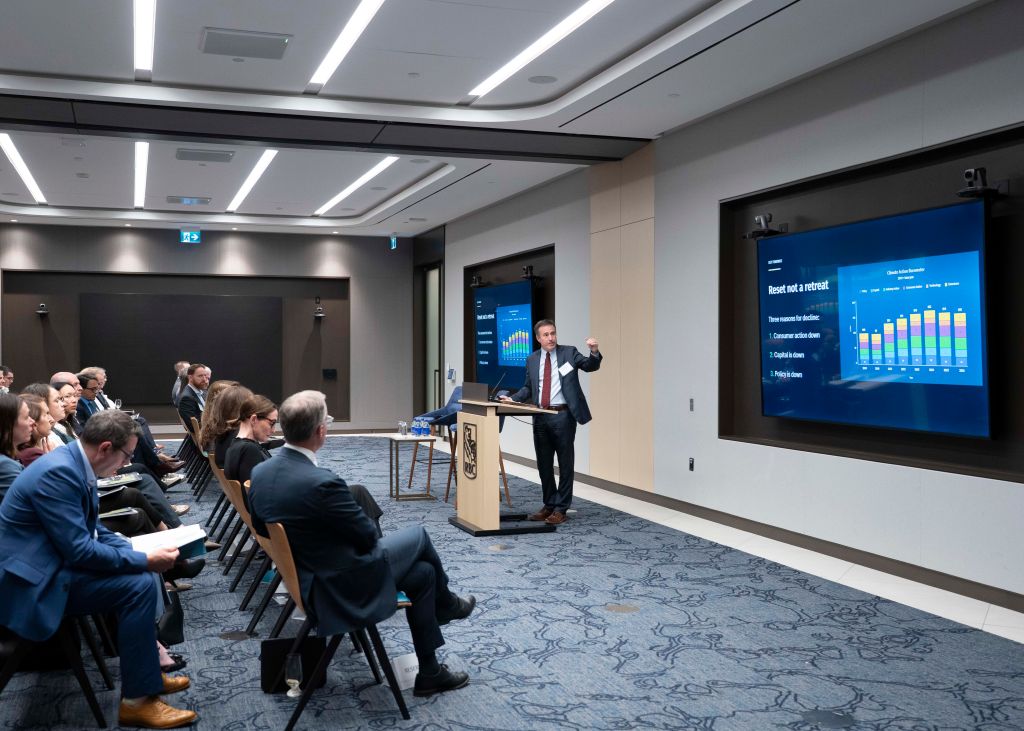
The annual report, now in its fourth year, tracks how Canada—and Canadians—are doing on climate action. Drawing on economic, consumer and industrial data, and individual, corporate and policy efforts, the report encapsulates Canada’s collective progress in a series of barometers and indexes—and the trends driving change.
This year’s event focused on electrification, featuring keynote speakers included Stephen Lecce, Ontario’s Minister of Energy and Mines, Mollie Johnson, Deputy Minister of Environment and Climate Change Canada, Josée Guibord, President & CEO, Electricity Canada, and Amanda Klein, President & CEO, Elexicon Energy.
Here are three takeaways from the gathering on building out our electricity infrastructure:
-
Build it before they come. In fastest-growing communities, investors are already knocking on our doors, which means we need to double or even triple capital programs—fast. And we will need it all: hydro, nuclear, solar, biogas, and natural gas.
-
Upgrade for the Age of Electricity. Regulatory systems built for a period of flat demand have to be revamped to facilitate an era of enormous growth. Meanwhile, the distribution grid is evolving from a plumbing system to a central nervous system, with two-way flows of electrons and information. That needs capital.
-
Supply chains could be major bottlenecks. Canadian suppliers cover much of what utilities need, but there are still years-long waits for transformers, and costs are climbing. We also need a workforce that can be ramped up to meet rising demand.
For more on how electricity and other sectors are balancing growth and emissions, read the full report here.
2. How a bad COP31 could lead to a good COP32
By John Stackhouse
The collapse of this year’s UN climate conference is unfortunate but not shocking.
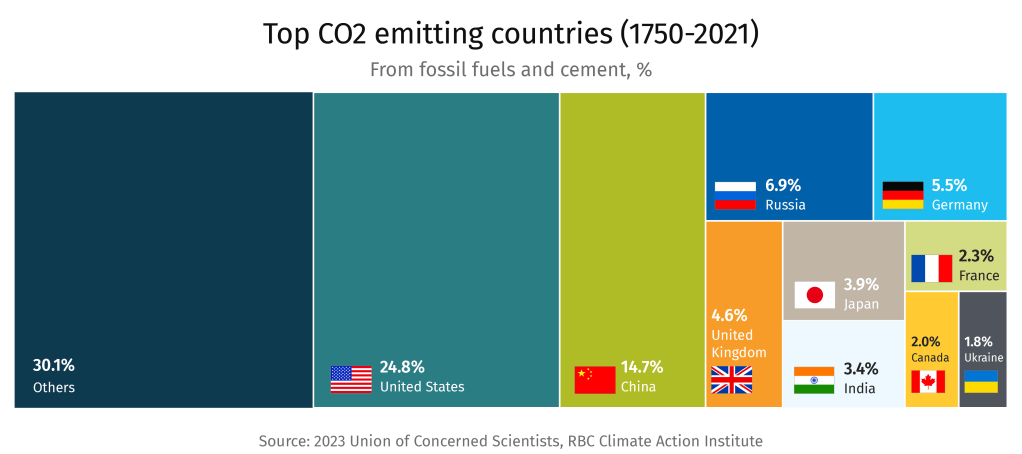
As our new Climate Action report spells out in its main essay, we’ve entered a new age of “geo-climate” — and an intersection of geopolitics and climate that’s creating a policy jam of trade, energy, capital and competition. Going forward, the COP process may need to move beyond its requirement for unanimous consent.
Here are some things to consider for next year’s COP in Ethiopia:
-
Is the world truly ready to declare an intent to transition away from fossil fuels, as was determined at COP28 in Dubai? This year, with 40% of the world’s oil going through war zones, many of the COP28 signatories wanted a more cautious approach.
-
Is the wealthy West truly committed to helping finance developing countries to develop their economies in a net zero manner? This was the COP where poor nations said, “no more words.” And the budget-battered West pushed back.
-
Don’t take these diplomatic setbacks as a reason to back away. Our Climate Action report lays out the case, regardless of global climate policy, to focus on electrification. For Canada—with or without COP—generating more capital to generate (and distribute) more electricity is critical for any reasonable path to net zero, as well as for economic growth and affordability.
-
The COP process is not dead, although the breakdown of COP31 is a blow to multilateralism. If anything, this year’s frustration may force the UN to address the internal contradictions that have impeded progress over the years. That could be a hallmark achievement for next year’s host, Ethiopia.
-
Few countries have suffered more from UN inaction or benefited more from UN leadership when it happens. And few people know better than Ethiopians, the climate isn’t waiting.
3. Iran war’s impact on energy transition
A prolonged Iran war could trigger structural changes in energy demand and accelerate energy transition, the International Energy Agency’s said in World Energy Outlook 2026 report.
Here are some of the IEA’s estimates on how it could play out:
-
In one scenario, global road transport oil demand could fall from 44 million barrels per day (bpd) today to 40 million bpd in 2035, as more consumers get behind the wheel of EVs.
-
Gas-importing regions could cut annual oil and natural gas demand in the buildings sector by one-third and 15%, respectively, by 2035, as electrification gains ground.
-
Energy efficient heat pumps make up 16% of global stock by 2035, up from 109% today.
-
Industrial fossil fuel demand falls to 56% by 2035, compared to 63% in 2025.
What could it mean for the energy mix? Electricity demand rises 40% to 11,500 terawatt-hours by 2035. Oil- or gas-importing regions would see electricity demand grow eight to nine times faster than overall energy demand, compared with a factor of around three elsewhere.
Electrification efforts were one of the few silver linings at COP31. Despite the absence of final consensus statement, more than 80 countries backed the “35-by-35 Electrification Pledge,” aimed at increasing the share of global energy use to 35% by 2035 (from 24% today).
4. Finding workers for B.C.’s energy transition
Much depends on British Columbia building out its renewable energy sector for several industries to meet its climate goals. Apart from capital, the build out will depend on a shovel-ready renewable energy workforce. A new Pembina report estimates B.C. will need to employ four times as many workers by 2050 to 27,800 compared to today to get to net-zero. Pembina’s solutions? Build local workforce capacity, expand recruitment and career pathways, and coordinate workforce planning with governments and industry.
5. Can a Blue Congress revive renewables?
Can a new and energized Democrat-controlled House and Senate reverse the slide in renewable energy projects in the U.S.? (See table below from E2). The past two years have seen the biggest surges in the number of projects cancelled, closed or downsized, and the biggest drop in new projects.
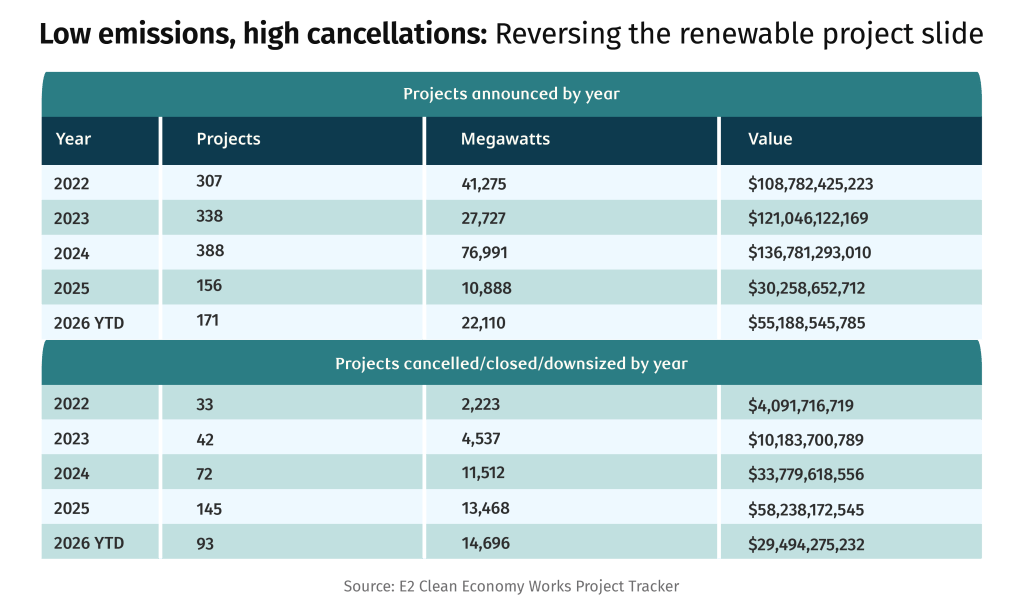
But don’t expect the Bipartisan American Affordability and Jobs Act that aims to speed up approvals of power plants, to speed up things. Some environmental critics say, if the bill passes as is, it will also fast-track data centres (opposed by many campaigning Democrats) and greenlight “buildout of fossil fuels.” But others say holding up permitting reform will be a mistake.
6. What’s in Alberta’s Bill 42?
The government’s proposed bill repeals the Oil Sands Emissions Limit, with the province arguing its industrial carbon pricing system provides sufficient incentives to reduce emissions. The bill also imposes stricter environmental and other rules on data centres.
Here are some other key details from the proposal:
Restrictions on where large data centres can be built. Proposed legislation would impose a 600-metre minimum distance from homes requiring at least 10 MW of electricity. Also off limits: around 14 million acres of prime agricultural and irrigated land. Large data centres would be required to bring cooling water consumption close to zero, monitor and report usage.
Proponents are responsible for electricity costs and grid reliability. Data centre operators would have to pay for their own power infrastructure, rather than shifting those costs to ratepayers.
Oil and gas companies would face tougher financial requirements for well cleanup. Energy companies would have to set aside funds to cover the eventual closure and reclamation of every new well they drill. Alberta has around 266,600 marginal, inactive or decommissioned wells, including more than 7,000 orphan well sites awaiting reclamation.
7. Climate culture
What’s going viral in energy transition
Read: The Hope, by Paul E. Hardisty, a climate emergency thriller.
Download: The New Energy Race: Batteries, bills and Canada’s grid, from RBC Disruptors.
Watch: Below (Netflix), a climate-adjacent fictional series on how melting glaciers in the Newfoundland and other Arctic regions—could unleash monsters.
Curated by Yadullah Hussain, Managing Editor, RBC Climate Action Institute.
Climate Crunch would not be possible without John Stackhouse, Jordan Brennan, John Intini, Farhad Panahov, Lisa Ashton, Shaz Merwat, Vivan Sorab, Caprice Biasoni, Lavanya Kaleeswaran, Joelle Schonberg and Alicja Siekierska.
Have a comment, commendation, or umm, criticism? Write to me here (yadullahhussain@rbc.com)
Climate Crunch Newsletter
This article is intended as general information only and is not to be relied upon as constituting legal, financial or other professional advice. The reader is solely liable for any use of the information contained in this document and Royal Bank of Canada (“RBC”) nor any of its affiliates nor any of their respective directors, officers, employees or agents shall be held responsible for any direct or indirect damages arising from the use of this document by the reader. A professional advisor should be consulted regarding your specific situation. Information presented is believed to be factual and up-to-date but we do not guarantee its accuracy and it should not be regarded as a complete analysis of the subjects discussed. All expressions of opinion reflect the judgment of the authors as of the date of publication and are subject to change. No endorsement of any third parties or their advice, opinions, information, products or services is expressly given or implied by Royal Bank of Canada or any of its affiliates. This document may contain forward-looking statements within the meaning of certain securities laws, which are subject to RBC’s caution regarding forward-looking statements. ESG (including climate) metrics, data and other information contained on this website are or may be based on assumptions, estimates and judgements. For cautionary statements relating to the information on this website, refer to the “Caution regarding forward-looking statements” and the “Important notice regarding this document” sections in our latest climate report or sustainability report, available at: https://www.rbc.com/our-impact/sustainability-reporting/index.html. Except as required by law, none of RBC nor any of its affiliates undertake to update any information in this document.