Language Flag Filename

rbc_language_toggle_menu_flag

Also in this edition: Untangling North America’s biofuel supply chain

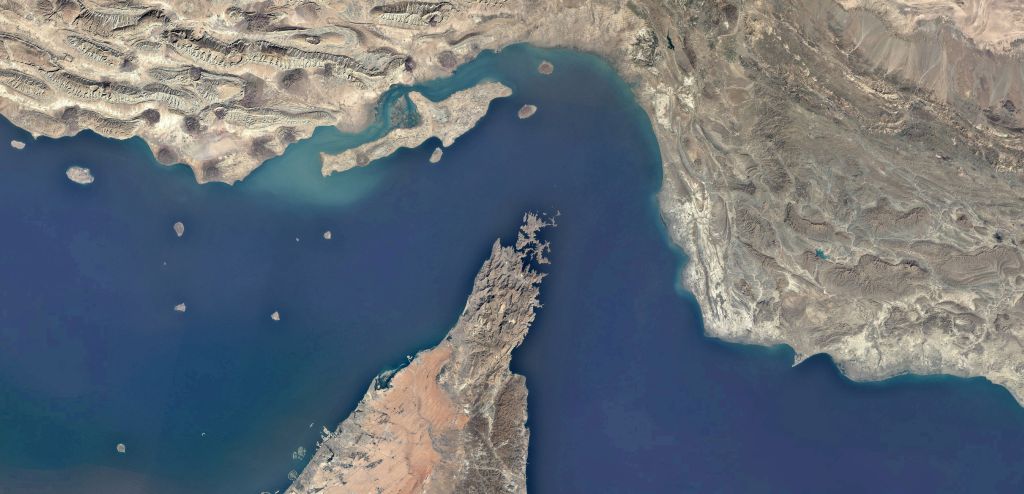
The Strait of Hormuz has long been treated as an oil story. When it closes, energy markets move, tanker rates spike, and the headlines follow crude. But it remains a slow-moving shock to the cost of moving goods, which becomes more entrenched over time.

First-Order: Crude and Tankers

The most direct impact is exactly where markets expected it. Benchmark Very Large Crude Carrier (VLCC) spot rates have surged six-fold since early January and are currently priced at US$98/t (US$13-14/bbl). Tanker volumes through Hormuz (and Suez) have essentially collapsed, with more than 500 vessels stranded in the Persian Gulf.

Second-Order: Products and Fuel

Refinery outages and export constraints tied to Hormuz have fractured global bunker supply chains, forcing vessels to seek fuel at alternative ports at elevated war-zone premiums. Charted below is the Singapore marine fuel indexed price, up 66% since the crisis began. Not charted but equally telling is the spread between Freight on Board (FOB) and delivered prices, typically <5% but well over 50% in mid-March, reflecting genuine physical dislocation in how marine fuel reaches vessels.

Maersk, a Danish shipping company, formalized this disruption on March 25 with a global Emergency Bunker Surcharge, entrenching a products shock into shipping economics worldwide.

Third-Order: Container and Dry Bulk

The Shanghai Containerized Freight Index (SCFI) fell gradually ahead of the conflict and has since rebounded (see chart), but the moves are likely seasonal. Chinese New Year brought port throughput to 40-50% of normal capacity in mid-February. How much of the SCFI March recovery is supply related in contrast to stronger demand is likely unclear until official port data is reported at month end.

Still, dry bulk was structurally underexposed to Hormuz to begin with–only around 55 dry-bulk vessels were transiting the strait weekly before the conflict and the Baltic Dry index is largely flat, if not marginally down. Nonetheless, large container vessel average speeds have edged marginally lower (see chart) since late February, a modest signal consistent with routine rerouting at the edges of the conflict zone.

–Shaz Merwat, Energy Policy Lead
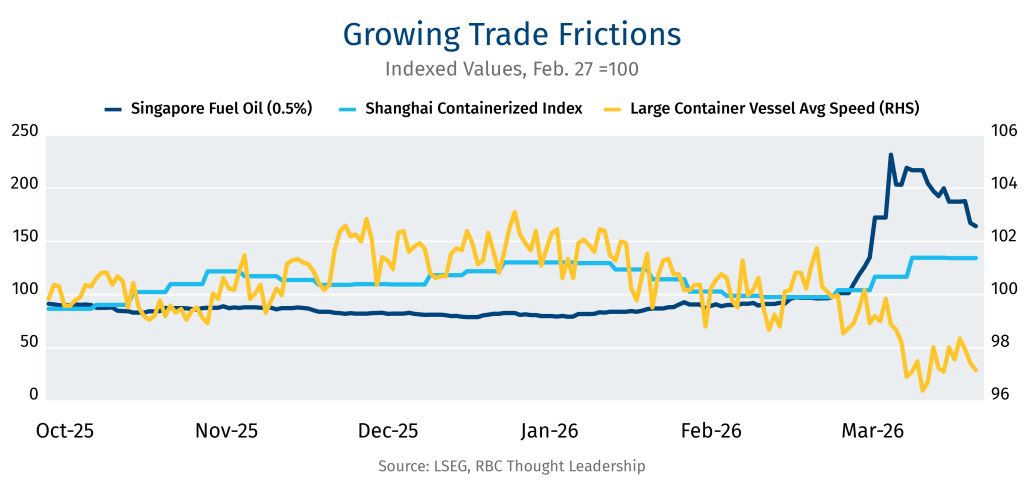
Growing Trade Frictions

North America’s once integrated biofuel supply chain is splintering along national lines.

U.S. federal incentives, state-level programs, and Canada’s Clean Fuel Regulations (CFR) are increasingly pulling in different directions, leading to a fragmented market with implications for Canadian biofuel producers and farmers growing oilseeds and grain including canola, soybeans, and corn.

Policy shifts triggered a continental divide

Changes to U.S. policy under the Renewable Fuel Standard (RFS) and new production tax credits have led the shift. Proposed 2026–27 RFS rules significantly increase domestic biomass-based diesel blending targets, reinforcing demand for oil-based feedstocks like soybean oil.

  • At the same time, newer incentive structures—particularly the transition from blender credits to production-based credits—are explicitly favouring domestic fuel production in the U.S.

  • The change eliminates the US$1 per gallon incentive Canadian biodiesels and renewable diesel received in the U.S. market as biofuels must be produced in the U.S. to earn the production-based credits. The result: an approximate 13% decline in value of Canadian imports into the U.S. between 2024 and 2025, according to Canada’s trade portal. It’s a meaningful departure from the bump Canadian biofuels received from U.S. subsidies.

What’s the impact on Canadian oilseed and grain markets?

Biofuel is a policy driven market and regulatory certainty is not a guarantee. Incentives for biofuel feedstocks under U.S. policy are still evolving as the U.S. Environmental Protection Agency (EPA) establishes its Renewable Volume Obligations (RVOs) for 2026 and 2027.

The pending U.S. policy uncertainty for Canadian farmers is that the EPA has proposed reducing the number of Renewable Identification Numbers (RINs) generated for imported renewable fuel and renewable fuel produced from foreign feedstocks, which would financially discourage U.S. biofuel refineries to use Canadian feedstocks. However, rising domestic Canadian demand could partially offset the export risk.

Canola: It’s the most exposed. Canola oil exported to the U.S. is primarily used for renewable diesel production. Exports of canola oil volume to the U.S. fell by 26% between 2024 and 2025, after climbing in each of the previous five years. The drop occurred while the Canadian canola industry spent more than a year in regulatory limbo, waiting for the U.S. Department of the Treasury and the Internal Revenue Service to clarify how production credits would work, confirming the inclusion of North American feedstocks in January this year.

Soybeans: Canadian soybean farmers may benefit from supportive U.S. policy. According to the U.S. Department of Agriculture’s 2026 outlook, biofuel mandates and tax incentives are expected to drive a 17% increase in U.S. soybean oil use for biofuels. Rising demand for soybeans is supporting prices, yet the commodity still faces potential downsides on trade with the U.S. if the EPA’s proposed RVOs are confirmed.

Corn: It remains anchored in U.S. ethanol production under the RFS. Yet, Canadian ethanol producers are now disadvantaged under the Clean Fuel Production Credit (45Z) that’s designed to encourage U.S. production of finished biofuel via incentives.

Bottom line

The Canadian outlook is mixed with domestic market demand hinging on the federal government’s forthcoming CFR amendments, where policy levers to shore up domestic demand are being considered, including minimum domestic content and credit multipliers for local producers.

–Lisa Ashton, Agriculture Policy Lead

Canadian beef producers raise concerns over potential Mercosur free trade deal

  • As Ottawa looks to secure a free trade agreement with the South American bloc this year, the Canadian Cattle Association (CCA) expressed concerns.

  • Brazil is the world’s largest beef producer, and the CCA worries that a Mercosur free trade deal would flood the Canadian market with cheap beef, harm the industry’s efforts to recover amid the tightest cattle supply in 40 years, and risk accusations from the U.S. of Canada enabling a “back door” into North American markets.

Fertilizer costs are leaping just as planting season gets underway

  • Disruption to shipments of fertilizers and commodities essential to fertilizer production through the Strait of Hormuz has increased prices, while North American farmers prepare to embark on their spring planting season. Urea, for example, has seen a ~40% price increase since the conflict began. The surge is quickly becoming a political issue for Trump who met this week with American farming groups, an influential political lobby.

  • Meanwhile, Russia, whose shipments remain unaffected by the Hormuz blockade, has deep reserves of fertilizers and commodities. Earlier this week, Russia halted its exports of ammonium nitrate, to shore up its domestic supply. But the conflict potentially raises the specter of Russia looking to increase its leverage on having restrictions on Russian fertilizer exports to Europe eased.

European parliament approves trade deal with U.S.

  • EU lawmakers had previously delayed approving the Turnberry agreement over U.S. President Donald Trump’s threats to annex Greenland, but on Tuesday the European parliament cleared the way for its implementation—with additional conditions attached. Prior to the vote, the U.S. threatened that the EU would lose favourable access to LNG shipments from the U.S. if the deal was further delayed, as Europe feels the bite of disrupted LNG shipments from Qatar.

  • The deal would eliminate EU tariffs on American industrial goods and some agricultural products and reduce U.S. tariffs on most EU goods to 15%. However, MEPs attached safeguards, such as delaying the EU’s tariff eliminations until the U.S. reduces its levies. These safeguards must be approved by EU member states, with negotiations commencing April 13th.

–Thomas Ashcroft, Geo-Politics Lead
Language Flag Filename

rbc_language_toggle_menu_flag

It does not take sustained disruption to ships sailing through the Strait of Hormuz for it to stop operating as a reliable artery of global trade. The costs are starting to add up: container shipping rates have risen 12% in the two weeks ended last Thursday, according to the Drewry World Container Index.

  • When maritime war risks emerge, a relatively concentrated group of insurers designate high-risk areas, standard coverage falls away and shipowners must secure additional war risk insurance on a voyage basis, priced as a percentage of the vessel’s value.

  • In recent weeks, those premiums have surged from fractions of a percentage point to now 5% of a ship’s value. For a large tanker, that translates into millions of dollars for a single passage. That could soon lead to shortages and likely higher prices for everyday items from toys to clothes to chips.

  • When Iranian drones, mines, or small-boat attacks present a persistent and credible threat to the strait, this also becomes a human judgment call for the captains and crew. Not to mention the shipowners who don’t want to see one of their expensive tankers go down or be rendered useless.

  • There are rising international efforts, including from Canada, to safely reactivate a key maritime channel in the Gulf, where an estimated 1,000 ships—largely energy tankers—are currently stalled.

  • According to Lloyd’s List Intelligence, the conflict has already seen 23 vessels targeted, with some incidents leading to crew casualties.

  • While Covid hit volumes sharply and dramatically increased freight rates, Hormuz is testing the precision of the global shipping system: flows are being rerouted, voyages are lengthening, and tonnage is being repositioned across basins. Cargo that would typically transit Hormuz is increasingly moving west via alternative corridors, with Red Sea ports emerging as key nodes in what is now a rapidly shifting map for cargo transiting through the Middle East.

What’s the impact?

  • Longer voyages absorb capacity, tighten vessel availability in some regions, and create imbalances elsewhere. For containerized trade, the impact is consequential. E-commerce delivery delays have already hit Middle East retail, as air cargo is also taking a hit.

  • Global supply chains depend on timing. Goods move in sequence and within defined windows. That predictability is now eroding. An increase in freight rates can be absorbed. A shipment that arrives weeks late, and without certainty, cannot.

–Thomas Ashcroft

Oil and gas trade has virtually halted in the countries surrounding the Strait of Hormuz in the Persian Gulf. And as Qatar’s natural export facilities suffered a hit, it has sent energy forecasters back to the drawing board.

The global LNG market was on track to move into meaningful surplus in 2026, with two million tonnes on supply of 475 million tonnes (MT) in 2026 and 30 MT on supply of 585 MT in 2029.

How badly are Qatar’s LNG exports hit?

  • A disruption to Qatari supply — the world’s second largest LNG exporter — would wipe that surplus out entirely for roughly three years to a 30 MT shortage in 2026, and only 8 MT excess in 2029. Of course, this assumes no demand destruction, which remains to be seen.

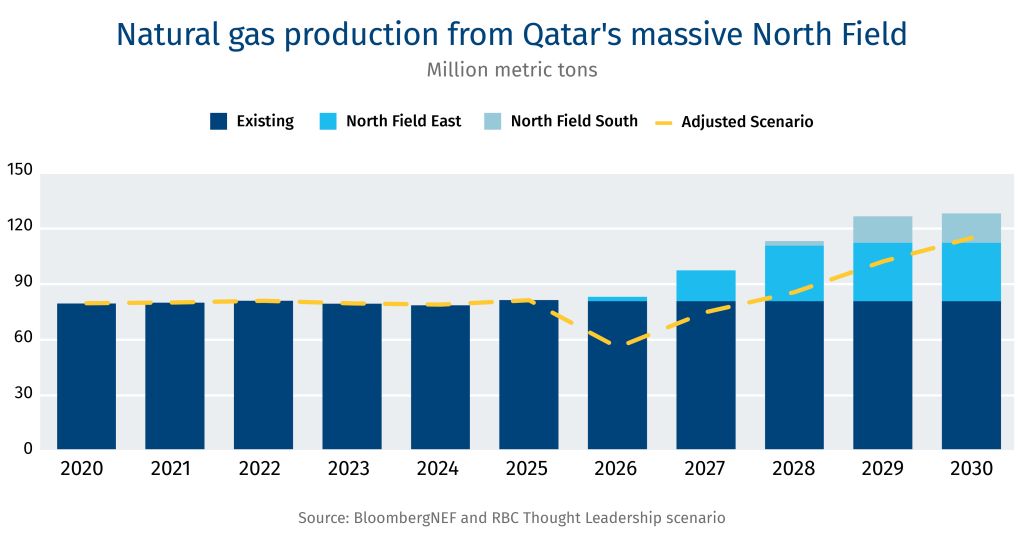
  • Based on conversations, Qatar’s adjusted supply scenario of LNG this year is likely 50-55 MT, a ~30 mtpa disruption from last year’s ~83 mtpa of production. That’s not a rounding error—it is a decline just under two times greater than Canada’s current entire LNG export capacity.

  • Qatar’s North Field expansion, which underpins the global supply growth story through 2030, could get pushed back with a slower ramp. The market was pricing in those volumes but is now repricing a near to mid-term shortage.

    Natural gas production from Qatar's massive north field

This is a two-stage shock

  • The Strait of Hormuz dimensions compound the picture. With tanker traffic effectively frozen, the disruption isn’t just a production story – even unaffected volumes are shut-out of the Strait.  

  • LNG Canada is revving up. Eight vessels departing B.C. in the first 17 days of March versus four in all of December signals that Pacific Basin buyers are already rerouting toward non-Gulf supply.

  • Reports suggest U.S. LNG cargoes are also headed to Asia via the Panama Canal.

  • Bottom line: The anticipated LNG glut — widely expected to lower prices and improve affordability — is likely off the table through at least 2028.

For more, read: Energy Shock: 8 charts that explain the global oil and gas fallout – RBC

–Shaz Merwat

Negotiating trade with President Donald Trump is like playing whack-a-mole. Irritants pop up relentlessly and belligerently. Except if you swing late, the mole pops up and whacks you back harder. The U.S. Trade Representative’s launch of a Section 301 investigation into Canada is just the latest belligerent act.

The investigations, targeted a total of about 60 trading partners, fall under two probes:

  • First, to determine if countries have failed to effectively ban or enforce prohibitions on goods produced with forced labour entering America (which is the focus of the Canadian investigation).

  • Second, whether foreign government subsidies result in overcapacity that floods markets and hurts U.S. manufacturing in key sectors.

The U.S.’s motive is to force allies to share the load in hardening against forced labour goods from regions like Xinjiang region—where minorities are forced to produce goods—, apart from overcapacity, and broader Chinese supply risks. It’s not just bilateral finger-pointing but, for Canada, it does initiate a deliberately targeted process:

  • Washington charges that Ottawa’s forced-labour enforcement regime unfairly burdens U.S. commerce by letting tainted goods flow into North America.

  • That triggers mandatory consultations, public hearings, and evidence-gathering before tariffs can then be applied.

What’s the realistic threat?

If Canada falls foul of these investigations, duties could target manufacturing inputs (steel, aluminum, minerals), high-tech goods (semiconductors, solar, electric vehicles), seafood, toys, electrical equipment, and consumer essentials like textiles and leather. 

Canadian Border Services Agency (CBSA) data reveals modest gains after 2024 Forced Labour and Child Labour in Supply Chains Act took effect in Canada. Seizures of suspected forced-labour shipments—apparel, toys, and electronics often traced indirectly to the Xinjiang autonomous region in China—edged up, with around 50 detentions in 2024 versus almost none in the prior three years. However, only one shipment was confirmed as violating the prohibition in Canada, a fraction of U.S. Customs and Border Protection’s US$1 billion in seizures over suspected ties to forced labour. The Canadian government committed $25.1 million over two years starting 2025 to Global Affairs Canada and CBSA for investigations and enforcement, to accelerate this, but Washington questions the bite, arguing the enforcement lacks the teeth would help achieve its strategic goals with China.

What happens now?

  • Section 301 is a process, not a trigger. Unlike Section 232, it requires consultations, evidence-building, and public hearings before any tariffs can be imposed.

  • Canada has a narrow window to shape the record: April 15 submissions and hearings beginning April 28 will be critical to demonstrate enforcement progress and anchor arguments in CUSMA labour commitments (Chapter 23).

How it impacts CUSMA negotiations

  • The timing is deliberate. Section 301 process is running in parallel with the CUSMA review, giving the U.S. Trade Representative office USTR an early signal of whether consultations are producing results.

  • United States Trade Representative’s Jamieson Greer said this week that Canada lags Mexico in the CUSMA review process. The Canadian pacing is strategic, reflecting a conscious allocation of risk and leverage in Ottawa. Mark Carney assembled his team and split roles accordingly: Ambassador Mark Wiseman courts Congress against wild cards like CUSMA withdrawal (which can be done through executive order, although Congress does maintain ultimate control over repealing the legislation).

  • Meanwhile, chief negotiator Janice Charette coordinates the relevant government departments and red lines for the PM.

  • Pre-U.S. midterms, Canada must collaborate on forced labour without offering high-value concessions like critical minerals access. Demonstrating enforcement progress and willingness, while holding strategic cards close and letting the midterms test Trump’s leverage to preserve Ottawa’s negotiating room.

–Thomas Ashcroft

China’s recent opportunistic “offer” to Taiwan to unite with the mainland in exchange for energy security illustrates how energy security, trade, and geopolitics are converging, as the Middle East conflict violently shakes up global energy systems.

Why does Taiwan need energy security?

  • The East Asian Island is the world’s leading producer of semiconductors, with natural gas and oil—mostly imported—accounting for 61% of energy supply, according to data from the Statistical Review of World Energy. Coal (33%), nuclear (3%), and renewables (3%) make up the rest.

  • In 2016, Taiwan initiated policies to phase out nuclear power and completed the shutdown of its final reactor in May 2025, bringing nearly 5GW of power—or 42% of Canada’s nuclear capacity—offline, and growing its liquefied natural gas imports.

  • Around 42% of Taiwan’s imported LNG came from Qatar, which suffered a severe missile attack from Iran this week.

  • Taiwan is revisiting its nuclear strategy, with feasibility studies to examine restarting two nuclear power plants. State-owned utility Taipower is also expected to submit reactor restart plans this month.

Lessons in a new energy era

  • Our report Atomic Advantage: Canada’s generational opportunity in a new Nuclear Age, underscored how energy security is driving a resurgence in nuclear power worldwide.

  • Many European and Asian nations are diversifying their energy suppliers but also power sources to navigate the geopolitical instability disrupting global energy markets.

  • As nations seek to diversify both energy supplies and power sources, Canada is well positioned to help. Canada’s Candu reactor technology, which includes sub-gigawatt scale reactors suited to smaller grids, and growing SMR expertise make it a natural partner for countries looking to reduce fossil fuel dependence without relying on Chinese or Russian technology.

–Vivan Sorab

Language Flag Filename

rbc_language_toggle_menu_flag

Oil and gas markets are reeling as the Iran war chokes off production in the Middle East, with its impact reverberating across the world. As energy supply chains get fractured and prices become volatile, we examine the emerging trends defining this new era of global energy insecurity.

  • Alternative Middle East export routes have limited capacity of 3.5 to 5.5 million bpd.

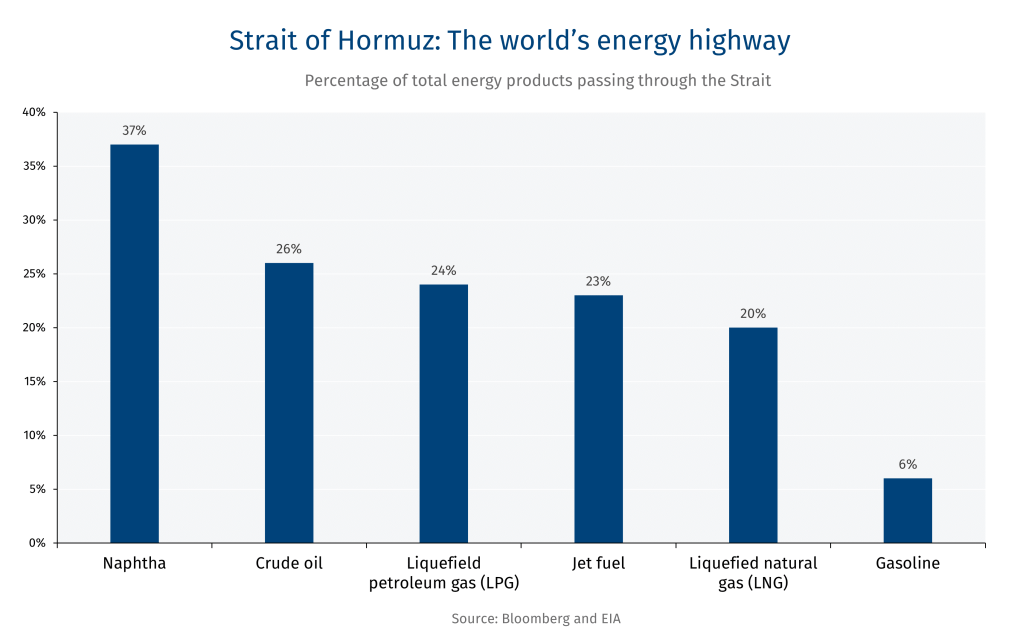
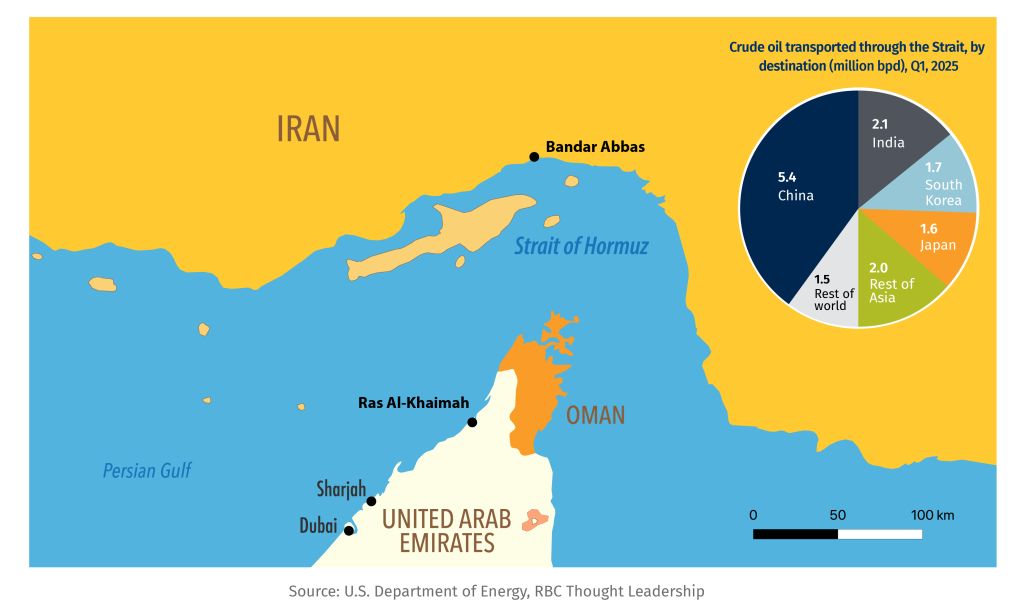
  • The 54-kilometre waterway handles 20 million barrels per day (bpd) or 20% of global oil supply. Only the Strait of Malacca, in Southeast Asia, handles more crude oil.

  • Close to 93% of Qatar’s LNG exports transit through the Strait—19% of global LNG trade.

Strait of Hormuz: The worlds' energy highway
  • Japan was the first country to announce the release of oil from its reserves as part of the International Energy Agency-coordinated action, injecting 80 million barrels in the market.

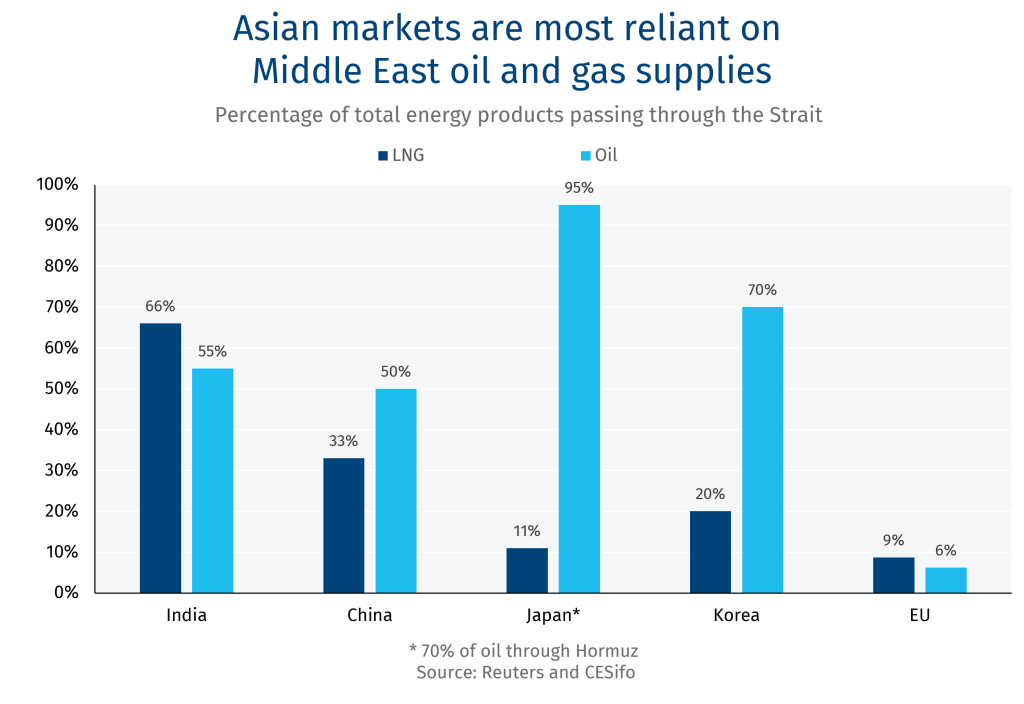
  • The U.S. is allowing India to buy Russian oil as a stop-gap measure—as New Delhi scrambles to find alternatives for some of the 2.5-2.7 million bpd it sources from Iraq, UAE, Saudi Arabia and Kuwait.

  • The U.S. has exempted Russian oil from sanctions for at least 30 days—weakening Western efforts to support Ukraine in its war against Russia.

Asian markets are most reliant on Middle East oil and gas supplies
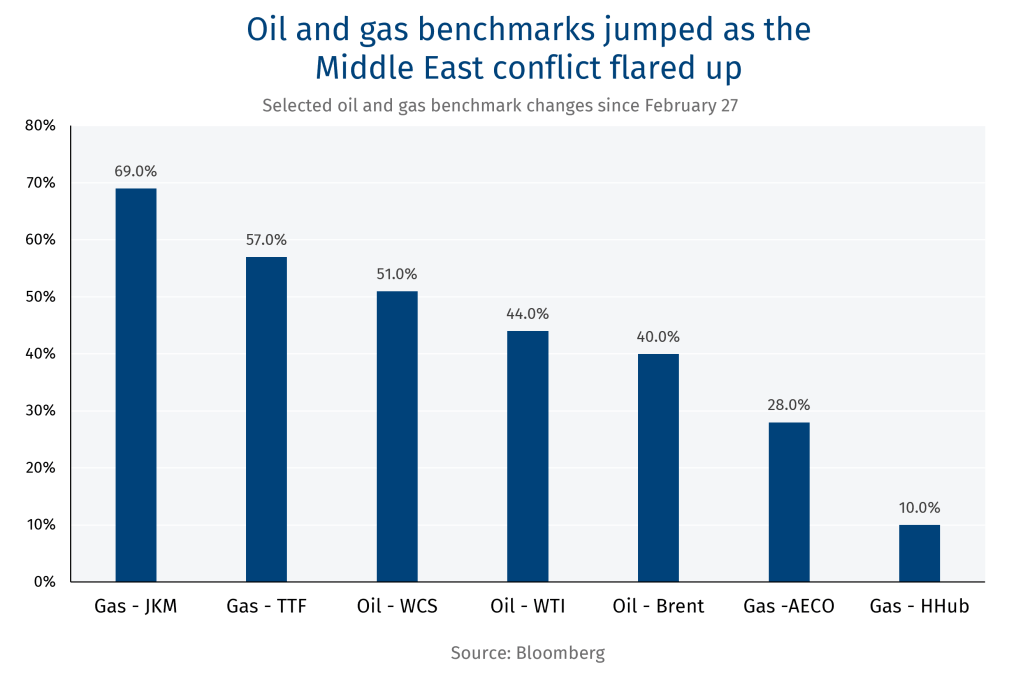
  • LNG Japan/Korea Marker (JKM) jumped the most, underscoring Asian dependence on the Strait.

  • The crisis has erased a looming LNG supply glut, with Europe Asia scrambling for supplies.

  • Oil prices remain volatile, vacillating between US$76-119 per barrel over the past week.

Oil and gas benchmarks jumped as the Middle East conflict flared up
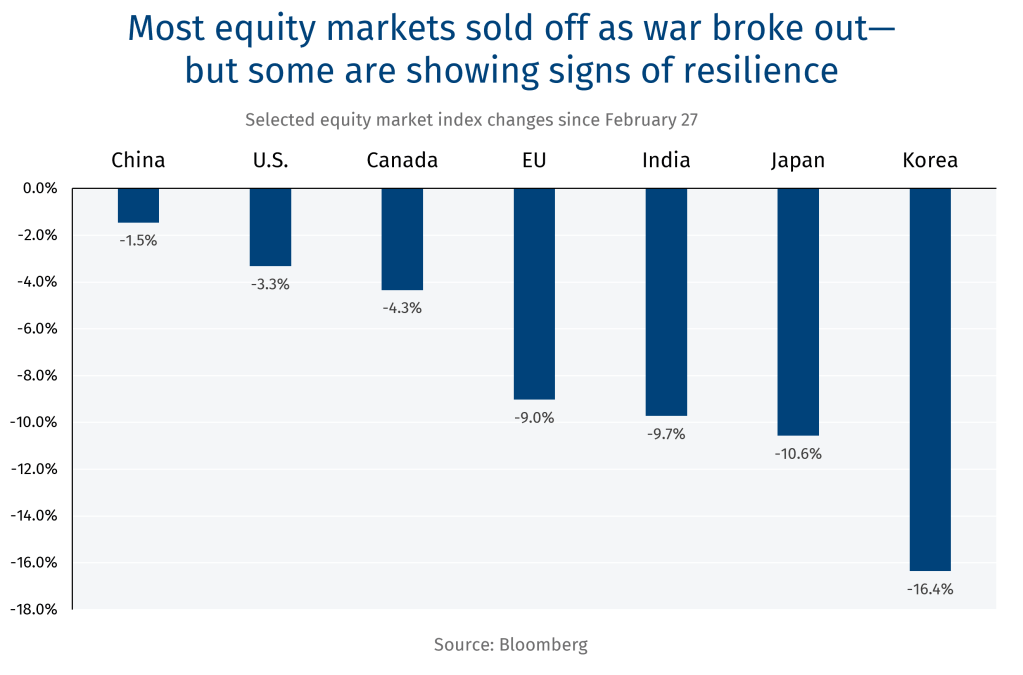
  • The Korean and Japanese stock market sell-off is reflective of energy exposure but also above-average year-to-date performance pre-crisis.

  • China’s estimated 100-day oil import cover has shielded its stock market from a severe downturn.

  • U.S. and Canada markets have been structural winners in the reallocation of global equities.

Most equity markets sold off as war broke out - but some are showing signs of resilience
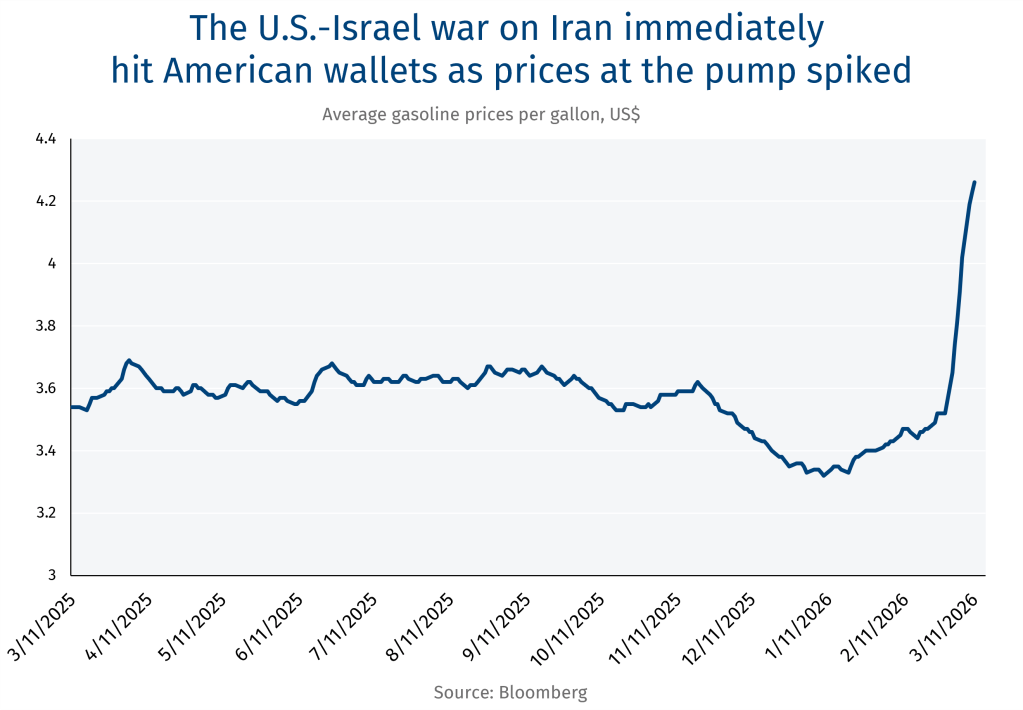
  • While North America’s net exporter of crude oil, the global structure of oil markets has not spared the American economy

  • A recent Washington Post/CNN poll shows about 7 in 10 American voters are “very” or “somewhat” concerned that the Iran war will send oil and gasoline prices higher

  • Higher gasoline prices would be a key datapoint for the U.S. administration as it plots it next move.

The U.S.-Israel war on Iran immediately hit American wallets as prices at the pump spiked
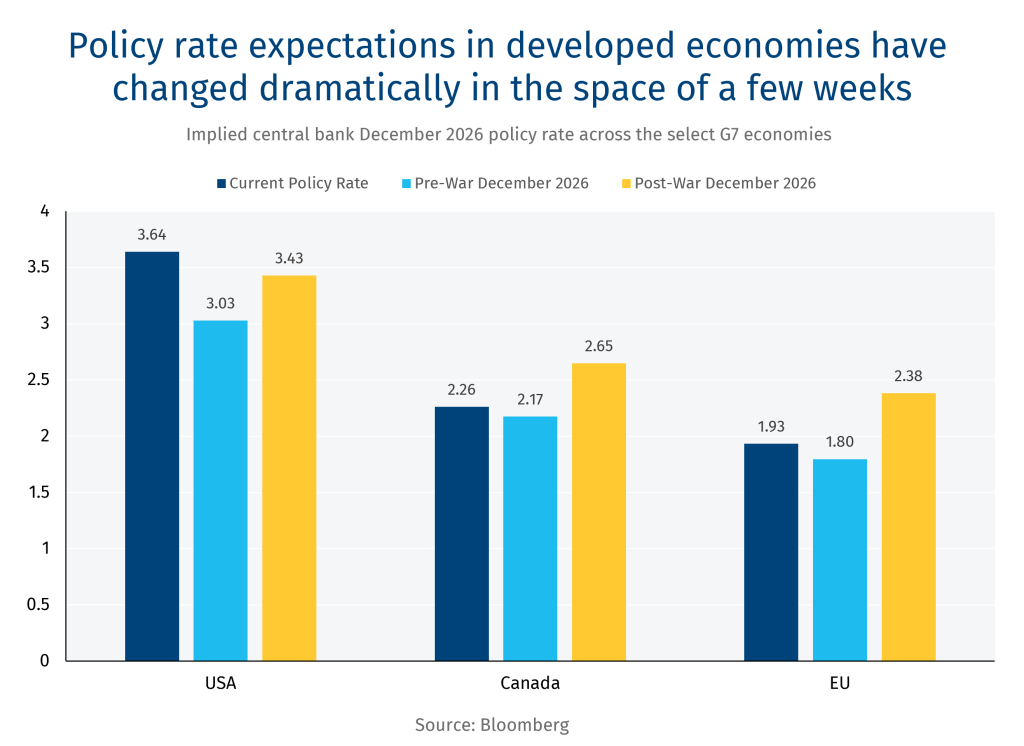
  • Across Canada, the U.S. and EU, the expectation was an easing of monetary policy as the year progressed—but it has reversed on fears of higher inflation.

  • A sustained US$80 oil could raise inflation from 2.2% to 2.5% in Canada, according to RBC Economics.

  • Similarly, the U.S. would see an increase from 2.7% to 3.1% at US$80 per barrel.

Policy rates expectations in developed economies have changed dramatically in the space of a few weeks
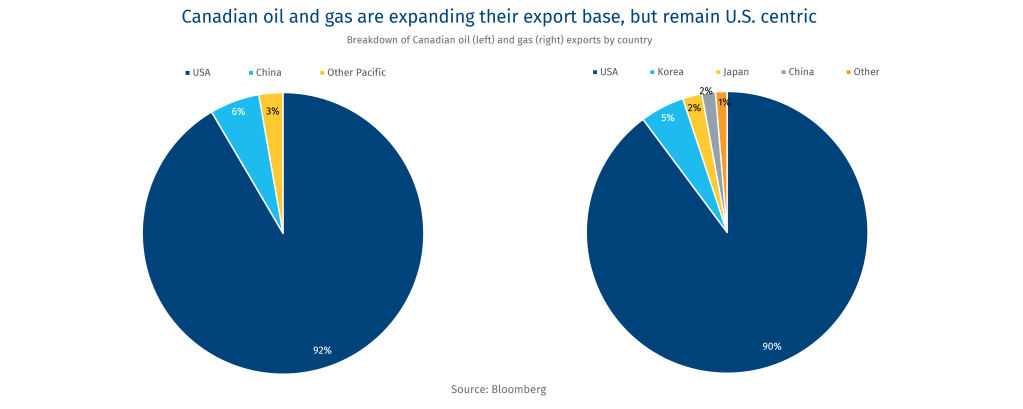
  • China has been Canada’s biggest non-U.S. oil export destination—which could grow further as relations with Beijing improve.

  • South Korea has been the primary destination for Canadian LNG to date.

  • Over the long term, Canada could likely serve a more meaningful role in de-risking Asian supply.

Canadian oil and gas are expanding their export base, but remain U.S. centric
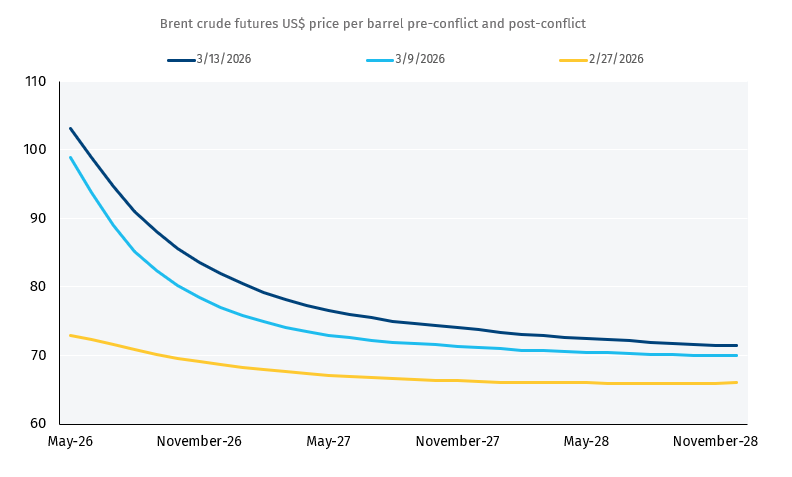
  • Around 8 million barrels per day of crude and 10 mbd of liquids production in the Middle East is reportedly shut in with the Strait of Hormuz at a virtual standstill, according to the International Energy Agency.

  • Despite International Energy Agency members planning 400-million-barrel injection into markets, the price trajectory would likely depend on the U.S.’s ability to ensure the security of the Strait of Hormuz.

Brent Future curve suggests oil prices will remain higher for longer

Language Flag Filename

rbc_language_toggle_menu_flag

Also in this edition: A Q&A with the former Chief Agriculture Negotiator for the Office of the United States Trade Representation

This week, RBC and Eurasia Group convened a roundtable in Washington, D.C., bringing together policymakers, business leaders, and trade experts as part of the lead-up to the Canada–U.S. Summit that we’ll co-host in Toronto in June.

The tone was cautiously optimistic, which is markedly different from the doomsday headlines and political noise that has become commonplace. Key players on both sides of the border remain focused on preserving and strengthening one of the most deeply integrated economic relationships in the world.

The discussion coalesced around several critical themes:

  • The upcoming CUSMA review, built into the agreement six years ago, was designed as a forum to air grievances, not dismantle the framework. That process alone won’t upend a trade relationship that sees Canada as the top trading partner for more than 30 U.S. states—a fact the Office of the United States Trade Representative is acutely aware.

  • Section 232 tariffs on aluminum, lumber, steel, and autos—imposed on national security grounds—lie outside the formal review process, and there will inevitably be high-stakes negotiations around changing the status quo.

  • Trump is also less likely, and less able, to unilaterally reimpose sweeping tariffs in 2026. Yet initiatives like Project Vault signal his intent to align allies with U.S. interests on critical minerals and advanced technologies. Trump will want to ensure Canada doesn’t stray too far from the U.S. orbit on those, particularly as the EU advances its own agenda on tech sovereignty and regulation.

  • For its part, Canada has distinct advantages to draw on: its supply of heavy rare-earth elements with irreplaceable magnetic and high-temperature properties, as well as its leading capabilities in quantum computing.

  • Meanwhile, China’s role in both markets remains a concern and will feature prominently in negotiations. For Washington, the priorities are to reduce the ability for Canada to serve as a backdoor for Chinese goods into the U.S. market and to decouple its critical minerals supply chain. Ottawa needs to manage that shift while maintaining a measure of economic flexibility.

  • Energy interdependence is key. The integrated Canada–U.S. energy system, bolted together by pipelines and grids, powers a landmass larger than Russia. Canada supplies more than 60% of U.S. crude oil imports, and industry leaders cautioned against viewing that relationship merely as leverage. With both countries ranking among the world’s top energy producers, the logic is compelling to expand joint infrastructure and strengthen North America’s competitive position globally.

Political leaders may argue and tinker with the details, but the machinery of integration continues, driven by habit, necessity, and sheer economic gravity.

-Thomas Ashcroft

RBC’s John Stackhouse on how trade tensions may strengthen Canada’s position in an integrated market:

Trump’s extraordinary use of tariffs has braced Canadians for a more fundamental remaking of continental free trade, on less favourable terms for Canada and Mexico.

This has put Canada on a more ambivalent, but strategic and resolute course. It is not unusual for Canadian governments of both major political parties over the decades to oscillate between closer alignment with Washington and periodic assertions of autonomy. But this time, it is different in at least one big way: Canada is now investing heavily in industrial strategy and other sovereign economic policies.

As a result, there are at least three major restructurings underway:

  • Expanding ports and export infrastructure to reach markets beyond the United States.

  • Building domestic defence, digital, and data capacity with a “Buy Canadian” approach to procurement and a willingness to increase collaboration with other European and Asian partners.

  • Rebuilding domestic industrial capacity while reorienting manufacturing toward higher-value, globally competitive activity.

Taken together, and if executed, this strategy would not imply a retreat from the U.S. market so much as a change in how Canada relates to it. Trade with the United States would remain large and central, but less one-sided: Canada would export more from a broader base of domestic capacity, rely less on U.S. inputs, and approach the relationship from a position of greater bargaining strength. The result would likely be steadier, more diversified cross-border trade.

Read the full commentary here.

Our Agriculture Lead Lisa Ashton sat down with Ambassador Darci Vetter, Former Chief Agriculture Negotiator for the Office of the United States Trade Representation, to unpack recent changes in the U.S. tariff approach and what the agriculture sector should be thinking of ahead of the CUSMA review. (This interview has been edited and condensed for brevity.)

Q: How might the Trump administration’s current focus on reciprocity and trade deficits impact agriculture and food trade, where supply chains are often multi-country and complex?
A: Farmers and food processors now have to factor multiple and changing tariff rates into their sourcing decisions. These calculations are further complicated by tariffs on steel, aluminum, auto parts, lumber and other products that are critical inputs. 

It’s also not clear to me that the U.S. agricultural trade deficit is a good indicator of the health of the U.S. agricultural sector. If you look at the products that the U.S. exports versus those it imports, you are quite literally comparing apples and oranges. While there is merit in examining how U.S. farmers can better serve local and national markets—and no country wants to be overly dependent on food imports—imported agricultural and food products ensure consumers have access to a varied, affordable and healthy diet.

The USDA’s latest agricultural trade forecast is predicting a US$20 billion decrease in the agricultural trade deficit.1 While the forecast predicts a small increase in exports, a closer examination shows the majority of the changes are due to a decrease in prices for high-value imports like coffee, cocoa and spirits, rather than changes in policy.

Q: What should agriculture and food sectors be watching for in the CUSMA review? 
A: The trilateral food and agricultural trade relationship among Canada, the U.S. and Mexico is one of the world’s most integrated agricultural trading relationships. In 2024, U.S. agricultural and seafood exports to Mexico and Canada totalled more than US$60 billion2. In the U.S., a broad group of agricultural associations have formed the Agricultural Coalition for USMCA to advocate for continuation of the agreement, recognizing its critical value for the sector.

Longstanding relationships are bound to have a few irritants. In his December testimony to Congress, U.S. Trade Representative Jamieson Greer listed a few issues in agriculture— including market access for U.S. dairy products that Canada committed to provide under CUSMA; addressing Canada’s exports of certain dairy products; and the impact of importing Mexican seasonal produce on U.S. growers. 

Q: What other elements of the CUSMA review could impact the sector?
A: The U.S. is likely to prioritize tighter rules of origin and/or North American content requirements for autos, auto parts, steel and aluminum—affecting supply chains for these important inputs for agricultural production and food processing.

One of the most important elements of CUSMA was the Sanitary and Phytosanitary Measures Chapter. CUSMA added important obligations to help ensure food safety and animal and plant health. The SPS Chapter calls for coordination to ensure regulations are transparent, based on sound science and risk, and allow for key agricultural technologies. The USMCA SPS Committee provides a venue to coordinate positions and inform international standards. While unlikely to be changed in the review, they provide a clear example of the benefits of long-term regional approach to trade relationships.

Language Flag Filename

rbc_language_toggle_menu_flag

Also in this edition: A conversation with Canada’s Foreign Affairs Minister Anita Anand, key takeaways from PDAC, and the Iran conflict’s impact on global oil supply and prices

If trade and investment are two sides of the same coin, Canada for a good while has been calling on trade when the coin was flipped. The Carney Doctrine—whenever it’s written—shows a new preference for investment. No capital, no bananas.

The prime minister signalled a capital-first inclination in his lightning tour of Asia this week, as he covered 30,000 kilometres, three countries and $5.5 billion in deals faster than the Toronto Maple Leafs can win a game. The messages in Mumbai, Sydney and Tokyo—three of the world’s key capital markets centres—is that Canada needs and wants capital. Not a lot of symbolic trade MOUs on this junket.

Carney’s Indo-Pacific initiatives focussed on capital flows, industrial partnerships, and supply chain integration across sectors such as critical minerals, semiconductors, AI, defence manufacturing, and energy security. From a distance, it looked more like a PE road show than a trade mission. Example: IFM, an infrastructure investment behemoth owned by Australian pension funds, declared its intention to invest up to $10 billion in Canada. That matters because more infrastructure in the two countries will enable more trade.

Back home, some subtler changes added to the trend toward global capital as the precursor to trade. A shakeup at Global Affairs was the latest sign that foreign policy is now rooted in the PMO. The Prime Minister and his top bureaucrat, Michael Sabia, also hired Glenn Purves as deputy minister of international trade. Purves is a long-time bureaucrat who had worked under Sabia before heading to the private sector early last year as head of macro research at BlackRock’s Investment Institute. 

Putting a capital markets guy atop the trade service is a signal: capital first. Purves now has his own global infrastructure, too, through trade commissions, to ensure Carney’s capital calls are met. Somewhere on that PMO in the Sky, the Prime Minister keeps a tally of commitments made, and commitments delivered. Call it the new balance of trade. 

John Stackhouse

The Strait of Hormuz, through which 20% of the world’s oil passes, is a key transit point for many energy-import dependent Asian countries. China, by a wide margin, tops that list.

Since the Iran conflict started, commercial shipments of crude and natural gas have slowed to a “near-total” pause. And the price is climbing—fast. Brent Crude futures crossed US$90 a barrel, the highest in almost two years, leading to fears of higher prices at the pumps and spiking inflation. 

–Farhad Panahov

This year’s Prospectors & Developers Association of Canada (PDAC) event in Toronto was abuzz with talk of Canda’s critical mineral riches and the speed at which they can be brought to global markets—at commercial scale. The industry is enthusiastic, the government supportive, but there is a long way to go to realize Canada’s mining potential.

Here are seven themes that we observed at the event:

  • Diverging views of supply chains exposures

  • Resolving refining bottlenecks will be key

  • Project Vault is not a partnership of equals

  • Copper is the clearest demand signal

  • Don’t ignore civilian demand

  • Prioritize across the minerals list

  • Regulatory coordination as competitive advantage

Read more on these key takeaways from Shaz Merwat, RBC Thought Leadership’s Energy Lead, here.

Hours after returning home from India, where Prime Minister Mark Carney kicked off talks of a Comprehensive Economic Partnership Agreement aimed at doubling two-way trade to $70 billion by 2030, Foreign Affairs Minister Anita Anand joined RBC’s John Stackhouse on stage at the Toronto Region Board of Trade.

Some key takeaways from the conversation (edited for brevity):

JS: What signals are you bringing home, especially to business decision makers?
AA: We are the only G7 country that has a free trade agreement with every other G7 country. We had the infrastructure in place from a trade perspective. We need it to be operationalized and utilized. Such is the case with India. We need all of us to be utilizing the agreements that we are executing, or we will keep having to rely on one trading partner and all the difficulty that has caused.

JS: I’ve heard this for decades. We need to diversify. We’re making progress but it’s slow progress. What are we, in business, missing?
AA: It’s really important to unpack what we are doing internationally. That’s what I’m trying to do, make foreign policy and these types of agreements accessible and understandable for businesses to utilize—that will yield actual trade diversification over and above the agreements that we’re signing.

JS: I wonder if you could wrap up with a positive reflection from your trip and if there was any one point that really gave you confidence, especially for businesses?
AA: There is a positive story here despite the very difficult economic environment we find ourselves in, despite a global conflict that is extremely disconcerting and stressful. Canada is on a positive path to growth. Canada has everything the world wants. There is not a room that I go into where people are uninterested in Canada.

Watch the entire conversation here.

States challenge Trump’s latest trade measures

  • As many as 24 U.S. states have sued the Trump administration over its new 10% tariffs imposed under Section 122 of the 1974 Trade Act, arguing the president again exceeded his authority after the Supreme Court struck down the earlier emergency-powers tariffs.

  • The case reopens yet another legal front in Washington’s tariff strategy and prolongs uncertainty for businesses, as courts weigh the limits of executive trade authority.

AI chip exports potentially being tied to U.S. investment

  • The U.S. Commerce Department is proposing new export rules that would require countries buying large volumes of Nvidia and AMD AI chips to commit investment into U.S. data-centre infrastructure.

  • The move signals a shift toward “investment-for-access” technology policy, as the U.S. tries to leverage its semiconductor advantage to support the huge buildout of data centres.

–Thomas Ashcroft

Language Flag Filename

rbc_language_toggle_menu_flag

Prime Minister Mark Carney arrived in India with clear ambitions to move quickly toward a Canada–India trade agreement. The geopolitical logic is sound, rooted in diversification, Indo-Pacific cooperation, and increasingly aligned strategic interests.

But successive Canadian governments have tried—and largely failed—to unlock India’s massive market at scale. India liberalizes selectively, opening sectors where imports support domestic growth while maintaining tight protection where political sensitivity is highest. Early gains are therefore most likely where India requires external supply or technology—energy security, industrial inputs, and advanced technologies—meaning Canada’s strategy must prioritize sequenced commercial outcomes rather than broad economy-wide concessions.

Luckily, there’s already a blueprint: Canadian pension funds have laid incredible groundwork, having invested over $70 billion in India, which can open up commercial entry points.

We identify some sectors where Canada can make inroads in the Indian market.

Agriculture: Domestic sensitivities, big trade

  • Agriculture remains Canada’s largest export sector to India, yet also one of its most politically constrained. Current measures—a 30% duty on Canadian yellow peas and 10% tariffs on lentils—are designed to protect Indian farmers and manage food-price stability.

  • India frequently adjusts tariffs, licencing rules, and procurement conditions in ways that effectively cap import volumes, particularly for pulses where Canada is a leading supplier.

  • These policies function as domestic economic management tools and can shift quickly with harvest outcomes or inflation pressures, creating persistent uncertainty for Canadian exporters. Clearer import frameworks would help.

Energy: Displacing Russian oil and gas

  • India’s energy demand is expanding across oil, gas, and electricity generation faster than any advanced economy, creating structural alignment with Canada’s resource base.

  • Yet current trade highlights the gap between potential and reality: Canada’s largest energy export to India today is coal, not oil or natural gas—demonstrating that infrastructure and commercial pathways are limiting the relationship.

  • India’s effort to diversify suppliers, notably Russia, under pressure from the U.S., creates an opening for Canada to reposition itself as a longer-term supplier of crude, LNG, and nuclear fuel.

  • Long-term oil and LNG purchase orders—not diplomatic announcements—will determine whether alignment translates into sustained export growth.

Nuclear: Powered by cooperation

  • India’s planned reactor expansion, targetting roughly 100 GW of capacity by 2047, requires secure fuel supply, while Canada remains one of a limited number of politically reliable uranium exporters.

  • Uranium trade operates on long planning horizons and structured supply arrangements, making it less exposed to short-term commodity volatility than most resource trade.

  • Cooperation typically extends beyond fuel into engineering services, safety systems, workforce training, and regulatory collaboration that deepen industrial ties over time.

  • A uranium agreement would signal that the bilateral reset has moved beyond diplomacy into sustained economic cooperation.

Talent and culture: Soft people power

  • Talent mobility and diaspora ties remain foundational infrastructure for the commercial relationship, underpinning investment and business linkages across sectors.

  • Pressures surrounding international students and domestic post-secondary capacity mean mobility policies must balance economic opportunity with political sustainability at home.

  • Film and media collaboration represents a practical early opportunity, as Bollywood production increasingly seeks global filming locations that “Hollywood North” can provide.

Industries: Beyond commodities

  • India’s growth constraints increasingly lie in systems—grids, logistics, emissions management, and industrial efficiency—not simply access to raw materials.

  • Canadian firms are competitive in these enabling technologies, allowing Canada to participate as a solutions partner alongside a resource exporter.

  • Pairing energy exports with clean technology and digital optimization broadens the relationship beyond commodity cycles and supports incremental, repeatable commercial integration.

Trade with India will advance not through political momentum alone, but by aligning commercial incentives with India’s domestic priorities. Canada’s success will ultimately be measured not by what paper is signed but what follows: goods shipped, projects financed, and supply relationships durable enough to expand over time.

–Thomas Ashcroft, Global Issues Policy Lead

Back to the Future: Lessons from a Post-WWII Tin Agreement

This week, the Office of the U.S. Trade Representative issued a request for comments on how a plurilateral critical minerals agreement should be designed. Buried within the submission is a reference to the 1956 International Tin Agreement. That reference is worth a short history lesson.

Why It Matters

The International Tin Agreement was one of the most ambitious experiments in commodity market governance ever attempted—a producer-consumer framework designed to bring price stability to a material the Western world depended on but couldn’t control. It lasted nearly 30 years but ultimately failed. The reasons it failed are precisely the questions the USTR notice is now asking allied governments to answer for critical minerals.

Lessons learned

  • The buyers’ club needs to be big enough to matter. The tin deal failed partly because non-members were significant suppliers. Plurilateral clubs need critical mass—hard to do given China dominates both refined supply and end-use demand.

  • Speed matters. Tin took six revisions over decades to lay the ground, and still collapsed. The window for today’s Western critical mineral supply chain realignment is shorter with China likely even more incentivized to further disrupt markets.

  • Rules of origin is the real enforcement mechanism. Price floors mean little without teeth, and the buyers’ club needs compliance. Given U.S. desires to reshore production, this reads as a competitive advantage for Canada relative to other U.S. trade partners.

Bigger picture

The critical minerals file is unusual as it’s the only area where Washington is leveraging partnerships rather than tariffs. Convening allies, building frameworks, and even asking trade partners to help design the rules is helping Washington foster greater confidence and investment certainty for industry and financiers.

The architecture is emerging, and if successful, a guaranteed price for metals tied to rules of origin that extend through to refined input should be enough to make Western refining economies work. At present, the capital to build that infrastructure is not. This is where more work needs to be done.


Landing on the eve of the annual Prospectors & Developers Association of Canada conference in Toronto, which attracts more than 27,000 attendees, is RBC Thought Leadership’s newest report,  Mine & Refine, which examines that capital gap—the structures, financing mechanisms, and sovereign investment needed to make Canada a credible supplier of refined critical minerals into the new supply chain order.

–Shaz Merwat, Energy Policy Lead

China’s finance ministry confirmed that tariffs on some Canadian agricultural goods will be suspended.

  • The announcement follows the deal Carney cut in Beijing earlier this month. 

  • While the 100% tariffs on canola meal and peas, and the 25% levy on lobsters and crabs will not be imposed, the announcement made no mention of canola seed tariffs, which were supposed to come down to 15% as of March 1.

Over 900 companies have sued the U.S. government after Supreme Court tariff ruling

  • FedEx was the first major American company to come asking for refunds after last Friday’s ruling putting ~$170bn of tariff revenue in play.

  • The onslaught of lawsuits that have been filed with the U.S. Court of International Trade will keep lawyers busy for some time and introduce another major layer of uncertainty and difficulty for U.S. President Donald Trump’s tariff regime.

Germany pushes China for a trade reset

  • Chancellor Friedrich Merz urged Beijing to curb subsidies, address industrial overcapacity, and ease restrictions on European firms as EU concerns over unfair competition and widening trade imbalances grow.

  • Xi Jinping positioned China as a defender of multilateral trade and encouraged closer EU alignment, even as Europe seeks to reduce strategic dependencies in critical supply chains.

–Thomas Ashcroft, Global Issues Policy Lead

Language Flag Filename

rbc_language_toggle_menu_flag

Roughly $1 in $10 in Canada’s mining sector has been directed towards pure-play critical mineral development over the past 25 years. The majority of the $700+ billion raised in Canadian mining equity and M&A has poured into other metals, with gold and precious metals accounting for 70% alone. In contrast, Australia directed twice that amount over the same period.

Critical minerals are finally attracting a bigger share of mining investment. Around 67 critical minerals projects—representing about half of all active mining proposals—are currently planned, proposed, or under construction, with a potential investment of $72.4 billion by 2034, according to the Major Projects Inventory.

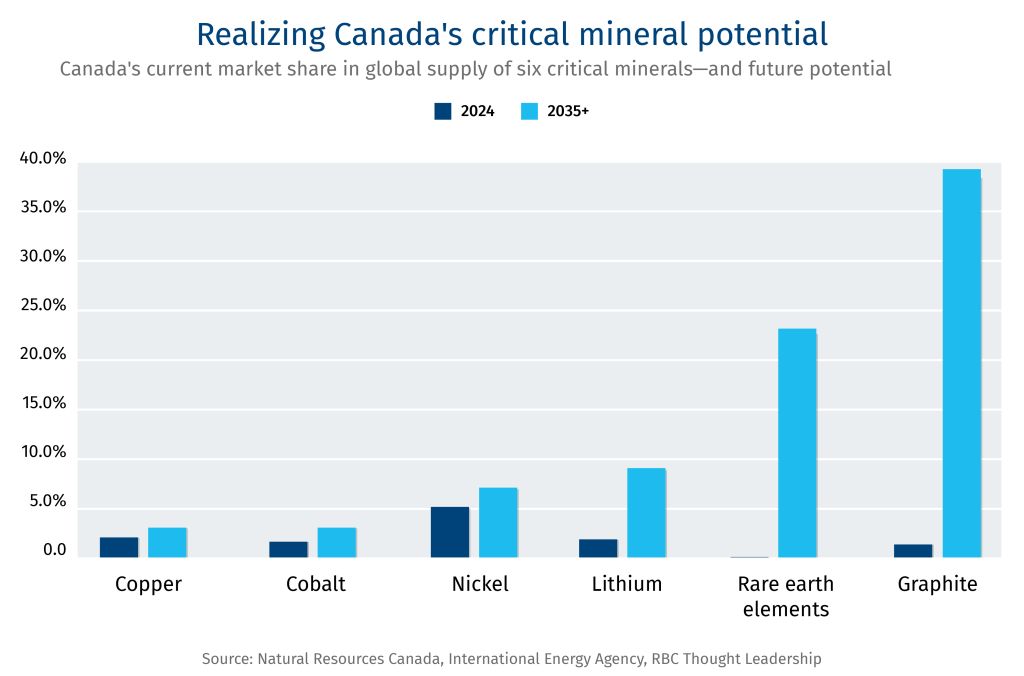
Canada could account for 14% of the global supply across the six key critical minerals by 2040. Current Canadian production of six core critical minerals, cobalt, nickel, lithium, copper, graphite and rare earth, is on average 2% of global supply. It could rise to 14%, on average, at full capacity if identified projects come on stream, the Canadian government estimates.

However, Canada lacks a strong base of well-capitalized domestic players. Only 19% of Canada’s publicly listed S&P/TSX Composite mining firms are diversified miners, compared to two-thirds of Australia’s S&P/ASX 300 mining index. To reach its goals, Canada will likely need to continue relying on international mining companies and foreign investors.

Two decades of capital allocation decisions have stunted critical minerals’ growth. Canada remains largely a “mine-and-ship” jurisdiction when it comes to critical minerals—with much of the value add and refining picked up by China and other players who have captured the refining segment, and further developed ancillary supply chains, such as electric vehicle, electronics and defence industries.

Despite trade tensions, there are still signs of U.S.-Canada capital alignment. Under President Donald Trump, the U.S. has invested an estimated US$135 million in direct equity stakes in Vancouver-based companies Trilogy Metals and Lithium Americas Corp., in addition to a US$2.3 billion bridge loan for Lithium Americas. It will be unlikely the U.S. can (or wishes to) completely phase out Canada from North America’s critical mineral ecosystem.

Canada faces a critical minerals capital crunch. The absence of patient, risk capital severely impedes the country’s ability to support both Canada and other Western nations in their efforts to move their critical mineral supply chains away from China.

Realizing Canada's critical minerals potential

That capital is needed for Canada to take advantage of the critical minerals industry that’s projected to grow between two to three times globally with a capital requirement of US$500-600 billion by 2040, according to an International Energy Agency forecast. Global demand for six core commodities—cobalt, copper, graphite, lithium, nickel and rare earth elements—will be driven by several growth sectors, including electric vehicles, clean energy infrastructure and space. As well as strategic sectors such as defence, manufacturing and electronics.

Canada holds world-class geology across all six metals but remains a relatively marginal player, accounting for roughly 2% of the global supply of the six metals. If identified projects proceed at full capacity, it could climb to 14% of total supply over the next 15 years, on average, according to Canadian government estimates. The development of vertical supply chains such as an expanded advanced manufacturing base, could have an exponential impact on Canadian supply to meet domestic and international demand.

Yet, Canada remains largely a “mine-and-ship” jurisdiction. Raw metals are shipped mostly to China where they are refined and transformed into high-value components. It’s the result of two decades of capital allocation decisions and the lack of a robust national strategy, but also China’s ability to depress metal prices to crush competitors.

There’s considerable global momentum to propel the Canadian critical minerals industry forward. The U.S. is leveraging its funding, market mechanisms and guarantees to build out a critical minerals market that excludes China. Meanwhile, Europe and several G20 allies are eager to diversify their critical minerals supply chain as they fear the Chinese industrial machine will crush their domestic economies and leave them ever more beholden to Beijing.

China’s recent export controls on key minerals—including rare earths, graphite, gallium, germanium—over the past year are a clarion call for Western countries to act.

Among its G7 allies, Canada is best equipped to take advantage: it’s home to high-grade lithium belts and graphite deposits in Quebec and Ontario, globally significant nickel resources in Manitoba, formidable copper reserves in British Columbia, and rare earth elements in pockets across Canada, including Newfoundland and Labrador. Few countries can claim this breadth across all six critical minerals at scale.

We have identified five structural pressure points that explain why Canada’s critical minerals sector remains undercapitalized, and why market forces alone will not correct the imbalance. Closing the gap requires a coordinated public-private agenda anchored in sovereign co-investment, infrastructure financing, miner-driven shared processing corridors and integration into Western supply chains.

1. The loss of national champions

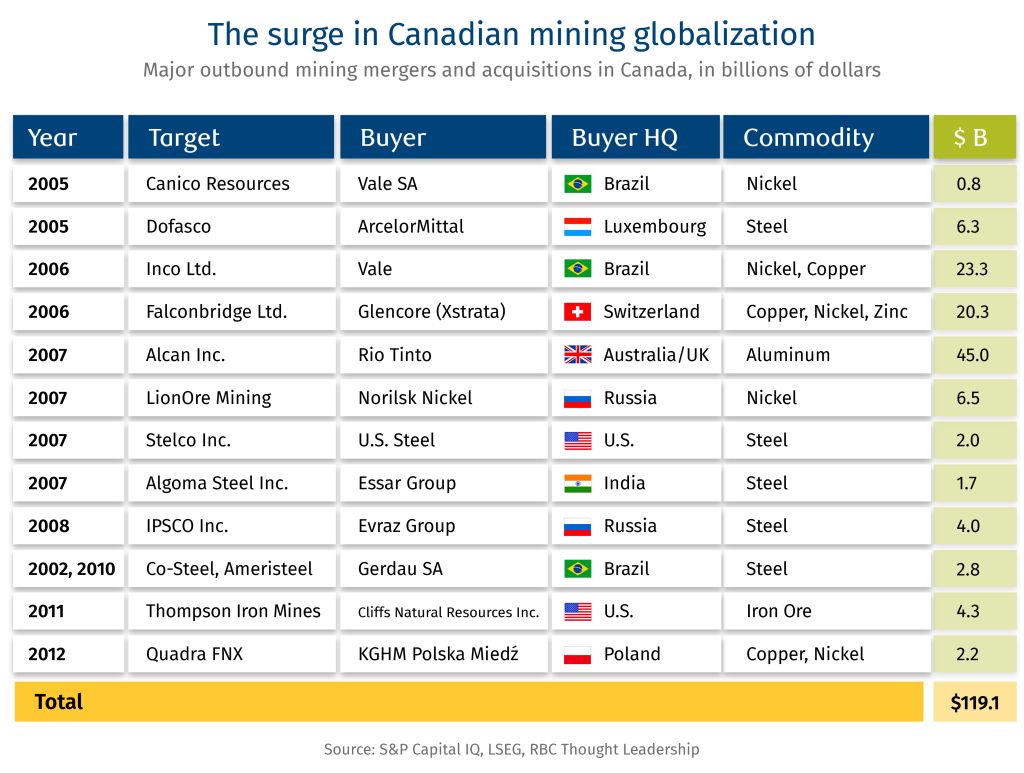
Between 2005 and 2012, more than $119 billion in Canadian base metals and steel assets transferred to foreign ownership.

The surge in Canadian mining globalization

The transactions were part of a wider globalization trend: foreign capital was expected to unlock value faster than our limited domestic capital markets, and nationality of ownership mattered less than the resulting economic uplift from mineral production and job creation. What that consensus underestimated was the long-term cost of losing domestic companies capable of anchoring new project developments—for a future era.

As Canada’s domestic giants were subsumed into global majors, the domestic capital-raising ecosystem was also disrupted. Boutique mining dealers shrank from around 60% of deal flow in 2010 to effectively 20% today, according to S&P Capital IQ. A similar trend is seen across capital holders as well, with resource-specialist funds now making up only 1-2% of domestic equity mutual fund assets under management today, compared to 6-8% in the early years following the global financial crisis, according to ISS MI MarketSage.

Many of the national champions that could have spearheaded Canada’s lithium, graphite and rare-earth projects largely no longer exist. Meanwhile, global majors allocate capital across their global portfolios that may not align with Canada’s strategic, sovereign objectives. This dynamic stands in marked contrast to the oilsands, which is the predominant operating asset controlled by large domestic players with large domestic ownership.

2. Capital consolidation around gold took the shine off other metals

Of the $700 billion raised in Canada in mining equity and mergers and acquisitions over the past 25 years, only 11% of capital was channelled to pure-play critical minerals development, according to S&P Capital IQ and LSEG. In contrast, Australia directed over twice as much capital to critical minerals during the same period. This was partly due to geology (Australia’s copper deposits are larger and less associated with gold), and partly to a closer proximity to Chinese and East Asian smelters.

The higher gold concentration in Canada reflects a historical M&A wave, with the S&P/TSX Composite mining complex becoming increasingly dominated by a smaller pool of large gold producers. In essence, Canada’s public mining equities evolved into a precious metals financing platform—a result of structural choices made over two decades across Canada’s critical minerals companies.

It doesn’t have to be a zero-sum game between gold and critical minerals—there is room to grow both mining sectors and even create ecosystems that feed off each other.

However, in Canada excellence in gold did not necessarily extend to critical minerals for two reasons:

  • The composition of Canada’s gold endowment made it efficient at producing the yellow metal, but relatively less so for other associated minerals like copper, nickel, cobalt as by-products. Australia’s mix of iron oxide-copper-gold deposits provide a more diverse commodity portfolio.

  • Gold mining skills and infrastructure do not inherently transfer to critical minerals. Gold smelting and refining are mature and standardized, whereas critical minerals processing, which is oriented towards specific end-uses (especially on battery metals) that require complex hydrometallurgy and chemical conversion..

3. Junior miners continue to face a financing cliff

Canada’s flow-through share financings—a tax incentive that allows investors to deduct 100% of their investment against their taxable income—works exceptionally well for early-stage exploration. It aggregates retail capital, reduces the effective cost of capital, and has successfully supported mineral exploration.

However, once a company completes the first assessment hurdle, these tax incentives expire (until construction begins). What follows is a $20-30 million financing gap: feasibility studies, engineering, permitting, and technical validation are required for ultimate final investment decision. These costs are often too large for high net-worth investors and too risky for institutional investors and lenders. Delays in permitting compound this challenge, as the companies remain pre-revenue with a stretched balance sheet.

For niche commodities such as graphite, rare earths and lithium, the problem is worsened by lack of market diversity. China often remains the sole buyer of mineral concentrates. Chinese lithium converters buy spodumene ore and process it into battery-grade lithium, while rare earth concentrates must be converted into a Mixed Rate Earth Carbonate—a processing step Canada largely lacks.

Few institutional investors have historically backed a Canadian junior whose only offtake market is a Chinese refiner, leading to a structural financing gap that has stalled viable projects for years.

4. Refining and processing face a structural deficit

Over the past three decades, Western countries effectively outsourced lower-margin, energy-intensive refining to China. Backed by state-backed capital, lax environmental regulations and lower labor costs, China now controls 70% of global refining market share for 19 of the world’s 20 most critical minerals.

China also builds overcapacity to squeeze competitors. Global copper smelting utilization was only 70% last year, and has played a role in Canada closing the Flin Flon, Gaspe and Kidd Creek copper smelters over the years. Today, only one Canadian copper smelter/refinery remains active: Glencore’s Horne smelter in in Rouyn-Noranda, Que., and its associated Canadian Copper Refinery.

Competing head-to-head in pure-play downstream processing against subsidized overcapacity is economically difficult. However, Canada’s advantage lies in pairing upstream mineral exposure—where margins are structurally higher—with selective downstream integration in “mineral corridors” that offer durable cost advantages, such as low-cost, zero-emitting hydro power in Quebec.

5. Limited domestic demand has constrained value chain growth

Refining investment follows demand—a capital-intensive smelter is hard to build in Canada where local demand is limited. Battery cell manufacturing is nascent and defence procurement operates at a fraction of U.S. scale. Magnet manufacturing, rare earth processing, and cathode precursor production are largely absent. The result is that shipping concentrates are shipped to where the customers are: primarily China.

The paradox is that Canada committed up to $55 billion to attract electric vehicle and battery manufacturers over the next 15 years without attaching domestic sourcing conditions that peer jurisdictions demanded. Germany and France implemented strict, minimum E.U. content and local supply-chain requirements into their electric vehicle subsidy schemes. South Korea similarly tied support to the use of Korean-source battery materials and components. The absence of such commitments in Canada, means the subsidies have not yet catalyzed ancillary industries.

1. Scale sovereign capital across the full value chain

Ottawa’s $2-billion Critical Minerals Sovereign Wealth Fund requires more heft to match the significant capital requirements. The Korea Zinc joint venture, for example, is developing a refinery in Tennessee for US$7.4 billion alone, demonstrating the substantial capital-intensity of downstream investments. A full build-out of mining, refining and processing critical minerals require an order of magnitude of patient capital that’s willing to persevere over years of construction and commercial validation.

The Canada Growth Fund (CGF) has made three mineral investments to address the gap. Its recent co-investment in Thompson Nickel Mines in Manitoba alongside U.S.-based Orion Resource Partners LP and Brazil’s Vale SA anchored the project, attracting credible corporate capital, and signalling strong sovereign commitment. This follows investments by the CGF in Quebec’s Nouveau Monde Graphite facility and the Foran Mining Corp. copper-zinc project in Saskatchewan.

Internationally, the Brazilian Development Bank also offers a template: a US$1-billion blended fund structured with government and private capital (including national mining champion Vale), managed at arm’s length and deployed across extraction, refining and processing. The structure, backed by government funding, instills commercial discipline, and makes strategic projects financeable.

2. Deploy infrastructure capital to unlock regions

Co-investing in enabling infrastructure—such as roads, transmission, grid connections to remote mining regions—reduces a project’s required break-even price by around 22-24%, the single largest lever of any individual policy measure, according to a recent Canada Infrastructure Bank (CIB) analysis.

The build-out of accompanying infrastructure is ideal for pension funds and long-duration institutional investors who are best suited to participate: lower risk than equity in a junior miner, contractual cash flows, and infrastructure-style returns. Ontario’s metal-rich Ring of Fire region alone requires as much as $2.4 billion in road and transmission investment before a single mine becomes commercially viable. For pension funds, it’s an opportunity to finance infrastructure, provided there’s surety of the facility being built, and the new infrastructure can be put to multiple uses and even serve as a springboard for new developments.

Investment in remote communities, many of which are on First Nations territories, presents another opportunity. However, unlike Alberta and British Columbia where oil and gas commercial precedents are well-established between First Nations communities and corporations, these mining jurisdictions require nurturing local governance and technical readiness to ensure long-term commercial success.

3. Build mineral corridors around Canada’s best clusters

Shared processing infrastructure solves multiple problems simultaneously. For instance, Quebec’s six high-grade, high-tonnage lithium projects can complement a regional refining hub. A similar logic applies to the lithium belt running from Thunder Bay to Winnipeg, and to the Sudbury nickel cluster, which already boasts world-class refining infrastructure that could expand to serve new critical minerals projects across Northern Ontario.

Such centralized refiners would give junior and mid-sized miners credible non-Chinese buyers, reinforcing their business and investment case. Corridor economics could also have a cascading economic effect, extending to logistic, transport, commercial and residential housing, and other amenities.

A shared Central Lithium Refinery—potentially structured with government loan guarantees and anchor offtake agreements with battery producers in Europe, Korea, Japan, and emerging Canadian manufacturers.

This offtake, in turn, makes projects financeable on Canadian equity markets and eventually eligible for project financing. The infrastructure economics improve further if the Plan Nord railway extension in Quebec proceeds—an initiative championed by the Cree Development Corporation that would materially reduce both the environmental footprint and capital costs of the Quebec lithium cluster.

4. Draw in global majors to improve project economics

The Canada Growth Fund is well-positioned to co-invest alongside global majors, provide offtake agreements that de-risk revenues, and leverage investment tax credits (ITC) to improve project economics. CGF’s partnership with Strathcona Resources Ltd., to build a $2-billion carbon capture and sequestration facility is a case in point: the government underwrote half the capital and allowed full ITC value to flow to private investors. Revenue de-risking tools, such as offtake agreements and contracts for difference, could reduce a project’s required break-even by approximately 18-19%, CIB analysis shows. The combination of infrastructure investment, revenue de-risking, and co-equity could move Canadian projects to the top of a global major’s priority list.

5. Forge closer ties with U.S. supply chains—but diversify

Few governments are doing more to reshape the global minerals order than the United States. The U.S. Office of Strategic Capital is authorized to deploy US$100-200 billion to bolster defence and industrial supply chains—roughly 15-20 times Canada’s federal funding. Washington’s Project Vault, a US$12-billion critical minerals stockpile, is already operational and striking deals with other countries.

Developing closer ties with U.S. supply chains is Canada’s greatest structural advantage other jurisdictions would struggle to replicate. Strategic deals under the Project Vault umbrella, would ensure Canadian minerals flow into U.S. rules of origin for batteries and EVs. Guaranteed offtake commitments would also give Canada both the demand signal and the financing certainty that mine-refine-process economics require.

The strategy is not without risk as deeper supply-chain alignment with Washington could mean Canadian minerals face U.S. export licencing and defence procurement priorities that serve American industrial policy first.

To avoid diminishing its resource sovereignty, Canada should pursue a strong diversification strategy targeting European and Asian allies, building on its 26 new investments and partnerships with G7 allies that unlocked $6.4 billion of critical minerals projects.

Australia and Canada share comparable geological endowments and mining traditions, but the similarities end there. Australia has consistently outpaced Canada in diversifying its resource wealth, employing a robust strategy focused on mobilizing capital, project permitting, and underwriting infrastructure—ultimately shaping investor behaviour.

Here’s how the Australian and Canadian playbooks have deviated:

1. Anchor investors lead the way

Australia’s pension funds maintain a standing allocation to resources, supported by specialist mining investors who understand the risk profile at every stage of development. Canadian pension funds don’t have the same obligation, while its overall investor base has rotated away from resources over the past 15 years towards tech, healthcare, and global equities. This has left mining capital in Canada episodic, cycle-dependent, and increasingly risk-averse at critical stages of development. The result is a more fragile domestic funding environment for Canadian miners, a trend partly driven by the historically lower total return performance of Canadian miners relative to their Australian peers.

2. Mechanisms to manage financing troughs

While both countries successfully fund early-stage exploration, Canada’s path diverges sharply after that. Flow-through financing—which provides tax incentives at the earliest stages—is effective but limited to exploration. This leaves feasibility, construction, and first production with few funding and incentive levers. This creates a structural incentive to sell assets early rather than build and operate them. Australia’s deeper capital pool through pension funds and specialist resource investors has fostered mid-tier producers that Canada largely lacks.

3. Permitting certainty as a capital advantage

Australia’s approval frameworks include statutory timelines to prevent processes from stalling indefinitely. Canada’s multi-layered federal and provincial reviews, combined with open-ended consultation processes, can stretch five years or more with no defined endpoint. Because permitting risks directly impact project economics, these delays serve as a significant deterrent to capital.

4. The virtuous cycle of base metal wealth—and expertise

Australia’s commodity diversity is anchored in bulk and base metals—iron ore, metallurgical coal, copper, bauxite and alumina—in greater propensity than Canada and its precious metals. That mix supported the growth of BHP Group, Rio Tinto Ltd and Fortescue Ltd., which are now backing other critical minerals including the energy-transition metals like lithium and rare earths. While Canada’s geology is diverse, public markets, historical mergers and acquisitions (M&A) and resulting producer base tilted towards gold companies.

5. Market access and Asian ties facilitated demand

The rise of Asian steel manufacturing, especially China but also Japan and Korea, drove long-term contracts for Australian iron ore and metallurgical coal and anchored the rise of the Australian mining majors. These deep commercial ties now extend to copper, alumina and other emerging battery materials. Canada, by contrast, built commercial ties with North America and Europe, and became cost uncompetitive from a supply standpoint given the lower operating costs of Asian refiners but also missed out on the nexus of demand from Asian battery value chains.

Download the report

Language Flag Filename

rbc_language_toggle_menu_flag

Janice Charette has at least two sets of marching orders: the one she received directly this week from Mark Carney, and the one she will receive indirectly next week from Donald Trump.

Trump’s unsurprising loss of the Supreme Court case on tariffs will only deepen the difference.

First to Carney:

  • The PM has an impressive depth of respect for his new chief trade negotiator, going back to their days in London but critically to her time last year overseeing his transition team.

  • As the country is learning, Carney works with concentric circles of trust and confidence. She’s one of a handful of people in the inner circle.

  • The PM is also known to value her deep knowledge of the Canadian government and businesses. She knows where to go for answers to the many questions and challenges the U.S. will throw at her.

  • Her first challenge will be to develop the framework for a marathon of trade talks. 

  • That includes structuring technical conversations with a counterpart that’s neither interested nor prepared right now.

  • And it means building up a team for the fight. In Trump 1, the Trudeau team set up a war room that built a network of influencers, including in industry and state governments. Something similar is needed now, but perhaps more of a data room—an operation that can gather and disseminate current information on the impact of tariffs in both countries. 

  • Her next challenge will be to align with the PM on the potential gives and red lines that any negotiator needs in their pocket.

  • One non-negotiable along the way: ensure the CUSMA exemption is maintained.

Now to Trump:

  • The President, who is also on a war footing with Iran, will spend the weekend also ramping up his next trade battle.

  • Many are expecting more Section 301 tariffs to replace the emergency powers tariffs that the Supreme Court struck down. Expect more non-tariff measures, too, and more threats

  • His key messaging may come in his State of the Union address Tuesday night, which is supposed to speak to affordability but will likely toggle between geopolitical conflicts and tariffs. 

  • The setting, on Capitol Hill, won’t be lost on a President who will cajole Congress to support him on both war fronts.

  • Trump’s lead negotiator, Jamieson Greer, has told people privately he’s preparing for negotiations with both Canada and Mexico to run beyond the November midterms. 

  • That flies in the face of many expectations for a replay of 2018, when the administration worked rapidly through the summer to complete what the President could present in the fall campaign as a BDE (best deal ever).

  • If that happens, a Democrat-led House would likely make any comprehensive deal with either country an improbability. Not only will the Dems want a different deal than Trump, Congress will be consumed—almost Watergate-like—with the Epstein files. 

Charette has faced plenty of such challenges in her career, and is widely known for grace under fire.

Press play on the next big test.

– John Stackhouse

A tariff backdoor just closed

  • The U.S. Supreme Court has effectively removed the International Emergency Economics Power Act (IEEPA) as a usable, fast-tariff instrument for any president: the ruling says IEEPA’s authority to regulate importation does not include the authority to impose tariffs absent explicit Congressional authorization.

  • That matters because IEEPA was the administration’s most flexible mechanism: it enabled broad, rapidly adjustable, country-wide duties (including “reciprocal” tariffs and fentanyl-related tariffs) that could be turned up or down quickly as negotiating pressure.

  • A large share of tariff collections tied to IEEPA is now legally exposed (and at minimum, frozen as a durable policy tool).

  • For Canada, the ruling does not touch the most biting tariffs: sectoral/national security tools (notably Section 232) remain the active battlefield for steel, aluminum, autos and other targeted categories.

  • RBC Economics hammers home that point in ‘Preserving CUSMA exemptions: Canada’s real priority amid U.S. IEEPA ruling.’“By our count, 89% of Canadian exports to the U.S. in December were not charged with tariffs because they’re compliant with rules of origin requirements in CUSMA. That leaves IEEPA measures only effective on less than 5% of exports to the U.S. In December (with the remainder accounted for by Section 232 tariffs), Canada faced an average effective U.S. tariff of 3.1%—the lowest of all major U.S. trade partners.


Canada: less blanket risk, key sectors remain exposed

  • The ruling weakens Washington’s negotiating power by removing the credibility of instantaneous escalation. Future tariffs must pass through investigations, evidentiary standards, and consultation.

  • Industries exposed to higher input costs, retailers sensitive to consumer prices, vulnerable agricultural exporters, and opposed politicians will have more opportunity to intervene before tariffs take effect.

  • The economic pain of 232 tariffs remains but the credibility of economy-wide escalation declines, improving predictability—a meaningful advantage for negotiations and investment decisions tied to North American supply chains.

  • Integration becomes a stronger argument. When tariffs require justification through formal investigations, deeply embedded cross-border supply chains become evidence against disruption.

Expect tariffs to persist, but with more politics attached

  • The administration will try to rebuild tariff leverage using other statutes, but those tools require more process, justification and time.

  • Canada can treat this as an opening to shape the record, not as an off-ramp from tariff risk. If the battlefield shifts toward investigations and consultations, Canada will need to make the case that tariffs are self-defeating for the U.S.

Coalition-building becomes more decisive

  • The most effective counterweight to new tariffs will often be U.S. stakeholders with skin in the game: downstream manufacturers, retailers, farmers, state governments, and industry associations that can credibly argue costs, shortages, and lost competitiveness.

  • Canada’s best outcomes will come from identifying where U.S. dependence is highest (inputs, components, energy-intensive processing, regional supply chains) and turning those into politically legible arguments.

What we’ll be watching closely going forward

1. Which alternative tools the Trump administration prioritizes, and whether it doubles down on using Section 232 tariffs.

2. Whether the White House seeks negotiated “wins” that substitute for tariffs: procurement commitments, investment announcements, or sectoral carve-outs.

3. How quickly and effectively U.S. industry groups and state actors coalesce around this momentum swing to further curtail White House trade power.

4. The legal and fiscal ramifications. The court did not decide whether revenues collected under IEEPA must be returned, leaving potentially US$175 billion subject to litigation. Pressure to issue large-scale repayments will be vehemently opposed but will reinforce opposition, potentially induce fiscal pressure, and complicate any attempts to rebuild a similar tariff regime.

— Thomas Ashcroft

Language Flag Filename

rbc_language_toggle_menu_flag

Also in this edition: What the future could hold for Canada’s auto industry

Agreements from Washington’s inaugural Critical Minerals Ministerial are still being digested, which saw bilateral frameworks with over a dozen trade partners and the unveiling of Project Vault.

Notably, Canada wasn’t among the signatories. So as America rewires the global minerals order, does Canada stand to gain or be left behind?

Why It Matters

Project Vault is America’s attempt to build a Strategic Petroleum Reserve for critical minerals. The problem: the SPR analogy breaks down in a way that matters enormously for Canada.

The original SPR worked because the U.S. had vast domestic refining capacity—stored crude to be converted into refined fuels along the Gulf Coast. Today, North America has almost none of the processing infrastructure needed to convert raw critical minerals into the refined compounds that defense, semiconductors, and EVs ultimately require.

So Project Vault faces a fundamental paradox: stockpile raw ore with no capacity to process it; stockpile refined material almost certainly bought from China—the very dependency the U.S. is trying to hedge.

By the Numbers

  • US$15 billion—EXIM Bank financing already mobilized across allied minerals projects globally, before Project Vault

  • US$12 billion—Project Vault financing (US$10 billion from the U.S. Export-Import Bank and US$2 billion in private capital)

  • 60-day supply target buffer for strategic minerals

  • 15 bilateral frameworks signed this week alone—including the EU, Japan, UAE.

  • China’s refining grip98% gallium, 91% rare earth magnets, 96% battery-grade graphite, 79% cobalt

  • Canada’s position—71% of U.S. unwrought aluminum imports; Quebec’s Vaudreuil refinery is one of only two alumina refineries left in North America.

  • Project Vault covers all 60 critical minerals on the USGS list, many of which are core economic exports for Canada

The Bigger Picture

The U.S. isn’t building a multilateral framework—the word chosen deliberately at the ministerial was plurilateral. A smaller, aligned coalition setting its own rules, coordinating price floors, and directing investment collectively. Through EXIM and Project Vault, this architecture is being built in real-time.

Energy-intensive refining and smelting, the very processes needed to turn minerals reserve into usable industrial inputs, on paper at least, is a good set up for Canada. Our clean and cost competitive power (hydro, nuclear) complements existing mineral deposits, which, with integrated rail networks, allow for better full-cycle economics than stand-alone processing and refining operations.

Bottom Line

Canada’s critical minerals endowment is arguably its most important bilateral tool heading into the CUSMA renegotiation. Its broader integration into U.S. supply chains—across aluminum, copper, nickel, zinc and manganese— limits being phased-out to a large extent. If Canada can secure explicit recognition of Canadian content in U.S. value chains, via CUSMA assisted by Project Vault’s predictive offtake and access to U.S. capital, it is a clear win.

That said, our minerals chip depreciates with each passing day. Every bilateral framework Washington signs with another partner narrows Canada’s relative leverage, especially if CUSMA negotiations extend into 2027. And at a time when investment decisions at times are less about economics and more a price of admission to the U.S. market (read: Korea Zinc JV).

Threading that needle will be the challenge.

– Shaz Merwat

RBC economist Farhad Pananov was at The Globe and Mail’s Future of Automotive event this week. Here’s some of what he heard:

  • Strategic investments in the auto sector have fallen off compared to just to a few years ago when manufacturers were setting long-term pivots.

  • While panelists heaped plenty of praise on Canada’s highly skilled and educated labour force and diversified local economies, it was clear what the country’s greatest advantage is access to the second largest auto market in the world. For now, at least.

  • The Canada-China EV deal, which will facilitate the import of 49,000 Chinese EVs a year at low tariff rates, was met with skepticism in the room: Which brands will come to Canada? Will Canadians actually buy them?

The answer to that last question could all come down to the price…

U.S. lawmakers rebuke Trump’s Canada tariffs 

  • The U.S. House of Representatives voted to rescind tariffs on Canadian goods, the same week President Trump threatened to block the opening of the Gordie Howe International Bridge because of trade disputes. 

  • While the President will likely veto the motion, Wednesday’s vote was backed by six Republicans, indicating growing discontent with Trump’s trade policies and threats. 

U.S. agriculture industry lobbies for CUSMA continuation

  • Over 40 U.S. agricultural groups have formed a coalition to support the Canada-U.S.-Mexico trade agreement, emphasizing the economic benefits it brings to rural communities and American farmlands.

  • The advocacy campaign is targeting members of Congress, the White House, and the President, with economic analysis that shows Canada and Mexico account for approximately one-third of the value of U.S. agricultural exports. 

U.K. government signals closer alignment with Europe

  • Chancellor Rachel Reeves announced the U.K. is prepared to unilaterally align with the EU’s single market rules in sectors like financial services to reduce trade barriers, describing closer integration with the EU as the “biggest prize” for U.K. growth, pivoting away from prioritizing non-European trade deals.

  • The Labour government has been reticent to reopen Brexit as a political issue but are beginning to look more fondly at closer integration with the EU as they search for ways to boost economic growth. 

— Thomas Ashcroft

Language Flag Filename

rbc_language_toggle_menu_flag

Canada’s agri-food startups present a $13-billion investment opportunity. Capital flows in growing agri-food companies could help Ottawa achieve its target of unlocking $1 trillion in investment by 2030 to power economic growth.

The country’s agri-food sector is currently undercapitalized by domestic growth funds. The sector accounts for only 2% of government-backed growth, venture and infrastructure funds at the federal level, and brought in an estimated 4% of total growth funds invested in Canada over the past 5 years.

It’s not that there isn’t interest. Venture and institutional funds have attempted to flow but fragmented governance across provinces and sector fit for funds have pushed agri-food to the sidelines of mainstream approaches to deploying growth capital.

Domestic agri-food companies got a piece of the growth capital boom–$10.5 billion–between 2015 and 2021. However, investments across sectors have dwindled. Today, growth investment in Canadian agri-food is lower than it was a decade ago, with values down 32% and deals by 29%.

The basic mechanics of growth for an agri-food company can cut the sector out of fund priorities. To align investment with Canada’s growth and sovereignty ambitions, funds like the $1B Venture and Growth Capital Initiative announced in the 2025 federal budget could establish agri-food lanes with tailored tools.

Other nations–including Finland, Japan, and the United Arab Emirates–are explicitly linking food security, productivity, and industrial policy through coordinated growth capital strategies. To achieve food security goals, the UAE launched the Agri-Food Growth and Water Abundance (AGWA) cluster with the ambition to attract $48 billion by 2045 specifically for their agriculture, food and water sectors.

The opportunity for Canadian investors and innovators–public and private–is to better calibrate and scale capital and businesses to anchor economic value domestically. This starts at the idea stage, improving universities’ weakening role in innovation and reverse trends in business outsourced investments to universities for agri-food R&D, which have fallen 64% in the past five years.

Canada has one of the world’s most productive agricultural systems, globally competitive farmers, and is a net exporter of value-added agriculture and food products. Yet, the country is steadily losing its position as a preferred place to start, scale, and retain agri-fooda startups. That’s because the pipeline for investment and innovation has structural gaps and barriers, from seed to maturity.

Canada is in building mode. Its ambition to attract $1 trillionb in investment over the next five years to drive growth for the country is a signal.1 A key piece of mobilizing this investment is to put Canada’s existing infrastructure, growth, and venture funds to work for potential high-growth sectors, such as agri-food industries. Most notably, the 2025 federal budget identified agri-food as one of three sectors that Canada enjoys a strategic global advantage. But Canadian agri-food accounts for less than 2% of growth-oriented government-backed funds. And over the past five years, agri-food companies have only captured 4% of total growth capitalc investment in Canada, which agri-food investors characterize as a stark under-investment in the sector.

If Canada were to align its growth capital investment in agri-food with the industry’s contribution to GDP as a benchmark to build from, it would require an estimated $13 billion from now until 2030–a 36% boost in investment relative to the past five years. An investment ambition to focus action and position Canada as a thriving, global hub of agri-food innovation and products.

Global disruptions over the past five years highlight the need to advance Canada’s sovereign capacity in agriculture and food innovation, production and processing. And the rest of the world is not waiting for Canada to perfect its approach. Without immediate action, Canada risks capping agri-food sector’s growth potential by not hosting more value-add processing domestically. It risks hollowing out the agri-food innovation ecosystem as companies and talent look to other countries, including Australia, Japan and Germany, which are growing their investment in R&D and commercialization.2 And it risks irrelevance in the era of disruptive technologies—including AI-driven decision tools, gene editing, biological inputs, automation, robotics, and novel food processing—that will shape productivity gains in the decades ahead.

There is a mismatch between the framing of Canada’s agri-food sector as a superpower and its strategic advantages with the actual scale and focus of investments domestically. Transforming Canada into an agri-food superpower requires a targeted, nimble approach to capital and growth that navigates the sector’s restraints and fulfills its true potential.

Canada-based companies attarct 3% of growth capital in agri-food sector
  • Purpose of capital: Idea development, early prototyping, market research

  • Investors: Angel investors, incubators/accelerators, university and government grants, venture seed funds, family offices

  • Strengths: Government and regionalized support via early-stage innovation programs

  • Challenge: Breakdown between public and private collaboration on commercialization of intellectual property (IP)

  • Purpose of capital: Pilots, prototyping, market testing, and small-scale production

  • Investors: Accelerators, venture firms, corporate venture, government grants, family offices, Crown corporations

  • Strengths: Growing network of venture funds

  • Challenges: Navigating investment pathways and undercapitalization risks that could force bridging rounds, slow development, and dilute equity

  • Purpose of capital: Continued innovation, market leadership emerging, scaling operations

  • Investors:  Venture firms, private equity, corporate strategic investment, Crown corporations

  • Strengths: Access to international market for capital, especially U.S. and EU

  • Challenges: Gap in follow-on fund, especially Series B to growth and fragmented domestic capital-raising options

  • Purpose of capital: Stable cash flows, slower growth, operational efficiency and expansion, exit

  • Investors: Commercial banks, private equity, merger and acquisition, trade sale, initial public offering

  • Strengths: Strong commercial bank support, however, project financing can be difficult to secure

  • Challenges: Few large domestic corporate acquirers; often requires sale to foreign buyers; Companies with infrastructure projects face structural challenges in assembling capital mixes

Not enough companies make it to growth; and not enough capital is available for the select few that do.

The scale, staging, and value of growth capital invested in growing companies are indicators of a sector’s momentum and growth prospects. In Canada, upstream and midstream marketsd  that cover agriculture inputs to food processing is generally well covered for early-stage capital by government grants, family offices, and venture firms. While end-stream markets like food brands have less access to early stage-funds, with fewer active venture firms in the market. Agri-food companies across market segments start to face Canada’s growth capital challenge of fragmented and shallow domestic funds when seeking to raise $15 million in capital or more. And across economic sectors, there is a significant gap in capital for growth, with domestic venture firms not positioned to inject more than $30 million. This constrains scaling and reduces Canada’s ability to attract and retain high-potential agri-food companies. The situation is exacerbated as agri-food in Canada is too complex for general investors to navigate without industry expertise. The capital pools, for example, engaging with an agriculture-tech company are often completely different from those engaged with a food brand company as their growth metrics, markets, and use of capital differ substantially (e.g., IP vs. a distribution warehouse).

The growth capital market has had a volatile decade. The world experienced a surge in growth capital across sectors, including agri-food, in the lead up to the peak in 2021. Between 2015 and 2021, growth capital in Canadian agri-food in the early and venture stages grew by 1,405% and 480%, respectively.3 This growth was driven by a few factors, and actors:

  • Global interest in agri-food technology and sustainable agriculture surged with the growing urgency to feed more people with fewer environmental impacts. As a result, global investment in agri-food technology rose to $71 billion in 2021.4

  • In response, Canada launched incubators (YSpace Food Incubator), accelerators (SVG Thrive) and applied food science centres (Saskatchewan Food Industry Development Centre) to enable commercialization of agri-food innovation.

  • Agriculture and food focused venture funds also grew in Canada, including District Ventures Capital, Ag Capital Canada, Emmertech, Tall Grass Ventures, and Nya Ventures.

  • And some crown corporations helped drive momentum in the sector through initiatives like Farm Credit Canada’s (FCC) $2 billion commitment by 2030 to advance innovation in the domestic agriculture and food industry.

Growth stage capital acocunts for 12% of investments over the past decade

Since 2021, most segments of growth capital availability and investments have dwindled. Investment in Canadian agri-food companies is now lower than it was a decade ago, with values down 32% and deal count by 29%.5 This contraction mirrors trends in other major agri-food economies—including the U.S., Brazil, and Australia—where funding focused on agri-food technologies dropped to a 10-year low.6

While there have been some positive signs in the past five years, such as rising private equity and a shift to focusing on impactful and mature companies, fundamental challenges in retaining and attracting capital remain. The most obvious challenge is the growth-stage. The value of available capital in Canada in growth stages falls roughly 37% compared to the venture stage where the startups are more supported by venture firms and incubators.7

Canada's agri-food companies face a deep valley at growth stage

However, focusing on fixing this problem in isolation, can result in new problems arising along the pipeline. For example, the agri-food venture funds that emerged over the past decade in Canada now seek to raise new, larger funds to address gaps at the growth capital stage, and this shift could risk creating a new gap in early venture—rounds of between $1 million and $5 million. Enabling capital availability at each stage of growth and across market segments therefore requires coordination among investors to build coverage along the pipeline.

The absence of a Canadian agri-food unicorn—defined as a privately held startup valued at more than $1 billion—is a macro signal that Canada does not have an ecosystem that can propel promising companies.8 Peers like the Netherlands, Germany, and Australia all have unicorns—and heavy hitters like the U.S., India, and China have a stable-full.

Top agri-food unicorn producing countries

Capital structures push companies down and out of Canada.

Canada’s agri-food startups often advance slower through their commercialization and market expansion stages relative to those in competing markets because capital pools are shallower. Less capital leads to incremental growth and longer time horizons to demonstrate returns. While early-stage companies can attract public and venture funding, those seeking larger rounds are often forced to seek capital abroad.

Canada's peers pull ahead in growth stage investments

Vive, a crop protection company based in Mississauga, Ontario, is looking to raise Series D capital, seeking more than $40 million, starting in Q1 of 2026. Vive expects that more than 75% of the capital raised in this round will come from outside Canada. This builds on Vive’s initial market expansion, which occurred in the U.S. because the active ingredient approval for their products took four years compared to the eight years it took in Canada.

Fueling early agri-food innovations but avoiding support for those same innovations at growth stages.

Support from government at the early stages of growth comes largely from incubators, accelerators, cost-share and R&D programs, which are important pieces of Canada’s agri-food innovation pipeline. Yet, this concentration and program delivery often results in Canada’s emerging leaders in agri-food being described as “grant-entrepreneurs” who are forced to spend excessive time on finding and writing applications and meeting reporting requirements instead of building investor-ready businesses. Of course, government checks and balances are vital in public funding, but accessing and reporting on these funds can be made more efficient.

Another challenge with government capital is that economy-wide pools of funds like the Canada Growth Fund do not intentionally restrict agri-food, but the sector often does not fit neatly within investment criteria for several reasons, including project scales, geographical dispersion of production and projects, and the definitions of innovation or clean technology. As a result:

  • Canada Growth Fund’s 17+ investments do not feature a single agri-food company.

  • Of Canada Infrastructure Bank’s 106 investments, only one is focused on agriculture production.

  • The agri-food sector makes up an estimated 3% of the 575 companies invested in through the Venture Capital Catalyst Initiative (VCCI) and Venture Capital Action Plan.

Capital from asset-tied farmers to blocked out institutional investors is an untapped resource for Canada’s agri-food sector.

Institutional investors in Canada, like pensionfunds and private equity firms, want to be engaged in Canadian agri-food but face a trifecta of investment barriers:

  • Limited number of sizeable projects

  • Co-investors, both private and public, to share risk

  • Investment-limiting regulations

Canada’s model for capital attraction in primary agriculture illustrates some of these barriers. Canada is optimized for family ownership with differing provincial regulations on ownership restrictions including foreign investment and supply management for some sub-sectors. This is in sharp contrast to Australia, for example, which treats agriculture as an investable export industry via large, aggregated farms with professional farm management companies. Investors can inject hundreds of millions into single companies, who then have more liquidity to make investments in new companies and innovations that can boost their productivity.

Institutional investors looking to make significant investments with proven returns might see Canada’s fragmented model difficult to navigate. As a result, some of Canada’s largest pension funds invest in agriculture outside of Canada. Public Service Pension Investment’s natural resource portfolio is made up of roughly 77% agri-food investments, with Canada accounting for 9.3%. The largest share, 43.3%, goes to Oceania countries, predominately Australia.

Farmers also have an important role in the agri-food innovation and capital pipeline as new products and services in the upstream market segment can directly impact their growth and productivity. But Canadian farmers are limited since capital is often tied up in operational costs and assets, like land, buildings and equipment. This reduces both demand signals for novel technologies and co-investment opportunities in impactful projects relative to countries that can attract large-scale investments at the farm-level and have available capital for expenditures beyond operations and assets.

Risk aversion dampens investor appetite, entrepreneurship, and innovation.

Unlike the U.S., where a “fail fast, iterate, scale” culture fuels deal activity and risk appetite, Canadian investors are generally more risk-averse, particularly beyond seed stage, which discourages bold bets. This shows up in the number of new Canadian companies seeking funding rounds.

Agri-food companies established in select top countries

Traditional investor preferences toward, for example, information technology over agri-food innovation —often perceived as lower-growth and lower-return—limit participation by generalist venture firms and institutional investors. This reinforces narrow capital pools for late-stage agri-food deals.

The onus to build clear and consistent approaches to access support and capital should not lie solely with investors. If startups can get customers, capital often follows. This stresses the need for improving the applicability of new innovations to real-world problems and the adoption of these innovations alongside investment, starting with Canadian farmers, corporates and retailers but also foreign customers for Canadian companies to truly scale.

Proven demand would enable startups to forge capital paths through their growth stages and work with investors to build the right capital stacks. Three Farmers, a Saskatchewan-based snack food company, scaled production in the Prairies and sells its seasoned pulses in more than 4,000 retailers across Canada and the U.S. Attracting growth capital has been a key component of the company’s success. That includes a 2022 raise of $6.2 million led by three pivotal investors: Venture capital firm District Ventures Capital who has deep consumer packaged goods expertise, Export Development Canada how helps companies effectively grow in foreign markets like the U.S., and Protein Industries Canada who can offer access to innovation and supply chain networks.9 In 2025, a new strategic partnership with Farm Credit Canada (FCC) added equity but also the smart capital that growing companies need in the form of mentorship to help navigate regulations and optimal approaches to capital mixes. Such examples offer a gameplan on engaging and connecting with the right type of investors—at the right time.

Building supply chains requires capitalemerging agri-food companies struggle to source it domestically.

Building out agri-food supply chains and commercializing products often requires infrastructure development for production and processing facilities, which demands the right capital structures across equity and debt to make the developments attractive for companies and investors. Often new facilities for production, especially for food products and processing, require off-take contracts or adoption commitments to secure investor confidence. In Canada, where there is a small pool of investors willing to engage in large capital projects, food supply chains are decentralized, and price benchmarks can be uncertain, particularly for novel food ingredients, obtaining these commitments can be difficult, raising percieved risk.

Despite the upfront cost to commercialize and expand, growth in the industry runs counter to the assumption that momentum is not building for value-add processing in Canada. Over the past decade, year-over-year revenue growth in agri-food manufacturing has averaged 5.9%, compared to the manufacturing average of 3.6%.10

Investment in agri-food manufacturing assets has grown by about 32% in constant prices over the past decade.11 This moderate growth is primarily driven by expansion of established, large scale agri-food companies building out meaningful processing capacity.

Yet, many new companies innovating in food ingredients face barriers in bringing together the right capital stacks due to supply-chain barriers–a lack of price certainty and contractual commitments from buyers before processing infrastructure is built. As a result, Canada risks losing value-add processing to other growing jurisdictions where the capital is flowing it. For example, Phytokana Ingredients Inc., an Alberta startup turning Canadian-grown fava beans into food ingredients, is working to build out Canada’s value-add processing of pulses and is in the process of securing funding to construct and commission a fully automated 30,000-metric-tonne-a-year dry fractionation processing facility near Strathmore, Alberta.12 However, building the right capital base is proving challenging with domestic investors, pushing Phytokana to explore foreign investors, which may have implications for where future value-add processing is developed.

Canada’s agri-food landscape is difficult to navigate for startups and investors not ingrained in the network of agri-food regional and national organizations. Once in these networks, startups in the early stages are often well supported, but two challenges to building consistent pathways for companies to attract staged capital remain:

  • Navigating the funding and support opportunities and application processes

  • Identifying where to go for follow-on funding

Mapping investor profiles to specific market segments and their mandates provides a structured roadmap for scaling capital from seed through to growth stages. Countries like the U.K., Israel, and Singapore offer examples of how to build such structure. The U.K., for example, is known for structured paths from seed accelerators and hubs into mid-and late-stage capital with organizations such as Founder Factory.

A key reason why agri-food deal counts in Canada over the past three years shrink by 450% between early to growth stage is the state of startup companies’ readiness. Investors consistently cite company readiness as a primary constraint. Founders of startups often excel at proof-of-concept and R&D but face challenges when transitioning to validated customer demand, repeatable revenue models, regulatory and supply-chain readiness and management and governance maturity.

Many organizations, including university research innovation offices and accelerators, are positioned to work on these issues. For example, the Canadian Food Innovation Network (CFIN) connects startups with corporate partners around defined food technology market segments such as food ingredients. These programs enable startups to build relationships with retailers and strategic buyers earlier, while giving corporates and supply-chain actors clearer visibility into emerging innovations. Making this connection is critical to improving startup success rates and building connectivity among industry leaders and startups, as only 6% of public corporate companies engage in venture investment in Canada, compared to 40% in the U.S.13

Canada is increasingly perceived as a regulatory burdensome place to scale an agri-food business and commercialize its IP in agri-food.

Canada lags key competitors like Australia, Japan, Germany, France, Italy, UK and South Korea as a priority jurisdiction for agri-food patent filing.14 An outcome of multinational companies, especially those in life sciences that reported that they have seen Canada significantly fall in their internal ranking of jurisdictions to invest in R&D over the last decade. This is in part due to approval processes for agri-inputs like active ingredients in pesticides struggling to maintain a timely and transparent process for reviewing applications.15 These trends are chipping away at Canada’s brand as a supporter of early agri-food innovation.

United States: Scale and depth

Market share: The U.S. captured 33% of global agri-food investments over the past three years.

Strength: The sheer scale and maturity of its capital markets.

Lesson: Build growth funds that can actively participate across the full company lifecycle. For example, Chicago-based S2G Investments has multiple funds, and can work with companies at different stages of growth, creating deeper capital pools, where agri-food companies have historically struggled to access capital from PE or commercial banks (e.g., pre-revenue).

India: Demand-driven growth

Market share: India now attracts 8% of global agri-food growth investment and is projected to be even more dominate over the next decade as its agriculture productivity rapidly improves.

Strength: Growth is anchored in massive domestic demand, a rapidly modernizing food system, and strong government support for agricultural innovation.

Lesson: Focus on the basics of where production and consumption is growing to steer investment. To meet consumption and production projections, India is experiencing strong growth in agri-marketplace platforms, supply-chain logistics, and precision agriculture through increased participation from domestic venture funds and strategic.

The country now captures nearly 8% of Europe’s agri-food tech investments.16 The recent surge was driven largely by a $260-million growth-stage investment in Finnforel, an aquaculture company, highlighting Finland’s strength in sustainable protein and advanced food production systems.

Despite just 2.3 million hectares of farmland—3.7% of Canada’s farmland mass—Finland is emerging as an innovation hub following a similar government-backed approach that the Netherlands and Denmark have taken to crowd-in private investment for the sector. Finland’s ecosystem is characterized by strong public-private collaboration, deep expertise in cold-climate agriculture and aquaculture, and a focus on export-oriented, high-technology solutions.

Japan is now the third largest agri-food technology investor in Asia capturing an estimated 13% of the market–behind India and China.17 Japan rose in the global rankings on the back of several large growth-stage deals, including a $89-million investment in biomaterials startup Spiber.

Japan’s competitive advantages include active participation by large corporate venture investors, including Global Brain Corporation and Beyond Next Ventures. Japan is a mature domestic market that supports commercialization of premium and functional foods and has notable advantages in key growth areas including biomaterials and fermentation technologies. The country’s domestic ecosystem also excels at scaling capital-intensive technologies that require long development timelines and strong industrial partners.

The UAE imports approximately 80% of its food. In response, food security has become a national priority. The UAE aims to produce 50% of its food domestically and rank first in the Global Food Security Index by 2051.18 To achieve this, the UAE launched the Agri-Food Growth and Water Abundance (AGWA) economic cluster, which aims to attract nearly $48 billion by 2045.

Food security as a strategic imperative has fueled rapid growth in the country’s agri-food sector, and is supported by broader benefits of the UAE’s economy, including:

  • Tax-free zones and investor-friendly regulation

  • Leading logistics infrastructure and a strategic geographic location as a connector between Europe, Africa, and Asia

  • Strong government backing aligned with long-term national goals.

Potential impact: Improve universities’ weakening role in innovation and reverse trends in business outsourced investments to universities for agri-food R&D, which have fallen 64% in the past five years.19

Incentivizing commercialization requires exploring approaches beyond rewarding researchers via grants that measure success based on peer-reviewed publications and promotions dependent on traditional academic-research-services model. Agri-food faculties across Canada could consider strengthening their promotion of academic-entrepreneur pathways for researchers—like Dalhousie University’s Agriculture Faculty offers—and create structured opportunities for universities and the private sector to negotiate IP ownership to support commercialization. This could include enabling co-design partnerships among institutions and companies, providing clearer conflict-of-interest guidance, and embedding commercialization activity into promotion and tenure criteria, particularly in applied sciences and engineering disciplines.

It is common practice for Canadian universities and colleges engaged in private-sector projects to automatically own the IP that’s developed. While this approach is often designed to protect public interest and institutional value, these conditions—combined with the lack of formal recognition, tenure credit, and financial reward structures for researchers acting as entrepreneurs—can create material barriers to commercialization. As a result, institutions like universities, which are foundational breeding grounds for experimentation and novel idea generation, risk being increasingly excluded from the agri-food commercialization pipeline, particularly in capital-intensive and applied innovation areas such as food processing, biomanufacturing, and agriculture tech. The U.S, Israel, and parts of Europe have demonstrated that flexible IP ownership models—such as creator-owned or shared-IP frameworks paired with clear revenue-sharing mechanisms—can materially increase startup formation, industry collaboration, and downstream investment without compromising academic integrity.

Potential impact: Mitigate the stark deal count shrink of 450% from early stage to growth stage; and retain entrepreneurial STEM and business talent in agriculture beyond the current 1% of postgraduates.20

To solve early-stage roadblocks, build an AI-powered concierge platform within an existing national organization with sector credibility and institutional knowledge that allows startups to navigate public and private opportunities in one place, building upon existing tools like AgPal.

There have been previous attempts at building similar services to help startups navigate this landscape, and many incubators and accelerators offer connection and navigation services. Yet, agri-food startups consistently report being lost in the early stages of company formation and experience a sharp drop-off in support once they graduate from an incubator or accelerator. This “support cliff” is particularly acute in agri-food due to long R&D cycles, regulatory complexity, and capital intensity. Such a tool could provide tailored, real-time guidance on funding eligibility, customer discovery, regulatory pathways, clearer hand-offs for each growth capital stage, and ecosystem connections.

Optimizing the platform would require investors and early-stage supporters to align on shared definitions of market segments, innovation categories, and support mandates so the tool can accurately route startups to the right opportunities.

Potential impact: Address agri-food’s underwhelming share of total domestic growth capital by engaging more generalists in the sector, while also attracting a larger share of global venture capital investment, totally more than $500 billion in 2025.21

If the sector wants outsiders to engage, existing agri-food leaders and investors in Canada need to offer more intentional platforms for non-agri-food investors to build familiarity, context, and conviction. A starting point could be targeted national roundtables for each market segment led by select agri-food investment leaders for domestic and international generalist investors to start building connections, share sector-specific investment theses, and compare notes on market segment profiles, timelines, and exit pathways.

On the other side, general investors that have intentions to materially and strategically invest in the sector also have an opportunity to pull agri-food into their coverage area. Opportunities to embed agri-food expertise directly into investment decision-making could include:

  • Investment committees and advisory panels that upgrade their agri-food expertise by including agri-food operators, processors, and sector investors.

  • Fund managers of investment firms participating in federal programs like VCCI must have a team with either:

    • Prior agri-food investing experience, or

    • A formal advisory relationship with sector experts.

Venture funds and programs allow for sector-specialist sub-allocations within broader funds such as agri-food market segment carve-outs within generalist funds.

The potential impact: Position agri-food to have investable projects and companies for government-back funds to invest in beyond the current 2% that the sector captures from these funds.

Although agri-food is cited as one of Canada’s key strategic advantages, government investment programs – at the provincial and federal level – are often not accessible to growing agri-food companies because they are not fit for purpose for the types of innovation, asset intensity, and scaling timelines typical of the sector. This misalignment leaves significant agri-food potential unleveraged.

For example, VCCI does not explicitly exclude agri-food, and some participating fund managers do operate agri-food-focused funds. But only 3% of companies invested in through VCCI-supported funds operate within the agri-food sector. While fund manager expertise and explicit mention of agri-food plays a role, so too do program criteria, technology definitions, and innovation classifications that shape investment decisions and systematically bias capital toward digital-first or asset-light sectors, resulting in agri-food being overlooked.

Rather than creating entirely new programs, existing funds could establish agri-food lanes with tailored tools. One option is to explore a growth-stage agri-food mandate within VCCI or its successor under the $1B Venture and Growth Capital Initiative that was announced in the 2025 federal budget.

There is an opportunity to adjust eligibility rules for federal and provincial government funds to reflect how agri-food companies scale as they raise growth capital, making way for high-quality agri-food companies:

  • Accepting asset-heavy business models that have robust business and risk management plans (e.g., processing facilities, fermentation tanks, cold storage, pilot plants)

  • Recognizing process innovation, novel ingredients, yield improvement, and cost reduction as legitimate innovation—not just software or IP-only advances

  • Allowing longer commercialization timelines (7–10 years vs. 3–5) consistent with regulatory, construction, and market adoption realities.

Potential impact: Canada is a net exporter of processed and value added agri-food products with immense potential to host more processing of products that are largely still exported as raw ingredients. One example is plant protein: while Canada is the number one exporter of dried peas, roughly 88% of production over the past five years has been exported as a raw commodity.22 23 This one example significant missed opportunity for domestic value creation, job growth, and export diversification to benefit from the burgeoning pea protein industry.

Expanding the Canadian agri-food value chain, requires public and private investors to be deploying blended capital structures that reflect agri-food economics. This includes considering tools to mitigate risks in capital deployment for high-impact projects that address a clear growth opportunity for Canada’s agri-food sector such as:

  • Subordinated or patient capital alongside private equity

  • Government first-loss guarantees to de-risk infrastructure projects

  • Revenue-linked instruments or convertible structures suited to variable margins

  • Support for offtake-linked financing when buyer commitments are conditional but there is clear demand

In agri-food markets, upstream buyers often hesitate to confirm long-term offtake agreements before facilities are built or scaled, while investors require revenue certainty to deploy capital—creating a structural deadlock. Targeted risk-sharing tools can bridge this gap and unlock private investment into processing, ingredients, and food manufacturing capacity. Of course, Canada will need to find buyers for processed verse raw ingredients, but not exploring the opportunities to scale processing domestically is a lost value creation opportunity for Canada.

Investing in abundance: Addressing Canada’s growth capital gap in agri-food - social

Download the Report

Alison Suntrum, Nya Ventures and CDL Agri-Food

Amy Standish, Saskatchewan Ministry of Agriculture

Andrew Heintzman, InvestEco Capital

Arlene Dickinson, District Ventures Capital

Ben Gibbons, Water Point Lane

Bianca Parsons, Alberta Food Processors Association

Blair Knippel, Inside Out LLC.

Brennan Gillis, Dalhousie University

Bruce Rathgeber, Dalhousie University

Celine Hildebrandt, Farm Credit Canada

Chris Hartt, Dalhousie University

Chris Paterson, Tall Grass Ventures

Chris Theal, Phytokana

D’Arcy Hilgartner, RDAR

Dana Gibson, Alberta Innovates

Darren Anderson, Vive Crop Protection

Dave Barrett, Dalhousie University

Dawn Trautman, SVG Ventures, THRIVE

Drew Dwernychuk, Innovation Saskatchewan

Evan Fraser, Arrell Food Institute, University of Guelph

Ghader Manafiazar, Dalhousie University

Glen Price, Venturepark

Graeme Millen, Farm Credit Canada

Graham Markham, New Protein International

Greg McElheran, Export Development Canada

Haibo Niu, Dalhousie University

Heather Bruce, Dalhousie University

Jeff Linner, PFM Capital Inc.

Jeff McKinnon, Four Mile

Jeff Zweig, Fiera Comox

Jodie Parmer, Canada Infrastructure Bank

Jolene MacEachern, Dalhousie University

Kassandra Quayle, Protein Industries Canada

Kee Jim, G.K., K Jim Farms and Feedlot Health Management Services Ltd.

Ken McDougall, McDougall Acres Grainex Inc.

Kirby Sawatzky, Parkland Potato Varieties

Krista Heidebrecht, Sofina Foods

Kristjan Hebert, Hebert Grain Ventures

Kyle Scott, Emmertech

Laurie Dmytryshyn, PIC Investment Group Inc.

Lawerence Hanson, Agriculture and Agri-Food Canada

Leah Perry, Wittington Ventures

Lenore Newman, University of Fraser Valley

Marie Barnes, Invest Alberta

Martin Vanderloo, New Protein International

Marvin Slingerland, MNP

Matt Coutts, Coutts Agro Ltd.

Matt Petrow, Rayhawk Technologies

Miranda Stahn, New Harvest Canada

Oleta LeRush, BASF Canada

Richa Gupta, Canadian Food Innovation Network

Rob Russell, Emmertech

Robert Saik, T1 Technology Corporation

Shaun Vey, Syngenta Canada

Stefanie Colombo, Dalhousie University

Steven Webb, Global Institute of Food Security

Suresh Neethirajan, Dalhousie University

Travis Esau, Dalhousie University

Tyler Groeneveld, Protein Industries Canada

Wayne Arsenault, Avena Foods

Wilson Acton, Tall Grass Ventures