Language Flag Filename

rbc_language_toggle_menu_flag

Field Notes: How Canadian businesses are navigating trade tensions

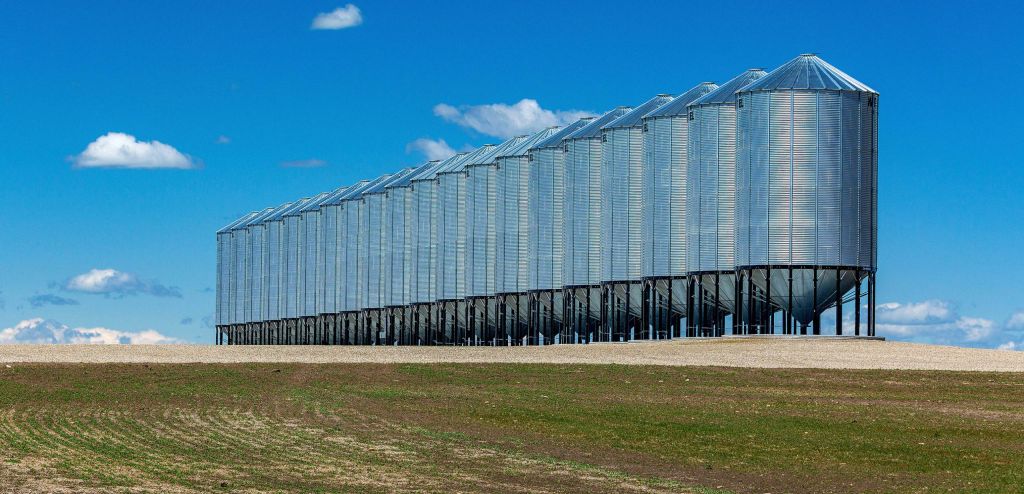
China’s 100% tariff on canola oil and meal has Canadian farmers concerned. That stress level could climb, as China also has its eye on Canadian canola seeds—the largest segment of our canola exports to China—, which have been spared for now. “That would be the other big shoe to drop,” said Rick White, CEO of the Canadian Canola Growers Association (CCGA), which represents approximately 40,000 farmers across Canada.

Canola was developed by Canadian scientists in the 1960s—hence the name. It’s considered healthy oil as it’s low in saturates (an unhealthy fat) and high in monounsaturates (considered good). Canada is the world’s largest canola producer and counts, with 40,000 farmers generating $43.7 billion, with the U.S., China and Japan—in that order, its three biggest export markets. Australia is among Canada’s biggest canola rivals.

As the Chinese tariffs hit Canadian canola farmers, they are freezing investments and need support. White shared some ideas on ways to soften the blow:

  • White says the tariffs were not a surprise, as past disputes with China (2019-2020) had targeted canola.

  • China has once again targeted the agriculture sector in direct response to Ottawa implementing tariffs on Chinese EVs, aluminum and steel.

  • The industry feels the Canadian government “absolutely bears the responsibility” of that action and should compensate farmers for the financial losses that they will incur.

  • Other major canola seed exporting countries include Australia, Ukraine, Russia. Canada specifically grows canola, which is defined as having low erucid acid and low glucosinolates. Australia and the EU are also significant growers of canola or double low rapeseed, which is of comparable quality.

Canola seeds in the crosshairs

  • A looming Chinese anti-dumping investigation on Canadian canola seed could trigger more tariffs. That’s “the big shoe to drop.”

  • Canola seed is Canada’s primary canola export to China, with canola oil and meal accounting for a smaller portion. In 2024, China imported six million metric tonnes of Canadian canola seed, worth $4 billion.

  • The Chinese are following World Trade Organization (WTO) rules around anti-dumping. WTO challenges take time but provide legal recourse. The CCGA has registered as a party to China’s investigation.

Farmers are looking to freeze investments

  • Farmers rotate crops for agronomic reasons, but canola is a Canadian staple crop, which limits alternatives. Agronomics involves soil and crop management and helps optimize distribution, management and productivity of land.

  • Farmers are already expressing concerns about market risks from China and the U.S. with some suggesting delays in capital investments and equipment purchases due to uncertainty.

  • Plus, purchase of new equipment could possibly come from the U.S. that could be subject to countervailing duty by Canada.

  • “Farmers are not going to take that risk of investing big pieces of capital into renewing infrastructure … there’s going to be a big chill on investment, at least this year.”

Across the border, more trouble is brewing

  • The U.S. is Canada’s largest canola export destination, valued at $7.7 billion in 2023. The U.S. has not yet imposed a 25% tariff on canola, as CUSMA (the Canada-U.S.-Mexico Agreement) remains in effect. But once exemptions expire, new U.S. tariffs could further harm Canadian canola exports.

There are ways to build a tariff-less ecosystem

  • Last December, the CCGA sent a letter to the federal government, forecasting farm gate losses of between $1.76 billion to $4.33 billion for 2025-26 due to the Chinese tariffs.

  • Ottawa has announced new loan products to sustain the industry, but farmers argue they cannot borrow their way through this crisis and need cash compensation.

  • “The federal government needs to compensate farmers commensurate with the losses that they will incur because of China… farmers can’t, nor should they, be expected to borrow their way—they need to be compensated.”

  • The CCGA is advocating for the development of a domestic biofuels and sustainable aviation market.

  • It could be a new domestic market for at least 2-3 million tonnes of canola seed. It would help soften the blow for canola farmers, as the risk and uncertainty around U.S. and Chinese markets is going to remain for a long time. It is an opportunity to help diversify and reduce Canada’s heavy dependence on China and the U.S. markets.
Dig deeper:

Language Flag Filename

rbc_language_toggle_menu_flag

RBC Chief Economist Frances Donald answers three questions on Trump’s tariffs and its impact on the global economy.

Q: What do the U.S. tariff exemptions mean for Canada’s economic growth outlook? U.S. still has tariffs on Canadian autos, steel and aluminum.
FD:
 How quickly the Canadian economic narrative has shifted. Prior to “Liberation Day,” our biggest concern was the implications of broad based tariffs on Canadian growth and particularly, that Canada appeared to be the biggest relative loser of American trade policy. Now, while various sector specific tariffs will weigh on Canada in 2025, our concerns are shifting to more “traditional” risks to Canada’s economy—the rising risk of a U.S. recession and a drop in oil prices. The latter may be more “indirect” in some capacity, but they are also more of a function of global developments that have far less to do with Canadian-U.S. political relations.

Q: Do you expect the Bank of Canada and the U.S. Federal Reserve to reassess as U.S. tariffs are rolled out?
FD: The Bank of Canada and the Federal Reserve are facing different challenges, just like their economies are struggling with different risks. In Canada, inflation is around 2% with some mild upside created by global supply chain disruptions ahead. And yet, Canadian growth is still tepid and supportive of a few more rate cuts. As of now, we continue to expect another 50bps of rate cuts.

The Federal Reserve is in a much greater bind. The size and scope of tariffs announced are consistent with higher inflation and a much lower growth profile. That “stagflationary” mix pulls at both sides of the Fed’s dual-mandate in opposite directions (price stability and full employment). At this point, our expectation is that concerns about inflation spiralling higher will keep the Federal Reserve on the sidelines, but markets have been increasing their probabilities of rate cuts to support what is likely to be a much weaker economy.

Q: A bigger tariff war looms, with the U.S.-China and U.S.-EU imposing tariffs and retaliatory tariffs. Will that be inflationary and damaging for the Canadian and global economy?
FD: Just how damaging U.S. tariffs turn out to be will largely be a function of how long they stay in place for, and economists are poorly credentialled on making that call. But the largest concern at this juncture is that we witness a global uptick in prices as supply chains become entangled and the interconnected nature of our global economy makes it difficult for any economy to escape rising costs. There are certainly similarities to the COVID era that can be drawn, except for one major one: we didn’t head into pandemic-era inflation having just gone through pandemic-era inflation. That is, Canadians and Americans have already experienced an over 20% increase in prices since 2020, and the ability of households and businesses to absorb a second wave of inflation so soon after is likely very limited. Last month, it seemed the trade war was North American centric. Now, it is global and without borders.

Further reading:

Yadullah Hussain is Managing Editor, RBC Thought Leadership

Language Flag Filename

rbc_language_toggle_menu_flag

Field Notes: How Canadian businesses are navigating trade tensions

Canada’s agriculture sector is among the first casualties of the trade wars with China and the United States. Monty Reich, CEO of SWT Ltd, a farmer-owned, independent grain and crop input company in Saskatchewan, discusses how farmers are navigating the trade tensions.

Uncertainty and volatility a near-daily irritant

  • The current environment is challenging, uncertain—and confusing. “Each day is a different journey,” Reich said.

  • Even before the 100% Chinese tariffs on canola oil and meal and yellow peas were imposed, the U.S. had started talking tariffs in December, with durum wheat on the list to be hit.

  • SWT had to absorb the financial blow of U.S. tariffs on durum wheat, choosing not to pass those costs onto its farmer-shareholders. “We sold product into future spring positions and took that hit on our own bottom line,” Reich noted.

  • U.S. tariffs have made durum wheat exports more costly. “We are the importer of record,” Reich noted, meaning SWT itself is directly responsible for paying the 25% tariff—a cost that prohibits any future sales.

Canola prices are plunging

  • For canola farmers, the impact has been brutal. Prices have plunged by 25-30% since the Chinese tariffs were imposed, dropping from around $16 per bushel to $12.

  • “Margins on the farm are pretty narrow as it is,” Reich said. Even small price shifts can turn a profitable season into a financial disaster. With this level of decline, farmers are watching their incomes evaporate.

Tariffs are hitting from all quarters

  • China’s restrictions on canola and yellow peas have cut off a crucial market, leaving farmers with few places to turn to. “China accounts for about 87% of the yellow pea market along with the U.S. and India,” meaning farmers now face a near-total lockout.

  • India’s on-again, off-again tariffs on pulses add another layer of uncertainty, leaving Canadian farmers with few viable alternatives.

Farmers are scrambling for alternatives

  • “Growers are penciling in right now, trying to figure out what’s going to provide them the best return,” Reich said.

  • Farmers could pivot to other crops, but in practice, it’s not that simple. “It’s not easy to just flip commodities,” he explained.

  • Farmers are “scrambling” to adjust before the next planting season.

Deferred investments, shrinking profitability

  • Some canola crush plant investments were already deferred a couple of years ago due to ongoing challenges with the Chinese marketplace and the cost of construction.

  • Production facilities being built today are going to continue, and existing facilities will continue operating, but margins are getting tighter.

  • Farmers are weighing whether to cut back production, reduce costs, or even scale down their operations altogether.

Fear of stranded shipments

  • China’s anti-dumping tariffs on canola seeds can come soon, adding to the threat.

  • That risk makes exporting to China a high risk. If canola seed shipments hit the waters, the Chinese “can slap on a tariff tomorrow.” That uncertainty alone is enough to spook exporters and depress prices.

  • This feels different from the dispute with China in 2019 that was more restricted to a few companies over “dockage concerns,” and quality issues.

Backdoor trade routes

  • In the past, when China restricted direct imports, Canadian canola still made its way there—through other markets.

  • “There will be other South Pacific Asian countries that’ll take the product and flip it over to China.” But those countries will try to secure the goods at a discount.

  • In addition, building trade relationships with new markets takes time. It’s not simply about switching markets from one to another (e.g., from China to the Philippines).

Other crops are also facing challenges

  • Pulse crop (e.g., lentils) are also facing challenges, particularly due to tariffs from India. This adds pressure to the profitability of these crops, with farmers having to navigate changing trade policies, especially when tariffs are applied or removed unpredictably.

Who will replace Canadian canola?

  • In the short term, other countries such as Australia can substitute Canadian canola, but Canada’s product is generally seen as highly reliable and high-quality.

  • As supply and demand dynamics shift, other countries may adjust their crop rotations to meet market needs.

  • Billions of dollars have been invested in Western Canada in canola capacity and crush capacity. There’s a lot of investment at stake in canola to “just let it go away,” Reich said.

The need for stronger government engagement

  • While farmers often prefer minimal government intervention, strong trade agreements are essential in resolving issues like tariffs or trade restrictions.

  • Canada’s government should ensure robust trade relations with key partners (China, the U.S., India) to reduce barriers, Reich recommended.

  • Saskatchewan, for instance, has set up nine offices abroad to facilitate smoother trade relations and reduce friction.

  • Canadian agriculture needs to have strong representation globally, not just through trade agreements, but through actual presence and ongoing diplomatic engagement.

  • Government investments are needed to improve infrastructure to boost interprovincial markets and move products west-to-east.

Language Flag Filename

rbc_language_toggle_menu_flag

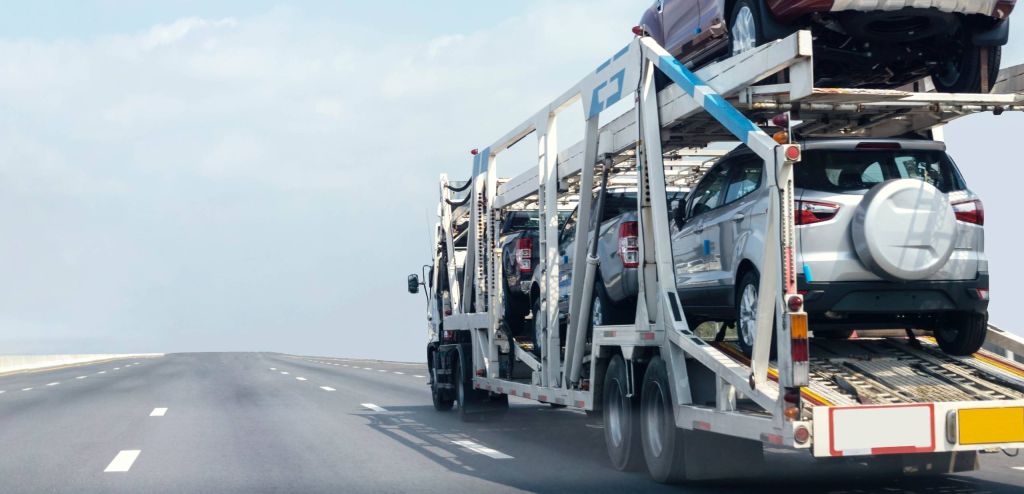
U.S. President Donald Trump finally dropped the hammer on the auto sector with tariffs on automobile and parts imports, upending the global auto industry and threatening economic damage on major suppliers to the U.S. market. The headline 25% U.S. levy has dominated the news but, as we discuss, the true cost of tariffs will be in the details. With countries from Canada to Germany to Japan roiled by the announcements, the industry is grappling with the following questions:

1. How will the tariffs be applied?

  • The proclamation is light on detail on targeted automobiles and automobile parts. Engines and engine parts, transmission and powertrain parts, and electronic components were singled out in a 2019 investigation into the impacts of automotive imports on U.S. national security.

  • But industry remains uncertain about the extent of tariff applicability this time around. The proclamation also allows the U.S. Secretary of Commerce and domestic producers of automobiles or auto parts to request parts not already included to be tariffed in the future.

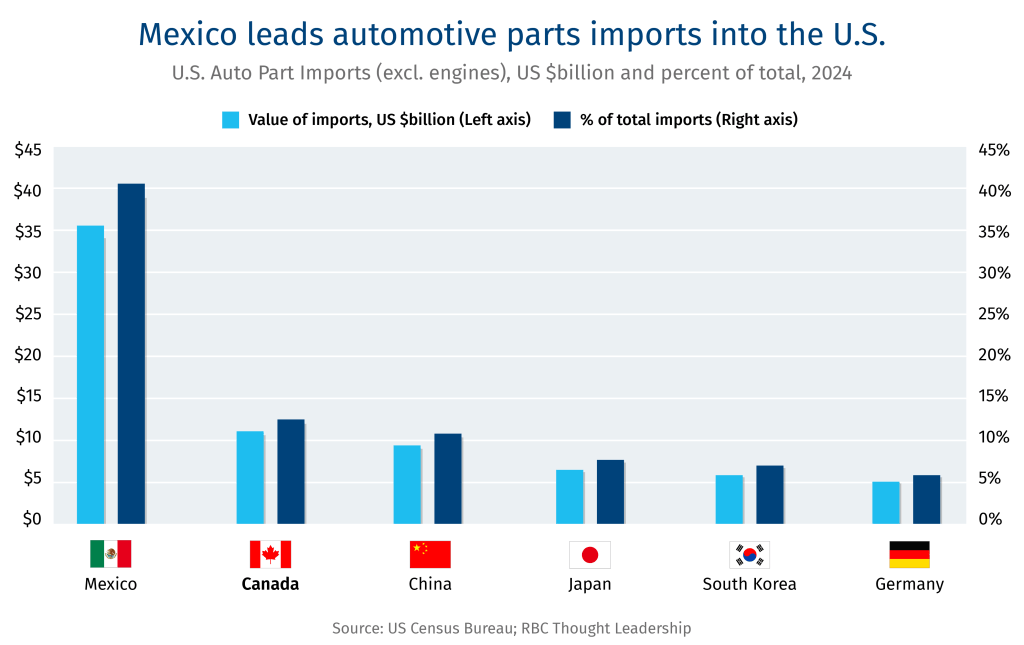
  • The U.S. imported US$83 billion in auto parts and accessories (not including engines) in 2024, with Mexico and Canada supplying 41% ($35 billion) and 13% (US$11 billion), respectively.

2. How will tariffs be implemented and compliance determined?

  • The true cost of tariffs will depend on the amount of U.S.-origin content in imported vehicles, but specifics remains unclear.

  • According to the president’s order, the 25% tariff will apply to the value of non-U.S. content in imported vehicles. However, discussions between the U.S. and Canada suggest CUSMA-compliant automobile imports with at least 50% U.S. content may be exempt. Those with less than 50% U.S. content may receive 12.5% tariffs.

  • Automotive parts will see tariffs of 25% applied to the value of non-U.S. content, according to a process being determined by U.S. Customs and Border Protection and the U.S. Secretary of Commerce. They are expected to come into force by May 3.

3. How will supply chains be affected?

  • The co-development of U.S., Canadian, and Mexican automotive industries have enabled efficiencies of production and market growth across the continent, from the Automotive Products Trade Agreement in 1965 (also known as the Canada-U.S. Auto Pact) through the integration of Mexico via NAFTA in 1994, and more recent renegotiations of Regional Content Values (RCV) under CUSMA.

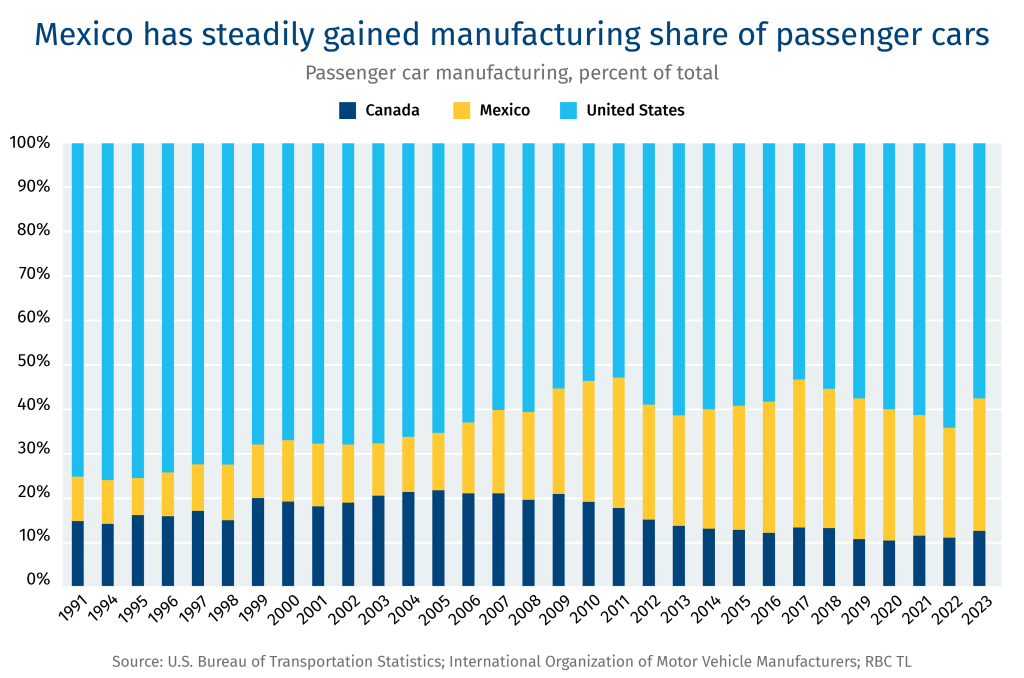
  • Over the past three decades, Mexico has steadily gained on the U.S. in production share of passenger vehicles in North America, rising from 10% pre-NAFTA in 1991, to 30% of passenger car manufacturing within the continent by 2023. Over the same period, the U.S.’s share of passenger car manufacturing dropped from 75% to 58%. Mexico surpassed Canada’s production share within the continent in 2008.

  • Though Canada’s share of passenger vehicle manufacturing grew from 15% in 1991 to peak at about 22% by 2005, it had dropped to 12% by 2023.

  • A similar trend has emerged in motor vehicle parts. From supplying 9% of U.S. imports in 1990, Mexico has grown to 41% of automotive parts imports in 2024, while Canada’s contribution has reduced to 13% in 2024 from a 1990 peak of 36%.

  • Data on the geographic origins of components across 315 car models available to the U.S. public between 2021-2025, show that, combined, U.S. and Canadian auto parts make up as much as 77% of the total value of certain models, with Mexican origin parts reaching as much as 80% in others.

  • Such high levels of integration means tariff-driven disruptions to automotive supply chains have a high likelihood of rippling through the industry, raising costs and putting pressure on manufacturers, distributors, and consumers across all geographies.

4. What’s the way forward?

  • The precise nature of tariff applicability, compliance, and enforcement remains largely uncertain, leaving manufacturers with few clear options on the way forward.

  • What’s certain is that impacts will be felt on both sides of the border, with 35 U.S. districts across 26 states importing auto parts from Canada in 2024, and southern Ontario’s automotive sector among the hardest hit.

  • The severity of reciprocal tariffs would dictate the added burdens on auto and parts manufacturers. Canada’s response to the U.S. auto tariffs would also determine the future of RCV-based tariff exemption thresholds.

Vivan Sorab is Senior Manager, Clean Technology, RBC Climate Action Institute

This article is intended as general information only and is not to be relied upon as constituting legal, financial or other professional advice. A professional advisor should be consulted regarding your specific situation. Information presented is believed to be factual and up-to-date but we do not guarantee its accuracy and it should not be regarded as a complete analysis of the subjects discussed. All expressions of opinion reflect the judgment of the authors as of the date of publication and are subject to change. No endorsement of any third parties or their advice, opinions, information, products or services is expressly given or implied by Royal Bank of Canada or any of its affiliates.

Language Flag Filename

rbc_language_toggle_menu_flag

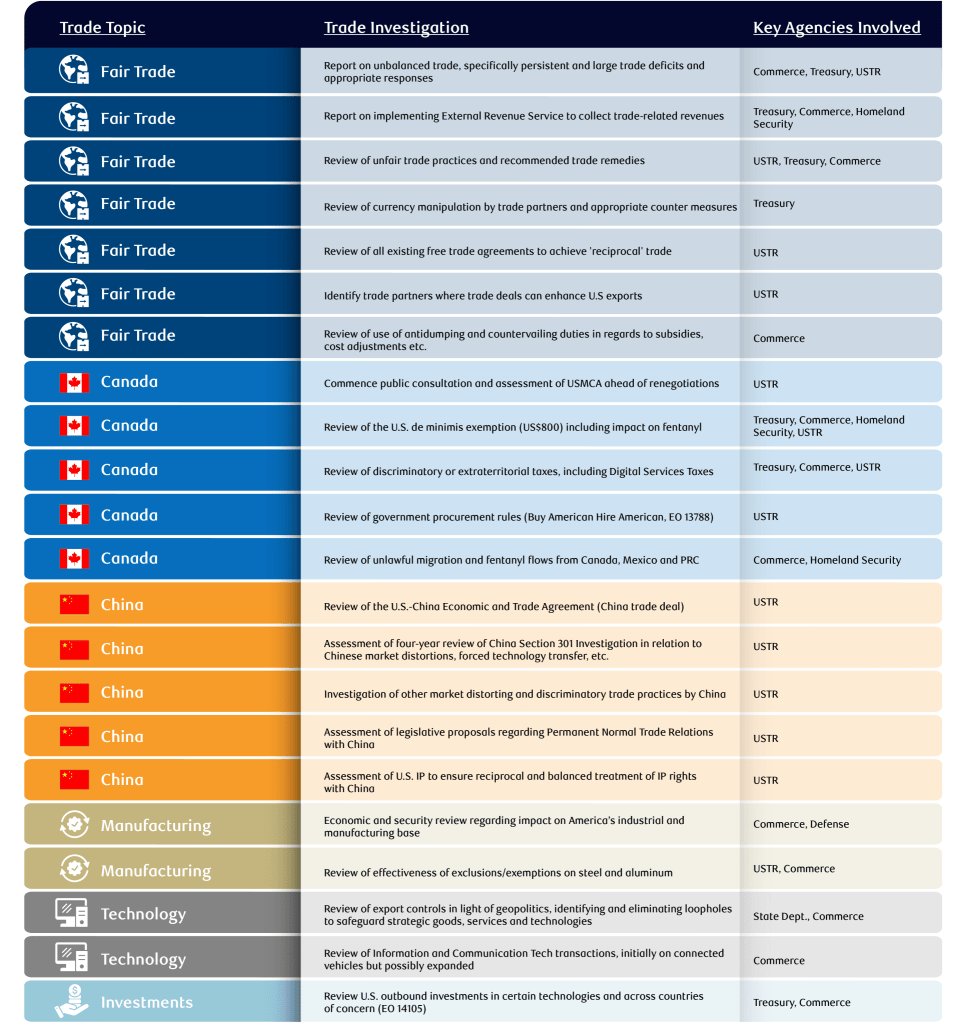
It has been 70 days since U.S. President Donald Trump directed eight federal agencies to commence the review, design and implementation of his America First Trade Policy (link). In total, over 20 investigations have progressed concurrently, to be delivered to the President on April 1.

While the final “reciprocal” tariffs are most likely a catch-all trade response to these investigations, their recommendations will shape the course of the Administration’s trade path over the next four years. In essence, we are entering a new phase – one (hopefully) out of a sprint and into a more measured pace, across six key trade themes that extend beyond the use simple tariffs as identified in the graphic below.

To get a sense of what to expect over the next few months from a hawkish Washington, read John Stackhouse’s interview with Steve Verheul, Canada’s Chief Trade Negotiator in the renegotiation of NAFTA (now CUSMA), on how he sees the trade war playing out. For more, see here.

Trump’s America First Trade Policy

Trade Investigations Due April 1

Source: whitehouse.gov

This article is intended as general information only and is not to be relied upon as constituting legal, financial or other professional advice. A professional advisor should be consulted regarding your specific situation. Information presented is believed to be factual and up-to-date but we do not guarantee its accuracy and it should not be regarded as a complete analysis of the subjects discussed. All expressions of opinion reflect the judgment of the authors as of the date of publication and are subject to change. No endorsement of any third parties or their advice, opinions, information, products or services is expressly given or implied by Royal Bank of Canada or any of its affiliates.

Language Flag Filename

rbc_language_toggle_menu_flag

I hosted a discussion for RBC clients with Steve Verheul, Canada’s Chief Trade Negotiator during the first Trump Administration, and now a member of the Prime Minister’s trade advisory council. Here’s some of what he shared: 

1. Canada-U.S. headed toward even greater trade conflict

  • We will be lumped in with the “Dirty 15” that have the biggest trade surpluses with the U.S. They include China, Canada, Mexico, the European Union, Vietnam, India, Japan, South Korea, Brazil, Thailand, Malaysia and Indonesia.

  • We may face 14-15% tariffs, although it could start smaller and grow until a trade balance is achieved.

  • Do not expect many exemptions, including on energy and food, at the start.

  • Canada will hit back with counter-tariffs, as mapped out earlier this winter.

  • Prime Minister Mark Carney won’t negotiate until the sovereignty threat is retracted.

  • Verheul does not recommend negotiating at all unless there is an agreement that duty-free status for Canada is still an option.

  • All the major countries and regions are trying to negotiate exemptions and carve-outs. The Eurasia Group believes Canada is still in the light tariff category, according to a grid of U.S. negotiating plans of small, medium, large (7%, 15%, 30%).

2. The U.S. approach will be unprecedented and unpredictable

  • U.S. President Donald Trump will receive reports next week on an array of topics, which will determine U.S. trade action on everything, from China to deficits to currency manipulation.

  • There are indications that the president will start low and grow.

  • The implementation schedule may not be clear, nor is there clarity on possible exemptions.

  • Reciprocal tariffs will be applied using a combination of tools including the International Emergency Economic Powers Act (IEEPA), a U.S. federal law, and Section 338 of the Tariff Act of 1930, or Section 301 of the Trade Act of 1974.

  • The U.S. Congress enacted IEEPA nearly 50 years ago to give the president the power to act promptly to protect the nation’s security—it had never been used.

  • April 2—the day Trump is expected to announce reciprocal tariffs—is the beginning, not the end, as negotiations will ensue.

  • The U.S. is thinking about excluding many countries and narrowing its list and focusing on a list of key sectors, as global tariffs would be too complex. The U.S. would have to go from 17,000 tariff lines to three million tariff lines, which would be impossible to administer.

3. The U.S. strategy is contradictory

  • It’s hard to negotiate as the U.S. is aiming for an outcome that tariffs may not be able to deliver.

  • The U.S. aim is to reshore manufacturing, but companies will require years to do that, and tariffs will cause near-term damage to the U.S. economy.

  • Supply chains are also too complex, and costly, to reshore.

  • It will inflict a lot of self-harm, which the administration appears willing to look past. The U.S. applied tariffs on steel and aluminum even though it requires imports to meet 50% of demand. As an example, the U.S. will need to build four Hoover dams to meet the energy requirements to produce steel domestically.

  • The administration is also trying to extract non-tariff concessions from a range of countries. Expect services to be thrown in, althought the U.S. has no apparent strategy or infrastructure within government to negotiate complex sectors.

  • The U.S. administration doesn’t fully understand the implications of what they are trying to do, caught between trying to move very quickly and the stark reality that companies cannot reshore quickly.

  • “It‘s hard to negotiate with a country willing to shoot itself in the foot.”

4. Trump’s approach is fundamentally different this time

  • His core advisors now are Peter Navarro, Steven Miller and Howard Lutnick, who lack institutional knowledge on trade and current agreements.

  • Robert Lighthizer, who led talks during Trump 1, had clear authority as well as expertise.

  • Jamieson Greer, the current U.S. Trade Representative (USTR), is not yet playing a big role, and focussed largely on China.

  • Lutnick has most influence on the Canada file, including oversight of USTR.

  • Trump is committed to five strategic sectors: steel, aluminum, lumber, semiconductors and pharmaceuticals.

5. VAT will remain a problem

  • The U.S. administration is coming down hard on the EU and Canada on what it views as unfair trade practice in value added tax (VAT) and general sale tax (GST).

  • The EU won’t budge, and it’s hard to see Canada making concessions as it’s a critical revenue source.

  • The issue will be contentious globally as 90% of countries have some form of GST like VAT.

6. USMCA is at risk

  • Verheul suggests leaving dairy, digital services tax (DST), and other contentious issues as is until there is proper negotiation.

  • He would not negotiate until tariffs are removed, and the U.S. expresses willingness to protect duty-free access. Without that commitment to duty-free, the U.S. Mexico-Canada (USMCA) trade agreement would not be worth fighting for.

  • He suggests sticking with the trilateral approach. Canada made “a significant mistake” by isolating Mexico early on.

  • Mexico is better to have at the table as it makes Canada look better, especially as the U.S. is more concerned with the southern border. Let Mexico take the heat.

7. Canada needs a strategic offramp

  • The U.S. is interested in broader continental security, but that’s hard to discuss if it’s not committed to trade access.

  • Canada’s premiers are also not aligned on what concessions to make.

8. Chinese investments will be a target

  • That would be tricky, especially for critical minerals.

  • Canada has taken a number of measures to restrict Chinese foreign direct investment in sensitive areas. That was largely done in reaction to U.S. concerns, but presents a challenge to Canada in how it develops its critical mineral resources.

  • Canada needs to rethink its relationship with China through the prism of critical minerals and border security.

9. China’s reaction to U.S. actions will be key

  • China has signalled it will retaliate with countermeasures, including tariffs, sanctions, and export controls to U.S. actions but only after U.S. measures take effect.

  • China will likely respond by targeting U.S. agriculture, as it’s the top importer of U.S. agriculture, at US$33.7 billion, followed by Mexico at US$28.2 billion, and Canada at US$27 billion.

10. Markets may prove to be the final check and balance

  • Trump still considers stock markets to be the leading arbiter. So far, they have been muted or resilient in response to tariff threats, at least in daily swings.

  • Business and consumer confidence is being hit, and causing an investment slowdown.

  • The S&P 500 is down 7.1% since Trump’s January 20 inauguration. The index is 9.3% lower than its all-time high, achieved on February 19, 2025.


John Stackhouse is Senior Vice-President, office of the CEO, at Royal Bank of Canada, and head of RBC Thought Leadership.

Read some of our latest insights here:

For more, go to rbc.com/thetradehub.

Download the Report

Follow RBC Thought Leadership on LinkedIn here.

This article is intended as general information only and is not to be relied upon as constituting legal, financial or other professional advice. A professional advisor should be consulted regarding your specific situation. Information presented is believed to be factual and up-to-date but we do not guarantee its accuracy and it should not be regarded as a complete analysis of the subjects discussed. All expressions of opinion reflect the judgment of the authors as of the date of publication and are subject to change. No endorsement of any third parties or their advice, opinions, information, products or services is expressly given or implied by Royal Bank of Canada or any of its affiliates.

Language Flag Filename

rbc_language_toggle_menu_flag

China retaliated with tariffs of its own on various Canadian agricultural exports in response to Ottawa’s tariffs last fall on Chinese electric vehicles and metals.

The new tariffs mark an escalation in trade tensions between Canada and China, with the risk tilted to the upside. It comes as the agriculture sector is already experiencing challenges posed by the trade uncertainty with the United States.

Another hit to Canadian exporters

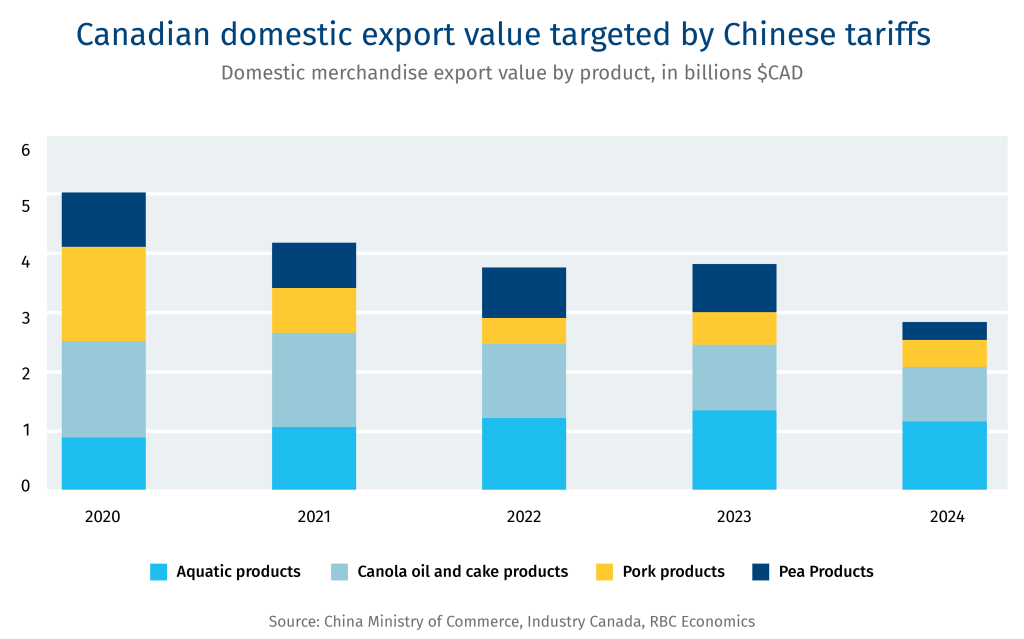
China imposed 100% tariff on Canadian exports of canola oil, canola oil-cake, and pea imports, and 25% duties on pork and aquatic products, which is expected to hit some industries and provinces hard.

The tariffs are expected to affect approximately $2.9 billion of domestic exports (in 2024), with seafood products making up the largest share at nearly $1.2 billion, followed by canola oil and cake at $938 million, and pork products ($467 million). China is also Canada’s second-largest export market for listed pea products ($306 million).

While the tariffs are expected to target only a small share of total Canadian domestic merchandise exports—roughly 0.4% in 2024—they are likely to pose challenges for some Canadian agricultural exporters.

Although China remains an important Canadian market for these products, its share of total exports has declined in recent years. In 2019, China accounted for roughly $3.8 billion (25%) of the export value of these goods, which has since declined to $2.9 billion, or 14%, in 2024. Over the same period, Canadian exporters have shifted to the U.S., with exports for these goods rising from $7.2 billion (47%) in 2019 to $12.3 billion (60%) in 2024. But that pivot to the U.S. could prove to be costly if Washington rolls out tariffs on Canadian exports as part of its April 2 trade “liberation day,” or later this year.

Atlantic provinces in the eye of the storm

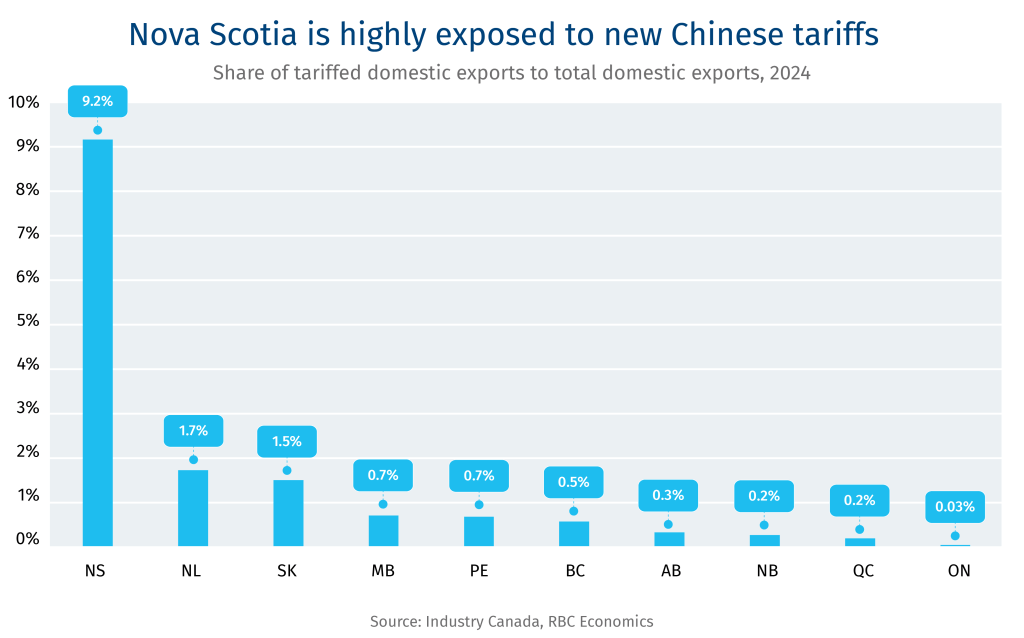
Among provinces, Nova Scotia is most exposed to these tariffs. The affected goods account for approximately 9.2% of the province’s total domestic exports. Notably, China is Nova Scotia’s second-largest export market for lobsters, which amounted to nearly $452 million in export value in 2024.

Newfoundland & Labrador shrimp exporters ($105 million) and Saskatchewan’s exporters of canola oil and cake ($515 million) are among the most exposed within their respective provinces. The listed tariffed goods account for approximately 1.7% and 1.5% of their total domestic exports, respectively.

China whips out an old playbook

China’s newly imposed duties on Canadian agricultural exports are not unprecedented. In 2019, China’s import restrictions on some Canadian canola exporters, led to a sharp decline in imports of Canadian canola seeds to the world’s second largest economy.

The restrictions are estimated to have contributed to significant losses for Canadian exporters, on reduced export volumes and the prices received for their products. The Canola Council of Canada estimated that between March 2019 and August 2020, China’s actions cost the domestic industry between $1.54 billion and $2.35 billion in lost sales and lower prices.

If the tariffs persist for some time, canola farmers fear job losses, declines in production volumes, and capital cuts beyond the projects that are already under way, according to an industry executive.

While the new tariffs could trigger losses for the targeted industries, the more significant risk stems from the potential escalation of the trade conflict. The latest measures, introduced on March 20th, followed China’s anti-discrimination investigation into Canada’s tariffs on Chinese EVs and metals. Meanwhile, China’s ongoing anti-dumping investigation into Canadian canola (including seeds) and chemical products raises the possibility of additional trade barriers. Given that China remains Canada’s largest export market for canola seeds – valued at approximately $4 billion in 2024 – any further restrictions could have significant economic repercussions on the industry.

Salim Zanzana is an economist with RBC Economics.

This article is intended as general information only and is not to be relied upon as constituting legal, financial or other professional advice. A professional advisor should be consulted regarding your specific situation. Information presented is believed to be factual and up-to-date but we do not guarantee its accuracy and it should not be regarded as a complete analysis of the subjects discussed. All expressions of opinion reflect the judgment of the authors as of the date of publication and are subject to change. No endorsement of any third parties or their advice, opinions, information, products or services is expressly given or implied by Royal Bank of Canada or any of its affiliates.

Language Flag Filename

rbc_language_toggle_menu_flag

Canada’s intractable softwood lumber dispute with the U.S. has long cast a shadow over the country’s promising forestry sector. However, reimagining its potential, building a value-added industry, and seeking new markets could be the playbook that Canada can replicate across the wider economy as more American tariffs come our way.

Forestry products account for 7.5% of Canada’s total exports, punching above their weight as they only comprise 1.2% of the country’s GDP, or $33.4 billion. Crucially, the industry employs more than 200,000 workers across the country.

These numbers could climb higher if Canada can resolve several other challenges that have been weighing down the industry, including wildfires in British Columbia and Alberta, pests, and increased regulations, that have all contributed to dozens of Canadian mill closures and thousands of job losses over the past few decades.

Here are three ways Canada can look beyond the softwood lumber tariff dispute with the U.S. and build up the forestry sector.

1. Capitalize on the e-commerce boom

The Covid-driven shift to e-commerce using paper-based packaging, and rising demand for single-use products is here to stay, despite the recent climate policy whiplash. That includes global efforts to cut emissions and introduce more sustainable, renewable materials, in packaging, energy production, and construction.

That’s an advantage for Canada, which is home to almost 10% of the world’s forested area, and sound public management that has limited deforestation to around 1% since 1990.

2. Look beyond lumber

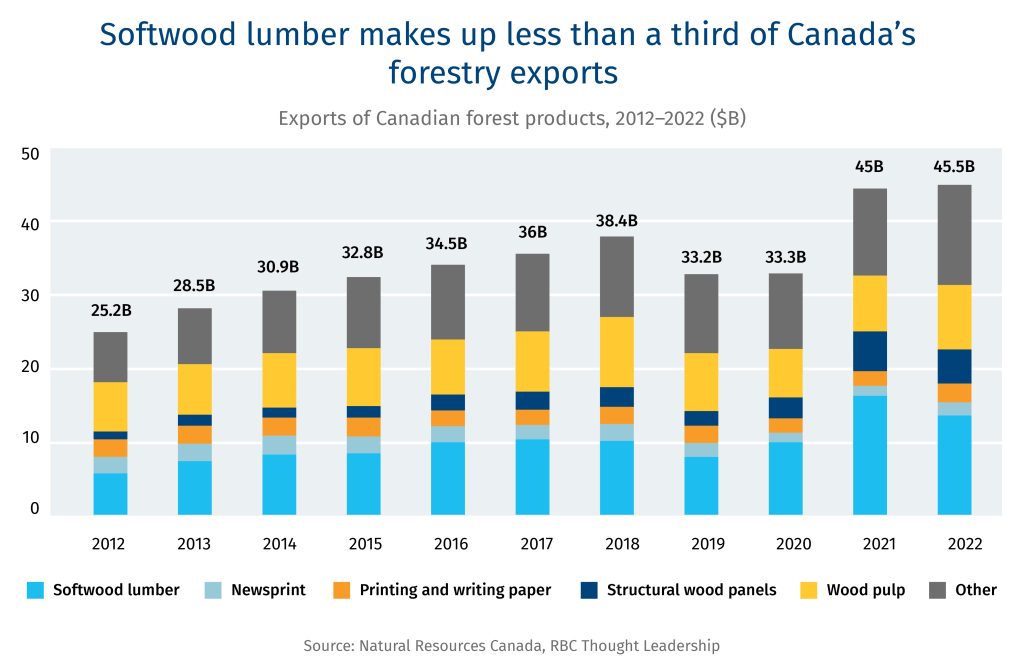
For all the attention it attracts, softwood lumber represents less than a third of Canada’s total forestry product exports.

Aside from logging, forestry comprises two other major subsectors: pulp and paper manufacturing, and higher-value solid wood product manufacturing, which includes millwork and structural wood panels.

The right policies and industry initiatives can help Canada tap the US$788 billion global wood products market, which is expected to nearly double in value by 2033. Indeed, the “finished wood products” category is seen as the sector’s fastest growing segment.

Sustainable and renewable materials in the construction of furniture, housing, and infrastructure are in high demand as the world grapples with resource depletion, even as emerging markets’ populations and infrastructure needs rise.

The sustainable economy is also booming as the industry seeks alternatives to fossil fuels and plastics. Wood fibre-based products, including bioplastics and biofuels, such as wood pellets, are seen as increasingly viable alternatives. The wood bioproducts market was valued at US$281 billion in 2022 and is expected to nearly double in the next decade amid a major consumer shift towards sustainability.

3. Global housing shortage could be a catalyst

Canada’s housing crisis and infrastructure needs are an opportunity to stimulate domestic demand and aid the energy transition through policy levers. Replacing concrete and steel in construction—wherever possible—with products such as mass timber could reduce global CO2 emissions by 14-31% – something that’s increasingly recognized by Canadian policymakers.

Governments in France, Germany, Denmark and Australia have either mandated the use of wood or mass timber products in new construction, or have placed stricter requirements on the lifetime environmental impact of buildings—which in effect, requires the use of more responsibly sourced and potentially recyclable materials.

Canada’s Green Construction through Wood (GCWood) Program encourages the use of innovative wood-based building materials in construction. However, the program is currently oversubscribed and overwhelmed. Expanding the scope and availability of these types of policy-driven incentives can open new possibilities to meet the challenges associated with sustainable growth and help in resolving the country’s affordable housing crisis.

Support firms as they transition and seek new markets

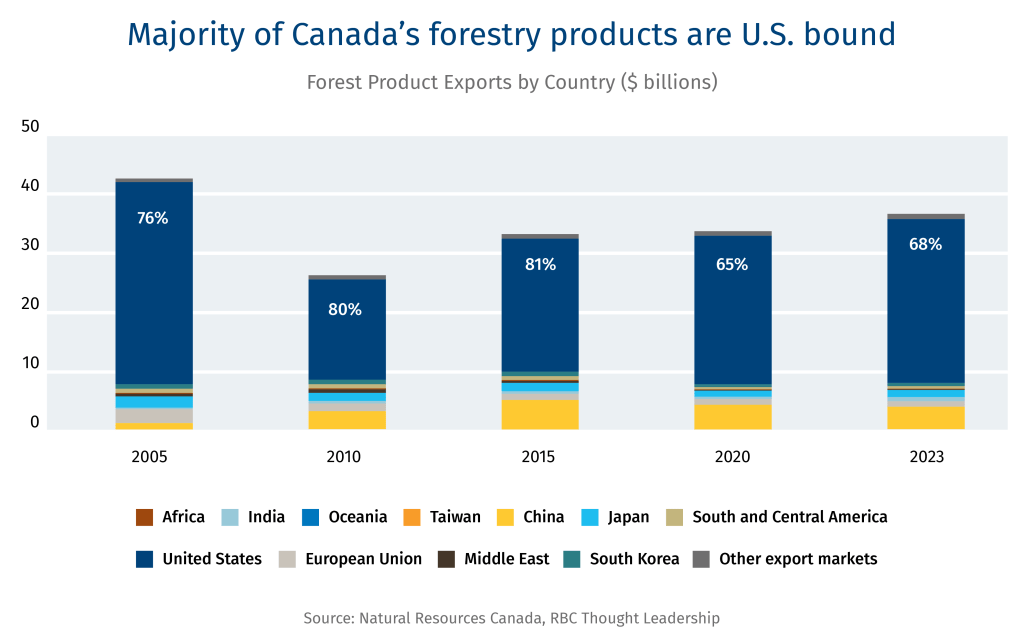
Canada’s forestry sector—like many others—is woefully over-exposed to the U.S. market, with nearly 70% of forest products, including lumber, headed south of the border.

But the sector has struggled to grow its market share in emerging markets beyond China. That’s an opportunity missed as the markets in Asia Pacific and Africa saw massive expansion over the past two decades. Even Canada’s forestry exports to the European Union have declined during this time. Ottawa’s renewed focus on forging trade ties with non-U.S. markets should include forestry as part of the discussions.

Executing all the three strategies mentioned above would also require government support as forestry is immensely capital intensive. In 2020 alone, the Canadian forestry industry spent a total of $5.3 billion on capital expenditures and repairs. Canadian pulp and paper mill operations will need financial help transitioning and retooling to meet the needs of the future economy. Sawmills are also directly impacted by U.S. tariffs and could benefit from liquidity support as they eye new export markets and product lines.

Increased adoption of data and analytics and improving communications and 5G infrastructure in rural and remote areas would also help the sector leverage the cutting-edge technologies available in other countries.

Stumped: How the U.S.-Canada softwood lumber trade tiff began

The U.S.-Canada softwood lumber dispute dates back to 1982, making it one of the longest and unyielding in the two partners’ trade history. The trade tiff has also transcended political party and presidents alike in the U.S., with the Joe Biden administration raising tariffs on Canadian softwood lumber to 14.54% from 8.05% as recently as last fall; the Donald Trump administration is pledging to raise them this year to 55%, according to a B.C. official.

Consisting of species such as fir, spruce, and pine, high quality Canadian softwood lumber is in global demand—with 67% of total production exported in 2020. It is most sought after in the U.S., which sources around 80% of its imports from Canada.

But over the decades, Washington officials have alleged that American producers are harmed by Canadian subsidies. Canada’s forests are almost entirely publicly owned and managed—94% are on public land—while U.S. forests are mostly private. In Canada, prices charged for harvesting logs—called “stumpage fees”—are set by provincial governments.

Stumpage fees are meant to reflect the market price in contrast to the U.S. where pricing is set by the private market. U.S. lumber producers claim the stumpage fee system amounts to a government subsidy as it keeps the cost of production artificially low. This misunderstanding has repeatedly triggered countervailing and anti-dumping duties on imports.

Since 1982, there have been four official Softwood Lumber Agreements and multiple rounds of negotiations through NAFTA and the World Trade Organization to reduce or eliminate tariffs and resolve the dispute. Despite these attempts, including multiple rulings in Canada’s favour, the issue persists. During this time Canadian industry has paid billions in additional costs exporting to the States; between 2017–2021 alone the U.S. collected approximately $5.6 billion in duties.

Ajay Nandalall is a Toronto-based research consultant, with a background in public policy and international banking.

Language Flag Filename

rbc_language_toggle_menu_flag

How dependent is the U.S. on Canadian electricity to power its homes and industries? Could electricity serve as a point of leverage in Ottawa’s trade negotiations with Washington?

These questions emerged after Ontario Premier Doug Ford imposed a 25% surcharge on its electricity exports to the U.S. border states of New York, Michigan and Minnesota—only to scrap it after Washington threatened to double tariffs on Canadian steel and aluminum. Electricity flowing between Canada and the U.S. are exempt from tariffs under USMCA, which explains why the Ontario government imposed a surcharge on electricity exports, a de facto export tax.

While Ontario’s threat has died down—for now—, the episode highlights the significance of Canadian electricity in cross-border trade dynamics. We shed some light on the continental power trade flow and whether electricity could be a card worth playing in Ottawa’s negotiations with Washington.

Powering the U.S.

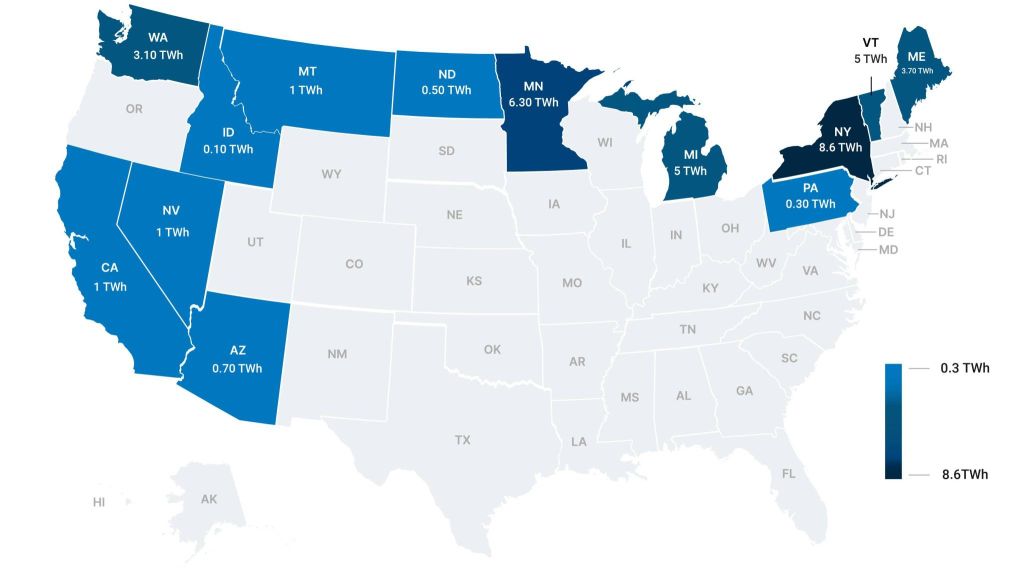
Canadian electricity exports to the U.S., by state (2024)

Source: Analysis of Statistics Canada data by RBC Thought Leadership

Four provinces dominate

Last year, Canada sent 35 terawatt-hours (TWh) of electricity to the U.S.–that’s less than 2% of total U.S. electricity generation—adding $3.4 billion to the Canadian economy. But some states are more dependent on Canadian power than others.

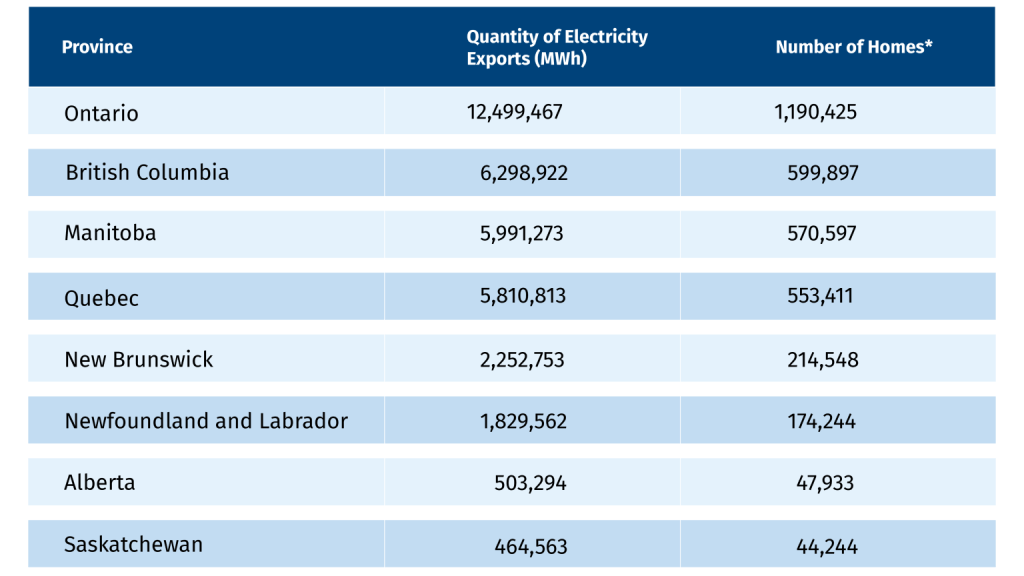
The movement of electricity within the continent follows a north-south axis, mirroring the broader trade pattern for physical goods. Four provinces dominate the Canada-U.S. electricity trade–Quebec, Ontario, British Columbia and Manitoba, accounting for 86% of exports.

Until 2022, Quebec had been the largest exporter, with one-third of Canada’s electricity exports originating from its border. While it has been surpassed by Ontario recently, that’s more a function of lower hydroelectric power output in Quebec due to droughts, and not a surge in the terawatt-hours (TWh) Ontario sends down to neighbouring states.

And it’s not entirely a one-way traffic. Occasionally, U.S. power surges back into Canada, with the above-mentioned four provinces also the biggest beneficiaries of these imports, accounting for 95% (21 TWh) of all U.S. electricity imports, especially in times of drought. British Columbia is the biggest buyer of American electricity, accounting for 57% of imports. Controlling for drought conditions and B.C.’s supply shortage—which will be resolved once the Site C hydroelectric dam runs at full capacity later this year—, Canada’s annual reliance on U.S. power would be 10 times smaller to around 2 TWh.

Canada Provides the U.S. with Enough Electricity to Power 3.4 Million Homes Annually

Provincial breakdown of electricity trade (2024)

*Numbers based on the power consumed by the average American home annually.

Source: Analysis of Statistics Canada data by RBC Thought Leadership

Maine and Minnesota are most dependent on Canada

Electricity as a bargaining tool in trade negotiations depends on the province’s market share in various U.S. jurisdictions.

While New Brunswick only accounted for 11% of Canadian electricity exports in 2023, the 5.5 TWh of power accounted for 44% of Maine’s power needs. When imports from Quebec and Newfoundland are added to the mix, Maine’s dependence on Canadian electricity jumps to 64%.

Similarly, Manitoba provided 13% of Minnesota’s electricity needs in 2023, a figure that’s expected to grow this summer. The Midcontinent Independent System Operator (MISO), which oversees transmission in several Midwest states including Minnesota, is anticipating a supply shortfall due to a confluence of events: the retirement of coal-fired power plants, growing demand, and slower than anticipated new generation assets coming online1.

Sourcing additional power from neighbouring system operators, Southwest Power Pool and PJM Interconnection are limited, as the grids operated by these systems operators are also facing a similar challenges2. That could leave Minnesota more reliant on Manitoba’s grid.

A weak hand?

For Quebec and Ontario, electricity is a weak hand to play. While Ontario supplies 6% of Michigan’s electricity needs, much of it is pushed out to neighbouring states, mainly Ohio and Indiana. New York, meanwhile, is reliant on Quebec and Ontario for 6% of its power.

Could the U.S. states easily switch to alternatives if Canada slaps new surcharges? New York is part of the Northeast Power Coordinating Council (NPCC), (which also includes Quebec, Ontario) and six New England states that can emerge as viable alternative suppliers. However, by 2026 demand growth in the northeast region is anticipated to cause a supply shortfall.

A co-ordinated strategy is required for Ontario and Quebec, if electricity is to be an effective bargaining chip with the U.S. administration. That may be tough for Quebec, as Hydro Quebec has an offtake agreement with New York’s independent system operator that may limit additional service level changes and charges outside of the contract.

What to watch for as trade tensions simmer

The Ontario government says electricity surcharges remain on the table as a retaliatory measure against any future U.S. trade actions. With reciprocal U.S. tariffs expected on April 2, Ontario may once again proceed with its credible threat of imposed the surcharge—as it briefly did on March 10.

A hot summer could further strengthen Ontario’s case. Keeping the lights on and air-conditioning running without Canadian electricity could prove to be challenging this summer for strained U.S. state grids. And that may prove to be the ultimate power play for Ontario, and other provinces.

But rather than a blunt negotiating tool, electricity trade represents a strategic asset for Canada—one that can help build deeper energy co-operation with the U.S. while ensuring stability for both economies.

Myha Truong-Regan is Head of Climate Research, RBC Climate Action Institute.


This article is intended as general information only and is not to be relied upon as constituting legal, financial or other professional advice. A professional advisor should be consulted regarding your specific situation. Information presented is believed to be factual and up-to-date but we do not guarantee its accuracy and it should not be regarded as a complete analysis of the subjects discussed. All expressions of opinion reflect the judgment of the authors as of the date of publication and are subject to change. No endorsement of any third parties or their advice, opinions, information, products or services is expressly given or implied by Royal Bank of Canada or any of its affiliates.

Language Flag Filename

rbc_language_toggle_menu_flag

Excluding energy, Canada has a trade deficit with the United States. That’s the top message Ottawa sent to Washington in a filing in response to U.S. Trade Representative’s (USTR) request for comments as it assesses the “unfair” practices of its trading partners.

U.S. President Donald Trump has decried the trade surplus Canada enjoys against the U.S., calling it “essentially a subsidy”. Ottawa’s eight-page filing, however, noted that the surplus is primarily due to American refiners’ preference for affordable, reliable Canadian fuels that Americans count on to power the U.S. economy.

Excluding energy, the U.S. has enjoyed a merchandise trade surplus with Canada since 2007, which stood at $34.3 billion in 2024. Meanwhile, U.S.’s services surplus with Canada stood at $34.9 billion.

The filing sets the stage for a Canadian response and also tries to get ahead of several sticky points that will likely come up in any future negotiations on the Canada-U.S.-Mexico Agreement (CUSMA).

Here are some of the key themes and numbers—and grievances—that emerged from Canada’s filing:

We are your biggest customer: Canada buys more U.S. goods than China, Japan,  and Germany combined. Canada was the top export destination for 32 U.S. states in 2024, and buys many high-valued finished manufactured products such as equipment, vehicles, agricultural products and a wide variety of consumer goods. Some eight million U.S. jobs are tied to trade with Canada.

Canada shares American concerns over unfair trade practices: Ottawa imposed 100% tariffs on Chinese EVs and 25% on Chinese steel and aluminum products, in addition to other tariffs on Chinese critical minerals, renewable equipment etc.—all these align Canada to several U.S. actions to limit Chinese goods. Ottawa is also monitoring steel import supply chains, and amended its Investment Canada Act last year to address national—and continental—security risks.

Crucially, “Canada is considering additional measures to address risks to Canadian and North American economic security and supply chains,” to crack down on critical mineral being sourced from “jurisdiction of concern.”
Equally critical, Canada emphasized that it’s neither a transshipment risk nor a backdoor to the U.S. market for trade practices that could harm the continent’s collective economic security.

There should be no beef over dairy trade: U.S. dairy exports to Canada has soared to $1.14 billion from $728 million when CUSMA came into force. The U.S. enjoys a dairy trade surplus with Canada, which has grown 45% since 2020. Trump had said Canada’s 200% tariffs on U.S. dairy products is a “trade irritant,” but omitted that the tariffs only apply if the agreed tariff-rate quotas on U.S. dairy imports under CUSMA are reached or exceeded. U.S. negotiators were interested in retail access to dairy during the original CUSMA negotiations, which may pop up again during the renegotiations process. But the quota system is what’s seen as a trade irritant, which may require some accommodation from Canada.

Canadian digital services tax do not discriminate: The tax does not solely target U.S. firms, but applies equally to Canadian entities. Last fall, Canada engaged in a substantive and constructive dialogue with USTR counterparts as part of the USMCA dispute settlement consultation process. The DST, however, has been a persistent irritant that corporations and the U.S. government have raised, and this letter is unlikely to wish that away.

Setting the record straight on VAT: A bone of contention that President Trump raised was Canada’s GST—a consumption tax, equating it to a tariff. The Canadian brief sets the record straight—that it’s not a tariff and does not unduly harm, U.S. firms.

Let’s launch a trilateral Financial Regulatory Forum: The first Trump administration had proposed the creation of a Canada-Mexico-U.S. Financial Regulatory Forum to boost dialogue on financial sector developments and regulations. The forum never got off the ground, but Canada said it welcomes the opportunity to establish the initiative.

We need each other in steel and aluminum: Canada bought 37% of U.S. steel exports , or $5.5 billion, and has historically been a top export destination for U.S. steel for the past fifty years. Meanwhile, U.S. manufacturers rely on Canadian steel are vertically integrated with companies north of the border to maintain their competitiveness.

The U.S. industry is also highly reliant on scrap aluminum – and particularly on primary scrap aluminum of which Canada is the primary source.

Canada has taken steps to protect both industries from unfair trade practices by imposing tariffs on Chinese imports and strengthening its trade remedies regime to address unfair trade and circumvention.

The overall message was Ottawa remains committed to promoting fair trade and countering unfair and non-reciprocal trade practices by other countries to facilitate North American competitiveness and security.

“However, Canada’s ability to take action to combat unfair trade practices from other countries is constrained when faced with unjust and unwarranted trade measures from the United States,” The briefing noted.

Ottawa said it aims to leverage its G7 presidency this year and stress on the issue of unfair trade practices with like-minded countries. Closer to home in Charlevoix, G7 Foreign Ministers came out with a statement calling out China’s “non-market policies and practices that are leading to harmful overcapacity and market distortions”, but watered down language on the human rights situation relative to prior G7 statements.

The G7 will be an important forum this year on issues of trade, economic security and energy, with Prime Minister Mark Carney inviting President Zelenskyy, with whom President Trump is signing a ceasefire deal with that could lead to Ukraine signing away some of its critical minerals. It’s a useful reminder that Canada is one of many countries that is at the receiving end of the U.S.’s economic statecraft measures.

Read Ottawa’s full response here.

With contributions from Shaz Merwat and Varun Srivatsan.

This article is intended as general information only and is not to be relied upon as constituting legal, financial or other professional advice. A professional advisor should be consulted regarding your specific situation. Information presented is believed to be factual and up-to-date but we do not guarantee its accuracy and it should not be regarded as a complete analysis of the subjects discussed. All expressions of opinion reflect the judgment of the authors as of the date of publication and are subject to change. No endorsement of any third parties or their advice, opinions, information, products or services is expressly given or implied by Royal Bank of Canada or any of its affiliates.