RBC Thought Leadership Archives for joelleschonberg

Janice Charette has at least two sets of marching orders: the one she received directly this week from Mark Carney, and the one she will receive indirectly next week from Donald Trump.

Trump’s unsurprising loss of the Supreme Court case on tariffs will only deepen the difference.

First to Carney:

  • The PM has an impressive depth of respect for his new chief trade negotiator, going back to their days in London but critically to her time last year overseeing his transition team.

  • As the country is learning, Carney works with concentric circles of trust and confidence. She’s one of a handful of people in the inner circle.

  • The PM is also known to value her deep knowledge of the Canadian government and businesses. She knows where to go for answers to the many questions and challenges the U.S. will throw at her.

  • Her first challenge will be to develop the framework for a marathon of trade talks. 

  • That includes structuring technical conversations with a counterpart that’s neither interested nor prepared right now.

  • And it means building up a team for the fight. In Trump 1, the Trudeau team set up a war room that built a network of influencers, including in industry and state governments. Something similar is needed now, but perhaps more of a data room—an operation that can gather and disseminate current information on the impact of tariffs in both countries. 

  • Her next challenge will be to align with the PM on the potential gives and red lines that any negotiator needs in their pocket.

  • One non-negotiable along the way: ensure the CUSMA exemption is maintained.

Now to Trump:

  • The President, who is also on a war footing with Iran, will spend the weekend also ramping up his next trade battle.

  • Many are expecting more Section 301 tariffs to replace the emergency powers tariffs that the Supreme Court struck down. Expect more non-tariff measures, too, and more threats

  • His key messaging may come in his State of the Union address Tuesday night, which is supposed to speak to affordability but will likely toggle between geopolitical conflicts and tariffs. 

  • The setting, on Capitol Hill, won’t be lost on a President who will cajole Congress to support him on both war fronts.

  • Trump’s lead negotiator, Jamieson Greer, has told people privately he’s preparing for negotiations with both Canada and Mexico to run beyond the November midterms. 

  • That flies in the face of many expectations for a replay of 2018, when the administration worked rapidly through the summer to complete what the President could present in the fall campaign as a BDE (best deal ever).

  • If that happens, a Democrat-led House would likely make any comprehensive deal with either country an improbability. Not only will the Dems want a different deal than Trump, Congress will be consumed—almost Watergate-like—with the Epstein files. 

Charette has faced plenty of such challenges in her career, and is widely known for grace under fire.

Press play on the next big test.

– John Stackhouse

A tariff backdoor just closed

  • The U.S. Supreme Court has effectively removed the International Emergency Economics Power Act (IEEPA) as a usable, fast-tariff instrument for any president: the ruling says IEEPA’s authority to regulate importation does not include the authority to impose tariffs absent explicit Congressional authorization.

  • That matters because IEEPA was the administration’s most flexible mechanism: it enabled broad, rapidly adjustable, country-wide duties (including “reciprocal” tariffs and fentanyl-related tariffs) that could be turned up or down quickly as negotiating pressure.

  • A large share of tariff collections tied to IEEPA is now legally exposed (and at minimum, frozen as a durable policy tool).

  • For Canada, the ruling does not touch the most biting tariffs: sectoral/national security tools (notably Section 232) remain the active battlefield for steel, aluminum, autos and other targeted categories.

  • RBC Economics hammers home that point in ‘Preserving CUSMA exemptions: Canada’s real priority amid U.S. IEEPA ruling.’“By our count, 89% of Canadian exports to the U.S. in December were not charged with tariffs because they’re compliant with rules of origin requirements in CUSMA. That leaves IEEPA measures only effective on less than 5% of exports to the U.S. In December (with the remainder accounted for by Section 232 tariffs), Canada faced an average effective U.S. tariff of 3.1%—the lowest of all major U.S. trade partners.


Canada: less blanket risk, key sectors remain exposed

  • The ruling weakens Washington’s negotiating power by removing the credibility of instantaneous escalation. Future tariffs must pass through investigations, evidentiary standards, and consultation.

  • Industries exposed to higher input costs, retailers sensitive to consumer prices, vulnerable agricultural exporters, and opposed politicians will have more opportunity to intervene before tariffs take effect.

  • The economic pain of 232 tariffs remains but the credibility of economy-wide escalation declines, improving predictability—a meaningful advantage for negotiations and investment decisions tied to North American supply chains.

  • Integration becomes a stronger argument. When tariffs require justification through formal investigations, deeply embedded cross-border supply chains become evidence against disruption.

Expect tariffs to persist, but with more politics attached

  • The administration will try to rebuild tariff leverage using other statutes, but those tools require more process, justification and time.

  • Canada can treat this as an opening to shape the record, not as an off-ramp from tariff risk. If the battlefield shifts toward investigations and consultations, Canada will need to make the case that tariffs are self-defeating for the U.S.

Coalition-building becomes more decisive

  • The most effective counterweight to new tariffs will often be U.S. stakeholders with skin in the game: downstream manufacturers, retailers, farmers, state governments, and industry associations that can credibly argue costs, shortages, and lost competitiveness.

  • Canada’s best outcomes will come from identifying where U.S. dependence is highest (inputs, components, energy-intensive processing, regional supply chains) and turning those into politically legible arguments.

What we’ll be watching closely going forward

1. Which alternative tools the Trump administration prioritizes, and whether it doubles down on using Section 232 tariffs.

2. Whether the White House seeks negotiated “wins” that substitute for tariffs: procurement commitments, investment announcements, or sectoral carve-outs.

3. How quickly and effectively U.S. industry groups and state actors coalesce around this momentum swing to further curtail White House trade power.

4. The legal and fiscal ramifications. The court did not decide whether revenues collected under IEEPA must be returned, leaving potentially US$175 billion subject to litigation. Pressure to issue large-scale repayments will be vehemently opposed but will reinforce opposition, potentially induce fiscal pressure, and complicate any attempts to rebuild a similar tariff regime.

— Thomas Ashcroft

Canada’s new automotive strategy is a signal that Ottawa is keen to persist with a central pillar of the country’s manufacturing sector, despite tariff pressures and suggestions from the U.S. President that “we don’t need cars made in Canada.” The new strategy aims to carve out a new path for the industry, led by electric vehicles that have blossomed into a US$750-billion market worldwide in 2025.1

Incentives are back, but unlikely to trigger a major uptick in sales. Provincial subsides are phasing out, and the eligible cars pool is limited

Offering up to $5,000 to consumers buying an EV under $50,000, the $2.3 billion subsidy will add 840,000 EVs to Canadian roads by 2030, the government projects.

Total impact on adoption, however, might be subdued. At least 7 in 10 of all purchases under the previous federal program received a subsidy, largely stacked on top of provincial rebates. But provincial support is also dwindling. The once $7,000 stackable support in Quebec now stands at $2,000, while the $4,000 EV subsidy in British Columbia has ended. Most of the other provinces have also pulled back incentives—Prince Edward Island lowered its rebate amount, New Brunswick and Nova Scotia are ending theirs, while rebates in Manitoba and Newfoundland expiring in March.

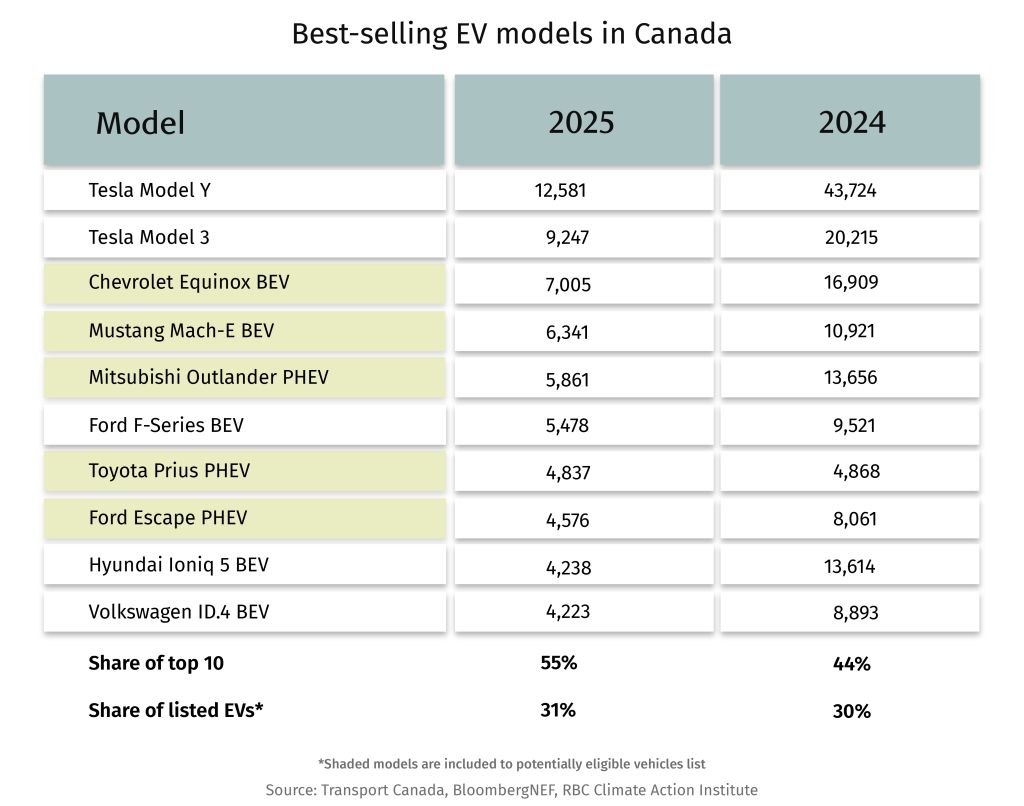
Transaction value threshold of $50,000 targeted for the mass-market segment is also likely to limit adoption. There are only 18 models included in the list of potentially eligible vehicles for a subsidy, 2 which made up only 30% of EV sales in both 2024 and 2025.3

EV prices are still high, and Chinese cars might not deliver the expected relief

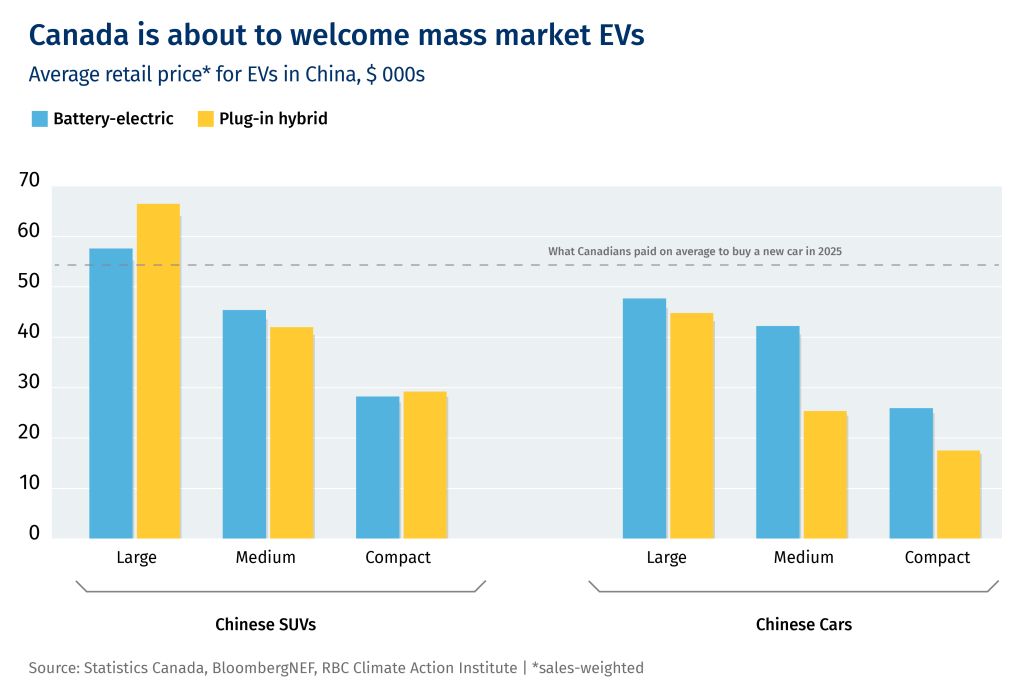
The average price of a new EV in Canada was about $70,000 last year,4 so the 49,000 cars under the new China deal could prove to be an attractive bargain. However, final costs for a Chinee EV are likely to creep up as Chinese imports still carry a 6.1% tariff, plus the costs of shipping vehicles to Canada. Chinese carmakers are also likely to seek higher profit margins compared to their competitive domestic market, which is awash with more than 50 brands.

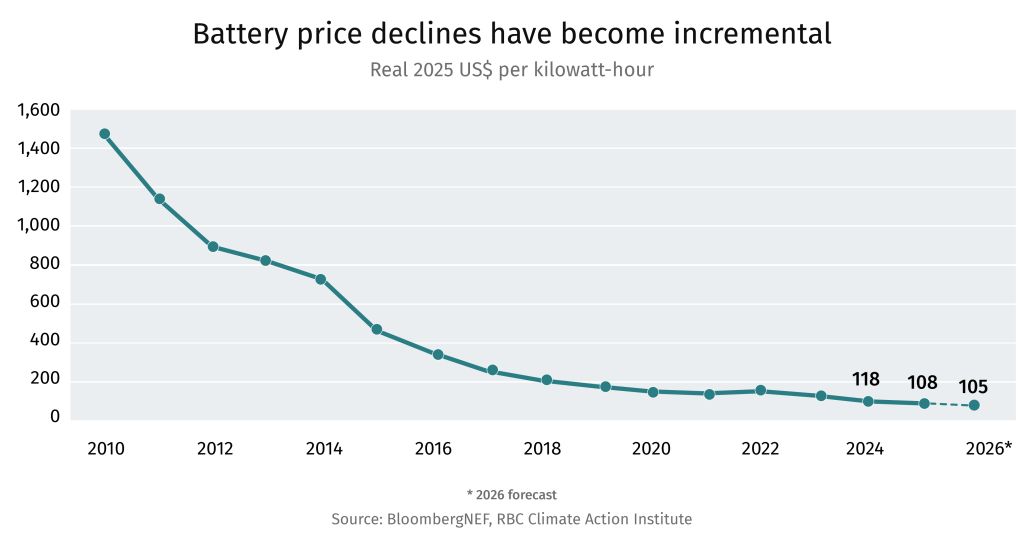
Overall, EV price improvements have lost momentum, especially as battery prices—that make up about a third of EV costs—are also flattening out. The 25-40% difference in costs between Chinese and U.S. carmakers stems from efficiency in battery production.5 The recent scale back of EV roll-out plans by the Detroit Three—Ford, GM and Stellantis—could further slow price improvements in North American EVs.

Check out RBC’s Electric Car Cost Calculator to compare electric vehicle costs to gas models

Emissions would likely to come down, mostly driven by hybrid electric vehicles adoption

Canada’s new emissions standards, however, don’t target EV sales specifically, they only aim to achieve equivalent emission reduction of up to 75% EV sales in 2035, compared to 100% EV sales required under the previous legislation.

Over the past decade, emissions performance improved by 30-50%, however, total emissions continued to rise as more cars entered Canadian roads, from ~20.1 million passenger vehicles in 2011 to 24.5 million in 2024.6 7 BloombergNEF projects that Canada’s car fleet will largely stay flat going into 2035 and decline further in future, in which case improved emissions performance will deliver absolute emissions reduction, though clean fleet eventually hinges on parting with all tailpipe emissions.8

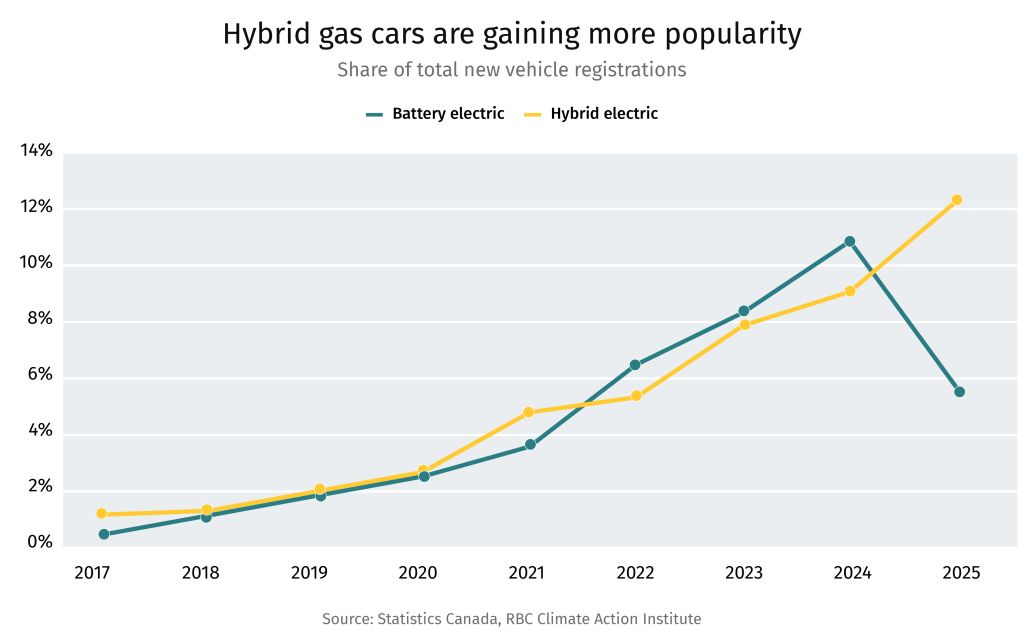
American carmakers now have the flexibility to adjust their technology to ensure compliance, which could delay full electrification in favour of hybrid cars, which are nearly half as less emitting and are more attractively priced. Hybrids are already ascendant, with car sales in the category on the rise in 2025 even as battery-electric vehicles (BEV) sales plummeted.

Also in this edition: What the future could hold for Canada’s auto industry

Agreements from Washington’s inaugural Critical Minerals Ministerial are still being digested, which saw bilateral frameworks with over a dozen trade partners and the unveiling of Project Vault.

Notably, Canada wasn’t among the signatories. So as America rewires the global minerals order, does Canada stand to gain or be left behind?

Why It Matters

Project Vault is America’s attempt to build a Strategic Petroleum Reserve for critical minerals. The problem: the SPR analogy breaks down in a way that matters enormously for Canada.

The original SPR worked because the U.S. had vast domestic refining capacity—stored crude to be converted into refined fuels along the Gulf Coast. Today, North America has almost none of the processing infrastructure needed to convert raw critical minerals into the refined compounds that defense, semiconductors, and EVs ultimately require.

So Project Vault faces a fundamental paradox: stockpile raw ore with no capacity to process it; stockpile refined material almost certainly bought from China—the very dependency the U.S. is trying to hedge.

By the Numbers

  • US$15 billion—EXIM Bank financing already mobilized across allied minerals projects globally, before Project Vault

  • US$12 billion—Project Vault financing (US$10 billion from the U.S. Export-Import Bank and US$2 billion in private capital)

  • 60-day supply target buffer for strategic minerals

  • 15 bilateral frameworks signed this week alone—including the EU, Japan, UAE.

  • China’s refining grip98% gallium, 91% rare earth magnets, 96% battery-grade graphite, 79% cobalt

  • Canada’s position—71% of U.S. unwrought aluminum imports; Quebec’s Vaudreuil refinery is one of only two alumina refineries left in North America.

  • Project Vault covers all 60 critical minerals on the USGS list, many of which are core economic exports for Canada

The Bigger Picture

The U.S. isn’t building a multilateral framework—the word chosen deliberately at the ministerial was plurilateral. A smaller, aligned coalition setting its own rules, coordinating price floors, and directing investment collectively. Through EXIM and Project Vault, this architecture is being built in real-time.

Energy-intensive refining and smelting, the very processes needed to turn minerals reserve into usable industrial inputs, on paper at least, is a good set up for Canada. Our clean and cost competitive power (hydro, nuclear) complements existing mineral deposits, which, with integrated rail networks, allow for better full-cycle economics than stand-alone processing and refining operations.

Bottom Line

Canada’s critical minerals endowment is arguably its most important bilateral tool heading into the CUSMA renegotiation. Its broader integration into U.S. supply chains—across aluminum, copper, nickel, zinc and manganese— limits being phased-out to a large extent. If Canada can secure explicit recognition of Canadian content in U.S. value chains, via CUSMA assisted by Project Vault’s predictive offtake and access to U.S. capital, it is a clear win.

That said, our minerals chip depreciates with each passing day. Every bilateral framework Washington signs with another partner narrows Canada’s relative leverage, especially if CUSMA negotiations extend into 2027. And at a time when investment decisions at times are less about economics and more a price of admission to the U.S. market (read: Korea Zinc JV).

Threading that needle will be the challenge.

– Shaz Merwat

RBC economist Farhad Pananov was at The Globe and Mail’s Future of Automotive event this week. Here’s some of what he heard:

  • Strategic investments in the auto sector have fallen off compared to just to a few years ago when manufacturers were setting long-term pivots.

  • While panelists heaped plenty of praise on Canada’s highly skilled and educated labour force and diversified local economies, it was clear what the country’s greatest advantage is access to the second largest auto market in the world. For now, at least.

  • The Canada-China EV deal, which will facilitate the import of 49,000 Chinese EVs a year at low tariff rates, was met with skepticism in the room: Which brands will come to Canada? Will Canadians actually buy them?

The answer to that last question could all come down to the price…

U.S. lawmakers rebuke Trump’s Canada tariffs 

  • The U.S. House of Representatives voted to rescind tariffs on Canadian goods, the same week President Trump threatened to block the opening of the Gordie Howe International Bridge because of trade disputes. 

  • While the President will likely veto the motion, Wednesday’s vote was backed by six Republicans, indicating growing discontent with Trump’s trade policies and threats. 

U.S. agriculture industry lobbies for CUSMA continuation

  • Over 40 U.S. agricultural groups have formed a coalition to support the Canada-U.S.-Mexico trade agreement, emphasizing the economic benefits it brings to rural communities and American farmlands.

  • The advocacy campaign is targeting members of Congress, the White House, and the President, with economic analysis that shows Canada and Mexico account for approximately one-third of the value of U.S. agricultural exports. 

U.K. government signals closer alignment with Europe

  • Chancellor Rachel Reeves announced the U.K. is prepared to unilaterally align with the EU’s single market rules in sectors like financial services to reduce trade barriers, describing closer integration with the EU as the “biggest prize” for U.K. growth, pivoting away from prioritizing non-European trade deals.

  • The Labour government has been reticent to reopen Brexit as a political issue but are beginning to look more fondly at closer integration with the EU as they search for ways to boost economic growth. 

— Thomas Ashcroft

Artificial Intelligence is poised to reshape how value is created across Canada’s economy. To understand that shift, RBC Thought Leadership interviewed more than two dozen firms that are on the frontlines of building or deploying AI for Bridging the Imagination Gap: How Canadian Companies Can Become Global Leaders in AI Adoption. The report distilled the patterns that emerged from those conversations.

Building on that report, our series of case studies goes a level deeper. Here we follow how Manulife, a global insurer and asset manager, used generative AI as a catalyst to rethink how the organization learns, shares, and scales new ideas. The company’s experience shows that successful AI adoption is not a technology challenge alone—it’s a challenge of capability-building, governance, and empowering people to work differently.

Manulife, a global asset manager headquartered in Canada, saw AI as a chance to move beyond incremental efficiency gains and reimagine products and operations. Leadership judged the sector “too comfortable,” set a clear ambition to become a digital-customer leader, and treated OpenAI’s Large Language Model in 2022 as a tipping point. A hands-on executive session turned AI from a niche experiment into a CEO-level agenda item, signalling that real impact would require structure, governance, and integration—not one-off pilots.

Build absorptive capacity (infrastructure). Manulife created a multi-tier learning stack and embedded ~200 data science and machine learning experts, and used leadership rituals to grow the “stock of prior knowledge,” so new AI advances could be absorbed and embedded faster.

Institutionalize adaptive capacity (the engine). Leaders normalized copying—if one team built something useful, others reused it. This turned isolated wins into shared playbooks and spread improvements quickly. By embedding that habit, Manulife accelerated the cycle of adopt, invent, select, scale, building adaptive and innovative capacity together.

Balance speed and safety (governance by outcomes). Responsible AI principles, expanded model-risk frameworks, cross-functional review, and real-time telemetry treated fast iteration and strong oversight as complements, not one-off pilots

It was mid 2020. Jodie Wallis, then Manulife’s Global Chief Analytics Officer, had summoned the company’s top executives into a Toronto boardroom. She knew the meeting would mark a turning point: OpenAI’s breakthrough latest large language model (LLM), GPT1– 2 had just been released, and, at nearly 100 times stronger than its previous models, GPT-2’s implications stretched far beyond the technology itself. For Manulife, a 137-year-old insurer built on actuarial precision and risk discipline, the question was whether this new capability would be treated as a passing novelty, or as the spark for deeper change.

For years, AI at Manulife meant prediction and automation—underwriting models, fraud detection, lead scoring. Even as the frontier advanced with machine-learning models that could conjure hyper-realistic images, these applications still felt contained within the realm of “computer things.” They were useful and very impressive but safely bounded by expectation.

To Wallis, large language models like GPT shattered those boundaries. Designed for an iterative exchange, they created value not through a single output but through an unfolding dialogue—shifting the dynamic from command-and-response to something closer to collaboration. LLMs could now reason with a human-like cadence, inviting conversation rather than instruction. The breakthrough was not a more polished “answer,” but the model’s ability to so fluidly augment inquiry itself—generating new directions of thought and discovery.

That shift—from bounded tasks to open-ended discovery—was as unsettling as it was exhilarating. Wallis framed the moment with unusual candor: “Our industry has been too comfortable. This technology isn’t just another tool—it’s a fork in the road. We either harness it, or risk being reshaped by it.”

Around the table, reactions varied: curiosity, excitement, apprehension. The challenge was immediate. Should Manulife treat generative AI as an experiment at the margins, or as the new trajectory of the business itself? Wallis herself was convinced of the answer, but she also knew the technology was still raw—too raw, perhaps, for the boardroom to fully accept. The choice would force hard calls about strategy, governance, culture, and investment, all at the breakneck pace at which the frontier was advancing.

In such moments of technological upheaval, corporate boards look to figures like Wallis to distinguish passing trends from transformative forces. Unlike the technologist-soothsayers popular at the time, her task was consequential: to foresee how generative AI might reshape an institution built on actuarial discipline, and to ensure Manulife seized the opportunity rather than being undone by it. Frame the moment correctly, and new value could be unlocked; misjudge it, and the consequences could be existential.

But foresight alone would not suffice. Wallis knew no memo or slide deck could capture the implications of generative AI; words on a page risked being dismissed as abstractions. The only way forward was direct confrontation. To overcome that gap, one had to experience it themselves. Fortunately, the technology itself offered an answer—the opportunity to turn the crystal ball around and let skeptical peers glimpse inside for themselves.

So, she placed a tablet in front of each leader, preloaded with the latest OpenAI model, and invited them to test it—to ask it the questions they might otherwise have asked her. The room fell silent as screens lit up with blinking prompts. One by one, Manulife’s senior leaders began conversing with GPT-2, watching as it generated fluent answers in real time. The exercise was disarmingly simple, yet it shifted the atmosphere. Within minutes, the conversation had moved from “is this real?” to “what does this mean for us?”—the kind of pivot that months of memos and meetings could never have achieved.

It was Wallis’s decision—to make her colleagues experience the frontier for themselves—that created conviction at the top. But she knew conviction alone would not be enough. To matter, it had to be built into infrastructure, and then into the agility to adapt. With that boardroom experiment, Wallis set the flywheel in motion—conviction, infrastructure, adaptation—that would carry Manulife through one of the most profound technological shifts in its history. In doing so, Manulife joined a small group of financial giants positioning Canada at the forefront of AI transformation.

To understand how this journey unfolded, RBC Thought Leadership sat down with Jason MacDonald, Chief of Staff in the Office of the CEO, and Jodie Wallis—now the company’s Global Chief AI Officer—to explore how they and their colleagues steered a $72-billion insurer through one of the most profound technological shifts in its history.

Strong buy-in from senior executives is critical at the beginning of any transformative initiative. Wallis understood that leaders had to experience AI directly for themselves. In doing so, she was putting into practice what Everett Rogers’ diffusion theory had long shown: new ideas spread faster when they are trialable—safe to experiment with in low-risk conditions—and observable—when peers can see results firsthand. Together, these conditions turn abstract technology into something tangible enough to believe in.

That is exactly what unfolded in the boardroom. Once a few respected voices found the tool useful—asking follow-ups, reading fluent outputs aloud—trialability was satisfied: executives could experiment in a low-stakes, hands-on way. And because these experiments happened in public, observability took hold: colleagues could watch, compare reactions, and see the system working in real time. What could have been a solitary experiment quickly became a shared moment of discovery. Peer-to-peer reinforcement allowed skepticism to fall away and curiosity to spread, because the technology no longer seemed risky or abstract.

But conviction alone is not enough. To matter, it had to be translated into infrastructure that would let Manulife absorb and scale what leaders had seen. That is where absorptive capacity comes in.

A single demo, however persuasive at the individual level, fades unless an organization as a whole can metabolize what it saw into repeatable capability. That is the job of absorptive capacity—a firm’s ability to recognize the value of new information, assimilate it, and apply it to commercial ends—the infrastructure that makes later adaptation possible. Research on absorptive capacity, first developed by professors Wesley Cohen and Daniel Levinthal in the 1990s, highlights two foundations of that infrastructure:

Knowledge is cumulative and path-dependent—it builds fastest on what people already know, meaning prior knowledge is like scaffolding for future learning.

Breadth of knowledge expands absorptive reach—organizations with a wide base of prior knowledge can take in and apply new external ideas more effectively.

Absorptive capacity is about learning—building the knowledge base and routines to embed new tools. Adaptive capacity (discussed in Insight Three) is about changing—reconfiguring those routines when the frontier shifts and old paths no longer fit. Manulife needed both, but it started by deliberately building the absorptive infrastructure needed to allow the organization to learn. In doing so, Wallis’s team treated culture and skills as equal pillars to technology and designed a multi-tier learning stack:

AI 101 for anyone with an interest

advanced prompt-engineering and data-science for power users, and

tailored executive modules delivered with university partners.

They then wove AI into leadership rituals. At Manulife’s Global Leadership Conference, for example, executives showcased employee-built solutions to their peers, creating a common language of use cases and governance. The goal wasn’t just awareness; it was to give every layer of the company—front line to boardroom—enough context to recognize where AI was relevant and embed it in daily work.

In Cohen and Levinthal’s terms, Manulife was steadily increasing its stock of prior knowledge, so each new wave of technology could be absorbed and recombined faster. Wallis’s actions directly aligned with the two conditions they described: training and rituals made learning cumulative by building on what employees already knew, and broad participation across the workforce expanded the base of knowledge available to draw on. In an industry often criticized as “too comfortable,” this gave Manulife a distinctive edge: the ability to build on new tools and embed them into its routines in ways that accumulated advantage over time.

But infrastructure alone is not enough. Once that foundation was in place, the challenge became keeping momentum when the frontier shifted and old paths no longer fit. That required a different capability: adaptive capacity—the engine that keeps the flywheel turning.

When then-CEO Roy Gori warned that the industry had grown “too comfortable,” Wallis knew this complacency was dangerous in a domain where new AI models and applications were appearing at a breakneck pace, driven by massive new capital flows. Absorptive capacity had already given Manulife the infrastructure to learn and embed AI tools across the enterprise. The next challenge was agility: ensuring the company’s response to advancing technology was equally swift and dynamic. Adoption couldn’t be a one-off event; it had to become iterative. That insight set the stage for adaptive capacity—the engine that converts adoption into continuous reinvention.

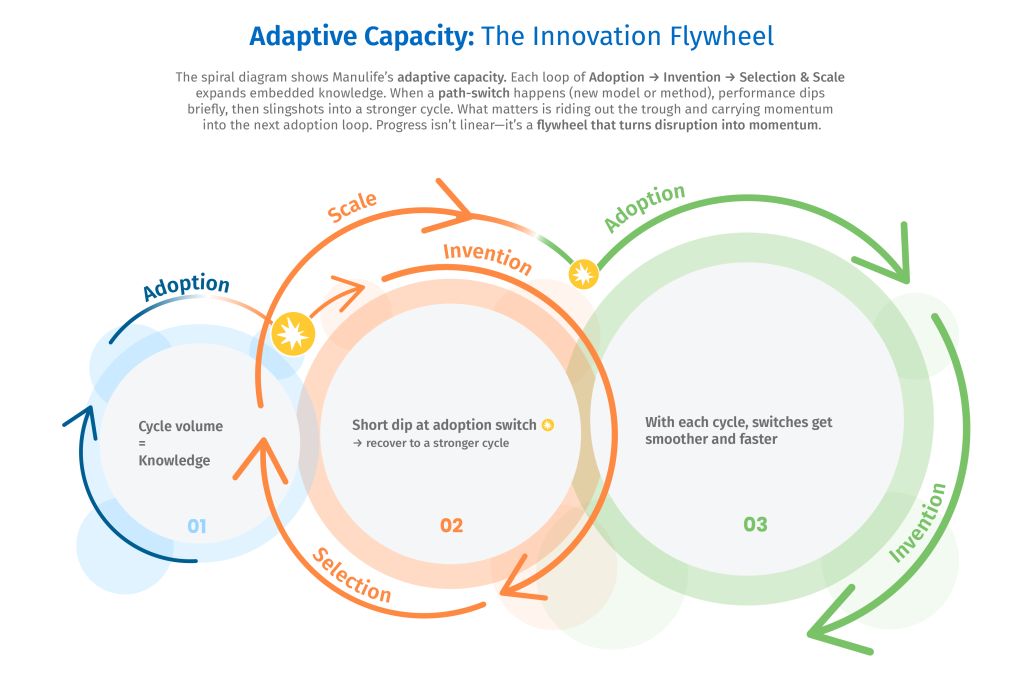
Research underscores why this engine is critical. Prior adoption experience is the single strongest predictor of inventive capacity: organizations learn to invent by first copying. Yet when firms switch paths—moving to new models or methods —performance often dips before it recovers, as old mental models stop fitting the new approach. Adaptive capacity is therefore the discipline of riding out that trough and recovering faster, turning temporary disruption into cumulative learning. Manulife operationalized this discipline through a set of deliberate routines.

Adoption→ taking in new tools, practices, or patterns developed elsewhere, and embedding them into the organization’s routines.

Selection and Scale → filtering what works, embedding it into routines, and scaling proven solutions across the enterprise.

Invention→ creating original solutions internally, without relying on external patterns.

Manulife built this discipline deliberately. With a strong foundation of AI literacy embedded across the company, leadership worked to smooth adoption pathways by normalizing copying as a precursor to invention. Wallis instituted prompt-a-thons and leadership conferences where employee-built tools were showcased, creating a common language of value and risk. These rituals made it legitimate to borrow, refine, and scale what worked—ensuring adoption wasn’t confined to early enthusiasts but cascaded across the enterprise. In Cohen and Levinthal’s terms, this was about continuously increasing the firm’s stock of prior knowledge so that when a path switch came—whether a new model, platform, or application—the organization could absorb and apply it faster.

Secondly, Wallis deliberately designed for safe path-switching. A vendor-agnostic, cloud-ready stack allowed models to be swapped ‘even daily,’ making technology change a managed routine rather than a disruptive reset. Scaling decisions were tied to clear business outcomes—revenue lift, cost savings, risk reduction, or productivity—so that pivots created value rather than noise.

Finally, it embedded selection capacity—the discipline to prune weak ideas quickly and scale winners. Cross-functional forums and outcome-based funding kept the portfolio focused, so absorptive capacity compounded rather than leaked.

Together, these routines formed Manulife’s innovation flywheel: adoption experience generated invention; selection routines filtered the noise; flexible architecture enabled safe path-switching; and the loop restarted with each cycle stronger than the last.

From the outset, the company made responsible AI governance a design choice. In the absence of clear national rules, it created its own responsible AI principles and operating rules to ensure experimentation and deployment stayed aligned with ethical, privacy, and compliance obligations.

Manulife expanded its existing model risk frameworks to address GenAI’s unique challenges—vetting third-party vendors, monitoring outputs for bias or hallucinations, and requiring ongoing performance assessments for every model in production. A cross-functional governance committee reviewed use cases for ethical and privacy risks, aligning policies with evolving global guidelines. Governance was embedded as a living process, not a static policy.

Critically, Manulife treated fast iteration and strong oversight as complements, not trade-offs. Continuous model monitoring—tracking accuracy, drift, and usage—was used to tighten controls in real time. This outcome-based approach allowed models to stay in production as long as they met error and bias thresholds, and to be adjusted or pulled the moment they didn’t. Iteration was welcome, but never at the expense of trust.

This proactive stance enabled Manulife to scale GenAI quickly and responsibly, building confidence with compliance teams, customers, and policymakers, even in the absence of clear regulation. The broader lesson is that firms in sensitive sectors should not treat regulation as a brake. By self-imposing principles, operationalizing oversight, and demonstrating to regulators that innovation can be pursued responsibly, companies can get ahead of uncertainty. For policymakers, the takeaway is equally important: enabling real-time oversight and outcome-based guardrails may achieve safety faster than prescriptive, one-off compliance checks.

Within just a year of embracing generative AI, Manulife achieved broad-based adoption at a speed few incumbents match. Its proprietary assistant, ChatMFC, went from pilot to near ubiquity: within months, 40% of employees were using it monthly, and by early 2025, more than 75% of the global workforce was actively engaged with GenAI tools, training, or use cases. Adoption was not siloed to tech teams; it touched nearly every function, from sales and service to back-office operations.

The impact on productivity was equally striking. In call centers, AI tools shaved 30 – 40 seconds off average call times without lowering customer satisfaction. Across the enterprise, generative AI was no longer a side project—it had become embedded in the daily flow of work.

Customer-facing gains were even more visible. Newer advisors ramped up faster, using AI coaching to practice and refine interactions. Meanwhile, advisors reported that AI freed them to focus on client relationships, creating the unusual outcome of a technology initiative that delivered both efficiency and deeper human engagement.

At the strategic level, the flywheel was spinning. By mid-2025, Manulife had 35+ GenAI use cases in production and 70 more in queue. Early deployments alone contributed an estimated $4.7 million in benefits, while the broader digital transformation program (with AI at its core) yielded over $600 million in 2024 benefits—savings, new sales, and better risk outcomes. Looking ahead, the company projects a threefold return on AI investments over five years. These results affirm that Manulife’s design choices — hands-on executive engagement, outcome-gated scaling, perpetual-beta governance—transformed AI from novelty to institutional capability.

Numbers

$1.6T Assets under management
35MCustomers worldwide
$53BMarket Capitalization
$5.1BNet Income
38kNumber of employees
200Data scientists and engineers embedded across teams
$600mBenefits attributed to digital transformation (with AI as a core part) in 2024.
75+AI use cases deployed by the end of 2025
75%Share of Manulife’s global workforce engaged with GenAI

Download the Report

Also in this week’s edition: How five tariff-exposed industries in Canada are faring

By Shaz Merwat, Energy Policy Lead

As U.S. President Donald Trump hosted Prime Minister Mark Carney and Mexico’s President Claudia Sheinbaum, energy issues loomed in the background amid U.S. concerns about structural deficits in heavy crude. Historically, Canadian barrels competed with Venezuelan heavy crude in key U.S. refining markets—primarily the U.S. Midwest and the Gulf Coast. While Venezuelan volumes have been largely absent for the past decade, shifting U.S. foreign-policy signals suggest that competition could re-emerge.

Why it matters — Trump cannot unwind two core U.S. dependencies

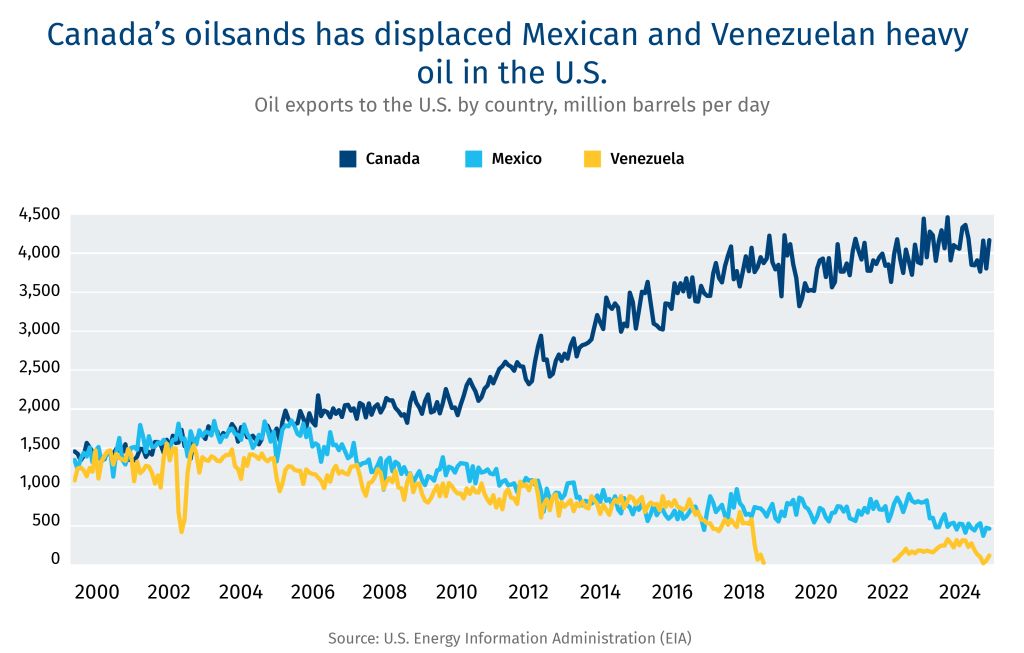
Despite efforts to reshape U.S. supply chains, Washington remains structurally dependent on two things it cannot easily substitute: Canadian heavy crude and Chinese rare earths. Heavy crude is foundational to U.S. refining capacity, and as it stands, the U.S. cannot easily replace Canadian supply: domestic production is overwhelmingly light, and heavy-crude alternatives from Mexico and Venezuela have structurally declined.

These twin constraints limit U.S. leverage and elevate the importance of stable, long-term supply partners. Alberta’s Memorandum of Understanding (MoU) arrives at a moment when U.S. policymakers must balance geopolitical objectives—such as renewed attention on Venezuela—with the reality that Canadian barrels remain irreplaceable in the refinery system.

By the numbers — the heavy-barrel shortfall

  • Mexico: U.S. bound heavy-crude exports have fallen from as high as ~1.7 mb/d in 2005-2006 to roughly ~0.40 mb/d today.

  • Venezuela: heavy-crude exports to the U.S. surpassed 1.5 mb/d in the early 2000s; today U.S. exports are ~0.1 mb/d.

  • Canada: The dominant exporter to the U.S., with around four million barrels of crude shipped south of the border daily. The Canada-Alberta MoU proposed 1 million bpd pipeline, plus 300,000–400,000 bpd from Trans Mountain together create a sizeable uplift in export capacity—primarily oriented toward Asia.

The bigger picture — if Venezuela returns, does Canada lose leverage?

A Venezuelan “return” would likely be slow, expensive and politically fragile. Refinery contracts, debt obligations and upstream infrastructure all require rebuilding. Even under a regime change, investors will demand decade-long stability before committing capital.

Mexico faces similar limits: Sheinbaum inherits state-owned Pemex’s declining production and mounting debt, meaning a rapid restoration of heavy-crude exports is unlikely.

This leaves Canada as the only credible, scalable source of heavy supply. The MoU’s accelerated timelines—carbon-pricing equivalency, methane rules and Pathways carbon capture, utilization and storage project—signal Ottawa and Edmonton are preparing for sustained output growth.

Bottom line — the MoU prepares Canada for a more competitive heavy-oil landscape

As Canada builds westward capacity through TMX and the proposed 1 million bpd pipeline, more barrels are positioned for Asia rather than the U.S. That shift inevitably forces U.S. policymakers to consider how they will secure heavy-crude supply in the coming decade—including whether to re-engage Venezuela in a more meaningful way.

For Canada, today, this is less of a challenge. The MoU ensures that, regardless of how U.S. policy evolves, producers have diversified market access and greater resilience. If Venezuelan volumes rise, Canada will have optionality; if they do not, Canada remains the primary supplier to U.S. refiners.

Either way, the middle of the next decade is shaping up to be a far more dynamic heavy-oil environment—and the MoU positions Canada to navigate it from a position of strength.

  • Canada entered the trade war in better shape than previously thought. StatsCan revised GDP for each of the past three years up by about half a point.

  • The Canadian government served automaker Stellantis a notice of default for shifting production of the Jeep Compass from Brampton, Ont., to Illinois despite receiving hundreds of millions in incentives in recent years. “Stellantis is on the hook,” said Industry Minister Mélanie Joly. “Defending these jobs means defending Canada’s economic backbone.”

  • While speaking to business leaders in Ottawa, Japan’s Ambassador to Canada Kanji Yamanouchi noted the role energy could play in future Canada-Japan relations. “If we need energy from a county which is difficult to trust or the country which we can trust,” he said, “it’s much better for us to have trade with a country with trust.”

  • Despite $500 million in government loans, Algoma Steel is laying off 1,050 workers from its plant in Sault Ste. Marie, Ont., in the face of “extraordinary and external market forces.”

The RBC Economics team did a deep dive this week: ‘Tracking the impact of U.S. tariffs on five targeted Canadian industries.’

Overall, we track moderately lower manufacturing production and employment in most of the highly tariffed sectors in Canada. These trends have also been much less volatile than international trade flow, that were heavily distorted around when tariffs were implemented (as U.S. importers front-ran purchases to build pre-tariff inventories in Q1.)

Selling prices among Canadian manufacturers have generally held up, with foreign buyers paying the bulk of initial tariff costs, but have led to declining U.S. corporate profits this year. We haven’t seen systemically higher U.S. consumer prices but still expect those will show up more significantly in 2026.

Here’s a breakdown of how five key Canadian industries have fared in their production, employment and selling prices, amid rising U.S. tariffs.

Read the full report here.

In a recent episode of DisruptorsJohn Stackhouse takes listeners to Quebec to meet former premier Jean Charest and Eric Desaulniers, founder & CEO of Nouveau Monde Graphite. Together, they explore how a new graphite mine at Matawinie and an integrated refining plant at Bécancour aim to connect the full chain from rock to anode material in one province—and what that could mean for Canada’s role as a trusted supplier of critical minerals to its G7 allies.

From China’s dominance in graphite refining to Quebec’s push for all‑electric mining fleets powered by hydro, this episode looks at how Canada can move from “quarry” to strategic partner in a re‑wired global economy.

The Canada-Alberta Memorandum of Understanding (MOU) sets the stage for the province to become a continental energy superpower across both traditional and non-traditional energy forms. A key piece of the MoU centres around a bitumen pipeline project provided Alberta proceeds with several low-carbon projects and programs in parallel.

As it stands, the province’s major projects inventory consists of almost 1,000 projects valued at $167 billion. Incorporating a new major bitumen pipeline, plus meaningful growth in data centres and accompanying power generation and distribution, could raise that figure to more than $400 billion.

Here are five themes that stood out to us from the MoU:

1. A clear roadmap: The level of specificity within the document gives the MoU teeth. Unlike most MoUs that usually focus on outlining broad contours of areas of co-operation, this MoU sets out clear guidelines and targets.

2. Tight deadlines: The accelerated timelines suggest an urgency that puts the onus on Alberta to deliver, quickly, on several climate policies in order to secure expansion of its fossil fuel sector. Most of the key action items required on the Alberta side (carbon pricing equivalency, methane equivalency, tri-lateral Pathways MoU) have an April 1, 2026, deadline. It also brings an urgency in British Columbia where Premier David Eby would have to make some quick decisions on a new pipeline (and the proposed expansion of Trans Mountain pipeline) across his province.

3. A new bitumen pipeline: The success of the MoU, especially in the context of a new, large bitumen pipeline, revolves around the historically challenged duty to consult and the Build Canada Act to bypass future legal challenges, which at this point appear almost certain.

4. A 700,000-bpd proposition:
The Alberta government is expected to remain the central pipeline proponent until all parties—including Indigenous groups— are on board to reduce the possibility of delays and cost overruns that has plagued past pipeline expansions. In the nearer to mid-term (next five years), pipeline expansions across Enbridge’s Mainline and the federal government-owned Trans Mountain will add up to 600,000 to 700,000 barrels per day in added capacity, which should be enough to support growth for the remainder of this decade.

5. Low-carbon boost: The space given to non-oil and gas commentary such as a substantial expansion of power generation for traditional heavy industry, but also around data centres, interties, and domestic supply chain capture (e.g., Canadian steel and pipeline), suggests that the federal government is creating linkages to ensure a potential Alberta boom cascades across industries and provinces.

What’s being overlooked:

  • The increase in Alberta’s TIER price to $130 per tonne does not specify a date. The Canadian federal benchmark was set to cross that threshold in 2027/2028. Current Alberta TIER prices have since risen to $25-27/tonne (from $17-18/tonne just a couple weeks ago) according to RBC’s Environmental Markets trading desk, implying a 5x return if prices reach the threshold level;

  • The MoU makes specific reference to include enhanced oil recovery (EOR) as part of an extension of existing federal investment tax credits for carbon sequestration, utilization and storage (CCUS). The economic uplift from the ability to monetize the additional oil stream can be meaningful. According to a University of Calgary study, certain Alberta EOR-CCUS reservoirs are economically viable at a carbon price of $60/tonne. In comparison, a Colorado School of Mines study suggests that in the U.S. allowing EOR within the 45Q tax credit— designed to accelerate carbon capture, utilization and storage—could provide an additional economic benefit of between US$95-$120 per tonne of CO2e.

  • Both the construction of a bitumen pipeline and construction of the oilsands-led Pathways carbon capture, utilization and storage (CCUS) project are preconditions of one another. Yet, that precondition is dependent upon the commencement of ”Pathways Phase 1 Projects” (22-million tonnes out of Pathways’ total 50-million tonne capacity). It’s unclear if that references the sequestering (12 million tonnes) or emissions reductions (10 million tonnes) initiatives.


    Shaz Merwat is Energy Policy Lead at RBC Thought Leadership

This op-ed originally appeared in the Toronto Star


Canada has entered a new space age.

The Carney government announced a historic commitment of $528.5 million to European Space Agency (ESA) programs, all of which will return to Canadian companies, enabling them to build deeper partnerships with European space and defence projects and companies.

It also says to the world that Canada wants to be a serious space player again, and to partner with plenty of allies beyond the United States.

One big step for Canada, yes, but compared to the even larger new space investments that other countries are making, it is still only one small step for humankind. To be a major global space player again, Canada needs to do much more, and do it quickly. To thrive in this new space age, we will need far more private capital and entrepreneurs than we’ve ever seen in our country. We need to attract and keep space investors (and there’s far more than Elon Musk out there), and ensure they’re generating capital, ideas, technology and high-value jobs in Canada — something other emerging space powers, from India to Japan to Germany, are already doing.

Our new report, A Higher Orbit: How Canada can build and finance a bolder space strategy, recently published by RBC Thought Leadership, lays out this new space imperative for Canada. It can’t be overstated: our sovereignty, Arctic defence, tech capabilities and economic prospects are all at various degrees of risk. Indeed, at a time when Canada is looking north, west and east, we need to look up, too — with much more ambition.

Let’s start by reconciling with the ground we’ve ceded. Canada was the third nation to go to space, in the 1960s, and for decades a pioneer and partner for our allies. Then we lost our way. Over the past decade, our space spending flatlined and were surpassed by numerous other countries.  Today, even the Netherlands spends a greater percentage of GDP on spacethan Canada.

Budget 2025 aimed to relaunch Canada’s space ambitions, quite literally. In addition to the ESA announcement, the budget allocated $182.6 million for domestic orbital launch capabilities, most likely to build two Atlantic Canada spaceports. Little else matters if we can’t launch our own rockets and vehicles into space, which is the case today. Until we do, we will be a passenger on SpaceX and other countries’ rockets — and beholden to their laws, timelines, and priorities.

Once we have Canadian controlled launch, we see a bold decade ahead in which Canadian satellites can join the front of the pack in earth observation and communications. Those will be our eyes and ears on the Arctic, and for Canadian interests everywhere. They also will be critical to our evolving security alliances and protecting our sovereignty. This is where elbows up needs to become heads up.

Beyond national defence, our research shows significant economic potential, touching pretty much every sector. The global space economy, led by the U.S. and China, is on course to triple in value to $1.8 trillion (US) over the next decade. Japan, Germany, India, South Korea and the United Arab Emirates are all gearing up national space programs to capture their share of that prize.

Corporate Canada needs to look up, too. As the saying goes, every company is now a space company. So, too, is every digital citizen. Whether you know it or not, your data travels, on average, 40 times a day through low orbit — and right now, that’s not secure as recent research indicates that satellites may be broadcasting up to half of their traffic through unencrypted channels.

Modelling from RBC Thought Leadership shows the need for roughly $12 billion in new capital for Canadian space ventures over the next decade, which in turn can generate more than $20 billion in annual industry revenue.

To get there, we will need a bolder strategy. That starts with a procurement pathway that says to the world what we’re willing to spend over the next five-10 years. If Canada commits 5 per cent of our enhanced 5 per cent NATO commitment to space, the government will be able to map out $7.5 billion a year in space spending — that’s enough to catapult Canada back into the peloton of advanced nations, less reliant on the U.S. and China. Without long-term commitment, global investors — the ones who can multiply that public investment — will not see Canada as a serious player.

Next, the upcoming Defence Industrial Strategy needs to lay out which sectors within space are top priotities. Much of this can be technologies that we are already excellent at – such as synthetic aperture radar and space robotics – but it will need to include new areas, such as counter-space systems, as well.

In addition to security and economic benefits, space monitoring technologies are critical to mitigating climate change, from melting ice conditions to changing water systems and shorelines. Quite urgently, space tech needs to play a leading role in our ability to predict, prevent and fight wildfires — a capability we can export to our allies, too.

Then there’s the Buy Canadian mandate. We can actually do more, and faster, in space than on Earth. We have globally respected companies, from big players like Brampton’s  MDA Space and Telesat in Ottawa to fast-growing innovators like Toronto’s Kepler and Montreal’s GHGSat, which can all scale more rapidly for global markets.

Recently, at SpaceBound, the annual forum organized by Space Canada, we were encouraged to hear Defence Minister David McGuinty and Industry Minister Melanie Joly share more of the government’s ambitions for space. Both ministers along with senior military officials carried that message to the Halifax Security Forum.

In Ottawa, we also convened a private roundtable with companies and investors who said much more needs to be done. Canadian investors — from private equity to pension funds — need to sharpen their space skills, as we’re seeing instutional investors do in the U.S. and Europe. Federal financial institutions like Export Development Canada and Business Development Bank of Canada need to make space a greater priority within their new strategies for defence finance. And our colleges and universities — long champions of space innovation — need to up their games in both the commercialization of research and training of a new generation of space pioneers.

The moment for that is now. When Jeremy Hansen joins the Artemis II mission to the moon this winter, he will be the first non-American to ever leave Earth’s orbit. It can be a defining moment, to all Canadians, to say to outselves and to the world: we’re going to make a lot more space for Canada. Just look up.


Artificial Intelligence is poised to reshape how value is created across Canada’s economy. To understand that shift, RBC Thought Leadership interviewed more than two dozen firms that are on the frontlines of building or deploying AI for Bridging the Imagination Gap: How Canadian Companies Can Become Global Leaders in AI Adoption. The report distilled the patterns that emerged from those conversations.

Building on that report, the series of case studies go a level deeper: following one company’s journey through specific problems, pivots and opportunities, helps illustrates the strategic choices and policy conditions that turn technical promise into economic and societal value.

Internal validation matters. Schneider Electric proved AI’s value both internally and in customer offers. Starting with supply chain projects that freed up millions to invest in predictive tools that reduced downtime. This internal credibility gave the company the confidence to embed AI directly into products and services.

Governance can be an advantage. By treating the EU AI Act as a design specification rather than red tape, Schneider built compliance into its MLOps machine-learning pipeline. This not only eased adoption internally but also created a “trust premium” with customers.

Centralization drives scale. A 350-person AI Hub concentrated scarce expertise, standardized tools, and linked directly to executive decision-making, turning AI into a repeatable capability rather than scattered experiments.

Future readiness requires sovereignty and edge leadership. Focusing on trust and compliance, Schneider is positioning itself to thrive in a world where data localization and sovereignty increasingly shape industrial competition.

When most people picture electronics manufacturing, they think of smart chips, GPUs, CPUs and capacitors. But it’s the hidden circuitry under the hoods that makes our world hum efficiently : a lattice of switches, sensors, drives, control panels, and interconnected IoT systems that silently, safely and reliably switch on lights, move elevators and keep servers cool.

Schneider Electric, the 189‑year‑old French manufacturing group, is the giant behind that invisible architecture. With €38.2 billion in annual revenue,1 177,000 employees, and operations in more than 100 countries, it manufactures the circuitry and control systems that power buildings, factories, grids and data‑centres.

2Schneider has maintained operations in Canada3for more than 100 years, with roughly 3,000 individuals across 10 provinces. Its products are featured in 40% of residences and 50% of commercial buildings in Canada.4

Schneider’s value to the global economy is twofold: it supplies5 the hardware and software that makes modern life possible and shepherds one of the world’s most distributed industrial supply chains6.

Yet even Schneider was not immune to the pandemic’s shock waves. By late 2020, COVID-19’s stop-start demand swings left warehouses bulging with unsold stock while plants struggled for parts. Across a network of 162 factories7, roughly 300,000 stock-keeping units (SKUs)8 and around revenues fell 6.4% organically9 in the first quarter of 2020, year-on-year, putting billions at risk.

Faced with this disruption, Schneider had to decide whether to keep tweaking legacy systems or take a chance on machine learning. They chose the latter.  Starting small, at one its North‑American switch‑gear plants, Scheider’s AI team trained a gradient‑boost model on three years of order history, macro indicators and pandemic mobility data. Six weeks later, there were double‑digit gains in forecast accuracy, safety‑stock days fell by a third, and the pilot resulted in considerable savings. The result became the catalyst for further exploring AI capabilities, that delivered great results in the energy management space. The strategic move to scaling AI initiatives globally resulted in creating Schneider’s centralized AI Hub.  

How did Schneider Electric transform multiple AI pilots into a global capability, and lead in enterprise AI deployment? To find out, RBC Thought Leadership sat down with Cédric Bureau, Senior Principal Product Manager for Artificial Intelligence at Schneider Electric, to unpack four key strategies the company implemented while scaling its AI capabilities, and the insights they offer today.

It clicked when we saw an internal AI pilot’s results. We weren’t just solving problems—we were building something that offered new opportunities for us and our customers — Cédric Bureau

Internally, under Schneider’s AI-at-scale program, the company rolled out machine-learning models across supply-chain planning and the factory floor; computer-vision and vibration analytics began feeding AI information and predicting failures, lifting throughput and uptime, and enhancing energy efficiency. In parallel, Schneider put AI into everyday enterprise support tools—HR and engineering chatbots and copilots, and enhanced energy-efficiency software—so teams had working tools, not just pilots.

The step-change came when those capabilities moved into customer offers. An anomaly-detection model first used to monitor building thermal performance and detect abnormal energy use now powers Schneider’s bespoke EcoStruxure Building Advisor10, which flags abnormal consumption and tunes HVAC automatically. By shifting from manual, Excel-based reporting to AI-powered building energy modelling, customers have achieved measurable benefits—including considerable operating cost savings across 50 sites and 2–5% reductions in energy consumption.

The two tracks now reinforce each other. Schneider’s AI-at-scale strategy sets the playbook—how pilots move to shop floor, enterprise tools and into products—and a centralized AI Hub runs it, rotating experts across projects, standardizing tooling and governance, and building enterprise-wide AI know-how. That pairing makes the hand-off between AI development and the factory floor routine: models that prove themselves are industrialized, documented and shipped into offers, while product telemetry feeds fresh data back for the next round. Internal efficiencies realized fuel further R&D, with every factory win becoming a candidate feature in a future product.

Takeaway: Use the enterprise as a live test bed and consistently build both technology and human capabilities to innovate with AI. When an AI solution delivers value inside the business, it provides credibility and de-risks similar use cases. Being able to claim “we run this at scale ourselves”improves sales prospects with cautious customers.


“AI is now past the hype cycle inside the company—it’s part of daily work habits”—Cédric Bureau

Scattered pilots could never keep pace with a network of 162 factories across five continents. So, in late 2021, Schneider launched a global AI Hub11—across three locations: Boston, Paris and Bangalore. Within 12 months the hub grew to around 350 data scientists, machine learning operations (ML Ops) engineers, product managers and an in‑house compliance squad. To ensure the hub can move at pace with technology development trends, it’s headed by a Chief AI Officer who reports to the executive committee, ensuring strategic bets on AI are scrutinized at the C‑suite level.

By elevating AI initiatives into a standalone enterprise function, Schneider pulled them out of isolated IT corners and gave them the strategic visibility needed to reach production. This centralized, AI-first organizational design enabled four key advantages:

1. Hub-and-spoke coordination: The centralized AI Hub supplies the technical backbone—algorithms, data infrastructure, compliance tools and features a team of AI product managers, each dedicated to a set of business units to work with marketing managers with clear understanding of local and/or industry specific challenges. This split of roles prevents duplication, ensures solutions are tailored to operational needs, and speeds up the rollout of AI projects across the enterprise.

2. Paved-road development: All AI projects share the same basic set of tools and processes—like standard methods to gather data, store and organize models, and perform quality checks. Think of it like using a standard recipe: following it takes some extra work at the start, but once you’ve done that, making adjustments or improvements becomes simpler and faster. Because as these processes are consistent across Schneider, teams don’t have to constantly reinvent the wheel. Netflix and Spotify use a similar concept, calling it a ‘paved road’, meaning a clear, straightforward path that makes developing technology quicker, safer, and easier.

3. Talent attraction and retention: The AI Hub offers a compelling career path and collaborative environment. Schneider can recruit top AI talent from Big Tech companies and retain skilled experts significantly longer than comparable industrial organizations.

4. Built-in compliance capability: Schneider’s compliance experts are integrated within the AI Hub. Every AI project undergoes a standardized risk assessment and bias testing before deployment, ensuring adherence to regulations such as the EU AI Act and laying the groundwork for the ‘compliance-by-design’ approach detailed further in the case.

Schneider is not alone in this architecture. Bosch’s Center for AI and the Siemens AI Lab follow a similar hub‑and‑platform pattern

Takeaway: Success comes from treating AI as a core enterprise function—appointing clear leadership, concentrating expertise, and serving business units as internal clients.


While talent solved capacity; trust solved adoption. When Brussels drafted the world’s first horizontal AI law, Schneider decided regulation would be a design spec, not a hand‑brake.” —Cédric Bureau

When the draft EU AI Act first circulated, many industrial peers froze projects, waiting to see how onerous the rules would become. In contrast, Schneider’s AI Hub embedded a ‘compliance squad’—lawyers, data‑privacy officers, risk engineers—directly into ideation and sprint teams. Every new use‑case begins with a 10‑question risk‑rating questionnaire that maps potential AI applications to the Act’s taxonomy (minimal, limited or high‑risk). Proposals assessed as high risk trigger up‑front data‑anonymization, mandatory human‑oversight12 plans and bias‑test requirements before development begins.

Schneider’s AI deployment pipeline itself enforces the law. Schneider’s AI policy requires that all use cases undergo a two-stage compliance review. First, use cases are scanned for risks across ethics, design, IP, data security, and governance. Then, those risks are mapped into a treatment plan—identifying owners, setting mitigation actions, and tracking accountability—so that compliance is not just a checklist but a living process. This AI Policy ensures alignment with EU AI Act Articles 1013 (data & bias), 11 (technical documentation) and 14 (human oversight). Once a model is live, the platform’s monitoring dashboard logs performance drift and automatically opens an incident ticket if thresholds are breached, satisfying Articles 72‑73 of the act on post‑market surveillance.

By having compliance experts on the team, Schneider’s engineers treat concerns like bias mitigation, data anonymization, and cybersecurity—as design inputs, not obstacles. This is an organizational cultural shift—developers are guided to think about ethical/legal constraints from the start rather than scramble to retrofit fixes later.

These extra steps yielded  three commercial dividends:

1. Faster sales cycles :Clients in heavily regulated industries often demand proof of AI governance; handing them an ‘AI‑Act‑ready’ dossier trims procurement reviews.

2. Trust premium: Positioning Schneider’s solutions as ‘regulation‑ready’ differentiates them against rivals who still treat compliance as paperwork to be done later. 

3. Build once, comply everywhere: Treating EU standards as the floor cuts duplication across markets and future‑proofs the portfolio against new laws—Canada’s Bill C‑27 included. As it stands, Schneider maintains compliance with standards across the world, including the Institute of Electrical and Electronics Engineers (IEEE14), International Electrotechnical Commission (IEC15) and the Organisation for Economic Co-operation and Development (OECD16).

Take‑away: By baking the rulebook into the codebase and deployment processes, Schneider converts the cost of compliance into a strategic advantage.


“We knew we’d succeeded when operators started asking us for AI models, not because management pushed them, but because workers saw firsthand how they improved their jobs.” — Cédric Bureau

With Schneider’s talent (AI Hub) and compliance guardrails (compliance by design) in place, it established the four-gate funnel to manage ideas. Every AI use case, from factory forecasting to customer-facing microgrid control, flows through the same four stages. At each gate, a go/no-go decision is made based on business case and feasibility. Pet projects without ROI, or projects deemed too high-risk are stopped early. Winners move quickly, because approval chains, tooling, and documentation are built in from the start.

Gate 1: Data owners co-develop a one-page problem brief with the AI Hub—qualifying return on investment (ROI), carbon impact, and passing a 10-question risk scan. Key technical challenges are identified, and sandbox phase on masked data with built-in bias and robustness testing is done to evaluate feasibility and to assess the best technology to overcome such challenges.

Gate 2: A Minimum Viable Product development and real-life deployment. Plant operators co-design dashboards and evaluate the solution in as-close to real-life-conditions as possible. Critically, the funnel separates trying from scaling—preventing the common trap of endless proof-of-concepts.

Gate 3: Solutions are hardened for production: user interfaces, documentation, and business integration. Models are migrated onto the Hub’s MLOps platform, and the compliance team completes the EU AI Act technical dossier.

Gate 4: Live dashboards track ROI, drift, and incident logs. Red flags auto-escalate to both the site lead and AI product team. Some models retrain automatically based on performance thresholds.

Takeaway: Human-centric design extends through the development, implementation, and operational phases of AI applications—Schneider doesn’t treat business stakeholders as merely AI end-users. They’re co-owners of AI solutions.

This cultural strategy scales, too. As small tools proved helpful, trust grew. Engineers adopted AI as naturally as any other tool. Plant managers began expecting data-driven insights in meetings. Executives used AI dashboards to spot margin opportunities. The result wasn’t just tech fluency—it wasa mindset shift. People no longer see AI as opaque or threatening—they understood where it fits, and how it can help them do better work.

Internally, Schneider backed this shift with a firm-wide initiative to elevate the AI knowledge of all employees through awareness/training programs, regular data & AI webinars, and the publicly available AI at Scale podcast.

Schneider Electric has thrived under Europe’s regulation-first approach, aligning early with the EU AI Act and embedding compliance into its operating model. This strategy has given it a competitive edge: customers see its solutions as “regulation-ready,” and regulators view the company as a trusted partner.

But the future of regulation may expose the company to competing paradigms, in which the EU resides in the middle. In the United States, a market-led approach prioritizes rapid innovation, with looser rules and fewer documentation burdens. China, meanwhile, pursues a state-steered model, demanding tight government oversight and strict localization of data. Each system pulls global players in different directions, and supply chains are increasingly split along regulatory lines.

Numbers

€38.2 b 2024 revenue
€4.3 bNet 2024 income
177 000 Number of employees
162Number of manufacturing sites, globally
1836Year of founding, in Le Creusot, France
100+Number of countries Schneider Electric maintains operations in     
5%Portion of revenue invested in R&D
20,000Number of active, global patents
1stRanking in Corporate Knights Global 100 most sustainable corporations

Download the Report

By John Stackhouse

The much-pilloried Canada-U.S.-Mexico trade agreement was signed seven years ago this weekend—on November 30, 2018. A year later, it was amended to address rules of origin for autos, digital trade, IP, dairy and, who could forget, a sunset clause. 

We can all do the math. The December 10, 2019 amendments set in motion a 16-year term for the agreement, with a mandatory review every six years. Which means we’ll see more of a requiem than a birthday bash next week when Mark Carney is in Washington to help kick off the 2026 FIFA World Cup. 

But don’t bury CUSMA just yet.

Despite the U.S. President’s freeze on negotiations, officials from both countries are talking every day and laying the groundwork for what will be an intense 2026. Not many insiders seriously expect CUSMA to go away; they’re working on changes—modifications, enhancements, renovations, depending on your point of view—that will continue to change the fabric of continental commerce.

Here’s what’s worth noting about CUSMA and its first five years (as it didn’t come into effect until 2020):

  • Canada-U.S. trade in goods is up about 23%;

  • Canada remains the U.S.’s top customer, buying US$440 billion of goods and services in 2024, or 14% of America’s exports;

  • U.S. direct investment in Canada hit $684 billion last year, up from about $400 billion; 

  • Canadian direct investment in the U.S. has doubled to $1.3 trillion;

  • between 2020-2024, automakers announced nearly US$175 billion in new investment in North American production, as they reshored supply chains to meet those rules of origin.

  • Canada-U.S. energy and agri-food trade has also surged in the 2020s, thanks in part to the certainty delivered by CUSMA. Energy is our biggest export to the U.S. — by far — worth $170 billion in 2024, up 50% from 2018.  

That energy number may be the biggest message Carney takes to Washington. Not by coincidence, he locked arms this week with Alberta Premier Danielle Smith to state boldly to Canadians, and the world, that the country will be exporting a lot more oil to Asia. The U.S. government, and many U.S. shippers, would prefer that crude flow south. But now Carney, with Smith’s help, can exert more leverage in his Washington trade talks.

Canada always tried to keep energy (and water) off the main trade table, which is focussed more on manufacturing. But in this new age of energy security, it may be what Canada needs more than ever to bend the ball like Beckham.

  • Canada will slap 25% tariffs on about $10 billion worth of steel imports starting December 26, to support a domestic industry that has been battered by U.S. tariffs and cheap Chinese steel.

  • Canada Inc. is shrugging off tariffs. Operating profits of Canadian corporations rose 3.8% (the fastest pace of growth in two years) to $200 billion in the third quarter, according to Statistics Canada.

  • The U.S. will export a record 10.7 million tonnes (+40% YoY) of liquefied natural gas (LNG) in November, which is expected to drive down the price of gas in Asia and Europe over the winter.

  • Though relations remain chilly, Mark Carney confirmed that he spoke to Donald Trump this week—but he wouldn’t say if they talked trade. “I don’t want to over signal things…they haven’t re-engaged yet,” said Canada’s PM, who will be in Washington next week for a World Cup event alongside the U.S. President.

  • India is looking to both ramp up trade with Mexico and be spared the tariffs that President Claudia Sheinbaum plans to levy on a number of Asian countries.

Compromise.

That’s how the world’s leading news organizations summed up COP 30, the United Nations climate conference that just ended in Belém, Brazil. A sampling;

“A climate compromise” — Le Monde (France)
“Mixed verdict” — The Times Of India (New Delhi)
“Fragile deal” — The New York Times
“Historic finance boost” — O Globo (Brazil)
“Progress on money, standstill on oil, gas, coal” — DER SPIEGEL (Germany)
“Vulnerable nations decry lack of fossil-fuel phaseout” — Al Jazeera Media Network (Qatar)
“Multitrao consensus, showcasing unity” — China Daily (Beijing)

The mutirão spirit, or working together, was as good as the conference could get, given it had compromise at every turn. Here’s what mattered most in the end:

  • Commitment to a Just Transition facility, aimed at supporting groups and communities most impacted by climate action

  • Commitment to triple adaptation finance, although no clear path to do so

  • 80 counties called for a roadmap to phase out fossil fuels, fewer than expected

  • New push for oceans-based solutions

  • New emphasis on “information integrity” to combat disinformation on climate

  • No significant agreements on deforestation, a setback for many given the summit’s location in the Amazon basin.

COPs (or Conference of the Parties who signed the UN climate framework) tend to end in a mix of commitment and disappointment. This one was no different — although given its milestone status and location in Brazil, home to the first Earth Summit in 1992, it fell short of most expectations. Perhaps that’s not surprising, given the state of geopolitics and the global economy.

Turkiye will host COP31 next year, while Australia will lead the negotiations. Both countries were vying for the lead role, and agreed to share the spotlight.

Another compromise!


John Stackhouse, Senior Vice-President, Office of the CEO, RBC