

 EN
EN 



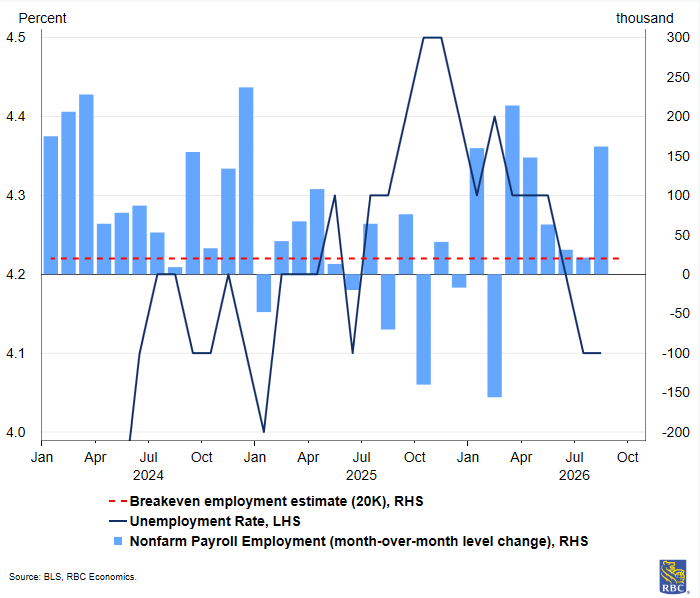
Next week is packed with data, capped off by the September employment report on Friday. We do not expect the labor market data to change the prevailing narrative — we are not concerned about the labor market. Nonfarm payrolls have been printing well above our estimate of breakeven employment (+20k), pushing the u-rate lower since the start of the year.
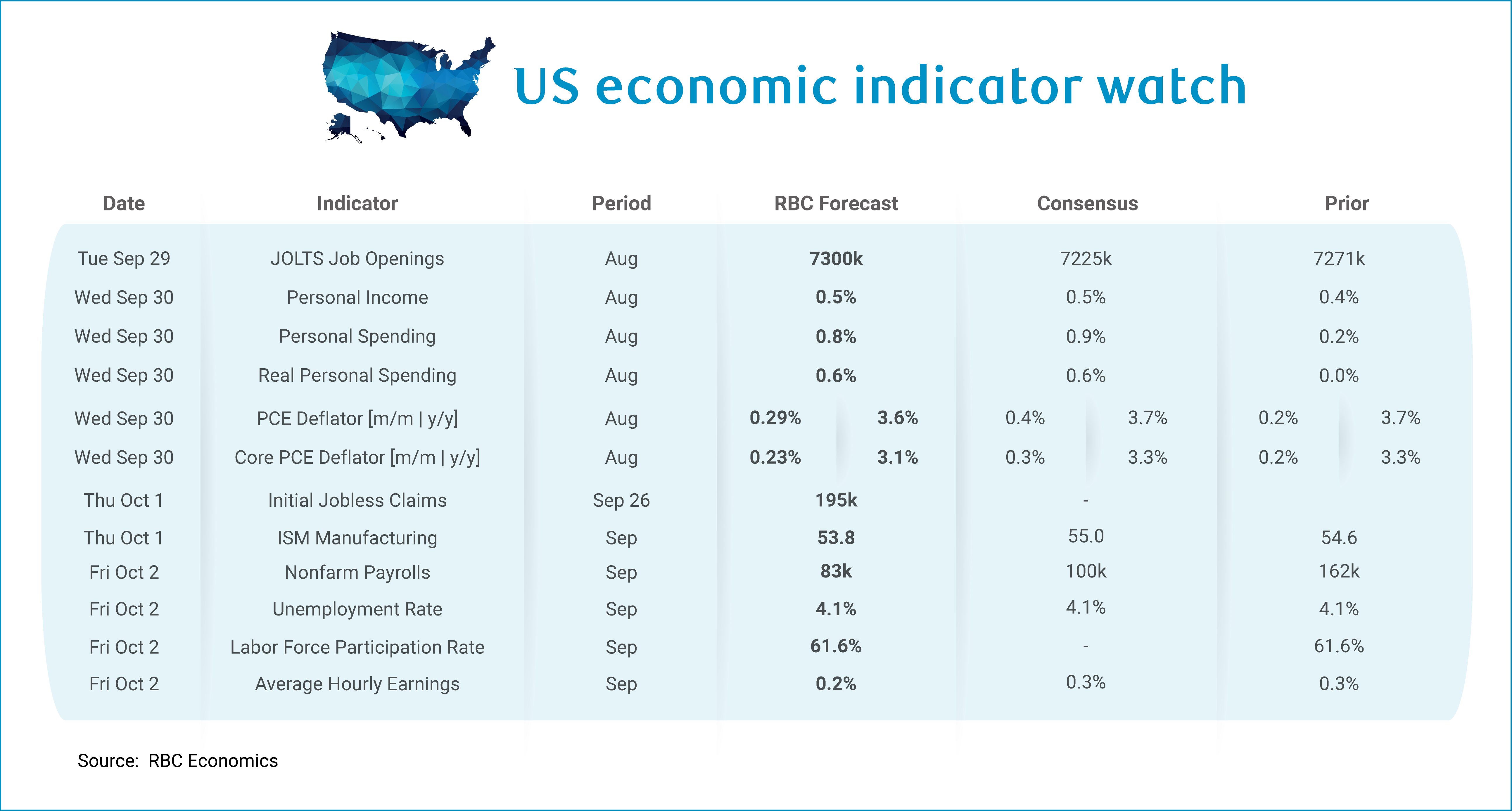
We expect another solid 83K print in September as job gains broaden beyond health care into the goods sector. Netting out construction hiring — which has been supported by the AI buildout — goods sector hiring has not fully recovered jobs shed during the onset of the 2025 trade war. A backdrop of continued retirements, extremely low layoffs (claims drifted lower into September), and minimal immigration is expected to keep the unemployment rate low at 4.1%. Importantly, the trend of slowing wage growth (3.1% y/y) is overshadowing a better measure of spending power: average weekly earnings (i.e., take home pay), which ticked up to 3.7% y/y in August.
Wednesday’s BEA personal income and spending report will offer important clues on consumer health. After a blowout retail sales release, we expect real personal spending rose 0.6% m/m in August, suggesting consumers continue to spend despite price pressures. Services spending remains exceptionally strong and should hold up in August: restaurant and bar spending popped—and not just due to inflation. Financial services and insurance should contribute meaningfully on the back of a 3% m/m uptick in the S&P 500. Health care spending will continue to grow due to an aging population. At the same time, lower- and middle-income households are increasingly relying on credit to fuel spending, with non-mortgage interest payments as a share of disposable income teetering just below the 2.8% threshold that has preceded the three pre-COVID recessions. The K-shaped economy remains in effect and we do expect to see a drop in the personal saving rate to 2.7%.
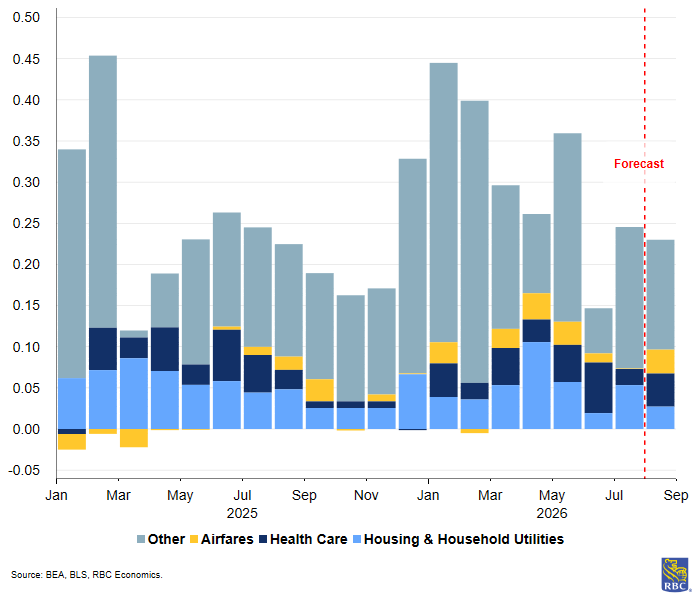
With inflation risks rising, the August PCE print will draw close attention. We expect to see that core PCE rose 0.2% m/m and headline PCE up 0.3% m/m. The PPI components that matter most for core PCE — specifically medical care services — were largely benign but will be offset by airline fares. With the release, methodology changes to three PCE deflator series will go into effect. The update is expected to bring a downward shift to the annual pace of PCE inflation, but this should not be mistaken for a sign of disinflation ahead.
Components that matter most for PCE inflation were mixed in August
2026 Payroll acceleration pushing the u-rate lower
About the authors:
Mike Reid is Head of US Economics at RBC. He is responsible for generating RBC’s US economic outlook, providing commentary on macro indicators, and producing written analysis around the economic backdrop.
Carrie Freestone is a Senior US Economist at RBC. She is responsible for generating RBC’s US economic forecasts across GDP, employment, and inflation, and providing macro commentary through publications, presentations, and the media.
Imri Haggin is an US Economist at RBC, where he focuses on thematic research. His prior work has centered on consumer credit dynamics and treasury modeling, with an emphasis on leveraging data to understand behavior.
This article is intended as general information only and is not to be relied upon as constituting legal, financial or other professional advice. The reader is solely liable for any use of the information contained in this document and Royal Bank of Canada (“RBC”) nor any of its affiliates nor any of their respective directors, officers, employees or agents shall be held responsible for any direct or indirect damages arising from the use of this document by the reader. A professional advisor should be consulted regarding your specific situation. Information presented is believed to be factual and up-to-date but we do not guarantee its accuracy and it should not be regarded as a complete analysis of the subjects discussed. All expressions of opinion reflect the judgment of the authors as of the date of publication and are subject to change. No endorsement of any third parties or their advice, opinions, information, products or services is expressly given or implied by Royal Bank of Canada or any of its affiliates.
This document may contain forward-looking statements within the meaning of certain securities laws, which are subject to RBC’s caution regarding forward-looking statements. ESG (including climate) metrics, data and other information contained on this website are or may be based on assumptions, estimates and judgements. For cautionary statements relating to the information on this website, refer to the “Caution regarding forward-looking statements” and the “Important notice regarding this document” sections in our latest climate report or sustainability report, available at: https://www.rbc.com/community-social-impact/reporting-performance/index.html. Except as required by law, none of RBC nor any of its affiliates undertake to update any information in this document.

