

 EN



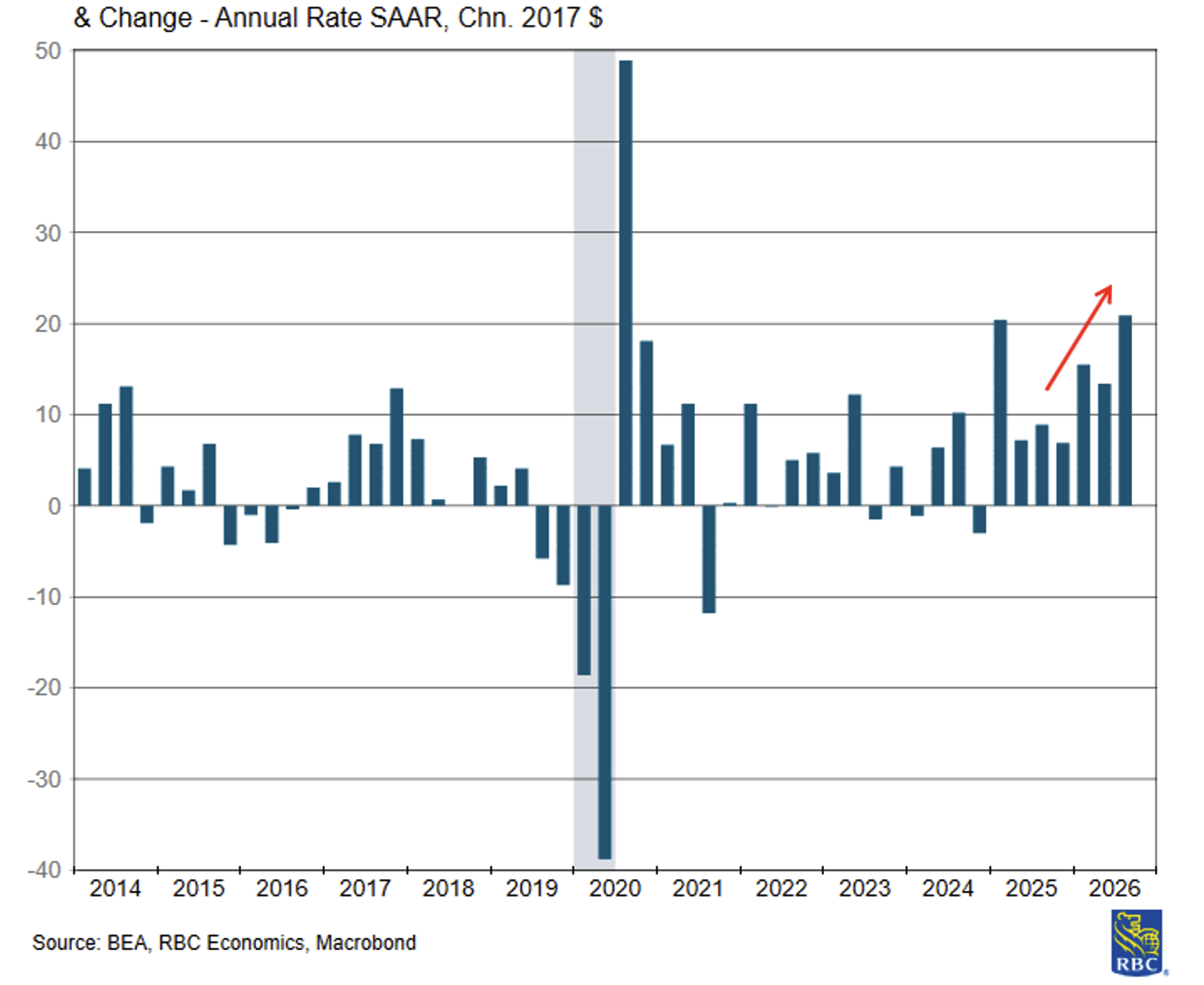
The US economy reported strong growth in Q3, with headline GDP accelerating to 3.4% (q/q SAAR). Growth was driven by a very strong consumer and exceptionally strong business investment. Indeed, the investment momentum is an AI story – following the data center boom, the structures are now being outfitted with equipment, including everything from IT and electrical equipment to plumbing and HVAC systems, all of which contributed to a record quarter for equipment growth.
And US consumers continued to show resiliency in the face of inflationary pressures, as Q3 consumption rose 3.8%. Some of this strength is attributable to the World Cup which ran through July. But services spending momentum held up through September and remains a key engine of growth in this economy. Low layoffs are another key signal – this is a tight labor market and when consumers have jobs, they spend their incomes. But discretionary spending is growing at a faster rate than non-discretionary, and real services sector spending is still in positive territory while real goods spending is not. This illustrates how the inflation backdrop is exacerbating the K-Shape economy.
Taken together, demand driven inflation is a growing concern and despite the softer core PCE print for September, broad inflation pressures are not going away anytime soon. At 3.6% y/y, core services excluding housing is now running at its highest pace in over two years, and this is in the face of mounting core goods pressures. To be clear: we do not expect that core PCE fully captures spillovers from higher energy costs just yet.
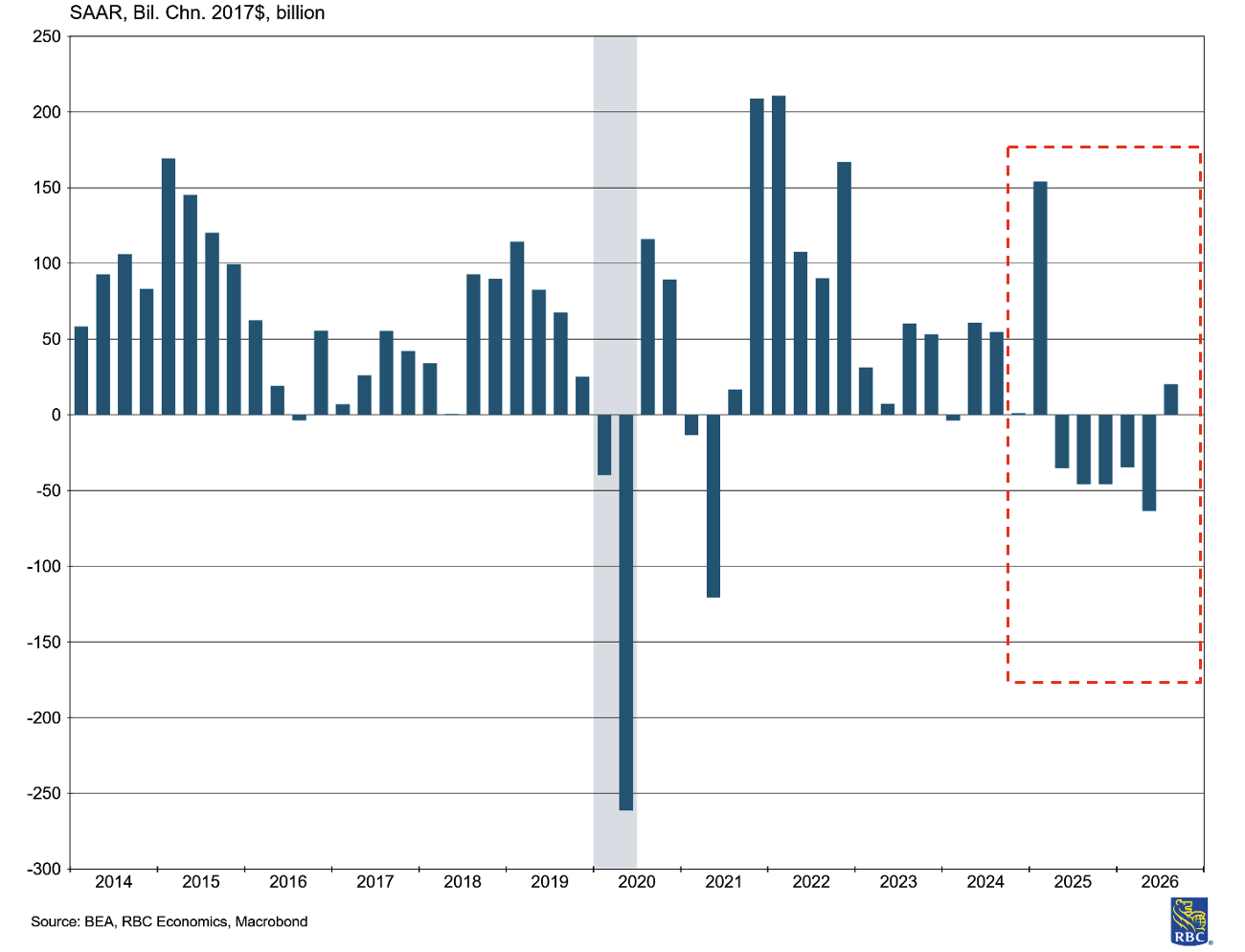
Looking ahead, another inflationary risk worth flagging is the rebound in inventories. Following 5 consecutive quarters of decline, inventories rose in Q3. The risk there stems from timing – most of the drawdown followed a Q1 2025 surge that was largely pre-tariff inventory. This adds cost pressures, increasingly the likelihood that tariffs pressures add to inflation in 2027.
AI buildout continues to drive exceptional growth in equipment investment
Q3 data signals pre-tariff inventories may be largely depleted
About the authors:
Mike Reid is Head of US Economics at RBC. He is responsible for generating RBC’s US economic outlook, providing commentary on macro indicators, and producing written analysis around the economic backdrop.
Carrie Freestone is a Senior US Economist at RBC. Carrie is responsible for projecting key US indicators including GDP, employment, consumer spending and inflation for the US. She also contributes to commentary surrounding the US economic backdrop which she delivers to clients through publications, presentations, and the media.
Imri Haggin is an US Economist at RBC, where he focuses on thematic research. His prior work has centered on consumer credit dynamics and treasury modeling, with an emphasis on leveraging data to understand behavior.
This article is intended as general information only and is not to be relied upon as constituting legal, financial or other professional advice. The reader is solely liable for any use of the information contained in this document and Royal Bank of Canada (“RBC”) nor any of its affiliates nor any of their respective directors, officers, employees or agents shall be held responsible for any direct or indirect damages arising from the use of this document by the reader. A professional advisor should be consulted regarding your specific situation. Information presented is believed to be factual and up-to-date but we do not guarantee its accuracy and it should not be regarded as a complete analysis of the subjects discussed. All expressions of opinion reflect the judgment of the authors as of the date of publication and are subject to change. No endorsement of any third parties or their advice, opinions, information, products or services is expressly given or implied by Royal Bank of Canada or any of its affiliates.
This document may contain forward-looking statements within the meaning of certain securities laws, which are subject to RBC’s caution regarding forward-looking statements. ESG (including climate) metrics, data and other information contained on this website are or may be based on assumptions, estimates and judgements. For cautionary statements relating to the information on this website, refer to the “Caution regarding forward-looking statements” and the “Important notice regarding this document” sections in our latest climate report or sustainability report, available at: https://www.rbc.com/community-social-impact/reporting-performance/index.html. Except as required by law, none of RBC nor any of its affiliates undertake to update any information in this document.

