

 EN



Bottom Line:
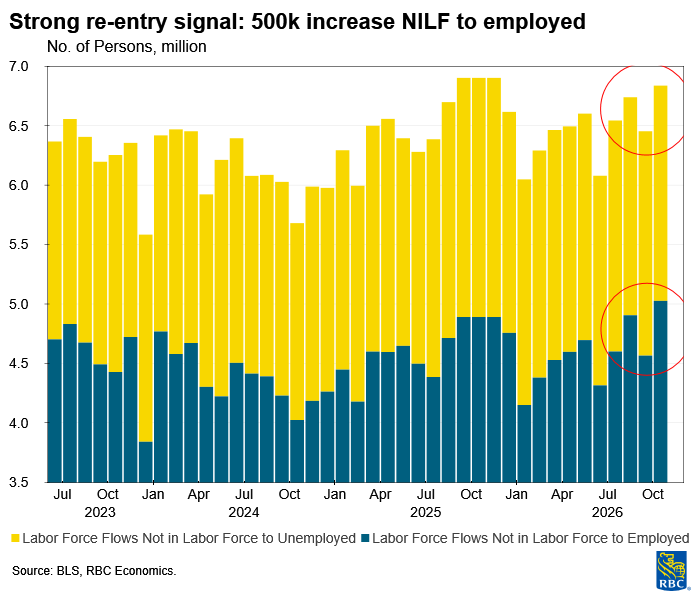
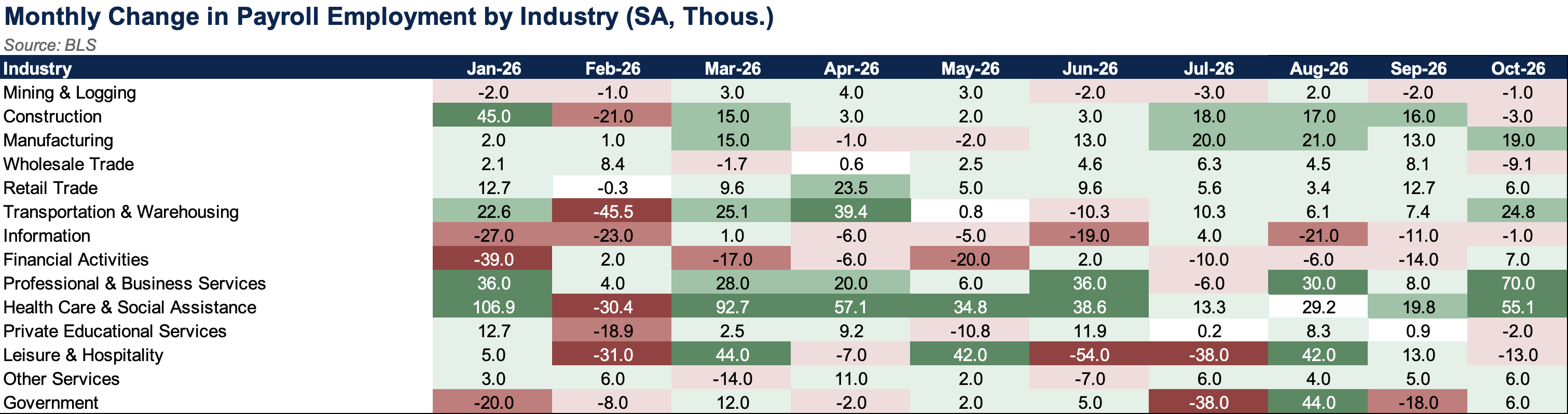
Any way you look at it, the labor market remains solid. Payrolls continued on a strong trajectory in October, adding 165k jobs. A better gauge of labor market health is the unemployment rate, which ticked down to 4.1% even as participation edged higher to 61.9% from 61.8%. Workers re-entering the labor force are finding jobs quickly — those transitioning from “out of the labor force” into employment outnumbered those entering unemployment by 3-to-1. By almost every measure, the labor market looks exceedingly healthy despite persistent inflation. There is little meaningful evidence of margin-preserving layoffs.
Seasonal hiring ahead of the holidays helped, with strong gains in transport and warehousing. But the majority of job gains came in the services sector, with notable gains in professional and business services. Health care is losing its title as the primary driver of job growth (it’s led growth only once in the past four months), meaning the strength in the labor market continues to broaden.
Monthly wage growth accelerated on the back of an upward revision to September, a tailwind for consumers who are struggling to keep up with inflation. Ultimately, what this means is that the Fed should remain solely focused on the upside risks to inflation, as this report removes the ability for the Fed to point to labor market weakness to justify another hold in December. Indeed, our call remains that they will hike two more times but demand driven inflation risks are growing.
About the authors:
Mike Reid is Head of US Economics at RBC. He is responsible for generating RBC’s U.S. economic outlook, providing commentary on macro indicators, and producing written analysis around the economic backdrop.
Carrie Freestone is a Senior US Economist at RBC. She is responsible for generating RBC’s US economic forecasts across GDP, employment, and inflation, and providing macro commentary through publications, presentations, and the media.
Imri Haggin is an US Economist at RBC, where he focuses on thematic research. His prior work has centered on consumer credit dynamics and treasury modeling, with an emphasis on leveraging data to understand behavior.
This article is intended as general information only and is not to be relied upon as constituting legal, financial or other professional advice. The reader is solely liable for any use of the information contained in this document and Royal Bank of Canada (“RBC”) nor any of its affiliates nor any of their respective directors, officers, employees or agents shall be held responsible for any direct or indirect damages arising from the use of this document by the reader. A professional advisor should be consulted regarding your specific situation. Information presented is believed to be factual and up-to-date but we do not guarantee its accuracy and it should not be regarded as a complete analysis of the subjects discussed. All expressions of opinion reflect the judgment of the authors as of the date of publication and are subject to change. No endorsement of any third parties or their advice, opinions, information, products or services is expressly given or implied by Royal Bank of Canada or any of its affiliates.
This document may contain forward-looking statements within the meaning of certain securities laws, which are subject to RBC’s caution regarding forward-looking statements. ESG (including climate) metrics, data and other information contained on this website are or may be based on assumptions, estimates and judgements. For cautionary statements relating to the information on this website, refer to the “Caution regarding forward-looking statements” and the “Important notice regarding this document” sections in our latest climate report or sustainability report, available at: https://www.rbc.com/community-social-impact/reporting-performance/index.html. Except as required by law, none of RBC nor any of its affiliates undertake to update any information in this document.

