

 EN
EN 


Bottom Line:
The July jobs report was a massive downside that surprised both markets and forecasters alike. The US labor market shed 23K jobs and the unemployment rate fell to 4.1%. But the July payrolls story does not mark a significant departure from our base case narrative.
Hiring is evidently less robust than previously anticipated – 60K jobs have been added over the past three months which marks a pronounced slowing from hires seen earlier this year. But with the unemployment rate ticking down to 4.1% as the labor force participation rate falls again to 61.4%, the story of labor market tightness is more pressing than ever, and breakeven employment continues to be exceptionally low.
Looking at labor force participation rates by age is important: prime-age participation did not fall – in fact, it ticked up (to 83.4% from 83.3%). Labor force participation fell for both workers under 24 and workers aged 55 and older. And interestingly, the number of persons out of the labor force who currently want a job declined which is suggestive that this could easily be a retirement story.
White collar hiring has certainly slowed, but layoffs so far this year have been limited to a few sectors, most notably: central bankers, insurance, commercial banking, and real estate as well as computer systems designs. The professional, scientific, and technical services sector has added over 50K jobs so far this year and some sectors within finance are still hiring. This does not appear to be a broad based “white collar” decline but one that is concentrated in a few sectors.
The main fallout has been leisure and hospitality, which was widely expected as the World Cup winds down and retail trade, offsetting earlier hiring ramp-ups. It is too soon to say whether these sectors are impacted by rising input costs, or whether this is temporary.
Given the fact that prime-age participation held up, the unemployment rate has fallen, and health care and social assistance still dominates hiring, the July payrolls story does not change the broader story. We expect that this report will preserve Fed optionality and if anything – the two consecutive CPI prints will be even more consequential ahead of September.
There are three core themes that stood out in today’s report:
1) The labor force participation rate contracted – but this was not a prime-age worker story
-
In July, the labor force participation rate ticked down yet again, but prime-age participation increased (the prime-age participation rate rose from 83.3% to 83.4%).
-
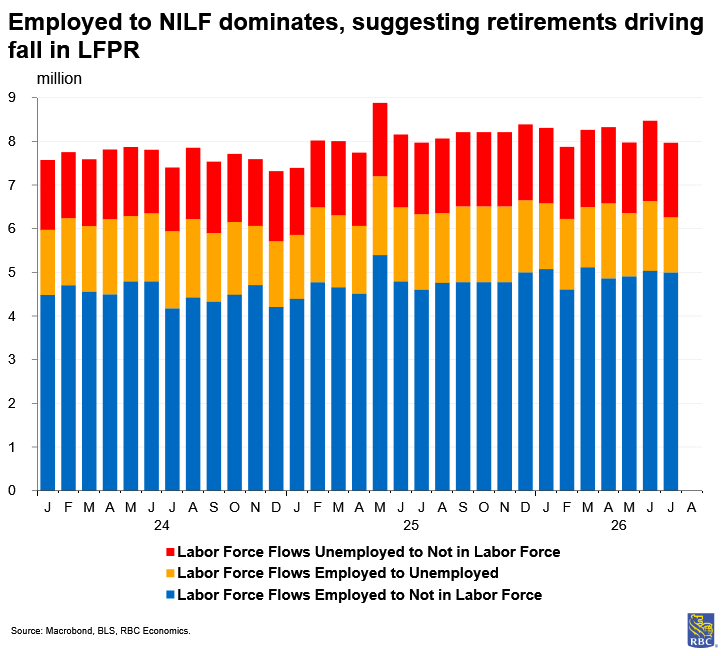
The bulk of the labor force exodus was mature workers aged 55+ and also workers under 25. Looking at flows into unemployment, most folks who exited the labor force were previously employed. This is more consistent with retirements than layoffs.
-
The unemployment rate fell again to 4.1% from 4.2% – as the size of the labor force contracted by more than the number of unemployed. Still, July saw unemployment fall.
-
U6 unemployment held steady at 7.9%. The number of marginally attached rose slightly and we saw an uptick in those working part-time for economic reasons. We have consistently seen that younger college works are victims of skills and credential-matching challenges. This may be playing out in these data points.
-
The share of long-term unemployed workers fell slightly to 26% from 27%.
2) Broadening-out in hiring has reversed (for now) – payroll gains are driven by structural hiring in a few sectors
-
As expected, the health care and social assistance sector accounted for the bulk of private sector job gains (23k of 30k private sector jobs created). But evidently, this is an underwhelming add from a sector that is consistently adding closer to 50K jobs each month.
-
On aggregate, we have seen some white-collar sectors shedding jobs, specifically in financial activities. But this is mostly an insurance, commercial banking, and real estate story.
-
The information sector has consistently shed jobs, but this is mostly a broadcasting and publishing story rather than traditional “tech” roles. Still, computer infrastructure providers account for 15% of losses so far in 2026. But professional, scientific and technical services continues to add jobs.
-
And as the AI buildout progresses, we have seen non-residential building construction account for almost the entirety (83%) of goods-sector hiring so far this year.
-
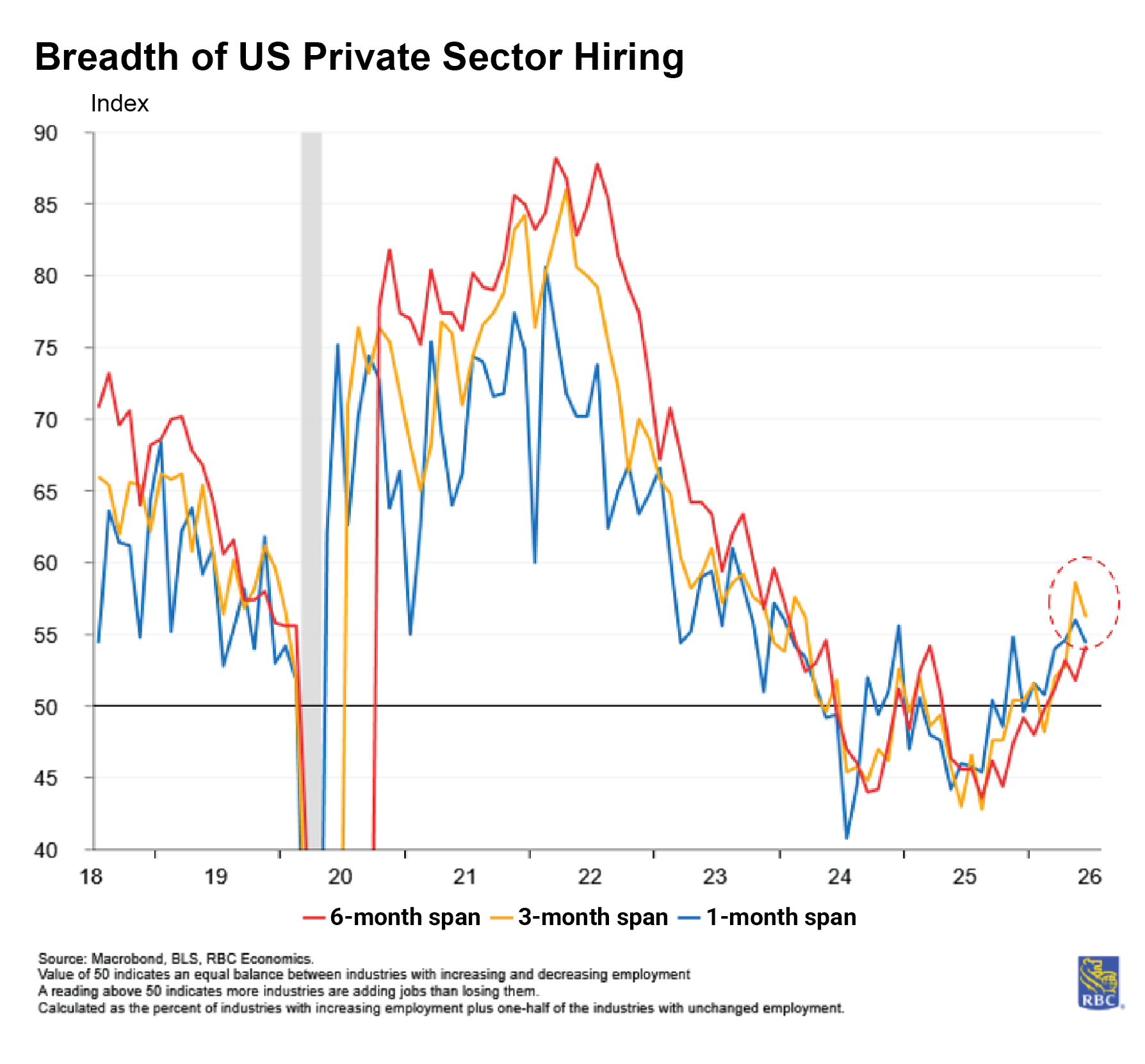
The bottom line is: while it previously appeared that hiring was broadening out, this trend has not fully held up. As hiring moderates, it is evident that the majority of net new jobs are still being created in a few sectors driven by structural trends like the AI infrastructure buildout and an aging population boosting demand for healthcare.
3) Aggregate hours worked look stable – this is a green flag for future headcounts
-
The differential between PPI and CPI (specifically, finished core consumer goods PPI vs. core CPI) is still exceptionally wide. This means that we are on the lookout for input price passthrough or the alternative, a labor market fallout. Of course, one month does not make a trend and we do not have sufficient evidence at this juncture that jobs shed in hospitality and retail are yet collateral damage from higher input costs. We will be closely watching these sectors in the incoming months to gauge whether this is the case.
-
But one thing we also know is that average weekly hours worked in private sectors held relatively steady in July. Typically, before firms lay off staff they resort to cutting hours. We did not see this play out in the July report, so we can be confident that weakness is concentrated in a few sectors for now (leisure and hospitality and retail).
About the authors:
Mike Reid is Head of US Economics at RBC. He is responsible for generating RBC’s U.S. economic outlook, providing commentary on macro indicators, and producing written analysis around the economic backdrop.
Carrie Freestone is a Senior US Economist at RBC. She is responsible for generating RBC’s US economic forecasts across GDP, employment, and inflation, and providing macro commentary through publications, presentations, and the media.
Imri Haggin is an US Economist at RBC, where he focuses on thematic research. His prior work has centered on consumer credit dynamics and treasury modeling, with an emphasis on leveraging data to understand behavior.
This article is intended as general information only and is not to be relied upon as constituting legal, financial or other professional advice. The reader is solely liable for any use of the information contained in this document and Royal Bank of Canada (“RBC”) nor any of its affiliates nor any of their respective directors, officers, employees or agents shall be held responsible for any direct or indirect damages arising from the use of this document by the reader. A professional advisor should be consulted regarding your specific situation. Information presented is believed to be factual and up-to-date but we do not guarantee its accuracy and it should not be regarded as a complete analysis of the subjects discussed. All expressions of opinion reflect the judgment of the authors as of the date of publication and are subject to change. No endorsement of any third parties or their advice, opinions, information, products or services is expressly given or implied by Royal Bank of Canada or any of its affiliates.
This document may contain forward-looking statements within the meaning of certain securities laws, which are subject to RBC’s caution regarding forward-looking statements. ESG (including climate) metrics, data and other information contained on this website are or may be based on assumptions, estimates and judgements. For cautionary statements relating to the information on this website, refer to the “Caution regarding forward-looking statements” and the “Important notice regarding this document” sections in our latest climate report or sustainability report, available at: https://www.rbc.com/community-social-impact/reporting-performance/index.html. Except as required by law, none of RBC nor any of its affiliates undertake to update any information in this document.

