

 EN
EN 


For the week of Sep 7th
Canada’s economic calendar will be quiet next week after a recent run of data pointed to a gradually improving domestic backdrop.
Economic activity rebounded through the second quarter, supported by stronger household spending and business investment, while some of the earlier drag from trade disruptions faded.
The pace of growth is unlikely to be sustained, but the broader trend remains consistent with a gradual recovery. And labour market conditions have also shown further signs of stabilizing. Employment fell by 42,000 in August, ending a 3-month run of firm job growth. But the unemployment rate was unchanged at 6.4%, down 0.7 percentage points from a year ago.
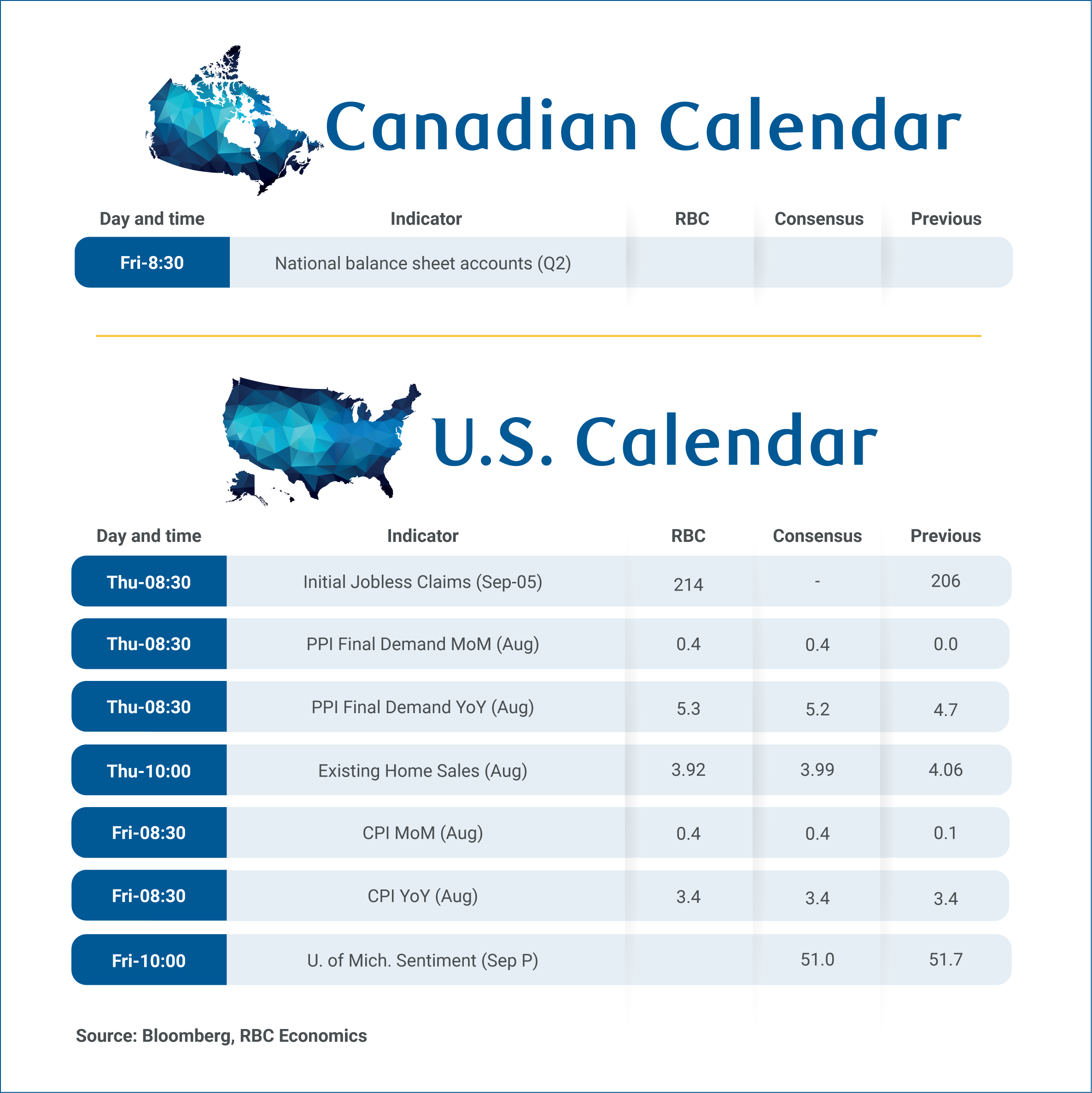
Next Friday’s Q2 national balance sheet accounts should show an increase in household net worth, boosted by rising financial assets and stabilizing housing markets. The TSX Composite Index rose another 6.4% in the quarter following a 3% gain in Q1, while the S&P 500 rebounded 17.2%, more than reversing its decline in the prior quarter. Non-financial assets were likely little changed, with the non-seasonally adjusted CREA Home Price Index rising just 0.2% in Q2. The household debt service ratio is also expected to edge lower, helped by stronger disposable income growth as wages and salaries increased and government transfers rose.
With limited Canadian economic releases scheduled next week, attention will also shift south of the border to the U.S. August CPI report on Friday. U.S. inflation has continued to cool overall, but the details have become increasingly problematic. Headline CPI rose 0.1% in July and was 3.4% above year-ago levels, while core prices increased 0.2% on the month and 2.5% from a year ago.
The breadth of U.S. inflation pressures has narrowed from earlier this year, but tariff-related cost pressures remain visible in some goods categories while services inflation, particularly shelter, remains stubbornly sticky. We expect headline CPI to rise 0.4% m/m in August, leaving the year-over-year rate at 3.4%, while core prices are expected to increase 0.2% m/m and 2.4% y/y. While some moderation in underlying inflation has occurred, the persistence of even core inflation measures at rates significantly above the Fed’s 2% inflation objective is concerning and raises the risk that additional interest rate hikes could be needed. The danger is that recent energy price pressures and tariff effects could prevent further disinflation or even drive a re-acceleration in core measures. If this materializes, the Federal Reserve would have limited ability to look through such a trend, leaving additional tightening as the most likely policy response.
About the authors:
Nathan Janzen is an Assistant Chief Economist, leading the macroeconomic analysis group. His focus is on analysis and forecasting macroeconomic developments in Canada and the United States.
Abbey Xu is an economist at RBC. She is a member of the macroeconomic analysis group, focusing on macroeconomic forecasting models and providing timely analysis and updates on economic trends.
Explore the latest from RBC Economics:
Bank of Canada meeting recap: holding steady amid trade headwinds
Mid-year outlook for Canada’s housing market: Between correction and recovery
Share these insights with your network:
This article is intended as general information only and is not to be relied upon as constituting legal, financial or other professional advice. The reader is solely liable for any use of the information contained in this document and Royal Bank of Canada (“RBC”) nor any of its affiliates nor any of their respective directors, officers, employees or agents shall be held responsible for any direct or indirect damages arising from the use of this document by the reader. A professional advisor should be consulted regarding your specific situation. Information presented is believed to be factual and up-to-date but we do not guarantee its accuracy and it should not be regarded as a complete analysis of the subjects discussed. All expressions of opinion reflect the judgment of the authors as of the date of publication and are subject to change. No endorsement of any third parties or their advice, opinions, information, products or services is expressly given or implied by Royal Bank of Canada or any of its affiliates.
This document may contain forward-looking statements within the meaning of certain securities laws, which are subject to RBC’s caution regarding forward-looking statements. ESG (including climate) metrics, data and other information contained on this website are or may be based on assumptions, estimates and judgements. For cautionary statements relating to the information on this website, refer to the “Caution regarding forward-looking statements” and the “Important notice regarding this document” sections in our latest climate report or sustainability report, available at: https://www.rbc.com/community-social-impact/reporting-performance/index.html. Except as required by law, none of RBC nor any of its affiliates undertake to update any information in this document.

