

 EN
EN 


Canada’s housing market seems to be finally taking steps toward recovery in 2026.
Home resales have been on a winning streak since April, inventory has levelled off, and prices appear to be stabilizing or at least falling more slowly.
We see room for further gradual progress ahead as improved affordability and brightening job prospects shore up confidence, increasingly unlocking pent-up demand and slowly draining piled up inventory.
But, the path is unlikely to be smooth or uniform across the country. The prolonged market correction in Ontario and British Columbia has left a deep mark on sentiment that will take time to heal.
And, more resilient regions have little upside left amid stable or rising interest rates and stagnant population growth.
The turnaround point has also come too late to prevent Canada-wide declines in 2026.
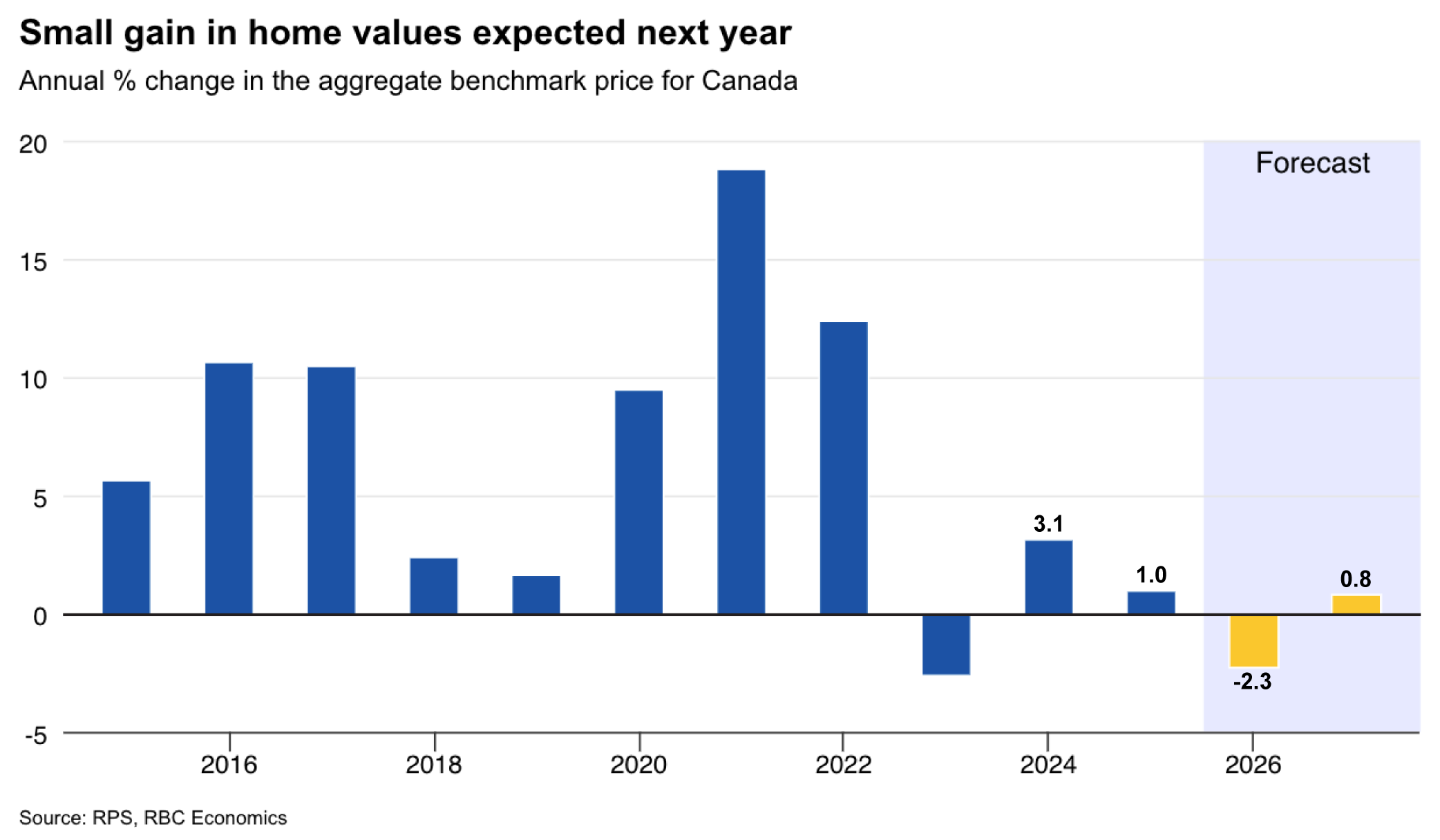
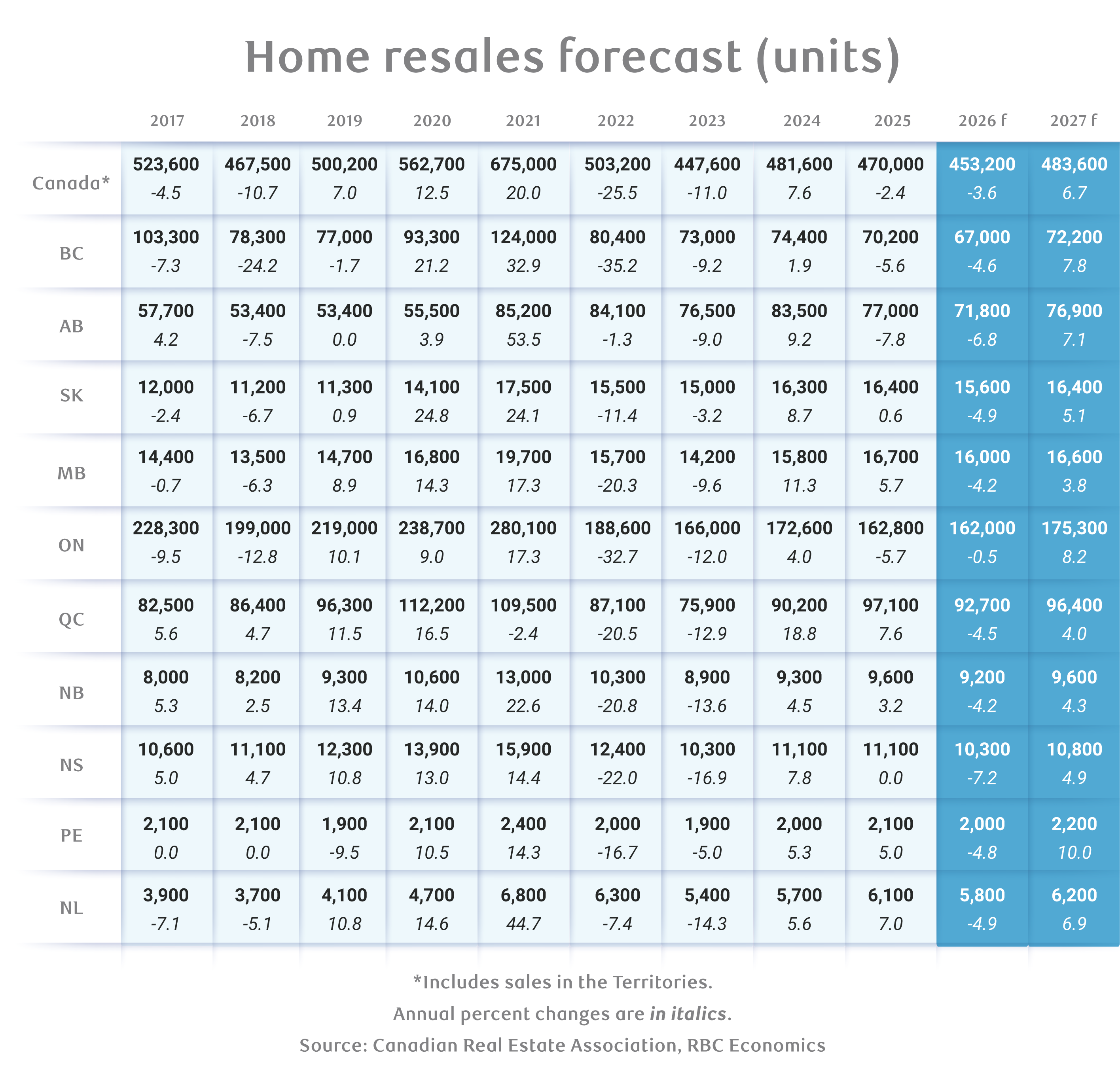
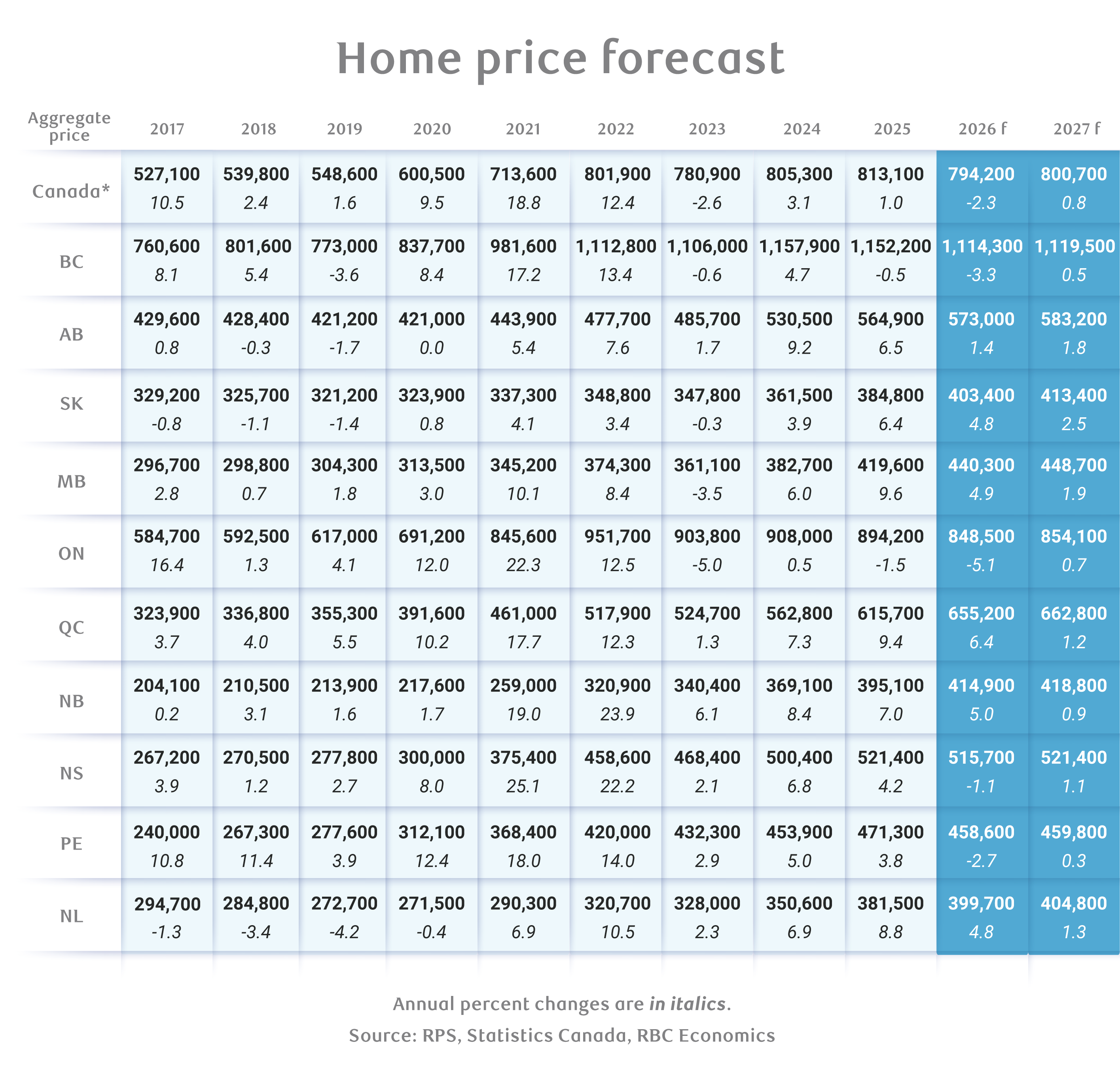
We project home resales and the benchmark price index to fall -3.6% to 453,200 units and -2.3% to $794,200, respectively, this year mainly reflecting weakness this winter and early spring.
Recovery will become more visible by 2027 when we forecast transactions to grow 6.7% to 483,600 units, and the benchmark value edges higher by 0.8% to $800,700.
An upturn of this magnitude won’t be transformative while welcome.
The general tone of Canada’s market will still be soft with our resales projections far below levels before the pandemic and home values just a smidgeon above the cyclical low.
Unlocking pent-up demand to outweigh stalled population growth
The key to the outlook will be the extent to which sidelined homebuyers make their way to market.
We think there could be hundreds of thousands of Canadians who put plans to buy a home on hold in the past several years due to sharp increases in ownership costs.
Many of them are living longer than preferred in rented accommodation or delaying upsizing or downsizing current digs.
There are also households that haven’t been formed yet. Our analysis of headship rates suggests the creation of more than 400,000 households could have been suppressed in Canada since 2019. Unlocking this represents substantial potential growth in housing demand.
We believe price corrections and material affordability improvement in parts of the country, and just the passage of time will draw more sidelined buyers.
Timing shouldn’t be underestimated, because many would-be buyers have been working hard toward making a purchase with savings near a 25-year-high rate, and 25- to 34-year-olds employed at an above average historical rate.
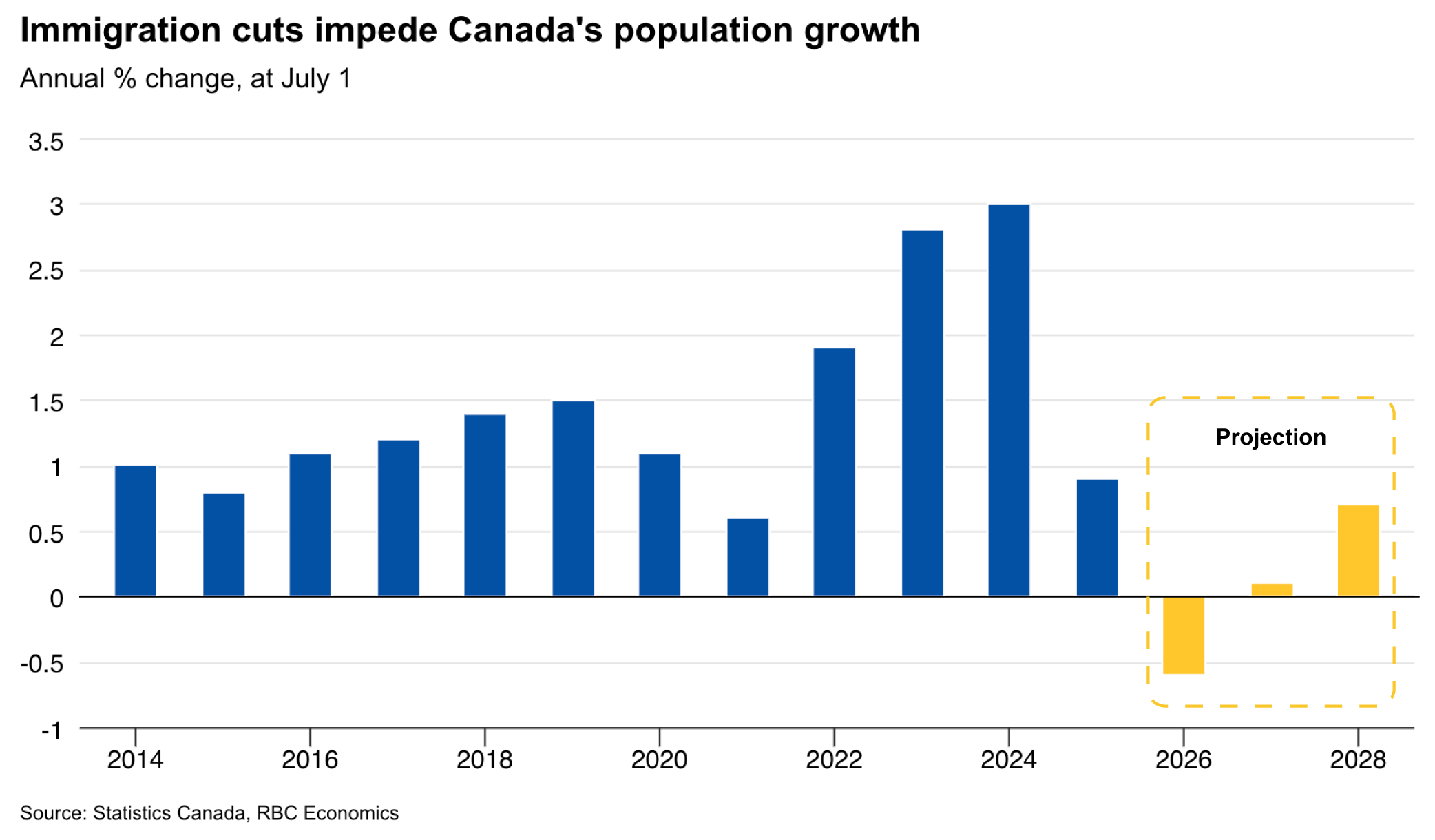
We see this influx of financially ready house hunters easily outweighing the lull in homebuyer demand from newcomers to Canada.
Immigration cuts, while posing a significant headwind, will more readily affect the rental space. Newcomers, especially temporary residents, tend to live in rental housing for the first five to 10 years in the country.
Healing economy, brighter job prospects will help rebuild confidence
Low confidence has been a major stumbling block in recent years. The disquieting mix of the market slump, dwindling home values, strained affordability, soft economy and job concerns have weighed heavily on the minds of prospective buyers.
But, we expect a more positive landscape (despite renewed tariff uncertainty) will help progressively rebuild sentiment. This process is likely already underway with the economy solidly rebounding in Q2, and the labour market improving since the end of spring.
Our base case forecast has GDP growth sustained through the end of 2027, albeit moderating from Q2’s pace.
This would eliminate labour market slack by spring next year, and even lead to a slight worker shortage by the second half of 2027.
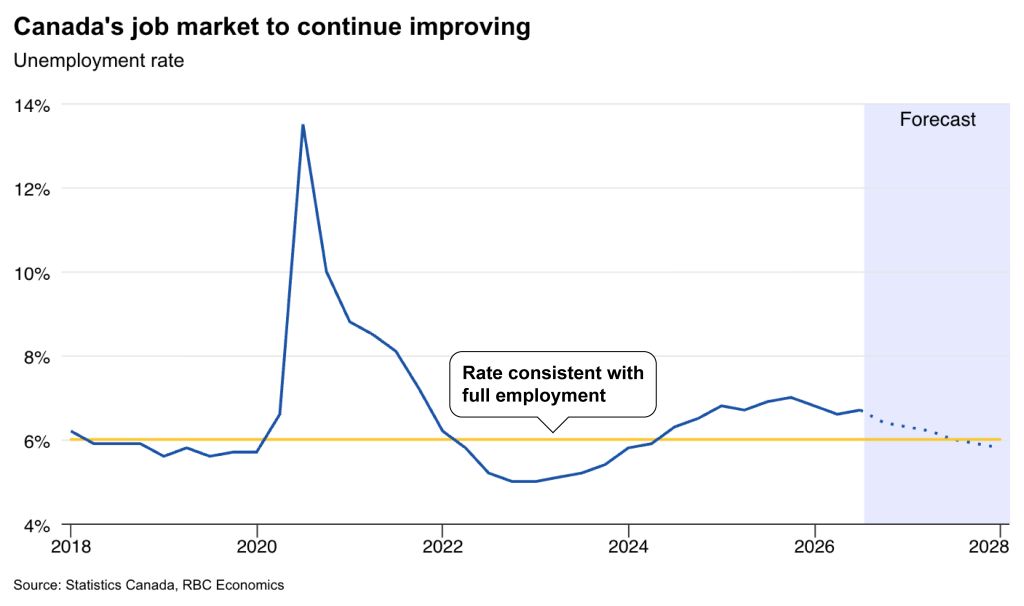
We think an improving job market will do wonders for confidence, and spur more buyers into action.
A self-reinforcing process
Stabilizing home prices will also have a bolstering impact.
A bottoming of home values—and eventual appreciation—will allay concerns about investing in a depreciating asset.
As increased transactions absorb units from inventory, a greater sense of urgency is likely to emerge. It may not pay off to play the waiting game as suitable options get snapped up faster.
Such signals to enter the market will be self-reinforcing. The more buyers respond, the stronger the signals, and ultimately, the recovery becomes.
Affordability struggles persist but are less straining
High home ownership costs still pose substantial challenges. They’re a primary reason why we aren’t expecting a sharp snapback in activity.
But, costs have come down materially in Canada’s most expensive markets since reaching all-time highs during the pandemic.
We see this improvement opening the door to an increasing number of prospective buyers.
Interest rates have hit bottom
Interest rates are unlikely to bring additional affordability relief, though. We believe they are as low as they will get this cycle.
Long term rates are, in fact, rising. Upward pressure on global bond yields is impacting Canadian rates. We expect further mild increases through the end of 2027.
Meanwhile, we see the Bank of Canada on hold until the end of this year before raising its policy rate in 2027 as the economy picks up steam.
Far from smooth sailing from here
The recovery ahead isn’t a sure bet given the many risks still facing the Canadian economy.
We’ve counted four false starts since 2023 with external events (think trade war or energy price spikes) derailing what promised to be lasting, albeit gradual improvement.
This time may not be different. Escalation in the trade war with the U.S. or conflict in the Middle East could further undermine confidence.
At home, immigration cuts or affordability issues could prove stiffer headwinds than we expect.
These risks threaten to perpetuate the on-again-off-again pattern in the housing market.
Even in the best of cases, we think the recovery will be irregular with two steps forward followed by a step back, and regions progressing and regressing at the same time.
Regional divergence to narrow
Our outlook has resales and prices rising in all regions in 2027.
We expect Ontario and B.C. to slowly emerge from their prolonged slumps with material affordability improvement—albeit from worst-ever levels—helping to unlock some pent-up demand.
We project transactions will increase 8.2% in Ontario and 7.8% in B.C. in 2027, following declines of 0.5% and 4.6% this year, respectively.
Similarly, we see 2027 home values (RPS Home Price Index) edging higher by 0.7% in Ontario and 0.5% in B.C. for the first time in two years.
It will take longer for the condo market segment to turn around, however. Abundant inventory in the Toronto and Vancouver areas, and investor apathy are bound to keep condo prices downward possibly into 2027.
Measured sales rebounds next year in Saskatchewan, Manitoba, Quebec and parts of Atlantic Canada will reflect steadier ownership costs, comparatively less pent-up demand to unlock and slower population growth.
Meanwhile, growing inventory will ease tight supply and demand.
We expect this will take the edge off home value appreciation in many of those regions. Our forecast has the rate of increase in the aggregate price index slowing from 4.8% in 2026 to 2.5% in 2027 in Saskatchewan, from 4.9% to 1.9% in Manitoba, from 6.4% to 1.2% in Quebec, from 5% to 0.9% in New Brunswick and from 4.8% to 1.3% in Newfoundland and Labrador.
For Nova Scotia and Prince Edward Island, we project prices will rebound next year by 1.1% and 0.3%, respectively after declining 1.1% and 2.7% in 2026.
Finally, we see a relatively robust economy and demographic picture in Alberta boosting resales, and adding a bit of heat to home values. We project transactions to rise by 7.1%, and the RPS HPI to gain 1.8% in 2027, following a 6.8% decline and 1.4% increase this year, respectively.
About the author:
Robert Hogue is the Assistant Chief Economist responsible for providing analysis and forecasts on the Canadian housing market and provincial economies.
This article is intended as general information only and is not to be relied upon as constituting legal, financial or other professional advice. The reader is solely liable for any use of the information contained in this document and Royal Bank of Canada (“RBC”) nor any of its affiliates nor any of their respective directors, officers, employees or agents shall be held responsible for any direct or indirect damages arising from the use of this document by the reader. A professional advisor should be consulted regarding your specific situation. Information presented is believed to be factual and up-to-date but we do not guarantee its accuracy and it should not be regarded as a complete analysis of the subjects discussed. All expressions of opinion reflect the judgment of the authors as of the date of publication and are subject to change. No endorsement of any third parties or their advice, opinions, information, products or services is expressly given or implied by Royal Bank of Canada or any of its affiliates.
This document may contain forward-looking statements within the meaning of certain securities laws, which are subject to RBC’s caution regarding forward-looking statements. ESG (including climate) metrics, data and other information contained on this website are or may be based on assumptions, estimates and judgements. For cautionary statements relating to the information on this website, refer to the “Caution regarding forward-looking statements” and the “Important notice regarding this document” sections in our latest climate report or sustainability report, available at: https://www.rbc.com/community-social-impact/reporting-performance/index.html. Except as required by law, none of RBC nor any of its affiliates undertake to update any information in this document.
Get the latest forecasts and analysis from RBC Economics.
Subscribe Now
- Unlocking pent-up demand to outweigh stalled population growth
- Healing economy, brighter job prospects will help rebuild confidence
- A self-reinforcing process
- Affordability struggles persist but are less straining
- Interest rates have hit bottom
- Far from smooth sailing from here
- Regional divergence to narrow
