

 EN
EN 


For the week of August 31st
A re-escalation of the Canada-U.S. trade war hasn’t prompted a significant downgrade to our economic outlook. We explained why that is here, and answered more pressing questions here.
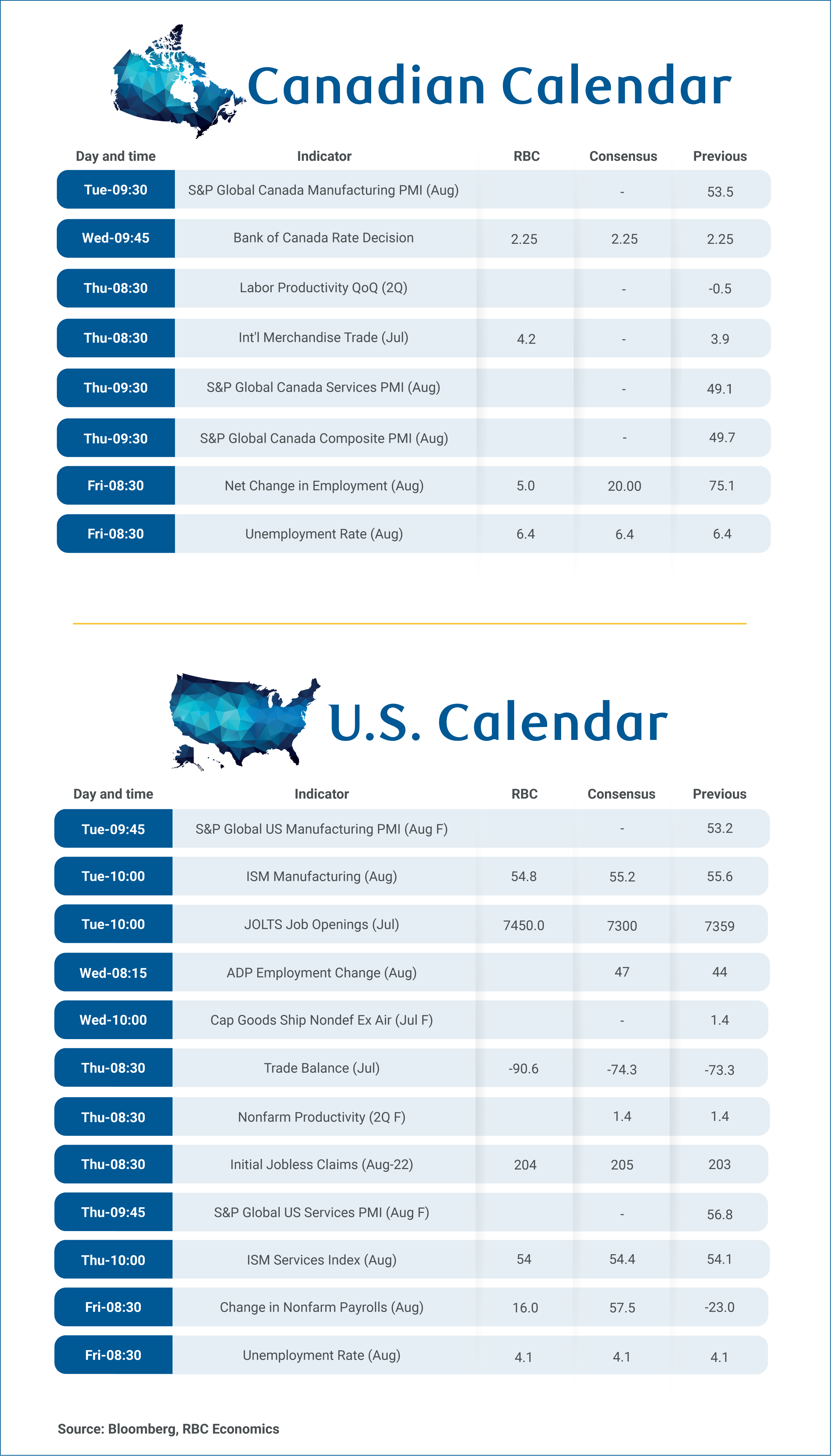
Data releases in the coming week offer important clues about the early economic impact of new U.S. tariffs in Canada, even before they take effect.
Trade data may show some front-loading
In the July trade data released on Thursday, we expect to see signs of another round of tariff front-loading that could have given a temporary boost to Canada’s exports.
The United States announced new tariffs on July 20 that didn’t take effect until August 22. During that window, U.S. importers were likely incentivized to build inventory—a pattern similar to what we saw in spring 2025 ahead of IEEPA tariffs coming into effect.
We look for Canada’s trade surplus to widen to $4.2 billion in July from $3.9 billion in June.
Labour market recovery could stall
Consecutive large job gains in Canada over the summer, combined with increasingly constrained labour supply from worker retirements and reduced immigration pushed Canada’s unemployment rate down to 6.4% in July. While it has declined, the rate remains higher than historical norms, suggesting there’s more room for hiring to recover.
Next Friday, we expect employment to post a smaller 5,000 increase in August, while the unemployment rate holds steady. Job postings from Indeed.com were little changed that month, and broader growth indicators have looked substantially better since activities stalled over the winter.
Recent resurgence in trade uncertainty pose risks to economic growth, but we remain cautiously optimistic that per-worker labour markets in Canada will continue to gradually improve, with the unemployment rate edging lower into 2027.
Bank of Canada to stay on the sidelines for now
Heightened growth risks from new U.S. tariffs and inflation risks from high oil prices likely created more discomfort for the Bank of Canada since their last meeting in July, but not enough to push them off the sidelines.
The silver lining is that backward-looking economic data have also strengthened considerably, including solid 3.3% (annualized) GDP growth in Q2 and on-target core inflation prints since April.
In Wednesday’s meeting, we expect the BoC to acknowledge both this strength and forward-looking risks-a balance that should leave interest rates unchanged.
Current U.S. tariffs and counter Canadian tariffs are not yet large enough to derail the Canadian economy’s recovery, but further escalation in tariffs is a real threat that could prompt a delay of BoC rate hikes we had expected in 2027, or worst, push the central bank to cut rates. But, we’re not there yet.
-
Nominal Canadian exports should edge up about 0.1% in July, supported by an increase in vehicle shipments. We anticipate a 0.3% contraction for imports, driving a surplus expansion. Oil prices were down slightly in July but still elevated, persisting the energy trade surplus.
About the authors:
Nathan Janzen is an Assistant Chief Economist, leading the macroeconomic analysis group. His focus is on analysis and forecasting macroeconomic developments in Canada and the United States.
Claire Fan is a Senior Economist at RBC. She focuses on macroeconomic analysis and is responsible for projecting key indicators including GDP, employment and inflation for Canada and the US.
Explore the latest from RBC Economics:
New developments in U.S.-Canada trade war: The impact on both economies
Food inflation in Canada: Six key questions about higher prices
Share these insights with your network:
This article is intended as general information only and is not to be relied upon as constituting legal, financial or other professional advice. The reader is solely liable for any use of the information contained in this document and Royal Bank of Canada (“RBC”) nor any of its affiliates nor any of their respective directors, officers, employees or agents shall be held responsible for any direct or indirect damages arising from the use of this document by the reader. A professional advisor should be consulted regarding your specific situation. Information presented is believed to be factual and up-to-date but we do not guarantee its accuracy and it should not be regarded as a complete analysis of the subjects discussed. All expressions of opinion reflect the judgment of the authors as of the date of publication and are subject to change. No endorsement of any third parties or their advice, opinions, information, products or services is expressly given or implied by Royal Bank of Canada or any of its affiliates.
This document may contain forward-looking statements within the meaning of certain securities laws, which are subject to RBC’s caution regarding forward-looking statements. ESG (including climate) metrics, data and other information contained on this website are or may be based on assumptions, estimates and judgements. For cautionary statements relating to the information on this website, refer to the “Caution regarding forward-looking statements” and the “Important notice regarding this document” sections in our latest climate report or sustainability report, available at: https://www.rbc.com/community-social-impact/reporting-performance/index.html. Except as required by law, none of RBC nor any of its affiliates undertake to update any information in this document.

