RBC Thought Leadership Thomas Ashcroft

How the political shift will impact the fractured relationship between the two nations—on trade, energy and defence.

The result could accelerate talks to push for a deal by year-end

Signals, both from Prime Minister Mark Carney and President Trump, suggest trade talks between senior Canada-U.S. officials have picked up in the past 24 hours. While a comprehensive deal before year-end remains unlikely, a limited deal, similar to the one tabled in August, could advance by then. Getting Ontario Premier Doug Ford’s support will be crucial, especially if tariffs remain on autos.

Donald Trump is expected to back away from the January 1st tariff increase but autos remain the key issue

The U.S. President’s threat to increase tariffs on Canadian autos and steel to 50% would drive up U.S. vehicle prices weeks after an election lost on affordability, and U.S. automakers oppose it. However, heavy auto tariffs remain the key sticking point in Canada-U.S. negotiations. To reach a limited deal before the end of the year, Canada may have to accept tariffs on autos in exchange for other concessions.

Trade policy still runs through the White House

Congress cannot remove the Section 232 and 338 tariffs, and it cannot block a tariff deal without a two-thirds majority in both chambers. These election results are a repudiation of Trump’s trade and foreign policy, which were consistently criticized by Democratics, but outside of indirect pressure exerted through committees, there is little Democrats can do to materially change trade policy set by the executive branch in the next two years.

Any deal will be managed trade, and tariffs will likely outlast Trump

Washington has been clear that tariffs will be part of any agreement, and Democrats have their own protectionist streak: eight of the 10 Senate votes against CUSMA in 2020 were Democrats, and Sherrod Brown (Ohio Senator-elect), Abdul El-Sayed (Michigan Senator-elect) and Josh Turek (Iowa Senator-elect) have all said they support targeted tariffs to protect U.S. manufacturing. However, over the medium-term this political shift is favourable regarding Canadian trade policy.

Canada has more allies in Congress

Candidates who blamed the trade war for higher cost of living won Senate races in Michigan, Maine, Iowa, North Carolina, South Carolina, Kansas, Ohio and Texas. Six of the new Democratic senators will replace Republicans who voted against ending the emergency tariffs on Canada. Republicans in Texas, Ohio and South Carolina now face electorates that swung sharply against their party, and more of them may be willing to break with the White House on Canada. Many Democrats are hawkish on China and likely to look at Beijing’s trade with Canada, particularly rules of origin, through that lens.

Congress will press on tariffs through votes, hearings and spending bills

Democrats remain well short of the two-thirds votes needed to override a veto. Nevertheless, in the first 100 days expect bills drafted to force recorded votes on tariffs, including on Canada, to identify Republicans willing to vote against the White House. The Office of the United States Trade Representative (USTR) must report to the Ways and Means and Finance Committees 70 days before each CUSMA review and brief them within 20 days, and Democratic chairs will use those obligations to call USTR to account.

Oversight will reach companies that made deals with the administration

House Oversight investigations begin in January, and the incoming chair, Robert Garcia, has warned the administration’s allies to “lawyer up.” Companies in tech, rare earths, financial services and pharmaceuticals, which struck deals with the administration, should expect subpoenas and document requests.

Democratic governors give Canada a stronger channel in key states

Democrats will hold most governorships for the first time since 2010, including in Michigan, Ohio, Georgia, Iowa, Minnesota and Maine—where Canada is the largest export market—and in Pennsylvania and Texas. Governors cannot change federal tariffs, but they lobby the White House and their congressional delegations, set state procurement rules, sign agreements with provinces and control energy and data-centre policy. Josh Shapiro’s June MoU with Ontario on electricity transmission, nuclear and critical minerals, though non-binding, shows the potential for Canada to work with state governments. Jocelyn Benson (Governor-elect in Michigan) has pledged to negotiate subnational agreements directly with Canada (though Republicans have said this will not be possible), and Amy Klobuchar, a leading Senate opponent of tariffs on Canada, moves to Minnesota’s governorship.

Democratic states could add legal pressure on the tariffs

A coalition of blue states, led by Oregon, joined the litigation in which the Supreme Court struck down the International Emergency Economic Powers Act (IEEPA) tariffs. Democrats have now won the Texas attorney general’s office and full control of Pennsylvania’s legislature, widening the options for state action on trade.

The data-centre backlash favours power-rich Canadian sites

Voters rejected data centres almost everywhere the question was on the ballot, and the new governors of Texas, Georgia and Ohio, three of the largest growth markets, ran against an unrestricted buildout. Texas accounts for roughly a third of planned U.S. capacity. With states making data centres pay for their own power and federal pre-emption now unlikely, hyperscalers will choose sites by power supply, which makes Alberta Canada’s most attractive market. The opportunity is limited: Canada’s market is about 3.4% the size of the U.S. market. U.S. states’ AI rules could also impact Canadian lenders, starting with Colorado’s law on AI in financial decisions coming into effect on January 1.

The oil industry wants permitting reform before Democrats take their seats

The U.S. industry is anxious to pass the Senate permitting bill in the so-called lame duck session and expects some progressives to try to derail it. The bill would shorten environmental reviews and the window for legal challenges and expand federal authority over interstate transmission, which would help cross-border pipelines and power lines. Democrats who won in oil and farm states are unlikely to turn against Canadian crude, which supplies about 60% of U.S. oil imports. If the bill fails, the next iteration will come on Democratic terms.

The Golden Dome will shrink, and Iran remains the main external risk

Democrats will shape the FY2027 defence budget and will trade defence funding for domestic spending programs and conditions on Iran. The Golden Dome missile program is likely to be redirected toward radars, interceptor batteries and regional munitions, which weakens Trump’s demand that Canada pay US$60–70 billion to join. Trump faces fewer constraints abroad than at home, and escalation with Iran before year-end remains possible even after Vice-President JD Vance blamed the war for the losses.
Canada and the EU already shared deep cultural, commercial, and security ties before they brokered the Canada-Europe Trade Agreement (CETA), which came into effect nearly a decade ago. And as both sides pursue a more ambitious alliance in the wake of seismic geopolitical and trade disruptions, the transatlantic collaboration is emerging as a cornerstone of economic, energy and defence on both sides of the Atlantic.

CETA laid the foundation. The deal removed 98% of tariffs between the two partners in 2017 and has since vaulted the EU into Canada’s second largest trading partner, behind only the U.S. and ahead of China. Canadian goods exports to the EU have surged 80% over that time, while imports from the EU rose 60%. Once services are factored in, Canada exports $68 billion to the EU and buys back $124 billion.1

But serious challenges persist, holding many Canadian businesses back from exporting more—or at all—to the region. To get a sense of the obstacles and opportunities, RBC conducted a market survey of nearly 1,000 Canadian business owners in September. Here’s a sampling of what we heard: 

  • “EU regulations are too complex.”

  • “China sells our products directly to EU countries, there is no room for us pricewise to compete.” 

  • “Our service could expand to [the] U.S. fairly easily, but Europe would be more difficult.” 

  • “I would sell to Europe if I could make a connection with a customer.”

While CETA has been in effect for nearly a decade, only one in five of the business owners surveyed were familiar with the deal and its benefits. And while there is interest in exporting to Europe, it often remains aspirational due largely to the time required to enter the market, distance and logistics, and a lack of access to expert support. That says nothing of the regulatory and tax burdens.

Still, as Canada focuses on a deeper alliance with Europe—one that will likely hinge on building on CETA—there is a significant opportunity. When it comes to the EU, Canada is massively under indexed on exports, and underweight on imports. If the two traded in accordance with their economic weight, Canadian exports of goods and services to the EU would more than double, rising to more than $150 billion. And EU exports to Canada would rise more than 40%, climbing north of $170 billion.

The gap in investment flows is equally stark. The EU has been exporting around US$360 billion in foreign direct investment (FDI) in recent years.2 The top destination—by far—is to other EU members, who receive 29 cents on every dollar. Canada has received just 1.4 cents on every dollar of the EU’s outward FDI, despite accounting for nearly 4 cents of every dollar globally. Likewise, the EU receives some US$300 billion in FDI, with Canada accounting for less than one cent on every dollar.

There is an abundance of cross-Atlantic opportunities to tap into: from high-tech manufacturing and defence to clean-tech energy and conventional resources as diverse as natural gas, oil and gas, potash, uranium and fertilizers. As Canada casts its net wider for new trade routes, Europe is emerging as a promising port of call.

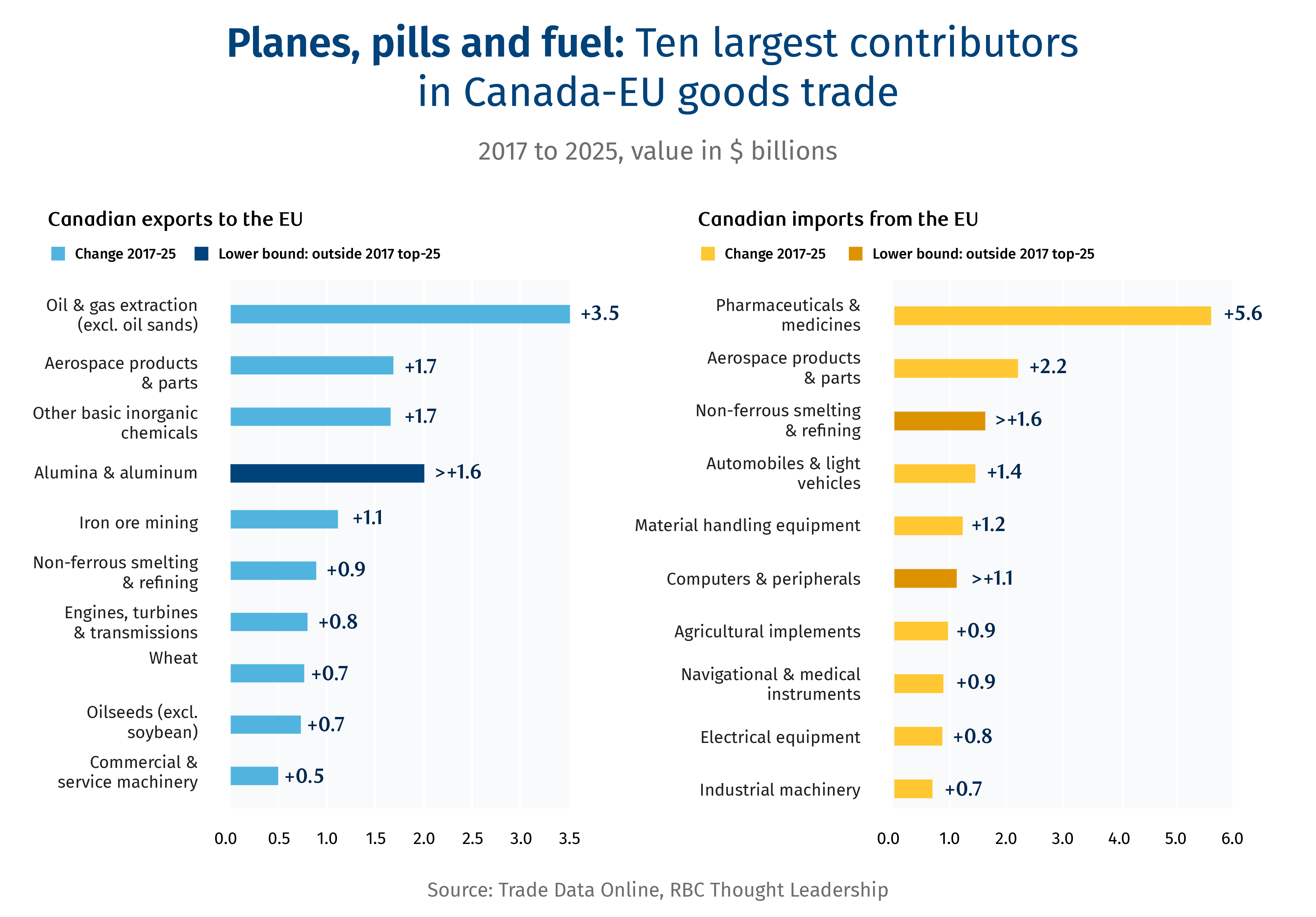
Planes, pills and fuels: Ten largest contributors in Canada-EU goods trade

Aerospace shows that two-way manufacturing trade across the Atlantic works, with further opportunity in the steel and aluminum sectors. Auto assembly is likely to remain challenged, until tariffs are lifted and the North American market electrifies.

North American and European manufacturing industries are struggling with excess capacity, weak domestic demand, and heightened competition from China. Global trade tensions complicate an already fragile economic reality. But there are opportunities for coordination in specific parts of advanced manufacturing.

Canada sells the EU raw and semi-processed goods and buys finished products. Manufactured goods are about 65% of Canadian goods exports to the EU (roughly $28 billion) but nearly all of what Canada buys back (roughly $90 billion). That $62 billion shortfall is softened by a $14 billion resource surplus, which leaves the ~$50 billion goods deficit.

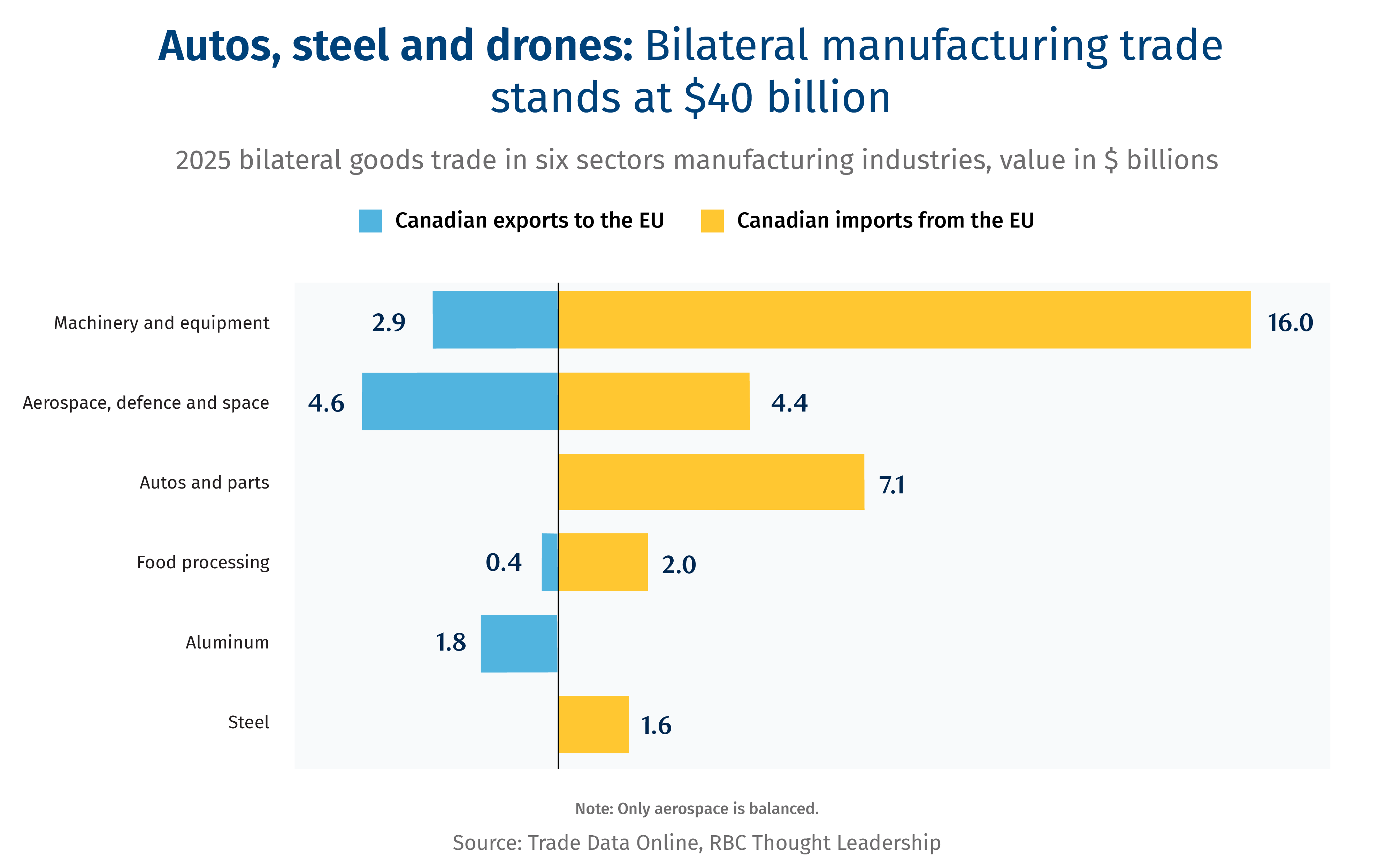
The aerospace industry is the exception to that trend, albeit a narrow one. Canada sold the EU $4.6 billion of aerospace products and parts in 2025 and bought $4.4 billion. Exports are up 60% since 2017. It could form a template for further deepening of ties when it comes to advanced manufacturing.

Autos, steel, and drones: Bilateral manufacturing trade stands at $40 billion

The growth potential

If Canada and the EU traded in accordance with their economic weight, Canadian manufacturing exports would more than double to $65 billion, while EU manufacturing imports would climb past $110 billion.

Aerospace is the template. Extend the same supply-chain model to other areas of advanced manufacturing, including defence aviation, space, electric vehicle assembly, auto parts and build on existing ties for steel and aluminum.

Low-carbon aluminum is an opening. Canada is the world’s fourth-largest primary producer (3.3 million tonnes in 2024) and reports the lowest carbon footprint among major producers. The U.S. took 90% of Canadian exports in 2024.3 The EU’s carbon border levy (CBAM) entered its definitive phase in January 2026, covering iron, steel and aluminum. Under CBAM, carbon intensity becomes a pricing differentiator. Brussels deducts carbon prices paid abroad, but only what is actually paid counts, net of rebates and free allocation, all of which must be independently certified.4

Steel is a smaller prize. Canadian mills sell little to Europe today and quotas are tight. The EU’s regime caps quota volumes at about 18 million tonnes and charges 50% above that threshold. Canada is listed as a free-trade partner but has not secured any quota of its own. The CETA goods committee has a technical meeting on overcapacity and an exchange on Canada’s melt-and-pour rules in train.5 Canada could use it to ask for a country quota, or guaranteed access to the pooled one, and offer reciprocity on Canada’s own quotas.

Autos: capitalize on existing EV investments, position to win new mandates. In Canada, final assembly is dependent on duty-free access to the American market, not CETA. Some 90% of what Canada produces is exported, and 90% of those exports go to the U.S. Parts and battery materials are less constrained. Canada’s goal of 75% EV sales by 2035 could eventually anchor demand, but is hemmed in by U.S. policy. Given the absence of EU-based assembly plants in Canada, and their absence of mention from Canada’s new auto strategy, the possibilities around enhanced partnership are limited.6 Options to catalyze investment include:

  • Co-invest with EU manufacturers. The Strategic Response Fund backed Volvo’s Prevost with $18.5 million on an $87.5 million project. Similar terms could be offered to EU parts, battery, and machinery makers.7

  • Canada’s EV incentive rules. EV incentives cap the price of imports from free-trade partners at $50,000, but not Canadian-made EVs, which face no cap.8

Burdensome regulations have limited Canada’s ability to make Europe a key export market, but there are opportunities ahead in supplying the bloc with critical agriculture commodities, including grains, protein and potash.

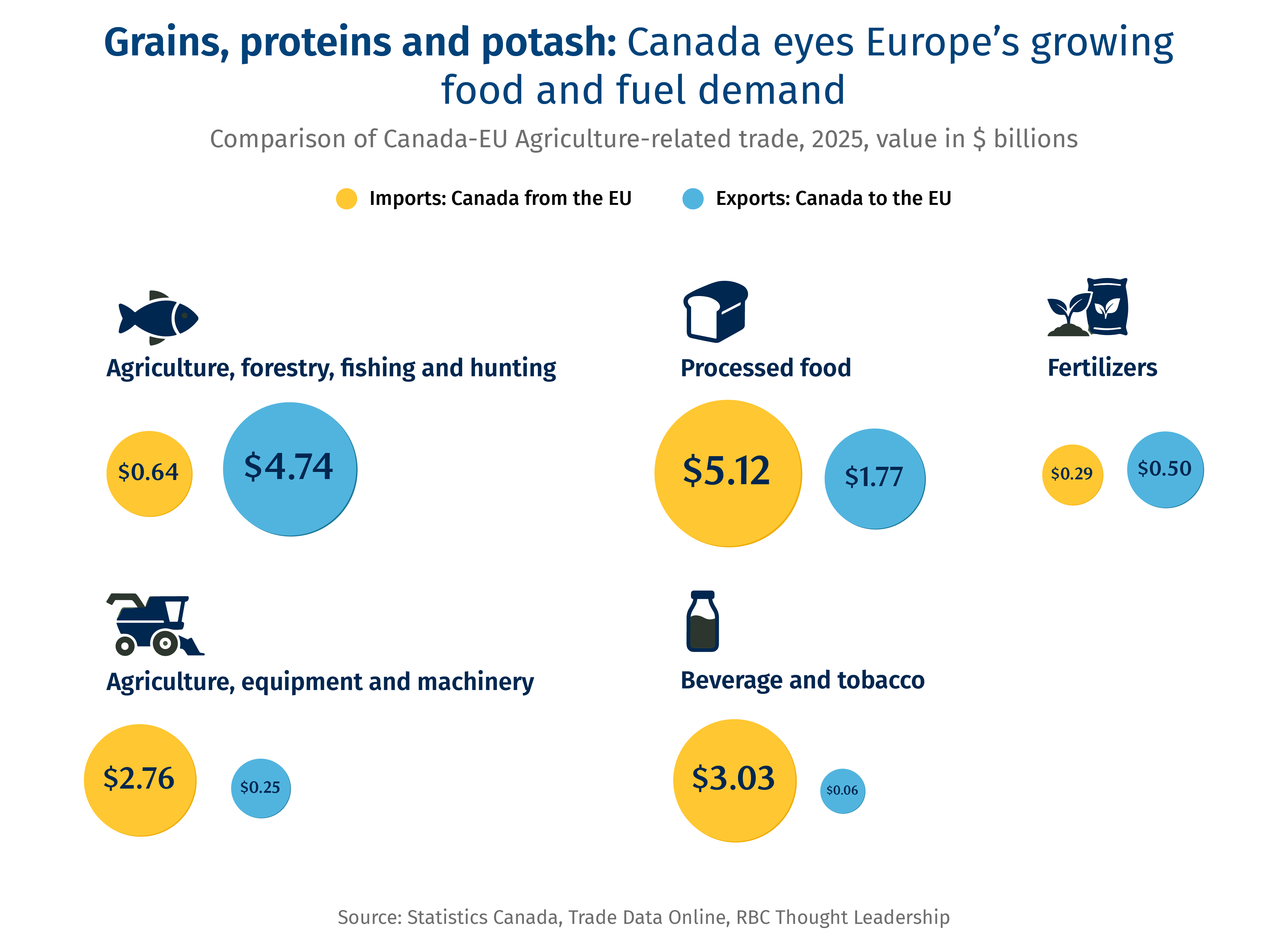
The value of the farm and food trade between Canada and the EU has roughly doubled in both directions since CETA took effect. Yet, the EU still only accounts for a small share of what Canada exports, at just over 6% of its Agri-exports in 2025. Canada sold the EU $7.32 billion of farm, fish, food and agriculture input products in 2025, and bought over $11-billion worth in return.9

The type of agricultural goods Canada and the EU exchange are very different. Europe is a large, wealthy, and mature food market that is already self-sufficient in most staples. The EU exported €238 billion worth of agrifood products last year10, with close to a €50 billion surplus, so its Canadian imports are goods or commodities it doesn’t produce in such large volumes, like primary grains. Canada’s major shipments to Europe are largely bulk grain and oilseeds, including canola, soybeans, wheat and corn, as well as potash fertilizer, while Europe’s food export basket to Canada primarily consists of prepared foods and drinks, such as wine, spirits and cheese, along with farm machinery.

Grains, proteins and potash: Canada eyes Europe's growing food and fuel demand

The growth potential

As the EU looks to improve resiliency in its agri-food supply chain, and Canada looks to grow its exports beyond the U.S., there are multiple areas that can benefit both partners.

Protein and oilseeds offer clear room to grow. In 2025, Canada bought $106 million of pork and $71 million of beef from Europe, while selling the EU just $6.5 million of pork and $24 million of beef.11 Growing those sales depends partly on Canada pressing the EU to recognize its food safety and quality standards, which currently limit Canadian exports.

Canada’s low-risk rating under the EU’s new deforestation rules, which cover cattle and soy, gives Canada a modest advantage over countries like Brazil and Argentina. Canola exports to the EU exceeded $1 billion in 2025, most of it seed crushed for biofuel, with meal going into animal feed. The EU is phasing palm oil out of its biofuel schemes by 2030, which leaves more room for sustainably produced Canadian canola.

Fertilizer is another strong opportunity. The EU began phasing in tariffs on Russian and Belarusian fertilizer in 2025, rising to €430 a tonne by 202812, to cut its dependence and Russia’s war revenue. Canada is the world’s largest potash producer, with about a third of global output13, and supplied 39% of world potash exports in 2024, about the same as Russia and Belarus combined.14 Canadian producers could sell more in Europe if they expand output and if rail and port capacity can move it east, or through the seasonal port at Churchill.

Regulations remain an obstacle. CETA did not change the regulatory requirements to access the EU market, limiting its ability to translate into higher Canadian exports. Examples of these requirements include restrictions on growth hormones in livestock, the use of peroxyacetic acid to control bacteria on meat carcasses, and testing for trichinosis, a disease Canada is free of.15 Compliance challenges are a key reason Canadian beef exporters use only about 3% of their EU duty-free quota.16 Most Canadian feedlots use growth hormones on cattle, and Canada’s two largest meat packers use sanitation products not accepted by the EU. Other EU rules, like those governing genetically modified crops, maximum pesticide residue levels, and sustainability requirements like deforestation prevention, further complicate market access and constrain export growth.

However, Canada’s National Food Security Strategy, which aims to strengthen competition in domestic food processing, could create an opportunity to develop a more flexible processing capacity tailored to export markets with distinct regulatory requirements that could help producers reach the EU in a more meaningful way.

Domestic infrastructure investment could open the doors to the EU. The United States is Canada’s largest trading partner, taking over 60% of Canada’s agri-exports in 2025.17 Canadian farms, packers and processors are built into North American supply chains that shared a common set of rules. As it stands, shipping Canadian agri-food products from points of production, which is often the Canadian Prairies, to the eastern ports that serve European markets is expensive – generally even more so than shipping across the ocean. Efficiency enhancements and other domestic infrastructure investments are core to growth in transatlantic trade.

Europe’s greatest need is energy, which is also Canada’s biggest strength, yet the two barely connect. Unlocking energy routes, and supplementing it with rising minerals, nuclear fuel and potash trade, could improve energy security and diversification for both jurisdictions.

Canadian oil and minerals are reaching Europe in record volumes, but from a low base. Mineral exports nearly doubled to $10 billion in 2025 from 2017, while energy (oil, gas and uranium) grew six-fold to $6.5 billion. Together, this makes up 38% of what Canada sells to the EU, up from 28% in 2016.

That growth says little about CETA itself. Crude oil was already duty-free, and the agreement removes tariffs only on refined and processed products, at up to 4.7% for non-crude petroleum. Canada’s energy flows are shaped more by geography than tariffs, with its oil and gas organized around the U.S. market.

Geopolitics is changing that. Europe’s hostile relations with Russia, one of its principal energy sources, and turmoil in the Middle East present an opening for resource-rich Canada. Aggressive U.S. trade policy has only added to the urgency on both sides. Europe’s demand for secure, non-Russian and non-Chinese supply is now written into law: the EU is ending Russian pipeline gas by September 30, 2027, and its raw-materials rules push buyers toward diversified suppliers.

Canada runs a goods deficit with the EU of about $49 billion, but energy and minerals enjoy a combined surplus of about $6 billion. Minerals and metals exports stand at $10 billion, with the EU taking 7.4% of Canada’s exports, though the basket is mostly iron ore ($3 billion), aluminum and nickel.

The growth potential

The EU wants to diversify its energy supply, and Canada its market base. The alignment could come from natural gas but also minerals, and nuclear fuel. With meaningful economic, emissions and energy-security gains at stake, resources could prove to be the biggest area of cross-Atlantic collaboration.

Oil demand has limited potential but could still expand. Europe favours the light-sweet grade from the Newfoundland and Labrador offshore; exports hit a high of $3.9 billion (from $2.1 billion in 2024 and $300 million in 2016), partly as U.S. tariffs pushed exporters to find other buyers. Meanwhile, much of Canadian energy infrastructure points south, with the U.S. taking about 90% of its crude, refined product and gas exports. Ironically, Canada is a net importer of refined fuel with the EU, which supplied around $2.2 billion in 2025, (mostly from the Netherlands and Belgium into Quebec and Nova Scotia), with exports at $800 million. Long-term EU demand for fossil fuels is forecast to shrink, which makes it harder to build new Canadian energy infrastructure facing east. The International Energy Agency projects a 730,000 barrel-a-day decline by 2030, while Asia sees a two-million-barrel-per-day increase. EU gas demand is forecast to fall from 275 billion cubic metres to as low as 190, by one estimate.

Canadian gas has a strategic role to play. All of Shell-backed LNG Canada’s 2025 cargoes were destined for East Asia, and its Phase 2 expansion targets Asian customers. There are circuitous routes, however, to get Canadian gas to European customers. Germany’s state-owned SEFE recently signed a conditional agreement for one million tonnes per annum (mtpa) from the First Nations-backed Ksi Lisims LNG project, and Uniper a binding 20-year deal for 2 mtpa, with first deliveries in 2032. But both are destination-flexible, and France’s TotalEnergies, with its own 2 mtpa deal, said it would serve Asian customers. Europe may end being a customer and financier of Canadian LNG, but not always its final destination.

EU’s emissions rules could favour Canadian energy. The EU’s Methane Regulation requires fossil-fuel importers to demonstrate equivalent monitoring, reporting and verification from January 1, 2027, with emissions-intensity limits from 2030. Proposed delays remain under negotiation, reflecting concerns about energy costs and supply security, but structurally this is a win for Canada either way (low intensity and politically stable). Canada’s methane controls could help its LNG suppliers meet these requirements and appeal to European buyers; electric-drive liquefaction powered by B.C.’s low-carbon electricity would place Canada amongst the lowest emissions intensity LNG, globally. This could strengthen Canadian LNG’s appeal through either direct delivery or cargo swaps, subject to EU compliance requirements.

Filling the processed critical minerals refining gap. China dominates processing of most battery minerals, so Canadian nickel or cobalt refined in China does little to reduce Europe’s dependence. The EU’S Critical Raw Materials Act’s 2030 benchmark, which states that no more than 65% of any strategic raw material can come from a single third country, could change that. A 2026 joint statement and non-binding letter of intent between the European Investment Bank and Canada could lay the groundwork, and Quebec’s Dumont nickel project is the one Canadian project the Commission has named a third-country strategic project, which can open access to EU financing. What is missing is offtake and processing: European buyers committing to Canadian nickel, cobalt and aluminum, and refining built in Canada rather than China.

Nuclear fuel is the most direct way to displace Russia. Uranium is the one commodity in which Europe is a major Canadian customer, taking as much as 45% of its uranium exports, according to one estimate. Canada is already the largest uranium supplier to EU utilities, with Saskatchewan-based Orano (25%) and Cameco (21%) providing a sizeable portion of EU’s processing needs. Russia still supplies about a quarter of EU conversion services (Rosatom, 24%) and enrichment (23%), so long-term contracts between Canadian suppliers and EU utilities are the most direct way to displace it. The Commission promised limits on Russian nuclear fuel in 2025, but there is scant evidence of alternative sources being pursued.

As the only non-European country admitted to the EU’s Security Action for Europe (SAFE) program, Canada is uniquely positioned to build a deeper partnership with its transatlantic allies.

Rising threats from Russia following its 2022 invasion of Ukraine has compelled the EU to bolster its defence industry, with spending set to rise to a record €454 billion ($704 billion) this year, from €418 billion ($648 billion) last year.

In addition to national budgets, the SAFE program lends governments €150 billion at low interest to buy weapons. Normally no more than 35% of a SAFE-funded product’s parts can come from outside Europe, but Canadian parts can make up to 80%.

So far Canada has barely leveraged that advantage: Canada’s exports make up 0.5% of the EU’s defence equipment spending, or about $900 million in 2025. That has gone primarily to Germany ($372 million) and Poland ($217 million).

As global defence needs rise in a more uncertain world, a slew of new opportunities could boost those export numbers. But first, Canada will need to bulk up: Most domestic defence firms are small, and the industry sells 70% of its goods to its Five Eyes intelligence partners: the U.S., U.K., Australia and New Zealand.

The growth potential

Embedding themselves in Europe’s defence supply chains would help Canadian companies advance Ottawa-Brussels efforts to boost security cooperation.

Canadian aerospace could fill an immediate European need. Canada supplied 8.9% of the aircraft, spacecraft and parts imported by the EU in 2025. Germany recently strengthened its independent intelligence capabilities with the procurement of at least three additional Pegasus signals-intelligence (Signit) aircraft based on the Bombardier Global 6000 business jets and is considering an expansion of the fleet by three to six additional units.

Join the Ukraine loan program to widen access. The EU has loaned Ukraine €90 billion ($140 billion) to cover about two-thirds of its financial and military needs in 2026 and 2027. That aligns with Ottawa, which has committed $8.5 billion in military aid since 2022, and with several Canadian firms, including Roshel, Dominion Dynamics and Sentinel R&D, building production partnerships with the Ukrainian industry.

Canada can also seek a cooperation agreement to explore integration into the EU’s IRIS² satellite constellation, as South Korea did in September.

Canada could use its multi-billion defence contracts to embed its companies in the EU’s supply chain. Ottawa recently awarded Germany’s Thyssenkrupp Marine Systems (TKMS) as the preferred supplier for up to 12 submarines—the largest defence procurement in Canadian history. Meanwhile, Sweden’s Saab has bid to build Gripen fighters and GlobalEye surveillance aircraft in Ontario and Quebec if Canada buys them.

Products made in EU factories count as European under SAFE and the loan’s buy-European rules, so work done at Roshel’s Czech joint venture and Davie’s Finnish shipyard qualifies. Ottawa could also leverage its submarine contract and fighter plane contracts to bring Canadian suppliers into the European supply-chain ecosystem.

Supply drones, water bombers and other defence equipment to Europe. The European Drone Defence Initiative, a network for detecting and halting hostile drones, is due to commence by the end of 2026. Ottawa is positioning to capitalize: it has awarded $50 million in contracts to six Canadian drone makers and opened a marketplace of about 400 vetted Canadian suppliers modelled on Ukraine’s Brave1defence-technology accelerator. 

Ground vehicles and their parts were Canada’s largest category of permitted military exports in 2025, worth $930 million across all non-U.S. markets. Canadian firms could also pursue opportunities to build those as part of the EU’s Eastern Flank Watch, a project to strengthen defences along the bloc’s eastern borders.

Meanwhile, as EU braces for frequent wildfires every summer, Calgary-based De Havilland has a deal to supply 22 of its DHC-515 water bombers to six EU countries, with more deals expected soon.

Collaborate on Arctic surveillance. Canada and several north European countries are concerned about environmental impacts, in addition to rising defence and logistics needs in the fast-warming region. Canada’s RADARSAT radar satellites that see through cloud and darkness and are part of European Space Agency’s (ESA) Earth-observation program, could be expanded.

New EU space rules present a new frontier for Canadian firms. Since its induction in 1979, Canada remains the only non-European cooperating state of the ESA. Ottawa’s €407-million pledge to ESA in November 2025 was its largest ever and includes ESA’s new program of Earth-observation satellites for security and defence.

The proposed EU Space Act could also be a boon for Canadian operators, as the EU would waive some of its regulatory and fee requirements for jurisdictions it deems comparable with its framework.

Canada could be a launching pad for EU space crafts. Europe has committed €902 million through the ESA’s European Launcher Challenge to buy launches from five new European rocket companies, with flights due by 2030. While Canada cannot currently launch its satellites from its home base, that could change in a few years as Ottawa is spending $200 million to help develop a launch pad at Spaceport Nova Scotia, near Canso, to be ready by the end of 2026. The Spaceport developer has already secured a contract to launch rockets for Germany’s Isar Aerospace.

As the world continues to ramp up AI spending, there’s opportunity for Canada to work more closely with the EU—but that will require some regulatory groundwork first.

Despite Canada’s privileged access to EU, bilateral tech trade remains small. Last year the EU imported computers, telecom equipment and electronic components valued at €724 million from Canada, and exported €1.6 billion here.

Since 2001, the EU has recognized Canada’s private-sector privacy law as adequate, so companies can send personal data from the EU to Canadian businesses without the enhanced legal safeguards other countries require. Building on that fast-tracked path, the two sides launched a Digital Partnership in 2023, and opened talks on a digital trade agreement in March, laying the ground for more tech-related trade.

The growth potential

Associate membership status could help open door to the EU for Canadian companies.

Europe is spending heavily on AI and cloud. The EU’s InvestAI initiative, launched in February 2025, aims to mobilize €200 billion for AI, including €20 billion for seven large AI computing centres known as gigafactories, and the EU wants to triple its data-centre capacity in the next five to seven years. Europe’s cloud market was worth €61 billion in 2024, but European providers held only about 15% of it. Canadian companies are making inroads. Toronto-based AI company Cohere plans to combine with Germany’s Aleph Alpha, which works with German public bodies, to form a Canadian-led company with headquarters in Toronto and Berlin. Canada and Germany also launched a Sovereign Technology Alliance in February to reduce reliance on foreign technology. In addition, Ericsson, the Swedish telecom-equipment maker, is spending more than $630 million on research in Ottawa and Montreal under a 2024 agreement with the federal government. Mistral AI, the Paris AI model developer, is opening an office in Montreal, plans to open another in Toronto and signed an agreement with the Quebec government in June on using AI in public services.

Few Canadian companies have the capacity to scale up in Europe. CGI earned $6.2 billion from their European operations in their latest financial year. Brookfield, the Toronto asset manager, has committed €20 billion to AI infrastructure in France and up to US$10 billion to an AI data centre in Sweden since 2025. But most companies don’t have the scale: about 99% of Canada’s 48,400 tech firms are small or medium-sized, 85% employ fewer than 10 people and only about a quarter export. The U.S. takes two-thirds of Canada’s tech hardware exports, with the EU and U.K. combined accounting for about 11%.

Europe is moving to keep government cloud and AI work with European providers. The EU’s Cloud and AI Development Act, proposed in June 2026, would generally limit public bodies to cloud providers established in the EU. For sensitive work, providers would also have to be owned and controlled in the EU, with exception only for countries the Commission approves of, and the most sensitive work would carry no exception. Canada could be one of those chosen few jurisdictions.

However, Canada’s consumer data privacy law needs an update. Bill C-36, which would update Canada’s privacy law, has not yet passed. The last update was back in 2000—way before the proliferation of social media—and there are concerns that the EU’s approval of Canada’s privacy laws could be withdrawn.For now, personal data flows freely from the EU to Canadian businesses because the EU judges that law to protect data adequately in line with its own regulations. However, that judgement is reviewed every four years (the next is due in 2028).

Secure associated country status under the new cloud rules. Under the Cloud and AI Development Act, Canada could gain this status, allowing Canadian-controlled providers to bid for critical EU cloud and AI contracts on an equal footing with EUoperators. The catch is that infrastructure, staff, and customer data must stay in the EU, so the biggest winners would be Canadian firms already operating in Europe. Ottawa would have to give something back: keep its privacy legislation up to EU standards and open Canadian public contracts, including Ottawa’s own sovereign cloud purchases, to EU providers on equal terms.

Agree to accept each other’s product testing. The Canada-EU Digital Partnership Council, which first met in Montreal in December 2025, is exploring mutual recognition of testing for AI-enabled and connected products. A deal would let Canadian labs certify products for the EU market, so Canadian makers can test once for both markets.

Canada has no domestic way to reach orbit, which is both an economic and national security weakness. The country is dependent on international spaceports to launch its satellites, severely limiting its ability to build its space industry in an era of global uncertainty, shifting alliances and need for defence deterrence.

Canada’s strong foundation in space innovation could serve as a launching pad. A-list space firms, three rocket-making startups, and renewed government focus on enhancing defence and space capabilities, could lay the foundation of a thriving industry.

Canada can capture a portion of a US$10 billion spaceport and launch market. Our research shows that domestic and international demand between 2027-2035 supports developing a viable North American launch alternative if Canada can move quickly.

Spaceport Nova Scotia enjoys several advantages prized by allies. The launch hub under construction could address the industry’s growing defence and commercial needs, allowing Canada to market its launch site to countries as diverse as Luxembourg and South Korea. Canada’s NATO and European Space Agency ties could help it emerge as a major space-faring nation.

The space launch industry will require upfront funding. Commercial demand alone will not close the gap and federal government supportwill be needed toensure the industry takes off. Federal support and military demand will also be needed to support the risky nature of space launches. Rockets cost hundreds of millions to build and launch, and of 216 small-launch programs tracked worldwide in 2025, only 37 had attempted orbital launch and 17 were operational.

The next big economic race is going to be in space. And it’s not just about sending astronauts to Mars. Many of the ambitions are for life on earth: satellites in low-Earth orbit for communications and data analytics for scores of industries that, combined with the backbone infrastructure, would triple the global space economy to a $1.8 trillion behemoth by 2035.1

But it starts with launching rockets. And Canada stumbles on that first hurdle, with no domestic way to reach orbit.

That is a major national security weakness, not just an economic threat. Canada’s military relies on satellites for surveillance, intelligence and operations. Adversaries have built weapons designed to disable satellites, and if Canadian assets were lost in a crisis, Ottawa would have to queue for space on foreign rockets and be beholden to their schedules in order to replace them. These satellites perform critical functions. For example, the RADARSAT Constellation Mission images Canada’s Arctic up to four times a day, detects ships that aren’t broadcasting their location, provides the data that guides vessels through Canadian waters and helps map floods and wildfires for emergency responders. All 27 Canadian satellites launched since September 2025 have hitched a ride on a SpaceX rocket from American launch pads, as did the three RADARSAT Constellation Mission satellites in 2019.2 The problem is that SpaceX has stopped taking new Falcon 9 bookings beyond late 2028.3

Canada now faces two challenges. The country needs to find an allied alternative that can launch Canadian satellites to orbit while it also develops domestic launch capability that preserves autonomy and sovereignty.

The good news is that Canada has a strong pedigree in space innovation. The Canadarm project and collaboration with NASA over decades has spawned a formidable industry, with A-list space firms including MDA Space, Telesat and Kepler Communications, among others. Ottawa has also buttressed that effort with a $105-million program to develop Canadian launch vehicles, a 10-year agreement for launch infrastructure in Nova Scotia, new space agreements with European allies and membership in NATO’s STARLIFT launch network.

But Canada needs to act fast, as launch decisions for the 2030s are being made now. Telesat, MDA Space and Kepler Communications have launch secured for about 300 satellites, almost all on SpaceX’s Falcon 9. But another 129 satellites planned between now and 2035, and representing approximately US$290 million in launch contracts, don’t have a launch booked.4

Adding to that is robust government demand expected on the horizon. How Ottawa handles launch in its upcoming military contracts will determine the progress of Canadian rocket developers, and partnerships with allied launch providers.

The Canadian Armed Forces plan to accelerate most of a $26 billion space investment program that was originally spread over 20 years, for which it will need rockets that can transport large payloads and launch frequently. Without sovereign launch capability, those satellites will be competing for scarce slots on foreign rockets.

The value of all orbital launches in 2025 reached US$19 billion, up a third in a year.5 Global launch value could total an estimated US$265 billion between 2027 and 2035.6 Little of that market, however, is open for competition, as China, Russia and other major space nations launch their own satellites from a home base and most governments currently fly missions on national rockets.

There is, however, at least a US$10-billion market that the Canadian launch industry can compete for between 2027 and 2035, as operators from Luxembourg and France to South Korea and Japan look to launch satellites into space for commercial and scientific purposes, as well as for defence.

That figure is conservative as it extrapolates from 2025 data and only accounts for government satellites securing slots internationally, as Spain, Luxembourg and South Korea did in 2025. It also includes commercial demand that to date has relied on Falcon 9 launches, but excludes the government markets of the United States, China, Europe, Japan and India, which mostly fly on their own rockets.7

However, some of those markets are running short of rockets.

The European Union expects its governmental missions to exceed planned Ariane 6 and Vega C rocket supply by 2030–31, and the European Commissioner for Defence and Space has warned of a shortage of launchers by around 2030.8

A made-in-Canada launch option could boost the domestic satellite industry and facilitate the launch of assets on short notice from allies. Rocket size matters, too. Canada’s military has targeted sovereign launch for 2028, but only for a small rocket with a payload of 200 kg. Small rockets carried only 4% of all satellites launched in 2025, with the rest flying on larger Falcon 9s, which carry about 17 tonnes.9 Satellites light enough to hitch a ride on a 200 kg rocket make up about a quarter of Canada’s planned satellites but are less than 2% of the total mass. So, while a small launcher meets the military’s need for a quick-response vehicle, a spaceport requires the launch of medium-lift rockets—capable of carrying a tonne or more—to sustain itself.

The demand may be coming: the medium-Earth-orbit component of the Arctic communications program, the Defence Enhanced Surveillance (which will succeed RADARSAT for military use) and the Surveillance of Space 2 project, could all add Canadian military satellites that based on comparable systems could require 10 to 25 tonnes of payload by 2035 on medium or heavy rockets.10

Canada’s domestic launch developers are increasingly converging on this opportunity with medium-lift capabilities, albeit through different development strategies, timelines and capital requirements.

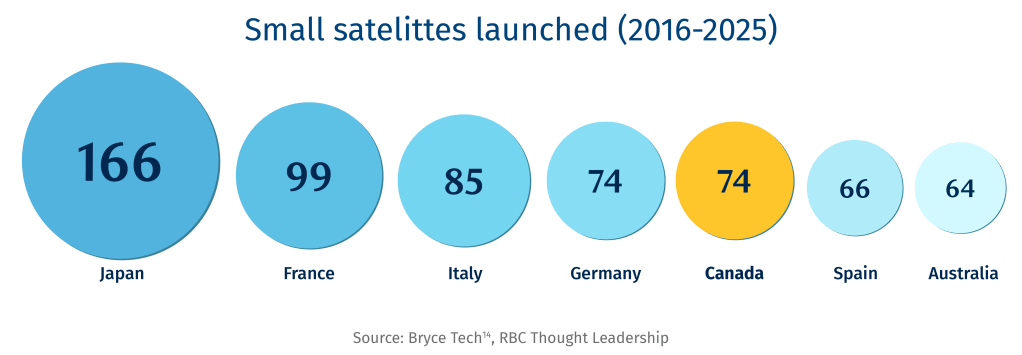
Small satelittes launched (2016-2025)

Capturing even a small share of the market would be significant. If a Canadian small rocket reaches orbit in 2029 and grows to six launches a year and a medium-lift rocket debuts in 2033 and flies four times by 2035, it would add up to 31 launches, worth a total of more than US$400 million. That’s about 4% of the total addressable market (TAM), and about US$150 million a year by 2035 (roughly a tenth of the projected TAM that year.)11

Canada’s first foreign launch revenue will likely come through its spaceport in Nova Scotia by 2028. Germany’s Isar Aerospace signed a 10-year agreement in July 2026 to fly its Spectrum rocket from Spaceport Nova Scotia from 2028, and U.S. operator SEOPS recently booked five Spectrum launches for 2028–2030 from Norway and Nova Scotia.

Allied defence also gives Canadian launchers an edge. Germany’s defence minister noted recently that national security must not get stuck “in commercial queues,” and allied governments are expected to prioritize military launches over commercial ones.

Canada also recently joined NATO’s STARLIFT network, which is building allied capacity to replace satellites on short notice. A rocket flying from Canada, able to reach the polar orbits used for Arctic surveillance, would be highly competitive for these customers.

As momentum picks up, Ottawa will need to decide how to structure the next tranche of launch spending: what payload capabilities to prioritize, which milestones to stage funding against and how to purchase launches. Defence should anchor those choices, as the most valuable part of the market and where sovereignty matters most. On average, a defence satellite costs five times more than a typical satellite to build and launch, and militaries pay for assured access. Defence is set to account for nearly half the value of satellites built and launched over the next decade but represent just 9% of satellite volume.12

Given the upfront capital-intensive nature of the industry, meeting the rising government and commercial demand will require considerable financing.

The country’s three rocket developers—Canada Rocket Company, NordSpace and Reaction Dynamics—have raised a combined $200 million, including $8.3 million that has been conditionally awarded to each under Ottawa’s Launch the North program. But that is a fraction of what it costs to bring a rocket into service. Canada Rocket Company, a Toronto-based firm set up in 2025 to develop  sovereign launch capabilities, says it needs up to US$660 million to fly its first rocket, a Falcon 9 alternative, in 2032.

Commercial demand alone will not close that gap. Even if Canadian rockets won every launch contract for the roughly 129 Canadian satellites currently without a ride to orbit, the revenue would be US$290 million based on current prices—less than half of Canada Rocket Company’s target.

Institutional investors have started to engage. The Business Development Bank of Canada (BDC) co-led Canada Rocket Company’s seed round in January 2026 and Reaction Dynamics has raised approximately $51 million to date, including a Series A financing backed by Investissement Québec. But early rounds still fall well short of the capital needed for an initial launch. Between development and first flight is where most ventures fail and financing matters most.

Government support is also needed to take on the risky nature of space launches: of the 216 small-launch programs tracked worldwide in 2025, only 37 had attempted orbital launch and 17 were operational. A further 112 had been cancelled, retired or gone dormant.13

Customers of Canadian satellite manufacturers can supply additional demand. A Canadian rocket would potentially allow domestic companies to sell satellites and launch as a package and steer foreign customers’ launches to Canadian soil.

Government funding will need to lead the way. SpaceX, for example, received a US$1.6 billion NASA Commercial Resupply Services contract that saved the company from bankruptcy early on its journey. Texas-based Firefly Aerospace received a US$93.3 million NASA contract before its first successful orbital launch with its Alpha rocket in 2022. 

  • Geography. Once completed, rockets launched from Spaceport Nova Scotia in Canso will be able to fly south over open ocean into the polar orbits used by Earth observation and surveillance satellites. Only a small number of allied sites, such as Vandenberg in California, Andøya in Norway and Saxa Vord in Scotland offer similar vantage points.

  • Proprietary technology and expertise. Canada already builds and operates satellites that allies want. Telesat’s 225-satellite Lightspeed low Earth orbit (LEO) network will serve commercial customers, the Canadian Armed Forces and NATO allies. MDA Space is building Lightspeed satellites, and its CHORUS radar technology will form the basis of Canada’s RADARSAT replenishment satellite. Kepler Communications launched the first 10 satellites of its optical data relay network in January 2026, using optical links compatible with U.S. Space Development Agency standards to move data in between satellites, aircraft and ground in real time.

  • A spaceport with an anchor tenant. The Department of National Defence has leased a pad at Spaceport Nova Scotia for 10 years at $200 million from Maritime Launch Services, with full orbital capability targeted for 2028. Quebec-based Reaction Dynamics, specializing in hybrid rocket propulsion and small satellite launch vehicles, plans its first orbital attempt there, while South Korea’s hybrid rocket maker Innospace has signed a letter of intent. A second site, NordSpace’s Atlantic Spaceport Complex in St. Lawrence, Nfld., plans orbital launches starting in2028 for light lift and medium-lift vehicles.

  • Alliances. Canada, which has space agreements with France and Norway, now belongs to several of the main allied frameworks for space, including the European Space Agency and NATO’s STARLIFT launch network.

Satellite classCanadian demandAllied options
Small (up to 200kg)~95 satellites, 3.3 tonnes over nine yearsRocket Lab Electron (U.S.): 18 successful orbital launches in 2025; reported cost of US$8m per launch; sold as a whole rocket; Rocket Lab’s backlog is 90 launches across Electron and Neutron.
Firefly Alpha (U.S.): One launch failure and a rocket lost in ground testing. Returned to flight March 2026, most of 2027 capacity already sold.
Isar Spectrum (Germany): Spectrum reached orbit in September 2026 after a failed first flight. It is sold out for 2027-28 and plans to fly from Nova Scotia in 2028.
PLD Miura 5 (Spain): Due to fly in 2027
MaiaSpace (France): Due to fly in 2027
Light (200-700kg)~33 satellites, 9.7 tonnes over nine years, mostly Kepler’s 300kg relay satellitesRocket Lab Neutron (U.S.): First launch targeted for late 2026. At least 7 launches sold through 2029, including for Kepler in 2028.
Isar Spectrum (Germany): See above.
Medium-heavy (1 tonne+)1 satellite: the RADARSAT replacement (est 1.4-2.2 tonnes, early 2030s). Planned military satellites not yet sized (est. 10-25 tonnes around 2035)Vega C (European Space Agency): 3 of 3 successful in 2025, 2 of 2 in 2026. Largely booked by European governments, the EU expects 6 Vega launches a year in 2030 (8 launches a year are needed just for European government missions).
Ariane 6 (European Space Agency): 4 of 4 successful launches in 2025, 4 of 4 in 2026. Amazon has 21 launches still to fly. The EU expects its governments will need 14 a year by 2031.
Rocket Lab Neutron (U.S.): Neutron is a medium-lift rocket capable of also carrying multiple light satellites.
H3 (Japan): 2 of 3 successful launches in 2025, 2 of 2 in 2026. Japanese government missions take priority; only 2 commercial customers have been announced.
Blue Origin’s New Glenn (U.S.): Failure in April 2026 and rocket explosion in May 2026; return targeted before end-2026. Amazon has booked 24 launches.
ULA Vulcan (U.S.): Grounded since February 2026; return targeted before end-2026. More than 80 missions booked, including 38 for Amazon, plus U.S. national security launches.

Facing a national security imperative, many allied governments have moved faster and committed more capital than Canada. Three lessons stand out:

1. Buy launch slots, not just rockets. Every successful model pairs development funding with a government commitment to buy flights.

  • Europe: Ariane 6 and Vega C operate under a 2023 agreement that guarantees a minimum number of government launches each year, backed by up to €340 million a year in support.

  • European Space Agency: member states committed €902 million to the European Launcher Challenge, which pays for launch services as companies hit milestones, including reaching orbit before 2028.

  • Germany: companies were awarded funding on the condition that they fly government payloads on their first two launches.

  • United States: SpaceX’s Falcon 9 was built on NASA cargo contracts, and the military’s national security launch program has committed about US$13.7 billion to roughly 54 missions through 2032.

Lesson for Canada: Committed government payloads would give providers a reason to invest in Canadian sites. Ottawa’s Launch the North program, however, is a $105-million initiative with no commitment to buy launch slots. The next generation of allied launch providers are filling their order books and choosing where to fly from. Canada can offer both a launch site, once completed, and a steady flow of government and commercial payloads. Committed early, that combination can buy Canada a standing on allied rockets that others cannot get.

2. Cooperate with allies.

  • Sovereign access increasingly means launching from allied territory and deepening industrial and military cooperation.

  • The UK’s 2026 space strategy leaves building rockets to “Germany and other allies” and puts its money into its spaceport.

  • France has opened its Kourou launch base in French Guiana to German and Spanish companies.

Lesson for Canada: Every established rocket that can carry Canada’s largest satellites serves its own government first. EU missions alone are projected to exceed Ariane 6 and Vega C supply by 2030-31. H3’s order book is dominated by government missions; U.S. national security launches take precedence on Vulcan Centaur’s heavy-lift orbital launch vehicle Vulcan, and Blue Origin’s flagship New Glenn and, increasingly, Falcon 9. Wherever capacity is constrained, Canadian payloads will rank behind those of the host nation, further supporting the case for domestic launch capability.

  • New Zealand brought its Technology Safeguards Agreement with the U.S. into force within six months of signing, before it hosted California-based Rocket Lab’s first launch. That agreement has since allowed the U.S. Space Force to fly a rapid-response military mission from New Zealand. Australia completed a similar agreement in nine months.

Lesson for Canada: Canada concluded negotiations on its own agreement more than two years ago but it has yet to be finalized. Without a launch act (Bill C-28, the Canadian Space Launch Act is at second reading), foreign rockets cannot use Canadian sites.

Download Mission Critical: Why Canada’s race to space is of national urgency

Download the Report