

 EN


Key Findings
Canada has no domestic way to reach orbit, which is both an economic and national security weakness. The country is dependent on international spaceports to launch its satellites, severely limiting its ability to build its space industry in an era of global uncertainty, shifting alliances and need for defence deterrence.
Canada’s strong foundation in space innovation could serve as a launching pad. A-list space firms, three rocket-making startups, and renewed government focus on enhancing defence and space capabilities, could lay the foundation of a thriving industry.
Canada can capture a portion of a US$10 billion spaceport and launch market. Our research shows that domestic and international demand between 2027-2035 supports developing a viable North American launch alternative if Canada can move quickly.
Spaceport Nova Scotia enjoys several advantages prized by allies. The launch hub under construction could address the industry’s growing defence and commercial needs, allowing Canada to market its launch site to countries as diverse as Luxembourg and South Korea. Canada’s NATO and European Space Agency ties could help it emerge as a major space-faring nation.
The space launch industry will require upfront funding. Commercial demand alone will not close the gap and federal government supportwill be needed toensure the industry takes off. Federal support and military demand will also be needed to support the risky nature of space launches. Rockets cost hundreds of millions to build and launch, and of 216 small-launch programs tracked worldwide in 2025, only 37 had attempted orbital launch and 17 were operational.
The next big economic race is going to be in space. And it’s not just about sending astronauts to Mars. Many of the ambitions are for life on earth: satellites in low-Earth orbit for communications and data analytics for scores of industries that, combined with the backbone infrastructure, would triple the global space economy to a $1.8 trillion behemoth by 2035.1
But it starts with launching rockets. And Canada stumbles on that first hurdle, with no domestic way to reach orbit
That is a major national security weakness, not just an economic threat. Canada’s military relies on satellites for surveillance, intelligence and operations. Adversaries have built weapons designed to disable satellites, and if Canadian assets were lost in a crisis, Ottawa would have to queue for space on foreign rockets and be beholden to their schedules in order to replace them. These satellites perform critical functions. For example, the RADARSAT Constellation Mission images Canada’s Arctic up to four times a day, detects ships that aren’t broadcasting their location, provides the data that guides vessels through Canadian waters and helps map floods and wildfires for emergency responders. All 27 Canadian satellites launched since September 2025 have hitched a ride on a SpaceX rocket from American launch pads, as did the three RADARSAT Constellation Mission satellites in 2019.2 The problem is that SpaceX has stopped taking new Falcon 9 bookings beyond late 2028.3
Canada now faces two challenges. The country needs to find an allied alternative that can launch Canadian satellites to orbit while it also develops domestic launch capability that preserves autonomy and sovereignty.
The good news is thatCanada has a strong pedigree in space innovation. The Canadarm project and collaboration with NASA over decades has spawned a formidable industry, with A-list space firms including MDA Space, Telesat and Kepler Communications, among others. Ottawa has also buttressed that effort with a $105-million program to develop Canadian launch vehicles, a 10-year agreement for launch infrastructure in Nova Scotia, new space agreements with European allies and membership in NATO’s STARLIFT launch network.
But Canada needs to act fast, as launch decisions for the 2030s are being made now. Telesat, MDA Space and Kepler Communications have launch secured for about 300 satellites, almost all on SpaceX’s Falcon 9. But another 129 satellites planned between now and 2035, and representing approximately US$290 million in launch contracts, don’t have a launch booked.4
Adding to that is robust government demand expected on the horizon. How Ottawa handles launch in its upcoming military contracts will determine the progress of Canadian rocket developers, and partnerships with allied launch providers.
The Canadian Armed Forces plan to accelerate most of a $26 billion space investment program that was originally spread over 20 years, for which it will need rockets that can transport large payloads and launch frequently. Without sovereign launch capability, those satellites will be competing for scarce slots on foreign rockets.
North Star: Canada’s US$10-billion space opportunity
The value of all orbital launches in 2025 reached US$19 billion, up a third in a year.5 Global launch value could total an estimated US$265 billion between 2027 and 2035.6 Little of that market, however, is open for competition, as China, Russia and other major space nations launch their own satellites from a home base and most governments currently fly missions on national rockets.
There is, however, at least a US$10-billion market that the Canadian launch industry can compete for between 2027 and 2035, as operators from Luxembourg and France to South Korea and Japan look to launch satellites into space for commercial and scientific purposes, as well as for defence.
That figure is conservative as it extrapolates from 2025 data and only accounts for government satellites securing slots internationally, as Spain, Luxembourg and South Korea did in 2025. It also includes commercial demand that to date has relied on Falcon 9 launches, but excludes the government markets of the United States, China, Europe, Japan and India, which mostly fly on their own rockets.7
However, some of those markets are running short of rockets.
The European Union expects its governmental missions to exceed planned Ariane 6 and Vega C rocket supply by 2030–31, and the European Commissioner for Defence and Space has warned of a shortage of launchers by around 2030.8
A made-in-Canada launch option could boost the domestic satellite industry and facilitate the launch of assets on short notice from allies. Rocket size matters, too. Canada’s military has targeted sovereign launch for 2028, but only for a small rocket with a payload of 200 kg. Small rockets carried only 4% of all satellites launched in 2025, with the rest flying on larger Falcon 9s, which carry about 17 tonnes.9 Satellites light enough to hitch a ride on a 200 kg rocket make up about a quarter of Canada’s planned satellites but are less than 2% of the total mass. So, while a small launcher meets the military’s need for a quick-response vehicle, a spaceport requires the launch of medium-lift rockets—capable of carrying a tonne or more—to sustain itself.
The demand may be coming: the medium-Earth-orbit component of the Arctic communications program, the Defence Enhanced Surveillance (which will succeed RADARSAT for military use) and the Surveillance of Space 2 project, could all add Canadian military satellites that based on comparable systems could require 10 to 25 tonnes of payload by 2035 on medium or heavy rockets.10
Canada’s domestic launch developers are increasingly converging on this opportunity with medium-lift capabilities, albeit through different development strategies, timelines and capital requirements.
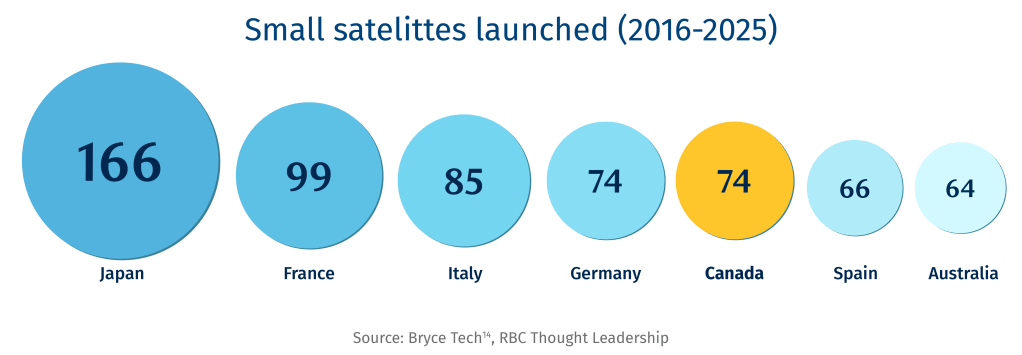
Capturing even a small share of the market would be significant. If a Canadian small rocket reaches orbit in 2029 and grows to six launches a year and a medium-lift rocket debuts in 2033 and flies four times by 2035, it would add up to 31 launches, worth a total of more than US$400 million. That’s about 4% of the total addressable market (TAM), and about US$150 million a year by 2035 (roughly a tenth of the projected TAM that year.)11
Canada’s first foreign launch revenue will likely come through its spaceport in Nova Scotia by 2028. Germany’s Isar Aerospace signed a 10-year agreement in July 2026 to fly its Spectrum rocket from Spaceport Nova Scotia from 2028, and U.S. operator SEOPS recently booked five Spectrum launches for 2028–2030 from Norway and Nova Scotia.
Allied defence also gives Canadian launchers an edge. Germany’s defence minister noted recently that national security must not get stuck “in commercial queues,” and allied governments are expected to prioritize military launches over commercial ones.
Canada also recently joined NATO’s STARLIFT network, which is building allied capacity to replace satellites on short notice. A rocket flying from Canada, able to reach the polar orbits used for Arctic surveillance, would be highly competitive for these customers.
As momentum picks up, Ottawa will need to decide how to structure the next tranche of launch spending: what payload capabilities to prioritize, which milestones to stage funding against and how to purchase launches. Defence should anchor those choices, as the most valuable part of the market and where sovereignty matters most. On average, a defence satellite costs five times more than a typical satellite to build and launch, and militaries pay for assured access. Defence is set to account for nearly half the value of satellites built and launched over the next decade but represent just 9% of satellite volume.12
Financing Canada’s launch capability
Given the upfront capital-intensive nature of the industry, meeting the rising government and commercial demand will require considerable financing.
The country’s three rocket developers—Canada Rocket Company, NordSpace and Reaction Dynamics—have raised a combined $200 million, including $8.3 million that has been conditionally awarded to each under Ottawa’s Launch the North program. But that is a fraction of what it costs to bring a rocket into service. Canada Rocket Company, a Toronto-based firm set up in 2025 to develop sovereign launch capabilities, says it needs up to US$660 million to fly its first rocket, a Falcon 9 alternative, in 2032.
Commercial demand alone will not close that gap. Even if Canadian rockets won every launch contract for the roughly 129 Canadian satellites currently without a ride to orbit, the revenue would be US$290 million based on current prices—less than half of Canada Rocket Company’s target.
Institutional investors have started to engage. The Business Development Bank of Canada (BDC) co-led Canada Rocket Company’s seed round in January 2026 and Reaction Dynamics has raised approximately $51 million to date, including a Series A financing backed by Investissement Québec. But early rounds still fall well short of the capital needed for an initial launch. Between development and first flight is where most ventures fail and financing matters most.
Government support is also needed to take on the risky nature of space launches: of the 216 small-launch programs tracked worldwide in 2025, only 37 had attempted orbital launch and 17 were operational. A further 112 had been cancelled, retired or gone dormant.13
Customers of Canadian satellite manufacturers can supply additional demand. A Canadian rocket would potentially allow domestic companies to sell satellites and launch as a package and steer foreign customers’ launches to Canadian soil.
Government funding will need to lead the way. SpaceX, for example, received a US$1.6 billion NASA Commercial Resupply Services contract that saved the company from bankruptcy early on its journey. Texas-based Firefly Aerospace received a US$93.3 million NASA contract before its first successful orbital launch with its Alpha rocket in 2022.
What Canada offers
-
Geography. Once completed, rockets launched from Spaceport Nova Scotia in Canso will be able to fly south over open ocean into the polar orbits used by Earth observation and surveillance satellites. Only a small number of allied sites, such as Vandenberg in California, Andøya in Norway and Saxa Vord in Scotland offer similar vantage points.
-
Proprietary technology and expertise. Canada already builds and operates satellites that allies want. Telesat’s 225-satellite Lightspeed low Earth orbit (LEO) network will serve commercial customers, the Canadian Armed Forces and NATO allies. MDA Space is building Lightspeed satellites, and its CHORUS radar technology will form the basis of Canada’s RADARSAT replenishment satellite. Kepler Communications launched the first 10 satellites of its optical data relay network in January 2026, using optical links compatible with U.S. Space Development Agency standards to move data in between satellites, aircraft and ground in real time.
-
A spaceport with an anchor tenant. The Department of National Defence has leased a pad at Spaceport Nova Scotia for 10 years at $200 million from Maritime Launch Services, with full orbital capability targeted for 2028. Quebec-based Reaction Dynamics, specializing in hybrid rocket propulsion and small satellite launch vehicles, plans its first orbital attempt there, while South Korea’s hybrid rocket maker Innospace has signed a letter of intent. A second site, NordSpace’s Atlantic Spaceport Complex in St. Lawrence, Nfld., plans orbital launches starting in2028 for light lift and medium-lift vehicles.
-
Alliances. Canada, which has space agreements with France and Norway, now belongs to several of the main allied frameworks for space, including the European Space Agency and NATO’s STARLIFT launch network.
Allied launch options
| Satellite class | Canadian demand | Allied options |
|---|---|---|
| Small (up to 200kg) | ~95 satellites, 3.3 tonnes over nine years | Rocket Lab Electron (U.S.): 18 successful orbital launches in 2025; reported cost of US$8m per launch; sold as a whole rocket; Rocket Lab’s backlog is 90 launches across Electron and Neutron. |
| Firefly Alpha (U.S.): One launch failure and a rocket lost in ground testing. Returned to flight March 2026, most of 2027 capacity already sold. | ||
| Isar Spectrum (Germany): Spectrum reached orbit in September 2026 after a failed first flight. It is sold out for 2027-28 and plans to fly from Nova Scotia in 2028. | ||
| PLD Miura 5 (Spain): Due to fly in 2027 | ||
| MaiaSpace (France): Due to fly in 2027 | ||
| Light (200-700kg) | ~33 satellites, 9.7 tonnes over nine years, mostly Kepler’s 300kg relay satellites | Rocket Lab Neutron (U.S.): First launch targeted for late 2026. At least 7 launches sold through 2029, including for Kepler in 2028. |
| Isar Spectrum (Germany): See above. | ||
| Medium-heavy (1 tonne+) | 1 satellite: the RADARSAT replacement (est 1.4-2.2 tonnes, early 2030s). Planned military satellites not yet sized (est. 10-25 tonnes around 2035) | Vega C (European Space Agency): 3 of 3 successful in 2025, 2 of 2 in 2026. Largely booked by European governments, the EU expects 6 Vega launches a year in 2030 (8 launches a year are needed just for European government missions). |
| Ariane 6 (European Space Agency): 4 of 4 successful launches in 2025, 4 of 4 in 2026. Amazon has 21 launches still to fly. The EU expects its governments will need 14 a year by 2031. | ||
| Rocket Lab Neutron (U.S.): Neutron is a medium-lift rocket capable of also carrying multiple light satellites. | ||
| H3 (Japan): 2 of 3 successful launches in 2025, 2 of 2 in 2026. Japanese government missions take priority; only 2 commercial customers have been announced. | ||
| Blue Origin’s New Glenn (U.S.): Failure in April 2026 and rocket explosion in May 2026; return targeted before end-2026. Amazon has booked 24 launches. | ||
| ULA Vulcan (U.S.): Grounded since February 2026; return targeted before end-2026. More than 80 missions booked, including 38 for Amazon, plus U.S. national security launches. |
Lessons for Canada:
Facing a national security imperative, many allied governments have moved faster and committed more capital than Canada. Three lessons stand out:
1. Buy launch slots, not just rockets. Every successful model pairs development funding with a government commitment to buy flights.
-
Europe: Ariane 6 and Vega C operate under a 2023 agreement that guarantees a minimum number of government launches each year, backed by up to €340 million a year in support.
-
European Space Agency: member states committed €902 million to the European Launcher Challenge, which pays for launch services as companies hit milestones, including reaching orbit before 2028.
-
Germany: companies were awarded funding on the condition that they fly government payloads on their first two launches.
-
United States: SpaceX’s Falcon 9 was built on NASA cargo contracts, and the military’s national security launch program has committed about US$13.7 billion to roughly 54 missions through 2032.
Lesson for Canada: Committed government payloads would give providers a reason to invest in Canadian sites. Ottawa’s Launch the North program, however, is a $105-million initiative with no commitment to buy launch slots. The next generation of allied launch providers are filling their order books and choosing where to fly from. Canada can offer both a launch site, once completed, and a steady flow of government and commercial payloads. Committed early, that combination can buy Canada a standing on allied rockets that others cannot get.
2. Cooperate with allies.
-
Sovereign access increasingly means launching from allied territory and deepening industrial and military cooperation.
-
The UK’s 2026 space strategy leaves building rockets to “Germany and other allies” and puts its money into its spaceport.
-
France has opened its Kourou launch base in French Guiana to German and Spanish companies.
Lesson for Canada: Every established rocket that can carry Canada’s largest satellites serves its own government first. EU missions alone are projected to exceed Ariane 6 and Vega C supply by 2030-31. H3’s order book is dominated by government missions; U.S. national security launches take precedence on Vulcan Centaur’s heavy-lift orbital launch vehicle Vulcan, and Blue Origin’s flagship New Glenn and, increasingly, Falcon 9. Wherever capacity is constrained, Canadian payloads will rank behind those of the host nation, further supporting the case for domestic launch capability.
3. Establish legal foundations early.
-
New Zealand brought its Technology Safeguards Agreement with the U.S. into force within six months of signing, before it hosted California-based Rocket Lab’s first launch. That agreement has since allowed the U.S. Space Force to fly a rapid-response military mission from New Zealand. Australia completed a similar agreement in nine months.
Lesson for Canada: Canada concluded negotiations on its own agreement more than two years ago but it has yet to be finalized. Without a launch act (Bill C-28, the Canadian Space Launch Act is at second reading), foreign rockets cannot use Canadian sites.

Download the Report
McKinsey. April 2024. Space: The $1.8 trillion opportunity for global economic growth.
RBC Thought Leadership tally of satellites launched for Canadian companies, government and universities, September 2025-October 2026.
Bloomberg. July 2026. SpaceX turns away Falcon customers in major bet on Starship.
RBC Thought Leadership calculations, publicly announced satellites and projections based on company’s stated cadence or record over the past five years.
Space Foundation. July 2026. The State of the Global Space Economy.
Novaspace. October 2025. Novaspace projects $665 billion in satellite build and launch activity.
European Commission. September 2026. Opening address by Commissioner Kubilius at the 2nd Access to Space Conference “Ready to Launch: Building Europe’s Competitive, Resilient and Responsive Access to Space”.
BryceTech. July 2026. Smallsats by the numbers 2026.
Government of Canada. December 2025. Surveillance of Space 2.
RBC Thought Leadership calculations based on current small- and medium-launch prices.
Novaspace. October 2025. Novaspace projects $665 billion in satellite build and launch activity.
New Space Index. October 2025. Small launchers – 2025 survey and competitive landscape.
BryceTech. July 2026. Smallsats by the numbers 2026.
This article is intended as general information only and is not to be relied upon as constituting legal, financial or other professional advice. The reader is solely liable for any use of the information contained in this document and Royal Bank of Canada (“RBC”) nor any of its affiliates nor any of their respective directors, officers, employees or agents shall be held responsible for any direct or indirect damages arising from the use of this document by the reader. A professional advisor should be consulted regarding your specific situation. Information presented is believed to be factual and up-to-date but we do not guarantee its accuracy and it should not be regarded as a complete analysis of the subjects discussed. All expressions of opinion reflect the judgment of the authors as of the date of publication and are subject to change. No endorsement of any third parties or their advice, opinions, information, products or services is expressly given or implied by Royal Bank of Canada or any of its affiliates. This document may contain forward-looking statements within the meaning of certain securities laws, which are subject to RBC’s caution regarding forward-looking statements. ESG (including climate) metrics, data and other information contained on this website are or may be based on assumptions, estimates and judgements. For cautionary statements relating to the information on this website, refer to the “Caution regarding forward-looking statements” and the “Important notice regarding this document” sections in our latest climate report or sustainability report, available at: https://www.rbc.com/our-impact/sustainability-reporting/index.html. Except as required by law, none of RBC nor any of its affiliates undertake to update any information in this document.