Oh Canada, we’ve got ourselves a deal

  • At long last, and just in time for Canada Day, the federal government is taking steps to tear down interprovincial trade barriers.

  • Bill C-5, the Free Trade and Labour Mobility in Canada Act, has become law. And while removing federal barriers to interprovincial trade is a positive step, history suggests obstacles will remain.

  • ‘Special interests’ groups will mobilize behind the scenes to secure carve-outs from the legislation, which may undermine its effectiveness.

  • More challenging still is the commercial reality on the ground. As Canada’s experience in free trade shows, the mere lowering of tariff walls does not automatically boost trade flows. Canada liberalized trade with Europe and Asia, for example, but Canadian exports to these regions have not meaningfully increased.

  • So can we expect to see more Okanagan Riesling on shelves east of the Rockies? It’s probably too early to pop the cork and celebrate that victory.

  • Statistics Canada data shows that Canadians trade less with each other than they do with the rest of the world, in percentage terms. In the ’80’s, roughly half of Canada’s total trade was interprovincial. Following a series of FTAs, that proportion has dipped closer to a third.

  • Internal barriers may help explain why trade between provinces has lagged trade with the wider world. RBC Economics concluded earlier this year that estimates may differ about the economic gains associated with reducing internal trade barriers, but what seems certain is that free trade among the provinces is a pro-growth policy—particularly for the smaller provinces.

The week that was

  • In addition to having her term as Canada’s Ambassador to the U.S. extended, Kirsten Hillman was named Canada’s chief negotiator in trade talks with the U.S.

  • Complaints from U.S. manufacturers that China was limiting the release of rare-earth elements despite its trade truce with Washington prompted Beijing to promise on Friday that it would approve U.S applications. This comes a day after Trump announced that the U.S. and China had “just signed” a deal.

  • The U.K. unveiled a broader trade strategy focused on its £500 billion a year service exports sector and the desire to land deals with a range of partners, including the six-member Gulf Cooperation Council.

  • Trump threatened Spain with increased tariffs, after Spanish Prime Minister Pedro Sánchez rejected NATO’s new target of spending 5% of GDP on defence.

  • Donald Trump, at the urging of oil executives, is pushing to rollback climate laws as part of U.S.-EU trade negotiations.

The big number

Total value of U.S. exports in May, down 5.2% versus April – that’s the sharpest month-over-month decline since 2000

Global oil and gas trade just got risky—again

As Iran and Israel traded missiles and the U.S. bombed three of Tehran’s nuclear facilities, oil tanker rate premiums spiked 83%. And with major LNG exporter Qatar briefly getting ensnared in the crisis, another element of risk was added to the global oil and gas trade.

While oil tanker rates cooled off a couple days after the ceasefire, this volatility could remain a perennial issue hovering over global commodity production—and prices. Meanwhile, LNG tanker rates, due to re-routing and summer demand, remain elevated. By 2030, almost 25% of global LNG flows are expected to pass through the Strait of Hormuz, a critical oil and gas channel in the Middle East, based on Rystad data.

Canada has an opportunity to help de-risk global supply from both a geopolitical and a concentration of supply standpoint—a proposition valued by European and Asian buyers, as we highlighted in our recent report A G7+ Strategy for Natural Gas: Four Scenarios for Energy Security in the 2040s.

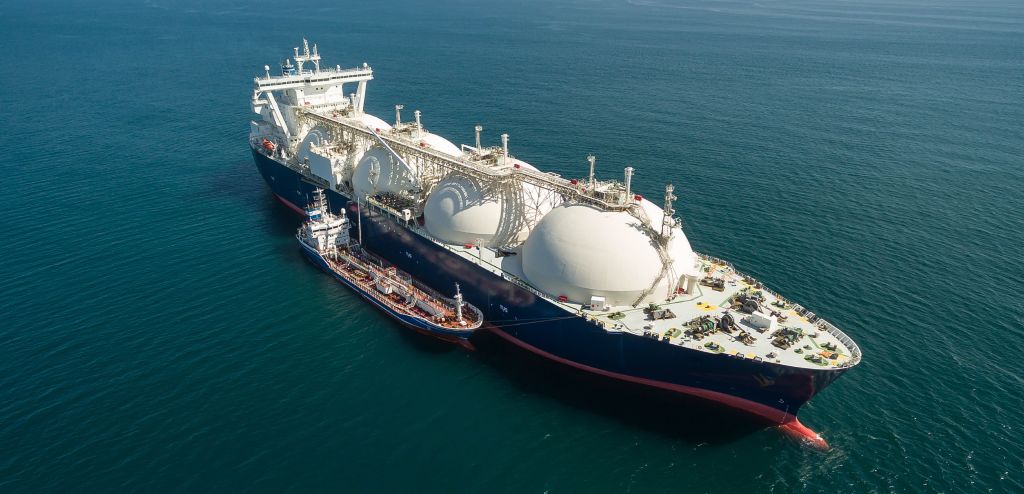
And Canada would soon become a bona fide member of the LNG exporters club.This weekend, LNG Canada awaits the arrival of likely two LNG carriers, including Puteri Sejinjang, a new 174,000-cubic-metre carrier, to pick up the first-ever shipment of gas from the West Coast facility.

Final Word

“Our strategic response to this new world can’t be based on nostalgia or post-imperial delusion, let alone any ideological or dogmatic attachment to one trading bloc or another.”
Douglas Alexander, U.K.’s Trade Minister

In this week’s edition: A critical minerals action plan, why trade diversification may not be a silver bullet and how tariffs are making food insecurity even worse

Noteworthy

By John Stackhouse

Mark Carney got out of the G7 alive. The Kananaskis summit could have been a trade wreck, but Donald Trump clearly had other things on his mind. That doesn’t mean Canada, or any of the other summiteers, can claim victory. Here’s why, and some of what we’re hearing: 

  • There was never going to be a Canada-U.S. agreement at the G7, for one simple reason: DJT was not going to announce something so important to his domestic agenda on foreign soil (unless, of course, he planted the Stars and Stripes with it.)

  • The ensuing suggestion of a 30-day window for a deal is aspirational. Anyone who has dealt with Trump knows he doesn’t stick to deadlines, and he uses time as a negotiating tool. That means don’t settle if you don’t have to. And now, the Carney team’s biggest concern is playing out, as POTUS gets distracted by events. A Middle East war, for instance.

  • Some on the Canadian side don’t mind that, thinking that a “rag the puck” strategy allows Canada to get to a fuller USMCA conversation in the fall.

  • But still other Canadians fear the worsening impact of countervailing tariffs. “Elbows up” sounds fine, until you elbow someone on your own team. Plain + simple: Canada is suffering more from the tariff war than the U.S. right now.

  • And the longer the uncertainty goes on, the more challenging it will be for Canada to attract investment.

  • Longer term, Canada remains in the crosshairs of Trump’s sectoral studies, which will only make it harder for our exports in his Core 5 categories: autos, steel/aluminum, lumber, pharmaceuticals and semiconductors.

  • As someone put it to Trade Zone: “When your negotiating partner is willing to be far more ruthless, you’re not in a good negotiating position.”

The week that was

  • The U.S. and Canada are looking to secure a deal within 30 days. If they can’t, Carney said, Canada will impose counter-tariffs.

  • Canada is cracking down on the dumping of cheap foreign steel to support domestic steel producers getting hammered by Trump’s 50% tariffs.

  • The volume of commercial trucks crossing into the U.S. from Canada is down more than 10% in each of the past two months compared to 2024. Meanwhile, trucks from Mexico to the U.S. were only down 2.8% in May (and 6.4% lower in April).

  • The U.K.’s Business Secretary said that efforts to get relief for steel exports to the U.S. will be wrapped into broader tariff negotiations, indicating that there is still a ways to go on the recently announced trade deal between the U.S. and U.K.

  • The U.S. Fed held rates steady and said it will watch the impact of tariffs closely this summer.

  • Housing starts in the U.S. hit a five-year low in May as tariffs hit imported construction materials.

  • Despite tariffs effectively shutting the U.S. out as a destination for its goods, China increased its overall trade surplus to US$500 billion so far this year—that’s up 40% YoY.

Minerals on the G7’s mind

G7 leaders unveiled a Critical Minerals Action Plan this week to counter non-market distortions, increase supply chain transparency, and reduce strategic dependency on Beijing. While light on specifics, some key items aligned with our report, The New Great Game:

  • Limit price distortions: G7 members committed to coordinated responses to supply disruptions and pledged improved market transparency and traceability. No explicit mention of a “China premium” or minimum price floor, as we noted, but positive developments, nonetheless.

  • Unlock financing: Encourage development banks, export credit agencies, and private capital to accelerate upstream investment in G7 countries and emerging market allies.

  • Supply-chain traceability, standard-setting and sustainability: A G7 roadmap due by year-end to create benchmarks to ensure responsible mining, environmental safeguards and labour standards.

Canada remains positioned as a central actor in mineral resources, with the potential to serve the growing needs of European and U.S. defence and new energy mineral needs—a natural advantage in trade talks with the U.S. and partners. Further efforts to strengthen the remainder of the value chain—building out refining capacity, for example—will complement Canada’s resource advantage.

Why trade diversification may not be a silver bullet

Diversifying trade partners, in the wake of the current trade war with the U.S., has become a hot topic. But while lowering tariff barriers is sound economics, this alone may not lead to higher export volumes.

The Harper conservatives pursued bilateral trade agreements with a range of countries and economic blocs, including Europe (CETA), Asia-Pacific (CPTPP), and a host of Latin American countries. And yet, just 4% of Canadian exports are EU-bound and 6% are shipped to CPTPP countries—ratios that remain unmoved over two decades.

Meanwhile, nearly 80% of Canadian exports are sent to the U.S. Canada’s reliance on a few key industries—energy, automotive and metals—further entrenches this dependence. Canada needs an integrated trade strategy that diversifies trading partners while boosting export competitiveness. And it makes the Carney-Trump 30-day deal deadline all the more important.

A trade war on food security

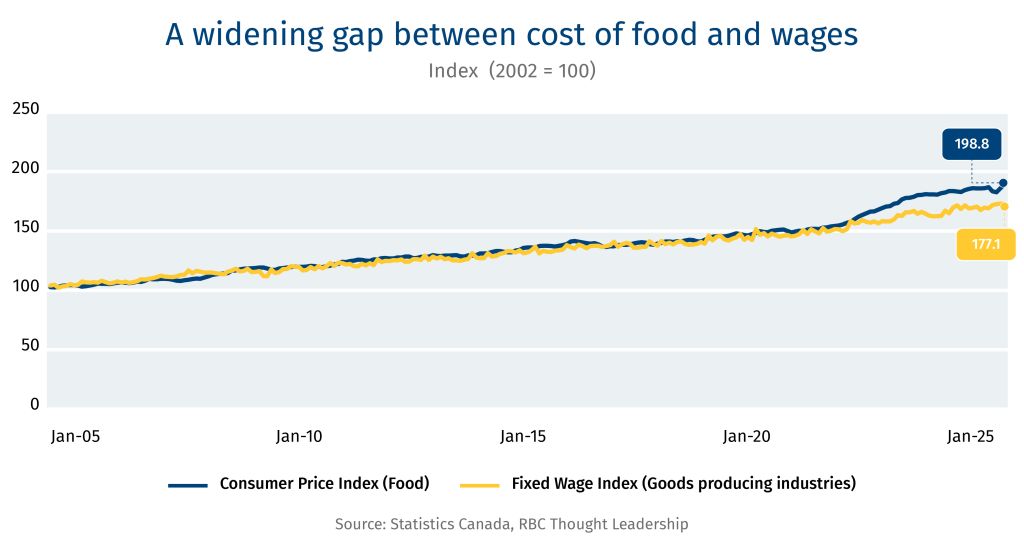
One in four Canadians are experiencing food insecurity—a level never seen before in this country. It’s an issue of affordability, and one that tariffs and the ongoing trade uncertainty, threatens to make worse.

  • Job loss and insecurity is forcing many to make difficult choices: Between January and May, Canada’s manufacturing sector lost 54,000 jobs and the country’s unemployment rate rose to 7%, the highest it’s been since 2016, excluding the pandemic.

  • Rising cost of living threatens to further deepen the food insecurity crisis. But it’s more than about jobs—over 60% of food-insecure households rely on wages or self-employment income to support themselves.

  • Supply chain disruptions impact food consistency and costs: In the U.S., tariffs are estimated to increase food prices by 2.6% in the short run, disproportionately impacting fruit and vegetables, that are expected to rise 5.4%.

In our latest report–Feeding the Crisis: The Tariff Toll on Food Insecurity–we lay out three potential solutions, all linked to Canada’s growth ambitions.

The Final Word

“If the current tariffs and counter-tariffs remain in place, past experience suggests pass through of about 75% of the costs of tariffs over roughly a year and a half.”
Bank of Canada Governor Tiff Macklem during a speech this week in St. John’s, Newfoundland.

From Arctic sovereignty to wildfire response, Canada’s challenges are increasingly being solved by the low earth orbital satellites less than 1000km from the earth’s surface.  In this episode, co-hosts John Stackhouse and Sonia Sennik dive into the pivotal role that satellite communications have in Canada’s future. Prompted by Prime Minister Mark Carney’s call for enhanced Canadian defense, the conversation explores how innovation in low earth orbit will shape global competitiveness and security.

Mike Greenley, CEO of MDA Space, offers a compelling look at how Canada’s satellite and robotics capabilities are fueling both surveillance and strategic infrastructure in space, including the next generation of the Canadarm. Dan Goldberg, CEO of Telesat, discusses their $6B Lightspeed constellation and how low Earth orbit networks will revolutionize broadband access across Canada and beyond. Finally, planetary scientist Dr. Margarita Marinova outlines a bold vision of an emerging space economy – from fire detection to lunar research, and what it means for Canadian innovation.

Listen on Apple Podcasts, Spotify or Simplecast

In this week’s edition: Trade signals at the G7, why it’s so hard for steel and aluminum manufacturers to diversify from the U.S., and how long it typically takes to get a major trade deal done.

The week that was

  • Reports surfaced (here and here) that Canada and the U.S. have a working trade document, including details of a potential deal. No timeline yet.

  • With Mexico’s Claudia Sheinbaum and India’s Narendra Modi in Kananaskis for the G7,  could more trade talk with Canada be on the agenda?

  • According to the World Bank, we’re about to experience the slowest decade of growth since the ’60s–the result of uncertainty caused by tariffs.

  • While Trump celebrates a “done deal” with China after two days of negotiations, word from China is more muted—Beijing’s official news agency called it an “agreement in principle.” China is said to only be lifting restrictions on rare earth minerals exports for six months leaving open the possibility of future escalation.

  • In the next week or two, Trump plans to send letters outlining unilateral tariffs to many countries.

  • Tariffs have yet to generate the inflation jump in the U.S. that many expected. Just wait, say economists.

  • Dominican Republic has become a hot spot for U.S. companies seeking alternative manufacturing hubs. The country’s 92 free zones and proximity to the U.S. are two key factors.

Trade signals at the G7

While there may not be a major breakthrough with the U.S. on tariffs and trade at the G7, there are certainly a couple things to keep an eye on:

Critical Minerals: The U.S. trade war with China exposed major dependencies on critical and rare earth mineral supply chains, which Beijing dominates. To feed its lofty energy and tech ambitions, the Trump administration needs a reliable supply. Collectively, the G7 possesses massive untapped resource potential, and the capital needed to fund projects.

USMCA: Claudia Sheinbaum’s attendance will mark the first time since Trump’s inauguration that all three North American leaders are participating in the same multilateral meeting. This unlocks the potential for a sideline meeting to chart a course for the 2026 USMCA review and discuss ongoing efforts to combat the issue of fentanyl that remains the core justification for the U.S.’s IEEPA tariffs on Canada and Mexico.

Noteworthy

By Jordan Brennan

I was in Ottawa this week at Canada 2020, where the general sentiment among attendees was cautious optimism. The focus was on reigniting growth through nation-building projects. And while opportunities abound—in energy, mining, housing, infrastructure, AI—a rebooted operating model is needed. A few themes stood out:

  • Internationally, Canada is seen as a high-risk jurisdiction thanks to regulatory delays (i.e. impact assessments that can stretch over a decade) and political instability (think rising separatist sentiment in Alberta). It was noted that international investors routinely add a 20% risk premium to capital allocation decisions involving Canada. Then there’s the broad political discretion cabinet holds over major projects. To unlock capital at home and abroad, we’ll need more regulatory and political certainty. Could a national trade corridor strategy help reduce Canada’s perceived risk profile?

  • Building export infrastructure assumes we’ll develop the resources to fill it—but many projects remain stalled or cancelled. So how do we responsibly move resources from Canadian soil to global markets? Here, treaty rights and the duty to consult First Nations come into focus—not as a hurdle, but as a competitive advantage. Successful companies build full economic partnerships with First Nations early in the process—on everything from impact assessments, employment and procurement agreements and equity stakes. If we want more projects approved—and faster—this kind of partnership is essential.

  • Same goes with Arctic security. With the retreat of sea ice, the Northwest Passage is being contested by foreign powers in part because it dramatically shortens the shipping time between North America, Europe and Asia. As one panelist put it, there’s no better way to assert Canadian sovereignty in the north than by developing the region. That means infrastructure—digital and physical—as well as the jobs and skills tied to mineral development.

  • Another challenge is timing. While resource prices are set on volatile global spot markets, projects like LNG terminals or major mineral developments have multi-decade lifecycles. Development must be aligned with future demand patterns, yes, but we must also be hyper-focused on cost competitiveness. Forecasting global energy and mineral needs in 2050 is daunting, but essential if we’re to attract the patient capital needed for big projects.

Three questions…

With the U.S. doubling tariff rates on steel and aluminum, Jake Silverthorn on RBC’s Capital Markets Diversified Industrials team, helps us understand the current landscape.

Q: Why are Canadian steel and aluminum producers more impacted from U.S. tariffs than vice versa?
A: There is a structural difference between U.S. and Canadian markets. Canadian producers mostly operate in spot markets while U.S. producers use contract-based transactions, which makes it difficult for Canadian companies to effectively pass through tariff costs. Additionally, the tariffs have created a demand and pricing imbalance between the U.S. and Canadian markets.

Q: Why is it hard for Canadian producers to diversify away from the U.S. market?
A: Given high shipping costs, the U.S. represented the most profitable destination. Canadian producers have strategically placed their operations near U.S. ports to make shipping easier.

Q: What can Canadian producers do to maintain their U.S. market share?
A: To remain competitive with the domestic U.S. producers and maintain existing operations, Canadian producers are expected to absorb part of the tariff costs, impacting margins and cash flow.

Bottom line

917

The number of days a typical trade deal takes to complete from start to finish (The USMCA took 896 days). In April, Trump promised 90 deals in 90 days. With just a couple weeks remaining on that self-imposed deadline, the U.S. has signed 1 deal (U.K.) and has scored a tariff truce with China.

  • Gas is critical in our best—and worst—case scenarios for global energy systems. Gas will be vital as a transition fuel in a ‘Decarbonizing World’ before declining by the late-2030s; and as an energy security cushion in our worst-case scenario, that we call ‘Dystopian World’.

  • Gas can anchor G7+’s energy security—but needs work. For G7+ consumers, it can reduce dependence on Russia in the near-term and avoid boom-bust cycles. In the longer term, it opens up promising new markets for G7+ producers. But the commodity is geopolitically problematic, too expensive in certain regions like Asia, and deemed too carbon-intensive. The G7+ can help overcome those hurdles.

  • Gas can help address, but also worsen, climate change. Achieving net-zero before the 2060s is challenged. But the G7+ can advance policies and technologies that catalyze carbon capture, accelerate methane intensity reductions, and encourage the development of low-carbon alternatives such as ammonia and hydrogen. That would help limit global temperature rise to around 1.7-1.8 Celsius compared to pre-industrial levels.

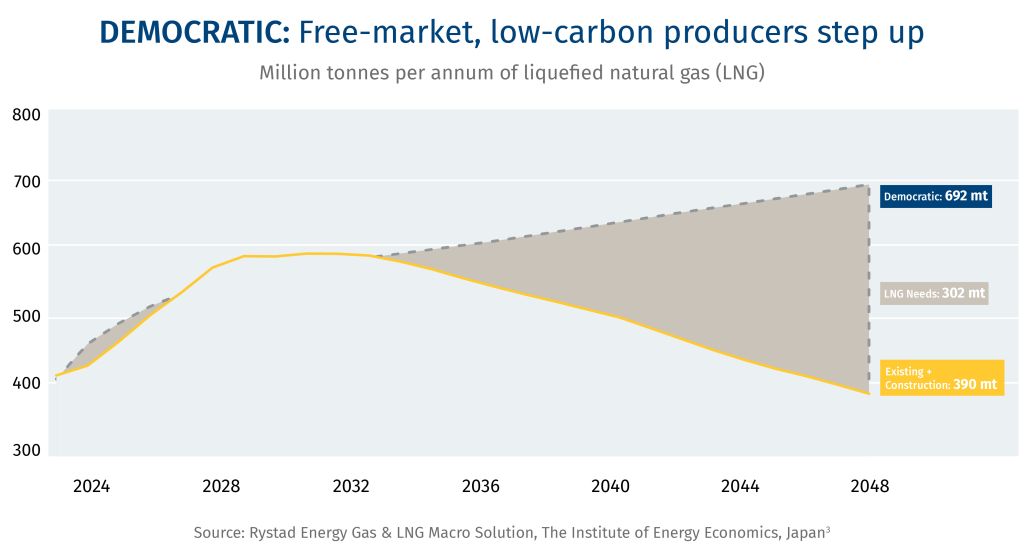
  • The G7+ could emerge as the most influential LNG player. By 2040, LNG exports from the U.S., Canada and Australia can power G7+ economies and also ship gas to emerging Asia, as we outline in our ‘Democratic World’ scenario. It’s an opportunity for G7+ to expand its geopolitical influence and forge stronger ties with emerging markets.

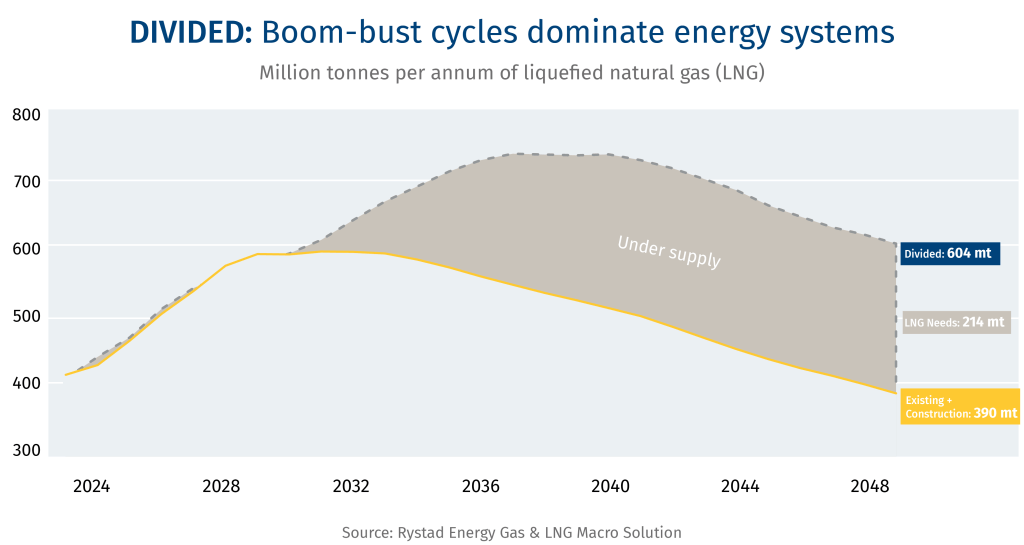
  • Global LNG export capacity may need to rise by nearly 50% by 2040. Current export capacity and supply under construction is insufficient to meet the needs and aspirations of a rising global population and a world economy that will expand 42%, according to our ‘Divided World’ scenario.

  • G7+ compact can help unlock financing for LNG projects. It could facilitate funding from a range of financial institutions, including multilateral development banks and national export credit agencies, that have excluded natural gas investment for fear of “locking in” emissions.

  • Exporting gas would require US$1.2-trillion in investments in North America alone. A build-out of the continent’s gas infrastructure would likely require around US$1.2 trillion over the next 15 years. But it would require supportive policies and clear frameworks for communities and corporations.

Welcome to the 2040s.

In the decade that will take us to the mid-century, our world will be very different, and so will our energy needs.

The planet will be home to at least a billion more people, with a population well over nine billion. The world’s economic output, if it follows recent decades, will add the equivalent of another U.S. economy, spread largely across Asia and the global south, with all the energy demands that go with it. Add to that something entirely new—the world of artificial intelligence at mass scale, with computing needs that, for now, seem incomputable. By one estimate, we will need 4,000 more terawatt hours of power to run this emerging data centre economy; that’s equivalent to 15% of the world’s electricity generation today.1

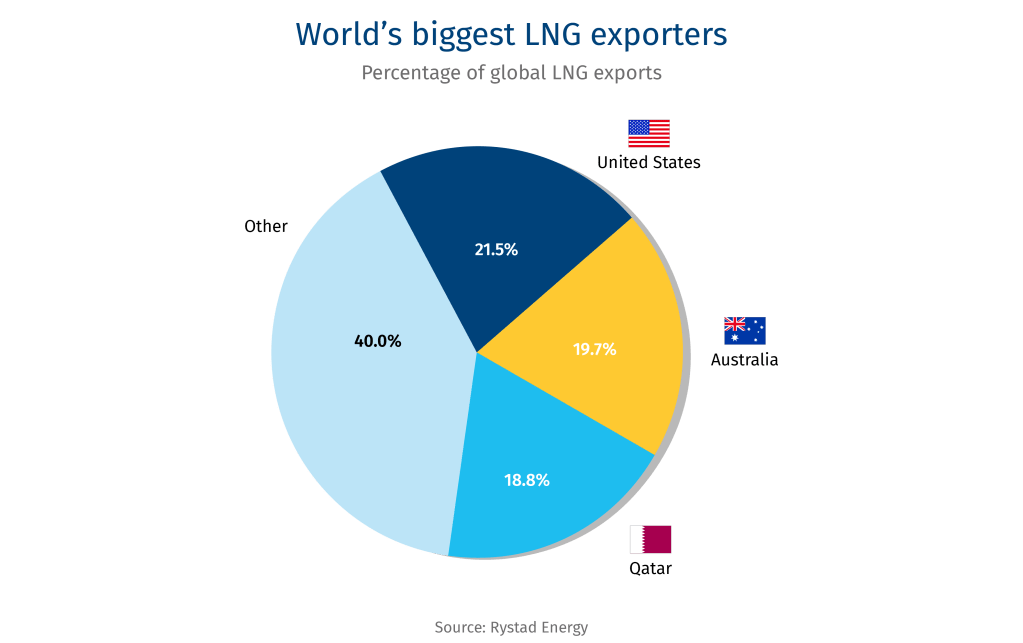
Another step change in energy demand may require more of every practical and affordable energy source, but the greatest expectations may be placed on natural gas. It’s expected to become the world’s dominant energy form, surpassing oil, having already grown in supply by 70% in the first quarter of the 21st century.2 The advent of liquefied natural gas, and supertankers to carry super-chilled LNG across oceans, has transformed the gas outlook even more. In a little over a decade, the United States has transformed itself from amongst the world’s largest gas importers, to the world’s largest LNG exporter.

As oil was to the 20th century, gas may be as critical to the 21st, but not without strategic choices that are already challenging the world. Russa’s invasion of Ukraine, and its weaponization of gas to weaken Europe, is just one indication of how the world’s rapidly growing reliance on gas has put energy security at risk. Rapidly growing and urbanizing countries across much of the world have found their dependence on imported gas to present further risks. The West’s growing ambition to reshore manufacturing, and remilitarize, may require more gas, too, as a reliable and affordable concentrated energy source.

Few bodies may be better suited to address these challenges than the G7, the group of leading liberal democracies (the United States, Canada, the U.K., France, Germany, Italy and Japan) that is meeting June 15-17 in Kananaskis, Alberta. Atop the group’s agenda: energy security.

The G7 was formed 50 years ago, in the mid-1970s, in response to similar disruptions to the global economy caused by an oil shock and ensuing conflicts. Today, the alliance faces new challenges, particularly from China and Russia, and may find opportunities in reasserting itself through an approach to democratic and decarbonized natural gas for a fast-changing world.

Properly managed, the G7 and key allies such as Australia and South Korea, known as G7+, can create stronger alliances with emerging markets, especially in Asia, stabilize energy prices and strengthen long-term global growth. It could even provide a bridge to lower energy emissions, by displacing coal. Led by the European Union’s 107 million tonnes per annum (mtpa) and Japan’s 64 million mtpa of LNG consumption, the G7+ consumes 227 mtpa, or 51% of global demand. That exceeds the 179 mtpa currently produced by the U.S. and Australia.

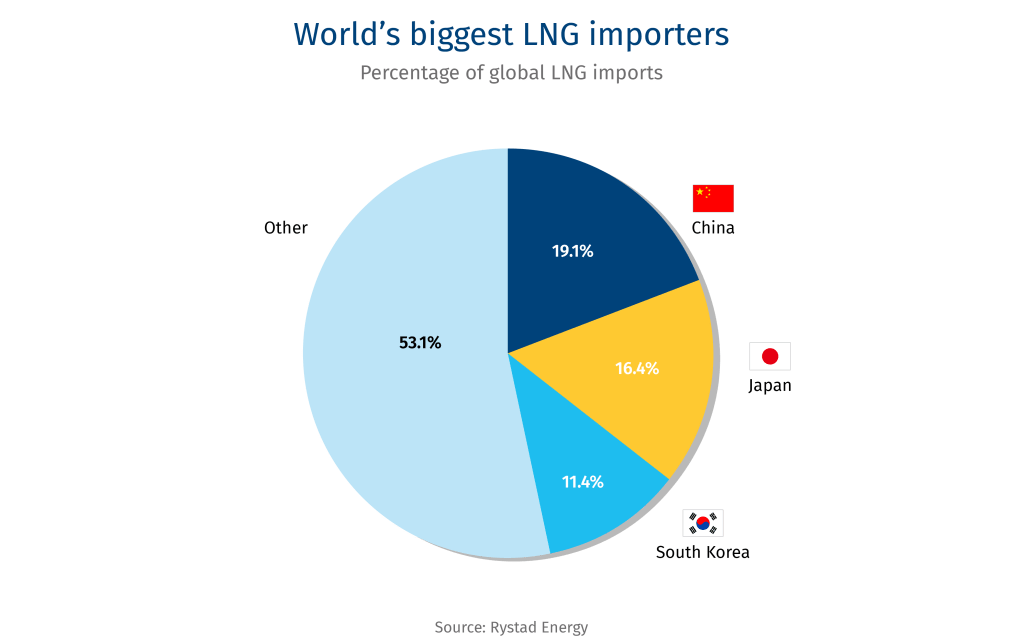
By 2040, however, the G7+ gas trade balance could reverse such that its supply far exceeds the demand of its members and allies—by almost 150 mtpa—requiring the Western-led alliance to secure new markets. China is expected to be, by far, the largest purchaser of LNG in 2040 (163 mtpa, from 79 mtpa in 2024, according to Rystad Energy’s base case). But trade frictions with North America could result in Chinese LNG imports diversifying away from American sources.

For the G7, other allies will be critical to ensure a greater balance between supply and demand. India is often seen as a vital long-term prospect for G7+ exports, with projected demand of 63 mtpa. But other emerging Asian markets such as Pakistan, Bangladesh, Thailand and Indonesia will be essential, too, as they’re projected to consume a combined 219 mtpa by 2040. In a potential world where the Chinese market is inaccessible to the U.S., and India follows its own path—prioritizing price above all else, perhaps from Russian supplies—Asian demand will be vital to any G7+ strategy.

With all these forces at play, the world almost certainly will need more gas in 2040—but just how much will be needed?

To map out potential pathways, RBC Thought Leadership and Oslo-based Rystad Energy developed a novel research methodology to outline plausible scenarios for the 2040s, knowing the trajectory of growth will be critical to the mid-century condition of our world. Each was shaped by geopolitical alignments, climate policy ambitions and market dynamics. We then worked with a range of policy experts to assess the risks in each scenario, and develop broader policy options.

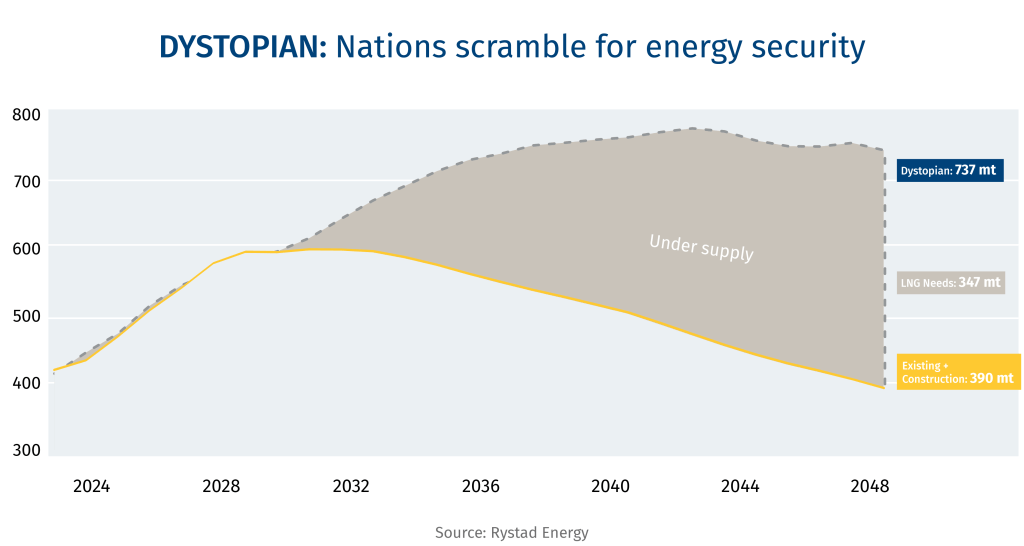
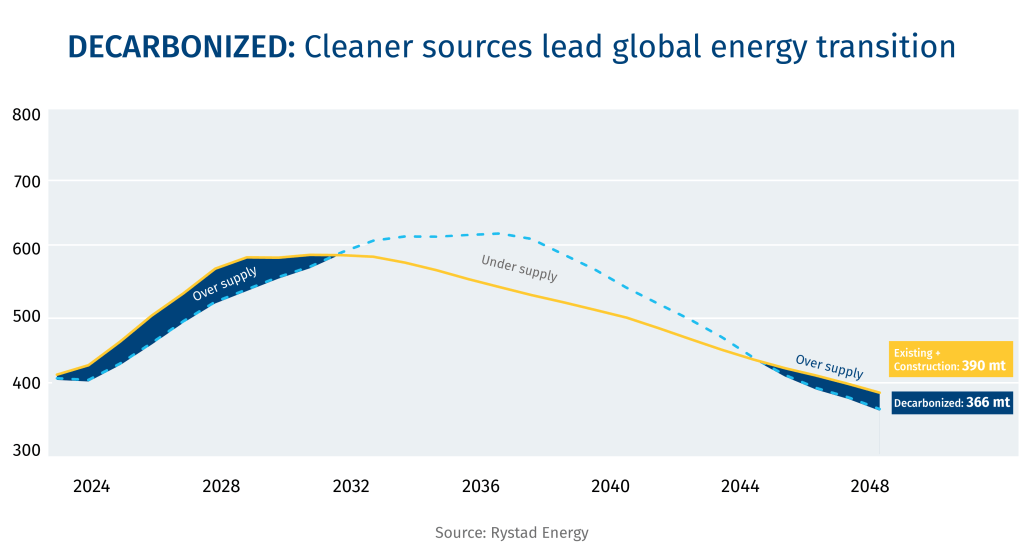
The outcomes suggested by each scenario are profoundly different. The range of our pathways shows that total global gas exports could grow from 411 mtpa in 2024 to as high as 737 mtpa by 2050—or shrink to just 366 mtpa. The net swing of 371 mtpa is nearly equivalent to current LNG exports.

The difference depends on whether the world develops more structured markets for gas, finds ways to connect fast-growing markets with reliable (and democratic) suppliers, and invests in technologies to cut emissions. The environmental attributes of this future gas supply—including the scale of transition to capture carbon and low-carbon derivative fuels like hydrogen and ammonia—will have a major impact on the direction of climate change, as methane emissions from gas are widely considered to be more dangerous to global warming than carbon, even though they’re also easier to contain.

The G7+ nations have an interest in securing long-term supplies of reliable and affordable natural gas, having experienced price shocks from the Western U.S. power crisis of 2000-01, the post-Fukushima disaster LNG price spike in Japan, the recent twin shocks of the Covid pandemic and Russia’s weaponization of gas exports in its war on Ukraine. A coordinated G7+ approach can stabilize markets through more cohesive policy alignment and joint investments around infrastructure.

Leveraging democratic, rules-based gas markets can ensure environmental standards across the supply chain, and further add to economic growth through industrial decarbonization, including investments in carbon capture, utilization and storage (CCUS), low-carbon fuels for industrial heat and heavy transportation, and a coordinated action plan on zero flaring and mitigation of fugitive methane emissions.

In a potential world where the Chinese market is inaccessible to the U.S., and India follows its own path—prioritizing price above all else, perhaps from Russian supplies—Asian demand will be vital to any G7+ strategy.

As such, emerging Asian markets including Pakistan, Bangladesh, Thailand and Indonesia, will be essential for the G7+ as they’re projected to consume a combined 219 mtpa by 2040, especially as they accelerate the switch from coal to natural gas.

To do all this, a G7 gas compact may be needed to lay the foundation for a robust and secure natural gas infrastructure that aligns with the needs of producers and consumers, delivering price stability, affordability, reliability, and lower greenhouse gas emissions. Such a compact could address the needs of a rapidly growing global gas world to develop more sophisticated markets and financial tools; to resolve infrastructure bottlenecks and coordinate national investment plans; and work collectively to ensure rapidly growing countries across Asia, Africa and Latin America have access to G7+ supplies, not only for economic growth but for geopolitical stability.

But the G7 and its core allies need to recognize the risks of some very divergent paths if a coordinated approach is not taken. Our modelling lays out four such outcomes.

Behind the scenes—our research approach

The research and methodology behind this paper is unique for three main reasons:

The research paired quantitative modelling with qualitative interviews and roundtable forums, including with senior officials in Canada’s federal and provincial governments, the private sector, Indigenous groups, international research institutions and multilateral development banks. The team engaged these experts individually and as part of convenings in Washington D.C., Vancouver, Ottawa, London, Beijing, New York, Calgary and Toronto.

RBC Thought Leadership spoke to more than 100 experts in Canada, the U.S., Japan and Europe to explore practical energy security solutions. These included representatives from the Asian Development Bank (ADB), the Bloomberg New Energy Finance (BNEF), Mokwateh, the First Nations Climate Initiative, Dr. Robert J. Johnston, Senior Director of Research, at the Center on Global Energy Policy, Columbia University, and Dr. Ken Koyama, Senior Managing Director, Chief Economist at the Institute of Energy Economics, Japan (IEEJ). RBC Thought Leadership partnered with Rystad Energy to collaborate on the data and modelling for this research.

The four scenarios were modelled for the purposes of developing robust recommendations for the G7+ heading into the Kananaskis meeting in June. We know that traditional forecasting methodologies fall short of capturing the complex drivers of change in our geopolitical landscape and energy systems. We mapped these drivers of change and developed a range of four distinct yet plausible futures against which to stress-test what a coordinated G7+ natural gas strategy could look like.

The scenarios are built on different variations of key drivers in the G7+ environment, including geopolitical stability, population and economic growth in emerging markets, digitization and data centre deployment, climate and energy policies, the role of international institutions and multilateral forums, fossil fuel production, manufacturing and supply chain distribution, the role of civil society, social cohesion and global gas demand.

Among our assumptions that span all four scenarios:

  • The world’s population will be approximately 9.2 billion, with significant regional variation depending on GDP, education and healthcare trends;

  • coal consumption will continue to decline in OECD countries;

  • continued growth of coal in Asia will offer significant potential for coal-to-gas switching;

  • oil will remain a dominant fuel for the transportation sector, particularly in emerging Asia;

  • nuclear generation will continue to have a strategic but overall minor role to play into the 2030s, with new builds expected in Asian markets such as China and in the U.S., particularly to meet growing demand from data centres;

  • renewables will enjoy exponential growth, particularly in solar and wind, as costs continue to decline;

  • global temperatures are expected to be anywhere from 1.8-2.2 degrees Celsius above pre-industrial levels.

The following scenarios are by no means a prediction of what the future will look like in 2040, rather, they represent a range of plausible futures.

  • Headline of the year: “Japan and China resilient to global gas price shocks

  • Fragmented, protectionist world order, with a further erosion of international institutions and growing influence of Russia and China as global powers.

  • Australia, Russia, Qatar and the U.S. dominate global gas production; concentrated gas supply subjects the G7+ to significant market risks and volatility as a supply gap emerges.

  • Technology growth is regionalized with China and the Gulf nations leading in AI and digital infrastructure that matches North America, driving gas flows to non-G7 markets.

Context

Divided 2040 is characterized by protectionism and regionalism, as the superpowers continue to recede from global alliances, opening the door to a world dominated by Russia for energy and resources, and China for technology and manufacturing. Concerns about energy security in the mid-2020s and early 2030s are now exacerbated by supply and affordability challenges. Multilateral institutions and alliances such as the G7 have limited influence over state actors. The U.S., China and other major global players have receded from international institutions and alliances, further embedding realpolitik and an increasing focus on national policy and borders. Energy security is one of the world’s primary concerns and has had a deep impact on emerging markets’ ability to industrialize and develop economically. A current boom-bust cycle leaves consumers exposed to volatile prices, while major producers such as the U.S., Qatar, Russia and Australia are vulnerable as customers avoid signing long-term contracts. As countries focus on addressing immediate energy security challenges, climate activism has given way to more extreme and violent civic action.

The Global Energy Story

Total power demand is up 66% in 2040 compared to 2025, driven by the industrialization of emerging markets, electrification of transportation, heating and industrial processes. Countries prioritize the deployment of energy systems based on renewables and clean energy sources such as nuclear and hydro, and while natural gas remains an important transition fuel, reliance on fossil fuels declines globally.

Global climate action from the late 2010s and early 2020s has slowed considerably, with only a handful of European countries strongly dedicated to the cause. While this world remains divided, climate progressivism still endures. Global companies and capital remain directionally committed to a net-zero target. Emissions, on a gradual decline for the remainder of the century, are due to hit net-zero by 2096 as temperatures are limited to 2.0C, an outcome marginally out of bounds of the Paris Agreement.

South Korea and China continue to lead as technology innovators and providers, while other nations are falling behind in the AI revolution and remain mere buyers of those technologies. Global data centre energy demand is about six times what it was in 2025. Technological development is increasingly influenced by regional powers, leading to divergent standards and ecosystems. This fragmentation hampers global interoperability and exacerbates geopolitical tensions. Efforts by Gulf nations to fast-track AI infrastructure deployment as set out in the mid-2020s have come to fruition. The UAE continues to have the highest public cloud spend per employee in the region and is now firmly established as a global AI leader, with Saudi Arabia and Singapore also in the forefront. Given China’s diversification of gas supply and acceleration of domestic production efforts in the mid-2030s, the Gulf and China are strong rivals to the G7 nations when it comes to clean technology innovation and digital infrastructure.

The LNG Story

The world needs to find 207 million more tonnes of LNG by 2040, relative to current capacity and supply under construction. Industrialization of emerging markets like Indonesia and India has been constrained due to the lack of affordable energy supplies. The rise of technological infrastructure in South Korea, China and the Gulf, however, provides a strong demand signal for consistent, growing natural gas demand that peaks in 2038. A supply gap emerges, and gas consumers are subject to market volatility with pricing predominantly influenced by incumbent suppliers—the U.S., Russia, Qatar and Australia—that hold a concentration of supply. The U.S. remains the world leader, bringing on more LNG than Russia and Australia through the 2030s. Other members of the G7+ are subject to market volatility as prices fluctuate, controlled by leading producers and subject to regional market disruptions.

Technology leaders such as South Korea, India and China remain dependent on non-democratic sources such as Russia for the majority of their energy supply to power data centres and digital infrastructure. The global landscape of AI data centres and digital infrastructure, ownership and operation are led by technology leaders. And while developing nations still gain access to AI tool sets, they have little say in setting standards and experience increasing bias and unfair terms from technology providers.

  • Headline of the year: “Indonesia’s new robot factory stalled by global gas shortage

  • Rise of regional conflicts and a global economic downturn in the late 2030s has led to a highly fragmented world.

  • Fossil fuel dependence continues to rise alongside rising demand for LNG.

  • With a significant energy supply gap emerging, Gulf states experience major growth.

  • Energy security dominates policy agendas, distracting from climate action, while national agendas prioritize trade weaponization and geopolitical leverage in the interest of security.

Context

In Dystopian 2040, regional conflicts and a protracted global economic downturn experienced in the late 2030s have led to an erosion of international institutions and the post-WWII global order. International protocols around the rule of law and global security are unenforceable and stuck in a quagmire of indecision and veto power. A failure of any country or international institution to meaningfully act in the face of growing aggression out of occupied Ukraine and the Middle East has resulted in violent and authoritarian regimes redefining the world stage. In economies like the U.S., fearmongering, protectionism and hardline authoritarian rhetoric has led to a declining global presence. The EU is dominated by protectionist policies, focusing on local economies and a handful of key trading relationships to buffer the impacts of regional conflicts. Security dominates national policies and agendas, with nationalist policies creating a bifurcated trade and investment climate. China’s imposition of export restrictions on rare earth elements in the mid-2020s set the stage for a growing trend of supply chain control, particularly in technology and defence sectors. As a result of closed borders and bloc-style co-operation, international trade is limited to small clubs of countries, who limit market access, building on the techno-nationalist policies of the late 2020s to bolster independence from foreign supply chains and competitiveness on semiconductor production. Rising unemployment due to a global economic downturn and a growing technological divide means that there is a rift among those who have access to digital infrastructure and those who do not. In a world where civil society and institutions are characterized by high levels of mistrust and a lack of coordination, the G7 struggles to build energy resiliency and withstand periodic energy supply and demand shocks.

The Global Energy Story

Climate change, alongside regional and protracted conflicts, creates fresh waves of humanitarian crises. The phrase “energy transition” has almost been forgotten, while national security agendas dominate the narrative around energy systems. Global sentiment is heavily tied to energy security, driving demand for low-cost fossil fuels such as oil and coal, at the expense of managing emissions. Fossil-fuel rich Gulf nations experience significant growth as they support Asian economies, and unlock a wealth of state capital increasingly oriented towards a data economy. Globally, increased nationalism and national security concerns lead to a decline in multilateralism. Coalitions like the Paris Agreement fade in significance as the pursuit of cheap energy and economic recovery dominate priorities. The weaponization of trade becomes a common occurrence—even an expected phenomenon as the competition between nations spreads into new spheres. Expect increased militarism and protectionism.

The LNG Story

Natural gas demand is up 16% from 2025 levels. These numbers are tempered by demand for other cost-effective fossil fuels like coal, which remains a core part of energy systems (22% of total primary energy). Global fossil fuel demand continues to rise beyond the original 2030 projections with no sign of slowing into the 2040s. As climate goals take a back seat to national security, coal-to-gas switching in Asia does not play out as predicted in the late 2020s. Energy and national security challenges lie ahead, with projected supply shortages limiting global economic growth. By 2040, an incremental 225 million tonnes of LNG—equal to over half what the world produced in 2024—is required on top of current and in-construction supply.

  • Headline of the year: “G7 Methane Club Declares Victory at 15th Anniversary of Kananaskis

  • Climate security dominates global policymaking, with aggressive emissions reduction targets.

  • Global power demand more than doubles, driven by industrialization and digital infrastructure. Renewables and clean-tech solutions take the lead to meet demand.

  • LNG demand declines, presenting the risk of stranded assets.

  • Remaining gas supplies are governed by the emergence of a clean gas market, with methane performance tracking to meet demand for abated natural gas.

Context

In Decarbonized 2040, aggressive climate policies and targets dominate the international landscape, as the world’s leading economies race to cut emissions and secure a more cost-competitive energy supply. Climate security is the pre-eminent focus shaping energy policies as destructive climate events became increasingly difficult to ignore by the 2030s, shaping voter preferences and civic action, and leading governments to re-invigorate global cooperation and international institutions. There is a meaningful return to global climate targets and the creation of new market mechanisms to unlock value from decarbonization. This includes the emergence of a clean fuels and certified natural gas market, underpinned by the measurement and tracking of methane emissions. Carbon capture is on track to reach three billion tonnes sequestered by 2050, equivalent to four times Canada’s total emissions in 2025. Millennials and GenZ, now in critical leadership roles in organizations, are driving the decarbonization agenda across governments and institutions. Civil society, too, is characterized by strong, diverse voices who are active in holding institutions accountable to their climate commitments.

The Global Energy Story

Total power demand is up 66% in 2040 compared to 2025, driven by the industrialization of emerging markets, electrification of transportation, heating and industrial processes. Countries prioritize the deployment of energy systems based on renewables and clean energy sources such as nuclear and hydro, and while natural gas remains an important transition fuel, reliance on fossil fuels declines globally.

While China has maintained its position as a clean technology manufacturer and intellectual property leader, the West’s investments in clean technologies through the 2030s begins to pay off, with a more distributed global supply chain that leads to greater resiliency and lower costs.

Countries that developed small modular reactors (SMRs) in the 2030s—Canada, the U.S., Argentina, Poland, Romania and China—are exporting that expertise around the world to countries seeking clean and reliable energy. Electrification is a clear winner, too, allowing for the displacement of direct-use emissions and an increase in energy efficiency. Oil demand falls almost 60% from current levels to 43 million barrels per day by 2050—a level not seen since 1969. Natural gas demand, while falling, remains more resilient, down 33% from current levels.

The LNG Story

The maturity of carbon markets, border adjustment mechanisms and a “methane club” across G7+ buyers and sellers drives a robust certified natural gas market. Throughout the 2030s, governments and industry leaders worked to develop clear and transparent market regulations, as companies were incentivized to reduce methane emissions and sought to differentiate themselves based on performance. National regulations in G7+ countries are grounded in a multilateral G7+ natural gas strategy, which enables global trade and methane measurement. Significant innovation around satellite technologies has enabled more effective methane tracking and robust data sets, enabling greater consistency of methane tracking than the world saw in the 2020s. There is a risk that existing LNG infrastructure becomes stranded, as the world’s leading economies shift to alternative energy sources and LNG demand declines. Global LNG demand declines rapidly by 2040 such that the world does not require any net new LNG by 2050 relative to existing and in-construction supply. Existing natural gas supplies from G7+ sources have a competitive advantage among climate-minded buyers looking for hydrogen/ammonia and abated gas. Multilateral development banks like the Asian Development Bank have supported energy efficiency improvements in gas distribution and gas power plants as well as coal-to-gas switching projects in Asia.

Net-zero likely occurs in the mid 2070s, with a projected temperature rise of 1.8C. However, further efforts such as requiring a 30% decrease in carbon intensity of natural gas production post-2030 could result in a further 40-45 billion tonnes of incremental CO2e avoided in this scenario by 2100.

LNG: An opportunity for reconciliation

Canada’s LNG opportunity cannot be capitalized without Indigenous partnerships and participation. Most of the land connecting the country’s major gas fields to the Pacific Coast are unceded territory, claimed by, or ratified through, treaty to First Nations in British Columbia. This is a huge opportunity for reconciliation—one that’s already being slowly realized. Cedar LNG and Ksi Lisims, two West Coast projects that will add 15 mtpa to Canada’s export capacity, have significant Indigenous ownership through the Haisla and Nisga’a Nations, respectively. By cultivating meaningful Indigenous partnerships and developing models for Indigenous capital, capacity and consent, LNG can be an opportunity for shared prosperity, while allowing Canada to meet the moment and expedite major projects quickly.—Varun Srivatsan

  • Headline of the year: “G7+ agreement to connect Earth with low-orbit data centres

  • The world is dominated by coalitions of like-minded nations, and multilateral institutions are reinvigorated.

  • A dual-energy trajectory emerges as renewables scale rapidly with global climate funds while LNG demand continues, driven by Asian industrialization and coal-to-gas switching.

  • Global supply chains and trade are more evenly distributed and resilient, with the G7+ coalition solidifying its influence in LNG and manufacturing in an effort to counter China’s dominance over supply chains.

Context

In Democracy 2040, the world features strong coalitions among like-minded nations, with a growing effort to counter the fragmentation seen in the late 2020s and early 2030s. Multilateral institutions are experiencing a renaissance, undergoing a shift in their governance and structures to address frequent and critical global challenges. There are a few dissenting and regionally-focussed nations, as we saw during a decade-long retrenchment of international institutions that continued through the late 2020s and early 2030s. The international landscape is now dominated by coalitions of democratic countries in the G7+ to counter China and Russia, and ensure resilience in critical sectors of the economy such as advanced manufacturing, defence and energy. The most recent G7+ Agreement enables G7 gas importers and allies such as South Korea to secure gas supply for power data centres and digital infrastructure needed to power the next generation of AI technologies. As renewables continue to scale, gas has a critical role to play to serve demand peaks in big cities and support resiliency of electricity grids. The G7+ cooperation on natural gas has reduced gas market volatility, compared to the 2020s. Without a robust clean gas market, however, tensions remain between EU countries and the rest of the G7 members, who have compromised on meeting emissions targets in favour of affordability and resiliency. The global public square is robust in democratic countries, with civil society organizations advocating for greater collaboration and cooperation between countries with shared values and renewed commitments to bold climate goals. However, system-level oppression of civil society actors and voices in non-democratic states creates a global divide between liberal democracies and the rest of the world.

The Global Energy Story

Progress on climate is slow to start in the 2030s, but the Green Climate Fund is beginning to have real impact on climate mitigation and climate action. Contributions from both the global south and the G7+ mean that in 2040, the Fund has reached $800 billion worth of leveraged investments with a total of 25 billion tonnes of avoided emissions. The Green Climate Fund is only one example of a general sentiment that shifting away from fossil fuels is inevitable and renewables’ share of the global energy mix continues to increase exponentially. The rapid adoption of cost-competitive renewable energy sources and the G7+’s coordinated strategy on natural gas helped the West secure energy supplies for rapidly growing economies like Indonesia and India.

Global trade and supply chains are diversifying in 2040 through international and regional trade agreement. Mutually beneficial friendshoring and reshoring in a systematic, orderly fashion provides policy certainty and unlocks capital for critical infrastructure. For the G7+, diplomacy among its members helps develop common ground for climate-minded economic growth, which in turn secures its geopolitical presence in South and Southeast Asia, countering growing Chinese influence.

Technology leadership is spread across a range of competitive states, including continued leadership from China, the U.S. and the United Arab Emirates, as in the mid-2020s. But a renewed commitment to multilateral institutions has resulted in robust global pacts such as a Global Digital Compact that seeks to democratize access to AI and the energy sources needed to power a new data economy.

The LNG Story

Access to resilient natural gas supply through the G7+ coalition unlocks greater adoption of AI and energy needs for greater industrialization across Asia. Japan, Thailand, Korea, and India are major demand centres as an Asian renaissance dominates global LNG demand through 2050. LNG demand reaches 692 million tonnes by 2050—and is still rising as global economic growth drives demand. The climate impact of this reality is mitigated by the maturity of methane capture technologies and demand for abated gas by ethical buyers like Japan. However, a global clean gas market hasn’t emerged in the way experts predicted in the late 2020s. Clean gas market mechanisms are adopted by smaller coalitions of states and in bilateral or multilateral trading relationships. Growing carbon markets among the G7+ ultimately enables both energy transition and greater gas supply, which allows for growing natural gas demand rooted in significant coal-to-gas switching in Asia. While the G7+ coordination on a natural gas strategy enables access to resilient supply and demand within these countries, China continues to play a significant and growing leadership role in clean technologies and manufacturing, posing a major risk to the G7+ who actively seek these technologies to meet their climate commitments.

As the G7 host and the world’s fifth-largest natural gas producer, Canada is uniquely positioned to shape the future of natural gas by advancing its own economic and climate goals and supporting global energy security.

But there are several roadblocks that’s holding back natural gas. First, G7+ member nations — the core group plus allies like Australia and South Korea — are not aligned on gas’s role in the future of energy markets. Major producers like Canada and the U.S. need contract security to build up infrastructure and strategic supply. But consumers such as France, Japan and Britain want contract flexibility and diversified supply sources to hedge their risks and meet climate targets. Another layer of complexity comes with Canada, Germany, Italy, Japan and the U.S. favouring natural gas, while France and Britain support greater use of hydrogen, nuclear and abated gas to achieve climate goals. Moreover, climate-minded governments in Australia, Canada, France and the EU also don’t see eye-to-eye with the U.S., which sees fossil fuels driving its energy dominance.

A coordinated and cooperative policy framework adopted by G7 members can facilitate the creation of a more resilient natural gas and LNG market that reduces price volatility, unlocks capital, increases diversified supply and de-risks demand, and enables the eventual transition to a decarbonized gas market.

Here are some action-oriented approaches that could help the G7, through its energy ministers, move toward a democratic and decarbonized future for gas:

1. Declare a G7 compact to support decarbonized natural gas

A G7 policy compact that defines the role of natural gas and related fuels across a range of energy demand scenarios can help break the boom-and-bust cycle of prices and investment. It can also signal investment and financing of gas infrastructure sufficient to meet the expected supply gap identified in three of the four scenarios outlined in this paper.

G7 governments should also work to end the debate over whether natural gas is a solution or contributor to climate change. It’s both. In the short to medium term, coal-to-gas fuel switching, methane intensity reduction, and deployment of gas as an intermittency solution for renewables make a significant contribution to climate action. Over the longer term, governments need to work with industry to secure a commitment to new pathways to develop abated natural gas pathways, which may be required across all scenarios.

2. Develop a stable, well-functioning global gas market

The LNG market has evolved dramatically over the past decade, from a series of regional markets anchored mostly by long-term, oil-indexed contracts to something more dynamic and global.

In these ways, the LNG market is starting to resemble the global oil market which has become deep, resilient and highly liquid since the 1980s, offering a wide range of contracts, price benchmarks, and risk management tools for both physical and financial markets. These features mean that oil prices, while volatile, have a greater capacity to absorb shocks and rebalance.

Despite progress, the LNG market still has a ways to go to become sufficiently global and liquid to attract price-sensitive importers and risk-averse capital providers. Price spikes in 2022, in the midst of the Russia-Ukraine conflict, were dramatic and damaging for consumers, leading to a rebound in coal demand in Asia and shut-ins of gas-intensive industrial production in the EU.

A key feature of a G7 gas compact should be to further develop a tradeable market with both financial and physical participants, which in turn derisks capital, reduces capital costs and incentivizes further investment. More financial, or non-commercial participants, can help expand liquidity and bring in new pools of capital.

The global LNG market also needs effective and transparent reference prices. The emergence of such benchmarks with variance in duration and indexation can anchor a well-functioning market. This includes the ability to structure contracts to trade LNG cargoes using a range of markers across varying periods of time to avoid exposure to a single formula based on Henry Hub or Brent benchmarks. G7 countries should look to build on existing efforts such as the Japanese-led Producer-Consumer Dialogue.

Methane-tech: Reining in a potent gas

Natural gas is predominantly made up of methane, a powerful greenhouse gas. Lowering methane emissions in the LNG value chain—from wellheads to carriers to regasification terminals—is seen as a key driver of environmental performance for companies. This is especially critical as methane is 28 to 36 times more potent than CO2 over a 100-year timespan.

Several technologies can help plug leaks from LNG infrastructure: this includes tech that can detect (through satellites, airborne and on-ground sensors), contain (through vapour recovery units, low-bleed pneumatic devices), or combust (high-efficiency flare stacks) methane. Emissions can also be reduced by replacing gas-powered devices such as compressors with electricity driven equivalents, freeing up the gas for shipment.

Several technologies and policies are already making a difference. In the U.S., methane emission intensities dropped across natural gas processing (30%) and transmission and compression (33%) facilities between 2014-23, according to Environmental Protection Agency (EPA) data. Norway, meanwhile, has the world’s lowest emissions intensity driven by policies such as a ban on non-emergency flaring as far back as 1971, and a venting and flaring emission tax imposed in 2015.

However, precise measurement of methane emissions remains a challenge, with estimates subject to widespread uncertainty and underreporting. As methane measurement advances (for example, through satellite-based monitoring, of which more than a dozen satellites are in orbit today), operators and regulators can further constrain emissions, lower measurement uncertainty, and take appropriate mitigating action.

Some methane mitigation technologies can also allow oil and gas producers to capture methane and feed it back into the gas chain to lower emissions. In North America, for example, leak detection and repair (LDAR) technologies and improved equipment maintenance practices can conservatively avoid up to 55 million metric tons of carbon dioxide equivalent (MTCO2e) in methane emissions annually—the equivalent of taking 13 million gas-powered cars off the road.-Vivan Sorab

3. Invest in decarbonization to cut emissions with new technologies 

A G7+ gas compact should not be an endorsement of business-as-usual practices. Action on methane mitigation is critical alongside pathways to carbon-neutral fuels derived from natural gas.

The elimination of fugitive emissions and routine flaring/venting from the natural gas value chain is embedded in the Global Methane Pledge, which is central to the natural gas industry’s hopes to be aligned with a low-carbon future. It can be business-friendly, too, as mitigation costs are generally low and even net-positive in cases where fugitive gas can be captured, processed, and sold.

The G7 can play a critical role in supporting the deployment of measurement, monitoring, reporting, and verification (MMRV) protocols for methane emissions. The EU is leading such efforts through the rollout of its Methane Regulation, which requires the energy sector to document the methane intensity of fossil fuel imports, as a precursor to implementing a shift to lower methane-intensity fuels. This can be a differentiator for LNG sources, and involve major consumers such as Japan and South Korea to adopt regulations similar to the EU, while producers like Canada, the U.S., and Australia align on timelines and technology/policy pathways for rapid reductions in methane intensity.

The pathway to carbon neutral fuels should include the application of carbon capture and storage (CCS) technology to the production of ammonia, methanol, and hydrogen products. CCS technology will also be integral to preserving long-term demand security for natural gas in power generation as industrial production decarbonizes.

Energy security generally depends on the diversification of energy sources by fuel, technology, and geography. Clean electricity is essential to achieving a low-carbon economy, but maintaining a diverse, resilient system will require other sources including nuclear, bioenergy, offsets, and carbon capture. Low and zero carbon fuels can also support the decarbonization of industrial production processes such as steel and cement production that require higher temperatures. Canada and the U.S. can also partner with G7+ countries to decarbonize bunker fuel markets by switching to ammonia or methanol. Recent data from China shows a pathway to displace diesel in trucking with LNG, a pathway that could further evolve to clean hydrogen.

4. Promote new financing tools for developing economies to invest in clean growth

LNG’s status as a fossil fuel and its inherent price volatility as a commodity, along with its capital-intensive nature, presents project financing challenges. Developing countries tend to require large-scale infrastructure to import and store LNG and convert it from liquid to gas, to be shipped to internal markets. Most require concessional financing. A clear G7+ policy signal, providing greater acceptance of natural gas can unlock financing across a range of institutions, including multilateral development banks like the International Finance Corporation (IFC) and European Bank for Reconstruction and Development (EBRD), national export credit agencies such as Export Development Canada and private sector banks and asset managers that have excluded natural gas investment for fear of “locking in” emissions or being misaligned with Paris Agreement objectives. Supportive policies should stress the above-mentioned compact among G7 member states and commit to derisking and decarbonization the natural gas sector.

The continued evolution and progression of Article 6 of the Paris Agreement and the use of Internationally Transferred Mitigation Outcomes (ITMOs) such as Japan’s Joint Crediting Mechanism (JCM) also provide avenues for new financing methods based around the transfer of carbon credits generated from investments in methane reduction, coal-to-gas switching, or bunker fuel to clean ammonia.

However, the current Article 6/ITMO framework is not fit for purpose for natural gas or for trade between developed countries. Nonetheless, the spirit of “carbon clubs”—and creating shared incentives for natural gas-linked carbon reduction projects among G7 members—could be used to create financeable revenue streams for projects. These measures could be further complemented by programs such as Japan’s GX bonds, and South Korea’s climate funds could also co-finance LNG aligned with energy security and emissions transitions.

The use of certified natural gas can further demonstrate a clear pathway to decarbonization and alignment on values within G7+, in turn reducing project finance risks and improving project economics through enhanced pricing and offtake, and enabling access to transition finance.

Japan’s Emissions Trading Opportunity

Launched in 2023, the GX-ETS is a central component of Japan’s strategy to achieve carbon neutrality by 2050 and support industry decarbonization through a phased approach. Auctioned carbon credits support the repayment of Climate Transition Bonds (GX Bonds) which support transition-focused spending in areas such as hydrogen, ammonia, carbon capture, and EV infrastructure. These sovereign bonds aim to raise approximately ¥20 trillion (US$150 billion) by the early 2030s, catalyzing greater capital mobilization of approximately ¥150 trillion (US$1 trillion) in public and private investments.

While its focus is on domestic decarbonization, Japan has expressed interest in securing clean energy and low-carbon supply chains abroad and in funding the development costs of clean technologies.

Canada can benefit significantly by aligning its clean fuel exports—especially LNG and hydrogen—with Japan’s GX goals, provided projects meet Japan’s standards on carbon intensity, transparency, and reliability.

Here’s how:

  • Japan’s GX policy accepts low-carbon LNG—particularly if paired with methane abatement, CCS, or certified emissions standards—as transition-aligned. Canadian LNG could qualify for long-term GX-aligned supply contracts, if emissions reductions are verifiable.

  • Japanese investment via GX Transition Bonds, especially in infrastructure such as liquefaction and CCS-enabled transport. The country is already engaging Australia and other countries for clean ammonia. Canada’ low-carbon certified energy products can tap several opportunities including financing through GX Transition Bonds and Japan’s Joint Crediting Mechanism (JCM)—a bilateral initiative launched by the government to facilitate GHG emission reduction in collaboration with partner countries.

  • Canada can also participate in Japan’s plan to scale imports of green and blue hydrogen and ammonia for power and industrial use, given Canada’s potential to produce green hydrogen, and several hydrogen hubs under development in Alberta and Newfoundland and Labrador. Blue hydrogen, through natural gas with CCS potential, could emerge as another opportunity.

  • Japan’s economy also needs power to maintain its edge in computation and digital infrastructure. Data centres, AI and digital infrastructure are going to depend on natural gas. — Robert J. Johnston.

5. Create a Centre of Excellence to share market insights, technologies and best practices

The U.S. and Canada have strong incentives for cooperation on natural gas. The two countries have deeply integrated domestic markets, growing demand for gas-fired electricity to support reindustrialization and data centres, and a shared need to ensure growing exports do not lead to higher prices at home. Increasingly, as LNG exports from North America grow, the incentives for cooperation and coordination across the G7+ loom large.

The G7+ can advance these interests through a new organization to provide follow-on technical and policy action to support the implementation of a decarbonized and derisked natural gas market. Canada would be an excellent location for such a centre, given its role as the host of the 51st G7 leaders’ summit, longstanding commitments to climate action, technical expertise in horizontal drilling, methane capture and electrification, and growing role as a producer.

The Centre could sponsor technical, applied research in areas like methane mitigation, lower cost ammonia and hydrogen fuels. Equally important would be policy research and financial innovation supporting areas such as regulatory project assessment, community benefits sharing, methane MMRV, and sustainable/transition finance to support developing countries. The Centre could further embrace analysis of carbon market development, including markets for certified natural gas.

A G7 Centre of Excellence would be a clear signal from the world’s leading natural gas producers and consumers of their commitment to a derisked and decarbonized global gas market.

Certified gas: The gold standard

Several natural gas certification programs underwritten by independent third parties have emerged in recent years. North American operators Project Canary, Equitable Origin (EO), and MiQ (Methane Intelligence) play a meaningful role in certifying the carbon, environmental and human-rights credentials of natural gas.

In North America, about 30% of natural gas is currently certified to EO and MIQ. A third of production from Canada’s Montney basin is certified, as is two-thirds of contracted supply of the soon-to-launch LNG Canada. Over half the production from the Utica and Marcellus in the northeastern U.S. is certified as well.

For methane, where leaks often go unreported, producers certify natural gas volumes to MiQ as a way of highlighting the low carbon pedigree of their molecules. Additional environmental and social performance aspects that exceed regulatory minimums such as Indigenous equity participation and water use minimization are captured under the EO standard, largely consistent with disclosures that would be required under the EU’s emerging Corporate Sustainability Reporting Directive. The theory is that that these environmental and social attributes would lead to higher prices or, at a minimum, better market access.

The certified market is in the early stages of development, but the outlook for certified natural gas and potential regulatory catalysts could drive a bigger, more liquid market. If enough countries jointly developed and implemented a methane-intensity requirement (or broader certification standard) that exceeded the volume of certified natural gas, then the value of the certifications would increase and further incentivize emissions reduction.

Finally, field-based audit by industry experts following increasingly well-defined assurance processes consistent with ISO and IFRS norms adds rigour and a paper trail to claims of higher commitment and associated performance on the ground. Certifications can also assist in reducing project finance and insurance risk premiums, improving project economics through the potential for enhanced pricing and offtake, and enabling access to transition finance. Dr. Robert J. Johnston

The Big 5: The power sources that fuelled the global economy over the past 25 years

Coal

2000: 24% of global market share
2024: 26% of global market share

Global coal consumption has risen 67% since 2000, with growth in Asia more than offsetting declines in Europe and North America. China alone accounted for 74% of Asian growth. While Chinese consumption is expected to decline, rising consumption in India and Southeast Asia means coal will remain a critical energy source in Asian economies.

Oil

2000: 37% of global market share

2024: 31% of global market share

Global oil consumption is up almost 30% since 2000, with China accounting for over half of global growth. North American and European consumption is largely flat, with growth primarily coming from emerging markets. Transport across road, marine and shipping has represented almost 80% of global oil demand growth since 2000. Still, oil’s dominance within global energy systems continues to fall.

Nuclear

2000: 7% of global market share

2024: 5% of global market share

Energy generation from the technology has remained relatively consistent over the past quarter century, with declines in the developed world offset by new capacity in China. New nuclear power plants proposed and underway in Asia, revival of nuclear power plants in Canada and Europe, and new reactor designs in the U.S., largely driven by the electricity needs of data centres, could offset historical declines in nuclear.

Renewables

2000: 10% of global market share

2024: 13% of global market share

Wind and solar generation has grown exponentially from negligible levels in 2000, boosting total renewables (including hydro and biomass) global primary energy market share to 13%. Growth in other renewable generation sources such as geothermal are also growing moderately.

Natural Gas

2000: 22% of global market share

2024: 25% of global market share

Gas has boosted its market share over the past quarter century on rising demand from several economies. The power sector’s shift from coal to gas has also spurred demand and helped lower emissions for several countries, including Canada. Since 2000, 50% of gas growth has come from the power sector. Another 12% from the energy industry and another 8% from the residential sector. As a critical feedstock for petrochemicals, gas was also at the centre of a plastics boom. The globalization of LNG markets, with several new countries building LNG import terminals, has also driven demand.

All data sourced from BNEF World Energy Outlook

The Growth Project

The report is part of RBC’s Growth Project, an initiative to spark new ideas for the Canadian economy. For more on the Growth Project, click here.

Sign up here to receive RBC Thought Leadership’s newsletter, flagship reports and analysis on the forces shaping Canadian business and the economy.

Download the Report

Subscribe to RBC Thought Leadership

All data from Rystad Energy unless otherwise mentioned. Rystad gas and LNG data is sourced from Rystad’s Gas and LNG Macro Solution module. Rystad energy and emissions data is sourced from Rystad’s Energy Scenario Solution module.

Please refer to Behind the scenes-our research approach section for more details on the research collaboration.

1. McKinsey & Co.
2. International Energy Agency
3.The Institute of Energy Economics, Japan, 2025 Outlook

What does it take to transform a startup into Canada’s second-largest company in just a decade? Sonia Sennik and John Stackhouse discuss his conversation with Harley Finkelstein, President of Shopify, live from C2 Montreal.

Harley discusses how Shopify embraced anti-fragility, continually reinvented itself beyond e-commerce, and leveraged AI to reshape retail and empower creators globally. He highlights the essential entrepreneurial mindset needed to foster innovation in Canada, urging ambitious entrepreneurs to think bigger, build stronger networks, and seize the opportunities emerging at the forefront of technology and commerce. Tune in to explore how crises become catalysts, why relentless ambition matters, and how Shopify’s success story could inspire Canada’s next wave of global companies.

Listen on Apple Podcasts, Spotify or Simplecast

John Stackhouse: [00:00:00] Hi, it’s John here

Sonia Sennik: And I’m Sonia Sennik, CEO at Creative Destruction Lab.

John Stackhouse: This is Disruptors x CDL: The Innovation Era.

Sonia, it’s conference season in Tech Land. They seem to be everywhere, every day, all at once, all over North America, from the Google and Microsoft Jam Fest to the upcoming Toronto Tech Week. I just got back from one of them C2 in Montreal, which is all about the creative class meets technology, and I got to interview on stage, our old friend and one of the first disruptors guests.

Harley Finkelstein, the president of Shopify, and a force of nature in the Canadian tech conversation.

Sonia Sennik: The trajectory that Shopify has been on for the last 15 years has been tremendous. You actually interviewed Harley on the anniversary of their IPO. Can you think back 10 years ago to what Shopify was like before they [00:01:00] became the public powerhouse that they are in Canada?

John Stackhouse: $3.50 is what springs to mind. I think that was the IPO price and yeah, it’s now in the $150 range or. Maybe it’s higher today, I don’t know, but it has been one of the great Canadian rocket ships. So let’s have a listen. Here’s our conversation recorded live at C2 in Montreal. Good morning.

I’m John Stackhouse with, uh, RBC here with my good friend Harley Finkelstein from Shopify. We’re gonna have a great conversation about Shopify, a bit about Harley, but mostly about entrepreneurship. And what we need to come to grips with at this amazing moment of time. We are recording Live for Disruptors, an RBC podcast.

So hello to people far and wide who are listening to this as well. Harley is a repeat guest on Disruptors. So Great to, I was one of your first guests, I think actually. Uh, you, you were an OG. Yeah. In fact, this is an auspicious day. For a [00:02:00] few reasons. May 21st, 2015, 10 years ago, today, Shopify went public.

That’s true. So congratulations Harley, and to the team at Shopify.

Harley Finkelstein: Yeah. 10 years ago, almost to the minute we rang the bell in New York Stock Exchange. And for all of you in the crowd that are entrepreneurs, you know that there’s no feeling in the world, uh, like ringing that bell where people like Henry Ford once stood and it’s been an amazing ride.

John Stackhouse: And just to give you a sense of the ride, a billion dollar valuation, then 10 years later about $150 billion,

Harley Finkelstein: Something like that. Yeah. Give or

John Stackhouse: take. Give or take. Looking back 10 years,

Harley Finkelstein: what’s been most surprising for you? Well, I mean today the largest company in Canada is RBC. The second largest company in Canada is Shopify.

Just saying it out loud, we’re the second largest company in the country is is unbelievable. So that I think, obviously sticks with me. The other thing that sticks with me is just the impact we’ve been able to have. Shopify now powers somewhere in the neighborhood of 12% of all US e-commerce. We cross a trillion dollars in sales on the platform like trillion with a T, [00:03:00] and pretty much other than Amazon, we are the largest checkout on the internet.

So from a business perspective, obviously that’s been remarkable. But the other thing has been the amount of people at Shopify that are still around. We’re now about 8,000 or 8,500 people at the company, and there is a lot of OGs that are still doing their life’s work at Shopify 10 years later. It’s been an amazing ride.

So many critical points along the way. If you had to pick, uh, one, what would it be? I think the pandemic was one of those moments that I think in any entrepreneur’s life, similar to IPO, that you can forget overnight. This is something that most people don’t know, but I. Everyone thinks e-commerce is obviously a huge part of the economy, which it is, but e-commerce as a percentage of total retail is still in Canada, like 16%.

So part of what happened with the pandemic was overnight, the entire physical retail world shut down and all of a sudden everyone kind of woke up and realized that the future retail is not just offline, it’s, it’s online, it’s offline, it’s on social, it’s everywhere. We’re operating now is not just as an e-commerce company for small business, but rather as the [00:04:00] world’s commerce company.

If you look at the top five companies by market cap in Canada, um, RBC was created in 17, 1800, something like that. It was 1800. 1800, 1800. We’re not, we’re not that old. I know. Sorry. Excuse me. 1800, 150 years old, 150 years old. So other than. Shopify. The youngest company in the top five market cap companies in Canada was created in the fifties, which was TD Bank 1950s.

So for us at least there, there is a real sense of responsibility that not only do we want Shopify to continue to become a leader in Canada, but also how do we inspire the next vintage of incredible entrepreneurs, many of you who are in the room right now, to actually build these global dominating companies from here in Canada.

John Stackhouse: Uh, I just take, take a detour here on this point about age, because we’re only as old as, uh, we let ourselves be because our RBC is 155 years old. We consider ourselves the youngest bank in Canada, and that is very important. There’s a corporate biography. The title is Fast to the Frontier, and that is a mindset if there is a frontier.

We get there [00:05:00] before the others do. So let’s pivot to this idea of the entrepreneurial mindset, not just for individuals, for entrepreneurs, but also for a country. And how can Canada be more entrepreneurial and be more of a builder nation, which is what entrepreneurs are. So give us a glimpse of Shopify and how you maintain that builder and entrepreneurial mindset.

Harley Finkelstein: I mean, part of it is the love of ambition, but the other part is, I dunno if you folks know this book, but there’s this great book by Naim Telleb called Anti-Fragile. You and I talk about this book all the time. So this idea of anti-fragility is a fascinating model because most people assume that there’s sort of two types of systems.

There’s fragile and there’s durable. So you take a glass. You drop it and it breaks and it’s fragile. Take a glass and you drop it and it doesn’t break and it’s durable. But there’s sort of this other system called anti fragility, which is effectively you drop the glass and the glass actually reshapes stronger than it was in the first place.

We’ve taken that approach to Shopify in many ways. We’ve tried to, you know, name your podcast. We’ve tried to disrupt ourselves. So one of the things that I think historically we were [00:06:00] known for is e-commerce. We actually do not think we are an e-commerce company. We think we are a commerce company. We think the future of retail will be retail everywhere.

And the big change between retail 30 years ago in retail today is not that you have new channels, whether it’s. Social commerce, or we just announced a partnership with Roblox. So now if you’re on Shopify, you can literally sell products in Roblox, which is a big deal because there’s a hundred million people living in Roblox digitally every single day.

What we realized was that what is happening now is consumers are dictating to the retailers how they wanna buy the retailers and the brands that are gonna be most successful will sell wherever it’s most convenient for those consumers. So we started to go into things like physical retail. We started to go into things like social commerce.

We constantly thought about what is the next version of Shopify? Not like next year’s version, but in 10 years from now, what it’s gonna look like. That’s the first thing. The second thing is probably one of the best venture capital firms in the planet is Sequoia. Sequoia passed on Shopify in 2010, and when you ask Sequoia why they passed, they will say, [00:07:00] ultimately, we had an issue with your TAM, your total addressable market.

At the time, in 2010, there were about 16 million retail SMBs in the world. So they basically said, well, Shopify has 2000 of them or 5,000 of them. We think that’s, that’s good growth, but that doesn’t necessarily mean they’re ever gonna be a billion dollar company. The way we saw it though was that rather than simply just growing our slice of the pie, we were trying to grow the pie itself, and I think what would due respect to Sequoia, what they missed was that.

We were actually creating new entrepreneurs, not just taking the larger market share from the existing base of entrepreneurs. That’s kind of the way we’ve always thought about things. How do we actually disrupt ourselves? So e-commerce is cool. What’s next? Where’s retail going? And maybe the, the last one I would say is that.

We don’t lick wounds very often. We have a lot of different areas of our business. We have a payments business as a standalone company. Shopify Payments would be one of the largest companies on the planet. We have a capital business. We have a shipping label business. We had a shipping and fulfillment business for a while.

It didn’t work. We shut it down. We moved on. We [00:08:00] believe failure is the successful discovery of things that did not work. And I think when you apply that lens to decision making, you end up making much better decisions and you end up growing faster. How do you assess failure as an organization or as a team?

It’s one of two things. Either it’s product market fit or it’s simply we don’t have the right team in place. And so in the case of fulfillment, for example, if you were to pretend that Shopify was a single retailer, you aggregated all of our stores into one single large store, we would be the second largest online retailer in America.

Amazon will be the first shop, be the second. We decided, uh, years ago that what if we actually acted like that as if we were the second largest retailer and then went ahead and tried to get economies of scale across every single pain point that a retailer might have. And so fulfillment was a pain point.

We thought if we build our own warehouses and we build our own fulfillment companies, three PL capabilities, maybe we can make that easier. At some point we realized that bits and bytes and atoms are very, very different. We’re really good at building software. We are not very good at building physical infrastructure.

And so we looked around and figured out [00:09:00] is there someone out there that is doing fulfillment in a way that we would love to emulate? In the case of fulfillment, there was a company called Flexport. And so we decided to, rather than do it ourselves, sell it all to Flexport. And now the thing that was a side quest for us is a main quest for them.

That’s kind of how we look at these things that don’t necessarily always work is, is there someone out there that can do this better than us, but we can still participate in the upside.

John Stackhouse: I wanna go back to the anti fragility point and link that to recruitment, because recruitment is a huge part of Shopify. As part of your culture, how do you recruit for anti fragility?

Harley Finkelstein: We have a little bit of a hack that all of you are welcome to steal from us, which is that. Ultimately, if you look across the company, most people that work at Shopify, again, Shopify is an entrepreneurship company.

The software we build, the products we care about, it’s all about entrepreneurship. Often what we end up doing is we end up hiring entrepreneurs. We look for founders. So [00:10:00] if you’ve met people that work at Shopify, the first question you can ask them as a test is, have you built your own company? And almost everyone at Shopify would say, yeah, I have.

Sometimes they’ve been very successful and we’ve acquired them. In other cases they said, yeah, I tried. It didn’t work. Looking for people that are actually founders, we have found to be the best type of DNA for people that to come work at Shopify. They seem to have the, uh, more of an anti fragility mindset about building, but more importantly.

They have been affected by entrepreneurship to the extent that falling in love with the mission of Shopify, which is about increasing the surface air of entrepreneurship is a lot easier. And so we recruit for that. We’ve now opened up our offices on Sundays. I told you we called it Builder Sundays. So every Sunday in Montreal, here and in Toronto, the Shopify office is open.

Any entrepreneur can come hang out, and for those of you that have been you, you know that I come hang out, I spend a couple hours every Sunday there. I’ll answer emails or I’ll work on a talk or something like that. That’s the best way for us to actually find incredible people that may wanna come work at Shopify, or in the worst case scenario, people [00:11:00] that wanna build apps for Shopify or build teams for shop, or be part of our ecosystem.

That ability to actually recruit founders to build software for other founders, that’s been the best thing for us on the recruiting side.

John Stackhouse: You mentioned total addressable market, TAM and how a lot of people don’t get that. They don’t get that. In a lot of companies, a lot of entrepreneurs are not good at explaining.

Yeah. Uh, explaining their TAM. How do you see TAM today for Shopify?

Harley Finkelstein: The clever answer that I’d like to say is it should be the same TAM as Oxygen, which is anyone, but ultimately it is someone that wants to sell a product to somebody else. Historically, the stores on Shopify, the businesses that we worked with were these startups, these small companies that started at their mom’s kitchen table that grew really large.

And if you look at companies like Aloe Yoga or RI or Gym Shark, that was their story. But now we’re seeing companies like Yellow and Mattel and Birkenstocks and on running also come to Shopify as well. Ultimately. What we’re trying to do is make it so that if you have something of value that you wanna share with someone anywhere in the world, on any single surface area, and that might be e-commerce, that may be [00:12:00] ai.

I mean, I think what’s one of the things that’s gonna happen in the next couple years is you’re gonna see the shift from searches, stop starting on search engines to search starting on. Chat GBT perplexity code. And that’s a huge opportunity. And so our responsibility is if you’re on Shopify, wherever someone is looking for your products, we make sure you show up.

So our TAM is is not a particular segment or a particular type of channel. It’s anyone that wants to sell something to anybody else. And so one is to helping existing entrepreneurs, but also helping aspiring entrepreneurs convert that idea in the shower into a real business. So if you think about the history of of commerce, the history of retail, the way it always started was first you build a product and the new found audience go back 150 years.

You’re the baker, you make bread, you then do some marketing. You get people to come into your bakery, you sell the bread. That’s how it always worked for the first time in the history of the world. What’s happening now is someone like Hailey Bieber. Who has a huge audience is able to create Rhode Beauty.

R-H-O-D-E. She created a cell phone case for your [00:13:00] iPhone that allows you to put your lipstick in it. So she has an audience. She understands her audience. She decides I’m gonna create a product specifically for this audience, and she creates a hundred million dollars company in a matter of months. This idea of shifting the sequence of events from product first, audience second to being audience first, product second.

That is some of the coolest thing ever that that’s ever happened in entrepreneurship.

John Stackhouse: Take us deeper into the AI aspect of this. How is AI going to change that, or how is it already changing that dynamic of creator and market?

Harley Finkelstein: There’s some obvious ones which around leverage you. You know this, and some of you in the crowd know this, but when I’m not a leading Shopify, my Sunday project is I have this podcast called Big Shot where I’m creating an archive of the greatest Jewish entrepreneurs.

One of my last episodes was a guy named Mickey Drexler. He’s about as close to retail royalty as it comes. He created Old Navy. He basically created J Crew. He ran the Gap for 20 years. He was on the board. Steve Jobs and him were very close friends. He was on the board of Apple. Mickey Drexler talks about that.

In the heyday at the Gap, there were literally hundreds of [00:14:00] people working in the product photography Department of the Gap. I. Doing product descriptions, product photography, merchandising. Today, it’s not a pitch for Shopify. Shopify is $39 a month. You get better tooling and a better quote, unquote helper or co-founder with a free product that we give you as part of Shopify than Mickey had at the gap with 300 people.

So that’s the obvious stuff that like technology is gonna make product descriptions and product photography much easier. But the much larger picture is that right now, if you go to Google and you type in sneakers. The first search result you’re going to see is Footlocker. It’s because Footlocker pays for that.

I believe in a few years from now, when you go to chatGPT or Perplexity or any of these amazing AI tools and you type in sneakers, they’re gonna look at all of your history of every search you’ve ever done on that particular platform, and they’re gonna say, you know what? That guy really likes running or hiking.

I’m gonna show him. Adams, Allbirds. I’m gonna show him ON running. I’m [00:15:00] gonna show Birkenstocks. All of a sudden now, consumers are getting products that actually they care about based on their particular search history, not who has the most amount of money. I. And for any of you in the room right now who sell product, particularly online, that is the biggest fundamental change like paradigm shift in 20 years of e-commerce, because now it’s not who has the most amount of money, it’s actually who can get in front of the most amount of customers.

And I think that is incredibly disruptive, but also incredibly democratizing.

John Stackhouse: So let’s shift to what Canada needs to do to seize this moment. ’cause it is a moment. I’m not sure there’s ever been a better time to be a creator. Yeah. In the world. There’s all sorts of challenges, but. Classic frictions are being removed hour by hour, minute by minute, and we just talked about what AI can do to reduce friction.

Yep. Interestingly, here in Montreal, there’s one of the greatest concentrations of creators in the [00:16:00] world. I think YouTube has more creators, producers in Montreal per capita than anywhere else. More gamers and game creators here in Montreal. The same can be said across Canada, and yet clearly we’re not creating enough value from that. What are we missing?

Harley Finkelstein: Well, first let me just say this, I’ve spoken at C2, I dunno, four or five times in my life. This is actually the first time I met C2 living in Montreal. I moved to Montreal 18 months ago because I think Montreal is by far one of the most entrepreneurial cities, not in Canada, on the freaking planet.

This is a place that praise of the altars of entrepreneurship. There is no place like this city, especially as someone that is an entrepreneur. I love this place.

The Canada thing. Part of what I think is missing here, and just look at the last 48 hours, there’s been two op-eds published, one in the globe and one in the financial posts. One says, is Canada a legitimate trading partner? The other one says, is Canada a real economy? So. I [00:17:00] think generally most people in the crowd are probably tired of hearing what the problems of Canada.

We get it. There are issues with the country, we can get better. We have a new government. We have a much more ambitious leader, I think here, and I think there’s a lot of momentum right now in Canada. So I don’t wanna talk about the problems of Canada. I think we talk about the opportunity. I think the opportunity is that ultimately if you’re a creator or you’re an entrepreneur.

There’s no reason that you cannot live in any of these amazing cities in Canada. There’s no reason that your audience, that your addressable market needs to be here too. In the same way that if you are a tech entrepreneur and you have to raise venture capital, you can look at great Canadian VCs. You can also look at great American VCs or European VCs or Asian VCs or Latin American VCs.

Businesses now geographically agnostic. When you look up something on Perplexity or chat GBT, and you’re looking for a pair of shoes and the shoes that come back up, you don’t ask yourself, where is the founder based? You ask [00:18:00] yourself, is this a product I wanna purchase? Yes or no? If it’s yes, click to buy, hopefully on shop pay.

If not, you move on. So I think one of the things that we need to just remember is that. This may be a smaller market than our neighbors to the South, but Shopify, most of our merchants are in the US. Most of our partners are in the US. The original venture capitalists from Shopify were American VCs.

Canadian VCs are also involved, but ultimately we were agnostic. I was born in Canada. I grew up in the States, Tobi’s born in Germany. We never looked at Shopify as being a company that needs to be focused on Canada. We were a company based in Canada, and although those sound similar, those are very, very different things.

RBC capital markets and your investment banking arm on Wall Street. You guys don’t wanna be the best Canadian investment bank on Wall Street. You wanna be the best investment bank. Full stop. And I think the companies that are most interesting, like Fullscript in Ottawa, or plus grade here, or I think about Cohere or League, uh, or Clio in Vancouver, all these guys running those companies, [00:19:00] they are not building.

Companies focus on Canada. They just happen to be building from Canada and they wanna be the best in the world, and they’re leveraging this incredible place. I think that’s not a major aha moment, it’s just a different way to think about ambition.

John Stackhouse: I can feel the energy from you here on stage. What do we need across the country? To force multiply this.

Harley Finkelstein: I think more role models are really, really important. I mean, I mentioned that builders Sunday, as at Shopify, brings in founders to come work in our office who want to. No strings attached, but selfishly, I also wanna meet these people.

I wanna hear what they’re doing. I wanna see what they’re excited about. I feel a responsibility to show up on Sundays, just to remind them that this office, they’re in Shopify, was not built overnight, nor was it built by having small ambition. The second is, you know, you started this, our session today by talking about the 10 year anniversary of [00:20:00] Shopify.

Anyone that has messaged me to say we are close. In IPO, I’ve pretty much stopped everything that I’m doing day to day and said I’m going to like come up to Montreal or come, I’ll meet you somewhere. I will give you the exact roadmap of what you need to be IPO, ready, company, team, bankers, lawyers, governance, whatever you need, I will deliver you in a silver platter.

I will not hold back. I will tell you the cheat sheet of how to do it because I actually think. Like success gets more success. We need more op-eds about what can we do given the current situation we’re in right now. And I think talking about anti fragility, talking about admission, celebrating our successes here.

You know, on the IPO roadshow, which was a 10 years ago, we were on the IPO roadshow. We did 93 meetings, probably 40 of those 93 meetings. Someone mentioned to us, oh, you’re Canadian. We haven’t seen a company from Canada since North Teller Rim. That wasn’t a compliment. They were sort of insinuating that companies in Canada, you know, don’t last.

We’re gonna be here in another 10 years and 20 years and 30 years, Shopify’s not going [00:21:00] anywhere. So again, like change that narrative that American investors think that just think of RIM or think of Nortel instead of thinking about Shopify. I think of us thinking about RBC instead of thinking about cohere.

I think that will help a great deal too.

John Stackhouse: By the way, just an observation for the crowd and those listening. Uh, Harley and I did our first fireside a little more than 10 years ago. It was before the IPO and Shopify was known then. You were known a little bit then, but early, early days. I was impressed then and more and more impressed over the decade about how you are.

Just irrepressible number one, but you, you power your network. You will reach out to, I’m guessing almost anyone, anytime for pretty much anything legit that is helpful to you, but also has a bigger purpose. I’ve seen you do this and not enough people will pick up the phone, even metaphorically, and just reach out to someone and say, can you help me?

And. What are the odds of someone saying yes?

Harley Finkelstein: Yeah. Uh, to that they’re not zero because we don’t have the quantity of population in Canada like they do in other places, in other countries. What we [00:22:00] do have is relationship. We actually have people here. There are, I’m looking around the crowd. There are a dozen people in this crowd right now who have helped me in my career.

Mitch Joel’s in the back when I was setting up smoofer, which was store number 137 on Shopify. Before I got to Shopify, I was one of the first merchants. Mitch Joel was running twisty mod at the time, sat down with me and said, here’s everything you need to know about digital marketing. He didn’t know me, he didn’t have to help me.

He did it because he gave a shit. And if all of us give a shit and we do this at scale over and over again, we’re gonna win. It’s kinda like a total addressable

John Stackhouse: market, but it’s not the market, it’s the supporters. That’s right. Like your, your team is almost infinite if you let it, uh, if you let it be.

Harley Finkelstein: That’s right.

That ecosystem reciprocity. That’s where this stuff gets really good. I get this call. We wanna build more Shopifys. Everyone in this room could build another Shopify. Tobi and I are not smarter than anyone in this room. We work really, really hard. We are incredibly disciplined. We’re very, very ambitious.

We just really. We give a shit, we really give a shit about Shopify being an incredible business product and company. I wanna share that with everyone that needs that from me.

John Stackhouse: So we’ve got just, uh, two minutes [00:23:00] left. Uh, how do we create that flywheel in Canada? And I think an important reference point is the value that Shopify has created gone from 1 billion to $150 billion.

That’s not a gold bar sitting. In a vault somewhere that is spread across thousands of people, largely here in Canada, I’m guessing, who are reinvesting, who are building other assets with that, as well as building Shopify. So we need more of that flywheel wealth creation. It’s not a bad thing, it’s a great thing.

Harley Finkelstein: And celebrating success like that is a great thing too. What we need to, so, you know, spin the flywheel. What John’s referencing is before we came on, I showed him a slack message on my phone from someone who now lives in TMR here in Montreal. And. This woman joined Shopify 12 years ago. I posted a photo of the IPO and she wrote me a note and said, my life has forever been changed by that particular day at the IPO.

That her life, her children’s life, her family’s trajectory for the next three generations has been changed by it. If anyone knows me and my background, my [00:24:00] family’s background, our story of, of immigrating to Canada, you know, like that hits hard for me. I love that stuff, but I think that is like sharing in the upside every single person that Shopify has equity.

Everybody, not a single person design of equity. So not only helping Shopify become a bigger company, but also I think we’ve created, I don’t know, 700 800 millionaires, people at Shopify that are now millionaires because of the IPO. That means that if they stay at Shopify, great. If they don’t, they may leave and they may be angel investors.

They may start another company. That stuff really matters. And so for those of you that are sort of the early stages, considering how to think about equity and your option pool, be really generous. Help that flywheel exist because getting a note like that from someone saying their family’s trajectory has been changed because of a single pushing of a bell in New York City 10 years ago.

That is what is exothermic energy gets distributed and then they get to distribute to other people as well.

John Stackhouse: That’s the magic of human capital and financial capital totally combining, which is the Shopify story. Um, last question. If we are fortunate enough to be here in 10 years time. What do you hope to be able to [00:25:00] say?

Harley Finkelstein: Well, there’s never been a trillion dollar market cap company ever been created in Canada ever before. I think obviously RBC is the largest, uh, I’d like you to say the largest. If there, there’s a bit of a curse, as you probably know, of companies that eclipse RBC from a market cap perspective, but there’s never been a trillion dollar company created in Canada ever.

Uh, there’s eight in the US or someone like that. I think I would like in 10 years from now for there to be a trillion dollar company in Canada. I’d love it to be Shopify, but I’d also be very proud if it’s one of you in the room who ends up doing that.

John Stackhouse: Let’s do it. Yeah. Harley, thank you so much. Thank you.

That was my conversation with Harley Finkelstein at the C2 Conference in Montreal, Sonia. It’s hard to be with Harley and not feel like you just drank a case of Red Bull. The guy has more energy than almost anyone I know he likes to call himself a power extrovert, but behind that extroversion is a lot of thinking about technology, about companies, about [00:26:00] startups, and about entrepreneurship. We sure need a lot more of that in Canada.

Sonia Sennik: John, one of the things I loved that Harley said at the end was about the importance of exothermic energy and creating relationships and networks that start to build upon themselves and create that flywheel effect. You could just sense his energy and his enthusiasm for entrepreneurship spending time on Sundays just with an open door at the Shopify.

Headquarters meeting entrepreneurs. That type of excitement for entrepreneurship is something that is rare and even more rare to see it 15 years into his journey as president at Shopify.

John Stackhouse: Yeah, I love that innovation of opening your doors. I’ve often called it mingling, and many of the best leaders I’ve known through the years have been mingler.

They mingle with their clients and potential clients. I used to know A CEO who would spend an hour a week. As a customer care person just to take complaint calls from his customers because he wanted to have an honest conversation. They [00:27:00] had no idea they were talking with the CEO, but for him it was this superpower of learning and business history is full of great leaders, innovators, and builders who perfect that art of mingling.

Sonia Sennik: A quote from your conversation with Harley that really stuck with me was fast to the frontier. And how important are networks and relationships when you’re looking to be fast to the frontier in any new emerging technology?

John Stackhouse: Yeah, you’re not gonna get there on your own. So find the force multipliers in your network or add them to your network.

That was something I’ve also learned from Harley in this conversation and in knowing him over the years, is he’s a power networker and not ashamed about it. And maybe a last point to refer to is the importance of crises in building a company. We don’t wish crises on anyone, but they come. And great companies.

Shopify is one of them. The global financial [00:28:00] crisis as a catalytic moment for Shopify before it IPO’d, and then of course the pandemic, which was another inflection point for it. But it became an inflection point because they made it an inflection point to many of us run to our basements, lock the door, and wait for a friendly knock rather than see it as.

What I’ve heard described is a blue water opportunity, and that means creating more blue water between you and your competitors.

Sonia Sennik: It’s so clear in listening to Harley’s story that Tobi and Harley were so incredibly focused. He talks about their work ethic, their discipline, and very humbly says, we’re not any smarter than anyone in this room.

We just knew what we wanted to build, and we’ve been relentless about building it. Tying that back to his conversation about the importance of networking in this world of hyper productivity where all of our calendars are stacked from morning to night. In the innovators that you’ve met with the CEOs that you talked to, how best for people to carve out that time and ensure they’re investing in relationships?

What have you [00:29:00] learned in all the conversations you’ve had, John?

John Stackhouse: Well look for those gifts that knock on the proverbial door, seeing someone in a room or in a hallway, or in an airport, and taking the opportunity to introduce yourself, seize that moment, and then keep the word relentless in mind, partly shows, and Shopify as a company, shows that you need to be focused, as you say, and just relentless in your pursuit of growth.

Not for growth’s sake, but for constant improvement. I love the reference from Tobi from way back when, where I think he says if you’re not growing 40% a year in whatever it is you’re doing, you’re stagnating. Wow. That’s a, uh, that’s a high bar. But uh, these are folks who keep raising that high bar higher and manage to keep clearing it.

And that is what has made them the most successful, dare I say, technology company in Canadian history. And part of that we should stress is Harley’s point that they don’t see themselves as Canadian. They happen to come from [00:30:00] Canada, but they’re global and we all need that mindset a little bit, maybe a lot more.

Sonia Sennik: And how you talk about yourself matters. I loved when he said that before they were even considering being on the list with the likes of Amazon, they were designing their company as if they were already the second biggest marketplace in the world and started building for scale well before they were there.

And I think if we can get more of that conversation in. The ecosystem of reciprocity of that network of entrepreneurs in our country think we’ll be in really great shape.

John Stackhouse: The mic drop moment, of course, was his reference to Canada needing a trillion dollar company. And why not Shopify? What a great ambition.

We’ll see if they get there. Let’s hope they, and many others do get there, but you’re not gonna get there if you don’t have that. Ambition. So thanks again to Harley for spreading the ambition and coming back to Disruptors. This [00:31:00] is Disruptors, an RBC podcast. I’m John Stackhouse.

Sonia Sennik: And I’m Sonia Sennik.

John Stackhouse: Talk to you soon.

In this week’s edition: Canada-U.S. in two phases, Trump’s three recurring trade narratives, and how businesses are handling the uncertainty

Noteworthy

Ottawa played host this week to some high-profile guests, from a gaggle of U.S. senators to King Charles—plus the first session of Parliament in 161 days.

  • Five U.S. senators, including one Republican, met with senior government officials to reinforce the Canada-U.S. relationship. A two-phase deal is being considered.

    • Phase 1: The climbdown of Section 232 (steel, aluminum and auto tariffs on national security grounds) in exchange for an increase in Canada’s defence spending commitment, which explains the ‘Golden Dome’ missile system talk. There’s some optimism that this can be done before or during the G7 Summit—though time is running out as that begins in two weeks.

    • Phase 2: The broader renegotiation of CUSMA. Expect that to start as early as this summer and conclude just before the review deadline of July 1, 2026.

  • The economic and security agreement got a shout out in the King’s Speech from the Throne, as did Carney’s trade diversification priorities. The legislative agenda, and the work that will happen during the summer session of the House, will likely be more domestically focused, including fast-tracking projects in the national interest and resolving federal barriers to internal trade. Expect Canada-U.S. negotiations to happen in the background—as was the case with Minister Dominic LeBlanc’s meeting with Secretary Howard Lutnick and USTR’s Jamieson Greer last week.

The week that was

  • A day after the U.S. Court of International Trade ruled that Trump overstepped by using the International Emergency Economic Powers Act (IEEPA) to impose tariffs, a federal appeals court reinstated them, at least temporarily.

  • The sluggish labour market in China may get a whole lot worse: Nine million manufacturing jobs in China could be lost due to the trade war.

  • Clear Seas estimates that by 2040, if all planned projects pan out, there will be a 60% increase in ship traffic on Canada’s Pacific Coast. The main driver: LNG projects.

  • Japan’s biggest businesses are getting hammered, prompting the government to step up with a US$6.3 billion package to protect its economy.

  • Trade-related crime is spiking in the U.S. And it’s proving tough for the government to stop.

  • India is playing hardball with the U.S. on key commodities (rice, wheat, maize) and dairy.

  • A UN agency predicts that trade-war-induced instability will lead to seven million fewer jobs in 2025 than first predicted. And U.S. consumer demand is connected to another 84 million jobs. Canada and Mexico, with 17.1% of roles tied to the U.S., are the most exposed.

The view from Washington

Washington’s word of the week is TACO—Wall Street shorthand for “Trump Always Chickens Out.” A phrase that underscores growing skepticism regarding the White House’s resolve to maintain tariffs in the face of market pressures and retaliatory actions from trading partners. The reality is more complicated. To justify trade policies, the administration relies on a rotating carousel of narratives:

  • A negotiating tactic to achieve other foreign-policy objectives. The White House applies this reasoning when implementing fentanyl-related tariffs on Canada and Mexico and frequently uses it as a crutch to justify cancelled or postponed tariffs: mission accomplished, claim victory and move on. Tariffs are short-lived in this line of thinking, and often resolved or scaled back by minor concessions from the target nation.

  • An industrial policy lever. They’re meant to encourage firms to reshore supply chains and production lines, which aligns with Trump’s promise to restore U.S. manufacturing to its former glory through sector-specific tariffs on autos, steel, and aluminum. Under this reasoning, tariffs are all about pointing to new production plants and other significant investments.

  • A tool for government revenue generation. Although the hype around Trump’s External Revenue Service has died down (for now), this narrative dominated the first weeks of the administration’s trade policy strategy. When this is the goal, foreign countries have few carrots to offer that would change the President’s mind.

The challenge is discerning which justification Trump is leaning towards on any given day. When asked about TACO this week, the President embraced the negotiation narrative. The narrative may change next week as the administration’s battle in court over IEEPA tariffs continues.

Three questions…

With Andrew Skinner, RBC’s VP of Trade Finance.

Q: How are businesses diversifying—both in terms of sourcing and selling?
A: Two key observations: In April, we had a record number of customers and prospective new users of our RBC Global Connect tool, which provides resources such as best countries to buy and sell and other trade intelligence. Secondly, some clients have found better margin opportunities in Europe for products historically shipped to the U.S. And importers are ensuring resiliency of supply by finding new suppliers.

Q: How have things changed in the past couple of months for companies that have maintained their business with U.S. customers?
A:
Compliance with CUSMA rose to 50% in March from 33% in February. From client discussions, we expect this will be much higher now based on the noted estimate that 94% Canadian exports to U.S. are likely to comply. Clients have maximized U.S. inventory storage and distribution channels to meet short-term demand and minimize tariff impacts. They are also regularly reviewing timing of shipments and location of delivery to navigate U.S. tariffs. Some clients have been able to pass on higher tariff costs where alternative supply is unavailable, and demand persists. Others are pausing transactions to ensure certainty of pricing and demand, especially if they can’t cover tariff costs.

Q: What advice do you have for companies navigating the uncertainty?
A: We are encouraging clients to review their key buyer and seller trade cycle—order to payment, contract terms and documentation available—and identify opportunities to renegotiate terms. The aim is to maintain long-term relationships and avoid Back-to-School, Black Friday, and Christmas peak sales cycles disruptions. There are a range of solutions available to minimize payment risk, improve cash flow and enable cost/ return efficiencies as new markets, suppliers and buyers are being considered.

Key Points

More than 100 mineral projects, valued at $107 billion, are at various stages of development in Canada over the next ten years. Unlocking that potential requires diversified capital flow, both domestic and foreign, for Canada to emerge as a commodity powerhouse.

With Chinese capital constrained by stricter federal rules, American capital is the natural partner to help develop Canada’s mineral resources, given the two countries’ geo-strategic alignment. Still, recent bilateral trade tensions with the U.S., suggest Canada should be clear-eyed entering into new partnerships and diversify capital sources to derisk projects.

If part of a broader security framework, Canada can position itself as a key pillar of the U.S.’s focus on breaking China’s hold on the supply chains of several commodities critical for defence, energy and high-end manufacturing. New cross-border commodity supply chains could serve as the bedrock of a North American high-end manufacturing, defence and energy infrastructure revival.

Building metal and critical mineral projects requires patient, long-term investors who can guarantee either long-term offtake agreements or security of demand to ensure their economic feasibility. To derisk projects, Canada could broaden its capital base beyond the U.S. and tap various global sources of foreign capital that are on the hunt for strategic assets—provided they meet Canada’s national interest and energy security thresholds.

Canada in the Great Resource Game

Canada’s vast natural resources present compelling investment opportunities. Crucially, they’re becoming strategic assets for G7 and other allies in a fragmented world.

Mineral development also gives Canada an opening to service several core verticals—automotive, energy equipment, defence, and high-end manufacturing. With the right strategy, Canada can position itself as a new manufacturing supply chain hub in a geopolitically-charged world, as we wrote in The New Great Game.

But injecting geopolitics into the minerals development space is a double-edged sword.

This was evident in recent years with China, a major supplier of foreign direct investment (FDI) in the global mining sector. Its involvement in Canadian minerals over the past few years have come under strict scrutiny on security concerns—coming to a head in 2022 when Ottawa ordered three Chinese entities to divest from three Canadian mining companies. The move has largely frozen Chinese interest in Canada’s minerals’ sector.

American companies are seen as more natural partners for Canada to develop mineral resources, given the countries’ long-standing geopolitical alignment. Despite the U.S. trying to squeeze Canada on trade, defence and several sectors such as lumber, automotives and steel and aluminum, the synergies on metals and minerals could be strategic for both countries. Recent U.S. rhetoric aside, there is a sense that collaboration on several metals and minerals supply chains would fortify North American energy and national security.

Trump charts a new direction

Washington’s approach to minerals development is still being laid out.

Signals indicate that the U.S. is poised to act decisively on critical minerals1 and other resources it considers vital for defence, technology, and semiconductors. The White House has fast-tracked 10 mining projects, signed an executive order aimed at stepping up deep-sea mining within U.S. and international waters, and floated the prospect of investing directly in mining companies, including through a proposed U.S. sovereign wealth fund.

Capitalizing on Canada's mineral bonanza

U.S. President Donald Trump’s hawkish stance on resource-rich Greenland, the recent signing of a minerals deal with Ukraine, and interest in one with the Democratic Republic of Congo, suggests minerals are a strategic asset in the U.S. quest to counter Chinese dominance.

Canadian Prime Minister Mark Carney’s interest in connecting trade talks with U.S. national security, dovetails with American interest in energy and minerals development. As recently as December2, the two countries had invested in a critical mineral project in Yukon, part of a broader bilateral collaboration under the Canada-U.S. Joint Action Plan on Critical Minerals Collaboration and the Canada-U.S. Energy Transformation Task Force.

The U.S. and Canadian governments have already injected billions in capital into the space. Between 2021-2024, the U.S. government funded at least 24 critical minerals and materials projects, including five in Canada jointly with the Canadian government. Ottawa has also funded at least another five projects as of early 2024.

While Canada is keen to partner with its American counterparts on mineral development, it has taken measures in recent months to place some guardrails over its assets in a world that’s become more transactional and unpredictable. In March 20253, the Innovation, Science and Industry Ministry, responsible for Canada’s investment review, expanded the criteria for national security review to include economic security, in a move seen directed at the U.S. And in April 2025, the Government of Ontario introduced new measures “to prevent foreign governments or corporations from claiming Ontario’s critical minerals.”4

Securing geo-strategic capital

To further derisk its resource base, Canada should tap into a wide variety of capital that’s on the hunt for strategic assets.

The Canadian mining sector is already a major capital magnet. There are currently more than 100 mineral and mining major projects underway in Canada at various stages of development (announced, in review, approved or under construction) valued at more than $107 billion in capital, according to the Natural Resources Canada’s major projects database. And the list has ballooned in recent years as interest in Canadian resources has grown.
But where will the capital come from?

As miners gear up for future development, they could tap four sources of capital: self-financing, global equity markets, foreign state-owned entities, and sovereign wealth funds (SWF)— each aligned to different investment horizons and risk appetites.

Foreign capital is already a well-established feature of Canadian mining, making up around 40-45% of investments flowing into the sector over the past few years.

Self-financing: Over the past two decades, capital raising for the minerals sector has been challenged as mining and mineral companies have lagged both the underlying commodity and the broader index. Across equities specifically, this underperformance is even greater on a risk-adjusted basis given the lower volatility in returns for both the S&P/TSX Composite and the S&P 500.

This has emerged as a key financing challenge for companies. Yet a new commodity super cycle, driven by geopolitical and energy transition dynamics, could drive renewed investor interest in the sector.
Despite the market underperformance, Canadian miners are generally in good shape to partially fund projects. The sector enjoys financial strength and discipline as evident from its 0.7x capex-to-cash-flow over the past 12 months (compared to 1x in the past 10 years), indicating that funds are available to invest, while the debt burden has also fallen considerably in recent years5.

All told, the S&P/TSX metals and mining firms have accumulated as much $14 billion in excess cash flow over the past 12 months, ready to be deployed globally6. While Canada could attract a portion of that, companies will still need to tap into a variety of other capital sources to finance projects.


Equity markets: Public equity markets remain a viable capital source. New corporate equity issuance is also an attractive option from institutional and Western capital, majority of which is composed of passive or long-only funds. While investor risk appetite has been lukewarm, new macroeconomic and geopolitical drivers, coupled with strong company balance sheets could shift investor sentiment.

State and SWFs: Sustaining some of these projects with long gestation periods require geopolitical actors that take a long-term view on strategic resources. They are already on the hunt: between 2022-2024, we estimate that about 20% of global mining M&A originated from sovereign wealth funds (SWFs). The share of state-linked transactions was almost certainly higher, since the majority of China’s 18% share of global deals would have been done through its state-linked corporates.

State capitalism extends beyond sovereign wealth funds, and could include corporations that are linked to or championed by governments.

Among such state-owned entities, not all actors would be classified as high geopolitical risk like those from China, in terms of threatening market control or transferring minerals’ intellectual property (IP). Clean energy infrastructure funds linked to public pensions funds, sovereign wealth funds or large private equity firms are also eyeing opportunities in mining. Canada’s well-capitalized pension funds could also play a role here.

Other deep-pocketed investors—such as Middle Eastern sovereign wealth funds and state-owned entities—could be more active in the future. While an important source of capital, they could pose security challenges, ranging from shifting geopolitical alliances or bilateral diplomatic spats, such as Canada’s diplomatic fight with Riyadh in 2018 over Saudi Arabia human rights record.

Containing China

The issues around security of strategic assets cannot be underestimated, and will only gain more traction, as evident with Washington and Beijing locking horns over supply chains. As President Trump embarks on signing trade deals with several countries, he may pressure those nations to purge Chinese capital from their mining supply chains.

That wouldn’t be entirely without precedent. Concerns over Chinese capital compelled the prior U.S. administration of Joe Biden to enhance its internal review of new Chinese investments in critical minerals and other strategic sectors7. In the past, Washington has also raised concerns more broadly about new Chinese investment in its allies, putting pressure on close trading partners Canada and Mexico to fortify their review processes.

Bolstering the Investment Canada Act
That has already triggered a shift in how Canada has handled Chinese investments in recent years. In 2022, the Investment Canada Act (ICA) national security provisions were enforced to require the divestiture of Chinese investment in three Canadian critical minerals companies with lithium mining activities. In doing so, the critical minerals sector was flagged for enhanced government scrutiny8.

Further amendments over the past year give the federal government enhanced scope to complete a national security review for any new foreign investment in Canada, not just those with controlling interests, and greater scrutiny of investments by state-owned entities (SOE), which primarily targets China.

Amendments also asserted quasi-extraterritorial powers of the ICA – that the foreign assets of Canadian businesses were within scope of ICA review in case of foreign SOE acquisition.

Canada’s expanded reach
Combined with the fact that Canada has major mining concentration—the Toronto Stock Exchange and the TSX Venture Exchange represent 40% of the world’s public mining companies and are home to more than a 1,000 listings—, the ICA’s quasi-territorial means it’s a powerful tool for policing some Chinese investments abroad. Canada has recently asserted this authority, with two Canadian companies attempting to re-domicile to avoid the ICA review.

In the case of a more significant break with China, President Trump may seek a broader Chinese investment purge by Canada as the cost of participating in U.S.-centric supply chains. For one, it could push Canada to test its powers under the ICA. It could also take issue with some legacy investments by Chinese state-owned companies in large Canadian miners (see Managing legacy Chinese investments).

However, a provoked China could retaliate against Canada by closing its markets to certain exports, similar to its tariffs on Canadian canola in March, or by further weaponizing its supply chain.

Even as China’s capital or long-term supply agreements may no longer be welcome in the Canadian mining sector, it remains a major supplier of industrial equipment and parts. Western governments could replace Chinese equipment over time, but it is sand in the gears of further developing resources. Trump’s recent backtracking on Chinese tariffs at the behest of American corporations points to the importance of Chinese materials in the global economy.

Managing legacy Chinese investments

Analyzing the largest public Canadian mining companies reveals three with material Chinese ownership from state-owned entities. No major U.S. mining companies have similarly significant or state-sponsored Chinese interests.

Given that these are legacy investments, the Canadian government lacks the legal authority to compel their divestiture, notwithstanding the shifting national security lens.

In the U.S., President Trump’s recent political pressure may have compelled the planned sale of Hong Kong-based Hutchison Whampoa’s stake in Panama Canal and other ports to an American-led consortium (currently paused while under review by China). Ergo, other tools may be within the Canadian government’s control to achieve its aims, but they could come at the cost of provoking China and damage to Canada’s reputation as an investor-friendly jurisdiction.

Canada’s investment opportunity

The world’s looking at Canada as a stable and dependable commodity player to help diversify its commodity supply. It’s also a generational opportunity for the provinces and the federal government to unlock resource developments that are rich in gold (vital as a safe haven commodity), copper, iron and critical minerals. The right strategy, investments and security measures can help power Canadian mining.


[1] https://www.whitehouse.gov/presidential-actions/2025/04/unleashing-americas-offshore-critical-minerals-and-resources/

[2] https://www.canada.ca/en/natural-resources-canada/news/2024/12/canada-and-united-states-co-invest-to-unlock-critical-minerals-development-in-yukon.html

[3] Guidelines on the National Security Review of Investments – Investment Canada Act

[4] Protecting Ontario’s Critical Minerals and Energy Sector | Ontario Newsroom

[5] The sector’s capex-to-cash flow of 0.7x over the past 12 months and debt-to-cash flow ratio of 1.1x are both well below their 10-year averages of 1.0x and 2.1x, respectively.

[6] Float-cap weighted average trailing twelve month operating cash flow less capital expenditures less dividends less buybacks across the S&P/TSX Metals and Mining Index (GICS Level 3)

[7] https://bidenwhitehouse.archives.gov/briefing-room/statements-releases/2024/09/20/fact-sheet-biden-harris-administration-takes-further-action-to-strengthen-and-secure-critical-mineral-supply-chains/

[8] https://www.canada.ca/en/innovation-science-economic-development/news/2022/10/government-of-canada-orders-the-divestiture-of-investments-by-foreign-companies-in-canadian-critical-mineral-companies.html

In this week’s Edition: On the ground in Canada’s “Pinnacles of Progressiveness,” How Trump’s ‘big, beautiful bill’ could impact Canada, and what major projects might be on the government’s fast-track list

Noteworthy

By John Stackhouse

This past week, I was in Quebec and B.C. — Canada’s “Pinnacles of Progressiveness” — to gauge how the conversation is shifting around resource development, particularly oil and gas exports. Here are a few of my takeaways:

  • In Quebec, which has generally opposed fossil fuel pipelines and LNG, Premier Francois Legault is expressing more and more support for a national East-West pipeline.

  • A senior Quebec official told me that more public pronouncements in favour of gas may come in the weeks ahead.

  • B.C. is about to become a global LNG player, which is why Premier David Eby is headed to Japan and Malaysia in the first week of June.

  • I spent time with the province’s Energy and Climate Solutions Minister Adrian Dix who says B.C. will continue to expand its electricity to power more LNG plants.

  • The LNG industry believes as many as six more LNG plants could be built, which would meet about 20% of the world’s projected growth in demand.

  • But the clock is ticking. I keep hearing people say that Canada has about an18-month window to get these major projects going.

Week in numbers

1

Number of times the word ‘trade’ was mentioned in the joint statement made by the G7 finance and central bank chiefs following three days of meetings in Banff, Alberta this past week. There wasn’t a single mention of ‘tariffs’ in the statement.

400

Companies in the S&P 500 that mentioned ‘tariffs’ in Q1 earnings calls

$1.5 billion

What Foxconn, Apple’s long-time supplier, is spending to build a production facility in southern India. Apple continues to shift production from China to India, which prompted Trump to end the week with a 25% tariff threat on iPhones not made in the U.S.

$3,500

One estimate on what an iPhone would cost consumers if it was made in the U.S. Another analyst landed on US$1,500, up about 25% from the current retail price. 

View from Washington

Trump’s “One, Big Beautiful” Bill includes several policies affecting cross-border industries and supply chains that grew out of Canada-US trade talks under Biden.

  • LOSER: North American electric vehicles. Four years ago, Canada and Mexico successfully lobbied for an expansion of the Inflation Reduction Act’s EV tax credit to include North American products. The bill would end the US$7,500 credit (US$4,000 for used EVs), eliminating a major consumer incentive for a cross-border industry already grappling with tariff-related price increases. And the resulting consumer demand slowdown bodes poorly for Canadian EV supply chain projects.

  • WINNER: Continental defence spending. Canada has expressed interest in joining Trump’s “Golden Dome” missile defence program, which gets a US$25-billion injection if this bill passes. Canada could integrate the acquisition of U.S. defence products into a broader Canada-U.S. trade agreement. Trump is a proponent of using defence sales to rebalance U.S. trade relations and said this week that Canada will pay its “fair share” if it joins.   

  • UNCLEAR: Canadian critical minerals. Critical minerals were a focal point of Canada-U.S. trade relations for several years; the countries even signed a Joint Action Plan on mineral supply chains in the final days of Trump 1.0. House Republicans have allocated an additional US$2.5 billion for critical minerals production. It’s too early to tell what impact that will have on Canadian critical minerals projects, which qualify for Pentagon funding through Title III of the Defense Production Act.

Major project list: What’s on the fast-track?

The upcoming discussions around a renewed economic and security agreement, and the broader imperative to diversify trade, cannot be advanced without expediting and realizing resource, energy and infrastructure projects.

A big part of June’s First Ministers meeting in Saskatoon will be identifying nation-building projects the federal government has promised to fast-track in collaboration with provinces and Indigenous Nations. Besides regional and political considerations, a project list must cut across multiple sectors, contribute to important strategic objectives (including energy and Arctic security), and build Canada’s economic strength.

The 19 projects below help meet many of those objectives. They represent more than $120 billion in capital costs, covering major transportation, critical minerals, oil and gas, nuclear, carbon capture, utilization and storage (CCUS) and Arctic security infrastructure. They span the regulatory lifecycle-from pre-feasibility to under construction. Most if not all will require Indigenous partnerships. And they bolster Canada’s clean and conventional energy, trade diversification and Arctic security capabilities.

AI is moving beyond passive outputs toward autonomous action. In this episode, John Stackhouse and Sonia Sennik explore Agentic AI, a new class of AI systems that can reason, plan, and take initiative with limited human oversight. These systems represent a major evolution beyond traditional and generative AI, capable of real-time adaptation and complex decision-making.

They’re joined by Adel El Hallak, Senior Director of Product Management at NVIDIA AI Enterprise, and Jacomo Corbo, CEO and Co-Founder of PhysicsX. Adel shares insights from his work delivering secure, scalable AI platforms for enterprise, while Jacomo draws on deep experience deploying AI in high-performance engineering contexts, including Formula 1 and advanced manufacturing.

Together, they unpack how agentic AI is already being deployed, the economic opportunities at stake, and the roadmaps and ethical considerations businesses need to navigate as AI agents become a force in real-world operations.

Listen on Apple Podcasts, Spotify or Simplecast

John Stackhouse: [00:00:00] Hi, it’s John.

Sonia Sennik: And I’m Sonia Sennik, CEO at Creative Destruction Lab.

John Stackhouse: This is Disruptors x CDL: The Innovation Era,

Sonia, today we’re talking about one of our favorite subjects, which is computer chips, semiconductors, as some like to call them. And the explosion in demand that we’re seeing, and frankly, we’re all part of through generative AI. We’ve got a great guest from Nvidia. It is the Global Champion right now in the chips race.

But we’ll also hear more about what we can all do in this age of Gen AI to be more efficient and effective in whatever it is we do. And the conversation could hardly be more timely. Just in the last few days, Donald Trump has taken a plane load of tech executives to the Middle East to sell American technology to the Saudis as well as to other Arab nations.

In fact, there were $600 billion in [00:01:00] commitments to American AI companies, including Nvidia, which is getting ready to sell hundreds of thousands of AI chips to Saudi Arabia. And this may just be the beginning. We got another signal of that from Mark Carney’s new cabinet in which he named Evan Solomon as the first ever minister for AI and a bunch of other things. But what’s really cool is that Canada now has a minister of AI.

Sonia Sennik: And John, you’ll remember last year, Canada announced a $2 billion investment into AI compute and setting up a new safety institute. The kingdom of Saudi Arabia’s economy is about 50% of Canada’s so about a trillion dollars in GDP versus our $2 trillion in GDP.

So you might expect a comparison, a billion dollar investment, but like you just said, they’ve just committed $600 billion in November of last year, another a hundred billion dollars. So the time is now for us to get engaged with this new wave of ai, generative AI and agent ai. It [00:02:00] is not slowing down. The more we can experiment, the better.

John Stackhouse: We’ll hear a lot more about that term agentic, but it feels like chips are the new oil and we’re better to see that than in the kingdom of oil, which is now the purchaser of chips. Not just for the sake of a trade balance, but because the Saudis are really determined to remake and reorient their economy and do it through the power of semiconductors and ai.

And that now is the challenge for Canada as well. How do we, as we think about reorienting. Our own economy use these incredible technologies to rethink, reimagine industries sectors, but also all of our organizations that can become much more efficient, more effective, and frankly more global than we might have been in the past.

Sonia Sennik: We’ve chatted about this before, but to have compute, you require chips to power them, of course, you need energy. So that connection between energy equals compute. Equal intelligence is [00:03:00] one to really pay attention to where are the regions in the world, where you have the intersection of these two things and leadership in these two areas.

John Stackhouse: Well, let’s get at it. Our first guest is Adel El Hallak. He runs software product management for enterprise AI at Nvidia. He’s also a proud Canadian from Montreal originally, and we’ll hear more about that. In his role, Adel focuses on delivering microservices and blueprints that enable organizations to build production grade agentic AI systems.

Adel, welcome to the podcast. Thanks, John. It’s great to be here. I’m so excited to talk about Agentic AI and GPUs, and a bit about Nvidia, but I wanna start with you ’cause you’ve had a really interesting journey. Like a lot of Canadians, a lot of Canadian techies. You started on one side of the border and you ended up in the valley.

Take us back a bit in time and tell us about your own journey.

Adel El Hallak: Yeah, John. So I did grow up in Montreal. It’s what I continue to call home. Whilst at [00:04:00] McGill. I did my computer science undergrad degree there. The very first internship I had was at business development back of Canada, but like every Canadian grad I had a stint at Nortel Networks.

It was a time when the economy as a whole was going through a downturn, but nonetheless, it was great to be part of a company that meant so much to Canada as a whole. But shortly after graduating, I wanted to venture away from Canada. I’d spent, you know, my entire undergrad still living at home. And so Dubai was a hot topic on campus and I ended up landing a job with IBM and spent, you know, a good 10 years in that region.

And about 2007 or 2008, I was working. In tech sales architecting an opportunity for a large oil company, Saudi Aramco. It was in 2007 for one of their clusters that they required something called A GPU. They send all these waves into the ground that come back up and you have to visualize the waves for them to be able to identify [00:05:00] where oil resides.

And I had to go source GPUs. I had to go introduce myself to a company called Nvidia. And uh, lucky enough, we ended up winning that opportunity and so spent 10 years in that region. It was great. But then corporate came calling, right? And I came back to the US and in 2015, IBM, Google, a company called Nvidia, a company called Melanox.

All collaborated to start what we called then the Open Power Consortium. And just through that collaboration with Nvidia, it was a, a marriage meant to be collaborated with them closely for a few years, launched our first deep learning software business over at IBM, and then just through the collaboration with Nvidia, the lure of living in California was too much to resist.

So in 2018. After living five years in Manhattan and working for IBM’s corporate office there, my family and I made the trip out to the Bay Area and it’s been our home ever since.

John Stackhouse: The power [00:06:00] of Canadians going abroad. I wrote a book called Planet Canada about people like you and anyone who’s listening and feeling a little hesitant about going out in the world.

Stop with a hesitation. ’cause you’re a great story of someone going out, coming back, going out, staying very connected to Canada. Tell us a bit about the GPU business that Nvidia has become. The emblem of it is beyond a powerhouse. It is the global force in GPUs.

Adel El Hallak: There, there’s kind of two factors that go into that, right?

There’s certainly the technological dimension that we’ll speak to for sure. But I think the GPU and acceleration as a whole, our founders have been great to recognize the opportunity decades ago and, and sticking with it, which was accelerated computing, right? Is going to fundamentally change the world.

And we were looking for the longest time for that killer app. And it started in 2012. It accelerated significantly in 2022. So 2012 [00:07:00] was the first time where deep learning kind of made a dent in driving accuracy percentages significantly. But then you fast forward a decade later and it was that chat GPT moment, and in November, 2022, it was when the world woke up to the power of large language models.

You saw a lot of creativity come about. It could write poems that could generate imagery. You can get it to summarize long documents for you. You can get it to analyze or rewrite or draft for you specific emails. And so that was a big moment, 2022, beginning of 2023. And since then, that timeframe’s only accelerated right from.

The birth of large language models to then taking large language models and grounding them with your enterprise data, what we call retrieval augmented generation, to the hot topic that is today, which is agentic AI and building systems that can autonomously make decisions.

John Stackhouse: Let’s jump into AgTech because it’s [00:08:00] become a bit of a buzzy word. I’m sure most people have heard it in one form or another. Take us deeper into what it means. What’s this agentic thing?

Adel El Hallak: So large language models create a generation different modalities. Write a poem, create a limerick, draft my email, use a text prompt to generate image, et cetera.

Those large language models are trained on the world’s corpus. As an enterprise, I need to give those large language models access to my corpus of data, my own knowledge base. So this notion of retrieval augmented generation came to be. And what that really does is it takes your knowledge base and turns it into vectors that can be searched semantically.

And so you can have a conversation about your data agents build on that. And there’s a few things that happened last year or so that have enabled this. The first thing is this notion of reasoning Models and reasoning models are more advanced than large language models. Large models will generate, and more often than not, will not take action unless prompted.

Now you [00:09:00] can have a sequence of prompts, but more often than not they’re unable to think through, rationalize through more complex problems. Reasoning models came to be that are able to address. Multiple tasks handle ambiguity. They’re able to go back, self-reflect and check their work. In fact, if you use any of those reasoning models, NVIDIA’s got one called Lama Nitron family.

But you see these models talking to themselves like it’s talking itself. Hey, have I considered all these options over here? Maybe I should consider this. Oh, wait a second. Well that was a better path. Okay, lemme stick to that. And so now you have these reasoning models that are able to. Rationalize through complex tasks.

Give us a couple of examples of how this is playing out in the real world. One of the fundamental changes that I’m seeing nowadays is, you know, in the past we treated AI as a tool. Now we’re seeing AI become more of a companion, and I kid you not, I’m seeing this happen on a personal front as well. My wife, my partner, has been using chat GPT to help draft emails, [00:10:00] do fun, creative stuff, but increasingly I’m seeing her talk to chat.

GPT Voice AI has enabled a new mode to engage with these models. Now, she’s not just chatting prompts. I see her practicing roleplaying with the ai, right? So nowadays you can give the AI. A role to play and the example there was a kerfuffle at school. Parents got involved and the reason she was roleplaying is because AI can be objective and you can have it coach you and hey, what’s a different perspective that I’m not considering as part of this?

It almost preps her as part of that conversation. In my personal day, I’ll give you examples in my personal day. The first thing is my ability to do deep research. This is not no longer just doing search matching queries. It’s being able to understand an entire knowledge base, being able to rationalizing and applying reason to it, and so on any given day, I do this at least three and a half a dozen times where I need to.

Get analysis on a given topic or a given subject or on a given dataset, my APIs, and tell the AI, Hey, can you [00:11:00] identify anomalies and patterns for me in this dataset? It will come back and we’ll find some things that I’ve never thought to look into. There are some arduous tasks that some of my engineers hate doing.

As an example, we deliver what we call microservices. You give it an input, an output comes up and they given a microservice delivered as a container. So inside the container, there’s hundreds of libraries that make up that given microservice, and any one of those libraries can have a vulnerability that can be exploited.

And this is standard practice. You have to scan your microservices for vulnerabilities all the time. And so a process that used to take engineers 4, 5, 6 hours, they have an AI companion, a security analyst that’s always on, that’s saying, Hey, I believe this to be vulnerable for these reasons. Here are the links for you to get to these websites, and here’s how I came up with the rationale.

The humans on the loop. They’re ultimately the decision maker as to whether we patch it. Or we don’t, but the AI companion is helping them. And you can extend this ability to [00:12:00] go and query all sorts of different knowledge bases, website, internal tools, right? Do a synthesis and present it to you with clear citations. That just makes me that much more productive.

John Stackhouse: How should, uh, we as consumers be thinking about this as we interact? More and more with agents and with agentic ai, and that includes the obvious concerns about safety and privacy.

Adel El Hallak: Yeah, it’s a fair and valid question. We’re in the dawn of a new era, but I go back to drawing to the AI companion, my AI teammate analogy because just like onboarding any employee, there are certain data sources that you’re gonna give your employee access to.

If you don’t trust that employee or it’s not within their discipline or their job, you do not give them access to that data source. When somebody joins a company, I join Nvidia. I gotta learn the cultural norms of Nvidia, right? I gotta understand its values, et cetera. We do the same thing with these AI companions, these AI teammates.

We train them, we ground [00:13:00] them in our values and our data sets, and at the same time, you gotta implement the guardrails in place the same way an employee is told. You cannot speak negatively to these points. These are things that you shouldn’t be saying externally, right? These same guardrails are applied to the AI topical guardrails, right?

Like you see some of these chats that will tell you, oh, sorry, I can’t conversate about this topic because I’m only supposed to stay within these lanes, right? So you can have topical guardrails, you can have safety guardrails, et cetera. So think of a human, think of an employee. They’re onboarding. Be very careful what you’re giving them access to because access control is super important.

And then implement the guard rails in place such that they remain within your values.

John Stackhouse: I like how you said we’re at the beginning or the dawn of a new era here. Where do you see it going over the next few years,

Adel El Hallak: where it’s headed in the next few years? Number one is all agentic systems require an interface. Today, a lot of those interfaces are written or chat type of interfaces.

Increasingly, you’re seeing these interfaces become [00:14:00] voice. Enabled interfaces because that communication is quite natural and a not so distance future. A lot of those interfaces are gonna be digital humans, digital avatars, your own avatar, and I think those are super powerful, right? Our ability to conversate opens up the aperture for a lot more folks to be able to engage with these AI systems.

The second thing is you’re gonna see us be able to tap and understand and reason through different modalities of these knowledge bases at higher accuracy rates. These agents are gonna be able to understand videos and different modalities all happening at once. And I think the third piece is you, you need a, a flywheel, which is, you know, those thumbs up on those thumbs down that we’re seeing increasingly in any engagements that you have.

Those are super, super valuable. ’cause every one of those clicks is a reinforcement. ’cause the uh, hey, you’re doing the right thing, you’re doing the wrong thing. I believe that in the future, that our interaction, our ability to interface with these agents through natural language, the same way you and I are talking right now, is gonna let us tap into all sorts of different.

Knowledge [00:15:00] bases across different modalities. Research synthesis, building training courses, managing my calendar, booking flights. We’re just scratching the service and it, it’s quite exciting what’s coming about.

John Stackhouse: So it all sounds quite wonderful. But of course, nothing comes for free. And one of the costs of agentic ai, as well as all those GPUs behind it, is just the enormous compute.

Requirements and that includes the energy requirements. How is this gonna play out so that all these GPUs that are doing all this work on our behalf, uh, don’t devour the entire energy capacity of the world?

Adel El Hallak: Yeah, I mean that, that’s, uh, it’s a great day to bring that up. And I always talk about full stack acceleration.

Yes, a lot of the world out there knows us for GPUs. That’s ultimately what we sell. But a large portion of engineers, Nvidia are working on software. I. The whole point of working on software is, is an [00:16:00] economics efficiencies gain, which basically says full stack accelerations translate to the best economics.

We wanna drive the highest tokens per second for the factory, but we want to do this at the most economical, lowest wattage possible, right? Because that’s what impacts your bottom line. Ultimately, that is something that is top of mind, which is how are we able to generate tokens as efficiently as possible?

Are you able to get the same type of accuracy with a much smaller model footprint? Full stack acceleration, which means hardware plus software will drive up efficiencies, drive down costs. And the second piece is using post trading techniques, fine tuning, lower adapters, et cetera, to customize smaller models to beat the accuracy of larger models that require, you know, more compute the process.

John Stackhouse: We’ve covered a lot of ground here and could keep going, but I wonder if you can sum up for our listeners what are two or three of the most important things they should keep in mind when they think about [00:17:00] Agentic AI.

Adel El Hallak: Number one is don’t think of this as a tool. Go back to think of this as a companion. A companion that specializes in a very specific case, right?

So help me write my code. Help me sort my calendar, right? Help me address vulnerabilities that come up in our software. Number two is go deep with one use case before you scale to others. Think about the access controls that you give it access to. Think about the guardrails you have to implement in place.

And the third piece is continuously looking to efficiencies, right? Because those are gonna scale just ’cause reasoning. Models are the thing to do. It doesn’t mean reasonable models are great for every use case. So always a value and make sure that you are using the minimum viable product and don’t just use it ’cause it’s a hot buzzword.

John Stackhouse: I love that advice. If it’s not adding value, don’t consider it. Yeah, it may be fun to play with, but it’s gotta add value at the end of the day. Adel, thank you. Wonderful conversation. Really enjoyed it.

Adel El Hallak: Appreciate you, John. Thank you.[00:18:00]

Sonia Sennik: We are joined now by Jacomo Corbo, CEO, and co-founder of PhysicsX, a company building powerful AI models for complex engineering and industrial applications. Jacomo was previously chief scientist at Quantum Black and a partner at McKinsey with deep experience in deploying AI across industries. He holds a PhD in computer science and has applied his AI expertise as the chief race strategist for the Renault F1 team.

Jacomo’s Research helped Renault win Double World Championships in 2005 and 2006. Jacomo, welcome to the podcast.

Jacomo Corbo: Well, thanks very much Sonia, John, for having me.

Sonia Sennik: So from Harvard to found in quantum black to McKinsey, to now starting and scaling Physics X, what compelled you to become an entrepreneur and solve some of the world’s most challenging problems like the energy transition?

Jacomo Corbo: It’s a very meandering path, so I still think of myself as an engineer. I had a passion for engineering from a very young age. Did my [00:19:00] undergraduate in electrical engineering, really in control theory and with tail end of my undergraduate, spent some time building steer by wire systems in Germany at Bosch and then went off to do my PhD and that was at Harvard.

And um, that’s how I got into the world of computer science. A lot of the things that I was doing were very much on the theoretical side of things. What pulled me back into the real world, into empirical things was finding my way into Formula One was the tail end of my PhD, this engineering competition that took place that Reno was hosting.

I got to know some of the team and they said, look, we think that a lot of what you’re doing is incredibly relevant to problems around race strategy. I ended up becoming the chief race strategist of the Reno F1 team, and it set me off on a bit of a journey I came into, an incredibly sophisticated engineering world, which is an F1 team, right?

You have people who know and understand aerodynamics incredibly deeply, who understand vehicle dynamics, who [00:20:00] understand materials incredibly deeply. But in all of these different areas of expertise, they only really understood how to model things and handle data in very traditional ways. So it certainly wasn’t taking advantage of techniques that computer scientists take for granted.

And that was very much the thesis for starting Quantum Black Machine Learning Engineering services company that we have worked with huge, you know, anchor clients, including pre Formula One teams and Boeing, and you know, and our desire is quantum black to stay very horizontal and across industry. The reality is that things are so much more advanced, but also I think the story of how the technology has evolved is that.

A lot of development has moved up the stack and it’s become a whole lot more democratized, a whole lot more consumable by software engineers. It’s become a form of software engineering in ways that sort of offsets the need to have people who are very [00:21:00] deep experts in very specific AI methodologies.

John Stackhouse: Jacomo, what advice do you give people when they’re thinking about how to land these ambitious technologies in their own backyard?

Jacomo Corbo: I think the very first thing is to start implementing, to start doing these things at some kind of scale. To really think about deploying this technology in ways that can drive internal productivity.

Right? Like the easiest example right now for a lot of organizations is. The use of getting leverage from generative code productivity tools, things that can make your software developers more productive, just using these things out of the box. Can buy you productivity, that productivity should be something that you are able to measure.

I see a whole lot of organizations that are really throttling consumption, trying to get it to a very small cohort of developers that have access to these tools, because ultimately what they’re [00:22:00] thinking about is this is a new line item. This is something which is going to increase cost. And there are cost controls on software in any large mature organization.

That makes a whole lot of sense. But with this technology, you really have to move into implementation. I think you have to force yourself to do things at a scale where you can really start measuring the outcome. The productivity is there, but again, you’re gonna have to become a little bit more sophisticated around how do you measure performance?

I think there’s a certain. Bias to action in terms of implementation required, as well as a discipline towards measurement that’s also, you know, an important prerequisite.

John Stackhouse: Love that bias to action and have the discipline to measure what that action leads to. Where are you seeing the most progress or most success across the economy?

Jacomo Corbo: There is a lot of relatively complex knowledge work that can be accelerated. Right. So I gave the example of software engineers. Absolutely. But there’s a [00:23:00] lot of other very horizontal functions, whether it’s in procurement or accounts receivable, accounts payable processes, where a lot of these tools are incredibly helpful trying to.

Find opportunities around spend reduction is something that a whole lot of organizations have invested in a huge amount of infrastructure. But one of the areas that I’m most excited about obviously is given everything that I’m doing with Physics X is. In industrial applications, I’m really talking about what engineers do and what the work of engineering, of designing things involves, of making them, testing them before you can manufacture things, whether it’s utility, whether it’s making steel or aluminum, the systems underpinning how that work gets done. Is incredibly ripe for a transformation.

Sonia Sennik: The point that you’re [00:24:00] making so well is it’s ripe for transformation in that generative AI or agentic AI as well. Being able to come in and be a dynamic contributor to making decisions and adjusting and aggregating learnings at a much faster rate. Can you speak a little bit to some specific examples of seeing that in action right now?

Jacomo Corbo: Absolutely. So a certain design, let’s say we’re talking about the exterior shape of a vehicle, we wanna understand how it performs at higher speeds and the efficiency of that vehicle and cutting through the air, the drag coefficients. We want to be able to, uh, assess how that structure made of a certain material will deform under loads in a crash test.

These things are different simulations. They’re incredibly compute intensive, but they also mean that the design runs through engineers who are deeply knowledgeable about those different performance criteria and who are ultimately trying to select down on the most important, the most informative, the [00:25:00] small number of experiments that they will run that will allow them to do those iterations and get to a better design.

On the other hand, you have testing, which runs through building physical prototypes in many cases, and then crashing them into a wall, for example, or building an airfoil and trialing it in the wind tunnel for 50,000 hours. You need a lot of infrastructure. Things take time. It’s incredibly expensive. And those iterations in so far as they run through tooling to make physical things, it’s incredibly slow.

Part of the revolution that’s happening right now around ai. For physics, for chemistry is that these models can’t, can be trained on a corpus of data, which is mostly numerical simulation, but they can also be trained on real world data, on experimental data, on test bench data, on wind tunnel data in ways that now allow you to get the boast of both worlds.

You get to models that are incredibly quickly, which allows you to do automation and optimization that is all together. [00:26:00] Impossible if you were only doing this on numerical simulation. And at the same time, they’re more accurate than our first principle’s. Understanding of, of the phenomena involved.

There’re a better, a higher fidelity representation of what actually happens in the crash.

Sonia Sennik: Jacomo, my last question would be around what you see specifically for the role of Ag agentic ai. In these systems of strategy, decision making and design, where do you see the biggest potential impact?

Jacomo Corbo: It’s a great question.

I would say that the frontier is moving so quickly that I wouldn’t put a limit on where exactly to apply this kind of modality, right? I wouldn’t put anything out of bounds. I think there’s an imperative for organizations to really start. Doing things to start experimenting with this, to really understanding what is working and how well things are working, because that will allow you to understand where things are falling over, not meeting requirements.

It [00:27:00] will tell you whether or not you need to do things like better prompt engineering or whether you need to do fine tuning where things are working incredibly well, in which case you want to be able to do more of that. I’d say we’re going to get it to a place where, for all categories of. Knowledge work.

People who are operating in desks, but also people who are sitting in clients, manufacturing operators, process engineers, drivers. Drivers, right? This is relevant in the built environment. It is going to change the way that we work. I think the opportunity is incredibly exciting and it can ultimately make work more interesting, more compelling.

So many of the organizations that I am in contact with are resource constrained in such important ways, and this is a mechanism through which you can relax a lot of those constraints and do more.

John Stackhouse: Those are great points to make work more interesting, more compelling, and to, I love the way you phrased it.

Relax, constraints. Can’t think of an organization that wouldn’t want to, uh, pursue that. Jacomo, thank you for the [00:28:00] conversation. This has been really inspiring.

Jacomo Corbo: Thanks very much, Sonia. John.

John Stackhouse: Sonia. As we were discussing in the introduction, this feels like the beginning of a new economic era. I shake my head thinking about the president of the United States going to Saudi Arabia to sell computer chips and American technology to help the Saudis transform their economy.

That’s just one of many things underway on the planet that are shaping the economy of the 2030s. And beyond.

Sonia Sennik: Well, John compute is just one piece of the puzzle. As we all know, adopting AI and managing change within enterprises is a really challenging problem. So thinking carefully about where AI can be implemented to prove productivity gains is an essential piece of the puzzle, and what I’m looking forward to seeing is the way in which this is harnessed and how people can adjust their processes to actually speed up that adoption cycle. [00:29:00] Because as you mentioned, this is a transformational opportunity, but there’s many, many aspects that need to change in order for it to really make impact.

I’d like to look back and tie that investment in compute and in chips directly to productivity gains and GDP growth. If we’re able to see that very clear line, then we’ll really understand this intelligence revolution that we’re in,

John Stackhouse: and it is an intelligence revolution. It’s not just artificial intelligence.

In fact, artificial intelligence works best when paired with human intelligence. So lots more to talk about in terms of what we can all do a little bit differently, more creatively and more ambitiously. This is Disruptors, an RBC podcast. I’m John Stackhouse.

Sonia Sennik: And I’m Sonia Sennik.

John Stackhouse: Talk to you soon.