In this week’s edition: Carney picks his main trade and security team; trade signals from Trump’s Middle East tour; and what to expect during U.S.-China negotiations

Noteworthy

By John Stackhouse

I was in Ottawa this week for something called the B7—a gathering of business leaders from the constituent countries of the G7, whose governments will be meeting in Alberta in a few weeks. 

The most divisive issue: trade.

  • The mood was largely bearish. Despite the May bull run on markets, there’s a sense the democratic—i.e. free-trading—world is growing more divided. “Trade follows geopolitics” was how one speaker put it.

  • Europe is turning more inward, with a focus on its own economic security. Get ready for more industrial policy and state investing, which won’t help trade.

  • Canada is at a crossroads, needing to ease up on U.S. trade and expand trade with other markets, even as other markets get tougher to deal with. 

  • A new age of “plurilateralism” is emerging, in which constant and continuous dealmaking is the norm.

  • Some U.S. speakers urged Canadians to look beyond Trump’s attacks, saying the country is going through a bit of a mood adjustment. 

  • But for now, at least, the U.S. is looking to show some Elbows Up, American-style. 

  • Incoming ambassador Pete Hoekstra will give his first big briefing to POTUS next week and will highlight “outrageous” Canadian actions like removing American liquor brands and banning procurement from U.S. firms. 

  • Expect some media donnybrooks between Hoekstra, a blunt-talking former Congressman from Michigan, and Ontario’s blunt-talking Premier Doug Ford. 

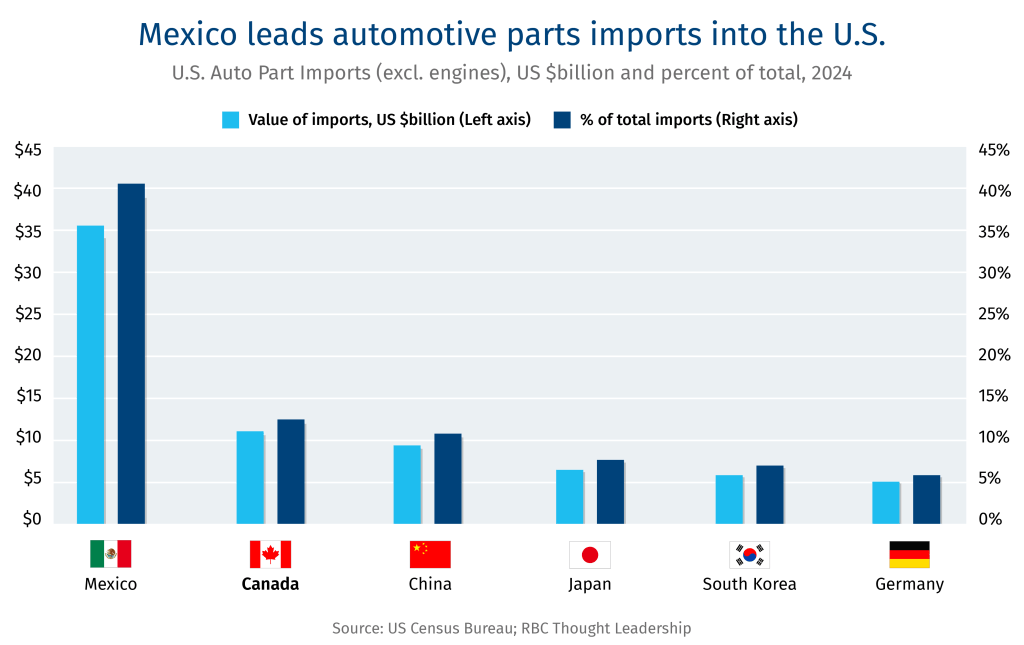
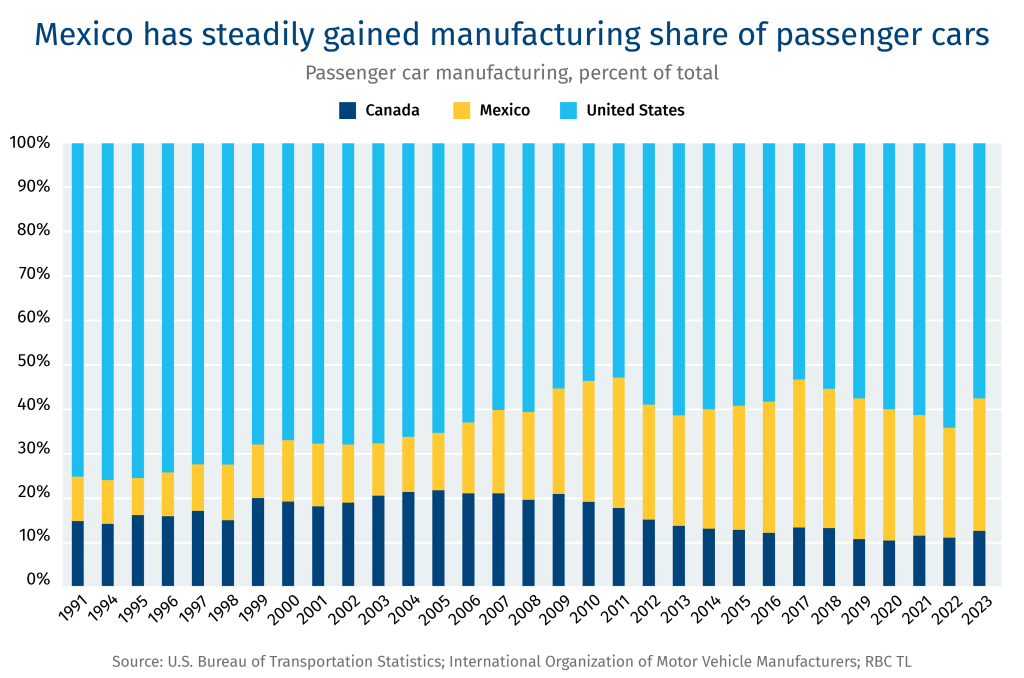
  • New Industry Minister Melanie Joly may have to round out the line, as the three work to save the U.S.-Canada auto sector from further damage. 

  • One suggestion: they meet at the Gordie Howe Bridge, in tribute to the OG of Elbows.

How things are shaping up on the allimportant Canada-U.S. file

Carney has been clear that he’s the boss—and will run point on Canada’s relationship with the U.S. Still, his team will play a major role in a new economic and security agreement.

The Core 5: In selecting a main negotiating unit of Dominic LeBlanc, Anita Anand, David McGuinty, Francois Philippe-Champagne and Gary Anandasangaree, Carney opted for veteran ministers who collectively hold substantial clout and relationships in the Beltway. Expect this group to be supplemented by Melanie Joly, Minister of Industry, who holds considerable experience on the file, and will lead domestic negotiations with critical industries, including steel, aluminum and autos. And, in a lower-profile way, by Lisa Jorgenson, Carney’s recently appointed Senior Advisor on Canada-U.S. Jorgenson brings experience from Public Safety and Justice and will provide advice and behind-the-scenes coordination across political and bureaucratic levels.  

Committee shakeup: Trudeau’s Canada-U.S. Committee is out. And the ‘Secure and Sovereign Canada’ Committee is in. Chaired by McGuinty and Anand, the new committee has a couple noteworthy inclusions. Maninder Sidhu, Minister of International Trade, who is tasked with diversifying Canada’s trade away from the U.S., a key Carney promise. And Rebecca Chartrand, Minister of Northern and Arctic Affairs, a nod to the importance of Arctic security, one of the three legs of the economic and security pact.

Diplomatic and bureaucratic shuffle: The tenures of a few high-profile ambassadors—Kirsten Hillman in Washington, Ralph Goodale in London, and Stéphane Dion in Paris—are expected to end soon. Carney will likely prioritize a mix of experience, relationships, and political muscle, especially in filling the role in DC, as Hillman, well respected in Ottawa and Washington, leaves big shoes to fill. As for the public sector, Carney’s right hands in the Privy Council Office are Clerk John Hannaford and Deputy Clerk Chris Fox, who both hold a depth of experience on national security, energy and trade files. A broader public service shuffle could be in the offing as the PM looks for near-term results.

The week in numbers

7

Lawsuits filed against Trump and his administration challenging the ’emergency’ used to levy tariffs under the International Economic Emergency Powers Act. The U.S. Court of International Trade held a first hearing earlier this week.

150

Number of countries that Trump says want to negotiate a deal. Without the time to meet with them all, his administration will send letters to a list of leaders in the next couple of weeks simply telling them “what they’ll be paying to do business in the United States.”

1,000

Products marked as being impacted by tariffs at Loblaw. The grocery chain expects that number to climb to 6,000 in two months. Meanwhile, Walmart, which saw profits decline in Q1, announced it will be raising prices in the U.S. because of tariffs.

60 million

iPhones that Apple plans to produce from India for the U.S. market. While on his Middle East tour, Donald Trump blasted Apple’s CEO (“I had a little problem with Tim Cook”) for building iPhones in India despite committing US$500-billion in the U.S.

The view from Washington

Details of Donald Trump’s Middle East tour offer a glimpse into how ongoing and future trade talks, including with Canada, could play out:

  • Spend big on U.S. Defense products: Saudi Arabia ($142 billion) and Qatar ($3 billion) signed defense sales and procurement deals that range from general upgrades to information systems to new air and missile defense capabilities. The Trump administration might push the purchase of U.S. defense products in its future trade deals, which is particularly relevant for Canada given the White House’s record of criticizing Canadian defense spending. Trump could use the U.S.-Canada deal to push Canada to get to 2% defense spending more quickly through deals with U.S. defense firms. 

  • Don’t ignore Big Tech: Trump announced a $20-billion investment by a Saudi firm in AI data centers and related energy infrastructure in the U.S. And Qatar pledged $1 billion for a joint quantum technology venture between American Quantinuum and Qatari Al Rabban Capital. Data centres are particularly interesting in the U.S-Canada context because of Canada’s potential to be a strong partner (available land, renewable energy capabilities, cooler temperatures).

  • Creating sector-specific funds: The U.S.-Saudi Arabia deal included the creation of investment funds for energy ($5 billion), aerospace and defense ($5 billion), and sports ($4 billion). Investments in areas of shared interest could arise in other negotiations. The U.S.-Canada deal could include shared funds for energy, border security or continental defense.

3 questions…on U.S.-China negotiations

With Jasmine Duan, Senior Investment Strategist, RBC Wealth Management, in Hong Kong

Q: How do you expect markets and Asian economies to react and perform during the 90-day negotiation window?
A:
It will likely feature a mix of optimism and volatility. Markets may seek specifics on the agreement, which could lead to short-term volatilities.

Q: What signals will investors be looking for?
A:
Investors will watch for what terms were finalized between the two sides and what concessions or incentives each party will offer. It would be a good sign if the negotiation focuses on trade-related issues like market access and goods purchase, not domestic topics such as fentanyl or politics.

Q: What structural changes will drive the U.S.-China relationship beyond trade and tariffs?
A:
The trade talks have not addressed many structural issues such as how will the U.S. revive domestic manufacturing and reduce China’s trade surplus. We think near-term resolution remains unlikely but progress in establishing bilateral mechanisms to address issues like technological competition, climate goals, and crisis management, will be important to fostering a sustainable relationship in the long-term.

In this week’s edition: How the U.S-U.K. deal sets the stage for the rest of the world; reading the signals from Washington’s trade talks with China; what Trump is looking for when making a deal.

Noteworthy

By John Stackhouse

It was a good week for Canada—and a better one for Britain. Next week may be another story.

  • Mark Carney got some fresh daylight on trade talks and managed to reposition negotiations with Donald Trump as much more than trade. Get ready for a new North American Security Partnership.

  • Neither leader threw Mexico’s Claudia Sheinbaum under the bus, but plenty of Mexican business leaders are for her lack of progress with Trump.

  • Britain secured its own deal with Trump that was neither big nor beautiful but is suddenly the template that the U.S. will use with other countries. Not unlike pattern bargaining in the auto sector.

  • The U.K.-U.S. arrangement is essentially a sectoral handshake. More British Land Rovers for more American cheeseburgers. (Cars for cows, in other words.) The end of the beginning, as Carney might say. But for Britain, it’s a competitive advantage against the EU, especially when layered on top of its much more comprehensive agreement.

  • British PM Keir Starmer is hoping to stop in Ottawa mid-June, enroute to the G7 in Alberta, and that’s where reality may bite. Canada-U.K. trade talks have been rocky for a few years, largely because of the farm lobby in both countries. Any bets on Carney serving British cheese, or Starmer sipping Canadian milk?

  • That leaves the two allies to focus on defence procurement. Carney has been keen to buy more BAE supplies, as an example, but he also has to keep options open with Trump, who wants Canada (and Britain) to buy more American planes and weapons systems.

  • Mark June 16-17 on the calendar for a G7 that will be as epic as the mountains around Kananaskis. Expect it to be largely about security (with a NATO summit to follow in late June), and whether the post-war pillars of democracy will trade with each other as they remilitarize or cut their own deals. Whether Canada and Britain stick together, or get wedged by the U.S., will be one signal.

Need to know

18: Countries that the U.S. is reportedly prioritizing for trade talks.

79: Percentage of Americans who think the USMCA is good for the U.S. economy, according to The Chicago Council on Global Affairs latest survey. That includes 90% of Democrats and 72% of Republicans surveyed.

2,500: U.S. products, including olive oil and wine, that will have reduced tariffs under the U.S.-U.K. Economic Prosperity Deal.

100,000: British vehicles for which U.S. tariffs are lowered to 10% as part of the deal. Rolls-Royce engines will be able to enter tariff free.

The view from Washington

For a good hint as to how the U.S. is approaching its trade talks with China, consider who’s at the table this weekend in Geneva.

In: Treasury Secretary Scott Bessent and U.S. Trade Representative Jamieson Greer

Out: Commerce Secretary Howard Lutnick and White House Trade and Manufacturing Counselor Peter Navarro

Sending Bessent and Greer, perceived as more moderate, indicates that practicality and progress will take precedence over maximalist political ideology. Of note: Bessent landed the leading role after delivering the long sought-after U.S.-Ukraine natural resources deal for the White House.

A few agenda items for this weekend—and future meetings:

  • Defence: Beijing’s use of export controls on rare earth and critical minerals target vulnerabilities in U.S. supply chains for semiconductors, fighter jets, submarines, and other products vital for the US defence industrial base.

  • Advanced tech: Chinese practices and commercial policies, specifically joint-venture requirements for operating in China and disclosure requirements for attaining licenses, force foreign firms to transfer sensitive IP as a requisite for accessing the Chinese market.

  • Shipping: U.S. shipbuilders and maritime workers have complained about Chinese practices that depress shipbuilding costs, specifically low-wage or forced labour and excess supply of shipbuilding inputs spurred by government subsidies.

What does Trump really want?

There will be a few recurring themes as Trump races to close 90 deals in 90 days:

  • Reducing tariffs and non-tariff barriers: Trump views the trade posture of many countries as unfair to the U.S. and seeks to reduce tariff and non-tariff barriers wherever possible.

  • Purchase agreements: Driven by the need to reduce the trade deficit, deals will likely include purchase agreements—take, for instance, China’s purchase commitment to buy US$200 billion worth of goods (which, ultimately, China did not meet).

  • Exemptions: Trump and his team are facing significant pressure to exempt goods considered strategic, necessary, or ones where the U.S. is heavily reliant on imports—from baby powder to car seats. Expect more exemptions blunting the impact of trade actions.

  • Investment commitments: Although inward investment will reduce the U.S. net international investment position, Trump likes to see foreign countries and companies invest in the U.S., akin to Taiwan Semiconductor Manufacturing Company’s Arizona semiconductor fabrication facility.

  • Exchange-rate corrections: Market observers have been bearish about a ‘Mar-a-Lago Accord’ to correct the trade deficit through coordinated weaking of the U.S. dollar. Not only would such cross-border coordination be unlikely, the biggest target for currency manipulation, China, is highly unlikely to appreciate the renminbi.

Carbon offsets aren’t enough. To truly tackle climate change, we need a global industry dedicated to pulling carbon out of the air and at massive scale. Join hosts John and Sonia inside the innovation race to scale carbon removal technologies, featuring insights from leading voices in the field.

They speak with Dr. David Keith, a pioneering climate scientist and founder of Carbon Engineering, who unpacks the technological, policy, and economic hurdles to direct air capture and other approaches. You’ll also hear from two recent XPRIZE Carbon Removal winners, Mike Kelland of Planetary Technologies and Jim Mann of UNDO about how their startups are using ocean alkalinity and enhanced rock weathering to permanently sequester CO₂, while also delivering benefits to farmers and marine ecosystems.

Together, they explore whether the world can build a scalable, measurable, and credible carbon removal industry – one capable of drawing down billions of tons of CO₂ annually.

Listen on Apple Podcasts, Spotify or Simplecast

John Stackhouse: [00:00:00] Hi, it’s John here.

Sonia Sennik: and I’m Sonia Sennik, CEO at Creative Destruction Lab.

John Stackhouse: This is Disruptors x CDL: The Innovation Era.

Sonia, we just marked Earth Day last month, and while a lot of things happened that day, one of the coolest was some XPRIZE announcements, particularly the winners of its a hundred million dollar carbon removal competition, which included a lot of Canadians.

Sonia Sennik: Yes, John. We were at the New York Stock Exchange with the XPRIZE team to celebrate Earth Day and the top three winners, we had Mati Carbon that came through our CDL program from India that won the $50 million prize Vaulted Deep from the United States that won the $8 million prize and UNDO, that does their work between the UK and Canada who won the $5 million prize.

XPRIZE also gave out a few other prizes for most promising companies in certain areas, and the X [00:01:00] Factor Ocean Prize went to Canadian company Planetary from Nova Scotia. It was a really exciting day to see people rally around the carbon removal market, and the most interesting part about the event was listening to all the different ways that people from everywhere around the world are tackling this problem. There’s not one way to approach it, which leaves the world ripe for innovation in this space.

John Stackhouse: Well, let’s zoom in on Mati Carbon, the Indian company for a moment, the one that won $50 million for carbon removal through enhanced rock weathering.

Sonia Sennik: So an essential part of Mati Carbon strategy is working with small farmers in India.

As you know, in India, there’s a lot of farmland and mad carbon has seized the opportunity of helping farmers advance their technologies while also giving them the benefit of contributing to carbon removal. They also have best in class monitoring, reporting, and verification. You’ve heard it in any MBA class.

If you can measure it, you can manage it. Their tech stack [00:02:00] includes novel methods for soil monitoring that are coupled with sophisticated mass balance and calculations that can determine the bulk CO2 removal.

John Stackhouse: So zooming back, all of these innovators are trying to solve the same problem, and that is carbon in our atmosphere, carbon dioxide.

There’s not only the enormous amounts that we as humanity are putting into the atmosphere every year. There’s legacy carbon and that goes back centuries. That’s still sitting up there. And these combine to warm our planet. Lots of exploration going on, as we’ve discussed over many episodes about new technologies that can reduce the amount of carbon that results from all of our activities.

But there’s also some impressive innovation, which we’re going to hear about in this episode, to get that carbon outta the atmosphere and back into the earth and also back into the ocean.

Sonia Sennik: Absolutely. John, we need 10 billion tons of carbon [00:03:00] dioxide removal by 2050 to stay on track for that one and a half degree Celsius warming measurement just for reference, one mature tree absorbs 22 kilograms of carbon dioxide a year, meaning you’d need 45 mature trees to offset the average Canadian’s annual emissions. But when the problem seems as big as this is John, we can sometimes get a bit overwhelmed and think, well, how do we even approach it?

And if we haven’t figured it out by now, will we figure it out? Through our partnership at Creative Destruction Lab with XPRIZE, we’ve seen incredible advancements in these startups.

John Stackhouse: Well, let’s get at it. We’re gonna hear from a couple of really impressive innovators who have been recognized by the XPRIZE, and we’ll also hear from the world renowned scientist, David Keith, a Canadian who’s been a pioneer in carbon removal for decades.

But before we jump into those conversations, Sonia. Give our listeners a sense of the XPRIZE and why it matters to innovators.

Sonia Sennik: [00:04:00] XPRIZE is truly a one of a kind organization. Their mission is to inspire and empower humanity to achieve breakthroughs that accelerate an abundant and equitable future for all.

They do this through setting up incentive prizes. For example, the XPRIZE Carbon Removal Prize was a hundred million dollars incentive prize. The idea is that they were inspiring scientists and technologists from all around the world to start focusing their efforts. On carbon removal technologies. What that sparked was thousands of teams applying to be part of XPRIZE and a rapid increase in acceleration in the technological development of these startups.

Vaulted Deep, a Houston-based startup that was part of our XPRIZE CDL Carbon Removal stream, removed over 2000 metric tons of carbon dioxide in just four months of operations. So one can just imagine with the right level of support. Investment and their recent win from XPRIZE. A company like Vaulted Deep along with so many others can [00:05:00] scale over the next five to 10 years, removing carbon from our atmosphere at a pace we just haven’t seen before.

John Stackhouse: Our first guest is Dr. David Keith, a professor at the University of Chicago, and one of the world’s leading experts on climate science and energy technologies. Over his career, David has helped pioneer research on carbon removal and solar geoengineering. He founded Carbon Engineering, a company advancing direct air capture technology, and he brings a rare perspective that bridges science policy and entrepreneurship.

David, welcome to the podcast.

David Keith: Hi there. Pleasure to be on.

Let’s start a bit with your own background. Tell us how you got into this field and what attracted you first to CDR or carbon dioxide removal for those who are still catching up with the acronym.

David Keith: I started working on climate in the late eighties. I started working on some climate engineering technologies back then, simply because nobody else was doing it. So I’ve done a big range of things from climate modeling to observations to early work on some carbon removal [00:06:00] technologies. I wrote one of the very first papers on biomass with capture. I did work on direct air capture and then later founded a company. I’m not involved anymore. I’ve done a big range of things, but it’s only one piece of what I’ve done on climate.

John Stackhouse: We have a pretty clear idea of the climate challenge right now, particularly carbon in the atmosphere and the amount that we’re adding to the atmosphere was the problem as clear to you then, as it is now?

David Keith: Yeah, I mean, so the very first report that went to the most powerful leader in the world to President Johnson had already the data from the global carbon data that showed the increase of CO2 in the atmosphere. And they were able to do the rough balance and knew the OS ocean and doubt. So the problem has been well understood for a long time, way before I got involved.

John Stackhouse: Maybe take us into some of the technology. For those not familiar with how carbon removal works, give us a 101 if you can.

David Keith: Maybe the single most important thing to know about climate change is that the amount of warming is [00:07:00] proportional to the cumulative emissions over overall industrial time. And that means that even if we brought emissions to Zero tomorrow, that wouldn’t stop climate change.

It would just stop it getting warmer, but it would still be warm. That would still be all the climate damages would be there. And if we want to reduce the warming, if at any time people want to make the planet cooler than it is when they make that decision. You have to either pull carbon out of the atmosphere or do sunlight reflection, so engineering or a combination of them.

But cutting emissions will not make the planet cooler. It just stops making the planet warmer. I think if, if the fundamental risk is caused by moving fossil carbon from these deep geological reservoirs where the carbon’s been isolated through the atmosphere for. Billions or hundreds of millions of years.

Then the only kind of carbon removal that can really reduce the long run risk is to put it back in some kind of stable [00:08:00] reservoir. Growing trees may be great. There’s lots of places where there’s deforestation and we need trees, but trees are inherently unstable. They want to be oxidized to burn to rot, and so they don’t remove carbon in the long run.

They don’t undo the consequences of. Burning a ton of fossil fuels and putting in the atmosphere. No amount of tree planting cannot undo that. What can undo it is either capturing carbon dioxide, the gas, and shoving it deep underground and there. Different ways you could capture it or reacting carbon dioxide with base minerals.

Carbon dioxide is a weak acid and people know that acid plus bases makes salts, so that’s what naturally wants to happen anyway. If humans all went away. The carbon dioxide would eventually be removed by reacting with these basic minerals that are all over the earth’s surface. And so perhaps the most important long runways to remove carbon are to accelerate those [00:09:00] reactions with the base minerals that have a endpoint of the CO2 being in stable salts.

Sonia Sennik: How has the conversation changed over time with people’s openness to seeing carbon removal as a commercially viable approach to business and a good use of their science and technology research?

David Keith: Well, it was kind of a nothing burger forever than the Paris agreement that had this stretch goal of keeping temperatures to 1.5 came about, and then modelers who model kind of economic system and, and carbon.

These models happened to have biomass with capture and at one kind of carbon removal technology, and they suddenly found in these economic models that that was the only way to meet 1.5. To be clear, these models didn’t have sunlight reflection in them. And it’s not obvious that 1.5 is a sensible, it’s not a scientific target.

So in some ways I think that was a kind of [00:10:00] intellectual nonsense, but it meant that carbon removal suddenly became very visible. And then there were lots of people, including lots of people promoting their businesses, putting out the idea that scientists say we have to have five gigatons or something of carbon removal by 2050.

And that’s kind of ignited a whole bunch of sudden attention to carbon removal in a, in a boom. To be clear, scientists don’t say that if you are thoughtful about it. And there’s certainly been a kind of boom of hype cycle though, driven by that argument.

John Stackhouse: You refer to 1.5 as intellectual nonsense. Give us a bit more sense of where you’re coming from with that comment.

David Keith: Well, I mean, the, um, there isn’t a scientific threshold or argument that 1.5 is the right target. 1.5 was a, I think, very clever. Political choice by the environmental community to make a really near term target that was unattainable so there wouldn’t be attained so that you could build political pressure for more action, [00:11:00] which is happening.

Last year, the world spent $2 trillion, just a little under 2% of the entire world’s economy on clean energy, which is a stunning success, and we’re likely going to see emissions peak in the next couple years, which is also a stunning success. But that doesn’t mean that it was kind of intellectually or in terms of environmental policy, the right place to aim that is that 1.5 is the right place to aim.

It was a a political negotiating tool, I think a really effective one.

Sonia Sennik: And so with that type of investment, David, do you believe where you’re sitting now that we will be able to tackle the challenge ahead of us?

David Keith: I think that with current technologies, no fundamental unobtainium, no giant innovation, it’s possible to do carbon removal in a way that really does reverse a bunch of the emissions that humans made.

So I think you could say that if you started kind of mid-century. That [00:12:00] there’s strong lines of evidence that say that for something like 1% of GDP spend over a hundred years, over another century, you could remove something like a thousand gigatons of carbon, which would be, for example, that’s about just under half of cumulative emissions to date.

To be clear, I don’t think it makes sense to do large scale carbon removal until emissions have been reduced, at least down to half or or a third of their current levels.

John Stackhouse: When you think about the next few years, how do you think about the business model for these sorts of technologies? Are we on the right course that they’re going to come to fruition and scale, or do we need more significant changes to both the business model and the broader economics? Of intervention?

David Keith: Uh, no. I don’t think we’re on the right course. Most of the carbon removal efforts now are driven by voluntary [00:13:00] offset markets that I think nobody I know believes are long-term scalable things. Uh, well, there’s a lot of hype and excitement. It’s important to say how small it is. So there’s this sort of 2 trillion total and clean energy.

The total money moving in carbon removal is a few billion, so really tiny compared to that. And I think that the system’s been driven by money coming in from venture capitalists and by companies with these voluntary offsets that I think are not a scalable way to do this. And it’s resulted in a whole network of startups.

But a lot of those startups are missing some of the things that are probably most scalable and low environmental impact, like large scale open ocean Alkalinity, for example. So I think the way I view it is, at least what’s happening now is there’s. People are actually beginning to try some of these things out.

At least much more research is happening than than five years ago. I think there isn’t a clear pathway forward for how to do it in the end. You want a public good like this to get paid for. It needs to get paid for as a public good. That’s the only way that I know we’ve ever done it.

John Stackhouse: You’ve [00:14:00] mentioned Open Ocean Alkalinity.

I would just wonder if you could give a quick explanation.

David Keith: If you take a glass of pure water and put it on a counter, it will gradually become acidic. Where did the acid come from? The acid is actually from carbon dioxide in the air that makes carbon acid a weak acid in water just kind of automatically, and you would pull the CO2 outta the air.

If you put some antacid in it, which is a magnesium hydroxide, you would neutralize that acid and pull more CO2 outta the air. And then you have a little machine for capturing CO2 outta the atmosphere by adding this an acid to your little glass of water. That works stably at the global scale. Most of the carbon that in the kind of act of biosphere is locked up in the ocean as carbon.

That is in this acid-based salt balance, which is stably there basically forever. And so if we can add more of these bases to the ocean in a way that doesn’t have local environmental harm, then we would both reduce ocean acidification, which is say damaging coral reefs and also permanently remove CO2 from the atmosphere.

And the big question is. [00:15:00] How to make the bases that will dissolve at scale and how to distribute them in the ocean. And for both of those things, the idea is old. The first big paper on this topic is published in 1995, but there really hasn’t been much work. We’re now doing a bunch of work at U Chicago.

We’re working closely with Frontier, the Stripe funded big, big actor in the, in the carbon removal space. But there isn’t really a kind of coherent research effort.

John Stackhouse: Talk to us a bit about the tech challenges right now with respect to direct air capture. What are the biggest hurdles on the technology side in your mind in the coming years?

David Keith: Well, direct capture is just one of many of these technologies. It’s one I was personally involved in. I think the big question is to actually shake out these technologies and understand what they cost on the sort of plant two or three. It’s very hard to know what things cost until you actually go build them in the real world.

Sonia Sennik: You mention in that description that offset credits won’t [00:16:00] last much longer. That is probably peaking the interest of some of our listeners. Would you mind just double clicking on that?

David Keith: Well, I mean, I don’t think in the end companies do big things voluntarily. I, I don’t think they really should. It’s not the appropriate place for companies to do stuff.

I mean, if you look at the giant successes that we’ve had in environmental policy, clean air, removing lead ozone, I mean, the world has made enormous progress. Air is much cleaner around the world than it was when I was a kid. And water is too. Those are fundamentally done by government setting rules. And then companies competing under those rules.

If you think about the giant success of the sulfur cap and trade market, that helped to be the core of the US Clean Air Act that’s been copied around the world. The idea was government shouldn’t be deciding the exact technology. Government should say there’s a total amount of emissions you can have and you guys can trade inside that.

But that’s very different from a tradable offset credit, which there’s [00:17:00] no cap to, and not really a, a way to verify and, and you don’t really, there’s not a reason for companies to do it at scale. They can do a little bit for the kind of PR reason, but in the long run, you’re not gonna spend the kind of 1% of GDP for PR.

John Stackhouse: I. The broader infrastructure projects, carbon infrastructure projects, and I suppose this is what IRA in the US was, uh, starting to move towards. Are you seeing success on that level at scale

David Keith: Really too early to say. I mean, I’m totally thrilled that the plant from Carbon engineering technology that I, you know, I founded the company, is now actually just coming into operation at a half million tons a year.

Absolutely fantastic and I’m super thrilled that Oxy was involved and that IRA and these US government antennas that helped to make it happen. But that’s the first plant. It’s a half million, 10 a year plant. You don’t really find out how these things really work and begin to really understand and plant costs until you built quite a few plants, which, you know, Oxy is keen to do and I’m thrilled they are.

And [00:18:00] of course, not just one line of technology. I. Obviously was one of the innovators, so I’m excited about it. But there’s a bunch of other lines in direct air capture and then there’s all these other methods, and I don’t think right now that the kind of innovation ecosystem for carbon removal is effective and focused as I’d like to see.

John Stackhouse: And with respect to the Oxy project, this is Occidental Petroleum in Texas. For those who aren’t familiar with it, it involves enhanced oil recovery, EOR, which some people have concerns about, ultimately leading to the production, not leading to reduction of fossil fuels. How do you think through some of that complexity?

David Keith: I have no problem with EOR. Obviously it really gets under the skin of, of some of the environmental community. But if you actually have a third party regulator that ensures that the amount of carbon that went down the hole is the same amount of carbon that went up in oil, then you really have made a hydrocarbon fuel, which you can use for things that are hard to decarbonize, which has no net emissions.

And I think that’s a [00:19:00] useful thing to have.

Sonia Sennik: I’m curious to know if you could make one policy change that you think would really. Improve outcomes or set the rate incentives for advancing carbon removal, what would that be?

David Keith: So in Canada there’s a bunch of subcritical little academic research and then startups.

What there isn’t is a serious effort to build some kind of public, private entity that really has research muscle in the public interest, say for some of these emerging technologies like Enhanced Rock and Ocean Alkalinity, and then to have. Canada government actually makes some choices about where it’s gonna push.

I mean, I’m a super proud Canadian. I love it. But of course, sadly we had to sell Carbon Engineering to a US company. I think Canada is awesome, but Canada is only 40 million people. And the idea that you’re just gonna kind of let every flower bloom and have [00:20:00] all this stuff spread around the country with no center and no focus is not a recipe for winning. We need a much larger system-wide approach, is what you’re saying. Yeah. And for some of these things like. The innovation model that works so well in pharma and it where there is an underlying giant commercial market for the products. If you could make the market work is just different here.

Sonia Sennik: Yes.

David Keith: And I think a different kind of innovation answer is needed. I definitely don’t think this should all be on my academics or government labs. It, it needs private innovation. It, and I think the point is maybe there’s some ideas that come totally outta left field. But I think the big message here is that most of the carbon removal technology we’re talking about are all have been known for decades.

The issue isn’t to advance some totally new thing. The issue is to actually take some of the things we understand and march them down the playing field by. Building them at scale, doing industrial engineering, and crucially coupling that with [00:21:00] studying their environmental impacts. ’cause the issue isn’t just can we capture carbon?

It’s can we capture carbon at a low enough cost with a low enough environmental footprint? And I. Putting those together, I think requires a kind of government action and a government action is able to not pick one winner, but say We’re gonna look at this set of things, not the usual. Very sad, I love Canada, but usual way that Canada has been kind of funding research in this, which is this.

Everybody gets a little money sprinkled everywhere and sprinkled regionally, which is just not a way to win.

John Stackhouse: You are suggesting we need more state capital, but this can’t be done by government. It needs to draw in private capital at scale, not vc, but big long-term capital, and then pick some industrial projects to just build at scale.

Demonstrate with engineering, it’s not the first project, it’s the second and third to see if you can cut the cost by 50% with each iteration.

David Keith: So one thing we don’t have is applied environmental science. [00:22:00] One part, I think. Is and should be. A government function is really high quality applied environmental science that can help answer the public interest question, which is what is the environmental impact of some of these technologies?

And that doesn’t work well by just a few university grants. It requires something that looks more like a coordinated center. That focuses on this really applied work, working closely with technology developers and that that’s something it wouldn’t cost that much and that Canada could do on some of these technologies easily.

There. There’s a little bit where Canada’s kind of started a nice road on some of the ocean liny things. There’s a project on the east coast, I. Dalhousie center that has some of that, but you could do that for one or two things in a serious way. That’d be an executable thing the government could do.

Sonia Sennik: David, thank you so much. This was fantastic.

Our next guest is Mike Kelland, CEO and co-founder of Planetary Technologies, a Canadian company and CDL alumni, pioneering a unique approach to carbon removal using ocean alkalinity [00:23:00] enhancement. Planetary was recently awarded the $1 million XFactor prize from XPRIZE, carbon removal for its breakthrough work, turning the ocean into a natural carbon sink.

Mike Kelland: So the process is very simple. We actually call it seawater restoration. The easiest way to think about it is that the ocean essentially breathes and everything we put up in the air and everything that’s in the atmosphere gets breathed in by the ocean. So when we put extra CO2 up in the air. The ocean’s gonna breathe all of that.

CO2 in the CO2 concentration of the ocean builds up really quickly and CO2, when it gets into water, turns into an acid. So you can kind of think of the ocean as having like a little bit of heartburn. What we do is we work inside coastal plants to reverse some of that acidification. We source a natural mineral and we introduce that into the water that flows through power plants and wastewater plants.

And as we do that, we’re gonna reduce that acidity in the water that’s flowing through. And what that does is it allows the ocean in the local region to essentially [00:24:00] breathe again. We’ve been doing this for about five years now, and the question when we started was always, can you measure this? Are you able to really see that reduction of acidity, that reduction of CO2 in the ocean as you’re moving forward?

And over the last year, we actually showed that we were able to directly measure using some really cool sensors. We were able to show this direct measurement of the reduction of CO2 in the surface ocean as a result of our activity. It’s a really exciting space right now, and what we’re seeing more and more is these papers coming out saying, okay, we were worried about biological impacts.

Now actually we’re seeing biological benefits. So we’re seeing things like an increase in the biomass of commercially important fisheries. We’re seeing increase things like shell growth and things like that for a variety of shellfish and important commercial fisheries. So there are those co-benefits, but fundamentally what we see is that this is a very high quality, very scalable, ultimately very cheap way [00:25:00] of permanently, hundreds of thousands of years timeframe, removing carbon dioxide from the atmosphere.

And I think that that’s gonna be the funding model. The bottom line is we need. A huge amount of carbon removal. So we need enough carbon removal to get to the net in net zero, but we also need to be removing legacy emissions. None of this carbon removal stuff matters if we don’t reduce our emissions, but it’s too late to solely rely on that.

30 years ago, we had done that and really sort of bent the curve downwards on emissions. We wouldn’t need to do a lot of carbon removal, but at this point it’s too late. We’re gonna lose so much if we don’t have carbon removal. As part of the portfolio of solutions, carbon removal has to become a $1.2 trillion market by 2050 if we want to hit our climate goals.

That means that 10 years from now, we need to be scaling pretty rapidly on these technologies. There’s gonna have to be a lot of public funding that goes into this. We kind of have to think of this. I. Like waste management, how do we pick up the garbage that [00:26:00] we’ve put into the atmosphere as quickly and easily as we possibly can and as cheaply as we possibly can?

And that that really is how the market has to eventually develop in terms of our technology. In particular, study after study, after study is showing that. This form of carbon removal is the most scalable and is the cheapest. The ocean is is really a global commons, and we have to be super, super cautious with the work that we do there.

But once it starts to scale, it’s gonna go really quickly because it is such a scalable and low cost solution.

Sonia Sennik: Our next guest is Jim Mann, founder and CEO of UNDO, a carbon removal company that aims to capture huge amounts of carbon dioxide from our atmosphere. UNDO was recently awarded $5 million for its enhanced rock weathering solution via XPRIZE.

Jim Mann: So we did a lot of our early experimentation in the UK where we spread basal, which is a silicon mineral onto agricultural land.

And then as we’ve started to scale up, [00:27:00] we focused much more on Canada where we are using a manual called tonite and applying that to active football. And farmers get a benefit from the application of minerals. It has a pH stabilizing and raising effect, which is good for farmers and it also absorbs CO2 from the atmosphere.

Enhanced truck weathering is an open system, and in these complex systems it becomes very difficult to get accurate measurements. So we’ve had to develop and actually file patents on new techniques that enable us to empirically measure the removal of CO2 within that complex field environment. We give the minerals to farmers for free.

They get all the benefits on their agricultural land, and as we generate carbon credits, we sell those carbon credits at a very reasonable price, which we sell to companies, the likes of British Airways, Microsoft, McLaren Racing, Barclays Bank, big organizations that have a footprint that they can’t avoid, and so they are [00:28:00] contributing to the removal of the emissions they’ve put out there.

But the whole of that rural ecosystem is benefiting right along supply chain. In terms of the markets, I think this is very different to historic markets where we were looking more reduced emissions. Typically, this is your removal technology. We’re actually taking the CO2 back outta the atmosphere. I.

And, um, as long as you can measure that and quantify that, I think we’ll build much more robust and credible markets. We’re starting to see regulators move towards that space and we can be confident about strong market going forward. I think in terms of the agricultural community, well, that’s why we structured the business model the way we have.

They often see a benefit very, very quickly, both in terms of the pH and soil health, but also depending on what crop they’re growing, they can see a benefit in. The quality of that crop, and this is a measured quality standard that they get more money for as early as the first year of the application.

So we don’t have to persuade them that the carbon [00:29:00] markets are a good thing. So it’s a very easy conversation for us. Our vision is to build an organization that can have a real impact on the world. We want to remove a billion tons of CO2 from the atmosphere. And this accelerates our progress towards that goal.

Sonia Sennik: John, what an incredible set of conversations that showcased how many different people are taking so many different approaches to solving the problem of carbon removal.

John Stackhouse: It’s remarkable to hear the extent and depth of science that’s going on, not just here in Canada, but around the world in this.

Different kind of space race to figure out how we can capture all that carbon in the atmosphere and get it back into the ground and maybe into the ocean. It’s ambitious and we can’t assume that these technologies are gonna work or work at scale in the timeframe that we need. So we also have to focus on our own activities, whether it’s as consumers, citizens, or companies in pretty much all [00:30:00] sectors to get emissions down.

I was also intrigued by some of the comments about measurement, which remains a bit of the Achilles heel. To be frank in all of this, there’s certainly lots of MRV systems emerging, but nothing in place now that people are willing to bet billions of dollars on to accelerate and scale what we need. So it’s not just the science, it’s the business models and the measurement reporting and verification models that all have to come together and have to come together pretty soon.

Sonia Sennik: What an interesting marketplace. The carbon offset market is a multi-sided marketplace to ultimately support carbon removal, while big companies build large data centers and energy facilities to support our increasingly digital world. It’s an interesting way to take responsibility to counteract the carbon that’s being released into the atmosphere.

And companies like Shopify, Disney, Stripe have all voluntarily committed to purchase carbon offset credits to get this marketplace going. I [00:31:00] cannot wait to see where we’re at five years from now.

John Stackhouse: Five years in the span of the earth is just a blink of the eye, but it’s also a reasonable timeframe for us all to set for ourselves in terms of marking material progress in the science and technology that we’re doing, and.

Who knows. Maybe we’ll be back at that time and hear from these innovators to see what they’ve done. This has been Disruptors, an RBC podcast. I’m John Stackhouse.

Sonia Sennik: And I’m Sonia Sennik.

John Stackhouse: Talk to you soon.

Welcome back to Trade Zone. Week Two. (Still in beta—so let us know what you think.)

Notebook

By John Stackhouse

It’s a big week ahead for shifts, in government and the private sector. Mark Carney is off to the White House on Tuesday, to reset relations. Expect some healthy talk about military spending, and how Canada can do more sophisticated investments for North American security. More drones. More cybersecurity. Can we make those future exports, too?

I spent part of the week in Vancouver—Canada’s gateway to the Asia-Pacific. The port looked to be thriving, thanks to massive shifts underway in supply chains:

  • Chinese and Vietnamese producers are moving goods and inputs to Canada, as they game the Trump tariffs.

  • A major B.C. agrifood producer told me his U.S. buyer has re-rerouted his company’s output to Singapore, and directed a New Zealand supplier to feed the U.S.

  • A major clothing producer explained how they’re making tariff-factored pricing decisions this week on Back-to-School products that will hit North American stores in August.

  • Another global firm told me they’ve been quietly reducing Chinese productions (now just 20%) but it’s a race to stay ahead of Trump negotiations with other markets like India.

Expect these shifts to continue.

The week in numbers

$900M is how much Apple says Trump’s tariffs could cost the tech giant this quarter. CEO Tim Cook said most iPhones for the U.S. market will now be made in India, not China.

60% fewer cargo ships travelled between China and the U.S. in April, according to one estimate. Softening demand has prompted some companies to use smaller ships.

750 jobs lost at the General Motors plant in Oshawa, Ont. The automaker has responded to tariffs by moving from three shifts to two.

Need to know

  • Before Carney goes to Washington, we have thoughts on what an economic and security deal with the U.S. could include:

    • Energy and economic security: Negotiators will want to address longstanding irritants (digital services tax, softwood-lumber dispute, strengthening rules of origin). Expect movement and strategies on gas, nuclear and critical minerals.

    • Defense and Arctic security: Everything from the plan to meet 2% defence spending targets, to NORAD modernization, dual-use accounting, social and economic infrastructure investments in the North, including an Arctic port, and expanding shipbuilding/icebreaker commitments.

    • Border security: Although Canada has made investments in border security, further collaboration, especially on money laundering, immigration and drug/arms trafficking, will likely come up during negotiations.

The big question

This week, we turned to Sue Noble, RBC’s Vice President Automotive Finance National Office, for the answer.

Q: What’s your main takeaway from Trump’s auto-tariff relief announcement this week?
SN: While the relief may be seen as a positive move, there continues to be a high degree of uncertainty that makes it challenging for manufacturers and the industry. North American production varies by manufacturer and even by brand. Without certainty on a long-term strategy for tariffs, we expect car manufacturers to take a cautious approach.

Final word

“The American people–the businesses here in America, the consumers here in America–are better off with a more stable relationship with your biggest customer. It makes sense for Americans, and it makes sense for the people who have put the President into the White House, to have affordable products to buy, to have relationships where companies invest in their communities. Companies don’t invest when there’s instability.”

Kirsten Hillman, Canadian Ambassador to the United States (The Atlantic on the Future event in Washington, April 29th)

The first 100 days for any new government are filled with a flurry of activity. For Mark Carney’s Liberal minority government that will include tabling a budget, trade talks with the Trump administration and hosting the G7 in June. Zoom out, and the key priorities come into focus. Here are five that RBC Thought Leadership has been keeping a close eye on and ones we believe will have Parliament’s full attention in the coming months—and beyond.

Securing an economic and security pact with the U.S.

During upcoming negotiations with the U.S., expect Canada to minimize concessions until duty-free trade is secured and the current trade agreement is honoured. The U.S., meanwhile, will seek to have a wide-ranging discussion that includes border and security concerns.

At a minimum, the agreement could include:

  • Energy and economic security: Negotiators will want to address longstanding irritants, including the digital services tax, attempting a resolution to the softwood-lumber dispute, and strengthening rules of origin. Expect movement and strategies on gas, nuclear and critical minerals, which dovetails nicely with the upcoming G7 meeting.

  • Defense and Arctic security: This includes everything from the plan to meet 2% defence spending targets, to NORAD modernization, dual-use accounting, social and economic infrastructure investments in the North, including an Arctic port, and expanding shipbuilding/icebreaker commitments.

  • Border security: Although Canada has made investments in border security, further collaboration, especially on money laundering, immigration and drug/arms trafficking, will likely come up during negotiations.

This won’t be the first attempt at a comprehensive continental economic and security agreement. In the mid-2000s, the Security and Prosperity Partnership of North America included the private sector in an effort to enhance continental competitiveness. While it didn’t come to fruition, many ideas—cooperation on infectious diseases, emergency management, and border security—have persisted. This attempt has a better chance of succeeding if it is targeted and time bound.

Address the housing affordability crisis

In The Great Rebuild, we outlined seven ways to address Canada’s housing shortage and affordability. When comparing the recommendations in our April 2024 report to the Liberal election platform, a number of key items line up:

  • Focus on prefab: Factory-built dwellings can be more time and cost-efficient. And the government has promised $25 billion in financing to prefab home builders—as well as a focus on sustainable building materials.

  • Cut red tape: Project approval timelines in Canada, as we noted, “can be among the lengthiest in the world.” Simplifying national building codes, streamlining regulations and leveraging standardized designs are all part of the Liberal platform.

  • Build affordable options: Government has pledged $10 billion worth of low-cost financing for lower- to middle-income Canadians.

None of this gets done, however, without shovels in the ground. We estimate that more than 500,000 additional construction workers are needed to build the homes required between now and 2030. The Liberal’s plan to incentivize companies to hire recent grads and offer apprentice programs is a start. But finding half-a-million construction workers requires more. Options include prioritizing construction skills of new immigrants, growing the enrollment of trade schools, and enticing older construction workers from retiring.

The affordability crisis has made it an imperative that Canada acts promptly and with more streamlined coordination across all levels of government.

Build Energy Corridors

Building out major energy infrastructure enhances economic resilience through the diversification of key commodity exports. In 2024, Canada’s major resource exports (minerals, metals and fuel) were among Canada’s largest, generating $175 billion in aggregate net exports–almost offsetting Canada’s global trade deficits across all other goods categories.

Success in taking projects from blueprint to buildout depends on policies directed at mobilizing private capital and reducing red tape. To date, existing key Liberal policies around Bill C-69, Bill C-48, the Oil and Gas Emissions Cap have not been conducive to large-scale investment. An ‘amended’ approach with a greater focus on pragmatism could establish a climate more conducive to attracting capital. Key focal points for Ottawa include:

  • Industrial carbon pricing: ‘Axe the tax’ likely shifts the burden of carbon pricing onto large industrial producers. A rising industrial carbon price likely remains, presenting competitiveness challenges relative to U.S. leadership focused on deregulation. A 50% carbon capture investment tax credit derisks capital costs, but projects need revenue certainty. To date, The Pathways Alliance, a consortium of Canada’s largest oil sands producers, has been unsuccessful in negotiating carbon credit guarantees from Ottawa. Of course, this comes at a time of competing fiscal priorities. Ottawa is already on the hook for 50% of CCUS capital costs (conservatively estimated between $60-75 billion). Contract for differences for Pathways would likely require tens of billions in additional funding (10-12 million tonnes at $125-150/t for 10 years).

  • Regulation/Permitting: Regulatory delays has led to drawn out timelines, leading to cost overruns and/or cancellation of key projects, as capital is ultimately redistributed to shareholders rather than towards growth-enabling infrastructure. Policies such as ‘One Project, One Review’ and declaring more energy projects as in the ‘National Interest’ are helpful. This is likely most beneficial to natural gas pipelines and LNG infrastructure, given the greater political alignment on the LNG file (B.C. and Ottawa).

  • Provincial trade barriers: East-west trade through greater use of interties yield a more resilient, flexible and efficient grid system—increasingly important given rising load growth over the next 25 years (up to 3x) and the need for cheap power for industry/manufacturing.

Safeguard federal finances

As RBC Economics wrote recently, a lot will be demanded of fiscal policy. A slowing economy and the risk of a greater trade-linked recession imply fiscal supports of varying degrees. And structural challenges loom–weak productivity, strained affordability, an aging population, export concentration, and shifting geopolitics could trigger more federal spending. Monetary policy has its limits—and won’t be able to address the areas of greatest need. As a result, Ottawa will need to keep the following in mind to keep the federal debt burden sustainable:

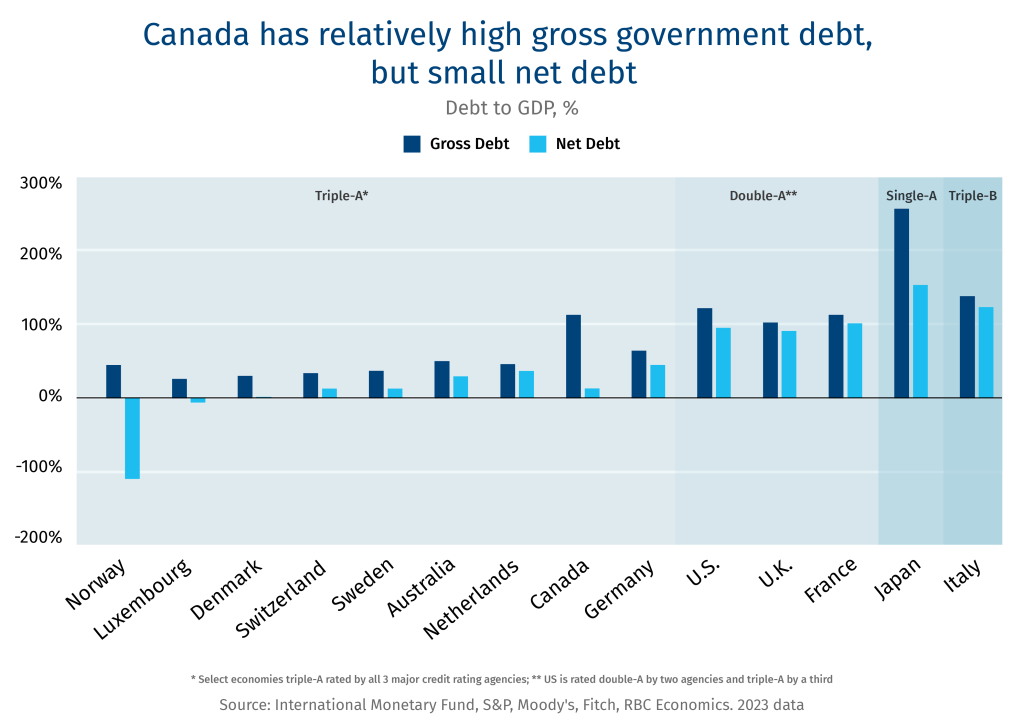
  • It’s not unlimited, but Canada has some fiscal space. Canada’s gross debt burden (debt-to-GDP-ratio) is high, but its net debt burden is the lowest in the G7.

  • Supporting the economy through a potential recession is expected by markets, and unlikely to raise red flags if sized and targeted appropriately. COVID-style supports that ‘bridge’ the economy is not the correct playbook in a trade shock where the economy, structurally, could look quite different in the aftermath.

  • Growth-positive investment is key to keeping federal debt levels sustainable. The more that each dollar of public spending delivers greater growth dividends, the more the federal debt burden will remain in check, even with higher spending.

    • Rebalance social and business investment measures. Canadians have benefited in recent years from an expansion in federal government spending on often broad-based social programs without absorbing the costs. Now, the feds have a new laundry list of to-dos, including kick-starting business investment. Non-spending measures like removing red tape help, but fiscal space will be needed for spending, as well.

    • Make social and other ‘must-do’ spending more growth positive. Major investment needs across the economy beg the question of sufficient capital and labour resources to achieve timely results without crowding out. Public spending in essential areas like housing, defence, and healthcare can promote efficiencies, innovation, and other growth drivers to ensure the economy can grow in multiple areas.

Transform AI into a productivity engine

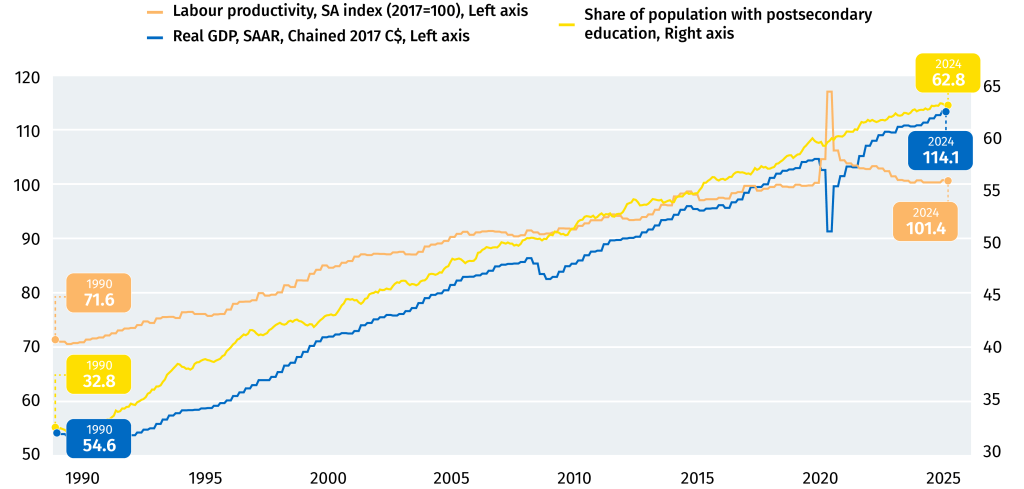
Canada is rich in AI talent but short on the three things that can translate that talent into prosperity: modern computing infrastructure, large-scale deployment, and robust domestic demand. Only 26% of Canadian firms report having implemented AI—eight points below the global average—and the country continues to slip in AI-readiness indexes.​ With labour-force growth flattening and labour costs rising, closing the AI adoption gap is Canada’s most direct route to higher productivity, greater economic efficiency, and continued competitiveness.

Ottawa could pursue a three-pronged approach—acting simultaneously as facilitator, champion, and early adopter—to transform AI from a fragmented set of R&D bets into a nationwide productivity engine.

  • Facilitator: Treat compute capacity as critical infrastructure, marshalling patient capital, procurement guarantees, and partnerships with global players to facilitate access to GPU clusters.​​ Further, government might consider targeted tax credits and grants favouring projects that embed Canadian IP and high-value jobs at home.

  • Champion: Ministers could become visible ambassadors for domestic AI successes, weaving them into every productivity, healthcare and defence announcement.​​ Demand-side tools—procurement quotas that reserve, say, 25–30% of relevant contracts for qualified AI firms, first-reference-customer letters, accelerated tax refunds for AI pilots—have the potential to generate the domestic demand needed to keep promising startups from fleeing south.

  • Early Adopter: In the immediate term, the government could equip frontline analysts, auditors and service agents with secure co-pilots to yield productivity gains and build AI fluency. Longer term, the government could work to re-engineer programs around models that learn across departmental silos, enabled by a U.S. Department of Defense-style fast-lane tech funding agreement, a shared sovereign large language model stack, and performance incentives for senior bureaucrats who are able to effectuate AI solutions.​​

Contributors:

Cynthia Leach, Assistant Chief Economist, RBC

Varun Srivatsan, Director, Policy and Strategic Engagement

Shaz Merwat, Energy Policy Lead, RBC Climate Action Institute

Reid McKay, Director, Technology Policy Lead

Welcome to the first edition of Trade Zone. It’s in beta testing, so please let us know what you think. Every week, our team at RBC Thought Leadership will share what we’re hearing from governments, learning from clients and seeing in our research. We’ll also give you a cheat sheet on the week, to help you keep pace.

Notebook

By John Stackhouse

  • If Mark Carney’s Liberals are re-elected on Monday, as polls are suggesting, expect them to shift their focus South and West by the end of the week.

  • To the South, expect a crew of newbies across the bureaucracy, as well as PMO, with experience in the U.S. A call with Donald Trump will top the To-Do list, with more than trade on their minds. “Comprehensive partnership” is one term floating about—to cover border security, immigration, Arctic and defence issues. And yes, trade, even if USMCA may not be long for this world in its current form.

  • Expect to see a highly structured and strategic Canadian approach, colliding with a highly unstructured American approach. The Trump team had been telling Canadians to avoid working groups or outside “experts.” Side note: American negotiators are driving the Mexicans batty with demands for them to control tomato shipments before any deal is reached.

  • The Trump team has been losing in the courts and in the markets. If that continues, Canada may opt for the long game, following Napoleon’s advice: “Never interrupt your enemy when he is making a mistake.”

  • To the West, watch for outreach from Ottawa to Alberta and Saskatchewan, with a focus on diversification of exports. That will take a lot more than a new pipeline (which may be on the table), as our resource-driven provinces think about new markets. Dow Chemical’s bombshell decision this week to delay its Alberta plant is just the latest trade warning. (I wrote about the Big Pivot on our Trade Hub, drawing on conversations this week at Public Policy Forum’s annual Growth Summit, which is a bit of an Olympics for policy wonks.)

  • Caught between the Potomac and the Prairies is Ontario, but not for long. Doug Ford stole the show at the PPF Summit with a feisty attack on Trump (“Sometimes the cheese seems to fall off the cracker with that guy”) and a passionate shout-out for Progressive Conservatives. Ford seems ready to play bad cop to the next PM’s good cop. He may be warming up for another role, too.

  • Get ready to hear more about Europe as a new (old) partner, for military procurement, AI standards and, yes, trade. Those conversations will grow ahead of the G7 summit in Alberta in June, when we’re expecting LNG and data centres to be front and centre. If the Trump team shows up—no bets there—they’ll want to ensure some alignment on LNG finance, especially for emerging markets, and access to gas-powered electricity for their hyperscalers (the latest euphemism for Big Tech).

  • Climate is creeping back into the trade conversation, although not in North America. Europe is marching ahead with border carbon adjustments (just don’t call them carbon tariffs). Japan is also advancing an emissions trading system, including cross-border carbon credits and a surcharge on fossil fuels (just don’t call it a carbon tax). Expect Canada’s Balkanized industrial carbon pricing system to be part of a likely discussion on the G7 sidelines. (Did we tell you that will be in Alberta?)

  • Indigenous equity will be an important aspect of any new trade relations, much more so than even five years ago. We’re part of the big First Nations Major Projects Coalition conference in Toronto next week and expecting both Ford and possibly a new PM to use the platform to advance their investment strategies. (No investment, no trade.) Other key guests will include Indigenous leaders from Alaska and Utah— hello, Republicans—who may offer a different kind of cross-border relationship.

Need to know

➔ We estimate that $125 billion is at risk for Canada as U.S President Donald Trump eyes 5 strategic sectors.

➔ In a bid to escape tariffs and wait out the trade war, third-party sellers on Amazon and Walmart are shifting stock from China to tariff-free warehouses in Canada.

➔ Not a single new IPO was completed on the TSX or Venture Exchange in Q1. Trade war is scaring companies south of the border, too.

➔ Coke vs. Pepsi: Who’s the winner of the ultimate taste, er, tariff test?

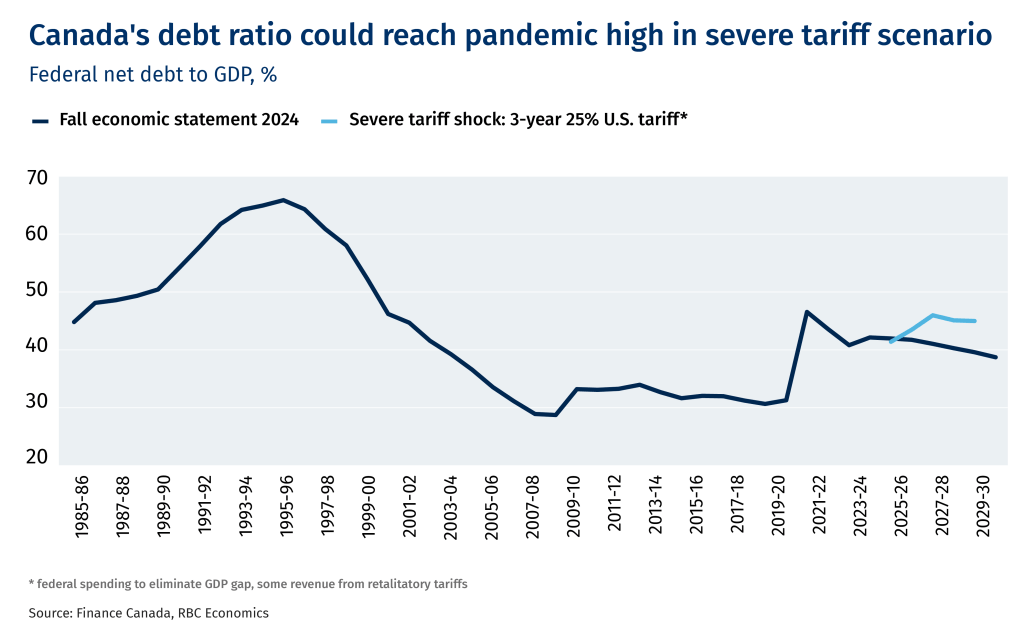
➔ Where we see Canada’s debt ratio headed over the next three years in a worst-case tariff

Final Word(s)

“All eyes right now are on the Arctic. We are the gateway to the Northwest passage and at the forefront of the conversation when we’re talking about security and sovereignty.”
—P.J. Akeeagok, Premier of Nunavut

“People are not going to race to build manufacturing in America. With the policy volatility, you actually undermine the very goal you’re trying to achieve.”
—Ken Griffin, Citadel CEO

“The renegotiation of the USMCA included a very forward-looking digital-trade agreement. I think there is meaningful opportunity there, and that’s in contrast with what you have seen in some other countries, where data sovereignty has been more restrictive.”
—David Schwimmer, CEO of the London Stock Exchange

“The EU is working on a targeted and measured response in case we cannot reach a deal [with the U.S.] rapidly.”
—Eric Lombard, France’s Minister of Economy, Finance and Industry

Early detection remains the single most effective strategy for treating cancer, significantly enhancing survival rates and outcomes. Join hosts John Stackhouse and Sonia Sennik as they explore how groundbreaking innovation and technology are reshaping cancer detection, treatment, and prevention. Physician and entrepreneur Jesse Salk discusses his pioneering Duplex Sequencing Technology, dramatically improving diagnostic accuracy. Peter Liu, CEO of Oxford Cancer Analytics, explains how advanced machine learning and proteomics are enabling more precise and accessible cancer screening. Andrea Seale, CEO of the Canadian Cancer Society, shares exciting advances like lung cancer breathalyzers and convenient at-home blood tests. Listen in to discover how these innovations, combined with inspiring personal stories, are bringing renewed hope to one of humanity’s most pressing health challenges.

Listen on Apple Podcasts, Spotify or Simplecast


John Stackhouse: [00:00:00] Hi, it’s John here.

Sonia Sennik: and I’m Sonia Sennik, CEO at Creative Destruction Lab.

John Stackhouse: This is Disruptors x CDL: The Innovation Era.

Sonia, it’s April, and that means spring is maybe not here, but around the corner. And of course, we’re seeing daffodils both in some parks, but also on people’s lapels, which is a good reminder that April is also Cancer Awareness Month and Cancer Awareness Month. And all those daffodils, if you weren’t aware, were introduced here in Canada way back in the 1950s as a symbol of Spring of Hope, and of that great slogan that cancer can be beaten.

Sonia Sennik: John, cancer remains one of the leading causes of death worldwide with one in five people expected to develop cancer in their lifetime. But in Canada, the number is even higher.

At about two in five Canadians are projected to face a cancer diagnosis. Seeing the treatment and disease management process up close and personal, I’m [00:01:00] sure is something that many of our listeners have experienced in some way, shape, or form.

John Stackhouse: Yeah, I suspect we’ve all been through excruciating aspects of cancer, both in our own families as well as social circles, and there’s no other word.

It is excruciating on the patient, first and foremost, but also on the families and support networks of everyone who endures and suffers cancer. It’s also extraordinary and inspiring to me always to see the quality of care in this country. It is getting better just as the diagnosis of cancer is getting better, not nearly fast enough, but one of the things I love about that slogan, cancer can be beaten is its expression of hope.

The Canadian Cancer Society doesn’t say it will be beaten, but it can be beaten. If we all do something about it, and we’ll hear on this episode some of the amazing things that all of us can take advantage of with technology that don’t get us there to defeating cancer, but certainly give us all a better [00:02:00] shot.

Sonia Sennik: The Canadian Cancer Society works with us, John here at Creative Destruction Lab, with a vision of putting together an early stage program focused solely on cancer prevention treatment and survivorship technologies. Today on our podcast, we have one of our mentors, Jesse Salk, as well as one of our CDL alumni graduates.

Peter from OxCan Analytics. These folks are dedicating their lives at the forefront of innovation and technology, of improving the experience of oncology patients around the world.

John Stackhouse: And I love it that CDL has embraced cancer as a pursuit for innovation for anyone who’s listening, who is thinking about a career at innovation, and you can start that at any age.

It doesn’t need to be just about the next delivery app. Whether you’re a technologist or a marketer or a digital program manager, you too can join the battle to defeat cancer and do it through innovation.

Sonia Sennik: Absolutely, John. Coding to cure cancer. We’re gonna hear from our guests today about how artificial intelligence is playing a role in [00:03:00] transforming oncology prevention treatments and survivorship.

John Stackhouse: We’ve got a great episode, so let’s get at it.

Sonia Sennik: First, we’ll hear from Andrea Seale, the Chief Executive Officer of the Canadian Cancer Society, which is the country’s largest national charitable funder of research into over a hundred types of cancer. The Canadian Cancer Society is committed to uniting and inspiring Canadians to take control of cancer funding high performance research that improves cancer outcomes and addresses the greatest opportunities for progress.

Canadian Cancer Society is also the founding partner of our CDL Cancer program, supporting innovators at the cutting edge of science.

Andrea Seale: Progress in science and technology is helping us to improve cancer survival rates decade after decade. And when we consider emerging technologies, we could talk about genomics, ai, radio, theranostics immunotherapy, and the Canadian Cancer Society is funding really important development in all of those areas.

But some of the most exciting [00:04:00] potential I see on the horizon is about finding cancer earlier. So let’s detect it when it is stage one or even sooner. And today we do this through some of our healthcare screening programs. So mammograms, scans, fit tests, but science is allowing us. To see evidence of cancer in smaller and smaller increments of material like in the molecules in your breath or your urine, or even fragments of tumor DNA that are circulating in your bloodstream and seeing it early gives us better treatment options, and this is really what we all want.

I was in a lab that’s using breathalyzer technology to try to identify a molecular signature for lung cancer and. This is a great example of a simple, portable, inexpensive technology. If it’s like that, it could let us screen more people, screen at younger ages, screen outside our big cancer centers.

Canada’s such a big country. Imagine if eventually we could have at [00:05:00] home cancer diagnostics. Less pressure on our medical system, we could avoid more invasive time consuming surgeries for patients. It’s really promising, and it’s so important that we work together on this

Sonia Sennik: Now we welcome Dr. Jesse Salk, a pioneer in cancer innovation, whose groundbreaking work is reshaping how we detect and treat cancer. Jesse is the co-founder of Twin Strand Biosciences, a company dedicated to enhancing the accuracy of DNA sequencing through revolutionary duplex sequencing technology.

Jesse, welcome to the podcast.

Jesse Salk: Thank you very much,

John Stackhouse: Jesse. Before we get going, we should point out to our listeners that in addition to that amazing resume, you’re also the grandson of Jonah Salk, who developed one of the first successful polio vaccines. I wonder if you can give us some insight into. Your grandfather and how that inspired what you’re doing today.

Jesse Salk: Well, I knew him growing up as a child and to me he was just a grandfather like [00:06:00] any other who brought presents and played and that sort of thing. I think in sort of retrospect now being a scientist and a physician, one of the things that I say I’m most proud about being related to him is the mentality that I remember.

He tried to pass on to me that you’re only as good as your legacy, and so it’s about what one does for others and the memories you leave and the things you do. Beyond yourself that are really the most memorable and lasting.

John Stackhouse: What a beautiful legacy for him to have left to you in addition to the extraordinary legacy he left to humanity.

Tell us a bit before we get into your company and your work, the sort of legacy that you’re trying to build.

Jesse Salk: I am a physician scientist. I came out of academics and I spent many years developing basic science tools and research and publishing papers. One of the things I learned early on was that there’s a huge amount of power in academics, but there’s also a lot of limitations in terms of the scope and breadth that one can deploy these new [00:07:00] technologies.

And so I developed a technology and started a company called Twin Strand, which was really based around that intersection of tools for scientists and, uh, things that can benefit patients and customers globally.

Sonia Sennik: Jesse, for our listeners who may be unfamiliar with the term duplex sequencing, how does that differ from traditional DNA sequencing methods?

Jesse Salk: Duplex sequencing is a technique I developed with colleagues from the University of Washington more than a decade ago that uses special biochemistry and special informatics to significantly improve the accuracy of DNA sequencing. So normal DNA sequencers work pretty well and have an error rate of around 1%, and duplex sequencing drops this to below one in 10 million to allow detection of extremely rare variants for applications like detecting the presence of residual cancer after a curative intent treatment or detecting the mutagenic [00:08:00] signature of a chemical in the environment. That’s a potential carcinogen. And things along those lines, really extreme use cases.

Sonia Sennik: So the more accurate the DNA sequencing, the better the outcomes. How does your technology impact the lives of patients?

Jesse Salk: I originally developed the technique with colleagues when we were studying the formation of cancer and early cancer processes, meaning things that humans are exposed to, either related to their normal endogenous aging process, or chemicals in the environment that can mutate, DNA, can actually change it.

And although we’re familiar with being. Born with a certain set of DNA and thinking about that being immutable during life. That’s not actually quite true. Every cell in our body undergoes a very small number of genetic changes with time, and some of these are the things that ultimately lead to cancer formation.

So this technique allows better understanding of early cancer formation processes and the things that drive it, potentially allows better [00:09:00] early detection of cancer when it’s more treatable. Allows detection of relapse of cancer early when something can be done about it. Cancer’s tricky. It’s not a disease that’s from an inherited single gene or a single virus or a single bacteria that causes it.

It’s a heterogeneous disorder that’s sort of interplays and is intertwined with aging. Our bodies naturally develop mutations and we have ways of preventing those from growing, but eventually some of them can let cells grow and expand into cancers, and we. Know that we don’t go from a state of normal to a state of cancer overnight.

This is a gradual process and better ways of resolving how those mutations occur, what caused them, and what allows the cells to carry them to grow and begin that early cancer process formation will hopefully lead to better insights for better cancer prevention and early detection.

Sonia Sennik: Jesse, you spent quite a bit of time with us this year in our CDL Cancer program.

I’m [00:10:00] curious to know what innovations you’re seeing that are exciting you the most.

Jesse Salk: There’s quite a lot, uh, in the cancer stream around artificial intelligence, whether that’s interpreting pathology or radiology slides or developing new drugs. So that’s an exciting area. That’s, um, something that I’m definitely anticipating is gonna really be impacting, uh, science and medicine going forward.

There’s also a lot of focus I’m seeing on health economics and ways of taking technologies that might be cool but are also expensive, and not just throwing more expensive solutions at our problems, but taking some of the problems we have and looking at the most cost effective and, uh, realistic ways to get the most out of the tools we do have.

I think the breadth of people in the room, both companies and mentors is enormous and it’s always a pleasure to participate and see something. I learn something new each session.

Sonia Sennik: Geoffrey Hinton, years ago, I think in 2017, famously said, [00:11:00] in five years there’ll be no more radiologists. I think each of us probably know a radiologist and radiologists are very much still in business.

What does the pathway look like for AI to start making really tangible changes when it comes to cancer prevention or treatment?

Jesse Salk: I think AI is obviously a tricky term because it’s not quite the same as human intelligence. I think there are things that many of the tools we have now can do better than humans.

A lot of tasks that I tend to forget or my colleagues would rather not spend their time doing so we can spend our time thinking and focusing and more sophisticated. Management decisions and strategy. Like I said before, cancer is an incredibly complex disease and we’ve over the last decade, developed more and more new tools for increasing the depth and breadth of data streams for measuring different molecular happenings in cancer and other diseases.

I think taking very complex disparate signals and integrating together using AI to create [00:12:00] models and learning that we can use to, from that information to predict outcomes or identify specific choke points where we can therapeutically intervene is probably one of the most relevant things. So it’s using.

Pattern matching that we as humans are not necessarily good for, to get additional insights into some of the data we have from new technologies that already exist and those that are coming on down the road.

John Stackhouse: Presumably, Jesse, you could do a lot of this in your lab, and even as an academic, you’ve chosen to create your own company, Twin Strand Biosciences. Tell us a bit about the origins of the company and what, as a scientist you felt you wanted to do also as an entrepreneur.

Jesse Salk: So I spent many, many years in academics, so I really, uh, appreciate that and understand the importance of academics.

A little kid that asked me the other day, what grade I was in after he told me he was in second or third grade, and I [00:13:00] thought it was sort of funny and I thought about it and you know, I realized that I had actually graduated in the 29th grade if you had a medical school and college and residency and fellowship.

And so I’ve been at that for a really long time. So, although on one hand I really am motivated by advancing science and teaching and, and taking care of patients, I also found that there’s a lot of challenges being able to deploy new technologies at the scale and scope and to the number of people that I, you know, would, would always want to be able to do.

And so starting a company was scary but exciting opportunity and I learned a whole lot in the process. You know, I think the future of advancing science and medicine is always gonna come at the interface of academics. And commercial, whether one is fully on the academic side or one is on the commercial side, there’s always a crossover point, and that’s where that intersection of, uh, innovation comes from the most.

Sonia Sennik: And Jesse, how do you balance being an entrepreneur and a practicing oncologist, [00:14:00] and how does each role inform the other?

Jesse Salk: It’s challenging, but just like, uh, anybody does multiple things. It’s challenging. As an oncologist, I still see patients half a day a week. I take care of oncology patients over at the local VA here in Seattle, but I also teach, I supervise residents and fellows and medical students and, and teach them how to be better doctors.

And as an entrepreneur, starting a company, I teach customers. I teach scientists at the company and I teach investors about the technologies and the opportunities we have. I think there’s more overlaps than differences, but it is challenging. It is challenging context, switching from one thing to the other, but just like context switching, running a lab and being a parent, or being a doctor and taking your kids to a soccer game, these are just part of life and one has to make it work.

John Stackhouse: Jesse, switching back to cancer research, what recent developments in cancer therapies maybe excite you most and [00:15:00] where do you think that will take us?

Jesse Salk: I think one of the biggest thematic changes in cancer therapy over the last, uh, 10 years that I’ve seen is the development of many therapies focused around harnessing the immune system.

The immune system is this amazing, adaptable, evolvable system that’s, you know, taken billions of years to, to get to the state where it is, and it’s really powerful for adapting to new changes and new threats to our body. And one of the ways cancer cells avoid being cleared out by the immune system is doing certain tricky molecular changes that hide.

And so many of the new treatments that we’ve developed, uh, checkpoint inhibitors and CAR T cells and other immunomodulators have really, uh, begun. To address those vulnerabilities and weaknesses in cancer, let the aspects of the immune system work really well overcome these relatively straightforward changes.

And although we’ve [00:16:00] made major progress for coming up with treatments that can be sometimes curative in a stage four setting, which was never possible before. For many cancers or being, uh, vastly more tolerable than past chemotherapies. I think there’s an extraordinary number of opportunities ahead of us, and when we look back in 10 years, I’m sure we’re gonna say that even where we’re at right now that I just said, we should be so proud of that technology of the present is actually probably gonna be medieval compared to where we are in a decade.

So I’m really excited to be in oncology because of that.

Sonia Sennik: Jesse, for any of the entrepreneurs, scientists or epidemiologists listening, what advice would you have if they’re looking to make a difference in the field of biotechnology and healthcare?

Jesse Salk: I think the most important thing is to do what you wanna do, not what you think you should wanna do.

Take the things that you’re passionate about and find ways to use those to not just create papers or a reputation for yourself, but get them out in the [00:17:00] world. And that means working with colleagues in academia, it means starting companies or working with other companies. It means being kind and creative and generous to the broader community that we’re all part of.

As many folks have said, we all stand on the shoulders of giants and are only able to move forward because of the past work behind us. And so be sure to respect the past scientists that you’ve come from and pass it on to the next generation as you move forward and make your legacy in the world.

John Stackhouse: Jesse, that’s truly inspiring.

Thank you for being on the podcast.

Jesse Salk: Thank you for having me.

Sonia Sennik: We’re now joined by Peter Liu, co-founder and CEO at Oxford Cancer Analytics, a company at the forefront of early cancer detection using advanced machine learning and blood-based diagnostics. Peter is also a Creative Destruction Lab alumni founder, graduating from our CDL Cancer program in 2024. Peter, welcome to the podcast.

Peter Liu: Thanks very much, Sonia.

Sonia Sennik: So Peter, let’s start with your [00:18:00] founding story. What inspired you and your team of researchers to launch Oxford Cancer Analytics?

Peter Liu: So I came from a clinical medicine and cancer research background, being trained as a medical doctor in Toronto. And then, uh, having completed my PhD in Oxford, I’ve been focusing on cancer innovation for the past 13 years.

The first half of my career, I focus on novel, innovative treatments for cancers and also the mechanism to which cancers are initiated. But during my, um, clinical experiences, I started realizing actually. When detected early, a lot of cancers can be subject to, uh, treatment with curative intent. But unfortunately, if you look at a lot of the, uh, the deadliest cancers, a cancer that unfortunately kill the most normal people, those are often detected too late.

For example, lung cancer is the leading cost of cancer deaths worldwide, and over 70% of patients are often detected at the late stage when this can be a death sentence for many. Whereas you’re able to [00:19:00] detect this cancer early, there’s a significant increase in those who are able to survive beyond five to 10 years or more.

And that’s why I started shifting my focus on the, uh, early cancer detection front and the idea that a simple blood test is able to pick up materials in the blood predictive of cancer is very exciting. The fact that we’re able to detect many cancers in a minimally invasive manner using the same kind of blood tests that any of us could have done at the family doctor or GPS office for early detection.

The ability to fundamentally transform the way that we get approached cancer prevention from one that’s reactive to proactive. I think when it comes to, um, innovation nowadays, especially in the health tech space. There needs to be intersection amongst three different perspectives. One is the clinical utility.

Second is the scientific feasibility, and thirdly is a commercial impact. You need to get all three of these right, intersected at the right [00:20:00] point. Having seen at least two outta three of these, um, from the clinical medicine partner with the research part, I’ve realized that what may be clinically feasible and promising may not be scientifically feasible and vice versa. A very innovative scientific idea without being fully integrated with existing clinical pathways may often have trouble being able to reach the hands of patients. The ability to bring innovation that can benefit patients, that can benefit clinicians with a feasible scientific idea will not reach the hands of patients we need the most without that commercial support.

And that’s where we decided to take a commercial approach. So with a group of highly skilled scientists, physicians, medical researchers, regulatory experts, and commercial experts we’re able to bring these innovations to hands of patients who need it most.

Sonia Sennik: And maybe just in the simplest terms, Peter, how does OXcan’s liquid biopsy work and how is it different from other diagnostic tools?

From a patient perspective? [00:21:00]

Peter Liu: Yeah, for sure. Uh, Sonia and John, when was the last time, uh, you were at a family doctor’s office for a blood test?

Sonia Sennik: Within the last few months. I’m a great citizen. Peter. John, what about you?

John Stackhouse: It would’ve been last summer.

Peter Liu: Well, you know what? For me it was just a couple months ago.

It’s the same kind of blood test you had done there that can tell you whether you are at a higher risk of cancer and whether we would recommend you to proceed with further confirmatory testing. The reason why we have decided to go with a blood-based approach is because it can be very cost effective, is fully integrated with existing pathways.

All the infrastructures are already in place. The challenge is really knowing what to test for in the blood and whether to, um, identify whether someone is at an increased risk of having cancer. And that’s why a lot of our R & D is focused on analyzing within the blood to identify the risk of cancer.

So all in all, it sounds very simple, simple blood test that many people would’ve experience, but the science behind it, it’s a lot more complex, but requires a lot of hard [00:22:00] work.

John Stackhouse: Well, simple is good, and as a male of a certain age, I get that mailing here in Ontario from the health ministry for a prostate test, which I’m glad to do.

But point being, we should all be doing more, and the more that the system does to make it easier for us, probably the more uptake there’s gonna be.

Peter Liu: Yeah, precisely and very similar to, um, the colorectal screening guideline. There is an existing screening guideline for lung cancer, which is a leading cause of cancer that’s worldwide.

But fortunately, many countries, including the US has reached some hurdles in terms of people adopting it. There is, uh, an exposure to radiation. Plus there’s also cost and there’s only so many people you get screened through these gigantic donors. So that’s where we come in as through a simple blood test.

And that’s why actually, uh, we’ve been doing quite well in terms of working with some of the, um, the largest, uh, screening programs for lung cancer in order to better triage and to allow more patients to be screened, uh, [00:23:00] faster at a lower cost. So that, and we can detect, um, more lung cancers. Earlier.

Sonia Sennik: Peter, cancer’s such a personal and emotional disease for many. How has working so closely on this issue affected your outlook, either professionally or personally?

Peter Liu: Yeah, Sonia, I grew up in, uh, Calgary, Alberta, and I remember when I first started my undergrad, I was volunteering at the Tom Baker Cancer Center working with quite a lot of families and patients who were struggling with cancer. What I saw were each individual human being, each with their own identity, their dreams, and I saw cancer as a disease that deprived people of their fundamental identity, often altered people’s personality and to behave in a way that were not them, but also deprive them of their, of some of the most fundamental dreams and hopes.

So these encounters ground [00:24:00] the purpose of what I did, and that’s how I started Paths to Cancer Innovation. Fast forward over a decade later, I continue to be motivated by these day one stories, uh, from patients. I have also lost some very close family members, uh, of my own, uh, two cancer, including lung cancer when I was developing this company.

So not only this personal, it’s also meant for, uh, other families and people who are. Currently fighting cancer, but also people who are focused and will continue to fight cancer. In a way, it’s unfortunate that my own family member would not be able to benefit from this technology, but I hope other families and other people will be struggling with cancer will have the opportunity to benefit from this, the whole ambitions to drastically transform the way that we detect cancer and treat cancer to enable more treatment, security attempt to save lives.

John Stackhouse: Peter, as we move towards close, I wonder if you can share a bit about what’s next for OXcan and, and [00:25:00] maybe also give us a sense of where you see AI taking your company, your work, and the broader field.

Peter Liu: Yeah, so AI at its core is a tool to help us analyze data and get an output from it. So what’s important is what goes inside of it and what comes out of it.

So AI is only as good as the data you put in there. So that’s why at Oxford Cancer Analytics, we have formulated a new generation of proteomic technology so that we can unravel previously unseen data in the blood for the first time so that we can feed this data into the machine learning algorithms so that it can tell us what new biomarkers can be, uh, used for early cancer detection.

And, um, in terms of what comes out of it, uh, it’s also important because you need to control these parameters in a very careful way. I think a lot of times people may misuse machine learning, people may misinterpret the data, uh, coming out of it. And this is especially [00:26:00] important in the field of clinical medicine and also early cancer detection because it’s one of these fields where there’s an increasing need for humans to be extra prudent in terms of AI use.

When we started back in uh, 2020, people were only beginning to try to use machine learning in this area of data analytics. We realized that actually a lot of the machine learning used at the time were not necessarily tailored appropriately. For example, we used a lot of high dimensionality and low sample size data, whereas a lot of machine learning were meant to be applied to millions of people compared to the hundreds of thousands of, uh, sample size that were dealing with in clinical medicine and science.

So we actually had to directly design a lot of the machine learning models from the ground up in order to tailor them towards getting the most. Out of these data in terms of the future, we have further built in an explainability component to address a lot of the concerns that people have for AI, especially in the, um, clinical medicine and regulatory domain.

Some of the, uh, more modern but complex machine learning models [00:27:00] can be seen as a black box. What we have done is actually, we added an explainability component. So the AI actually talks back to us telling us exactly how it’s made that decision. So not only I think this patient has cancer, and I think these are the important biomarkers, it actually tells us, this is why I think this patient has cancer, and this is how I made that decision at.

And we have to pioneer a lot of new generation machine learning models, explainable AI models in order to best utilize this tool in the most responsible and suitable manner to maximize what we can get. From these innovative proteomics data for early lung cancer detection, I’m highly optimistic about AI.

I think it’s inevitable that AI will become an everyday part of our, uh, work and life, but also, especially certainly in our field, there’s an increasing need to approach it with responsibility and prudence. Uh, in terms of what’s next for Oxford Cancer Analytics. We’re excited to launch our product in the next year, starting from the US North America, UK, and EU, and hopefully being able [00:28:00] to benefit, uh, more patients globally.

Sonia Sennik: Thanks so much for joining us on the podcast.

Peter Liu: Thank you very much, Sonia and John.

Sonia Sennik: In the words of Coldplay’s, Chris Martin, it was all yellow. Daffodil month is upon us, and we’ve heard from some amazing visionaries and innovators in the cancer space.

John Stackhouse: There was so much to learn from in that episode, and sometimes cancer can seem overwhelming, but there’s a few very simple things all of us can do, not just in Cancer Awareness Month, but through the year.

Number one is to talk about it. This isn’t a secret that we should tuck away. It should be a common part of our conversation so that we’re all learning and sharing and supporting. We could also spread awareness through those daffodils and donating our time and money. And then lastly, perhaps most importantly, get tested.

No matter who you are, no matter what age or stage, there’s no real good excuse for not testing yourself and helping others get tested for cancer. That’s how collectively we can all live up to that motto of beating cancer. [00:29:00]

Sonia Sennik: John, one of my favorite parts of the CDL Cancer program is our patient contribution group.

So we’re piloting a new structure where we have patients in the room, in our CDL sessions with the innovators and our mentors and scientists. Engaging firsthand in technological development. Having the chance for the patients to share their stories and provide input to our technologists at these early stages is a really rare and special experience to observe.

And what I’ve learned is no two cancer journeys are the same. So as you mentioned, educating yourself, getting tested early and contributing to our ecosystem that has incredibly smart innovators that can tackle this problem, is an opportunity for all of us.

John Stackhouse: That’s so well said, Sonia. No two journeys are the same, so whatever yours is, don’t be afraid to share it.

This is Disruptors, an RBC podcast. I’m John Stackhouse.

Sonia Sennik: And I’m Sonia Sennik.

John Stackhouse: Talk to you [00:30:00] soon.

Overview

Economic theory and evidence tell us that the more educated a society is, the more productive its economy will be. Countries or regions with highly educated people will attract advanced industries, generate more savings and investment and create entirely new economic sectors.

That promise is not yet fulfilled in Canada. Despite having one of the world’s highest rates of postsecondary education and a steady rise in postsecondary attainment over the past quarter century, economic performance, including productivity, is lagging. Too many graduates have advanced degrees that don’t deliver an advanced economic return. Not enough employers can build teams with the right skill sets. Too often, students don’t know how their programs line up with the labour market. And our international students continue to struggle to gain productive work in a fast-changing economy.

The challenges are all the more pressing in a worsening trade environment in which many Canadian businesses are looking to quickly pivot to more global, and more competitive, opportunities. Trade wars mean talent wars.

Of course, this is not entirely new. Canada’s postsecondary sector, and employers and governments, have been working for years — decades, really — to build a more productive, knowledge-driven and skills-based economy.

But for all the innovations in workforce-readiness, there‘s still a substantial gap between education inputs and economic outcomes, which Canada’s struggling economy and productivity cannot afford.

In this report, we identify why Canada is not reaping the benefits of its globally respected postsecondary education systems and we make recommendations about how to address our current postsecondary education/productivity disconnect. Getting that relationship right is key to sharpening Canada’s competitive edge. At the end, we present examples of what more productive economies have done to leverage the knowledge capital and research capacity of their postsecondary systems. And we highlight innovative experiments in postsecondary delivery, giving food for thought.

RBC launched The Growth Project initiative this year to discover a new generation of ideas for the Canadian economy. Throughout this project, we’ve been exploring key drivers of economic growth including productivity. To build on our report on why the economy is stuck in neutral, we’ve partnered with the Business + Higher Education Roundtable (BHER) to address the role of postsecondary education in Canada’s productivity crisis.

Productivity is an important measure of an economy’s efficiency at generating additional income from each hour worked. Some economies generate more additional income per hour worked than others, leading to better economic performance and growth.

Where we are

Canada’s labour productivity growth falters even as more Canadians obtain postsecondary education

Source: Statistics Canada, RBC Economics

Canada’s population is highly educated but our productivity doesn’t match — We are the most highly educated population in the G7 and above average across OECD countries. In 2024, some 63% of Canadians aged 25 to 64 had a postsecondary credential compared to an OECD average of 41%.1 Yet these two charts show that our productivity record has not kept up and is not only lagging our peers but has worsened over the past decade even as the rate of higher education, including for new Canadians, has improved.

And that productivity growth lags many OECD countries

Average annual labour productivity growth, 2014-2023, %

Source: OECD, RBC Economics

Our graduates get jobs, but their incomes  — College and university graduates experience lower levels of unemployment and earn more over time than Canadians with a high school diploma or less.2 But, regardless of education level, Canadians earn an average of 8% less than their American peers,3 a gap that is wider in many professions.4 This is one reason for a perennial migration — a brain drain — of people with advanced degrees to the United States and a loss to Canada, economically and otherwise. The differing costs and standards of living in the U.S. aside, Canada still only falls in the middle of the pack when we look at individual returns on investment from higher education compared to peer countries.5

Postsecondary Education in Canada

Canada does not have a singular postsecondary education system. Each province and territory holds responsibility (a constitutionally protected authority for provinces and federally delegated for territories) for establishing and regulating its universities, colleges and institutes, including giving power to grant degrees and diplomas and making choices about provincial funding and tuition. This has led to variation in policy and systems across the country. About 64% of postsecondary students are enrolled in universities and 36% in colleges6, the vast majority in publicly funded institutions split among about 100 universities and 200-plus colleges, including 13 polytechnic schools7. This is alongside more than 1,500 private vocational colleges, about half in Ontario8.

Universities have traditionally offered longer-term degree programs in subject disciplines and public colleges have offered shorter-term diplomas in career-focused programs. But provincial governments outside Quebec and the four Atlantic provinces have also allowed public colleges to grant degrees9, and diploma and certificate programs are frequently found at universities. The federal government contributes to the postsecondary systems indirectly as well, through research grants, student financial assistance and provincial transfer payments10.

The Challenges

At its best, higher education contributes to productivity by developing a skilled workforce, driving innovation through research and fostering industry collaboration. Postsecondary institutions equip graduates with critical skills, support businesses with cutting-edge research and fuel economic growth by creating new technologies, startups and talent. Research has shown a positive relationship between a region’s economic health and the presence of higher education institutions, with an additional 0.4% in future GDP for every 10% increase in the number of universities per capita11. This effect is driven by boosts to human capital and innovation, not just direct institutional and student spending.

Higher learning institutions also contribute to the social and intellectual vitality of a community, region, and society that are hard to quantify. Nevertheless, Canada’s record underscores that the presence of a higher education system with a high rate of participation and research activity does not always translate into high returns when we look at economic measures.

So, what’s missing? Pinpointing which factors contribute to the overall economic value of a postsecondary education is limited by a lack of data and research12 13. But we can look to other countries with higher productivity and strong postsecondary systems for clues about what works and is showing promise — some of those are highlighted later in this report. We can also identify clear gaps here at home, whether that’s in human capital development or in research.

Disconnects persist between the knowledge and skills outcomes of Canada’s higher education systems and labour market needs.

The OECD has noted that “higher educational attainment does not always directly correspond with higher skills14.” Employer surveys consistently indicate that companies still have a hard time finding new hires with the skills they need, especially interpersonal and communication skills15. We also know that there is a growing gap in graduates’ technical skills related to artificial intelligence, cybersecurity and working with big data, all areas rapidly growing in importance.

Postsecondary business models are inadequate to meet the outcomes expected of Canada’s higher education systems in the current global economy.

Postsecondary institutions have a balance sheet problem. Their finances are rapidly changing due to stagnating provincial government funding, restrictions or even freezes on student tuition increases, and a federal immigration policy shift that has led to steep drops in international students and the significant revenue their higher tuition contributed to the bottom line. The postsecondary revenue crunch is likely to worsen without a reformed business model — one that is capable of responding to the demands of a changing economy.

Trouble is, postsecondary leaders are constrained by insufficient control over their revenue sources, regulations that circumscribe how they run their budgets, and little to no ability to cut or reallocate some of their biggest fixed costs. Staff wages and benefits amount to more than 50% of total expenditures at both colleges and universities16 and a high presence of permanent faculty and teaching staff protected through collective agreements, tenure or both limit institutions’ ability to nimbly adjust or close programs as enrolments and demands change. The hiring of contract faculty to teach students has been one attempt to gain some flexibility but the practice is not a panacea and has led to a teaching underclass with insufficient access to resources or basic job stability.

Amid this shaky and constrained financial picture, academic programs that connect best with high productivity industries are the most expensive to run. Science, technology, engineering and mathematics programs – STEM — have been expanding over the last 30-plus years as labour market and student demands have shifted, from 18.3% of enrolments in 1992-1993 to nearly 26% in 2022-202317. But labs, computers and other equipment mean they cost at least twice as much as training for a humanities or business student. If traditional revenue sources are no longer reliable, colleges and universities need to be freed – and encouraged – to develop fresh revenue streams, funding models and educational redesigns that make sense for them and the broader societal and economic needs they serve. The case of Arizona State University (illustrated later in this report) is an example of an institution that has taken an entrepreneurial approach, reimagining its programs and research activities as well as its business model to gain back institutional control from reduced state funding while making student access a priority, including for marginalized students.

Canada lacks comparable data to assess outcomes of our postsecondary systems and support linkages with labour market information.

It’s hard to fix what isn’t well-measured and Canada falls down on data to assess outcomes of its postsecondary systems20. While completion and employment rates data are sometimes tracked, outcomes data are not uniform across provinces or even institutions; nor is it timely or robust enough to confirm alignment between graduates’ skills and the labour market. The provincial/territorial control of higher education systems may seem to make national standardization of this data a non-starter. But given the renewed exploration of how to better harmonize provincial/territorial economies and trade, there is a perfect opportunity to bring postsecondary institutions into the discussion.

Countries such as the U.S. and Australia do a better job with postsecondary data tracking, enabling well-informed public policy discussions and change. In the U.S., tracking has been federally mandated for institutions that participate in federal student aid programs, and data is available through its Integrated Postsecondary Education Data Systems. Australia has developed its Quality Indicators for Learning and Teaching, a suite of annual government-endorsed surveys that follow higher education students from enrolment to employment.

There is a mismatch of graduates with advanced degrees.

Nearly 15% of Canada’s working-age population hold a graduate degree today — just below the share that held a bachelor’s degree in 1997, at 16%21.But those degrees aren’t always leading to jobs that require them. (In fact, there are more job vacancies for positions requiring only a high school diploma than there are openings for positions requiring a bachelor’s degree or higher22.)

As a result, there’s a rising number of highly educated Canadians working in jobs that do not make effective use of their degree. The OECD has ranked Canada as having the second-highest overqualification rate of 37 countries23, with an overqualification rate of 10.6% for Canadian-born workers and 11.8% for Canadian-educated immigrants in 202324.

Degree-holders undoubtedly enjoy a wage bump compared to those without a postsecondary degree. But that wage premium is shrinking when comparing the benefit of a master’s degree to a bachelor’s. Between 1997 and 2019, that premium averaged 23%. Since the pandemic, that’s fallen to 18% as more graduate degree holders compete for the comparatively smaller pool of jobs that require their credentials.25 What people pursue in their advanced degrees matters too: business PhD holders were the highest earners in a 2021 analysis of doctoral graduates, although they represented only 4% of all PhDs, while humanities and science PhDs (9% humanities and 22% sciences) were among the lowest. Math and computer science doctorate holders meanwhile showed the highest earnings growth in the five years after PhD completion26.

As well, fewer Canadian PhDs are working for private industry, compared to the U.S., which may be partly tied to an economy that is still heavily resource-based and where we have lower levels of industry R&D investment that would demand their skills27. Nevertheless, graduate students have relatively low levels of participation in work-integrated learning experiences (discussed later in this report) and lack opportunities to demonstrate and apply their skills and expertise to Canadian firms that could benefit from them. Canada certainly needs people with advanced degrees, but more thought should be given to which programs are of greatest need and how to make the most out of the skills and knowledge they produce.

Canada has seen expansion of postsecondary campuses and programs over the last 25 years but it’s unclear whether we have the right number or distribution.

Participation in higher education has expanded over the last 35 years and along with it has come expansion of programs and campuses. We need a high-quality postsecondary sector to educate and inspire the next generation of talent and skilled workers while generating transformative discovery. But it’s worth asking whether the size and spread of Canada’s roughly 100 public universities and 200-plus colleges with associated campuses and 25,000-plus programs are aligned as well as they could be with the country’s most pressing needs and the challenge of creating a more productive economy.

This question becomes more urgent given the pullback on international students who until 2024 functioned as a significant counterweight against more recent shrinkage in domestic enrolment and revenue, which has been acute in some regions. Population demographics forecast modest growth among Canada’s   over the next decade before declining to something slightly above current numbers28.

Memories are also relatively fresh of the 2021 financial crisis at Laurentian University in Sudbury, Ont., when the institution declared insolvency due to what was later deemed primarily to be poorly planned capital projects combined with administrative bloat29.

Let’s think seriously about how to better align higher education resources with a broader student demographic and the evolving needs of the economy.

We are not setting up international graduates of Canadian postsecondary education for integration into high productivity labour sectors.

International students are part of the solution to Canada’s future economic needs and its productivity crisis. But over the last several years we’ve seen how the country’s efforts to recruit these students ballooned out of control, leading to students being underserved and/or ending up in programs without pathways to high value industries. As one example, international students are more likely to be enrolled in business or management programs versus STEM30,and many have struggled to find jobs after graduation when their visas allow them to stay.

As Canada works to reduce and recalibrate this student pool, we should focus on recruiting and educating high quality international students with targeted workforce development in mind. The federal government recently made this a requirement, with new rules about fields of study that international students need to be enrolled in to qualify for post-graduate work permits.

That’s a start, but the execution left something to be desired and threw many postsecondary institutions into crisis-mode trying to fill financial and programmatic gaps overnight. When the dust settles, fields of study should be chosen with consideration of regional labour demands too. International students will also need more help to translate their skills to the workplace, via focused career counselling and work-integrated learning opportunities, which some struggle to access due to immigration work restrictions.

Students need more complete skills toolbox.

We need data scientists who are storytellers, electricians who can communicate technical complexity to their clients, and culture creators who can make magic by leveraging cutting-edge digital technologies. Hard skills and knowledge learned in STEM programs are valuable, but so are the skills where humanities excel: persuasive and effective writing and speaking, critical thinking and creative approaches to problem-solving.

We also know that students may not end up working in the domain where they received their education, whether that was in STEM or business/humanities31. Not enough postsecondary programs encourage cross-pollination across disciplines. But programs such as McGill University’s Bachelor of Arts and Science (B.A. & Sc.) degree, which allows students to study disciplines in both faculties, BCIT’s Bachelor of Creative Industries program that combines training in the arts, technology, and business, or Langara College’s Environmental Studies program, blending biology, chemistry, English and geography, are promising examples32. Many programs leave room for electives, too, where students can acquire that breadth of skills independently.

But this is tinkering along the edges of what’s possible and needed. As enrolments continue to slide in humanities programs, postsecondary institutions must reimagine the core competencies the humanities provide to all students and how to extend that across subjects, disciplines and faculties in a world of growing STEM demand. Critical thinking and the ability to analyze complex problems are top skills for the most needed jobs in the face of advancing artificial intelligence and automation33 as is the ability to identify how to effectively use these technologies. Can we start to break down entrenched silos that prevent the STEAM concept from being embedded more directly into most students’ programs and curricula?

Canadian companies are not making the most of postsecondary research output and are weak adopters of postsecondary research innovations.

In 2022, Canada ranked 10th globally in terms of scientific publications34 and we are a global leader in specific fields, such as artificial intelligence. But Canadian companies aren’t picking up the ball when it comes to making the most of made-in-Canada discoveries. The U.S., with a much better track record, benefits from a more robust ecosystem to support research translation into market applications, including venture capital funding, supportive public policies and an intellectual property framework that incentivizes researchers and postsecondary institutions to pursue commercialization.

All told, Canadian business investment in research and development was just 1.7% of GDP in 2022, putting us below the OECD average and well below highly productive countries like Israel (6.0%), South Korea (5.2%) and the U.S. (3.6%)34. Even in AI research, where Canada is a global leader, we lag peer countries in its commercial use.

How we can do better

The discussion about aligning postsecondary education and training with labour market needs isn’t a new one. Colleges and universities recognize this, and there are growing pockets of innovation. But employers and economic data signal a different story: that Canada is still missing the mark in generating the skills and knowledge needed to meet its evolving productivity challenge in an increasingly competitive world. Here are a few things we can do differently:

Eliminate barriers to institutional innovation.

Postsecondary institutions in Canada require new business models that free them to be more entrepreneurial and in control of their financial destinies while remaining responsible and accountable to the people and communities they serve.

Too often institutions that attempt to innovate are frustrated by a host of mostly provincial but also federal regulations on everything from tuition to procurement to partnerships and mandatory programs without corresponding government financial support. Reasonable deregulation would help clear the way for institutions to become more creative, collaborative and in step with a changing world. Internally, colleges and universities need mechanisms to incentivize change where barriers and resistance exist within institutions to creating or altering programs at scale or incorporating industry into program design.

Enhance the awareness and articulation of skills developed in PSE programs.

Prospective students and new graduates need to know the skills they will emerge with, allowing them to fairly evaluate whether a program is for them and to communicate these skills to employers. Some programs are already clear about this, notably at colleges, but the practice should become widespread and should be tied into a larger drive towards national comparable postsecondary outcomes data that can be linked to labour market information.

The challenge can be more acute for advanced degree holders, most of whom won’t spend their careers in academia. They, and employers, also need to understand what skills they’re developing through their research and how these can be translated to a non-academic workplace.

Get work-integrated learning to where it’s needed most.

Work-integrated learning, or WIL, is the practice of integrating work and real-world experiences into a student’s higher education program. Internships, practicums, co-op programs, entrepreneurial mentorship and field work are common examples. These experiences help students connect and apply their learning to workplace realities, acquire new and relevant skills and assist businesses to recruit and develop students for their specific labour needs.

As such, WIL is part of the solution to Canada’s productivity and skills challenges – two-thirds of employers participating in WIL programs through BHER reported an increase in their productivity.36But while the country has made important strides in providing these opportunities, WIL is not yet the norm – just under half of all postsecondary graduates in 2020 had experienced a WIL opportunity.37 There are also variations in uptake, with PhD students (18%) and those in the humanities (16%) less likely to have a WIL experience38.

Most businesses in Canada are small and medium-sized enterprises (SMEs) and face more barriers than larger organizations to participating in conventional forms of WIL in terms of resources, time and risk. For them, shorter-term, more flexible and less resource-intensive forms of WIL aligned more closely with SME realities and needs make more sense. These should be considered as part of a robust suite of WIL experiences. They include consulting engagements, multiple short-term placements of up to 10 days, online projects and placements, and engagement in industry challenges through hackathons, competitions and course-based projects submitted by employers39.

Develop upskilling and reskilling opportunities.

Businesses have a responsibility to help workers stay current with the skills needed to keep doing their jobs as they evolve with technological and other changes. Postsecondary institutions are well-positioned to be providers for that learning and can take advantage of these opportunities as revenue streams in a reformed business model. Too often Canada’s companies struggle to partner with postsecondary institutions and end up developing their own in-house training solutions40.

To do that well, higher education must stay on top of and respond to upskilling opportunities in their communities, partner with employers (and vice versa) to understand and respond to specific skills gaps and create programs that fit the working and personal lives of learners. Continuing education departments are particularly well-positioned to do this. An opportunity also exists for governments to financially support and promote these programs, such as through tax and other incentives, as they look for policy responses to labour force disruption. Microcredentials – rapid, often virtual courses — are one form of upskilling that have proven effective in complementing workers’ existing skills41.

especially the programs and courses that are developed by postsecondary institutions (for example, Ontario provides access to these via its provincially funded eCampus portal).

Similar opportunities exist for postsecondary institutions in reskilling programs where workers exiting one industry acquire an entirely different set of more in-demand skills. Partnering with local companies’ outplacement programs is one example. Given that it’s a more substantial undertaking than upskilling, the reskilling shift can be trickier, especially if we want it to happen quickly. Competency-based education (CBE) courses may offer a way forward. CBE is singularly focused on mastery of a discrete set of competencies, often required for a particular job, such as nursing. CBE courses tend to be flexible, virtual, personalized, self-directed and recognize prior learning. The approach has been used in limited ways in Canada, is more widespread in the U.S. and may offer inspiration for reforming the structure and delivery of traditional programs42.

Intensify the drive towards institutional differentiation.

Canada has done an excellent job of providing access to public postsecondary education across a big country and into remote communities. But we neither need nor can we afford to have every institution offering the same menu. Not every institution needs its own artificial intelligence research hub or history department.

Differentiation is critical, where public colleges and universities are encouraged to lean into the teaching, learning and/or research they are best at, and discouraged from unnecessary program duplication. The government of Ontario has followed this policy, though without a strategic vision for the sector or what separate roles should be played by colleges and universities43.

Differentiation might mean institutions that are focused on and excellent at teaching mostly undergraduates, such as members of eastern Canada’s Maple League of Universities, or that are highly research-intensive, such as the University of Toronto, or whose teaching and research are strongly aligned with key local industries, such as the country’s polytechnic institutes.

Differentiation can also happen through the business model an institution uses to sustain itself and remain relevant. It can be promoted through strategic mandate agreements negotiated between institutions and government funders, as Ontario does. Government research funding models can also encourage differentiation and build capacity by favouring institutional specialization, such as through the federal government’s Canada First Research Excellence Fund.

The growing financial sustainability crisis faced by colleges and universities makes differentiation a strategic imperative for each institution.

Make it easier for Canadian businesses to adopt and invest in research.

Our world-class postsecondary researchers are part of an innovation pipeline that includes Canadian businesses who can adopt researchers’ discoveries, commercialize, refine and run with them, boosting their own competitive edge. But that pipeline is slowed by Canada’s fragmented regulatory and approval processes, at every level of government, which delay and complicate business investment decisions. Streamlining those processes by implementing, for example, a harmonized federal-provincial environmental assessment process for projects of national strategic importance would speed up approvals and drive private sector investment into new major projects.

Our outdated tax system is also in need of a comprehensive review with an eye to encouraging greater private sector investment in Canadian research and development. This review could include an assessment of the impact of recently announced changes to the, could further spur private sector R&D investment.

Conclusion

Postsecondary education is one of this country’s greatest strengths. But we’re not using it to its full potential and we’re not keeping pace with the rest of the world as a result. Our productivity crisis is clear and urgent with direct impacts on the standard of living all Canadians can expect, including the graduates of tomorrow, especially in a global economy that is more divided and disruptive. Governments, institutions and employers must each play a role in bridging the gap:

  • Take action on regulatory and tax reform to encourage greater private R&D investment and adoption of made-in-Canada research discoveries.

  • As federal departments work through a reformed strategy for international students, focus on ways to match their abilities and interests with programs aligned to Canada’s most pressing economic needs, regionally and nationally. Eliminate immigration restrictions that prevent international students from participating in work-integrated learning.

  • Address business barriers and raise awareness about the value of participating in work-integrated learning experiences, especially among SMEs, by investing in partnership and capacity building.

  • Use tax incentives and federal funding to encourage industry partnership with postsecondary institutions in support of cost-effective, high-quality upskilling and reskilling programs for employees.

  • Engage in pan-Canadian work and leverage relevant federal programs and departments to develop comparable, accessible, comprehensive and easy-to-understand data for timely identification and analysis of postsecondary education outcomes, including by institution and program.

  • Implement a clear vision and strategy for the province’s postsecondary systems that differentiates between the purpose of college vs. university programs and incentivizes differentiation within them.

  • Embark on a process of limited postsecondary deregulation that gives institutions more control over their finances, revenue streams and promotes innovation in programs and industry partnerships.

  • In parallel, promote accountability through mandatory institutional reporting of comparable and detailed data on postsecondary outcomes by institution and program, including graduates’ skills, which can be linked to labour market information.

  • Continuously and rigorously review changing labour needs and update labour market information to better support alignment with postsecondary programs.

  • Be explicit about the skills students will develop through the programs and courses offered to them and provide ways to communicate those to employers. Draw on the expertise of continuing education departments which are already well-positioned to help.

  • Encourage, support and incentivize departments and faculty to explore new models of teaching and learning, especially where these integrate skills students will need in the workplace.

  • Break down faculty, disciplinary and subject siloes that interfere with cross-curricular and interdisciplinary learning needed to promote STEAM skills and expose students to problems in high labour demand sectors.

  • Look for novel ways to spread student awareness of work-integrated learning opportunities, why they’re valuable and help them overcome barriers to access.

  • Engage with postsecondary institutions — or intermediaries like the Business + Higher Education Roundtable that can help navigate to and through them — to communicate skills needs and identify potential opportunities for collaboration.

  • Explore becoming a work-integrated learning participant to bridge the skills gap and potentially develop the next crop of employees.

  • Look to postsecondary institutions for short-duration programming to help upskill and/or reskill your employees before turning to untested third-party providers.

  • Engage in local outreach to high schools to raise awareness about their industry, why it’s an exciting place to work and the education pathways to a fulfilling career in that sector.

  • Continue to contribute to labour market information systems by sharing data with governments and collaborate to find new ways to enhance the accuracy and relevance of labour market analyses and policy development.

Global Stories in Higher Education Research and Development

Facilitating knowledge transfer to SMEs – Heilbronn University, Germany

The challenge: Bridge the knowledge gap for local small- and medium-sized enterprises.

The innovation: This applied research university created a virtual AI lab that is publicly accessible, frequently updated and helps businesses understand AI research developments and adopt pragmatic AI solutions in a city quickly becoming known as an AI hub.

Powering startups through global connections — Block 71, National University of Singapore

The challenge: Bridge the knowledge and connection gap for startups.

The innovation: Block 71 was set up in 2011 to create an innovation hub by connecting startups with academic research, mentorship and global markets. It has since spread to 10 other global locations including Silicon Valley, Saigon and Nagoya, leading to more than 100 startups connected with more than 50 venture capitalists.

Creating a research powerhouse through merger — University of Paris-Saclay, France

The challenge: Enhance research institutions’ global and research impact.

The innovation: Created in 2019, this technological research-intensive university brings together 20 prestigious colleges, public universities and research institutes under one campus while preserving their individual autonomy. Through their combined resources, the collaboration has positioned the university as a leading force in global science and technology research, education and innovation.

Fostering local economic engagement – Innovation and Economic Prosperity Program, Association of Public and Land-Grant Universities, United States

The challenge: Connect university teaching, learning and research to local economic development.

The innovation: The IEP program encourages universities to understand, communicate and develop their local economic engagement through a designation process. It also conducts annual awards recognizing outstanding examples of talent and workforce development; innovation, entrepreneurship and technology-based economic development; and other forms of community engagement.

Global Stories in Higher Education Teaching and Learning Innovation

Degree Apprenticeships — Manchester Metropolitan University

The challenge: Address graduates’ skills gaps and boost productivity

The innovation: Degree apprenticeships combine full-time work with part-time study, engaging industry in co-designing and delivering a large portion of the program. Manchester Met has achieved exceptional outcomes through this model, including a 44% median salary increase for apprentices, estimated to be equivalent to a 60% boost in productivity, and 70% of employers reporting productivity gains.

Disrupting the Model – Arizona State University, U.S.

The challenge: Redesign the university to provide broad access to education, advance research of public value and engage in community economic challenges.

The innovation: Under the transformative leadership of Michael M. Crow, the university is redefining the role of higher education under its “New American University” model. It’s been ahead of the curve in offering full degree programs online and improving access for non-traditional students, including a partnership with Starbucks to provide free online degree programs for its employees. On the research and intellectual property side, it has secured more than 1,600 patents since 2003, attracted more than $1.4 billion in investment capital and is considered a leader in technology transfer.

  • South Korea – This east Asian powerhouse has the highest rate of postsecondary education attainment in the OECD, at nearly 70% of its population and is an OECD leader in productivity growth. The country has leveraged its educational advantage towards its economic development, with a strong top-down system of close research collaboration between government, industry and the academic community. Although it is currently facing slippage in its record, its fundamentals remain strong and it stands as an example of what’s possible through robust policy, investment and collaboration.

  • Israel – With a 6.5% growth rate in 2022, Israel’s high-tech sector accounts for more than 15% of GDP and universities are tightly woven into its activities. Israel was ranked first globally for AI talent concentration and fifth for AI talent penetration by Stanford University’s 2024 AI Index Report. This has been attributed to “an exceptional ecosystem of startups, academia, and strategic support from both local and multinational players.”

  • Slovenia – Showing strong productivity gains over the last decade, this small eastern European nation has also seen significant gains in postsecondary education attainment since 2012, from 35.3% of the population to 47.3% in 2022. The country directs about 1% of GDP towards higher education, has seen rapid growth in STEM program graduates and manages higher education within the same government ministry as science and innovation.

Digital Technologies Program, York University
  • The challenge: Address skills gaps in the digital economy and foster a diverse, innovative workforce.

  • The innovation: Canada’s first fully work-integrated learning degree, where students spend 80% of their time in the workplace, including paid work opportunities, and 20% on coursework. The competency-based curriculum allows students to apply real-world skills while moving through advanced tech-related topics. Employers highlight gains in productivity resulting from longer-term placements and deeper student engagement with projects.

Electrical Technician Program, Nova Scotia Community College
  • The challenge: Meet the demand for new skills as Nova Scotia’s government works to grow its onshore wind generation.

  • The innovation: With an investment from RBC Foundation as part of a larger $2-million commitment, NSCC is updating its Electrical Technician Program to include large-scale wind energy training, in alignment with labour market demand and provincial clean growth initiatives. The funds will support new course development and hands-on training materials.

Global Innovation Clusters, Innovation, Science and Economic Development Canada
  • The challenge: Solve complex problems and improve Canada’s productivity in key emerging industries.

  • The innovation: Better known as the “superclusters,” this program brings together businesses, academic institutions and nonprofits under five industry categories to drive growth and innovation, backed by shared government and industry funding. The program generated more than $1.6 billion in project spending by the federal government and industry partners between 2018 and 2023 and created nearly 24,000 full-time jobs.

Mitacs Research and Internship Partnerships
  • The challenge: Connect postsecondary research expertise and innovation to problems faced by businesses and bridge the skills translation gap for undergraduate and graduate students.

  • The innovation: Through several programs, this not-for-profit organization brings students and post-doctoral researchers together with private sector partners through internships and collaborative research projects focused on real-world challenges faced by the business. Mitacs also provides dedicated professional skills development for graduate students and postdocs. The program has resulted in an 11% increase in productivity for its more than 12,000 partners and $1.2 billion in R&D spending between 2018 and 2023, according to a Statistics Canada/Mitacs analysis.

For more, go to rbc.com/thegrowthproject.

Download the Report

Contributors:

RBC Thought Leadership

John Stackhouse, Senior Vice-President, Office of the CEO, RBC

Caprice Biasoni, Graphic Design Specialist

Shiplu Talukder, Digital Publishing Specialist

Business + Higher Education Roundtable

Val Walker, CEO

Matthew McKean, Chief R&D Officer

Andrew Bieler, Director of Partnerships & Experiential Learning

Carmela Busi, R&D Associate

External Contributor

Moira MacDonald, Writer & Copy Editor

1. OECD. Adult Education Level. Retrieved from: https://www.oecd.org/en/data/indicators/adult-education-level.html?oecdcontrol-4e20b448f7-var6=TRY

2. Statistics Canada (2023), From high school, into postsecondary education and on to the labour market.

3. RBC Economics (2024). Canada’s Growth Challenge: Why the economy is stuck in neutral.

4. Statistics Canada and RBC Economics Research.

5. OECD and RBC Economics Research.

6. Statistics Canada (2024). Postsecondary enrolments, by International Standard Classification of Education, institution type, Classification of Instructional Programs, STEM and BHASE groupings.

7. Usher, A., & Balfour, J. (2024). The State of Postsecondary Education in Canada, 2024. Toronto: Higher Education Strategy Associates.

8. Higher Education Quality Council of Ontario (2024). Understanding the Regulatory Landscape of Private Career Colleges.

9. Usher, A., & Balfour, J. (2024). The State of Postsecondary Education in Canada, 2024. Toronto: Higher Education Strategy Associates.

10. Ibid.

11. Valero, Anna & Van Reenen, John. (2018) The economic impact of universities: evidence from across the globe. Economics of Education Review.

12. OECD (2019), Benchmarking Higher Education System Performance, Higher Education, OECD Publishing,

13. Paris.

14. Côté, A., Dobbs, G. (2023) Canada’s Black Box of Higher Education Outcomes. Canadian Standards Association, Toronto.

15. OECD (2019), Benchmarking Higher Education System Performance, Higher Education, OECD Publishing,

16. Paris.

17. Business + Higher Education Roundtable (2022), Empowering People for Recovery and Growth: 2022 Skills Survey Report.

18. Usher, A., & Balfour, J. (2024). The State of Postsecondary Education in Canada, 2024. Toronto: Higher Education Strategy Associates.

19. Statistics Canada (2024), Postsecondary enrolments by field of study, registration status, program type, credential type and gender.

20. Hemelt, Steven W. et al, “Why is math cheaper than English? Understanding cost difference in higher education,” Working Paper 25314, National Bureau of Economic Research, November 2018

21. Usher, Alex, “The Shifting Cost-base of Ontario’s Higher Education System,” February 2020.

22. Côté, A., Dobbs, G. (2023) Canada’s Black Box of Higher Education Outcomes. Canadian Standards Association, Toronto.

23. Statistics Canada. Retrieved from Labour Force Survey.

24. Statistics Canada (2023). Unemployment and job vacancies by education, 2016 to 2022.

25. OECD/European Commission (2023), Indicators of Immigrant Integration 2023: Settling In, OECD Publishing, Paris

26. Ibid.

27. Statistics Canada. Retrieved from Labour Force Survey microdata.

28. Council of Canadian Academies (2021). Degrees of Success, Ottawa (ON). The Expert Panel on the Labour Market Transition of PhD Graduates.

29. Ibid.

30. Statistics Canada. Population projections for Canada, provinces and territories: interactive dashboard.

31. Office of the Auditor General of Ontario (2022). Special Report on Laurentian University.

32. Canadian Bureau for International Education (2024). The Student Voice – National Results of the 2023 CBIE International Student Survey, Report, CBIE, 2024.

33. Council of Canadian Academies (2015). Some Assembly Required: STEM Skills and Canada’s Economic Productivity. Ottawa (ON): The Expert Panel on STEMSkills for the Future, Council of Canadian Academies.

34. RBC (2018). Humans Wanted: How Canadian youth can thrive in the age of disruption.

35. Nature Index. (2023). 2022 Research Leaders.

36. OECD. Gross domestic spending on R&D.

37. Innovative Work-Integrated Learning: Smarter Skills Solutions for Canada’s SMEs, Business + Higher Education Roundtable, 2025.

38. Statistics Canada. Table 37-10-0249-01 Work-integrated learning participation during postsecondary

39. Ibid.

40. Business + Higher Education Roundtable (2025). Innovative Work-Integrated Learning: Smarter Skills Agenda.

41. Business + Higher Education Roundtable (2023). Upskilling and Reskilling: how employers are retraining and retaining Canada’s workforce.

42. Pichette, J. & Courts, R. (2024) Postsecondary-offered Microcredentials in Ontario: What Does

43. The Evidence Tell Us? Higher Education Quality Council of Ontario

44. Pichette, J., Watkins, E. K. (2018). Competency-based Education: Driving the Skills-measurement Agenda. Toronto: Higher Education Quality Council of Ontario.

45. Office of the Auditor General of Ontario (2022). Value for Money Audit: Financial Management in Ontario Universities.

46. Statista (2025). Share of people with tertiary education in OECD countries in 2022, by country.

47. Lee, Soo & Jung, Hyejoo. (2021). Higher Education in the National Research System in South Korea.

48. World Bank. Retrieved from https://data.worldbank.org/country

49. OECD Economic Surveys 2023: Israel.

50. Press, Gil. “In 2024, Israel became a Global Leader in Applied AI Innovation,” Forbes, Dec. 22, 2024.

51. European Commission (2024). Country Reports: Slovenia.

52. Ibid.

53. Government of Canada (2022). Innovation Superclusters Initiative: Economic analysis final report.

54. Mitacs (2024). Measuring the Economic Impact of Mitacs.


With global energy demands surging and climate concerns intensifying, Canada finds itself in a rare position: rich in natural resources, top technical talent, and the innovation needed to become a clean energy superpower. But how do we harness that potential without compromising on sustainability?

John and Sonia take listeners inside Houston’s CERAWeek energy conference to unpack the growing momentum behind methane abatement, and Canada’s opportunity to lead the charge.

The episode dives deep into methane: why it is 30x more potent than CO₂, where it leaks from — oil fields, landfills, farms etc. – and Canada’s commitment to methane capping.

Hear from four groundbreaking Canadian cleantech entrepreneurs working on space-based emissions detection, sensor-agnostic software, nitrogen-powered pneumatics, and emissions data modeling to tackle the methane challenge for the country and beyond.

Listen on Apple Podcasts, Spotify and Simplecast


ohn Stackhouse: [00:00:00] Hi, it’s John here,

Sonia Sennik: and I’m Sonia Sennik, CEO of Creative Destruction Lab.

John Stackhouse: Welcome back to Disruptors x CDL: The Innovation Era.

Sonia, like a lot of Canadians, maybe most Canadians, you’re probably fretting about the future of our nation. This is a massive moment of insecurity for us, but also an incredible moment of national pride. It’s like the country’s going through this identity crisis again, and I was struck reading an article in the Financial Times on the weekend.

About Canada’s potential to be the world’s next superpower. There’s probably something a lot of humble Canadians don’t want to thump our chests with and declare to the world, but it made a pretty compelling case that certainly with resources, we’ve got everything that the world needs from oil and gas to water and hydro to critical minerals and heavy metals.

It’s all here right now, and the world’s gonna need a lot more of it.

Sonia Sennik: [00:01:00] Absolutely John. I was driving on the weekend and saw Canadian flags on the sides of cars without a World Cup and without any hockey championship around the corner. Just Canadians celebrating being part of this country, and I think we have an amazing opportunity to start with some Greenfield projects in the country, as well as innovating on some Brownfield projects in our existing incredible refinery, smelters and oil and gas facilities around the country.

John Stackhouse: I think one of the key points that we’ll be hearing a lot about in the months ahead is that Canada can produce a lot more. We consume a lot, maybe too much, but we can also produce a lot for ourselves and for the world. Uh, and that’s a great opportunity for the country. But of course with more production comes interesting challenges around sustainability.

How do we produce more and do it more sustainably, including. Perhaps with fewer emissions.

Sonia Sennik: We have the pen in our hand, John. We have the opportunity to draw out what we want these [00:02:00] technologies to look like, how they should be implemented, and how they can sustain us long term as a country. I think we should all really see this as an incredible moment for us to rethink who we wanna be for the decades to come, and how we want to contribute to the global economy.

John Stackhouse: Interestingly, I heard a lot of Pro Canada messages at a big oil and gas conference that I attended in Houston. It’s a big energy conference and it draws 10,000 people from around the world, Saudis and Japanese Australians and Brazilians. As well as a lot of Americans, and I expected maybe a skeptical eye of Canada just given all the rhetoric we’ve been hearing.

But on the contrary, there was a lot of bullishness about what Canada can do and a lot of interest in investing in Canada, especially for the kind of Greenfield as well as Brownfield projects that you’re describing, Sonia. So the opportunity is right before us. I thought the conference, which is sometimes nicknamed the Super Bowl [00:03:00] of Energy, was going to be a drill, baby drill convention, and there was certainly a lot of enthusiasm for that, but there was a lot of deep thought about how Canada and the United States, as well as other economic partners can create energy security.

And yes, some Americans want energy dominance, but it was really about energy security in a world that is going to be probably more fractured in the years ahead.

Sonia Sennik: John the door is wide open for innovation. We have incredible talent coast to coast, but especially in Alberta where we run our CDL Rockies Energy Stream.

It’s been one of our most compelling streams to watch with the types of innovators it attracts, and the rate at which these companies are able to scale with large corporate

John Stackhouse: customers. And you know what? Speaking of Alberta, much of the conversations at CERAWeek were about the AI opportunity data centers, which Alberta, as we’ve discussed on previous podcasts, has great ambitions for the data center.

Revolution is [00:04:00] underway, and it was a dominant theme. I learned that data centers right now are consuming about as much energy as the country of Japan, and it’s going to multiply in the years ahead. So while there were a lot of energy folks at CERAWeek, there was a huge number of tech folks as well. All the hyperscalers were there in force and not as visitors or tourists.

They’re working, in fact, they’re integrating their operations increasingly with gas companies because gas is what is going to power, at least in the near term. A lot of the data centers that we’re all going to need, that we’re all using already, even though we don’t know where that data crunching goes or all the power.

That’s needed to make it happen. So get ready for more demands for gas, but also an imperative for what you said, Sonia, for innovation in the ways that we extract gas, we produce it, we ship it, and we use it at scale with technologies that make it more sustainable.

Sonia Sennik: That statistic, [00:05:00] John, you used for energy consumption comparing it to the country of Japan.

I think at a micro level, a reminder for everybody that just two chat GPT prompts consume the same amount of power to charge your entire iPhone one time, which is, I think, interesting for folks to keep in mind when we think about how much our demand is growing around the world.

John Stackhouse: So bottom line, we’re gonna need a lot, lot more energy.

In fact, I wrote a blog post about this that you can find on my LinkedIn channel or at RBC thought leadership, and the title was from MAGA to MEGA, and MEGA being Make Energy Great Again. I kid you not, that was one of the slogans of CERAWeek and one of the challenges of making energy great again, especially if it’s more gas, is coming to grips with the methane that comes with the production of gas, as well as other activities including a lot in agriculture.

Fortunately, there’s a ton of new technology and more technology on the horizon [00:06:00] that is showing how we can produce more gas with less methane emission. We’ll hear later in the podcast from four Canadian innovators who I met at CERAWeek in Houston. They’re at the forefront of the methane challenge and have some incredible ideas already in the field.

But like me, a lot of listeners probably wouldn’t want to take a spot quiz on methane. It’s complex. It’s something most of us probably haven’t studied, and to help us understand it better, we turn to my colleague Vivan Sorab, who is our Clean Tech specialist at the RBC Climate Action Institute.

Vivan Sorab: Methane, first and foremost is the main constituent of natural gas methane is a greenhouse gas like carbon dioxide. When it’s emitted into the atmosphere, it captures heat over time. That accumulation of heat causes global warming. And it’s interesting to note that methane is significantly more powerful than carbon dioxide. As a greenhouse gas methane is 27 to 30 times more potent than carbon dioxide.

Now, why is it important [00:07:00] in Cleantech? One, because natural gas is critically important to the world. We use it to power our industries. We use it to produce petrochemicals. And managing methane emissions from the production of natural gas is critical, but methane emissions also come from other areas.

Agriculture is a significant source of methane. Think emissions from ruminant animals like cows, but also from rice farming. And this is a particularly large problem in Southeast Asia. It also comes from waste, organic waste when it decomposers produces methane emissions. And finally, it’s important to note that methane emissions do.

Occur naturally as well. So swamps, speed, bugs, and similar environments also produce methane emissions. So take an oil field, you drill a well, and you produce some kind of hydrocarbon fluid from subsurface. What you get out of the subsurface can be natural gas. It could be a mixture of oil and gas, or it could be pure oil underground, but when you relieve the pressure on it.

Stuff that’s dissolved in the gas escapes, and that’s very often methane. [00:08:00] When those hydrocarbons enter the gathering infrastructure on the surface, the people who are operating the oil fields need to release some of that methane into the atmosphere and the collective term to describe the release of methane.

Whether intentional or unintentional from this infrastructure is called venting. It’s one of the main major sources of methane emissions, and there are several technologies that are available to address venting. Knowing where the emissions come from is a harder question to answer than many appreciate, and entrepreneurs have come up with a truly remarkable range of technologies to answer that question, whether it’s satellites that circle the globe and provide insights into where the emissions are coming from at various spatial and timescales.

To Airon sensors. You can have a company that mounts a sensor on an aircraft, flies over an oil field, or flies over some kind of infrastructure and tells the operator, here it is where I think you should focus your search. And then there are startups that are developing ground-based sensors, think [00:09:00] infrared cameras or certain detection systems that are kept on site to measure where the emissions are coming from and providing very high precision to operators who want to control their emissions.

So I think that those are some of the key technologies, specifically on the oil and gas side. But I should also say that there are amazing entrepreneurs doing methane abatement in various sectors, including agriculture and waste. Canada has committed to reducing methane emissions by 75% relative to 2012 levels by 2030.

That is gonna take a lot of new technology to find where the methane leaks are coming from, as we already discussed, but then also going after the last stage of methane emissions that are a little more complicated or a little more challenging to drain in the, the simple ones. There’s a lot of political uncertainty right now, so it remains to be seen how some of these commitments move forward in time.

But the US, Canada, the European Union, a lot of governments around the world are taking initiative. And it’s also industry. I’ll just give you two examples. One is the Oil and gas climate Initiative. It’s a consortium of the world’s leading, as they’re called, super majors. The [00:10:00] large private integrated oil companies that have banded together and are aiming to reduce their methane footprint as close to zero as possible by 2030.

And then there’s the oil and gas methane partnership. Another consortium between the United Nations and various private sector players that provides a framework for these industries to measure their emissions and also report them allowing for transparency into the methane emissions ecosystem.

John Stackhouse: Sonia, that was a really helpful explanation of methane. In fact, I think I might be willing to take that spot quiz. But before we go there. Let’s hear from those clean tech entrepreneurs. I got to meet in Houston. We’ll start with Stephane Germaine. He’s the president of GHGSat, a Montreal Space Tech company that’s looking literally at the bigger picture.

Stephane Germaine: Hi, my name is Stephane Germaine from GHGSat. GHGSat uses its own satellites to monitor greenhouse gas emissions from industrial facilities around the world. So satellites [00:11:00] have a unique way of being able to do that. They can cover the whole world daily and help find those big leaks fast to help operators and governments really understand that true scope of the problems so they can better control and reduce those emissions.

Our customers are becoming more and more aware of the urgency of being able to reduce their majority of their emissions at in some cases. Very little cost and, and sometimes even at a profit, that whole business case has become much more prevalent, much more present in the last five or 10 years or so.

And that’s driven our focus first on methane instead of carbon dioxide, despite the fact we do both. And that has led to a lot more mitigation, which is great. Methane captures more heat than carbon dioxide does. So they’re both greenhouse gases. They both drive global warming, but methane does it faster.

So not only does it have a bigger impact for every unit or volume you reduce, it also has a much shorter term impact. We will go look at [00:12:00] places that our customers ask us to go look at, so their own operations so that they can better understand, control and reduce their emissions. After that, we always make sure we use a full capacity of our satellites, so we’re seeing stuff all over the world that even from places that aren’t necessarily our customers.

So there we work to reach out directly to the operators of those sites. So it could be, uh, an oil and gas facility internationally, or waste management facility internationally. And when that doesn’t work, then we work with international institutions. Like we work closely with the UN Environmental Program.

We work with industry associations like the Oil and Gas Climate Initiative, and we work with them to reach out to those operators to make them aware of what’s going on and then hopefully then also arrange for transfer of best practices and information to help them understand how they can reduce their emissions.

Canada’s a great place to do R & D, right? So it’s, it took a unique set of skills and experience that we as a country are fortunate to have. In our country, so around space and environment. But in addition to that, it’s a great [00:13:00] place for funding R & D. We were able to get some really important support from the Canadian government in various forms from the Quebec government, the Alberta government, and that helped drive us to a point where the technology was mature and was ready to be commercialized.

So Canada’s a great place for that.

Sonia Sennik: Hey John, remember when I said every company is a space company? GHGSat is leveraging space technology to inform clean tech decisions on the ground here on planet Earth. So what can be done with the data they get from their satellites? Companies can look internally at their own operations, make modifications, but better yet, they can observe the impact of their decisions over time.

And as Stephane said, our world’s methane challenge is urgent, important and fixable. And technology in lower Earth orbit, like their satellite named Hugo can really help.

John Stackhouse: And here’s another interesting point that we heard from our friend Chris Hadfield on a previous episode. Looking at Earth from outer space, you actually cannot see political borders, but you can see the [00:14:00] consequences of human and perhaps political activity, including emissions.

Now, it’s one thing to see the methane as Stephane’s satellites are clearly showing it’s quite another to then do something about it. That’s where our next guest is actually bringing the challenge down to earth. I met Liz O’Connell, co-founder and CEO of Arolytics. It’s a software startup that not only helps the oil and gas sector track their emissions data, it also identifies strategies to efficiently reduce methane.

Liz O’Connell: Hi, I am Liz O’Connell. I am one of the co-founders and the CEO of a company called Arolytics. Alytic is an emissions software company, so we help the oil and gas sector track all of their emissions data, integrate it from various sensors, but also help manage and then forecast that information to identify best opportunities to abate their methane.

One thing that makes us unique is we do not have any hardware. We are sensor agnostic, and so we can really take a very consultative [00:15:00] approach when we work with the oil and gas sector, really sitting down, helping evaluate all the different sensors and technologies out there, helping them build that strategy.

And we leverage an in-house modeling tool where we can actually virtually evaluate what combination of technologies is best for their measurement strategy. And so one concrete example of that is, you know, how do we look at integrating the operational data side that you’re already collecting? And then.

Correlating that with the emissions data and helping from an operations, a field level, but also the, you know, environment teams. How can we start to marry those two teams and provide visibility in that single platform to connect workflows around that? There’s something called oil and gas methane partnership.

It’s a global initiative. I think there’s about 50% of the global oil and gas production is signed on to a voluntary commitment to start measuring and be more transparent around their methane reduction. And their measurements. And so we see a lot of traction on initiatives like that, and our platform can help collect the data to really provide support for those global initiatives like that and start to marrying that operational [00:16:00] piece to just improve operational efficiency and start to collect the data that’s already being used for operations.

Sonia Sennik: Vivan mentioned earlier that methane abatement solutions will require hardware. But in the case of Arolytics, Liz and her team reinforce that they are sensor agnostic, meaning they can seamlessly integrate into any system. So in a world where companies are under immense pressure to cut emissions, having easy access to the right data at the right time is essential to making thoughtful and efficient decisions.

This is where innovative software can play an important role as companies work towards meeting their global methane reduction targets.

John Stackhouse: Sonia. I think another point worth stressing is that Arolytics is based in Calgary, as are the next two companies that we’ll hear from, and that’s an important point, geographic location that we’ll come back to in our wrap up.

After chatting with Liz, I spoke with Jacqueline Peterson, she’s the Chief Climate Officer at Kathairos Solutions, and if you’re wondering what Kathairos means, it’s [00:17:00] Greek for clean air. Jacqueline told me how the company completely eliminates methane venting at remote oil and gas well sites by using liquid nitrogen.

Jacqueline Peterson: Hi, my name’s Jacqueline Peterson. I’m with Kathairos Solutions. So Kathairos addresses this challenge of. Pneumatic venting and pneumatic venting is responsible for about 40% of the methane emissions that come from the oil and gas sector. Pneumatics, routinely vent methane just in order to essentially operate the site to separate the liquids from the gas to move it along.

But every time these devices are actuated, they release methane into the atmosphere purposely, which is very bad. So we. End this process or eliminate it by essentially replacing the gas that’s used to drive and power and pressure these pneumatics. So we use nitrogen instead. We’ll put a specialized tank on [00:18:00] site, tie it into all the existing pneumatic control loops, and we fill these tanks with liquid nitrogen.

The liquid nitrogen is then. Released as a gas at the pressures and quantities needed to power the various pneumatic devices at the well site. But instead of venting methane, at the end of it, we vent nitrogen instead. So it’s a very simple solution that then allows us to scale quickly across hundreds of sites, thousands of sites, and hopefully tens of thousands of sites in the near future.

The biggest challenge we have right now is truthfully some political uncertainty and regulatory uncertainty, and everybody wants to address this problem, but there’s other priorities going on too, right, that they’re competing with for their dollars. And so once companies know, have that political clarity about what’s expected to them, then they just [00:19:00] address the issue head on and create a plan and execute, like the industry has always done.

We have currently close to a million well sites in North America currently venting methane. That’s very difficult to solve, but that also means that there is so much to be done and seeing all of these great technologies coming out that show us where the methane is, and then ultimately how we can eliminate that from being vented.

There’s so much that we can do from that climate perspective to drive down methane reduction. And significantly clean up oil and gas to make it a much more sustainable fuel as we move forward as an economy.

Sonia Sennik: Jacqueline gave us a clear look at how regulatory uncertainty is a major roadblock to methane reduction, and how corporate leadership can push for real change her perspective on the sheer scale of the opportunity.

With over a million sites still venting methane because of their legacy pneumatic [00:20:00] systems, it really drives home how much work there is to be done. And the scale of this opportunity and her company’s solution to replace gas and instead use nitrogen is simple and flexible to tie into any pneumatic control loop.

John Stackhouse: I think we’re starting to get the picture, Sonia, that solving the methane challenge involves multiple technologies. At multiple levels. We’ve started in space and came down to earth with some good old analytics, and we’ve just heard about some of the chemistry as well as physics that can be applied to methane.

But of course, as Jacqueline said, all of this has to be approached with a business lens. Companies are not going to take this on if it’s not part of a broader company’s strategy. And that’s where our final guest comes in, helping to piece this together for companies to think through not just the methane challenge, but the business opportunity.

I spoke with Jessica Shumlich, co-founder and CEO of Highwood Emissions Management. We’ll now hear from Jessica about her startup, which is also from Calgary, [00:21:00] leverages data analytics and sophisticated simulation tools to optimize emissions management.

Jessica Shumlich: Hello, my name is Jessica Shumlich. I’m the co-founder and CEO of High Emissions Management.

Our mission is to deliver the oil and gas’ premier solution for the development of measurement informed inventories that deliver accurate, transparent, and scalable emissions reductions. Customers are based all over, so a lot of them are based in the US but we’re increasingly seeing interest in Europe as well as the Middle East.

And so we’re looking to be the world’s go-to solution for measurement informed inventory, which means that hopefully we’ll be adopted in every single country that has oil and gas development. We’re seeing a lot of investor pressure, stakeholder pressure, and we’re seeing oil and gas companies say, Hey, I’ve made these commitments.

And actually the whiplash to go back on their commitments and then just to potentially in four years have to reinstate all of them, is gonna cause them more problems than otherwise. We fundraised on being a billion dollar company, which means about a hundred million dollars in revenue. We think [00:22:00] between methane as well as other services that are adjacent to methane, broader greenhouse gases, we can really take and transform this whole market.

So we have two customers officially in our platform, which is terribly exciting considering the fact that we’ve only launched in January of this year. We’re seeing a lot of progress, but these are enterprise sales and they take a very long time. I’m from Canada, Canada’s my home and I love it there. We have access to some of the best available talent, and so the majority of our staff, with the exception of a few business development staff, are actually based in our headquarter in Alberta.

So proud to be in Albertan, proud to be an Alberta company.

Sonia Sennik: Jessica’s insights into finding product market fit in the emissions management space were very on point. It’s one thing to have a great idea. A compelling technology, but it’s quite another to get real traction in an industry that’s still figuring out how to prioritize methane reduction.

Her perspective on companies still moving forward with emissions commitments despite the political uncertainty, was also a good reminder that [00:23:00] investors and consumers are shaping this market too, not just the regulatory environments.

John Stackhouse: Sonia, you’re an engineer. What in your mind was most interesting of all those challenges that you’d love to take on?

Sonia Sennik: I love the idea of interdisciplinary approaches. For example, this selection of four companies. Could figure out ways to collaborate to make an even stronger set of tools, measurements, and management opportunities. I think the more that we can figure out ways in which these technologies can intersect and support each other to move more quickly and make a better impact, a greater impact faster.

That’s what gets me really excited. It’s all about the system, John.

John Stackhouse: It’s all about the system and there’s some great systems in many places in Canada, but especially when it comes to clean tech in Calgary. I was really impressed by Jessica’s sign offline that she’s very proud to be Albertan, proud to be Canadian.

And one of the groups we didn’t hear from, but that was very present at CERAWeek, is the Clean Resource Innovation [00:24:00] Network. Or CRIN, it’s one of those quiet success stories of Canada that brings together entrepreneurs as well as investors and policy makers and tries to advance exactly what you pointed out, Sonia, a systems approach.

We’ve got that in ag and critical minerals. But thanks to CRIN, we also have a lot of progress underway in methane management. I was also struck in my conversations with the entrepreneurs how concerned they and their investors are about regulatory uncertainty. I thought going to Houston, there’d be almost a celebration of the end of climate action policy and quite the contrary.

Pretty much every energy company and oil and gas company I spoke to is fully committed to emissions reduction. And they’re excited about these technologies, not just because of what it does for the planet, but what it does for profitability. These technologies make companies more efficient and yes, therefore more profitable.

And when they’re more profitable, that attracts more capital and that feeds that ecosystem that you are [00:25:00] speaking of.

Sonia Sennik: So how can we meet the moment and make the most of our innovations and our resources here in Canada? We just scratched the surface today, and there’s definitely more to unpack in our upcoming episodes.

John Stackhouse: And that’s a great note to end on.

Sonia, there seems to be so much despair in the world right now, and almost a sense of helplessness and hopelessness, but listening to these entrepreneurs, it’s hard not to have hope, that innovation, that imagination, and yes, human ingenuity. He’s going to overcome all the challenges that we’re talking about. For now, I’m John Stackhouse.

Sonia Sennik: And I’m Sonia Sennik.

Thanks for listening.

This article is intended as general information only and is not to be relied upon as constituting legal, financial or other professional advice. A professional advisor should be consulted regarding your specific situation. Information presented is believed to be factual and up-to-date but we do not guarantee its accuracy and it should not be regarded as a complete analysis of the subjects discussed. All expressions of opinion reflect the judgment of the authors as of the date of publication and are subject to change. No endorsement of any third parties or their advice, opinions, information, products or services is expressly given or implied by Royal Bank of Canada or any of its affiliates.

With cybercriminals leveraging AI to fuel scams and misinformation, how do we verify what’s real? Joined by cybersecurity experts Shuman Ghosemajumder (former Global Head of Product Trust at Google and Co-founder of Reken), and Ken Nickerson (Inventor and Entrepreneur, iBinary, ex-Microsoft, ex-Rogers, ex-Kobo, ex-OMERS, and behind Sealed, a tool designed to verify digital content), John Stackhouse and Sonia Sennik confront a startling new reality where AI-generated deepfakes can mimic voices, images, and even entire identities with frightening accuracy.

Together, they unpack the rapidly shifting landscape of AI-driven fraud, explore the concept of “zero trust,” and highlight innovative solutions that could help us navigate an era where digital deception is the norm.

They explore how to protect democracy, businesses, and personal identities in a world where proof of authenticity is harder than ever.

Listen on Apple Podcasts, Spotify or Simplecast


John Stackhouse: [00:00:00] Hi, it’s John here

Sonia Sennik: and Sonia.

John Stackhouse: Welcome to Disruptors x CDL: The Innovation Era.

Sonia Sennik: All right, John, let’s start light today. What’s the meaning of life?

John Stackhouse: Such an easy question to kick things off.

Sonia Sennik: Exactly. No small talk here, straight to the big existential dilemmas.

John Stackhouse: All right. If I had to take a swing at it, I think life is about experiences, seeing new places, meeting interesting people, and eating incredible food.

How about you? What’s your take?

Sonia Sennik: I think it’s connection. Finding people who get you, who make the weirdness of life feel a little less weird. Creating bonds, especially with your cat.

John Stackhouse: That’s insightful. And what may I ask is your cat’s name?

Sonia Sennik: It’s Salt.

John Stackhouse: I totally forgot. My bad. And, uh, what was the name of the street you grew up on?

Or perhaps your favorite teacher?

Sonia Sennik: This conversation is taking a turn

John Stackhouse: Maybe it’s because we’re not real.[00:01:00]

So Sonia, that was bizarre because that was not you and me talking. Those were deep fakes.

Sonia Sennik: So John, is this you right now?

Of course it’s me, but you may want to verify that.

Sonia Sennik: That’s exactly what your AI would say, John.

John Stackhouse: It’s remarkable that we’re suddenly in this age where maybe we have to prove who we are and verify who we are and also ask people, even those who we know really well, to also verify that it’s really them.

And this has become much more than what we used to call a parlor game. This is a growing source of international crime, of challenges to democracy, and even disruptions to our communities and society.

Sonia Sennik: Establishing trust is really difficult in a world where you can recreate someone’s voice, their image or their likeness in seconds.

I’m sure you heard of that story in Hong Kong recently. A bunch of folks thought they were on a zoom call with their chief financial officer who was directing them to send 25 million to an offshore bank account. They verified it [00:02:00] was him. They thought they were on the call with him. And of course, the money went walking out the door.

John Stackhouse: And I fear that sort of thing is happening probably on a daily basis, maybe at a smaller scale, but increasingly prevalent all over the world. And I think we have to anticipate that those challenges are going to get more intense. It’s not just money either. We may see in a likely spring election this year, foreign interference using deep fakes.

Unfortunately, we have two outstanding thinkers on all things deep fake and much more on this episode.

Sonia Sennik: Leaders in the emerging technology space who are looking to harness best in class technology to re establish trust in the systems we use every day, the conversations and transactions we do every hour.

John Stackhouse: Long time listeners may remember Shuman Ghosemajumder who was on the podcast in 2019 talking about what was then just this emerging idea of deepfakes. Shumann is one of the world’s leading experts in cybersecurity, fraud prevention, and AI [00:03:00] driven threats. He was Google’s global head of product trust and safety, and played a key role there in tackling some of the internet’s biggest fraud challenges.

Now, as the co-founder of Reckon, he’s at the forefront of using AI to combat AI driven fraud.

Sonia Sennik: We’re also joined by Ken Nickerson. Ken is an inventor, coder, entrepreneur, investor, and a veteran in the cyber security world. Ken was one of the earliest mentors at Creative Destruction Lab. He has spent years co-founding emerging technology companies.

Ken is also the co-founder of Sealed, an open source method to prove ownership of media.

John Stackhouse: Shuman, Ken, welcome to the podcast. Good to be here. Thank you. Shuman, let’s start with you because you were on Disruptors in 2019. We’re talking about deepfakes. What has changed in the last six years?

Shuman Ghosemajumder: Well, you might remember in 2019, we actually made a demo of you playing the role of Simon Cowell, uh, changing his face into your face. And it was [00:04:00] amazing that after three days of computation, one of my engineers was able to generate something that looked halfway decent, but it was actually pretty poor quality. And so I think that the big thing that’s changed in the last many years is the. Ability of the technology to be able to create deep fakes that are hyper realistic in a very short amount of time and really democratize this technology so that anyone can use it and to be able to use it across many different types of media.

So, being able to take two seconds of somebody’s voice and clone it absolutely realistically. Being able to translate their words into a completely different language and then clone their voice so that you can match it up and make it look like they’re actually speaking in another language in their own accent.

These are things that were just theoretical science fiction five, six years ago, and now they’re technologies that are being used by people [00:05:00] all over the world. And if you can think out six years. Where do you think we’ll be? There’s this, uh, great quote from William Gibson that the future is already here.

It’s just not evenly distributed. So there was the ability for folks who had enough computing power, who had enough skill and, you know, had enough talent to be able to create highly realistic deep fakes six years ago, or even before that. But it was really painstaking work. And now what’s happened is that it’s really easy for folks without GPU power, without talent, without a skill to be able to, uh, do much higher quality work.

And we’re just going to see an extension of that six years from now, where it’s going to be built into all kinds of different tools that we have built into different products, and it’s going to. Change the way that we think about content generation in ways that are currently difficult to imagine, but we know it’s going to become more ubiquitous.

So an example of this is every single time [00:06:00] Apple or Google launch a new phone, they’re now talking about AI capabilities that allow you to be able to modify that image in ways that would have been inconceivable 10 years ago.

John Stackhouse: Ken you’ve been watching this and we’ve been talking about this for years? I wonder if you can tell our listeners a bit about your work with someone who is definitely not fake, Margaret Atwood because it’s a fascinating window into this challenge.

Ken Nickerson: Yes, so I’ll keep it as shallow as possible When I had a breakfast a couple of years ago with Ms. Atwood, I asked her what her biggest worry was, and we were both speaking at a conference, and she was concerned that people were taking the cover of the artwork from her books, and possibly her text, and using them for the artwork.

so called AI, uh, you know, content generation. And, uh, you know, it bothered me. And I already had an idea for a project I had thought about a few years earlier. And I hired a summer student and built it. And it’s publicly available in open source. It’s called sealed. [00:07:00] ch. The thing about deep fake versus deep real versus real versus fake.

is that it’s really hard to prove a negative. It’s known as an NP hard problem. NPS can be a really hard problem to figure out something’s fake. But you can prove that something’s real. And so a concept actually came from the Musée d’Orsay in Paris. I was there about 13 years earlier, where on a kind of a private tour underground there, I found out that the way they ensured the art was by taking The frame off and photographing the edges.

So I took that old 100 year old technology and applied it with using a fairly modern programming language called rust and making it open source. So anyone could take an image of video, a text or an audio, run it through sealed. Compile it on their own. So full, full disclosure and trust, but be able to then prove beyond the shadow of a doubt in many, many court cases now that they were the original owners of that content.

And so if you flip the problem on its head, what you could do is make it so that all browsers. [00:08:00] Chat tools applications would have to see like HTTPS, like an SSL certificate, they would have to see proof that that is real versus trying to verify something is unreal, which is quite frankly, a really essentially an uncomputable problem.

Sonia Sennik: Shuman, many refer to AI as the ultimate fraud machine because it can do things, as you were mentioning through the list and examples that you gave us, it’s just an endless sea of opportunities to create, as Ken mentioned, things that are not real. What do you see for verification? How do you think about authentication or harnessing emerging technology to verify media or content?

Shuman Ghosemajumder: I think it’s critically important. I think that you are constantly looking for opportunities, like Ken was mentioning, to be able to authenticate identity, to be able to authenticate content, and you want to be able to Make that as implicit as possible in [00:09:00] every single communication and every single type of content that you’re consuming.

The challenge is that we have this entire back catalog of the entire internet that was built without any of that. We have this entire back catalog of all of human civilization that was built without any of that. And so how do you. Harmonize those two things. How do you take all of the images and videos that have existed historically and verify that something really is a true historical record and not something that was fake?

Because now with generative AI, we can show a behind the scenes video that demonstrates how the moon landing was faked. If we wanted, like we could create like a 60 minute documentary that. Films inside of NASA from the, the viewer’s point of view, how the moon landing was faked. And that’s going to look like it’s completely realistic.

And then if someone asks, well, what’s the, uh, watermark that shows that this is a [00:10:00] real video? You say, well, it was filmed in the 1960s. We don’t have a watermark. How do you know what’s real and what’s not in terms of any kind of content that is excluded from the ability to be authenticated that way?

Sonia Sennik: Traditional verifications and authentication methods just really aren’t keeping up. From your experience working with small businesses, medium businesses, and large enterprise, what would you say is the biggest blind spot that needs to be addressed right now?

Ken Nickerson: Yeah, so the way that things are done today, obviously in a digital world, they’re computed.

And so we have things like certs, certificates, we have things called CRC, cycle redundancy checks, and whether it’s quantum or Racks of hundreds of thousands of GPUs. There is the potential for abuse by essentially reverse engineering a photo, putting it back together with fake information or a video or whatever, and then re [00:11:00] CRCing it so that it looks authentic.

And so the computational challenge to authenticity is quite severe. And so my guess is that there’ll be an analog component to the future of authenticity. And by analog, things that become you know, more in line with nature that become harder to compute just using raw horsepower of computation, the ability to reverse engineer and create these fakes is accelerating.

You’ll soon be able to do it on your phone. Certainly people do it today with filters on any of the social media tools. Finding a method that is incomputable for verifying authenticity is the problem that needs to be solved. The folks like Adobe and Leica in particular, the camera company Leica, they and a large consortium have gotten together to create something called content credentials.

There’s an API and software. But you know, the reality is anything that can be computed can probably be reversed. And so I’m looking for solutions beyond the kind of current standards for [00:12:00] authenticity.

John Stackhouse: Ken, this is a really interesting idea that computation may not be sufficient and you’re looking for something in nature.

Take us a bit deeper into that and whether it’s even possible to capture non digital solutions in a digital universe.

Ken Nickerson: Yeah, so there’s kind of cheating ways, leaving out information that can’t be computed no matter how much horsepower you have. Think about cropping a photo. So say you took a photo and it’s Sonia and I standing shaking hands, but I have a knife over my head and it’s a wide angle shot and you crop it out.

So it’s just us smiling and shaking hands. And there’s a bunch of famous perception images like that. The point is the cropping has changed the narrative and it’s left information out. And therefore it has literally changed the story of the image. It’s leaving out information because the outside of that frame could not be computed.

And that’s basically how Sealed works. If you look beyond that in the analog realm, there’s things you [00:13:00] can do that are very hard to reverse. So they’re not based on pure math. So for example, you could sequence someone’s DNA. And if you do sequence your DNA, it’s about a 512 megabyte file. And then you could say, here’s an offset from the start of that file.

And here’s the first six DNA strands. Now tell me the next 20. These are not things that can be computed. They’re hidden information.

Sonia Sennik: So Shuman, just to pivot to your latest venture, what is unique about Reckon’s approach to tackling AI driven fraud?

Shuman Ghosemajumder: Well, I think that you were alluding to it before in terms of how we’ve called AI the ultimate fraud machine. So what we have embarked upon as an industry in terms of how we’re trying to realize the dream of artificial general intelligence is not An extension of the types of AI that [00:14:00] we had in the 1990s and earlier, where we’re trying to teach machines how to reason, but instead taking things like large language models, which allow us to simulate what realistic reasoning machines would actually produce.

And so we know some of the drawbacks of that, that sometimes the large language models will hallucinate and they’ll come up with answers that are completely wrong. However, what they’re always doing is generating answers that look highly plausible to the viewer. And so, that’s the case for image generation models, for audio generation models.

It’s not actually generating a true sample of someone’s voice or a true image of that person, but it is generating something that can look highly plausible to the viewer. Who is consuming it? So on one hand, you’ve got legitimate enterprise who is trying to take generative AI and solve the problems of hallucinations and [00:15:00] errors that are introduced by that approach.

And then they discover in certain cases that if they actually hand the keys over in terms of decision making to content that is coming from a generative model, then it could lead to disastrous results when that model hallucinates. But there’s another side to this, which is that cyber criminals have been looking for a way to be able to automate their operations for the last 20 years, and they’ve been succeeding at greater and greater levels in terms of being able to have different federated groups of cyber criminals who specialize in different aspects of cybercrime.

A cyber attack in order to be able to create the cybercriminal equivalent of the open source ecosystem, where they can collaborate together to create more sophisticated attacks than any cybercriminal could individually. But there was always a last mile problem, if you want to call it that, that cybercriminals had where there were certain operations that still required humans.

And now with generative AI, what they’ve discovered [00:16:00] is that they can understand natural language for the first time. They can generate realistic audio and video for the very first time. And unlike the case of legitimate enterprise struggling with the limitations of generative AI as far as hallucinations are concerned, for cybercriminals, none of that is a problem.

Because essentially when you’re engaged in fraud, everything is a hallucination. And so now with generative AI, something that generates output that’s plausible to their victims, cybercriminals are adopting this at massive scale. And so this is what we’re focused on. How do you deal with that problem of cybercriminals being able to create more realistic fraud than we’ve ever seen before, and to be able to distribute that at scale?

And as we were discussing, the problem is much greater than just being able to identify that the content is AI generated. The problem extends to identity and being able to verify that someone is actually who they claim to be.

Sonia Sennik: Ken, do [00:17:00] you agree with the overview of how large language models or today’s latest and greatest version of AI is being harnessed by cybercriminals?

And is there a fix for deepfakes?

Ken Nickerson: Yeah, so anyone with an agenda is going to find a tool to meet that agenda. It just so happens this tool is sharper than the last one. But the question on identity is a little different. On identity, you can follow that trail. And so the key things in identity that I look for, you know, and I’ve talked with this all time is just, do you have authority?

Do you have accountability? And then lastly, is there an audit? There’s lots of methods of doing that in a large, massive scale. Certainly the blockchain is one interesting aspect, but I think the reality is going to be that whether we like it or not, there’s always an agenda. I think we could easily see a time by the end of this decade There’ll be some form of identity to log on to the internet to begin with.

And so that truth chain that’ll [00:18:00] start to be formed will start with your ability to get on. So, so I don’t think the tools of making things more sophisticated and more believable are going to go away. I think they’re actually going to get incredibly aggressive over the next 12 to 24 months, but the ability to trace it back to the source may become more possible.

You can prove something’s true or not, but not something’s fake or not. But you may be able to discover the trail that led to that fake. And there’s some hope for that, I would say.

Sonia Sennik: Shuman, earlier in our conversation, we mentioned the term zero trust. For listeners who aren’t familiar with the encryption space or the cybersecurity space, can you explain the concept of zero trust and why it’s really useful for transactions?

Shuman Ghosemajumder: Sure. What it refers to is the idea that you shouldn’t just have an authentication mechanism, like asking someone for a password, and then give that person or account the ability to do whatever they [00:19:00] want because you fully trust them.

The idea of zero trust is that you never Provide absolute trust, but are constantly looking at the behavior that occurs post authentication or post whatever transaction is some kind of dividing point, and you look for signs of fraud or abuse that might not have been evident Just in that authentication step just because somebody provides a password doesn’t necessarily mean that they’re the rightful holder of that password just because somebody has a token doesn’t necessarily mean that they should have access to that token And because of that you have to constantly analyze their behavior

Sonia Sennik: So, simply put, Zero Trust means every time I speak to Ken, Ken has to prove to me he’s Ken, and I have to prove to Ken I’m Sonia.

Shuman Ghosemajumder: Yeah, absolutely. And it basically never ends. So, at the beginning of that conversation that you have with Ken, you first have to decide whether or not you’ve contacted the real Ken. [00:20:00] And he has to decide whether or not he’s contacted the real Sonia, and then maybe you exchange some information to be able to give yourselves a greater sense of trust, but there’s never any point at which you fully trust, because there might be something that the canon quotation marks says 10 minutes into the conversation that makes you think, hold on a second, I thought it was Ken, but maybe this is just the next level technology representation of a synthetic version of Ken, and it fooled me in the first few steps.

That’s really what Zero Trust is all about, in terms of being able to constantly look for signs that there may be a new sophisticated technology that eluded your previous ability to detect it.

Sonia Sennik: So Ken, 24/7 authentication, what does it look like?

Ken Nickerson: The key thing is that we’re moving into this kind of digital twin world.

You know, we’ve over many decades have developed tools for trust in the analog world. And those tools, we jerry rigged them a little bit for the digital world, you know, what’s the [00:21:00] password and stuff like that. But we’re on a process of discovery. You know, we have to redefine what it means to live half your life in the analog world, half your life in the digital world.

What protocols exist? A handshake. Oh, they got a pulse and they’re right in front of me. The analog world. I guess I can trust Sonia. She’s in front of me. The digital world. What are the models I can use for establishing trust, and not just at the start of the call, but if I were with, say, a sophisticated agency, I would allow the call to be established and then cut in seamlessly during the call, and you wouldn’t even realize it.

So pass the protocol. And so how do you continuously requalify trust in a digital world? I suspect it’ll look like something like very peer to peer where whether we have an agent process based on seconds, then every few moments While we’re in conversation, trying to be social in a digital setting, it will re establish that we both exist.

And there’s a lot of ways to do that. One would be, we’re in this call right [00:22:00] now. Maybe a three letter agency has already replaced me. And you’re going to go, that doesn’t sound like Kat. It’s a physical act. So an analog act, participating in the digital world to reestablish a bridge of trust between analog and digital.

Uh, one model that I worked on years ago, after reading a book of all things, a science fiction book, was that we’d all start smoking, because the calculations for the smoke would be just so expensive that, that nobody could afford to replicate smoking in a video call. You probably wouldn’t spend a hundred thousand dollars to replicate the smoke coming out of my mouth.

Shuman Ghosemajumder: I think science fiction points the way. I think that, uh, uh, it’s really been, uh, science fiction authors who have thought very deeply about future societies that have technology that isn’t available to us yet. And what we’re trending towards in terms of being able to authenticate that someone is human, for instance, which is a problem that I worked on in my previous company and at Google before that, is the [00:23:00] Voight Kampff test from, uh, Blade Runner.

Analyzing someone’s reactions to different questions and asking them to, uh, tell you about their mother and, you know, all the different ways that humans would respond differently than what we think a simulated human might do. So, an example of this is, uh, CAPTCHA. CAPTCHA stands for Completely Automated Public Turing Test to Tell Computers and Humans Apart.

So, this is something that has been trying to establish humanness by being able to discover any mechanical system, essentially, that can’t pass a Turing test. But the problem is that we now have generative AI that’s capable of effectively passing most of those Turing tests that we’ve conceived of. And so CAPTCHA today is now doing the exact opposite of what it was intended to do.

It’s become a huge impediment for real humans who can no longer identify whether or not, you know, that looks like a bicycle [00:24:00] or that looks like the edge of a car in the image that I’m trying to identify. But for machine learning based optical character recognition and other capture solving mechanisms, cybercriminals have no problem at all being able to solve those captions.

John Stackhouse: So you guys mentioned science fiction. My mind’s also going to old spy novels and spy movies and the John le Carre conceits and devices to masquerade people. I’m wondering how much this is going to require us to change as people. Maybe we become more distrusting or maybe we just become more astute in observation.

Ken Nickerson: You know, in the 1980s, I forget where I was, but I was at some research place, and I got my first piece of spam, and I answered it very politely. Dear spam. Oh, I’m sorry, you’ve got the wrong guy, if I can help you. And then you get the second one, you’re like, ah, yeah. So I would say kids are [00:25:00] far more astute than we are online.

I mean, their perception of the world is, you know, both analog and digital. They’re very comfortable in a digital space. GPT and LLMs doing fake images, two years ago I could have told you right away, today it’s getting harder, by the end of this year, I’ve got to be honest, I’m not sure I’ll be able to tell you what’s real or what’s fake, I don’t expect to be able to.

And so I’m going to have to just accept that’s the worldview. Kids are going to come up with their own models for that discovery. Uh, I think far sooner than us, maybe they’ll have to teach us just like they had to teach us how to reset the clock from 12 on VCRs when, you know, we were kids.

Shuman Ghosemajumder: I totally agree.

I think that what is changing in society from generation to generation is the expectation of how much technological change you’re going to experience in your lifetime. So, a hundred years ago, your expectation was that you’re not going to experience a whole lot of technological change in your lifetime.

Whereas now everyone expects that the technology that we use on a day to day basis is going to look very [00:26:00] different 10 years from now than it does today. And so if you’re born into that, if you’re generation alpha or generation beta, you’re expecting artificial intelligence changing. Every aspect of your job or your life on a pretty frequent basis, and you’re constantly learning and adjusting to that, but there is an adjustment period there.

There is that period where you have to come up to speed. And so one of the differences with younger generations versus older generations is that. Nothing has generally happened to them at that point in their life that has made them that paranoid yet. And so when you look at the stats, and when I talk to IT departments at universities, for instance, what they consistently say is that Gen Z falls for scams at a much greater rate than their boomer grandparents do.

Which is astonishing when you consider how otherwise technologically sophisticated they are.

Ken Nickerson: If you go back to the analog world, when I was a kid, there [00:27:00] were, you know, we knew that on the walk home from school, we knew the bully kids houses and we didn’t walk by those. We took different routes. And so you developed what’s then known as a street savvy.

The equivalent has to happen in the digital world. It’s the same world just flipped upside down. You know, we’re through the looking glass. We have to develop that digital savviness. I doubt anyone on this call or probably a large majority of your listeners will develop that to any real sophisticated level, but their kids or grandkids will immediately.

And I think that’s a good thing. It changes us, but I don’t think it’s a change for the worse. I think it brings back critical thinking and situational awareness in the digital sphere that just quite frankly doesn’t exist for the vast majority of us today.

John Stackhouse: So we started this conversation with some pretty dire outlooks, and I’m sensing a bit more positivity from you both.

Are you more hopeful about where this is taking us?

Shuman Ghosemajumder: Absolutely. I think that to expand upon what Ken was saying, I think that people [00:28:00] are capable of evolving and societies are capable of evolving in a way that allows them to be able to protect themselves more effectively without making life a drag where you have to be paranoid and scared all the time.

I think that there are many instances of society going through difficult times and emerging stronger as a result of that. And I think that right now, there are a whole bunch of new technologies that are challenging the way that we think about the information that we consume and are challenging the way that we think about how much we can trust different communications.

But this is one of the reasons that we’ve started our company, because we think that technology has a role to play in terms of being able to address those problems while allowing society to actually be a lot more positive. And so I think that we’re going to discover exactly how those types of solutions integrate into every aspect of how we live our lives in the coming years.

And it’s going to allow us to be [00:29:00] able to, uh, be more positive in the future.

Ken Nickerson: Whether it’s digital or analog, hope can be demonstrated every night when you set your alarm clock for the next morning. So, we are a hopeful species by default. It takes a lot to squeeze hope out of someone. And these are new tools and new worlds to discover.

I am super hopeful, especially in the way of education. If I had to pick the one thing that I’m the most excited about with this evolution of digital twin and VR and XR and AI is a hope that there’s going to be just a total sea change in the education. I really think that any average 10 year old in 2040 will have twice the IQ that I could ever hope to aspire to because they’ve not only learned something, but they’re going to have literally the experience of walking through Shakespeare’s Macbeth and being one of the assassins or um, Uh, flying an airplane through the Alps.

I’m super excited. I, I don’t know if I’ll [00:30:00] live long enough for that, but I genuinely think we’re at a step function potential. I think this next step function is actually evolving us rapidly now to kind of like a human 2.0 and any kid born 20, 30 or after I have nothing but massive hopes for what they have the capacity to become.

John Stackhouse: That was very deep and not fake. Thanks for being on the podcast.

Shuman Ghosemajumder: That’s fine.

Ken Nickerson: Take care.

John Stackhouse: Sonia, I didn’t imagine we would end that podcast on some very strong notes of hope.

Sonia Sennik: I think Ken and Shuman were speaking to this evolution of computation, an evolution of how we use our technology, and actually building a safer world for the next generations and beyond.

John Stackhouse: I guess if there’s a message though in it, that safer world, especially the safer digital world, ain’t gonna happen on its own. It’s not gonna program itself. Humans are going to have to program it and continue to reprogram it with [00:31:00] principles and direction that avoids those horrific traps that we described at the beginning of the episode.

Sonia Sennik: And what an opportunity for creativity, innovation, and tackling challenging problems in a totally new way. I think it’s going to take a lot of different types of people to solve this problem.

John Stackhouse: Well, maybe that’s a good note to wrap up with and offer a truly human, non fake goodbye. Trusted and verified.

I’m John Stackhouse, and this is Disruptors, an RBC podcast.

Sonia Sennik: And I’m Sonia Sennik. Thanks for listening.

John Stackhouse: Talk to you soon.