Also in this week’s edition: How five tariff-exposed industries in Canada are faring

By Shaz Merwat, Energy Policy Lead

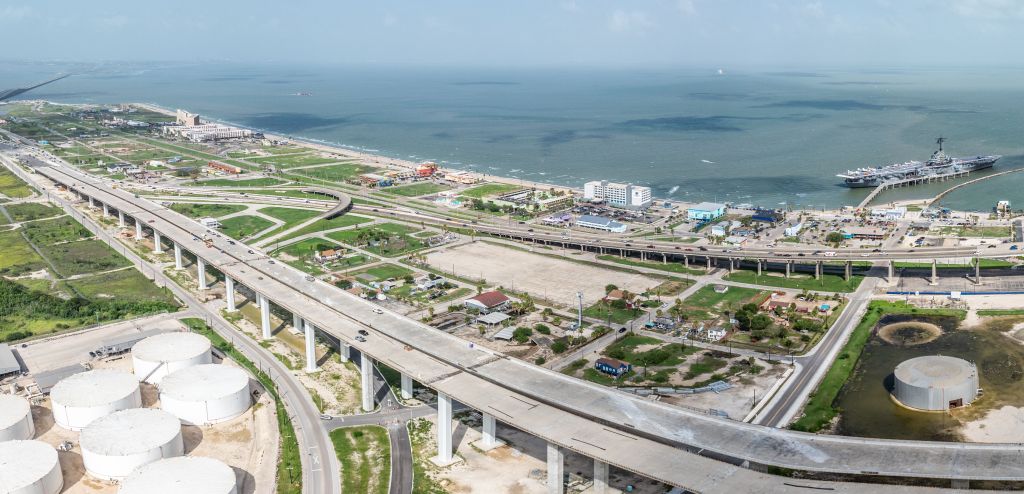
As U.S. President Donald Trump hosted Prime Minister Mark Carney and Mexico’s President Claudia Sheinbaum, energy issues loomed in the background amid U.S. concerns about structural deficits in heavy crude. Historically, Canadian barrels competed with Venezuelan heavy crude in key U.S. refining markets—primarily the U.S. Midwest and the Gulf Coast. While Venezuelan volumes have been largely absent for the past decade, shifting U.S. foreign-policy signals suggest that competition could re-emerge.

Why it matters — Trump cannot unwind two core U.S. dependencies

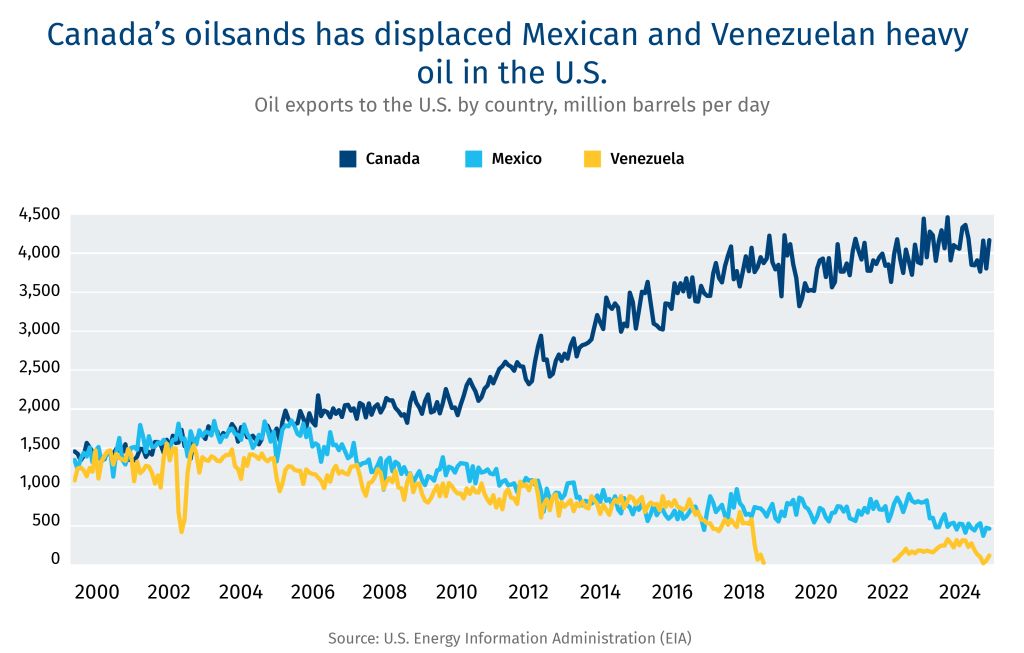
Despite efforts to reshape U.S. supply chains, Washington remains structurally dependent on two things it cannot easily substitute: Canadian heavy crude and Chinese rare earths. Heavy crude is foundational to U.S. refining capacity, and as it stands, the U.S. cannot easily replace Canadian supply: domestic production is overwhelmingly light, and heavy-crude alternatives from Mexico and Venezuela have structurally declined.

These twin constraints limit U.S. leverage and elevate the importance of stable, long-term supply partners. Alberta’s Memorandum of Understanding (MoU) arrives at a moment when U.S. policymakers must balance geopolitical objectives—such as renewed attention on Venezuela—with the reality that Canadian barrels remain irreplaceable in the refinery system.

By the numbers — the heavy-barrel shortfall

  • Mexico: U.S. bound heavy-crude exports have fallen from as high as ~1.7 mb/d in 2005-2006 to roughly ~0.40 mb/d today.

  • Venezuela: heavy-crude exports to the U.S. surpassed 1.5 mb/d in the early 2000s; today U.S. exports are ~0.1 mb/d.

  • Canada: The dominant exporter to the U.S., with around four million barrels of crude shipped south of the border daily. The Canada-Alberta MoU proposed 1 million bpd pipeline, plus 300,000–400,000 bpd from Trans Mountain together create a sizeable uplift in export capacity—primarily oriented toward Asia.
The bigger picture — if Venezuela returns, does Canada lose leverage?

A Venezuelan “return” would likely be slow, expensive and politically fragile. Refinery contracts, debt obligations and upstream infrastructure all require rebuilding. Even under a regime change, investors will demand decade-long stability before committing capital.

Mexico faces similar limits: Sheinbaum inherits state-owned Pemex’s declining production and mounting debt, meaning a rapid restoration of heavy-crude exports is unlikely.

This leaves Canada as the only credible, scalable source of heavy supply. The MoU’s accelerated timelines—carbon-pricing equivalency, methane rules and Pathways carbon capture, utilization and storage project—signal Ottawa and Edmonton are preparing for sustained output growth.

Bottom line — the MoU prepares Canada for a more competitive heavy-oil landscape

As Canada builds westward capacity through TMX and the proposed 1 million bpd pipeline, more barrels are positioned for Asia rather than the U.S. That shift inevitably forces U.S. policymakers to consider how they will secure heavy-crude supply in the coming decade—including whether to re-engage Venezuela in a more meaningful way.

For Canada, today, this is less of a challenge. The MoU ensures that, regardless of how U.S. policy evolves, producers have diversified market access and greater resilience. If Venezuelan volumes rise, Canada will have optionality; if they do not, Canada remains the primary supplier to U.S. refiners.

Either way, the middle of the next decade is shaping up to be a far more dynamic heavy-oil environment—and the MoU positions Canada to navigate it from a position of strength.

  • Canada entered the trade war in better shape than previously thought. StatsCan revised GDP for each of the past three years up by about half a point.

  • The Canadian government served automaker Stellantis a notice of default for shifting production of the Jeep Compass from Brampton, Ont., to Illinois despite receiving hundreds of millions in incentives in recent years. “Stellantis is on the hook,” said Industry Minister Mélanie Joly. “Defending these jobs means defending Canada’s economic backbone.”

  • While speaking to business leaders in Ottawa, Japan’s Ambassador to Canada Kanji Yamanouchi noted the role energy could play in future Canada-Japan relations. “If we need energy from a county which is difficult to trust or the country which we can trust,” he said, “it’s much better for us to have trade with a country with trust.”

  • Despite $500 million in government loans, Algoma Steel is laying off 1,050 workers from its plant in Sault Ste. Marie, Ont., in the face of “extraordinary and external market forces.”

The RBC Economics team did a deep dive this week: ‘Tracking the impact of U.S. tariffs on five targeted Canadian industries.’

Overall, we track moderately lower manufacturing production and employment in most of the highly tariffed sectors in Canada. These trends have also been much less volatile than international trade flow, that were heavily distorted around when tariffs were implemented (as U.S. importers front-ran purchases to build pre-tariff inventories in Q1.)

Selling prices among Canadian manufacturers have generally held up, with foreign buyers paying the bulk of initial tariff costs, but have led to declining U.S. corporate profits this year. We haven’t seen systemically higher U.S. consumer prices but still expect those will show up more significantly in 2026.

Here’s a breakdown of how five key Canadian industries have fared in their production, employment and selling prices, amid rising U.S. tariffs.

Read the full report here.

In a recent episode of DisruptorsJohn Stackhouse takes listeners to Quebec to meet former premier Jean Charest and Eric Desaulniers, founder & CEO of Nouveau Monde Graphite. Together, they explore how a new graphite mine at Matawinie and an integrated refining plant at Bécancour aim to connect the full chain from rock to anode material in one province—and what that could mean for Canada’s role as a trusted supplier of critical minerals to its G7 allies.

From China’s dominance in graphite refining to Quebec’s push for all‑electric mining fleets powered by hydro, this episode looks at how Canada can move from “quarry” to strategic partner in a re‑wired global economy.
By John Stackhouse

The much-pilloried Canada-U.S.-Mexico trade agreement was signed seven years ago this weekend—on November 30, 2018. A year later, it was amended to address rules of origin for autos, digital trade, IP, dairy and, who could forget, a sunset clause. 

We can all do the math. The December 10, 2019 amendments set in motion a 16-year term for the agreement, with a mandatory review every six years. Which means we’ll see more of a requiem than a birthday bash next week when Mark Carney is in Washington to help kick off the 2026 FIFA World Cup. 

But don’t bury CUSMA just yet.

Despite the U.S. President’s freeze on negotiations, officials from both countries are talking every day and laying the groundwork for what will be an intense 2026. Not many insiders seriously expect CUSMA to go away; they’re working on changes—modifications, enhancements, renovations, depending on your point of view—that will continue to change the fabric of continental commerce.

Here’s what’s worth noting about CUSMA and its first five years (as it didn’t come into effect until 2020):

  • Canada-U.S. trade in goods is up about 23%;

  • Canada remains the U.S.’s top customer, buying US$440 billion of goods and services in 2024, or 14% of America’s exports;

  • U.S. direct investment in Canada hit $684 billion last year, up from about $400 billion; 

  • Canadian direct investment in the U.S. has doubled to $1.3 trillion;

  • between 2020-2024, automakers announced nearly US$175 billion in new investment in North American production, as they reshored supply chains to meet those rules of origin.

  • Canada-U.S. energy and agri-food trade has also surged in the 2020s, thanks in part to the certainty delivered by CUSMA. Energy is our biggest export to the U.S. — by far — worth $170 billion in 2024, up 50% from 2018.  

That energy number may be the biggest message Carney takes to Washington. Not by coincidence, he locked arms this week with Alberta Premier Danielle Smith to state boldly to Canadians, and the world, that the country will be exporting a lot more oil to Asia. The U.S. government, and many U.S. shippers, would prefer that crude flow south. But now Carney, with Smith’s help, can exert more leverage in his Washington trade talks.

Canada always tried to keep energy (and water) off the main trade table, which is focussed more on manufacturing. But in this new age of energy security, it may be what Canada needs more than ever to bend the ball like Beckham.

  • Canada will slap 25% tariffs on about $10 billion worth of steel imports starting December 26, to support a domestic industry that has been battered by U.S. tariffs and cheap Chinese steel.

  • Canada Inc. is shrugging off tariffs. Operating profits of Canadian corporations rose 3.8% (the fastest pace of growth in two years) to $200 billion in the third quarter, according to Statistics Canada.

  • The U.S. will export a record 10.7 million tonnes (+40% YoY) of liquefied natural gas (LNG) in November, which is expected to drive down the price of gas in Asia and Europe over the winter.

  • Though relations remain chilly, Mark Carney confirmed that he spoke to Donald Trump this week—but he wouldn’t say if they talked trade. “I don’t want to over signal things…they haven’t re-engaged yet,” said Canada’s PM, who will be in Washington next week for a World Cup event alongside the U.S. President.

  • India is looking to both ramp up trade with Mexico and be spared the tariffs that President Claudia Sheinbaum plans to levy on a number of Asian countries.

In this week’s edition: The opportunities for Canada in Latin America and how Canadian exports of pulses provide valuable lessons when it comes to trade diversification

By John Stackhouse

Canada’s trade diversification menu seems to consist of East Asia and Western Europe, with a side dish of Middle Eastern and South Asian economies.

What happened to Latin America?

Sure, the prime minister and his senior team are all over Mexico — largely though as part of their North American trade strategy. The much bigger economic hemisphere south of the Rio Grande still beckons.

This week, the Canadian Council for the Americas published a significant policy paper on how Canada can position itself for the decade ahead in South America, Central America and the Caribbean. 

The region’s GDP is roughly $6 trillion, more than double Canada’s and more than double what it was 20 years ago. And yet Canadian exports in 2024 were a modest $18.6 billion, down nearly 11% that year as agri-food shipments got hammered by trade disruptions. 

Looking ahead, there are dozens of markets to consider, but just focussing on the Big Five—Brazil, Mexico, Chile, Colombia, Peru—would access a combined population of nearly 500 million people, half of them middle class.

We’ve spent the past 25 years negotiating and announcing Free Trade Agreements in Latin America. Most did much less than was promised. One illustration: we have $24 billion of investment in Chile, and less than $1 billion in exports. Now we need to be more strategic.

The CCA report suggests:

  • develop consortium approaches to infrastructure, to help fill the region’s $150 billion infrastructure gap

  • focus on energy (LNG), machinery, pipelines, digital systems, and mining technology

  • target machinery and equipment (buses, tunnelling equipment) for megaprojects

  • develop critical minerals partnerships, including processing

  • get more sophisticated with labour mobility, as we’ll need a lot more students, skilled workers, professionals and entrepreneurs from the region

  • step up as a security partner, helping with defence and security tech, including in space

An age of America First doesn’t need to mean Americas Last.

Check out the full report here.

  • Mark Carney wrapped up his visit to Abu Dhabi by announcing a $70-billion investment from the United Arab Emirates–the money is expected to go towards the development of critical minerals, energy, ports and AI.

  • U.S. Ambassador to Canada linked purchase of F-35s to trade talks. Pete Hoekstra said that Canada needs to “harmonize” with the U.S. on some key economic and military issues to get back to the negotiating table. He specifically referenced the federal government’s F-35 fighter jet review.

  • The U.S. exported more to Mexico than Canada for the first time in 30 years. New trade data showed that US$226.4 billion of American goods went to Mexico between January and August this year, compared to the US$225.6 billion worth that crossed into Canada. While the ongoing trade tensions between Canada and the U.S. is one factor, the gap has been narrowing for years.

  • The Canadian Mutual Recognition Agreement, which eliminates all barriers to trading goods (except food) between provinces and territories, was signed this week and takes effect in December. The government estimates that it could drive $200 billion worth of value.

  • The European Union is looking to Australia and considering a similar strategy to the one the U.S. has taken when it comes to critical minerals and rare earths: invest directly in the mining companies.

Services now make up nearly a quarter of Canada’s exports and have delivered 62% of total real exports growth since 2014. Services trade hold a key to diversification—they are less exposed to tariffs, more resilient to economic downturns, and are already more diversified with exports almost 50/50 split between U.S. and non-U.S. markets, compared to goods exports, 75% of which flow south of the border. (Read RBC Economics full report here).

By Lisa Ashton, Director of Agricultural Policy

Pulses, of which Canada is the number one exporter globally, is a powerful example of how Canada can deliver on its ambitions to diversify its trading partners beyond the U.S. It’s all about building the right trading relationships and investing in logistics and food-standard alignment where markets are growing.

Why it matters:

  • The 2025 federal budget outlines a plan to grow Canada’s trade with the world, including a goal to double Canada’s non-U.S. goods exports to $600 billion by 2035.

  • Specific to agri-food, the Canadian Food Inspection Agency (CFIA) is receiving funding to modernize it trade tools and work with trading partners to expand market access for Canadian agri-food products.

  • Diversification is easier said than done. The U.S. accounted for over 60% of Canada agri-food export value in 2024, making Canada the least diverse when it comes to trading partners among top agri-food exporters.

  • But Canada’s agri-food sector is staking its claim as a global leader in pulses. These pulses are destined for markets far beyond the U.S.

By the numbers:

  • Canadian pulses account for roughly 24% of global trade. For dried lentil and peas, Canada’s top markets include countries in South Asia and West Asia including India, Turkey, and the UAE as well as South America, including Columbia and Peru. Canada’s dried peas and lentils, examples of Canada’s pulses boom, export value in 2024 was nearly $4 billion.

  • The EU and Indo-Pacific are expected to increase annual consumption by 11% and 14%, respectively, over the next decade, providing growing market opportunities in Canada’s target markets identified in Budget 2025. 

  • To meet global demand, Canada’s pea and lentil production volumes have increased by roughly 73% and 393%, respectively, over the past 25 years. Pulses are an important crop in a farmers’ rotation, fixing nitrogen in soils, reducing the need for fertilizer application.

The bigger picture:

  • Global pulse consumption is expected to rise by 15% over the next decade.

  • Global production is led by Asia and Africa with annual growth in product at roughly 3%. India is the single largest producer accounting for 29% of global production with most of their production being used for domestic consumption. 

  • China is the largest importer of pulses, accounting for about 13% of global trade.

  • The U.S., Turkey and Ukraine follow Canada in exports of dried peas. But Canada, maintains a strong lead, exporting volumes that are 5 times that of the U.S.

Bottomline:

Canada’s approach to diversifying goods exports to non-U.S. markets can learn from the Canadian pulse experience of expanded domestic production, efficiently navigating international trade logistics, and diversification in growth markets where demand is expected to continue to rise. 

References: OECD-FAO: OECD-FAO Agricultural Outlook, 2025; OECD. OECD Agriculture statistics (database), 2025; UN COMTRADE. Trade Data, 2025.

In this week’s edition: North America’s Critical Minerals Moment — and Canada’s Strategic Role

By John Stackhouse

A few years ago, Saudi Arabia and Canada were barely on speaking terms. Now they’re exploring trade deals, investment opportunities and, if plans come together, a visit to the Kingdom next year by Mark Carney.

In the Age of Trump, they’re among a host of mid-sized powers that are looking to carve out a new economic and geopolitical path.

Here’s what could redefine the Saudi-Canadian relationship: energy, including renewables, nuclear and EVs; advanced manufacturing, including drones and satellites; AI and quantum; mining and critical minerals; and advanced education and health care. The two countries also have a lot of capital to deploy, and a lot of capital that they need.

The rapidly evolving relationship was on display earlier this month when Saudi Investment Minister Khalid Al-Falih spent a day in Ottawa, with Carney and a range of senior ministers, and then a day on Bay Street. Less noticed but also important was Alberta Premier. Danielle Smith’s visit to the region, including Saudi Arabia, to promote energy technology and investment.

Here’s some of what may be worth watching in the coming months:

  • Carney’s pitch for $1 trillion+ in new investment (most of it private capital) will need to include sources like Saudi investment funds and corporates;

  • Saudi’s ambitions to diversify its energy sector—Al-Falih mentioned green and blue hydrogen, green ammonia and EVs—could use a lot more Canadian technology, talent and investment. The visiting Saudis met with Ontario autoparts makers, hoping they might want to be part of the Saudi ambition to make 600,000 EVs a year;

  • Canadian manufacturers and producers, especially in agri-food, can be leading players in Saudi’s ambition to be a food hub for the Middle East and North Africa.

  • Ottawa is hoping to restart trade talks with India under a “new process,” said Canadian Trade Minister Maninder Sidhu. On a three-day visit to India, the Minister discussed critical minerals, clean energy, agriculture and artificial intelligence.

  • In an effort to lower grocery bills, U.S. President Donald Trump is working lower tariffs on items like coffee and bananas into deals with a handful of Latin American countries. 

  • The price of pasta from Italy, however, could skyrocket for Americans come January when the proposed 107% tariff on goods from 13 Italian companies is scheduled to begin.

  • Canada’s forestry industry is planning to re-route about 10% of wood (enough to build 75,000 homes) that would normally go to the U.S. to the UK and Europe.

  • Amazon and Microsoft threw their support behind the Gain AI Act, legislation that would require chip makers to satisfy U.S. demand before exporting to other countries, including China. Nvidia, which has been seeking access to the world’s second largest economy, view the act as an unnecessary intervention.

By Shaz Merwat, Director of Energy Policy

A recent submission to U.S. Trade Representative Jamieson Greer from the Coalition for North American Trade (CNAT)—co-chaired by former U.S. House Ways and Means Chairman Kevin Brady, Canada’s former NAFTA lead negotiator Steve Verheul, and Mexico’s Ken Ramos—positions CUSMA as one of the continent’s most powerful tools for rebuilding critical-minerals security.

Key details from the filing:

  • The U.S. remains 100 percent import-reliant for 16 critical minerals (including graphite) and over 50 percent reliant for another 29 such as rare earths, zinc, cobalt, and nickel.

  • Canada is the U.S.’s primary import source for indium, nickel, potash, tellurium, uranium, vanadium, and zinc—and the second largest for copper, graphite, niobium, and tungsten.

The CNAT submission argues the CUSMA’s tariff-free architecture and co-production model are the ideal platform to accelerate re- and near-shoring of critical-minerals supply chains—from exploration and permitting to processing, refining, and battery-grade materials. Integrating Canada’s resource base with U.S. manufacturing strength and Mexico’s processing capacity fills a gap in critical-minerals collaboration to date, with most of the focus on G7+ allies.

For Canada, the strategic opening lies in deepening trilateral integration—leveraging CUSMA to attract investment, expand value-added processing, and align upstream resources with the broader North American production system to build a fully regional critical-minerals platform.

By Shaz Merwat, Director, Energy Policy

Ottawa’s trade diversification push, laid out in part in the Federal Budget this week, could redraw North America’s energy map—and test its most important economic relationship.

Why it matters

  • The 2025 federal budget sets an explicit goal: double Canada’s non-U.S. goods exports to about $600 billion by 2035.

  • Mark Carney’s ASEAN tour last week reinforced that ambition, courting Asian partners and positioning Canada’s growth story squarely in the East.

  • Together, these moves turn oil and growing LNG exports into instruments of economic diversification and strengthening multilateralism within trade.

  • A removal of the oil and gas emissions cap opens the door to greater oil exports to Asia.

By the numbers

  • Roughly 75% of Canada’s exports flow to the United States.

  • In 2024, Canadian energy exports totaled $197 billion, with crude oil alone accounting for $147 billion.

  • About 91% of Canada’s crude exports remained U.S.-bound through the first seven months of 2025. Canada’s remaining crude exports–about 450,000 barrels a day, about 1% of Asian demand–ends up in Asia.

  • Asia’s oil-import demand i.e., India, China, Japan, and South Korea has climbed by more than 25% since 2015 to about 22 mb/d, driven primarily by China and India’s rapid industrial growth.

The bigger picture

  • Heavy crude’s staying power: Electrification is largely displacing gasoline – a light barrel – but not diesel, jet fuel or petrochemical feedstocks. That longevity gives heavy barrels strategic value.

  • Asia’s heavy-oil hub: China is sharply pivoting into petrochemicals, aiming to take Japanese and Korean market share. India, too, is expected to see oil imports grow 1.5 million bpd by 2035 as both countries seek steady supplies of heavy and sour crude. Today, that supply originates from the Middle East, Russia and Venezuela, creating an opening for a stable, Western entrant.

  • Investment and offtake matter: Canada’s oil expansion will come from oil sands growth. Long-term commitments–both investment and offtake – will be essential to anchor any future West Coast capacity. With CNOOC, Sinopec and PetroChina already in Canada, and better ties with India envisioned, how would renewed Asian capital be welcomed in Ottawa…and Washington?

  • Carbon and shipping constraints: Industrial carbon pricing, expectations for progress on progression on the Pathways carbon capture and storage project, a federal Tanker Ban and tighter International Maritime Organization (IMO) shipping regulations all hang in the balance, unanswered.

Bottom line

Canada’s bid to expand exports through a multilateral trade system could sit awkwardly beside Washington’s more bilateral instincts. For decades, U.S. policy has treated Canadian energy as a secure extension of its own supply chain. As Ottawa builds eastward links and asserts greater agency in global oil markets, it’s not only testing the flexibility of the North American partnership—it’s testing whether America will allow that independence to take shape.

  • The Liberal government’s federal budget earmarked billions of dollars in funding in response to the Trump Administration’s tariffs.

    • As part of the shift from “reliance to resilience,” the budget pledged $5 billion over seven years to create the Trade Diversification Corridors Fund.

    • And an additional billion dollars for an Arctic Infrastructure Fund with a stated goal, in part, of linking the Canada’s North to global markets.

    • The introduction of a $2 billion critical minerals sovereign fund, that would make equity investments, loan guarantees and offtake agreements with mining companies.

  • The Supreme Court case pertaining to President Trump’s use of the International Emergency Economic Powers Act to impose tariffs, including the fentanyl tariffs on Canada, kicked off. Even members on the bench from the conservative majority questioned the U.S. President unilaterally setting tariffs on imports. A decision is likely months away.

  • By approving measures to protect farmers, the European Union moved a step closer to the Mercosur trade deal, a massive agreement with South American nations that’s been a quarter century in the making.

  • Despite pressure from U.S. tariffs, Ontario projected a smaller deficit than expected in its fiscal update. The economic statement also promised a balancing of the books in 2027-28.

  • The U.S. Department of the Interior added silver and copper to its list of critical minerals paving the way for both to be included in future tariff policies.

“The U.S. footprint in global trade will be smaller. The world needs to adjust to that. It will be a bigger adjustment for us.”
Bank of Canada Governor Tiff Macklem, speaking at The Logic’s Summit this week.

In this week’s edition: Lots of trade talk on the sidelines of the Asia Pacific Economic Cooperation summit and a generational investment in Canada’s competitiveness

By John Stackhouse

This week’s federal budget will aim to reorient Canada’s economy for a new global economic order, and that goes well beyond Donald Trump. 

The Canadian economy has been out of step with global trading and investment patterns for some time. Trump just shone a light on it. 

Consider trade itself. Global trade as a percentage of GDP reached a post-war peak of about 60%, coinciding with the Global Financial Crisis (itself an outcome of trade and investment imbalances). It’s since dropped to the mid-50s, and will likely come down a touch this year and next as the global economy slows. 

This doesn’t mean an end to globalization. It does indicate a re-globalization that—cue the budget signals—will lead to significant capital shifts. And they will be perhaps more significant than anything we’ve seen in 25 years, since China entered the WTO and became the new magnetic pole for global capital. 

This time, capital won’t flow to the lowest cost, mass producer. It will find the sources of strategic goods and resources, which would play well to the new Canadian pitch. Especially for energy, minerals, defence, space and food. 

Those strategic exports will be especially valuable to some of Canada’s key trading partners like South Korea and Germany, as they seek to reduce reliance on the U.S. and China. Moreover, big exporters like the Koreans and Germans will need more secure energy supplies if they’re going to be ready for a world of more modest trade in manufactured goods. 

I spoke about this new energy security paradigm last week at an IEA energy innovation forum, on the sidelines of the G7 energy ministers meeting in Toronto. You can read the full text here.

  • Prime Minister Mark Carney’s meeting with China’s President Xi Jinping this past Friday didn’t yield any major results but it was the first formal meeting between a Canadian Prime Minister and the Chinese President since 2017. Carney, who described it as a “turning point” for the two countries, also accepted XI’s invitation to visit China.   

  • Wanting more info on the state of Canada-U.S. relations, several Canadian Premiers are calling on Carney to host a First Ministers’ meeting. The last time the PM met with the premiers was August 6. 

  • A couple of days after U.S. President Donald Trump vowed he wouldn’t talk with Carney for some time, the two were placed directly across from one another during an eight-person dinner hosted by South Korea’s President. The PMO wouldn’t confirm if trade talk was on the menu but did say the World Series was a topic of conversation.

  • On Friday, Trump doubled down on his promise to not engage Canada in trade talks; which differed from the message sent from his Energy Secretary Chris Wright, who, while at the G7 Energy and Environment Ministers’ meeting, said the goal is for the two countries to get back to the table and cooperate more closely on oil, gas and critical minerals.

  • While it didn’t lead to a finalized trade deal, the meeting between Donald Trump and China’s Xi Jinping resulted in agreements on a few key items–including export controls on rare earths and chips.

  • The truce came on same day China’s factory activity numbers revealed its longest decline in nine years.

Canada’s prosperity depends heavily on how efficiently it can move goods to market—yet its largest ports have fallen behind the world’s best.

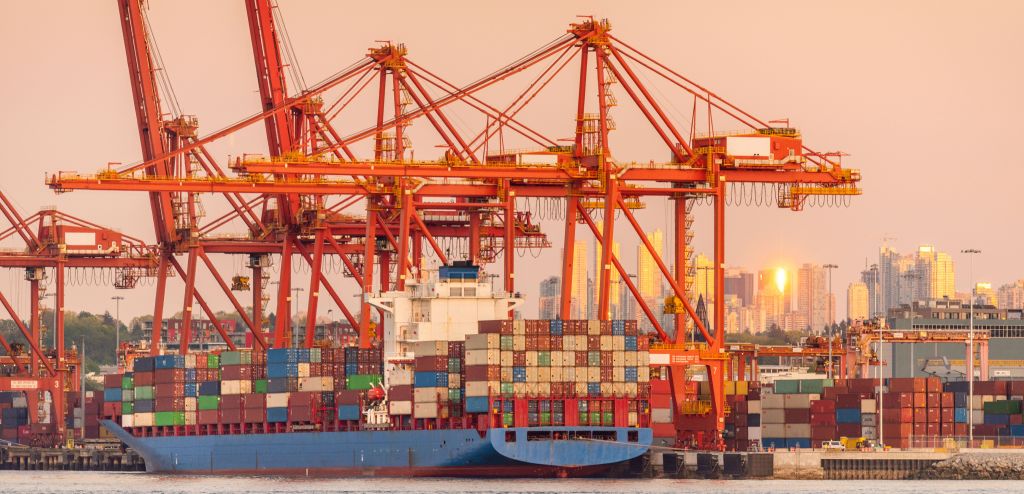
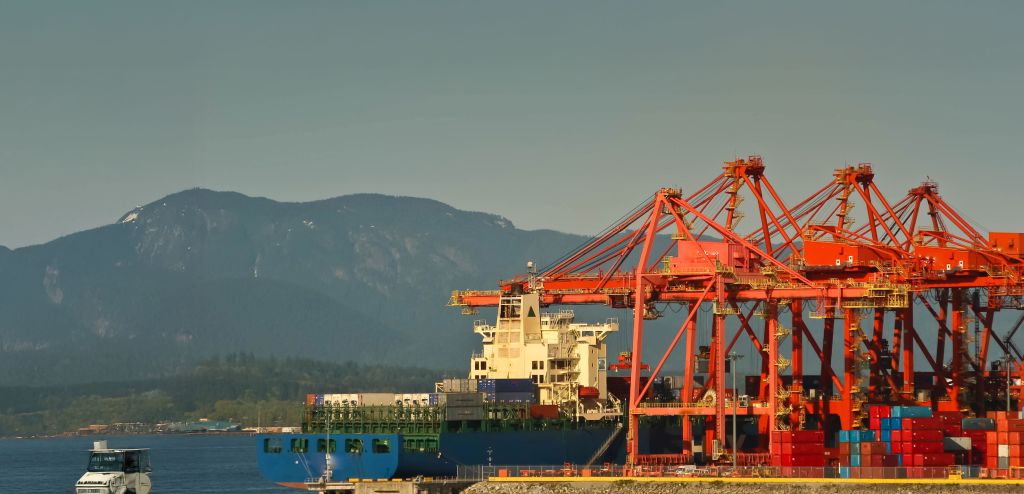
In the latest episode of Disruptors: The Canada Project, John Stackhouse spoke with Devan Fitch, Program Manager of the Roberts Bank Terminal 2. The long-planned project, at the mouth of Fraser River Delta, represents a generational investment in Canada’s competitiveness.

Here’s an excerpt from this week’s episode:

JS: Most Canadians probably take the Port of Vancouver for granted, even though if you look around, at least some of the stuff in your life passed through this port. Give us a sense, Devin, of the magnitude of the Port of Vancouver and what it means to the Canadian economy.

DF: If you take out of the equation all of the trade that we do with the U.S. and you think about the trade that we do with the rest of the world, $1 in every $3 of trade passes through the Port of Vancouver. That’s supporting businesses right across Canada. Consumers right across Canada. We happen to be located in Vancouver, but we are very much Canada’s port.

JS: As I understand it, the Port of Vancouver is the size, nearly, of the next five biggest ports in the country.

DF: That’s correct.

JS: And Roberts Bank will enable it to grow by another 30%. Is that correct?

DF: Yeah, somewhere between 20 and 30%.

JS: What does 30% bigger actually mean?

DF: In one fell swoop, it will increase capacity on the west coast of Canada by approximately one third. It will add 135 hectares of new waterfront trade enabling industrial land in one of the most industrial land constrained regions of North America. To give you a sense of scale of T2 – 12-million cubic metres of sand and 4-million cubic meters of manufactured rock. On the sand side, that’s about 2,500 Olympic sized swimming pools.

JS: Sounds enormous, but how does it compare to the world’s mega ports?

DF: It’s big for Canada. It is modest in size and scale compared to some of the largest ports around the world in Asia and Europe. But certainly a step function increase for Canada. It will provide capacity to move a $100 billion worth of trade goods every single year and support over 17,000 supply chain jobs across the nation.

JS: Give us a sense of how the port business is transforming and what opportunities there may be for Canada to move up in the competition leagues.

DF: Right now the world’s biggest container ships are about 24,000 twenty-foot equivalent units (TEUs). They’re applying their trade from Asia to Europe, and we see shipping lines cascading those large ships onto the North American routes as they age. We’re expecting as we move forward to see a significant increase in the size of ships, calling at the Port of Vancouver. Right now the average size is around 10,000 TEUs and we’re building Roberts Bank Terminal 2 to futureproof it to be able to accommodate ships as large as 24,000 TEUs.

Listen to the full episode here.


In this special season of Disruptors: The Canada Project, we’re crisscrossing the country and speaking to visionary leaders who are harnessing technology to take on Canada’s most-urgent challenges. Listen and subscribe wherever you get your podcasts.

On the eve of Canada hosting the G7 Energy and Environment Ministers’ meeting in Toronto, John Stackhouse, Senior Vice President, Office of the CEO, RBC, delivered a keynote at the IEA Energy Innovation Forum 2025. He focused on three forces redefining how the world operates.  


As you all know, we live in a new era of urgency, in which ambitions are growing and horizons shrinking.

  • It took 15 years for the semiconductor to change the world

  • It took 5 years for the Internet to change the world

  • And it’s taken barely 15 months for Generative AI to change entire landscapes

I was reminded of these new forces of compression during a visit to Silicon Valley last week where a few major tech CEOs said the same thing: “Long term is now six months.”

Yes, we live in a time of unprecedented change and unprecedented compression. And we live in a world that’s being restructured, in our view, by three defining forces. These forces are converging to redefine how nations, markets and societies operate—and they are all connected by energy security.

The first mega force of the 2020s will not surprise any of you. It’s frontier technology

Roughly 45% of the S&P 500 today is comprised of AI Hyperscaler stocks. These hyperscalers are spending more than half a trillion dollars a year, collectively, and that’s rising. For 2025-2027, that could mean $1.5 trillion.

It’s a huge concentration of capital that towers over what now seems like a distant memory: the big capital swings that the U.S. Inflation Reduction Act unleashed just five years ago.

Energy is essential to that growth, as you don’t scale—let alone hyperscale—without a new quantum of energy. And it needs to be secure energy.

The second mega force are the growing geopolitical divisions over trade.

Global trade as a percentage of GDP grew steadily following the Second World War from 10% to reach roughly 60% at the onset of the Great Financial Crisis. It has since plateaued in the mid-50s. This likely falls further next year, with trade volumes expected to increase a meager 0.5% in 2026, much slower than global GDP growth of 2.6%.

We don’t see an end to globalization, but this new age of re-globalization will lead to further capital shifts and energy innovation, just as we saw a quarter century ago when China joined the WTO.

Why? Countries trading less will inherently need more of their own energy, or at least energy from a smaller range of suppliers. Bring on the innovation.

Third, we’ve entered a new security paradigm in which defence—including space—will make major claims on both public and private capital in this more fractured, uncertain and conflictual world. Increased defence and security needs are top of mind for most of our governments. And, as you all know, defence supremacy requires energy.

NATO countries are targeting spending on defence and security to be 5% of GDP by 2035. That’s an annual spend of $2 trillion–and this in rapidly aging societies that may have less productive capacity and greater social need.

This trio of global shifts—in technology, trade and security—will require capital and demand innovation. Critically, these forces point to a clear global need: low-cost, accessible, reliable energy.

You don’t have security in the 2020s without data, critical minerals and energy. Every major advancement in AI will rely on enormous computing power. By 2035, global data center power demand is expected to reach 1,600 TWh, that equals the current power needs of Germany, the UK and France.

Just this week, the U.S. government announced a massive partnership with Brookfield Asset Management, Cameco and Westinghouse Electric, to accelerate the deployment of nuclear power—in part because of America’s ambition of AI supremacy.

Nations and companies that secure abundant and ideally low-carbon power will own the digital future. I stress low-carbon power because renewables are still the cheapest form of electricity generation. Low-carbon power because nuclear is the most energy dense, and increasingly adaptable with the advent of SMRs. Low-carbon power because Big Tech remains committed to procuring affordable, reliable and clean over the medium to longer term. For the G7, low-carbon power can be a competitive advantage and key to a security agenda.

Nations that master the ability to generate, store and distribute these diverse power sources, locally, will also reduce security vulnerability. From drones, sensors and cyber defence–modern militaries are increasingly electrified and digitized. And in an economic environment that can feel more like a battlefield than a marketplace, energy self-sufficiency will reduce exposure to price shocks and geopolitical pressure. Nations that master next generation energy technologies—think large-scale battery storage, or carbon removal and storage—will govern the industries of the future.

This competition for those industries may be won by those that have secure, affordable access to data, energy, and critical minerals. And that competition will be shaped by the two great techno-powers, the U.S. and China. As I mentioned earlier, the new security imperative depends on three inputs—AI, energy and critical minerals. The U.S. has two of these three. China is well on its way to having three out of three. Through collaboration, the G7+ can have an overwhelming security of all three. But we need to be faster, faster and faster. Back to that Silicon Valley ethos of time.

For energy, faster means removing frictions in key inputs traded across our nations. And faster means removing our own internal frictions. Across the developed world, it simply takes too long to build major projects. We have not found a way to disrupt NIMBYISM.

If we do, removing these frictions can quicken development, reduce uncertainty, improve economics and unlock capital to move in both speed and scale. Faster, faster and faster.

This is what is needed to keep pace with the speed in which our energy systems are transforming. Systems that used to evolve over decades now need to reinvent themselves in just a few years.

Energy efficiency–the “first fuel”—has slowed in the past decade. Grid modernization, renewable integration and EV infrastructure must scale faster than any energy transformation in history. Supply chains for lithium, nickel and rare earths are being rebuilt in real time to reduce our dependence on China.

A collaborative approach to responsible resource development across the G7 could be streamlined, with common regulations, standards and financing to mobilize cross-border flows. But let’s not fool ourselves, retooling energy systems at breakneck speed is not cheap. Ten years ago, the economic conditions were, frankly, more accommodating.

  • Low-cost capital

  • More fiscal capacity for subsidies

  • More aligned policy support and favourable market conditions

All those made clean energy projects financially attractive and relatively low risk. Today, higher long-term interest rates, trade frictions, and inflationary supply chain pressures have made the same investment environment more challenging.

And that presents a dilemma. Sustainable energy investments for all of the above could require $2 trillion per year—globally. And that is at the heart of our collective energy innovation challenge. Venture Capital and Private Equity are needed to drive innovation and new technologies to proof of concept. But we’ve reached a point where demonstration projects are too expensive for traditional venture capital and too risky for mainstream capital. This is challenge known as the ‘missing middle’ of capital.

Yet this challenge, is an opportunity. While China has become a global trading nation and clean tech leader, the G7 still dominates capital flows. G7 currencies account for 85% of global foreign exchange volume and dominate the $12.3 trillion in global currency reserves. And a lot of that capital—public and private—is flowing toward these opportunities around security.

Just think of how much has changed in the past six months—a.k.a. the new long term.

First, governments are now investors. We’ve seen the Pentagon create what’s essentially a private equity arm–a firm signal that governments will take more active roles as procurers, capital allocators and resource captors to ensure their economic prosperity and energy and resource security.  The Canadian government is standing up a new Defence Investment Agency with similar ambitions and will likely be using key financing arms to direct more venture capital to defence, space and other strategic security needs.

Secondly, we’re seeing much more assertive and strategic approaches to procurement, including indications from some key allies to create strategic reserves of critical minerals, secure supply chains for energy infrastructure and strategic offtake agreements.

Thirdly, we have seen nations explore new ways to use their collective balance sheets. Here’s one example: RBC is one of 10 global banks that is helping to stand up a new entity called the Defense, Security and Resilience Bank, to facilitate capital expenditures across the defense industry–some of which could conceivably be earmarked for energy and mineral development.

This is all part of a new chapter of what some might call state capitalism—or at least the economically activist state. This will be important for the G7+ and others to, at least, monitor, if not coordinate. Especially in terms of how markets across our countries can align and connect to facilitate new capital flows to these growing strategic imperatives.

Governments can also bridge market failures specific to regulatory uncertainties, demand and financing of first-of-a-kind projects. They can procure, finance and invest.

For example, U.S. Defense Procurement Act Title 3 allows for funding of critical minerals. Here in Canada, public entities like the Canada Infrastructure Bank and Canada Growth Fund can be used to help build out the dual use infrastructure of energy, minerals and defence.

The same opportunity exists for business development banks and export finance agencies across the G7+, to help underwrite the risks of new energy ventures as part of a bigger security strategy. It’s these new approaches to finance—ideally through public and private sector cooperation—that can unleash new waves of capital for this new imperative of energy security.

And do it with Silicon Valley speed.

Consider this: In 2022, climate tech private equity and venture capital outraised defense tech at a scale of 7:1. In 2025, the two are essentially even. I think we can all guess how 2026 is shaping up.

For emerging climate tech ventures, tapping into this new paradigm of defence and security capital may be key to the next few years of global innovation. There isn’t time to wait to see how it plays out. Technology is moving fast. Geopolitics are shifting. And a new map of global security is taking shape. Energy and critical minerals will be the ink on that map, and the G7—and the innovators in this room—have the chance to help draw it.

In this edition: AI investments are partially masking the impact of the trade war on global growth – but Canada is missing out

By Jordan Brennan, Head of RBC Thought Leadership

The U.S.-Canada auto story just took another hit – or two.

On the tails of the Stellantis decision to move production of its Jeep Compass from Brampton to Illinois, this past week’s news is compounding:

  • General Motors announced it will end production of its BrightDrop electric delivery vans at the CAMI plant in Ingersoll, affecting 1,000+ jobs.

  • Paccar is laying off 300 workers at its plant in Sainte-Thérèse, Quebec ahead of U.S. heavy-truck tariffs.

What’s going on? You could interpret these shifts as proof that Trump’s “re-patriation” strategy is working. But dig deeper: both plants were already facing weakness. CAMI had encountered soft demand for BrightDrop vans; Paccar is turbo-exposed to U.S. heavy-truck demand and tariff risk. Brampton had a litany of problems over the years, including softening EV sales.

Where does this leave Canada? Our auto industry sits between two storms:

  • China is going all in on EVs—nearly half of all new car sales last year were electric.

  • The U.S. and EU EV market are stalling or retrenching—EV penetration in Europe fell to ~21% in 2024 from ~22% the year before.

  • The U.S. sits at just 10%. And that was before Trump’s One Big Beautiful bill shredded EV incentives.

This makes Prime Minister Mark Carney’s pending climate strategy even more consequential. Canada has three broad options:

  • Align with the U.S.: back off EVs and count on gas guzzlers to propel the industry forward.

  • Follow China: invest aggressively in next-gen batteries and hope EVs are the future.

  • Carve a middle path: incentivize hybrid adoption while infrastructure and consumer preferences catch up.

  • A 60-second ad, sponsored by the Ontario government and featuring former U.S. President Ronald Reagan disparaging the use of tariffs, prompted President Donald Trump to immediately cancel all trade talks with Canada. Premier Doug Ford’s government agreed to take the campaign off the air on Monday. But saying it wasn’t quick enough, Trump threatened an additional 10% tariff hike on Canadian goods.

  • Over the next 10 years, Prime Minister Mark Carney wants to double Canada’s exports to markets outside the U.S., boosting trade by $300 billion.

  • India invited Carney to New Delhi to meet with Prime Minister Narendra Modi. According to India’s new High Commissioner, a comprehensive free trade partnership between the two countries could result in $50-billion worth of trade annually, about double last year’s total.

  • An import ban on liquefied natural gas from Russia is part of a new package of sanctions agreed upon by the European Union countries..

  • President Trump will meet with his Chinese counterpart Xi Jinping next Thursday during the Asia-Pacific Economic Cooperation summit. This will mark the first meeting of the two since the U.S. President’s re-election.

By Farhad Panahov, Economist

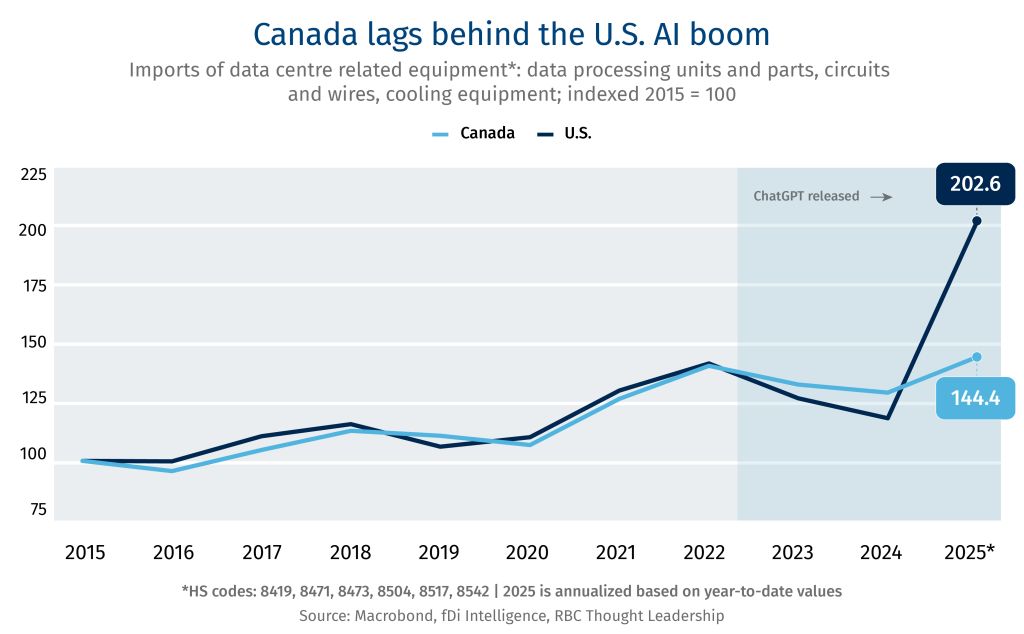
AI-related investments may have masked the impact of the U.S. trade war on global growth so far, the IMF notes in the latest World Economic Outlook. Since the release of ChatGPT in late 2022, U.S. firms have quadrupled data-centre construction spending to nearly US$40 billion. There are now 5,000 data centres dotted across the U.S. Imports of data centre related equipment is up 50% over the same period. Taiwan accounted for half of the growth when it comes to U.S. imports of digital processing units. Canada, as the chart below indicates, has remained on the sidelines of the AI boom despite a growing number of data centre applications. Demand for related equipment has shown only a small uptick in recent years.

By Lisa Ashton, Director of Agriculture Policy

Canada’s agriculture equipment manufacturing industry is caught up in the U.S. tariff blitz.

The industry, which generates $7 billion in annual revenues (more than double from a decade ago), plays a critical role in North America’s food production, providing farmers with the equipment to plant seeds, harvest crops, feed animals, milk cows, and operate an efficient farm business.1

The U.S. market dominates exports, accounting for 82% in 2024, which has so far remained unchanged in 2025.2 But there’s a shift under way. The tariffs have benefitted the domestic industry in some cases by raising domestic demand of Canadian-made products and reducing some input prices, including Canadian steel.3 But the industry is also facing risks of rising costs to produce equipment that has parts from both sides of the border. Manufacturers are wadding through compliance complexity, with U.S. tariffs on some parts such as tractor brakes and Canada’s counter tariffs on parts such as tractor tires.4 For farmers, this means potentially higher input costs for new equipment and parts to repair their existing equipment—forcing decisions on investments that impact agricultural productivity. The shifts come as the industry has already seen a growing trade deficit since 2020, more than doubling in size in 2024.5

Manufacturers are setting their eyes on new growth markets, while maintaining relationships with their U.S. customers and supply chain. A renewed commitment in 2025 to the Canada and Mercosur free trade agreement negotiations offers promise for Canadian agricultural manufacturers to expand their presence in Argentina, Bolivia, Brazil, Paraguay and Uruguay, where agriculture production is expanding, and on-farm mechanization is exponentially improving.

In this week’s edition: Is Stellantis the first domino to fall? And how Canada can strengthen its role in an REE-bifurcated world.

Is this the end of the auto pact?

By Jordan Brennan, RBC’s Head of Thought Leadership

Frustration is building in Canada’s auto sector. And concern.

Less than one week after U.S. Secretary of Commerce Howard Lutnick told a Canadian audience that “car assembly is going to be in America and there is nothing Canada can do about it,” Stellantis announced it will shift planned Jeep Compass production from Brampton to Belvidere, Illinois.

This looks like the fruits of America’s trade strategy, which aims to re-industrialize America through re-patriation of manufacturing capacity.

The fear: Stellantis is the first of many dominos to fall. 

Canada’s original managed trade in autos—the 1965 Auto Pact—tied duty-free access to production and value-added commitments in Canada, catalyzing continental supply-chain integration and shifting Canada from many low-volume domestic models to fewer, high volume North American models.

Today, Canada exports roughly nine-in-ten Canadian-made vehicles to the U.S. In any ordinary business, reliance on a single customer would be intolerable. But it appeared tenable through the Auto Pact and NAFTA eras. Today’s push to re-patriate Canadian auto jobs is a reversal of the 1965 logic. And it reminds us about our dangerous concentration risk.

In the face of the trade turmoil, Prime Minister Carney has pursued a strategy of patient diplomacy. What are Canada’s options if that doesn’t work?

The U.S. assembles 10-11 million vehicles annually, most of which are sold within the domestic market. Some 15% of American-made vehicles are exported. And in any given year, one-third of those exports are shipped to Canada, making us the largest export market. Closing the door on American imports would hit a channel equal to 7-10% of annual U.S. production.

Then there is the China angle. Beijing slapped a 75% provisional duty on Canadian canola in August. China’s ambassador has since proposed reciprocity—lifting canola and pork tariffs if Ottawa removes its 100% tariff on Chinese EV’s. Premiers Scott Moe and Wab Kinew have urged Ottawa to explore the proposal, which would intensify competition with Tesla, for example.

Other options include sectoral deals with Germany, Japan and South Korea. Think LNG offtake for defence procurement commitments—with auto-assembly mandates as part of the package negotiations.

While none of these options are great, Canada has leverage—as America’s top auto export market and a deeply integrated supplier base. This only works if used surgically. America’s real economic competition and strategic threat comes from China, not Canada. A grand bargain that locks in North American capacity and predictable market access remains the cleanest outcome. 

  • The Keystone XL pipeline is back in the conversation. This time at the negotiating table during the ongoing trade talks in Washington between the U.S. and Canada.

  • Setting a “new roadmap” for Canada-India relations. Foreign Affairs Minister Anita Anand met Indian Prime Minister Narendra Modi after a two-year diplomatic rift.

  • Canadian manufacturing sales fell 1% in August, while wholesale receipts dropped 1.2%, underscoring the impact of U.S. tariffs on key trade-exposed sectors.

  • Canada added 28,000 new manufacturing jobs in September—the increase was concentrated in Ontario and Alberta and partly offset the 58,000 manufacturing jobs lost between January and August.

  • Ikea responds to Trump’s new furniture tariffs with plans to boost U.S. production. Currently, only 15% of what the Swedish home furnishing giant sells in the U.S. is made there.

By Vivan Sorab, RBC Thought Leadership’s Senior Manager of Clean Energy

As China escalates its Rare Earth Element (REE) advantage over the United States with enhanced export controls that could have widespread impact on critical defense and semiconductor supply chains, Canada must strengthen its role in the REE supply chain.

The challenge? Canada has the resources, the capital, and the intellectual property to start building a supply chain but needs to mobilize at speed.

Funding: The tools to build a REE supply chain exist. Canada classifies REEs among its priority 6 critical minerals (alongside lithium, graphite, nickel, cobalt, and copper) to receive funding under a $1.5 billion carveout from the Strategic Response Fund. While funding has flowed for REE mining (e.g., commitments to REE projects in Labrador), Canada must accelerate deployment to processing and manufacturing of key REE-based products like magnets.

Guarantee Demand: U.S. government-backed price floors and offtake agreements for REE products are helping make REE projects more attractive to the private sector. Similar approaches in Canada could help step up a domestic supply chain.

Build Domestic Processing Capability: Canada has REE intellectual property on home soil. Kingston-based Cyclic Materials, a REE magnet recycler, is building a $25 million Centre of Excellence and is partnering with France-based Solvay to supply recycled REE oxides for further processing. By growing processing capabilities at home, Canada can strengthen its position.

By Jordan Brennan, Head of RBC Thought Leadership

There was a volley of compliments, smiles and backslaps between Donald Trump and Mark Carney during their meeting earlier this week, with the U.S. President telling reporters that Canada was going to walk away “very happy.” But optimism had come crashing down by the next day, with the U.S. Commerce Secretary Howard Lutnick telling a Toronto audience that “car assembly is going to be in America and there is nothing Canada can do about it.”

The view from the White House is that Americans don’t need Canada to assemble their cars. It’s difficult to know what to make of Secretary Lutnick’s remarks. Is it a genuine threat or “art of the deal” bravado in which Trump asks for the sun, the moon and the stars and ends up settling for the moon? Word on the street is that President Trump doesn’t like being told “America needs Canadian oil, steel, lumber” and so on.

A Canadian trade team remains in Washington to chase sectoral deals on steel, aluminum, energy and autos—a hallmark of what Washington now calls “managed trade.” With little material progress to date, and an American negotiating team that’s bogged down in bilateral deals with many other countries, it’s an open question if Canada will be able to secure meaningful sectoral agreements prior to the formal review of CUSMA next July.

It looks like “managed trade” is here to stay for now. But what does that mean?

In June, Trump doubled tariffs on Canadian steel and aluminum to 50%, up from the 25% rate announced in February. The impact was immediate. Canada produces roughly 13 million tonnes of primary steel annually, exporting half—and nine out of every ten tonnes goes to the U.S. Those flows are now drying up.

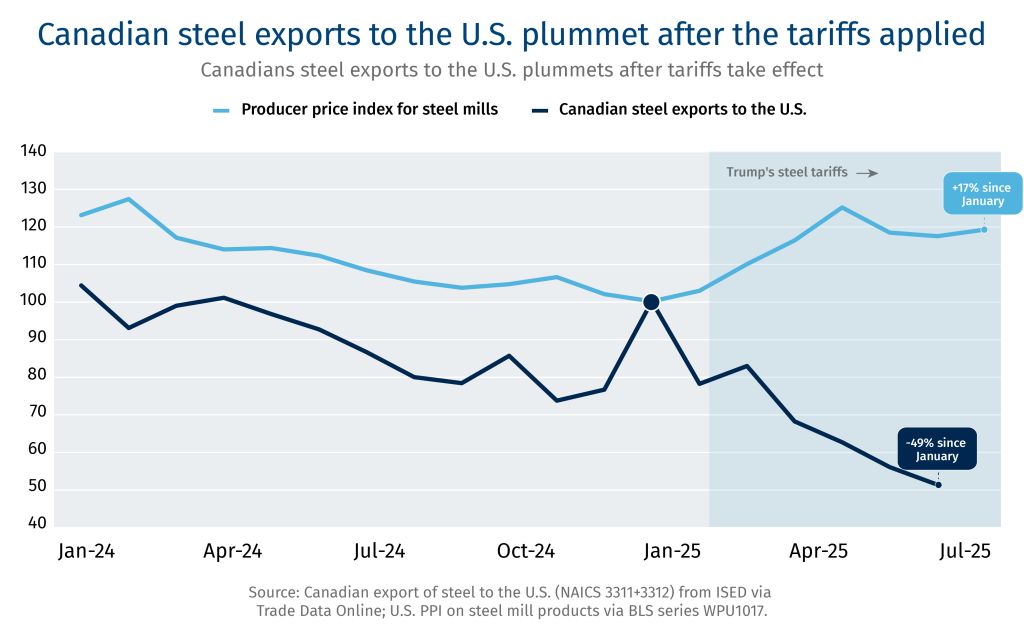
Steel prices tell the story. The chart below shows the value of Canadian steel exports to the U.S. and U.S. steel prices, both indexed to 100 in January 2025 to simplify the comparison. In the 12 months leading up to Trump’s tariffs, Canada’s steel exports to the U.S. and American steel prices both trended downward. Then came the trade war and the two series diverged—Canadian steel exports fell off a cliff while American steel prices marched north.

The new tariffs have reignited steel price inflation. With Canadian imports throttled, American producers are facing less competition and are quietly raising prices. U.S. steel imports from Canada are down 49% while steel prices are up 17% since January.

This is the face of managed trade. It isn’t about opening markets; it’s about organizing them. Under the free-trade order of the past four decades, governments agreed to minimal barriers and let consumer preferences, technology, and competition sort out winners and losers. Managed trade flips that logic. Governments pick strategic sectors, shield them from global competition, and steer investment through tariffs, quotas, and subsidies.

For Canada, the question isn’t whether we like it—it’s how we adapt to it. Ottawa looks ready to pivot, having announced a suite of sector supports in September. We need to learn to play by the new set of rules: identify national priorities, deploy capital strategically, and make reciprocity work in our favour.

Managed trade may be messy. But in this new era, it’s the only game on the field.

  • Donald Trump wants his team to “quickly land deals” with Canada. So said Canada-U.S. Trade Minister Dominic LeBlanc after the U.S. President met with Prime Minister Mark Carney in Washington. LeBlanc remains in Washington to continue trade talks.

  • China unveiled sweeping export controls on rare earths. Trump has threatened ‘massive’ tariffs on Beijing in retaliation.

  • Industry Minister Melanie Joly unveiled a three-point plan as part of an effort to counter U.S. tariffs. Itfocused on protecting jobs, creating new ones and attracting both investment and talent.

  • The U.S. has collected US$195 billion in custom duties during the 2025 fiscal year. That figure stood at US$77 billion in 2024.

  • Chips and other AI-related goods contributed nearly half of global trade growth in the first half of 2025, according to the World Trade Organization. The impact of tariffs is expected to really kick in next year—the WTO expects trade to grow a paltry 0.5% in 2026.

Mark November 5 in your diaries. That’s the day the U.S. Supreme Court will hear the case of President Donald Trump’s emergency tariffs under the International Emergency Economic Powers Act (IEEPA). The Department of Justice (DoJ) will be hoping to overturn a decision in May by the Court of International Trade that declared that Trump had overstepped IEEPA when he used the law against Canada and other U.S. trade partners.

The case combines three separate cases claiming Trump’s tariffs on Canada, China, Mexico and other trade partners are illegal. One was brought by Democratic state attorneys general, while the other two are from separate coalitions of small businesses.

Here’s what you need to know:

  • It’s “illegal”: The plaintiffs’ central argument is that the tariffs were never designed to deal with the specific U.S. grievances against Canada, Mexico and China over drug-trafficking.

  • Trump has been losing—so far: A three-judge Court of International Trade panel, a federal district judge in Washington, D.C., and the 11 active judges on the U.S. Court of Appeals for the Federal Circuit backed the plaintiffs in a 7-4 decision. The DoJ is hoping the Supreme Court will overturn the “incoherent” rulings.

  • The Supreme Court could go either way: The wins in lower courts could be overturned. It’s a “coin flip,” according to Scott Lincicome, a trade expert with the Cato Institute.

  • The White House has many other tools: Some analysts suggest the Supreme Court could side with the lower courts as the U.S. administration has many another avenues to replace the IEEPA tariffs, such as Section 232 of the Trade Expansion Act of 1962.

  • Refund bonanza: If the challengers are successful, it could spark a wave of legal battle over refunds of well over US$80 billion.

The Supreme Court ruling could come by the end of the year.