EN
EN 

Did Nations Just Mark The End Of The Oil Age In One Of The World’s Wealthiest Oil Cities?
In this week’s edition: The world—kinda, maybe—agreed to move away from fossil fuels in oil town, more Canadians Googled about climate anxiety than ever before, and Ottawa sets its sight on lowering climate-fouling cow burps.
Climate Signals is going on a short break. We will back on Jan 12, subscribe here to ensure you don’t miss an issue. Happy holidays!
Circus in the Sand: COP28 And Climate’s Midlife Crisis
By John Stackhouse
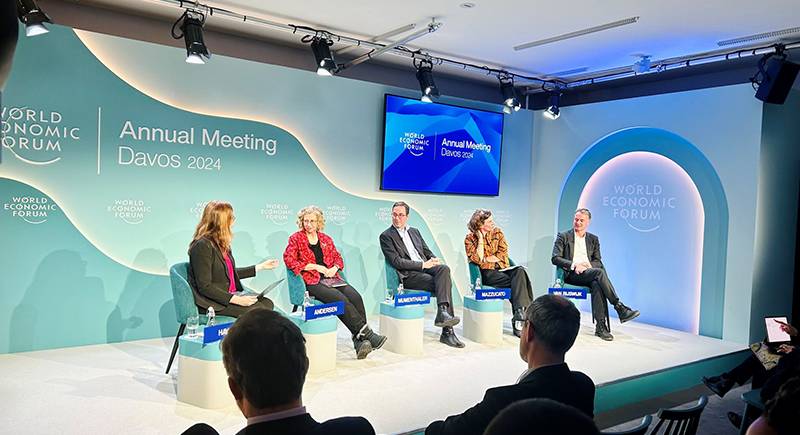
The business COP. The oil COP. The pragmatic COP. The sellout COP. There were almost as many labels thrown at COP28 as there were people (100,000) at the climate conference in Dubai. But one thing’s for sure: the annual UN gathering may never be the same. There were electric bikes and scooters to ferry people around the vast Dubai Expo site, retractable outdoor shades to protect them from the sun and acres of indoor trade show pavilions showcasing everything the Middle East is doing in the new economy. And in the end, there was a remarkable, if flawed, agreement to push the world away from fossil fuels.
Did the end of the oil age just happen in one of the world’s wealthiest oil cities? Or was this more diplomatic show than strategic will? Either way, the 28th Conference of the Parties to the UN climate agreement will be seen as a turning point in climate diplomacy. Perhaps a midlife crisis. Perhaps a coming of age. Here are some of the trends I spotted:
Climate Action Is Now Big Business: Dubai was a good metaphor for the COP conundrum, with a can-do business culture focussed on Net Zero. The host United Arab Emirates made no apologies for a business-focused conference, placing it in a massive trade park that normally houses some of the world’s biggest festivals of capitalism. Many of the business leaders spent more time at lavish side conferences and events in Dubai’s celebrated swanky hotels, where US$37 billion in commitments were announced, including US$7 billion for climate-smart food systems.
It’s A Long Way From Paris: While the ink is still drying on the final communique, COP28 will likely be remembered as the fork in the road that started in Paris in 2015. Back then, COP21 was all about ambition as the world pledged to cut greenhouse gas emissions significantly and quickly enough to prevent catastrophic climate impacts. Progress from Paris has been patchy, as was reflected in a “stocktake” exercise in Dubai. The conference’s theme—Unite, Act, Deliver—spoke to a more pragmatic tone that may soon see the world concede that the Paris goals that were updated at COP26 in Glasgow may not be possible, at least not in the time given.
It’s About The Oil, Stupid: The COP host, Sultan al Jabbar, also runs UAE’s main oil and gas company, and is a serious player in OPEC. So, it was a big deal when he kicked off the conference with a commitment from 50 oil majors, representing 40% of global production, to decarbonize by 2050, and then ended the conference with the first commitment ever by the world to transition away from fossil fuels. The when, where and how of that remain unresolved, but COP28 drew a line in the sand.
No, It’s About Renewables: One strong sentiment at COP28 was around the irreversible rise of renewables. The conference committed to tripling renewables by 2030 while doubling energy efficiency. Wind and solar can be seen everywhere in the UAE, which fancies itself as a renewables powerhouse. Green hydrogen was also the talk of the conference. That’s the hydrogen created by wind or solar power and usually converted into ammonia to be shipped to energy-hungry markets. Who will be the big supplier? The Saudis and Chinese are working together across Asia to establish an early grip, while the U.S. is considering a more ambitious hydrogen export strategy. With the right incentives to compete with fossil fuels, Texas hydrogen could be the Sino-Saudi alliance’s biggest rival. And then there’s Canada, with proposals in Newfoundland, Nova Scotia and Quebec. A green hydrogen race is on.
Or Is It About The Mix?: Energy security is not a popular expression at COP, but it’s clearly top of mind for the Biden administration. Yes, John Kerry still gets most of the podium time at these conferences, with his Al Gore-inspired jabs at Big Oil. But away from the mic, other officials laid out a more pragmatic view rooted in national security. They don’t want to be dependent on a single supplier of anything, which means the U.S. and its allies will need to produce a wider array of energy, even if that costs the economy a bit more. That could include a lot more nuclear: 20 countries, including Canada, came to COP to commit to tripling nuclear production by 2050. That will require 100 gigawatts of extra nuclear power—10 times current levels—to get to Net Zero.
For more on John’s post-COP insights, read his full dispatch from Dubai here.
Listen to the Podcast here

Where’s the next COP? Baku, capital of Azerbaijan, is confirmed as the host of COP29. It was all very geopolitical: it was an Eastern European country’s turn (that included former Soviet states) to host the annual UN climate summit, but Bulgaria was forced to drop out after Russia threatened to veto any bid from an EU country because of the bloc’s support of Ukraine. Armenia, a fierce rival of Kremlin-neutral Azerbaijan, also withdrew partly to resolve its conflict with its bigger neighbour. The decision means the annual climate conference will be held in an autocratic fossil-fuel producing nation for the third year in a row.
Canadian renewables are set to bounce back after a tough few years. That’s RBC Capital Market’s 2024 forecast for an industry that’s struggled due to a combination of supply chain constraints, higher interest rates and significant project cost inflation. However, a new dawn could break in 2024 as government subsidies and tax credits accelerate renewable deployment. “We believe 2024 tailwinds for the sector include lower interest rates, moderating inflation, and a slowdown in economic activity (improves labour availability),” the report noted.
Carrots for ag, sticks for oil and gas. Fresh from releasing an emissions cap proposal on oil and gas, Ottawa unveiled a greenhouse gas offset credit draft system to encourage beef cattle farmers to cut enteric methane that’s emitted during the digestive process of cows and is released into the air when cows burp. If finalized, it could prove significant as agriculture accounts for 31% of Canada’s methane emissions.
Feeling climate-anxious? Google searches for climate anxiety shot up this year globally, with search queries in English around “climate anxiety” in the first 10 months of 2023 around 27 times higher than six years ago, while searches in Chinese, Arabic and Portuguese were also on the rise. Google Trends combines eco anxiety with climate anxiety. Queries around climate change (up 120%), adaptation (up 120%), greenhouse gas emissions (up 120%) and sustainability (up 40%) were also popular over the past year.
CHART OF THE DAY
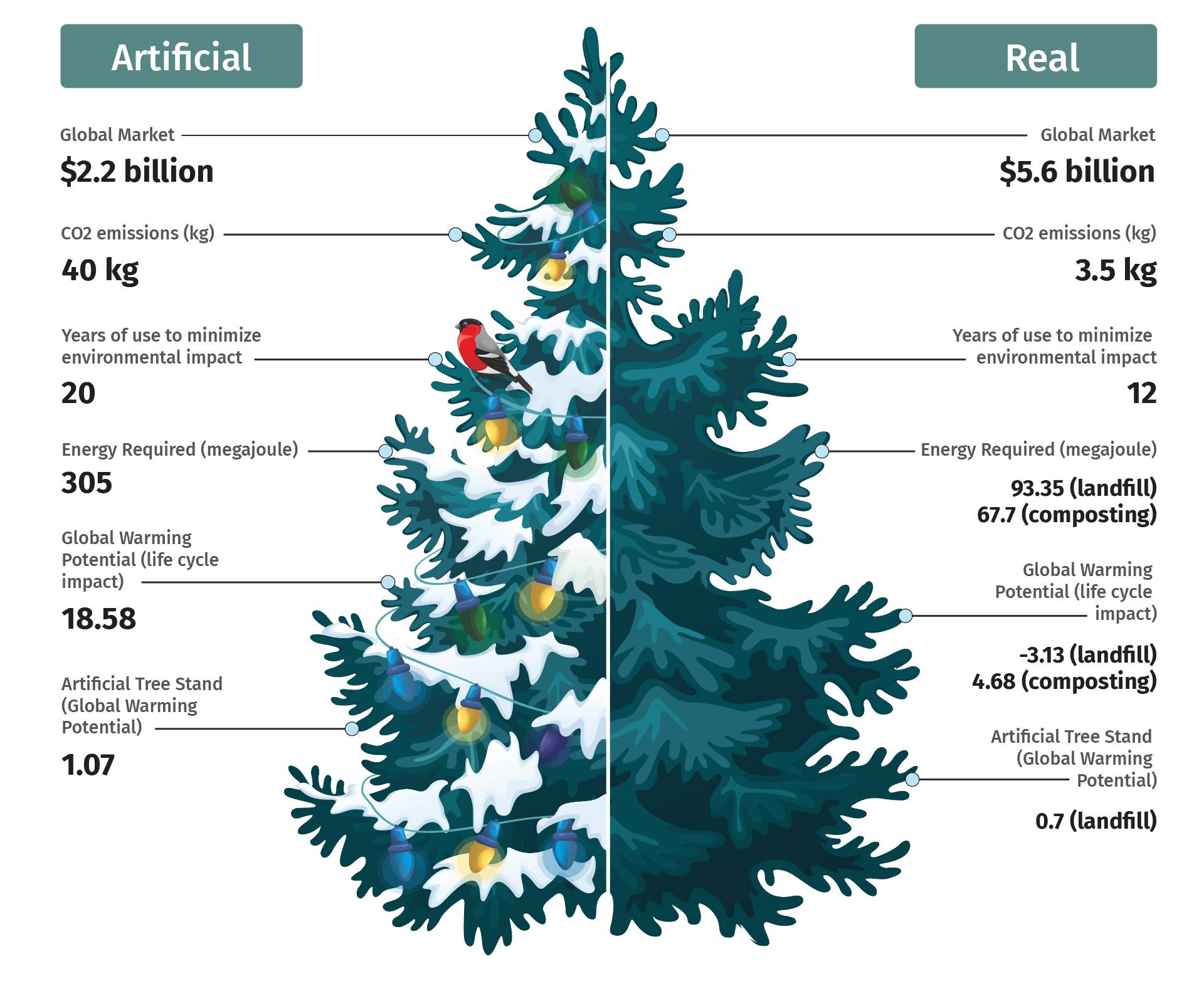
Christmas Tree Debate: Fake Or Real Fir?
Life cycle impact after one year prior to disposal of artificial and real Christmas trees
Source: RBC Climate Action Institute, Mordor Intelligence, Cognitive Market Research, PE Americas
We don’t want to come across as the Grinch who dampened your holiday cheer, but the festive season can lead to a bit more wastefulness (or is that waist-fulness?) as we indulge and splurge more than usual. Christmas trees present themselves as decorations that could do with a bit more climate thoughtfulness. While real trees seem to be the sustainable choice—if disposed of responsibly—there are no wrong answers: if you prefer the artificial variety, just make sure you roll it out year after year.
ZEROING IN
12th
Vancouver’s ranking in a global survey of top global cleantech hubs. The Toronto-Waterloo region was ranked 13th and Calgary was a distant 31-35th in the Startup Genome survey. Silicon Valley, London and Amsterdam-Delta, in that order, were ranked as the world’s top three cleantech hives.
Climate Signals is curated by Yadullah Hussain, Managing Editor, RBC Climate Action Institute, with contributions from the Institute’s experts.
Previous Articles:
In this week’s edition: Climate summit president backtracks on controversial fossil fuel comments, ‘tripling’ is the new buzzword at COP, and why a heavier lift is needed to fund the new energy economy.
COP28 president faces backlash for ‘no science’ comments. Sultan Al Jaber, president of this year’s UN Climate Change Conference in Dubai, was forced to defend his country’s commitment to climate change after he was quoted as openly doubting the connection between fossil fuels and global warming at a pre-COP meeting. Jaber claimed his comments were “taken out of context,” but it has reignited criticism of the host, including by UN Secretary General Antonio Guterres. The UAE is among countries that risk losing half their income if fossil fuel demand plummets, according to Carbon Tracker.
Under pressure oil companies pledge to decarbonize by 2050. Fifty oil companies, including 29 state-owned companies such as Saudi Aramco, committed to decarbonize by 2050 and cut upstream methane emissions to near-zero by 2030. The move comes as COP negotiators consider calling for a formal phase-out of fossil fuels as part of a final deal. Ex-U.S. vice president Al Gore remains skeptical of the oil majors’ pledges: “They’re much better at capturing politicians than they are at capturing emissions.” Critics also worry about the rising number of fossil fuel lobbyists at this year’s event.
Some are calling it “world-leading” draft rules on methane. Flanked by U.S. Climate Envoy John Kerry at the COP28 summit in Dubai, Environment Minister Steven Guilbeault announced new draft methane rules that set a target of reducing Canadian oil and gas methane emissions by at least 75% from 2012 levels by 2030. Domestic dissension has already taken off with Alberta vowing to challenge the “costly, dangerous and unconstitutional” measures.
A Prince Edward Island-born teacher won a climate award at COP28. Lucas Olscamp, a teacher at Pearson College UWC on Vancouver island, won the Burjeel Holdings-Oxford Saïd Climate Change Challenge in Dubai for his work on embedding Indigenous beliefs in his course. Olscamp was the only Canadian finalist among 600 entries. The course, “Narrative Ecology, Selfhood and Thinking,” now in its second year, is part of the school’s Climate Action Leadership Diploma program.
CLEAN TECH
Nuclear’s Make Or Break Moment
Ontario must feel chuffed. Earlier this year, the province embarked on Canada’s biggest-ever expansion of nuclear with a doubling of capacity at Bruce Power—already the world’s largest nuclear reactor. The province also envisions the construction of 17,800 megawatts of new nuclear power, roughly equivalent to building another Bruce nuclear plant, two more Darlingtons and an additional Pickering. Plus, its eyeing three more small modular reactors.
Months later, as many as 22 countries, including Canada and the United States, pledged to triple nuclear capacity at COP28 this week.
Much-maligned nuclear appears to back in the fold. Once a central figure of hate among environmental groups, the energy source’s low-carbon credentials and decades-long track record of clean dispatchable baseload power has put it firmly in the climate plans of most countries. Nuclear’s energy security advantage has also made it irresistible for some in these geopolitically charged times.
Nuclear Ramp Up

Source: World Nuclear Association
Currently, nuclear generates around 10% of the world’s electricity, with 60 reactors under construction and 110 more planned. Thirty countries, including Bangladesh, Egypt and Turkey, are considering nuclear energy first time, to add to the roster of 33 nuclear-powered countries.
For Canada, it’s an opportunity to extend its lead and leverage its technology internationally. Federal investment tax credits of 15% on the construction of emission-free electricity systems could also provide the much-needed momentum to the energy source.
But the industry is not without its challenges in Canada and globally. In the past a single high-profile accident (Fukushima, Three Mile Island) has set the industry back decades, although it is working hard to raise safety standards.
The International Atomic Energy Agency says financing, economic considerations, and supply chain complexities, such as uranium supplies, persist and could also hamper the industry’s growth, while much remains to be done to deploy small modular reactors safely. The industry feels it can take these challenges on. It has been fighting against public perception for years, but solving technological problems are more in its wheelhouse.
CHART OF THE WEEK
As many as 118 nations, including Canada and the United States, pledged to triple renewable energy capacity by 2030 and double energy efficiency to wean themselves off “unabated fossil fuels.” However, the pledge lacks bite as China and India—two major fossil fuel energy consumers—are not among the signatories.
Tripling Renewables, Cutting Fossil Fuels
(Terrawatt Hours)
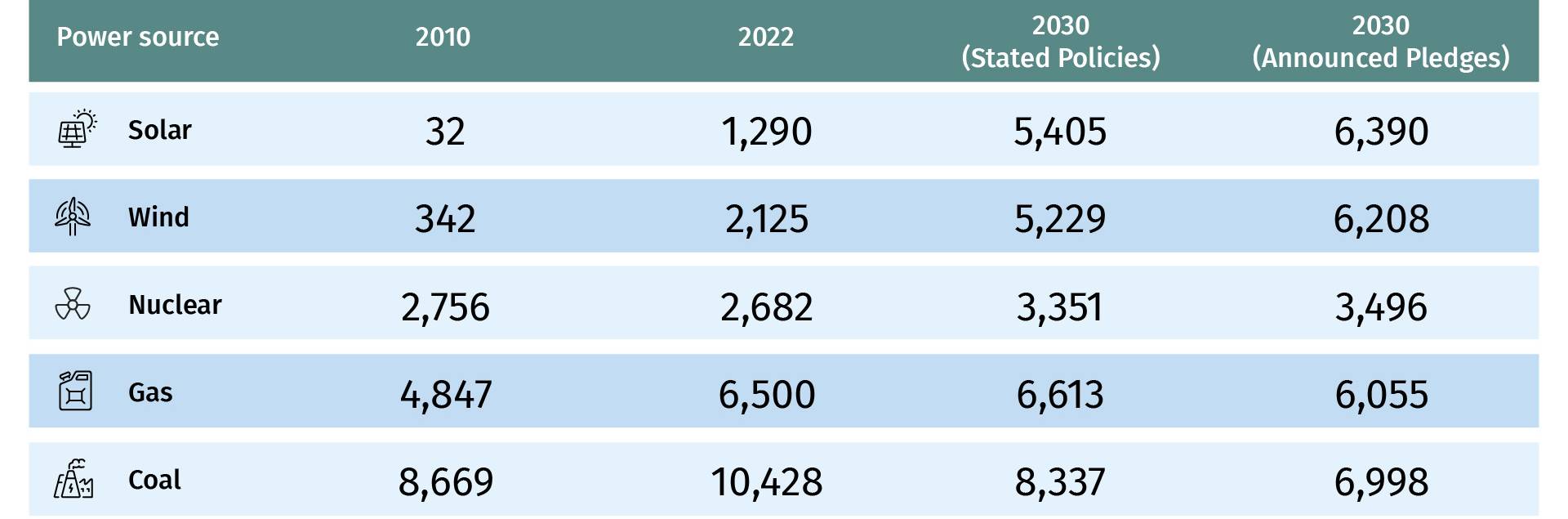
Source: IEA WEO 2023
ZEROING IN
8x
The estimated rise in global carbon dioxide emissions due to an extreme wildfire season in Canada in 2023, according to the Global Carbon Budget. The 8 gigatons of fire-related emissions is equivalent to about 70% of China’s emissions from burning fossil fuels.
In this week’s edition: As this year’s UN climate summit kicks off, COP28 president Sultan Al Jaber emerges as a man of contradictions, Alberta takes on Ottawa’s Clean Electricity Regulations, and it’s tough being a clean tech investor these days.
COP28 saw a breakthrough on Day 1. Germany and host UAE both pledged US$100 million each for a new $429 million loss and damage startup fund to help developing countries cope with the impacts of climate change—seen as an early win for this year’s annual UN climate conference taking place in Dubai. The UK chipped in with US$75, but the U.S. has been criticized for its “embarrassing” US$17.5 million contribution.
Canada has a full COP agenda. Steven Guilbeault, Minister of Environment and Climate Change, has a long to-do list at the climate jamboree: pushing for the US$100 billion climate finance goal, a global coal phaseout, the Global Methane Pledge and Canada’s Global Carbon Pricing Challenge.
Cut back on steaks to save the planet. Less meat consumption and boosting livestock productivity are among several recommendations being unveiled by the UN Food & Agriculture Organization at COP28 as part of a Net Zero plan for food systems. The Dubai summit will walk the talk, with two thirds of the catering expected to be plant-based.
It’s tough being a clean tech investor these days. The U.S. S&P Global Clean Energy Index, featuring the 100 largest clean energy-related firms, has plunged 30% year-to-date, compared to a 1% decline for the fossil-fuel heavy S&P 500 Energy Index. Cancellation of several high-profile U.S. renewables projects due to higher rates and costs triggered a broad sell-off. Given the wave of investments streaming into renewables, are investors being too short-sighted?

CLIMATE SUMMIT
Meet Mr. COP28
Sultan Al Jaber is a man of contradictions: As the head of the Abu Dhabi National Oil Company he has signed off on a US$150 billion investment plans over five years to expand the UAE’s oil and gas production. And as president of the COP28 summit in Dubai starting this week, Al Jaber is leading the global fight against climate change, at least this year. The host nation is reportedly setting up a US$30 billion climate-related investment fund with BlackRock, TPG and Brookfield on the eve of the summit. Al Jaber is eyeing “transformational progress” at the summit as he thinks the phase down of fossil fuels is “inevitable.” Yet, reports have emerged that the UAE is planning to use its role as the host of the UN climate summit talks to strike oil and gas deals, including with Canada. Al Jaber has denied the reports. This past year alone, ADNOC invested in carbon capture and direct-air capture projects, but also shipped LNG to Germany for the first time ever, opening a new fossil-fuel revenue stream.
Contradictions, indeed. Or will all energy executives need to keep two opposing ideas in their heads to solve a very complex challenge?
While oil-heavy ADNOC has thrived under the 50-year-old, Al Jaber’s record in the renewable energy space is not as enviable. His vision to build Masdar City, a new low-carbon city on the outskirts of the capital Abu Dhabi in 2008, remains a work-in-slow-progress despite the government sinking US$15 billion on the project.
Climate observers were opposed to his presidency, with 400 climate and environmental groups writing to the United Nations earlier this year to “kick out big polluters,” on concerns that major oil exporting countries are impeding climate progress. Among oil and gas firms, ADNOC is among the world’s top emitters of greenhouse gas emissions, and has a vested interest in delaying regulations around sequestration or policies that lead to declines in global oil and gas demand.
While that’s true, climate politics is complicated. The UAE is a representative of the loose coalition of emerging economies, the so-called Global South, that are driving global growth and want climate policies framed in ways that do not damage their growth prospects. The UAE and other major exporters such as Saudi Arabia are closely aligned with major energy consumers such as China, India and South Korea in climate policy. Together they will form a powerful group influencing discussions at COP28. Al Jaber is their voice this year.
New Climate Conference Peak
Number of attendees at COP28 could set a new record

Source: Carbon Brief
CHART OF THE WEEK
The annual UN Climate Change Conference, or COP, is experiencing attendance inflation as diplomats, scientists, environmentalists, lobbyists, executives and media rub shoulders with presidents, prime ministers and heads of states. The event in Dubai till December 12 is expected to be the biggest ever concentration of climate folks yet, befitting the urgency of the crisis.
CANADIAN POLICY
Clean Electricity Regulations Get Messy
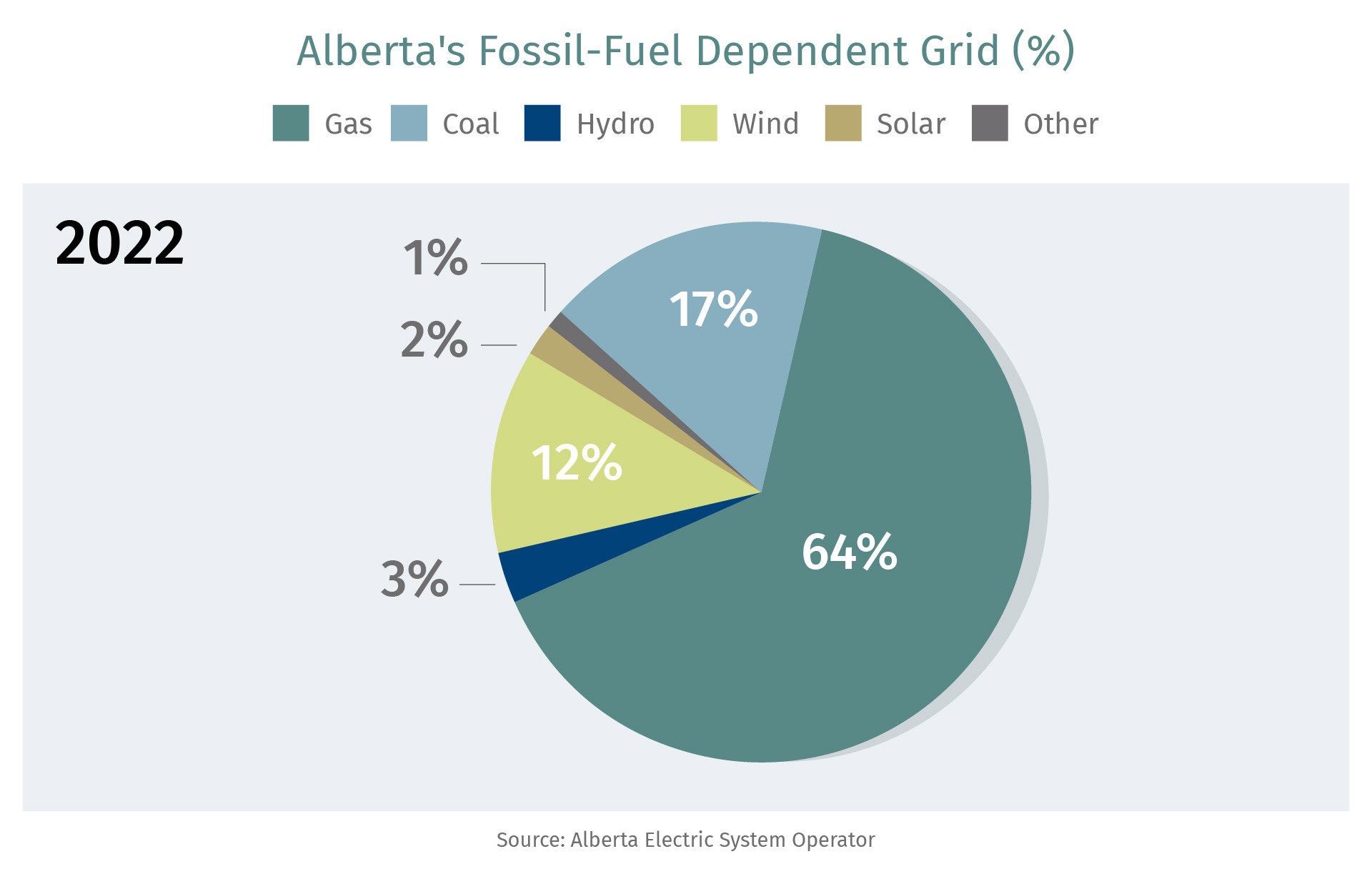
Alberta is stepping on the gas. By invoking the Sovereignty Act, Danielle Smith’s government is challenging the federal draft Clean Electricity Regulations, which aim to cut emissions from electricity starting 2035, meaning limited room for natural gas on the grid. Alberta says the timeline won’t work as the province only recently switched from coal to natural gas and the leap to renewables would be difficult without raising prices or affecting grid reliability.
The province is also eyeing a Crown corporation that could operate natural gas plants without worrying about falling foul of federal rules.
Ottawa has lately faced some resistance on its climate policies. In recent months, the federal government announced carbon tax exemption on heating oil in Atlantic Canada, while a federal court overturned Ottawa’s single-use plastic ban this month. A recent Supreme Court ruling limited federal influence over resource projects, but it was not quite the reversal its opponents were hoping for. While it’s seen as a pushback on federal climate policies, more likely it’s the push and pull of negotiations on policies.
Elsewhere, there are signs of progress on bringing emissions down. The Pathways Alliance, for example, is on the move. Engineering work is underway on the proposed carbon capture, utilization and storage (CCUS) project in northeastern Alberta with a potential launch date of 2030, according to a consortium of Canada’s six largest oilsands producers. The Alberta government added to the momentum this week, providing up to 12% of new eligible capital project costs, building on the federal CCUS investment tax credit. Crucially, the federal credits will be applicable retroactively from the start of 2022 to businesses that have incurred eligible CCUS expenses. Canada’s climate progress may not be linear, but it’s not off track either.
Alberta’s Gassy Electricity Grid
Distribution of electricity generation in Alberta by source

Source: Statista
Elsewhere, there are signs of progress on bringing emissions down. The Pathways Alliance, for example, is on the move. Engineering work is underway on the proposed carbon capture, utilization and storage (CCUS) project in northeastern Alberta with a potential launch date of 2030, according to a consortium of Canada’s six largest oilsands producers. The Alberta government added to the momentum this week, providing up to 12% of new eligible capital project costs, building on the federal CCUS investment tax credit. Crucially, the federal credits will be applicable retroactively from the start of 2022 to businesses that have incurred eligible CCUS expenses. Canada’s climate progress may not be linear, but it’s not off track either.
ZEROING IN
43%
The decline in emissions needed by 2030 from 2019 levels to limit global warming to 1.5 Celsius above pre-industrial levels, according to the UN’s Intergovernmental Panel on Climate Change. A key part of the COP28 agenda is the “global stocktake” to assess progress countries have made towards cutting emissions.
In this week’s edition: What the federal Liberals really, really want for Christmas, five themes to watch for at COP28, and why even Taylor Swift can’t escape the ravages of climate change.
Charting The Fall Of Climate In The Fiscal Update
By John Stackhouse
If there were any doubts how far climate has fallen down Santa’s wish list for the Trudeau government, read Chrystia Freeland’s Fall Economic Statement. She delivered the government’s annual economic strategy without once mentioning “climate change” or “environment.” (“All I Want for Christmas is Two” could be her holiday jingle, as she dreams of 2% inflation.) Such a narrow consumer focus may be bad news for her green caucus. But Freeland’s renewed focus on execution may be welcome. In her government’s strategy for the “clean economy”—Ottawa speak for climate—she made a few things clear.
First, the new Canada Growth Fund will allocate roughly half its $15 billion funding for “carbon contracts for difference”—essentially carbon price guarantees if government policy changes. That’s a lot of money but may not be enough to underwrite a clean economy. Second, the government will soon introduce legislation for investment tax credits for carbon capture and clean technology projects, which were promised a year ago but never finalized. They will be critical to decarbonization projects, and there is some concern they’re still not competitive with U.S. incentives. Ottawa is also pushing ahead with its hydrogen agenda, promising tax breaks for ammonia, and giving more incentives for waste biomass (wood chips and crop residue) that can be used in sustainable aviation fuel. To attract more capital, Freeland gave the green light for a “taxonomy” to help banks and pension funds label investments as “green” or “transition,” and she will push pension funds to invest more in Canada’s “clean economy.”
How a taxonomy treats natural gas will be contentious, as will another Freeland proposal: a national Indigenous loan guarantee. Will Ottawa limit what Indigenous communities can buy, depending on its climate impact? A group of 130 Indigenous nations were quick to say, not a chance. After centuries of colonization, they’ll pick their own projects, including natural gas, thank you very much. Such debates will dominate the winter term, as the Trudeau Liberals try to show they can manage the current economy and help build a new one.
Hydro-Quebec’s energy investment bill will hit $185 billion by 2035. It’s four times higher than the provincial utility’s average annual spend in the past five years, but the company has pledged to keep electricity rates affordable. The utility forecasts that it will need to produce about twice as much power by 2050 as it can currently—an additional 150 to 200 terawatt-hours—for homes and the province’s growing industrial and clean-tech sector.
Article 6.4 could come down the pipe by 2024. That’s according to the chair of the U.N. supervisory body charged with setting rules that would allow a company, say an LNG exporter in Canada, to reduce emissions domestically and have them credited and sold to a different company in another country.
The body hammered out a deal after two years of “tense” negotiations, which will now be reviewed by country negotiators at COP28.
Ontario is helping Saskatchewan dabble in small modular reactors. Ontario Power Generation unit Laurentis Energy Partners and SaskPower will work together to support the provincial utility’s nuclear program management and project licencing processes. SaskPower aims to cut greenhouse gas emissions by at least 50% from 2005 levels by 2030.
No one is shielded from climate change—not even Taylor Swift. The pop-cum-economic powerhouse postponed the Brazil leg of her Eras tour after a 20-year-old fan’s death at her concert was connected to Rio de Janeiro’s extreme heat. Thousands of Brazilian cities are under the spell of “unbearable” heatwaves. It serves as a wake-up call for the multi-billion dollar outdoor events industry.
CLIMATE POLICY
Five COP28 Themes To Watch For
COP28 hopes to set the tone for tackling climate change this decade. But there is pessimism whether host UAE, a major oil producer, can corral around 200 countries on at least some of the climate change challenges. The UAE has a long history of punching above its weight—and a self-serving ambition to have a summit as memorable as Paris back in 2015.
The event, taking place in Dubai from Nov 30-Dec 12, will tackle virtually every climate topic, but these five are worth paying close attention to as they could be instrumental in tackling emissions.
Snuffing Out Methane: The U.S.-China commitment earlier this month to cut methane emissions is seen as a major step, given the pollutant’s potency. Building on their surprisingly collaborative approach on climate, the U.S. and China plan to host a meeting on methane and other greenhouse gas emissions at COP. A number of countries, including Canada, have signed the Global Methane Pledge (GMP) to cut methane emissions by at least 30% from 2020 levels by 2030, but 46% of the emissions reduction opportunity is within the countries that have not endorsed the GMP. Expect pressure on them to sign up.
Tackling The Methane Menace
Countries with the biggest methane footprints
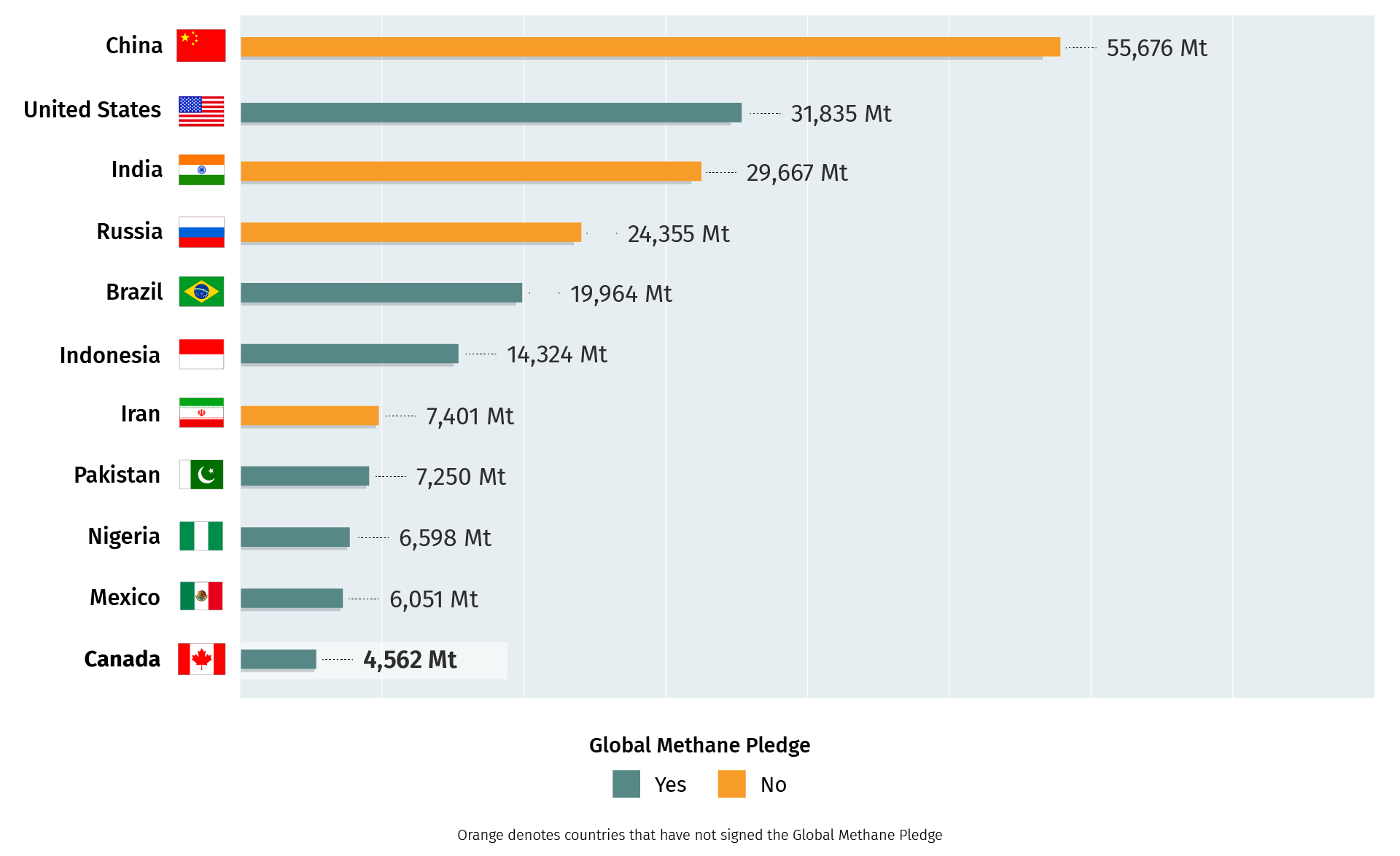
Source: International Energy Agency
3X-ing Renewables: The U.S. and Europe are pushing to triple renewable capacity and a doubling of energy savings by the end of the decade. China, seen as key to the endorsement, pledged to ramp-up renewables along with the U.S. during their summit, which could spur further development. The twist is that it could lead to a continued dependence on China’s cleantech supply chains.
Return Of Nuclear: Expect the U.S. to lead a push to triple the amount of installed nuclear power capacity globally by 2050. That would be a turnaround for an industry that has been castigated by climate activists. Canada, which is actively pursuing a few nuclear and small modular reactor projects, could play a role in the industry’s worldwide expansion.
Loss and Damage Fund: Finance is expected to be among the hottest—and most heated—debating points at the event. The EU has pledged a “substantial” contribution to the L&D fund aimed at providing financial assistance to nations most impacted by climate change. But it will be hard to convince other countries given the fiscal pressures on most economies. The UAE is expected to make a significant contribution that could help the fund flow.
Agriculture’s Big Day: The sector will get good play at COP as the world belatedly connects food to climate. Global food security is under threat as disasters affecting agrifood systems have quadrupled in the past 20 years, according to the United Nations. There is a push to sign a Leaders Declaration on Food Systems, Agriculture and Climate Action with the aim to integrate food systems and agriculture into national climate agendas. COP’s focus on methane dovetails nicely with agriculture as it’s the largest source of anthropogenic methane emissions.
CHART OF THE WEEK
Vexed By Carbon Tax
Support for carbon tax pricing across Canada

Source: Angus Reid Institute
A new survey reveals a profound lack of awareness, and misconceptions about how much carbon tax Canadians believe they pay, whether they receive a rebate and its net financial benefits to households. Meanwhile, ongoing cost-of-living crisis and skepticism over carbon pricing’s role in fighting climate change are driving 42% of Canadians to call for the tax to be abolished, according to an Angus Reid Institute poll. It echoes a recent European poll that suggests climate fatigue despite deep conviction that climate change poses a threat to the continent’s economy.
35 million
The number of people employed in the low-carbon sector, compared to 32 million in hydrocarbons’ sector in 2022, according to the International Energy Agency. Energy job grew 5% (versus 2019) compared to global job growth of 1%. The growth came primarily from solar PV, wind, electric vehicles and battery manufacturing, heat pumps and critical minerals mining.
In this week’s edition: Why unabated is going to be a buzzword at COP28, Australia’s climate diplomacy trumps China, and the U.S.’s small modular reactor ambition suffers a major blow.
U.S and China are coming together on climate. The world’s two largest greenhouse gas emitters agreed to triple renewable energy capacity to “accelerate the substitution for coal, oil and gas generation,” as the two powers seek to reset their frosty relationship. The 25-point plan also aims to cut methane emissions, advance carbon capture projects and halt and reverse forest loss by 2030.
The U.S.’s first direct air capture facility has a Canadian connection. U.S. startup Heirloom Carbon Technologies unveiled a commercially facility capable of removing and storing 1,000 tons of carbon dioxide—a tiny but groundbreaking debut. The company is deploying Halifax-based CarbonCure’s green concrete technology to permanently store atmospheric CO2 captured in the building material.
Climate diplomacy helped Australia thwart Chinese influence in the Pacific. Australia is offering permanent residency to 280 Tuvalu citizens each year under a climate security guarantee to the remote atoll nation, which is threatened by rising sea levels. The treaty gives Australia the ability to block any policing tie-up between China and Tuvalu, as well as any telecommunications, energy, or port deal.
A landmark EU deal on deforestation would raise food prices, industry warns. The new law, which obliges food companies to prove their goods are not produced on recently deforested land, will be enforced by the end of 2024. Emerging economies also say the new law is “inconsistent with WTO obligations.” Palm oil, coffee, cocoa, beef, and rubber are among commodities expected to be affected.
CLIMATE POLICY
The Fuzzy COP28 Word That Could Move Billions Of Dollars
One fuzzy word, “unabated,” could move, or even, halt the flow of billions of dollars. The European Union’s starting position at COP28 is a “global phase-out of unabated fossil fuels.” Canada and United States are also on board with “unabated,” and are pushing for carbon capture and storage (CCS) technology–a key carbon abatement option.
Summit host UAE has called for an “energy system free of unabated fossil fuels in the middle of this century,” while oil and gas producers Saudi Arabia and Russia and fossil fuel dependent nations such as India and China favour more vague language.
There is a lot riding on the word: abatement suggests a focus on emissions rather than production, heavy investments in nascent carbon capture technologies, perhaps even a crowding out of investments in renewable energy. And it could lead to more emission-inducing (but captured) oil and gas drilling.
And what constitutes abatement, anyway? Some suggest CCS must separate high levels of carbon dioxide from emissions—preferably 95% and above—with low methane leakage or fugitive emissions to pass the smell test. Should offsets be excluded? Entire emissions life cycle covered? And should laws be put in place to ensure captured carbon is not used for enhanced oil recovery? These questions will lead to heated debates at COP28. And answers will help companies decide between funding CCS or switching to electricity or hydrogen.
The Global Hunt To Capture Carbon
Growth in capture capacity of CCS projects in construction and development (excludes capacity in operation)

Source: Global CCS Institute
Without a clear global rule of thumb or norm for what constitutes “abated enough,” many investments could become stranded, warns a Centre for Global Economic Policy report.
Billions of dollars are poised to be injected based on the understanding of the word: CCS capacity under development surged 57% in a year to 312 metric tonnes in 2023, and the industry requires investment of US$130 billion annually until 2050 to hit global decarbonization targets, according to McKinsey.
The fight over language comes as the world wavers on its climate goals. Emissions are expected to rise around 9% by 2030, compared to 2010 levels based on current climate commitments, according to a recent UN scientific body. A separate UN report noted that many Net Zero targets that remain uncertain or have been kicked down the road need to take place now, to cut emissions and keep “1.5 alive,” a reference to maintaining global warming to levels agreed to in Paris, in 2015. Separately, the latest World Resources Institute’s State of Climate Action report is littered with phrases like “off track” (it appears 98 times) and “insufficient” (66 times).
CHART OF THE WEEK
No Emissions, High Ambitions
Major proposed green hydrogen projects in Canada
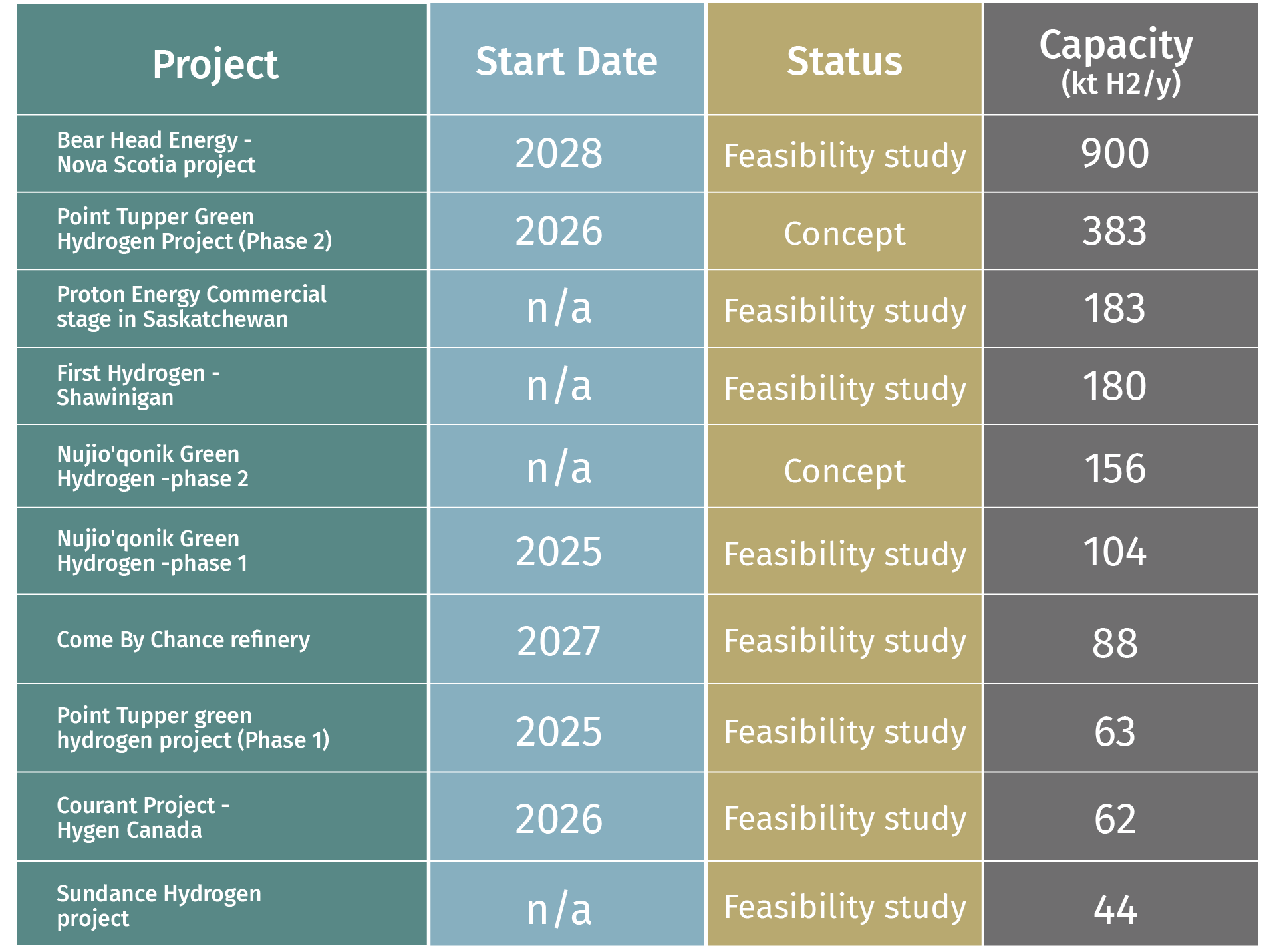
Source: International Energy Agency
Quebec’s cheap hydropower just snared a major green hydrogen project. Belgian-based Tree Energy Solutions plans to build a US$4-billion plant in the province to produce “electric natural gas.” Apart from cheap hydropower, the company cited federal tax incentives for its decision to build the 70,000-tonne project by 2028. The facility alone is expected to help Quebec cut its emissions by 3% by 2030. The project is one of several announced in Canada (see chart) in recent months, as the country competes with the U.S. and others for green hydrogen dollars.
ZEROING IN
75%
The estimated jump in the cost of a U.S. small modular reactor (SMR) project to US$9.3 billion. Oregon-based NuScale Power abandoned the project as costs ballooned, and customers balked at the 53% hike in power tariffs. The project cancellation is seen as a blow to the U.S.’s SMR ambitions.
In this week’s edition: Canada’s climate season turns gnarly, Enbridge emerges as a dominant green gas player, and an obscure Paris clause could boost Canada’s LNG prospects.
Editorial
by John Stackhouse
The weather in Ottawa turned gnarly this week, as did the politics around Net Zero. Is this the winter of our climate discontent? I spent Thursday at the Canadian Climate Institute’s third annual conference, and it was hard not to feel a change in weather. The sunny ways of the past decade are now clouded by economic reality, as governments (and consumers) look increasingly for economically-minded ways to decarbonize our world. The days of free money are gone, which is undermining venture capital and all those innovators trying to create and scale new energy technologies. Governments (like consumers) are running low on fiscal gas, which will limit the billions they had hoped would stimulate climate action. The mood for regulation also seems to be dwindling, judging by the Trudeau government’s muted presentation of an oil and gas emissions cap (now called a “framework”) at the event. And then there’s all that global volatility—two hots wars and a cold one—that’s got energy markets (and market confidence) everywhere on edge.
Looking to 2024, the outlook for climate action may seem dark. But if there’s hope, it’s in private sector. This year’s CCI conference had a greater business focus, with steelmakers, oil producers and builders sharing their plans to decarbonize—not just for the planet but for their own competitiveness. That was also a clarion call from the Biden Administration, which sent its top energy diplomat to Ottawa this week to talk up business-led climate action. Geoffrey Pyatt laid out how the Inflation Reduction Act is transforming America’s energy systems (and its competitiveness), creating significant opportunities for business and trade for its allies. On that count, Pyatt wanted to know about Canada’s “political geography,” and how we can fit into a continental energy strategy that will include oil, nuclear, hydrogen and natural gas. In other words, climate security is now energy security, and both are about national security. The climate crowd didn’t embrace every word, but they did get the message. It’s a new season.
Enbridge is now a green gas powerhouse. The Calgary-based pipeline company snapped up seven renewable natural gas facilities for US$1.2 billion from U.S.-based Morrow Renewables, driven by strong U.S. policy incentives. The acquisition makes the company the third biggest RNG player after BP and Shell. RNG is made from food waste and farm waste and can be blended with conventional gas.
Carbon capture is about to take off. Investments in carbon capture, utilization and storage infrastructure hit US$6.4 billion in 2022, with another US$5 billion expected this year, as industry tackles hard-to-abate sectors, according to BloombergNEF. The U.S. could capture 40% market share by 2035, followed by the U.K. (14%) and Canada (12%). Carbon capture still has its critics, though, notably tech—and now cleantech—billionaire Bill Gates.
Here comes the IRA rush. More than 10,000 green energy power projects were in the queue waiting to be connected to the U.S. electricity grid at the end of 2022, as the Inflation Reduction Act sparked an investment surge, according to a Lawrence Berkeley National Laboratory report. Cancellations are also on the rise, however, with interest rates, supply-chain snarls and permitting delays taking some shine off the IRA driven boom.
The world’s food bill is US$10 trillion higher partly due to emissions. While our love of ultra-processed foods is responsible for 70% of the hidden costs of food production, a fifth of the total agrifood systems costs are environment related, says a new Food Agriculture Organization report. Greenhouse gas and nitrogen emissions, land-use changes and inefficient water use are the key culprits.
ENERGY
How An Obscure Paris Clause Could Lift Canada’s LNG Hopes
It’s awkward. Canada is set to join a new wave of liquefied natural gas production that will dramatically alter global LNG trade. It comes at a time when Canada is eyeing oil and gas caps on emissions (to be clear, not production) and British Columbia is imposing stringent emissions test and rules for future LNG projects. Federal environment minister Steven Guilbeault also does not believe Canadian oil and gas can solve Europe’s energy crisis triggered by the Russian invasion of Ukraine.
But the LNG train in Canada chugs along. The completion of the Coastal Gas Link pipeline in B.C. that connects Shell-backed LNG Canada (which is 85% complete and preparing to ship first cargo by mid-decade) to Montney reserves is an important industry milestone. First Nations’-backed Cedar LNG has secured environmental approvals and eyeing a final investment decision by the fourth quarter of 2023, while Enbridge-backed Woodfibre LNG is also the move.
It’s part of a coming North American dominance in LNG production. Major exporters Qatar and Australia are set to lose their stranglehold over the market, with U.S. and Canada expected to account for 39% of all LNG production capacity by 2030.
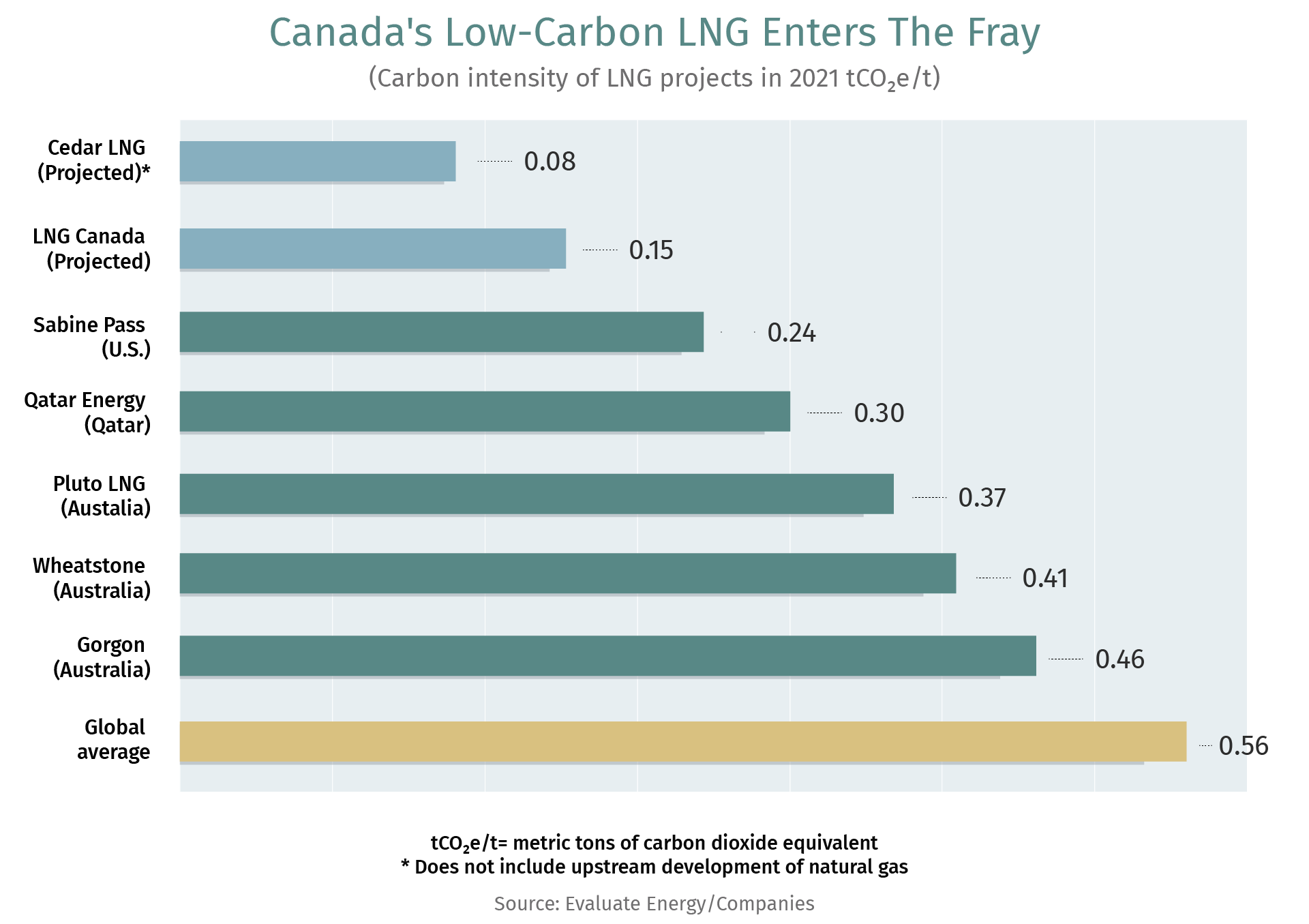
“This new supply will reshape global trade flows,” wrote Evaluate Energy in a new report.
Canada could emerge as the world’s fifth largest LNG producer before the end of the decade, Evaluate forecasts. More crucially, Canada could be one of the lowest carbon suppliers if B.C. continues to expand its green electricity grid.
The global climate regulatory cogs are also moving to help Canadian governments’ get over their awkwardness, with Article 6.4 of the Paris Agreement making some progress behind the scenes, although more works needs to be done.
The clause provides a structure for a carbon credit market on which greenhouse gas emission reductions or removals may be transferred internationally. That means, in theory, an LNG project in B.C. could get credit for displacing coal power in China. A 2020 report noted Canadian LNG exports could cut Chinese coal emissions by 34-62%.
The obscure clause gained momentum behind the scenes in recent weeks with the supervisory body adopting more than 100 crucial decisions. In October, Olga Gassan-zade, the chair of the Article 6.4 Supervisory Body, told S&P Global she was “confident but apprehensive” on the ratification of a finalized document by countries at COP28 in Dubai. But the group failed to finalize carbon trade text with new meetings planned as it scrambles to present a final text. If the text is endorsed by countries at COP28, the UN can proceed to registering projects under Article 6.4 next year. Big if.
CHART OF THE WEEK

Canada is the worst performer among G7 countries since 1990 in reducing emissions, according to a report by the federal environment commissioner. The U.S. and the U.K. are the other two oil and gas producers. The pessimistic assessment also suggested that the Emissions Reduction Plan— Ottawa’s signature climate policy—is also insufficient to meet 2030 climate targets.
ZEROING IN
90%
The percentage of graphite refined by China. New Chinese export restrictions on a key electric vehicle battery material has left automakers scrambling for new supplies.
In this week’s edition: Provinces fume over new federal carbon tax exemptions, offshore wind is facing headwinds, and COP28’s big debate: who should pay more in the climate loss and damage fund?
Ottawa has no plans to boost carbon capture subsidies for the oilsands. The feds believe the proposed 50% tax credits are sufficient for the oilpatch to build carbon capture and storage (CCS) plants. Alberta has yet to disclose details of its support. Oilsands firms were hoping for more from the federal government as they plan CCS projects aimed at slashing industry emissions by around 27% by 2030.
Coastal Gas Pipeline is complete. Some First Nations are opposed but 17 Indigenous groups are eyeing equity co-ownership of the natural gas conduit connecting Shell-backed LNG Canada’s Kitimat plant to shale basins in B.C. The liquefied natural gas export project is set to raise Canada’s greenhouse gas emissions by 4 million tonnes when it starts in 2025.
Global offshore wind is facing a stiff breeze. Higher financing costs, supply chain bottlenecks and labour shortages have squeezed developers’ margins, and short-circuited a fantastic growth spurt. Orsted, the world’s largest offshore developer, cancelled two projects off the New Jersey coast this week, due to rising costs. The slowdown could impact global installations that must rise to 77GW by 2030, compared to a current annual average of 3GW (outside China) to meet Net Zero targets, Wood Mackenzie estimates.
Electric vehicle makers are slowing down. Tesla is delaying plans for a Mexico factory while Ford is slowing production of its F1-50 Lightning pickup truck, as higher interest rates sap consumer sentiment. While U.S. EV quarterly sales topped 300,000 for the first time in Q3, companies are predicting gloomier times as global economic growth slides.
PUBLIC POLICY
How Energy Inflation Threatens Canada’s Climate Policy
Natural Gas & Fuel Costs Across Canada Remain Elevated
% change, latest 3 months change from 2018 average
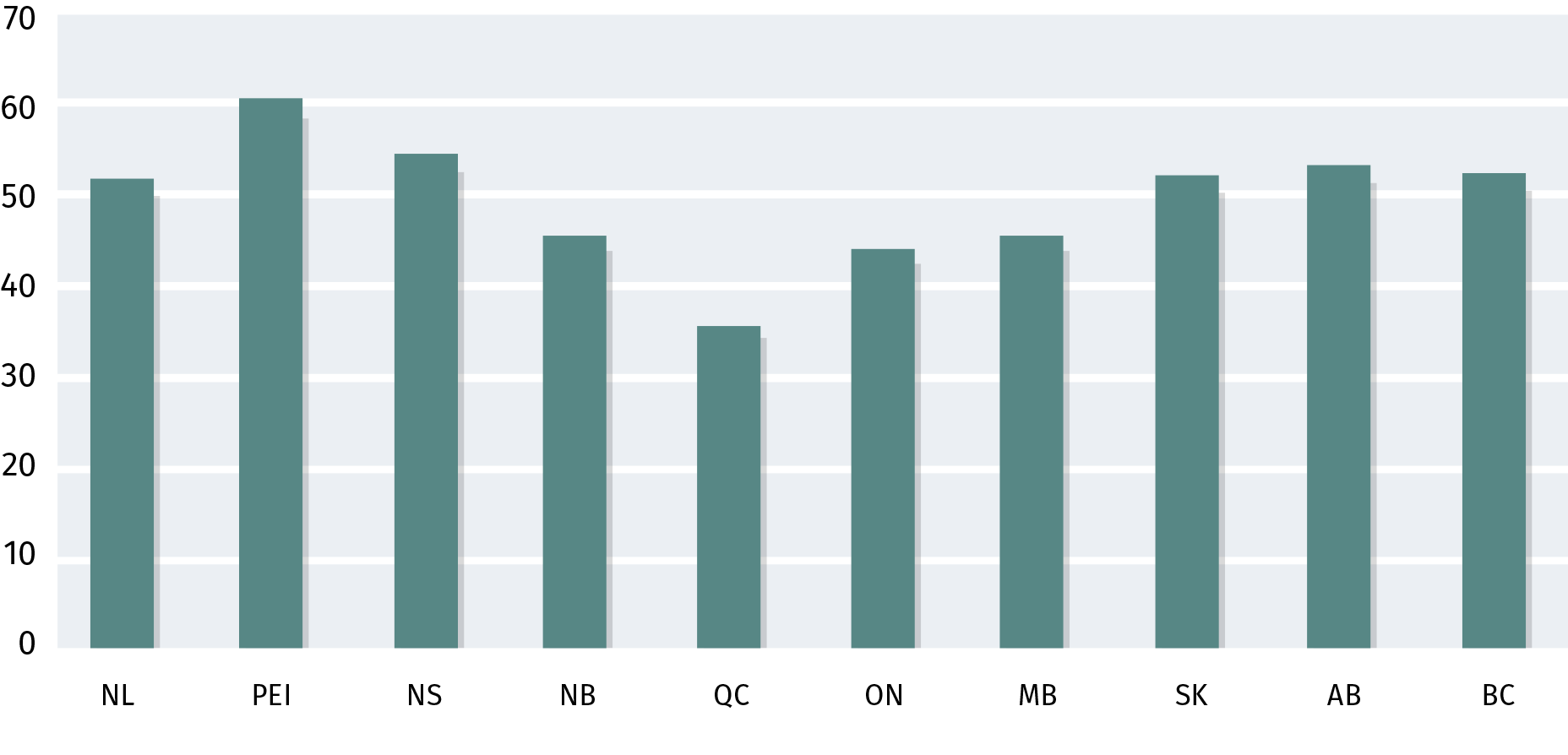
Source: Statistics Canada, RBC Economics Research
First Europe, and now Canada.
Across the Atlantic, policymakers have been chipping away at their own ambitious climate change rules to rein in energy inflation and keep consumer and business ire at bay. An alarmed European parliament president Roberta Metsola recently warned that climate progressives could be in trouble in next year’s EU elections if they don’t square their long-term climate policies with immediate cost-of-living priorities.
That politically-tinged debate has now reached Canada through the Atlantic shores and cascaded across the country.
Ottawa’s three-year exemption for heating oil from the carbon tax as part of an affordability package to shore up political support in the Atlantic, has riled up other provinces who say their citizens are also hurting from high energy bills.
The Liberals themselves are to blame for inflicting a blow to their once iron-clad policy. Bank of Canada governor Tiff Macklem had recently estimated the carbon tax is only responsible for 0.15 percentage point of inflation. That was exactly the argument Liberals had been making all along—until they didn’t with their new “energy affordability package.”
Non-Atlantic provinces now have a compelling argument to make: Why not extend the exemption to natural gas, which has a smaller carbon footprint than heating oil, and a bigger impact on energy bill inflation across Canadian households?
Statistics Canada data shows household spending on energy in the Atlantic remains historically higher than other parts of the country. But that’s due to the region’s heavy reliance on higher-cost heating oil that is linked to global oil markets. In fact, household energy spending in the Atlantic dropped slightly (as of 2021) as a share of total spending compared to pre-federal carbon tax days (2018). In contrast, Alberta, Ontario, Manitoba, Saskatchewan and British Columbia saw a jump in energy’s share of spending compared to 2018.
At a broader level, it challenges the federal government to reset its climate policy lest it’s completely dismantled in the next election cycle. (Federal Conservatives, currently leading in the polls, have pledged to “axe the tax.”)
It’s going to be tricky. The political fallout from the Liberal’s climate retreat has been rapid, with their first major show of flexibility on climate policy seen as a political miscalculation.
But it’s also true that we are in a new economic reality where geopolitics, global warming and supply-chain constraints are making commodities and manufacturing inputs costlier—and the fight against climate change even more complicated.
Buildings
Three Ways to Unlock Canada’s Mass Timber Opportunity
Canada can leverage its abundant forestry resources to develop a new, low-carbon-building material: mass timber. Made of engineered wood, the material can replace or complement hard-to-abate cement and steel in mid-rise towers. As a bonus it could help solve Canada’s housing supply crisis.
So why aren’t we doing it on a mass-scale? Timber Rising, a new report by RBC Climate Action Institute, explores how Canada can unleash a new low-carbon industry.
“Mass timber deployment in new apartments, condos, and office towers could cut emissions by at least 9MT, or nearly 10% of the sector’s emissions, by 2030,” wrote Myha Truong-Regan, the report’s lead author and the Institute’s head of climate research.
But three key challenges are impeding the industry’s growth:
- Insurance premiums to build a mass timber building can be 10 times costlier than a similar building constructed with steel and concrete. That’s keeping many developers on the sidelines.
- A mismatch between location of mass timber production (Western Canada) and demand for the material (Eastern Canada).
- High cost of manufacturing equipment is preventing new players from entering the sector.
Canada can emerge as a leader in mass timber, capturing at least 25% of the global market but, the reports argues, it must first address these three barriers to unlock the industry’s growth potential.
Read the full report here.
CHART OF THE WEEK
Who Pays For Emissions?
The countdown has begun for COP28 in the UAE. So does the accounting of emissions. For years, wealthy nations have rejected poor nations’ demands for “compensation” for their high share of planet-heating emissions that have triggered frequent extreme floods, droughts, and storms. So how should reparations be calculated: on a per capita basis (to account for population), historic or current emissions?
Global Fight Over Emissions
Selected G-20 members emissions per capita and historic share of global emissions

Source: BloombergNEF
ZEROING IN
US$1.8
The proportion of investment in clean energy systems in 2022 compared to every US$1 invested globally in fossil fuels. Five years ago, the ratio stood at 1:1.
In this week’s edition: One of Canada’s first Indigenous premiers could help Manitoba lead the country’s race to Net Zero, Ottawa softens its climate policies amid provincial pressure, and oil companies defy IEA warning.
The Wab Kinew Way
By John Stackhouse
I visited Winnipeg last week and there’s a new energy in the air. The election of Wab Kinew as Manitoba premier—one of the first Indigenous persons to lead any province—has put a new spotlight on the province, its role in reconciliation and leadership in the race to Net Zero.
I met with Premier Kinew to discuss his climate policies, insights from the RBC Climate Action Institute, and whether Manitoba could be a new model for Canada’s transition. He kept returning to a single word: hydrogen. His NDP government wants to make Manitoba a green hydrogen hub, even though the province is running short of surplus industrial power. Kinew is also keen to advance electric vehicle adoption, especially for the buses, trucks and farm machines that account for a third of Manitoba’s emissions. He has a hometown advantage in New Flyer Industries, a global player in electric and hydrogen buses, but needs a growing economy to finance the transition.
More electricity generation and transmission will be an added challenge for Kinew’s promise of reconciliation. His province’s population is 20% Indigenous, the highest in Canada, and new projects will face growing tests of “free, prior and informed consent.” The same challenge will face the NDP’s promise of critical minerals production. (The province claims to hold 29 of 31 key minerals, including lithium.) Kinew said he is hoping to see “enthusiastic consent” exhibited through business partnerships.
Manitoba’s other great climate opportunity? Agriculture. I visited the University of Manitoba’s Glenlea Research Station, south of Winnipeg, to see Canada’s oldest soil sequestration test site, aimed at capturing greenhouse gases. The station is also developing technologies to capture gases from the province’s four million cows, hogs and pigs.
Manitoba is home to only 1.4 million people. It will need all the climate tech it can develop to harness their—and the province’s—energy.
Cracks appear in Ottawa’s climate policy. Higher rural rebates on carbon pricing and exemptions on home heating oil are among the measures in Ottawa’s new “energy affordability package.” The federal move comes amid provincial pressure to soften climate policies and a chastening Supreme Court decision. The big question: could the Feds’ policy flexibility lead to more exemptions and carve-outs, ultimately threatening Canada’s ambitious climate targets?
New EU climate rules put 50,000 multinationals on notice. The new law expands the number of international firms, from 10,700 currently, that must disclose detailed data on their businesses’ impact on people and the planet and any sustainability risks they are exposed to, starting next year. A number of Canadian companies are already on the hook.
Toyota is charging ahead with a promising EV technology. Finding itself in the unusual position of trailing rivals, the world’s largest producer of internal-combustion engine cars is on the cusp of developing the next generation of “solid-state” batteries. The technology is considered revolutionary as it reduces charging times and the risk of explosion and fire. The Japanese automaker has set a 2027 date for commercial rollout, but the market remains skeptical as Toyota has repeatedly missed development timelines in the past.
Younger Europeans are willing to sacrifice more to help the planet. All age groups are concerned about climate change, but younger Europeans are more prepared to change their lifestyles to fight it, according to a YouGov survey. Europeans aged 18-34 were more willing to have fewer children to fight climate change, and more likely to pay extra fee for flights to offset environmental impact. Crucially, they are more supportive of transformative climate policies than older age cohorts.
ENERGY
Did North America’s oilpatch miss the IEA memo?
Chevron and ExxonMobil seem to have missed the International Energy Agency’s (IEA) reports on declining oil demand. The U.S. oil heavyweights recently struck two separate deals to buy smaller oil rivals with a combined value of well over US$110 billion.
The doubling down on oil comes as the IEA recently suggested fossil fuels were in terminal decline. The agency’s status quo scenario (called the Stated Policies Scenarios, or STEPS) sees demand for coal, oil and natural gas fall before the end of this decade. The demand peaks “underline the economic and financial risks of major new oil and gas projects, on top of their risks for climate change,” the IEA warned in its latest World Energy Outlook out this week.
Almost in defiance, the U.S. and Canadian oil sectors have embarked on a merger spree—on bullish sentiment rather than fear. Chevron, CEO Mike Wirth argued, was allocating capital to meet “real-world” demands,” not scenarios. Meanwhile, Royal Dutch Shell is cutting jobs in its clean energy unit, and Middle East gas producers are sewing up multi-year deals.
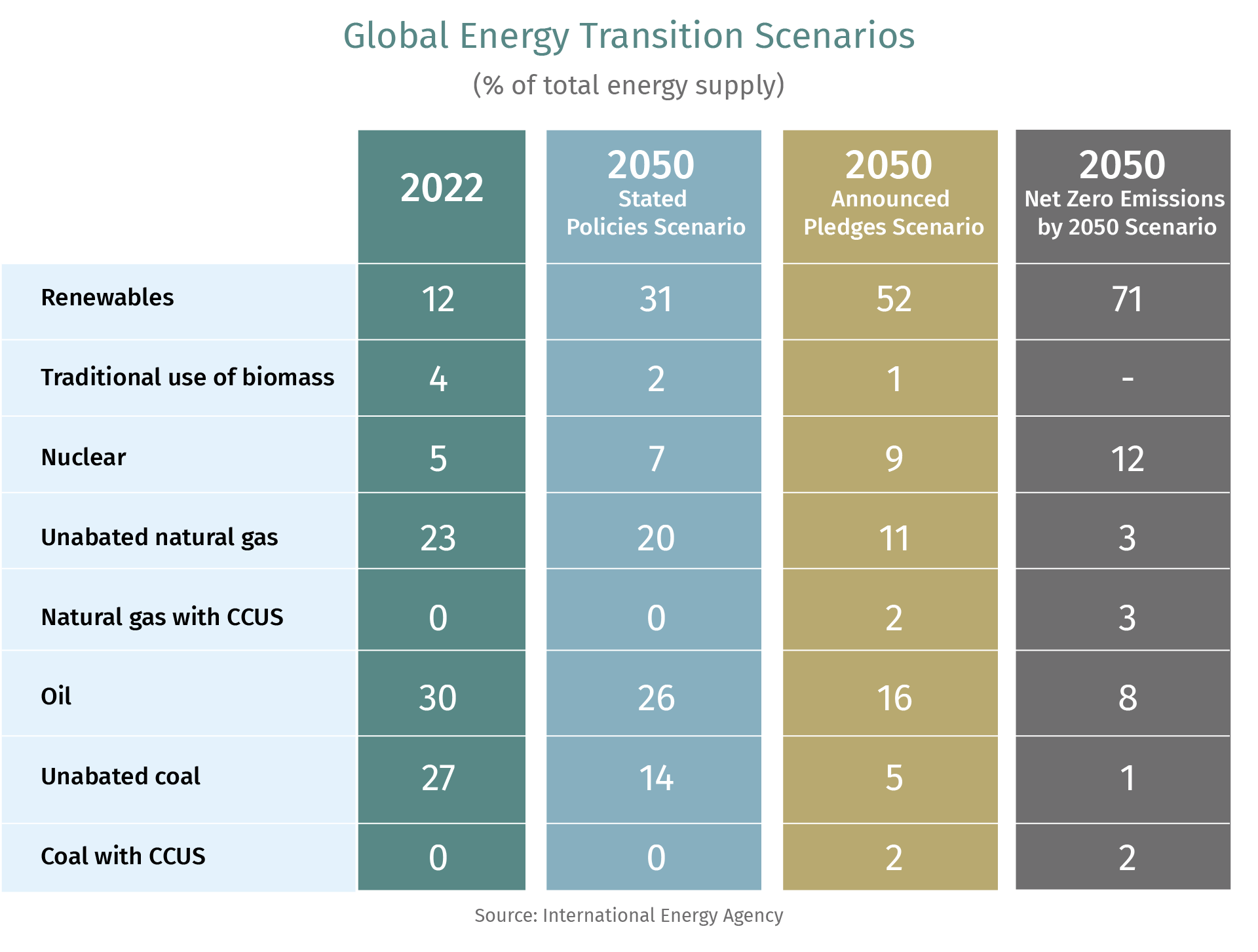
It could turn out to be a high-stakes gamble for oil and gas companies. The world is at an inflection point with an “unstoppable” energy transition attracting billions of dollars. If the IEA’s most ambitious scenario, ‘Net Zero Emissions By 2050,’ starts to play out, oil demand could plummet (187 exajoules in 2022 to 42 EJ by 2050), while natural gas (146EJ vs 14EJ) and coal (170EJ vs 12EJ) could virtually peter out.
We seem to be in a bi-polar energy transition, with the two opposing sides investing billions of dollars at a time of high uncertainty, geopolitical flux and a wobbly global economy. The molecules versus electrons debate will be a key point at COP28 in Dubai a month for now. Doesn’t seem like a recipe for an orderly discussion—or a soft-landing for energy transition.
CHART OF THE WEEK

Canadian venture capitalists and private investors injected record levels of funding in the cleantech space last year. But much of it is in late-stage investments. Lack of capital for seed and early-stage deals is a “market failure” representing a critical funding gap and missed opportunities, Export Development Canada said in a new report.
ZEROING IN
290 Mt CO2e
The estimated emissions from this year’s wildfires in Canada—43% of Canada’s 2022 emissions. But Canada’s official inventory will only estimate a portion of those emissions—and none of them will count toward the country’s total.
In this week’s edition: Canada’s highest court reins in federal government’s climate ambition, how Canadians can save $800 on their monthly energy bills, and why the world’s trees are stressed
A windy eastern outpost could emerge as Canada’s offshore wind hub. The Sable Island Bank could be home to 1,000 offshore turbines, generating 70,000 gigawatt hours—almost twice the annual electricity consumed in Atlantic Canada, according to a Public Policy Forum study. Not a single turbine currently exists in the region, but timely investments could leverage its excellent wind conditions, ice-free areas and water depths for large-scale deployment, the report noted.
Suncor is sticking to its climate commitments. The oilsands giant soothed nerves by reaffirming its Net Zero emissions target by 2050 to Canadian lawmakers this week. Ottawa was worried about the company’s resolve after CEO Rich Kruger said in August that Suncor had neglected “the business drivers of today” (i.e., oilsands) and had placed a “disproportionate emphasis” on the energy transition.
Seven regional hydrogen hubs are set to spring up in the U.S. The hubs, dotted across the country, will secure US$7 billion to accelerate the domestic market for low-cost, clean hydrogen. The funds will be amplified by US$43 billion in planned investments by companies to develop hydrogen projects for refineries, ports, heavy-duty trucks and fertilizer production. But could the U.S.’s major investment threaten Canada’s hydrogen strategy that partially relies on exporting the fuel to its southern neighbour?
Trees are getting sick across the world. Shifting climate has raised the risk of disease in trees, with numerous outbreaks being linked to global warming, according to a new study. The increased frequency of climate-linked extreme events could elevate stress levels in trees, depriving the world of their carbon-absorbing abilities, warned Andrew Gougherty, an ecologist at the U.S. Forest Service.
REGULATIONS
Did The Supreme Court Just Rattle Ottawa’s Climate Plan?
It was a tough week for Canada’s federal climate stewards.
Last week, Nova Scotia and New Brunswick abandoned an Ottawa-backed Atlantic Loop project, aimed at getting the two provinces off coal by using hydro power from Newfoundland and Labrador and Quebec. Nova Scotia scoffed at the project’s cost, and is pursuing other ways to meet its 2030 emissions targets.
And then came the big blow on Friday: five out of 7 Supreme Court judges sided with Alberta and ruled that portions of Ottawa’s Impact Assessment Act (formerly known as the controversial Bill C-69) are unconstitutional.
Alberta had taken Ottawa to court on the grounds that the Act—known as the ‘No More Pipelines Act’ in some quarters—infringed provincial jurisdiction and gave the federal government wide powers to reject major energy projects.
Alberta Premier Danielle Smith, Ontario Premier Doug Ford and Saskatchewan Premier Scott Moe claimed victory following the court decision. But it’s not quite the win provinces were hoping for, as the court has not struck down the legislation. Ottawa can modify the IAA’s language to remain within its constitutional remit. Crucially, the court acknowledged the federal government’s role even if a project is predominantly within provincial jurisdiction. “It just said that the role is a lot narrower than the Act, as currently constituted, would provide,” according to one lawyer.
Proponents looking to challenge the IAA may also have a steep road ahead of them. “We suspect that a court would agree to any federal request to pause any such litigation for a reasonable period of time while these changes are being pursued,” wrote Martin Olszynski, Nigel Bankes, and David Wright, University of Calgary professors. Olszynski and Wright intervened in support of the IAA before the Supreme Court.
With critics of federal climate policies emboldened, it will be interesting to see how the forthcoming federal greenhouse gas emissions cap announcement, expected this fall, and the finalized Clean Electricity Regulations, expected next year, play out. “We suspect that more court battles loom ahead,” the University of Calgary professors noted.
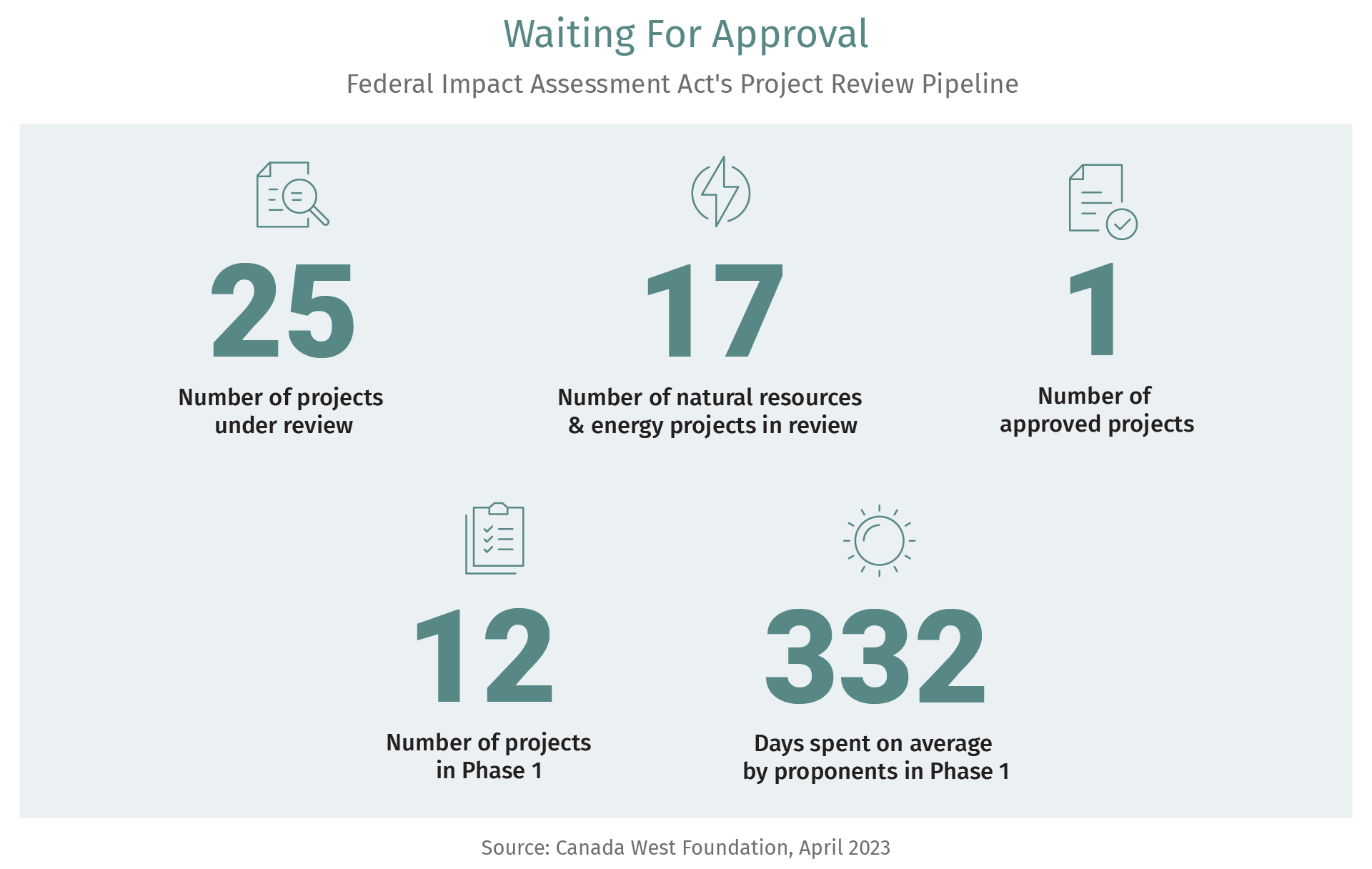
While Canada’s climate regulations just got a bit messier, it might be an opportunity for the federal government to reset the IAA, which has had its share of challenges since it was enacted in 2019. Most projects under its purview remain largely stuck in the first two phases (focused on planning and impact statements by proponents) of the four-phase process, according to a Canada West Foundation report earlier this year. Only one project (the First Nations-backed Cedar LNG) has secured approval under the IAA.
CHART OF THE WEEK
Lower Bills—And Emissions
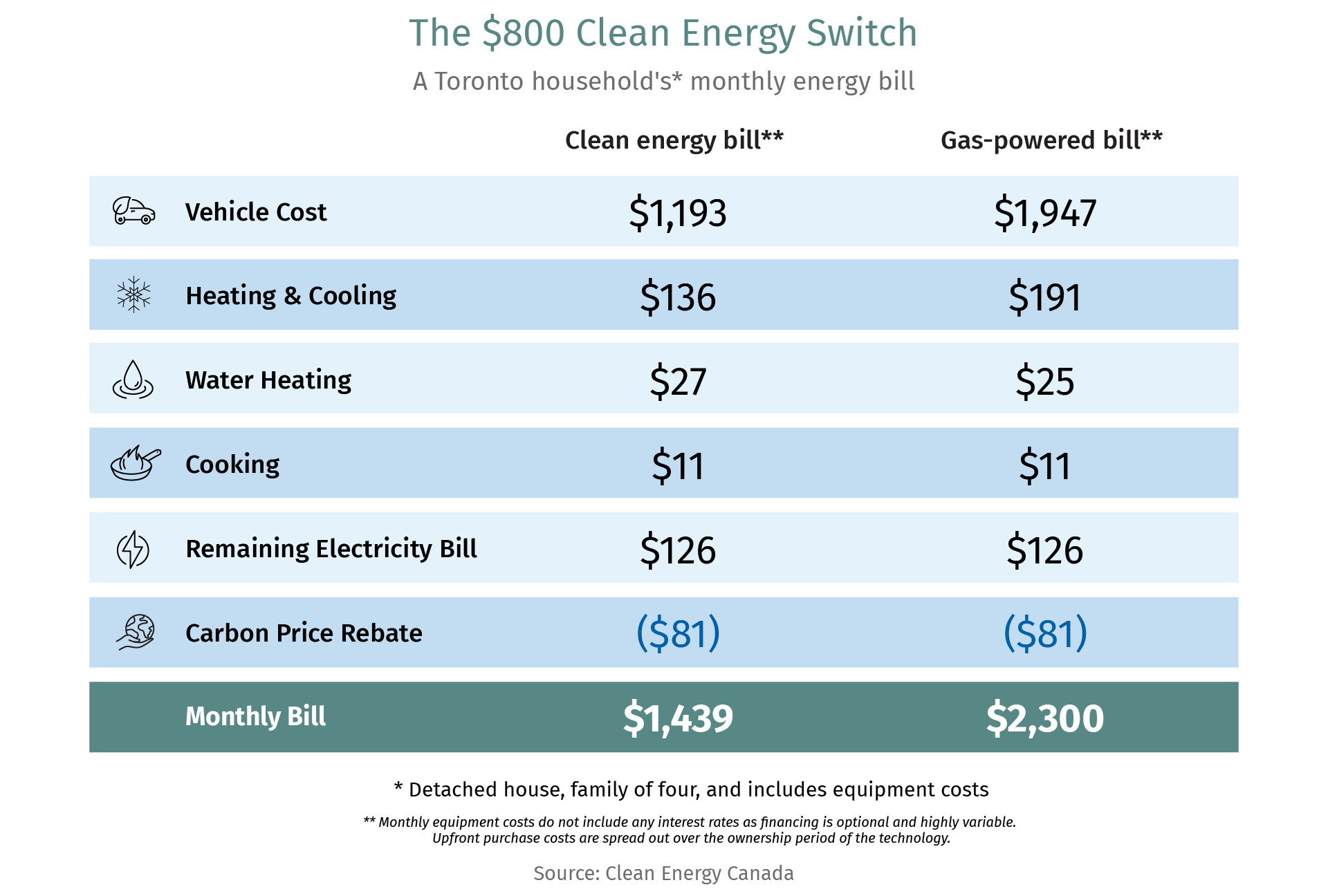
Switching to electric vehicles and swapping gas-powered furnace with a heat pump would help a household of four in Toronto cut its carbon footprint—and its energy bill by $800 per month, according to a new Clean Energy Canada report. Governments can push things along by extending existing clean energy program and home energy efficiency upgrades.
ZEROING IN
1,000 kilometres
The distance a solar-powered car covered across the Sahara desert, considered to be a world first. Most battery-powered cars can hit a top range of 400 kilometres with a single charge. The two-seater, developed by university students in the Netherlands, recorded 97% efficiency in turning sunlight into electricity, compared to 45% for the most efficient solar panels.
In this week’s edition: A new alliance aims to decarbonize Canada’s agri-food system, hot wars could delay the energy transition, and a climate scientist is eyeing Mexico’s presidency.
Editorial
The digital farming frontier
Data farming is here. Visit any ag operation from Penticton to Prince Edward Island, and you’ll find as much software as fertilizer. A generation of precision agriculture has helped farmers boost yields and exports. Now it’s helping fight climate change, too. In a fractured world, digitally-enabled farming can help Canada produce more food with fewer emissions, which is the ambition of the Canadian Alliance for Net Zero Agri-food (CANZA). The alliance was launched this week by some of Canada’s biggest companies and farmers to help cut emissions from animals, food waste, soil disturbance and machinery. Agri-food accounts for 20% of emissions, but the sector can also be a carbon sink—if we reward farmers for sustainable land and animal management. The sector has already cut its emissions intensity by 50% over the past two decades, and could eliminate 150 million tonnes of carbon over the next two decades—equivalent to Canada’s car fleet—with climate-smart agriculture.
Created by RBC, Maple Leaf Foods, McCain Foods, Loblaw and Nutrien, CANZA believes emissions cuts won’t come through technology alone. Enter systems change. The alliance launched its first pilot project, in Saskatchewan, to demonstrate how farmers can capture and store greenhouse gas emissions in soil. They’ll then be able to make money by selling carbon credits to food processors and retailers, and eventually investors, but first Canada needs an accepted approach to measurement, reporting and verification of the results. The RBC Climate Action Institute estimates that with a proper MRV framework, at least $2 billion could be generated for Canadian farmers. To unlock that value, governments will need to support farmers as they develop new growing methods. Transparent and accountable markets will be needed. And consumers will need to be more discerning. The connective tissue: trust. As every farmer knows, data without trust is like soil without rain. – John Stackhouse
A climate scientist is vying for Mexico’s top job. Presidential hopeful Claudia Sheinbaum has contributed to two of the Intergovernmental Panel on Climate Change’s landmark reports and is currently mayor of Mexico City. Sometimes compared to ex-German chancellor Angela Merkel, Sheinbaum wants to build on the retiring Andrés Manuel López Obrador’s progressive policies in the next general elections in June 2024. Oil-producing Mexico is the only G20 nation without net zero emissions targets.
Ottawa’s green tech fund is under fire for mismanaging a $1 billion fund. An independent report said Sustainable Development Technology Canada did not follow its internal rules on conflicts of interest and financial management in its grant to companies for developing and deploying sustainable technologies. It’s a blow to Canada’s climate funding at a time of high costs and urgency to build out clean energy infrastructure.
In what’s seen as a COP28 dress rehearsal, OPEC leaders made the case for oil and gas. Leaders of Saudi Arabia, UAE and Iraq said the world needs hydrocarbon resources to ensure a “responsibly priced” transition at the UN-backed Middle East North Africa (MENA) Climate Week in Riyadh. UAE’s state-owned oil company is also among 20 fossil fuel firms proposing a Global Decarbonization Alliance that’s committed to net zero emissions by 2050.
Google’s Floodhub app could serve as a surge alert. The tool uses thousands of satellite images to build a digital model that could predict floods between two to seven days in advance—enough time to plan a hasty evacuation. Parent firm Alphabet has rolled out the service in 20 countries with 60 more this year, including in parts of Canada and the U.S.
Geopolitics
How Hot Wars Complicate World’s Climate Battles
The world’s bracing for a second major war. The Israel-Hamas conflict further inflames global energy market turmoil at a time when the global economy is already reeling from the aftermath of Russia’s invasion of Ukraine. The situation could escalate: U.S. Treasury Secretary has warned Iran, which has close ties with Hamas, that nothing is “off the table” if Tehran is linked to this week’s militant attacks on Israel. Oil prices are jittery.
Elevated prices are already sapping business sentiment, delaying much needed investments in energy transition. The latest OECD business confidence index reading shows sentiment has dipped to levels last seen in August 2020, when a global pandemic sent the world into a deep freeze. It echoes views of 57% of CEOs in Eurasia Group-Deloitte’s summer survey that suggested “geopolitics” is likely to disrupt their business in the coming year.
The risk to energy transition is clear: Geopolitical divisions are among the major risks (extreme weather being another) that will lead to “fragmentation” of commodities (energy, metals and clean-tech supply chains) and make decarbonization more costly, the International Monetary Fund warned in its latest global outlook.

“A fragmented world would be more volatile,” sending food and commodity prices soaring, and raising the cost of decarbonization, the IMF forecast.
Higher energy prices have left consumers cold on policies that could further inflate energy prices. The UK Conservative government is retreating on climate goals, while there is mounting domestic discontent over the EU Green Deal, with a new EU consumer survey showed concerns around rising energy prices and supply eclipsed environment and climate changes for the first time in years.
Adding to the turmoil, portfolio managers ditched renewable energy funds at the fastest rate on record in the three months to September, as high interest rates and soaring material costs squeezed profit margins of clean-tech firms. Total assets under management now stand at US$65.4 billion—a 23% decline from June, according to LSEG Lipper data. That’s a blow to a segment that is struggling to gain traction and accounts for a mere 0.14% of all investment fund assets.
Policymakers and corporate leaders have seven short years to cut emissions by 45% by 2030—as called for in the Paris Agreement. But they are grappling with a series of immediate crises, including the far-reaching implications of geopolitics on their businesses. Can they course-correct in time to meet 2030 targets?
CHART OF THE WEEK
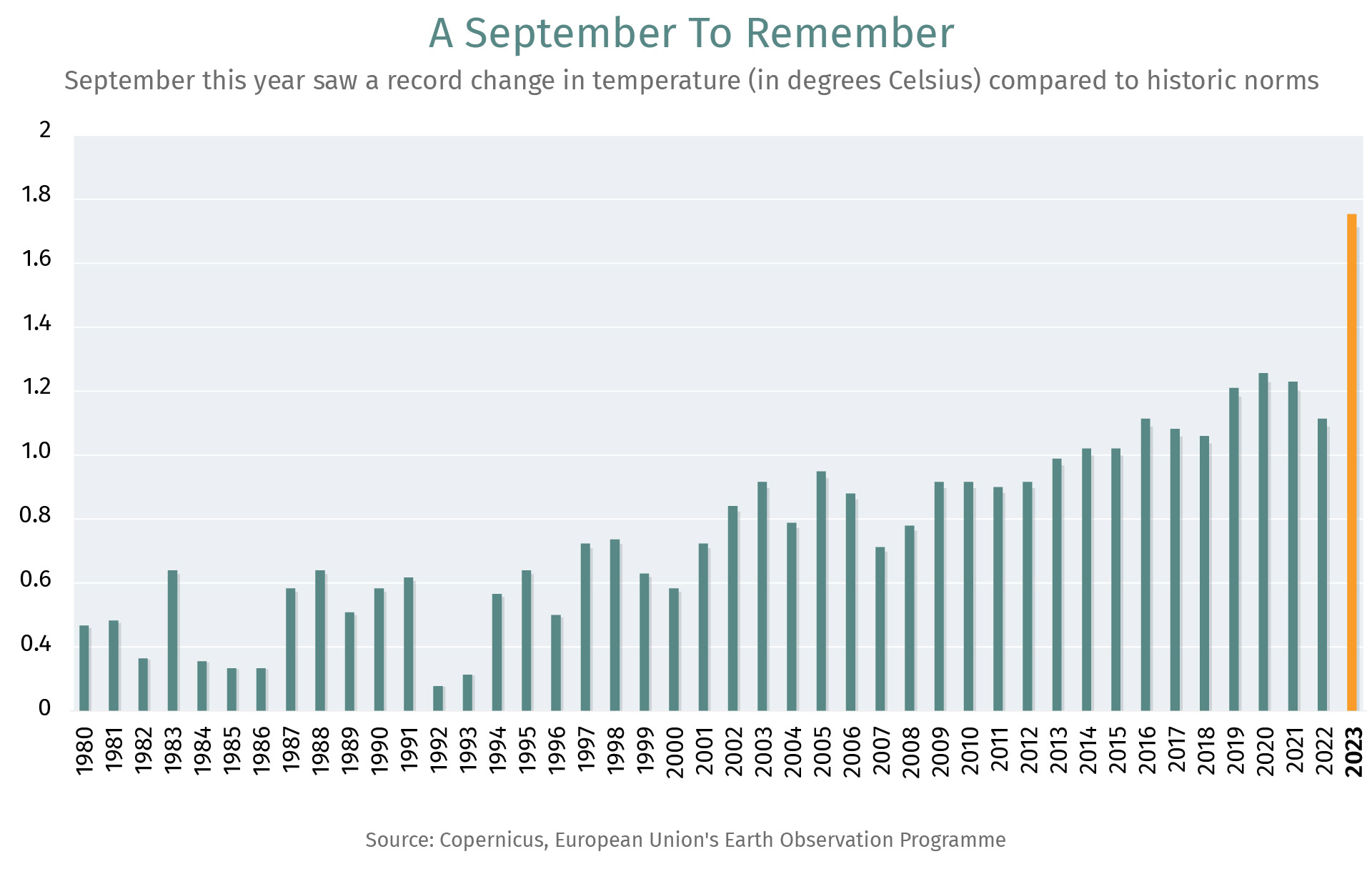
Sizzling September Sets Up Warmest Year On Record
The streak of extraordinary land and ocean temperatures is sending an ominous signal about the speed with which greenhouse gases are changing the climate, according to latest data from the European Union’s Copernicus Climate Change Service (C3S). Expect record-breaking temperatures to continue for months, “with cascading impacts on our environment and society,” according to the United Nations.
ZEROING IN
US$16 million
Extreme weather’s hourly cost to the global economy, according to a study, published by scientific journal Nature. Researchers from a New Zealand university say their modelling could be used to calculate climate funding needed for the UN loss and damage fund for poor countries.
In this week’s edition: Why Bill Gates, the billionaire who wrote How To Avoid A Climate Disaster, is not a tree hugger, Alberta is gearing up for two big climate fights with Ottawa, how Canadian farmers can benefit from a $4B carbon market.
Planting trees to fix climate change is “complete nonsense,” says Bill Gates. “Are we the science people or are we the idiots?,” the Microsoft founder harshly told a summit in New York last week. Gates’ anti-tree diatribe runs contrary to a global mad dash to plant billions of trees across an area larger than the size of the U.S. Gates may have a point. Last year, an Australian study warned that excessive tree planting would gobble up land desperately needed for food production and nature protection.
Investments in renewable energy could be 30% lower by 2030 if trade barriers persist. Geopolitical frictions could restrict trade of key commodities vital for energy transition, the International Monetary Fund warned in its latest World Economic Outlook. If cooperation between countries remains elusive, like-minded policymakers will need to establish “green corridors” to support the energy transition, according to the Fund.
Climate concerns topped energy security in Ireland. Dublin’s top planning body rejected a proposal for a major new liquefied natural gas terminal in the name of climate action. It’s seen as a rare rejection of a fossil fuel project at a time when Ireland—like many energy importers in Europe—faces a severe energy security challenge.
Energy transition themes dominated FT’s Business Book of the Year shortlist. Material World: A Substantial Story of Our Past and Future, by Ed Conway, underlines mining’s environmental risks as the world pursues a more sustainable path. Cobalt Red: How the Blood of the Congo Powers Our Lives, by Siddharth Kara, investigates the human rights abuses that taint the mining of clean-tech essential cobalt. Walter Isaacson’s biography of Tesla’s maverick founder Elon Musk also made the cut.
PUBLIC POLICY
Blackout Warnings
Alberta is gearing up to fight two of Ottawa’s signature climate policies: the Clean Electricity Regulations (CER) and the imminent oil and gas cap emissions.
The Alberta Electric System Operator (AESO) warned last week that the province could suffer blackouts if it pursued the CER. The province does not have sufficient resources to ensure power reliability by 2030 and will face an “asset retirement cliff” for its electricity assets if it fully complies with the draft regulations, AESO warned. Indeed, the reliability and cost implications of the CER’s 2035 target may “jeopardize” the path to electrification of hard-to-abate sectors such as oil and gas, mining cement and petrochemicals, the independent operator noted. Federal Environment Minister Steven Guilbeault called AESO’s blackout warning “misinformation,” while noted Calgary economist Blake Shaffer has sought details from AESO on its modelling work and assumptions.
But the battle lines are drawn. Premier Danielle Smith is preparing a Sovereignty Act to defend the province’s economic interest against what she sees as federal overreach. The Act would also help Alberta pre-empt the oil and gas emissions caps that Smith believes is “unconstitutional.” Ottawa is looking to release an emissions cap draft later this year that requires the oil and gas sector to cut emissions by 42% below 2019 levels by 2030. Separately, Alberta government also slapped a moratorium on renewable energy projects, that’s sent a chill through its burgeoning clean-tech sector.
Edmonton’s moves come as a survey by Research Co. suggested 62% of Albertans were in favour of an oil and gas emissions cap, while a separate Leger poll suggested 57% “were at least somewhat in favour.”
Beyond the public showdown, there is much that Alberta and Ottawa need to collaborate on: notably support for the Pathways Alliance’s mega oilsands carbon capture, utilization and storage project that could dramatically cut Canada’s emissions.
Chart of the Week
Canadian Clean-Tech Spending Surges
Investments in hydrogen and fuel cells has boosted spending in clean technologies in Canada. Latest available data from Statistics Canada showed that corporate spending on research and development (R&D) in the clean-tech sector stood at $2.3 for every $1 spent on fossil fuels R&D in 2021

Agriculture
A $4B Carbon Market
Serving as a powerful carbon sink, active farmland in Canada can sequester between 35MT to 38MT of carbon by 2050—that’s around 40% to 45% of the oilsands’ current annual emissions.
If Canada gets its policy right, the country’s voluntary carbon markets could emerge as a $4-billion behemoth by 2050, according to A New Ag Deal: A 9-Point Plan for Climate-Smart Agriculture, a new RBC Climate Action Institute report. An active market could mean new revenue streams for some operators—well over a $1 million for some large operations.
With food producers in the U.S., EU, Australia and China already receiving roughly three times the climate funding that Canada provides to its industry, the report argues that we risk falling behind.
But a thriving carbon market must rest on a solid system for measuring and reporting soil carbon and emissions, which are currently lacking in Canada. A New Ag Deal suggests ways to create a vibrant market through a robust measurement, reporting, and verification (MRV) framework. Federal and provincial government investments are sorely needed to enable improved data collection and help develop current and future emission baselines, similar to the United States’ US$300-million build out of its MRV infrastructure.
Developing a robust carbon market is one of nine policy recommendations in the report aimed at propelling Canada’s agriculture sector to the forefront of the next green revolution and compete globally.
It’s going to be necessary. The agriculture sectors in the U.S., EU, Australia and China get roughly three times the climate funding that Canada provides to its industry. Yet the expectations placed on our farmers are growing: to produce more (in increasingly adverse weather conditions), to cut emissions and to help boost global food security. The report suggests it’s time for Canadian governments to step up their commitments and create a robust policy environment that recognizes the sector’s economic potential, its role as a reliable global food exporter and as a climate-smart leader.
Read all nine policy recommendations here.
Zeroing In
40 million tonnes
The estimated lithium deposit discovered recently along the Nevada-Oregon border. It’s nearly double the deposits found under the Bolivian salt flats, currently the world’s largest known reserves. If validated, it would alleviate U.S. fears over its inadequate lithium supplies as it builds out its electric vehicle supply chain.
Quebec did it again, snagging another clean-tech high-flyer as it builds out an electric vehicle manufacturing hub. Swedish battery maker Northvolt AB picked Saint-Basile-le-Grand in southwestern Quebec for a US$7-billion electric vehicle battery production facility. Supported by provincial and federal government, it’s the largest private sector investment ever made in Quebec, as the province elbowed out other North American jurisdictions with its cheap, clean hydropower. Ontario should take note.
CLIMATE IN ACTION
Emissions-counting California. You can move out of The Golden State (350 major companies moved out of California over the past three years), but you must still account for your emissions. The state’s senate passed a law this month that requires companies of a certain size that do business in the state to publicly disclose their CO2 emissions. This includes emissions of their suppliers, customers, contractors and even commuting workers. California is also suing Big Oil on what it alleges is climate “deception.”
Mind your climate language. New EU rules will ban unsubstantiated climate claims on consumer products. Key phrases such as “green,” “nature’s friend,” “nature-friendly,” “eco,” “climate-neutral,” “biodegradable,” and “energy efficient,” are being targeted, as the EU aims to rein in wild sustainability claims in the consumer sector. The changes will come into force by 2026.
Lego can’t break-up from oil. The Danish toy brickmaker had pledged to ditch oil-based plastics two years ago in favour of recycled plastic bottles. But the recycled polyethylene terephthalate (RPET) would have a bigger carbon footprint over the product’s lifetime, the company discovered. It’s also been hard to replicate the bricks’ “clutch power”—the ease of putting together and pulling them apart—with alternative components. The company is trying to cut its carbon footprint in other ways.
Climate poll: Around 40% of Canadians are willing to act on climate change even if it comes at a financial cost, according to a new Leger poll. The survey of 1,500 Canadians suggests nearly three quarters believe climate change is responsible for extreme events, and 65% believe their frequency will rise in the future.
TRANSPORTATION
Preparing For The End Of ICE Age
Joe Biden’s emissions-busting Inflation Reduction Act is facing a big test in Michigan. The U.S. auto industry is all in, committing US$210 billion to build a North American electric vehicle supply chain, but auto workers at three American automakers are on strike, concerned about becoming extinct as the ICE (internal combustion engine) Age ends at some point in the future.
The United Auto Workers union is seeking higher wages and job security amid Ford, General Motors, and Stellantis’s generational shift to electric vehicles. In a show of support, Biden even joined the picket line.
Strikes Could Disrupt Projected U.S. EV Momentum
U.S. electric vehicle sales forecast
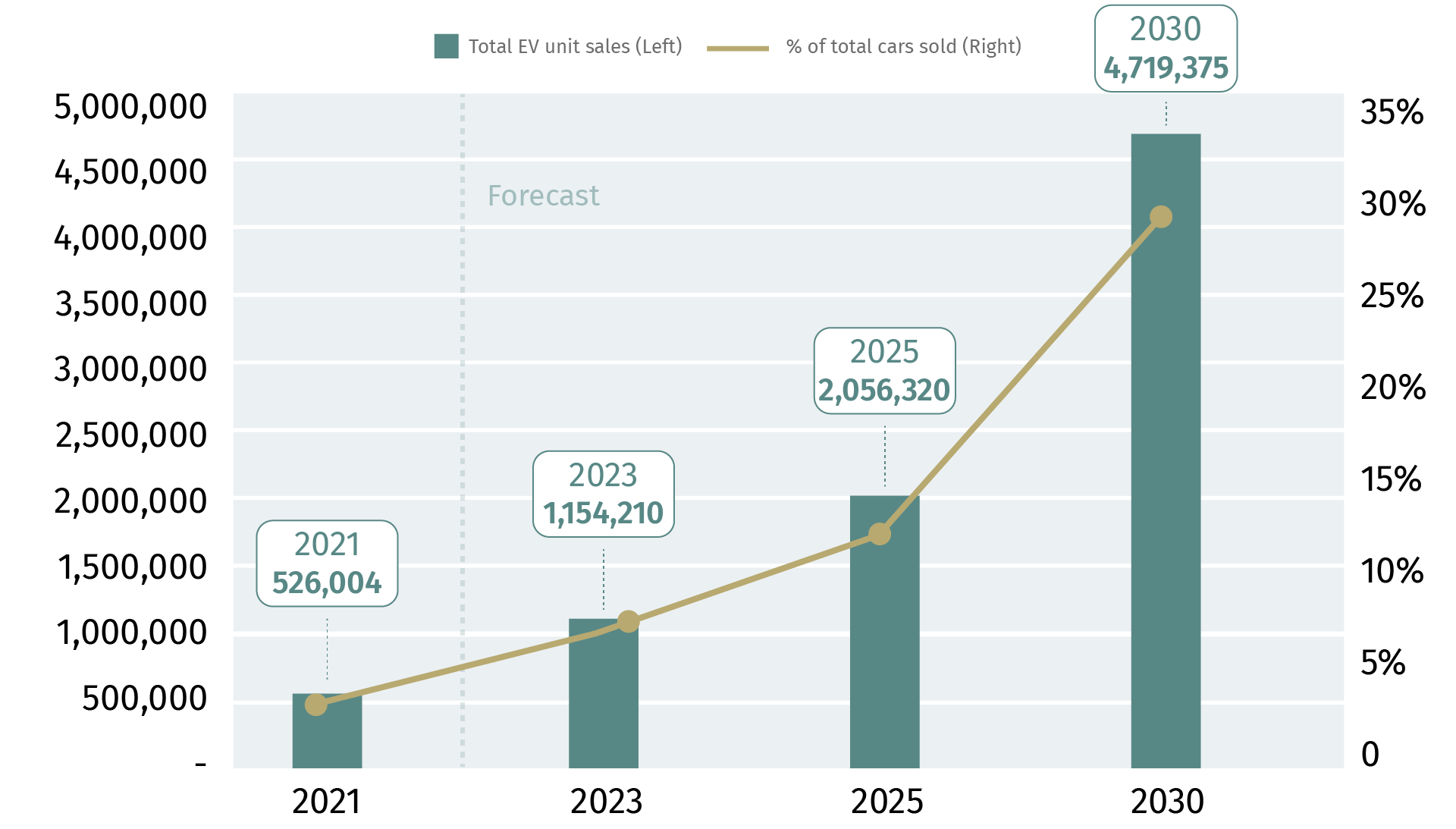
Source: EV Adoption
The union’s biggest non-monetary concern? Mass redundancies as battery-powered vehicles don’t need labour-intensive mufflers, catalytic converters and fuel injectors assembly lines. It’s what the International Labour Organization defines as “just transition,” to ensure greening the economy creates “decent work opportunities” and leaves no one behind.
The Big 3—challenged by the price-cutting, non-unionized EV leader Tesla—are fighting back. Union demands “would force Ford to scrap its investments in electric vehicles,” Jim Farley, Ford’s CEO, warned. Ford has already halted plans to build a US$3.5 billion EV battery plant in Michigan amid financial pressure from the strikes.
A prolonged strike has the potential to decelerate the EV car sales, which now account for 7% of all U.S. car sales and set to exceed a record 1-million-unit sales this year. While there is enough EV stock for now, a protracted strike could add to costs and delay EV rollout at a time when the Big 3 are scrambling for market share.
The integrated nature of the North American auto industry means downtime at U.S. plants would likely ripple through Canada’s auto supply chain, too. Canada avoided its own “just transition” moment after Ford and the Unifor labour union agreed on a three-year contract that included the highest wage increases in the country’s auto bargaining history. Equally crucial, it “provided protections during the (electric vehicle) transition,” according to Lana Payne, Unifor president.
The auto industry, famous for its just-in-time manufacturing acumen, will also need to ensure it’s just in transition, too.
CHART OF THE WEEK
The Methane Menace
Slashing methane emissions is Canada’s next big climate challenge. That was Prime Minister Justin Trudeau’s message at the UN Climate Ambition Summit last week. Ottawa is working on new rules before the year-end that will accelerate Canada’s goal of slashing methane from the oil and gas sector by 75% from 2012 levels by 2030, the PM said . Methane is considered 86 times more harmful than carbon dioxide over a 20-year period. While agriculture remains a significant source of methane emissions, government projections show oil and gas players will have to do most of the heavy lifting over the next 7 years.
Canada’s 2030 Methane Pledge
Oil & gas to drive emission cuts (Mt CO2e)
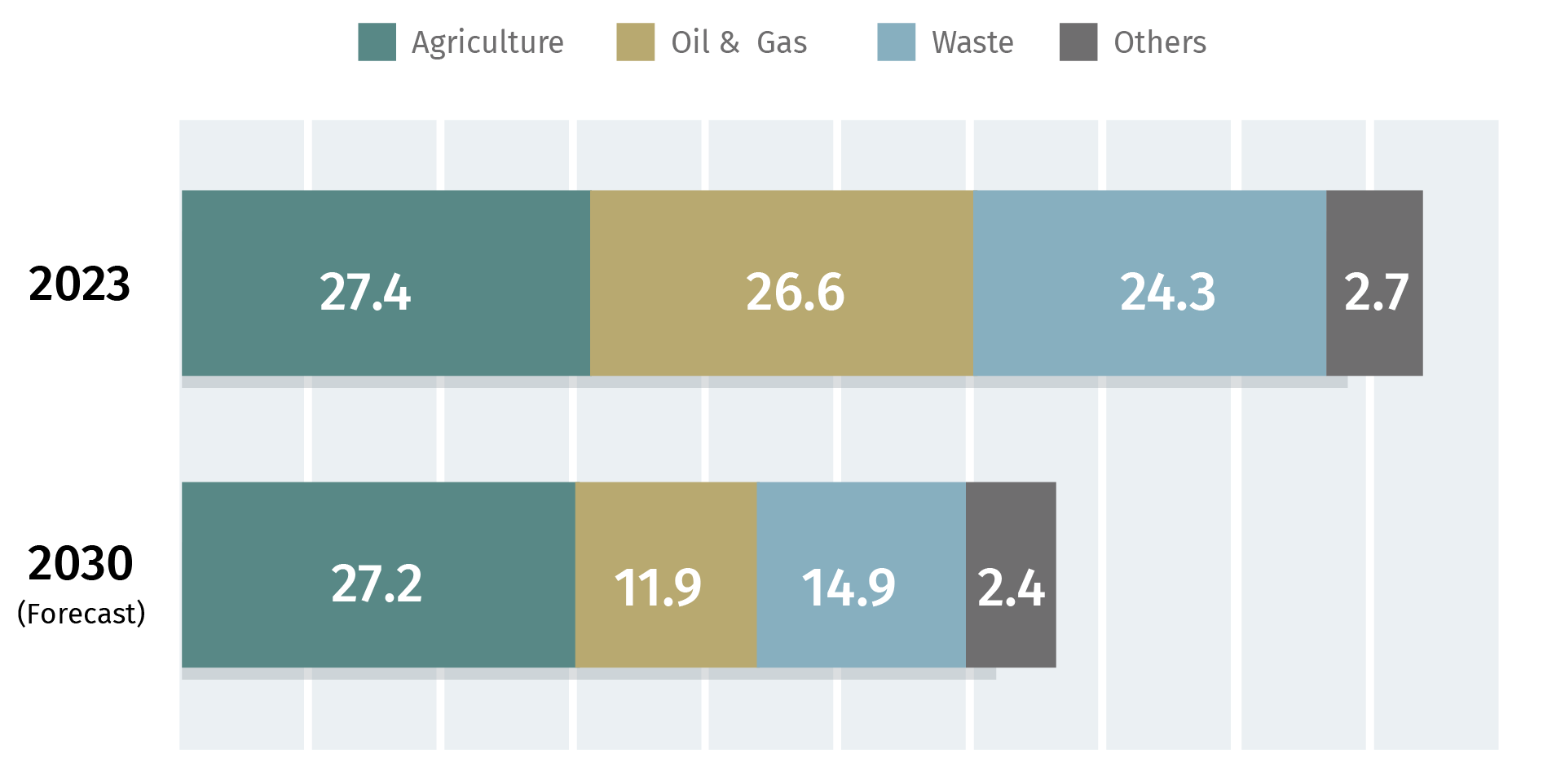
Source: Government of Canada
COP 28
Big Energy Disconnect
A great disconnect between major energy powers is unravelling. That was evident last week when some international climate leaders called for a rapid energy shift to renewables at the UN General Assembly and Climate Week in New York. Meanwhile, major energy producers, including the Saudis, chose an international petroleum event in Calgary to warn of the consequences of ditching oil and gas too soon.
Amid the tensions, the International Energy Agency’s latest Net Zero Roadmap: A Global Pathway to Keep the 1.5 °C Goal in Reach is set to further harden positions.
The OECD-funded agency projects tripling of installed renewable energy capacity by 2030 and doubling the annual rate of energy intensity improvements to cut fossil fuel demand and curb emissions.
A record US$1.8 trillion will pour into clean energy this year. But it’s not enough–renewable energy investments must rise to US$4.5 trillion a year by the early 2030s to meet the IEA’s Net Zero forecast.
IEA’s Pathway to Net Zero
Hitting climate targets will demand a major energy shift

Twh=terrawatt hours
Source: International Energy Agency
The IEA says the world has the tools to ramp up renewables even faster, the agency says. Well-designed policies that focus on efficiencies and expand renewable energy are key to driving fossil fuel demand down by 25% by 2030, in the IEA’s most ambitious climate scenario (called the Net Zero Emissions by 2050 Scenario).
The IEA’s latest report foreshadows its landmark World Energy Outlook report in October that’s expected to project peak demand for fossil fuels by 2030.
The disconnect between IEA projections and what energy companies see in the market could cause slow down investment flows in various energy sources at a time when “urgency, agency and equity” are needed to fight climate change.
Expect both reports to be key talking points at COP28 in Dubai, UAE, in November.
ZEROING IN
2.1%
The rise in Canada’s total emissions in 2022 compared to the previous year, according to an early estimate of national emissions. Still, emissions were 6.3% below 2005 levels, suggesting some progress in Canada’s goal to cut emissions by 40-45% below 2005 levels by 2030.
The world seems to have a bit of ambition fatigue, and wants a lot more climate action. New York Climate Week just wrapped up, and it felt like a moment when lofty aspirations were left at the airport, in favour of concrete plans and a focus on the next 12 months rather than the next 12 years. Climate Week is built around the annual United Nations General Assembly, where world leaders gather, and has become a Manhattan mixer of business leaders (Bill Gates), celebrities (Bono), agitators (Al Gore)—and traffic jams. (Yes, there really are cavalcades of SUVs shuttling between hotels, each with police escorts). I had the chance to sit down with government leaders, industry executives and environmentalists, who all seemed to impress a clear and urgent demand for more doing and less talking. As one said, we’re a third of the day through the “Decisive Decade,” and don’t have anywhere near a third done of what we need to do in the 2020s.

The glorious September sunshine didn’t do much to break through the political clouds around the UN. Joe Biden came, and it wasn’t lost on many that this could be his last General Assembly, as the 2024 U.S. Presidential election will be in full swing next September. Biden’s big climate spending plans will be on the ballot, as will his push for an EV revolution.
Plenty of other key countries—Britain, France, China, India—kept a low profile, as their governments refocus on energy security over climate action. Anything that could lead to more energy shortages—and therefore more inflation and higher interest rates—is on every political radar map. As crude headed toward US$100 a barrel, I met with a range of major oil and gas producers who seemed prepared to produce more, not less. Even countries trying to get off coal—Germany, Indonesia, Vietnam—told me it’s proving to be harder and more expensive than expected. And they don’t want to put a penny of that on the backs of citizens. Some policymakers suggested, privately, we may need more regulations, not less, to get emissions down. But as I prepared to head home, I had to wonder if all those drivers outside would agree, at either the pump or the polls. – John Stackhouse
SUMMIT SOUND BITES
Bend The Trend
Soundbites were flying at the UN and NYCW events as speakers tried to capture the scale of the climate challenge on our hands. But the underlying theme was the same: we are at a tipping moment and must redouble efforts to get a handle on the crises.
Antonio Guterres, UN secretary general, at the UN Climate Ambition summit: “Humanity has opened the gates of hell… If nothing changes we are heading towards a 2.8 degree temperature rise—towards a dangerous and unstable world. But the future is not fixed. It is for leaders like you to write it.”
Jim Skea, chairman of the Panel on Climate Change (IPCC). “Climate policies have begun to bend the trend on emissions, but we have yet to put global emissions on the steep downward path needed.”
Helen Clarkson, CEO of Climate Week: “No knight in solar clad armour charging in in a white electric vehicle to rescue us. Or rather, since we’re in New York, there’s no Spiderman to swoop down and save us. We are all the cavalry.”
Dr. Sultan Al Jaber, COP28 President-Designate: “We will foster new, multi-level partnerships to help fast track the energy transition, fix climate finance, focus on people, lives and livelihoods, and make sure local voices are heard at the international climate table.”.
Dee Yang, Partner, McKinsey Sustainability. “Nature risk awareness has greatly accelerated. I would estimate that it’s about 12 to 18 months behind climate awareness. One trend to look at is the number of institutional investors that are making pledges for biodiversity outcomes; that number is really growing.”
Kate Brandt, Chief Sustainability Officer, Google. “With our AI-powered Flood Hub, a platform that shows when and where riverine floods may occur, we can issue flood forecasts up to seven days in advance for communities in danger.”.
CLIMATE IN ACTION
Coalitions, Challenges & U-Turns
It wasn’t just all talk, there was a lot of action, too, in New York, including the arrest of more than 100 climate activists gathered in the Big Apple.
High Ambition: Alarmed by the latest UN Global Stocktake report, 17-leader High Ambition Coalition signed a statement calling for swifter cuts to carbon emissions, and called for a “systemic transformation.” The report warned the world was way off track to meet Net Zero targets.
Carbon Challenge: The Canada-led Global Carbon Pricing Challenge welcomed Norway and Denmark as its latest members (both have carbon pricing already in place). The GCPC’s goal is to triple the coverage of carbon pricing mechanisms around the world to reach 60% of global emissions by 2030. Ivory Coast also joined as a “friend” of the challenge. Around 33 countries have carbon pricing in place.
New Treaties: Countries came together this week to formally finalize a treaty to protect the ocean. Achieved after nearly two decades of negotiations, the deal strengthens rules on the conservation and sustainable use of marine biodiversity, in over two-thirds of the world’s ocean.
A U-Turn: UK Prime Minister Rishi Sunak, who missed the UN Summit, chose the big climate week to reverse some of his government’s climate commitments. Downing Street announced a five-year delay in the ban on the sale of new petrol and diesel cars and a nine-year delay in the ban on new fossil fuel heating for off-gas-grid homes.
Transportation
The Need for Speed
Electric vehicles are the poster child of clean-tech success. But even here, EV sales will need to accelerate for the world to meet Net Zero ambitions. The Breakthrough Agenda Report, a new International Energy Agency study released to coincide with NYCW, marked the progress made in cutting emissions from the transportation sector—and how far we still need to go to reach Net Zero.
Here are the IEA’s key findings on EVs:
- Global EV car sales now account for 14% of all auto sales and have been doubling every 1.2 years.
- EV cars sales will exceed what’s required in Net Zero at this rate—but electrification of other vehicle types and policies to reduce car use remain paramount.
- International collaboration, vital to kick-start the global EV industry, has been “modest,” the IEA warned. Lack of harmonized sustainability standards, slow de-risking of investments, and product supply bottlenecks have impeded progress.
- An Accelerating to Zero (AtoZ) coalition to get EVs to 100% of all car sales by 2040, boasts 40-plus national signatories (including Canada). But the U.S., China, South Korea and Japan are notably absent, as are some of the world’s biggest car makers.
- As countries and various companies pursue different technologies, the world should insist on sustainable mining standards, common operating manufacturing standards, and responsible sourcing and data governance.
Long, Winding Road To Decarbonization
EV sales share targets by 2030 to meet Net Zero goals
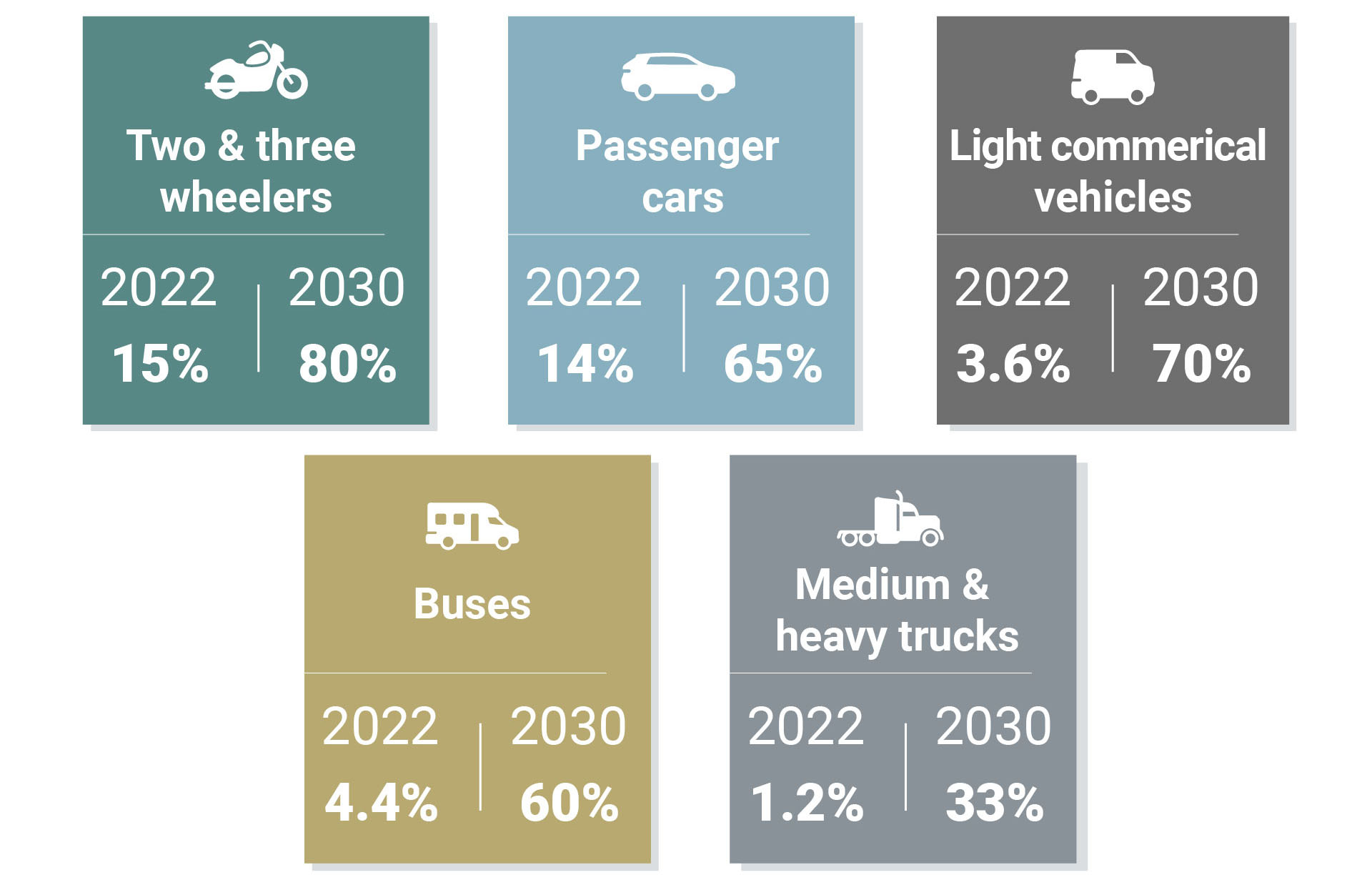
Source: International Energy Agency
CHART OF THE WEEK
The Big Miss
Lack of progress on the 17 sustainable development goals (SDGs) UN members had signed up for 2015, was a key talking point at both the UN and NYCW.
But the world’s off track on most of these indicators, according to the latest UN report card ( to rescue SDG finance, the UN unveiled a series of bold solutions).
Eight of the 17 SDGS directly touch on environment issues. Here’s the world’s report card to date:
World Struggles To Meet Sustainable Goals
Eight of the 17 Sustainable Development Goals touch on the environment

Source: United Nations
ZEROING IN
Taking the Pulse of Corporate Climate Action
Some of the world’s biggest companies are finding it hard to translate their lofty ambitions into action, according to a new survey of 200 companies by Oliver Wyman and Climate Group, coinciding with Climate Week.
Here’s what the companies said they were struggling with as they pursued climate transition:
| 55% | The percentage of companies that have not integrated climate action in their core business strategy yet. |
| 61% | The percentage that see decarbonization as a serious challenge by 2030; 31% believe it will be an existential threat by the end of the decade. |
| 59% | The number of companies that allocated less than 6% of their total capital expenditure to climate action. |
| 47% | The percentage of companies active in climate transition that cited lack of clear government policy targets as the biggest barrier to decarbonization. |
Source: Oliver Wyman and Climate Group
CLIMATE IN ACTION
Clothes for a warming world are coming soon to a store near you. Startups are stitching together new clothing lines for the climate-change era featuring reflective fabrics, new weaving techniques and thermostats that can cool bodies by as much as 8C. Initially targeted at agriculture and construction workers, clothes for a “boiling” world are also coming for office workers (and even their pets). With sweltering extended summer days expected to become a permanent feature in the future, a wardrobe update may be in order for most of us.
Small islands’ big day in court. Worried about being submerged by rising seas, 9 small island nations, including Bahamas and Tuvalu, took on high-emitting countries in the International Tribunal for the Law of the Sea in Hamburg, court this week. It’s considered to be the first climate justice case aimed at protecting the ocean. The islands are not seeking damages but advice from the court on large emitters’ legal obligations to protect the oceans.
Korean companies heart Canada. South Korea’s Solus Advanced Materials Co. is the latest to eye a clean-tech opportunity in the country. With backing from Ottawa and Quebec, Solus is reviving an old plant at a cost of $750 million to produce 25,000 tonnes of copper foils for electric vehicle batteries starting 2026. South Korean firms Sk On and EcoProBM also recently teamed up with Ford Motor to build a $1.2 billion cathode manufacturing facility in Quebec.
New York, New York. Climate Week NYC starts Sep 17-24. The event, themed “We Can. We Will,” aims to tackle big ideas, such as ways to rapidly implement green technologies and channel investments where they are needed most. Look for Climate Signals’ special coverage next week from the event.
EMISSIONS
A world off track
As the G20 dithered in New Delhi on climate-change issues, the United Nations issued a stark warning last week: the world is “not on track” to meet the long-term goals of the Paris Agreement.
The agency’s first “Global Stocktake” aims to measure the world’s progress towards Net Zero by 2050. The UN believes the current set of policies are inadequate and the window to a world that’s only 1.5 Celsius warmer, as set out in Paris in 2015, is rapidly closing. Despite billions of dollars of investments in climate action (to the tune of US$803 billion annually in recent years) and a slew of policy measures, emissions continue to rise with humanity already experiencing climate related losses and damages.
“Much more ambition in action and support is needed” to accelerate mitigation measures and set more ambitious national targets to cut global GHG emissions by 43% by 2030 and 60% by 2035 compared with 2019 levels, and eventually reach Net Zero CO2 emissions by 2050 globally, the UN advised.
The frequency of bleak climate forecasts have surged in recent years, but the UN report also offers ways forward: credible, accountable and transparent actions by all parties, a systemwide transformation of the energy system, phasing out of unabated fossil fuels, ending deforestation, and rapid transfer of new clean technologies to developing nations are among its many recommendations.
Global Emissions On The Up
Annual carbon dioxide (CO₂) emissions worldwide (in billion metric tons)

Source: United Nations/Statista
COP28 : While they were thwarted at the New Delhi G20 summit, climate negotiators will use the findings from the latest UN report to hammer home the urgency of action at the COP28 event in Dubai in November. It will be one of several contentious issues at the summit: Expect more heated discussions on fossil fuel consumption, and climate financing, which has emerged as a key grievance of the “Global South” against developed economies. Meanwhile, proper functioning of emissions markets is emerging as another tough nut to crack.
CHART OF THE WEEK
Mining For A Net Zero Future
The world has enough resources to build a decarbonized economy by 2050. But more exploration to expand reserves will be needed for key energy transition materials. That’s the key finding of a new report by U.K.-based think-tank Energy Transitions Commission that tabulated the breadth and scale of materials needed to build solar panels, wind turbines and electric-vehicle batteries, etc. While existing mines will help, a wave of new mining projects will be critical to meet surging demand.
How Global Decarbonization Will Drive Metals’ Demand

Source:Energy Transitions Commission
PUBLIC POLICY
How To Fix Canada’s CCUS policy
Canada’s carbon capture, utilization and storage policy is centred on an investment tax credit of 50% for capture and 37.5% for transport and storage, and the prospect of contracts for difference to provide certainty on future revenues.
But the government needs to do more, a C.D. Howe Institute note recommends, especially as rivals are moving quickly. The U.S.’s 45Q tax credit policy, for example, is indexed to inflation, covers as much as 2/3 of projects costs, and has already attracted 132 new operating and proposed projects.
Canada’s draft tax credit rules are less generous: “Notably, expenditures made after 2030 will only get 50% credit value–regardless of whether the investment decision was prior to 2030. CCUS projects can take six years to build, and would need to start next year to get the full benefit.” wrote Ben Brunnen, a senior fellow at the C.D. Howe Institute. That means the 42% credit value is probably closer to 30% through to 2033.
Key recommendations: Enable CCUS project expenditures (committed before 2033) to qualify for the full credit, and adopt a government funded credit approach that matches the U.S. 45Q are policy measures that can boost CCUS in the country. Brunnen also recommends policies that encourage low-carbon oil and gas investment, rather than the “punitive” oil and gas emissions cap.
ZEROING IN
Newfoundland’s Hydrogen Ambition
The Newfoundland and Labrador government selected four companies in late August to develop wind farms to supply power for new hydrogen plants. EverWind NL Company, Exploits Valley Renewable Energy Corp, ABO Wind and World Energy GH2 received the approvals to proceed, subject to environmental and regulatory assessment. While the projects still have a long way to go and face plenty of competition, it’s part of Canada’s overall ambition to supply Germany and other European countries with green hydrogen.
| 19 | The total number of bids received by the Newfoundland government for the wind farm projects. |
| $66.3 billion | The four approved projects’ combined estimated capital spend. |
| 2025 | Start date for World Energy’s Project Nujio’qoni, featuring two 1GW wind farms, and a hydrogen/ammonia plant. |
| 5 times | The estimated increase in Canadian production of low-carbon hydrogen by 2050 from the current level of 4 metric tonnes, according to Ottawa’s Hydrogen strategy. |
Source: Newfoundland & Labrador government and companies
CLIMATE IN ACTION
Big Federal Conservative convention taking place in Quebec City this week. How does the party that’s rising in the polls see climate change’s interplay with the economy? Policies up for discussion include carbon tax (leader Pierre Poilievre wants to axe them), climate mitigation (via technology not tax, according to one proposal), and energy security. We will also be watching for Conservatives’ stance on the Liberals’ Clean Electricity Regulations and the new flashpoint—oil and gas emissions cap.
G20 Summit: China’s Xi Jinping and Russia’s Vladimir Putin will skip the India meeting starting Saturday, which is apt as it highlights the G20’s dysfunction. “One Earth. One Family. One Future,” India’s G20 presidency theme, is laudable, but the G20 family is at odds over several issues, including climate. Indeed, the G20 environment ministers’ meeting in July ended without an agreement or joint statement. U.S. President Joe Biden will come bearing gifts for the so-called “Global South,” such as World Bank reforms that would free up funds for climate finance.
Financing Africa. A continent away from the G20 jamboree, African governments signed a “Nairobi Declaration on Climate Change,” proposing a global carbon tax and scaled-up carbon markets at the first-ever African Climate Summit in Nairobi, Kenya. African leaders aim to use the declaration as the basis of their negotiating position at November’s COP28 summit. The continent accounts for around 20% of the world’s population but attracts less than 2% of global investment in clean energy.
Operation Ox Removal. The Amazon lost roughly an Austria-sized chunk of rainforest in the past four years. Now the Brazilian government is fighting back. Operation Eraha Tapiro (or “Ox Removal” in the language of the Assurini Indigenous people) was launched as the country marked Amazon Rainforest Day this week. The initiative aims to rein in environmental crimes and halt the expansion of agricultural lands.
“Baby” G-Wagon. Mercedes is developing an electric, smaller version of the iconic G-Wagon—its most expensive and popular model. The new model could hit the road as early as 2026. In terms of “coolness” factor, it could give high-end Tesla models a run for their money.
ENERGY
Offshore Wind Faces A Stiff Breeze
‘’Unpredictable,’’ is how the CEO of Orsted, one of the world’s largest renewable power firms, has described the current global offshore wind market, which is suffering from rising costs.
Corporate concerns: The Danish company is reeling from impairments in major U.S. offshore projects, due to “rising interest rates and unexpected delays“ in its supply chains. Orsted is not alone. In July, Swedish developer Vattenfall stopped a 140-turbine project in the North Sea citing surging capital costs, while in the U.S. developer Avangrid blamed rising costs for getting out of a supply contract deal in Massachusetts. Large offshore wind developers in New York are also asking for an average 48% price adjustment in their contracts to cover rising costs, while the Alliance for Clean Energy NY also requested an average 64% price increase on 86 solar and wind projects.
After an impressive decade-long declines in costs, some segments of renewables are showing signs of fatigue. That poses a challenge as many countries are ramping up zero-carbon power to meet their decarbonization goals, with 1,000 gigawatts needed annually—roughly three times current levels—by 2030 to keep 1.5°C within reach.
Excluding China: A new International Renewable Energy Agency report shows around 86% of all the newly commissioned renewable capacity in 2022 was less expensive than power generated from fossil fuels. But China’s low cost and market dominance has skewed the numbers. Excluding China, 11 of the top 20 markets for solar PV saw their total installed cost rise year-on-year in 2022, while 8 of the top 20 wind markets also saw an uptick in costs. Europe saw a 32% increase in newly commissioned renewable projects.
Renewables’ decade-long cost declines showing signs of fatigue
Levelised cost of electricity (US$, kilowatt hour)
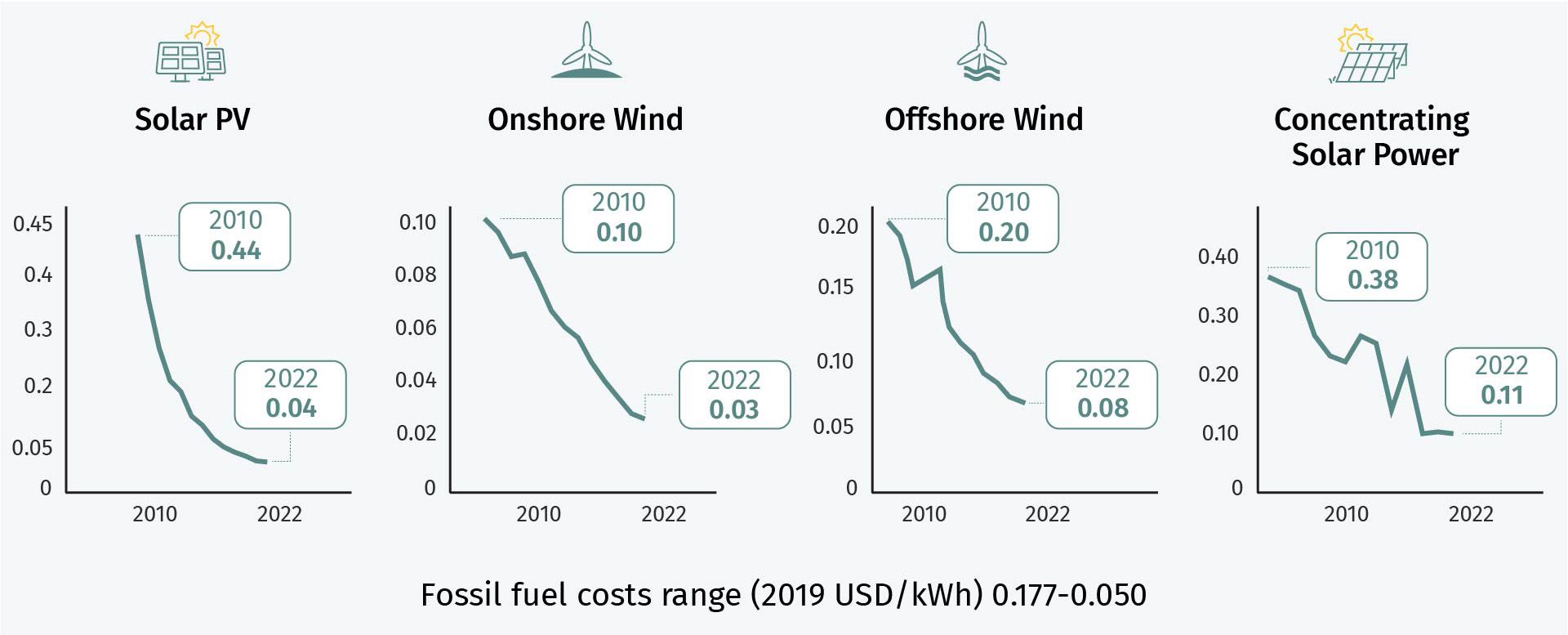
Source:International Renewable Energy Agency
Pricey fossil fuels: Offshore wind’s cost inflation shouldn’t be overstated, especially as renewables as a group continue to beat fossil fuels on costs. IRENA believes “expected high fossil fuels prices will cement the structural shift that has seen renewable power generation become the least-cost source of new generation.”
But there is room for complacency. With critical minerals—vital for solar panels and wind turbines—facing a crunch, and higher interest rates and strained supply-chains challenging project economics, renewables need to get over this speed bump fast.
CHART OF THE WEEK
Oil’s Mixed Signals
The world consumes around 100 million barrels per day of oil, but what does the future hold? U.S. super major ExxonMobil’s bullish outlook for oil demand clashes with what the International Energy Agency (IEA) believes is necessary to fight climate change. Clearly, oil producers’ forecasts have an inherent bias, but it also signals industry strategy: oil majors are buying up smaller oil and gas rivals (upstream M&As were above their five-year average in Q2), increasing dividends and buybacks, and showing signs of cooling off on renewable investments—at least for now.
Where’s Oil Demand Headed?
Global oil demand forecast (in million barrels per day)

Source:International Energy Agency, companies
ZEROING IN
Breaking Tesla’s Grip
Tesla is slowly losing its grip on the Canadian EV space. The trendy EVs now account for 40.6% of British Columbia’s new EV sales, compared to nearly 61% a year ago, with Ontario and Quebec witnessing similar drops. But the overall EV pie is growing, with every 10th registered car in Canada in the second quarter an EV.
| 10.5% | EV’s share of new vehicles registered in Canada in Q2, surpassing the record 10.3% set in Q4, 2022. |
| 40.5% | Quebec’s share of all new Canadian EV registrations in Q2; Ontario accounted for 28%, and B.C. 23%. |
| 6,487 | Tesla’s Model Y sold in the quarter, the highest of any model. But the U.S. car-maker’s market share in percentage terms has slipped across Canada. |
| 23% | S&P Global’s forecast for EV’s market share of all new cars registered in Canada by 2025. |
Source: S&P Global Inc.
Climate In Action
As Hurricane Idalia hit Florida with all its ferocity, Hollywood is channelling—and streaming—climate anxiety. While movie studios’ fascination with dystopian futures stretches back decades, ‘Extrapolations,’ Apple TV’s 8-part series climate thriller (starring Meryl Streep, et al), offers a peek into a near-future, eco-wrecked world. Life in a 1.5+ Celsius environment is hellish with climate refugees, people lugging around oxygen tanks, and profiting billionaires fiddling with ineffective transition technologies. Grim stuff. Think Netflix’s ‘Black Mirror’ with a climate twist.
Capping oil and gas emissions. Federal draft regulations to cap emissions from oil and gas production are coming this fall, according to Environment Minister Steven Guilbeault. Details are scarce, but last year’s Emissions Reduction Plan notes that the cap aims to “reduce emissions at a pace and scale needed to align with the achievement of net-zero emissions by 2050, with five-year targets to stay on track.” Alberta Premier Danielle Smith has shot back, stating that “under no scenario” would the province permit the oil and gas cap (or the proposed federal electricity regulations, for that matter) to be implemented.
Border Tax: The European Union is set to slap a special tax on countries with weaker environmental rules. The Carbon Border Adjustment Mechanism will soon be levied on cement, iron and steel, aluminum, fertilizer and electricity from non-EU countries depending on the carbon content of their imports. Implementing it will be tricky, and auditing emissions a nightmare. India and other emerging economies are worried, but the EU sees it as part of the G7’s Climate Club initiative to encourage greener supply chains across emerging markets.
Zero emissions roadblocks. Everyone wants climate action and clean air—until it hits their wallets. The state of New Jersey is suing the federal government to stop New York City’s landmark congestion price plan. Across the pond, London mayor Sadiq Khan was forced to shelve plans to levy charges on all combustion-engine vehicles entering central London after strong backlash from several quarters, including Prime Minister Rishi Sunak.
Burning up: Climate activism is turning up in unlikely places these days. An 18-year-old Swedish activist is suing Greenpeace for what she calls the environmental group’s “old-fashioned” anti-nuclear stance. A protestor threw (washable) paint on a Tom Thomson painting in Ottawa’s National Gallery as part of a worldwide attack on global installations to bring attention to climate change. Meanwhile, climate activists blocked traffic to the Burning Man festival in the Nevada desert. Among their demands: ban private jets, single-use plastics, and generator use at the bohemian festival.
PUBLIC POLICY
Grocers’ Plastic Problem
Canada’s biggest grocers are on notice. Ottawa is asking the country’s major retailers to cut single-use containers that account for two-thirds of products on grocery shelves.
Limiting plastic use would lower emissions (plastics are sourced from fossil fuels) and reduce energy and food waste. Target products include condiment bottles, baby food packets, plastic pet food sacks, milk bags and shrink-wrap on vegetables and meat that often have short shelf life and quickly end up in landfills. Industry claims it would raise grocery bills and do little to limit food waste.
Why go after single-use plastics?: Images of plastic bits and pieces stuck in marine animals’ throats are a common, harrowing sight. Such plastics are also among the four most widespread items polluting the oceans. It’s a growing problem, too: single-use food and beverage packaging litter found on Canadian shorelines nearly doubled in a year in 2020.
Plastic Pollution: A Growing Problem

Source:Government of Canada
What’s the target? Industry is being asked to come up with voluntary regulations to reduce plastic packaging in grocery stores, but Ottawa will step in if proposed standards are inadequate. A government consultation document—a P2 notice–,released in early August, set the following ambitious goals:
- At least 75% of fresh fruits and vegetables to be sold in plastic-free packaging by 2026, and 95% by 2028.
- 100% of primary food plastic packaging should be reusable, recyclable, or compostable by 2028.
- Develop strategies for 60% of the products that come in reuse or refilled system, plastic-free packages by 2035.
- As Canadian retailers often control vast chunks of the supply chain, products should be designed to optimize circularity and recyclability.
What’s next?: The government will draft a notice for public comments but hasn’t released a final date yet.
CHART OF THE WEEK
Fading Beaches In A Warming World
A world with fewer beaches is a poorer world indeed. On World Beach Day today, we highlight a forecast commissioned by the European Commission in 2020, that suggests many of Canada’s sandy beaches could wash away—roughly the size of Greece’s coastline— as global warming raises sea levels. Sustainable coastal zone and catchment management practices are under way in Canada and elsewhere, but more needs to be done.
Length of Sandy Beaches Projected To Be Lost By 2100

Source: Delt University of Technology/Joint Research Centre of the European Commission
CAPITAL
ESG Is Out, Heat Pumps Are In
Hydrogen and heat pumps are the new buzzwords in Corporate North America. While top executives largely avoided saying “ESG,” (short for environmental, social and governance) during earnings calls this quarter, “climate” and “decarbonization” were in frequent use, according to a report by Sara Mahaffy, equity analyst at RBC Capital Markets LLC, who crunched the numbers on key words used by the C-suite during investor calls.
Some quarter highlights:
- While avoiding ESG—which has become a politically charged word in the U.S. — companies used more specific terms such as circularity, water scarcity, wildfires and Indigenous rights (the last two particularly in Canada).
- Energy executives across North America largely avoided the word “climate” in their latest calls, focusing on transition technologies such as hydrogen and heat pumps.
- “Nuclear power” is gaining traction in Canada (albeit from a low base), with companies touting longer-term opportunities from customers’ refurbishing plants and opportunities around small modular reactors.
Transition Technology Buzz
Mentions of Energy Technologies By North American Executives

Source: RBC Capital Markets LLC
ZEROING IN
China’s Coal Addiction
Canadian Environment Minister Steven Guilbeault’s visit to China this week to attend diplomatic meetings with an international group that advises Beijing on climate change has led to political outrage among some quarters at home. The minister argued that there’s “no solution” on the climate without China.
Some statistics show the scale of China’s emissions problem and coal addiction:
| 29.18% | Percentage of global greenhouse gases emitted by China, making it the world’s biggest polluter in absolute terms. |
| 60% | Power sourced from coal in China. It needs to drop to 5% by 2050 for China’s power sector to achieve Net Zero by 2055. |
| 68% | China’s market share of all new coal projects under development across the world in 2022. |
| 128GW | Increase in China’s projected coal power capacity by 2030—an 11% increase over current levels. |
Source: International Energy Agency, Global Energy Monitor
School’s back. As young Canadians return to the classrooms next month, some likely experienced harrowing real-life climate change episodes (wildfires, heatwaves and floods). Is it time to formally introduce climate change in the curriculum? New Jersey did so recently, but it’s a tall order. Informally, around 40% of Canadian educators spend 10 hours or less in a school year on climate topics, a third don’t teach it all, while many do not feel they are adequately trained to teach climate change.
BRICSAIEESAU, anyone? It doesn’t roll off the tongue quite as easily as BRICS, but the Brazil-Russia-India-China-South-Africa alliance invited Argentina, Iran, Egypt, Ethiopia, Saudi Arabia and the UAE at their summit in South Africa this week. With several members at odds with each other (China-India and Saudi Arabia-Iran rivalries are well-documented), the union could struggle to present a united front on geopolitical issues and counter what it perceives as the Western narrative on climate change and low-carbon financing.
But if it can pull together, the union of some of the world’s biggest oil and gas producers and consumers could potentially hold a lot of sway over global energy and decarbonization policies.
De-extinction events. U.S.-based Colossal Biosciences, backed by billionaire Peter Thiel, plans to bring the woolly mammoth, Tasmanian tiger, and the dodo back from extinction. What could possibly go wrong? A mammoth revival could help “rewild” the Arctic tundra, and help recover the region’s lost biodiversity, the company claims. The project has US$225 million in funding but faces formidable bio-engineering challenges. If all goes to plan, mammoths may be roaming the Arctic as early as 2028 (note big if).
Climate of anger: A study of Norwegians angry about climate change is quite revealing: Anger is the biggest driver of activism and policy support, but does little to change the individual’s own behaviour. Climate denialism was a major anger trigger, while nearly a third held politicians and industry responsible for climate change. A popular solution reported by respondents? Tax gasoline to alter the behaviour of industry–and individuals.
Sails up. A Cargill cargo ship powered by two 120-feet tall steel sails (picture here) embarked on a China-to-Brazil trip this week to test the technology. While not exactly billowing, the glass-and-steel sails could cut marine emissions by 30% and help the industry meet new energy efficiency rules.
BUILDINGS
Tackling A Housing Crisis
Dearth of affordable housing was a top agenda item at the federal government’s retreat in Charlottetown this week. The discussion was reportedly informed by a new report by housing experts such as Mike Moffatt. Among its 10 recommendations: focus on energy efficient rentals.
We may need to extend that to all housing, as the RBC Climate Action Institute wrote in a recent report.
Canada’s residential emissions are among the world’s highest
Tonnes of CO2 per capita from residences

Source: RBC Climate Action Institute, OECD
Here are some ideas policymakers may want to consider as they build their way out of the housing crisis:
- Coding up: Building the estimated 5.8 million new homes by 2030 (a 40% increase over current levels) with current building codes would add up to 18 million tonnes of greenhouse gas emissions, according to our estimates.
- Sustainable tech: Heat pumps—already popular in Atlantic Canada and B.C.—should become mainstream and eventually replace emissions-intensive gas furnaces.
- Labour force: Canada needs 45% more HVAC tradespeople and 55% more electricians, according to our estimate. New housing minister Sean Fraser also recently identified skills shortage as a major obstacle to building new homes.
- Printable homes: Tech-driven innovations such as 3D-printed or prefabricated buildings could gain traction with building codes supportive of Net Zero buildings.
- Low carbon designs: Innovations such as mass timber can address the “embodied carbon” challenge. Wood in tall buildings allows the carbon to effectively be locked up for 100+ years and reduce heat loss.
Sustainable housing features prominently in Ottawa’s recently-released National Adaptation Strategy, but it’s a Canada-wide effort, with provincial and municipal policymakers such as new Toronto mayor Olivia Chow also tackling facing the heat of housing affordability. As Moffatt wrote in an op-ed, tackling the housing crisis demands a “war-time effort.” Bring on the big policy guns.
CHART OF THE WEEK
A Prairie Renewable Surge, Interrupted
Renewable energy companies are reportedly initiating their own pause after the Alberta government halted approval of new projects for seven months to address land-use issues. Some analysts worry that the time-out could interrupt Alberta’s country-leading drive to expand renewables in the power sector.
Renewable Energy Capacity in Alberta
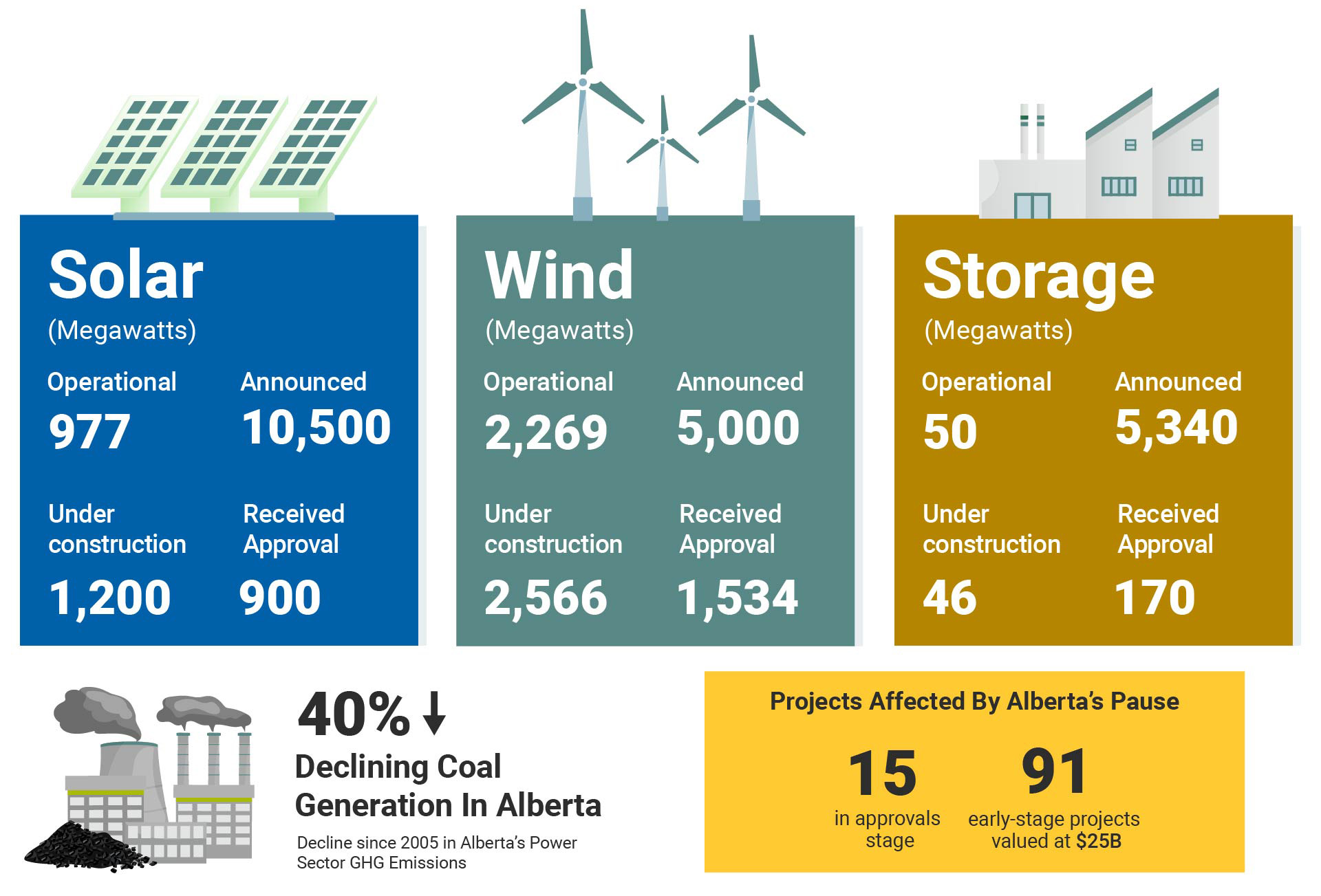
Source: Alberta Electric System Operator, Business Renewables Centre, *Pembina forecast
CRITICAL MINERALS
A Looming Commodity Crunch
Lack of nickel and cobalt could stymie the U.S.’s energy transition, warns a new S&P Global study led by energy historian Daniel Yergin. The Inflation Reduction Act and other emissions-busting measures would raise U.S. demand for cobalt, lithium and nickel by as much 20 to 27 times compared to current levels. But shortages could throttle the transition.
U.S. Critical Mineral Demand
Thousand metric tonnes

Source: S&P Global
Some report highlights:
- Significant deposits of critical metals such as cobalt, copper, lithium and nickel are controlled by “foreign entities of concerns,” which the U.S. views as hostile.
- Allies Canada and Australia produce enough cobalt to support U.S. energy-transition-related demand, but currently 12% and 3% of their exports, respectively, are U.S. bound.
- Nickel production is concentrated in countries that do not have a free trade agreement with the U.S.
- Around 90% of U.S. lithium imports are sourced from Argentina and Chile. Planned capacity in the U.S., Canada and Australia must deliver to protect the U.S.’s booming electric vehicle industry.
- By 2030, the U.S. domestic nickel demands will likely surpass total production in countries the U.S. has a trade agreement with.
- Chile and Peru are key drivers of copper, “the metal of electrification,” but China controls nearly half the supply in those countries. U.S. permitting challenges and limited capacity additions puts American access to copper at risk.
There is no shortage of concerns. Critical mineral superpowers such as Chile, Democratic Republic of Congo, Zimbabwe and Namibia, are introducing new levies and polices, exports bans and even restricting supplies, a la OPEC, to ensure higher prices for their commodities. There is also the fear the weaponization of critical minerals, just as Russia leveraged its oil and gas to squeeze Europe.
If the path to energy transition is through mines, the West will need to be shovel-ready.
ZEROING IN
Climate Migration–Canadian Edition
Canadians are temporarily fleeing Yellowknife and Kelowna that have been hit hard by extreme weather. But some are contemplating a more permanent move in what’s emerging as an early indicator of climate-related migration by Canadians, according to a new Angus Reid poll.
Some highlights from the 1,600-Canadian poll:
| 13 | Percentage of Canadians looking to permanently relocate to avoid wildfires and smoke; young adults are more anxious with a quarter looking to get out of climate vulnerable places. |
| 63% | Canadians who say climate change is a crisis that must be addressed; 10% believe it’s already too late. |
| 55% | Canadians who believe wildfires will get worse in the future. Only 8% expect moderate weather ahead. |
| 53% | Percentage of Canadians who were compelled to stay inside to avoid smoke and heat this summer. A quarter cut back on exercise, while a fifth saw their health impacted by the smoke. |
Source: Angus Reid Institute.
CLIMATE IN ACTION
It’s been an unrelenting summer, but we refuse to doomscroll. The brutal force of climate change (the Northwest Territories and Maui being the latest victims) has galvanized regular folks (see Montana youth and Climate Dads below), while new policies and capital flows are leaning towards climate action.
Buffett’s Carbon Bet. Warren Buffett-backed Occidental Petroleum snapped up B.C.-based startup Carbon Engineering for US$1.1 billion, attracted by the novel carbon-removal technology developed by founder David Keith. The two entities are well-known to each other, with Carbon Engineering a partner in Occidental’s Texas-based Stratos project, set to be the world’s largest direct air capture plant once it’s built in 2025. Stratos was also one of two projects that secured a combined US$1.2 billion from the U.S. Department of Energy last week.
Courting Climate Action. In a stunning decision, a Montana state court ruled that the major coal-producing state’s promotion of fossil fuels deprived a nine-year-old and 15 of his youthful companions of a “clean and healthful environment.” A key consideration by the court: the state didn’t factor in the various energy projects’ greenhouse gas emissions before approving them. The state’s attorney general’s office will appeal the ruling to the Montana Supreme Court. Similar activist efforts have failed in the past, but the first-of-its-kind U.S. ruling could usher in a wave of environmental cases.
Superconductor’s superfizzle. A South Korean superconductor experiment was largely debunked, but it has revived efforts to crack one of physics’ hardest challenges. Korean scientists had claimed a concoction of copper, lead, phosphorous and oxygen could conduct direct current electricity without energy loss—a superconductor, if you will. This could change how we use energy in grids and transportation (think levitating trains and fast-charging EV cars), making it a superpower among energy sources, especially if paired with fusion power.
Arise, Climate Dads! An 800-strong advocacy group of young fathers experiencing climate change anxiety are hoping to spark a love of plant-based proteins (move over, Grill Dads) and heat pumps in their children. But they are everywhere, with some climate dads even willing to downsize their homes to cut their carbon footprint, according to a survey. Bring on the Climate Dad jokes.
PUBLIC POLICY
CER Makes Room For Gas
Ottawa’s Clean Energy Regulations consultations, launched last year, had sparked tensions between Ottawa and fossil-fuel reliant provinces such as Alberta and Saskatchewan that had insisted on keeping gas on the grid. Now draft CER rules, launched last week, offer an olive branch in an effort to alleviate provincial concerns.
Here’s how the draft rules view gas use:
- High threshold: An unabated gas-fired generator produces 400-500 tonnes per GWh. New rules suggest new major gas plants after 2035 must meet an annual average emission threshold under 30 tonnes of CO2 per gigawatt-hour (GWh) of electricity produced.
- Some wriggle room: For reliability, unabated peaking gas turbines can fire for up to 5% of the year without meeting an emissions performance standard.
- A free pass, even: Natural gas turbines already in service before 2025 have 20 years of uncapped emissions before being subject to the rule. Plants built after 2025 can emit until 2035 but will need to comply after that.
- Underpinned by abatement: Natural gas-fired generators that install carbon capture can apply for exceptions to the emissions threshold (increasing allowed emissions to 40 tonnes/GWh on an annual average basis) for up to 7 years after commissioning the unit.
Some provincial grids will find it harder to hit Net Zero targets by 2035
GHG emissions in electricity sector by jurisdiction
| Jurisdiction | Electricity Total Greenhouse Gases (Megatonnes) |
Electricity Sector Emissions as a % of Total Emissions | Share of clean/renewable electricity (%) |
|---|---|---|---|
| British Columbia | 0.4 | 1 | 97.5 |
| Alberta | 32.7 | 13 | 15.1 |
| Saskatchewan | 13.9 | 21 | 14.1 |
| Manitoba | 0 | 0 | 99.8 |
| Ontario | 3.7 | 2 | 92.3 |
| Quebec | 0.3 | 0 | 99.7 |
| New Brunswick | 3.5 | 28 | 73.4 |
| Nova Scotia | 6.3 | 43 | 26.6 |
| Prince Edward Island | 0 | 0 | 99.3 |
| Newfoundland and Labrador | 1 | 10 | 97.8 |
| Yukon | 0.1 | 9 | 72.8 |
| Northwest Territories | 0.1 | 4 | 68.7 |
| Nunavut | 0.2 | 25 | 0.2 |
| Canada | 62.1 | 9 | 82.6 |
Source: Environment & Climate Change Canada, Canada Energy Regulator, RBC Climate Action Institute
The rules give gas-reliant Alberta and Saskatchewan some breathing room, but economic incentives announced in Budget 2023 are firmly nudging provinces to transition natural gas out of the grid over time.
Read RBC Climate Action Institute’s full analysis here.
Further Reading: Renewable energy companies seek transparency on Alberta moratorium – The Globe and Mail
CHART OF THE WEEK
Canada’s Carbon Count Shoots Up
Wildfires are set to throw Canada’s carbon count out of whack. Natural Resources Canada scientists’ preliminary research shows around 1,420 million metric tons of carbon dioxide equivalent were released from the fires as of mid-July—more than double Canada’s total 2021 emissions. With wildfires razing parts of Europe, Central Asia and now Maui, how would it impact the world’s carbon emissions count this year?
Wildfires Light Up Canada’s Carbon Emissions Count
Million metric tons of CO2 equivalent released
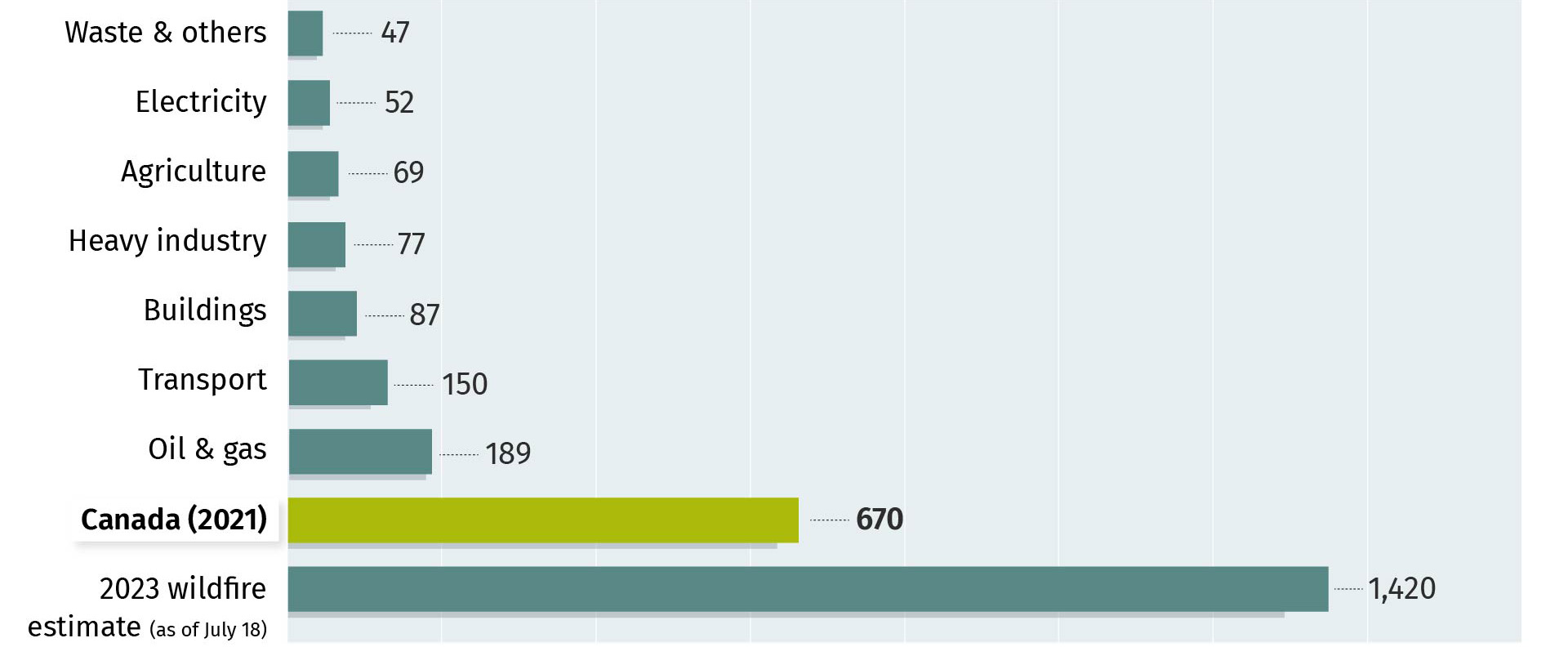
Source: Natural Resources Canada/Bloomberg
PUBLIC POLICY
A Year Full Of IRA
Investment Magnet
Investments in clean energy projects in U.S. post-IRA
| Sectors | # of projects | Investments (US$ Bn) | Jobs |
|---|---|---|---|
 Batteries Batteries |
91 | 77.7 | 92,918 |
 Clean Technologies Clean Technologies |
25 | 133.38 | 18,588 |
 Electric Vehicles Electric Vehicles |
65 | 44.1 | 32,428 |
 Grid & Transmission Grid & Transmission |
13 | 4.73 | 2,413 |
 Hydrogen Hydrogen |
12 | 11.71 | 7,140 |
 Solar Solar |
56 | 20.85 | 21,572 |
 Wind Wind |
29 | 20.07 | 8,020 |
Source: Climate Power (Aug 16, 2022-July 25, 2023)
Happy birthday, IRA! The Inflation Reduction Act was signed into law by U.S. President Joe Biden this week last year, and while its impact on inflation is uncertain, it has already made an impression on the climate economy:
- Over 280 new clean energy projects valued at more than US$278 billion were unveiled in 44 states since its launch, creating over 170,000 jobs, according to research firm Climate Power.
- Of these, 152 clean energy projects valued at US$225 billion in investments were announced in 92 Republican-held districts, creating 96,000 new jobs.
- Michigan attracted the largest number of IRA-related projects with 24, followed by Georgia (22), South Carolina (20), California (16) and Texas (14).
For all of IRA’s promise, the U.S. may still struggle to meet its Paris pledge to cut greenhouse gas emissions by 50-52% below 2005 levels by 2030, with Rhodium Group predicting the country will only manage to cut GHGs by around 42% by 2030.
ZEROING IN
Greenbelt Blues
Ontario’s decision to alter the province’s Greenbelt region to build more housing “was not transparent, fair, objective, or fully informed,” a critical Office of the Auditor General of Ontario report concluded last week. The move was not needed to alleviate the province’s housing crunch and would degrade green spaces and contribute to climate change, the auditor noted.
A look at the Greenbelt’s critical role in maintaining the province’s biodiversity and climate mitigation efforts:
| 2 million | Acres of protected land that arc around the Greater Toronto Area. Created in 2005, the preserved area offsets 71 million tonnes of carbon (equal to taking 56.5 million cars off the road annually). |
| 78 | Number of at-risk species protected by the Greenbelt. The area also preserves 721,000 acres of wetlands, grasslands and forests. |
| 7,412.64 | The acres Ontario government removed from the Greenbelt to build homes. The government added 9,400 acres elsewhere to ensure regulatory compliance. |
| 29 | The number of at-risk species that live, or are likely to live, in the removed sites; 76% of the acres removed were in active agriculture use. |
Source: Greenbelt Foundation/ Office of the Auditor General of Ontario
Climate In Action
What we are watching:
The site formerly known as Twitter seems to have taken a wrong turn. Search results for the word climate in the newly minted “X” are teeming with climate conspiracies and looney hot takes on heatwaves, while scholarly voices appear to have mostly abandoned the world’s so-called town square.
New Energy: Jonathan Wilkinson added “energy” to his portfolio as Natural Resources Minister in the latest federal cabinet shuffle. The change potentially highlights the heavy-lifting needed to cut oil and gas emissions and build a low-emissions energy system.
Climate culprits: Human fingerprints are all over this current heatwave, at least according to Imperial College London researchers. The authors conclude—with “certainty”—that the current extreme weather spell in North America would have been “virtually impossible to occur” without human induced climate change.
Avalanche of cases: A U.K. judge threw out an activist group’s case against Shell’s board of directors, citing that the lawsuit “ignores” the company’s size and complexity. But the avalanche of climate-related lawsuits is unlikely to subside: since December 2022, 2,180 climate-related cases have been filed in 65 jurisdictions..
Thrill, baby, thrill: Actor Jamie Lee Curtis debuted a gruesome graphic novel at the San Diego Comicon about an “experimental” oil project gone wrong, leading to an eco-disaster. Plus, three breezier climate reads for the summer.
Climate Signals is taking a two-week break. Look out for us again in your inbox on August 18.
CHART OF THE WEEK
Green Metal Powerhouse
A new BloombergNEF ranking places Canada second only to Australia as a jurisdiction suitable for developing metals and minerals that are vital for energy transition. While its green metals’ reserves may not be massive, Canada’s regulatory framework and talent pool could transform the country into a metal power, the ranking shows.
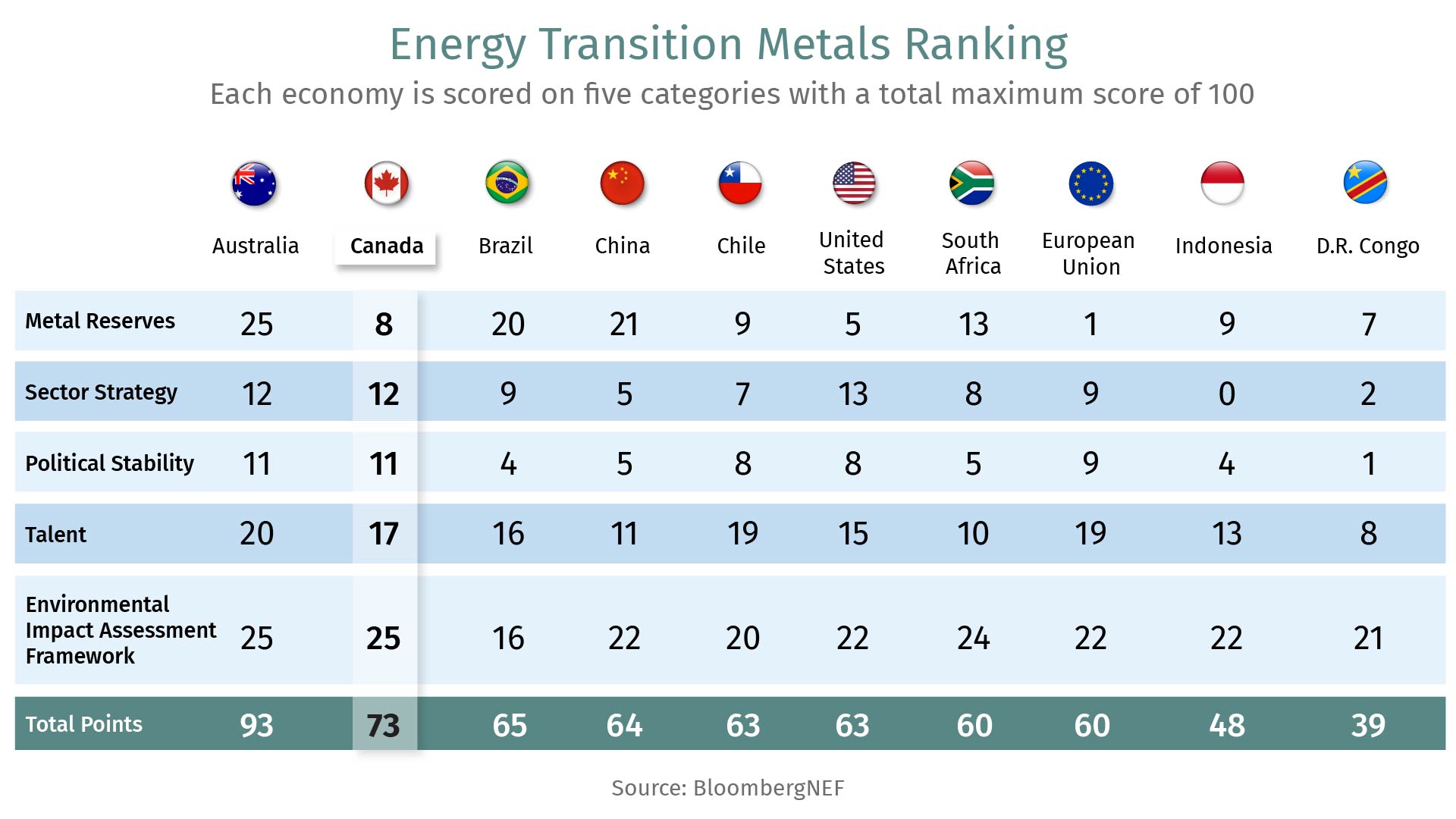
ENERGY
3 Fossil Fuel Subsidy Loopholes
Canada released a framework to eliminate inefficient fossil fuel subsidies—the first among G20 nations to do so. But there is a catch—six of them—that could allow the federal government to facilitate fossil fuel growth. Three carve outs that caught our attention are projects that:
#1. Enable significant net GHG reductions in Canada or internationally through Article 6 of the Paris Agreement: Canada could presumably get carbon credits if, say, Japan cuts coal consumption as a direct consequence of B.C. LNG exports to the country.
#2. Involve Indigenous groups’ participation. Economic opportunities for Indigenous groups are essential to economic reconciliation. And with proposed liquefied natural gas exports backed by Indigenous groups, and many First Nations servicing oilsands projects, the industry seems unlikely to get bogged down by the new policy.
#3. Support carbon capture, utilization, and storage (CCUS), or have a credible plan to achieve net-zero emissions by 2030. The oilsands’ biggest expense item will be unaffected by the new no-subsidy rule.
AGRICULTURE
Farming In Extreme Weather
Talk about being on the frontlines of climate change: Farmers are among the first to take an economic hit from the current heatwaves baking the world.
With harvest season weeks away, around 20 drought-hit municipalities in Saskatchewan—Canada’s bread basket—declared states of emergency. An unusually large swarm of grasshoppers (partly due to unusual climate conditions) in the province are also ravaging crops. In Alberta, some producers have abandoned crops and/or sold off livestock due to lack of rain and feed supply.
Food fight: Heatwaves in Europe and the U.S. are also hurting yield, with prices of corn, oats and soybeans rising. India, facing extreme heatwaves and flooding, is banning sale of certain rice varieties to meet domestic demand, while Russia exited a grain export deal that allowed peaceful flow of food exports from Ukraine. The series of blows risk triggering price hikes and food security challenges in many countries, the IMF warned.
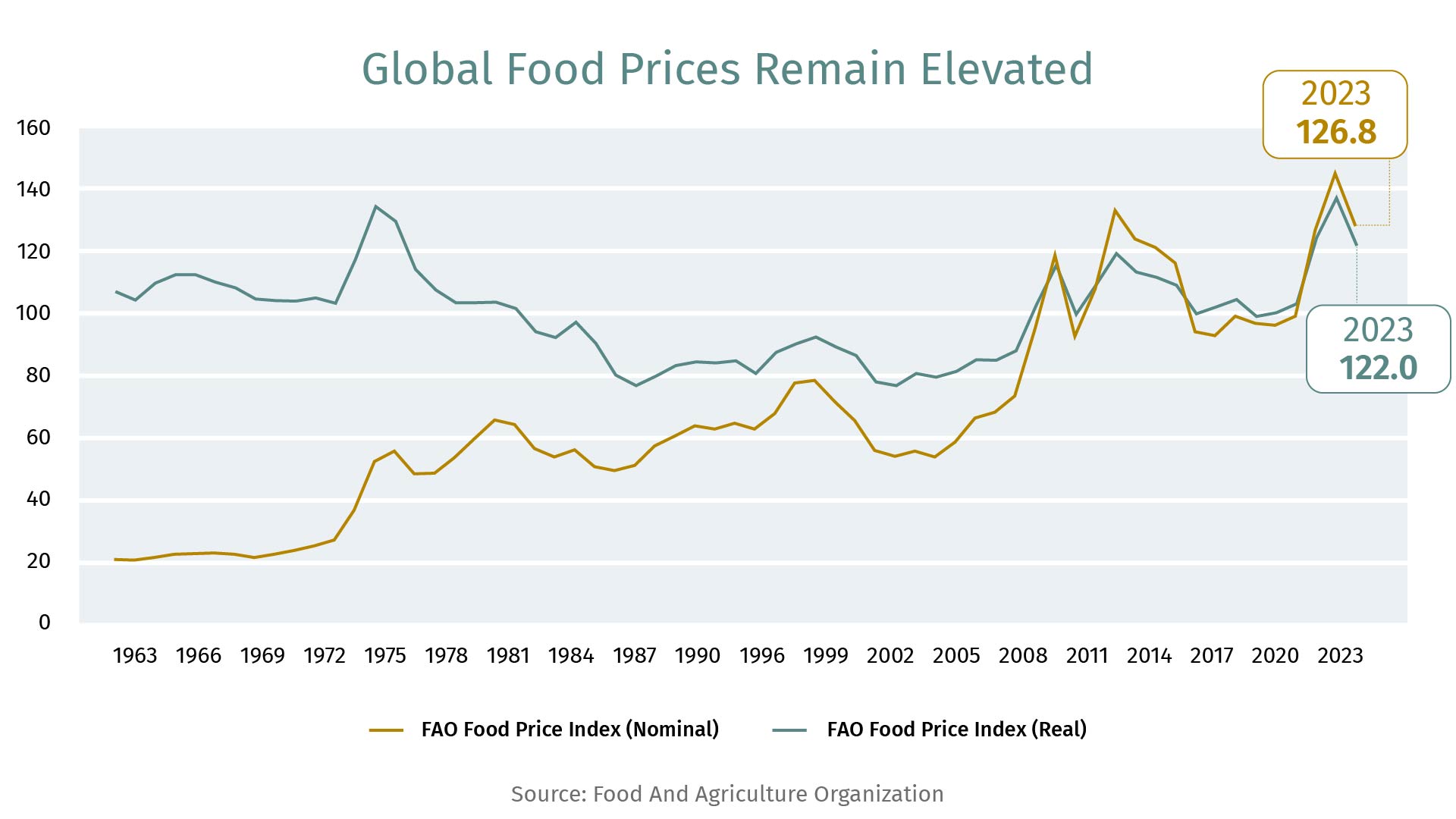
New Green Revolution: There are no quick solutions, but for Canada, the challenge is to raise food production and lower emissions for a hungry world. In a series of recent reports on agriculture, RBC identified strategies that can set us on a path to produce more while emitting less. Read more here.
ZEROING IN
How Green Is AI?
ChatGPT may change the world, but it could also drive pollution higher. Tech industry’s shiny new toy has a pretty formidable carbon footprint—and it’s just getting started, especially as AI frontrunners Microsoft and Alphabet build more energy-intensive data centres to meet soaring demand for new-age AI services.
| 502 tonnes | GHG emissions needed to train Microsoft-backed GPT-3 last year—equivalent to 123 gasoline-powered passenger vehicles driven for a year. |
| 0.8-1 kgCO2e | Emissions generated by a single AI query, 4-5 times that of a simple Google search. |
| 2.3 terawatt hours | Power needed by Google’s AI annually—equivalent to powering all homes in Atlanta. |
| 2 | The percentage of global emissions generated by data centres that AI depends on, equivalent to the aviation industry’s footprint. |
Source: Stanford University, Bloomberg, Carbon Credits
Climate In Action
What we are watching:
It’s getting apocalyptic out there, with flash floods, heat domes and wildfires setting new records—everywhere. The death of two brave firefighters and a helicopter pilot in West Canada are stark reminders of the ferocity of a wounded ecosystem. Economic flows are rattled too, with the frequency of extreme weather ravaging crops, straining power grids, and upending summer travel. One early silver lining in the hazy cloud? Visible weather disruptions are triggering change in consumer behaviour, according to one early study.
Climate policy space is heating up, too:
Climate Clash: Even U.S. climate czar John Kerry’s charm failed to sway Beijing as the world’s two major contributors to greenhouse gas emissions continue to clash. Soon after “reconnecting” with the U.S. during Kerry’s recent visit to China this week, Beijing issued a stern warning: it will not tolerate outsider interference in its climate-change policies. Co-operation on climate is on a knife-edge as the world sizzles.
New climate COP: Expect tempers to flare further as the UAE, COP28 host, unveiled a “brutally honest” agenda for the UN Climate Summit in November. Its four key themes: fast-tracking the energy transition, fixing climate finance, focusing on people’s lives and livelihoods, and full inclusivity. Not on the agenda, but likely to dominate headlines: fight over fossil fuels.
Easterly winds: Nova Scotia is emerging as a promising renewable energy destination after EverWind Fuels’s agreed to invest $1 billion in wind farms generating 530-megawatts, to power its green hydrogen and ammonia production for export markets. EverWind is also in the running to develop an $8-billion green fuels project in Newfoundland and Labrador.
Some climate adaptation tips: Birdbaths for our feathered friends, and ice vests for cyclists.
CHART OF THE WEEK
Burn rate
Canada’s crisp, blue skies are replaced by a smoky, grey blanket as wildfires rage across the country. And the costs are real: at its peak year-to-date, 2,000-plus workers were engaged in fighting fire, around three times the 10-year average. While Canada’s recent National Adaptation Strategy set goals for 2025 and beyond, it feels like we need to take action now.
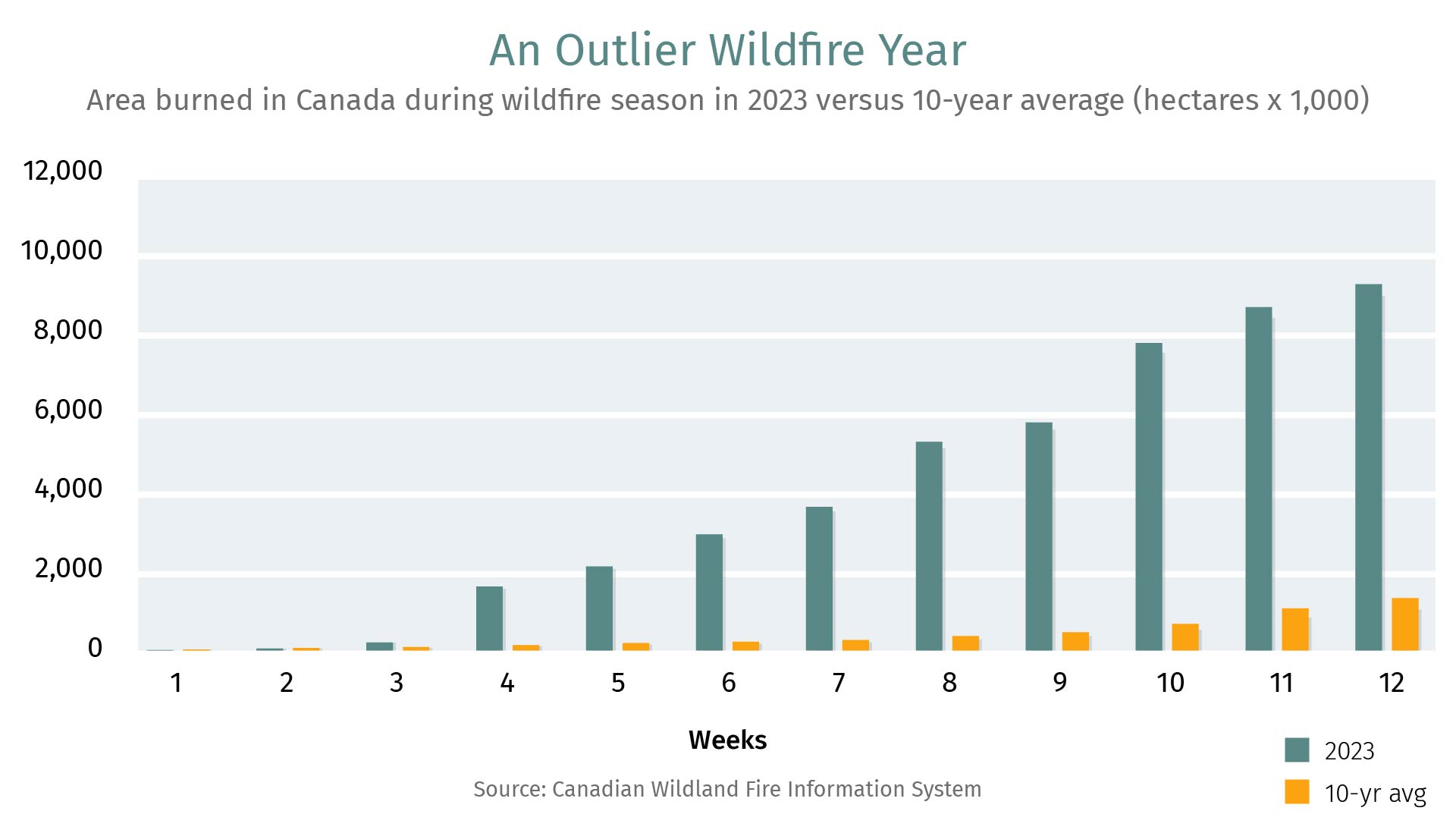
Source: Canadian Wildland Fire Information System
CRITICAL MINERALS
Time to Dig Deep
The Ring of Fire is emblematic of Canada’s critical minerals potential: promising but lacking political capital to get major projects on the starting line.
Northern potential: Indigenous buy-in is key for mine development in the Northern Ontario region abundant in critical minerals. But the region is also home to peatlands that store an estimated 35 billion tonnes of carbon.
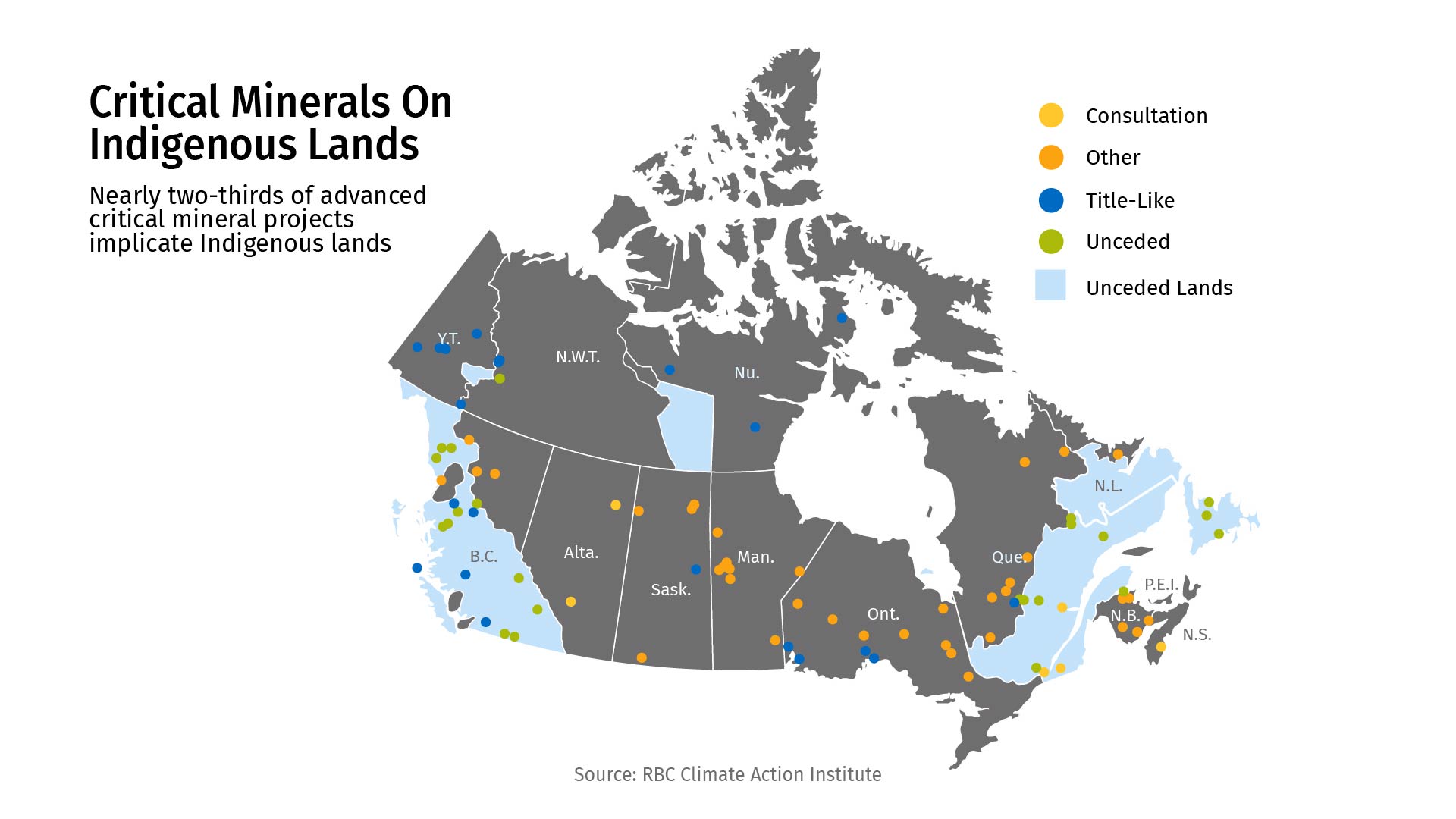
Fast-tracking projects: The Ring of Fire is a “challenging space,” senior Ottawa officials acknowledge, while Environment Minister Steven Steven Guilbeault believes the exclusion of Indigenous groups in projects has delayed projects. Ottawa is also expected to unveil a plan by the year-end to streamline permitting for mining projects, while there is a push to establish a national Indigenous loan guarantee program.
Mineral investment magnet: While the Ring of Fire has been in a regulatory bog, Canadian miners have been on the move elsewhere. Canada led the world (along with Australia) in minerals’ exploration with over 40% year-on-year growth in 2022, especially in lithium and nickel plays, according to the International Energy Agency. A third of all new cobalt refining projects is planned in Canada, while General Motors, BASF, POSCO and Vale are eyeing development of a battery hub in Bécancour, Quebec, including raw materials, cathode and recycling operations. But there’s a need to move faster as metals scarcity and geopolitics could impede energy transition.
Alternative to China: Canada has struck a slew of deals with the U.S., EU, the U.K., Japan and others to leverage its critical mineral abundance and reduce Western dependence on China. Now we need to boost critical mineral production. Case in point: Beijing’s recent export curbs on gallium and germanium metals had the West scurrying for the commodities used in solar parts. Luckily, Canada’s Teck Resources is a major producer of germanium, while both metals feature in The Canadian Critical Minerals Strategy.
PUBLIC POLICY
Losing To IRA
The Inflation Reduction Act is the 900-pound green beast that looms over discussions between energy corporations with officials in Ottawa and provincial capitals these days.
For good reason. While Canada can compete for wind and solar power investment with U.S. incentives turbocharged by its climate bill, it is struggling to remain competitive in other low-carbon technologies, according to a new report by Clean Prosperity and The Transition Accelerator.
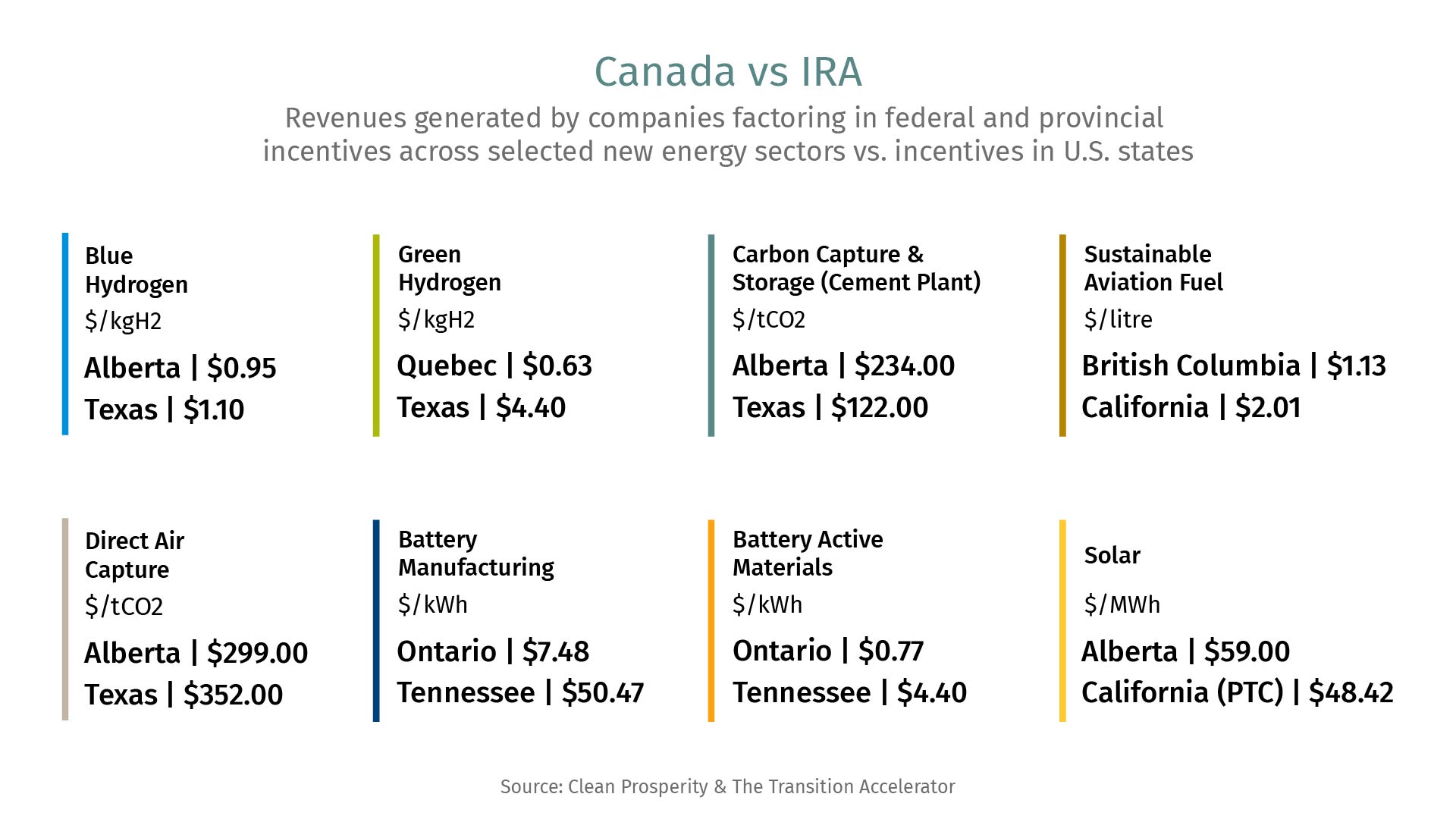 How can Canada keep up? The analysts have two recommendations:
#1. Companies are concerned Canadian climate policies don’t lend themselves to cashflow certainty for projects. Time is running out as many companies are making investment decisions now to meet 2030 goals. Ottawa should quickly introduce long-term contracts for difference (CCfDs) to bring market certainty.
#2. Canada will struggle to compete with U.S. firepower, but it can focus on strategic sectors such as hydrogen, biofuels and CCS, and leverage its policy tools such as carbon pricing mechanisms, tax credits, and direct financing tools like loans and CCfDs to create a formidable package.
It echoes a recent report by RBC Climate Action Institute, which recommended Canada play to its advantage by doubling down on key strategic sectors and treat IRA as a climate enabler, not a competitor.
ZEROING IN
Barbie’s Not-So-Fantastic Footprint
Barbie, a flick about the coming of age of the world’s most famous doll, hits the screens this week, and it got us thinking about plastic toys. They can go quickly go from joyful to junk, as children tire of them within a few years (weeks, even), but Barbies, Kens and other polymer playthings can hang around in landfills and at the bottom of seas for long periods of time—1,300 years in some cases. Here’s the scale of the challenge:
| US$1 Mn | Revenue from 48 million tonnes of plastic produced—a pile nearly 1,000 feet high, and more than half a mile in diameter—underscoring the industry’s plastic intensity. |
| 18.3 kg | The weight of plastic toys bought by the average Western household per child each year. Roughly $300/per child is spent annually on toys in North America. |
| 0.6kg CO2e | GHG emissions generated by a single Barbie, lower than Lego (Star Wars, Catwoman), Marble Frenzy, and a battery-powered plush dog, but more than Jenga, according to an 8-toy study. |
| 3.3 billion kg CO2 | GHG emissions generated by 60 million Barbies produced each year—equivalent to 734,000 gasoline cars on the road for a year. |
Source: UN Environment Program, Bloomberg, U.S. Environment Protection Agency, Report by Sarah Levesque, Madeline Robertson, Christie Klimas.
Climate In Action
What we are watching:
“All sticks and no carrot.”: That was Alberta Premier Danielle Smith pithy assessment of the spate of Ottawa’s climate policies being rolled out. Several premiers echoed that sentiment at their annual summit, concerned that federal climate policies are hurting growth. Ottawa countered that low-carbon economy will spark innovation.
#Restorenature: That was activist Greta Thunberg’s hashtag to push European Parliament members to vote for a strengthened Nature Restoration Law. The parliament’s biggest party opposed the deal over concerns about price hikes for consumers and impact on farmers and food industries. But the law was passed, albeit with a razor-thin margin.
A Canadian lake marks the beginning of a new geological age. Human-driven climate change and biodiversity loss are among reasons some scientists believe we are now in the Anthropocene era. The new age even has an epicentre: Thanks to its unique characteristics, Crawford Lake, 60 kilometres west of Toronto, was picked by scientists as the location that best records the dawn of the human epoch.
CHART OF THE WEEK
Supercharging EV supply chains
With clouds lifting over the Stellantis-LG deal, Canada has a strong foothold in the emerging EV supply-chain space. Ottawa is eyeing a couple more projects of similar scale, “but that’s going to be it, because that’s what Canada can afford,” according to François-Philippe Champagne, Minister of Innovation, Science and Industry of Canada, in what seems like a slightly underwhelming tone. Where’s the ambition?
Here’s what Canada has attracted so far:
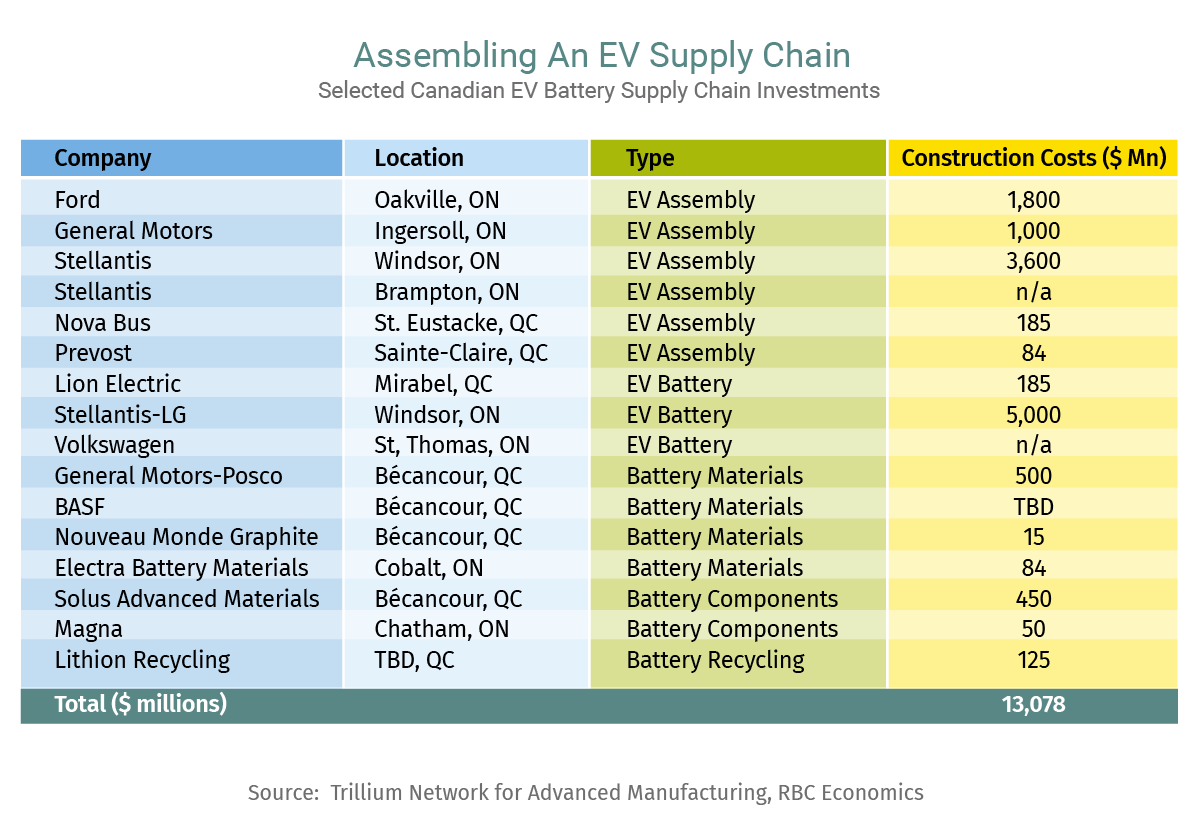
INDIGENOUS
A Powerful LNG Trio
Add uranium to the list of minerals facing critical shortages.
A trio of powerful Indigenous women are making a compelling sales pitch to Canada: a liquefied natural gas industry in the hands of First Nations means strong environmental discipline. Crystal Smith of Haisla Nation, Eva Clayton of Nisga’a Lisims, and Karen Ogen, of First Nations LNG Alliance, were out in force this week to make the case for West Coast LNG export projects as the global LNG industry met in Vancouver.

Gas’s tricky role: Gas has emerged as a vital but contentious energy source post-Ukraine. Backers say swapping coal with natural gas can rapidly cut fast-growing Asia’s emissions; skeptics argue continued dependence on natural gas delays the switch to zero-emission energy sources.
Indigenous pitch: Cedar LNG, backed by Haisla Nation and midstream company Pembina, has already secured environmental approvals and is eyeing a final investment decision by the fourth quarter of 2023. Woodfibre LNG, a smaller project by Pacific Energy Corp. and Enbridge, signed an Impact Benefit Agreement with the Squamish Nation, while Nisga’a Nation and a group of Calgary-based oil and gas producers are behind the massive Ksi Lisims LNG project.
Licence to export?: Indigenous backing gives LNG so-called social licence (although not all Indigenous groups back the projects), but several questions on environmental impact remain unanswered before an export license can be issued. Pembina Institute’s modelling shows the development of Shell-backed LNG Canada Phase 1 and Woodfibre means emissions from the sector will blow past the province’s 2030 sectoral targets. If Cedar and Ksi Lisims also proceed, total emissions could triple from targets.
Article 6: A Paris Accord clause that allows jurisdictions—at least in theory— to receive credit for reducing emissions in other countries was a topic of discussion between Alberta Premier Danielle Smith and PM Justin Trudeau on the sidelines of the Calgary Stampede. But Article 6 is far from the finished, umm, article, with consumers reluctant to transfer hard-earned emissions cuts to producers. An RBC Climate Action Institute report in April on Canada’s LNG conundrum showed global net emissions could decline 105 MtCO2e if Canada’s LNG displaces Asian coal consumption, although Canadian emissions would rise 16.6 MtCO2e.
ENERGY
A Grid Greenprint
Ontario’s clean grid strategy, released this week, has the “all-of-the-above” vibe to it.
The province is doubling down on its nuclear power prowess, keeping natural gas in play and eyeing more hydro even as it plugs in more solar and wind into the grid.
There’s a lot to like in the provincial government’s plan to meet rising long-term electricity needs. The plan to invest more in nuclear will add certainty that Ontario’s electricity grid would facilitate Net Zero goals by 2050. But its reliance on natural gas in the near term could threaten short-term climate targets.
Ontario’s “Plan For A Clean Energy Future” signals the government’s recognition that the province’s economic growth depends on more clean electricity: a greener grid would help the province attract billions of dollars in transition energy investments such as electric vehicle supply chains, decarbonizing industries, energy storage, and critical minerals.
But the plan falls somewhat short in putting much of the focus on the 2040s. The province’s decision to maintain natural gas-fired power in the energy mix could set up a potential political dust-up with the federal government, which is poised to finalize its Clean Electricity Regulations.

Read RCAI senior economist Colin Guldimann’s analysis here.
ZEROING IN
Steely Resolve
Steel would be the third biggest CO2 emitter in the world after China and the United States if it were a country, accounting for 7-9% of global emissions . The industry is also the poster child of “hard-to-abate” sectors, given the carbon-intensive process involved. But Luxembourg-based steel giant Arcelor Mittal is giving it a shot with a strategic investment in Ontario-based Char Technologies. It’s a start:
| $6.6M | Arcelor Mittal’s investment in Char Technologies, securing a 12.48% stake in the company. |
| 35,000 tonnes | Cuts in greenhouse gas emissions expected over 4 years from Char’s electric arc furnace. |
| 58% | Percentage decline in emissions from crude steel production needed to meet Net Zero goals, the International Energy Agency estimates. Steel emissions have risen in the past decade. |
| US$180M | Arcelor’s investment in decarbonizing the steel sector since 2022. |
Climate In Action
What we are watching
- Atlantic Double Whammy: Ottawa’s Canada-wide Clean Fuel Regulations (CFR) rolled out on Canada Day just as Atlantic Canada was digesting a federal carbon tax that took effect in the Maritimes last week. Worried New Brunswickers were the first to see prices rise at the pump due to the CFR, but a quarterly carbon tax rebate in October may calm nerves. Here’s how the CFR works.
- Fight On The Seas: China is urging developing nations to oppose a new emissions levy and decarbonization targets on the shipping sector ahead of an International Maritime Organization meeting this month. France and other wealthy countries are pushing for stricter rules, setting up yet another China-versus-the-West flashpoint. Read more here.
- Canada Vs IRA: Ottawa and Ontario will provide $15 billion in corporate subsidies to secure a deal with an Stellantis-LG consortium for an EV battery plant. Canada was compelled to match the U.S. Inflation Reduction Act’s EV incentives after the companies threatened to move the plant out of Windsor.
- Resetting Expectations: Shell’s renewable energy head has quit as the company resets its priorities under its new CEO. The move comes as oil majors strive to balance long-term climate commitments with customers’ short-term energy security challenges. For now big oil shareholders are choosing cash over climate.
- Car Lift: A fully electric flying car is cleared for take-off in the U.S. Regulators have permitted California-based Alef Aeronautics to test run the $300,000 ‘Model A’ vehicle on the road and in the sky before its ready for a 2025 launch.
CHART OF THE WEEK
Canada’s Strong Startup Game
Investments of US$3-5 trillion annually are needed globally to reach Net Zero by 2050. Canada has had an early lead as a climate tech leader (see table below), but BCG Consulting estimates we need 6-9 times increase in climate-focused investment to reach our own climate goals and remain ahead of competitors.

ENERGY
Uranium, the original critical mineral
Add uranium to the list of minerals facing critical shortages.
Nuclear is on the cusp of a renaissance as it gains acceptance as a bona fide member of clean energy sources that will power us to Net Zero by 2050. The energy source received yet another boost this week, with Ontario eyeing a new, 4.8 -gigawatt nuclear power plant at the Bruce Nuclear Generating Station site—the province’s first large-scale nuclear project in 30 years. If the expansion proceeds, the site would generate 11GW—surpassing Japan’s Kashiwazaki-Kariwa plant, currently the world’s largest nuclear facility. The province is also developing Canada’s first grid-scale small modular reactor (SMR) at Ontario Power Generation’s Darlington nuclear site.
The resurgence means the global nuclear industry must work through several bottlenecks, notably securing enough uranium to fuel nuclear reactors, in order to capture its renewed promise.
Yes, a renaissance!: Countries are extending the life of their nuclear power plants, while at least 60 new reactors are under construction. Some forecasters are predicting average annual deficit of 40 million pounds per annum for the next decade. The International Energy Agency expects nuclear power to grow 43% to 590 GWe by 2050, with 30 additional countries looking to start nuclear power programs.
Radioactive Russia: Unrest in the Central Asian state of Kazakhstan, which produces 40% of the world’s uranium, raised concerns over the past few years. Then Russia, another major producer, made its move on Ukraine, which has made Russian exports unwelcome in certain quarters. The global nuclear industry is heavily reliant on Russian supplies, which accounts for 14% of uranium concentrates, 27% of conversion and 39% of enrichment. Nearly 80% of primary production is in the hands of state-owned enterprises, setting up an energy security challenge.
Nuclear waste: A regulator-approved plan by Japan to release more than a million tons of treated nuclear waste water from the destroyed Fukushima power plant in the ocean has also highlighted the challenge of nuclear waste—something the industry would have to address as nuclear regains popularity.
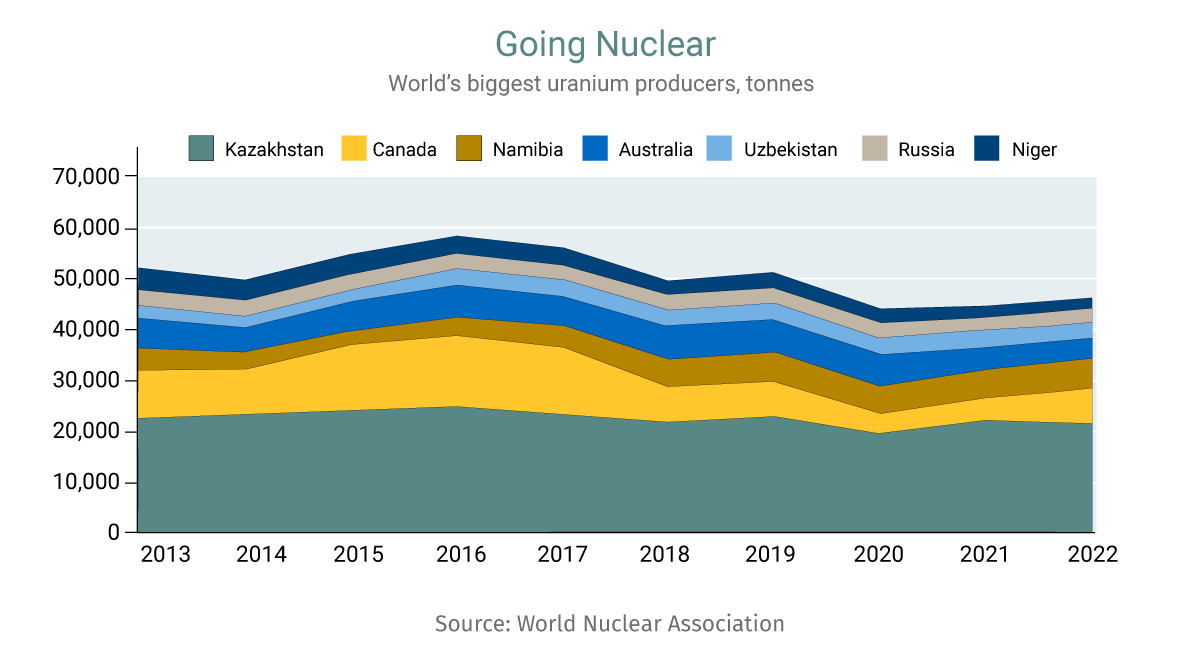
Canadian context: Uranium prices have been creeping up, but producers remain wary after a prolonged price slump. Home to the world’s third largest uranium reserves, Canada was once one of the largest uranium producers in the world until it was overtaken by Kazakhstan. Around 40 companies are exploring for new prospects in Canada, but Nova Scotia, Quebec and British Columbia have banned uranium mining and exploration. Interest in small modular reactors in Ontario and elsewhere is expected to raise demand for uranium, while the Feds are helping with nuclear among the energy sources eligible for an investment tax credit for clean electricity. Is it time for Canadian provinces to re-assess their position on uranium?
PUBLIC POLICY
Looping In The Atlantic
How important is the Atlantic Loop to Nova Scotia’s climate goals? The province is eyeing an 80% Net Zero grid by 2030—an ambitious target as coal powers just over half of the province’s grid, making Nova Scotia’s grid the most coal-dependent in the country.
Media report suggests the Atlantic Loop—an ambitious plan to plug fossil-fuel dependent Maritime provinces with hydropower from Newfoundland & Labrador and Quebec—is imminent. Provinces and utilities are negotiating with Ottawa, which has offered to invest $4.5 billion to support the project. It’s not enough, says Nova Scotia Premier Tim Houston who believes the project could bankrupt the province. Houston’s government outlined a plan that shows the province can meet its 2030 electricity target, with or without the Atlantic Loop.
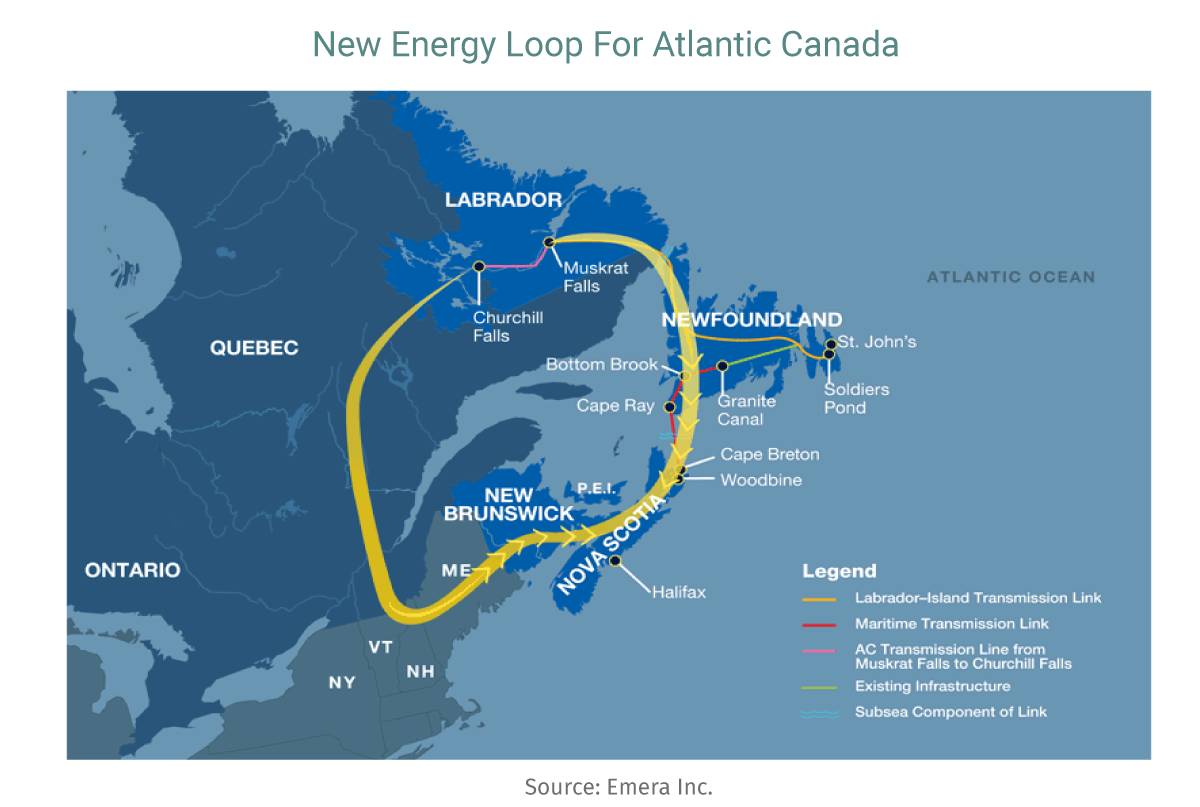
The Atlantic Loop is a microcosm of the challenge of building major energy infrastructure projects in the country. But a deal on the project could prove to be a win for Canada as: (1) provinces leverage their resources to collaborate with neighbours, (2) a major energy project proceeds in Canada, (3) Nova Scotia goes a long way in getting off coal, and (4) transmission lines are built across provinces—a rarity in the country.
ZEROING IN
On The Low-Carbon Track
Swapping smokestack with fuel cell stacks, North America’s first hydrogen-powered train is taking riders on an emissions-free trip around central Quebec. Beyond the commercial service demonstration, the big win would be to shift freight from diesel and gasoline-powered trucks to hydrogen-run trains at a mass scale, leading to lower road congestion and emissions.
| 120 | The number of passengers the Alstom-built hydrogen train can carry. |
| 140 kilometres | Top speed of the train, comparable to a standard regional diesel train—but without the noise. |
| 0.9% | Percentage of emissions generated by railways in Canada’s transport sector; on-road freight trucks account for 35%. |
| 2020 | The year CP Rail unveiled plans to develop hydrogen-powered locomotive. CN Rail is developing a lithium-ion battery-electric freight locomotive. |
PUBLIC POLICY
Climate-Proofing Canada
With much of the country blanketed in wildfire haze, Canada rolled out its National Adaptation Strategy this week. The initiative to protect the country from the ravages of climate change covers a lot of ground: coastlines, disaster resilience, health and well-being, biodiversity, infrastructure, the economy, and workers.
It’s also necessary. The 2019 heat wave in British Columbia led to 619 deaths, while the bill to combat wildfires has averaged $1 billion annually (the current wildfire season, said to be the worst on record, is estimated to have cost Ontario nearly $1.3 billion alone, and counting). By 2025, Canada could suffer climate losses of $25 billion annually, equal to half of projected GDP growth, the government estimates.
Forestry, agriculture, fisheries, energy, mining, transportation, and tourism are at highest risk, while repairs after floods and wildfires is already costing each Canadian $720 a year, the Canadian Climate Institute estimates. In contrast: $1 spent on adaptation measures could result in as much as $15 in total benefits.
Some key NAS goalposts:
- Deaths due to extreme heatwaves eliminated by 2040.
- All northern and Indigenous communities have resources to develop and access tools and information to address climate risks by 2030.
- By 2028, Ottawa, provinces and territories have identified at least 200 higher-risk flood areas for new flood hazard maps and regional-level modelling.
- New climate change resiliency considerations are embedded into the National Building Code, Canadian Highway Bridge Design Code, and Canadian Electrical Code by 2030. Climate-resilient building codes in Canada has a benefit-cost ratio of 12:1—equivalent to a 1,100% return on investment.
- By 2030, health systems have identified risks, developed adaptation plans, and are measuring progress towards climate-resilience
- Conserve 30% of land and waters and establish 15 new national urban parks by 2030 to conserve nature.
- 70% of civil engineers, planners, landscape architects, accountants, and members of related professions can apply climate change adaptation tools and communicate the business case for adaptation measures to clients by 2027.
The plan has earmarked around $2 billion to implement the strategy:

Further Reading:
Power Shift: How Ontario Can Cut Its $450-Billion Electricity Bill
Canada’s $40 Billion Net Zero Building Challenge
PUBLIC POLICY
Alberta’s Moonshot
Climate change presents Canada its greatest technological challenge—and economic opportunity. And Alberta needs to play a leading role in the energy transition, not because this is where the energy transition risks are concentrated, but because it’s where the opportunities are.
We explore five opportunities Alberta can lean into:
Opportunity #1: Buildings Revolution
Rapid population growth means we need six million new homes In Canada by 2030. Alberta is the perfect place to launch Canada’s buildings revolution, as it has the materials, science labs, a deep history in construction, deep pools of capital, newer building stock and a young, growing population.
Opportunity #2: Soil Capture
Many grain growers in Western Canada are already net-negative in terms of emissions, thanks to the rapid scaling of nutrient management, adoption of natural or planted windbreaks and other climate smart techniques. In a province of annual plantings, there’s a further opportunity to strategically plant crops that boost the province’s ability to store carbon. The potential soil capture prize for Alberta could be $1.2 billion annually by 2050.
Opportunity #3: Anaerobic digester
Across Canada, farmers are exploring the use of biodigesters as an additional source of revenue and reduce emissions from livestock. Anaerobic digestors will play a key role in sequestering carbon and creating new revenues for producers in the province.
Opportunity #4: Hydrogen
Industrial hydrogen powerhouse Alberta can lead in a potentially $2.5 trillion global market, especially as it rolls out its Hydrogen Roadmap and Edmonton’s Hydrogen Hub. While Canada’s allies are reaching out to us as a potential source, we need to assure them that our policies won’t constantly change, and that our infrastructure is robust, resilient and reliable.
Opportunity #5: Carbon Capture and Storage
Carbon capture and storage is Canada’s moonshot—an engineering project that should galvanize a nation. Alberta’s Carbon Trunk Line may not have the same ring to it as, say, Apollo 13, but it can carry the same weight in terms of nation-building and demonstrating a technology at scale that can help other sectors and that we can sell to the world.
–Excerpt from a speech by John Stackhouse, RBC Senior Vice-President, to the Business Council of Alberta in June.
INDIGENOUS
Nation Building
The 2023 federal budget proposed several initiatives that are necessary to build a thriving, sustainable clean economy in Canada. One of its most meaningful is to improve the quality and consistency of benefits that Indigenous communities derive from major green projects in their territories, especially as the government pursues its Critical Minerals Strategy.
In Nation Building: Unlocking Indigenous Potential To Power Canada’s Net Zero Economy, Allan Clarke, an Indigenous consultant who once served as Director General, Economic Research and Policy Development with the former Indigenous and Northern Affairs Canada, explores ways to further unlock capital for First Nations participation in the clean economy, including:
- Modernization of Loan Support Programs. By providing access to affordable capital and de-risking capital risks, loan guarantee programs can help Indigenous communities overcome impediments to economic development and barriers to economic inclusion.
- Forging A New Fiscal Relationship With Indigenous Peoples. Structural changes to the fiscal and taxation frameworks governing Indigenous Peoples are needed to address infrastructure deficit on reserves and to create a long-term and predictable stream of capital for meaningful Indigenous participation in major green projects.
Read Allan Clarke’s Essay for the RBC Climate Action Institute:
Nation Building: Unlocking Indigenous Potential To Power Canada’s Net Zero Economy
ZEROING IN
Amazon’s Bioeconomy
The lungs of the world needs a breath of fresh air. The Amazon rainforest, which produces 20% of the world’s oxygen, is facing rapid deforestation with Brazil losing tree cover the size of Belgium every year. A new World Resource Institute report outlines a plan to halt deforestation and build an Amazon bioeconomy, using renewable biological resources sustainably to produce food, energy and industrial goods.
Here’s how Brazil can sow the seeds of a sustainable economy:
| 96% | TReduction in emissions needed in the Amazon to ensure Brazil meets its Paris commitments. Brazil is the world’s 12th largest emitter of greenhouse gases. |
| 24M hectares | Restoration of forest, an area roughly the size of Italy, and no further deforestation, can cut net carbon emissions by 94%. |
| US$8.2 billion | Annual GDP growth from Amazon by 2050 with a thriving agriculture, livestock production and mining sector in addition to the bioeconomy. |
| 833,000 | New jobs in the bioeconomy and restoration sectors, replacing activities linked to deforestation. |
Source: New Economy for the Brazilian Amazon
CANADA Vs WORLD
Copper Crisis
Industry executives are warning of a coper “train wreck” as supply stalls of a critical metal. Copper is a prized metal used in many industrial processes and green technology including renewable energy generation and electric vehicles. RBC Capital Markets expects copper demand to rise 2.8% annually until 2035 as electrification gains momentum (from 2.5% previously). Constrained supply, however, could trigger higher prices that could lead to demand for copper substitutes such as aluminum and plastics.
Primary copper supply deficit may hit 32 million tons in 2050 and new mines and recycling will be needed to meet demand, according to BloombergNEF. Can Canada help?

Currently, Canada is the world’s 11th largest producer of copper and 13th largest in terms of reserves. While the country’s copper production has declined 2% annually over the past five years, it could rise 3% annually over the next three, according to one estimate, with 10 copper projects planned or underway.
Chile, Peru, Russia and Democratic Republic of Congo are among the countries expected to drive just over 50% of production growth. But with all of them facing their own set of unique political and economic challenges, can Canada’s Critical Minerals Strategy and Critical Mineral Exploration Tax Credit help boost the country’s copper output?
Public Policy
How To Decarbonize Canada
Here’s what Canada could look like in 2050: Falling oil and gas production, surging electricity demand that generates net-negative emissions, and electric vehicles dominating the highways. That’s a scenario where Canada achieves Net Zero by 2050 even if the rest of the world struggles to cut its emissions, according to the Canada Energy Regulator’s latest biennial forecast.
The CER also paints a picture for two other scenarios: Global Net Zero, where the world’s emissions fall in tandem with Canadian GHGs, and a Current Measures scenario, which effectively suggests that policy measures to date will fall short of our 2050 targets.
A Net Zero world that shuns conventional energy will also require steely resolve in the face of economic growth uncertainty, rising consumer prices, and a slightly unfavourable Canada-U.S. exchange rate.
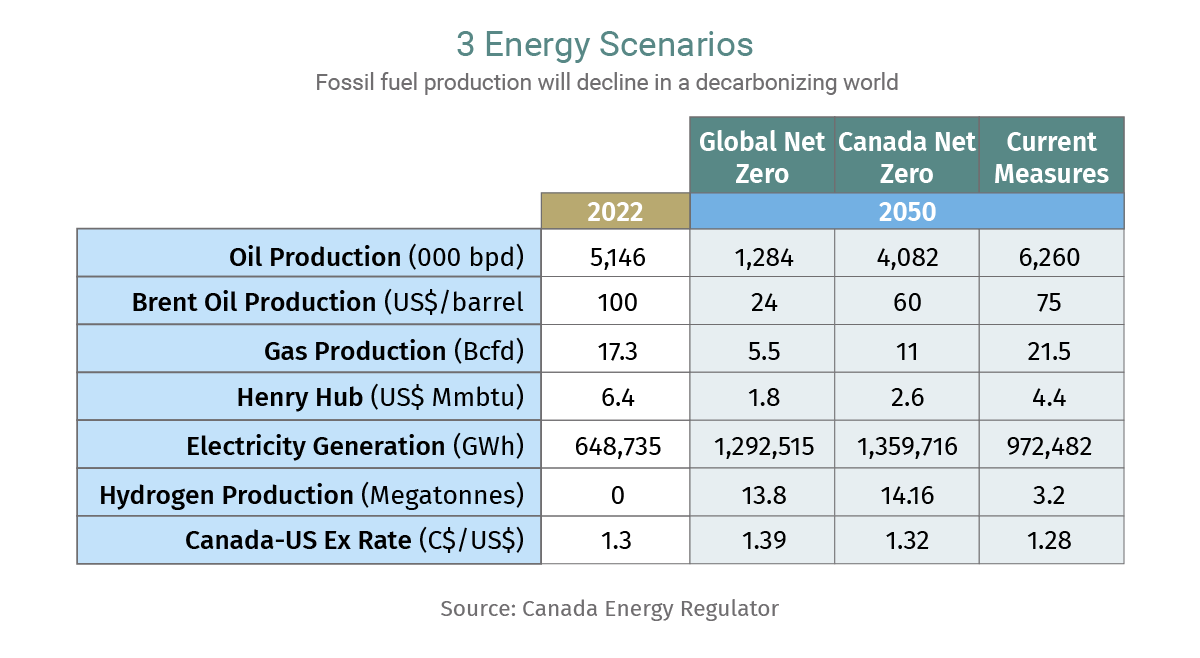
The report is not meant to be a prediction or recommendation but explores how possible energy futures might unfold for the Canadian economy:
Oil: Mentioned 316 times in the report. Exports (2022, $): $156.6 billion
Canadian oil production declines in two out of three scenarios (see table above). Carbon capture, utilization and storage (CCUS) plays a role with the technology’s capacity in the oilsands peaking at 27 MT in 2033 in the Global NZ Scenario (and 49 MT in 2035 in the Canada NZ Scenario). Still, most oil facilities are expected to shut down with only the most efficient projects in operation by 2050 in a decarbonizing world.
Natural Gas: 345 mentions. Exports (2022, $): $24.6 billion
A CCUS-fitted energy source has a role to play—if diminishing—in a Net Zero world. LNG Canada and Woodfibre LNG on the West Coast are set to be the two main liquefied natural gas export projects in a decarbonizing world, but there is room for more exports (think LNG Canada Phase II) if the world is struggling to rein in emissions.
Electricity: 342 mentions. Exports (2022, $): $5.7 billion
Electricity is the new star of the Canadian energy complex, accounting for 41% of energy use by 2050 (from 17% today). Decarbonized by 2035, low-carbon electricity will power transportation, heavy industries, and homes. Wind, nuclear power, hydro, natural gas with CCUS, bioenergy with carbon capture and storage (BECCS), and solar making up most of the new generation growth over the projection period. Net electricity exports to the U.S. will fall modestly in both NZ scenarios.
Hydrogen: 257 mentions. Exports (2022, $): $0.7 billion
Hydrogen gets its own chapter in the report. Canada could export around 4.5 MT to 5 MT of low-carbon hydrogen, produced from natural gas+CCUS, electrolysis and biomass gasification in the two Net Zero scenarios.
Other notable mentions: Wind (47 times), solar (31), nuclear (29), hydroelectricity (5).

ELECTRICITY
How To Cut Ontario’s $450B Power Bill
Ontario faces a $450-billion investment bill by 2050 to meet surging demand and emerge as a green-grid hub that’s attractive to industries aiming to lower their emissions. But rising electricity demand could strain the province’s grid as early as 2026 and even trigger chronic shortages by 2030.
Ontario is eyeing more gas-fired power generation to meet its pressing needs, but unabated natural gas plants could clash with the federal government’s forthcoming Clean Electricity Regulations.
Power Shift: How Ontario Can Cut Its $450-Billion Electricity Bill, a new RBC Climate Action Institute report, explores how the province can avoid making hasty and expensive decisions on its future energy mix.
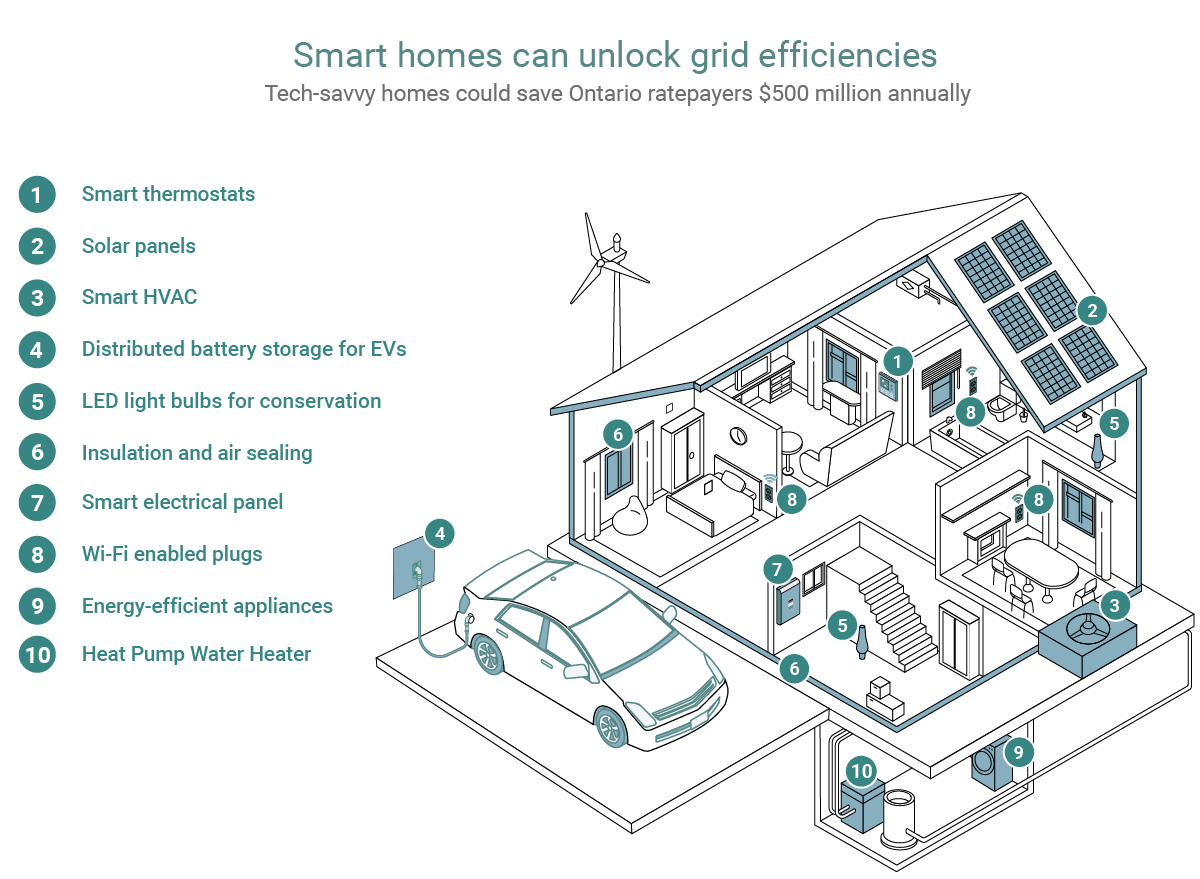
Deploying technology such as smart thermostats and AI-enabled HVAC systems, and timely action to conserve energy could save enough electricity to power 3 million homes by early 2040s—a little more than half of the province’s residential electricity demand.
Deferring hefty financial commitments will keep electricity affordable and give Ontario time to redefine itself as a low-carbon manufacturing hub that attracts companies involved in electric car supply chains, green metal production, and clean-tech.
Read Power Shift:
How Ontario Can Cut Its $450-Billion Electricity Bill
Public Policy
Canada’s 5 Strategic Choices
Can Canada and the world’s energy infrastructure withstand the changes brought about by climate change and energy transition in the next 25 years? Here’s the scale of the challenge:
- A five-fold increase globally in new wind and solar capacity by 2030
- Cut global fossil fuels production by 6% annually, when in fact it’s growing.
- Cut methane emissions in energy by 66% by 2030.
- Canada will need at least 50% more electricity by 2030; 200% by 2050.
It’s going to be monumentally hard, though not impossible. To capture the opportunity, Canada needs to make some strategic choices. Here are five to consider:
1. Fiscal support. The U.S. Inflation Reduction Act is a game-changer. Ottawa’s latest budget went a good way toward matching it, with the clean electricity investment tax credit, and making it available to non-tax paying entities was essential.
2. Regulatory flexibility. This will likely come to a head this summer with the Clean Electricity Regulations, which is contentious with political support waning. There is clearly a risk to locking in gas production for a long time, but we need to be mindful that long-term climate ambitions can undermine short-term realities, which could also derail those climate ambitions.
3. Capital incentives. The Infrastructure Bank, and the new Growth Fund will need to play a frontline role with “contracts for difference” — essentially carbon price guarantees — to reduce the long-term political risk of transition projects.
4. Indigenous inclusion. We need to ensure the tools are there for Indigenous communities to fully participate in the transition. One critical option: a national loan guarantee to help backstop Indigenous equity ownership in projects, modelled after similar programs in Alberta, Saskatchewan and Ontario.
5. Consumer technology. As we wrote in Power Shift, a recent report that examined Ontario’s grid challenge, nearly 20% of the province’s expected demand could be met through conservation, including AI-enabled HVACs and smart thermostats.
These levers show that we have choice — but not for as long as we might like.
–Excerpts from a speech by John Stackhouse, RBC Senior Vice-President, at the Electricity Canada Policy Symposium in Winnipeg in June
ZEROING IN
Viral Clothing
“Fast fashion” may need to slow down. Inexpensive clothes that capture a fleeting viral trend have severe climate consequences, according to a new report. Here’s why the current clothing system is not working:
| 1 | The number of truckloads of clothing sent to landfills or incinerated globally every second. |
| 98 million tonnes | Non-renewable resources used by textile industry every year: including oil to produce synthetic fibres, fertilizers to grow cotton, and chemicals to produce, dye, and finish fibres and textiles. |
| 7-10 | The number of times a ‘fast fashion’ item is worn before it’s discarded. Customers can save US$460 billion annually if they continue to wear the items. |
| US$560B | Circular economy that can be unlocked if business models can be developed to keep clothes in use longer. |
Source: Ellen MacArthur Foundation.
Fashion and the circular economy (ellenmacarthurfoundation.org)
Capital
Arrested Project Development
Resource companies can line up funding, pick a location and plan out project feasibility relatively quickly in Canada. But then comes the dreaded assessment phase—a process that can last years and crush even the most feasible project under the weight of the scrutiny.
The Business Council of Alberta recently identified nine challenges in the concept-to completion regulatory process that need to be addressed. We capture a few of the key hurdles the BCA identified in its report:
Challenge 1: Expectations around Indigenous engagement are unclear and capacity improvements are needed.
Recommendation: Establish an independent, centralized Indigenous Consultation Office that liaises with communities and government agencies and conducts nation-to-nation consultation.
Challenge 2: Third-party interventions can be repetitive or not pertinent.
Recommendation: Agencies should proactively scope and assess third-party intervenor engagement activities/submissions alongside the proponent to answer inquiries into standard or repetitive issues of concern.
Challenge 3: Federal internal coordination is inefficient.
Recommendation: Ensure lead agencies (such as Canada Energy Regulator) don’t cede control to non-lead departments involved in the process. Lead agencies should place limits on, and establish strict timelines for, other departments or agencies’ involvement in reviews.
Challenge 4: Project review timelines are long, expanding, and not proportional to project risk.
Recommendation: Categorize projects based on complexity, with review of more complex projects capped at 15 months.
Challenge 5: Political and policy preferences are creating uncertain processes.
Recommendation: Make policy environment predictable and stop adding and layering new regulations on top of existing ones. Impact Assessment Agency of Canada (IAAC) should draft clear, logical, and predictable guidelines for projects.
Challenge 6: Construction windows are too easily disrupted, and permits are often required from all three levels of government.
Recommendation: A co-ordination body will avoid duplication and obstruction from other jurisdictions.
Read BCA’s Recommendations:
Future Unbuilt Task Force Paper
CLIMATE
Smoke Signals
Canada is in the throes of what’s being called its “worst wildfire season of the 21st century.” The blazes have spread across nine Canadian provinces and territories, burning through 47,000 square kilometres to date—that’s roughly seven times the size of the Greater Toronto Area.
The wildfires also have severe emissions consequences.
Alberta’s forest fires this year alone have spewed 17 megatonnes of carbon emissions (a fifth of the oilsands’ annual emissions), according to Copernicus, the European Union’s Earth Observation Programme. That’s the highest emissions level seen in the province since the 2019 fires when 8,000 square kilometres burned. “Carbon emissions for Saskatchewan, British Columbia, Ontario, Northwest Territories and Nova Scotia are also already at record or near-record levels,” Copernicus wrote in an early June report.
CO2 emissions from North America and Eurasia’s boreal forest fires have surged since 2000, touching a new high in 2021, according to a group of researchers writing for Science magazine. Typically, boreal fires account for 10% of global CO2 emissions from wildfires (tropical forests usually generate far more emissions), but in 2021 they produced nearly a quarter of the total.
“This abnormally high total resulted from the concurrence of water deficits in North America and Eurasia, which was an unusual situation,” the researchers said. “The increasing number of extreme wildfires that is accompanying global warming presents a real challenge to global climate change mitigation efforts.”
Indeed, persistent drought conditions has left Canada’s landscapes vulnerable to wildfires, with around 47% of the country classified as “abnormally dry” or in moderate to extreme drought, including 70% of the country’s agriculture landscape in May, according to Agriculture and Agri-Food Canada.
While analysts quibble over the wildfires’ direct links to climate change, the International Panel For Climate Change says overshooting 1.5°C will certainly lead to more severe weather events including more wildfires.
Apart from disrupting the economy, wildfires lead to higher carbon monoxide exposure, particle exposure, impact on biodiversity and habitat (especially during nesting season), with prolonged exposure leading to health complications.
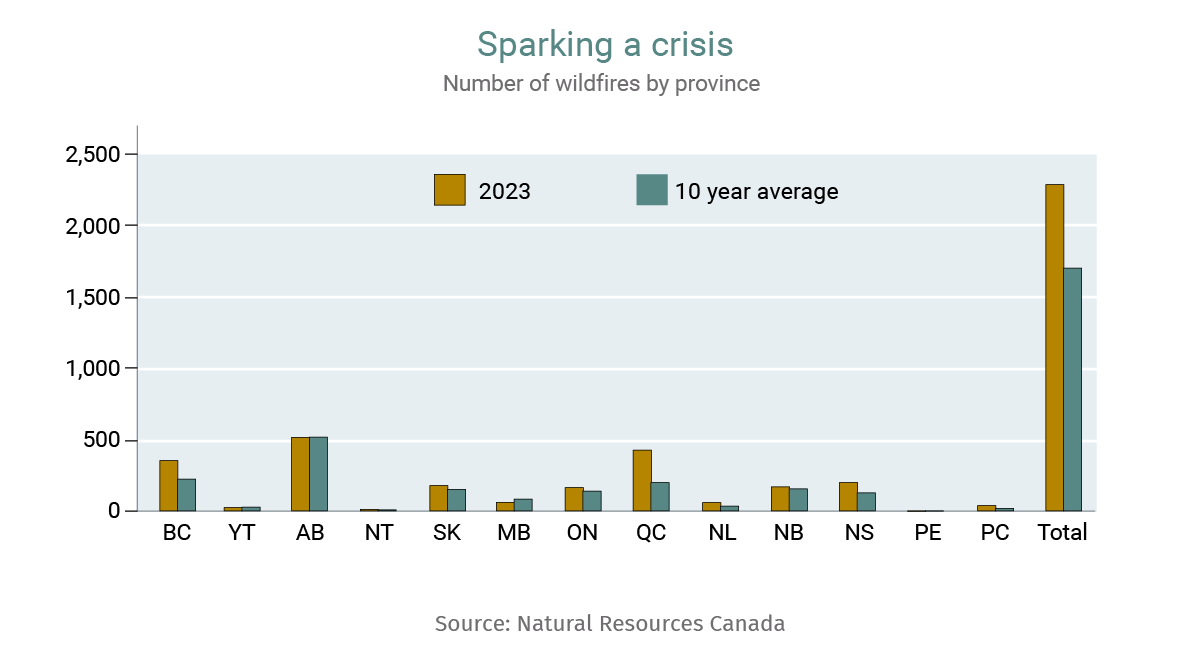
Insurance claims related to weather have routinely averaged above $2 billion annually in the country in recent years, according to the Insurance Bureau of Canada. Meanwhile, two major insurers have stopped offering property and casualty coverage to new customers in California, citing the frequency of natural disasters in that state.
Ensuring climate resiliency of cities, and infrastructure is fast emerging as a new, and costly, headache for policymakers at all levels. The National Research Council has already started work on building climate resilient homes and infrastructure.
ENERGY
A New Arctic Resource Expedition Begins
As global warming melts the Arctic, paradoxically many states that lay claim to part of the North Pole are eyeing its hidden riches.
The Arctic plays a critical role in regulating global temperatures, with permafrost and sea ice vital vaults for storing carbon, while its rapid warming is also a barometer on the speed of climate change. The shrinking sea ice (by as much as 12.6% per decade) has led to a flurry of activities in the Arctic, tempting countries to exploit the estimated 30% of the world’s undiscovered gas and 13% of undiscovered oil that is buried beneath the permafrost.
Canada has been protective of the North, extending a ban on offshore oil and gas drilling in the region earlier this year.
But other allies, notably Norway and the U.S., have been casting around for riches in the thawing seas:
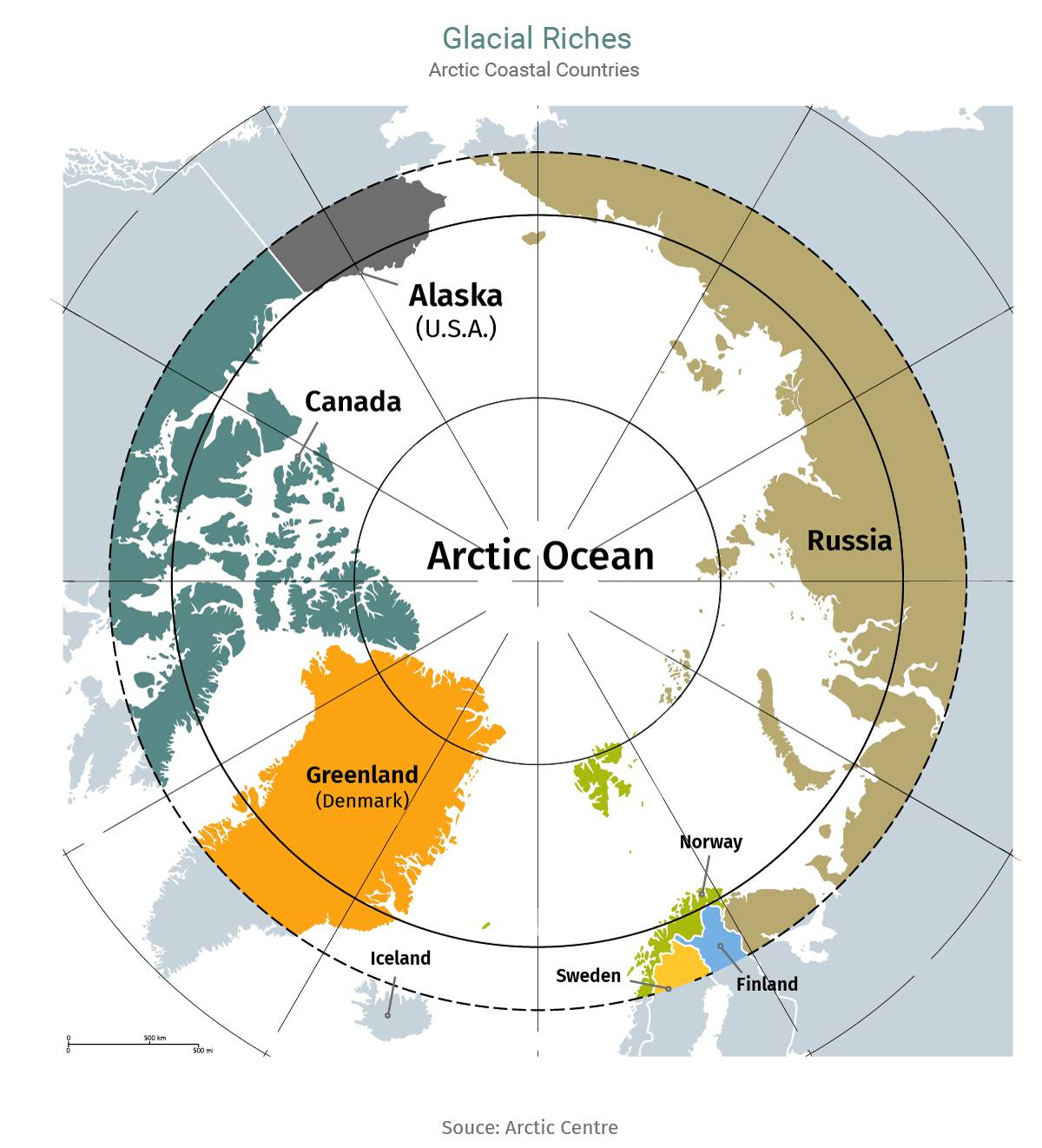
- In May, U.S. President Joe Biden approved an US$8 billion project in Alaska with the capacity to produce more than 600 million barrels of crude oil over the next 30 years.
- A US$39-billion Alaska Gasline Development Corp.’s LNG project was approved by the U.S. on grounds of free trade and energy security. The adverse potential impact on climate change, soils and sediment and aquatic resources were “negligible” to “less than significant,” the U.S. Department of Energy’s wrote in its final assessment.
- Norway’s top energy official also recently encouraged oil and gas companies to “leave no stone unturned,” to find more hydrocarbons in the Barents, according to a Bloomberg report. All told, Norway plans to offer 92 exploration blocks in Barents and Norwegian Seas.
- Russia’s new LNG projects in the country’s north have stymied due to Western sanctions. But state-owned Vostock Oil is eyeing oil projects in the north of Krasnoyarsk Territory that will produce and export as much as 2 million barrels per day annually.
- China, which calls itself a “near Arctic” state, has had little success in the region so far. But its increasingly cozy economic and trade relationship with Moscow poses fresh uncertainties for the region.
Given the abundance of oil and gas resources elsewhere in the country, Canada has chosen not to pursue oil and gas drilling in the Arctic core. But as Ottawa remains concerned about Russia and China’s ambitions in the Arctic, a sharper northern strategy is going to be critical for Canada’s local communities and national security.
TRANSPORTATION
$100B Market Set To Take Off
Fuel extracted from cooking oil and food scraps could soon be powering airplanes. It’s not a flight of fancy, either. RBC Capital Markets expects sustainable aviation fuels, or SAF, to emerge as a US$100-billion market by the end of the decade.
What’s SAF, again?: The fuel is produced from sustainable, renewable feedstocks such as cooking oils, packaging, textiles and food scraps. Switching from conventional jet fuel to SAF can cut emissions by up to 80%, according to industry estimates. With aviation accounting for 3% of global energy-related CO2 emissions, SAF could play a key role in delivering global Net Zero targets.
What policy measures are driving the segment?: The European Union’s RefuelEU has progressive blending mandates to boost adoption, while the U.S.’s Sustainable Aviation Fuel Grand Challenge is offering tax credits to raise SAF consumption to at least 3 billion gallons per annum in 2030. Airbus and Boeing have also committed to 100% SAF capability for commercial and military aircraft by 2030.
What’s been the Canadian response?: The Canadian Council for Sustainable Aviation Fuels, featuring 60 airlines operating in the country, recently set out domestic SAF consumption target of 1 billion litre (264 million gallons) by 2030, or 10% of the country’s jet fuel demand.
Are there alternatives to SAF?: SAF faces competition from sun-to-liquid, power-to-liquid (using hydrogen) , and electrically-powered aircraft, but the industry believes an electric or hydrogen engine for jumbo-sized aircraft remain a long way off.
Headwinds for SAF?: SAF capacity could range from 20 metric tonnes to 60 metric tonnes, RBC Capital Markets estimates, taking supply levels potentially above demand at 24 metric tonnes by 2030. However, “we see potential risks in completing projects and delivering volumes,” RBCCM notes, as many producers signing offtake deal have relatively little experience in the biofuel space. Another challenge: It’s not easy for some in the industry to gain access to feedstock.
CANADA VS THE WORLD
Climbing The Green Chart
Canada and Australia are often grouped together as twins separated at birth (with The Economist recently coining the hideous portmanteau “Ozanada”), but MIT begs to differ.
The U.S. university’s latest 76-country Green Future Index considers Canada a “green leader” with a respectable 14th ranking overall (6th among G20, excluding the European Union), while Australia is labelled a “climate laggard” with a 42nd placing (12th among G20). Canada, which climbed a spot from last year, fared especially well on climate policy with MIT identifying the 2030 Emissions Reduction Plan as a key policy lever.
The MIT ranking is in contrast to BloombergNEF’s latest G-20 Zero-Carbon Policy Scorecard, which placed Canada as 8th among G20 nations, behind the U.S.

A Middling Green G20: Only seven of the 19 G20 members were in MIT’s “Green Leaders” group. South Africa, China, Japan and Brazil were in the “Greening Middle,” for making some progress on building a green future. Australia, Argentina, Indonesia, India were in the “Climate Laggards” camp, suggesting slow climate progress, while Russia and Turkey were firmly in the “Climate Abstainers” group.
Renewable laggard: BloombergNEF’s report praised Canada’s Clean Fuels Regulations, carbon capture tax credit and a scheme to increase energy efficiency in buildings, but Canada still dropped two places from last year on the slowest growth among G20 in renewable energy capacity and domestic funding for fossil fuels.
Further Reading:
The Green Future Index 2023 | MIT Technology Review
BNEF’s G-20 ZeroCarbon Policy Scoreboard
ZEROING IN
Key To The Next Boom
Canada’s Indigenous groups hold the key to unlocking the country’s resources. Their proximity to hundreds of energy and mining projects, and insights on sustainable practices make them a key partner in accelerating Canada’s new-energy economy and help the country achieve economic reconciliation.
As Canada celebrates National Indigenous History Month, we look at why Canada’s next resource boom must include Indigenous consent and collaboration:
| 56% | Share of critical mineral projects that involve Indigenous territory; 35% of top land suitable for solar is near title-like lands. |
| $100B+ | Combined value of renewables and critical minerals developments on or near Indigenous lands. |
| $2.6B | Gross own-source revenues earned by First Nations; natural resource revenues stood at $322 million in 2015-16 |
| $48B | GDP attributed to Indigenous people in 2020. Indigenomics Institute aims to more than double that to $100 billion |
Source: RBC Climate Action Institute/Statistics Canada
Further Reading:
92 To Zero: How Economic Reconciliation Can Power Canada’s Climate Goals
PUBLIC POLICY
Power Anxiety
The Prairie provinces are feeling anxious over Ottawa’s impending Clean Electricity Regulations, with premiers of both Alberta and Saskatchewan raising questions about the CER’s merits and impact on power bills.
So, what does the CER aims to accomplish and why are some provinces so concerned?
The CER is a signature federal climate proposal aimed at achieving Net Zero electricity sector by 2035. Despite provincial deviations, Canada already boasts a low-carbon grid with 82% of power generated by either hydro, nuclear, wind and solar—among the cleanest in the world. But rising electricity demand and population growth means maintaining lower carbon source in its energy mix will be a challenge going forward.

Enter the CER, which aims to strike a balance between managing GHG emission reduction, reliability and affordability.
The role natural gas will play in the reimagined energy grid is among the thorniest issues: heavy investments in long-lived natural gas projects would lock in emissions and clash with Canada’s Net Zero aspirations. Gas’s reliability and affordability makes it a compelling proposition, especially in the Prairies where phasing out coal is already leading to significant baseload shortfalls that will be challenging and expensive to plug with renewables alone. SaskPower, for example, says it will need natural gas or nuclear to ensure grid reliability.
The federal government, for its part, suggests Budget 2023’s major clean electricity subsidies that will see Ottawa picking up part of the tab for a Net Zero grid, should be incentive enough.
CER could emerge as a source of debate between federal government and provinces soon. Here are some key themes to look for:
1. Urgency: In terms of infrastructure planning, 2035 is just round the corner, with many nuclear and hydro projects requiring long lead times. Federal and provincial policymakers must agree quickly and provide investors regulatory certainty before they can move ahead with projects.
2. Questions around gas. CER aims to address the role of natural gas to maintain reliability in extreme weather, emergencies, or other Black Swan events. Ottawa’s investment tax credit for clean electricity (focused primarily on wind, solar photovoltaic and hydro etc.), also makes room for abated natural gas-fired electricity generation (which would be subject to an emissions intensity threshold compatible with a Net-Zero grid by 2035).
3. New technologies. Is CER an opportunity for hydrogen and small modular reactors to shine? In recent years, Ottawa has laid out a Small Modular Reactor (SMR) Action Plan and a Hydrogen Strategy over the past few years, but both promising technologies would require some bold—and quick—decision-making.
As RBC wrote in Price of Power, Canada needs to move quickly to address a potential 50% jump in electricity demand over the next decade. Ontario, Alberta and Saskatchewan are faced with especially urgent challenges, but each province has to choose its own path—and quickly.
CAPITAL
How To Rein In Aramco & Co.’s Emissions
Are Saudi Aramco and other state-owned oil companies about to face a US$550-billion climate reckoning?
Global oil production is shifting away from publicly-listed Western companies to national oil companies in emerging markets, with the Organization of the Petroleum Exporting Countries (OPEC), expected to secure a greater market share of (albeit falling) global oil production over the next few decades.
Which raises the question: How ESG compliant are national oil companies (NOC) such as Saudi Aramco or Russia’s Rosneft? Most NOCs tied to OPEC countries have escaped deep environmental, social and governance scrutiny, as most are either not listed on international equity markets or listed on domestic markets with their primary shareholder—their government—still calling the shots.
But NOCs and their governments are major debt issuers and that’s catching the eye of institutional bond holders.
The face value of foreign bonds issued by NOCs stood at around US$550 billion as of March 2023, of which 40% outstanding bond debt matures in 2030 or beyond, according to a recent Center on Global Energy Policy at Columbia report.
That leverage could potentially allow international bond investors to pressure NOCs and their governments to develop a more robust ESG framework, and bring them on a level playing field with Western counterparts.
“Failure of NOCs to address ESG risks could lead ESG-conscious investors to hold less bond debt from fossil fuel companies in general, which could impact NOCs’ ability to refinance or contract new debt in the future, or could increase their cost of financing,” according to the research.
The report identified Mexico’s Pemex, India’s Oil & Natural Gas Corp., China’s PetroChina and CNOOC Ltd and Aramco at the bottom in ESG performance (based on a combination of lists from rating agencies and other institutions).
Rating agencies are currently focused on the NOCs’ financial metrics (which remain solid with oil prices north of US$70 per barrel), rather than their climate and governance frameworks. But Russia’s attack on Ukraine has added a new dimension, with governance—the G in ESG—coming to the fore.
AGRICULTURE
A $3.5B Blue Carbon Opportunity
Canada’s 243,000 kilometres of coastline—the longest in the world—can emerge as a key weapon in the fight against climate change. But it remains largely untapped, according to The Tide Is High, a new RBC Climate Action Institute report.
The ocean’s power to sequester carbon—pushing us closer to our climate targets—is unmatched by any other sector. It absorbs 31% of global CO2 emissions, capturing and storing “blue carbon” through a variety of processes involving mangroves, seagrass (known as eelgrass in Canada) and salt marshes.
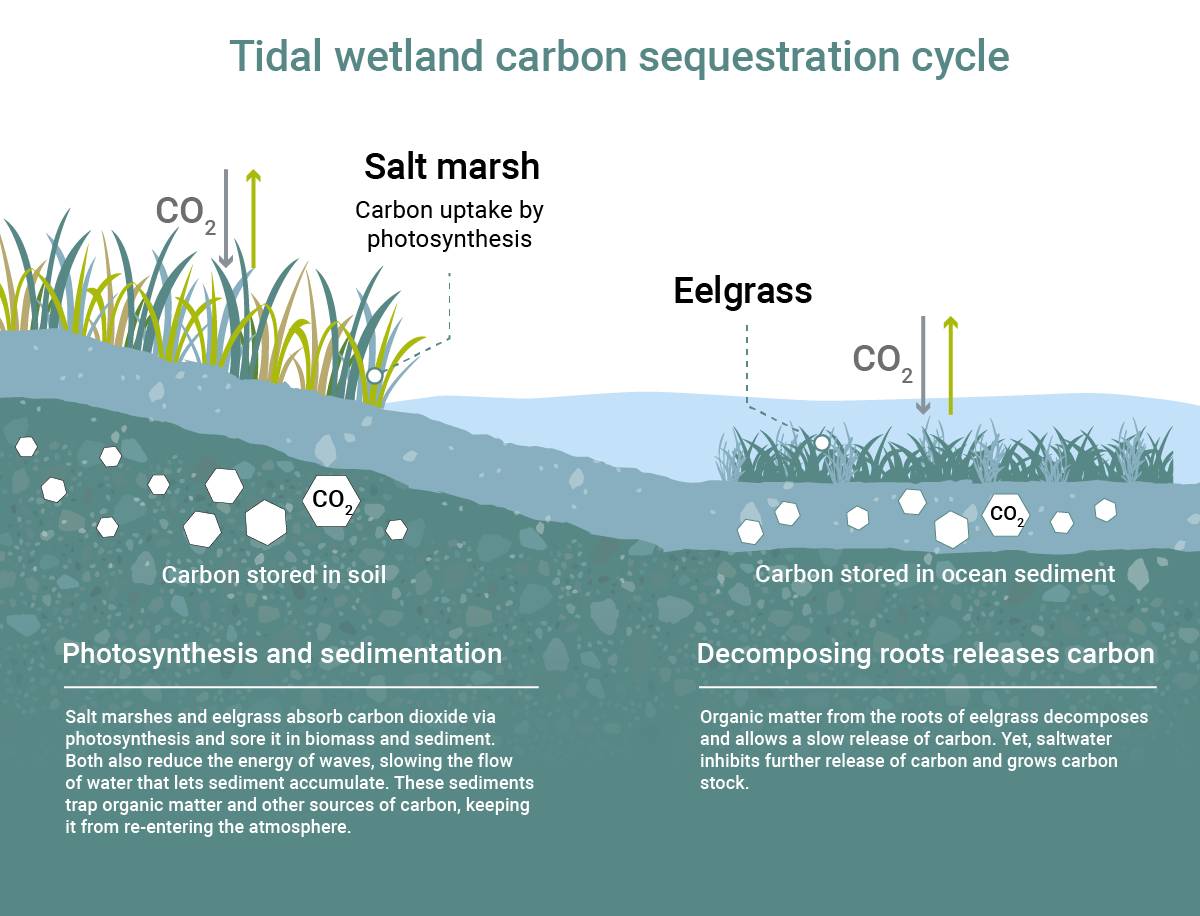
And the financial toll of ignoring it is growing as more nations take on the challenge of mapping their seabeds and developing nascent blue carbon markets. Blue carbon credits are worth two to three times more than typical carbon credits—largely because of significantly higher sequestration potential and additional ecosystem services. Early estimates suggest Canada’s “blue carbon” represents an $3.5 billion market opportunity.
The report explores three key steps Canada can take to tap this greenfield opportunity. Read the report here.
CANADA Vs THE WORLD
Rich, Resourceful & Emitting

Among G20 members, featuring 19 of the world’s richest countries (plus the European Union), Canada is the world’s ninth largest national economy, smack-in-the-middle 10th in terms of total emissions by country, and the third largest greenhouse gas emissions footprint in per capita terms.
None of these are perfect measures (due to the distinct strengths of various economies, population sizes and economic maturity etc.), but it underscores the work Canada needs to do to lower emissions.
Emerging Emissions: Emerging economies such as China, South Korea, India, Brazil, Mexico and Indonesia have seen steep emission hikes over the past two decades. These countries are also key global economic growth drivers, which makes their climate policies very consequential going forward.
Mature and slowing: For all its vacillations on climate issues, the U.S. has managed to lower its GHG footprint. Germany, the U.K., France and Italy, all mature economies that Canada is often bracketed with, have also managed to lower their emissions over the past two decades. Apart from Canada, Australia and Japan are the two other developed economies with still-rising emissions.
ZEROING IN
Solar’s Star Rises
With an expected global investment of US$1 billion-plus a day in 2023, solar is set to eclipse annual investments in upstream oil for the first time ever, International Energy Agency forecasts.
Some of the dollars are trickling down to Canada with a Greek firm pouring $1.7 billion to build the country’s largest solar farm in Alberta. The company said it was drawn by Ottawa’s clean investment tax credits.
Here’s how solar has emerged as a new star in Canada’s energy mix:
| 25.9% | The growth in solar installation in 2022 vs 2021, or 810 megawatt (MW) of new capacity. |
| 759MW | New solar capacity in Alberta in 2022, accounting for most of the growth. Saskatchewan installed 10MW and Nova Scotia 2MW. |
| 4GW | Annual solar capacity in Canada by the end of 2022. Canada Energy Regulator expects solar capacity to reach 27GW by 2050. |
| 1.6GW | Annual solar PV capacity buildout needed each year to meet a 2050 target set by Canadian Renewable Energy Association, an industry association. |
PUBLIC POLICY
It’s Danielle Smith’s Alberta Now
UCP’s election victory in Alberta gives Premier Danielle Smith the mandate to push made-in-Alberta climate and energy policies that may or may not always align with federal climates goals. In her victory speech, Smith identified “Ottawa’s de facto production cap” and the proposed Clean Electricity Regulations as federal policies she intends to resist. Still, with both levels of government eyeing Net Zero by 2050, there is room for compromise and collaboration.
Here are a handful of the UCP’s energy and climate related policies and ideas that could be consequential for Canada’s climate targets:
Alberta Job Growth & Diversification Strategy: Featured in the UCP platform, the plan aims to welcome companies from agriculture, aviation, energy and manufacturing. Alberta had some success attracting new energy startups, but could the new plan spark a bigger influx and accelerate diversification? A UCP pledge not to raise taxes could help the province win over investors exploring various jurisdictions.
Attracting skilled trades: A $1,200 non-refundable tax credit for workers in key areas including trades—vital for decarbonization efforts—could help address a chronic labour shortage.
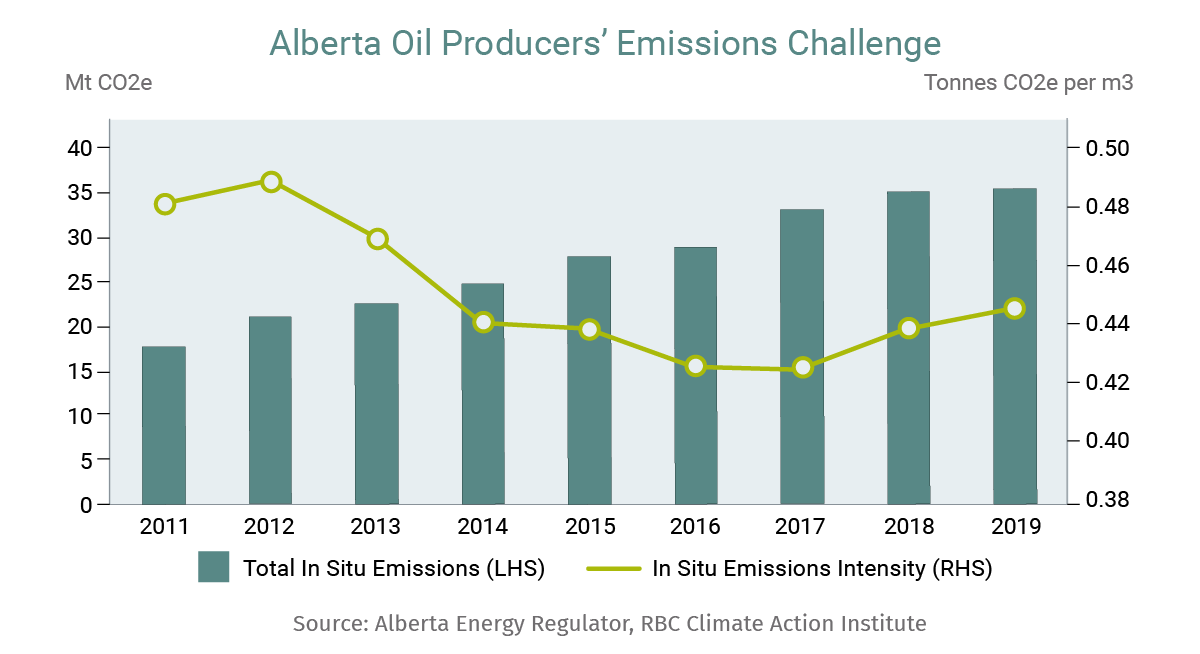
Carbon capture incentives?: Will the provincial government now move ahead with decarbonization incentives for the six-company Pathways Alliance in its quest to achieve Net Zero in the oilsands by 2050? Smith had previously indicated she would consider it.
Alberta Emissions Reduction & Energy Development Plan: Currently short on details, the plan aims to achieve Net Zero by 2050. Pembina Institute suggests the province show its intent with a shorter-term plan to cut oilsands and methane emissions by 2030.
PROJECTS
Debt Deal’s Climate Clause
Buried in the market-moving news of the White House and Republican leadership avoiding a catastrophic debt default, was a nugget crucial for U.S. energy transition: agreement on speeding up energy projects.
The 99-page agreement includes reforming the National Environmental Policy Act for the first time in nearly 40 years, and creating a “single lead agency ” that streamlines environmental reviews. Various U.S. government agencies must wrap up environmental
reviews in a year, while more complex projects will have a two-year timeframe. The deal is seen as a victory for the wider energy industry that has bemoaned the slow pace of permitting in the U.S., despite the roll out of the Inflation Reduction Act, the White House’s signature climate program.
Canadian CEOs are already anxious about the U.S. climate program and the permitting pace of various levels of Canadian governments. CEOs of around 45 low-carbon companies were in Ottawa this week to discuss regulatory reforms, industrial subsidies, and financing mechanisms, with government and opposition leaders.
Surveys over the past few weeks also suggest a mix of uncertainty and hope among Canadian C-suite on climate. Some highlights:
- A third of Canadian CEOs polled by the Globe/Nanos see climate change as a threat; over a third see it as an opportunity.
- Close to one-fourth of respondents see IRA as a threat; a third see it as an opportunity.
- Just under 28% see climate change driving demand for products and services; while over 22% see it as major threat “for everyone.”
- The pace of project approvals was also a top concern among North American utilities, according to a recent Bain & Co. survey shows.
- Overall, lack of policy and regulatory support (56%) and slow permitting and legal processes (36%) were among the major barriers identified by 600 executives surveyed by the consultancy across the global energy and natural resources sector.
Should Canada follow the U.S. with a similar, one-window permitting agency?
Further reading:
- Read the Debt-Ceiling Document’s Section On Permitting Reform (page 71)
Debt limit increase bill text – DocumentCloud - Bain Survey: State Of The Transition 2023
TRANSPORTATION
A Summer of Emissions
Getting on a plane this summer? Some of us are conscious of the impact of our wanderlust on the environment.
| Return Flights | T CO2e | Cost to offset |
|---|---|---|
| Vancouver to Cancun | 1.01 | 22.53 |
| Toronto to Rome | 1.48 | 34.09 |
| Calgary to Hawaii | 1.43 | 38.34 |
| Montreal to Bangkok | 4.21 | 92.31 |
Source: Choose
It’s true that aviation emissions are rising faster than from rail, road and shipping, while sustainable aviation fuels have yet to take flight in a major way.
While there is no reason to feel guilty for indulging in a bit of R&R in an exotic location, buying carbon offsets could be helpful. Canadian airlines offer options to buy carbon credits to offset the environmental cost of your travel. Just remember a few things:
1. It’s an imperfect solution. Buying carbon credits only allow you to balance your travel emissions by financing the planting of a few trees in, say, Ecuador—it’s not exactly like-for-like. Many would argue carbon-offsets are ineffective, but it’s far better than taking no action. It’s, of course, no substitute for policies aimed at decarbonizing industries.
2. Find a reputable provider. Some carbon offset programs are not as efficient at reducing greenhouse gas emissions as advertised. The Gold Standard, backed by the World Wildlife Fund and others, offers transparency with fully traceable projects, but there are plenty of other choices, too.
3. Climate justice. Every little action helps. Buying carbon credits for projects in low-income countries can contribute to climate justice—as these are often countries that are bearing the brunt of climate change but have negligible emissions of their own.
Still curious? The Disruptors podcast covered the topic last summer on the 10-Minute Take series, “Are Carbon Offsets Actually Effective?”
ZEROING IN
The Cost of Clean Fuels Regulations
How much will Canada’s Clean Fuel Regulations (CFR) cost Canadians by 2030 when it kicks in on July 1? Office of the Parliamentary Budget Officer (PBO) found the new policy to be “broadly regressive.” Ottawa pushed back, calling the PBO report “skewed .” CFR aims to lower carbon intensity of gasoline and diesel by 15% by 2030 (vs 2016 levels). Premiers of Atlantic Canada provinces also want the Feds to delay the new regulations until a plan is in place to “address the disproportionate impact of the regulations on Atlantic Canadians.”
Here’s how the PBO sees CFR’s economic impact:
| 17 cents/litre | Increase in gasoline prices by 2030; 16 cents for diesel. |
| -0.3% | Decline in Canada’s real GDP, or $9 billion in 2030. |
| 0.62% | Percentage of disposable income spent on CFR by low-income household in 2030; higher income households will spend 0.35 |
| 0.87% | Cost of CFR for average households in Saskatchewan (or $1,117)—highest ratio among provinces. Alberta (0.80%, or $1,157) and Newfoundland and Labrador (0.80%, or $850), reflecting the higher fossil fuel intensity of their economies. |
Source: Office Of The Parliamentary Budget Officer
AGRICULTURE
Farmers Dig Renewables
Canadian farmers are embracing renewable energy and new technologies to lower emissions while raising production.
Around 12% of Canadian farmers had integrated renewable energy on their farms in 2021, more than double the levels reported in 2015, Statistics Canada data shows. But is renewable energy uptake accelerating fast enough to cut agricultural emissions that currently account for 10% of Canada’s total GHG emissions? Easier said than done. Bringing cleaner power to farmlands is hard with many smaller farms grappling with the high costs of plugging into cleaner grids in remote locations.

Sunny ways: Solar emerged as the most popular renewable energy source, with a third of farmers in Ontario and a quarter in Alberta reportedly harnessing the power of the sun. While installing solar energy on a farm is expensive, potential long-term savings can help offset costs. One Canadian farmer RCAI spoke to had installed solar panels worth $300,000 with the expectation of getting his return on investments in seven years through energy savings. Wind energy is also gathering momentum on Canadian farmlands with Ontario accounting for more than half of all wind installations.
Tapping the underground. Geothermal, a primary source for heating greenhouses, soil and water for fish farming, was deployed by 1.9% of farms in Canada, with farmers in Manitoba (4.1%) and Ontario (3.5%) leading the way.
A slice of soil: Prince Edward Island and Quebec farmers were most inclined to do soil sample tests, but farmers in other provinces are also warming up to the practice. Soil sampling measures nutrients left in the field after a harvest help assess, and lead to more efficient yields.
More with less: Improving productivity on farms will also help Canada produce more with less energy. More than a quarter of farms reported using auto-steer in 2021 (versus one-fifth in 2015), which cuts seed and fertilizer wastage, while 20% had deployed robotic milkers (up from nearly 9% in 2015).
ENERGY
Cooling Market Heats Up
Temperatures rising 1.5C persistently above pre-industrial levels will spark more intense wildfires, floods and extreme weather—and more demand for air conditioners, perhaps even mandated by law. As energy demand from air conditioning triples by 2050, the segment’s emissions could double in the absence of cleaner grids and efficient cooling technologies.
The Ontario Human Rights Commission is pushing for protection against heat for tenants in the province (currently air conditioning is not deemed a vital service in the Residential Tenancies Act). Already, around 64% of Canadian households had some type of air conditioning in 2021, compared to 55% in 2013 , and rising immigration levels and stickier weather could propel demand. It goes beyond discomfort: A heat dome in 2021 led to the deaths of 619 people, according to British Columbia’s Coroners Service.
Other parts of the world could see even more intense conditions, with populous South Asia expected to bear the brunt of climate change. The World Bank says “equitable cooling” will be vital as rising heat and humidity could risk up to 4.5%-5% of GDPs of India, Pakistan and Bangladesh—for a combined population of nearly 1.8 billion.
As temperatures—and incomes— rise in India, the International Energy Agency (IEA) expects the country’s cooling needs to exceed 1 billion units by 2050 from 67 million today. China’s A/C unit stock will nearly double to 1.4 billion.
A/Cs already account for nearly 4% of global greenhouse gas emissions. With many Asian nations still burning coal for electricity, the pivot to natural gas, nuclear and renewables will need to be accelerated to beat the heat and rein in global warming.

PUBLIC POLICY
Five Climate Ideas From D.C.
Critical minerals are the new oil, and quickly reshaping America’s worldview—Canada better be prepared, says RBC senior vice-president John Stackhouse after a visit to Washington earlier this month. Here are his top 5 climate observations from the U.S. capital that has implications for Canada:
1. The great pivot. It’s becoming clear that Joe Biden wants his presidency to be defined by America’s ability to shift away from China. Some of that is rooted in his climate policies, and the Inflation Reduction Act’s gargantuan investments in hydrogen, carbon capture and electric vehicles. But a greater force at play is America’s security concerns that it’s become too dependent on China for everything.
2. More Arctic tensions. The U.S. is mapping out critical mineral opportunities in Alaska, while Russia is doing the same on the other side of the Arctic Sea. Canada will need to move fast to develop and export our share if we want to be part of the new U.S. green supply chain.
3. Renewed trade tensions. Don’t take for granted that the U.S. will renew the Canada-U.S.-Mexico Agreement without a fight. Subsidies to encourage green growth could be an easy target, and even though Washington is doing the same, contradictions have never stood in the way of U.S. trade policies.
4. Energy security as national security. Who would have expected Joe Biden to be President Drillbit, but little matters more in Washington right now than oil and gas and their role in domestic inflation. Any overt move by Canada to curtail energy supplies could add to #3.
5. More demands for infrastructure. Biden’s efforts to re-shore manufacturing require massive investments in ports, roads and digital corridors, and Canada has a lot to offer, from our construction and engineering companies to institutional investors. This could be a moment to help our ally, while also helping ourselves.
ENERGY
Recycle Economy: How To Cut Plastic Pollution
Often the scale of the climate challenge—in tonnes of oil equivalent, parts per million, and kilojoules—is hard to get our heads around. Take the plastic industry, for example: 430 million metric tonnes is produced each year. It’s gobbledygook unless broken down in human terms: that’s around 50 kilograms for each of the 8 billion people on the planet, or the weight of two full suitcases airlines would allow (without charging extra fees).
The UN Environment Program (UNEP) explores three ideas to help solve the seemingly insurmountable mountain of plastic piling up and help clean up the oceans.
1. Plastic Design 2.0: Cars, homes, air fryers, laptops and modern essentials have plastic components—with few cheaper alternatives available. UNEP argues that better design decisions (such as dyes, material combinations and size) could help recycle majority of the plastic.
Solution?: Establish design rules that favour reuse or recycle and standardize formats that can be shared across companies.
Result: Recycling profitability could double and lead to a 48% drop in greenhouse gas emissions, UNEP projects.
2. Build collection infrastructure. Globally, more than two billion people are not connected to waste collection systems.
Solution?: Aligning the collection and sorting processes with recycling systems can ensure recycled plastic matches the quality, consistency and grade requirements for new plastic. Governments can de-risk recycling infrastructure with long-term offtake agreements.
Result: “Mechanical recycle,” based on proven technologies, and chemical conversion tech (controversial due to its higher eco-footprint) can recreate plastics from existing materials.
3. One country’s trash…: The UNEP recommends doubling down on recycle trade economics.
Solution: Legally binding frameworks for trade in plastic waste will create transparency, curb illegal dumping, and save countries from embarrassing situations (Read the Canada-Philippines waste dispute).
Result: Powerful incentive for the private sector, governments and other stakeholders to facilitate and develop recycling technologies.
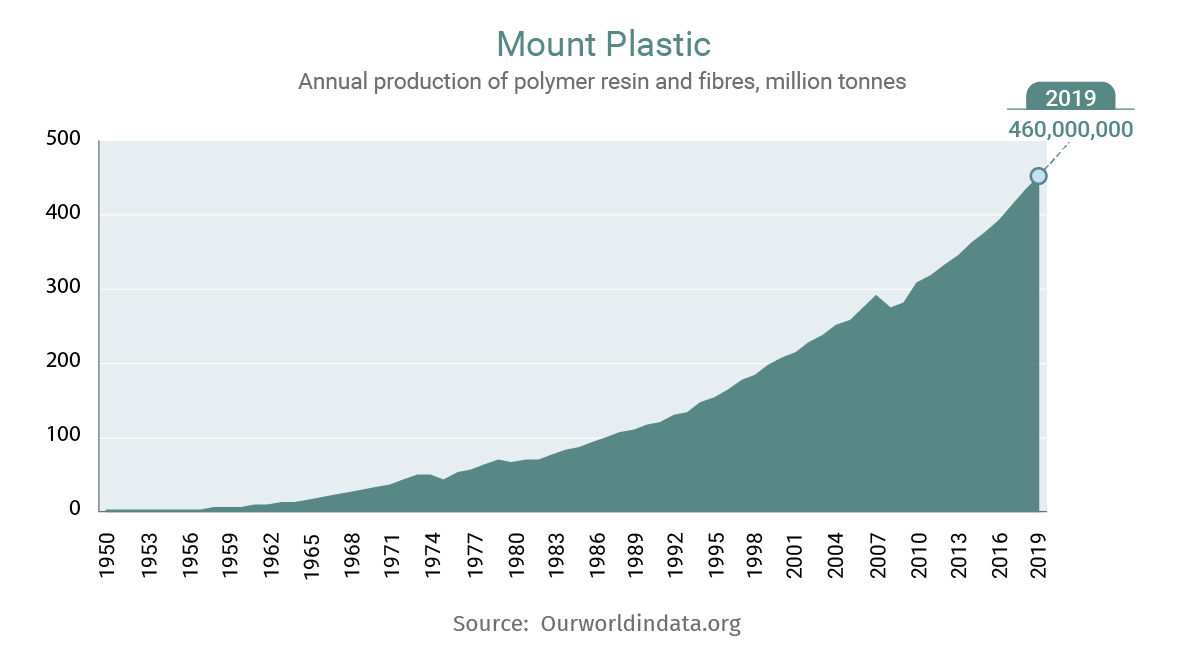
Further reading:
UNEP: How the world can end plastic pollution
ZEROING IN
Breaking Up From China’s Clean Energy Supply Chain
About that decoupling from China: the country will still be home to 65% of global clean technology manufacturing capacity by 2030, according to a new International Energy Agency forecast. While the U.S. Inflation Reduction Act, Canada’s green incentives and Europe’s Net Zero Industry Act will expand clean energy infrastructure in the West, China’s dominance in clean energy supply chains will remain intact for the foreseeable future, according to a new International Energy Agency forecast:
| US$ 790 billion | Expected annual global manufacturing output from 5 technologies by 2030: solar, wind, batteries, electrolyzers and heat pumps. |
| US$ 500 billion | CO2 needed to be captured annually by 2050 to meet the U.S.’s energy transition goals. |
| 55-65% | China’s share of global onshore wind nacelle (containing the gearbox) manufacturing capacity by 2030, from 60% currently; around 80% for offshore equipment. |
| 66% | China’s share of global EV battery capacity by 2030, compared to 75% in 2022.ina’s share of global EV battery capacity by 2030, compared to 75% in 2022. |
Source: International Energy Agency
PUBLIC POLICY
G7’s Clean Energy Blueprint
Lost in the haze of a new Cold Conflict with Russia and China was the G7’s Clean Energy Economy Action Plan unveiled in Hiroshima last week.
Some top takeaways from the CEEAP blueprint:
Zero-sum competition: G7 pledged not to fight over green investments—that’s a nod to the infighting already evident with Canada and the European Union trying to lure automakers and others from the hypnotic charms of the U.S. Inflation Reduction Act.
Emissions accounting is coming: Markets must account for embedded emissions in traded goods and supply chains to ensure countries cavalier with their emissions are aligned with global climate goals. The G7 has asked the OECD “to explore methodological approaches for computing carbon intensity of goods or sectors.”
No ally left behind: While G7 countries are signing critical minerals pacts with each other, most of the resources lie in emerging economies. The G7 Partnership for Global Infrastructure and Investment (PGII) aims to tap resources of emerging countries, bringing them along the Net Zero journey and ensuring a more just energy transition, at least in theory. The PGII is a direct response to China’s sprawling Belt and Road program that aims to connect various emerging markets through ports and other infrastructure.
Climate finance: There was more talk of climate finance for low-income economies vulnerable to climate change. The World Bank is tasked with addressing the challenge.
Further reading:
The G7 Clean Energy Economy Action Plan
PUBLIC POLICY
Gas On G7’s Mind
Germany is pushing for more natural gas investments, while China (along with India, which is also invited) is seeking “multiple pathways” for fossil fuel use, setting up a clash with partners at the G7 Summit starting in Hiroshima, Japan, today.
Germany sees natural gas as “a transitional source of energy,” arguing that its hurriedly built liquefied natural gas import terminals can be repurposed for hydrogen when that technology achieves scale, while China and India say a one-size-fits-all energy path doesn’t meet their needs.
With G7 seeking to undermine future Russian energy output at the summit, agreement on pathways (plural) to achieve energy transition has become more pressing.
There are a number of energy security, environmental and geopolitical issues on the G7 agenda. We will also be watching for developments on the “Climate Club,” that was fleshed out at the G7 summit in Germany last year.
Who can join the club and what will its framework look like? The Asian Development Bank Institute has a few ideas:
-
- Phase out subsidies and improve carbon pricing. ADBI recommends that as a pre-requisite to joining the club.
- Increase support for green research and development. Environmental-related R&D hovers around 1.8% of total R&D in the U.K. and France, and 0.3% in the U.S.
- Impose a carbon import levy on regions without carbon pricing. A border carbon adjustment will be needed to protect the competitiveness of Climate Club participants.
Further Reading:
Read the G7 Finance Ministers’ communique here.
Read the Asian Development Bank Institute’s report here.
BUILDINGS
The $4OB Challenge
Buildings have long been at the heart of Canada’s emissions problem, generating an eighth of our emissions, or some 90 million tonnes (MT) of carbon dioxide each year. And those emissions are rising, as more houses and commercial spaces heated with natural gas are built.
A new RBC Climate Action Institute report explores the scale of the building challenge in Canada:
- 5.8 million: The number of new houses—a 40% increase by 2030—needed as the current housing affordability crisis and immigration boom accelerate demand.
- 18MT: The added greenhouse gas emissions to our carbon footprint annually with prevailing codes and practices. Emissions from production of the cement and steel used to build them will add even more.
- 90MT: Greenhouse gas emissions from existing buildings. We’ll need to change how and what we build to meet Net Zero targets. We’ll also need to re-visit our current buildings—retrofitting some 16 million homes and 750 million square metres of commercial space.
- $40B: Capital investment required each year, with 60% going to retrofits and the rest to new builds.

Read the full report here.
BIODVERSITY
Halt & Reverse
The wildfires currently raging in Alberta have already destroyed just over half a million hectares: that’s precious biodiversity lost in weeks.
The makes the federal government’s public consultations launched this week to shape Canada’s 2030 Biodiversity Strategy even more urgent. The accompanying document, “Halting And Reversing Natural Loss,” lays out the challenge of protecting the country’s habitats in the face of climate change and rapid development.
Canada’s 2030 strategy builds on the Biodiversity COP15 Summit in Montreal last year—dubbed by some as nature’s “Paris Accord” moment—that ended with countries signing a landmark Kunming-Montreal Global Biodiversity Framework (GBF) to protect biodiversity, restore ecosystems and protect Indigenous rights.
Canada has had early success in protecting 300,000 square kilometres of land since 2015 and 14% of oceans protected (from 1% previously). But the frequency of volatile weather events such as droughts, wildfires, floods suggest a constant state of vigilance.
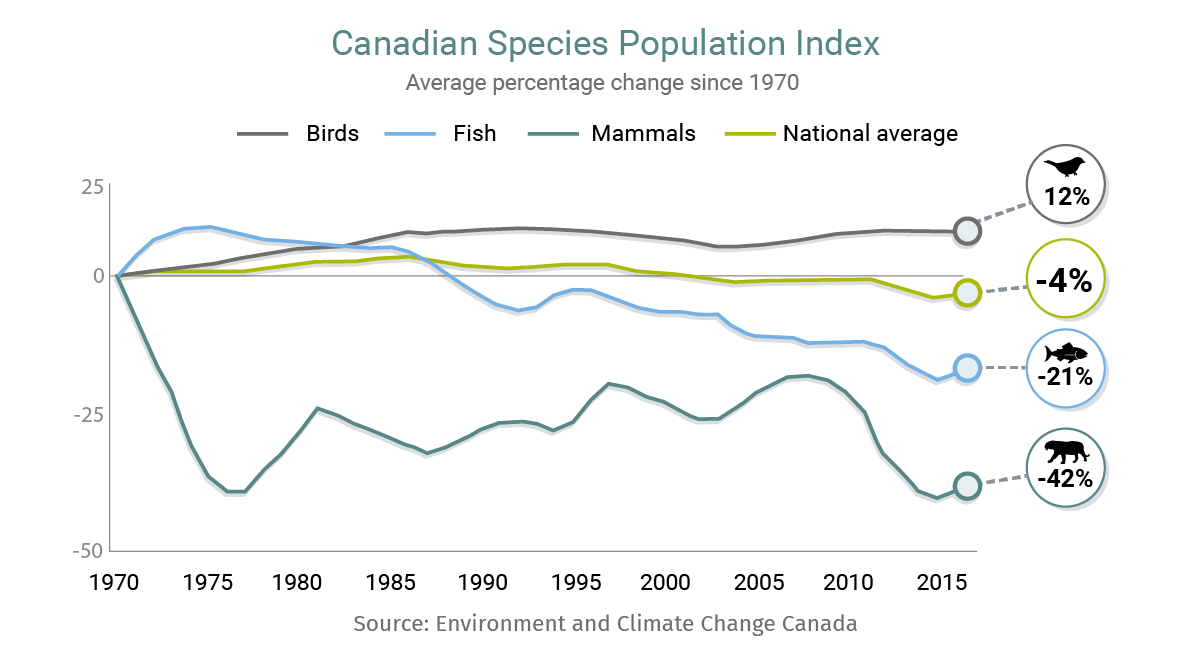
Indigenous stewards: Engaging Indigenous groups and ensuring provincial and municipal buy-in are critical to achieving the stated goal of protecting 30% of Canada’s land and water by 2030. More than a 1,000 Indigenous guardians have been stewarding various conservation initiatives across the country and that number will only grow, according to Environment Minister Steven Guilbeault.
Tree inflation: The government helped plant 30 million trees in 2021, and 60 million in 2022, but the effort will need to be at a “cruising altitude” of 300 million trees a year to get to Canada’s target of two billion by 2030, the Minister said.
Ecology and economy: Coordinating the efforts of more than 3,500 municipal, regional, Indigenous, and other local governments responsible for many direct, on-the-ground conservation activities will be a major undertaking. Another challenge would be to calibrate Canada’s growing economic needs—housing, infrastructure and industry—with a lighter footprint on the country’s ecology.
Further Reading:
Toward a 2030 Biodiversity Strategy for Canada: Halting and reversing nature loss.
ZEROING IN
The U.S. Carbon Capture Bill
Capturing and storing carbon in the U.S. is emerging as a massive investment opportunity as the Inflation Reduction Act tax credits roll out. A new U.S. Department of Energy report on the carbon capture, utilization and storage (CCUS) opportunity identifies the scale, and challenge, of the country’s energy transition:
| 20 million tonnes (MT) per annum |
Existing CCUS capacity in the U.S.— the largest in the world. |
| 400 to 1,800 MT | CO2 needed to be captured annually by 2050 to meet the U.S.’s energy transition goals. |
| US$600-billion | Investments needed in the U.S. to capitalize on the CCUS opportunity. |
| 48,000 to 155,000 | Kilometers of pipe needed to link CO2 to U.S. capture and storage sites by 2050. Current infrastructure: 8,000 km. |
Source: U.S. Department of Energy
EMISSIONS
Charles The Green?
The King recycles. While it’s hard to imagine the newly crowned King Charles III sorting out plastic from organics himself, the Royal household has a history of recycling food waste, glass, plastic, and paper across its palaces. Windsor Castle is powered by hydroelectricity, Balmoral by geothermal, and LED bulbs and smart meters dot the vast estate. Biodiversity is also a key consideration across the properties with long-grass policy, limited use of pesticides, and the recent introduction of bee hives at Buckingham Palace.
Still, latest data shows the Royal household’s greenhouse gas emissions shot up in 2022 on heating, owned/leased vehicles, and a 46% increase in business travel from the pre-pandemic levels.
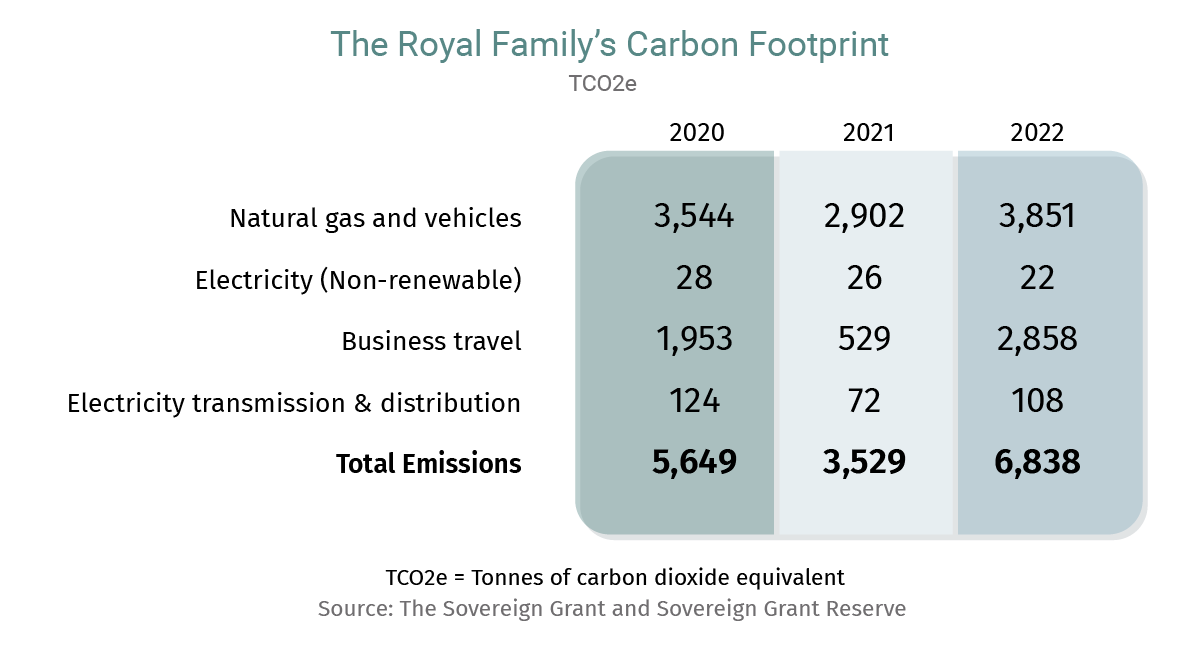
A princely warning: Over the decades, the new King has earned a reputation as an environmentally-conscious heir apparent. At a G20 summit in Rome in 2021, the-then Prince of Wales warned policymakers representing the world’s most powerful economies that it’s “quite literally the last-chance saloon,” to forge public-private partnerships and secure trillions of dollars needed to mitigate the impact of climate change. Famously, he was discouraged from giving a major speech at COP27 in Egypt last year by then Prime Minister Liz Truss.
Call to private sector: As prince, Charles also launched the Sustainable Markets Initiative at The World Economic Forum Annual Meeting in Davos in 2020, backed by 500 CEOs, to accelerate the private sector’s transition to a sustainable future. The SMI’s mandate, Terra Carta, proposes a set of principles that puts nature, people and planet at the centre of global value creation.
Earthshot Prize: The Royal Foundation and Prince William, the current Prince of Wales, created the £1million Earthshot Prize Awards last year to reward companies fighting climate
change. Winners included an Omani company mineralizing CO2 in rock, and an Australia-based Indigenous women’s group protecting the Great Barrier Reef.
Royal emissions: With support for the monarchy at a historic low in the U.K. (and in Canada), burnishing the new king’s climate credentials could help shed an (LED) light on climate change. A good place to start: the Royal household’s own emissions.
TRANSPORTATION
Recharging Canada’s EV Sales
Is Canada on track to ensure all auto sales by 2035 will be zero-emissions? At current pace, we are on course to fall short of the target, according to projections by BloombergNEF and RBC Climate Action Institute. EVs would also account for only 38% of all Canadian car stock—short of the 50% target needed to reach the overall goal, BNEF projects. Boosting EV car stock is critical in making a dent in emissions.

A spate of investments, including generous incentives, is pouring in to bolster Canada’s EV supply chain and safeguard the auto industry’s future. But hitting 100% sales target in just over a decade would require massive consumer buy-in. Industry will have to address affordability challenges and improve charging infrastructure to spark broader adoption.
Charger anxiety: A third of Canadians polled by KPMG were reluctant to buy an EV due to charger anxiety, among other factors. Another third of those polled would prefer a hybrid (for fear of running out of battery juice).
But EV owners are hooked: A vast majority of Canadian EVs owners polled in a separate survey in March expect their next car to also be an EV, given its lower operation costs, driving enjoyment and “quietness of ride,” compared to combustion cars. Still, nearly half of EV owners hesitate to take their cars on long road trips, and two-thirds own a gas vehicle for longer journeys, according to a PlugShare survey.
Perception & reality: Before purchasing an EV, around two-thirds of those polled believed their EV’s range was their most serious concern, but that dropped to nearly a third after owning the vehicle. Crucially—and this is arguably the biggest issue to address—before owning a vehicle, 66% worried about access to public charging stations, and that figure remained a significant 44% after owning an EV.
RCAI’s research shows Canada is lagging others countries when it comes to charging infrastructure. Canada’s EV charging and refuelling infrastructure targets call for 84,500 chargers (current status: ~21,500) and 25 hydrogen stations (current status: 5) to be deployed by 2029.
SKILLS
Green Jobs Key To US$44-Trillion Transition
The latest International Renewable Energy Agency outlook has a number of interesting data points—such as US$44 trillion needed globally this decade to remain in the 1.5°C Scenario until 2030—but what caught our eye is the focus on skillsets, which IRENA believes will be the “lynchpin” of a successful energy transition.
- The renewable energy sector created 5 million jobs over the past 10 years to reach 12.7 million.
- Tens of millions of additional jobs will be created in coming decades, but they need to be “decent” with equal opportunities for women, youth and minorities.
- Incorporating renewable energy in education and expand technical and vocational training opportunities.
- Develop pathways for fossil fuel industry workers to retrain and recertify for careers in renewable energy.
The last point is contentious in Alberta. The federal government, which has moved away from the troubling “just transition” phrase to “sustainable jobs,” laid out a 32-page plan in February to pivot from combustion-energy to clean-energy jobs. A federal bill is forthcoming, but the two main political parties in Alberta, now in the midst of an election cycle, are opposed to it—at least for now.
Canada’s skills shortages are well documented, and may be exacerbated by provinces and federal governments’ inability to find common ground. At stake are thousands of jobs and the country’s energy and climate security. If Canada can get its policies right, around 400,000 new green jobs can be created, according to RBC estimates.
ZEROING IN
Quest For Sustainable Ag
The world needs to embark on a more sustainable agriculture path—and fast. The vital sector is draining resources, remains carbon-intensive and eroding biodiversity. A new report examines the natural capital being consumed by the sector:
| 23% | Agriculture’s share of global greenhouse gas emissions. |
| 80% | Agriculture’s contribution to biodiversity loss. It’s also responsible for 80% of land-system change (land use and deforestation), and 5% of ozone depletion. |
| 50% | The percentage of all ice-free land used for agriculture; 55% of ocean is industrially fished. |
| 70-84% | Percentage of freshwater withdrawals used for agriculture. |
Source: Bloomberg NEF BNEF (bbhub.io)
Further reading:
- The Next Green Revolution: How Canada can produce more food and fewer emissions (rbc.com)
CRITICAL MINERALS
Plugging The Lithium Deficit
Chile’s decision to nationalize its lithium mines highlights the precariousness of the resources vital in building decarbonized sectors. While the move is aimed at boosting Chile’s production, analysts question the major producer’s ability to raise output on its own. The move comes on the heels of Mexico nationalizing lithium mining and extraction earlier this year, and is part of a wider expansion challenge facing “green metals” at a time when they are expected to play a key role in decarbonization. While alternatives are also gaining traction, lithium-ion batteries are expected to power the global electric vehicle industry and cut transportation sector’s emissions.
Global scramble: Lithium is facing a supply deficit just as major automakers are ramping up EV production. Germany restarted a mothballed fluorspar mine—a metal known as “lithium’s little brother”—after 27 years in a desperate measure to gain some self-sufficiency in EV batteries for its all-important auto sector. Capital spending on lithium extraction globally hit a record US$467 million in 2022, the highest since S&P Global Ratings started tracking the commodity in 2010, as the industry eyes more politically-stable jurisdictions.
Canada’s lithium play: Last year, Ottawa signed deals with two major German automakers to tap Canada’s battery minerals, including lithium, cobalt, nickel and graphite. Tesla, which is building a lithium refinery in Texas, signed a deal earlier this year to source high-purity lithium ore from a Quebec mine. Canada has the world’s 6th largest lithium reserves but negligible production, with a few companies suffering bankruptcies over the past few years. The absence of an active lithium mining and processing sector remains another challenge. Still, a number of promising lithium projects have advanced in Manitoba, Ontario and Quebec, Alberta and Saskatchewan. Canada also forced Chinese companies to divest from Canadian-listed lithium companies last year to secure its supplies.
Brine credits: To help feed the North American EV sector, the federal government’s 2023 budget expanded the eligibility of the Critical Mineral Exploration Tax Credit to lithium from brines and allow producers of lithium from brines to issue flow-through shares (effectively a tax deduction). That would benefit several tech-intensive lithium brine projects in Alberta and Saskatchewan eyeing lithium extraction from oil and gas fields and industrial wastewater.

ENERGY
$100B: The Cost of Oil Sands Phaseout
Phasing out the oil sands to get to Net Zero? That’s one way, but Canada will be poorer for it, with limited environmental gains. An accelerated push to phaseout the oil industry would trigger a $100-billion GDP loss, a deep recession, lower incomes, and declining exports by 2050. That’s the projection of a new Public Policy Forum report. Part of the Energy Future Forum project that features RBC as a member, the forum explores practical ways for Canada to get to Net Zero by 2050.
- The rest of the economy would hurt too, but economic engine Alberta would bear the brunt. In fact, research firm Navius Research, which crunched the numbers, says it may be underestimating the impact to Alberta’s economy.
- It will be marginally less costly for rest of the economy to achieve its emissions targets, but Canada would turn into a net importer, with fewer jobs.
- It denies existing producers the opportunity to innovate their way to a Net Zero future. Think of the potential of carbon capture and, arguably nascent, direct air capture technology.
Conflating emissions with fossil fuels is not helpful. To be clear, Canada needs to implement new policies as the current levers leave us well short of Net Zero targets. But energy reliability and affordability, and economic prosperity, should not play a secondary role to emissions reduction. We can find better ways.
ENERGY
India’s Emissions Challenge
India, which recently surpassed China as the world’s most populous country, has a major climate challenge on its hands. The South Asian nation’s 1.4-billion strong population is powering the economy to new heights with GDP expected to vault past Japan and Germany by 2030 to become the third largest economy after the U.S. and China. India already has the third largest emissions footprint on the planet—can it manage emissions without sacrificing economic expansion?

Here’s a quick look at India’s energy trends over the past decade:
- India is a major producer and consumer of coal, with consumption rising more than 4% annually over the past decade.
- Consumption of petroleum products surged around 3% annually, natural gas 1.2%, and electricity demand rose over 5% during the period.
- Per capita energy consumption shot up 9.3% during the period, although energy intensity contracted 2.4%.
Middle class boom: Some estimates show India’s middle class will grow from just under a third of its current population to almost two-thirds by 2047. That’s a lot of new people eyeing the necessities of modern life: cars, refrigerators, phones, housing, utilities and food—all requiring energy and emissions intensive processes.
Climate Ambition: The runaway growth has also meant that India is home to five of the 10 most polluted cities in the world. Plans to raise non-fossil fuel power capacity to 50% by 2030 is part of an overarching plan to get to Net Zero by 2070, but Climate Action Tracker deems India’s climate policies and actions “insufficient.” The country is investing heavily in solar parks, wind farms and hydro, while the government launched Mission LiThe sector got a big boost with Ottawa proposing investment tax credit for mining companies in the 2023 federal budgetFE (Lifestyle for Environment), aimed at changing individual behaviour.
What can Canadian companies offer India?: There’s no shortage of companies wooing India. Middle East, European and Russian conventional and cleaner energy producers are well-entrenched in the Indian supply chain, while U.S. LNG producers have ramped up exports to the South Asian nation. Canada’s Indo-Pacific strategy focuses on clean technology, but Canadian companies have barely scratched the surface of India’s energy potential, including its efforts to develop green hydrogen, solar and wind projects.
A new way: India, along with China, also recently pushed for “multiple energy pathways,” that allows some G20 countries to choose a roadmap to cut carbon emissions instead of setting a deadline to end the use of fossil fuels. The issue will likely come up again at COP28 being held in the UAE later this year.
ENERGY
Rise Of Renewable Natural Gas
Expect renewable natural gas (RNG) projects to more than double in Canada over the next few years, as policy changes and provincial mandates take effect. As many as 18 new projects are underway taking Canada’s total RNG capacity to 17.1 petajoules, from 7.2 petajoules in 2021, according to the Canada Energy Regulator.
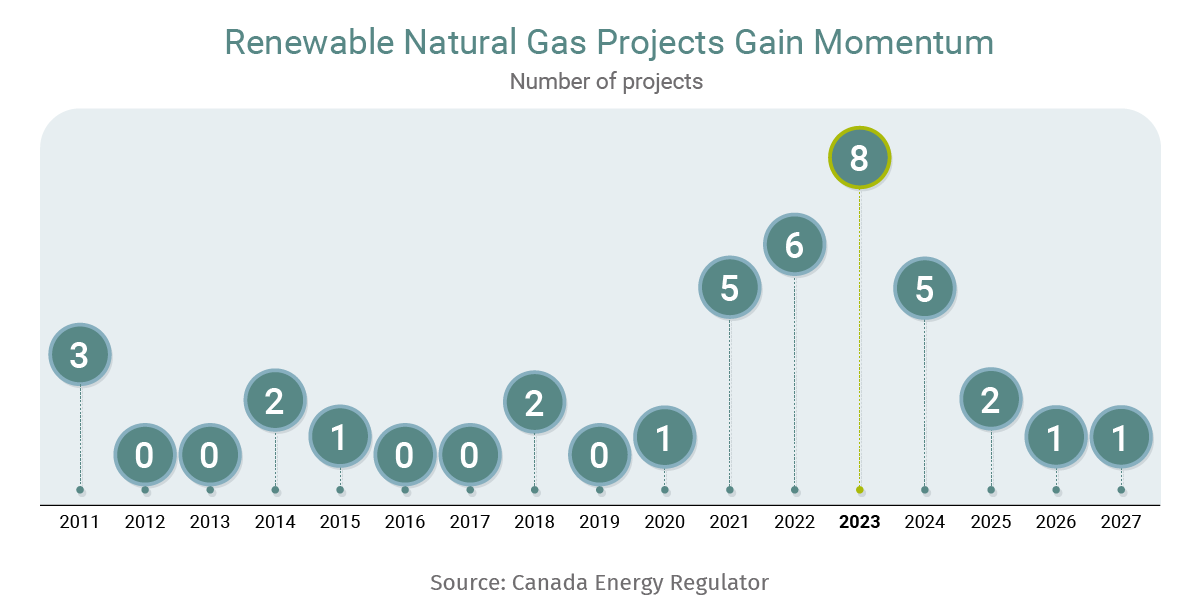
How is it produced?: Biogas used to produce RNG is sourced from solid waste landfills, livestock farms, and organic waste management operations, among others, through a biochemical process, such as anaerobic digestion. Its key superpower: RNG captures and recovers methane, a potent greenhouse gas. RNG is also indistinguishable from conventional gas once processed and can be injected into existing natural gas pipeline to power transportation, industry and homes.
Quebec leads: The province was the first in Canada to mandate inclusion of RNG in natural gas, with a target to blend a minimum of 5% RNG in natural gas by 2025. British Columbia has a committed to 15% renewable content by 2030. Utilities are teaming up with farmers to leverage their organic waste and build biogas facilities and cut agriculture emissions that account for around 10% of Canada’s greenhouse gas emissions.
Emissions: An inspirational target set by Canadian utilities to blend 10% of RNG in the mix by 2030, would lead to a 24 million tonne reduction of GHG emissions—equivalent to removing 5.2 million cars off the road, according to the Canadian Gas Association.
Challenges?: There are a few. Anaerobic digester facilities face long regulatory timelines, while scale is another issue facing smaller facilities. The federal government is seeking feedback for a proposed regulatory framework to reduce Canada’s landfill methane emissions, which could give RNG a boost.
TECHNOLOGY
The Good, The Bad & The Ugly of AI
When the “Godfather of AI” says he regrets his life’s work and we may have gone too far with the technology, it’s time to take notice. Geoffrey Hinton, who pioneered artificial intelligence systems that are the bedrock of new AI iterations such as ChatGPT, is warning that the unregulated technology could soon flood us with fake photos and videos and upend labour markets. This has far-reaching repercussions for the entire energy and climate complex, too.
The Good: AI is seen as a promising tool to mitigate climate change. Its ability to process detailed climate data and models, and quickly detect changes in complex locations such as oceans, near-space and the Arctic could be vital in proactively managing crises, according to Jim Bellingham, executive director of the Johns Hopkins Institute for Assured Autonomy. Other applications include using AI to build low-emissions materials for electric cars, solar panels and wind turbines that are lighter, stronger and cheaper.
University of Toronto was recently the biggest recipient of a $200-million grant from the Canada First Research Excellence Fund for a project that combines artificial intelligence, robotics and advanced computing to discover new materials and molecules at a fraction of the usual time and cost. “Applications include everything from life-saving medications and biodegradable plastics to low-carbon cement and renewable energy,” UofT said.
The Bad: But Geoffrey Hinton, and a number of other thought leaders in the space, are gripped by AI’s supercharged ability to spread misinformation. That could seep into political discourse and set back discussions and decisions on climate change and biodiversity. Hinton also warned that it will be hard to stop “bad actors from using it for bad things,”—and the possibilities are endless.
The Ugly: As historian Yuval Hariri wrote in the New York Times, while AI can invent new solutions for climate and energy crises, “it doesn’t matter how high the skyscraper of benefits AI assembles if the foundation collapses.”
PUBLIC POLICY
Taking Stock Of Canada’s Emissions
Scaling down down Canada’s emissions to 440 Mt by 2030 from its current levels of 670 MT will require cuts equal to around four times the drop seen during the pandemic, according to a new RBC Climate Action Institute analysis.
While existing policies have moved the needle, achieving Ottawa’s target of 40% lower emissions by 2030 will require a harder push from industry and federal and provincial policymakers.
While oil and gas sector has the steepest challenge, population growth and economic expansion means agriculture, building and transportation sectors must also find ways to grow without expanding their emissions footprint.
Read the full report here to explore the challenges facing provinces and key sectors to meet 2030 targets.
ZEROING IN
IAAC: A Fast-Track Process Stuck In Slow Motion
The Impact Assessment Agency of Canada came into effect in 2109 to streamline federal and provincial decisions on infrastructure projects. It is early days, but the process has struggled to accelerate decision-making, according to a new Canada West Foundation report.
| 1 | The number of projects approved by the IAAC since its inception—around 25 projects are under review. |
| 180 | The legislated limit IAAC has to complete its work in the planning phase. But the IAAC can suspend the clock if requested by proponents or the Ministry of Environment. |
| 332 | The average days projects spent in Phase 1, suggesting the process remains a work in progress. |
| 862 | The number of days Fording River Extension, a coal mining project, has spent in the regulatory process—the most among projects in review. |
Source: Canada West Foundation
PUBLIC POLICY
5 Ways Alberta Can Upgrade Its Climate Plan
Canada would struggle to hit its Net Zero targets with Alberta pulling along in the same direction.
The province released its Emissions Reduction and Energy Development Plan days after Canada’s latest emissions report showed the province’s emissions rose 8%, even as national emissions reversed 8% in 2021 vs 2005. The reason: Oilsands production in Alberta surged 775% and emissions shot up 460% to 70 metric tonnes since the 1990s. On the flip side: the world needed Canadian oil and higher production generated tax revenues, economic activity and shareholder wealth.
Skeptics argue that the EREDP doesn’t have a clear path forward (Pembina Institute said the plan lacked “key elements of credible strategy.”)
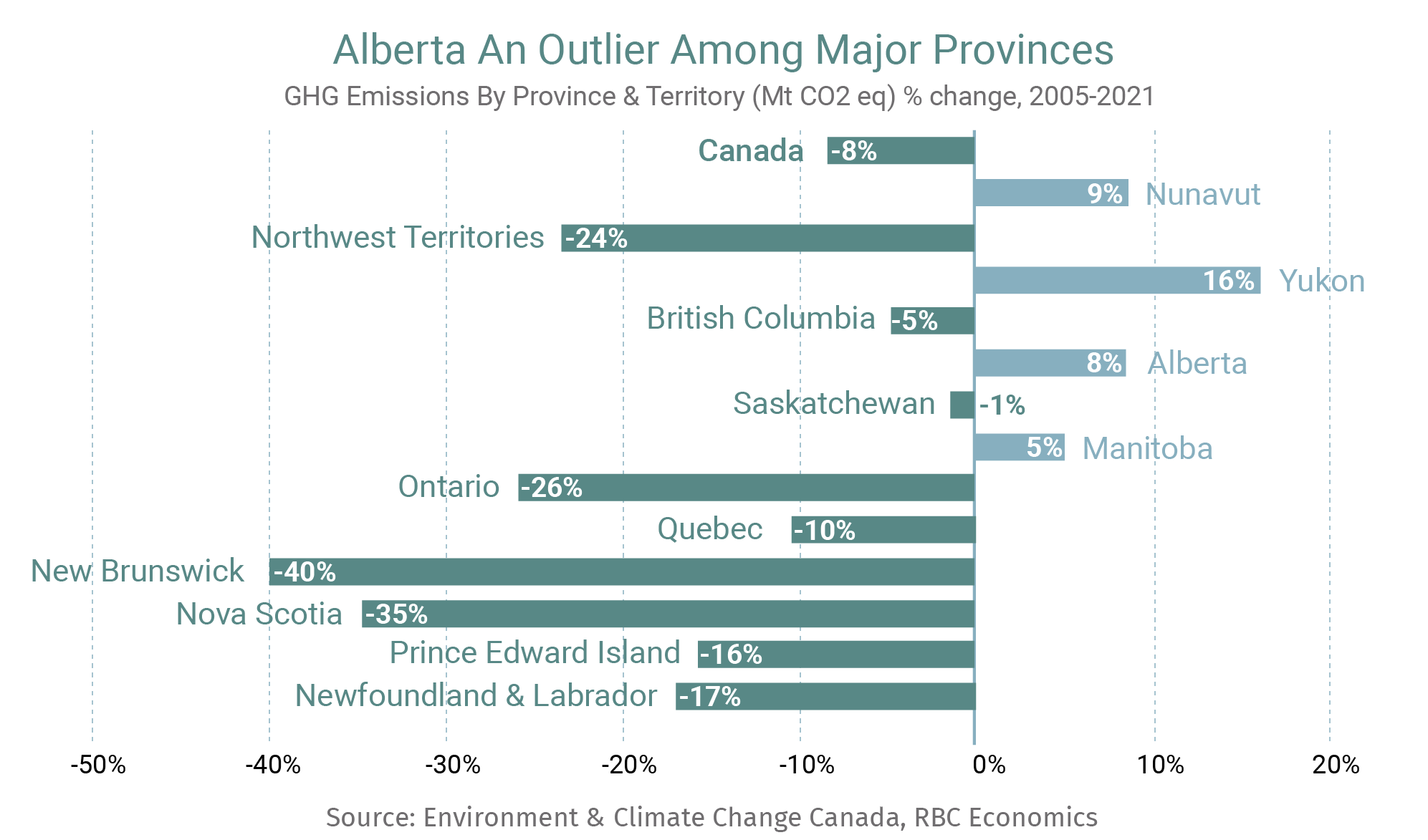
Here’s how the province could upgrade its plan:
-
- Target 2030: It’s hard to set a 2030 emissions plan with only seven years to go, but Alberta should offer some climate guardrails and emissions targets. Committing to the federal target of 40-45% cut in emissions by 2030 would send a strong signal. Working with Indigenous group to help speed up the six-company Pathways Alliance’s carbon capture projects would bring instant climate cred.
- Stringent regulations: There are still too many leaks, spills and accidents in the oil and gas sector that distract from the important work being done by industry on emissions. Orphan oil and gas wells cleanup is another challenge worth addressing head-on.
- Alberta Calling: The province’s tongue-in-cheek ads to attract Canadians from the expensive housing markets of Toronto and Vancouver netted 33,000 net migrations in Q3, 2022—a remarkable success. Can Alberta make a pitch to (new) clean tech immigrants to lay down their roots in the province? The federal government has also earmarked billions in clean tech and mining investment tax credits. Leverage Alberta’s affordable housing to attract some of those dollars in the province.
- Green shoots: Emissions from Alberta’s agriculture sector fell slightly from 2005 levels—is there a way to get further reductions? RBC’s report, “The Next Green Revolution” has some thoughts.
- Electrify to the hilt: Alberta’s last coal-powered plant is set to close down this year—seven years ahead of schedule. The switch away from coal has led to a 25% drop in electricity emissions since 2005—a remarkable effort. Despite the spate of wind and solar farms dotting the Prairies, the switch from coal has favoured natural gas, with 3,886 megawatts in new natural gas capacity. Committing to a Net Zero grid by 2035, would spur investments in cleaner energy sources, including small modular nuclear reactors (SMRs) and hydrogen.
Further Reading:
Emissions Reduction and Energy Development Plan | Alberta.ca
PUBLIC POLICY
Why G7 Eco-Communiqué Was A COP28 Preview
The G7 environment ministers’ behind-the-scenes divisions in Japan could foreshadow what’s to come later in the year at COP28 in Dubai, UAE.
Crucially, the ministers agreed to phase-out “unabated fossil fuels” to achieve Net Zero by 2050 in their 36-page communiqué—that commitment had failed to make the cut at COP27, as Saudi Arabia, China and others prevailed. Japan’s push for greater support for natural gas (and hydrogen) was also diluted in the final draft; in a compromise, no timeline was set for phasing out coal-fired power plants. (As an aside, the word “unabated” means oil and gas producers must double-down on carbon capture and other emissions-cutting tech).
New Climate Bargain: Expect more climate bargaining to come as COP28 host UAE, a major hydrocarbons producer, and its allies, counter the G7 call. The challenge will be to remain true to Net Zero. Compromise is already in the air, with Sultan Al Jaber, President of COP28 (and CEO of state-owned Abu Dhabi National Oil Co.) advocating “a pragmatic energy transition.” While some have questioned the merits of an oil CEO running the world’s most influential climate platform, hydrocarbon hubs such as the UAE are also where the biggest climate fights are taking place, and the stakes are even more consequential for economies of the so-called “Global South.”
Further Reading:
A Kingdom Built On Oil Now Controls the World’s Climate Progress
TRANSPORTATION
E-Scooters’ Rough Ride
E-scooters seem like an eco-friendly, fun solution for last mile and quick trips, but the two-wheelers have divided people. Parisians said au revoir to the 15,000-scooter services recently in a stunning 89% vote against it (even the pro-cycling Socialist Paris Mayor Anne Hidalgo supported the ban). In the UK, the National Federation of the Blind thinks e-scooters are unlike bikes and a danger to the blind and visually impaired, while the Accessibility for Ontarians with Disabilities Act Alliance considers them a “silent menace.”
What’s the case against e-scooters?: They clutter roads and often have lower age limits than other modes of transport. E-scooters have been blamed for deaths and serious accidents in many cities. (There are also concerns about recycling but that’s not unique to e-scooters).
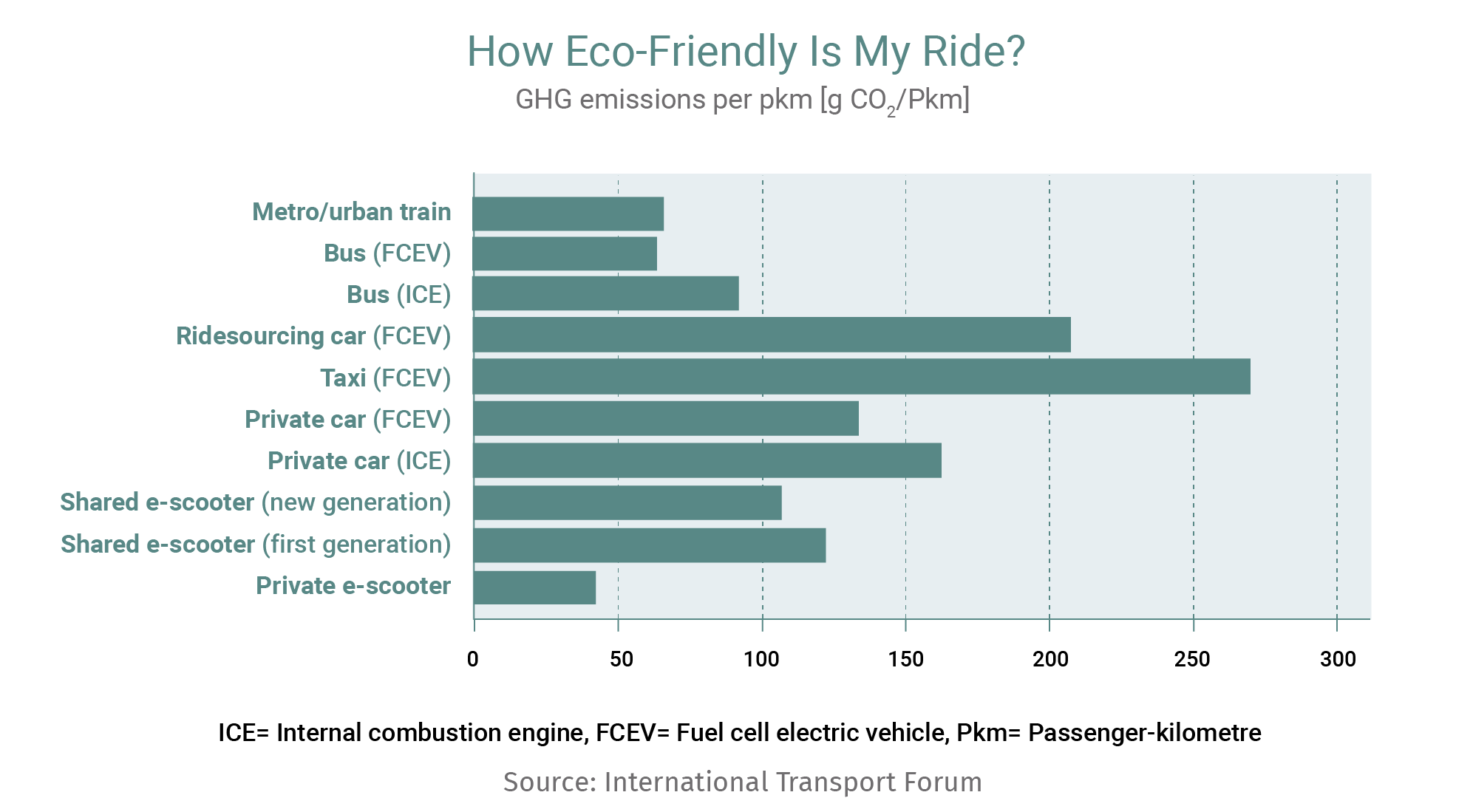
What about their eco credentials? Research by the International Transport Forum suggests e-scooters’ environmental impact is lower than taxis, ride-sharing services, private cars, but “shared mobility services have the highest energy and GHG emission impacts/per km of all urban mobility options.” New generation of e-scooters have swappable batteries that add to greenhouse gas emissions per kilometer, but it could also extend their life.
Another study notes that the lifecycle greenhouse gas emissions associated with e-scooter use is higher in 65% “than the suite of modes of transportation that are displaced.”
Also, use of e-scooters and other shared micro transportation services could displace the most eco-friendly practice in mobility: walking. It’s going to be hard for e-scooters to compete with increasingly-electrifying public transport in major Canadian cities. But with cost of gas rising, it remains a tempting option for many.
Where do Canadian cities stand on e-scooters?: Many large Canadian cities, notably Toronto has banned e-scooter services, but some cities such as Vancouver approved a three-year electric kick scooter pilot program starting in 2021, with restrictions. E-scooters are set to return to Ottawa in May, subject to stricter rules.
ENERGY
Canada’s Gas Conundrum
resource could unlock a fresh wave of economic activity and help cut global emissions. But we risk missing our Net Zero targets without major investments in abatement technologies.
Canada’s Conundrum: Three Ways To Address The World’s Gas & Climate Crises, a new report by RBC Climate Action Institute, explores three roles Canada can play to boost global energy and environmental security:
- The Gulf Coast Exporter: Ramp up natural gas exports to the U.S. Gulf Coast liquefied natural gas (LNG) producers, which is developing a number of gas-exporting projects. The strategy may raise Canada’s upstream gas sector emissions by up to 7%.
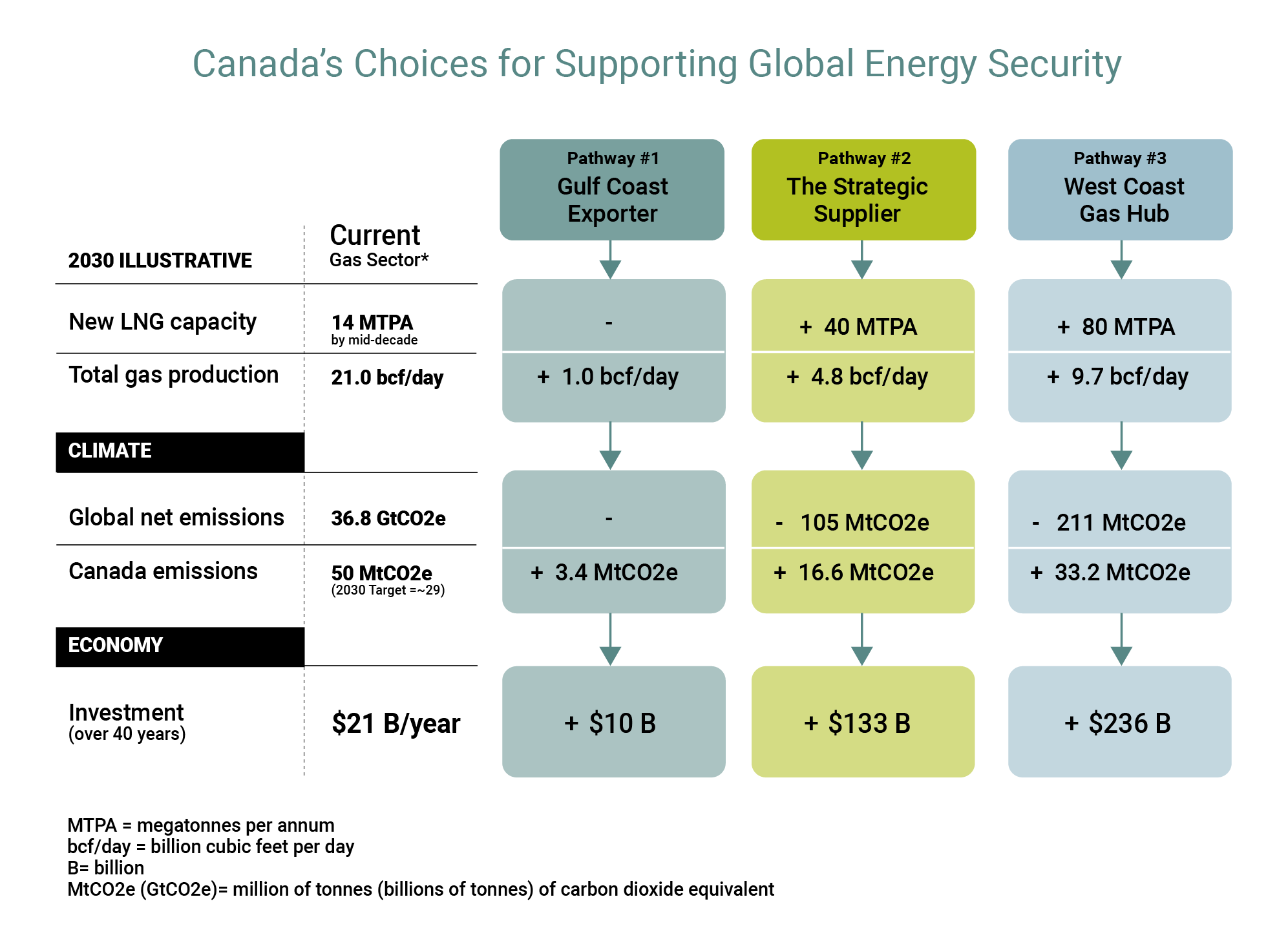
- The Strategic Supplier: Carve a niche in global LNG markets as a strategic supplier of stable, low-emissions gas. A handful of projects could potentially reduce global emissions by a net 105 MtCO2e—roughly equivalent to Qatar’s total GHG emissions, but would also raise Canadian gas sector emissions by a third assuming current technologies.
- The West Coast Gas Hub: Build out LNG capacity to its full potential, taking a more assertive role in global natural gas markets. The strategy could reduce net global emissions by as much as 211 MtCO2e but raise the Canadian sector’s emissions by 66%. The strategy would attract more than $200 billion in investments.
Read the full report here.
ZEROING IN
Charge Of The EV Brigade
Electric vehicles are steadily raising their market share, not just in the key markets of China, U.S. and Europe, but also in a number of promising emerging markets, according to a new report by the International Energy Agency. Some highlights include:
| 10 million | The record number of electric cars sold globally in 2022—with forecasts of 14 million EV car sales in 2023. |
| 5 million | The number of oil barrels set to be avoided by 2030, thanks to the transport sector’s rapid electrification. |
| 60% | China’s market share of EV car sales. |
| 9.6% | The market share of cars sold in Canada that were zero-emissions in Q4, 2022, up from 8.7% in Q3. |
TRANSPORTATION
EVs To Supercharge Canada’s Mining Sector
North America’s electric vehicle sector has moved into the fast lane. A new U.S. proposal to impose strict emissions rules on conventional cars is set to boost EV sales in the country, with the added bonus of cutting U.S. oil imports by 20 billion barrels (CC: Canadian oil producers) and avoiding 10 billion tons of CO2 emissions—more than twice the total U.S. CO2 emissions in 2022. But a lot more critical minerals will be needed to reach the U.S.’s stated target of EVs making up 66% of all cars sales by 2032.
The hunt for raw materials: While lack of charging infrastructure could slow EV sales, an even bigger concern is the looming raw material shortage that could restrict supply. Western countries and auto makers are scrambling for increasingly-expensive lithium, copper, nickel and rare earth materials, that’s adding to costs. G7 environment ministers’ latest communique after a meeting last week in Sapporo, Japan, stressed the importance of strengthening critical minerals and materials supply chains towards a Net Zero economy.
Canada’s opportunity: Don’t expect the transition from combustion to clean vehicles to be easy and on time, but the U.S. move is a boon for Canadian mining.
The sector got a big boost with Ottawa proposing investment tax credit for mining companies in the 2023 federal budget. A $3.8-billion Critical Minerals Strategy was announced in the 2022 budget aimed at taking advantage of the U.S.’s Buy North American provisions and the U.S. Inflation Reduction Act. The Feds also launched the $1.5-billion Critical Minerals Infrastructure Fund towards energy and transportation projects needed to unlock mineral-rich deposits. Canada has already signed a joint-action plan with the U.S., EU and Japan as it positions itself as a provider of critical minerals.
What’s missing?: Engagement with Indigenous groups, which is impeding development of clean-energy infrastructure projects—a critical Canadian weakness. Many mineral-rich deposits such as the Ring of Fire in Ontario, straddle Indigenous territory and need their capital—natural, financial, intellectual and human, as outlined in our recent report 92 to Zero—before projects can proceed.
BUILDINGS
Warming Up To Heat Pumps
There is a quiet climate revolution breezing through the world’s ventilation systems. Heat pump purchases in the U.S. exceeded those of natural gas furnaces in 2022, part of a global uptick in sales of the heating and cooling system.
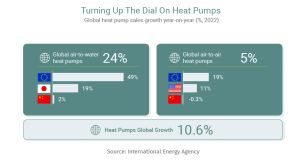
What are heat pumps, again?: Similar to furnaces or boilers, heat pumps can be two to three times more efficient than other electric home heating sources—making them a favourite among environmental economists. Heat pumps have had a slow uptake in Canada as they are less optimal in sub-freezing conditions, but that’s changing as more efficient upgrades emerge.
So, the world’s warming up to them?: Yes, global sales of heat pumps jumped almost 11% in 2022—a second year of double-digit growth, International Energy Agency data shows. Europe saw a 40% surge in sales as the continent worked hard to cut its dependence on Russian natural gas exports. Globally, heat pumps (when used as a main heating device) account for 10% of the heat needs of buildings—and are expected to reach 20% by 2030 to meet global climate pledges.
Installing heat pumps require high upfront costs but the technology has benefitted from strong financial incentives in 30 countries, with subsidy levels rising in a number of countries. The U.S. Inflation Reduction Act, for example, offers federal income tax credits for installing heat pumps. Global supply chains in the space are currently stretched, especially for chips, but manufacturing incentives in the U.S. and EU should boost supplies.

Why is Canada cool on heat pumps? The federal government sees heat pump adoption as one of the ways to bring down building emissions that account for 13% of Canada’s greenhouse gas emissions. But sales have crawled. Heat pumps had a 5.3% market share in 2019 of the Canadian heat and ventilation market, but Emissions Reduction Plan policies could help double that by 2030, the Canadian Climate Institute estimates.
How can Canada spur faster heat pump adoption? Here are three ways:
- By offering subsidies to make the expensive upfront cost of heat pumps more palatable to early adopters and help drive down the cost curve.
- By targeting policy at segments where heat pumps already make financial sense (e.g., for many households with oil or propane heat).
- By educating HVAC technicians and installers about the benefits heat pumps can help market them to more homeowners.
FINANCING
A Greener World Bank
The biggest news in climate last week didn’t make the news. But it could make history.
The world’s leading economic powers met in Washington and agreed to reforms for the World Bank that will allow the institution to lend an additional $50 billion over 10 years to low- and middle-income countries to fight climate change. It’s an important step towards helping developing countries invest now in cleaner energy and industrial processes.
We’ll have to do a lot more. The Peterson Institute for International Economics figures the world’s developing economies, which will account for the overwhelming growth of greenhouse gas emissions in the coming decades, need a seven-fold increase in climate-related investments. Most of that can come from the private sector, but there needs to be a lot more government-backed lending, too, to reduce the risk for other investors.
Enter multilateral development banks like the World Bank, Asia Development Bank and African Development Bank. They provided US$20 billion in climate financing in 2020, compared to the US$66-111 billion of government-backed loans the Peterson Institute estimates will be needed to fight climate change.
To get that sort of capital, the West will need to invest a lot more in the World Bank and others like it – or let China and other growing middle-income countries play a greater role. Both options are challenged because of fiscal restraint in the West and Washington’s desire to keep Chinese influence at bay.
U.S. Treasury Secretary Janet Yellen told the Bank to do more with what it has. Finance ministers from developing countries also came to Washington to share concerns about climate overtaking poverty alleviation as a global priority, as they find governments and investors looking eagerly to invest in solar farms over primary schools.
If the U.S. and other major World Bank shareholders don’t continue to push for reforms and more capital, they may find their climate ambitions to be a day late and a dollar short.
PUBLIC POLICY
Waiting For A Net Zero Investment Wave
Canada’s 2023 federal budget offers a significant response to the United States’ multi-billion dollar Inflation Reduction Act (IRA), but a Net Zero investment wave could face headwinds from rising international competition, regulatory impediments and the difficulty in getting provinces on board.
The budget’s new green measures are focused on bolstering the upstream supply chain for a low-carbon economy with new refundable investment tax credits (ITC) for clean electricity, clean-technology manufacturing, and hydrogen. Combined with carbon capture and cleantech ITCs announced over the past year, the federal government expects to spend about $80 billion over 10 years on green investment tax credits.
The measures compare favourably to IRA, but RBC Climate Action Institute’s new Policy Insight, Will Budget 2023 Spark A Green Investment Wave?, explains why Canada’s efforts to secure green investments could still face challenges.

The measures compare favourably to IRA, but RBC Climate Action Institute’s new Policy Insight, Will Budget 2023 Spark A Green Investment Wave?, explains why Canada’s efforts to secure green investments could still face challenges.
ZEROING IN
Taking Stock Of Canada’s Emissions
Some good news in the run-up to Earth Day on April 22: Canada’s 2023 National Inventory Report shows some progress towards climate action. Still, there’s a long way to go to reach Canada’s 2030 emissions reduction targets. Some key stats from the latest NIR:
- -8.4%
- Decline in Canada’s greenhouse gas emissions in 2021 from 2005 levels. But emissions in 2021 rose 1.8% compared to the pandemic-hit 2020.
- 5%
- Increase in GHG emissions from transport, followed by 4% jump in oil and gas emissions, between 2020 and 2021.
- -2.2%
- Decline in agriculture GHG emissions between 2020 and 2021, partly due to drought-related declines in crop production on the Prairies.
- -29%
- The decline in emissions intensity of Canadian GDP since 2005, suggesting a decoupling of economic growth from emissions.
Source: National Inventory Report





 Canada faces a triple economic challenge, and with it, a triple economic opportunity that can lay the foundation for growth through the 2030s.
The three points of this new growth triangle—economic reconciliation, productivity and climate action—are mutually dependent. In other words, you can’t have one without the others.
This was clear at COP28 in December, where there was an emphasis on growth, capital formation and economic inclusion to reach our climate goals. And it can be Canada’s strategic advantage if we make some important adjustments.
Let’s start with climate action, and a blunt reality: Net Zero is going to require a scale of investment that we have not seen in our lifetimes.
RBC’s Climate Action Institute recently published a report on the state of the transition in Canada, called
Canada faces a triple economic challenge, and with it, a triple economic opportunity that can lay the foundation for growth through the 2030s.
The three points of this new growth triangle—economic reconciliation, productivity and climate action—are mutually dependent. In other words, you can’t have one without the others.
This was clear at COP28 in December, where there was an emphasis on growth, capital formation and economic inclusion to reach our climate goals. And it can be Canada’s strategic advantage if we make some important adjustments.
Let’s start with climate action, and a blunt reality: Net Zero is going to require a scale of investment that we have not seen in our lifetimes.
RBC’s Climate Action Institute recently published a report on the state of the transition in Canada, called 
 Cleantech is in correction mode. Last year’s CleanTech Forum, in Palm Springs, was brimming with measured optimism, although there were whispers of some impending corporate failures wafting down the halls.
Clean technology fortunes between the commercially viable and the questionable had already begun to diverge in 2023, a trend that will only deepen.. At this year’s forum in San Diego, there was a full-throated acknowledgement of a much-needed cleantech shakeup in the offing.
This year will almost certainly see further retrenchment from the US$40 billion capital flows into clean technology companies and national and corporate climate commitments of 2023, according to BloombergNEF.
Companies with weaker economics or technical fundamentals are struggling, while venture and growth dollars for new industrial technologies are waning. Dozens of cleantech companies have seen their values drop and financial flows dry up as financing becomes more difficult to obtain. Further declines and eventual consolidation in the industry seems inevitable.
Still, that’s in Silicon Valley’s DNA: test, crash and burn until a unicorn rises. On repeat.
To be clear, there’s plenty of optimism, too: project financing and job creation for clean technology manufacturing facilities have never been stronger. Meanwhile, government measures, such as the U.S. Inflation Reduction Act, and climate-focused investors will sustain the best companies as they commercialize.
Cleantech is in correction mode. Last year’s CleanTech Forum, in Palm Springs, was brimming with measured optimism, although there were whispers of some impending corporate failures wafting down the halls.
Clean technology fortunes between the commercially viable and the questionable had already begun to diverge in 2023, a trend that will only deepen.. At this year’s forum in San Diego, there was a full-throated acknowledgement of a much-needed cleantech shakeup in the offing.
This year will almost certainly see further retrenchment from the US$40 billion capital flows into clean technology companies and national and corporate climate commitments of 2023, according to BloombergNEF.
Companies with weaker economics or technical fundamentals are struggling, while venture and growth dollars for new industrial technologies are waning. Dozens of cleantech companies have seen their values drop and financial flows dry up as financing becomes more difficult to obtain. Further declines and eventual consolidation in the industry seems inevitable.
Still, that’s in Silicon Valley’s DNA: test, crash and burn until a unicorn rises. On repeat.
To be clear, there’s plenty of optimism, too: project financing and job creation for clean technology manufacturing facilities have never been stronger. Meanwhile, government measures, such as the U.S. Inflation Reduction Act, and climate-focused investors will sustain the best companies as they commercialize.
 North America’s manufacturing renaissance is underway with technologies graduating from demonstration to deployment. Factories for electric vehicle batteries, electrolyzers, carbon dioxide pipelines, and low-carbon steel, cement, and ammonia plants are coming online across the continent.
Other bright spots are the opportunities in emerging economies, especially in Asia Pacific. Highly susceptible to climate change’s impacts as they raise their standards of living, India, South Korea, and China, for example, are bucking the Western downturn and are happy hunting grounds for clean technology investors and entrepreneurs.
By the end of the year, the role of politics, another key variable in forward climate trajectory, will also become clearer. Electoral unease has already manifested in the rollback of climate policies around electric vehicles and strengthened oil and gas licensing in the U.K., and calls for axing the carbon tax in Canada.
In the conference halls of San Diego Bay Mission Resort there were whispers of further headwinds with a potential return to a Donald Trump presidency. But with Red States securing most of the capital flows emanating from IRA incentives, climate policies may yet not be dumped by Trump. Of course, another Joe Biden term could cement climate policies in the American economy.
North America’s manufacturing renaissance is underway with technologies graduating from demonstration to deployment. Factories for electric vehicle batteries, electrolyzers, carbon dioxide pipelines, and low-carbon steel, cement, and ammonia plants are coming online across the continent.
Other bright spots are the opportunities in emerging economies, especially in Asia Pacific. Highly susceptible to climate change’s impacts as they raise their standards of living, India, South Korea, and China, for example, are bucking the Western downturn and are happy hunting grounds for clean technology investors and entrepreneurs.
By the end of the year, the role of politics, another key variable in forward climate trajectory, will also become clearer. Electoral unease has already manifested in the rollback of climate policies around electric vehicles and strengthened oil and gas licensing in the U.K., and calls for axing the carbon tax in Canada.
In the conference halls of San Diego Bay Mission Resort there were whispers of further headwinds with a potential return to a Donald Trump presidency. But with Red States securing most of the capital flows emanating from IRA incentives, climate policies may yet not be dumped by Trump. Of course, another Joe Biden term could cement climate policies in the American economy.