U.S. President Donald Trump’s refusal to renew the Canada-United States-Mexico (CUSMA) agreement by the July 1st deadline came as no surprise. But it did usher in a new era for the agreement, one that will include more talks—and even more uncertainty.

What does the no deal by the deadline really mean?

  • For starters, the deal is not dead: The agreement will require annual reviews for the next decade. So little changes in the near term, as tariff carve outs for Canadian and Mexican goods that comply with CUSMA remain in place. If, however, the three parties do not reach an extension agreement by 2036, the deal expires.

  • Will the U.S. withdraw before then? Trump has threatened to do so. But he would need to provide six-months written notice—and, according to the U.S. Senate’s finance committee, requires approval from Congress. As our colleagues in RBC Economics pointed out in their latest report, “We continue to view outright termination of CUSMA as unlikely if economic reasoning holds. Exporters/importers on both sides of the border have a strong incentive to maintain the deal.”

  • What about side deals? The U.S. is expected to push for separate “protocols” with Canada and Mexico. Canada-U.S. Trade Minister Dominic LeBlanc said his government is open to this path.

The roadblocks:

The U.S. has a long list of irritants, outlined in the 2026 National Trade Estimate report released by the U.S. Trade Representative (USTR) earlier this year. That includes a few often-cited issues—Canada’s supply management system; a lack of market access for American wine, beer and spirits; and the federal government’s Buy Canadian policy.

But that’s not all:

  • Improved access to Alberta’s power market: The USTR believes there’s been little progress in improving points of access to Alberta’s energy market for Montana energy producers, and that equally priced power generated in Montana is being deprioritized to benefit Alberta power producers.

  • Aircraft regulatory approvals take too long: The U.S. said stakeholders raised concerns about the regulatory process and timelines associated with aircraft validation in Canada.

  • ‘Cumbersome’ seed regulations: Canada’s system for importing of seeds, claims the USTR, is “slow and cumbersome and disadvantages U.S. seed and grain exports to Canada.”

  • A lack of IP protection: The USTR put Canada on its Watch List for intellectual property protection and enforcement. It also flagged the poor enforcement of counterfeit or pirated goods at the border and within Canada as a concern, referring specifically to the Pacific Mall in Toronto.

What’s next:

  • Negotiations will continue through the summer: The U.S. is meeting with Mexico the week of July 20 for a third round of bilateral negotiations. Mexico may be willing to make concessions, as Claudia Sheinbaum’s government has made the U.S. its top trade priority. Washington and Ottawa have yet to start negotiations.

  • Another deadline looms: Section 122 tariffs will expire on July 24 unless Congress extends them, which is unlikely. It’s expected that the Trump administration will instead introduce a new set of tariffs. That’s already spurred an increase in shipping—and shipping rates—as businesses try to get ahead of a fresh batch of tariffs.
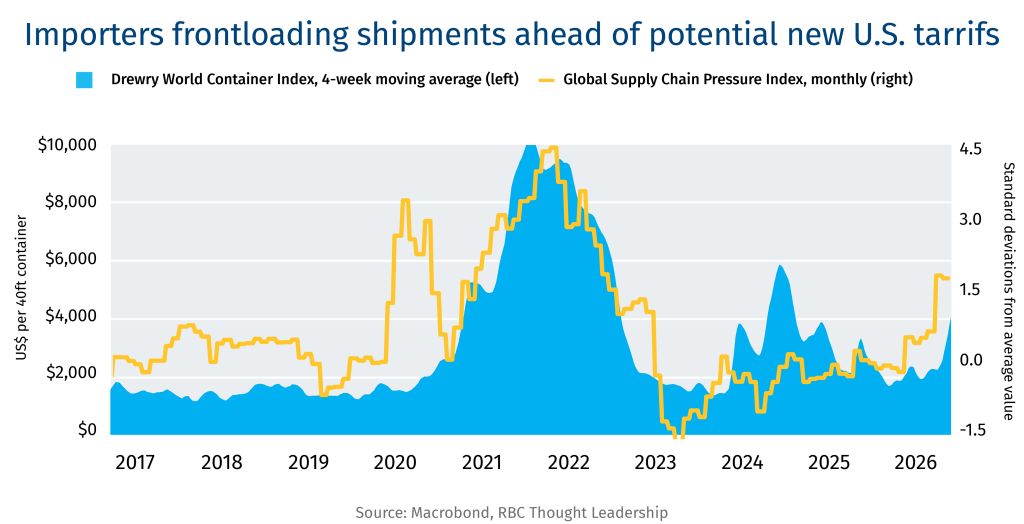
    Importers frontloaidng shipments ahead of potential new U.S. tarrifs
  • Investment uncertainty will dominate: Although the agreement is still in place, the annual reviews will prolong the business uncertainty that is already weighing on investment. Without clarity, businesses are likely to hold off on making critical long-term investment decisions. As Mexico’s economic minister Marcelo Ebrard recently said, “if you drag us into a constant review process, you’re going to choke off investment.”

The urgency to feed 10 billion people by 2050 has long been a central concern in agri-food research and policy. But with fertility rates down and global populations beginning to stabilize, a new S&P Global Energy study reframes the long-term question for the ag sector: what if supply outpaces demand?

For certain crop commodities, the rate of demand growth is predicted to slow through 2050, with feed crops especially exposed as growth in per capita meat consumption decelerates toward 0.1% annually.

Meanwhile, crop yields and food production continue to increase. That story rings true for Canada, which has boosted its yields and overall production of most crops considerably since the turn of the millennium. For instance, between 2000 and 2012 annual wheat production did not exceed 30 million tonnes, but had reached nearly 40 million in 2025.

Type of cropAverage annual yield growth (percent), 2000-2025
Canola (rapeseed)3.4
Corn for grain2.1
Wheat, all types3.0
Barley3.3

Source: Statistics Canada. Table 32-10-0359-01  Estimated areas, yield, production, average farm price and total farm value of principal field crops, in metric and imperial units

If such annual yield increases continue from 2026 to 2050 — and seeded acres remain constant —wheat and canola output would grow by tens of million tonnes.

Although an absolute reduction in food consumption is not expected, when slowing population growth contrasts with continued gains in ag outputs, a gap could pose structural challenges for the export market’s long-term health and profitability. Rising demand for biofuels and alternative markets may take some of that surplus, but Canada will need to continue enhancing its efficiency while working to differentiate itself from other major crop exporting countries. Emphasizing the quality of Canada’s exports and its dependability as a trade partner can help preserve its reputation as a preferred supplier.


Contributors: Alicja Siekierska, Farhad Panahov, Wilson Fink

Also in this edition: 10 numbers that define Brexit’s impact on the U.K. 10 years later 

Expertise, not electrons, could be Canada’s critical energy export 

  • Ottawa’s electricity trade debate keeps circling east-west interties and cross-border electricity flows, but Canadian expertise could be an understated export asset. One such example, called out during Canada’s National Electricity Summit in Ottawa this week, was Manitoba Hydro International (revived in 2024 by the provincial utility following a three-year closure), which started selling Canadian utility expertise to more than 120 clients around the world in 1998. 

Canada needs to remove barriers to trade and to investment 

  • A big takeaway from a C.D. Howe Institute roundtable this week was that while trade diversification is important, lowering barriers to foreign investment is just as urgent. Holistically reforming the country’s corporate income tax system was one of the ideas that was floated.  

Next week, North America will cross a threshold in the Canada-U.S.-Mexico trade relationship.  

It’s not a cliff, but it will start a new chapter in what has been the world’s most successful trade pact. 

To assess what may come next, RBC’s John Stackhouse joined a Brookings Institution virtual roundtable this week, with policy thinkers from all three countries. One thing seemed certain: no matter how a revised CUSMA looks, the spirit of North American trade is likely to bring more elbows and fewer handshakes. 

Some other takeaways: 

1. There will be a deal: “Reason for optimism” was a refrain, although the costs of that deal will be felt in all three countries. So, too, is timing, especially if negotiations continue after the U.S. mid-terms and into a more fractious Washington.  

2. Get used to tariffs: Beyond the July 1 trigger for a CUSMA review, the current regime of Section 122 tariffs will expire on July 24, when we should expect the Trump administration to create another regime. Canadians need to think through a range of tariffs that could follow, from a “heavy hand” option of 15-25% tariffs (unlikely), to a variation of the status quo, which could carry greater border measures on digital trade. A safe bet is some form of “market access” price, perhaps in the 5% range, with plenty of exemptions. 

3. Side letters will be key: The general agreement may stay largely in place, with a host of side agreements that don’t require legislation. That can be good news, as such letters can be changed more easily than a full agreement. But that risk can also apply to safeguards that Canada and Mexico may seek in side deals.  

4. Mexico is willing to make concessions: Claudia Sheinbaum’s government—more overtly than Canada—has made the U.S. its top trade priority, and is adopting policies to align with Washington’s asks. That could include stricter rules of origin for the auto sector. Mexico is also interested in a broader framework, to address border, energy and food security  issues as well as trade. 

5. Canada needs to manage internal divisions: There’s no single Canadian economy when it comes to trade. The current 232 tariffs cover 36-37% of Canadian exports to the U.S.—but 58% for Ontario and 55% for Quebec. The Maritimes, Saskatchewan and Alberta face hits of less than 10%. Canadian opinion has also hardened against a deal at any cost, in part because Canadian trust in U.S. commitments has declined.  

6. Uncertainty is hurting investment and growth: In all three countries, businesses are hedging the borders, diversifying production to get ahead of new tariff and non-tariff measures. For Canada, there also may be some investments taking place to serve non-U.S. export markets, notably Europe and China.  

This week marked the 10-year anniversary of the referendum that resulted in the United Kingdom leaving the European Union. A decade after the seismic vote, the ramifications are still being calculated and realized. 

  •  14% – The decline in U.K.’s exports of goods to the EU in 2025 compared to 2019, before the two partners signed a new trade deal. During the same period, U.K. exports to non-EU countries were down 8%.   

  • 28% – The jump in U.K.’s services exports to the EU compared to 2019. Exports to non-EU countries were up 26% from 2019. However, the Centre for European Reform estimates that service exports are still 7% lower than they would have been if the U.K. had stayed in the EU. 

  • ↓  6-8% – The decline in the U.K.’s GDP growth by the end of 2025 due to Brexit, according to a study from the National Bureau of Economic Research.  


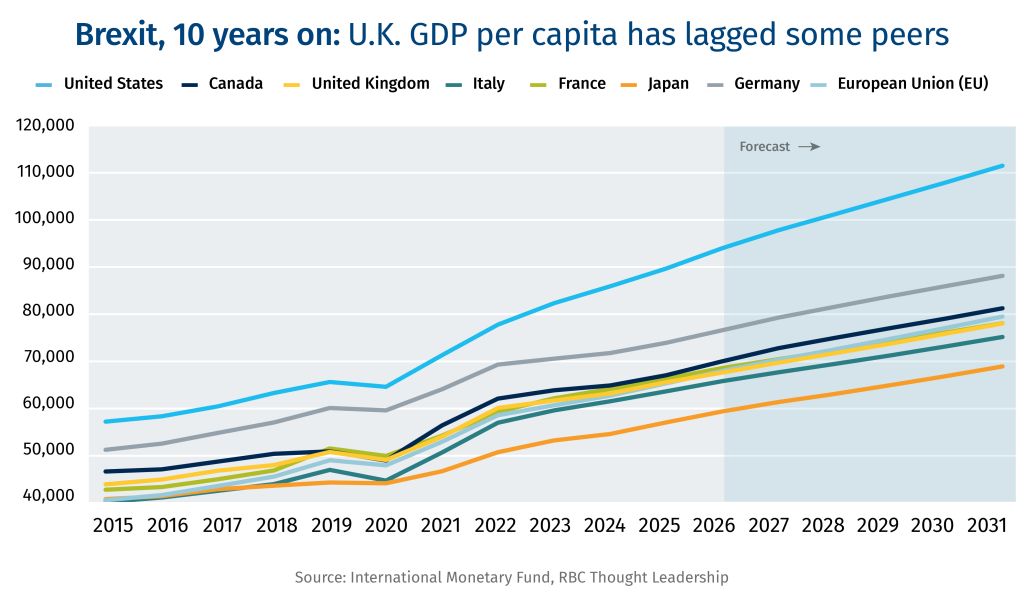
    Brexit, 10 years on: U.K. GDP per capita has lagged some peers

  •   5-10% – The U.K.’s GDP per capita growth was between 5% and 10% less than other similar countries between Brexit and the end of 2025, NBER also estimates.

  • ↓  13% – The decline in the U.K. business investment. Another study suggested U.K. firms invest just 11.1% cent of GDP, with only Canada lower in the G7.

  • 16% – The share of businesses reporting that Brexit was an important source of uncertainty as of Sept. 2025. It was as high as 40% shortly after the U.K. left the EU. 

  • 39 – The number of trade deals Britain has signed covering 72 countries since Brexit. Still, while the U.K.’s trading relationship with the EU fundamentally changed post-Brexit, the bloc remains the U.K’s largest trading partner.  


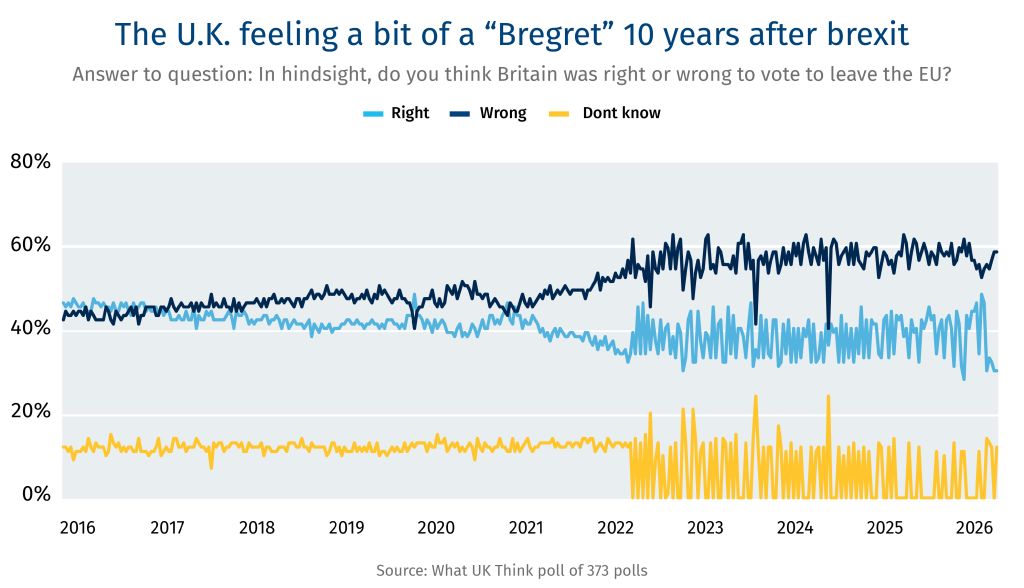
    The U.K. feeling a bit of "Bregret" 10 years after Brexit - chart

  • 57% – Of respondents said Britain was wrong to leave the EU in a recent poll.  

  • 41% – The EU accounted for 41% of the U.K.’s exports, and 50% of the U.K.’s imports.  

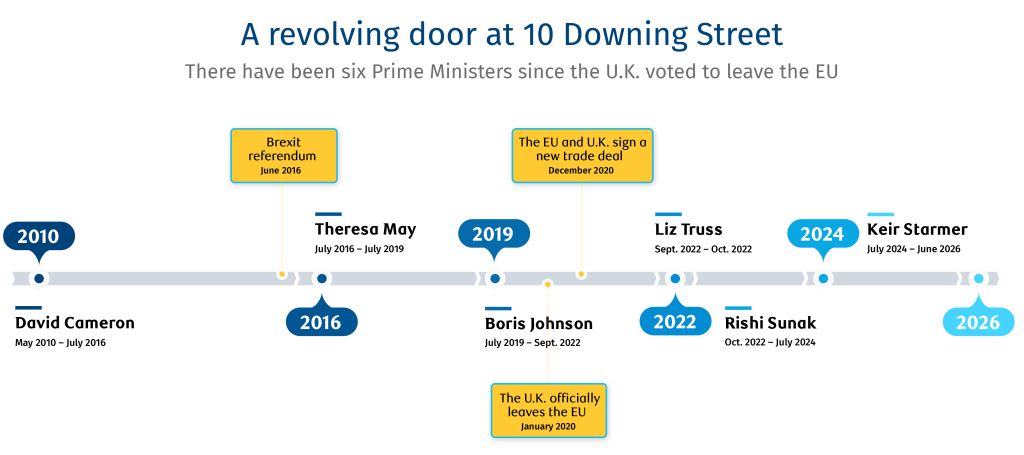
  • – The number of Prime Ministers the U.K. has had since the referendum. Former Greater Manchester major Andy Burnham is expected to become the seventh PM since Brexit. 


    A revolving door at 10 downing street

U.S.-Mexico trade talks have worsened over security issues  

  • While talks between the U.S. and Mexico appear to be progressing, impasses have surfaced over security concerns, particularly extraterritorial U.S. operations to combat drug cartels.  

Chinese EVs remain a major irritant for the U.S. in trade talks with Canada 

  • It was no mistake that Prime Minister Mark Carney used his moment with President Donald Trump at the G7 Summit to explain the cap on the deal. Behind closed doors, a group of American policymakers remain highly concerned about the entry of China into strategic areas of the North American economy.  

Government continues to align foreign and trade policies 

  • Foreign Minister Anita Anand will take Türkiye’s foreign minister to a nuclear SMR facility in Darlington next week. Another sign that energy is increasingly a pillar of foreign policy.  

How energy markets could shape up post-Hormuz 

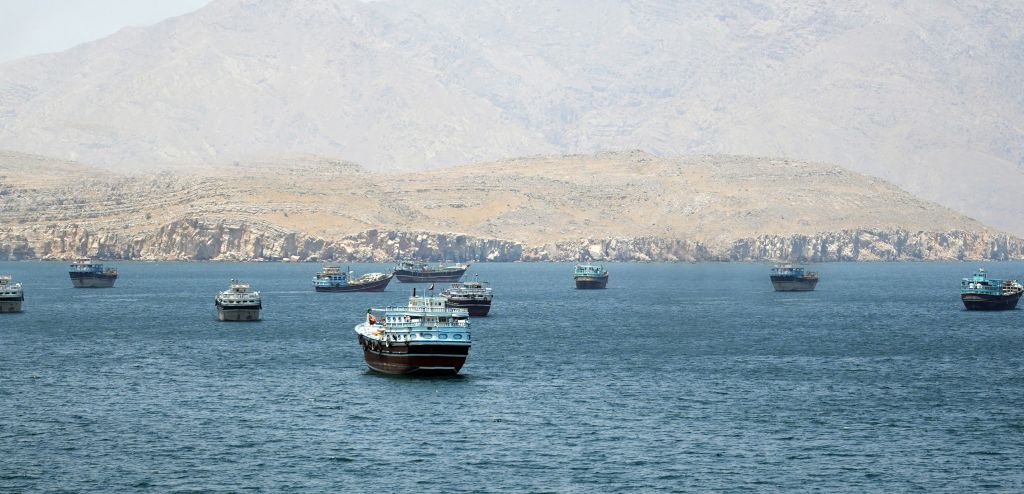
While hostilities between Iran and the U.S. appear to be subsiding, the re-opening of the Strait of Hormuz will continue to shape trade flows in the days, months, and years ahead. 

Why it matters—an MoU is signed, but the Strait isn’t solved 

The Washington-Tehran memorandum of understanding guarantees toll-free passage for 60 days only, followed by negotiations with Oman to define the future administration of the waterway. 

The Red Sea serves as a cautionary tale. In July 2024, a deal was struck with the Houthis, and Bab el-Mandeb Strait traffic—in the Arabian Peninsula—has not returned to early 2024 levels. Reopening of the Hormuz will be a difficult logistical process regardless of when it starts; with more than 500 vessels stranded in the Persian Gulf, mines to clear, and insurers to convince. Peak Hormuz flows may be behind us. “The vase is broken,” said IEA Executive Director Fatih Birol. “Now all actors know that the Strait of Hormuz was closed once and it can be shut down again.” 

By the numbers — resilience, and its limits 

The oil market proved more resilient than most forecasts. Brent peaked at roughly US$126 per barrel—a significant shock, but far below the US$200 worst-case scenarios circulated at the height of the crisis.  

The reason was adaptation, with a parallel logistics system emerging in real time. 

  • U.S. crude exports surged to more than 6 million barrels per day (bpd) 

  • Dark-tanker transits climbed to roughly 3 million bpd by early June, with cargoes shuttled by ship-to-ship transfer in the Gulf of Oman  

  • Alternative Saudi and UAE pipelines absorbed what they could, which was meaningful even though short of pre-crisis Hormuz volumes 

  • Kpler estimates more than 90 million barrels of non-Iranian crude and a further 70 million barrels of Iranian crude are now waiting to leave the region—a significant near-term overhang as the Strait reopens. 

But even resilience has a limit, and it is grade. Asian refiners, built for heavy sour Middle Eastern crude, spent the quarter force-feeding light sweet American barrels as a stopgap. The Hormuz gap was more around heavy oil and LNG shipments. 

The bigger picture—buyers won’t unlearn concentration risk 

Concerns are shifting to a near-term supply glut as trapped Gulf barrels flood the market. The IEA expects a significant crude overhang by 2027 if peace holds. Still, a key learning is that oil markets remain remarkably resilient. When the system was under genuine stress, it adapted through shadow infrastructure, bypass routing, and emergency substitution. Some of this was ad-hoc, but some was planned years, if not decades, ago (such as Chinese strategic reserves, and the Saudi East-West pipeline).  

These themes were discussed at RBC’s Global Energy, Power and Infrastructure Conference in New York this month, where access to global markets was the biggest topic among Canadian producers and importers—with buyers in Asia, and one in Germany cited as anchors for Canadian LNG projects in both the Atlantic and Pacific basins. Importing nations are chasing supply security and portfolio diversification, with a willingness to sew up new contracts running well ahead of the industry’s willingness to sanction new supply. 

Bottom line — a ceasefire changes the headline, not the lesson 

Canada, with one proposed cross-border crude pipeline targeting a mid-2027 final investment decision, TMX volumes already moving west, and West Coast LNG coming online, has meaningful volumes in the near to mid-term. The market will watch the Strait, but the next generation of trade will come from future agreements, which could increasingly include Canada. 

Shaz Merwat, Energy Policy Lead 

New research out of Purdue University illustrates the benefits to food prices of the trade deal now known as the United States-Canada-Mexico agreement and the costs if its dismantled. The USMCA Affordability Study: The Effect of North American Trade on U.S. Food Prices aims to quantify the effect of North American free trade agreements on U.S. food prices, and outlines a scenario where NAFTA was not implemented and historical tariff rates remained fixed. It concludes: 

  • For every percentage point in reduced tariff rates, there was a cumulative food price reduction of 2.8% over a 10-year period.  

  • Food prices were 12% lower by 2014 than they would have been in the no-NAFTA scenario, saving average households at the time approximately US$500 a year. 

  • Reversing the trade agreements would unwind those gains. And since U.S. agri-food imports from Canada and Mexico have grown significantly since the studied period, American consumers could be hit with much higher grocery bills at a time when budgets are already strained.  

Following the tariff reductions, key U.S. export commodities such as wheat, corn, and beef products did not see a rise in domestic prices that stronger export demand would normally predict. This is suggestive of how interconnected the North American food supply chains have become. 

Food affordability is already weighing heavily on household budgets in Canada and the U.S. New tariffs or trade restrictions emerging out of the upcoming negotiations could undo decades of food supply chain integrations and deepen pressure on consumers. 

Wilson Fink, Agriculture Policy Lead 

On the hunt for domestic investment, Mélanie Joly was in China this week pressing Chinese automakers to build in Canada, not just sell. Shoring up investment in Canada’s battered auto industry is necessary, but there are multiple crises on the horizon.   

Trapped between two auto giants 

Canada is in a tight squeeze in CUSMA negotiations. Section 232 tariffs aim to make Canadian assembly too expensive, threatening one of Canada’s largest export industries unless removed. Meanwhile, China eyes Canada as its North American beachhead—BYD already secured quota approval, with Chery and Geely racing for their slice of the 49,000-unit imports. 

The dynamics are stark: China wants Canadian consumers, America wants Canadian assembly jobs. Canada’s 125,000-strong auto workforce is caught in the crosshairs. 

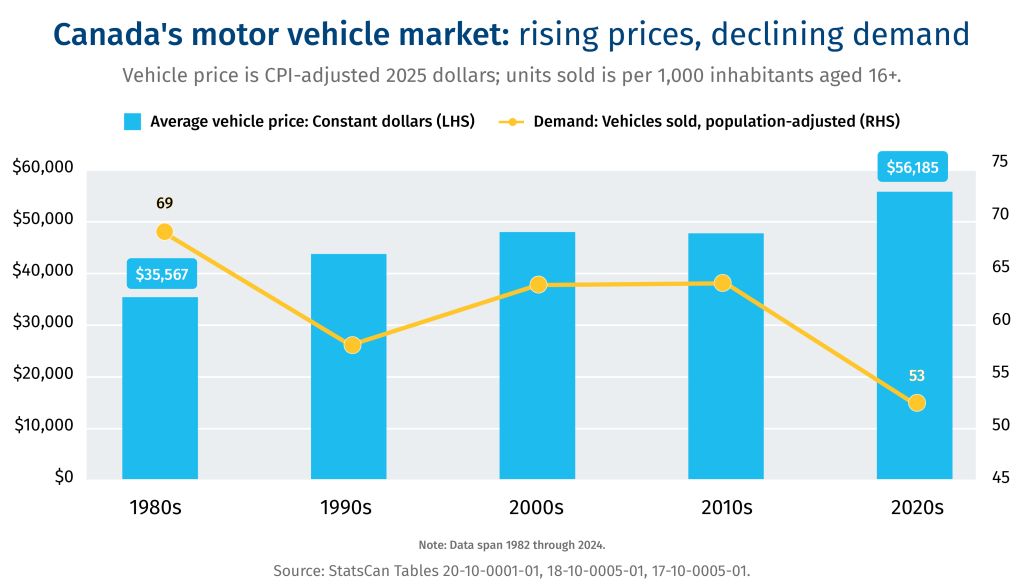
But here’s what everyone’s missing in this tug-of-war: while Canada struggles to secure its share of North American assembly, rising vehicle prices are pushing more consumers out of the new vehicle market altogether, compressing demand while the global auto industry is facing over-capacity issues.  

The affordability trap no one’s watching

Canada's motor vehicle market: rising prices, declining demand

Vehicle prices have structural headwinds that make tariffs particularly dangerous. SUVs and pickups, which are more expensive than sedans and compact vehicles, already dominate sales. Ever-more tech features also pump up the price tag. When we layer tariffs on vehicles, steel, and aluminum, affordability doesn’t just suffer—it tanks. 

The Canadian numbers illustrate the trend: 1.92 million new vehicles sold in 2024, down 160,000 units from 2017 despite 4.3 million more driving-age residents in Canada. Population-adjusted sales have collapsed more than 20% since the 1980s while average vehicle prices have cruised 60% higher after inflation.  

The pattern repeats stateside—there are 20 million more Americans today than 10 years ago, but vehicle sales fell from 17.4 million units in 2015 to 16.4 million in 2025. As the price of vehicles rise, buyers will be pushed into the resale market.  

Bottom line 

Higher prices don’t just hurt consumers—they kill the very jobs these policies aim to protect. Fewer purchases mean reduced demand, worsening oversupply, and ultimately eliminating assembly positions across North America.  

(For more on North America’s auto industry, read our latest report: Steering Through Uncertainty

Jordan Brennan, Managing Director, RBC Thought Leadership

Also in this edition: Breaking down six under-the-radar trade themes and a deep dive on four strategically significant industries that could drive U.S.-Canada relationship going forward

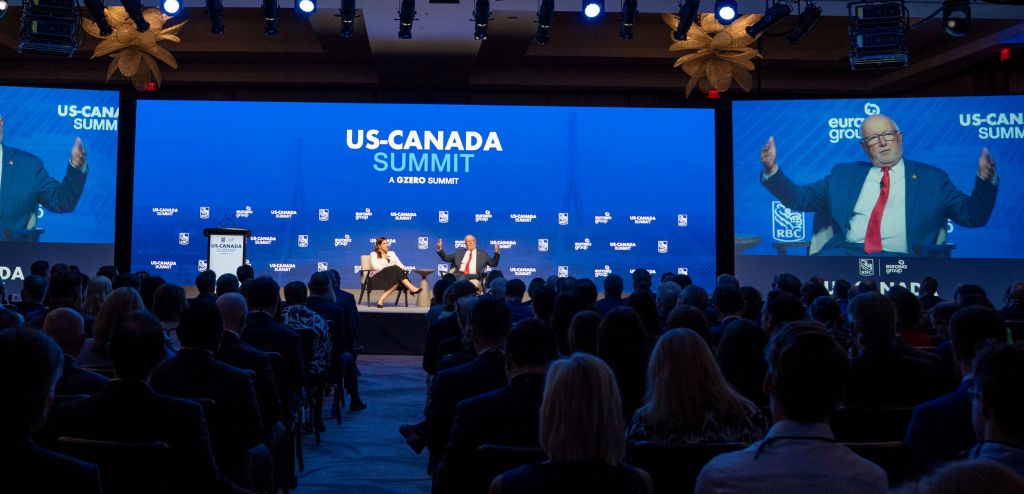
With the CUSMA deadline looming and rhetoric heating up (“We don’t need anything Canada has,” President Donald Trump told reporters earlier this week) more than 300 senior business and government leaders from both sides of the border gathered in Toronto for the RBC and Eurasia Group’s US-Canada Summit.

Here are some highlights:

  • Robert Lighthizer, the 18th United States Trade Representative, argued why 50 years of trade deficits left the U.S. no choice but to impose tariffs. And why, despite not being the worst offender, Canada was a target. In a democratic political system, a government doesn’t have years to address an issue, he said. It needs to act quickly. As for where things go with tariffs from here, Lighthizer didn’t mince words: “Nobody here has a grandchild in whose lifetime America is going to be free trade.”

  • Regardless, it’s up to Canada to put on its “sales hat” said Pete Hoekstra. Though the U.S. Ambassador to Canada said potash is about the only thing the U.S. needs from Canada, the U.S. is open to offers. Hoekstra pointed to autos and oil, and even offered some points to help make Canada’s case: the countries have similar pay scales, labour standards, and a thoroughly integrated ecosystem.

  • “America First doesn’t mean America Alone,” said Mark Wiseman, Canada’s Ambassador to the U.S., who added that Canadians are not always good at reminding Americans about the importance of Canada. Remind them of what exactly? For starters: Canada is the largest buyer of U.S. cars, outside the U.S. The No. 1 export market for 30 states. And in the top 3 for almost every state. And Canadians, on per capita basis, buy 40x more American goods than the EU, China and India.

  • Dominic LeBlanc, Minister for Canada-U.S. Trade, noted that the Canadian government has put some proposals forward to the Trump administration—but is also building a Canadian economy that is strong and resilient. Canada is not an “idle spectator.”

  • Wiseman, along with Michael Sabia, the Clerk of the Privy Council and Secretary to the Cabinet, were clear that the government’s diversification efforts do not equate to decoupling from its largest trade partner. It’s ‘and’ not ‘or’. A stronger Canada, they both noted, is a stronger partner for the U.S.

  • Hoekstra didn’t disagree, noting that if Canada is a rich country, maybe a few of those dollars could flow south—maybe to Michigan (“in the summer”), Florida and Arizona. He also joked about Kentucky bourbon, which has been removed by several provinces amid the trade war: “If you need some, I’ll see that you get some.”

After decades of economic co-operation comes a trade shock from the U.S. side. In a report in the runup to the U.S.-Canada Summit, Frances Donald, Senior Vice President and Chief Economist at RBC Economics, notes that the bruised U.S.-Canada ties have uncovered several under-the-radar trade themes. Here are a few worth highlighting:

  • Global trade growth rate doubled without the U.S. Rather than break the global economy, the rest of the world is re-orienting around the U.S. market.

  • The year of Canada’s trade divergence. Higher gold prices helped Canada boost exports to other markets, even as shipments to the U.S. fell 6% in 2025.

  • Canadians have taken economic protection into their own hands. Cutting U.S. travel, boycotting American-made liquor, and seeking out domestic products showed Canadian resolve.

  • Canada added more jobs than the U.S. in 2025. While 68% of Canadian exports are headed for the U.S., only 12% of jobs are dependent on U.S. demand.

Canadian employment rose in 2025 despite trade shock. Annual percent change.

Read Frances Donald’s full briefing here.

It’s the world’s largest bilateral trade relationship—but it’s now under strain. Jordan Brennan, RBC Thought Leadership’s Managing Director, identified four strategically significant industries, which could drive U.S.-Canada relationship going forward.

Auto Manufacturing: Build on the already-integrated nature of the industry by harnessing Canadian clean power, aluminum, and critical minerals with American capital markets, OEM headquarters, and consumer demand.

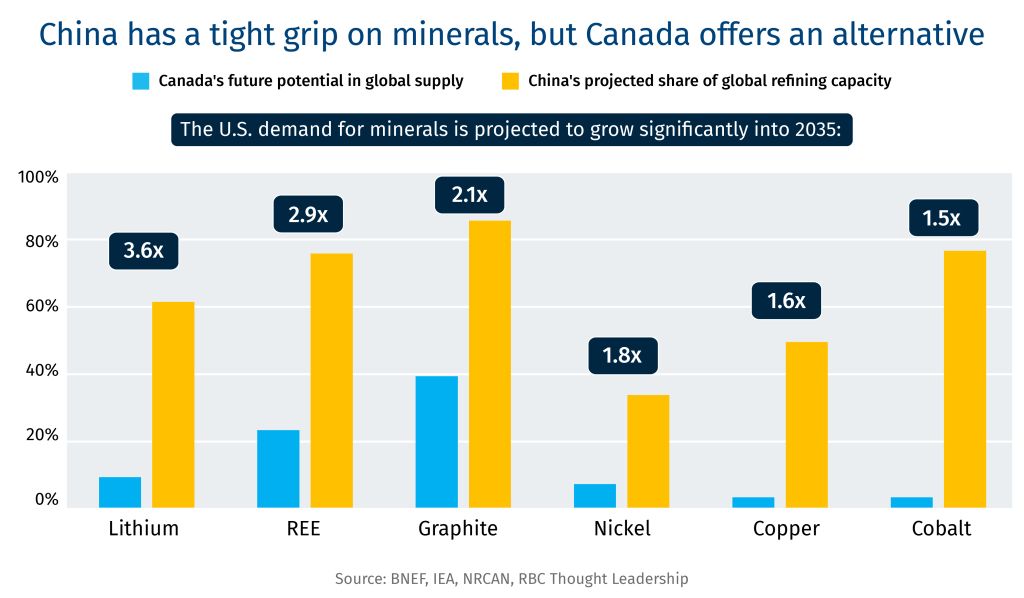
Critical Minerals: Tie Canadian geology and mining with American financing and manufacturing demand, to deepen supply chain resilience and dependence on China-controlled minerals.

China has a tight grip on minerals, but Canada offers and alternative. The U.S. demand for minerals is projected to grow significantly into 2035.

Oil and Gas: Match Canada’s significant oil and gas resources, pipeline infrastructure, and tidewater access with U.S. refining capacity and capital markets to deliver affordable energy domestically—and to the world.

Defence: Combine American capital depth, technological sophistication, and R&D expenditure, with Canada’s geographic depth and world-class capabilities in sensors, avionics, satellite technology, and training and simulation to surveil and defend the continent.

Read Jordan Brennan’s full briefing here.

While the U.S. and Mexico were kicking off bilateral talks on CUSMA (and announced two more sets of meetings in June and July, without a mention of Canada), Prime Minister Mark Carney was in New York making the country’s case to a business audience.

As the U.S. pivots to bilateral talks in its effort to reshape North American trade dynamics, we examine how Canada and Mexico have fared as the U.S. squeezed both with tariffs and other economic pressures.

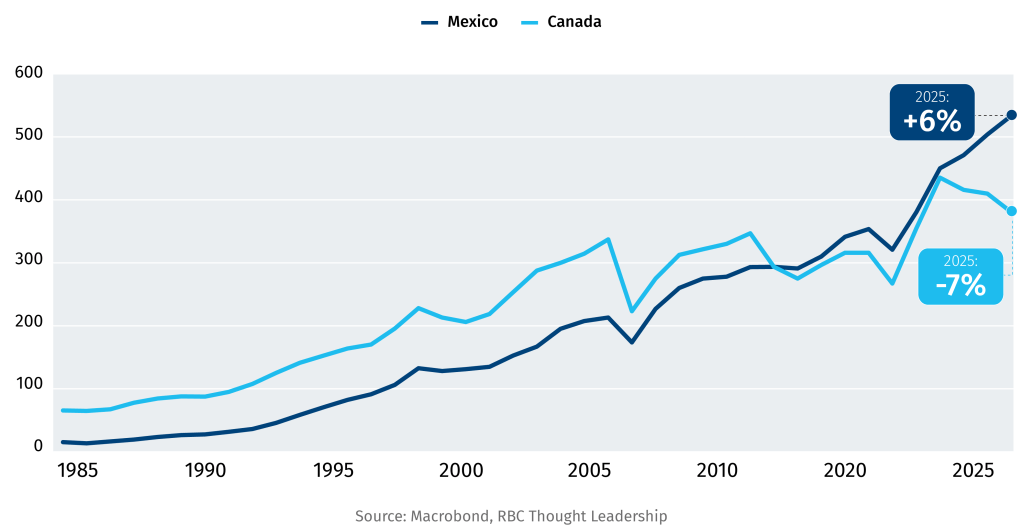
Mexico’s exports to the U.S. soared, Canada’s slipped in 2025

Annual U.S. imports from Canada and Mexico, billion US$

  • Despite one of the lowest effective tariff rates of ~3-4%, thanks to CUSMA shielding ~90% of Canadian exports, the U.S. imported nearly US$30 billion less goods from Canada—the second largest drop among U.S. trading partners behind only China.

  • Canada’s loss was almost identical to Mexico’s gain. It remains America’s largest import source and has extended its lead on the rest of the pack.

  • Both Canada and Mexico were at the epicenter of the tariff war, yet the divergence came down to the product mix, and new emerging trends, such as AI.

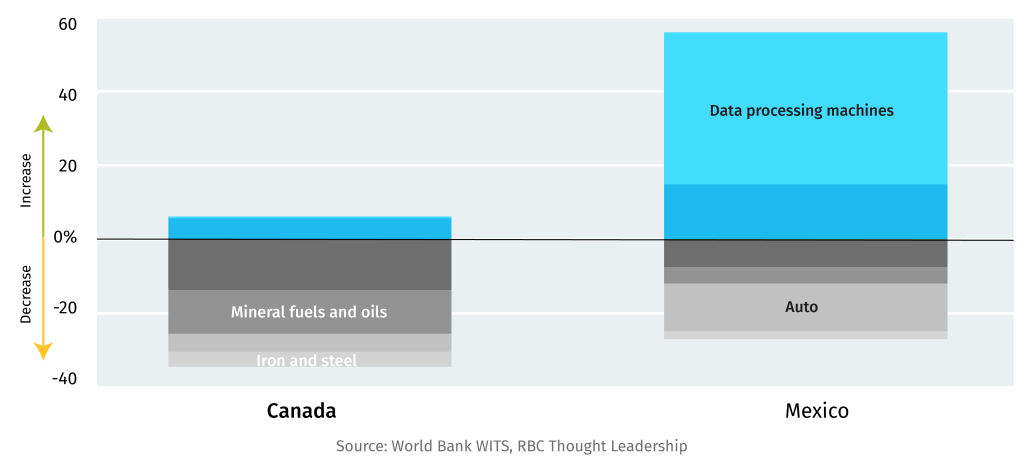
    Tariff-hit sectors squeezed both countries, but AI lifted Mexico

    Change in imports compared to 2024 by product categories, billion US$

  • Canada’s losses were broad-based. U.S. purchases from Canada fell across product categories that accounted for 84% of all imports from Canada. Lower oil volumes along with soft oil prices in 2025 accounted for a third of the drop in imports, with auto, steel and aluminum extending the decline by nearly as much.

  • Like Canada, Mexico reeled from the Section 232 tariffs. The U.S. imported US$13 billion less in auto and parts from Mexico, accounting for half of the decline.

  • The AI boom, however, lifted Mexico’s trade balance. The U.S. imported US$250 billion data processing units last year—almost double what it bought a year earlier—and Mexico was the single largest seller, supplying a third of that.

  • Data processing machines climbed to the top of the Mexico’s export ladder displacing passenger cars. Mexico’s share in global supply has doubled over the past two years, now supplying 18% of the US$550 billion global imports, and rapidly catching up to China and Taiwan.

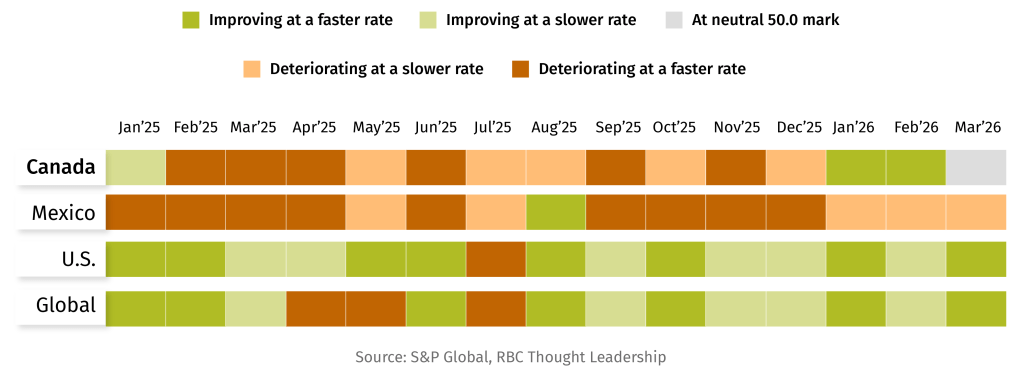
    Manufacturing sector remained soft throughout 2025

    Manufacturing Purchasing Managers’ Index (PMI)

  • Canada’s manufacturing sector, which makes up a tenth of the economy, took far more than a tenth of the pain, with GDP down 2.5% in 2025, marking a third consecutive decline. The squeeze was broad-based—14 of the 18 manufacturing subsectors contracted, from transport equipment and food & beverage to chemical and metal products.

  • Both countries shed factory jobs in 2025 but things are now diverging. Canada is regaining footing on its factory floor, with PMI climbing above 50 this year—seen as a level that signals expansion driven by new orders. Mexico’s manufacturing has been trending within the contraction zone for the past 22 months, long before tariffs were introduced, and shows no signs of immediate recovery.

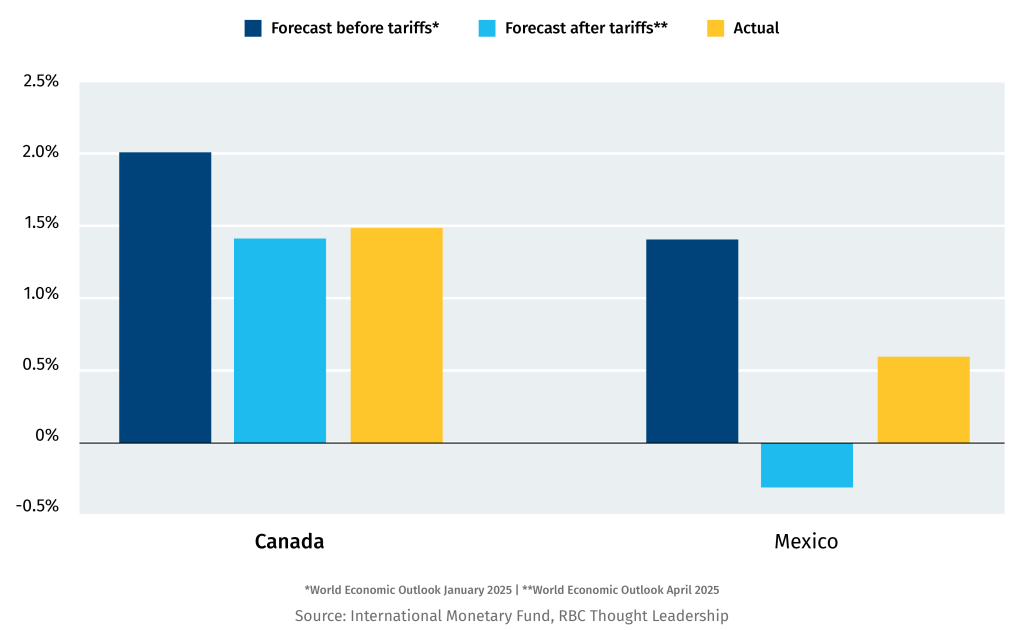
    U.S. tariff impact less damaging than feared for both Canada and Mexico

    Projection and actual real GDP growth for 2025

  • Doom and gloom scenarios did not materialize thanks largely to CUSMA, though tariffs shaved off about a fifth of Canada’s pre-trade war growth expectations, and over half for Mexico.

  • Resilient consumer demand and fiscal policy provided a cushion for the Canadian economy. Mexico saw the opposite trend as the government tightened its budget. Meanwhile, remittances from the U.S. dropped 4.6%, partially due to an immigration crackdown and softening household consumption.

 Farhad Panahov, Economist

For more:

One year later: How US tariffs and trade policy have reshaped the landscape – RBC Economics

One year of tariff shocks in Canada: What we learned

Brussels prepares broader measures against Chinese imports

  • The European Commission signalled it will expand the use of import quotas and safeguard tariffs across entire sectors as concerns grow over Chinese overcapacity in chemicals, metals, clean technology, and manufacturing. Industry Commissioner Stéphane Séjourné said the EU’s trade deficit with China has reached roughly €1 billion per day, with policymakers increasingly framing the issue as a threat to European industrial competitiveness.

India sends largest-ever trade delegation to Canada

  • Indian Commerce Minister Piyush Goyal led an Indian trade and investment delegation as Ottawa and New Delhi look to accelerate free trade negotiations and target $50 billion in bilateral trade by 2030, up from roughly $10 billion today. 

Shipping industry warns of rising costs and capacity constraints

  • Global shipping executives told the World Trade Organization that disruptions in the Gulf region and other maritime chokepoints are driving up costs across supply chains, while alternative transport corridors face growing capacity constraints. Industry leaders noted that a single container ship can carry the equivalent of roughly 70 freight trains.

ECB warns geopolitics are becoming a financial stability risk

  • The European Central Bank warned that the Iran conflict, volatile U.S. trade policy, and growing geoeconomic fragmentation are increasing risks to global financial stability. The Bank cautioned that markets may be underestimating the potential economic impact of prolonged energy disruptions, elevated sovereign debt levels, and renewed inflationary pressures stemming from geopolitical shocks.

Thomas Ashcroft, Global Issues Policy Lead

Also in this edition: The Power of Siberia 2 and implications for Canada 

A year into Prime Minister Mark Carney’s trade diversification push, global infrastructure investors are registering the signal. The Global Infrastructure Investor Association (GIIA) Spring 2026 survey—covering leading infrastructure funds across North America and Europe—ranks Canada #1 for investment attractiveness, ahead of the U.S. and Germany. It’s the first time Canada has finished atop the annual survey. Here are the highlights: 

  • Global infrastructure fundraising hit a record US$289 billion in 2025. LP allocations are rising further in 2026—but capital is concentrating, with the top 10 managers capturing 40% of total commitments. Commitments above $2 billion are increasing most sharply. 

  • Battery storage topped North American sector rankings for the first time. Regulated gas improved materially. Geopolitical risk is now priced in individual transactions: supply chain exposure, policy durability, and counterparty strength are deal-level considerations. 

  • Canada’s pension funds—CPPIB, OMERS, Ontario Teachers’, PSP—sit at the intersection of that capital and those relationships. Their sovereign co-investment networks across Asia, the Gulf, and Europe are the intermediation layer global allocators. 

The world is noticing the shift in Canada, but it wants to see evidence of intent and action. The federal government will get a chance to bolster the case for Canada at the Canada Investment Summit in Toronto this September. 

 Shaz Merwat, Energy Policy Lead 

In ‘Surging gold prices, inroads to foreign markets cushion Canada’s exports,’ RBC Economics notes that ‘gold exports to the U.K. surged by a nominal $17 billion, or 76%, in 2025—making gold Canada’s second-largest export after crude oil—significantly cushioning declines in other goods.’ 

It wasn’t a headline agenda item of the Xi–Putin summit this week, but the Power of Siberia 2, a long-stalled pipeline that would carry Russian natural gas east to China, inched back into the spotlight as a result of the two leaders high-profile meeting. 

What is being proposed? 

A 2,600-kilometre pipeline carrying up to 50 billion cubic metre per year of gas, nearly on par with the capacity of the now idle Nord Stream 1, from Siberia’s Yamal gas fields through Mongolia to China.  

What’s the holdup? 

For one thing, price. Beijing wants roughly 12–13 cents per cubic metre, near Russia’s domestic rate; Moscow wants double. The summit ended with warm words but no price or project timeline. 

If it did come to be, how would it alter Chinese demand for non-Russian imports? 

An overland gas pipeline sidesteps maritime chokepoints China’s seaborne LNG must run through, such as the Strait of Hormuz, where tensions have left oil and gas tankers stranded for weeks (two Chinese tankers passed through Hormuz this week). A direct pipeline link to Russia would displace gas that China might otherwise pull from global LNG markets, with potential downward pressure on prices. 

Implications for Canada’s LNG ambitions? 

According to Robert Johnston at the University of Calgary, Canada’s gas story lies closer to home. More Russian gas east would push U.S. and Qatar LNG cargoes toward the same Asian buyers Canada is courting, impacting prices as LNG Canada’s second phase ramps up. But with an image of geopolitical stability and strong emissions credentials (Russian gas has an emissions intensity 50% higher than Canada’s gas) the decisive variable for Canada’s LNG ambitions–the rollout of major projects–is domestic execution rather than economics.

Additionally, energy importers are increasingly wary of relying heavily on one geography, especially after Russia weaponized natural gas exports to pressure Europe as it ramped up its war in Ukraine, and Middle East suppliers are being hemmed in by the Strait of Hormuz blockade. Canada offers largely apolitical, stable supply in a fragmented world with disrupted energy trade flows.

 Vivan Sorab, Clean Tech Lead 

IEA warns oil markets nearing “red zone” by late summer 

  • International Energy Agency Executive Director Fatih Birol warned oil markets could enter a “red zone” by July-August, with 14 million barrels per day disrupted, inventories falling, and no meaningful new Middle East supply entering the market amid the Iran crisis.  

China’s renminbi payment system sees record surge

  • China’s Cross-Border Interbank Payment System (CIPS) processed a record average daily value of RMB920.5 billion (US$135.7 billion) in March, briefly peaking at RMB1.22 trillion and nearly 42,000 transactions in a single day representing a surge in energy trade outside the U.S. dollar system.

Brussels advances implementation of U.S. trade pact 

  • EU lawmakers and member states reached a provisional agreement to implement last year’s U.S.-EU trade arrangement, including safeguards allowing Brussels to suspend tariff reductions if Washington maintains steel and aluminum duties above agreed levels beyond 2026.   

EU approves expanded foreign investment screening powers 

  • The European Parliament approved new foreign investment screening rules covering sectors including AI, semiconductors, quantum, aerospace, energy, and critical infrastructure, broadening scrutiny over third-country investment across the bloc.

Ottawa and Nunavut launch tariff-response workforce program 

  • The governments announced more than $1.5 million in funding for marine-sector training and employment supports tied to tariff-related economic disruption.  

Manitoba opens trade office in India amid diversification push 

  • Manitoba announced plans to establish a trade office in India as provinces continue pursuing direct commercial relationships abroad and reducing reliance on the U.S. market.

—Thomas Ashcroft, Global Policy Lead 

Also in this edition: Should farmland be used to produce food or fuel? And four potential routes for Canada’s embattled auto industry. 

The summit between President Donald Trump and President Xi Jinping in Beijing produced no breakthrough agreements, but that may have been beside the point. After a year in which tariffs between the two countries exceeded 100% and trade flows sharply contracted, the immediate objective on both sides appears to have been stabilization versus resolution. 

The atmospherics mattered. Trump described the talks as producing “fantastic trade deals,” while Beijing emphasized “common understandings” and continuity. But beneath the optics, the summit revealed where the real negotiations and constraints now sit.  

A few themes stood out: 

The trade relationship is structurally smaller than it was 

  • U.S. imports of Chinese goods and the bilateral trade deficit are now at roughly 20-year lows. Washington’s efforts to reduce exposure to China through tariffs, supply chain diversification, and industrial policy have had a measurable effect. The relationship is no longer defined by integration.

  • There was no material progress on tariffs or the Section 301 trade investigations targeting China over state-subsidized production overcapacity in sectors like steel, and electric vehicles.

China’s priority is predictability 

  • The Chinese spent the years between Trump’s first and second terms doing their homework, preparing counteractive policies for more U.S. trade confrontation. Export controls on rare earths and critical minerals, industrial policy tools, and tighter supply chain leverage have proven key weapons in China’s arsenal.  

  • But the summit reinforced that Beijing’s near-term priority is a more predictable operating environment with Washington—one that reduces the risk of escalation and preserves access to key export markets, technology inputs, and capital flows.  

No major progress on chips and export controls 

  • Global semiconductor stocks slid with no major chip deals announced and continued stagnation over the sale of Nvidia’s H200 chips to China.  

  • This remains the clearest dividing line in the trading relationship. Washington still sees leading-edge chips and export controls as a way to mitigate China’s access to advanced semiconductors that could be used for military applications or AI innovations. Beijing, in turn, hasn’t formally approved shipments of the chips and has looked inward, urging Chinese firms to switch to domestic hardware.

Agricultural purchases are a U.S. political priority 

  • The clearest deliverables, as is often the case in trade negotiations with China, may ultimately come in agriculture. U.S. Trade Representative Jamieson Greer said Washington expects China to commit to “double-digit billions” in annual purchases of U.S. agricultural products over the next three years, including soybeans, poultry, and pork.  

  • The White House needs to be seen as supporting U.S. farmers, especially as the impacts of the Iran war on fertilizer prices and other agricultural inputs rise ahead of the mid-terms and as planting season gets underway.

Both sides appear to want guardrails 

  • Discussions around a possible “board of trade,” investment mechanisms, and even preliminary AI guardrails show neither Washington nor Beijing currently wants uncontrolled escalation.  

  • The strategic rivalry continues, but both sides appear increasingly focused on managing it rather than intensifying it in the near term. 

Thomas Ashcroft, Global Issues Policy Lead 

Skyrocketing oil and gas prices and supply constraints are pushing countries to boost biofuel production and use. The shift aims to curtail reliance on Middle East oil and gas supplies. But the surge in policy-driven biofuel demand coincides with the rising food affordability crisis reviving a recurring debate: should farmland be used to produce food or fuel?  

The biofuel boom:

  • The U.S.’s Environmental Protection Agency set record Renewable Volume Obligations (RVOs) for 2026–2027 with notable increases for biomass-based diesel, produced primarily from soybean and canola oil in North America. In addition, the U.S. House passed legislation this week to allow nationwide year‑round sales of gasoline containing 15% ​ethanol (labelled as E15), which is largely produced from corn in the U.S. 

  • The European Commission proposed the AccelerateEU strategy in April, which includes measures to boost EU sustainable biofuel production and use. This proposal is a rapid response to the bloc spending an additional €24 billion on fossil fuel imports within the first 50 days of the Iran conflict.  

  • Indonesia revived its plans to introduce a higher biofuel blend in 2026 following rising fossil fuel import costs. The blending rate mandate ​for biodiesel made from palm oil is planned to move to 50% from 40% this year.   

  • Brazil is actively accelerating its biofuel blending mandates to enhance energy sovereignty. President Luiz Inácio Lula da Silva announced in April that the ethanol blend mandate will be raised to 32% (E32) in gasoline this spring. For biodiesel, testing is underway to understand the viability for moving the blending rate from 15% to 20%.  

  • India reached its E20 ethanol blending goal in April. Disruptions to the country’s oil and gas prices and supply are prompting discussions on ramping up to E85 or E100 as production capacity expands.    

  • Vietnam expedited its national mandate for 10% ethanol blends in gasoline to begin in April due to energy shocks in price and supply. Ethanol is produced mostly from cassava, sugarcane, and increasingly corn in the Southeast Asian nation.   

  • …and Canada? In response to the previous shock to Canada’s biofuel supply chains from U.S. trade tensions, the federal government announced a $370 million Biofuel Production Incentive and committed to amending the Clean Fuel Regulation to prioritize domestic low-carbon fuel production. These measures, while not in response to Iran war, are intended to increase the resilience of the domestic biofuel sector.  

Bottomline: The global biofuel market is poised to enter another expansion cycle as countries raise blending mandates to meet energy security and transition to lower greenhouse gas emitting energy sources. However, early signs of rising corn, sugarcane, and vegetable prices may further pressure food prices this year.  

Lisa Ashton, Agriculture Policy Lead 

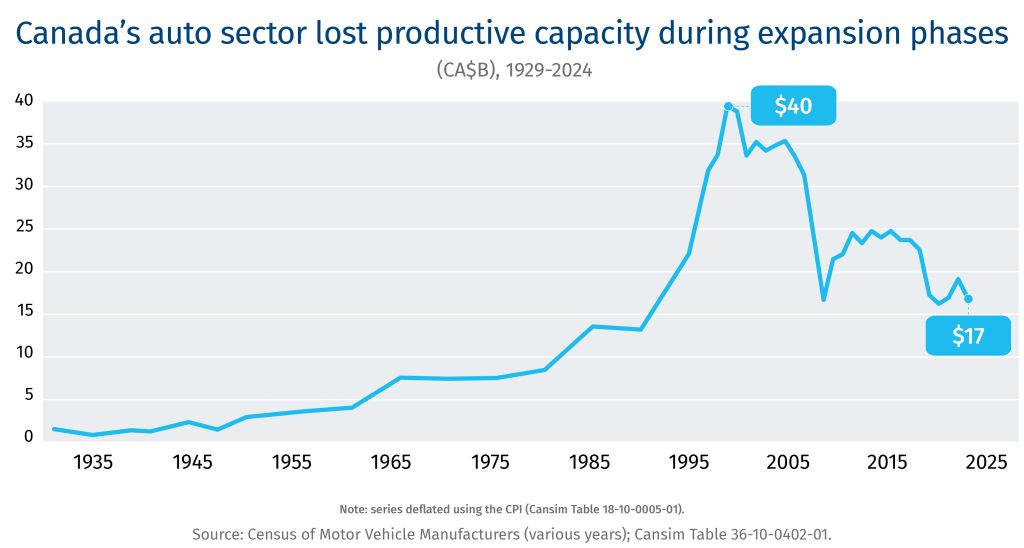
About 200 auto sector executives packed into a hotel ballroom this week for the Toronto Region Board of Trade’s Ontario Auto Forum. Magna CEO Swamy Kotagiri laid out three distinct options for dealing with the industry’s headwinds: protect jobs, chase affordability, or build resilience through anchoring the industry in capabilities that can’t easily be replicated. The latter, he said, should be the priority.  

RBC Thought Leadership’s Managing Director Jordan Brennan also took to the stage, presenting findings from his latest report Steering Through Uncertainty, which charts four distinct paths for the embattled auto industry.  

Canada's auto sector lost productive capacity during expansion phases

Read the full report, including the five strategic considerations that cut across all four scenarios, here.  

USTR pushes for “Fortress North America” steel protections under USMCA 

  • Deputy U.S. Trade Representative Jeffrey Goettman said an updated USMCA should include “unified tariff borders” for sectors like steel, aluminum, and autos to prevent products made with non-North American inputs from entering through Canada or Mexico. U.S. steel executives backed tighter “melt-and-pour” origin rules. 

EU sanctions on Chinese chip supplier raise fears of automotive disruption 

  • Industry executives warned EU sanctions of Chinese chipmaker Yangzhou Yangjie Electronic Technology, for allegedly supplying military technology to Russia, could trigger renewed chip shortages across the auto sector. Some firms are already seeking exemptions as manufacturers remain vulnerable following last year’s rare earth and semiconductor disruptions.   

EDC expands focus on diversification, defence, and strategic sectors 

  • Export Development Canada announced it facilitated $135 billion in trade-related activity in 2025, supported nearly 24,000 businesses, launched new programs, while expanding its European and Indo-Pacific presence. 

Bank of Canada research highlights declining maritime connectivity 

  • Canadian ports became less central to global shipping networks between 2016 and 2023, with declining direct connectivity and lower shipping capacity relative to major Asian hubs. The risk, writes the BoC, is “greater exposure to supply chain disruptions that could increase the cost of doing business.”  

The Strait of Hormuz has now been effectively closed for 69 days, and with global jet fuel prices now over US$180 per barrel—roughly double a year ago—the costs are showing up on earnings calls. Delta Air Line’s fuel bill is expected to rise by US$2.5 billion this quarter alone and the company has signalled higher fares and fees to help offset the costs. The disruption has already driven Spirit Airlines into bankruptcy, with the potential for more as prices remain elevated.

By the numbers: more than half of globally traded jet fuel is impacted

  • 23% of seaborne jet fuel flows directly through Hormuz, primarily to European markets.

  • 40-50% of global jet fuel exports originate from Asia, and those exports are down two-thirds from pre-crisis levels—starved of Middle Eastern feedstock.

  • China, a major Asian fuel exporter, reduced exports of jet fuel, diesel, and gasoline exports by as much as 33% in March to safeguard domestic market from disruptions.

  • With Europe getting 75% of its jet fuel net imports from the Middle East, the IEA warned in mid-April that parts of the region could run out by the end of May if countries don’t find alternatives

The bigger picture: energy security runs through the refinery as well

As Hormuz illustrates, energy security is not just about who controls the crude and (as is the case with critical minerals) final products matter. Along with China, South Korea and Thailand, which are also major fuel exporters, also capped shipments on most refined fuel exports as countries struggle with Middle East supplies or protect their domestic aviation sectors.

India’s response is instructive. Rather than scrambling for alternative imports, it moved to reduce structural exposure—amending its aviation fuel regulations to allow blending with domestic agricultural feedstock. Energy security and clean fuels became the same policy.

In Canada, an often-cited vulnerability has come to the fore

Canada’s physical exposure to Hormuz is limited, but Ontario and Quebec remain structurally reliant on imported refined petroleum products, of which jet fuel is the largest. That import dependency sits with the U.S., which is more than willing to use energy trade as leverage. The Hormuz crisis revisits a harder question for Canada: what is the right shape of tomorrow’s energy integration with the U.S.?

Sustainable Aviation Fuel (SAF): Where clean and secure meet?

Canada is different from Asia in one important respect: we sit on a lot of feedstock. Oil, of course, but also canola, tallow, and municipal waste, which flow into operating renewable diesel infrastructure, most notably in Strathcona, Alta., through Imperial Oil and Come by Chance refinery in Newfoundland and Labrador, Nfld., (Braya). Yet, Canada produces zero SAF.

SAF accounted for less than 1% of jet fuel consumed globally in 2025. That number is expected to climb to 4% by the end of the decade, according to BloombergNEF. And while energy security has not been part of that growth story, it could be the catalyst, as India proved, that brings new participants to the table. For Canada, that would not just be a domestic resilience argument—but a growing export opportunity for the energy and agricultural sector.​​​​​​​​​​​​​​​​

–Shaz Merwat, Energy Policy Lead

The surge in oil prices and another spike in gold exports pushed Canada’s trade balance back into surplus in March.

According to Assistant Chief Economist Nathan Janzen: “Significant trade uncertainty remains with negotiations on CUSMA renewal likely to intensify in coming months, but we continue to expect, as a base-case, that a more stable U.S. tariff backdrop in 2026 (albeit still at significantly higher tariff rates for some products) will leave trade as less of a headwind to growth than it was in 2025.”

Read more in ‘Canadian trade balance back in surplus as energy prices surge’ here.

U.S. trade court rejects Trump’s latest global tariff push

  • The U.S. Court of International Trade ruled against President Trump’s latest 10% global tariffs, finding the administration improperly used Section 122 of the Trade Act of 1974 to justify broad-based duties tied to trade deficits.

  • The decision is another legal setback for the administration’s tariff strategy following earlier rulings against the use of the International Emergency Economic Powers Act (IEEPA). The White House is expected to appeal and find other ways to implement tariffs.

Trump extends EU deadline while new regulatory disputes emerge

  • President Trump extended the deadline for the EU to implement elements of last summer’s trade arrangement until July 4, while warning tariffs could further increase if Brussels does not follow through on commitments.

  • Separately, major U.S. business groups are pushing Washington to intervene against the EU’s updated Product Liability Directive, arguing new rules around digital products and consumer claims could expose firms to significant litigation risk.

Chinese outbound M&A accelerates

  • Chinese overseas mergers and acquisitions reached a five-year high in Q1, totaling US$9.6 billion and marking the fifth consecutive quarter of growth, according to Rhodium Group data.

  • The increase comes as Beijing simultaneously tightens controls over inbound foreign acquisitions in strategic sectors, including retroactively blocking Meta’s acquisition of Chinese AI app Manus.

Auto sector pushes for continuity under CUSMA

  • Major North American auto industry associations urged the Trump administration to extend CUSMA, warning against splitting the pact into separate bilateral arrangements.

  • Industry groups representing GM, Toyota, Tesla, Volkswagen, Hyundai and others argued that separate agreements would increase regulatory complexity and disrupt integrated North American supply chains during a period of rapid technological transition.

Mexico ramps up commercial engagement with Canada ahead of USMCA review

  • This week, Mexico launched one of its largest trade missions to Canada in recent memory, bringing more than 240 companies to Toronto and Montreal for over 1,800 business meetings.

  • The outreach comes as Ottawa and Mexico City position themselves ahead of the upcoming CUSMA review, though both countries continue to take visibly different approaches to engagement with the Trump administration.

–Thomas Ashcroft, Global Issues Policy Lead

Food prices were expected to stabilize globally in 2026, but disruptions have materially changed that outlook. Instead of easing, risks are now skewed toward renewed food inflation.

The biggest geopolitical driver right now is the Middle East conflict, specifically disruptions to a critical artery—the Strait of Hormuz—for global energy and fertilizer trade. The World Bank now expects energy prices to jump roughly 24% in 2026. This rise in energy prices matters for food prices as energy feeds directly into transportation, processing, and refrigeration. This is a classic second-round inflation effect: food inflation lagging energy inflation by several months.

Disruptions to fertilizer supply chains is the hidden risk to food prices from conflict (and the most underpriced one). Fertilizer prices are projected to rise 31% as roughly a third of global fertilizer trade flows through Hormuz, according to the World Bank. Urea, a key fertilizer vital for boosting crop yields, is up 86% in March 2026, compared to the same time last year, with a 53% jump since February alone on Middle East troubles.

Generally, the fertilizer price shock creates a delayed but powerful effect: Farmers reduce fertilizer usage, leading to crop yields decline, a surge in food prices rise is triggered—with a lag (2026–2027).

We’re already seeing early signals of this effect with farmers expected to plant fewer acres of crops and tightening grain balances into the 2026-2027 season, according to the International Grains Council.

Layering in climate risk, this year’s food production outlook has flipped from benign to another accelerant to rising global hunger. This growing season, farmers are expected to face what projections are calling a “super” El Niño-related disruption, causing droughts across Asia and Australia, while potentially dumping the excess moisture in North and South America. These hard-to-predict weather dynamics could hinder production across the world’s biggest breadbaskets growing rice, wheat, and soybeans.

Globally, an estimated 363 million people are at risk of acute hunger in 2026—a rising number with growing conflicts and climate change effects, especially heat waves and droughts, that challenge food production and access in developing and unstable countries.

In Canada, a nation of abundance, people experiencing food insecurity are most impacted by food affordability. And global disruptions are expected to rise prices even further in 2026. The most recent estimates from Canada’s Food Price report project a 4% to 6% jump in food prices for Canadians between 2025 and 2026-that’s nearly an extra $1,000 dollars on groceries per year for an average family of four.

What to watch for: Reactive policy from food inflation could further disrupt global trade flows. Geopolitics can reset trade flows when global risks intensify through export restrictions to protect domestic food stocks and monetary tightening by central banks can suppress demand but raise global volatility in supply chains.

Bottomline: Food access and price risks have moved from moderate to accelerated. Food inflation expectations are being revised, higher, and quicker: The United Nation’s Food and Agriculture Organization’s Food Price Index is up 2.4% between February and March 2026, with notable pressures in oils, sugar, and grain prices.

—Lisa Ashton

Ottawa is preparing a summit later this year to attract $1 trillion in new investments over five years. The February securities data offers an early read on the foreign investors’ Canadian playbook.

Global investors are staying in Canada, but repositioning around the trade war. In February, foreign investors put $6.2 billion into Canadian securities, adding to the $106 billion accumulated over the past four months. At the same time, Canadian investors deployed $25.4 billion into foreign securities—the largest outflow since March 2024. While monthly securities data is volatile by nature, the net result was a $19.2 billion outflow from the Canadian economy. The headline, however, understates what is happening. The February data is less a single story than three simultaneous ones—foreign investors distinguishing between Canadian credit and growth, domestic capital chasing U.S. returns, and a market navigating the trade tumult.

Within equities, the rotation is structural, not random. Foreign capital is rotating hard within Canadian equities—out of energy and manufacturing, into banks. Foreign investors sold $9.2 billion of Canadian equity securities in February, even as the benchmark TSX rose 7.6%. At the sector level, credit intermediation and related services absorbed $12.1 billion in February alone, the largest single-sector inflow in the dataset. Energy and mining shed $9.4 billion  the same month, its weakest reading in the past five months. Manufacturing has posted outflows in four of the past five months. This pattern isn’t random: foreign allocators are concentrating in assets insulated from trade disruption (e.g. banks) while cutting the ones that aren’t (energy and manufacturing).

The bond market offers some comfort. Foreign investors added $22.6 billion in Canadian bonds in February, including $11.1 billion in corporate bonds, mostly foreign currency bonds issued by Canadian financial corporations—and $8.4 billion in federal government bonds. At the same time, they sold $9.2 billion in Canadian equities. It demonstrates foreign investor’s confidence in Canada’s credit, and more caution towards equities.

Sydney Wisener

USTR provided more CUSMA comments

  • U.S. Trade Representative Jamieson Greer told an audience in Washington that “America First” will continue to guide policy, and that the Canada-U.S.-Mexcio trade deal put its two partners in the most enviable trading position with the U.S.

  • Greer did signal a willingness to work with Canada on energy and critical minerals development but warned against using those as leverage in trade negotiations. Almost on cue, U.S. President Donald Trump signed an order authorizing a proposed Canada-Wyoming oil pipeline.

Top EU trade official leaving position over disagreements on U.S.-EU deal

  • Sabine Weyand will step down as Director-General for Trade after raising concerns that the agreement the EU struck with President Donald Trump does not meet global trade rules.

  • The President of the European Commission Ursula Von Der Leyen has repeatedly defended the deal—where the EU agreed to pay 15% tariffs on most products while reducing tariffs on most American goods to zero—as the first step towards a broader free trade agreement.

OECD reports sustained increase in critical mineral export restrictions

  • Analysis shows export restrictions on critical minerals have increased fivefold since 2009, with more countries applying controls across defence, technology, and energy inputs.

  • China continues to dominate supply, producing roughly 70% of rare earths and over 90% of some key materials, with recent export disruptions highlighting ongoing supply chain vulnerabilities.

China warns of retaliation over EU “Made in Europe” proposal

  • China’s commerce ministry warned the EU it may take countermeasures if the bloc’s proposed Industrial Accelerator Act restricts access for Chinese firms to subsidies and procurement.

  • The EU initiative is squarely aimed at reducing dependencies on China, and seeks to raise manufacturing’s share of GDP to 20% (from 14.3%) by 2035.

—Thomas Ashcroft

Also in this edition: CUSMA’s non-negotiables and a back-and-forth on provincial booze bans

The future of Canada-EU economic ties lies in industrial policy

  • As Canada diversifies its trading relationships beyond the U.S., the European Union has emerged as a priority partner.

  • Increased diplomatic engagement has some even floating the idea of Canada joining the bloc.

  • While that’s unlikely for several reasons, what is relevant and actionable is the growing alignment between Canada and Europe on industrial policy, particularly in sectors where governments are directing capital, shaping supply chains, and setting the terms of competition.

From market access to industrial access

For the past decade, the Canada-EU relationship has been defined by the Comprehensive Economic and Trade Agreement (CETA) signed in 2016. Trade has grown materially in that time, but the agreement has not been frictionless in practice:

  • Ratification remains incomplete and the agreement is yet to come into full effect, with several EU member states still yet to approve its investment chapter.

  • Regulatory barriers persist, particularly in agriculture, where Canadian exporters face constraints tied to EU sanitary rules, pesticide thresholds, and product standards.

  • However, its provisional application has seen bilateral merchandise trade increase by over 77% from 2016 to $134 billion in 2025.

  • Now, across clean energy, advanced manufacturing, and defence, both Canada and the EU are directing public financing and procurement towards building domestic capacity and securing supply chains. That shift is changing how bilateral market access will be determined.

How access is being redefined

  • The European Green Deal is directing capital into batteries, hydrogen, and industrial decarbonization, to concentrate production within the EU.

  • The proposed “Made in Europe” Industrial Accelerator Act would tie access to subsidies and public procurement in strategic sectors to EU-based production or partner-country based reciprocity.

  • This week, Industry Minister Mélanie Joly said Canada will pursue negotiations with Brussels to gain access to the “Made in Europe” program with a reciprocal approach that aligned on industrial policy.

Defence is leading Canada-EU industrial collaboration

  • Canada’s participation in the EU’s Security Action for Europe (SAFE) program provides the clearest example yet of how this shift is taking shape.

  • SAFE will provide up to $244 billion in loans to EU member states to support defence projects and in December, Canada became the only non-member state to gain preferential access to the program.

In practice, that means:

  • Canadian firms can bid into EU-funded defence contracts on the same footing as European suppliers, competing directly for contracts rather than relying on subcontracting or local intermediaries.

  • Up to 80% of Canadian content is permitted in contracts, versus the 35% for other third countries, materially increasing the ability for Canadian manufacturing, engineering, and supply chains to anchor work domestically while still qualifying for EU procurement contracts.

  • Canada will provide an upfront €10 million contribution, and a 15% participation fee will apply to the value of Canadian content in contracts where European content makes up less than 65% of the value.

What to watch

  • Whether Canada secures entry into “Made in Europe”: the government has opened the door, but EU openness to participation will require significant negotiation. The key question is whether Canada can convert political alignment into formal access across multiple sectors, not just defence, to participate in subsidy-backed projects.

  • How SAFE translates from access to contracts: preferential terms are in place, but the signal to watch will be contract awards. Whether Canadian firms can secure meaningful roles in SAFE-funded projects and scale their exports across the continent, will define the scale and longevity of this partnership.

  • The evolution of CETA: key sticking points remain for exporters, the agreement is only provisionally applied, regulatory alignment will be difficult to achieve, and negotiations are underway to reach an agreement on digital trade.

Taken together, these will determine whether Canada moves from being a preferred partner to a structural participant in Europe’s buildout and capitalize in trade on the hundreds of billions the EU is deploying through its industrial policies.

–Thomas Ashcroft, Global Policy Issues Lead

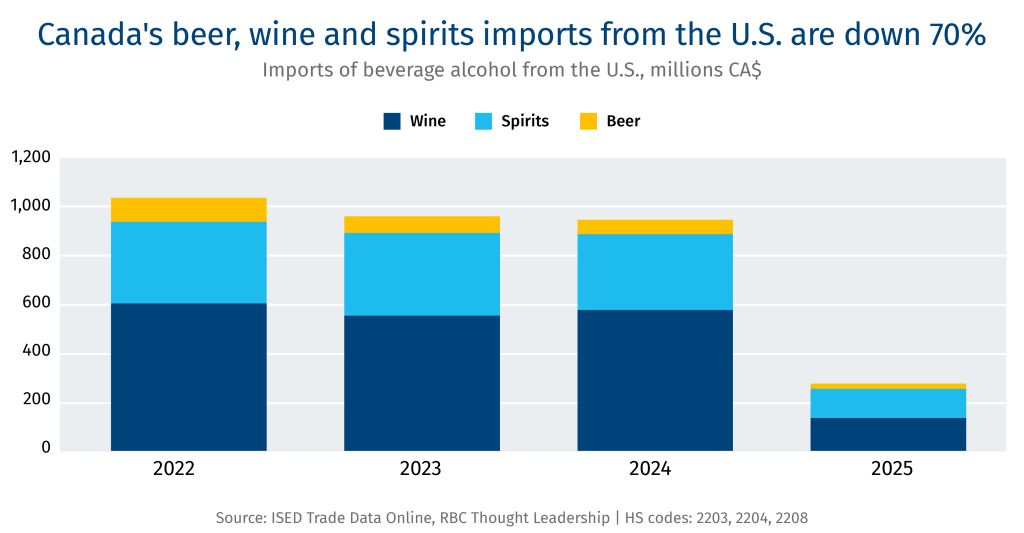
Canada's beer, wine and spirits imports from the U.S. are down 70%
  • Provincial bans on U.S. liquor could be resolved “quickly” said Mark Carney. That is, the Prime Minister said, if the U.S. takes steps on the tariffs imposed on Canadian steel, aluminum and autos—as well as Canadian forest products: “Those are more than irritants,” said Carney. “Those are violations of our trade deal.” The comments came a day after U.S. Trade Representative Jamieson Greer threatened “enforcement action” in response to Canadian provinces, including Ontario, B.C. and Quebec, keeping U.S liquor off store shelves.

  • Ottawa said it won’t back down on dairy supply management in trade talks. Dominic LeBlanc,the Minister responsible for Canada-U.S. Trade, also said Canada won’t give in to U.S. demands on French-language labelling rules when CUSMA negotiations begin later this year. Both of those issues, as well as Canada’s Online Streaming Act and its Buy Canadian policies, have been criticized by the Trump Administration. On whether tariffs of some kind will remain in place even if a deal is struck, LeBlanc said “we should be realistic–they have not taken anybody to zero.”

  • Trump administration to begin refunding US$166 billion of tariffs—plus interest. Two months after the Supreme Court struck down the “Liberation Day” tariffs, the U.S. government began accepting requests for refunds this week. The government had to build a new processing system for the 330,000 importers who paid International Emergency Economic Powers Act (IEEPA) duties.