Earlier this week, U.S. Trade Representative Jamieson Greer clarified what had been building for months: the U.S. will seek to keep the core of CUSMA intact but negotiate new and bifurcated terms with Canada and Mexico.  

Under the CUSMA status quo, different terms do currently exist for Canada and Mexico with the U.S. But Greer’s comments represent a material shift, one that widens the scope of issues under examination in the Canada-U.S. economic relationship and will fundamentally change how it is governed.

A deal with many strings attached

  • By negotiating bilateral grievances under parallel agreements with Canada and Mexico, Washington is predicating market access for the two countries on outcomes across multiple files, rather than a single, fixed set of rules.

  • For instance, rather than locking in a 16-year extension, Greer indicated that the U.S. is likely to trigger a process of annual reviews that can run for up to a decade–keeping the agreement in force, but under continuous pressure of renegotiation.

  • Practically, that means trade policy becomes more iterative. Outcomes on tariffs, procurement, digital rules, dispute resolution, or enforcement will not be settled once but revisited as negotiations evolve.

  • Politically, Greer is foreshadowing that it’s impossible to neatly resolve this all by the July 1st deadline, where instead he can now announce that the core protocols of CUSMA remain in place while thornier issues continue to be hashed out in expanded side agreements.

  • Additionally, with the current unpredictability in energy markets, Greer may have been looking to assure investors that the integrated North American energy market will continue with some semblance of a process in place.

  • Steve Verheul, Canada’s former chief trade negotiator, noted that the war on Iran has strained America’s supply chains across energy, aluminium, fertilizers—commodities that Canada could help supply, giving Ottawa some leverage.

The central question is about a baseline market access tariff

  • The most important issue is whether the U.S. introduces a broad market access tariff and, if so, what’s the number.

  • Many on the Canadian side argue anything above 5% would be unacceptable. But the U.S. may look to push for as high as 10%, albeit this would likely come with significant carveouts and exemptions.

  • A baseline market access tariff would have broader implications for the Canadian economy than the more concentrated effects the sector-specific Section 232 tariffs have had, as demonstrated in RBC Economics latest report: One year of tariff shocks in Canada.

Beyond trade: a more strategic negotiation

  • Prior to Greer’s comments, the USTR also released its annual National Trade Estimate Report on March 31st, listing what it deems as “significant foreign trade barriers” for partners, including Canada. 

  • Most of the irritants listed aren’t surprising, they are becoming increasingly central to negotiations.

  • Because of Trump’s trade war, some of these gripes have evolved and expanded, including provincial liquor stores no longer stocking U.S. alcohol.

  • Others cut into how Canada structures parts of its economy: increased “Buy Canadian” procurement provisions, dairy supply management, digital and streaming regulations, and newfound sovereign data ambitions.

  • Adding to that is the U.S.’s strategic ambition with respect to critical minerals. Canada’s level of participation in those ambitions will be a key issue, as we discussed in February.

The timeline ahead and how it impacts strategy

  • June 1st: Greer must report to Congress on the administration’s intent–whether to extend CUSMA as is or pursue changes.

  • July 1st: Canada, Mexico, and the U.S. will meet formally for the six-year review built into the agreement, at which point the U.S. likely pushes to shift towards a 10-year framework of annual reviews.

  • The U.S. is positioning for a sustained model of negotiation under the rolling review, where it can continue to exert leverage on unresolved issues.

  • One of Ottawa’s objectives, in addition to ultimately maintaining favourable, broad access to the U.S. market, is to push decisions on priority files as close to the mid-term elections as possible, without jeopardizing the entire agreement.

–Thomas Ashcroft, Global Policy Issues Lead

It’s been a year since Donald Trump stood in the Rose Garden at the White House and announced his government’s “Liberation Day” tariffs. This week, our colleagues at RBC Economics took a close look at the impact of those tariffs. Here are a couple of the key takeaways (click on the links for plenty more analysis):

Canada: One year of tariff shocks in Canada: What we learned

  • Despite heightened trade tension, Canada was still the largest source of imports for 22 American states last year, unchanged from 2024.

  • Canada’s limited retaliatory measures minimized the trade war’s impact on consumer prices in Canada.

  • Since the U.S. tariffs on Canadian goods are targeted, the impact has been uneven across the country.

The U.S.: One year later: How U.S. tariffs and trade policy have reshaped the landscape

  • Tariffs have not reduced trade imbalances, particularly with China.

  • Tariffs revenue has little impact on reducing the deficit—for one thing, they don’t come close to making up for the Big Beautiful Bill tax cuts.

  • There is no evidence that tariff policy has led to a reshoring of manufacturing jobs.
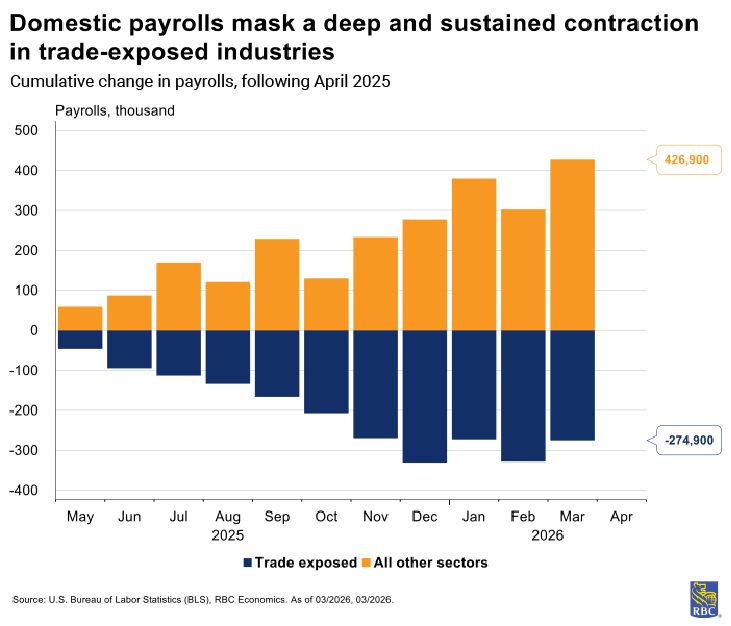
Domestic payrolls mask a deep and sustained contraction in trade-exposed industries
  • The shutdown of the Strait of Hormuz is forcing Japan to release 20 days’ worth of oil planned for May.

  • Despite heightened tensions between the U.S. and the European Union on several files, a deal on critical minerals, as part of an effort to lessen their reliance on China, is bringing the two together.

  • Global demand for AI chips drove Taiwan’s exports in March (up almost 61% year-on-year) to an all-time high.

  • International Monetary Fund plans to cut its global growth forecast. “Buckle up,” the IMF’s chief Kristalina Georgieva said, noting that the world is ill-equipped to respond to the shocks of the war in Iran.

As the Middle East crisis drags on, many oil-importing emerging economies face a “triple squeeze”: rising energy import costs, currency depreciation, and higher rates to reprice debt.

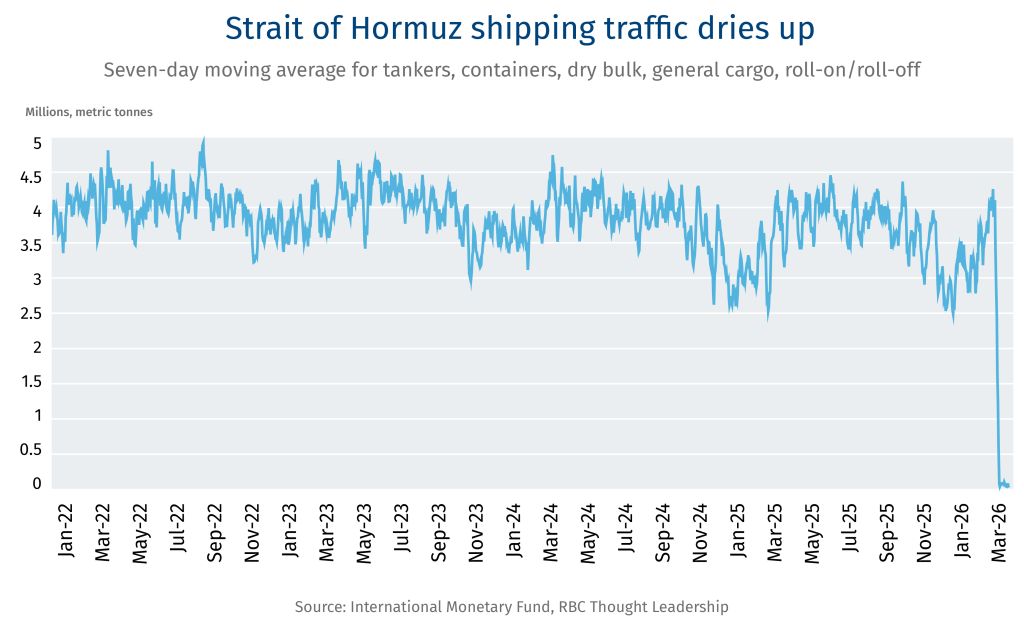
Strait of Hormuz shipping traffic dries up

Iran’s virtual blockade of the Strait of Hormuz has sent oil, diesel and gas prices soaring, raising costs for food, fertilizer and transport globally. But it’s developing economies that are bearing the brunt. For several African economies, energy and transport make up 15-25% of the CPI basket, a stronger U.S. dollar (up 0.85% against a basket of currencies since the Iran war began) has raised local currency debt service costs. Countries from Argentina to Vietnam have embarked on energy conserving measures and/or initiated emergency consumer support measures to offer some relief. Energy-driven inflation is pressuring central banks to maintain high interest rates even as domestic economies slow and foreign exchange reserves are drained. Investor confidence has already taken a hit with the MSCI Emerging Market Index wiping out its 13% year-to-date gains, while emerging market bond sales hit their lowest level for March since 2009.

Emerging markets’ debt vulnerabilities were already at historic highs. Developing countries paid US$741 billion more in debt service than received in financing (2022–2024). Borrowing costs have risen materially, with post-2020 issuance coming at rates around 10%, roughly double pre-pandemic levels. With 29% of Low-Income Countries (LIC) bonds maturing by 2026, default risk is rising for some sovereigns. The World Bank says it’s “ready to respond at scale” to assist emerging markets that have reached out.

Here are some of the countries that are under strain:

  • Egypt: Net energy importer with large fuel subsidies (28% of government spending), high USD debt, and near-term Eurobond rollovers US$4 billion); FX pressure (currency −8%) and current account deficit (−3% GDP) compounded by reliance on GCC remittances (73% originate from Gulf economies) and declining Suez/tourism revenues.

  • Pakistan: Petroleum prices are up 25%, as upcoming rollover (US$1 billion) is due 2026; recent debt crisis history, and heavy reliance on GCC remittances (62% of remittances originate from Gulf economies) strain reserves and heighten balance-of-payments risk.

  • Bangladesh: Structurally dependent on LNG (50% of electricity) with no short-term substitutes; supply disruptions and rising transport costs are pushing inflation (~9%+) and increasing FX reserve pressure.

  • Zambia: Extremely high debt service burden (10% of GDP) and fertilizer import dependence (2.5% of GDP); FX depreciation (−5%) compounds external financing stress.

  • Sri Lanka: Post-2022 default economy remains fragile; fuel rationing and continued import dependence constrain recovery despite partial stabilization of LNG supply via the U.S.

  • Côte d’Ivoire, Mongolia, Dominican Republic: Combination of FX-denominated debt exposure, current account deficits, and 2026 maturities; several also carry subsidy burdens (e.g., Mongolia) that amplify fiscal pressure as energy prices rise

  • South Africa: High share of local debt held by non-residents (16% of GDP); FX pressure (currency –5.2%); vulnerable to capital outflows, bond market volatility, and tightening financial conditions.

  • Turkey: Extremely high domestic yields (>35%), persistent currency depreciation, and significant reserve depletion (US$23 billion) from FX intervention; limited policy flexibility.

  • India: crude import dependence is at 89%, roughly half via the Strait; rupee at record lows, fertilizer plants capped at 70% capacity; exposure amplified by reliance on remittances.

  • Philippines: Imports 90% of its oil from the Middle East; current account deficit (−3.4% GDP). Maritime shipping disruptions are compressing margins in its most critical export sector (as semiconductors and electronics account for roughly 60% of total exports), while energy price pass-through is driving inflation above target.

Several of the markets critical to Canada’s diversification strategy are exposed to the war in Iran: Bangladesh and Pakistan are key destinations for Canadian pulses. In Zambia, where copper accounts for roughly 70% of export earnings, Canadian firms are leading major production expansions. Reports of hours-long queues at fuel stations in India signal the shock is already hitting at the household level—and it comes as the Canada-India Comprehensive Economic Partnership Agreement (CEPA) negotiations target $70 billion in two-way trade by 2030. Meanwhile, Canadian entities’ exposure to emerging market assets across South America, Africa and Asia, could also present another challenge.

Sydney Wisener

World Trade Organization (WTO) reform talks derailed

  • The WTO’s 14th Ministerial Conference, held in Cameroon last week, failed to usher in a new era of global trade reform after the U.S. and Brazil sharply diverged over how long to extend the E-Commerce Moratorium, an agreement that prohibits levies being placed on electronic transmissions and digital services.

  • The disagreement was the primary reason why a draft plan for reform of the WTO was not adopted, a major setback for the organization as it looked for ways to fight back against its marginalization and remain relevant in this new era of trade disruption.

  • U.S. Trade Representative Jamieson Greer slammed the WTO upon his return to the U.S., saying it would only play a “limited role” in future global trade policy discussions.

Helium emerges as another Hormuz headache

  • As well as disrupting global energy, aluminum, shipping, and fertilizer markets, the quasi-closure of the strait threatens the global supply of helium, a key component in the production of semiconductors.

  • Since helium is primarily a by-product of LNG production, LNG supply chokes threaten to also disrupt the flow of the gas, of which a third of global supply passes through Hormuz. Helium prices have roughly doubled since the war began according to Fitch Ratings, which could have knock-on effects for technology-heavy economies, such as South Korea, Japan, and even the United States tech sector.

  • Tungsten and sulfur are also key components of the global semiconductor supply chain and have experienced sharp price increases. Prior to the war beginning on February 28th, China had restricted its tungsten exports and called for tighter limits on sulfuric acid exports.  

The U.S. announces new tariffs on pharmaceuticals

  • Donald Trump announced new levies on branded drugs from pharmaceutical companies, including 100% tariffs on patented medications and their active ingredients.

  • This follows through on the threats Trump made last fall as part of his administrations drive to pressure pharmaceutical manufacturers to build or onshore production facilities to the U.S.

  • Reduced rates of 15% will be offered to jurisdictions that have secured trade deals with Washington, including Switzerland, Japan, the EU and South Korea. A U.S. official said the UK will essentially have zero tariffs on its imports as major British companies have struck deals with the administration.

— Thomas Ashcroft

Also in this edition: Untangling North America’s biofuel supply chain

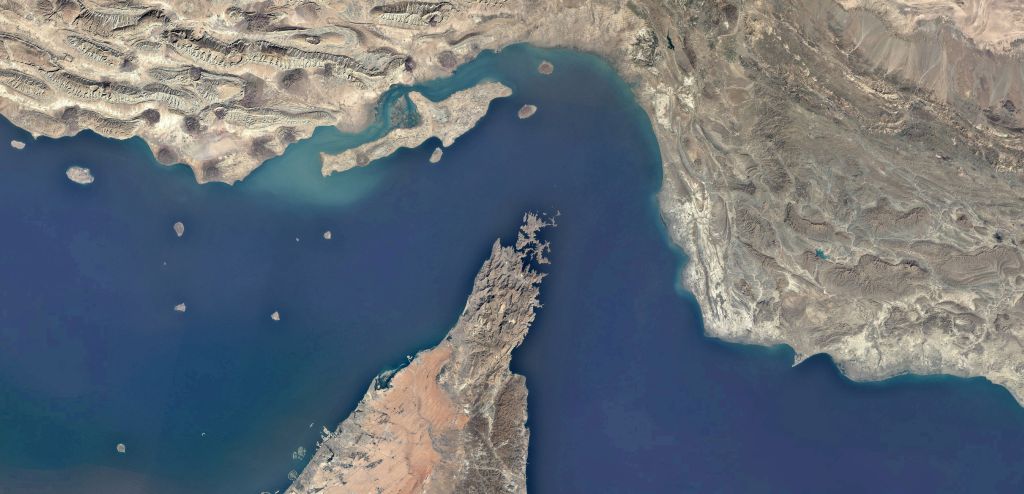
The Strait of Hormuz has long been treated as an oil story. When it closes, energy markets move, tanker rates spike, and the headlines follow crude. But it remains a slow-moving shock to the cost of moving goods, which becomes more entrenched over time.

First-Order: Crude and Tankers

The most direct impact is exactly where markets expected it. Benchmark Very Large Crude Carrier (VLCC) spot rates have surged six-fold since early January and are currently priced at US$98/t (US$13-14/bbl). Tanker volumes through Hormuz (and Suez) have essentially collapsed, with more than 500 vessels stranded in the Persian Gulf.

Second-Order: Products and Fuel

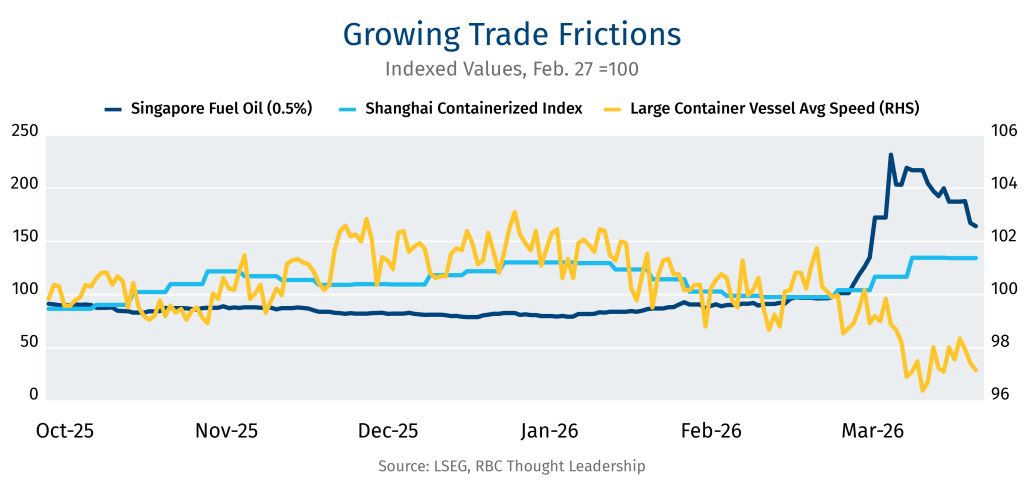
Refinery outages and export constraints tied to Hormuz have fractured global bunker supply chains, forcing vessels to seek fuel at alternative ports at elevated war-zone premiums. Charted below is the Singapore marine fuel indexed price, up 66% since the crisis began. Not charted but equally telling is the spread between Freight on Board (FOB) and delivered prices, typically <5% but well over 50% in mid-March, reflecting genuine physical dislocation in how marine fuel reaches vessels.

Maersk, a Danish shipping company, formalized this disruption on March 25 with a global Emergency Bunker Surcharge, entrenching a products shock into shipping economics worldwide.

Third-Order: Container and Dry Bulk

The Shanghai Containerized Freight Index (SCFI) fell gradually ahead of the conflict and has since rebounded (see chart), but the moves are likely seasonal. Chinese New Year brought port throughput to 40-50% of normal capacity in mid-February. How much of the SCFI March recovery is supply related in contrast to stronger demand is likely unclear until official port data is reported at month end.

Still, dry bulk was structurally underexposed to Hormuz to begin with–only around 55 dry-bulk vessels were transiting the strait weekly before the conflict and the Baltic Dry index is largely flat, if not marginally down. Nonetheless, large container vessel average speeds have edged marginally lower (see chart) since late February, a modest signal consistent with routine rerouting at the edges of the conflict zone.

–Shaz Merwat, Energy Policy Lead

Growing Trade Frictions

North America’s once integrated biofuel supply chain is splintering along national lines.

U.S. federal incentives, state-level programs, and Canada’s Clean Fuel Regulations (CFR) are increasingly pulling in different directions, leading to a fragmented market with implications for Canadian biofuel producers and farmers growing oilseeds and grain including canola, soybeans, and corn.

Policy shifts triggered a continental divide

Changes to U.S. policy under the Renewable Fuel Standard (RFS) and new production tax credits have led the shift. Proposed 2026–27 RFS rules significantly increase domestic biomass-based diesel blending targets, reinforcing demand for oil-based feedstocks like soybean oil.

  • At the same time, newer incentive structures—particularly the transition from blender credits to production-based credits—are explicitly favouring domestic fuel production in the U.S.

  • The change eliminates the US$1 per gallon incentive Canadian biodiesels and renewable diesel received in the U.S. market as biofuels must be produced in the U.S. to earn the production-based credits. The result: an approximate 13% decline in value of Canadian imports into the U.S. between 2024 and 2025, according to Canada’s trade portal. It’s a meaningful departure from the bump Canadian biofuels received from U.S. subsidies.

What’s the impact on Canadian oilseed and grain markets?

Biofuel is a policy driven market and regulatory certainty is not a guarantee. Incentives for biofuel feedstocks under U.S. policy are still evolving as the U.S. Environmental Protection Agency (EPA) establishes its Renewable Volume Obligations (RVOs) for 2026 and 2027.

The pending U.S. policy uncertainty for Canadian farmers is that the EPA has proposed reducing the number of Renewable Identification Numbers (RINs) generated for imported renewable fuel and renewable fuel produced from foreign feedstocks, which would financially discourage U.S. biofuel refineries to use Canadian feedstocks. However, rising domestic Canadian demand could partially offset the export risk.

Canola: It’s the most exposed. Canola oil exported to the U.S. is primarily used for renewable diesel production. Exports of canola oil volume to the U.S. fell by 26% between 2024 and 2025, after climbing in each of the previous five years. The drop occurred while the Canadian canola industry spent more than a year in regulatory limbo, waiting for the U.S. Department of the Treasury and the Internal Revenue Service to clarify how production credits would work, confirming the inclusion of North American feedstocks in January this year.

Soybeans: Canadian soybean farmers may benefit from supportive U.S. policy. According to the U.S. Department of Agriculture’s 2026 outlook, biofuel mandates and tax incentives are expected to drive a 17% increase in U.S. soybean oil use for biofuels. Rising demand for soybeans is supporting prices, yet the commodity still faces potential downsides on trade with the U.S. if the EPA’s proposed RVOs are confirmed.

Corn: It remains anchored in U.S. ethanol production under the RFS. Yet, Canadian ethanol producers are now disadvantaged under the Clean Fuel Production Credit (45Z) that’s designed to encourage U.S. production of finished biofuel via incentives.

Bottom line

The Canadian outlook is mixed with domestic market demand hinging on the federal government’s forthcoming CFR amendments, where policy levers to shore up domestic demand are being considered, including minimum domestic content and credit multipliers for local producers.

–Lisa Ashton, Agriculture Policy Lead

Canadian beef producers raise concerns over potential Mercosur free trade deal

  • As Ottawa looks to secure a free trade agreement with the South American bloc this year, the Canadian Cattle Association (CCA) expressed concerns.

  • Brazil is the world’s largest beef producer, and the CCA worries that a Mercosur free trade deal would flood the Canadian market with cheap beef, harm the industry’s efforts to recover amid the tightest cattle supply in 40 years, and risk accusations from the U.S. of Canada enabling a “back door” into North American markets.

Fertilizer costs are leaping just as planting season gets underway

  • Disruption to shipments of fertilizers and commodities essential to fertilizer production through the Strait of Hormuz has increased prices, while North American farmers prepare to embark on their spring planting season. Urea, for example, has seen a ~40% price increase since the conflict began. The surge is quickly becoming a political issue for Trump who met this week with American farming groups, an influential political lobby.

  • Meanwhile, Russia, whose shipments remain unaffected by the Hormuz blockade, has deep reserves of fertilizers and commodities. Earlier this week, Russia halted its exports of ammonium nitrate, to shore up its domestic supply. But the conflict potentially raises the specter of Russia looking to increase its leverage on having restrictions on Russian fertilizer exports to Europe eased.

European parliament approves trade deal with U.S.

  • EU lawmakers had previously delayed approving the Turnberry agreement over U.S. President Donald Trump’s threats to annex Greenland, but on Tuesday the European parliament cleared the way for its implementation—with additional conditions attached. Prior to the vote, the U.S. threatened that the EU would lose favourable access to LNG shipments from the U.S. if the deal was further delayed, as Europe feels the bite of disrupted LNG shipments from Qatar.

  • The deal would eliminate EU tariffs on American industrial goods and some agricultural products and reduce U.S. tariffs on most EU goods to 15%. However, MEPs attached safeguards, such as delaying the EU’s tariff eliminations until the U.S. reduces its levies. These safeguards must be approved by EU member states, with negotiations commencing April 13th.

–Thomas Ashcroft, Geo-Politics Lead

It does not take sustained disruption to ships sailing through the Strait of Hormuz for it to stop operating as a reliable artery of global trade. The costs are starting to add up: container shipping rates have risen 12% in the two weeks ended last Thursday, according to the Drewry World Container Index.

  • When maritime war risks emerge, a relatively concentrated group of insurers designate high-risk areas, standard coverage falls away and shipowners must secure additional war risk insurance on a voyage basis, priced as a percentage of the vessel’s value.

  • In recent weeks, those premiums have surged from fractions of a percentage point to now 5% of a ship’s value. For a large tanker, that translates into millions of dollars for a single passage. That could soon lead to shortages and likely higher prices for everyday items from toys to clothes to chips.

  • When Iranian drones, mines, or small-boat attacks present a persistent and credible threat to the strait, this also becomes a human judgment call for the captains and crew. Not to mention the shipowners who don’t want to see one of their expensive tankers go down or be rendered useless.

  • There are rising international efforts, including from Canada, to safely reactivate a key maritime channel in the Gulf, where an estimated 1,000 ships—largely energy tankers—are currently stalled.

  • According to Lloyd’s List Intelligence, the conflict has already seen 23 vessels targeted, with some incidents leading to crew casualties.

  • While Covid hit volumes sharply and dramatically increased freight rates, Hormuz is testing the precision of the global shipping system: flows are being rerouted, voyages are lengthening, and tonnage is being repositioned across basins. Cargo that would typically transit Hormuz is increasingly moving west via alternative corridors, with Red Sea ports emerging as key nodes in what is now a rapidly shifting map for cargo transiting through the Middle East.

What’s the impact?

  • Longer voyages absorb capacity, tighten vessel availability in some regions, and create imbalances elsewhere. For containerized trade, the impact is consequential. E-commerce delivery delays have already hit Middle East retail, as air cargo is also taking a hit.

  • Global supply chains depend on timing. Goods move in sequence and within defined windows. That predictability is now eroding. An increase in freight rates can be absorbed. A shipment that arrives weeks late, and without certainty, cannot.

–Thomas Ashcroft

Oil and gas trade has virtually halted in the countries surrounding the Strait of Hormuz in the Persian Gulf. And as Qatar’s natural export facilities suffered a hit, it has sent energy forecasters back to the drawing board.

The global LNG market was on track to move into meaningful surplus in 2026, with two million tonnes on supply of 475 million tonnes (MT) in 2026 and 30 MT on supply of 585 MT in 2029.

How badly are Qatar’s LNG exports hit?

  • A disruption to Qatari supply — the world’s second largest LNG exporter — would wipe that surplus out entirely for roughly three years to a 30 MT shortage in 2026, and only 8 MT excess in 2029. Of course, this assumes no demand destruction, which remains to be seen.

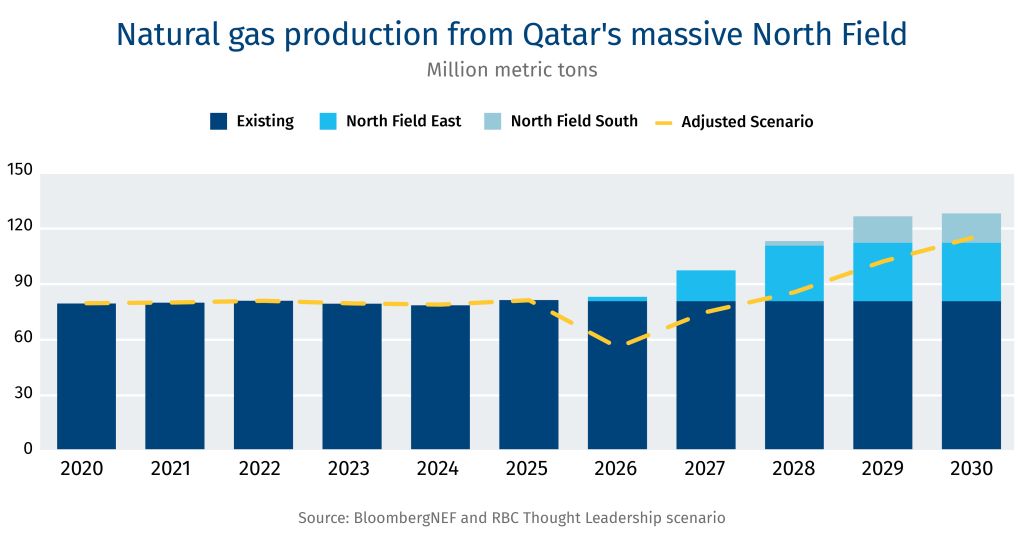
  • Based on conversations, Qatar’s adjusted supply scenario of LNG this year is likely 50-55 MT, a ~30 mtpa disruption from last year’s ~83 mtpa of production. That’s not a rounding error—it is a decline just under two times greater than Canada’s current entire LNG export capacity.

  • Qatar’s North Field expansion, which underpins the global supply growth story through 2030, could get pushed back with a slower ramp. The market was pricing in those volumes but is now repricing a near to mid-term shortage.

    Natural gas production from Qatar's massive north field

This is a two-stage shock

  • The Strait of Hormuz dimensions compound the picture. With tanker traffic effectively frozen, the disruption isn’t just a production story – even unaffected volumes are shut-out of the Strait.  

  • LNG Canada is revving up. Eight vessels departing B.C. in the first 17 days of March versus four in all of December signals that Pacific Basin buyers are already rerouting toward non-Gulf supply.

  • Reports suggest U.S. LNG cargoes are also headed to Asia via the Panama Canal.

  • Bottom line: The anticipated LNG glut — widely expected to lower prices and improve affordability — is likely off the table through at least 2028.

For more, read: Energy Shock: 8 charts that explain the global oil and gas fallout – RBC

–Shaz Merwat

Negotiating trade with President Donald Trump is like playing whack-a-mole. Irritants pop up relentlessly and belligerently. Except if you swing late, the mole pops up and whacks you back harder. The U.S. Trade Representative’s launch of a Section 301 investigation into Canada is just the latest belligerent act.

The investigations, targeted a total of about 60 trading partners, fall under two probes:

  • First, to determine if countries have failed to effectively ban or enforce prohibitions on goods produced with forced labour entering America (which is the focus of the Canadian investigation).

  • Second, whether foreign government subsidies result in overcapacity that floods markets and hurts U.S. manufacturing in key sectors.

The U.S.’s motive is to force allies to share the load in hardening against forced labour goods from regions like Xinjiang region—where minorities are forced to produce goods—, apart from overcapacity, and broader Chinese supply risks. It’s not just bilateral finger-pointing but, for Canada, it does initiate a deliberately targeted process:

  • Washington charges that Ottawa’s forced-labour enforcement regime unfairly burdens U.S. commerce by letting tainted goods flow into North America.

  • That triggers mandatory consultations, public hearings, and evidence-gathering before tariffs can then be applied.

What’s the realistic threat?

If Canada falls foul of these investigations, duties could target manufacturing inputs (steel, aluminum, minerals), high-tech goods (semiconductors, solar, electric vehicles), seafood, toys, electrical equipment, and consumer essentials like textiles and leather. 

Canadian Border Services Agency (CBSA) data reveals modest gains after 2024 Forced Labour and Child Labour in Supply Chains Act took effect in Canada. Seizures of suspected forced-labour shipments—apparel, toys, and electronics often traced indirectly to the Xinjiang autonomous region in China—edged up, with around 50 detentions in 2024 versus almost none in the prior three years. However, only one shipment was confirmed as violating the prohibition in Canada, a fraction of U.S. Customs and Border Protection’s US$1 billion in seizures over suspected ties to forced labour. The Canadian government committed $25.1 million over two years starting 2025 to Global Affairs Canada and CBSA for investigations and enforcement, to accelerate this, but Washington questions the bite, arguing the enforcement lacks the teeth would help achieve its strategic goals with China.

What happens now?

  • Section 301 is a process, not a trigger. Unlike Section 232, it requires consultations, evidence-building, and public hearings before any tariffs can be imposed.

  • Canada has a narrow window to shape the record: April 15 submissions and hearings beginning April 28 will be critical to demonstrate enforcement progress and anchor arguments in CUSMA labour commitments (Chapter 23).

How it impacts CUSMA negotiations

  • The timing is deliberate. Section 301 process is running in parallel with the CUSMA review, giving the U.S. Trade Representative office USTR an early signal of whether consultations are producing results.

  • United States Trade Representative’s Jamieson Greer said this week that Canada lags Mexico in the CUSMA review process. The Canadian pacing is strategic, reflecting a conscious allocation of risk and leverage in Ottawa. Mark Carney assembled his team and split roles accordingly: Ambassador Mark Wiseman courts Congress against wild cards like CUSMA withdrawal (which can be done through executive order, although Congress does maintain ultimate control over repealing the legislation).

  • Meanwhile, chief negotiator Janice Charette coordinates the relevant government departments and red lines for the PM.

  • Pre-U.S. midterms, Canada must collaborate on forced labour without offering high-value concessions like critical minerals access. Demonstrating enforcement progress and willingness, while holding strategic cards close and letting the midterms test Trump’s leverage to preserve Ottawa’s negotiating room.

–Thomas Ashcroft

China’s recent opportunistic “offer” to Taiwan to unite with the mainland in exchange for energy security illustrates how energy security, trade, and geopolitics are converging, as the Middle East conflict violently shakes up global energy systems.

Why does Taiwan need energy security?

  • The East Asian Island is the world’s leading producer of semiconductors, with natural gas and oil—mostly imported—accounting for 61% of energy supply, according to data from the Statistical Review of World Energy. Coal (33%), nuclear (3%), and renewables (3%) make up the rest.

  • In 2016, Taiwan initiated policies to phase out nuclear power and completed the shutdown of its final reactor in May 2025, bringing nearly 5GW of power—or 42% of Canada’s nuclear capacity—offline, and growing its liquefied natural gas imports.

  • Around 42% of Taiwan’s imported LNG came from Qatar, which suffered a severe missile attack from Iran this week.

  • Taiwan is revisiting its nuclear strategy, with feasibility studies to examine restarting two nuclear power plants. State-owned utility Taipower is also expected to submit reactor restart plans this month.

Lessons in a new energy era

  • Our report Atomic Advantage: Canada’s generational opportunity in a new Nuclear Age, underscored how energy security is driving a resurgence in nuclear power worldwide.

  • Many European and Asian nations are diversifying their energy suppliers but also power sources to navigate the geopolitical instability disrupting global energy markets.

  • As nations seek to diversify both energy supplies and power sources, Canada is well positioned to help. Canada’s Candu reactor technology, which includes sub-gigawatt scale reactors suited to smaller grids, and growing SMR expertise make it a natural partner for countries looking to reduce fossil fuel dependence without relying on Chinese or Russian technology.

–Vivan Sorab

Also in this edition: A Q&A with the former Chief Agriculture Negotiator for the Office of the United States Trade Representation

This week, RBC and Eurasia Group convened a roundtable in Washington, D.C., bringing together policymakers, business leaders, and trade experts as part of the lead-up to the Canada–U.S. Summit that we’ll co-host in Toronto in June.

The tone was cautiously optimistic, which is markedly different from the doomsday headlines and political noise that has become commonplace. Key players on both sides of the border remain focused on preserving and strengthening one of the most deeply integrated economic relationships in the world.

The discussion coalesced around several critical themes:

  • The upcoming CUSMA review, built into the agreement six years ago, was designed as a forum to air grievances, not dismantle the framework. That process alone won’t upend a trade relationship that sees Canada as the top trading partner for more than 30 U.S. states—a fact the Office of the United States Trade Representative is acutely aware.

  • Section 232 tariffs on aluminum, lumber, steel, and autos—imposed on national security grounds—lie outside the formal review process, and there will inevitably be high-stakes negotiations around changing the status quo.

  • Trump is also less likely, and less able, to unilaterally reimpose sweeping tariffs in 2026. Yet initiatives like Project Vault signal his intent to align allies with U.S. interests on critical minerals and advanced technologies. Trump will want to ensure Canada doesn’t stray too far from the U.S. orbit on those, particularly as the EU advances its own agenda on tech sovereignty and regulation.

  • For its part, Canada has distinct advantages to draw on: its supply of heavy rare-earth elements with irreplaceable magnetic and high-temperature properties, as well as its leading capabilities in quantum computing.

  • Meanwhile, China’s role in both markets remains a concern and will feature prominently in negotiations. For Washington, the priorities are to reduce the ability for Canada to serve as a backdoor for Chinese goods into the U.S. market and to decouple its critical minerals supply chain. Ottawa needs to manage that shift while maintaining a measure of economic flexibility.

  • Energy interdependence is key. The integrated Canada–U.S. energy system, bolted together by pipelines and grids, powers a landmass larger than Russia. Canada supplies more than 60% of U.S. crude oil imports, and industry leaders cautioned against viewing that relationship merely as leverage. With both countries ranking among the world’s top energy producers, the logic is compelling to expand joint infrastructure and strengthen North America’s competitive position globally.

Political leaders may argue and tinker with the details, but the machinery of integration continues, driven by habit, necessity, and sheer economic gravity.

-Thomas Ashcroft

RBC’s John Stackhouse on how trade tensions may strengthen Canada’s position in an integrated market:

Trump’s extraordinary use of tariffs has braced Canadians for a more fundamental remaking of continental free trade, on less favourable terms for Canada and Mexico.

This has put Canada on a more ambivalent, but strategic and resolute course. It is not unusual for Canadian governments of both major political parties over the decades to oscillate between closer alignment with Washington and periodic assertions of autonomy. But this time, it is different in at least one big way: Canada is now investing heavily in industrial strategy and other sovereign economic policies.

As a result, there are at least three major restructurings underway:

  • Expanding ports and export infrastructure to reach markets beyond the United States.

  • Building domestic defence, digital, and data capacity with a “Buy Canadian” approach to procurement and a willingness to increase collaboration with other European and Asian partners.

  • Rebuilding domestic industrial capacity while reorienting manufacturing toward higher-value, globally competitive activity.

Taken together, and if executed, this strategy would not imply a retreat from the U.S. market so much as a change in how Canada relates to it. Trade with the United States would remain large and central, but less one-sided: Canada would export more from a broader base of domestic capacity, rely less on U.S. inputs, and approach the relationship from a position of greater bargaining strength. The result would likely be steadier, more diversified cross-border trade.

Read the full commentary here.

Our Agriculture Lead Lisa Ashton sat down with Ambassador Darci Vetter, Former Chief Agriculture Negotiator for the Office of the United States Trade Representation, to unpack recent changes in the U.S. tariff approach and what the agriculture sector should be thinking of ahead of the CUSMA review. (This interview has been edited and condensed for brevity.)

Q: How might the Trump administration’s current focus on reciprocity and trade deficits impact agriculture and food trade, where supply chains are often multi-country and complex?
A: Farmers and food processors now have to factor multiple and changing tariff rates into their sourcing decisions. These calculations are further complicated by tariffs on steel, aluminum, auto parts, lumber and other products that are critical inputs. 

It’s also not clear to me that the U.S. agricultural trade deficit is a good indicator of the health of the U.S. agricultural sector. If you look at the products that the U.S. exports versus those it imports, you are quite literally comparing apples and oranges. While there is merit in examining how U.S. farmers can better serve local and national markets—and no country wants to be overly dependent on food imports—imported agricultural and food products ensure consumers have access to a varied, affordable and healthy diet.

The USDA’s latest agricultural trade forecast is predicting a US$20 billion decrease in the agricultural trade deficit.1 While the forecast predicts a small increase in exports, a closer examination shows the majority of the changes are due to a decrease in prices for high-value imports like coffee, cocoa and spirits, rather than changes in policy.

Q: What should agriculture and food sectors be watching for in the CUSMA review? 
A: The trilateral food and agricultural trade relationship among Canada, the U.S. and Mexico is one of the world’s most integrated agricultural trading relationships. In 2024, U.S. agricultural and seafood exports to Mexico and Canada totalled more than US$60 billion2. In the U.S., a broad group of agricultural associations have formed the Agricultural Coalition for USMCA to advocate for continuation of the agreement, recognizing its critical value for the sector.

Longstanding relationships are bound to have a few irritants. In his December testimony to Congress, U.S. Trade Representative Jamieson Greer listed a few issues in agriculture— including market access for U.S. dairy products that Canada committed to provide under CUSMA; addressing Canada’s exports of certain dairy products; and the impact of importing Mexican seasonal produce on U.S. growers. 

Q: What other elements of the CUSMA review could impact the sector?
A: The U.S. is likely to prioritize tighter rules of origin and/or North American content requirements for autos, auto parts, steel and aluminum—affecting supply chains for these important inputs for agricultural production and food processing.

One of the most important elements of CUSMA was the Sanitary and Phytosanitary Measures Chapter. CUSMA added important obligations to help ensure food safety and animal and plant health. The SPS Chapter calls for coordination to ensure regulations are transparent, based on sound science and risk, and allow for key agricultural technologies. The USMCA SPS Committee provides a venue to coordinate positions and inform international standards. While unlikely to be changed in the review, they provide a clear example of the benefits of long-term regional approach to trade relationships.

Also in this edition: A conversation with Canada’s Foreign Affairs Minister Anita Anand, key takeaways from PDAC, and the Iran conflict’s impact on global oil supply and prices

If trade and investment are two sides of the same coin, Canada for a good while has been calling on trade when the coin was flipped. The Carney Doctrine—whenever it’s written—shows a new preference for investment. No capital, no bananas.

The prime minister signalled a capital-first inclination in his lightning tour of Asia this week, as he covered 30,000 kilometres, three countries and $5.5 billion in deals faster than the Toronto Maple Leafs can win a game. The messages in Mumbai, Sydney and Tokyo—three of the world’s key capital markets centres—is that Canada needs and wants capital. Not a lot of symbolic trade MOUs on this junket.

Carney’s Indo-Pacific initiatives focussed on capital flows, industrial partnerships, and supply chain integration across sectors such as critical minerals, semiconductors, AI, defence manufacturing, and energy security. From a distance, it looked more like a PE road show than a trade mission. Example: IFM, an infrastructure investment behemoth owned by Australian pension funds, declared its intention to invest up to $10 billion in Canada. That matters because more infrastructure in the two countries will enable more trade.

Back home, some subtler changes added to the trend toward global capital as the precursor to trade. A shakeup at Global Affairs was the latest sign that foreign policy is now rooted in the PMO. The Prime Minister and his top bureaucrat, Michael Sabia, also hired Glenn Purves as deputy minister of international trade. Purves is a long-time bureaucrat who had worked under Sabia before heading to the private sector early last year as head of macro research at BlackRock’s Investment Institute. 

Putting a capital markets guy atop the trade service is a signal: capital first. Purves now has his own global infrastructure, too, through trade commissions, to ensure Carney’s capital calls are met. Somewhere on that PMO in the Sky, the Prime Minister keeps a tally of commitments made, and commitments delivered. Call it the new balance of trade. 

John Stackhouse

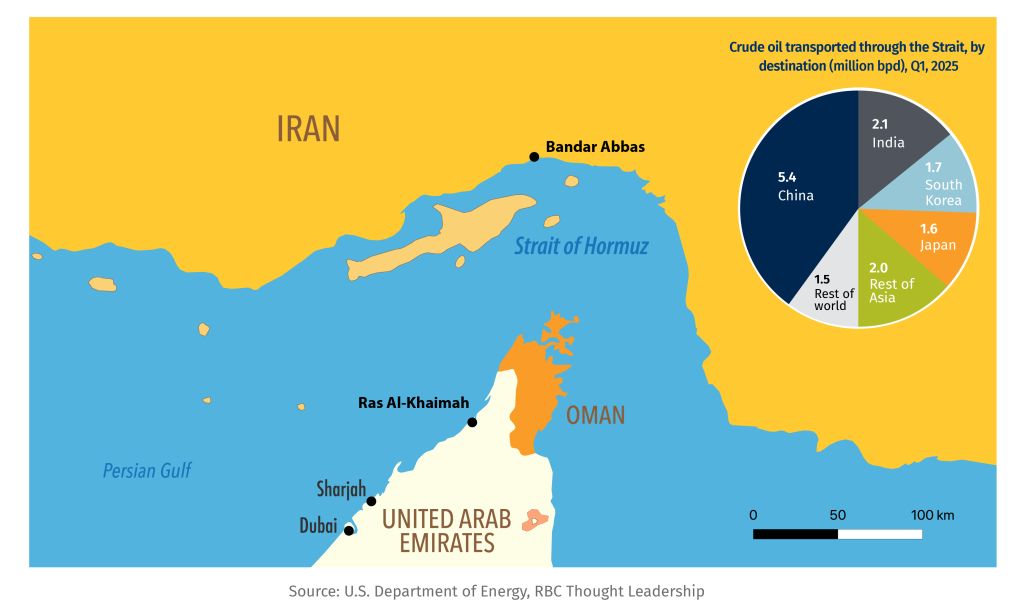
The Strait of Hormuz, through which 20% of the world’s oil passes, is a key transit point for many energy-import dependent Asian countries. China, by a wide margin, tops that list.

Since the Iran conflict started, commercial shipments of crude and natural gas have slowed to a “near-total” pause. And the price is climbing—fast. Brent Crude futures crossed US$90 a barrel, the highest in almost two years, leading to fears of higher prices at the pumps and spiking inflation. 

–Farhad Panahov

This year’s Prospectors & Developers Association of Canada (PDAC) event in Toronto was abuzz with talk of Canda’s critical mineral riches and the speed at which they can be brought to global markets—at commercial scale. The industry is enthusiastic, the government supportive, but there is a long way to go to realize Canada’s mining potential.

Here are seven themes that we observed at the event:

  • Diverging views of supply chains exposures

  • Resolving refining bottlenecks will be key

  • Project Vault is not a partnership of equals

  • Copper is the clearest demand signal

  • Don’t ignore civilian demand

  • Prioritize across the minerals list

  • Regulatory coordination as competitive advantage

Read more on these key takeaways from Shaz Merwat, RBC Thought Leadership’s Energy Lead, here.

Hours after returning home from India, where Prime Minister Mark Carney kicked off talks of a Comprehensive Economic Partnership Agreement aimed at doubling two-way trade to $70 billion by 2030, Foreign Affairs Minister Anita Anand joined RBC’s John Stackhouse on stage at the Toronto Region Board of Trade.

Some key takeaways from the conversation (edited for brevity):

JS: What signals are you bringing home, especially to business decision makers?
AA: We are the only G7 country that has a free trade agreement with every other G7 country. We had the infrastructure in place from a trade perspective. We need it to be operationalized and utilized. Such is the case with India. We need all of us to be utilizing the agreements that we are executing, or we will keep having to rely on one trading partner and all the difficulty that has caused.

JS: I’ve heard this for decades. We need to diversify. We’re making progress but it’s slow progress. What are we, in business, missing?
AA: It’s really important to unpack what we are doing internationally. That’s what I’m trying to do, make foreign policy and these types of agreements accessible and understandable for businesses to utilize—that will yield actual trade diversification over and above the agreements that we’re signing.

JS: I wonder if you could wrap up with a positive reflection from your trip and if there was any one point that really gave you confidence, especially for businesses?
AA: There is a positive story here despite the very difficult economic environment we find ourselves in, despite a global conflict that is extremely disconcerting and stressful. Canada is on a positive path to growth. Canada has everything the world wants. There is not a room that I go into where people are uninterested in Canada.

Watch the entire conversation here.

States challenge Trump’s latest trade measures

  • As many as 24 U.S. states have sued the Trump administration over its new 10% tariffs imposed under Section 122 of the 1974 Trade Act, arguing the president again exceeded his authority after the Supreme Court struck down the earlier emergency-powers tariffs.

  • The case reopens yet another legal front in Washington’s tariff strategy and prolongs uncertainty for businesses, as courts weigh the limits of executive trade authority.

AI chip exports potentially being tied to U.S. investment

  • The U.S. Commerce Department is proposing new export rules that would require countries buying large volumes of Nvidia and AMD AI chips to commit investment into U.S. data-centre infrastructure.

  • The move signals a shift toward “investment-for-access” technology policy, as the U.S. tries to leverage its semiconductor advantage to support the huge buildout of data centres.

–Thomas Ashcroft

Prime Minister Mark Carney arrived in India with clear ambitions to move quickly toward a Canada–India trade agreement. The geopolitical logic is sound, rooted in diversification, Indo-Pacific cooperation, and increasingly aligned strategic interests.

But successive Canadian governments have tried—and largely failed—to unlock India’s massive market at scale. India liberalizes selectively, opening sectors where imports support domestic growth while maintaining tight protection where political sensitivity is highest. Early gains are therefore most likely where India requires external supply or technology—energy security, industrial inputs, and advanced technologies—meaning Canada’s strategy must prioritize sequenced commercial outcomes rather than broad economy-wide concessions.

Luckily, there’s already a blueprint: Canadian pension funds have laid incredible groundwork, having invested over $70 billion in India, which can open up commercial entry points.

We identify some sectors where Canada can make inroads in the Indian market.

Agriculture: Domestic sensitivities, big trade

  • Agriculture remains Canada’s largest export sector to India, yet also one of its most politically constrained. Current measures—a 30% duty on Canadian yellow peas and 10% tariffs on lentils—are designed to protect Indian farmers and manage food-price stability.

  • India frequently adjusts tariffs, licencing rules, and procurement conditions in ways that effectively cap import volumes, particularly for pulses where Canada is a leading supplier.

  • These policies function as domestic economic management tools and can shift quickly with harvest outcomes or inflation pressures, creating persistent uncertainty for Canadian exporters. Clearer import frameworks would help.

Energy: Displacing Russian oil and gas

  • India’s energy demand is expanding across oil, gas, and electricity generation faster than any advanced economy, creating structural alignment with Canada’s resource base.

  • Yet current trade highlights the gap between potential and reality: Canada’s largest energy export to India today is coal, not oil or natural gas—demonstrating that infrastructure and commercial pathways are limiting the relationship.

  • India’s effort to diversify suppliers, notably Russia, under pressure from the U.S., creates an opening for Canada to reposition itself as a longer-term supplier of crude, LNG, and nuclear fuel.

  • Long-term oil and LNG purchase orders—not diplomatic announcements—will determine whether alignment translates into sustained export growth.

Nuclear: Powered by cooperation

  • India’s planned reactor expansion, targetting roughly 100 GW of capacity by 2047, requires secure fuel supply, while Canada remains one of a limited number of politically reliable uranium exporters.

  • Uranium trade operates on long planning horizons and structured supply arrangements, making it less exposed to short-term commodity volatility than most resource trade.

  • Cooperation typically extends beyond fuel into engineering services, safety systems, workforce training, and regulatory collaboration that deepen industrial ties over time.

  • A uranium agreement would signal that the bilateral reset has moved beyond diplomacy into sustained economic cooperation.

Talent and culture: Soft people power

  • Talent mobility and diaspora ties remain foundational infrastructure for the commercial relationship, underpinning investment and business linkages across sectors.

  • Pressures surrounding international students and domestic post-secondary capacity mean mobility policies must balance economic opportunity with political sustainability at home.

  • Film and media collaboration represents a practical early opportunity, as Bollywood production increasingly seeks global filming locations that “Hollywood North” can provide.

Industries: Beyond commodities

  • India’s growth constraints increasingly lie in systems—grids, logistics, emissions management, and industrial efficiency—not simply access to raw materials.

  • Canadian firms are competitive in these enabling technologies, allowing Canada to participate as a solutions partner alongside a resource exporter.

  • Pairing energy exports with clean technology and digital optimization broadens the relationship beyond commodity cycles and supports incremental, repeatable commercial integration.

Trade with India will advance not through political momentum alone, but by aligning commercial incentives with India’s domestic priorities. Canada’s success will ultimately be measured not by what paper is signed but what follows: goods shipped, projects financed, and supply relationships durable enough to expand over time.

–Thomas Ashcroft, Global Issues Policy Lead

Back to the Future: Lessons from a Post-WWII Tin Agreement

This week, the Office of the U.S. Trade Representative issued a request for comments on how a plurilateral critical minerals agreement should be designed. Buried within the submission is a reference to the 1956 International Tin Agreement. That reference is worth a short history lesson.

Why It Matters

The International Tin Agreement was one of the most ambitious experiments in commodity market governance ever attempted—a producer-consumer framework designed to bring price stability to a material the Western world depended on but couldn’t control. It lasted nearly 30 years but ultimately failed. The reasons it failed are precisely the questions the USTR notice is now asking allied governments to answer for critical minerals.

Lessons learned

  • The buyers’ club needs to be big enough to matter. The tin deal failed partly because non-members were significant suppliers. Plurilateral clubs need critical mass—hard to do given China dominates both refined supply and end-use demand.

  • Speed matters. Tin took six revisions over decades to lay the ground, and still collapsed. The window for today’s Western critical mineral supply chain realignment is shorter with China likely even more incentivized to further disrupt markets.

  • Rules of origin is the real enforcement mechanism. Price floors mean little without teeth, and the buyers’ club needs compliance. Given U.S. desires to reshore production, this reads as a competitive advantage for Canada relative to other U.S. trade partners.

Bigger picture

The critical minerals file is unusual as it’s the only area where Washington is leveraging partnerships rather than tariffs. Convening allies, building frameworks, and even asking trade partners to help design the rules is helping Washington foster greater confidence and investment certainty for industry and financiers.

The architecture is emerging, and if successful, a guaranteed price for metals tied to rules of origin that extend through to refined input should be enough to make Western refining economies work. At present, the capital to build that infrastructure is not. This is where more work needs to be done.


Landing on the eve of the annual Prospectors & Developers Association of Canada conference in Toronto, which attracts more than 27,000 attendees, is RBC Thought Leadership’s newest report,  Mine & Refine, which examines that capital gap—the structures, financing mechanisms, and sovereign investment needed to make Canada a credible supplier of refined critical minerals into the new supply chain order.

–Shaz Merwat, Energy Policy Lead

China’s finance ministry confirmed that tariffs on some Canadian agricultural goods will be suspended.

  • The announcement follows the deal Carney cut in Beijing earlier this month. 

  • While the 100% tariffs on canola meal and peas, and the 25% levy on lobsters and crabs will not be imposed, the announcement made no mention of canola seed tariffs, which were supposed to come down to 15% as of March 1.

Over 900 companies have sued the U.S. government after Supreme Court tariff ruling

  • FedEx was the first major American company to come asking for refunds after last Friday’s ruling putting ~$170bn of tariff revenue in play.

  • The onslaught of lawsuits that have been filed with the U.S. Court of International Trade will keep lawyers busy for some time and introduce another major layer of uncertainty and difficulty for U.S. President Donald Trump’s tariff regime.

Germany pushes China for a trade reset

  • Chancellor Friedrich Merz urged Beijing to curb subsidies, address industrial overcapacity, and ease restrictions on European firms as EU concerns over unfair competition and widening trade imbalances grow.

  • Xi Jinping positioned China as a defender of multilateral trade and encouraged closer EU alignment, even as Europe seeks to reduce strategic dependencies in critical supply chains.

–Thomas Ashcroft, Global Issues Policy Lead

Janice Charette has at least two sets of marching orders: the one she received directly this week from Mark Carney, and the one she will receive indirectly next week from Donald Trump.

Trump’s unsurprising loss of the Supreme Court case on tariffs will only deepen the difference.

First to Carney:

  • The PM has an impressive depth of respect for his new chief trade negotiator, going back to their days in London but critically to her time last year overseeing his transition team.

  • As the country is learning, Carney works with concentric circles of trust and confidence. She’s one of a handful of people in the inner circle.

  • The PM is also known to value her deep knowledge of the Canadian government and businesses. She knows where to go for answers to the many questions and challenges the U.S. will throw at her.

  • Her first challenge will be to develop the framework for a marathon of trade talks. 

  • That includes structuring technical conversations with a counterpart that’s neither interested nor prepared right now.

  • And it means building up a team for the fight. In Trump 1, the Trudeau team set up a war room that built a network of influencers, including in industry and state governments. Something similar is needed now, but perhaps more of a data room—an operation that can gather and disseminate current information on the impact of tariffs in both countries. 

  • Her next challenge will be to align with the PM on the potential gives and red lines that any negotiator needs in their pocket.

  • One non-negotiable along the way: ensure the CUSMA exemption is maintained.

Now to Trump:

  • The President, who is also on a war footing with Iran, will spend the weekend also ramping up his next trade battle.

  • Many are expecting more Section 301 tariffs to replace the emergency powers tariffs that the Supreme Court struck down. Expect more non-tariff measures, too, and more threats

  • His key messaging may come in his State of the Union address Tuesday night, which is supposed to speak to affordability but will likely toggle between geopolitical conflicts and tariffs. 

  • The setting, on Capitol Hill, won’t be lost on a President who will cajole Congress to support him on both war fronts.

  • Trump’s lead negotiator, Jamieson Greer, has told people privately he’s preparing for negotiations with both Canada and Mexico to run beyond the November midterms. 

  • That flies in the face of many expectations for a replay of 2018, when the administration worked rapidly through the summer to complete what the President could present in the fall campaign as a BDE (best deal ever).

  • If that happens, a Democrat-led House would likely make any comprehensive deal with either country an improbability. Not only will the Dems want a different deal than Trump, Congress will be consumed—almost Watergate-like—with the Epstein files. 

Charette has faced plenty of such challenges in her career, and is widely known for grace under fire.

Press play on the next big test.

– John Stackhouse

A tariff backdoor just closed

  • The U.S. Supreme Court has effectively removed the International Emergency Economics Power Act (IEEPA) as a usable, fast-tariff instrument for any president: the ruling says IEEPA’s authority to regulate importation does not include the authority to impose tariffs absent explicit Congressional authorization.

  • That matters because IEEPA was the administration’s most flexible mechanism: it enabled broad, rapidly adjustable, country-wide duties (including “reciprocal” tariffs and fentanyl-related tariffs) that could be turned up or down quickly as negotiating pressure.

  • A large share of tariff collections tied to IEEPA is now legally exposed (and at minimum, frozen as a durable policy tool).

  • For Canada, the ruling does not touch the most biting tariffs: sectoral/national security tools (notably Section 232) remain the active battlefield for steel, aluminum, autos and other targeted categories.

  • RBC Economics hammers home that point in ‘Preserving CUSMA exemptions: Canada’s real priority amid U.S. IEEPA ruling.’“By our count, 89% of Canadian exports to the U.S. in December were not charged with tariffs because they’re compliant with rules of origin requirements in CUSMA. That leaves IEEPA measures only effective on less than 5% of exports to the U.S. In December (with the remainder accounted for by Section 232 tariffs), Canada faced an average effective U.S. tariff of 3.1%—the lowest of all major U.S. trade partners.


Canada: less blanket risk, key sectors remain exposed

  • The ruling weakens Washington’s negotiating power by removing the credibility of instantaneous escalation. Future tariffs must pass through investigations, evidentiary standards, and consultation.

  • Industries exposed to higher input costs, retailers sensitive to consumer prices, vulnerable agricultural exporters, and opposed politicians will have more opportunity to intervene before tariffs take effect.

  • The economic pain of 232 tariffs remains but the credibility of economy-wide escalation declines, improving predictability—a meaningful advantage for negotiations and investment decisions tied to North American supply chains.

  • Integration becomes a stronger argument. When tariffs require justification through formal investigations, deeply embedded cross-border supply chains become evidence against disruption.

Expect tariffs to persist, but with more politics attached

  • The administration will try to rebuild tariff leverage using other statutes, but those tools require more process, justification and time.

  • Canada can treat this as an opening to shape the record, not as an off-ramp from tariff risk. If the battlefield shifts toward investigations and consultations, Canada will need to make the case that tariffs are self-defeating for the U.S.

Coalition-building becomes more decisive

  • The most effective counterweight to new tariffs will often be U.S. stakeholders with skin in the game: downstream manufacturers, retailers, farmers, state governments, and industry associations that can credibly argue costs, shortages, and lost competitiveness.

  • Canada’s best outcomes will come from identifying where U.S. dependence is highest (inputs, components, energy-intensive processing, regional supply chains) and turning those into politically legible arguments.

What we’ll be watching closely going forward

1. Which alternative tools the Trump administration prioritizes, and whether it doubles down on using Section 232 tariffs.

2. Whether the White House seeks negotiated “wins” that substitute for tariffs: procurement commitments, investment announcements, or sectoral carve-outs.

3. How quickly and effectively U.S. industry groups and state actors coalesce around this momentum swing to further curtail White House trade power.

4. The legal and fiscal ramifications. The court did not decide whether revenues collected under IEEPA must be returned, leaving potentially US$175 billion subject to litigation. Pressure to issue large-scale repayments will be vehemently opposed but will reinforce opposition, potentially induce fiscal pressure, and complicate any attempts to rebuild a similar tariff regime.

— Thomas Ashcroft

Also in this edition: What the future could hold for Canada’s auto industry

Agreements from Washington’s inaugural Critical Minerals Ministerial are still being digested, which saw bilateral frameworks with over a dozen trade partners and the unveiling of Project Vault.

Notably, Canada wasn’t among the signatories. So as America rewires the global minerals order, does Canada stand to gain or be left behind?

Why It Matters

Project Vault is America’s attempt to build a Strategic Petroleum Reserve for critical minerals. The problem: the SPR analogy breaks down in a way that matters enormously for Canada.

The original SPR worked because the U.S. had vast domestic refining capacity—stored crude to be converted into refined fuels along the Gulf Coast. Today, North America has almost none of the processing infrastructure needed to convert raw critical minerals into the refined compounds that defense, semiconductors, and EVs ultimately require.

So Project Vault faces a fundamental paradox: stockpile raw ore with no capacity to process it; stockpile refined material almost certainly bought from China—the very dependency the U.S. is trying to hedge.

By the Numbers

  • US$15 billion—EXIM Bank financing already mobilized across allied minerals projects globally, before Project Vault

  • US$12 billion—Project Vault financing (US$10 billion from the U.S. Export-Import Bank and US$2 billion in private capital)

  • 60-day supply target buffer for strategic minerals

  • 15 bilateral frameworks signed this week alone—including the EU, Japan, UAE.

  • China’s refining grip98% gallium, 91% rare earth magnets, 96% battery-grade graphite, 79% cobalt

  • Canada’s position—71% of U.S. unwrought aluminum imports; Quebec’s Vaudreuil refinery is one of only two alumina refineries left in North America.

  • Project Vault covers all 60 critical minerals on the USGS list, many of which are core economic exports for Canada

The Bigger Picture

The U.S. isn’t building a multilateral framework—the word chosen deliberately at the ministerial was plurilateral. A smaller, aligned coalition setting its own rules, coordinating price floors, and directing investment collectively. Through EXIM and Project Vault, this architecture is being built in real-time.

Energy-intensive refining and smelting, the very processes needed to turn minerals reserve into usable industrial inputs, on paper at least, is a good set up for Canada. Our clean and cost competitive power (hydro, nuclear) complements existing mineral deposits, which, with integrated rail networks, allow for better full-cycle economics than stand-alone processing and refining operations.

Bottom Line

Canada’s critical minerals endowment is arguably its most important bilateral tool heading into the CUSMA renegotiation. Its broader integration into U.S. supply chains—across aluminum, copper, nickel, zinc and manganese— limits being phased-out to a large extent. If Canada can secure explicit recognition of Canadian content in U.S. value chains, via CUSMA assisted by Project Vault’s predictive offtake and access to U.S. capital, it is a clear win.

That said, our minerals chip depreciates with each passing day. Every bilateral framework Washington signs with another partner narrows Canada’s relative leverage, especially if CUSMA negotiations extend into 2027. And at a time when investment decisions at times are less about economics and more a price of admission to the U.S. market (read: Korea Zinc JV).

Threading that needle will be the challenge.

– Shaz Merwat

RBC economist Farhad Pananov was at The Globe and Mail’s Future of Automotive event this week. Here’s some of what he heard:

  • Strategic investments in the auto sector have fallen off compared to just to a few years ago when manufacturers were setting long-term pivots.

  • While panelists heaped plenty of praise on Canada’s highly skilled and educated labour force and diversified local economies, it was clear what the country’s greatest advantage is access to the second largest auto market in the world. For now, at least.

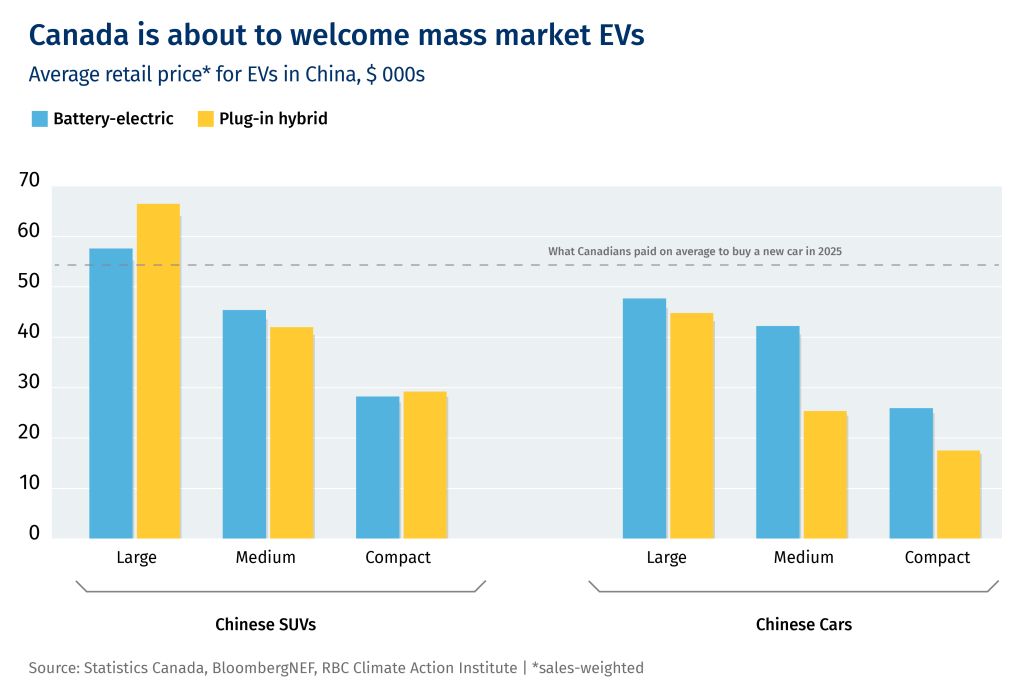
  • The Canada-China EV deal, which will facilitate the import of 49,000 Chinese EVs a year at low tariff rates, was met with skepticism in the room: Which brands will come to Canada? Will Canadians actually buy them?

The answer to that last question could all come down to the price…

U.S. lawmakers rebuke Trump’s Canada tariffs 

  • The U.S. House of Representatives voted to rescind tariffs on Canadian goods, the same week President Trump threatened to block the opening of the Gordie Howe International Bridge because of trade disputes. 

  • While the President will likely veto the motion, Wednesday’s vote was backed by six Republicans, indicating growing discontent with Trump’s trade policies and threats. 

U.S. agriculture industry lobbies for CUSMA continuation

  • Over 40 U.S. agricultural groups have formed a coalition to support the Canada-U.S.-Mexico trade agreement, emphasizing the economic benefits it brings to rural communities and American farmlands.

  • The advocacy campaign is targeting members of Congress, the White House, and the President, with economic analysis that shows Canada and Mexico account for approximately one-third of the value of U.S. agricultural exports. 

U.K. government signals closer alignment with Europe

  • Chancellor Rachel Reeves announced the U.K. is prepared to unilaterally align with the EU’s single market rules in sectors like financial services to reduce trade barriers, describing closer integration with the EU as the “biggest prize” for U.K. growth, pivoting away from prioritizing non-European trade deals.

  • The Labour government has been reticent to reopen Brexit as a political issue but are beginning to look more fondly at closer integration with the EU as they search for ways to boost economic growth. 

— Thomas Ashcroft

Also in this edition: Canada’s trade with non-U.S. markets is hitting all-time highs and the U.S. looks to create a critical minerals trading bloc to rival China

The Liberal government’s much-anticipated auto-sector strategy reinstates electric vehicle incentives, eliminates EV sales mandates, invests in expanding the EV charging network, and offers incentives and tax breaks for global auto makers to build in the country.

It’s all in response to U.S. tariffs, and the looming threat that President Donald Trump might tear up CUSMA in the coming months.

Of course, Prime Minister Mark Carney is hoping to preserve CUSMA and build on its North American supply chain advantages to a new set of investors. But even if Canada’s access to the U.S. market is no longer unfettered, Ottawa can point to several reasons why European and Asian countries may want to set up their auto shop in Canada:

  • Canadians buy a lot of pricey cars and SUVs: Canada is the world’s 9th-largest auto market, with ~1.9 million vehicles sold annually—skewed toward higher-value SUVs and trucks, with a robust servicing and after-market (courtesy of our harsh winters). OEMs also now compete for high-margin customers, not volume. Canadians buy a lot of cars, including a lot of expensive (read: high margin) cars.

  • Asian carmakers want a North American hub: With 7.2 million global sales in 2024, the combined Korean power of Hyundai-Kia edged out GM and Stellantis for the third spot in the global rankings. However, the companies’ manufacturing footprint and market share remains Asia-heavy, creating an incentive to rebalance toward North America. Canada could become a second North American production zone, hedging geopolitical, climate, and labour risks.

  • Canada is critical to global supply chains: Our store of critical minerals (nickel, cobalt, lithium, graphite), batteries, parts ecosystem, and reliable, clean power offer supply chain integrity at low cost. Just ask Volkswagen.

  • The Ontario-Quebec corridor is an auto-tech Silicon Valley: Canada’s strengths in AI, autonomy, and software—the frontier of future value creation for the auto industry—further enhances the offering.

  • Canada is a free-trade haven: It stands to reason that Canada will secure some form of market access to the U.S. that makes an auto trade possible. We shouldn’t forget the 14 other free trade agreements we’ve signed that cover 50+ countries, 1.5 billion consumers, and 60% of global GDP.

— Jordan Brennan

According to RBC Economist Claire Fan:

“Despite the deteriorating trade balance, Canadian exporters continue to show signs of partial diversification into non-U.S. markets. Goods exports to non-U.S. destinations were 29% above year-ago levels in November, while goods imports from non-U.S. markets rose 18%—both near or at all-time highs.”

U.S. looks to create a critical minerals trading bloc rivalling China

  • At a Washington summit, attended by representatives from more than 50 nations, the U.S. outlined a vision for a rare earths trade zone, using tariffs to create a price floor for minerals and drawing on the respective strengths of partner countries across the value chain, to counter Chinese dominance.

  • Several bilateral deals were struck, including U.S. “Action Plans” with Mexico, the EU and Japan, to develop coordinated trade policies.

  • Foreign Minister Anita Anand said more details were needed before agreeing to such a framework, which would play a role and potentially give Canada some leverage in upcoming CUSMA negotiations.  

Trump and Modi broker trade truce

  • Washington committed to cutting tariffs on Indian goods from 50% to 18%, in return for New Delhi stopping its purchases of Russian oil.

  • While details on the timing of the tariff changes and other trade barrier reductions remain vague, the amelioration of some of Trump’s most punitive tariffs gave a boost to U.S.-listed shares of Indian companies.

Red Sea reopening adds to shipping overcapacity pressures

  • As Houthi attacks on the critical shipping lane subside, and Suez Canal transit rises, container companies are bracing for pressures on their bottom line if freight rates lower and oversupply worsens.

  • Danish group AP Møller-Maersk, the world’s second largest container shipping company, announced its first operating loss in years and plans to cut jobs to insulate these impacts.

  • Naval escorts have become a necessity for container ships passing through the Red Sea, and tensions between Iran, the U.S. and Israel remain a threat to the stability of the passage.

Ottawa indicates foreign aid will be increasingly tied to trade objectives

  • Randeep Sarai, Secretary of State for International Development, said Canada’s development and humanitarian spending will focus more on opportunities that create “mutual prosperity.”

  • As it reduces the foreign aid budget, the government will look to use the distribution of these dollars as a tool with countries that Canada wants to increase trade with.

— Thomas Ashcroft