Language Flag Filename

rbc_language_toggle_menu_flag

On the eve of Canada hosting the G7 Energy and Environment Ministers’ meeting in Toronto, John Stackhouse, Senior Vice President, Office of the CEO, RBC, delivered a keynote at the IEA Energy Innovation Forum 2025. He focused on three forces redefining how the world operates.  


As you all know, we live in a new era of urgency, in which ambitions are growing and horizons shrinking.

  • It took 15 years for the semiconductor to change the world

  • It took 5 years for the Internet to change the world

  • And it’s taken barely 15 months for Generative AI to change entire landscapes

I was reminded of these new forces of compression during a visit to Silicon Valley last week where a few major tech CEOs said the same thing: “Long term is now six months.”

Yes, we live in a time of unprecedented change and unprecedented compression. And we live in a world that’s being restructured, in our view, by three defining forces. These forces are converging to redefine how nations, markets and societies operate—and they are all connected by energy security.

The first mega force of the 2020s will not surprise any of you. It’s frontier technology

Roughly 45% of the S&P 500 today is comprised of AI Hyperscaler stocks. These hyperscalers are spending more than half a trillion dollars a year, collectively, and that’s rising. For 2025-2027, that could mean $1.5 trillion.

It’s a huge concentration of capital that towers over what now seems like a distant memory: the big capital swings that the U.S. Inflation Reduction Act unleashed just five years ago.

Energy is essential to that growth, as you don’t scale—let alone hyperscale—without a new quantum of energy. And it needs to be secure energy.

The second mega force are the growing geopolitical divisions over trade.

Global trade as a percentage of GDP grew steadily following the Second World War from 10% to reach roughly 60% at the onset of the Great Financial Crisis. It has since plateaued in the mid-50s. This likely falls further next year, with trade volumes expected to increase a meager 0.5% in 2026, much slower than global GDP growth of 2.6%.

We don’t see an end to globalization, but this new age of re-globalization will lead to further capital shifts and energy innovation, just as we saw a quarter century ago when China joined the WTO.

Why? Countries trading less will inherently need more of their own energy, or at least energy from a smaller range of suppliers. Bring on the innovation.

Third, we’ve entered a new security paradigm in which defence—including space—will make major claims on both public and private capital in this more fractured, uncertain and conflictual world. Increased defence and security needs are top of mind for most of our governments. And, as you all know, defence supremacy requires energy.

NATO countries are targeting spending on defence and security to be 5% of GDP by 2035. That’s an annual spend of $2 trillion–and this in rapidly aging societies that may have less productive capacity and greater social need.

This trio of global shifts—in technology, trade and security—will require capital and demand innovation. Critically, these forces point to a clear global need: low-cost, accessible, reliable energy.

You don’t have security in the 2020s without data, critical minerals and energy. Every major advancement in AI will rely on enormous computing power. By 2035, global data center power demand is expected to reach 1,600 TWh, that equals the current power needs of Germany, the UK and France.

Just this week, the U.S. government announced a massive partnership with Brookfield Asset Management, Cameco and Westinghouse Electric, to accelerate the deployment of nuclear power—in part because of America’s ambition of AI supremacy.

Nations and companies that secure abundant and ideally low-carbon power will own the digital future. I stress low-carbon power because renewables are still the cheapest form of electricity generation. Low-carbon power because nuclear is the most energy dense, and increasingly adaptable with the advent of SMRs. Low-carbon power because Big Tech remains committed to procuring affordable, reliable and clean over the medium to longer term. For the G7, low-carbon power can be a competitive advantage and key to a security agenda.

Nations that master the ability to generate, store and distribute these diverse power sources, locally, will also reduce security vulnerability. From drones, sensors and cyber defence–modern militaries are increasingly electrified and digitized. And in an economic environment that can feel more like a battlefield than a marketplace, energy self-sufficiency will reduce exposure to price shocks and geopolitical pressure. Nations that master next generation energy technologies—think large-scale battery storage, or carbon removal and storage—will govern the industries of the future.

This competition for those industries may be won by those that have secure, affordable access to data, energy, and critical minerals. And that competition will be shaped by the two great techno-powers, the U.S. and China. As I mentioned earlier, the new security imperative depends on three inputs—AI, energy and critical minerals. The U.S. has two of these three. China is well on its way to having three out of three. Through collaboration, the G7+ can have an overwhelming security of all three. But we need to be faster, faster and faster. Back to that Silicon Valley ethos of time.

For energy, faster means removing frictions in key inputs traded across our nations. And faster means removing our own internal frictions. Across the developed world, it simply takes too long to build major projects. We have not found a way to disrupt NIMBYISM.

If we do, removing these frictions can quicken development, reduce uncertainty, improve economics and unlock capital to move in both speed and scale. Faster, faster and faster.

This is what is needed to keep pace with the speed in which our energy systems are transforming. Systems that used to evolve over decades now need to reinvent themselves in just a few years.

Energy efficiency–the “first fuel”—has slowed in the past decade. Grid modernization, renewable integration and EV infrastructure must scale faster than any energy transformation in history. Supply chains for lithium, nickel and rare earths are being rebuilt in real time to reduce our dependence on China.

A collaborative approach to responsible resource development across the G7 could be streamlined, with common regulations, standards and financing to mobilize cross-border flows. But let’s not fool ourselves, retooling energy systems at breakneck speed is not cheap. Ten years ago, the economic conditions were, frankly, more accommodating.

  • Low-cost capital

  • More fiscal capacity for subsidies

  • More aligned policy support and favourable market conditions

All those made clean energy projects financially attractive and relatively low risk. Today, higher long-term interest rates, trade frictions, and inflationary supply chain pressures have made the same investment environment more challenging.

And that presents a dilemma. Sustainable energy investments for all of the above could require $2 trillion per year—globally. And that is at the heart of our collective energy innovation challenge. Venture Capital and Private Equity are needed to drive innovation and new technologies to proof of concept. But we’ve reached a point where demonstration projects are too expensive for traditional venture capital and too risky for mainstream capital. This is challenge known as the ‘missing middle’ of capital.

Yet this challenge, is an opportunity. While China has become a global trading nation and clean tech leader, the G7 still dominates capital flows. G7 currencies account for 85% of global foreign exchange volume and dominate the $12.3 trillion in global currency reserves. And a lot of that capital—public and private—is flowing toward these opportunities around security.

Just think of how much has changed in the past six months—a.k.a. the new long term.

First, governments are now investors. We’ve seen the Pentagon create what’s essentially a private equity arm–a firm signal that governments will take more active roles as procurers, capital allocators and resource captors to ensure their economic prosperity and energy and resource security.  The Canadian government is standing up a new Defence Investment Agency with similar ambitions and will likely be using key financing arms to direct more venture capital to defence, space and other strategic security needs.

Secondly, we’re seeing much more assertive and strategic approaches to procurement, including indications from some key allies to create strategic reserves of critical minerals, secure supply chains for energy infrastructure and strategic offtake agreements.

Thirdly, we have seen nations explore new ways to use their collective balance sheets. Here’s one example: RBC is one of 10 global banks that is helping to stand up a new entity called the Defense, Security and Resilience Bank, to facilitate capital expenditures across the defense industry–some of which could conceivably be earmarked for energy and mineral development.

This is all part of a new chapter of what some might call state capitalism—or at least the economically activist state. This will be important for the G7+ and others to, at least, monitor, if not coordinate. Especially in terms of how markets across our countries can align and connect to facilitate new capital flows to these growing strategic imperatives.

Governments can also bridge market failures specific to regulatory uncertainties, demand and financing of first-of-a-kind projects. They can procure, finance and invest.

For example, U.S. Defense Procurement Act Title 3 allows for funding of critical minerals. Here in Canada, public entities like the Canada Infrastructure Bank and Canada Growth Fund can be used to help build out the dual use infrastructure of energy, minerals and defence.

The same opportunity exists for business development banks and export finance agencies across the G7+, to help underwrite the risks of new energy ventures as part of a bigger security strategy. It’s these new approaches to finance—ideally through public and private sector cooperation—that can unleash new waves of capital for this new imperative of energy security.

And do it with Silicon Valley speed.

Consider this: In 2022, climate tech private equity and venture capital outraised defense tech at a scale of 7:1. In 2025, the two are essentially even. I think we can all guess how 2026 is shaping up.

For emerging climate tech ventures, tapping into this new paradigm of defence and security capital may be key to the next few years of global innovation. There isn’t time to wait to see how it plays out. Technology is moving fast. Geopolitics are shifting. And a new map of global security is taking shape. Energy and critical minerals will be the ink on that map, and the G7—and the innovators in this room—have the chance to help draw it.

Language Flag Filename

rbc_language_toggle_menu_flag

In this edition: AI investments are partially masking the impact of the trade war on global growth – but Canada is missing out

By Jordan Brennan, Head of RBC Thought Leadership

The U.S.-Canada auto story just took another hit – or two.

On the tails of the Stellantis decision to move production of its Jeep Compass from Brampton to Illinois, this past week’s news is compounding:

  • General Motors announced it will end production of its BrightDrop electric delivery vans at the CAMI plant in Ingersoll, affecting 1,000+ jobs.

  • Paccar is laying off 300 workers at its plant in Sainte-Thérèse, Quebec ahead of U.S. heavy-truck tariffs.

What’s going on? You could interpret these shifts as proof that Trump’s “re-patriation” strategy is working. But dig deeper: both plants were already facing weakness. CAMI had encountered soft demand for BrightDrop vans; Paccar is turbo-exposed to U.S. heavy-truck demand and tariff risk. Brampton had a litany of problems over the years, including softening EV sales.

Where does this leave Canada? Our auto industry sits between two storms:

  • China is going all in on EVs—nearly half of all new car sales last year were electric.

  • The U.S. and EU EV market are stalling or retrenching—EV penetration in Europe fell to ~21% in 2024 from ~22% the year before.

  • The U.S. sits at just 10%. And that was before Trump’s One Big Beautiful bill shredded EV incentives.

This makes Prime Minister Mark Carney’s pending climate strategy even more consequential. Canada has three broad options:

  • Align with the U.S.: back off EVs and count on gas guzzlers to propel the industry forward.

  • Follow China: invest aggressively in next-gen batteries and hope EVs are the future.

  • Carve a middle path: incentivize hybrid adoption while infrastructure and consumer preferences catch up.

  • A 60-second ad, sponsored by the Ontario government and featuring former U.S. President Ronald Reagan disparaging the use of tariffs, prompted President Donald Trump to immediately cancel all trade talks with Canada. Premier Doug Ford’s government agreed to take the campaign off the air on Monday. But saying it wasn’t quick enough, Trump threatened an additional 10% tariff hike on Canadian goods.

  • Over the next 10 years, Prime Minister Mark Carney wants to double Canada’s exports to markets outside the U.S., boosting trade by $300 billion.

  • India invited Carney to New Delhi to meet with Prime Minister Narendra Modi. According to India’s new High Commissioner, a comprehensive free trade partnership between the two countries could result in $50-billion worth of trade annually, about double last year’s total.

  • An import ban on liquefied natural gas from Russia is part of a new package of sanctions agreed upon by the European Union countries..

  • President Trump will meet with his Chinese counterpart Xi Jinping next Thursday during the Asia-Pacific Economic Cooperation summit. This will mark the first meeting of the two since the U.S. President’s re-election.

By Farhad Panahov, Economist

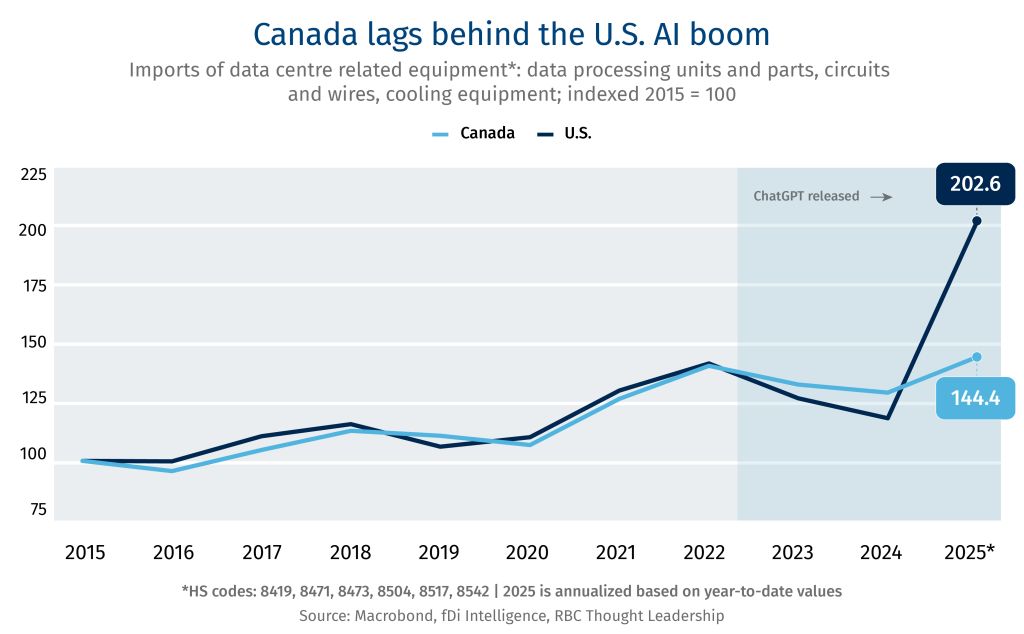
AI-related investments may have masked the impact of the U.S. trade war on global growth so far, the IMF notes in the latest World Economic Outlook. Since the release of ChatGPT in late 2022, U.S. firms have quadrupled data-centre construction spending to nearly US$40 billion. There are now 5,000 data centres dotted across the U.S. Imports of data centre related equipment is up 50% over the same period. Taiwan accounted for half of the growth when it comes to U.S. imports of digital processing units. Canada, as the chart below indicates, has remained on the sidelines of the AI boom despite a growing number of data centre applications. Demand for related equipment has shown only a small uptick in recent years.

By Lisa Ashton, Director of Agriculture Policy

Canada’s agriculture equipment manufacturing industry is caught up in the U.S. tariff blitz.

The industry, which generates $7 billion in annual revenues (more than double from a decade ago), plays a critical role in North America’s food production, providing farmers with the equipment to plant seeds, harvest crops, feed animals, milk cows, and operate an efficient farm business.1

The U.S. market dominates exports, accounting for 82% in 2024, which has so far remained unchanged in 2025.2 But there’s a shift under way. The tariffs have benefitted the domestic industry in some cases by raising domestic demand of Canadian-made products and reducing some input prices, including Canadian steel.3 But the industry is also facing risks of rising costs to produce equipment that has parts from both sides of the border. Manufacturers are wadding through compliance complexity, with U.S. tariffs on some parts such as tractor brakes and Canada’s counter tariffs on parts such as tractor tires.4 For farmers, this means potentially higher input costs for new equipment and parts to repair their existing equipment—forcing decisions on investments that impact agricultural productivity. The shifts come as the industry has already seen a growing trade deficit since 2020, more than doubling in size in 2024.5

Manufacturers are setting their eyes on new growth markets, while maintaining relationships with their U.S. customers and supply chain. A renewed commitment in 2025 to the Canada and Mercosur free trade agreement negotiations offers promise for Canadian agricultural manufacturers to expand their presence in Argentina, Bolivia, Brazil, Paraguay and Uruguay, where agriculture production is expanding, and on-farm mechanization is exponentially improving.

Language Flag Filename

rbc_language_toggle_menu_flag

In this week’s edition: Is Stellantis the first domino to fall? And how Canada can strengthen its role in an REE-bifurcated world.

Is this the end of the auto pact?

By Jordan Brennan, RBC’s Head of Thought Leadership

Frustration is building in Canada’s auto sector. And concern.

Less than one week after U.S. Secretary of Commerce Howard Lutnick told a Canadian audience that “car assembly is going to be in America and there is nothing Canada can do about it,” Stellantis announced it will shift planned Jeep Compass production from Brampton to Belvidere, Illinois.

This looks like the fruits of America’s trade strategy, which aims to re-industrialize America through re-patriation of manufacturing capacity.

The fear: Stellantis is the first of many dominos to fall. 

Canada’s original managed trade in autos—the 1965 Auto Pact—tied duty-free access to production and value-added commitments in Canada, catalyzing continental supply-chain integration and shifting Canada from many low-volume domestic models to fewer, high volume North American models.

Today, Canada exports roughly nine-in-ten Canadian-made vehicles to the U.S. In any ordinary business, reliance on a single customer would be intolerable. But it appeared tenable through the Auto Pact and NAFTA eras. Today’s push to re-patriate Canadian auto jobs is a reversal of the 1965 logic. And it reminds us about our dangerous concentration risk.

In the face of the trade turmoil, Prime Minister Carney has pursued a strategy of patient diplomacy. What are Canada’s options if that doesn’t work?

The U.S. assembles 10-11 million vehicles annually, most of which are sold within the domestic market. Some 15% of American-made vehicles are exported. And in any given year, one-third of those exports are shipped to Canada, making us the largest export market. Closing the door on American imports would hit a channel equal to 7-10% of annual U.S. production.

Then there is the China angle. Beijing slapped a 75% provisional duty on Canadian canola in August. China’s ambassador has since proposed reciprocity—lifting canola and pork tariffs if Ottawa removes its 100% tariff on Chinese EV’s. Premiers Scott Moe and Wab Kinew have urged Ottawa to explore the proposal, which would intensify competition with Tesla, for example.

Other options include sectoral deals with Germany, Japan and South Korea. Think LNG offtake for defence procurement commitments—with auto-assembly mandates as part of the package negotiations.

While none of these options are great, Canada has leverage—as America’s top auto export market and a deeply integrated supplier base. This only works if used surgically. America’s real economic competition and strategic threat comes from China, not Canada. A grand bargain that locks in North American capacity and predictable market access remains the cleanest outcome. 

  • The Keystone XL pipeline is back in the conversation. This time at the negotiating table during the ongoing trade talks in Washington between the U.S. and Canada.

  • Setting a “new roadmap” for Canada-India relations. Foreign Affairs Minister Anita Anand met Indian Prime Minister Narendra Modi after a two-year diplomatic rift.

  • Canadian manufacturing sales fell 1% in August, while wholesale receipts dropped 1.2%, underscoring the impact of U.S. tariffs on key trade-exposed sectors.

  • Canada added 28,000 new manufacturing jobs in September—the increase was concentrated in Ontario and Alberta and partly offset the 58,000 manufacturing jobs lost between January and August.

  • Ikea responds to Trump’s new furniture tariffs with plans to boost U.S. production. Currently, only 15% of what the Swedish home furnishing giant sells in the U.S. is made there.

By Vivan Sorab, RBC Thought Leadership’s Senior Manager of Clean Energy

As China escalates its Rare Earth Element (REE) advantage over the United States with enhanced export controls that could have widespread impact on critical defense and semiconductor supply chains, Canada must strengthen its role in the REE supply chain.

The challenge? Canada has the resources, the capital, and the intellectual property to start building a supply chain but needs to mobilize at speed.

Funding: The tools to build a REE supply chain exist. Canada classifies REEs among its priority 6 critical minerals (alongside lithium, graphite, nickel, cobalt, and copper) to receive funding under a $1.5 billion carveout from the Strategic Response Fund. While funding has flowed for REE mining (e.g., commitments to REE projects in Labrador), Canada must accelerate deployment to processing and manufacturing of key REE-based products like magnets.

Guarantee Demand: U.S. government-backed price floors and offtake agreements for REE products are helping make REE projects more attractive to the private sector. Similar approaches in Canada could help step up a domestic supply chain.

Build Domestic Processing Capability: Canada has REE intellectual property on home soil. Kingston-based Cyclic Materials, a REE magnet recycler, is building a $25 million Centre of Excellence and is partnering with France-based Solvay to supply recycled REE oxides for further processing. By growing processing capabilities at home, Canada can strengthen its position.

Language Flag Filename

rbc_language_toggle_menu_flag

By Jordan Brennan, Head of RBC Thought Leadership

There was a volley of compliments, smiles and backslaps between Donald Trump and Mark Carney during their meeting earlier this week, with the U.S. President telling reporters that Canada was going to walk away “very happy.” But optimism had come crashing down by the next day, with the U.S. Commerce Secretary Howard Lutnick telling a Toronto audience that “car assembly is going to be in America and there is nothing Canada can do about it.”

The view from the White House is that Americans don’t need Canada to assemble their cars. It’s difficult to know what to make of Secretary Lutnick’s remarks. Is it a genuine threat or “art of the deal” bravado in which Trump asks for the sun, the moon and the stars and ends up settling for the moon? Word on the street is that President Trump doesn’t like being told “America needs Canadian oil, steel, lumber” and so on.

A Canadian trade team remains in Washington to chase sectoral deals on steel, aluminum, energy and autos—a hallmark of what Washington now calls “managed trade.” With little material progress to date, and an American negotiating team that’s bogged down in bilateral deals with many other countries, it’s an open question if Canada will be able to secure meaningful sectoral agreements prior to the formal review of CUSMA next July.

It looks like “managed trade” is here to stay for now. But what does that mean?

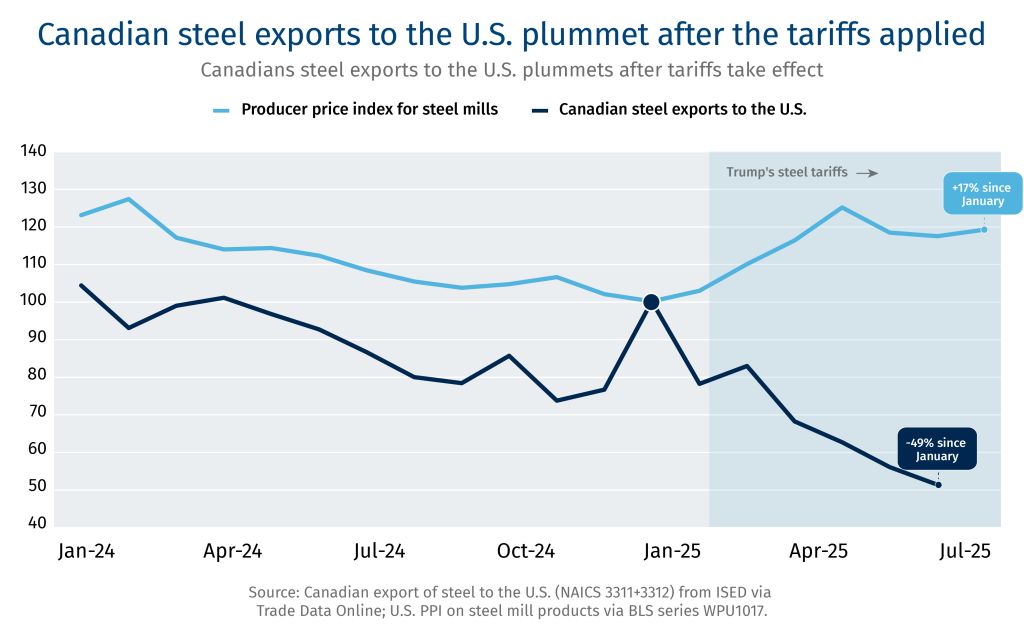
In June, Trump doubled tariffs on Canadian steel and aluminum to 50%, up from the 25% rate announced in February. The impact was immediate. Canada produces roughly 13 million tonnes of primary steel annually, exporting half—and nine out of every ten tonnes goes to the U.S. Those flows are now drying up.

Steel prices tell the story. The chart below shows the value of Canadian steel exports to the U.S. and U.S. steel prices, both indexed to 100 in January 2025 to simplify the comparison. In the 12 months leading up to Trump’s tariffs, Canada’s steel exports to the U.S. and American steel prices both trended downward. Then came the trade war and the two series diverged—Canadian steel exports fell off a cliff while American steel prices marched north.

The new tariffs have reignited steel price inflation. With Canadian imports throttled, American producers are facing less competition and are quietly raising prices. U.S. steel imports from Canada are down 49% while steel prices are up 17% since January.

This is the face of managed trade. It isn’t about opening markets; it’s about organizing them. Under the free-trade order of the past four decades, governments agreed to minimal barriers and let consumer preferences, technology, and competition sort out winners and losers. Managed trade flips that logic. Governments pick strategic sectors, shield them from global competition, and steer investment through tariffs, quotas, and subsidies.

For Canada, the question isn’t whether we like it—it’s how we adapt to it. Ottawa looks ready to pivot, having announced a suite of sector supports in September. We need to learn to play by the new set of rules: identify national priorities, deploy capital strategically, and make reciprocity work in our favour.

Managed trade may be messy. But in this new era, it’s the only game on the field.

  • Donald Trump wants his team to “quickly land deals” with Canada. So said Canada-U.S. Trade Minister Dominic LeBlanc after the U.S. President met with Prime Minister Mark Carney in Washington. LeBlanc remains in Washington to continue trade talks.

  • China unveiled sweeping export controls on rare earths. Trump has threatened ‘massive’ tariffs on Beijing in retaliation.

  • Industry Minister Melanie Joly unveiled a three-point plan as part of an effort to counter U.S. tariffs. Itfocused on protecting jobs, creating new ones and attracting both investment and talent.

  • The U.S. has collected US$195 billion in custom duties during the 2025 fiscal year. That figure stood at US$77 billion in 2024.

  • Chips and other AI-related goods contributed nearly half of global trade growth in the first half of 2025, according to the World Trade Organization. The impact of tariffs is expected to really kick in next year—the WTO expects trade to grow a paltry 0.5% in 2026.

Mark November 5 in your diaries. That’s the day the U.S. Supreme Court will hear the case of President Donald Trump’s emergency tariffs under the International Emergency Economic Powers Act (IEEPA). The Department of Justice (DoJ) will be hoping to overturn a decision in May by the Court of International Trade that declared that Trump had overstepped IEEPA when he used the law against Canada and other U.S. trade partners.

The case combines three separate cases claiming Trump’s tariffs on Canada, China, Mexico and other trade partners are illegal. One was brought by Democratic state attorneys general, while the other two are from separate coalitions of small businesses.

Here’s what you need to know:

  • It’s “illegal”: The plaintiffs’ central argument is that the tariffs were never designed to deal with the specific U.S. grievances against Canada, Mexico and China over drug-trafficking.

  • Trump has been losing—so far: A three-judge Court of International Trade panel, a federal district judge in Washington, D.C., and the 11 active judges on the U.S. Court of Appeals for the Federal Circuit backed the plaintiffs in a 7-4 decision. The DoJ is hoping the Supreme Court will overturn the “incoherent” rulings.

  • The Supreme Court could go either way: The wins in lower courts could be overturned. It’s a “coin flip,” according to Scott Lincicome, a trade expert with the Cato Institute.

  • The White House has many other tools: Some analysts suggest the Supreme Court could side with the lower courts as the U.S. administration has many another avenues to replace the IEEPA tariffs, such as Section 232 of the Trade Expansion Act of 1962.

  • Refund bonanza: If the challengers are successful, it could spark a wave of legal battle over refunds of well over US$80 billion.

The Supreme Court ruling could come by the end of the year.

Language Flag Filename

rbc_language_toggle_menu_flag

By Jordan Brennan, Head of RBC Thought Leadership

  • Mark Carney is going back to Washington next week. His agenda? Revive “security and economic” ties with the U.S., or at the very least bring some relief to Canada’s beleaguered steel, aluminum and auto sectors.

  • With security and economic front and centre, other likely topics at the Oval Office could include the Golden Dome missile shield program, something Donald Trump brought up as recently as this week, taking the opportunity to sting Ottawa with another “51st state” jibe. Could Carney push steel and aluminum’s importance as part of the defence collaboration with Washington?

  • Dominic LeBlanc, the minister responsible for trade with the U.S., sounded upbeat this week about making progress on some of our main pain points with the Trump administration.

  • The two partners also launched consultations last month on CUSMA ahead of the tripartite trade deal review. But what happens if the days of tariff-free access to the American market are permanently behind us?

  • It’s not far-fetched to suppose that Canada ends up with a U.K.-style deal, namely an across-the-board ‘market access’ tariff of 10%.

  • Trump slapped a 25% tariff on the non-U.S. content of automobile exports (the so-called ‘232’ or ‘national security’ tariffs) in March. Given that roughly 50% of the content of a Canadian-assembled vehicle comes from the U.S., Canadian autos have faced an effective tariff rate of about 12.5%. That’s close enough to the 10% market access tariff to warrant comparison.

  • Both sides are suffering: unemployment in Canada has ticked up since the trade war began, with the auto-producing municipality of Windsor suffering from the highest unemployment rate among Canada’s urban centres. South of the border, the manufacturing sector has shed 40k jobs over the past six months, with additional hits to primary and fabricated metal manufacturing.

  • Canadian softwood lumber producers got hammered with an additional 10% tariff. The new levy will be added to the current 35.16% anti-dumping tariff that the U.S. imposed on lumber imports from Canada this year.

  • The European Union is expected to announce a 50% tariff on steel imports next week, aligning the bloc with similar U.S. and Canadian measures.

  • At the request of UK Prime Minister Keir Starmer, U.S. President Donald Trump is said to be considering easing the 10% tariff on imported Scotch whisky.

  • South Korea’s foreign ministry revealed that Seoul will likely announce a new security agreement with the U.S. before finalizing trade talks.

An India-Canada reset is underway, writes John Stackhouse, and this time it will require a lot more than handshakes. 

On trade, India has gone from Canada’s 16th largest partner in 2008 to 10th in 2015 to 7th last year.

The same can’t be said about Canada, which ranks only 30th for India. Bilateral trade reached $31 billion in 2024, including services, compared to $117 billion with China. The decline in international students—one of the largest sources of Indian revenue for Canada—will further slow that progress, as Canada’s perceived closed-door policy has tarnished our reputation across a generation of educated Indian youth.  

That’s not the only reason Canada’s quest to restart trade negotiations may require patience. An increasingly confident India—and confident Modi—will not compromise easily, especially over issues like intellectual property rights, which India has long viewed as a form of Western colonialism. 

Those differences aside, the two countries have unique and deep ties, largely through the Indo-Canadian population. Going forward, India will want a more mature relationship, based on interests, especially economic interests. Canada can pursue greater opportunities, too, from heavy oil and LNG to advanced manufacturing and space technologies. 

A renewed relationship will require both countries to recognize what they bring to each other. It can also stress what they can achieve through alliances and multilateral groups.

Read the full column.

Language Flag Filename

rbc_language_toggle_menu_flag

An India-Canada reset is underway, and this time it will require a lot more than handshakes. 

Two years ago, Justin Trudeau sent relations between the two countries reeling. He publicly indicated the Indian government may have been involved in the murder of a Canadian Sikh activist, Hardeep Singh Nijjar, in Vancouver, creating the biggest bilateral crisis in decades. The two governments went on to expel diplomats, froze a range of visa services and suspended trade negotiations. Then came Trump, and a new age of America First that put every other foreign policy second.

This week, the Carney and Modi governments began in earnest a difficult rapprochement that will require some compromise by both. More importantly, it will require them to declare what their mutual interests (rather than shared values) are in an increasingly divided world.

Prime Minister Mark Carney himself opened the door to an interests-based policy when he invited Narendra Modi to the G7 in Alberta, in June. Modi, who was never enamoured with Trudeau, seized the olive branch.

The two governments quickly appointed new high commissioners, and re-engaged on security issues, particularly over the Nijjar case, which they both want to prevent from dominating bilateral relations. 

This week, Foreign Affairs Minister Anita Anand and her Indian counterpart S. Jaishankar met at the United Nations, ahead of a possible visit to India this fall by Anand. And Ottawa quickly moved to action, labelling India’s Bishnoi gang a “terrorist organization,” which will help both countries better police the concerning rise of Indian-based criminal activity in Canada.

All that is good news for those wanting to restore an active partnership, especially for trade and investment. But it won’t be a simple channel change back to a normalized relationship, as the two countries are on different economic, social and geopolitical wavelengths. They’ll have to find some strategic points of interest.

As Canada returns to India, it will need to navigate a more confident and independent power. Canada also needs to recognize that a decade of bilateral opportunities was either lost or fell short. And in that decade, India has changed significantly. 

It has achieved the highest nominal GDP growth among major global economies, while household incomes have nearly doubled, led by rural communities. As the world’s most populous country, India now sees itself as an economic and political power for the mid-century. It’s also quickly becoming one of the world’s most advanced digital nations, with its Aadhaar biometric ID system now covering more than 90% of the population.  

In that decade, Canada added—officially—500,000 people of Indian origin, making South Asia now the largest source of immigration. 

Those two dynamics—rising India and diverse Canada—will require a careful balance.

Carney, so far, has managed to rise above local politics to put Canadian interests at the centre of that balancing act. His government has signalled that a new chapter of India policy will focus first on economic issues, including better guardrails to ensure those interests are protected from diaspora politics.

A more interests-based policy will need to strengthen commercial ties, for both trade and investment. Over the past five years, India has become a strategic option for many Canadians (and others) shifting away from China, even as relations with India chilled and then froze, interest among major investors heated up. Between 2019-2023, Canadian pension funds directed 25% of their investment flows to India, up from 10% over the previous 15 years, as it overtook China to become the second largest destination for Canadian pension funds, behind only the U.S.

Ontario Teachers’ Pension Plan has been at the forefront, investing over the past year in the infrastructure (the National Highways Trust), vehicle finance (Kogta) and AI (Darwinbox). The Brookfield group has been equally active, buying up clean energy assets and telecom sites and, in late September, signing a $1 billion (US) partnership with GIC, a Singapore sovereign wealth fund, to manage more than five million square feet of office space in three major cities, Mumbai, Bengaluru and Hyderabad.

In trade, India has gone from Canada’s 16th largest partner in 2008 to 10th in 2015 to 7th last year.

The same can’t be said about Canada, which ranks only 30th for India. Bilateral trade reached $31 billion in 2024, including services, compared to $117 billion with China. The decline in international students—one of the largest sources of Indian revenue for Canada—will further slow that progress, as Canada’s perceived closed-door policy has tarnished our reputation across a generation of educated Indian youth.  

That’s not the only reason Canada’s quest to restart trade negotiations may require patience. An increasingly confident India—and confident Modi—will not compromise easily, especially over issues like intellectual property rights, which India has long viewed as a form of Western colonialism. 

Those differences aside, the two countries have unique and deep ties, largely through the Indo-Canadian population. Going forward, India will want a more mature relationship, based on interests, especially economic interests. Canada can pursue greater opportunities, too, from heavy oil and LNG to advanced manufacturing and space technologies. 

A renewed relationship will require both countries to recognize what they bring to each other. It can also stress what they can achieve through alliances and multilateral groups. Both Anand and Jaishankar rooted their UN addresses this week in the need for multilateralism in an America First world. India, as a rising second-tier power, and Canada, as a challenged middle power, can both find strength in collective efforts.

Fifty years ago, in 1975, India-Canada relations hit their lowest point after Indira Gandhi’s government tested a nuclear bomb the year before and then declared a State of Emergency. The relationship didn’t recover until Jean Chrétien travelled to India in 1996.

For both countries, too much is at stake for another long winter of discontent. 

Language Flag Filename

rbc_language_toggle_menu_flag

In this week’s edition: Carney’s U.K. visit, new Trump tariffs, and the potential impact of Canada’s new deal with Indonesia

By Jordan Brennan, Head of RBC Thought Leadership

  • Prime Minister Mark Carney is back in the headlines today, this time in London with U.K. Prime Minister Keir Starmer. At stake: trade diversification and the kind of economic and security alliances that will define the coming decade. No doubt the security situation in Europe forms part of the backdrop to the conversation, including Russia’s alleged incursions into NATO airspace.

  • This week’s meeting builds on talks from June. Back then, the development of the UK-Canada Economic and Trade Working Group got rolling, which will make recommendations on barriers to trade and critical minerals, among other topics.

  • Carney is in a strong spot to lead. With the global order splintering, new partnerships are required to foster security and prosperity. Critical minerals sit at the nexus of both. Secure and stable access to critical minerals is a pre-condition for economic dynamism and geo-political security in the 21st century. They not only underpin the defence industry—their applications span space exploration, clean technology, the digital economy, health care and much beyond.

  • Here’s the problem: NATO and allied countries lack a cohesive strategy. This is Carney’s opportunity to shine. The Canadian government could craft a critical minerals strategy in partnership with allied countries that secures supply chains while attending to the dangerous concentration risk posed by China.

  • As noted in a recent RBC Thought Leadership report, The New Great Game, China is way out in the front, controlling between 60% and 90% of refining capacity for lithium, cobalt, rare earths, and graphite.

  • Building on Canada’s abundant mineral resources, the strategy would leverage Canada’s strength as the global centre for mining excellence. From copper to cobalt, uranium to nickel, lithium to graphite, Canada possesses the raw materials that nourish frontier industries and the engineering and financing capabilities to drive product to market. 

  • The U.S. is taking bold steps in this space, too. Earlier this week, the White House announced it is seeking a 10% equity stake in Lithium Americas, a Vancouver-based company miner. Backed by a Department of Energy loan, Lithium Americas is developing what may become the largest lithium mine in the Western Hemisphere, built in Nevada.

  • As it happens, RBC hosted a delegation this week from Washington. Two dozen staff officials from Congress (from both sides of the aisle) and the Canadian Embassy explored the possibility of a critical minerals partnership between Canada and the U.S. Coupled with Washington’s positioning on Lithium Americas, enhanced cooperation on critical minerals might be one avenue to strengthen Canada’s trading relationship with the Americans.

  • Prime Minister Mark Carney will attend the ASEAN summit in October, amid talk of a potential trade deal between Canada and the Association of Southeast Asian Nations bloc at some point next year

  • Canada should consider making a “business case” to supply liquefied natural gas (LNG) to Germany, its ambassador suggested recently. Germany currently imports about 90% of it’s LNG from the U.S.

  • If an international pharmaceutical company isn’t building a manufacturing plant in the U.S., its drugs will have a 100% tariff levied on them starting October 1. Foreign-made heavy trucks (25%) and household furniture (30%) will also face new tariffs starting next week.

  • Trump promised U.S. farmers, who largely voted for him last November but have been hammered by his trade policy, relief by giving them “some of that tariff money.”

  • The American aerospace giant Boeing may soon land a massive contract with China—potentially a centerpiece of the ongoing U.S.-China trade talks.

  • Most countries are performing better than expected despite the pressure of tariffs, according to a new report from the OECD.

By Shaz Merwat, Energy Policy Lead

After four years of negotiations, Canada signed a Comprehensive Economic Partnership Agreement (CEPA) with Indonesia last week.

The deal is expected to increase Canadian exports by $447 million–a paltry 0.04% increase over current figures. Still, it provides Canada with a call option on Indonesia’s economic growth. The country is expected to become a Top 5 global economy by mid-century and a vast market for Canadian agriculture, food products, machinery, services and even nuclear technology.

The announcement follows on the heels of the Trump Administration’s reciprocal trade deal with Indonesia, moving quickly to secure valuable critical mineral market access and resources—notably nickel. Indonesia agreed to remove its export restrictions on ore, allowing raw and semi-processed nickel to be shipped to the U.S. for refining and keeping the supply chain out of Chinese-operated Indonesian smelters.

For Canadian miners, the nickel arithmetic is likely negative. According to BNEF, Indonesia’s production of Class 1 Nickel (the higher quality needed for batteries) is expected to reach 1.6 million metric tonnes by 2030, accounting for 52% of the global supply. This puts Indonesian supply in direct competition with Canada (240,000 metric tonnes by 2030) and allows for more tariff-free nickel flows to land in North America–positive for North American security of supply but possibly at the expense of Canada.

The U.S. trade deal with Indonesia is the more impactful and given the lack of domestic mineral resources in the U.S., diversification of resources is key. For Canada, the focus remains leveraging our shared national security interests and economic integration to become a de-risked source of supply; competitive advantages that are more challenging for other trade partners to replicate.  

Language Flag Filename

rbc_language_toggle_menu_flag

  • Natural capital remains an underused economic engine. The GDP of Canada’s nature-based sectors, including forestry, agriculture, mining and fisheries, grew 0.3% slower, year-over-year, compared to the rest of the economy over the past quarter century. A similar trend is observed in the United States and the United Kingdom.

  • Ignoring nature threatens prosperity. More than half of the world’s economy, roughly $78 trillion, depends on nature, from food to tourism to construction. Canada, the U.S. and the U.K. are looking to build back their economies, but the nature base their economies rely on for long-term growth is depleting, and its true value is not accounted.

  • There is a generational opportunity to leverage natural capital wealth through nation-building agendas. Countries that track and grow natural capital alongside GDP can unlock growth and attract global investors hunting for investable natural capital projects. With finance mobilizing to close the nature finance gap, demand is rising—and an estimated $580 billion is required annually by 2030. That will increase to nearly $940 billion by 2050.

  • Private capital is critical to closing the gap – and scaling. Governments currently account for 82% ($222 billion) of nature finance. Private sector would need stronger policy signals and assurance that their investments will generate returns.

  • Nature’s place in finance and environmental markets is growing but remains underrepresented. Nature is a small segment of sustainability finance. In 2025, nature-based carbon offsets have represented 13% of voluntary carbon credits but hold more than half of the annual potential of carbon credit creation.

  • Policy integration, AI, and…yes, accounting can get nature on the balance sheet and growth agenda. For Canada, a timely test for all three is the implementation of the Critical Minerals Strategy and emerging major mining projects.It starts withincluding Indigenous values and knowledge systems in natural capital accounting frameworks.

RBC launched the Climate Action Institute in 2023 to support Canadians in our collective journey to net-zero, with a commitment to inform, engage and act on all aspects of the climate challenge. Protecting, conserving, and growing natural assets is a critical part of the journey to net-zero.

Nature is a foundational asset in growing our economy. This is a timely issue as advanced economies like Canada, the U.K., and the U.S., push forward nation-building policy agendas and projects. But there’s a problem: Nature and the people who steward it–including Indigenous communities, farmers, fisherpersons, and fosterers–are often left off the balance sheet. This is the issue that the RBC Climate Action Institute and Nature United, the Canadian affiliate of the global conservation organization, The Nature Conservancy, dig into in this report.

Building, consuming, and exporting more to boost GDP inevitably strains the forests, soils, and waters that make all growth possible. But pro-growth agendas also present a generational opportunity–to treat nature not as a cost to manage but as an asset to build, value, and leverage.

More than $78 trilliona of the global economy–roughly half of total GDP–is highly to moderately dependent on nature.1 Yet, national GDPs count nature only after it is extracted–fish, grain, timber–while mostly ignoring ecosystem services from nature. This includes carbon storage in agricultural soils, water filtration in healthy peatlands, and cultural and biodiversity benefits of intact forests. Valued at more than $200 trillion, ecosystem services remain largely invisible in economic accounts, leaving both a major source of growth and a growing source of risk unrecognized.2

Accounting nature’s true value has been an agenda item for global leaders at nature and climate change meetings for more than 30 years. When Brazil last hosted the world at the 1992 Earth Summit in Rio, leaders signed the first global agreements on climate and biodiversity. This Fall, at COP30, leaders are gathering again in Brazil and have the chance to finally put nature at the center of economic strategy.

Securing finance for nature continues to be a challenge. The vast majority is coming from governments, as industry has largely steered clear due, in part, to uncertainty around investment returns. Global public and private nature finance amounts to roughly $270 billion per year. To close the nature finance gap by 2030 more than $580 billion is required annually. That climbs to about $940 billion a year by 2050.3

A marriage between nature and pro-growth policy agendas provides an unprecedented opportunity to leverage nature as an investable asset. Building natural capital wealth provides a pathway to reboot nature-based sectors, including agriculture and forestry, and boost nature’s role in the built economy, including green infrastructure in housing developments. Investing in nature also mitigates economic losses, including the $3.3 trillion at risk, globally, if ecosystem services such as wild pollination or marine fisheries collapse due to over extraction.4

Canada, the U.S. and the U.K. have all set pro-growth agendas and offer three policy and economic models for nature integration. Roughly 7% of Canada’s GDP is from a nature-based sector–agriculture, mining, forestry and fisheries. Collectively, these sectors’ GDP growth has been 0.3% slower than the rest of the economy over the past quarter century.5 In the U.S., the Federal Reserve estimates that extreme weather events can negatively impact the country’s GDP by 0.5% annually.6 And natural protection, like coastal wetlands, are disappearing to developments, intensifying the impacts. If current trends persist, the U.K.’s management of its natural capital could cause GDP to shrink by roughly 5% by 2030.7

Nature is now both a reportable risk and an investable asset class. Yet, implementation is uneven. More than 90 countries, including Canada and Australia, have adopted natural capital accounting frameworks aligned with the United Nation’s System of Environmental-Economic Accounting (SEEA). But a gap remains in fully integrating natural capital into national GDP accounts and using natural capital accounting to guide large-scale investments. In the private sector, some regions–like the European Union–mandate sustainability reporting and encourage alignment with nature-related finance frameworks, such as the Taskforce on Nature-related Financial Disclosures (TNFD).

While the landscape of nature accounting and finance standards remains messy, these examples show that the policy and reporting scaffolding to treat nature as a cash-flow–relevant asset exists. Now, it’s time to streamline nature governance, improve accessibility for companies and governments by applying disruptive technologies like AI, and integrate it into pro-growth policy.

The Canadian model: Rich in resources, searching for new growth drivers

Canada is abundant in natural assets—home to 25% of the world’s wetland, 24% of boreal forests, and 30% of the world’s freshwater—and, as noted above, roughly 7% of the country’s GDP directly depends on their stability and productivity and this dependency trickles down the supply chain.8

Canada’s approach to integrating nature into economic growth is driven by funding and finance packages, target setting, including the 2030 Nature Strategy, and the expansion of national parks and ecological corridors. These investments and commitments are enabling progress on conservation and nature protection. Yet, existing policy measures fall short in capitalizing on nature accounting frameworks to return that value to the people on the ground at scale.

Canada’s challenge with integrating nature into its pro-growth policy is balancing its natural resource dependent growth with its commitment to United Nations Declaration on the Rights of Indigenous Peoples, while also upholding its legislated climate commitments. A complex landscape to navigate. But a necessary one to ensure Canada’s nation-building projects do not undermine Indigenous peoples’ rights and knowledge systems, nor hollow out one if its greatest assets in nature. 

The U.K. model: A natural resource-strapped country with outsized ambitions for use

The U.K. is one of the most nature depleted countries in the world with only half of its native wildlife intact.9 The country’s economy is primarily driven by service sectors like finance and real estate, while nature-based sectors account for roughly 2% of the economy.10 But, the country’s intense competition for natural assets and the rate of their depletion has ignited momentum for nature finance domestically. This momentum includes a call for recommendations on how the government can help expand the private sector’s role in nature recovery under the U.K. Government’s pro-growth strategy, Plan for Change.

A key component of the Plan for Change is the country’s ambitions to build 1.5 million homes and fast-track planning decisions on at least 150 major economic infrastructure projects, including the establishment of AI Growth Zones for data centres. Through the U.K.’s biodiversity net gain (BNG) and nutrient neutrality policies, a market-based opportunity for landowners and stewards to build up natural assets is integrated into these developments.11 This demonstrates that nature-focused U.K. policy is increasing and aligned with pro-growth policies.

But the country is still expected to fall short in both addressing GDP loses from natural capital depletion and achieving targets, such as conserving 30% of its biodiversity by 2030.12 The U.K. presents a challenge of nature restoration at scale, amidst intensifying and competing interests in natural assets. The water and land demands of housing, agriculture, and AI data centres expansion stresses the need for greater natural capital planning that informs nature positive economic growth options, beyond offsetting impacts.13

The U.S. model: An economic giant veering off course in valuing nature

Roughly 3% of the U.S.’s GDP is from nature-based sectors. And more than 10% of its GDP is highly exposed to nature, including industries that are down the supply chain of nature-based sectors, like food manufacturing.14 And yet, more than 40% of its natural ecosystems are said to be at risk of collapsing.15 In 2023, the Statistics for Environmental-Economic Decisions (SEED) program–informed by the SEEA framework–quantified the value of U.S. natural assets. This exercise valued private land at $43 trillion, about 30% of the U.S.’s net wealth. This positioned the federal government to make informed investments in conservation programs and green infrastructure developments, including the $1.3 billion delivered under the Inflation Reduction Act for urban greening.16

Under the Trump Administration, there has been a shift from accounting renewable natural assets on extracting non renewables. This is most notable under the Unleashing American Energy executive order, which revokes guidance to federal agencies to consider ecosystem services like a wetland’s contribution to flood management in project reviews. Newly proposed amendments to the One Big Beautiful Bill Act could also jeopardize a more than 100-year-old revenue-sharing agreement between the federal government and rural communities in forest management. This longstanding agreement returns 25% of the federal government’s profits from commercial logging to rural communities–where the logging takes place but doesn’t generate local property tax–to invest in local infrastructure. The amendments to the Act could redirect those funds back to the federal government and raise the minimum logging requirements.

Sidelining national efforts that account natural assets alongside GDP risks overlooking a source of economic growth and risk. The polarizing nature of U.S. federal politics calls for a rebranding of natural assets and their management that can withstand changes in administration. Most pressing is a communication strategy that stresses nature’s value within the federal administrations focus on a production-based economy.

Finance and funding: The tidal wave for stimulating growth

FundsDedicated investment funds that finance projects aimed at conserving, restoring, or sustainably managing natural capital.
GrantsNon-repayable funds given to support nature-related activities. 
SubsidiesFinancial incentives or support to encourage environmentally beneficial activities (e.g., tax breaks, or reduced fees)
BondsA fixed income debt instrument where proceeds from investors are specifically used for nature-based projects.
LoansBorrowed funds for nature projects that must be repaid with interest or improved lending conditions.
Debt-for-nature-swapsA deal where part of a country’s foreign debt is forgiven in exchange for commitments to fund conservation projects.                 

Funds and financing can open the floodgates in creating a role for nature-based solutions in the economy. However, governments are largely footing the bill–providing 82% of nature finance flows, globally17–making it difficult to raise the funds required for transformational projects.

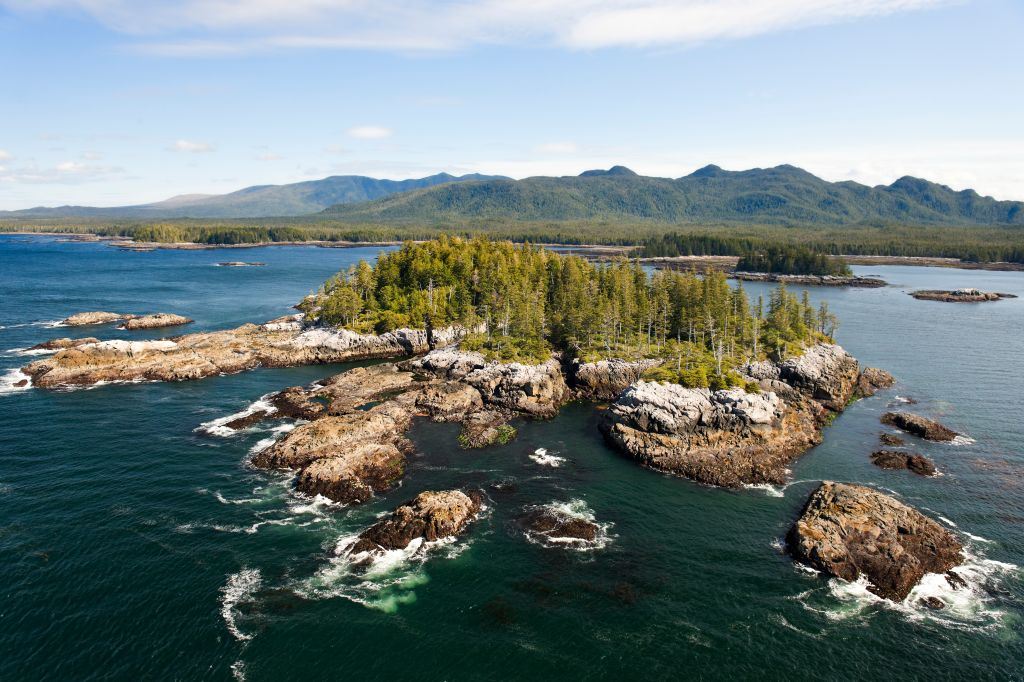
Project Finance for Permanence (PFP) in Canada is a breakthrough conservation finance model for matching long-term government, private, and community funding. The first PFP in Canada, Great Bear Rainforest, born from a community well-being crisis in First Nations and conflict over logging, is now repositioning nature as a source of prosperity and enabling Indigenous-led conservation and economic development opportunities. Since the inception of the Great Bear Rainforest PFP in 2007, more than $444 million has been invested.18

CASE STUDY

Where: Great Bear Rainforest and Haida Gwaii, British Columbia, Canada

Long-term conservation finance steered by First Nations’ vision for economic development and conservation is multiplying the magnitude and durability of opportunities for communities, businesses, and nature conservation.

Driver:

A crisis in First Nations community well-being and an economy heavily reliant on extractive industries in B.C. in the 1980s and 1990s underpinned the growing conflict over natural resource management and limited economic and community development opportunities resulting in First Nations with unemployment rates as high as 80%.37 This unsustainable model came to a head in the 1990s. The First Nations-led movement, including War of the Woods, the historic Clayoquot Sound Protests in 1993, and with support from environmentalist groups, demanded protection of First Nation’s territories and access to economic opportunities. This movement led to the B.C. government initiating a strategic land-use planning process. This was a key step in making way for transformational change where prior piecemeal attempts had failed to improve community well-being, and economic and environmental conditions.

Resulting from the demand for change, was the creation of Coast Funds in 2007, a conservation finance institute with a mandate to implement portions of the Great Bear Rainforest Agreements. Coast Funds was created out of mutual recognition by First Nations, environmental groups, industry, and government that community well-being is critical to a sustainable economy and responsible management of natural resources.

Mechanism for change

First Nations and environmental organizations raised $60 million in private funds in 2006 to create the Coast Conservation Endowment Fund, with $4 million of those funds going towards conservation planning and operational start-up costs. One year later, the provincial and federal governments came to the table with match funding, and the Coast Economic Development Fund was born. These two funds, initially amounting to $120 million, are governed by the Coast Fund’s board of directors, which are appointed by First Nations, the B.C. Government and philanthropic foundations. The board oversees the funds’ finances and investments in Nations, who bring forward projects for the board to review.

The governance structure of the board has evolved as the foundations have consolidated their governance roles and relinquished their voting rights to elevate the influence of First Nations in steering the direction of Coast Funds, giving them equal control with Crown governments. This shift in governance advances the vision of Indigenous-led economic development and stewardship being led by Indigenous Nations. 

In the making

First Nations have invested more than $120 million from Coasts Funds and leveraged $324 million of their own funds and additional funding sources. The $444 million has been invested across economic sectors, including tourism, manufacturing, forestry, and aquaculture.

Complementary to funds from Coast Funds, Nations are generating carbon credit sales under the Atmospheric Benefit Sharing Agreement between two regional Indigenous organizations, their respective First Nations member Nations, and the provincial government. These agreements lay out the framework for sharing carbon benefits like offset credits associated with the Great Bear Rainforest agreements that avoid deforestation.  

Taan Forest, a Haida-owned forestry company, is one example of stacking funds and supporting carbon credit creation to advance sustainable forestry businesses. The company leveraged dollars from Coast Funds to develop an industrial park that enabled Haida entrepreneurs to participate in the value-add forestry sector.38 Taan Forest provides economic opportunities while protecting the Nation’s environmental and cultural assets by securing the forestry tenure for 60% of forestry operations on Haida Gwaii.39

Impact

Coast Funds has been a catalyst for Indigenous-led-and-owned economic development initiatives, which includes the growth or establishment of 144 businesses, the creation of more than 1,400 jobs, including 850 fulltime roles, with salaries totaling more than $70 million.40 Recognizing the Nations’ forestry stewardship and its role in climate action under the Atmospheric Benefit Sharing Agreement, the B.C. government has purchased more than $56.5 million in carbon credits from the Great Bear Carbon Credit Limited Partnership and $6.8 million from the Na̲nwak̲olas Offset Limited Partnership.41

On-the-ground, First Nations have led more than 444 habitat restoration and research initiatives benefiting species with cultural and economic significance, including salmon, kelp and trees. Taan Forest’s practices are aligned with Forest Steward Council Certification, Rainforest Alliance Certification, and the conservation standards of the Haida nations Land Use Order, enabling their sustainable forestry practices to be recognized by their supply chain. The latter ensures sensitive habitats are protected, including bear dens, bird nesting areas and reducing the allowable cut for logging, enhancing habitat protection and restoration.42

Lessons

Funding allocation criteria focused on scale can lead to inequity. The original Great Bear Rainforest funding allocation model incentivized higher levels of conservation by providing more benefits to First Nations that committed to large-scale biodiversity protection through the protection of intact forest ecosystems. As a result, First Nations with the largest conservation area and populations received the largest allocations, while First Nations’ whose lands had already been intensely logged, and those with smaller populations, received less. Recognizing this challenge, First Nations decided on the funding allocation formula for the Great Bear Sea PFP to ensure equity and account for nuances in scale and impact. Through the Great Bear Sea PFPs, all participating First Nations receive a baseline of support to advance their economic development and stewardship goals.

Great bear rainforest
Photo credit: Andrew S Wright

Building upon the momentum of the Great Bear Rainforest PFP, Coast Funds is now also overseeing the delivery of funds under the Great Bear Sea PFP. This PFP has an initial $335 million in funding, securing long-term Indigenous-led financing for Indigenous-led stewardship and development.19

Expanding conservation financing

Debt products for nature-based solutions can provide upfront capital, but projects must deliver competitive returns for investors and financers. Debt-for-nature swapping, for example, often engages development banks to help keep the cost of borrowing down and provide greater assurance to private investors. The debt-swapping market has more than doubled in the past year, totaling $3.6 billion.20 However, some nature finance experts say the structure for debt-for-nature swapping has expanded beyond its original purpose. They suggest that involving development banks and agencies in building natural capital helps build financing needed for projects as it reduces risks for other investors. However, the country receiving the funds should also consider how the debt swapping impacts their ability to control how their natural capital wealth is managed.

Green and sustainability-linked bonds and loans have also grown into significant debt products, with nearly $15 trillion in value to-date.21 Yet, nature focused debt remains a relatively small slice of total bond funds allocated. Over the past year, less than 10% of proceeds from green and sustainability-linked bonds explicitly went towards nature-based projects. While nature-based projects mature in their ability to guarantee returns for investors, the government and impact investor’s roles in scaling debt products for nature remain critical.

Beyond funding and finance, governments can also use their authority to recognize high-integrity nature-based projects to attract private dollars. Environment and Climate Change Canada, for instance, is piloting a Conservation Exchange. In the pilot, the federal government is testing an approach that recognizes the proven benefits of conservation projects funded by companies through government approved biodiversity certificates.22 Building from a long-term funding relationship, insurance firm Aviva and the Nature Conservancy of Canada are leveraging the Conservation Exchange pilot to deliver value through nature’s role in risk management and revitalizing working lands, like range pastures on restored native grasslands.

CASE STUDY

Where: Saskatchewan, Canada

Nature is an asset and a risk. Insurers and those managing working lands like grasslands for livestock grazing face this reality every day. Investing in long-term projects that restore depleted lands and their natural ecosystem functions provides a gateway for nature to contribute to economic resilience.

Driver:

Roughly 75% of Canada’s native grasslands are gone.43 Canadian grasslands stitch together the prairie provinces, store two- to three-billion tonnes of carbon, and are home to a dwindling number of ranchers, livestock herds, and native species that now make up one of the world’s most endangered ecosystems.44 Grassland loss is driven by land-use conversion for cropland production, resource extraction from mining and energy production, and urban sprawl. While these activities contribute to growing Canada’s economy, the loss of grasslands intensifies resource depletion and environmental risks, including droughts.45 Extreme weather, wildfires and the impact on natural and built assets is a material risk for the economy and a growing cost for insurance companies. The summer of 2024 was the most destructive and expensive season in Canada from extreme weather, with weather event losses totaling $7.7billon.46

Mechanism for change

Restoration does not happen overnight, which is a deterrent for investors who want immediate results. But with some foresight and common ground, The Nature Conservancy of Canada (NCC) and Aviva engaged in a 7-year partnership to restore grasslands across nearly 450 acres in Saskatchewan. Restoration investments are typically short term (1-3 yrs) and focused on immediate outcomes, not allowing for a multi-phase approach that restoration often requires to be durable. Aviva’s investment breaks that cycle.

To strengthen the partnership, government recognition of the grassland restoration projects is helping boost its appeal. Environment and Climate Change Canada is piloting a Conservation Exchange, providing companies with certificates that recognize their investment in high-integrity nature-based projects that have proven to deliver real biodiversity impacts. This exchange is a new approach to attract capital to build natural assets and provides companies with the opportunity to obtain government issued biodiversity certificates that acknowledge their investment, making associated sustainability claims more rigorous. NCC’s grassland restoration projects, supported by Aviva in Saskatchewan, are part of the Conservation Exchange pilot. 

In the making

Native seed production in Canada is limited by a lack of capital investment and long-term contracts, making it difficult for local growers to scale grassland restoration. To address this, the partnership with Aviva allowed NCC to establish a multi-year agreement with a native seed grower: Skinner Native Seeds. The upfront investment from Aviva reduced financial risk for Skinner Native Seeds and supported a scale up in production, improving restoration outcomes for grasslands and strengthening the resilience of Saskatchewan’s native seed industry.

Impact

The benefits are multi-dimensional but grounded in restoring productive working landscapes that combine opportunities to support conservation and agriculture production.

Through the Conservation Exchange pilot expert evaluation, the projects received positive scores, overall, for species and ecosystem restoration and improved probability of persistence for focal species, which serve as a proxy for broader biodiversity status. At the Old Man on His Back grassland restoration site in Saskatchewan, habitat for Species at Risk and grazing capacity is being expanded by increasing available native vegetation. To enable this restoration project and to increase seed production, Skinner Native Seeds estimates wildflower seed production at their facilities will increase by up to 200 lbs., – in 2027, leading to the expansion of roughly 40 species of native wildflower to support biodiversity and climate-resilience in the prairies.

Government recognition of these biodiversity benefits adds credibility and transparency, allowing companies and the public to understand the scale of the impact and the species and ecosystems expected to benefit.

Lesson

Nature restoration project developers looking to scale investment need to master communicating outcomes in a way that resonates with investors. They also need to play a role in educating investors on the importance of time in delivering meaningful and long-lasting impacts on the ground. This communication and education starts with knowing the audience. Understanding investors’ objectives in nature-based solutions–including mitigating risks, ESG claims, and meeting climate targets–is paramount in designing nature restoration projects that meet shared objectives among communities, conservationist, companies, and governments.

Nature Conservancy of Canada
Photo credit: Nature Conservancy of Canada

Streamlining policies to optimize public investment

While governments are driving investment in solutions, they may also be undercutting progress. The United Nations Environment Program finds that public finance flows to nature-based solutions are less than one-tenth of public spending on environmentally harmful subsidies. This issue is especially of concern in agriculture. Farmers in Canada, for instance, can receive funds for sustainable practices under the On-Farm Climate Action Fund, supporting the adoption of cover crops and improved fertilizer practices. And they can access government subsidized crop insurance, which some farmers are finding can incentivize growing crops on marginal land that would otherwise be uneconomical.23 24 Similar examples can be found in the U.S. under the Federal Crop Insurance Program. Some states are taking steps to address the mismatch between government safety nets and supports for sustainable agriculture by offering programs such as insurance premium discounts for farmers who adopt sustainable practices, like the Iowa Department of Agriculture & Land Stewardship’s Crop Insurance Discount Program for cover crop adoption.

Governments and the private sector have also struggled to expand market-based incentives for nature-based projects. Some farmers are taking note and using government grants to kickstart grassroot initiatives that give them control over how the value of ecosystem services is integrated into their business and recognized in the marketplace. The Prince Edward Island Federation of Agriculture, for example, learned early in their GHG mitigation journey the importance of robust data collection and monitoring of soil carbon to tap into carbon markets. Spurred by local leadership, the federation is helping position farmers to align practices with carbon offset protocols and build algorithms and data standards to unlock carbon value and improve efficiency.

CASE STUDY

Where: Prince Edward Island, Canada 

With sights on carbon credits, Prince Edward Island farmers learned that the efficiencies they gained from practices that reduce GHG emissions were indeed the real economic opportunity.

Driver:

A desire to incentivize farmers for their climate action was the impetus for P.E.I. Federation of Agriculture (PEIFA) in building soil carbon and GHG emissions measurement infrastructure required to connect farmers to carbon markets, while maintaining ownership of their data.

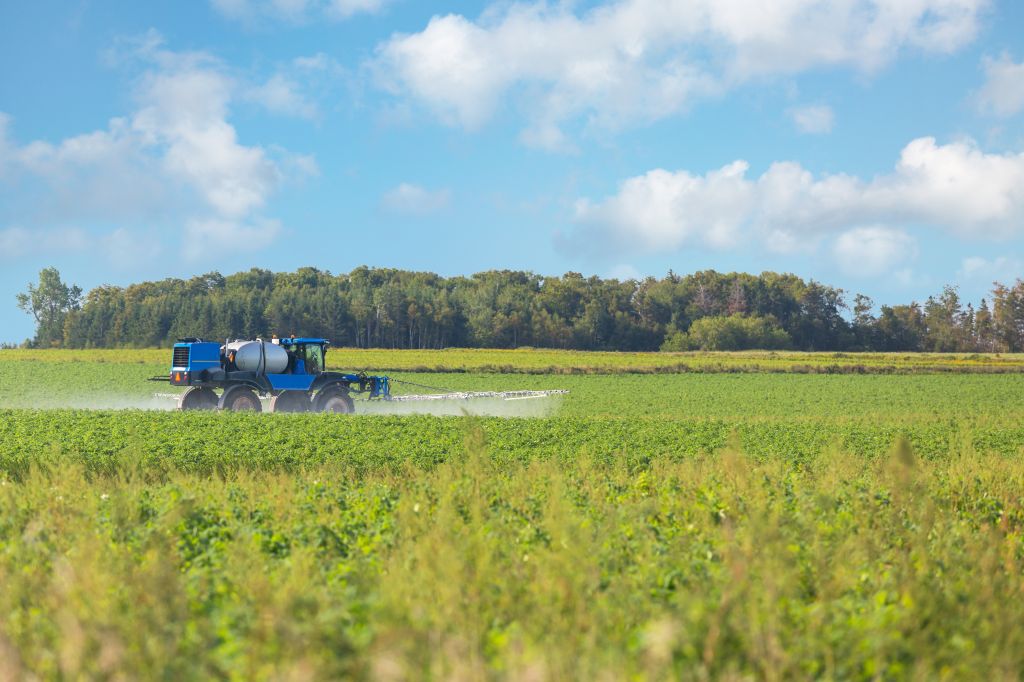
Farmers can be leaders in advancing climate solutions. Responsible management of inputs like nitrogen fertilizer that are essential tools in growing healthy crops and yields is a key part of farmers’ role in driving climate action. Potato production represents most of the agricultural land use on P.E.I., roughly 86,500 acres, and potatoes are a nutrient dense crop to grow, presenting an opportunity to explore how efficiencies in fertilizer use can be incentivized through carbon credits that reward reductions of net GHG emissions.

Mechanism for change

A mix of government funding and provincial leadership spearheaded by the P.E.I. Federation of Agriculture, and the launch of the offset protocol for improved agricultural land management on VERRA’s voluntary offset carbon registry, together, created the right conditions for the federation’s Agriculture Internet of Things (AgIoT) to come to life. AgIoT is a farmer-owned, scalable, data-agnostic, and real-time monitoring platform.

Money, project leadership, and a protocol that outlines the standard on how to enhance soil carbon and reduce GHG emissions are all necessary pieces to producing carbon credits. But, for nature-based projects, like this, arguably the hardest part is the data collection. This is why AgIoT, a technology solution for farmers by farmers, was created.

In the making

To access carbon markets, projects need baseline measurements, from which farmers adopt best management practices like precision nitrogen application or cover crops to show progress. The P.E.I. Federation of Agriculture developed the ‘P.E.I. Low Carbon Cropping Initiative’ with 4,800 acres now enrolled, forming an offset market-compliant project with the goal of registering the project on a carbon market. At the start of the project, the federation and its farmers had an ‘Aha moment’: farms did not have the existing capacity to collect data at a level required for accessing carbon markets. As a result, they set out to automate farmers’ engagement with AgIoT as much as possible.

AgIoT automates data collection and processing, with the goal of reducing the burden on farmers to manage and maintain their data. In-field sensors provide real-time data collection that automatically uploads to the cloud and is accessible to the user through the AgIoT dashboard. AgIoT’s soil carbon and GHG algorithms are estimating agriculture carbon in soils and GHG emissions with real farmer data to determine impacts on net GHG emissions AgIoT platform.

Impact

In 2024, a semi-automated software version of AgIoT algorithms was used to model pilot farms participating in the Low Carbon Cropping Initiative. It analyzed crop history submissions, recent soil cores, and a process-based model for GHG emissions and soil carbon estimation. The results from the pilot farms showed that the farms’ GHG emissions reduction are between 50 kilograms and 150 kilograms of carbon dioxide equivalent per hectare. The piloted practices including precision nitrogen fertilizer management also showed that farmers could save $50 to $120 per hectare on inputs. A direct result of optimizing a production system to drive positive economic and environmental outcomes.

If these modelled efficiencies were applied to the 86,500 acres of annual potato production, it could result in reducing the equivalent of 1,750 to 5,250 tonnes of carbon dioxide per year. That’s just from improving farmers’ data resolution to inform greater efficiencies.

Lesson

Carbon markets for nature-based projects is not for the faint at heart. It’s costly. It’s time consuming. And it’s complicated to measure, monitor, report and verify net GHG reductions from biological systems over time because there are many variables to consider that are out of a human’s control. But when you have the right mix of technical skills on the ground to build and apply data solutions like AgIoT, pursing carbon credits can be a pathway to unlock new innovations and efficiencies for farmers.

A farm operation that can collect the necessary data for accessing carbon markets will have a tremendous opportunity to improve decision making and profitability, which is more valuable than the actual carbon credit.

.

Harnessing markets to promote nature and raise revenue

Offset marketsTrading system where those wanting to offset their environmental impacts compensate others for creating environmental benefits elsewhere.
Inset schemesReducing or compensating environmental impacts within a company’s own value chain. A company invests in nature and climate-positive projects directly linked to its suppliers, operations, or distribution. 
PremiumsPaying extra for sustainable products or services to cover the higher cost of low-carbon or nature-friendly options.
Consumers or buyers along the supply chain pay a higher price or give preferential treatment for sustainable production or nature protection.
Market accessGaining entry to markets by meeting specific sustainability standards or certifications.

Marketplaces for ecosystem services cover a growing range of outcomes, including water quality trading schemes in the U.S., emerging biodiversity markets, like those in Australia, and compliance carbon markets in the EU. Yet, market activity is primarily focused on producing credits from greenhouse gas (GHG) emission reductions, removals and avoidances through compliance and voluntary carbon schemes. Cumulatively, $15.3 billion in credits have been traded on the voluntary offset carbon market. Peaking in 2021 at $2.6 billion, there has been a steady fall in market activity with 2024 being a 5-year low with traded credits valued at $727 million.25 This decline can be attributed to compounding factors including the market going through a maturity phase with the onboarding of additional integrity and assurance guardrails, and macroeconomic volatility since the coronavirus pandemic.

Despite the market downturn, nature is banking on a maturing carbon market to drive finance. The voluntary offset market is still going through a transition phase, focused on raising the quality of credits on the market and aligning with compliance market standards. An early sign from the voluntary offset market reset is a higher demand for quality, nature-based projects that produce GHG removal credits. It’s an opportunity for nature-based projects that actively pull carbon dioxide from the atmosphere through active management and restoration of carbon sinks, including wetlands, croplands, forests, grasslands, and sea bottoms. Recent developments in nature-based offset protocols provide the frameworks needed to produce GHG removal credits that are in demand.

Blue carbon, for example, has the potential to remove three gigatons of carbon from the atmosphere per year, equivalent to more than 3% of global emissions.26 With the development of blue carbon protocols like the Tidal Wetland and Seagrass Restoration on VERRA’s carbon offset registry, communities and landowners restoring seagrasses can see returns from their conservation efforts in the marketplace. A seagrass restoration project in the eastern coastal bays of Virginia that includes researchers, conservationists, the local community, and the Commonwealth of Virginia serves as a proof of concept for how to bring a blue carbon project to the marketplace, including the amendment of laws, as the state owns the coastal sea bottom.

While nature-based protocols have allowed for increased market access, nature-based carbon offsets account for only 13% of voluntary carbon credits issued in 2025 to-date but hold more than 50% of annual carbon credit potential.27

CASE STUDY

Where: Cairngorms National Park, Scotland

Presenting the risks and returns to investors positioned this restoration project to attract patient investments and in return benefit from long-term contracts that reduce project costs and uncertainty.

Driver:

Scotland’s peatlands cover a fifth of the country’s land mass and store roughly 1.6-billion tonnes of carbon. Peatlands also play a critical role in water filtration and flows, influencing the water supply for neighbouring cities like Dundee and Aberdeen.47 But more than 80% of the country’s peatlands are depleted.48This depletion is caused by a combination of factors, including drainage for peat extraction, livestock grazing, and planting of non-native species like some conifers tree plantations. Today, degraded peatlands account for more than 3.5% of the U.K.’s emissions, as well as increasing flood risk and habitat loss.

The Cairngorms Peatland Restoration Project, one of the largest of its kind in Scotland, is an award-winning collaboration between landowners, the Cairngorms National Park Authority, Palladium, an impact consultancy, and Revere, the coordinator of the collaboration. The project blends public funding and private finance to share risk in peatland restoration and enable durability in nature finance solutions. More than 1,700 acres of peatland restoration is under way in Cairngorms National Park, across nine sites.

Mechanism for change

The project combines government funding via Peatland ACTION, a government program, with private finance through the sale of carbon offset credits verified by the Peatland Code–a voluntary certification standard for peatland restoration projects in the U.K. The Peatland Code ensures that projects are credible, providing assurance to investors through independent validation and verification. 

Carbon benefits from nature-based projects can take years to verify. As a result, revenue from carbon credit sales can be slow to materialize. This presented a challenge: find long-term investors that understand nature-based carbon and are willing to wait on their returns. Santander U.K. and Respira, an impact investor, met the challenge and provided partial funding, which facilitated an agreement with a British law firm that purchased some of the project’s Pending Issuance Units (PIUs) verified under the Peatland Code. Such patient investors were key to funding the upfront project costs.

At the start of the project, the collaborators agreed to allocate 10% of the project’s profits to a local community trust. A commitment that reflects rural Scotland’s community values and the collaborators’ responsibility to the local economy.

In the making

Restoration begins with an assessment of the peatland’s health, including measuring the depth of peat and the extent of degradation. A key indicator of success in peatland restoration is raising the water table. When peatlands dry out, they are more likely to degrade and emit GHGs, damaging the rich ecosystems that they support.

Approaches to raising the water table include blocking man-made drains or ‘grips’ and restoring erosion features by creating ‘bunds’ like an embankment or dam, and reprofiling or revegetating areas of bare peat. The Peatland Code provides a methodology for calculating the GHG emissions impact of these approaches by assessing the pre- and post-restoration condition of the peatland.

Impact

The restoration projects across the nine sites are delivering carbon avoidance over a 30-year project term, amounting to the equivalent of more than 44,000 tonnes of carbon dioxide removed from the atmosphere. The project is also enhancing natural habitats conserving wildlife species such as golden plover, red grouse, meadow pipit, and curlew. Healthy peatlands also naturally filter water, reducing pollutant and nutrient levels.

The project collaborators have also worked with the Scottish Land Commission and the Scottish Government to develop economic benefits beyond financial returns from carbon credits, such as employment opportunities for contractors. This provides immediate, tangible benefits for local communities while the 10% financial commitment will be invested in the community over the long-term.

Lesson

Current carbon market prices and government funds are insufficient in covering project costs alone.  Attracting equity finance requires establishing offtake agreements that provide investors with the right assurances that make them feel confident in the project’s risk management and long-term viability.

In addition to greater value in dollars spent on restoration over long-term projects, longer-term subcontracts bring more certainty to the project’s budget and allow the team to more accurately forecast and price the carbon credits it sells to companies. Having a stable cost base means it is easier to calculate the revenues needed to make the project profitable.

Photo credit: Ed Smith

Patient investors are key to big nature returns

Bringing quality nature-based projects to market takes time. The long-term nature of ecological changes and the inherent difficulty in attributing specific, measurable biodiversity outcomes to a single intervention adds to the complexity and cost.

Carbon offset creation from nature-based projects, for instance, can take decades to verify. This presented those involved in a peatland restoration project in Scotland’s highlands with a challenge: find investors who are willing to wait patiently for their returns. One way is to seek advanced market commitments from buyers through pending credit returns for carbon removals or biodiversity benefits that have higher value in the marketplace but take longer to generate, compared to renewable energy projects that can often generate credits the day they are turned on. A recent precedent is the Symbiosis Coalition, made up of Microsoft, Google, Salesforce, Meta and McKinsey & Company. These large-scale organizations provide assurance to more risk-averse investors.

CASE STUDY

Where: Eastern shores of Virginia, United States

Community, research and conservation leadership led to the largest seagrass restoration project in the world. Changes to state legislation made it possible to connect the project to the carbon marketplace– creating an additional source of funds to invest back into conservation. 

Driver:

The Virginia Coast Reserve is the longest expanse of coastal wilderness along the East Coast: 75 miles long and covering 133,000 acres of conserved and protected land. Stakeholders of the coastline, like The Nature Conservancy who own and actively manage more than 40,000 of these acres, are contributing to the natural ecosystem and local economy in more ways than one–boosting biodiversity of finfish and shellfish and protecting and restoring natural barriers that protect communities from extreme weather events like hurricanes. But there was a missing piece in this growing, vibrant ecosystem.

For more than 70 years, eelgrass, an aquatic grass that grows in shallow bays, was thought to have been eliminated along the coastal bays of Virginia due to a pathogen outbreak and the Storm of 1933. But in 1999, a small patch was found, indicating that a source of seeds was drifting, likely from Chincoteague Bay, and generated optimism that eelgrass recovery was possible.49

Eelgrass restoration has multiple benefits, including supporting commercial and recreational fisheries by acting as a nursery for fish and shellfish, preventing erosion of shorelines, and carbon sequestration. Planting eelgrass and the associated carbon sequestered in the sea bottom through eelgrass roots is called “blue carbon,” and can remain in the sea bottom for thousands of years, making it one of nature’s longest-term solutions to climate change.

Mechanism for change

The approach to scaling eelgrass restoration in Virginia is a model for how to collaborate on a complex nature-based project. The Nature Conservancy, Virginia Institute of Marine Science, The University of Virginia, and the Commonwealth of Virginia all contribute in different ways—reseeding, community engagement, measurement and monitoring, and policy changes.

This project is also a proof of concept for how to bring blue carbon projects to carbon markets. While producing carbon credits was not the driving force for this collaboration to flourish, it did present an opportunity to help the team finance their restoration efforts into the future. But positioning the eelgrass restoration project to produce carbon credits for sale required protocols to be developed and policies to change.

It started with the creation of the offset protocol, Tidal Wetland and Seagrass Restoration, on Verra’s carbon offset registry in 2015. This enabled the project to follow a standardized approach to measure, report and verify the impacts of the reseeded eelgrass on carbon removals. The second missing piece was positioning the Commonwealth of Virginia to own and sell carbon credits from nature restoration projects, which was a practice that was not recognized in its legislation. The Commonwealth of Virginia owns all subaquatic bottomlands in the state, and with that comes the legal right to the carbon stored there. Amendments to laws, has enabled the state to participate in carbon projects and requires any revenue resulting from the sale of carbon credits to be invested back into the project—to be used to implement additional monitoring and research or to cover administrative costs.

In the making

Direct seeding of eelgrass is producing credits in the restoration project, further expanding seagrass coverage in the region. The Virginia Institute of Marine Science leads the restoration practices, and The Nature Conservancy engages the community who have played apivotal role in collecting more than 72 -million seeds. These seeds have been spread onto 700 acres to help accelerate the natural spread of eelgrass, which now covers 10,000 acres in South, Spider Crab, Hog Island and Cobb Island bays. The area enrolled in the carbon market project, meeting the offset protocol criteria, is roughly 3,000 acres – including restored eelgrass and available sea bottom for restoration to expand

Impact

The project is expected to deliver the equivalent of more than 42,000 tons of carbon dioxide (CO2e) captured from the atmosphere over 30 years, raising $1.4 million for continued research and management of the eelgrass restoration in coastal Virginia.

The project’s economic benefits go well beyond carbon credits. Bay scallops were abundant in the coastal area in the early 1930s, supporting commercial fishing. But the disappearance of eelgrass resulted in the loss of the bay scallop’s preferred habitat. Successful restoration of eelgrass could pave the way for the potential restoration of scallops–a nature-built pathway for reintroducing recreational and commercial fishing. While the shellfish aquaculture industry has raised concerns that eelgrass expansion may compete with shellfish for bottom areas, new research and inclusive land use planning approaches are ensuring both conservation and the clam industry can thrive.

Lesson

Developing carbon credits through an established marketplace can take years, underlining that they are a strong option to contribute to blended finance but are often not the driving force for a successful project. Ultimately, the project should provide benefits to communities, nature and businesses through means beyond carbon credits to foster durability in nature-based solution projects.

Photo credit: Nature Conservancy of Canada

Recognizing that farmers, foresters, and fisherpersons, cannot take on all the risk in investing in building natural capital, a growing movement has started to advance sustainable farming practices through supply-chain funding and incentives. Investments are coming from buyers including PepsiCo to input providers like fertilizer companies Nutrien and Yara through a variety of mechanisms including inset programs, payment for practices and green premiums, totaling more than $1.6 billion publicly committed by companies to-date.28

Raising the bar on sustainable supply chains

Green premiums—the higher prices paid for products that meet sustainability standards—and favorable market access conditions tied to sustainability criteria play a powerful role in encouraging sustainable practices. But a key question remains: Who will pay the premium? Often, it’s assumed it will be the end buyer, but in practice, end buyers need a market signal for paying the premium. As a result, premiums in the marketplace are sporadic. Most recently, farmers growing biofuel feedstocks like canola, soybeans and corn are seeing green premiums emerge in the marketplace to prove the sustainability of their production to access markets like the EU and U.S.

Green premiums are often underpinned by certifications that more broadly encourage responsible management of resources and community well-being and set standards for associated practices. Globally, these certifications are growing in market share with 19% of all wild marine catch engaged with Marine Stewardship Council (MSC) and roughly 200,000-million hectares of global forests certified under Forest Stewardship Council (FSC).29 30

While these certifications have been critiqued for their rigor, they are proving to advance and track practice implementation on-the-ground. For example, mammal monitoring in Gabon and the Republic of Congo shows there is greater diversity in species in FSC-certified forests compared to uncertified forests.31 Such certifications remain one of the few approaches available at scale that drive market standardization around sustainable use of natural assets and enable supply chain recognition and incentivization.

These industry-based certifications often operate outside of government, but governments are also stimulating markets for nature. In the U.K., under the Biodiversity Net Gain scheme, biodiversity credit payments totaled more than $360,000 in the first year of operation (2024 to 2025).32 A market-mechanism that creates value for those managing natural assets like farmers, outside of development zones, as well as incentivizing developers to integrate nature within their new builds. Wendling Beck, a collaboration led by four farmers in Norfolk County, U.K., is demonstrating how farmers can capitalize on revenue opportunities in environmental markets, while also producing food.

CASE STUDY

Where: Wendling Beck, Norfolk County, United Kingdom

Ambition to build 300,000 homes per year in the U.K. and a complementary biodiversity offset scheme presents a new way for farmers to generate income and build resilience on their land.

Driver:

Water stress in Norfolk County is mounting. By 2045, the county could run a deficit of 472-million liters of water per day.50 This is being driven by the county’s over-licensing and extraction of water from the region’s waterways, a growing population, and the effects of climate change, as well as water pollution. Water stress presents real challenges to economic growth from yield losses on farms to the availability of water required for built infrastructure, manufacturing, and human consumption.

Compounding the need to mitigate environmental stressors such as water availability, U.K. farmers increasingly are challenged by economic strain. The EU’s Common Agricultural Policy funding will be phased out in the U.K. by 2028, and onboarding of area-specific subsidies is underway. Furthermore, increasing volatility and frequency of disruptive events from droughts to tariffs can uproot farming businesses–driving demand for more diversified and durable revenue streams beyond agri-food commodity markets.

Mechanism for change

Farmers are known for helping their neighbours and community. But managing private land is often an individual endeavor.Four farmers from Wendling Beck are challenging this norm by working with conservation organizations and the local water utility company to lead landscape-scale adoption of nature-based solutions, delivering positive outcomes for water, biodiversity, climate and the farmers’ businesses.

Grants kickstarted the feasibility phase of the Wendling Beck farmers’ adoption of nature-based solutions. This helped mitigate the risks for the farmers if new practices such as rehabilitating marginal land did not net out positively. Now, the farmers’ efforts in rehabilitating landscapes and maintaining practices are enabled through private finance, ecotourism, and environmental marketplaces. Biodiversity net gain (BNG) units are a key source of revenue under the new scheme introduced in 2024, which requires developers to deliver at least a 10% net increase in biodiversity compared to pre-development conditions.

In the making

Over 2,000 acres are being rehabilitated with diverse activities on the land, including food production, wildlife habitat, flood management and water quality improvements. These activities are the result of farmers adopting nature-based solutions, including species-rich grassland restoration. Wendling Beck farmers continue to generate revenue through farming black currents and raising livestock on grasslands, stacked with revenue from environmental credits.

To ensure there is evidence backing the rigor of the credits sold by the farmers, counterfactual baseline measurements were set, and ongoing monitoring is conducted to ensure impacts are accounted. Species count, water quality and carbon sequestration are all being monitored through remote sensing, surveys, and eDNA barcoding.

Impact

Ultimately the Wendling Beck farmers have redesigned their business model, diversifying beyond revenue generation from food production to also profit from their contribution to building natural capital in the U.K. The project’s financial model conservatively uses CAD$47,000 per biodiversity unit, resulting in a financial projection of $131 million over 30+ years in revenue for the Wendling Beck farmers. They have nearly $10 million under contract already. These credits cover 1,500 acres of the habitat creation. The project is also reverting 400 acres of land back to its natural habitat for nutrient credits for housing developments under the Nutrient Neutrality scheme. The scheme requires housing developers to offset and mitigate the net impact of nutrient runoff from new housing developments in protected water habitats through the purchase of credits. The creation of nutrient neutrality credits by the Wendling Beck farmers enables the construction of roughly 2,000 homes in Norfolk.51

Lessons

Developing a vision map and fostering alignment among stakeholders has been essential to the project’s success as the number of stakeholders grows. Nature finance projects often involve stakeholders from different sectors with different objectives. Developing a shared vision can advance a common purpose, communicate how components of a project feed into the broader objectives, and foster continuity as new stakeholders come on-board at varying stages of the project. The Wendling Beck model is scalable and nature finance streams are stackable, but it requires bridging the gap between agricultural production and environmental conservation know-how to develop practical solutions for working farms. Farmers engaged in the Wendling Beck project are now enabling other regions to do the same through a farmer-led consulting firm.

Photos: The Wendling Beck Project
Photo credit: The Wendling Beck Project

Unlocking nature’s potential through business models

Triple-bottom lineA business framework that measures success across three dimensions: People (social), Planet (environmental), and Profit (economic).
 
Companies integrate social and environmental performance into their strategies alongside financial performance, often tracking metrics for each dimension.
Sustainable products and servicesBusiness models that design, produce, and deliver goods/services with minimal negative environmental and social impact, often with positive contributions.
 
Products/services are designed for reduced resource use, circularity, ethical sourcing, and/or social benefit, marketed as sustainable options.

Over the past year, nature has climbed the priority list for corporate ESG reporting. A Stanford University Business School survey of investors found that sustainability of supply chains and natural capital are 3rd and 4th on the priority list of environmental factors they consider when it comes to a company’ ESG reporting.33 Climate action remains the top consideration in environment and in the top three topics of investor ESG engagement across the three pillars of ESG. That’s an important consideration since nature and climate issues are interconnected, especially for nature-based sectors like forestry where investors’ key interests for ESG engagement with companies is risk mitigation.34

This growing focus on nature is a response from investor demand and recognition of the risks if natural capital is not managed responsibly by businesses. Over 27 pension funds at COP16 UN Biodiversity Summit in Colombia in 2024 called out government inaction, demanding greater regulations and standards to tackle the nature crisis. Black Rock publicly stated that sustaining nature–water, soil carbon, and biodiversity–is a foundational asset class. Goldman Sachs launched a Biodiversity Bond Fund with the goal of raising more than $700 million. Norway’s Government Pension Fund Global, which manages $2.1 trillion in assets, released an assessment of nature-related risks across approximately 90% of its portfolio.35

Community driven business models that work

A growing number of investors are on the hunt for companies that can demonstrate durability in their relationship with and use of natural assets. Companies that reduce their ecosystem impact intensity and land and carbon footprint also perform better. Annualized over 5-years, the S&P 500 Biodiversity Index slight outperforms the S&P 500 Index by 0.26%.b

Rethinking conventional business models for companies and industries reliant on natural assets is an opportunity to reposition nature’s strategic role in a growing economy. But buy-in and evidence at the ground-level is essential. A Canadian Prairies-based collective of farmers, conservation organizations, and corporates are working together to understand if water stewardship plans in the Lake Winnipeg Basin is good for business. Driven by curiosity, this group is creating a model for evaluating farmer returns on investments and profit margins with nature accounting integrated, which is replicable and scalable to any farming region.

CASE STUDY

Where: Southern Manitoba, Canada

Farmers are transforming their role in conservation through water stewardship action on their farms. Farmers in southern Manitoba are demonstrating how their practices produce positive environmental outcomes in their watershed and benefit their bottom line.

Driver:

Lake Winnipeg, the 10th largest freshwater lake in the world, has deteriorated over the past 50 years due to runoff of nutrients from agriculture, urban developments, and municipal and industrial waste. This has resulted in algae blooms, hinders industrial water use, and restricts recreational enjoyment of the lake.52 This is costly to the Canadian economy and businesses that rely on the stability in water quality and quantity, notably farmers in the Lake Winnipeg basin.

Mechanism for change

A collective of Prairie-based organizations, agri-businesses, and four farms covering more than 45,000 acres came together to design a project to demonstrate how water stewardship practices are good for business.53 An applied research project is helping this collective understand how water stewardship plans and implementation helps create value for farmers, empowering them to tell data-driven stories about their contribution to positive environmental outcomes.

While funding was not the reason farmers joined the collective–it was curiosity in what the impacts of water stewardship would have on their farms and communicating those impacts–companies in the collective are working with participating farmers to test incentive models, including a mix of carbon credits and practice incentive payments. Nutrien, a Canadian fertilizer company, is working with two of the participating farms through their Sustainable Nitrogen Outcomes program. The program generates an outcomes-based payment from GHG emission reductions produced through farmers’ improved management of nitrogen fertilizers.54

In the making

The farmers are implementing practices from their water stewardship plans and working with a research team to value the return on investment for profit, productivity and the environment. Water stewardship practices were categorized and assessed under two strategies. The first involves practices specifically deployed on croplands, which includes changes in tillage, adoption of precision agriculture technologies, and crop rotations. The second focuses on the enhancement of non-cultivated natural lands on the farm property, such as restoration of marginal farmland, or enhancements to wetlands, hedgerows, and green spaces. Assessed outcomes from practices adopted in 2023 and 2024 by the four farms, include improved air quality, better soil health, and enhanced biodiversity, which were organized based on public and private good.

Impact

Farmers generated, on average, $6,900 per acre of value for the public through ecosystem services such as pollination habitat, soil health, and water regulation. The value returned to farmers, based on carbon market values in the region, was $33 per acre.

There is also a social impact. Water stewardship awareness amongst the farming community has seen tremendous uptake and interest through knowledge sharing events and farm tours. This project is also inspiring similar landscape-based efforts, driven by water stewardship, in other regions. 

Lesson

Governments play a key role in a farmers’ ecosystem of support, providing funding, extension, and standardization. However, government timelines and priorities are not always aligned with those of farmers and companies. Nonetheless, not ensuring government was part of the collective in an active role became a barrier to scaling its impact. Their absence also resulted in missed opportunities in aligning farmers’ water stewardship plans with government programming. The collective is actively working to engage government and capitalize on opportunities from collaboration.

Photo credit: Mike Nemeth

In a triple bottom line business model, multiple revenue streams can help alleviate friction between environment, community resilience, and economic growth objectives. An enabling finance and policy environment helps, too. An ecosystem-based management plan that mapped the multiple environmental, community and economic objectives of forest management, positioned the Cheakamus Community Forest surrounding Whistler, B.C., to build a resilient business model that balances revenue from ecosystem services and logging.

CASE STUDY

Where: Whistler, British Columbia, Canada

From conflict to community driven economic development, B.C.’s Community Forest Agreements opened a pathway for community-led logging that is delivering on a triple bottom line business model that is generating profit from ecosystem services like carbon sequestration, tourism and logging.

Driver:

Conflict over forest management and ownership has been a longstanding issue in B.C. In response to greater calls for First Nations and local community control over forests, the province introduced area-based forest licenses called Community Forest Agreements (CFA) in 1998. This allowed for a new type of tenure in forestry management that aligns with local communities’ values and vision for development.

Mechanism for change

Community Forest Agreements take place on provincial Crown land in B.C., where Crown land covers roughly 94% of the land base. Licenses are issued by the province to communities that develop a management plan, including commitments to make a broader social, economic and resource use impact. These management plans are critical to the success of CFAs and empower communities to build a business model that generates social, economic, cultural, and environmental benefits, ensuring that local values and priorities shape how forests are stewarded. Community Forest Agreements are also long-term—25-to-99-year agreements—granting communities the exclusive right to harvest timber and manage botanical forest products within a fixed area. 

Today, there are 62 CFAs, covering about 5% of annual harvest volumes in B.C. on public lands.55 Roughly half of these CFAs are led by Indigenous Nations or Nations working in partnership with non-Indigenous communities to oversee activities under the CFA. One example, the Cheakamus Community Forest (CCF), is a three-way equal partnership including Lil’wat Nation, Squamish Nation and the Resort Municipality of Whistler. The Cheakamus Community Forest covers 81,589 acres and manages its tenure under an Ecosystem-based Management (EBM) Plan that focuses on delivering ecosystem function, cultural values, wildfire risk mitigation and recreation/tourism values, as it plans its harvesting operations.

In the making  

The Cheakamus Community Forest’s Ecosystem-based Management Plan led to developing a carbon offset program, as forest conservation and protection was a priority for the community under the plan. The Ecosystem-based Management Plan informed the community’s forestry management approach, which includes reduced harvest levels, extended rotation ages, expanded reserves, and enhanced old-growth and wildlife habitat protection compared to standard forestry practices. Because of these practices and the establishment of an atmospheric benefit sharing agreement, the Cheakamus Community Forest operates the only community forest carbon offset project in B.C., generating revenue to fund their stewardship and climate initiatives.

The Cheakamus Community Forest surrounds the Whistler resort, one of the top tourist destinations in the province, positioning the community to build tourism experiences throughout the managed forest. But it also adds a greater responsibility to undertake large-scale wildfire risk reduction to protect Whistler’s wildland–urban interface. Recently, the Cheakamus Community Forest completed a climate change risk assessment and identified areas subject to wildfire and drought risks, which they are using to inform strategic forestry operations plans to create a diverse, climate resilient forest.

Impact

The community forest tenure contributes $1-2 million annually through timber harvesting to the Sea-to-Sky economy, supports Indigenous employment and capacity-building, and ensures transparent, community-driven governance through significant community engagement and information sharing agreements.

Since its inception in 2009, the Cheakamus Community Forest has demonstrated its environmental impact through Improved Forest Management as defined by the B.C. Forest Carbon Offset Protocol, by avoiding an estimated 10,000–15,000 tonnes of carbon dioxide emissions, annually, generating over 150,000 carbon credits to-date, which equates to about $100,000 per year from carbon sales to reinvest in forest stewardship.56

Lessons  

In a triple bottom line business model, frictions between environment, community resilience and economic growth can lead to the development of multiple revenue streams that contribute to building natural capital. The Ecosystem-based Management Plan was foundational in identifying how to create win-win opportunities for the community and set the stage for the carbon project. For others to do the same, enabling policy that positions other community forests to generate profit from their work in producing ecosystem services like GHG mitigation is required. This is an opportunity to explore under the B.C. Minister of Forests recent mandate to expand the community forest tenure system.

Photo credit: Heather Beresford

Nature accounting: Getting it on the books

Used properly, nature accounting can result in smarter projects, resilient supply chains, reduced disaster losses, and pipelines of investable natural assets–turning ecosystems into wealth drivers. But frameworks like the UN’s SEEA that already exist need more use cases to demonstrate its value informing investments.

In Canada, the Critical Minerals Strategy and major projects that fall within could be a litmus test for implementing SEEA in project assessments and plans to mobilize capital. However, inclusion of Indigenous lands, values, and knowledge in SEEA framework is critical in closing the gap between Free, Prior, and Informed Consent (FPIC) and nature accounting metrics. Indigenous rights and knowledge must be at the core of nature accounting—so economic growth builds natural capital wealth and respects those who steward it.

Embedding natural capital values in impact assessments and broader pro-growth agendas like the U.K.’s Plan for Change could ensure that new developments unlock investment for green infrastructure and proceed where water use demands can be met. Nature accounting in the Thames Valley, one of the U.K.’s most water-stressed regions, could transform how housing and infrastructure projects are assessed. Leveraging nature as an asset in development and land-use decision making can reframe local authorities and developers’ approach in weighing the economic costs and trade-offs of water management and broaden the suite of options, including grey, green and hybrid options. Finally, consider the Chesapeake Bay watershed, covering six states along eastern shores of the U.S., which faces some of the highest nutrient pollution in the country from industry, agriculture and urban runoff, causing degraded water quality, habitat loss, and economic impacts on fisheries and recreation.36 Integrating natural capital values into infrastructure and land-use planning would enable targeted investments in green infrastructure and ecosystem services. It also presents an opportunity for farmers in the region to replicate the approach taken by the farmers in the Lake Winnipeg Basin Project case study to drive investment in agricultural-based water stewardship.

Policy integration: Net-new is not necessary to move money and rules toward nature-positive growth

Integrating government funding with plans to build supply of carbon offset projects in compliance offset markets is one key area for policy integration to grow, while ensuring projects adhere to additionality principles. In Canada, offset protocols for forestry and agriculture are emerging on the Federal GHG Offset System, yet farmers, as demonstrated by the Prince Edward Island Federation of Agriculture’s case study, are generally ill-equipped to meet data quality and record keeping requirements of carbon offset projects. Leveraging existing funding programs, like the nearly $500 million Agricultural Clean Technology program is an opportunity to address this challenge. Supporting farmers in navigating how their investments in hardware and software can help them collect the necessary data to access carbon incentives could help build the supply of nature-based offset projects on the Federal GHG Offset System and improve funding program outcomes.

The explicit inclusion and prioritization of nature-based sectors and green infrastructure projects in government-led growth funds is another launch pad for integrating nature into pro-growth agendas. The forthcoming United States Sovereign Wealth Fund, the nearly-$50 billion National Wealth Fund in the U.K., and the $15-billion Canada Growth Fund are places to start in prioritizing investable nature-based and natural capital wealth projects.

Finally, improving the community resilience and potentially reduce costs in the housing development boom is an imminent policy integration opportunity. The U.K. is driving action through the biodiversity net gain scheme–an opportunity to crowd in greater private capital. In Canada, there is an opportunity to use the National Adaptation Strategy to mainstream nature-based projects in municipal housing programs tied to federal funds including, the Canada Housing Infrastructure Fund (CHIF). The CHIF has committed to investing CAD$6 billion over 10 years in housing development water and wastewater management.

Embracing disruptive technology: Enable AI to streamline nature governance and build natural capital

Nature accounting and governance is deeply complex. There are numerous protocols, frameworks and standards for measuring, monitoring, accounting, reporting, and verifying natural assets and their ecosystem services. Since this governance network of standards and framework is critical to ensure rigor in nature accounting, there is a need to simplify it to ease adoption. Learning from countries like Estonia, a leader in implementing AI to transform public administration, is an opportunity for the nature and conservation sector to advance the implementation of nature standards and frameworks like SEEA.

Nature-based projects that assess outcomes and monitor progress can also leverage AI to automatically process satellite imagery, remote sensing, sensors, and public datasets to monitor ecosystems in near real time, reducing manual data collection costs and improving accuracy. Of course, the cost of powering AI can’t be ignored. AI data centres are a growing competitor in the demand for land, water and energy. It is a strategic imperative, especially among countries with depleting natural resources like the U.K., to leverage natural capital in determining where it is possible to build a clean fleet of AI data centres. In addition to location, design features are critical in mitigate natural resource use, like rainwater harvesting or net-positive watering, which can return clean water back to neighbouring landscapes. To ease pressure on land, the use of heat offtake can also position AI data centres to have a dual purpose in, for example, greenhouse food production.


Pro-growth agendas need to do more than extract for wealth, they need to build natural assets that sustain wealth today and for the future. Nations that do so can shift control and value of natural wealth to those who steward it. Global finance is already moving, and investors are on the hunt for impactful natural capital projects that generate returns. Countries that account and build their natural capital wealth can be home to this investment. This opportunity requires a shift in government and business approaches, treating natural capital, not as a regulatory box to tick or a nice to have, but as foundational for growth – the wealth beneath wealth.

Download the Report

Our project partner

Andrew Day, BC Parks Foundation

Audrey Popa, Coast Funds

Chance Cutrano, Resource Renewal Institute

Chuck Rumsey, Ecotrust Canada

Craig Harding, Nature Conservancy of Canada

Craig Losos, Nature Conservancy of Canada

Dave Secord, Salazar Center for North American Conservation

Deb Davidson, Center for Large Landscape Conservation

Donald Killorn  PEI Federation of Agriculture

Eddy Adra, Coast Funds

Glenn Anderson, Wendling Beck Environment Project

Heather Beresford, Cheakamus Community Forest

Holly Story, UK National Parks

Jane Church, Nature United

Jennifer Gunter, British Columbia Community Forests Association

Jill Bieri , The Nature Conservancy

Katie Davis, Wildlands Network

Leah Blechschmidt, Nature United

Leslie Harroun, Salazar Center for North American Conservation

Lisa Mclaughlin, Nature Conservancy of Canada

Maas, Tony, Nature United

María José González, MAR Fund

Matthew Mitchell, University of British Columbia

Maya Kocian, Earth Economics

Meg Lovett, Nature Conservancy of Canada

Mike Nemeth, Nutrien

Raine Playfair, Coast Funds

Risa Smith, IUCN/World Commission on Protected Areas

Ross Dixon, Coast Funds

Sara Aminzadeh, California Natural Resources Agency

Stephanie Walker, Revere

Stephenne Harding, Great Northern Strategies

Steven Nitah, Nature for Justice Canada

Susan Mulkey, British Columbia Community Forests Association

Language Flag Filename

rbc_language_toggle_menu_flag

In this week’s edition: The challenges that lie ahead now that CUSMA consultations have kicked off and what a redrawing of the critical minerals map would mean for Canada

By John Stackhouse

Mark Carney’s Mexican charm offensive—and successful visit with Claudia Sheinbaum—may soon seem like a happy vacation memory. The two countries return this weekend to harsher realities, especially in their shared as well as separate relationships with the United States. Here’s how it could play out:

  • The Trump administration has triggered a review of the Canada-U.S.-Mexico trade agreement, by launching public consultations. Canada is expected do the same this weekend, opening the door for 45 days of lobbying, teeth-gnashing and perhaps genuine reflection.

  • Expect the three amigos (2 amigos + 1 amiga) to then amass small armies of trade and industry experts to begin the more formal dialogue. The Canadian government is already recruiting people to speak with their American and Mexican counterparts, especially in energy, autos, steel, aluminum and lumber. They’re a little worried the Americans won’t show up anywhere near as well prepared and may even push for a quick (and perhaps flawed) deal. 

  • Mexico has taken a different tact, working with U.S. Secretary of State Marco Rubio on a range of non-trade issues like curtailing drug cartels. They’re hoping that will gain goodwill for the next round of trade talks, which for Mexico are not shaping up well. The U.S. has effectively banned hothouse tomatoes and is clamping down on remittances—all signalling tough times ahead for Mexico. 

  • The biggest issue for Mexico will be “rules of origin,” i.e. how to reverse the massive increase of Chinese investment and trade that turned Mexico into a side door to the U.S. market.

  • For Canada, early signals suggest Commerce Secretary Howard Lutnick and Trade Representative Jamieson Greer want to protect the foundation of a trilateral trade agreement, with special interest in Canada and enhancing two-way trade. Side agreements or subordinate deals under a North American umbrella could evolve. 

  • For Canada, the biggest existential concern remains autos, and Trump’s apparent desire to move as much Canadian production to U.S. soil. We’ll see if the American industry can persuade him of the economic logic of cross-border production.  

  • Would Canada accept a “market access” tariff of, say, 10% to secure some kind of second life for Canadian factories? 

  • Beyond autos, U.S. concerns continue to focus on dairy and digital. We all know the dairy challenge. On digital, U.S. tech platforms continue to complain about Canada’s treatment of online news. And yet, having compromised on a digital sales tax, the Carney government will be challenged to give again, especially since any concession would likely hurt struggling media and publishers. 

  • For the U.S., the biggest challenge may be more political. Does Trump push for a quick win on CUSMA? And then focus on the bigger challenges of China, India and Brazil? Or does his team work on deep and lasting changes to CUSMA, aiming to present a win ahead of next year’s midterm elections? 

  • Worth noting: Trump’s closest friends continue to suggest he’s open to tearing up CUSMA. Maybe bluster. Maybe leverage. But as the hard work begins, expect some hard challenges to continue to pop up.

  • Speaking at a Halifax Chamber of Commerce event, U.S. Ambassador Pete Hoekstra said he is disappointed by the “anti-American, elbows up” rhetoric from Canadians.

  • U.S. and Chinese officials gathered in Madrid for their fourth round of talks—to talk about TikTok.

  • In 2024, China imported US$12.6 billion worth of soybeans from the U.S. Last week: 0. A clear indicator that Beijing isn’t afraid to use agriculture as leverage with Washington.

  • Trained on 25 years of shopping data, Amazon is releasing a retooled AI agent to assist sellers with inventory decisions to manage the increased volatility caused by the trade war.

By Shaz Merwat, Energy Policy Lead

A pair of U.S. senators introduced the Restoring American Mineral Security (RAMS) Act, a bipartisan Senate Bill that would establish a Critical Minerals Security Alliance, granting duty-free access among trusted partners and require allies to match U.S. tariffs on Chinese supply.

Here are three implications for Canada:

  • Alliance membership comes with obligations. Canada would need to mirror U.S. tariff levels on Chinese minerals and strengthen enforcement against Chinese supply/transshipment. Heading into formal CUSMA renegotiations, the U.S. is looking again to allies to close the Chinese back door (note: Mexico increased tariff rates on a number of Chinese goods). Specific to minerals, shutting out Chinese supply is crucial for industry to scale. RAMS makes that firewall a requirement.

  • Capital will follow the club. Perhaps the most novel element is the U.S. plan to recycle tariff revenues from non-alliance imports into allied projects–20% specifically to support international critical mineral projects in member nations. Still, given our close minerals trade relationship (we are each other’s #1 minerals trade partner), Canada directionally wins from reinvestment in U.S. mineral projects. That could provide ‘cheap’ capital to Canadian miners—historically an obstacle for junior miners.

  • Preferential access is only useful if we scale. Duty-free treatment would give Canadian producers a cost edge into the U.S. market. But without faster project approvals and similar investments in accompanying transport infrastructure, we lose our advantage. It’s worth noting that there are two minerals projects in the first tranche of Prime Minister Mark Carney’s fast-tracked Major Projects list: McIlvenna Bay (copper and zinc) and the Red Chris mine expansion (copper).

While Canada faces a national shock from its trade relationship with the United States, the provinces are facing differentiated trade shocks that are creating divergences in both growth and growth drivers, according to RBC Economics. Read the full report – Quarterly Canadian outlook: Low but positive growth ahead – RBC

Language Flag Filename

rbc_language_toggle_menu_flag

Even as the world reels from tariffs, there’s a new levy lurking on international borders: a carbon duty on imports.

The EU rolled out its Carbon Border Adjustment Mechanism (CBAM) in 2023; Mark Carney’s government is considering a Border Carbon Adjustments (BCA) to level the playing field for domestic energy and heavy industry against foreign competitors; and a handful of bills in the U.S. at the federal and state level are proposing fees on imports with weaker climate compliance.

The idea of a border carbon fee is simple: ensure that manufacturers from, say, Montreal or Berlin, that spend money and effort to adhere to their domestic robust carbon policies are not disadvantaged against competitors that benefit from weak climate policies in their jurisdictions. Combined, a domestic carbon policy and a border carbon fee is a one-two punch that forces foreign competitors to raise their environmental standards, and ensures domestic industries are not unduly penalized for pursuing decarbonization strategies. Think of Ottawa taxing coal-powered Chinese steel to ensure its not unfairly advantaged against Canadian steel that’s forged by low-carbon but highly capital-intensive electric furnaces. 

While a border carbon fee would be a natural extension to Canada’s industrial carbon policy, its implementation is tricky. For starters, it could further inflame Ottawa’s already tense relationship with the Trump administration, which has cracked down on climate policies.

Canada’s carbon policy is in a state of flux, too. Earlier this year, the federal government scrapped a fuel charge—widely known as a carbon tax, followed soon after by British Columbia that had one of the longest and most stable emissions pricing systems globally. The past year has seen Canadian policymakers wobble on industrial carbon pricing: commitment to carbon pricing in Quebec and British Columbia all the  while  Alberta froze its carbon price at $95/tCO2e earlier in the year, and Saskatchewan cancelled its industrial carbon pricing system.

Canada’s industrial carbon policy has had mixed success to date—it has helped fund renewable energy projects, but with limited direct impact on emissions reduction to date. As the federal government and some provincial jurisdictions look to adjust their industrial carbon pricing strategy, they will also need to factor in shifting trading patterns, changing global economic priorities and the competitiveness of Canada’s industries.

Canada is one of 40-plus countries that have deployed a version of carbon pricing, covering 28% of global emissions.1 Several are now also exploring or advancing domestic carbon pricing systems in response to the European Union’s CBAM:

  • Emerging markets such as India, Türkiye and Brazil are pursuing domestic carbon pricing mechanisms to ensure their exports comply with EU rules.

  • The U.K. is in the process of linking its carbon market to the EU to streamline its climate policy with the economic bloc.

  • China recently expanded its carbon pricing coverage to include cement, steel and aluminum sector emissions.

  • Japan is consolidating its carbon pricing regimes into a single market as part of its Green Transformation (GX) plan, starting early 2026.

Still, pricing of carbon remains varied. Emissions trading schemes (ETS)—the most common carbon pricing system—rely on market signals to determine the pathway for emissions reduction. As the chart below shows, different jurisdictions assess their sectoral emission profiles, emission reduction potential and costs, that has led to significant differences in how they price carbon.

The U.S.’s Border Carbon Policy Proposals

The Foreign Pollution Fee Act (of 2025) is making its way through the U.S. Senate. It’s a policy designed to impose hefty levies on carbon-intensive imports from primarily China and Russia. But Canada could also get caught in the crossfire, and potentially face carbon tariffs ranging between 17%-33% on its industrial exports to the U.S.2

American policymakers have also been looking to shield domestic industries through a slew of other carbon policy proposals. These include:

  • The FAIR Transition and Competition Act aimed at ensuring American businesses are not undercut by unregulated importers by imposing a border carbon adjustment on carbon-intensive imports.

  • A U.S. Clean Competition Act would establish US$55 per tonne carbon tax on domestic producers and protect them from imports through border adjustments.

  • PROVE IT Act, if enacted, will facilitate the collection of emissions intensity data for energy intensive industries across major trading partners to ensure global transparency on carbon emissions. It was considered a precursor to the Foreign Pollution Fee Act.

The Foreign Pollution Fee Act, reintroduced on April 8, 2025, by Republican Senators Bill Cassidy and Lindsey Graham, seems most advanced. The structure avoids domestic carbon tax, and creates a linear relationship between the levy on importers and their emissions intensity gap. While the bill is unlikely to proceed, it’s seen as another form of protectionism under the guise of climate change policies.

Alberta and Quebec kicked off Canda’s carbon pricing journey in 2007, pursuing two different ways to apply carbon levies on their large industrial emitters. Now, a patchwork of federal and provincial carbon pricing regimes in Canada apply to a range of sectors including power, industry, mining and extraction, and covering nearly half of the country’s total emissions.

With some exceptions, the emissions trading system is Canada’s preferred carbon pricing mechanism. This is how it works: a greenhouse gas emissions performance benchmark places allowance limits on a company’s emissions. Companies emitting beyond those benchmarks buy permits from other companies with emissions that are under the prescribed level. The policy is designed to incentivize investments in low-carbon technologies that would help sharpen Canada’s competitive edge.

The system has encouraged capital to flow to sustainable projects: More than $80 billion worth of projects in carbon capture, utilization and storage (CCUS), wind, solar and bioenergy were either shovel-ready or under consideration and poised to benefit from carbon credit revenues, according to the Major Projects Inventory in 2024.3 Similarly, Emissions Reduction Alberta, funded through the province’s industrial carbon pricing, has facilitated over 300 clean technology projects, valued at more than $10 billion.4

Setting performance benchmarks means not all emissions are subject to carbon pricing, only those beyond the allowance limit—by design. Average cost in Canada, when adjusted for free pollution allowances, stood at $10 per tonnes of carbon dioxide equivalent (tCO2e) in 2024, a fraction of the $80 headline carbon price, according to latest estimate by the Canadian Climate Institute.5 This helps limit carbon leakage (i.e., manufacturers moving to jurisdictions with lower compliance).

Impact on emissions reduction

Carbon pricing reduces emissions with limited or no impact on the economy, according to several studies. But the scale of emissions reduction remains relatively small, with up to 2% annual GHG reduction on average across a range of countries with carbon pricing, including Canada.6 Emissions will need to climb down 6% annually for Canada to reach its climate goals by 2030, as set out in its Nationally Determined Contribution (NDC) commitment to the United Nations.

But there’s a reason the impact on emissions has been muted over the past two decades: Carbon prices were kept low as most clean technologies were nascent with high costs and in early-adoption stage. That’s slowly changing, with solar and wind becoming competitive with fossil fuels, and electric vehicles poised for price parity with conventionally-powered cars; in places like China, EVs are cheaper than gas-powered vehicles. Meanwhile, carbon-capture capacity has doubled globally over the past 10 years.

Major discrepancies in carbon pricing with its trading partners can impact Canada’s competitiveness at a time of a structural global upheaval.

Overall, about a fifth of Canada’s imports and exports are from jurisdictions that don’t price carbon. In the U.S.—where policy vary by state—the average carbon price is only US$6 per tonne when adjusted for Canada-U.S. trade flows at the state level.

Here’s what Canada should watch for as its looks to maintain its global competitiveness amid fragmented trade and climate policies:

  • Diversify trade partners: This won’t be an easy task with 75% of goods destined for the U.S. But nearly a third of Canadian export categories are more diversified; even oil and gas exports are finding new customers in Asia since the expansion of the TMX pipeline and the start of LNG Canada. Beyond the U.S., the global rise of climate-compliant products could give Canada an edge. For instance, Japan’s evolving carbon pricing policy favours cleaner fuel sources.

  • Foster predictable policy: Access to capital was the top challenge businesses faced in their emissions reduction goals, as noted in our Climate Action Report 2025. Large-scale investments to advance low-carbon technologies require strong and stable price signals to lower risk and allow capital to flow. Policy certainty could help pave the way for capital to be directed towards Canada.

  • Streamline provincial systems: Reducing barriers and inefficiencies could help de-risk the investment environment. Businesses operating in multiple jurisdictions face different rules, varying price levels and limited or no ability to transfer credits between their facilities. We have previously emphasized that harmonizing fragmented markets could offer considerable economic upside. Removing interprovincial trade barriers could offer greater market access and liquidity.

  • Beware the wrath of the U.S.: Reconciling carbon policy differences with the U.S.— where less than a tenth of total emissions are priced and at a much lower rate—is eventually required. With 80% of Canada’s oil production, 90% of aluminum, about half of steel and a third of cement shipped to the U.S., Ottawa needs to be mindful of how the U.S. reacts to changes to our policies. For some industries like the oilsands, compliance with emissions obligations costs about $1 per barrel, and less than 50 cents when using carbon offsets. This limits the competitiveness concerns. However, other industries already under tariff pressure and commanding much lower profit margins might require more support.

  • U.S. trade irritants cut both ways: Extending carbon pricing to imports through BCA is effectively a tariff. With Canada already at odds with its biggest trading partner, any attempt to level the playing field with American companies might be viewed as a trade escalation.

  • Resolve administrative complexity: From reporting to verifying, BCA is a daunting administrative task. Especially with varying provincial prices, coverage and benchmarks. It’s another reason to pursue harmonization as we wrote previously. The EU excluded SMEs and individual importers from CBAM to avoid regulatory complexity and reduce their costs. Canada should also strive for simplicity of rules.

  • Beware of unintended consequences: Emissions-intensive trade-exposed (EITE) sectors account for only 5% of Canadian GDP. However, those materials feed into an array of downstream industries. In effect, BCA could cascade through the supply chains. Raising costs for imported steel, for example, while protecting domestic manufacturing may raise costs for automakers, and construction companies, among others, as estimated by the Bank of Canada.7