View By Topics Or Author Page Link

view_by_topics_or_author_page_link

our stories

Videos that showcase Canadian entrepreneurs changing the world. Learn and be inspired.

RBC has joined forces with the C100 to share stories of Canadian entrepreneurs and our connections with Silicon Valley. “our stories” is your inside track on what it takes to succeed as a global player. RBC and C100 will be sharing videos that showcase Canadians changing the world, provide real-life stories of successes (and failures) and advice on how to succeed as an entrepreneur.

RBC is committed to sharing Canadian technology, entrepreneurship and innovation stories to elevate the conversation at home and abroad. Sharing and highlighting content elevates the conversation around infrastructure, education, talent, regulation and resources needed for economic prosperity in Canada.

C100 is dedicated to giving back to the Canadian innovation economy and fostering the next generation of successful entrepreneurs and innovative companies in Canada. Showcasing Canadian business thought leaders in the San Francisco Bay area through storytelling sheds light on their successes, their challenges and their advice for those who are building global players based in Canada.

About the C100:

C100 is a non-profit, member-driven association of Canadian thought leaders in the San Francisco Bay Area committed to supporting and accelerating the innovation economy in Canada. The C100 represents a select group of experienced entrepreneurs, executives of leading technology companies, and venture capital investors.

View By Topics Or Author Page Link

view_by_topics_or_author_page_link

https://youtube.com/watch?v=FPAtJBUfwUM%3Frel%3D0

our stories

Videos that showcase Canadian entrepreneurs changing the world. Learn and be inspired.

RBC has joined forces with the C100 to share stories of Canadian entrepreneurs and our connections with Silicon Valley. “our stories” is your inside track on what it takes to succeed as a global player. RBC and C100 will be sharing videos that showcase Canadians changing the world, provide real-life stories of successes (and failures) and advice on how to succeed as an entrepreneur.

RBC is committed to sharing Canadian technology, entrepreneurship and innovation stories to elevate the conversation at home and abroad. Sharing and highlighting content elevates the conversation around infrastructure, education, talent, regulation and resources needed for economic prosperity in Canada.

C100 is dedicated to giving back to the Canadian innovation economy and fostering the next generation of successful entrepreneurs and innovative companies in Canada. Showcasing Canadian business thought leaders in the San Francisco Bay area through storytelling sheds light on their successes, their challenges and their advice for those who are building global players based in Canada.

About the C100:

C100 is a non-profit, member-driven association of Canadian thought leaders in the San Francisco Bay Area committed to supporting and accelerating the innovation economy in Canada. The C100 represents a select group of experienced entrepreneurs, executives of leading technology companies, and venture capital investors.

View By Topics Or Author Page Link

view_by_topics_or_author_page_link

https://youtube.com/watch?v=7eErbTFymM8%3Frel%3D0

our stories

Videos that showcase Canadian entrepreneurs changing the world. Learn and be inspired.

RBC has joined forces with the C100 to share stories of Canadian entrepreneurs and our connections with Silicon Valley. “our stories” is your inside track on what it takes to succeed as a global player. RBC and C100 will be sharing videos that showcase Canadians changing the world, provide real-life stories of successes (and failures) and advice on how to succeed as an entrepreneur.

RBC is committed to sharing Canadian technology, entrepreneurship and innovation stories to elevate the conversation at home and abroad. Sharing and highlighting content elevates the conversation around infrastructure, education, talent, regulation and resources needed for economic prosperity in Canada.

C100 is dedicated to giving back to the Canadian innovation economy and fostering the next generation of successful entrepreneurs and innovative companies in Canada. Showcasing Canadian business thought leaders in the San Francisco Bay area through storytelling sheds light on their successes, their challenges and their advice for those who are building global players based in Canada.

About the C100:

C100 is a non-profit, member-driven association of Canadian thought leaders in the San Francisco Bay Area committed to supporting and accelerating the innovation economy in Canada. The C100 represents a select group of experienced entrepreneurs, executives of leading technology companies, and venture capital investors.

View By Topics Or Author Page Link

view_by_topics_or_author_page_link

1. Survivor: It’s the Story of Every Entrepreneur

Vinod Khosla, the billionaire co-founder of Sun Microsystems, said those who want to build successful companies have to stick it out at all costs. It’s not about getting lucky; it’s about survival. “You only control three of the top ten things that determine if you’ll be successful as an entrepreneur,” he said. “For many entrepreneurs, what’s important is to stay alive long enough to get lucky.”

2. Preparing Society for the AI Revolution

Artificial intelligence may be one of the most disruptive economic forces we’ll see in our lifetimes, and the social dislocation will impact every business. Few economists see evidence of mass job loss because of AI — now or in the foreseeable future. But they agree it is about to profoundly change the nature of work, and therefore the value of work. Rather than unemployment, a key economic statistic to watch will be income disparity. Integrate.AI founder Steve Irvine said he’s not a believer in the AI Armageddon, but every employer and entrepreneur needs to understand the social impacts: “The people will rise up before the robots do.”

3. Focus on Talent, the Machines Can Take Care of Themselves

Work is three things: problem-solving, performing tasks, and using your skills. Gary Bolles, a San Francisco consultant and founder of SocialCapitalMarkets.net, believes AI will replace more tasks than jobs — and so the onus is on us to continue to change the nature of our jobs and continue to learn through our careers. Self-Inventory 101 is the number one class necessary for elementary schools kids to succeed in the future, Bolles said. Self-inventory enables youth to identify skills they have and those they need, promoting life-long learning and enabling career mobility in a fast-changing labour market.

4. When Disruption Goes to School

Elevate Toronto speakers Ananya Chadha, 15, and Gaurav Dogra, 14, have resumes most college graduates would be envious of. Chadha is already working on a team at Toronto’s SickKids hospital that edited the gene for muscular dystrophy out of mice. Dogra has founded two companies and is working on tough questions in virtual reality. But neither of them can find the courses in high school or university to satisfy their curiosity. “If we’re learning in school what you were learning in school, we have a problem,” Dogra said.

5. Will Cryptocurrency Be the Next Big Thing?

Ted Livingston has built one of Canada’s most successful tech companies on the back of social chat, the biggest platform of the past decade. He thinks the next frontier is cryptocurrency, and has launched Kin, his attempt to connect the world financially. He’s already raised more than $100 million from 17,000 people in 139 countries, yet Canada isn’t one of them. Despite our strong financial institutions and world-respected regulators, we’re too cautious when it comes to crypto, Livingston said. His proposal for Kin was rejected by the Ontario Securities Commission, one of the only regulators in the world to do so, he said.. “This is a problem for Canada: When someone starts to innovate, we say, “Ooo, there’s risk, shut it down.”

6. Cyber-Risk: An Existential Threat (and Opportunity) to Every Business

Hacking and data loss are a risk to every enterprise, not just the big names that make headlines. Melissa Hathaway, who was Barack Obama’s cyber adviser, says we’re on the brink of a new, and far more dangerous, age. At the Waterloo Innovation Summit, she recalled how the U.S. privatized its Global Positioning System in 2000, not appreciating how the mobile and cloud revolutions were about to open the floodgates to online attackers. She worries the coming Internet of Things revolution — think connected clothing — will take hacking to a frightening new place, and worries the world is not even talking about it. Hathaway thinks the best hope may lie with entrepreneurs trying to foil the dark hats. “We need to be talking about how the next generation of innovators can help us.”

7. How Canada Can Focus on Winning, Not Whining

Investor and entrepreneur Anthony Lacavera said Canada need to protect its interests and stop leaking economic value to foreign powers. That means investing in innovators, from better support for startups at the growth stage to building Canada’s brand as a leading country for innovation. Canadian modesty is our worst trap: we need to embrace competition, double down on winners, move up the value chain, spend to foster and retain talent, and commercialize our R&D. Entrepreneur Dan Debow said if we can build 10 AI companies the size of Shopify within 10 years, we’ll know we’ve won.

8. Diversity Becomes Canada’s Killer App

Canada’s open doors and open minds are such a rarity in today’s world that they’ve become a strategic asset. Razor Suleman, who returned to Toronto from Silicon Valley after selling his start-up, said Canada’s diversity and inclusion sets us apart at a time when America and parts of Europe seem headed in the opposite direction. AI pioneer Yoshua Bengio cited Canada’s open arms as a key selling point when he tries to lure the world’s best and brightest to Montreal. Jordan Jacobs, founder and CEO of AI startup Layer 6, said his company’s first 11 hires were born in different countries — an unintentional diversity marker that came from hiring the best people for the job.

9. A Sea-Change on Sexism

Actress Amanda Crew is known for her role as one of the handful of women on HBO’s male-dominated tech startup satire “Silicon Valley.” She says that her role on the show woke her up to the challenges of female founders and investors, and she’s now put her own money beyond women working in the Valley. A series of high-profile scandals, along with the broad reach of social media, have brought attention to the need for men and women to step up and call out sexism where they see it. There’s hope, she said: “This younger generation is growing up with this conversation so loud that they’re aware of it from the beginning.”

10. Innovation Without Purpose Is Not Innovation

J.B. Straubel, the co-founder and technical brains of Tesla, concluded the Waterloo Innovation Summit with a simple message to entrepreneurs: if you’re not passionate about what you’re building, drop it. At Tesla, he and Elon Musk are not out to build a car company. They’re out to save the planet. “Follow your passions and carefully choose what projects you want to pursue,” he said. Julie Hanna, the CEO of micro-lending sensation Kiva, gave a similar message to the Elevate crowd. Through a global digital network, Kiva has created $1 billion (US) in loans to help 2.5 million entrepreneurs — 83% of whom are women. “Technology is the most democratizing force in the history of human kind.”

View By Topics Or Author Page Link

view_by_topics_or_author_page_link

Q: What’s Your Biggest Pet Peeve When It Comes to Large Organizations Working With Entrepreneurs?

Darrell: Having to be bounced between multiple people to explain the opportunity repeatedly and not having clarity about who can prioritize. Corporates need someone who acts as a project manager to vet the opportunity in full internally in the organization. Similar to how a VC firm vets opportunities then brings them internally to an investment committee team once initially vetted accordingly. Jamie: Large organizations often don’t appreciate the real resource constraints of entrepreneurial businesses. A large organization can send many people to several lengthy meetings over and over again, while entrepreneurs can barely sacrifice 30 minutes.

Q: What’s the Smartest Thing an Entrepreneur Can Do to Get Through the Door of a Large Corporate?

Darrell: Put yourself in the corporate’s shoes: why would they want the meeting? What’s in it for them? Understand their needs. Don’t look desperate or look like you are for sale. Have a compelling value proposition a corporate could see benefit in or don’t waste your time. Jamie: Find a champion in the large corporation who’ll shepherd the entrepreneur to the right person to begin a real discussion. Darrell: Learn how to sell. Enterprise sales needs to be a function of your company’s DNA. There are winners and losers based on the deals they can do. If you can’t sell, hire someone who can to manage the process.

Q: What Do Canadian Entrepreneurs Need to Do to Take on the World?

Darrell: Depends on the stage of the company. They are not bound by borders like large corporates, but you need to methodically know how to approach. On one hand, limiting yourself to Canada will not get you the scale you want long term, but a great market to launch and get to revenue stage in Year One. Trying to boil the ocean all at once will burn a lot of capital and not gain you not a lot of relevance anywhere at your initial stage. Jamie: Set goals to be a world-leading. Whether it’s building a world class team or world class product, there’s no reason a company in Canada can’t be world-leading. Darrell: Stop labelling yourself as a Canadian start up. You are a start-up that happens to be domiciled in Canada, but solves problem X for customer Y with a compelling value proposition. Absolutely think bigger.

View By Topics Or Author Page Link

view_by_topics_or_author_page_link

The latest RBCDisruptors looked at the state of entrepreneurship, how companies big and small can be more entrepreneurial, and how leading corporates can work better with startups.

Our guests were Hubdoc co-founder Jamie Shulman, Goldmoney Network founder Darrell MacMullin , and Laura Buhler, executive director of the C100, a non-profit group linking entrepreneurs in Silicon Valley and Canada. Here’s some of what they had to say:

1. Hire for Curiosity

Shulman built Hubdoc’s recruiting after taking stock of the characteristics of its most successful employees and looking for a common denominator.

“The one that popped up that we weren’t necessarily expecting was curiosity, being interesting and interested,” he said.

That led them to redesign their process in search of the most curious candidates.

The first round of their recruiting for sales staff is a simple sales call—but the potential employee has to call in and sell the company on their own product. The second round has nothing to do with sales: candidates have to come in and give a presentation about their passion, whether it’s fly fishing or the Dave Matthews Band.

2. Know Your Customer. Really Know Your Customer

The last stage of Hubdoc’s recruiting process focuses on something both Shulman and MacMullin said is key: knowing the customer.

Hubdoc asks new hires at all levels to spend a month doing customer support, to better understand their product and how the company works with customers.

“The biggest thing is they just learn how the customers and prospects are viewing our product, which is very different than how we were staring at it every day,” he said.

MacMullin said customer feedback is one of the most critical data sources for any business—and often the most underused. He gets a report every week about the top issues customers have reported. “We actually have someone that kind of straddles customer service and the product team that actually has a prioritized roadmap directly related to customer solutions.”

3. Be Ruthlessly Transparent

It’s no secret that communication is necessary condition for business success, and MacMullin said entrepreneurs have little room for error. “Most failures come down to misalignment of expectations or breakdown in communications.”

Goldmoney has had around three meetings in the last 12 months, MacMullin said, thanks to its use of the messaging software Slack for the majority of its internal communication. It’s efficient and helps people cut to the chase.

Shulman added, “Transparency often empowers people. People have a better sense of what they’re doing and what’s going on and how they can be a part of that.”

4. Boil Expectations, Not the Ocean

MacMullin said misaligned expectations come down to either timelines or resources, and can happen within a company or in a partnership between a small company and a big one.

“A lot of times, entrepreneurs are thinking, ‘oh I’m going to get a deal done with RBC and we’re going to be up and running and have a million customers in six months.’ Let’s be real here, that’s not going to happen.”

The challenge for hard-driving entrepreneurs, he said, is getting caught up in the final goal and not building the proper platform for success. It’s even more of a challenge when the product itself needs work to move from idea to execution.

“People tend to try and boil the ocean on a bigger project versus trying to figure out what the stages are,” he said.

5. Always Be Building Your Bench

The best organizations have accountable leaders, and the best startups identify and empower those people early on.

“There is a very clear level of accountability, a clear level of communication and a very real sense of urgency against the opportunity,” MacMullin said.

He said he tries to imitate a shared characteristic of all the best companies in any field: they not only seek out the best recruits, but they develop what they already have.

“That’s actually part of their culture is actually investing in their people, investing in their processes,” he said. “They’re always working on how they run meetings, how they get the right questions, how they get the right leaders to mentor the people on their teams.”

6. Time Is Money. Don’t Waste It

Shulman said dealing with slow-moving incumbents can be challenging for entrepreneurs.

“Large organizations often don’t appreciate the real resource constraints of entrepreneurial businesses,” Shulman said.

In one meeting, he said, so many people from a potential client showed up that the first 15 minutes was taken up with introductions.

“A large organization can send many people to several lengthy meetings over and over again, while entrepreneurs can barely sacrifice 30 minutes,” he said.

7. Build Fast, and Know When to Go Slow

MacMullin said that large organizations are great targets for entrepreneurs looking to score their first big client, but they can’t stake everything on a single source. He added that in the early going, many small businesses are still on their way from zero to one.

“Part of the balance is building your own value proposition,” he said. “It’s very difficult for a large company to actually see how they would implement that or justify a use case or meaningful proof of concept when you haven’t been able to do it yourself.”

It’s still important to reach out to established companies, he said, with the end goal of building relationships, rather than a one-time sale.

“We had the same type of thing,” he said, referring to Shulman’s story of the over-populated meeting. “But it wasn’t until we got to a certain stage, and the fact that we already nurtured and built that relationship over time, that was key.”

8. Tell Your Story (No One Else Will)

Buhler said there are lots of great stories of Canadian entrepreneurs changing the world, but the general public just doesn’t always hear about it.

“We think those stories need to be shared, because they inspire and help future entrepreneurs and they get the word out about the great things that are coming out of Canada,” she said.

The C100 is now capturing the many stories of Canadian entrepreneurs who have and continue to play key roles in the startup and venture community. One example is Geoff Lewis, who founded two companies before joining the US$3-billion Founders Fund venture capital group led by former PayPal CEO Peter Thiel.

“We have a thriving startup community, but we’re not always good at amplifying our stories,” she said. “We are hoping to change that so many more Canadian entrepreneurs can benefit from the knowledge and experience of others.”


View By Topics Or Author Page Link

view_by_topics_or_author_page_link

Advances in artificial intelligence mean computers can now use machine prediction to learn and make decisions on their own, opening the door to a new wave of automation and the threat of computers taking over jobs or at least augmenting human capabilities in ways we can’t fully anticipate.

“This isn’t something that we want to look at five years from now, because it would be way too late,” says Noel Webb, founder of Karen.AI, a recruitment startup.

Webb was among a group of AI entrepreneurs who spoke at RBC Disruptors, a monthly forum on technology and how it’s changing the way we live and work.

He said advancements in AI could have such a broad impact that every company and government needs to have an AI policy.

“We’re at a really great fork in the road here,” Webb said. “The public education system came up back in the first industrial revolution. It’s been hundreds of years since we’ve had to take a look at what it means to have a future of work.”

Webb is part of the first cohort of NextAI, a venture initiative supported by RBC to startups in the field. He was joined on stage by other NextAI entrepreneurs: Shea Balish, founder of fitness-focused REP.ai, and Nima Shahbazi and Krista Caldwell, co-founders of food logistics startup Deepnify.

All four noted the benefits and drawbacks of AI. For consumers, it offers the possibility of an entirely new range of personalized services — including self-driving cars and automated personal assistants. For business, AI it offers the potential to improve operational efficiencies, predict consumer preferences and reduce human error.

Webb said AI can actually help humans by augmenting their skills.

His company’s software reads every single resume submitted for a job — he says companies receive 250 applications for every open position, on average — and uses advanced algorithms to sort and filter them. It’s far beyond keyword searching. He said Karen.AI’s software can even predict personality fits.

“The problem that we’re solving is basically an administrative task,” he said. “The recruiter can really focus on what they want to do best: actually interacting with humans and imparting that judgment.”

Balish, whose company uses AI to generate three-dimensional graphs from two-dimensional videos of athletes, said Rep.AI’s services can save physiotherapists and doctors time during the diagnostic process. Caldwell said Deepnify, which uses advanced AI to optimize logistics and cut waste for fresh food in grocery stores, allows grocery managers to focus on more important work.

Yet AI could also prove destabilizing, accelerating the ongoing process of automation that has affected manufacturing jobs and even broadening it to new forms of work previously thought safe, such as the image recognition algorithms now analyzing X-rays or the natural language algorithms helping lawyers build legal cases.

“There will be some job loss, but I think there will be new jobs created in the process,” Balish said. “It will create an immense amount of value within the economy, so the cost of a lot of things like your vegetables and your daily kind of needs is going to go way down.”

Rep.AI’s focus is athletics and the market for healthcare, and Balish said that improving health outcomes is one of the most promising areas of AI.

“The policies that will be put in place and the foresight that’s already being engaged by some of the top leaders in the world is on a positive trajectory,” he said. “But what I’m most excited about is mitigating human suffering, increasing flourishing.”

A new generation of AI research was kick-started in 2012 by a scientist working out of the University of Toronto, Geoff Hinton, and other Canadian researchers including University of Montreal’s Yoshua Bengio and Richard Sutton made key contributions. Now, their work is the basis for voice assistants like Apple’s Siri, the AI algorithms that beat world champions at games like poker and Go, and the self-driving cars already piloting around San Francisco streets.

View By Topics Or Author Page Link

view_by_topics_or_author_page_link

The American filmmaker has 7.2 million subscribers on his YouTube channel, and his videos—most of which feature him as the narrator and star—have been viewed more than 1.6 billion times.

Neistat is one of a new generation of digital celebrities that have found a home on YouTube, which launched in 2005 and now posts more than 1 billion users around the world.

And his success, according to YouTube’s managing director of global brand solutions Debbie Weinstein, is a great example of the democratizing power of the platform.

“It’s a platform for anyone who has a story to tell to come and tell it,” she said. “And you can find huge audiences on YouTube.”

For much of its early years, YouTube’s slogan was “Broadcast Yourself.” The democratizing power of online video has transformed advertising, the entertainment business, and mobile communications—and could transform the way businesses interact with their customers.

A Changing Audience

Once a disruptor, YouTube—which is owned by Alphabet—has become a part of the mainstream media. It accounted for more than one-fifth of the mobile video watched in the US in 2016, and creators such as Lilly Singh and PewDiePie have become household names—especially among those under 21. YouTube has launched family-friendly versions of the site in some territories, using even stricter content controls than its work-safe default.

Older generations are also spending time on YouTube and other mobile video sites—they now account for one-third of all viewing time for Americans aged 50 to 64, according to Nielsen.

“What’s great about YouTube is that you can find whatever you’re into, there’s something for everyone there,” Weinstein told the crowd at an #RBCDisruptors event on May 31.

The Upside for Advertising

While networks like NBC, ABC and CBS like to talk about age- and gender-based demographics, YouTube is most interested in what its individual users actually watch. Two random users might be of wildly varying ages and backgrounds, but their love of acoustic Katy Perry covers makes them the perfect market to buy her latest single.

The company uses machine learning to build sophisticated recommendations based on a user’s browsing habits—and uses that same data to serve customized ads.

“What’s great about YouTube is that you can find whatever you’re into,” Weinstein said. “And with the signals you can capture in the digital world, you actually can find consumers at scale that are right for your business.”

Know Your Users

As the company and its audience have expanded, so too have its relationships with advertisers. Weinstein said the democracy of online video demands marketers be much more honest about who they are.

“It means that anyone can actually help amplify your message or detract from the message that you’re trying to tell the marketplace,” she said.

Weinstein said marketing firms need to know where their clients stand on social issues such as diversity hiring practices and environmental responsibility.

Dealing with the potential backlash is worth it for advertisers, though. The NFL’s annual Super Bowl championship game generates headlines with ads that cost US$5 million for a 30-second spot, but Weinstein points out that YouTube reaches a Super Bowl-sized audience every day.

Controversial Content

The latest controversy for the platform surrounds advertising and extreme content such as hate speech. More than 205 companies, including five of the top 20 US advertisers, said they were suspending or reviewing their YouTube ad spending in February and March of this year after reports that ads were being served on inappropriate content.

Weinstein said the company has reviewed and expanded its policies around extreme content, updated its AI-powered automatic monitoring, and instituted new controls for advertisers

“We take this really seriously and we’ve made a huge investment in terms of engineering and human resources,” she said. “Technology as a solution for democracy’s messiness is a hard thing.”

The Copyright Conundrum

In the early years, Weinstein says the company was “almost killed” by the challenge of copyright and intellectual property. Its solution to people uploading videos produced by others, be it TV shows or music videos, is a complex piece of software called Content ID that automatically detects copyrighted works and either removes them or credits the proper creator.

The company struck early deals with record companies, including Universal Music Group and Sony Music Entertainment’s VEVO partnership, to bring streaming music and official music videos to the platform. By some measures, it is now the largest streaming music service in the world.

“What we sometimes find happening is publishers, originators of content, make more money from people who actually rip off their IP, from the Content ID claim that they’re able to make, than from the original upload themselves,” she said.

Innovation in Immersion

YouTube has been less successful striking deals for video content, as subscription-driven rivals such as Netflix and Hulu have spent millions on the rights to critically acclaimed cable and network shows such as Breaking Bad and original shows including House of Cards.

“Many of these Golden Age of TV dramas are being created on Netflix or Amazon, which are actually behind a paywall,” Weinstein said. “If you’re an advertiser, and you want to surround that experience with your message and connect to those audiences, you can’t.”

That’s one of many reasons YouTube’s online power—it is the second most-visited site on the web—doesn’t protect it from disruption of its own business model.

The company is now imitating the approach of traditional networks by producing its own content—shows and creators that are meant to be more focused and advertiser-friendly than the anything-goes content of even its most on-brand stars.

It’s also investing in 360-degree videos, live video and virtual reality in order to add a previously unseen level of immersion to online video, and broadcast much of the recent Coachella music festival with its latest surround technology.

Weinstein said YouTube is tracking the way people watch online video, from desktops to mobile devices and now back to TV screens. The future will see a divergence in the kind of content YouTube tailors to each device, she said, and the company will work with marketers to tailor ads to anything from the biggest communal screens to the personal VR headsets.

“Imagine being in the front row of the concert, but really being in it,” she said. “We haven’t seen a lot of marketing yet exploring what will be possible.”


View By Topics Or Author Page Link

view_by_topics_or_author_page_link

The New Artificial Intelligence

Artificial Intelligence has been around for decades, but is the hottest area of technology today because of vast improvements in computing power and data availability. For business, AI offers the potential to greatly improve operational efficiencies, predict consumer preferences and reduce human error, through self-teaching algorithms that can transform business models with unprecedented speed and certainty.
The promise of AI has led to a global surge in investment and a war for scarce talent that threatens to tilt the playing field in favour of a few nations and companies that have the money, datasets and computing power to win at scale. The Analysis Group estimates the global economic impact of AI over the next decade could be worth as much as US$3 trillion.
For Canada, once a leader in the field, the surge in AI has presented a national challenge. The Canadian government recently committed $125 million to a national AI initiative; Quebec added $100 million and Ontario committed another $50 million, largely to retain academic talent in the face of aggressive hiring by Google and Microsoft, among others. Despite these investments, only a fraction of Canadian companies have announced AI programs and the Canadian AI start-up space remains nascent. If Canada is going to remain competitive in the age of artificial intelligence, a more collective ambition will be needed.

AI, Defined

The most common approach to artificial intelligence is known as machine learning, a general term used for teaching computers to do things for which they are not explicitly programmed. One way to understand machine learning is as a very advanced form of pattern recognition, and AI researchers seek to teach computers to make inferences and predictions from those patterns.
One important subset of machine learning is called deep learning, where researchers build complex algorithms designed to mimic the reasoning process of the human brain. These so-called neural networks connect a huge number of small, simple processing units into a much larger whole. Take the common example of a cat picture. While no individual artificial neuron can understand what a cat looks like, a neural network can assemble the pieces and see the bigger picture.
Another growing branch of AI is reinforcement learning, an advanced form of trial-and-error reasoning that would be familiar to anyone who’s ever played the board game Battleship. These AI algorithms learn behaviour based on feedback from the environment, thanks to designers who build in rewards for proper actions. Think Pavlov’s dog—with a digital bell.

An Academic Head Start

Canada had an early lead thanks to three noted researchers: Geoffrey Hinton, from the University of Toronto; Richard Sutton, from the University of Alberta, and Yoshua Bengio, from the Université de Montréal. This trio has been able to draw the leading talent from around the world to Canada, researchers who are now training post-graduates who will in turn be teaching the next generation of AI talent.

  Montréal Toronto Edmonton
Basic researchers 11 6 11
Applied AI researchers 10 3 8
AI students 120 116 75
Estimated Total 140 140 107

To help retain and nurture academic talent, the federal government, Ontario and 30 corporate backers this year created the Vector Institute, a new AI research facility in Toronto that is seeded with $180 million over 10 years. The Montreal Institute for Learning Algorithms and the Alberta Machine Intelligence Institute follow similar models. But the research resources in other counties, especially the United States, tower over Canada’s. Former students and colleagues of Canada’s three AI leaders now lead AI divisions at Apple, OpenAI, Facebook and Google.

The Emergence of AI Superpowers

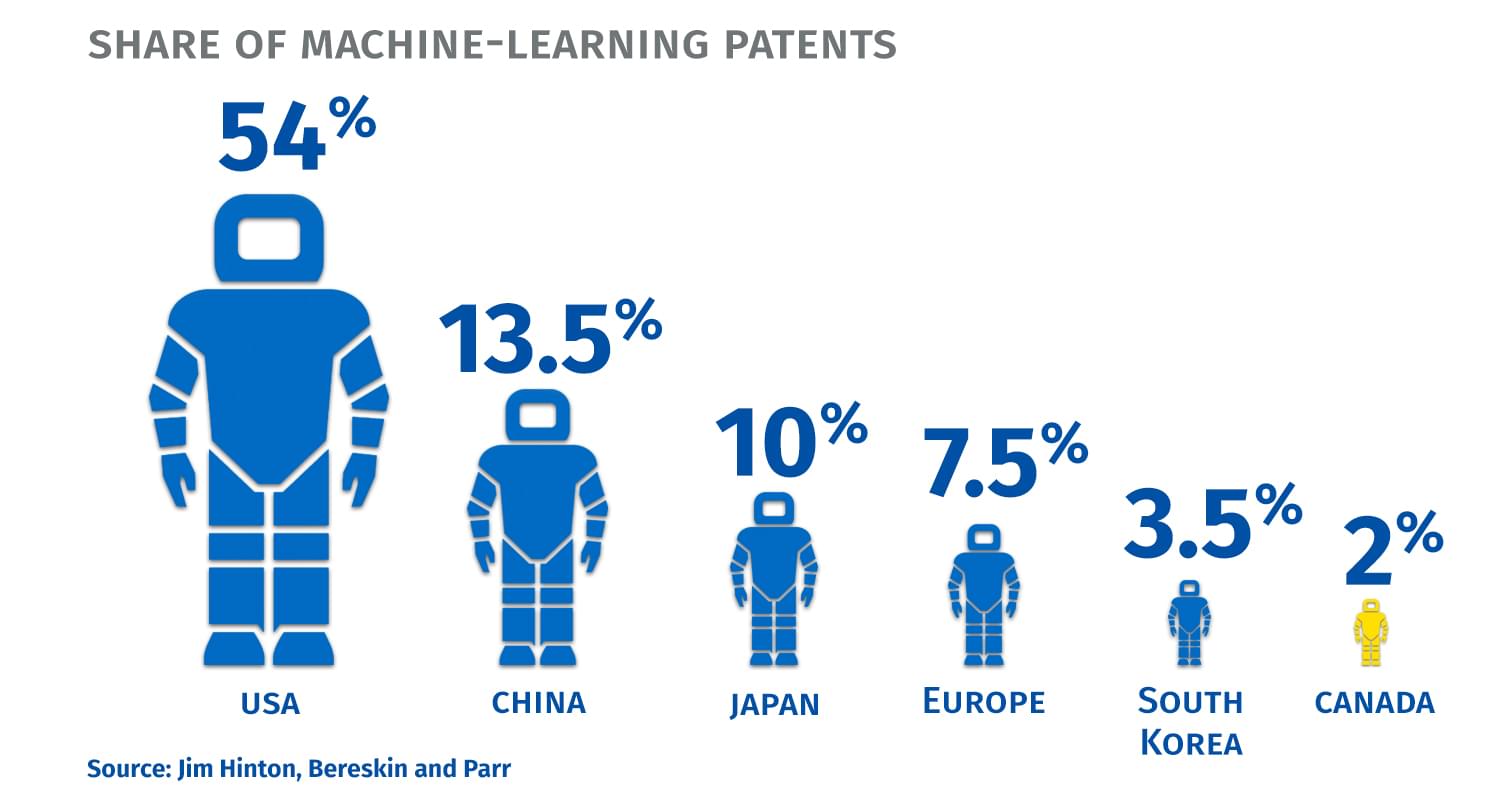
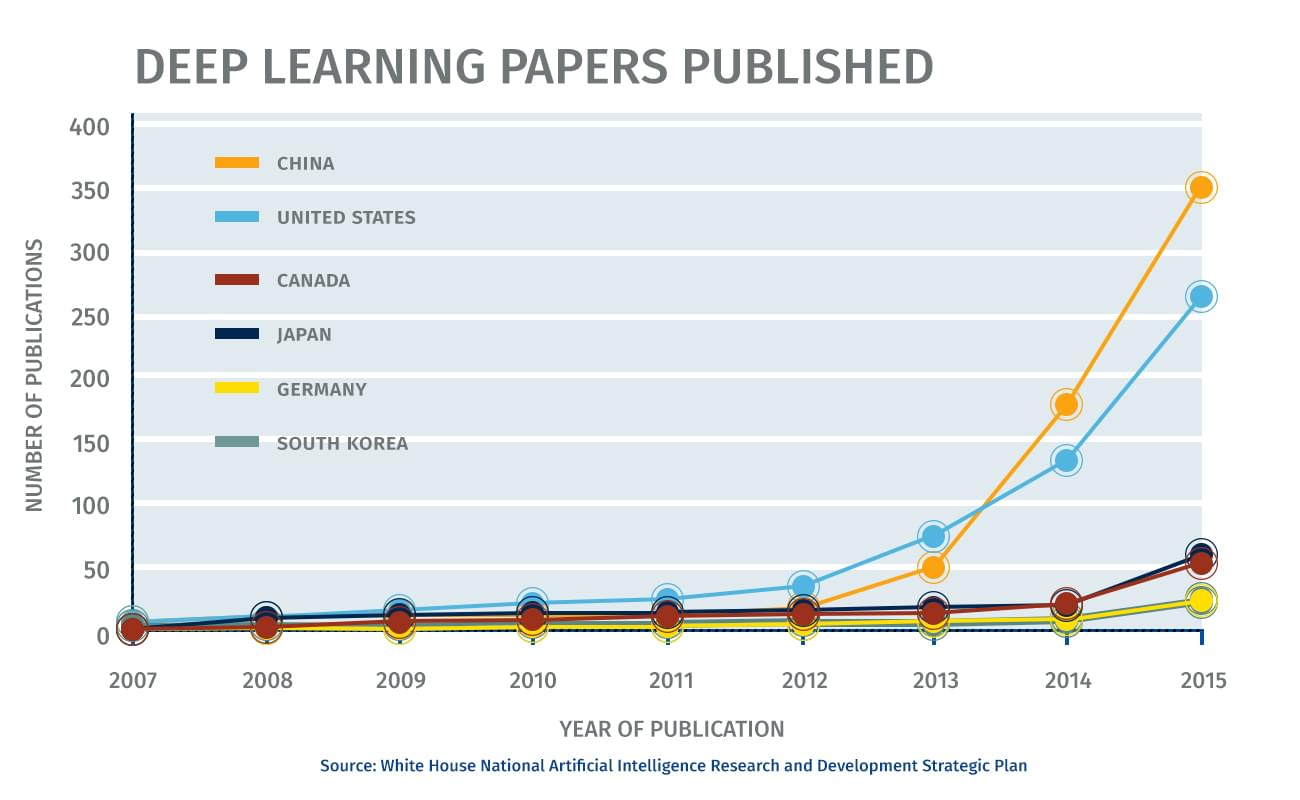
The concentration of AI research has grown sharply since 2012, with the United States and China emerging as AI superpowers.
Share of machine-learning patents
Deep learning papers published
Deep learning publications cited

The Start-Up Challenge

  • Around the world, 650 AI start-ups raised US$5 billion in 2016.[1]
    • The number of AI deals (funding rounds and exits) has increased more than fivefold since 2012
  • Canada accounted for 18 of the 658 AI acquisitions in 2015[2]
    • No Canadian company ranks in the top acquirers for AI startups

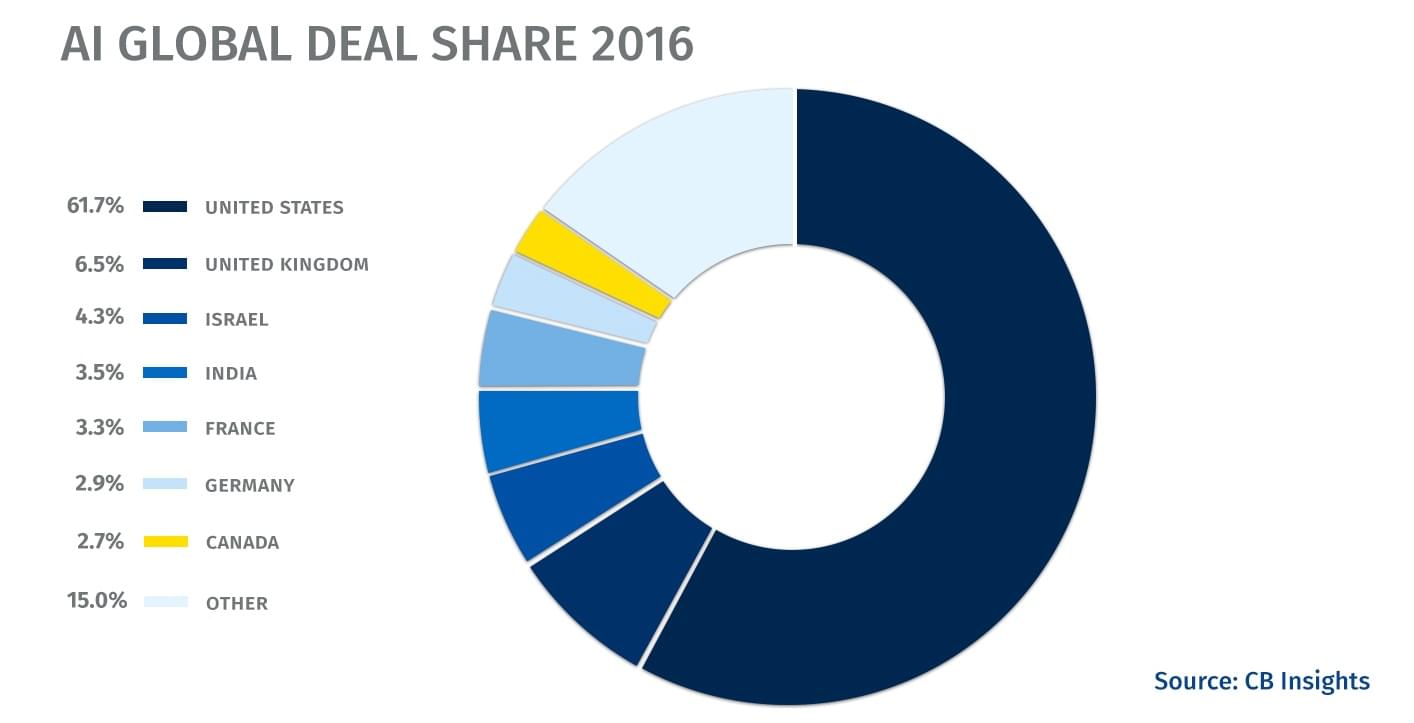
AI Global Deal Share 2016

The Corporate Challenge

American tech companies have put millions into Canadian AI. Microsoft pledged to invest $7 million in AI research in Montreal as part of its January 2017 purchase of machine language start-up Maluuba, while Google donated $4.5 million to MILA in 2016 and has opened labs in Montreal and Toronto. In May, Uber hired University of Toronto professor Raquel Urtasun to run a new Toronto AI lab focusing on driverless car technology.
Canadian companies have also invested in AI. NextAI, a partnership between RBC, Magna, BDC Capital and Scotiabank, was launched in 2016, with $5 million in initial funding to draw entrepreneurs to Canada to work on AI challenges. More than 20 Canadian companies have committed to funding the Vector Institute. Of the top 60 companies on the TSX, 22 have expressed interest in AI and 13 have publicly announced investments in AI. (See Appendix).
Between the federal and provincial governments, academic networks and partnerships including the Vector Institute and MILA, and commitments from private corporations, nearly $500 million has been committed to developing Canada’s artificial intelligence ecosystem over the past 18 months.
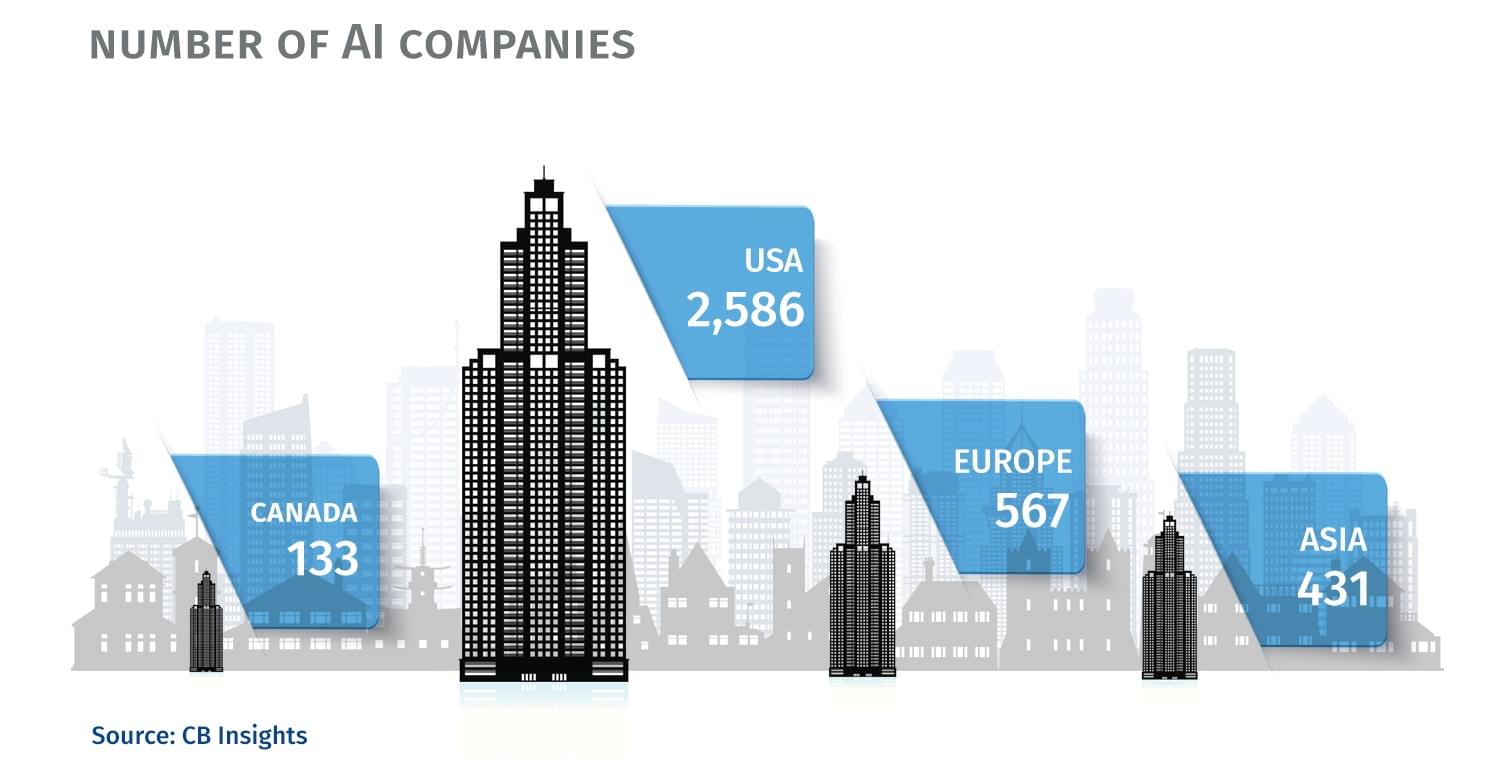
Number of AI Companies

Making Canada AI-Ready – 10 Ways for Government, Business and Academia to Build on Canada’s Success.

1. Create an AI Council to Guide Policy:
A private sector-led council could advise government on AI opportunities and challenges, and help track and benchmark Canada’s adoption of AI relative to global competitors.
2. Expand the AI Talent Pool:
Set an ambitious national target for both graduation levels in AI and related fields, and immigration levels for global AI talent.
3. Make the Workforce AI-Ready:
Equip students with AI-complementary skills, including work-integrated learning to ensure broad student exposure. This should include a focus on girls to ensure more gender balance in AI-related fields, including design, interface and impact.
4. Promote AI Across Business Sectors:
With business groups (Business Council of Canada, chambers of commerce), diffuse understanding of AI across organizations and encourage its adoption by all key sectors to build Canadian competitiveness.
5. Focus Research Funding on Commercial Innovation:
Ensure publicly-funded AI research focuses on commercial application— and require government funding agencies to better coordinate AI investments.
6. Develop an AI-Focused IP Strategy:
Modernize the IP regime to support the monetization and commercial scale-up of ideas in Canada, and to guard against activities (e.g. patent trolling) that stymie Canadian commercial innovation.
7. Leverage Our Data:
Establish a national data strategy, including a possible data bank for Canadian-owned companies and entrepreneurs to help them build scale in key areas.
8. Create a National Challenge:
Pool government and private resources, including data, to help Canadian firms, entrepreneurs and researchers use AI to solve grand challenges such as carbon emissions and hospital wait times.
9. Pursue an AI Trade and Investment Agenda:
Create a subject-expert AI representative in the federal government to work with multinational companies and investors. Apply an AI lens to trade negotiations. Review investment policies to consider the interests of Canadian firms.
10. Position Canada as a Global Leader in Advancing AI for Good:
Play a constructive role, through the G20 and multilateral organizations, to convene and build global awareness about the social, economic and cultural consequences of AI.

Appendix
Public AI interest and investment, TSX60 companies [5]
AI interest AI investment
1.     Bank of Montreal 1.     Bank of Montreal
2.     Bank of Nova Scotia 2.     Bank of Nova Scotia
3.     Barrick Gold Corporation 3.     BlackBerry Limited
4.     BCE Inc. 4.     George Weston Limited
5.     BlackBerry Limited 5.     Loblaw Companies Limited
6.     Canadian Imperial Bank of Commerce 6.     Magna International Inc.
7.     CGI Group Inc. 7.     Manulife Financial Corporation
8.     George Weston Limited 8.     Power Corporation of Canada
9.     Goldcorp Inc. 9.     Royal Bank of Canada
10.  Loblaw Companies Limited 10.  Sun Life Financial Inc.
11.  Magna International Inc. 11.  Telus Corporation
12.  Manulife Financial Corporation 12.  Thomson Reuters Corporation
13.  National Bank of Canada 13.  Toronto-Dominion Bank
14.  Power Corporation of Canada  
15.  Rogers Communications Inc.  
16.  Royal Bank of Canada  
17.  Sun Life Financial Inc.  
18.  Suncor Energy Inc.  
19.  Teck Resources Limited  
20.  Telus Corporation  
21.  Thomson Reuters Corporation  
22.  Toronto-Dominion Bank  
   
[1] The 2016 AI Recap: Startups See Record High In Deals And Funding. (CB Insights, Jan. 2017.)
[2] The 2016 AI Recap: Startups See Record High In Deals And Funding. (CB Insights, Jan. 2017.)
[3] The Geman Artificial Intelligence Landscape. Asgard.VC, February 2017.
[4] Worldwide Semiannual Cognitive/Artificial Intelligence Systems Spending Guide. (IDC, October 2016.)
[5] Factiva press search

As Senior Vice President, Office of the CEO at RBC, John Stackhouse is responsible for interpreting trends for the executive leadership team and Board of Directors with insights on how these are affecting RBC, its clients and society at large. Prior to this, John was editor-in-chief of The Globe and Mail (2009-14), editor of Report on Business, the newspaper’s national editor, foreign editor and its foreign correspondent based in New Delhi, India (1992-99).

View By Topics Or Author Page Link

view_by_topics_or_author_page_link

GM Canada has a team of 750 software engineers in the Toronto suburb of Markham, working on what it calls “the future of mobility.” It also has ambitious plans to open a experimental centre in the city’s east end, where consumers will be able to test self-driving cars, electric bikes and any other innovation that runs on wheels.

For the auto giant, the Toronto innovation drive is designed to get it closer to consumers and better understand how they’re adapting to radically new car technologies — and how that innovation can lead to better communities, safer roads and a new business model for mobility.

“We’re redefining ourselves in terms of mobility, as opposed to cars, trucks and crossovers,” said GM Canada’s president Steve Carlisle.

GM is in a race with Uber, Alphabet, Tesla and other car companies to develop self-driving cars that are safe, reliable and affordable. Earlier this week, Uber Technologies announced a new Toronto research team led by University of Toronto professor Raquel Urtasun that will be tasked with “transforming transportation.”

For both GM and Uber, Toronto has everything they need: great universities, a strong startup ecosystem, five million people, terrible traffic and four intense seasons that can test every on-board instrument in a car.

“We’re blessed with abundant crappy weather,’ Carlisle said, “so we should invest in it and play a global role there.”

Carlisle was onstage at Roy Thomson Hall for RBC Disruptors, a monthly speaker series focussed on innovation and disruption.

After emerging from the great recession as a shadow of its former self, GM has picked four channels of innovation: self-driving vehicles, electric vehicles, connected vehicles and shared vehicles.

Carlisle said the company wants to think about share of data and share of kilometres driven, rather than just share of new car sales.

“We need to think in terms of not just selling vehicles — but selling kilometres and gigabytes too … The idea is to get our minds moving beyond market share and sales and into share of kilometres ridden and share of data used.”

He can see a future in which fewer cars are sold but they’re used more through shared ownership, or ride-hailing of autonomous-driving vehicles. The average car is used around four per cent of the time.

While that may lead to fewer vehicle sales for GM, Carlisle says the difference will be made up by servicing and parts, as vehicles being used more often will wear out faster. There will be new business models, too, such as paying per distance.

The company already has its own car-sharing business, Maven, that is trying to better understand how quickly consumers are willing to change habits.

GM is already gaining some revenue from new data models, such as prompting drivers, through its OnStar service, with special offers at restaurants or shops along a highway, based in part on a driver’s habits. It typically gets a share of sales connected to drivers, if they’ve opted to share their data.

Today’s vehicles already have as much as two million lines of computer code in them. Tomorrow’s vehicles will be wired more than a typical space vehicle, enabling GM to build relationships with a host of other service providers wanting to reach consumers while they’re in their cars.

While self-driving cars — and the ensuing changes to our cities — are still years away, Carlisle said they’re coming sooner than most people think.

The biggest challenge is in the marketplace. Take electric cars. Despite being on the market for more than a decade, they account for half of one per cent of total sales. The same resistance could hold true for cars that pilot themselves.

“We all want to reduce greenhouse gases, but we’re all consumers as well,” he said. “When do we make the leap to being a part of that solution instead of perpetuating the status quo?”

Even if self-driving cars gain currency, Carlisle doubts the love-affair that many owners have with their cars will die. Instead, many will buy second cars for pleasure driving, while using autonomous-driving vehicles and shared vehicles for mundane trips. “Everyone loves driving,” he noted. “No one likes commuting.”