

 EN
EN 

Issue #07
➔ America’s era of energy dominance is here. What does it mean for climate policy?
➔ Climate Action Annual Report 2025: What Semex and Purolator have in common
➔ What Canadian business leaders say about climate action
➔ The TV series capturing U.S. oilpatch’s cheery mood
Hot takes
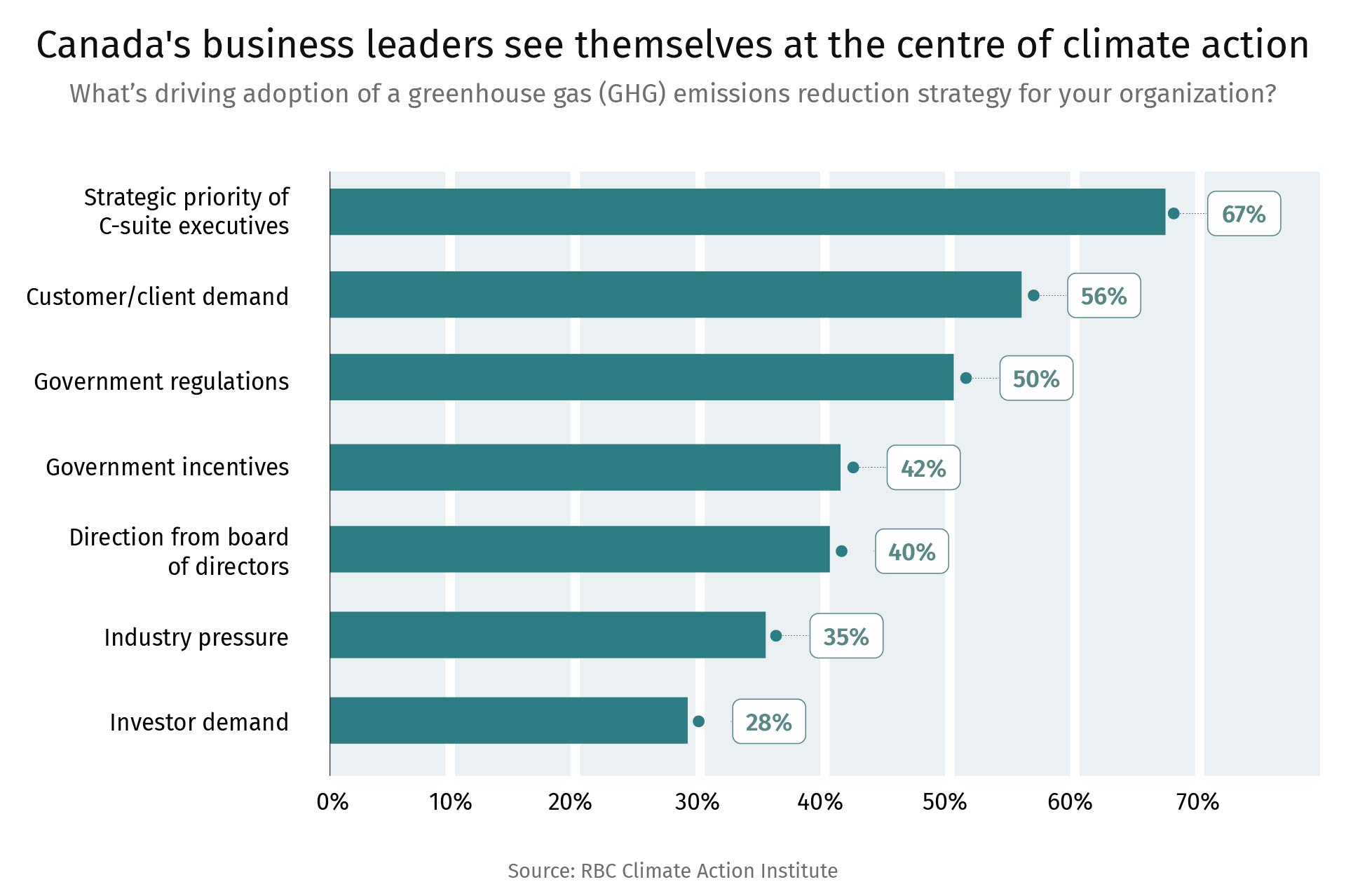
Subsidies, funding and leadership. These three levers will advance climate progress, according to a majority of the 100-plus business executives we surveyed for the Climate Action 2025: A year for rewiring, our annual report tracking Canada’s climate progress. Around three-fourths of Canadian businesses have a climate strategy in place, and roughly 40% believe they are (almost) equal partners with governments in driving climate action. Read the survey here.
Severe weather events are costing Canada’s economy. Natural disaster claims of $8 billion last year in Canada smashed the previous record of $6 billion, as climate-change fuelled weather events played havoc across the country from Jasper to Toronto, Insurance Bureau of Canada estimates. It’s not just Canada. Early estimates show Los Angeles’ wildfires could trigger economic losses of as much as US$150 billion—the costliest natural disaster in U.S. history. Globally, the losses stood at US$320-billion last year, 30% higher than 2023.
Misinformation is the world’s top short-term global risk. That’s according to a World Economic Forum report on global risks. While misinformation, and its close cousin disinformation, pervades society, it also pollutes discourse on climate issues. Social media is not helping as it plans to remove guardrails on misinformation. WEF’s top 4 long-term risks are all environmental: extreme weather events, biodiversity loss, critical changes to Earth’s system, and natural resource shortages.
Oilpatch cowboy tales. Taylor Sheridan, co-creator of the Yellowstone TV series—which tapped America’s conservative-progressive cultural clash—, is back with Landman (Amazon Prime), a Texas Permian Basin tale rife with drug cartels, roughneck life and merciless ribbing off the renewable sector’s presumed deficiencies compared to the oil sector. Watch the acerbic, plain-speaking oil lease executive—or landman—Billy Bob Thornton bat away Permian and parental troubles on a daily basis. It’s reductive and retro—quite like the American mood right now.
➔ Bi-Weekly Climate Action Award: To Ontario for launching a Home Renovation Savings Program that offers 30% rebate on heat pumps, rooftop solar panels and battery storage systems, etc. Buildings account for 13% of Canada’s emissions.
➔ Bi-Weekly Climate Action Fail Award: To Australia for delaying the rollout of new carbon emission targets by 2035, citing the return of Donald Trump’s return to the White House.
Canada’s role in U.S. energy dominance
There were no tariffs on Canadian goods on Day One of Donald Trump’s presidency—but they could come as soon as Feb. 1. Amid the chaos of Washington’s tariff and “economic force” threats, there might even by a sliver of opportunity for Canada: the potential of a new bilateral energy trade deal between the two as the U.S. president vows “energy dominance” for America.
The U.S. president has declared an “energy emergency” to build new critical infrastructure. Could some of it be built in Canada given the integrated nature of the two country’s energy sector?
Trump’s inaugural speech focused on “liquid gold under our feet,” and exporting American energy all over the world. Would Canada be feeding America’s domestic oil and gas markets that would free up U.S. output for exports? The contours of Trump’s Great Energy Game views Greenland, Canada, Mexico and the Panama Canal, as resource and depots hubs that the U.S. can draw upon. Glass half-full suggests Canada can be an equal partner in fortifying North American energy security. Glass half-empty suggests the U.S. may need less Canadian oil and gas in the future if its “drill, baby, drill,” mantra leads to a domestic output boom. Cue for calls in some quarters to resurrect the long-dead, Asia-facing Northern Gateway oil pipeline.
Canada has its work cut out as it keeps tariffs at bay and helps America realize its energy ambitions without losing sight of its own climate goals.
Meanwhile, the U.S.’s own climate targets are out the window with its exit from the Paris Climate Accord. If that positioning turns into a full reversal of the Inflation Reduction Act, it’s hard to see other major economies not following suit and scaling back their investments, according to Institute head John Stackhouse.
Read John Stackhouse’s take on Trump’s first day back in the White House.
Climate Action 2025: Rewire & reboot
The Institute’s second annual report on Canada’s climate action is full of insights, but here are five themes that stood out to us:
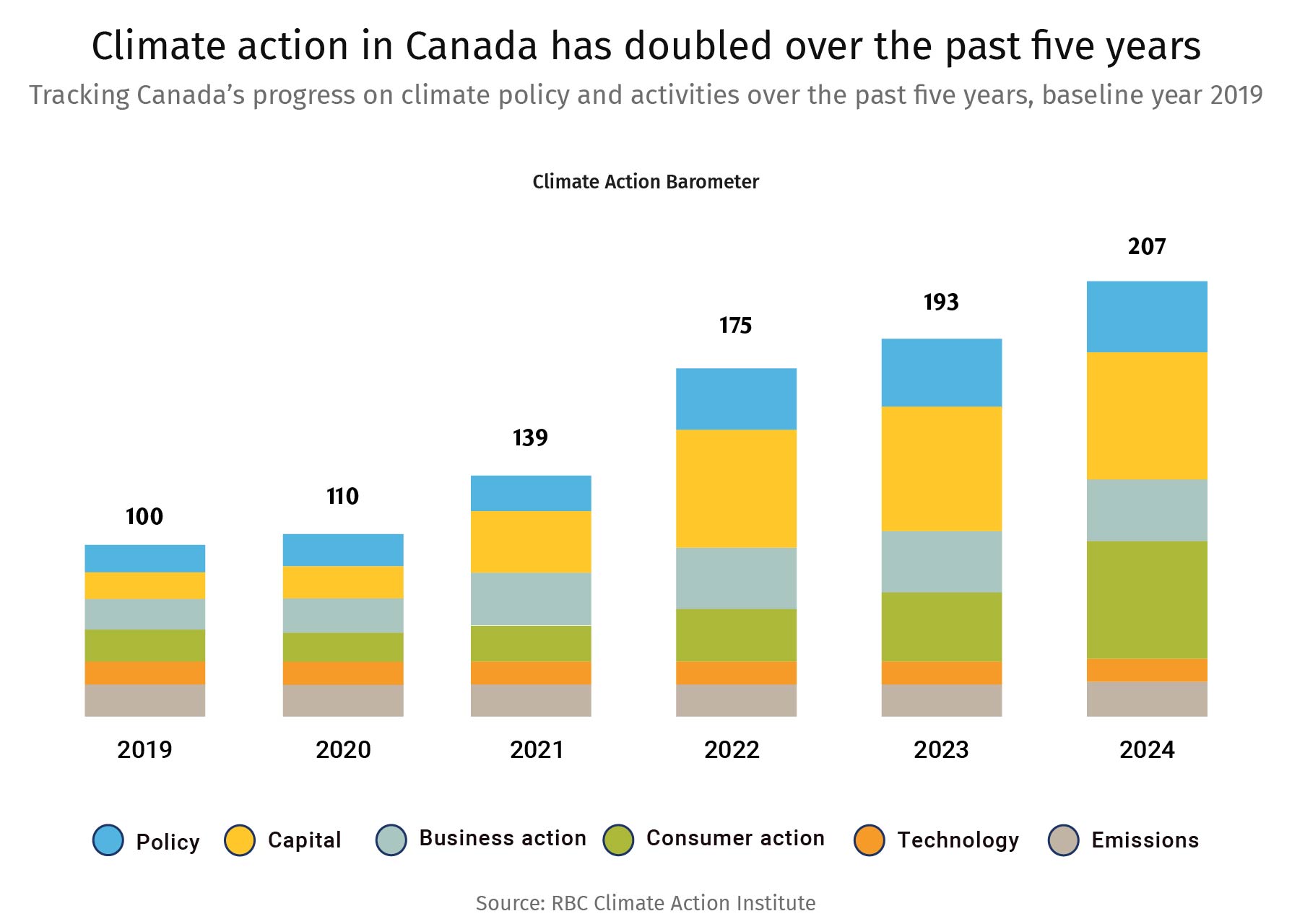
1. The big number: Climate action has doubled in Canada over the past five years, and there is one big driver: sizeable government funding announcements of $177 billion worth over the past decade, according to our tracking. Now comes the other hard part: how to fully deploy it.
2. Climate security is the new watchword. ESG is out, climate security is in—or so it seems. Protecting North American resources and supply chain is going to be critical over the next decade. However, governments will also need to distinguish between friend and foe (yes, we are looking at you, America).
3. Canadian innovation is alive and well—and under-reported: Guelph-based Semex is working away to make future generations of Holstein cattle breeds low-carbon. Meanwhile, unknown to most, logistics firm Purolator helped Canadian startups build better e-bikes. Innovation, driven by market forces, can lead to serendipitous solutions.
4. Alberta is a climate leader: The province’s early coal phaseout needs to be celebrated. Of course, Alberta’s U-turn on renewable development has undone some the goodwill, but climate progress is almost never linear.
5. A spate of new green projects could boost the Climate Action Barometer. Our proprietary index on Canada’s climate action is tracking progress from a spate of decarbonizing projects, including Entropy’s carbon capture and storage projects, Shell’s Polaris carbon capture and Canada Nickel’s Timmins project, among others.
ICYMI
➔ Seven big environmental decisions facing the B.C. government in 2025
➔ Donald Trump’s economic advisors on the wonder of tariffs
➔ U.S. energy chief vows to ‘unleash’ U.S. expansion
➔ U.S. ESG funds had a bad year with a record outflows
➔ California is waiving climate rules to speed up wildfire-hit LA’s rebuild. That might be a mistake
The Institute In Action
➔ On January 15, we gathered over 100 business, NGO, government, and climate leaders to launch our flagship climate action report, Climate Action 2025: a year for rewiring. We heard from Dave McKay, RBC CEO, Sir Andrew Steer, President and CEO of the Bezos Earth Fund, and Canadian artist Ed Burtynsky on ways Canada and the world can rewire our thinking and strategies to keep climate on the radar.
➔ Institute head John Stackhouse is in Davos. Follow him on LinkedIn to read his frequent updates.
➔ On January 30, Myha Truong-Regan, our Head of Climate Research, will be on a panel alongside Jennifer McLeod Macey, SVP, Public Affairs & Communications, Leger, and Tracey Bodnarchuk, CEO, Canada Powered by Women, at the Toronto Regional Board of Trade’s Powering our Climate & Energy Economy Symposium, to discuss what Canadians really think about climate and energy policy.
What’s on the team’s reading wish list: Waste Land: A World in Permanent Crisis by Robert D Kaplan, The Technological Republic: Hard Power, Soft Belief, and the Future of the West by Alexander C Karp and Nicholas W Zamisk, Abundance by Ezra Klein and Derek Thompson.
Curated by Yadullah Hussain, Managing Editor, RBC Climate Action Institute.
Climate Crunch would not be possible without John Stackhouse, Myha Truong-Regan, Sarah Pendrith, Farhad Panahov, Lisa Ashton, Shaz Merwat, Vivan Sorab, Caprice Biasoni and Frances Dawson.
Have a comment, commendation, or umm, criticism? Write to me here (yadullahhussain@rbc.com)
Climate Crunch Newsletter
This article is intended as general information only and is not to be relied upon as constituting legal, financial or other professional advice. The reader is solely liable for any use of the information contained in this document and Royal Bank of Canada (“RBC”) nor any of its affiliates nor any of their respective directors, officers, employees or agents shall be held responsible for any direct or indirect damages arising from the use of this document by the reader. A professional advisor should be consulted regarding your specific situation. Information presented is believed to be factual and up-to-date but we do not guarantee its accuracy and it should not be regarded as a complete analysis of the subjects discussed. All expressions of opinion reflect the judgment of the authors as of the date of publication and are subject to change. No endorsement of any third parties or their advice, opinions, information, products or services is expressly given or implied by Royal Bank of Canada or any of its affiliates. This document may contain forward-looking statements within the meaning of certain securities laws, which are subject to RBC’s caution regarding forward-looking statements. ESG (including climate) metrics, data and other information contained on this website are or may be based on assumptions, estimates and judgements. For cautionary statements relating to the information on this website, refer to the “Caution regarding forward-looking statements” and the “Important notice regarding this document” sections in our latest climate report or sustainability report, available at: https://www.rbc.com/our-impact/sustainability-reporting/index.html. Except as required by law, none of RBC nor any of its affiliates undertake to update any information in this document.