

 EN


Budget-strapped Canadians willing to pay a bit more for climate action, but want corporations and governments to lead the way.
We have found that Canadian consumers are willing slightly more to tackle climate change, but a higher cost of living and affordability crisis has made the issue a lower priority for many across the country.
The second annual survey of approximately 2,000 Canadians, conducted by polling firm Ipsos on behalf of RBC Climate Action Institute, highlights the tension between addressing their own immediate cost of living challenges and the greater longer-term issue of addressing and mitigating global warming. The survey was conducted across Canada, roughly 50-50% between men and women, with representation from Ontario (36%), Quebec (23%), British Columbia (12%), Alberta and Saskatchewan (10% each) and Atlantic Canada (8%). Millennial Generation (1981–1996), Generation X (Born 1966–1980), and Baby Boom Generation (Born 1946–1965) were evenly split, with Generation Z (born 1987-2012) making up 11%.
Ipsos also polled approximately a thousand American consumers and roughly an equal number of Britons to understand consumer attitudes in peer countries, suggesting Canadians aren’t the only ones grappling with helping the environment without straining their budgets.
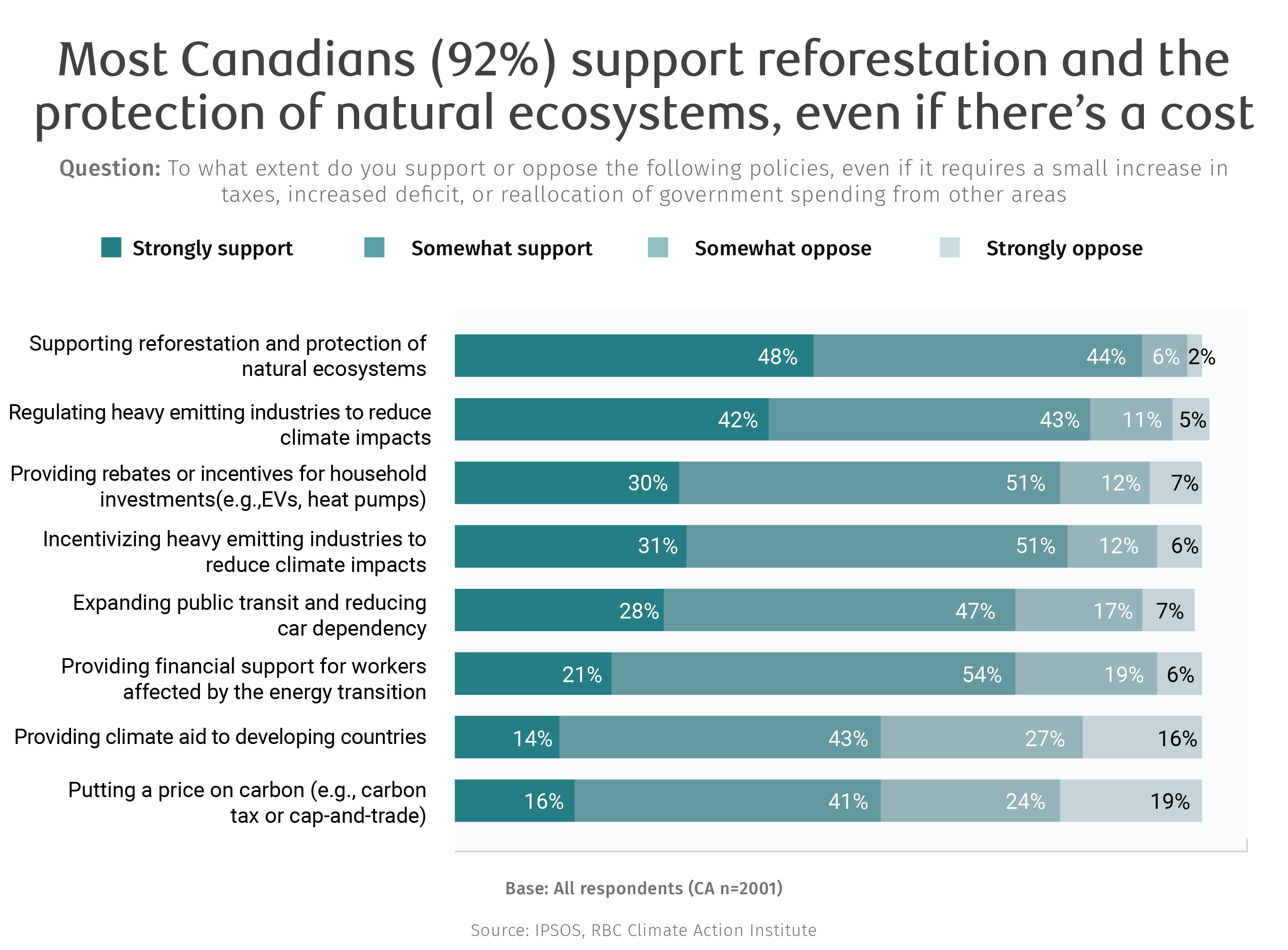
Eight in 10 Canadians also said they would strongly support or be somewhat supportive of regulating and incentivizing heavy-emitting industries to reduce their impact on the climate, even if it requires a small increase in taxes, increased deficit, or reallocation of government spending from other areas, according to the survey of Canadian consumers’ attitude towards climate issues.
Other related social measures—like providing financial support for workers in energy transition or expanding public transit—have broad support.
However, roughly a year after the federal government scrapped the consumer carbon tax, the nation seems ambivalent about putting a price tag on carbon emissions to manage climate change.
1. One in 10 Canadians see climate among Canada’s top two priorities—but there’s a provincial divide. That’s compared to 21% last year. Cost of living was the most dominant issue on Canadians’ minds at 70%. But there’s provincial divergence: 16-17% of Quebecers and Maritime residents listed climate in the top two issues for Canada, compared to 6% in Prairies, 10% in Ontario and 12% in British Columbia.
2. A near majority (47%) says we must act urgently on climate change, but balance it with the economy and other needs. That was the dominant sentiment – only 13% don’t see an impetus for urgent action citing other priorities.
3. Every second Canadian has witnessed the impact of extreme heat or wildfires in the past few years. The survey was also taken just before the wildfire smoke blanketed the sky across several provinces. The U.S. and the U.K. share similar experiences with extreme heat, topping the chart for the three nations. But Canadians surveyed claim to be more affected more across the board of extreme weather events.
4. One in four Canadians claim to have suffered a health issue due to climate change in the past two to three years. Women report higher impact than men across health and wellness categories. One in five Canadians were also hit economically, with Gen Z and Millennials feel the greatest impact overall, especially compared to Boomers.
5. Cost and affordability are the top barriers to climate-friendly action. Three quarters (74%) of Canadians cited it as the biggest challenge, followed by limited availability of options. A striking quarter of Canadians doubt individual actions matter.
6. More than half (57%) of Canadians have not taken any of the climate action investments (outlined below) in the past 12 months.
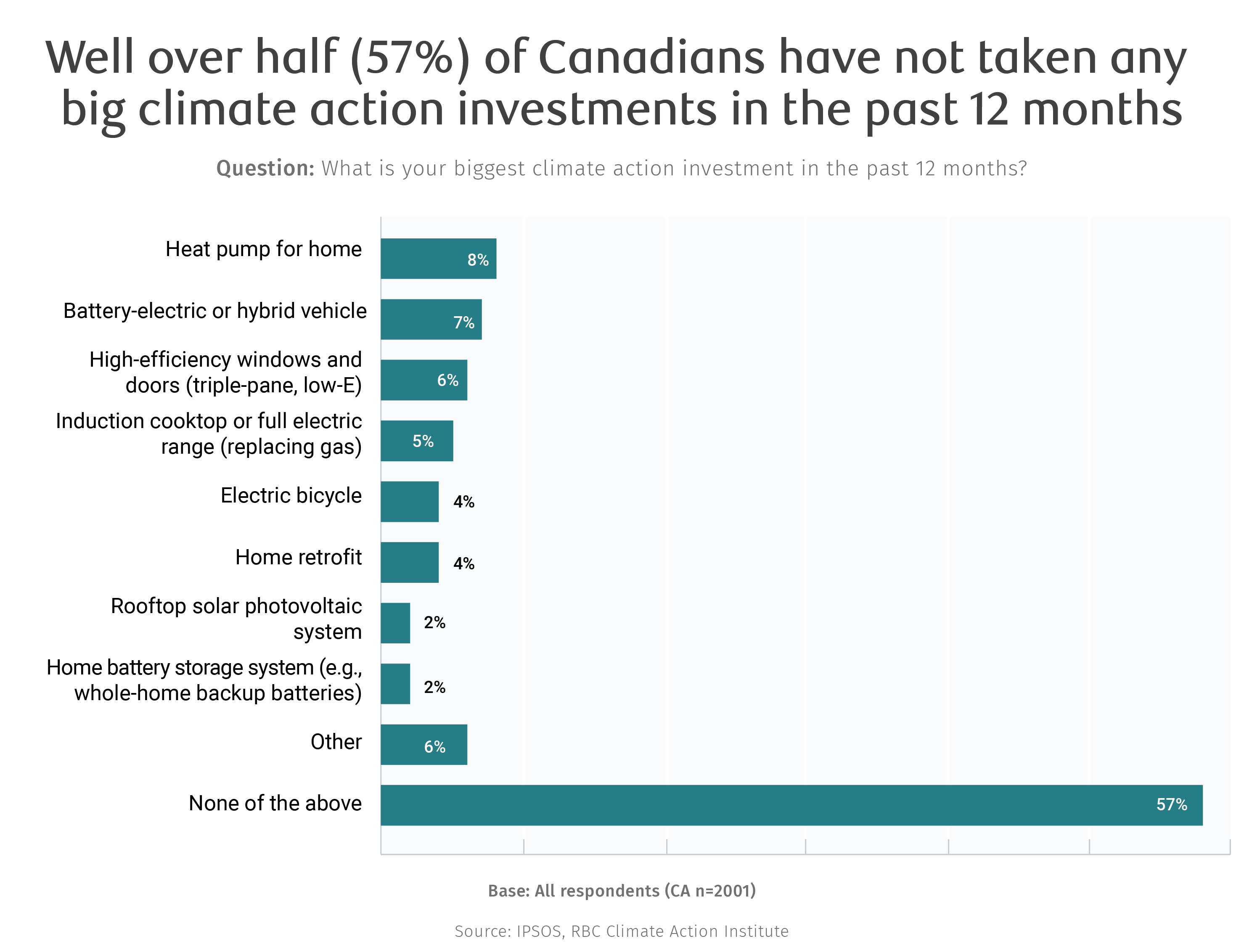
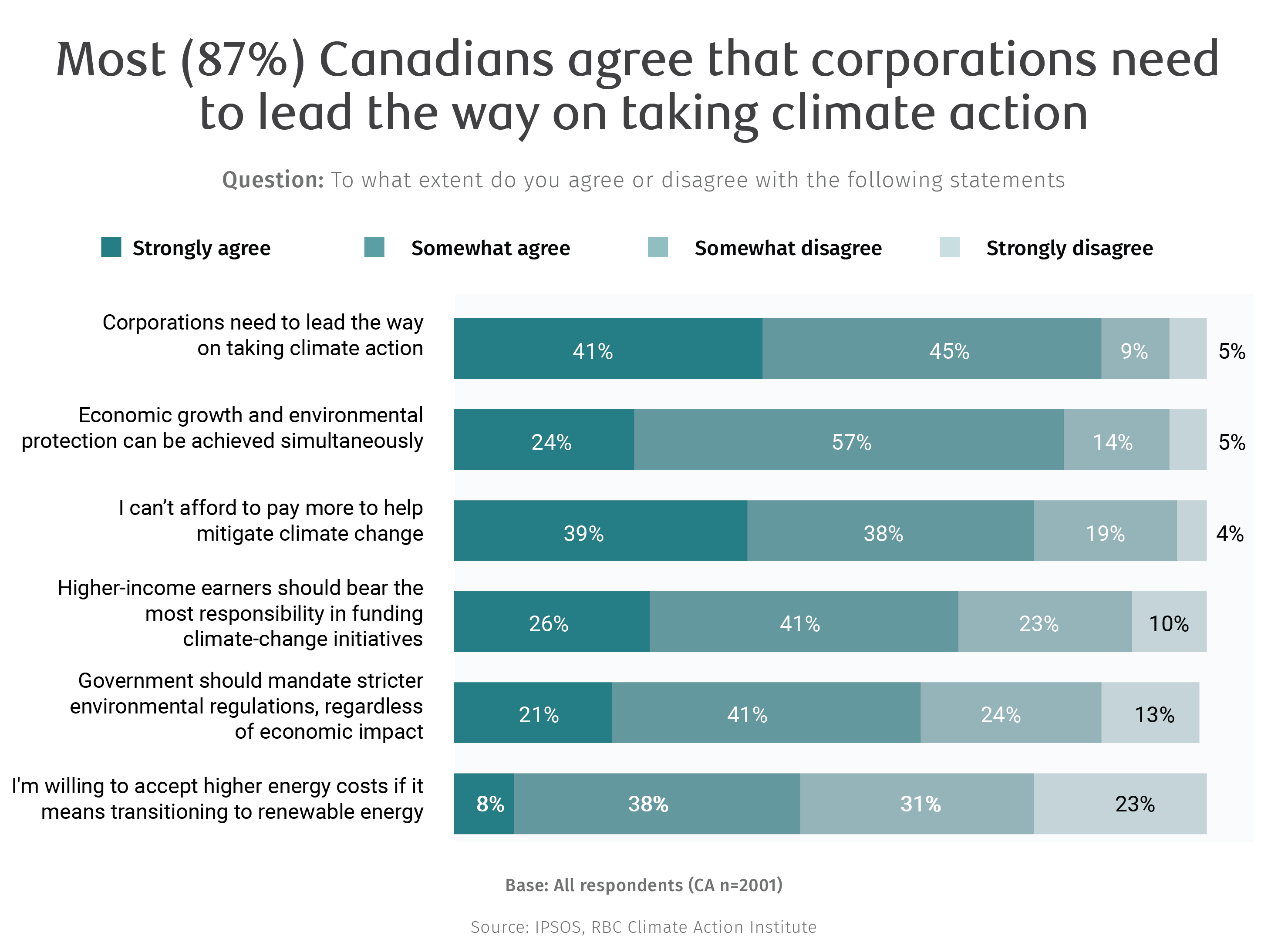
This tension is reflected in expectations: Canadians overwhelmingly believe governments (62%) and corporations (58%) should lead on climate action, while individual engagement remains more limited and cost-sensitive.
7. Two in five (38%) Canadians are willing to pay more for a product or service that’s considered “environment friendly”. Younger Canadians are significantly more willing to pay higher premiums – 51% and 45% among Gen Z and Millennials compared to 31% and 37% for Gen X and Boomers. Most of those willing to pay more, however, would accept up to 10% higher price, and only 2% going as far as paying over 50% premium.
8. Few Canadians want to see their energy costs rising. About a quarter oppose accepting higher energy costs if that means transitioning to renewable energy. Generational gap was most pronounced, with nearly two-thirds of Gen Z willing to accept higher costs compared to 38-49% across the rest of age cohorts.
9. Canadians believe corporates and governments should take the most responsibility for addressing climate change and mitigation. Canadians surveyed believe that it is the job of lawmakers and major emitters, with only 1 in 10 Canadians seeing individuals taking the most responsibility. One in four Quebecers is more likely to say NGOs should take on some of the burden.
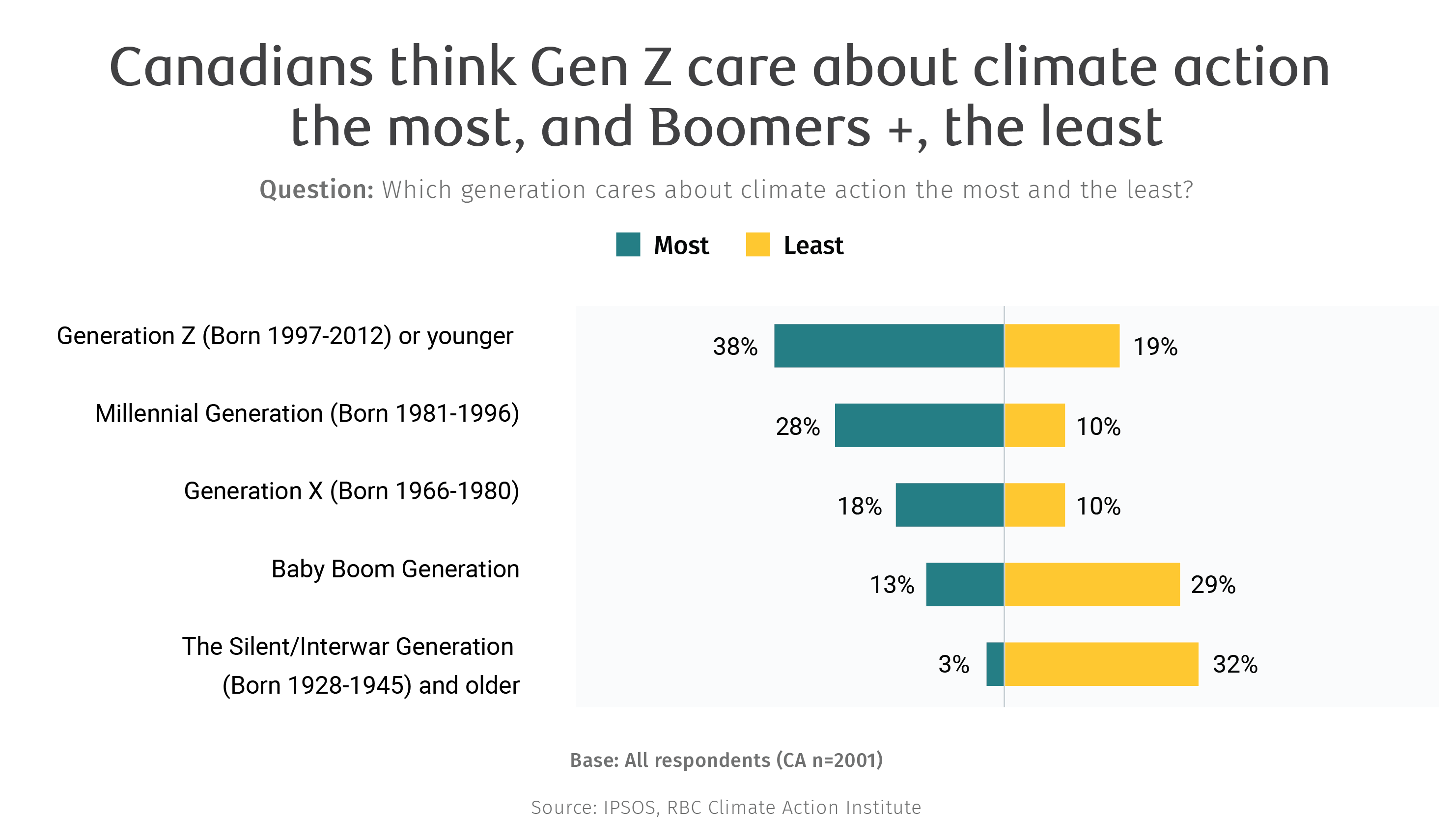
10. Every generation believes they are the generation that cares the most about climate action. All the generations surveyed identified themselves as most caring about climate action. However, among all the Canadians surveyed, Generation Z was viewed as the most concerned about climate action, with Boomers and the Silent Generation getting the fewest votes.”
Affordability is seen as a single main obstacle to making choices with climate in mind across all three countries (57-74%), in Canadian provinces (70-79%), and age groups (71-75%). Though younger generations quote convenience as a relatively more challenging barrier, boomers, at the verge of retiring and one of the largest consumer groups, cited finding limited options.
11. Women care more than men. Canadian women generally displayed more concern for the environment:
-
They are more likely to say we must act urgently, balancing environmental and economic needs (52%), compared to men (43%).
-
Women are more likely than men to report taking several actions, including reducing consumption (61% vs. 47%), reducing home energy use (54% vs. 44%), and shifting diet (23% vs. 14%), while men are more likely to say they have taken no actions (12% vs. 7%) or “none of the above” (19% vs. 11%).
12. Canadians are not the only ones struggling to balance climate with other priorities. British (14%) and American (15%) residents are largely in line with Canadians (12%) to identify climate change as among their nation’s top priorities. Still, climate remains among the lowest priorities for all three nations.
-
Americans surveyed are more likely to have experienced climate change through extreme heat waves (47%) or severe storms (38%). Western U.S. residents are most likely to report extreme heat effects and drought or water restrictions, along with poor air quality.
-
Britons experienced climate change through heat waves (46%) and changes in seasonal patterns (36%).
Government Pulse Check
The government pulse check is informed by quantitative and qualitative insights on government spending, government policy impact on GHG emissions trajectory, and climate policy experts’ perspectives on climate policy and its efficacy in Canada.
The RBC Climate Action Institute research team tracks annual government spending at the federal level and in the four largest provinces by gross domestic product to maintain tracking of government fiscal commitment to climate action.
To understand if government policies and spending are tracking towards 2035 and 2050 targets, the research team also considers the modelled projections of policy on GHG emissions scenarios to provide a directional, quantitative lens on policy efficacy in meeting GHG targets. These projections are produced each year by Environment and Climate Change Canada.
Finally, the research team surveyed an expert policy panel of more than 40 to glean additional detailed insights on the impact of current policies on Canada’s GHG emissions reduction targets. CAI solicited their views of policy efficacy (i.e., did it achieve its desired result), policy impact (i.e., broader consequences of policy–intended and unintended), policy durability (i.e., long-term stability of policy). This survey was conducted between June and August 2026.
The list of participants for the expert policy panel was curated by the Climate Action Institute and the Canadian Climate Institute and included academics, policy experts, former government officials and analysts. Key policy actions identified in the Government Pulse Check—such as carbon pricing, methane regulations and Clean Fuel Regulations, consumer incentives, industry incentives, funding programs and education and awareness—were deemed by our Climate Action team, in collaboration with external climate policy experts, to have a meaningful impact on the trajectory of Canada’s emissions.
Business Pulse Check
The business survey tracks year-over-year change in business leaders’ approach to climate action in their strategies, operations and products and services. The businesses are primarily focused on the six key sectors identified by the CAI Team as our focus areas, namely: Buildings, Agriculture, Oil & Gas, Transport, Heavy Industry, and Electricity.
The business survey is run by Kantar Canada Inc., a third-party vendor in June and July 2026 and attracts roughly 150 business responses.
Kantar Canada’s business survey is a self-administered online poll. It targeted vice-presidents and business leaders on a best-effort recruitment process. The survey was targeting complete responses from 100-150 companies.
Industry coverage included Buildings, Agriculture, Oil & Gas, Transport, Heavy Industry, and Electricity, with top up in ‘other’ industries.
Consumer Pulse Check
The consumer survey tracks year-over-year change in Canadian consumers’ perspectives, experiences and actions on climate change.
The consumer survey is run by a third-party vendor, Ipsos Canada, between June and July 2026 and collects roughly 2,000 individual responses from its Ipsos online omnibus in English and French across Canada.
This survey examines the views, experiences, and actions related to climate change among adults in Canada, the United States, and the United Kingdom.
All three countries were asked the same three questions, while respondents in Canada were asked an additional 11 questions.
The survey was conducted online between June 3–5, 2026 in Canada, June 8–9, 2026 in the United States; and June 12–16, 2026 in the United Kingdom.
Surveys were completed by adults aged 18 and older through the Ipsos I-Say Panel.
Results are considered accurate within a confidence interval (+/- percentage points), 19 times out of 20, compared to what would have been obtained if all adults aged 18+ had been surveyed. Sample sizes and confidence intervals are as follows:
CA n=2001 +/- 2.7
To allow for international comparisons, Ipsos ran select questions in the U.K. and U.S. to gleam insights from international consumers. These surveys run in June and July and collect roughly 1,000 responses each.
Sample sizes and confidence intervals are as follows:
U.S. n=1005 +/- 3.8
U.K. n=1122 +/- 3.6
This article is intended as general information only and is not to be relied upon as constituting legal, financial or other professional advice. The reader is solely liable for any use of the information contained in this document and Royal Bank of Canada (“RBC”) nor any of its affiliates nor any of their respective directors, officers, employees or agents shall be held responsible for any direct or indirect damages arising from the use of this document by the reader. A professional advisor should be consulted regarding your specific situation. Information presented is believed to be factual and up-to-date but we do not guarantee its accuracy and it should not be regarded as a complete analysis of the subjects discussed. All expressions of opinion reflect the judgment of the authors as of the date of publication and are subject to change. No endorsement of any third parties or their advice, opinions, information, products or services is expressly given or implied by Royal Bank of Canada or any of its affiliates. This document may contain forward-looking statements within the meaning of certain securities laws, which are subject to RBC’s caution regarding forward-looking statements. ESG (including climate) metrics, data and other information contained on this website are or may be based on assumptions, estimates and judgements. For cautionary statements relating to the information on this website, refer to the “Caution regarding forward-looking statements” and the “Important notice regarding this document” sections in our latest climate report or sustainability report, available at: https://www.rbc.com/our-impact/sustainability-reporting/index.html. Except as required by law, none of RBC nor any of its affiliates undertake to update any information in this document.