

 EN
EN 



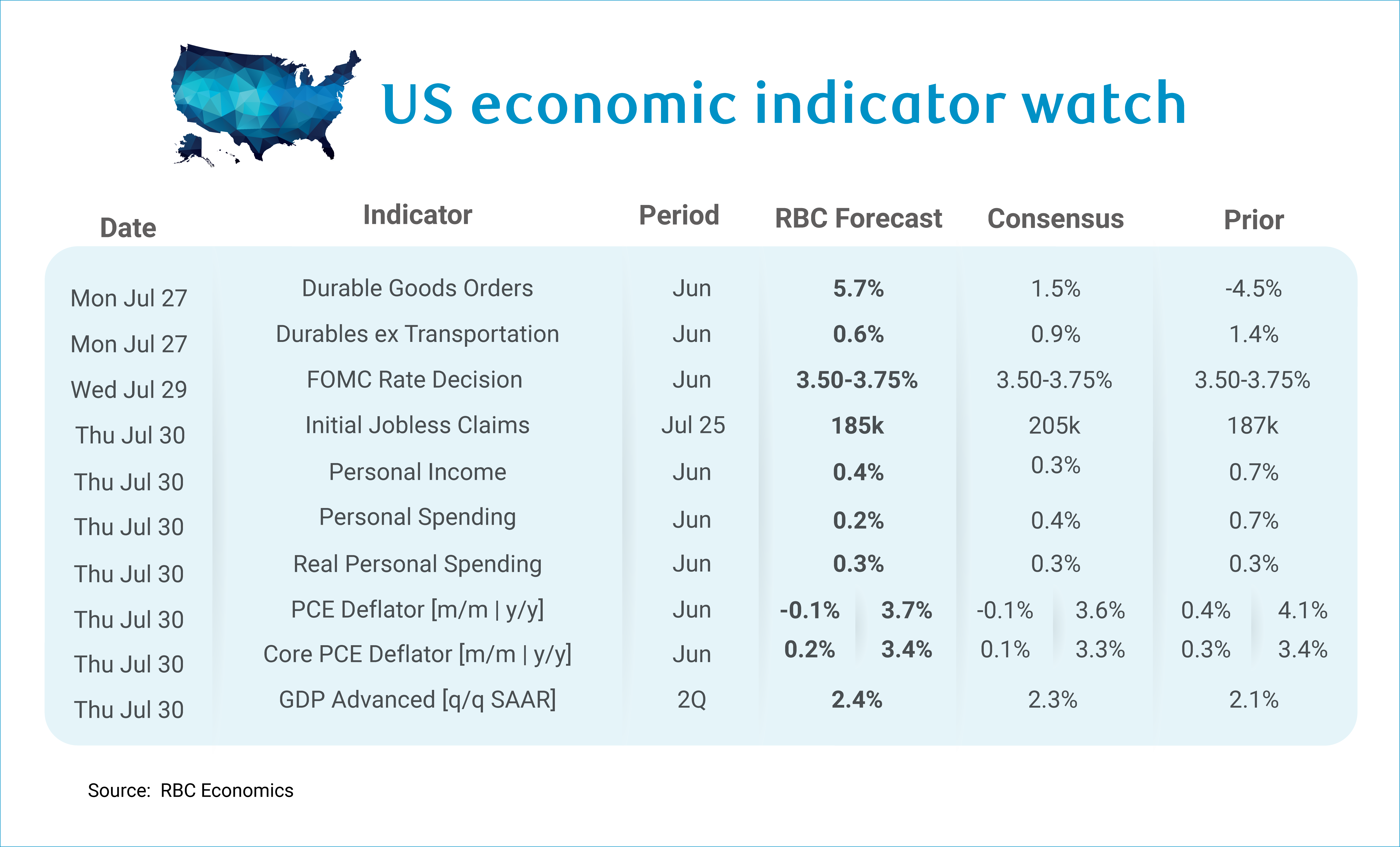
Next week we will be focused on the FOMC rate decision on Wednesday. We expect they will hold interest rates steady, and continue to expect they will remain on hold for the remainder of 2026.
The Fed continues to be challenged by persistent inflation and has been looking through energy pressures, but that may become more challenging as the Iran war re-escalates. The recent announcement of new tariffs adds another layer of uncertainty and will likely add inflationary pressures in the months ahead. Still, we suspect that the primary takeaway will come from their stated views on risks to the broader economy.
We will get the Fed’s preferred measure of inflation on Thursday. The PCE deflators are expected to present a more modest deceleration compared to June’s CPI and PPI prints. Headline PCE is expected to decline -0.1% m/m with lower gas prices largely responsible. But the combination of weighting and elevated prints in several medical service passthrough components (i.e., in June, PPI for hospitals rose +0.7% m/m, home health and hospice care rose +0.3% m/m) explains the expected 0.2% m/m rise in core PCE compared to the flat core CPI print in June.
We look for personal income to rise +0.4% m/m, supported by continued strength in non-labor income (i.e., interest and rent). Spending is forecasted to have slowed in nominal terms (+0.2% m/m), with real spending reporting slightly higher (+0.3% m/m) as the drop in gas prices flatter the headline deflator. Gas price related spending declines may have temporarily boosted the savings rate, but this rebound is fragile. War escalation has pushed energy commodities back up in recent days, and the year’s outsized tax refunds have largely been spent. In our view, middle and lower income consumers (operating under elevated personal interest expenses) will be caught between reduced savings and a growing reliance on credit. We are monitoring consumer sentiment in the following week with the University of Michigan release.
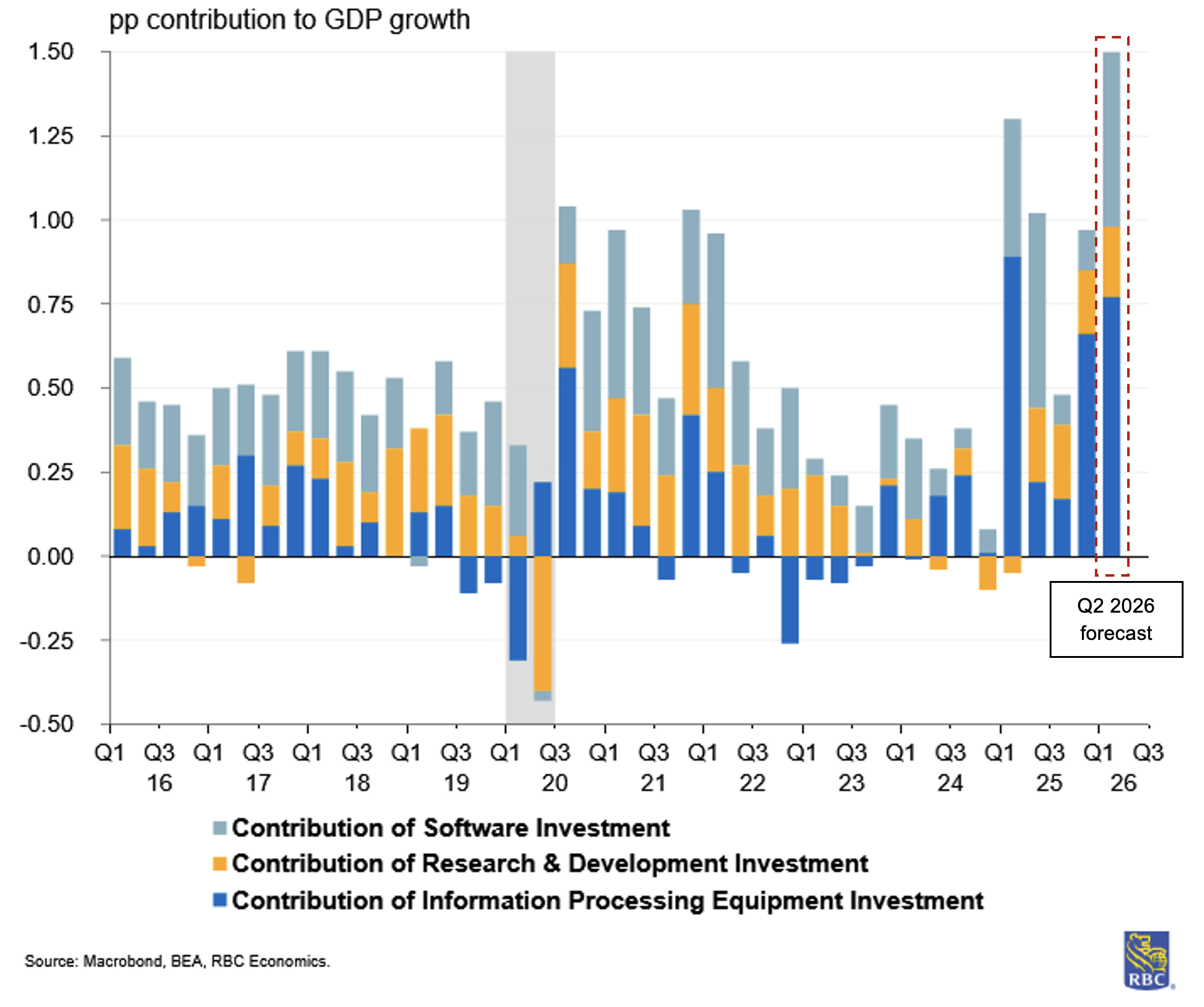
On the growth front, we expect the advance Q2 GDP print to report 2.4%, a pace that reflects the resilience of the consumer as well as strong business investment in AI infrastructure. The retail sales control group (which excludes autos, gas, food services, and building materials) accelerated at its fastest quarterly pace since 2022, validating the claim that domestic demand remains robust. Alongside outsized equipment investment by the tech hyperscalers, these two sectors alone are expected to contribute nearly 2ppt to headline growth.
AI investment contribution to GDP growth continues to rise
Other indicators to watch next week include:
-
Durables goods orders are expected to rise +5.7% m/m, driven by a rebound in Boeing orders. Stripping out transportation (i.e., orders ex transportation), the demand for AI infrastructure inputs is expected to maintain sturdy growth of 0.6% m/m.
-
We look for initial jobless claims to remain low, with a forecast of 185k for the week ending July 25. The continued absence of broad-based layoff activity reflects structural supply constraints facing the labor force.
About the authors:
Mike Reid is Head of US Economics at RBC. He is responsible for generating RBC’s US economic outlook, providing commentary on macro indicators, and producing written analysis around the economic backdrop.
Carrie Freestone is a Senior US Economist at RBC. She is responsible for generating RBC’s US economic forecasts across GDP, employment, and inflation, and providing macro commentary through publications, presentations, and the media.
Imri Haggin is an US Economist at RBC, where he focuses on thematic research. His prior work has centered on consumer credit dynamics and treasury modeling, with an emphasis on leveraging data to understand behavior.
This article is intended as general information only and is not to be relied upon as constituting legal, financial or other professional advice. The reader is solely liable for any use of the information contained in this document and Royal Bank of Canada (“RBC”) nor any of its affiliates nor any of their respective directors, officers, employees or agents shall be held responsible for any direct or indirect damages arising from the use of this document by the reader. A professional advisor should be consulted regarding your specific situation. Information presented is believed to be factual and up-to-date but we do not guarantee its accuracy and it should not be regarded as a complete analysis of the subjects discussed. All expressions of opinion reflect the judgment of the authors as of the date of publication and are subject to change. No endorsement of any third parties or their advice, opinions, information, products or services is expressly given or implied by Royal Bank of Canada or any of its affiliates.
This document may contain forward-looking statements within the meaning of certain securities laws, which are subject to RBC’s caution regarding forward-looking statements. ESG (including climate) metrics, data and other information contained on this website are or may be based on assumptions, estimates and judgements. For cautionary statements relating to the information on this website, refer to the “Caution regarding forward-looking statements” and the “Important notice regarding this document” sections in our latest climate report or sustainability report, available at: https://www.rbc.com/community-social-impact/reporting-performance/index.html. Except as required by law, none of RBC nor any of its affiliates undertake to update any information in this document.

