

 EN
EN 


The FOMC held interest rates steady in the June meeting – as was widely expected. But the decision this month comes with a growing concern about inflation’s trajectory. Three members voted against the decision to maintain the target range and indicated a preference to increase interest rates at this meeting. Indeed, the conflict in the Middle East was again cited as contributing to the elevated uncertainty facing the economy. And, while it only received a passing reference, the introduction of a new round of tariffs presents another risk to the persistent inflation backdrop that will weigh on the Fed. Importantly, the Fed continues to emphasize a focus on getting inflation back to its 2% target, suggesting a growing probability that hikes could be delivered before year end. Clearly, Chair Warsh’s comments in the press conference suggest that rate hikes cannot be ruled out:
“If you were to try to force a description that this was a pause, I would say financial market prices would take the other side of that. Financial market prices, in this intervening period, they didn’t pause. They reacted to the inflation data in one direction, strong economic growth in the other direction, and nominal and real rates went up. Did the Fed take an explicit change in its policy rate today? No, but I think that’s the beginning of the story, not the end of the story.”
As the Fed heads into the second half of the year and assesses if, and, or when to hike rates, we expect the Fed will be faced with the reality of inflation as a persistent issue.
A false sense of security on the path of inflation ahead
While June offered a short reprieve on CPI and PPI data, if Chair Warsh is stressed about inflation now, we expect that he’s likely to feel the pressure heightened further in the coming months. The re-escalation of the conflict in the Middle East coupled with the introduction of new tariffs means we are unlikely to see a trend of deflationary pressures ahead. Our own outlook for core CPI is that it remains bound in the 2.6-2.8% range through year-end, but with upside risks. If we’re correct, the Fed will be battling another year of core inflation above its 2% target.
Apart from uncooperative month over month inflation data, the Fed is facing two challenges in assessing the inflation signal from the noise:
First, inflationary pressures are broad and exist beyond the sectors that are being impacted by the conflict in the Middle East as well as tariffs. Nearly 40% of the CPI basket is seeing price increases above 3% y/y, including many services and most of the items that consumers buy regularly including food, rent, electricity, and childcare.
Second, the Fed needs to contend with structural supply-side pressures on inflation and what type of inflation best merits a monetary policy response. Chair Warsh flagged one of these in particular: the insatiable demand for AI investment, a trend that is unlikely to retreat in the coming months.
As Chair Warsh noted:
“The most striking feature of the economy is the strong growth of business investment. The surge in high-tech Capex has been remarkable but that does not necessarily make the fed’s role any easier.”
Consumers still experiencing price level concerns
Meanwhile, consumers aren’t likely assessing their cost of living pressures by the year-over-year changes, but by the price-level increase that has hit them since the pandemic.
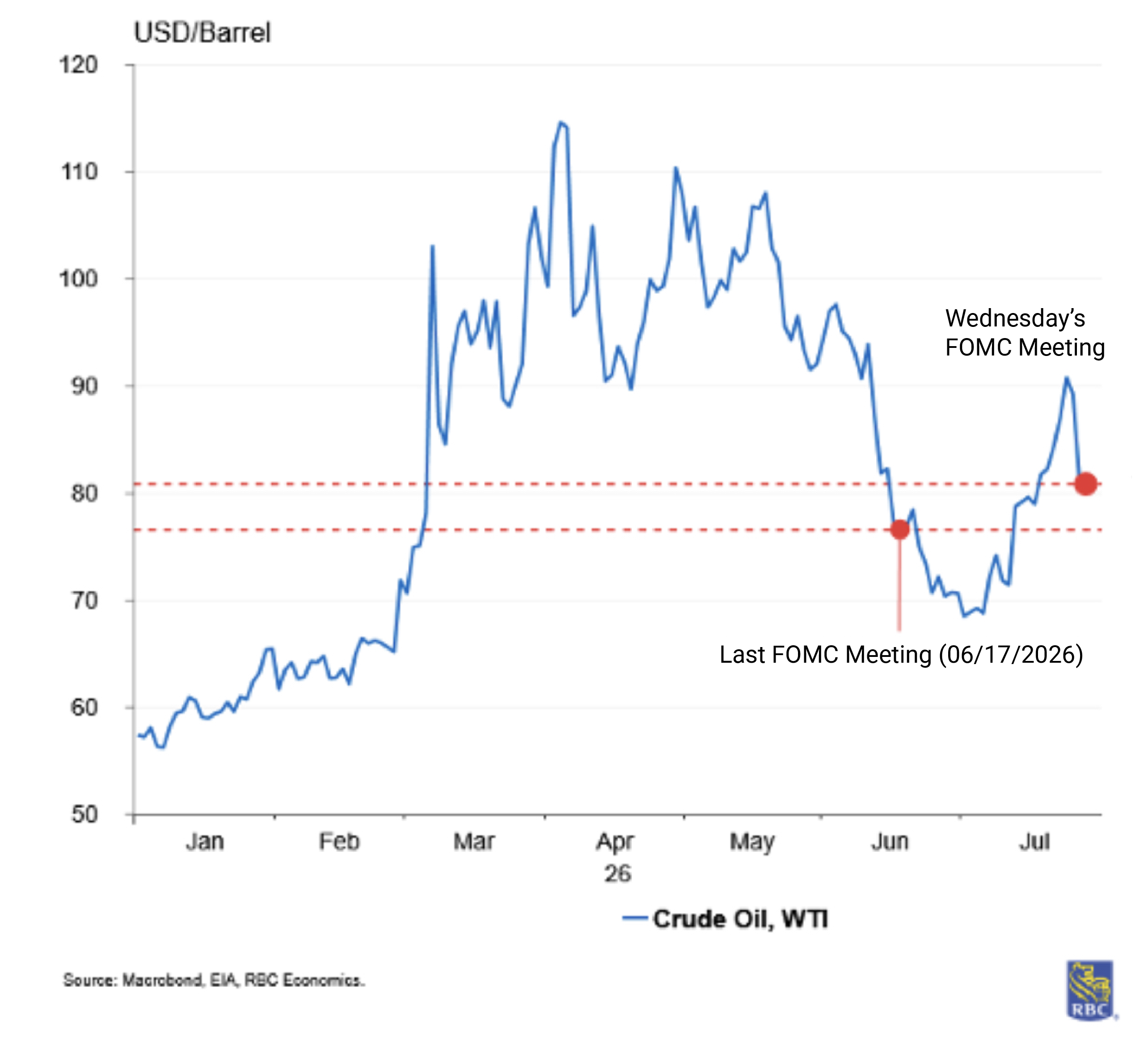
While the pace of inflation has slowed this year, prices are up nearly 30% since January 2020. Consumer staples including food and rent are up 34% and 33% respectively over the same period. More recently, oil prices reversed course – they are up nearly 5% since the June meeting and risk gas prices hovering around that psychologically important $4 per gallon level.
With the labor market on solid footings, many consumers have been able to keep up, but certainly not all. Consumer sentiment remains near record lows, and a growing divergence in the K-shaped economy suggests a growing share of consumers are falling behind on inflation. Indeed, the FOMC remains focused on bringing inflation back to its target, but acknowledges the long road ahead:
“Not one of my FOMC colleagues is under any illusion. We have begun a new chapter and we understand that the five-plus years of inflation above target cannot be cured in nine weeks or by a single month of modest price decreases.”
If it’s truly the case that the FOMC is concerned about the inflation past and future, then new Fed Chair Warsh is going to have to spend the next few FOMC meetings addressing why he remains so committed to addressing inflation, which is clearly problematic… by keeping monetary policy on hold.
Oil price volatility remains a risk to the U.S. inflation outlook
About the authors:
Mike Reid is Head of US Economics at RBC. He is responsible for generating RBC’s US economic outlook, providing commentary on macro indicators, and producing written analysis around the economic backdrop.
Carrie Freestone is a Senior US Economist at RBC. She is responsible for generating RBC’s US economic forecasts across GDP, employment, and inflation, and providing macro commentary through publications, presentations, and the media.
Imri Haggin is an US Economist at RBC, where he focuses on thematic research. His prior work has centered on consumer credit dynamics and treasury modeling, with an emphasis on leveraging data to understand behavior.
This article is intended as general information only and is not to be relied upon as constituting legal, financial or other professional advice. The reader is solely liable for any use of the information contained in this document and Royal Bank of Canada (“RBC”) nor any of its affiliates nor any of their respective directors, officers, employees or agents shall be held responsible for any direct or indirect damages arising from the use of this document by the reader. A professional advisor should be consulted regarding your specific situation. Information presented is believed to be factual and up-to-date but we do not guarantee its accuracy and it should not be regarded as a complete analysis of the subjects discussed. All expressions of opinion reflect the judgment of the authors as of the date of publication and are subject to change. No endorsement of any third parties or their advice, opinions, information, products or services is expressly given or implied by Royal Bank of Canada or any of its affiliates.
This document may contain forward-looking statements within the meaning of certain securities laws, which are subject to RBC’s caution regarding forward-looking statements. ESG (including climate) metrics, data and other information contained on this website are or may be based on assumptions, estimates and judgements. For cautionary statements relating to the information on this website, refer to the “Caution regarding forward-looking statements” and the “Important notice regarding this document” sections in our latest climate report or sustainability report, available at: https://www.rbc.com/community-social-impact/reporting-performance/index.html. Except as required by law, none of RBC nor any of its affiliates undertake to update any information in this document.

