

 EN
EN 


The path of the full yield curve can be as important as the BoC’s next policy move for the real Canadian economy.
The overnight rate (set by the BoC) matters for variable-rate mortgages and consumer credit. But, rising term yields are already reshaping fixed-rate borrowing for most households, businesses and governments in Canada, raising debt servicing costs.
While some of the rise in Canadian bond yields has been driven by global factors, the path for interest rates still also depends on domestic economic conditions. According to one common decomposition of bond yields, about 70% of the increase in ten-year government bond yields since last year was driven by higher expected short-term interest rates, and the rest by rising term premium.
This distinction is important. It means that much of the rise in term borrowing costs is tied to expectations that the BoC will hike interest rates in the year ahead. And, we continue to view those hikes as largely contingent on an improving economy.
In other words, interest rates rising should effectively be contingent on further improvement in borrowers’ ability to manage costs.
Debt service ratio set to rise again
Rising interest rates will likely mark an end of the improvement in Canadian household debt serviceability seen over the last two years stemming from moderating interest rates, lower household non-mortgage borrowing relative to pre-pandemic levels, and solid disposable income growth.
In Q2 2026, households’ debt payments as a share of disposable income, or the debt service ratio, fell to 14.5%— its lowest in four years. Part of the decline between Q1 and Q2 reflected a temporary income boost to households from Indigenous settlements and a one-time HST rebate set to unwind in Q3.
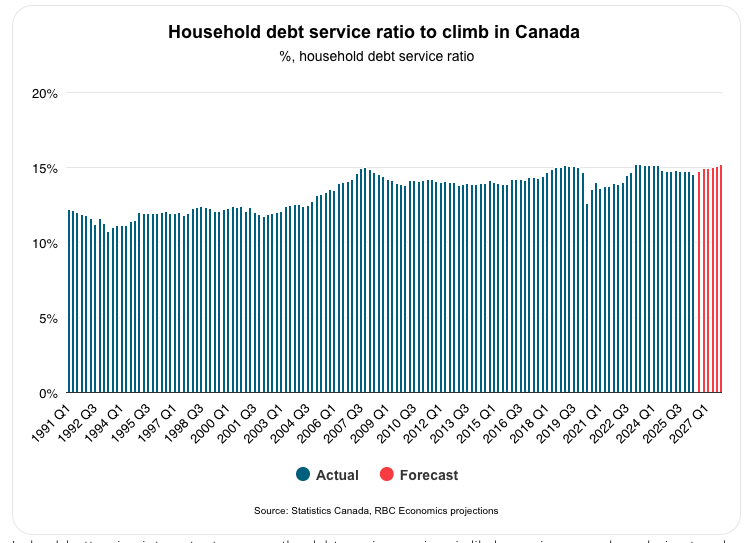
But bottoming interest rates mean the household debt service reprieve is likely nearing an end – echoing the tapering of housing affordability gains we’ve flagged in the past.
Heading into 2027, we expected growth in households’ debt payments will again begin to outpace growth in disposable income, pushing the debt service ratio gradually higher.
Higher rates impact some borrowers sooner than others
Households taking on new debt or facing imminent renewals will feel the impact of higher interest rates first, but eventually all borrowers will adjust. We saw this play out in real time when rapid rate hikes by the BoC in 2022–2023 triggered a wave of mortgage renewal concerns in subsequent years.
There remains a final cohort of five-year fixed-rate borrowers who locked in ultra-low rates in 2021–2022, but have yet to adjust to higher rates. Other three to four year shorter term fixed rate borrowers could still renew at lower rates compared to 2023.
Still, with existing borrowings continuing to renew and new borrowing added to the books at higher rates, effective borrowing rates on average across households should be trending upward, pushing debt service ratio higher despite relatively low overall households’ indebtedness (measured by debt to income).
Rising bond yields could be a larger issue for other regions and governments
Similarly, businesses and governments also face rising debt servicing costs with varying lags. And those that are more leveraged could be particularly sensitive. For governments, rising debt-servicing costs generally means one of three things: Spending cuts, tax hikes, or larger deficits.
Bond yields in recent months have risen more in France and the U.S., where concerns over fiscal sustainability are most acute. Rising interest rates feed into fiscal challenges as they materially worsen the debt-to-GDP trajectory in the U.S. from an already concerning baseline.
About the author:
Claire Fan is a senior economist at RBC. She focuses on macroeconomic analysis and is responsible for projecting key indicators including GDP, employment and inflation for Canada and the US.
This article is intended as general information only and is not to be relied upon as constituting legal, financial or other professional advice. The reader is solely liable for any use of the information contained in this document and Royal Bank of Canada (“RBC”) nor any of its affiliates nor any of their respective directors, officers, employees or agents shall be held responsible for any direct or indirect damages arising from the use of this document by the reader. A professional advisor should be consulted regarding your specific situation. Information presented is believed to be factual and up-to-date but we do not guarantee its accuracy and it should not be regarded as a complete analysis of the subjects discussed. All expressions of opinion reflect the judgment of the authors as of the date of publication and are subject to change. No endorsement of any third parties or their advice, opinions, information, products or services is expressly given or implied by Royal Bank of Canada or any of its affiliates.
This document may contain forward-looking statements within the meaning of certain securities laws, which are subject to RBC’s caution regarding forward-looking statements. ESG (including climate) metrics, data and other information contained on this website are or may be based on assumptions, estimates and judgements. For cautionary statements relating to the information on this website, refer to the “Caution regarding forward-looking statements” and the “Important notice regarding this document” sections in our latest climate report or sustainability report, available at: https://www.rbc.com/community-social-impact/reporting-performance/index.html. Except as required by law, none of RBC nor any of its affiliates undertake to update any information in this document.

