

 EN
EN 


The Bottom Line:
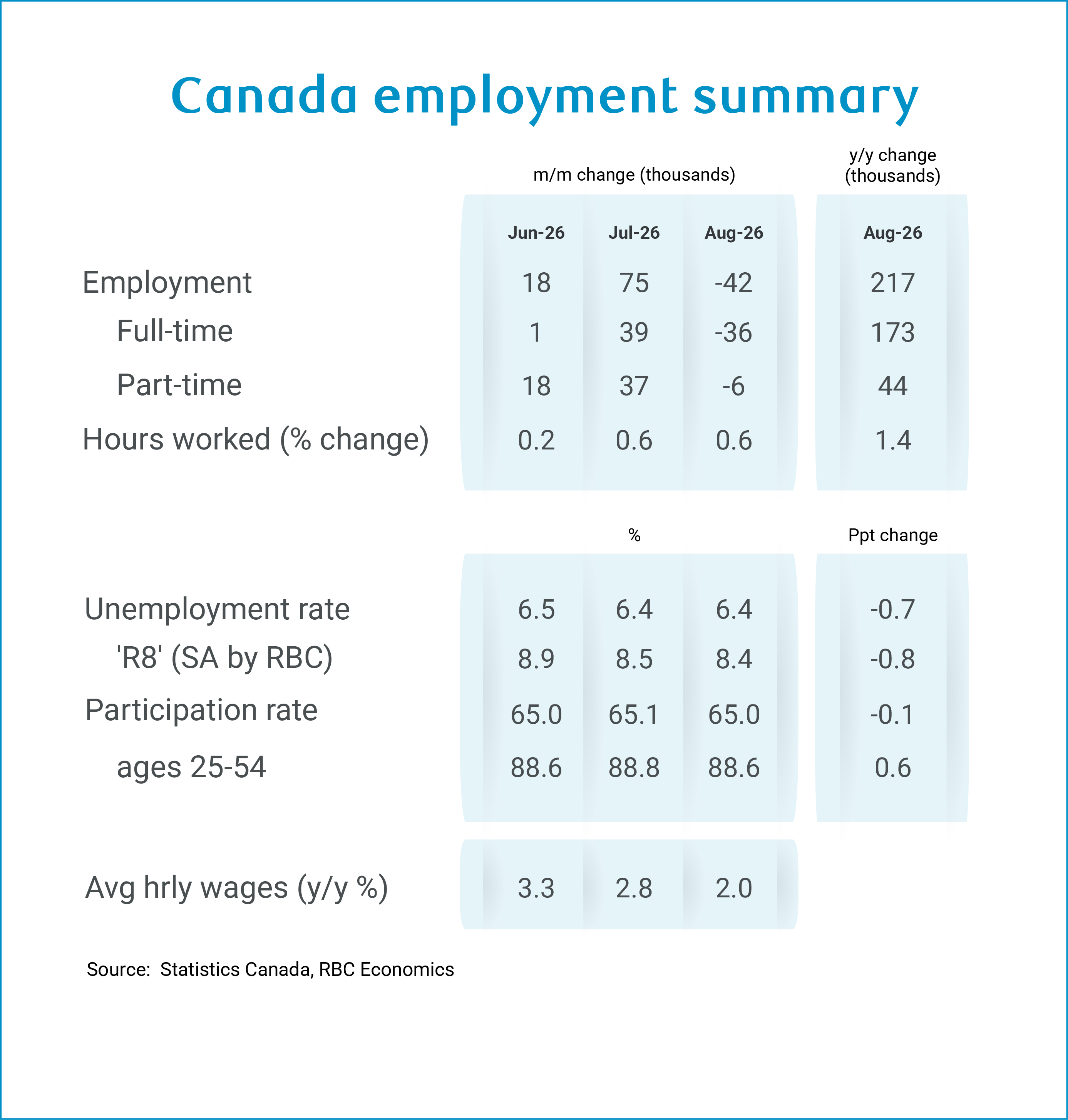
Canada’s labour market lost 42,000 jobs in August, partially reversing the 181,000 gain between May and July to leave year-to-date job growth at a smaller 27,000.
Headline job growth is notoriously volatile, and we continue to point to structural changes, including rising retirement from aging demographics and slowing population growth from weak immigration as bigger drivers behind dismal job growth in Canada this year.
As employment is impacted by those structural changes, we have been relying more on the unemployment rate as a better gauge of cyclical conditions. And today’s report reinforces that labour markets were improving year-to-date ahead of the latest round of U.S. tariffs that took effect last month.
In August, the unemployment rate held onto improvements in the prior months. It was unchanged at 6.4%, still elevated by historical standards but more than half a percentage point below the 7.1% reading a year ago.
Hours worked also saw strength, up another 0.6% in August to build on a similar sized gain in July, and leaving the Q3 quarter to-date annualized increase at an elevated 5%.
Statistics Canada noted higher layoff rate (0.9%) in sectors dependent on U.S. demand for exports in August, compared to other industries (0.7%). This is in line with our own analysis, that continues to expect U.S. tariffs will have pronounced, but targeted effect on Canada’s labour market –we estimated 0.4% of jobs are directly involved in producing the goods that are on the new Section 338 tariff lists.
The new tariffs were implemented too late in August to significantly impact this morning’s labour market data. Still, early signs including job openings from Indeed.com have not flagged a significant pullback in hiring demand in the wake of those measures.
Near-term labour market impacts will be watched closely but we continue to expect solid domestic demand, as was seen in GDP data in Q2 will support further labour market improvement into 2027.
The details:
-
Employment declined 42,000 in August, mostly in full-time employment (-36,000) and entirely among services-producing sectors (-52,000).
-
The monthly labour market data is notoriously volatile and the August job decline followed sizable increases the prior three months. Year-to-date, employment is up 27k in 2026, led by a 46k increase in full-time jobs.
-
Job losses in August were widespread across services industries but most notable in business, building and other support services (-20,000). Manufacturing led the offset with a 22,000 job gain in August.
-
The unemployment rate held steady at 6.4% following three consecutive monthly declines earlier. Among the unemployed, there was a slight increase in permanent layoffs in August with offset from a decline in labour market entrants.
-
The labour force participation rate ticked lower to 65%, around levels that are the lowest since the 1990s as retirement accelerates to reduced available labour supply relative to the total population.
-
Weak immigration is stalling population growth in Canada. In August, LFS estimated population was up about half a percent from last year in August, well below the 1.9% pace observed in August 2025 and 3.5% pace in August 2024.
-
Those estimates also continue to lag the slowing reported in the official demographic statistics, that noted year over year declines in population over Q4 2025 and Q1 2026.
-
Total hours worked were up another 0.6% in August, and 5% on a quarter-to-date annualized basis in Q3. This suggests at least some of the GDP momentum in Q2 was carried over into the third quarter.
-
Wage growth normalized substantially in August, up 2% from last year that was the slowest in five years. Overall, month wage numbers can be volatile but we continue to expect normalization on balance, due mostly to current excess labour supply reducing the need among businesses to compete for workers.
-
Regionally, the employment loss was concentrated in Quebec and Ontario. Quebec experienced the steepest decline, shedding 19,000 jobs in August and marking the only province to report a year-over-year employment loss (-54,000), though its unemployment rate held steady at 5.6%.
-
Ontario saw employment fall 18,000 (-0.7%), with the unemployment rate edging higher from 6.8% to 6.9%. British Columbia and Alberta posted more modest declines, the former seeing its unemployment rate climb from 6.2% to 6.5%. Elsewhere, employment was little changed.
About the author:
Claire Fan is a Senior Economist at RBC. She focuses on macroeconomic analysis and is responsible for projecting key indicators including GDP, employment and inflation for Canada and the US.
This article is intended as general information only and is not to be relied upon as constituting legal, financial or other professional advice. The reader is solely liable for any use of the information contained in this document and Royal Bank of Canada (“RBC”) nor any of its affiliates nor any of their respective directors, officers, employees or agents shall be held responsible for any direct or indirect damages arising from the use of this document by the reader. A professional advisor should be consulted regarding your specific situation. Information presented is believed to be factual and up-to-date but we do not guarantee its accuracy and it should not be regarded as a complete analysis of the subjects discussed. All expressions of opinion reflect the judgment of the authors as of the date of publication and are subject to change. No endorsement of any third parties or their advice, opinions, information, products or services is expressly given or implied by Royal Bank of Canada or any of its affiliates.
This document may contain forward-looking statements within the meaning of certain securities laws, which are subject to RBC’s caution regarding forward-looking statements. ESG (including climate) metrics, data and other information contained on this website are or may be based on assumptions, estimates and judgements. For cautionary statements relating to the information on this website, refer to the “Caution regarding forward-looking statements” and the “Important notice regarding this document” sections in our latest climate report or sustainability report, available at: https://www.rbc.com/community-social-impact/reporting-performance/index.html. Except as required by law, none of RBC nor any of its affiliates undertake to update any information in this document.

