

 EN


Budget 2026 delivers a familiar formula: big new spending offset by an improved baseline, leaving the bottom line and fiscal anchors on track.
The Carney government’s $500 billion private investment goal gets a push from the Productivity Mega Deduction, funding under the National Electricity Strategy, and a range of supporting measures. But budget 2026 does not mark a strategic departure or deliver new signature wins on major projects and defence — nor did we expect it to, given the long lead time to bring these initiatives to fruition.
Otherwise, budget 2026 dedicates significant funding for major social infrastructure and affordability measures, especially Indigenous funding, non-market housing, and one-time direct cost-of-living supports. In total, half of the budget’s $150 billion in new measures is for day-to-day, not capital spending.
This raises the stakes on the government’s fiscal strategy. Growth dividends from the investment agenda remain longer dated and uncertain.
Materially increasing day-to-day spending now to address affordability issues may reduce capacity to take on future investments, especially while other major (implicit) fiscal commitments around defence, health and childcare loom.
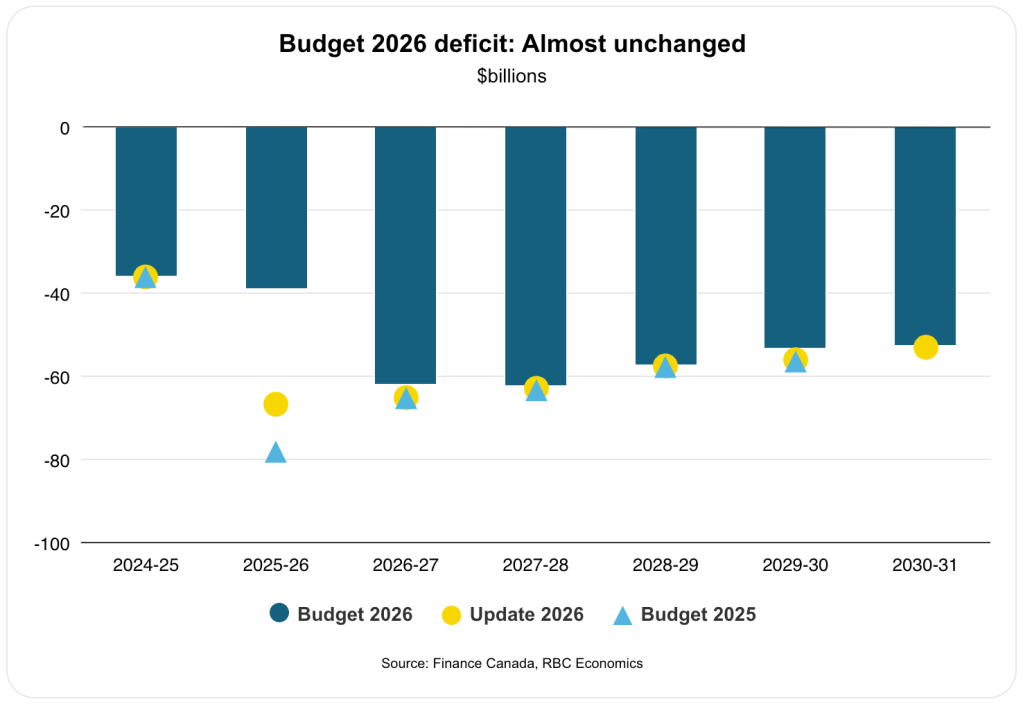
Deficits stable after big 2025-26 improvement but spending is still high
Budget 2026’s deficit path delivered a big surprise versus our preview, basically flat versus the spring update from 2026-27 on, thereby preserving the declining deficit-to-GDP ratio.
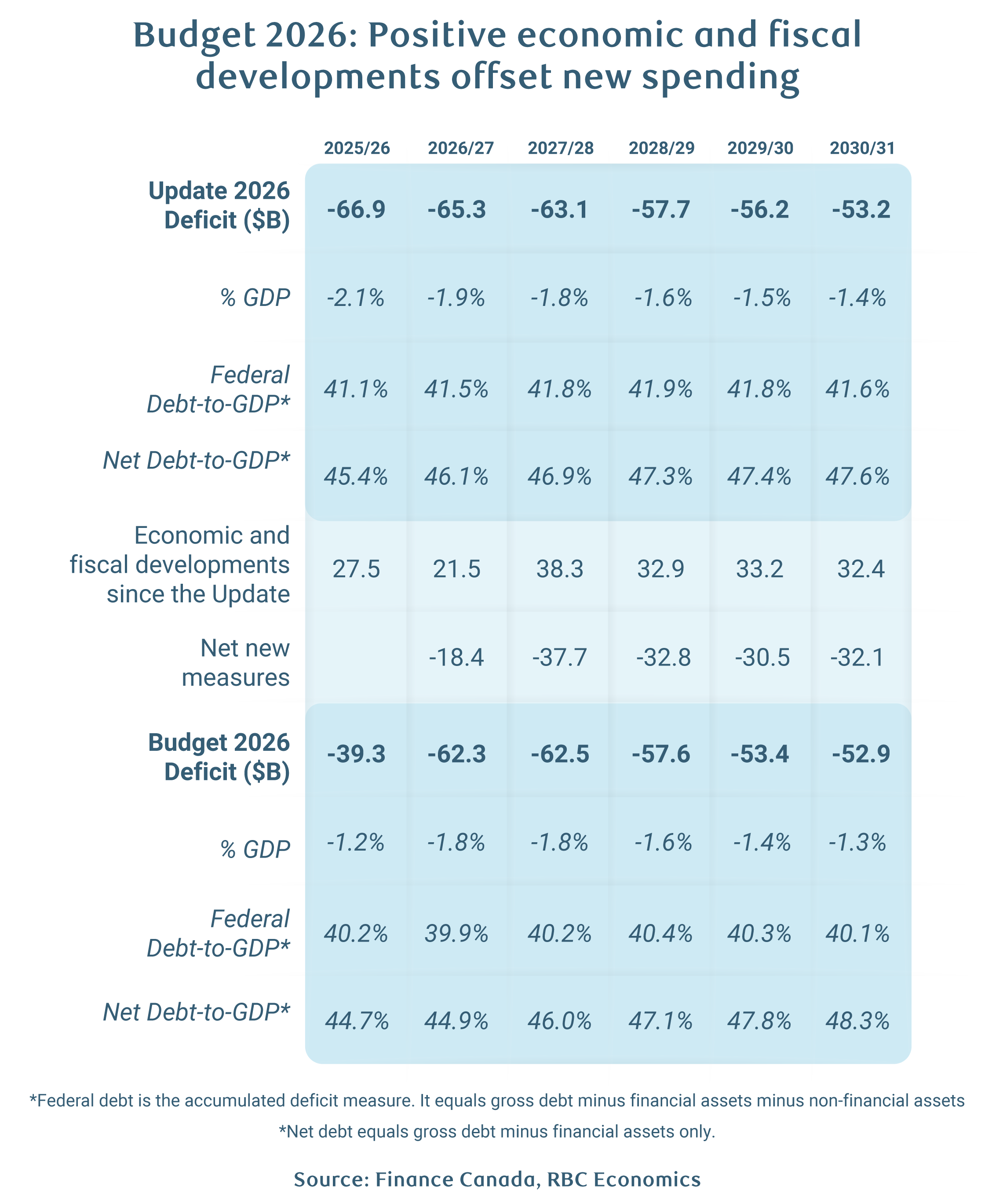
At $39 billion the preliminary 2025-26 number is almost $30 billion better than the update’s $67 billion projected deficit. A much smaller 2025-26 deficit was our suspicion for most of the year – fiscal monitor tracking for even the first 11 months of the year showed a cumulative deficit of only $25.6 billion – before March’s monitor revised it up to $55.3 billion. Major year end adjustments clearly reversed course, linked to higher year-end tax receipts.
In a rerun of the update, though, a mostly unchanged go-forward deficit profile does not mean restrained new spending. Instead, $158 billion in positive economic and fiscal developments over the 5 years from 2026-27, are matched with $152 billion in new spending.
Fiscal anchors
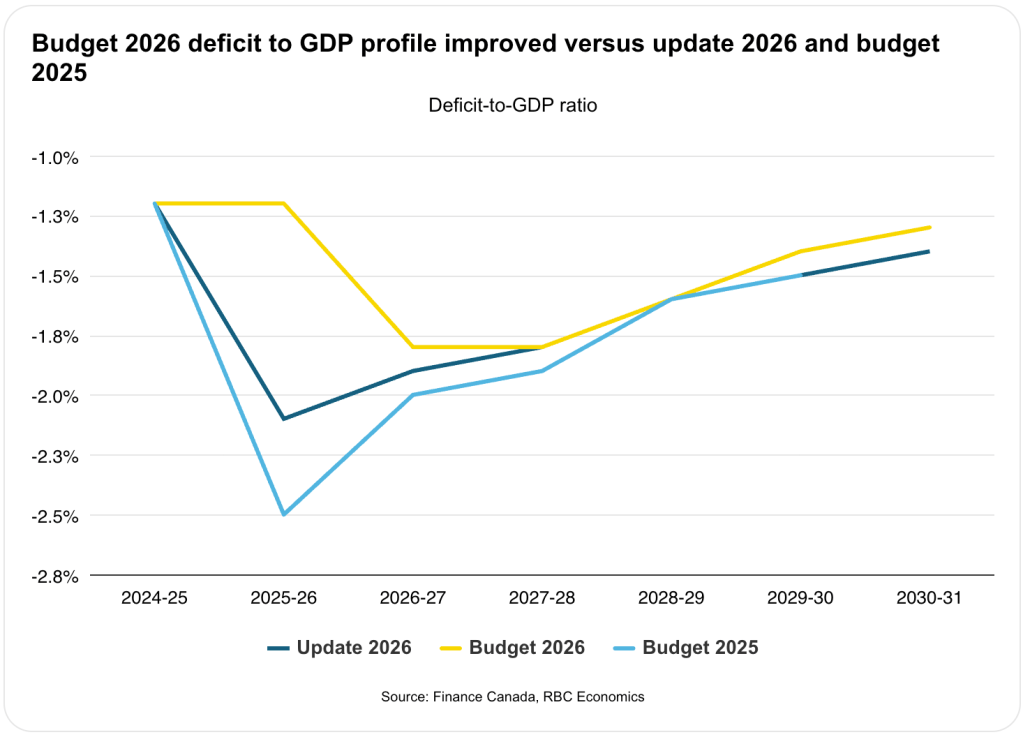
Ottawa has set two fiscal anchors – i) a declining deficit-to-GDP ratio; and, ii) balancing the operating budget by 2028-29 – as well as an overarching fiscal objective to attract $500 billion in private investment ($1 trillion total) over 5 years.
Per above, anchor i) continues to be met with budget 2026 showing an improved profile, and end point, versus both the spring update and budget 2025.
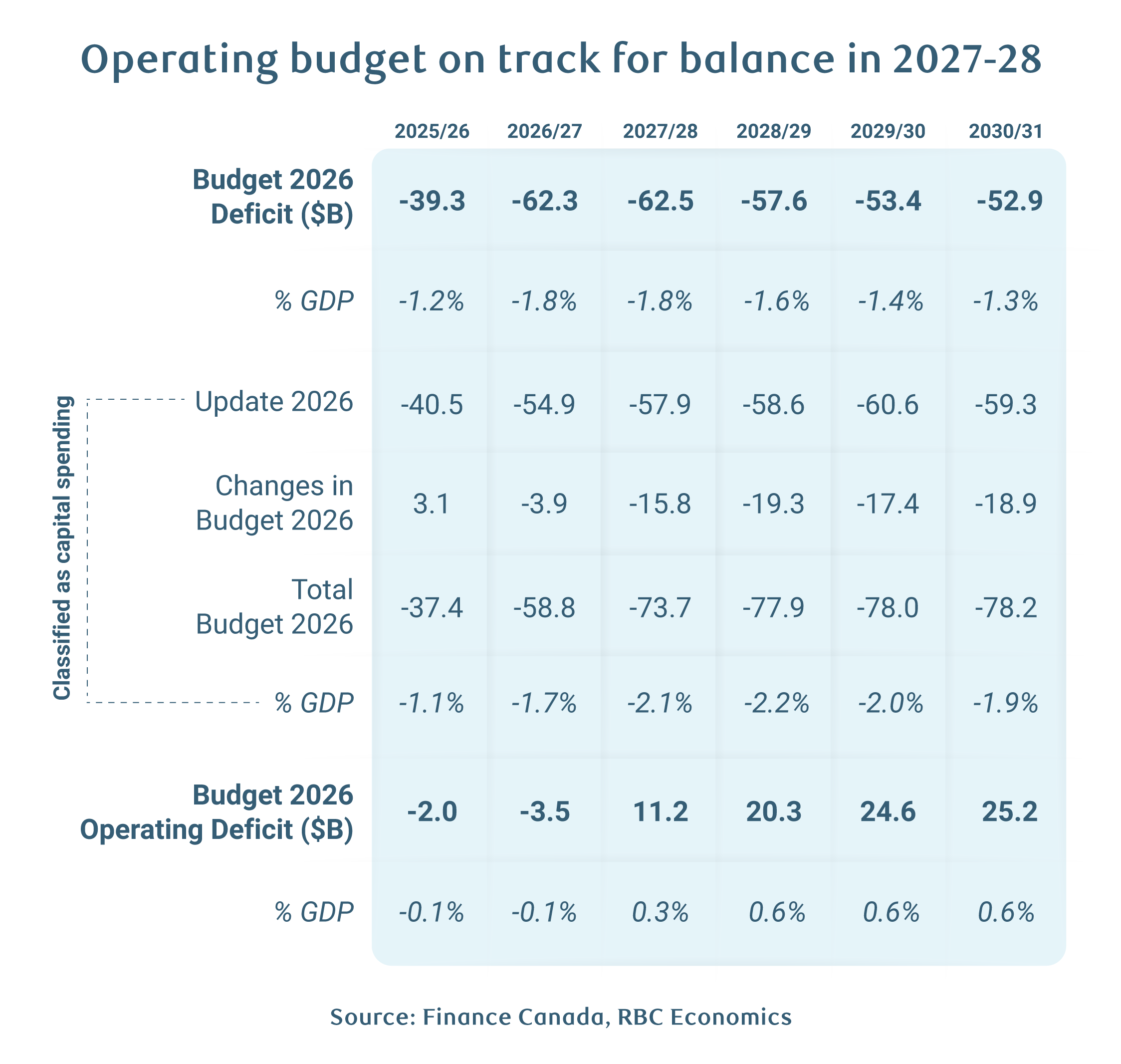
Based on the budget’s capital tables, half of new spending in Budget 2026 qualifies as capital under the government’s definition (the budget says that two-thirds of new measures support growth and investment). Budget 2026 continues to meet anchor ii), with a balanced operating budget expected one year early in 2027-28.
Budget 2026 reiterates Ottawa’s focus on and tracking toward the $500 billion goal.
Debt & borrowing requirement
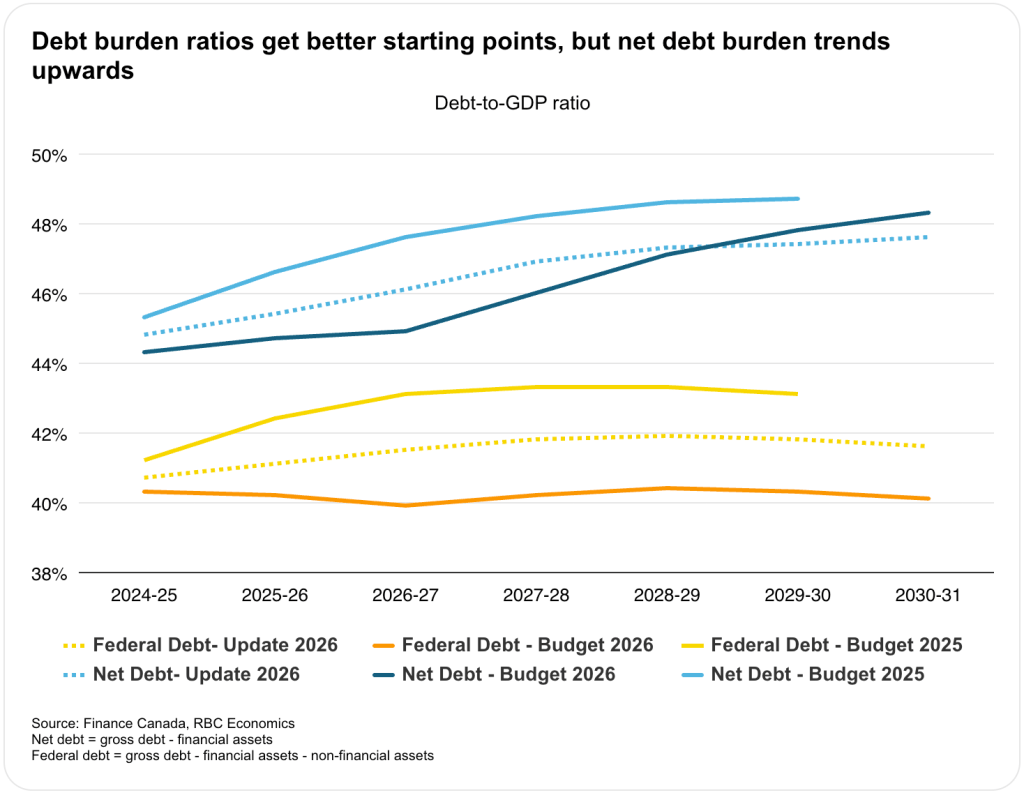
The federal debt-to-GDP ratio – Ottawa’s favoured debt burden ratio that excludes both financial and non-financial assets from gross debt– gets a better starting point from higher baseline nominal GDP, staying below both the spring update and budget 2025 profiles throughout the projection period. It remains flat throughout, without any turn downward until the mid-2030s in Ottawa’s baseline long-term projections, the same as before.
In partial contrast, the net debt burden – gross debt minus financial assets only and of particular interest to investors and credit rating agencies – trends upwards from 2026-27 onwards. But with a better starting point, it ends up only slightly higher versus the spring update in 2030-31.
The differing trajectory is related to Ottawa’s borrowing to fund non-financial assets.
Ottawa’s cumulative 5-year financial requirement between 2026-27 and 2030-31 now looks to come in at $765 billion, up across each year by an average of $19 billion versus the spring update. The biggest driver is higher outlays for acquisition of non-financial assets, especially in defence. Higher projected Crown borrowing and settlements related to contingent liabilities also play a role.
Borrowing plan
There were no changes to planned Government of Canada bond issuance in FY26/27 at C$298bn. This means the current pace of bond issuance should be maintained over the remainder of the fiscal year. The higher financial requirements in FY26/27 are funded with a C$16bn increase in the planned treasury bill stock as of 31 March 2027 to C$284bn.
For FY27/28, bond issuance is increased by C$18bn to C$316bn, with 2y and 5y issuance raised, while 10y and 30y issuance were held steady. The bill stock is projected by the budget to rise by a further C$6bn in FY27/28, to C$290bn by 31 March 2028.
– Simon Deeley, Canadian Rates Strategist
Revenue & Spending
The positive economic and fiscal developments that offset new spending are attributed ~70% to higher revenues – mostly income taxes because of higher oil prices and carry-forward of a stronger 2025-26 baseline.
The remaining 30% is from lower direct program expenses, reduced by an average $12.4 billion per year. This is attributed to a better assessment of timing and take-up across a broad range of federal non-capital spending. While some of this may be delays in recent initiatives, it is applied to the whole expense category – which grew strongly in recent years- and is pitched as a permanent downward adjustment in the direct program expense profile.
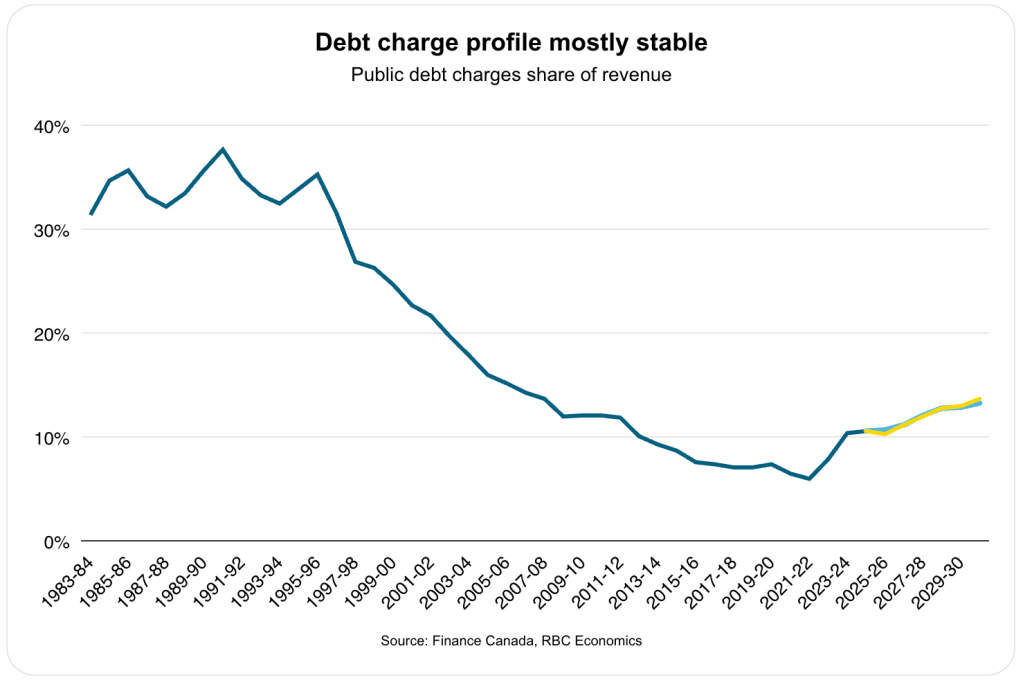
Public debt charges follow substantially the same profile as in the spring update, trending upwards over the projection period.
New measures
Budget 2026 pairs major new incentives for private investment – notably the mega deduction – with a lot of social infrastructure and affordability supports.
Measures with biggest 5-year fiscal cost
-
$36 billion – Productivity Mega Deduction
As expected, Budget 2026’s biggest measure was the corporate tax mega deduction.
Ottawa’s headline tax measure for helping small business – the Canada Growth Incentive tax exemption for capital gains and rollover of capital gains tax liability – has only moderate fiscal cost. The budget also includes a bunch of tax simplification measures.
-
$27 billion – Advancing reconciliation with Indigenous Peoples
While the budget narrative does not highlight this major new commitment, budget 2026 includes at least $12 billion to Indigenous infrastructure, especially clean water, as well as housing and other infrastructure in First Nations communities. The remainder targets education, children and families, and health and safety.
-
$16 billion – Housing and related supports
Housing, in particular non-market, gets a focus with a new goal of ending homelessness within 10 years. About $11 billion is provided to Build Canada Homes for a new fund pairing wrap around health and social supports with housing, funding the capital of new provincial/territorial supportive and transition funding, and renewing the Canada Housing Benefit.
Build Canada Homes also gets a $13 billion cash boost over 10 years starting in 2028-29 to expand non-market housing, although the accrual impact is expected to be less, and further commitments to provide federal lands for housing.
Despite the major new commitments, the budget is silent on whether this constitutes the new National Housing Strategy (the old one expires in 2027-28) and how overall federal support for housing will evolve versus the declining profile previously predicted by the Office of the Parliamentary Officer.
-
$14 billion – Direct affordability supports
This includes a mix of previously announced and new measures. New is a further 2027 one-time 50% top up to the Groceries and Essentials Benefit (ie., the former GST/HST credit), costing almost $5 billion over 5 years. Otherwise, extension of the federal fuel tax reduction, stabilization funding for national childcare, and funding for new heat pump retrofit programs – all previously announced – largely make up the balance.
-
$11 billion – Supporting workers and businesses
Previously announced tariff relief and diversification initiatives.
-
$9 billion – Powering Canada Strong (National Electricity Strategy)
The budget trumpets $50 billion in federal funding to 2050 for the National Electricity Strategy released in May, with most of this total likely attributed to previously announced clean tax credits. Fiscal costs booked in the budget are for expanded eligibility of these clean tax credits and their extension to 2040 (previously expiring in 2034), specific electricity infrastructure and projects, and EV charging infrastructure.
-
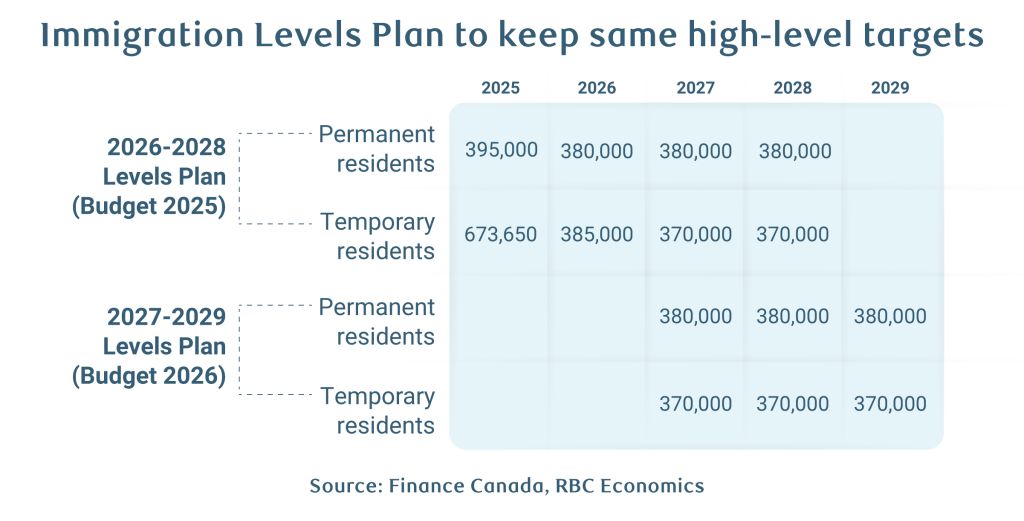
Non-budgetary: Immigration Levels Plan 2027-2029
Although the budget notes the plan will maintain the same high-level targets, there appears to be a repeat of last year in a one-off admittance category that could transition an additional 200,000 temporary residents to permanent. While this appears to be a material loosening of permanent resident targets (even higher than levels plans at the height of the population surge), we’ll provide a full analysis soon of the Plan published in parallel.
As for temporary residents – the main reason for the surge – budget 2026 holds inflows constant but does not say anything the timeline to meet the prior 5% population share target. Statistics Canada recently released population data revisions showing a slower pace of temporary resident exits.
About the authors:
Cynthia Leach is the Assistant Chief Economist at RBC with a focus on federal and provincial fiscal analysis, government policy, demographics, and other thematic research.
Salim Zanzana is an economist at RBC. He focuses on emerging macroeconomic issues, ranging from trends in the labour market to shifts in the longer-term structural growth of Canada and other global economies.
This article is intended as general information only and is not to be relied upon as constituting legal, financial or other professional advice. The reader is solely liable for any use of the information contained in this document and Royal Bank of Canada (“RBC”) nor any of its affiliates nor any of their respective directors, officers, employees or agents shall be held responsible for any direct or indirect damages arising from the use of this document by the reader. A professional advisor should be consulted regarding your specific situation. Information presented is believed to be factual and up-to-date but we do not guarantee its accuracy and it should not be regarded as a complete analysis of the subjects discussed. All expressions of opinion reflect the judgment of the authors as of the date of publication and are subject to change. No endorsement of any third parties or their advice, opinions, information, products or services is expressly given or implied by Royal Bank of Canada or any of its affiliates.
This document may contain forward-looking statements within the meaning of certain securities laws, which are subject to RBC’s caution regarding forward-looking statements. ESG (including climate) metrics, data and other information contained on this website are or may be based on assumptions, estimates and judgements. For cautionary statements relating to the information on this website, refer to the “Caution regarding forward-looking statements” and the “Important notice regarding this document” sections in our latest climate report or sustainability report, available at: https://www.rbc.com/community-social-impact/reporting-performance/index.html. Except as required by law, none of RBC nor any of its affiliates undertake to update any information in this document.

