

 EN
EN 


The Bottom Line:
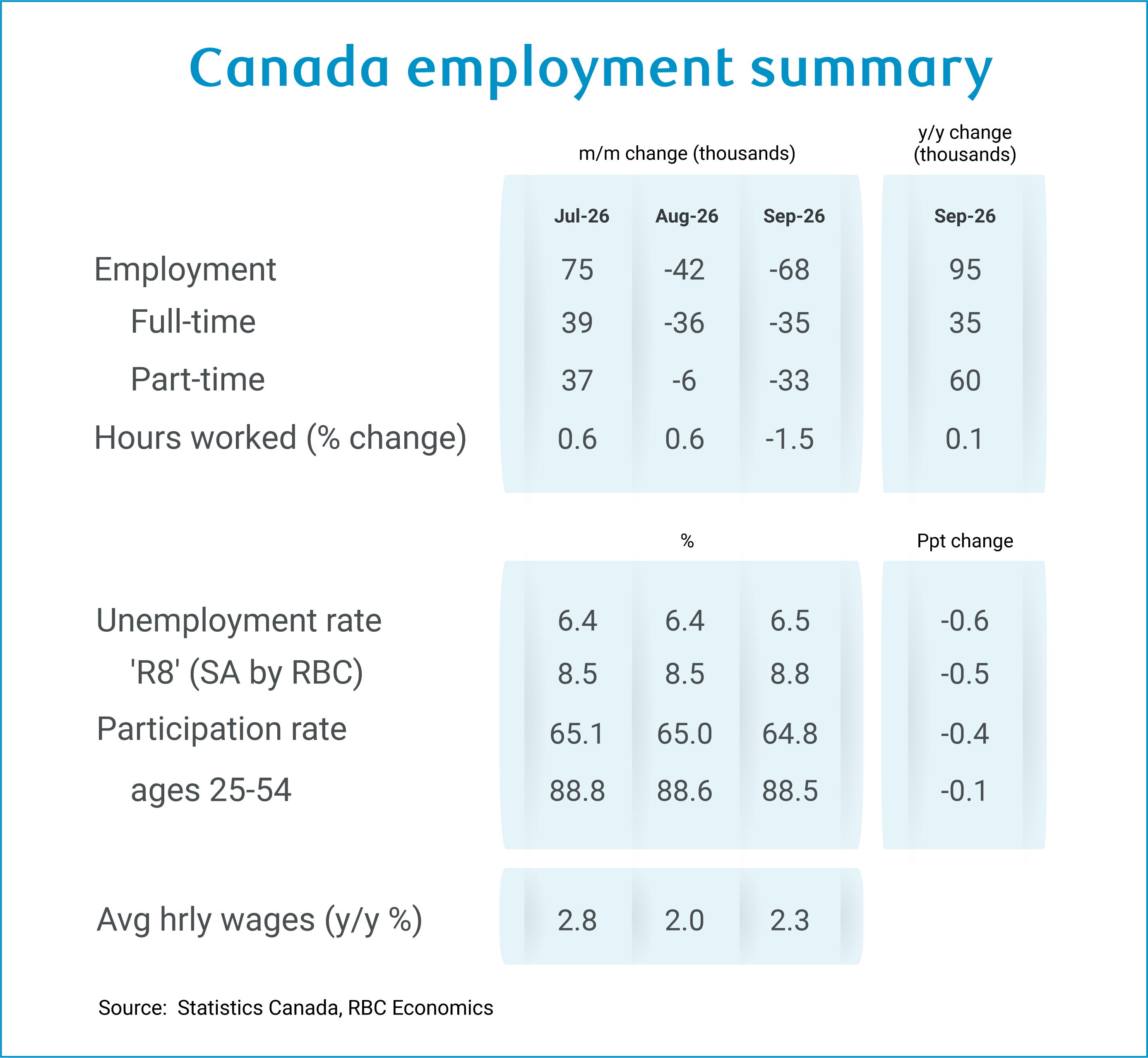
Canada’s labour market lost 68,000 jobs in September, driven by losses in public sectors (education and health care), piling onto the 42,000-job loss in the prior month. These losses reversed most of the job growth seen over the summer and leave the year-to-date employment count at -41,000.
The monthly employment counts are notoriously volatile, and there are reasons not to read too much into the softer reading too quickly. In September, 70%, or 48,000, of the decline in employment was among those aged 15 to 24, a group that typically sees seasonal headwinds around this time of year after the school year starts. The unemployment rate, as a more stable and reliable gauge of labour market conditions, ticked up slightly from 6.4% to 6.5% but remained 0.6 percentage points below a year ago.
Looking ahead, we continue to point to important leading indicators such as job openings from Indeed.com as indications that hiring demand has not retreated to a problematic extent since new U.S. tariffs (that cover a small scope of Canadian exports) were imposed. We expect progress made in Canada’s labour market earlier will be largely sustained, and the unemployment rate to broadly edge lower through the end of 2026.
The details:
-
Employment declined 68,000 in September, with losses split evenly between full-time (-35,000) and part-time jobs (-33,000) but largely accounted for by younger Canadians between the ages of 15 and 24.
-
Notable job losses were in education services (-35,000) and health care and social assistance (-23,000). Education has seen persistent losses that drove employment in the sector 67,000 below levels a year ago, whereas health care and social assistance are still seeing net job growth (+93,000) on a year-over-year basis. Manufacturing jobs mostly held steady amid new U.S. tariffs.
-
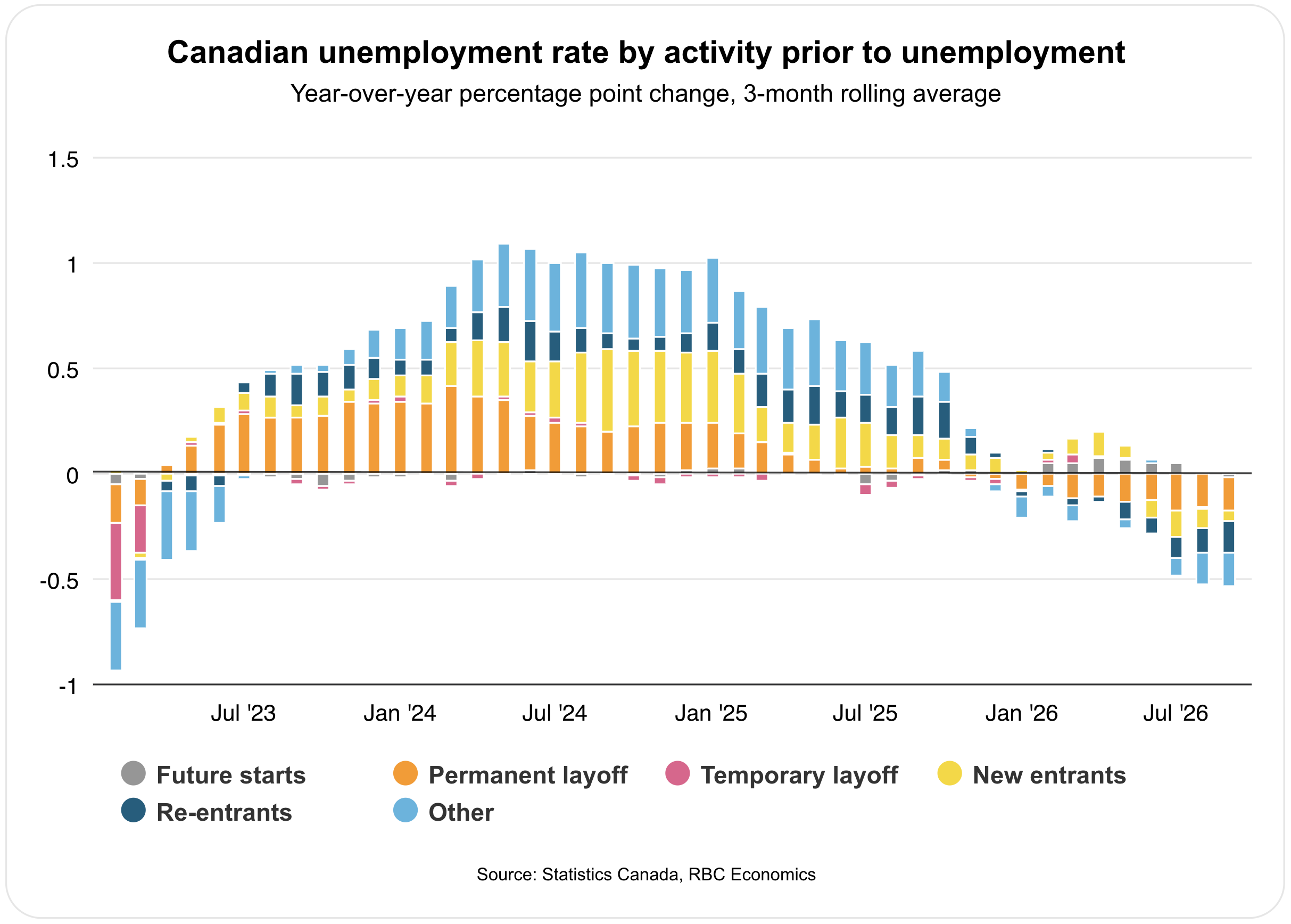
The unemployment rate ticked higher to 6.5% in September, still well below the 6.9% 2026 high in April, and the 7.1% reading in September a year ago. All sub-categories contributed to the year-over-year decline in overall unemployment, including fewer permanent layoffs and labour market entrants.
-
Still, there was another increase in permanent layoffs on a month-over-month basis in September that pushed this group as a share of overall unemployment to closer to a quarter.
-
The labour force participation rate declined in September to extend a longer-run trend shaped by aging population. The 64.8% reading in September is the lowest since May 1997 (outside of the pandemic years). Rising retirement and weaker immigration (among whom participation rate is typically higher) remain main accelerants that are reducing available labour supply relative to the total population.
-
Total hours worked declined a larger 1.5% in September following four consecutive months of stronger increases. On a quarter-to-quarter annualized basis, hours worked were still up 3.2% in Q3.
-
Wages were up 2.3% from last year, between the 2% reading in August and 2.8% in July. Directionally, we continue to expect wage growth to moderate following persistent slack in the labour market.
-
Regionally, the employment decline was concentrated in Quebec where 49,000 jobs were shed (37,500 of which were in educational services). That brings total employment losses in the province year-to-date to around 130,000 and the unemployment rate up 0.4ppts to 6%—the highest since April.
-
British Columbia and Ontario also posted declines of 20,000 each, with unemployment rates little changed at 6.4% and 7%, respectively. Alberta bucked the trend, with employment rising 23,000 (+76,000 year-over-year) and the unemployment rate falling from 6.8% to 6.4%.
About the author:
Claire Fan is a Senior Economist at RBC. She focuses on macroeconomic analysis and is responsible for projecting key indicators including GDP, employment and inflation for Canada and the US.
This article is intended as general information only and is not to be relied upon as constituting legal, financial or other professional advice. The reader is solely liable for any use of the information contained in this document and Royal Bank of Canada (“RBC”) nor any of its affiliates nor any of their respective directors, officers, employees or agents shall be held responsible for any direct or indirect damages arising from the use of this document by the reader. A professional advisor should be consulted regarding your specific situation. Information presented is believed to be factual and up-to-date but we do not guarantee its accuracy and it should not be regarded as a complete analysis of the subjects discussed. All expressions of opinion reflect the judgment of the authors as of the date of publication and are subject to change. No endorsement of any third parties or their advice, opinions, information, products or services is expressly given or implied by Royal Bank of Canada or any of its affiliates.
This document may contain forward-looking statements within the meaning of certain securities laws, which are subject to RBC’s caution regarding forward-looking statements. ESG (including climate) metrics, data and other information contained on this website are or may be based on assumptions, estimates and judgements. For cautionary statements relating to the information on this website, refer to the “Caution regarding forward-looking statements” and the “Important notice regarding this document” sections in our latest climate report or sustainability report, available at: https://www.rbc.com/community-social-impact/reporting-performance/index.html. Except as required by law, none of RBC nor any of its affiliates undertake to update any information in this document.

