

 EN



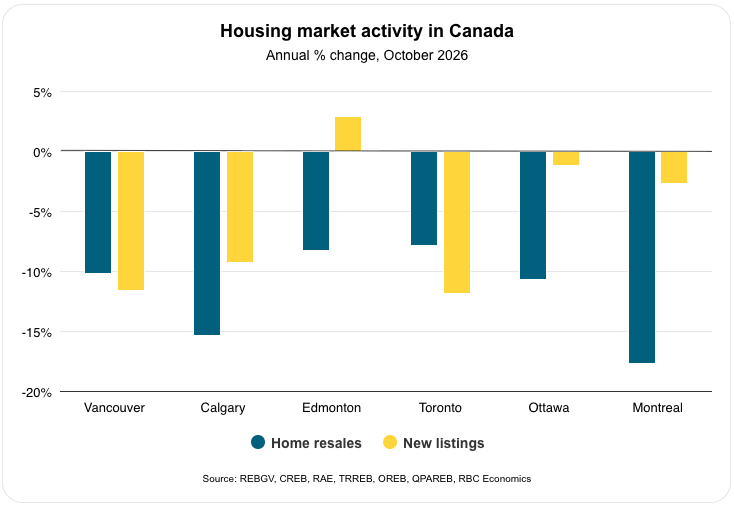
The housing market recovery in Canada is shaky at best this fall. Early October data in major urban areas show minimal sales momentum once again in most cases, and flat or declining home values.
Elections in B.C. and Quebec, and a referendum in Alberta no doubt crowded lawn signs and diverted attention in what is traditionally the second busiest house hunting season.
Recent escalation in the trade war with the United Sates, rising long-term interest rates and lower immigration also appear to be weighing heavily on the minds of many buyers and sellers.
Still, the market is on the rails for now. A majority of local real estate boards reported a seasonally adjusted sales increase in October from September (including Vancouver, Fraser Valley, Edmonton, Regina, Hamilton, Toronto and Ottawa).
It’s just that we aren’t seeing much vigour with levels generally remaining weaker than a year ago—with some exceptions in the Prairies.
Activity in Calgary, Saskatoon, Winnipeg and Montreal softened further last month.
On the positive side, the risk of oversupply is diminishing. Inventory continues to gradually shrink in markets where it had become abundant like Vancouver, Fraser Valley, Toronto and Hamilton.
Inventory is still rising in Montreal, Quebec City and Ottawa though, but from previously low marks.
Rebalancing supply and demand is dampening the rate of home price declines in Vancouver, Fraser Valley, Toronto and Hamilton, and moderating increases in Saskatchewan, Manitoba, Montreal and Quebec City.
We remain of the view that recovery will prevail across Canada despite current headwinds. Generally, we expect improving affordability and a resilient economy will progressively unlock pent-up demand. But, the road ahead is likely to be bumpy and uneven.
Toronto area: Marginal progress towards recovery
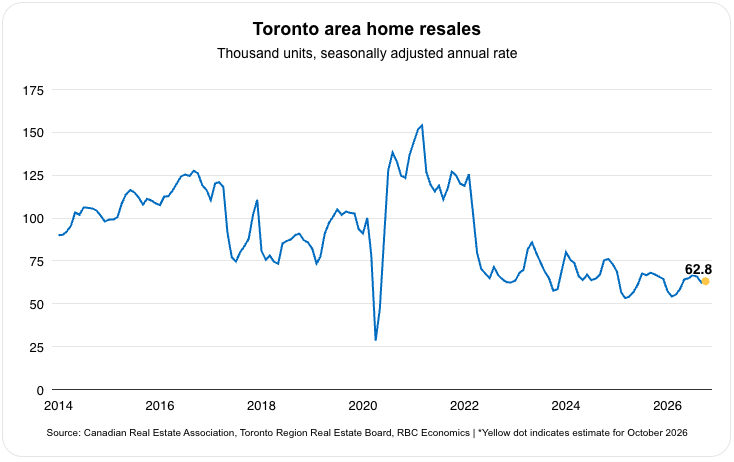
Upticks of 1.2% in home resales and 0.1% in the MLS Home Price Index in October from September barely move the needle when it comes to progress toward recovery in the Toronto area.
Activity and home values still undershoot year-ago levels by wide margins of -7.9% and -4.3%, respectively.
The budding rally that emerged earlier this year has floundered since August amid renewed trade war concerns, rising long-term interest rates and stalling population growth.
One positive development that’s been sustained, though, is the drawing down of inventory. Active listings continue tracking below a year ago (down 10% in October), thanks in part to fewer sellers entering the market.
That’s a trend worth monitoring closely, because further declines are necessary for home values to eventually stabilize.
An abundance of condo apartments for sale remains—accounting for nearly a third of listings. This sustains heavier downward price pressure with the condo index falling 7.3% from a year ago, compared to a 4.4% drop for the single-detached index.
Montreal area: Resilience tested
It seems many sellers took a pass at entering the market in October when the provincial election made it an inopportune time to list in Montreal.
We estimate new listings dropped a sizable 7% seasonally adjusted from September, and came in below a year ago (-2.7%) for the first time since December 2025—clearly breaking from strong seller influxes since the beginning of the year.
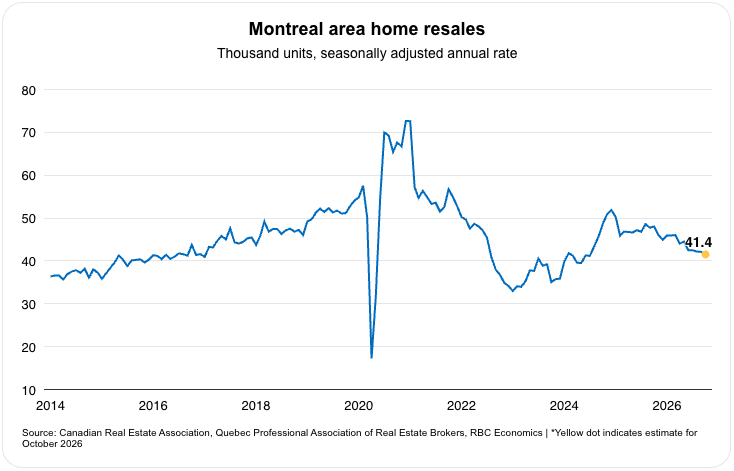
Buyers also held back, causing resales to fall for the fifth consecutive month to the lowest since July 2024.
Montreal’s resilience is being tested. Activity is now down 20% since reaching a post-pandemic peak at the end of 2024.
Inventory is also on the rise. Homes for sale are at their highest level since 2019, up 18% from a year ago.
This has helped rebalance what was previously tight supply to demand and significantly dialled down the heat on prices.
Cooling is most evident in the condo segment where median prices have barely budged in the past year (up just 0.3%).
Single-family homes show slightly more appreciation with the medium value rising 1.3%.
We expect stretched affordability, stalling population growth and rising long-term interest rates will contain housing demand ahead.
Vancouver area: Many distractions, few signs of turnaround
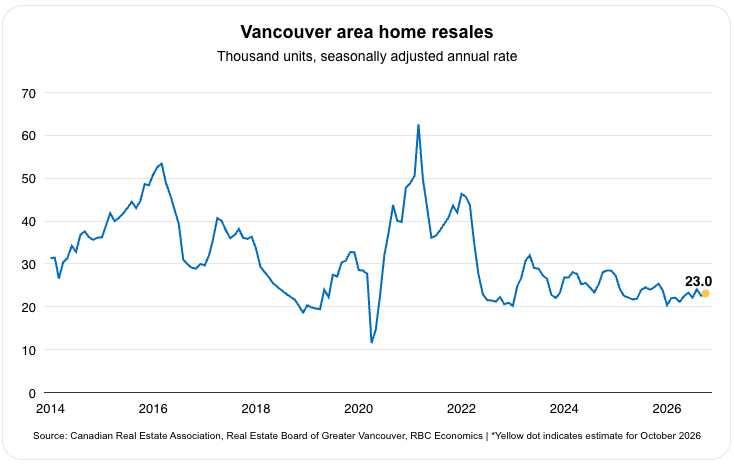
The state of the Vancouver market remains generally soft with home resales almost 30% below pre-pandemic levels in October, and prices continuing to fall 5.2% from a year ago.
But, more transactions took place last month than September (up an estimated 2.5% seasonally adjusted). That’s despite local and provincial elections creating many distractions and some interest rates rising, which we take as further evidence that activity is still on a (very) slow recovery path.
We see persistent price declines helping to gradually unlock pent-up demand. But, the impact on affordability so far has been insufficient for many sidelined buyers to consider making a move, especially when the economic context remains uncertain.
Nonetheless, the easing trend in home values is likely to be sustained near term amid abundant inventory and fierce seller competition, supporting further (albeit mild) affordability relief.
Active listings have dropped for six consecutive months, but they’re still close to a decade high.
Calgary: In balance
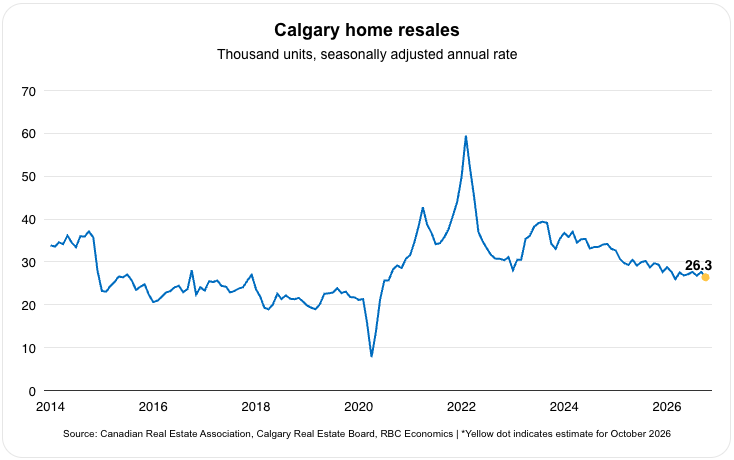
October showed further signs of stabilization in Calgary. An estimated 4% dip (seasonally adjusted) in resales from September reversed a similar gain the previous month, leaving activity quieter than a year ago—though still historically strong.
Prices have largely levelled off with the composite MLS HPI down just 0.4% from last year.
Inventory has also ceased to build as new listings moderated in the first 10 months, keeping supply and demand balanced.
We see stable conditions enduring ahead.
Near record homebuilding is poised to bring more supply to market, but we expect a relatively robust economy, and population growth will boost demand, maintaining balance.
About the author:
Robert Hogue is the Assistant Chief Economist responsible for providing analysis and forecasts on the Canadian housing market and provincial economies.
This article is intended as general information only and is not to be relied upon as constituting legal, financial or other professional advice. The reader is solely liable for any use of the information contained in this document and Royal Bank of Canada (“RBC”) nor any of its affiliates nor any of their respective directors, officers, employees or agents shall be held responsible for any direct or indirect damages arising from the use of this document by the reader. A professional advisor should be consulted regarding your specific situation. Information presented is believed to be factual and up-to-date but we do not guarantee its accuracy and it should not be regarded as a complete analysis of the subjects discussed. All expressions of opinion reflect the judgment of the authors as of the date of publication and are subject to change. No endorsement of any third parties or their advice, opinions, information, products or services is expressly given or implied by Royal Bank of Canada or any of its affiliates.
This document may contain forward-looking statements within the meaning of certain securities laws, which are subject to RBC’s caution regarding forward-looking statements. ESG (including climate) metrics, data and other information contained on this website are or may be based on assumptions, estimates and judgements. For cautionary statements relating to the information on this website, refer to the “Caution regarding forward-looking statements” and the “Important notice regarding this document” sections in our latest climate report or sustainability report, available at: https://www.rbc.com/community-social-impact/reporting-performance/index.html. Except as required by law, none of RBC nor any of its affiliates undertake to update any information in this document.

