

 EN



For the week of November 2nd
The Bank of Canada followed through on a well-telegraphed interest rate hike this week, but left the potential for additional increases contingent on the evolution of growth and inflation data.
The details of Thursday’s federal budget will be watched closely for growth measures—see our preview of what to expect.
But so will October’s labour market report next Friday and September’s international trade data on Wednesday for further signs on whether underlying growth remains resilient as the economy continues to absorb the latest round of U.S. tariffs imposed in August.
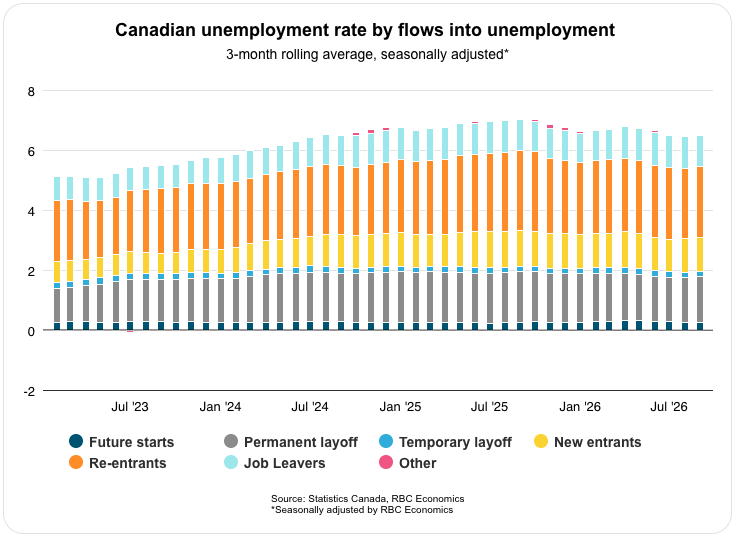
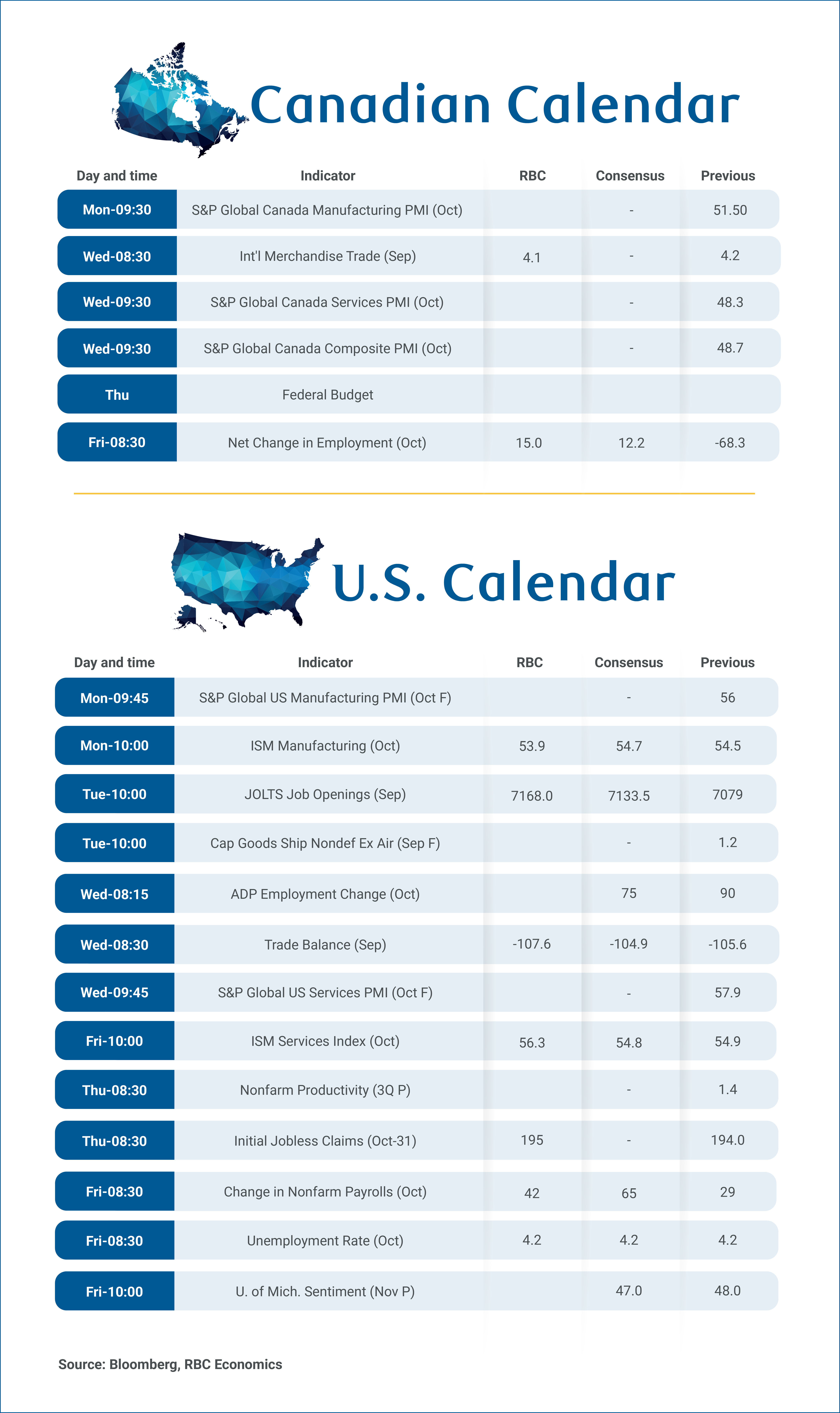
We expect total Canadian employment in October rose by 15,000 with the unemployment rate edging down to 6.4% from 6.5% in September. Jobs surprised significantly on the downside in September (-68,000), but with weakness largely concentrated in public-sector roles (education and health workers) rather than heavily trade-exposed private sectors.
Manufacturing employment did fall in September, but only partially reversed the prior month’s gains and early job openings data from indeed.com points to firming in hiring demand in October.
This is consistent with our view that tariffs may have stalled progress in the labour market, but are not severe enough to reverse it. Overall, we estimate that roughly 0.4% of Canada’s gross domestic product and employment is tied to U.S. demand for goods on the tariff lists.
The BoC’s Business Outlook Survey for Q3 aligns with this assessment. Employment outlooks, while soft, remain positive and higher than a year ago. Although lingering uncertainty about the longer-term trade environment is discouraging firms from committing to expanding workforces, most report plans to keep headcounts unchanged. Those reporting expansion plans tend to be linked to public spending or natural resources.
Pullback expected from U.S. buyers in trade data
Canada’s merchandise trade for September will capture the first full month of data since U.S. Section 338 tariffs took effect on Aug. 22. The August release showed Canada’s trade surplus surging higher, in part as exporters front loaded shipments ahead of tariffs being implemented late in the month. A 16% jump in September oil prices likely added to Canada’s energy trade surplus in September, but we expect that reversal in U.S. purchases of newly tariffed products to be evident in a pullback in September non-energy exports.
We continue to expect new tariffs imposed by the U.S. administration will have a significant impact on directly targeted sectors. However, with more than 80% of Canadian exports to the U.S. still maintaining duty-free access under CUSMA, we anticipate limited spillover to the broader economy.
And, while the Canadian trade balance will likely move lower, import data will also provide clues about the strength of domestic demand. Equipment imports, in particular, have been firming in recent months in a positive sign that domestic equipment investment is improving, supported in part by early signs that the AI infrastructure buildout is spreading more significantly into Canada.
-
U.S. labour markets likely remained tight in October with the unemployment rate holding at 4.2% after ticking up to that level in September from 4.1% in August. Employment growth is expected to remain historically modest but we expect a slightly firmer 42k increase than the 29k September rise, and labour force growth is expected to continue to be restrained by reduced population growth and high retirement rates. Initial jobless claims show layoffs are still low.
About the authors:
Nathan Janzen is an Assistant Chief Economist, leading the macroeconomic analysis group. His focus is on analysis and forecasting macroeconomic developments in Canada and the United States.
Annie Zheng is an economist at RBC. She is a member of the macroeconomic analysis group, focusing on macroeconomic modeling.
Explore the latest from RBC Economics:
Ontario Update 2026: Balance delayed another year before mega-deduction
The economic pressures shaping the 2026 midterms in five maps
Full steam ahead: US GDP growth accelerates in Q3
Bank of Canada applies preventative medicine: Hikes rates as inflation risks grow
FOMC recap: This is not a 1980s’ hiking cycle
Caribbean Outlook Monitor: Uncertainty is the only certainty
Canadian federal Budget 2026: Looking for disciplined execution
Share these insights with your network:
This article is intended as general information only and is not to be relied upon as constituting legal, financial or other professional advice. The reader is solely liable for any use of the information contained in this document and Royal Bank of Canada (“RBC”) nor any of its affiliates nor any of their respective directors, officers, employees or agents shall be held responsible for any direct or indirect damages arising from the use of this document by the reader. A professional advisor should be consulted regarding your specific situation. Information presented is believed to be factual and up-to-date but we do not guarantee its accuracy and it should not be regarded as a complete analysis of the subjects discussed. All expressions of opinion reflect the judgment of the authors as of the date of publication and are subject to change. No endorsement of any third parties or their advice, opinions, information, products or services is expressly given or implied by Royal Bank of Canada or any of its affiliates.
This document may contain forward-looking statements within the meaning of certain securities laws, which are subject to RBC’s caution regarding forward-looking statements. ESG (including climate) metrics, data and other information contained on this website are or may be based on assumptions, estimates and judgements. For cautionary statements relating to the information on this website, refer to the “Caution regarding forward-looking statements” and the “Important notice regarding this document” sections in our latest climate report or sustainability report, available at: https://www.rbc.com/community-social-impact/reporting-performance/index.html. Except as required by law, none of RBC nor any of its affiliates undertake to update any information in this document.

