

 EN



Budget 2026 lands a year after the Carney government launched its “borrow to invest to grow” pivot. After a spring update and flurry of announcements, the core question is: What’s left to do?
The answer, in our view, is less about new programs and more about disciplined execution.
The bottom line: Ottawa’s strategy still fits the bill, but deficits and debt are headed higher, and the big lift to growth is years away. Budget 2026 needs to show it continues to deliver on both growth and fiscal strategies.
Here are four realities facing the budget, and four things it needs to deliver.
Four realities facing Budget 2026



Four things the budget needs to deliver


Four realities facing Budget 2026
1. Deficit math: New spending has consumed the fiscal windfall
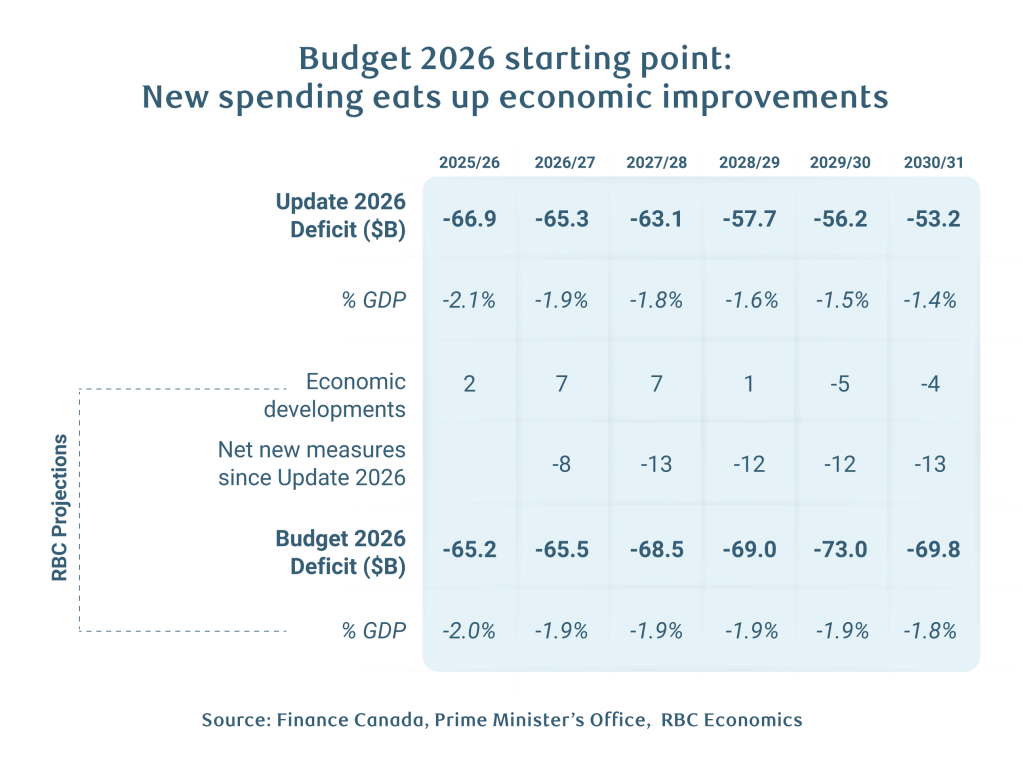
Higher oil prices and stronger near-term nominal gross domestic product (GDP) give Ottawa a better starting point than the spring update, but recent announcements have more than offset the gain.
We estimate $57 billion in new five-year spending commitments — led by the corporate tax mega deduction ($36 billion), childcare funding, and the fuel tax holiday extension1.
Combined with our more subdued medium-term growth outlook — dragged lower by population growth revisions — deficits could run $15 billion+ deeper by 2030–31 than the spring update, almost erasing the buffer against the government’s first fiscal anchor: a declining deficit-to-GDP ratio.
The deficit path would not differ dramatically from Budget 2025, and its flatness partly reflects improvements to near-term numbers. Still, the concern is the familiar pattern: later-year deficits are revised higher while unmet commitments loom over the horizon.
The second anchor — balancing the operating budget by 2028-29 — remains within reach, as most new spending qualifies as capital under the government’s definition. Finance Minister François-Philippe Champagne has suggested this could arrive a year early.
2. Debt pressures are building beyond the deficit
Deficits tell part of the story of government finances; while borrowing tells a lot of the rest.
Debt-burden ratios benefit from the nominal GDP boost for most of the projection period, but new spending could turn trajectories upward. These are not fiscal anchors for Ottawa, but they are important sustainability metrics.
Moreover, with large non-deficit spending in the works, such as federal capital projects or Crown financing for third parties, the risk is towards a faster rise in gross and net debt. This spending is booked as assets, so only a portion of outlays hit the deficit right away, but the cash is reflected in gross debt and sometimes net debt.
Together, the proposed Pacific Link federal pipeline ($35–$44 billion), other post-spring update contingent capital commitments, and new deficit spending could add over $110 billion to gross federal debt over the next decade2.
Federal borrowing requirements are already tracking $35 billion above the spring update’s $133 billion plan for 2026-27 — whether that reflects cash timing or a bigger shift in non-deficit spending, the budget’s borrowing plan will be telling.
Ottawa would see some offsets to higher debt ratios over time through repaid loans or stronger economic growth. But the key question is when.
3. Signals are positive on private investment, but the big lift to growth is years away
Ottawa is lining up spending now for growth later.
So far, Canada’s private sector investment push has mostly comprised government action, essentially steps to improve the investment climate and the promise of public incentives. The ultimate test is a hand-off to private capital deploying at scale on new projects.
Early signals show some building momentum – such as rising machinery and equipment imports, higher global investor interest in Canada3, and a growing major project inventory – but a meaningful shift in private capital is not yet visible in the data.
We view later 2027 as a more realistic checkpoint on the private investment pipeline, where real impacts become more visible, or foreseeable.
Still, the larger growth lift is likely five to 10 years out. That’s a function of the project pipeline and the reality that the bigger dividends of Ottawa’s strategy lie in completed infrastructure projects that support ongoing and broad-based investment.
In the interim, there is mild support to growth from high federal and provincial deficits, both on the operating and capital side, where higher government investment, in defence for example, is increasingly visible.
Spending now but growth later raises an important question: Does it matter if Ottawa’s debt ratios are elevated for longer?
4. Rising rates and investor attention on public debt
Canadian government bond yields have followed the global march higher, with the 10-year up 40 basis points over four months. Shifting inflation and rate expectations are the primary driver, but rising term premiums — potentially linked to fiscal concerns — are also at play.
Rising rates pressure all borrowers. Budget 2025 estimated a sustained 100 basis-point rate increase raises the deficit by $8 billion after four years. Higher rates and larger deficits in Budget 2026 will push public debt charges higher still as a share of revenue versus the spring update’s upward path.
Canada is not top of the list for investor scrutiny — debt and deficit levels are lower than peers like France and the United States (especially on a net basis), and the structural fiscal outlook is more favourable. Markets are likely to accord Ottawa some budgetary flexibility.
This is not a free pass. A recent erosion in provincial finances complicates the aggregate debt picture, for example. Continued credibility on both the growth agenda and fiscal sustainability remains core to Canada’s relatively strong credit profile despite macroeconomic headwinds.
Four things the budget needs to deliver
1. Progress reports and adjustments, not new programs
Most immediate fiscal pressures are at bay. Big platform priorities have been funded. On affordability, Ottawa has been responsive with tariff and oil-shock support for vulnerable households, aided by a slowly improving economy and sideways housing in many markets.
There are ways to enhance the growth agenda – from further tax measures beyond the mega deduction to increasing investable assets beyond Ottawa’s planned opening of airports to private investment – but the high cost of the mega deduction4 plus tougher revenue or political tradeoffs of some other measures err to Ottawa largely waiting. Still we’ll watch for messaging on future directions.
Non-budgetary policy remains a key lever. Regulatory reform through Bill C-39 (Building Canada Strong Act) is the kind of decentralized change we hoped for, clearing the way for investment beyond what lands at the Major Projects Office. Competition policy is another area where overtures have yet to turn into into a coordinated approach.
Instead of new programs, the budget should focus on a clear accounting of how and when major initiatives are progressing, plus targeted adjustments.
Budget 2026 will likely preview the 2027-2029 Immigration Levels Plan
Improving labour markets and an emerging project pipeline could soon escalate skilled-labour shortages, suggesting an adjustment may be in store for the plan. We expect some slippage on Ottawa’s 5% temporary resident (TR) target given recent population revisions showed slower TR exits – either a longer adjustment period or higher endpoint. Permanent resident targets could also be revised gently higher. Recent government changes to the Express Entry system suggest other changes could be in the works.
2. A plan for housing and health
Even with immediate pressures contained, two spending areas must soon be accommodated.
Budget 2026 could release the next iteration of the National Housing Strategy, which winds down in 2027-28. The Office of the Parliamentary Budget Officer (PBO) highlighted how federal housing funding drops from over $10 billion in 2026-27 to $4 billion by 2028-29 even with Build Canada Homes5. Update measures like development charge reforms may have lifted that profile but appear temporary.
Several provincial health funding arrangements also wind down in 2027-28, including the 5% guaranteed Canada Health Transfer escalator and one-off agreements ( about $3 billion+/year). Provinces are increasingly vocal about a permanently higher federal funding share as rising healthcare costs drove deteriorating 2026 budgets, an ongoing pressure. With recent one-year extension funding for mental health, Health Minister Marjorie Michel has designated this a 2027 issue.
In both areas, we’ll be looking for Ottawa to push for efficiencies — across its own programs/agencies and from provinces —to contain fiscal costs, and for eventual agreements ideally to delineate long-term commitments rather than funding patches that punt the issue.
3. Not forgetting about longer-term defence and childcare
Defence was Budget 2025’s largest initiative — $59 billion in deficit spending (accrual) and $82 billion in debt spending (cash) over five years. It’s a fair argument that Ottawa’s growth and fiscal health objectives both depend on getting defence right.
Ottawa recently clarified that Budget 2025’s spending is consistent with 2.5% NATO core funding by 2030 (4% total)6. Reaching the agreed 3.5% core target by 2035 (5% total) could require over $65 billion more in annual cash spending by 2035-36, according to the PBO (current dollars)7.
Defence cash spending is higher than accrual due to the capital-heavy nature of outlays but eventually amounts show up in the budgetary balance as amortization expense. It means that even today’s allocated defence funding will represent a lift to spending well beyond the current projection period.
National childcare CWELCC extension agreements to 2030-31 have been signed with all provinces except Alberta, but the $43 billion budgeted for the five-year extension will be up for renewal before the end of the budget’s projection period. Provinces have been asking for a minimum 10-year funding framework, and some remain outside the stated $10/day target.
We don’t expect funding for either commitment in Budget 2026 but will be watching how Ottawa frames the path ahead and manages fiscal room.
4. Managing big contingent liabilities and program review
Managing contingent liabilities is another way Ottawa can preserve fiscal space. Ottawa’s annual expense for contingent liabilities has been volatile but trending higher, related to various items but especially Indigenous claims.
Final 2025-26 deficit figures could include $10-$15 billion+ in contingent-liability expense.
Budget 2025 foreshadows this, implying the forecast incorporated a per-year expense around the $10 billion annual average, with a larger amount in 2025–26. A multi-year provision was also made for bad tax debt; if taken as a one-time charge, we estimate $5 billion to return the age of current tax receivables to its pre-pandemic average.
Liabilities must meet certain criteria to be booked, but to the extent Ottawa has discretion, pulling forward their recognition would serve as a fiscal clean-up: helping avoid future surprises that disrupt a downward sloping deficit path. That said, booking the liability is one thing; managing it is another – and funds don’t go out the door until the issue is resolved.
Another way to build fiscal contingency is rationalizing existing spending.
Budget 2025’s expenditure review had a narrow base — government operations only — sparing transfers to people and provinces. The political preference is clearly to hold the line, especially while unified support matters for the growth agenda. Still, we’ll look for signs Ottawa is harvesting efficiencies or paring ineffective programs as a prelude to the possibility of tougher choices down the road.
About the author:
Cynthia Leach is the Assistant Chief Economist at RBC with a focus on federal and provincial fiscal analysis, government policy, demographics, and other thematic research.
- We assume all defence announcements are covered under prior funding envelopes and no reprofiling of existing spending as it is hard to predict. ↩︎
- The Update already projected a much steeper $672 billion increase in total borrowing requirement over the five-year projection period versus $296 billion for the accumulated deficit. It’s not clear the amount of baseline outlays for major projects or Crown lending incorporated in this gross figure. ↩︎
- https://www.cppinvestments.com/insights-institute/trusted-but-untapped-canadas-next-competitive-advantage-is-investibility ↩︎
- The corporate mega deduction was expensive — contrary to Ottawa’s messaging, we believe its application to existing activity means the fiscal cost will outpace the direct growth payoff. Alone it won’t transform the investment landscape but it’s a positive addition that should produce a small permanent boost to GDP— we estimate about 0.2% over the next decade, back-weighted. ↩︎
- https://www.pbo-dpb.ca/en/publications/RP-2526-020-S–build-canada-homes-outlook-housing-programs-under-budget-2025–maisons-canada-perspectives-entourant-programmes-logement-dans-cadre-budget-2025 ↩︎
- NATO’s 5% target comprises at least 3.5% of GDP in core defence spending using NATO’s existing definition, and up to 1.5% in ancillary spending supportive of defence and security (like critical infrastructure). ↩︎
- https://distribution-a617274656661637473.pbo-dpb.ca/b9f6943126db9046c5ab3cf60dd1e2e24fa6ddecc55ea53677581b0207a7aebe ↩︎
This article is intended as general information only and is not to be relied upon as constituting legal, financial or other professional advice. The reader is solely liable for any use of the information contained in this document and Royal Bank of Canada (“RBC”) nor any of its affiliates nor any of their respective directors, officers, employees or agents shall be held responsible for any direct or indirect damages arising from the use of this document by the reader. A professional advisor should be consulted regarding your specific situation. Information presented is believed to be factual and up-to-date but we do not guarantee its accuracy and it should not be regarded as a complete analysis of the subjects discussed. All expressions of opinion reflect the judgment of the authors as of the date of publication and are subject to change. No endorsement of any third parties or their advice, opinions, information, products or services is expressly given or implied by Royal Bank of Canada or any of its affiliates.
This document may contain forward-looking statements within the meaning of certain securities laws, which are subject to RBC’s caution regarding forward-looking statements. ESG (including climate) metrics, data and other information contained on this website are or may be based on assumptions, estimates and judgements. For cautionary statements relating to the information on this website, refer to the “Caution regarding forward-looking statements” and the “Important notice regarding this document” sections in our latest climate report or sustainability report, available at: https://www.rbc.com/community-social-impact/reporting-performance/index.html. Except as required by law, none of RBC nor any of its affiliates undertake to update any information in this document.

