Advances in artificial intelligence mean computers can now use machine prediction to learn and make decisions on their own, opening the door to a new wave of automation and the threat of computers taking over jobs or at least augmenting human capabilities in ways we can’t fully anticipate.

“This isn’t something that we want to look at five years from now, because it would be way too late,” says Noel Webb, founder of Karen.AI, a recruitment startup.

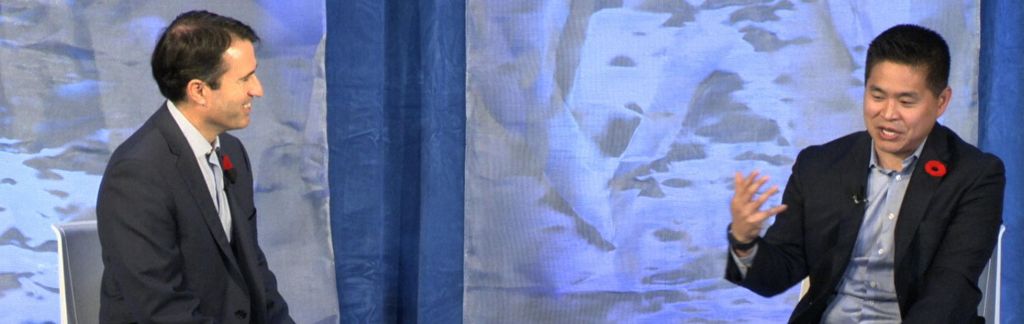
Webb was among a group of AI entrepreneurs who spoke at RBC Disruptors, a monthly forum on technology and how it’s changing the way we live and work.

He said advancements in AI could have such a broad impact that every company and government needs to have an AI policy.

“We’re at a really great fork in the road here,” Webb said. “The public education system came up back in the first industrial revolution. It’s been hundreds of years since we’ve had to take a look at what it means to have a future of work.”

Webb is part of the first cohort of NextAI, a venture initiative supported by RBC to startups in the field. He was joined on stage by other NextAI entrepreneurs: Shea Balish, founder of fitness-focused REP.ai, and Nima Shahbazi and Krista Caldwell, co-founders of food logistics startup Deepnify.

All four noted the benefits and drawbacks of AI. For consumers, it offers the possibility of an entirely new range of personalized services — including self-driving cars and automated personal assistants. For business, AI it offers the potential to improve operational efficiencies, predict consumer preferences and reduce human error.

Webb said AI can actually help humans by augmenting their skills.

His company’s software reads every single resume submitted for a job — he says companies receive 250 applications for every open position, on average — and uses advanced algorithms to sort and filter them. It’s far beyond keyword searching. He said Karen.AI’s software can even predict personality fits.

“The problem that we’re solving is basically an administrative task,” he said. “The recruiter can really focus on what they want to do best: actually interacting with humans and imparting that judgment.”

Balish, whose company uses AI to generate three-dimensional graphs from two-dimensional videos of athletes, said Rep.AI’s services can save physiotherapists and doctors time during the diagnostic process. Caldwell said Deepnify, which uses advanced AI to optimize logistics and cut waste for fresh food in grocery stores, allows grocery managers to focus on more important work.

Yet AI could also prove destabilizing, accelerating the ongoing process of automation that has affected manufacturing jobs and even broadening it to new forms of work previously thought safe, such as the image recognition algorithms now analyzing X-rays or the natural language algorithms helping lawyers build legal cases.

“There will be some job loss, but I think there will be new jobs created in the process,” Balish said. “It will create an immense amount of value within the economy, so the cost of a lot of things like your vegetables and your daily kind of needs is going to go way down.”

Rep.AI’s focus is athletics and the market for healthcare, and Balish said that improving health outcomes is one of the most promising areas of AI.

“The policies that will be put in place and the foresight that’s already being engaged by some of the top leaders in the world is on a positive trajectory,” he said. “But what I’m most excited about is mitigating human suffering, increasing flourishing.”

A new generation of AI research was kick-started in 2012 by a scientist working out of the University of Toronto, Geoff Hinton, and other Canadian researchers including University of Montreal’s Yoshua Bengio and Richard Sutton made key contributions. Now, their work is the basis for voice assistants like Apple’s Siri, the AI algorithms that beat world champions at games like poker and Go, and the self-driving cars already piloting around San Francisco streets.


The American filmmaker has 7.2 million subscribers on his YouTube channel, and his videos—most of which feature him as the narrator and star—have been viewed more than 1.6 billion times.

Neistat is one of a new generation of digital celebrities that have found a home on YouTube, which launched in 2005 and now posts more than 1 billion users around the world.

And his success, according to YouTube’s managing director of global brand solutions Debbie Weinstein, is a great example of the democratizing power of the platform.

“It’s a platform for anyone who has a story to tell to come and tell it,” she said. “And you can find huge audiences on YouTube.”

For much of its early years, YouTube’s slogan was “Broadcast Yourself.” The democratizing power of online video has transformed advertising, the entertainment business, and mobile communications—and could transform the way businesses interact with their customers.

A Changing Audience

Once a disruptor, YouTube—which is owned by Alphabet—has become a part of the mainstream media. It accounted for more than one-fifth of the mobile video watched in the US in 2016, and creators such as Lilly Singh and PewDiePie have become household names—especially among those under 21. YouTube has launched family-friendly versions of the site in some territories, using even stricter content controls than its work-safe default.

Older generations are also spending time on YouTube and other mobile video sites—they now account for one-third of all viewing time for Americans aged 50 to 64, according to Nielsen.

“What’s great about YouTube is that you can find whatever you’re into, there’s something for everyone there,” Weinstein told the crowd at an #RBCDisruptors event on May 31.

The Upside for Advertising

While networks like NBC, ABC and CBS like to talk about age- and gender-based demographics, YouTube is most interested in what its individual users actually watch. Two random users might be of wildly varying ages and backgrounds, but their love of acoustic Katy Perry covers makes them the perfect market to buy her latest single.

The company uses machine learning to build sophisticated recommendations based on a user’s browsing habits—and uses that same data to serve customized ads.

“What’s great about YouTube is that you can find whatever you’re into,” Weinstein said. “And with the signals you can capture in the digital world, you actually can find consumers at scale that are right for your business.”

Know Your Users

As the company and its audience have expanded, so too have its relationships with advertisers. Weinstein said the democracy of online video demands marketers be much more honest about who they are.

“It means that anyone can actually help amplify your message or detract from the message that you’re trying to tell the marketplace,” she said.

Weinstein said marketing firms need to know where their clients stand on social issues such as diversity hiring practices and environmental responsibility.

Dealing with the potential backlash is worth it for advertisers, though. The NFL’s annual Super Bowl championship game generates headlines with ads that cost US$5 million for a 30-second spot, but Weinstein points out that YouTube reaches a Super Bowl-sized audience every day.

Controversial Content

The latest controversy for the platform surrounds advertising and extreme content such as hate speech. More than 205 companies, including five of the top 20 US advertisers, said they were suspending or reviewing their YouTube ad spending in February and March of this year after reports that ads were being served on inappropriate content.

Weinstein said the company has reviewed and expanded its policies around extreme content, updated its AI-powered automatic monitoring, and instituted new controls for advertisers

“We take this really seriously and we’ve made a huge investment in terms of engineering and human resources,” she said. “Technology as a solution for democracy’s messiness is a hard thing.”

The Copyright Conundrum

In the early years, Weinstein says the company was “almost killed” by the challenge of copyright and intellectual property. Its solution to people uploading videos produced by others, be it TV shows or music videos, is a complex piece of software called Content ID that automatically detects copyrighted works and either removes them or credits the proper creator.

The company struck early deals with record companies, including Universal Music Group and Sony Music Entertainment’s VEVO partnership, to bring streaming music and official music videos to the platform. By some measures, it is now the largest streaming music service in the world.

“What we sometimes find happening is publishers, originators of content, make more money from people who actually rip off their IP, from the Content ID claim that they’re able to make, than from the original upload themselves,” she said.

Innovation in Immersion

YouTube has been less successful striking deals for video content, as subscription-driven rivals such as Netflix and Hulu have spent millions on the rights to critically acclaimed cable and network shows such as Breaking Bad and original shows including House of Cards.

“Many of these Golden Age of TV dramas are being created on Netflix or Amazon, which are actually behind a paywall,” Weinstein said. “If you’re an advertiser, and you want to surround that experience with your message and connect to those audiences, you can’t.”

That’s one of many reasons YouTube’s online power—it is the second most-visited site on the web—doesn’t protect it from disruption of its own business model.

The company is now imitating the approach of traditional networks by producing its own content—shows and creators that are meant to be more focused and advertiser-friendly than the anything-goes content of even its most on-brand stars.

It’s also investing in 360-degree videos, live video and virtual reality in order to add a previously unseen level of immersion to online video, and broadcast much of the recent Coachella music festival with its latest surround technology.

Weinstein said YouTube is tracking the way people watch online video, from desktops to mobile devices and now back to TV screens. The future will see a divergence in the kind of content YouTube tailors to each device, she said, and the company will work with marketers to tailor ads to anything from the biggest communal screens to the personal VR headsets.

“Imagine being in the front row of the concert, but really being in it,” she said. “We haven’t seen a lot of marketing yet exploring what will be possible.”


The New Artificial Intelligence

Artificial Intelligence has been around for decades, but is the hottest area of technology today because of vast improvements in computing power and data availability. For business, AI offers the potential to greatly improve operational efficiencies, predict consumer preferences and reduce human error, through self-teaching algorithms that can transform business models with unprecedented speed and certainty.
The promise of AI has led to a global surge in investment and a war for scarce talent that threatens to tilt the playing field in favour of a few nations and companies that have the money, datasets and computing power to win at scale. The Analysis Group estimates the global economic impact of AI over the next decade could be worth as much as US$3 trillion.
For Canada, once a leader in the field, the surge in AI has presented a national challenge. The Canadian government recently committed $125 million to a national AI initiative; Quebec added $100 million and Ontario committed another $50 million, largely to retain academic talent in the face of aggressive hiring by Google and Microsoft, among others. Despite these investments, only a fraction of Canadian companies have announced AI programs and the Canadian AI start-up space remains nascent. If Canada is going to remain competitive in the age of artificial intelligence, a more collective ambition will be needed.

AI, Defined

The most common approach to artificial intelligence is known as machine learning, a general term used for teaching computers to do things for which they are not explicitly programmed. One way to understand machine learning is as a very advanced form of pattern recognition, and AI researchers seek to teach computers to make inferences and predictions from those patterns.
One important subset of machine learning is called deep learning, where researchers build complex algorithms designed to mimic the reasoning process of the human brain. These so-called neural networks connect a huge number of small, simple processing units into a much larger whole. Take the common example of a cat picture. While no individual artificial neuron can understand what a cat looks like, a neural network can assemble the pieces and see the bigger picture.
Another growing branch of AI is reinforcement learning, an advanced form of trial-and-error reasoning that would be familiar to anyone who’s ever played the board game Battleship. These AI algorithms learn behaviour based on feedback from the environment, thanks to designers who build in rewards for proper actions. Think Pavlov’s dog—with a digital bell.

An Academic Head Start

Canada had an early lead thanks to three noted researchers: Geoffrey Hinton, from the University of Toronto; Richard Sutton, from the University of Alberta, and Yoshua Bengio, from the Université de Montréal. This trio has been able to draw the leading talent from around the world to Canada, researchers who are now training post-graduates who will in turn be teaching the next generation of AI talent.

  Montréal Toronto Edmonton
Basic researchers 11 6 11
Applied AI researchers 10 3 8
AI students 120 116 75
Estimated Total 140 140 107

To help retain and nurture academic talent, the federal government, Ontario and 30 corporate backers this year created the Vector Institute, a new AI research facility in Toronto that is seeded with $180 million over 10 years. The Montreal Institute for Learning Algorithms and the Alberta Machine Intelligence Institute follow similar models. But the research resources in other counties, especially the United States, tower over Canada’s. Former students and colleagues of Canada’s three AI leaders now lead AI divisions at Apple, OpenAI, Facebook and Google.

The Emergence of AI Superpowers

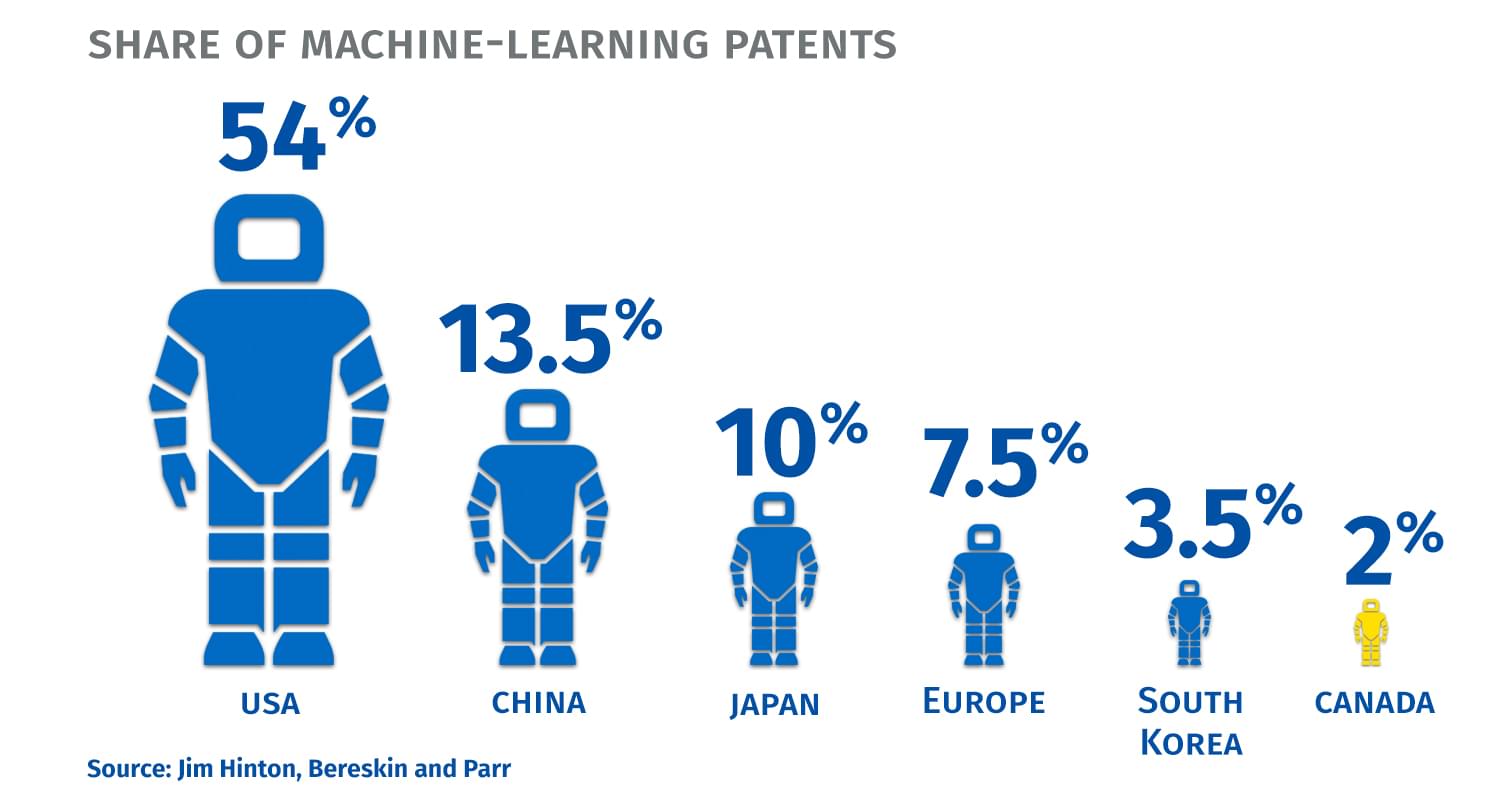
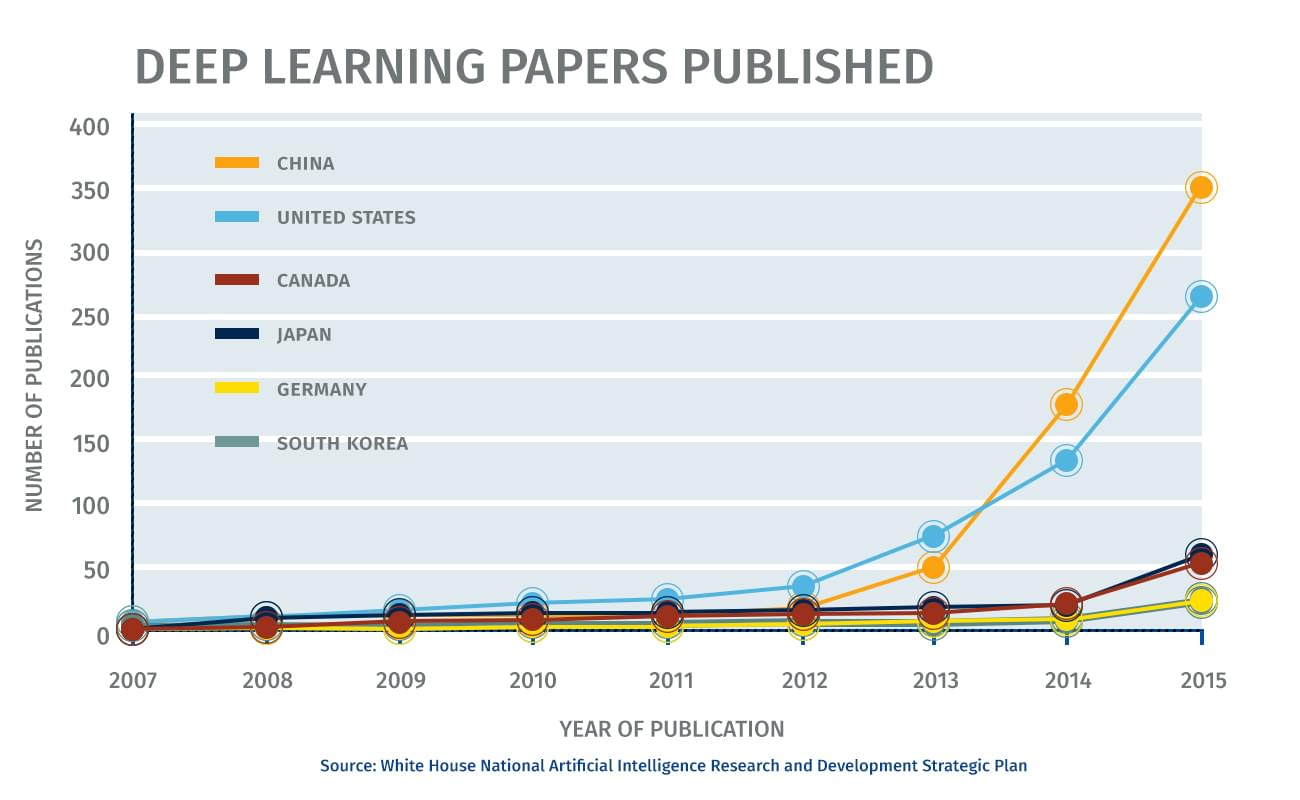
The concentration of AI research has grown sharply since 2012, with the United States and China emerging as AI superpowers.
Share of machine-learning patents
Deep learning papers published
Deep learning publications cited

The Start-Up Challenge

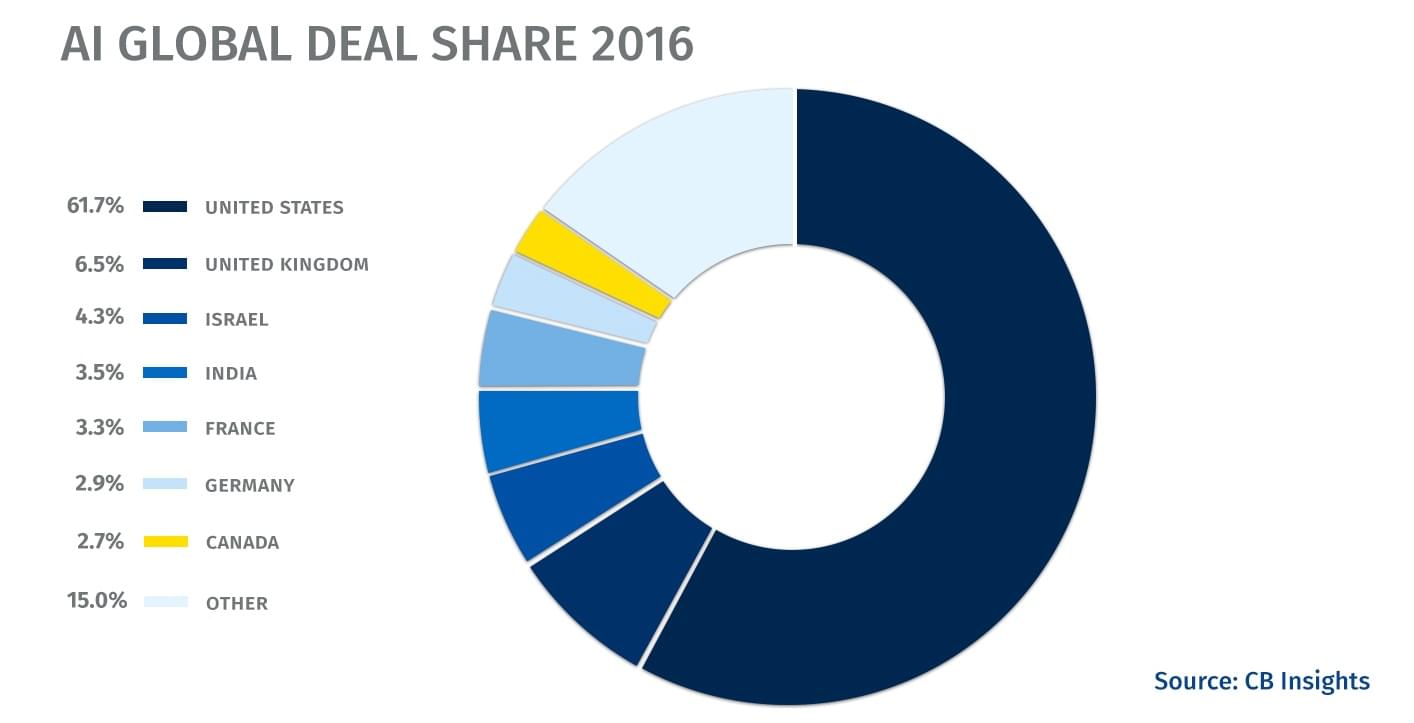
  • Around the world, 650 AI start-ups raised US$5 billion in 2016.[1]
    • The number of AI deals (funding rounds and exits) has increased more than fivefold since 2012
  • Canada accounted for 18 of the 658 AI acquisitions in 2015[2]
    • No Canadian company ranks in the top acquirers for AI startups

AI Global Deal Share 2016

The Corporate Challenge

American tech companies have put millions into Canadian AI. Microsoft pledged to invest $7 million in AI research in Montreal as part of its January 2017 purchase of machine language start-up Maluuba, while Google donated $4.5 million to MILA in 2016 and has opened labs in Montreal and Toronto. In May, Uber hired University of Toronto professor Raquel Urtasun to run a new Toronto AI lab focusing on driverless car technology.
Canadian companies have also invested in AI. NextAI, a partnership between RBC, Magna, BDC Capital and Scotiabank, was launched in 2016, with $5 million in initial funding to draw entrepreneurs to Canada to work on AI challenges. More than 20 Canadian companies have committed to funding the Vector Institute. Of the top 60 companies on the TSX, 22 have expressed interest in AI and 13 have publicly announced investments in AI. (See Appendix).
Between the federal and provincial governments, academic networks and partnerships including the Vector Institute and MILA, and commitments from private corporations, nearly $500 million has been committed to developing Canada’s artificial intelligence ecosystem over the past 18 months.
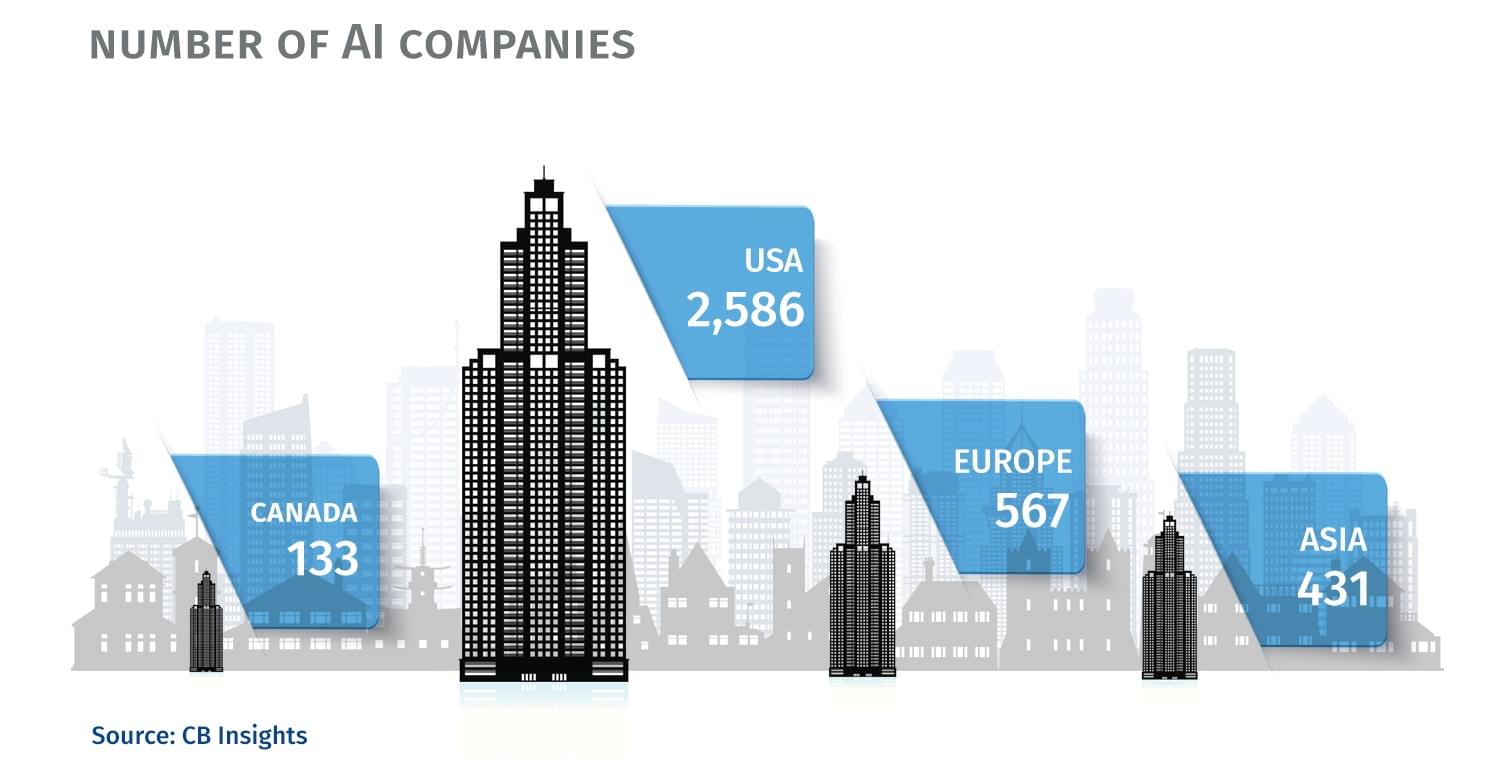
Number of AI Companies

Making Canada AI-Ready – 10 Ways for Government, Business and Academia to Build on Canada’s Success.

1. Create an AI Council to Guide Policy:
A private sector-led council could advise government on AI opportunities and challenges, and help track and benchmark Canada’s adoption of AI relative to global competitors.
2. Expand the AI Talent Pool:
Set an ambitious national target for both graduation levels in AI and related fields, and immigration levels for global AI talent.
3. Make the Workforce AI-Ready:
Equip students with AI-complementary skills, including work-integrated learning to ensure broad student exposure. This should include a focus on girls to ensure more gender balance in AI-related fields, including design, interface and impact.
4. Promote AI Across Business Sectors:
With business groups (Business Council of Canada, chambers of commerce), diffuse understanding of AI across organizations and encourage its adoption by all key sectors to build Canadian competitiveness.
5. Focus Research Funding on Commercial Innovation:
Ensure publicly-funded AI research focuses on commercial application— and require government funding agencies to better coordinate AI investments.
6. Develop an AI-Focused IP Strategy:
Modernize the IP regime to support the monetization and commercial scale-up of ideas in Canada, and to guard against activities (e.g. patent trolling) that stymie Canadian commercial innovation.
7. Leverage Our Data:
Establish a national data strategy, including a possible data bank for Canadian-owned companies and entrepreneurs to help them build scale in key areas.
8. Create a National Challenge:
Pool government and private resources, including data, to help Canadian firms, entrepreneurs and researchers use AI to solve grand challenges such as carbon emissions and hospital wait times.
9. Pursue an AI Trade and Investment Agenda:
Create a subject-expert AI representative in the federal government to work with multinational companies and investors. Apply an AI lens to trade negotiations. Review investment policies to consider the interests of Canadian firms.
10. Position Canada as a Global Leader in Advancing AI for Good:
Play a constructive role, through the G20 and multilateral organizations, to convene and build global awareness about the social, economic and cultural consequences of AI.

Appendix
Public AI interest and investment, TSX60 companies [5]
AI interest AI investment
1.     Bank of Montreal 1.     Bank of Montreal
2.     Bank of Nova Scotia 2.     Bank of Nova Scotia
3.     Barrick Gold Corporation 3.     BlackBerry Limited
4.     BCE Inc. 4.     George Weston Limited
5.     BlackBerry Limited 5.     Loblaw Companies Limited
6.     Canadian Imperial Bank of Commerce 6.     Magna International Inc.
7.     CGI Group Inc. 7.     Manulife Financial Corporation
8.     George Weston Limited 8.     Power Corporation of Canada
9.     Goldcorp Inc. 9.     Royal Bank of Canada
10.  Loblaw Companies Limited 10.  Sun Life Financial Inc.
11.  Magna International Inc. 11.  Telus Corporation
12.  Manulife Financial Corporation 12.  Thomson Reuters Corporation
13.  National Bank of Canada 13.  Toronto-Dominion Bank
14.  Power Corporation of Canada  
15.  Rogers Communications Inc.  
16.  Royal Bank of Canada  
17.  Sun Life Financial Inc.  
18.  Suncor Energy Inc.  
19.  Teck Resources Limited  
20.  Telus Corporation  
21.  Thomson Reuters Corporation  
22.  Toronto-Dominion Bank  
   
[1] The 2016 AI Recap: Startups See Record High In Deals And Funding. (CB Insights, Jan. 2017.)
[2] The 2016 AI Recap: Startups See Record High In Deals And Funding. (CB Insights, Jan. 2017.)
[3] The Geman Artificial Intelligence Landscape. Asgard.VC, February 2017.
[4] Worldwide Semiannual Cognitive/Artificial Intelligence Systems Spending Guide. (IDC, October 2016.)
[5] Factiva press search

As Senior Vice President, Office of the CEO at RBC, John Stackhouse is responsible for interpreting trends for the executive leadership team and Board of Directors with insights on how these are affecting RBC, its clients and society at large. Prior to this, John was editor-in-chief of The Globe and Mail (2009-14), editor of Report on Business, the newspaper’s national editor, foreign editor and its foreign correspondent based in New Delhi, India (1992-99).

GM Canada has a team of 750 software engineers in the Toronto suburb of Markham, working on what it calls “the future of mobility.” It also has ambitious plans to open a experimental centre in the city’s east end, where consumers will be able to test self-driving cars, electric bikes and any other innovation that runs on wheels.

For the auto giant, the Toronto innovation drive is designed to get it closer to consumers and better understand how they’re adapting to radically new car technologies — and how that innovation can lead to better communities, safer roads and a new business model for mobility.

“We’re redefining ourselves in terms of mobility, as opposed to cars, trucks and crossovers,” said GM Canada’s president Steve Carlisle.

GM is in a race with Uber, Alphabet, Tesla and other car companies to develop self-driving cars that are safe, reliable and affordable. Earlier this week, Uber Technologies announced a new Toronto research team led by University of Toronto professor Raquel Urtasun that will be tasked with “transforming transportation.”

For both GM and Uber, Toronto has everything they need: great universities, a strong startup ecosystem, five million people, terrible traffic and four intense seasons that can test every on-board instrument in a car.

“We’re blessed with abundant crappy weather,’ Carlisle said, “so we should invest in it and play a global role there.”

Carlisle was onstage at Roy Thomson Hall for RBC Disruptors, a monthly speaker series focussed on innovation and disruption.

After emerging from the great recession as a shadow of its former self, GM has picked four channels of innovation: self-driving vehicles, electric vehicles, connected vehicles and shared vehicles.

Carlisle said the company wants to think about share of data and share of kilometres driven, rather than just share of new car sales.

“We need to think in terms of not just selling vehicles — but selling kilometres and gigabytes too … The idea is to get our minds moving beyond market share and sales and into share of kilometres ridden and share of data used.”

He can see a future in which fewer cars are sold but they’re used more through shared ownership, or ride-hailing of autonomous-driving vehicles. The average car is used around four per cent of the time.

While that may lead to fewer vehicle sales for GM, Carlisle says the difference will be made up by servicing and parts, as vehicles being used more often will wear out faster. There will be new business models, too, such as paying per distance.

The company already has its own car-sharing business, Maven, that is trying to better understand how quickly consumers are willing to change habits.

GM is already gaining some revenue from new data models, such as prompting drivers, through its OnStar service, with special offers at restaurants or shops along a highway, based in part on a driver’s habits. It typically gets a share of sales connected to drivers, if they’ve opted to share their data.

Today’s vehicles already have as much as two million lines of computer code in them. Tomorrow’s vehicles will be wired more than a typical space vehicle, enabling GM to build relationships with a host of other service providers wanting to reach consumers while they’re in their cars.

While self-driving cars — and the ensuing changes to our cities — are still years away, Carlisle said they’re coming sooner than most people think.

The biggest challenge is in the marketplace. Take electric cars. Despite being on the market for more than a decade, they account for half of one per cent of total sales. The same resistance could hold true for cars that pilot themselves.

“We all want to reduce greenhouse gases, but we’re all consumers as well,” he said. “When do we make the leap to being a part of that solution instead of perpetuating the status quo?”

Even if self-driving cars gain currency, Carlisle doubts the love-affair that many owners have with their cars will die. Instead, many will buy second cars for pleasure driving, while using autonomous-driving vehicles and shared vehicles for mundane trips. “Everyone loves driving,” he noted. “No one likes commuting.”
 

How do I reach new customers? Can I break into the U.S. market? At what stage should I try to go global? If you’ve asked yourself any (or all) of these questions, you’re likely a tech startup looking to take your company to the next level. These questions aren’t easy to answer, but they’re the ones you’ll need to solve if you’re going to grow. https://youtube.com/watch?v=fmD75iw-CuE%3Frel%3D0
Alternate YouTube video with closed captioning
  At Google’s Go North Event, we asked some of Canada’s hottest tech leaders for their advice about scaling a startup. Here’s what they said:

Think even bigger

The future of our economy is in technology, so the sky’s the limit when it comes to what you can achieve. Thinking big seems to come naturally to Americans, but Canadians tend to think smaller. Don’t put any artificial limitations on yourself and imagine how far you can go. Then make a plan to get there.

Be nimble

The ride ahead likely won’t be smooth. You’re sure to come across bumps in the road, even disenchantment and failure. You’ve got to be able to learn quickly and pivot when the path you’re on has too many barriers.

Find the right talent

When you’re starting out, you want to hire for potential, passion and loyalty. Then it’s time to layer on experience. Find like-minded people who know how to scale up a company and can guide you through the process. But as far as outsourcing your expansion goes? That job has to stay with the founder. You know your business best–outside help can support you, but you’ve got to hold the reins.

Go to the U.S.

The U.S. is likely where you’re going to find the experienced talent you’re looking for. It also sets the tech agenda for the world, so you need to get your company exposed to the U.S. market, and accepted within its tech community. If you want to grow, you have to win the U.S.

Get more buttoned down

As you get bigger, people start to care about what you’re doing and how you’re doing it. Get up to speed on regulations and have your patents in order.

Don’t stop.. learning, dreaming, building

When you recognize that there will always be more to learn, more problems to solve and more risks to be taken, you’ll be a force in the industry. Just ask Shopify. Each growth step will be hard for different reasons. You’ll have to design new layers of management, keep up with regulatory changes, learn more about taxes and foreign policies, and remember the names of more people.Keep experienced individuals close by who can help you move forward. And just imagine where your little startup can go.

He’s the CEO of IEX, a new stock exchange that is set apart from established players like the NASDAQ and the New York Stock Exchange by a speed bump.

At RBC, Katsuyama figured out that high-frequency traders were skimming billions off the market, using light-speed Internet connections to the big exchanges to outrace buyers and sellers and tilt the market in their own favour.

That’s why, at IEX, everyone trades at the same speed. Every order goes through a 38-mile coil of fibre-optic cable, which adds enough of a delay—though still measured in millionths of a second—to limit the worst aspects of computerized front-running while still allowing orders to flow.

Katsuyama’s mission to uncover the worst of conflicted exchange practices and high-frequency trading was detailed in Michael Lewis’s 2014 bestseller, Flash Boys. Since then, IEX has fought for and won approval from the Securities and Exchange Commission to operate as a full exchange.

Katsuyama spoke at two RBC events this month about the challenges of disrupting an unfair market, how outsiders and insiders can work for change, dealing with regulators, and why education is his most powerful sales pitch. Here are some of the highlights.

The Incumbent as Obstacle

Stock exchanges are private, for-profit companies, and it’s in their interests to make money by offering preferential access to high-frequency traders and anyone else who wants to pay for it.

Some traders use this access to get an advantage, sniffing out big orders and racing to buy up the available stocks before the original order can be completed. This all happens in microseconds, far beyond the ability of any humans to react. But for computers, such a task is trivial.

Katsuyama, who worked as a summer intern at RBC and graduated from Wilfrid Laurier University, recognized there was a problem while working on the RBC trading desk in New York in the mid-2000s.

If he tried to buy a big chunk of stock, the order would only be partially fulfilled before the price moved higher. After years of investigation, he realized high-frequency traders were using their high-speed technology to outrun his order and then try to sell the stocks back to him at a higher price. What’s more, not only were the exchanges unable to do anything about it, they were enabling the gaming —after all, those same high-frequency traders were paying millions to fulfill their need for speed.

Katsuyama worked with a small group at RBC to create THOR, an order-routing system that allowed buyers to stay ahead of the front-runners. He left the bank in 2012 to found IEX.

“We thought, ‘Why not start a stock exchange that doesn’t sell these advantages?'” he said.

Katsuyama left the bank in 2012 to pursue the idea, and IEX—and its speed bump—were born.

“For us, the speed bump was about saying let’s put as many people on a level playing field as possible,” he said.

The Insider as Disruptor

Disruption is usually seen as an external force, where outsiders bring in new ideas that can destabilize an established industry. Yet Katsuyama said an insider’s knowledge is key to the process.

Steve Jobs wasn’t new to consumer technology when he created the iPhone. One Netflix founder was a veteran software entrepreneur; the other had extensive experience in mail-order sales. Jeff Bezos worked on Internet businesses, including international financial transactions and online consumer services, before founding Amazon.com.

“You have to have experienced the problem that you’re trying to solve,” Katsuyama said. “That experience will guide you through times of turbulence and self-doubt.”

Katsuyama shies away from calling the market rigged. But he said it gives an unfair advantage to the high-frequency traders who front-run other investors.

“If you’re invested in a pension fund or mutual fund, there’s a multi-billion-dollar skim,” he said. “It’s a diffuse harm with a concentrated benefit.”

Only someone with an insider’s knowledge, he said, could have discovered the problem in the first place.

“Finance is going to be disrupted by people working in finance,” Katsuyama said.

The Regulator as Ally

When it comes to disruption, regulators can often be an incumbent’s best friend.

“Regulation makes it harder to disrupt,” Katsuyama said. “It actually benefits those who are being regulated.”

Nobody knows the complex regulatory structure of equities trading better than those who are being regulated, and they can use that as a competitive advantage to keep out new entrants stymied by the thicket of rules and requirements.

IEX began operating as an alternative trading system in 2014, and applied to the SEC to operate as an exchange soon after.

Katsuyama said the SEC received more comments on the IEX application than all the comments on all previous stock exchange applications in the history of the regulator.

The big exchanges fought hard against the application, with the head of the company that owns the NYSE calling IEX “un-American.” Members of the public also chimed in, supporting IEX and the idea of a level playing field.

One reason: Flash Boys had made Katsuyama a celebrity in the trading world. He said he participated in the book because he knew Lewis would do the story justice and bring the story of an unfair market to a much wider audience.

IEX received its certification in June 2016, and its first trading day was Sept. 2.

The Customer as Challenge

Katsuyama’s sales pitch for IEX isn’t much of a pitch. He tells CEOs how the market operates and how traders can front-run buyers. And after an hour-long meeting, he said, he’s often asked back.

Executives are often completely in the dark about the modern world of trading, he said, where always-on computers, dark pools and private exchanges have created a complex and interconnected market that is mostly invisible.

“It’s not a sales pitch, it’s about saying here’s what’s going on,” he said. “I meet corporate CEOs all the time who don’t know that 85 per cent of their stock doesn’t trade on the New York Stock Exchange.”

Front-running by high-frequency traders takes a tiny bit off a transaction. With billions of transactions on the market every day, those tiny bits add up to a huge sum—one that Katsuyama says is a tax on every listed company.

“People shouldn’t have to be experts in the stock market to have a belief that the stock market is fair, that it’s designed in their interests,” he said. “Our hope is to return that trust back to the market.”

The Business Plan as Principle

Restoring trust in the market is clearly more than a business proposal for Katsuyama. He said IEX has fielded buyout offers, but selling the company simply to cash out would violate his principles.

That’s not to say he’s not a capitalist, though.

“For us it’s more about the mission than it is anything, but we’re not going to shy away from the fact that we think there’s an opportunity here,” he said.

That was one of Katsuyama’s arguments to the SEC: that instead of regulatory action against predatory high-frequency trading, IEX represented a free-market solution to the problem.

Katsuyama noted that even before it opened the doors on its exchange, the company had already been in the black for more than a year.

Building a successful startup is a monumental task, to say nothing of challenging the basic assumptions of your industry and taking on powerful incumbents. Katsuyama said his belief in the principle of fair trading kept him going in the face of opposition.

“A lot of powerful people don’t like me,” he said. “When you’re faced with that kind of controversy, I just keep going back to ‘I know this problem exists. I faced it as a trader. And that gives me the resolve to keep battling.'”

When you think of Alberta’s economy, your mind probably turns to oil, beef — and advanced technology? Big time. Put together clean energy, info-tech, biotech and nanotech, and the province’s innovation sector generated $16 billion last year, second only to conventional energy.

To explore Alberta’s growing innovation economy, we took our monthly #RBCDisruptors series to Calgary this week and profiled three local entrepreneurs and what they’re up against. Our panel included Arlene Dickinson, former star of Dragon’s Den who is building a business accelerator and venture fund to finance food and wellness start-ups; Kip Fyfe, CEO of 4iiii Innovations, his second wearable technology business; and Trent Johnsen, founder of Hookflash, a real-time communication firm whose customers include Google and Microsoft.

The economic context isn’t pretty. Two years into the oil slump, joblessness across the province is edging toward 10%, and more people are leaving Calgary than moving there. Venture capital funding is paltry, too, with barely 3% of the national total going to Alberta.

But in the face of low energy prices, the entrepreneurs felt it’s time for human ingenuity to launch the next Alberta boom. Here’s some of what they said is needed:

1. Recognize what you’re good at — and own it

Alberta needs to pick its spots. Clean energy is an obvious one, given the province’s engineering talent and deep knowledge of energy. Agricultural is another, especially coupled with healthy living. In fact, food and beverage shipments surpassed refined energy products last year in exports. Looking ahead, Dickinson argued, Alberta food and wellness products should be seen globally as the new standard for quality. “That is exactly what the world needs,” Dickinson said. She argued the same brand value should be attached to Alberta oil and gas. All of which means a lot more value-added processing will be needed in the province, along with better marketing abroad.

2. Push oil money to think beyond oil

There’s plenty of private wealth in Alberta, and a lot of business-building brainpower to go with it. That’s what every startup needs. But getting successful entrepreneurs and business executives who’ve made their fortunes in oil and gas to look to other sectors is a challenge. They like to know what we buy, and buy what we know. And as oil prices creep back, there will be more and more opportunities for that oil wealth to stay in the patch. The provincial government recognized as much this year, announcing a new 30% tax credit for investment in alternative industries — areas like IT, clean tech and health tech. Even more could be done to bring together angel investors, matching them with entrepreneurs and matching their investments with additional government- and bank-generated capital, as is the case in Quebec.

3. Use the economic downtown to engineer a talent upturn

It’s a common theme across the country, the war for talent. Once a champion, Alberta is now on the losing side, with the oil exodus continuing. Some of the labour migration is inevitable. But even in boom times, creative coders and dreamy entrepreneurs were making their way to places like Vancouver and San Francisco, where the software startup scenes are more vibrant. Case in point: Garrett Camp, the Calgary-born engineer who moved to Silicon Valley, co-founded Uber, wrote most of its code, and is expanding his new venture, Expa, in San Francisco and Vancouver. Calgary may not win him back, but it can use the downturn to woo a lot of other talent. Housing is at last affordable, office space is plentiful and the lifestyle options — mountains, rivers and wide-open spaces — compete well with anything Portland, Seattle or Austin has to offer. Then there’s immigration. As the federal government steps up Canada’s economic immigration program, Alberta has a chance to make its case to the world’s best and brightest. It offers great universities, relatively low taxes, liveable cities and increasingly diverse communities, all at 40%-off sale compared to Vancouver and Toronto.

4. Infect Alberta’s universities with Alberta’s business mindset

One complaint shared by all three panelists was the relative inability of Alberta’s universities to commercialize their research. In fact, they all said they’d look elsewhere for R&D. That may be a tad unfair to the schools, but not entirely so. Take the University of Alberta. It’s been quietly building top-drawer expertise in artificial intelligence — something campus entrepreneurs should be able to turn into massive business opportunities, whether it’s using machine learning to cut the oil sands’ carbon emissions or improve the efficiency of the province’s hospitals. But to get there, such campuses will need an IP culture that encourages professors and their students to turn academic ideas into commercial gold.

5. Use Calgary as an international gateway

With mountains to the west, prairies to the east, arctic to the north and badlands to the south, Alberta can seem detached from much of the startup world. Not so. Trent Johnsen is building his company with open-source partners from around the planet, and he rarely needs to leave home. His connectivity is superb, and time zones play to his favour. Kip Fyfe works from the small town of Cochrane, where he prefers to keep people on staff and have them close at hand — but he’s never felt far from the U.S. or the world. Through two ventures, he said, nearly all of his sales have been international. And if he needs to get to key markets for athletics wear, he’s just 45 minutes from the airport and a quick flight to the west coast. That’s about to get even better. A $2-billion expansion of the Calgary International Airport opened this week, calling itself “the most advanced airport terminal in Canada.” Innovation from the moment you land.