RBC Thought Leadership John Stackhouse

More than 500 business, government, policy, and community leaders, along with policy thinkers and academics, came together for the annual U.S.-Canada Summit, hosted by RBC and the Eurasia Group in Toronto on June 11, to discuss where the world’s most prosperous relationship is at—and where it might go.


Here’s some of what emerged:

Tone matters—and this year’s summit carried none of last year’s hostility. Both countries’ ambassadors spoke of hope, although with different expectations, and both sides spoke of tariffs as a new normal, again with different expectations. The fundamentals are too large to ignore: $1.3 trillion in annual two-way trade, 120-million border crossings per year, and a relationship woven through shared IP, talent, capital, and innovation. Trump’s former trade czar Robert Lighthizer acknowledged Canada is not the main problem—America’s real frustration is with China, Germany, and Japan. But Canada isn’t exempt, and he was blunt: tariffs aren’t going anywhere for a generation.
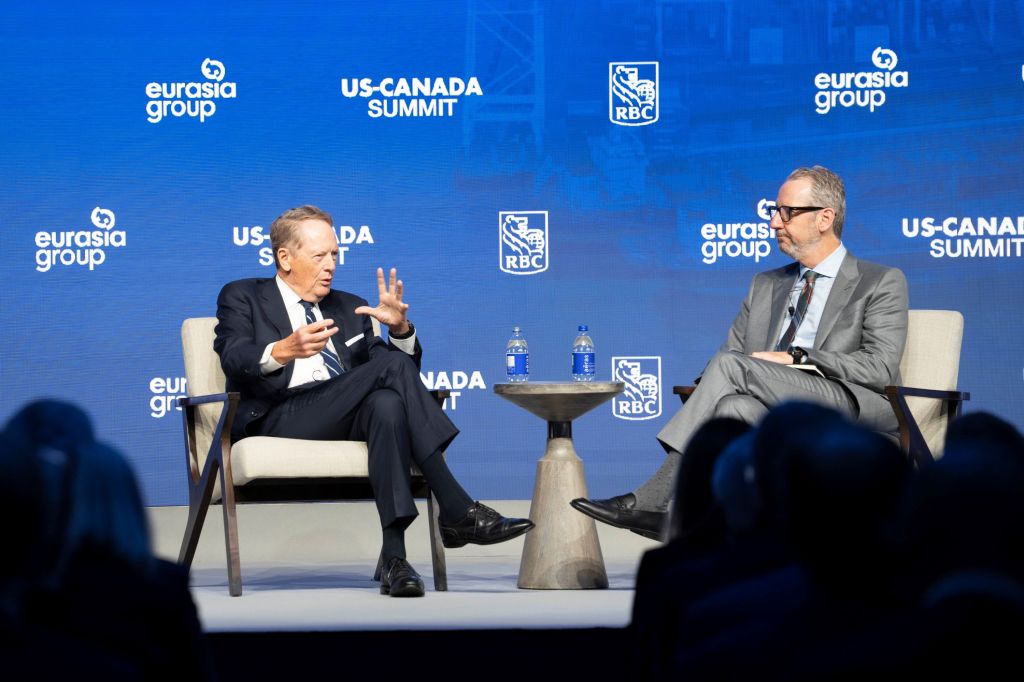
That’s not to suggest there’s rapprochement. Business leaders agreed the damage to Canada-U.S. relations is not irreparable—but there is damage, and it will take time to heal. Trust comes back slowly. Uncertainty recedes slowly, too. But the economic logic of closer Canada-U.S. ties remains strong. One Canadian portfolio manager said that no matter how they run their risk models, they end up with a 50-60% allocation to the U.S. The two governments now have the summer, and likely part of the fall, to find a way forward on trade. They’ll also have to recognize how much their economies are changing at the same time. This isn’t your parents’ trade zone anymore.

As hopes for free trade fade, a new age of state capital is evolving. Both Washington and Ottawa are now explicitly using government spending, tariffs, procurement, and regulation as tools of economic strategy—and the era of assuming that politics would leave globalization alone is over. Daleep Singh of asset manager PGIM put it plainly: we are in a world of fiscal dominance, with industrial policy in the midst of renaissance. Every cross-border linkage—trade, capital, energy, technology—is now at risk of being weaponized for geopolitical leverage. The result is more government debt, higher trend inflation, more political risk and a stronger case for physical assets connected to economic security.

Will this also mean a return to mercantilism? If governments try to gain economic favour by diminishing and constraining others—competitive strength over comparative advantage—Canada will need to play its many cards more assertively: low-carbon natural gas, critical minerals, food and fertilizer, nuclear fuel, and a stable rule-of-law environment that capital increasingly prizes. It presents material opportunities for business, too, as governments create incentives to reshore economic sectors and underwrite the scaling of companies, from AI to life sciences. Annesley Wallace of pension manager HOOPP captured the investor mood: Canada now has the attention of global investors in a way it didn’t a few years ago. But capital wants to see execution and policy certainty, not just ambition.

Data centres are the new factories—the physical infrastructure of the AI economy. And Canada is largely absent from the map. Hamid Moghadam of Prologis, one of the world’s leading logistics companies with $5 billion invested in Canada, was direct: companies building data centres go where it is easiest. Canada is not on that list. Prologis currently has no AI data centre capacity in Canada, with the Netherlands and the United States dominating. The culprit is a “quirky provision” in Canadian tax law that imposes a 15% burden on U.S. tax-exempt capital invested in Canadian properties—a friction that doesn’t apply in reverse. That could be the greatest cross-border risk as enterprise users (unlike the hyperscalers) turn more to inference models that can use low-latency infrastructure. Bell Canada is seizing on that with a new data centre in Regina that is, initially at least, expected to rely on U.S. users.

The slower pace of AI adoption in Canada—fewer than one in five companies, and fewer public sector users have deployed the technology—is starting to show up in economic and business performance. Canada is trying to catch up with a new national AI strategy that aims to invest in AI awareness and skills, as well as business adoption. Jenny Johnson of investment management firm Franklin Templeton put it starkly: the pace of AI is moving so quickly that companies that get it right will leave others in their sector behind permanently. She told her own executives: if you aren’t building agents yourself, you’re already behind. Trouble is, citizens in both countries are increasingly anxious and skeptical about AI. That’s leading to more grassroots pressure, including in this year’s mid-term election campaigns in the U.S., to regulate AI. 

Both Canada and the United States are navigating a crisis of public trust in technology—but they are responding in ways that could put them on a collision course over regulation, data, and digital trade. In the U.S., the AI boom is turbocharged by private capital, hyper-scalers, and a permissive regulatory culture. The concern is less about governance and more about falling behind China in the AI arms race, although local resistance to data centres, especially over their use of electricity and water, could change the conversation. Canada, by contrast, is pursuing a more rights-based, sovereignty-first approach. 

In both countries, and across their borders, the AI revolution is moving so quickly that governments seem destined to react. Ian Bremmer, Eurasia Group’s founder and president, warned of a deepening crisis in which no political leader could overcome a structural gap between technological transformation and outdated governance systems. Technology companies, he said, increasingly act as functional sovereigns in their own domains—and the absence of governance around AI is one of the most urgent risks on the horizon. Canada’s AI Minister Evan Solomon acknowledged the paradox: Canada’s best and biggest AI partner remains the United States, and access to frontier models, compute, and capital still flows primarily north-south. But as Canada builds its own AI sovereignty framework—and as the Safe Social Media Act, new privacy rules, and the AI for All strategy take shape—conflicts over data flows, platform regulation, and digital trade are increasingly likely. 

Defence is again central to the relationship, and central to emerging divisions. One big one: what technologies will dominate the battlefields and defensive lines of tomorrow? Case in point: Three days before the summit, an Iranian drone shot down a U.S. Apache helicopter, and then an American sea drone rescued the two downed airmen. The U.S. is investing heavily in AI systems, robotics and autonomous war machines, as well as bio- and cyber-weaponry. Canada is trying to catch up on advanced military technology, and at the same time restore and restock bigger hardware like fighter jets and submarines. The Canadian strategy is driven by economic policy as much as defence strategy, to build trade ties with European and Asian allies.

The wars in Ukraine and the Middle East have rewritten defence doctrine. Scalable production and resilient supply chains have proven as decisive as firepower. MDA Space CEO Mike Greenley put it this way: defence and space remain areas of full collaboration and full integration, even amid trade tensions. “The stronger we are, the better partner we are.”
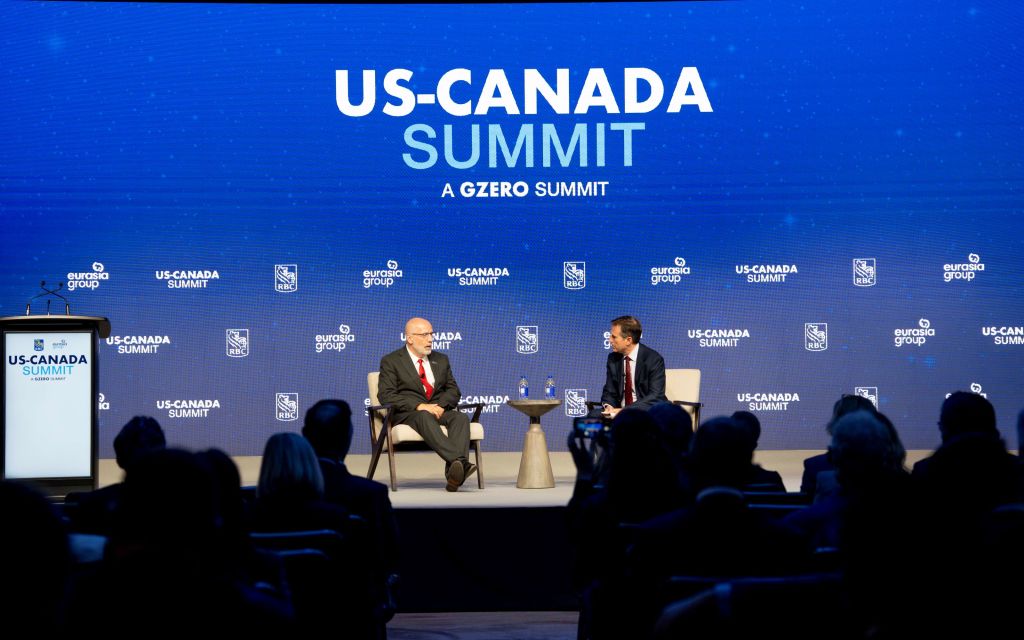
That may require an intricate matrix of supply chains and partnerships in which Canada could continue to play a role in the F-35 fighter jet program while also building the GlobalEye partnership between Sweden’s Saab with Bombardier to make surveillance aircraft for Arctic defence. Energy and critical minerals will be a critical component of this new chapter. Vivek Lall of defence firm General Atomics identified a technology triad linking AI, nuclear energy, and autonomy as the defining framework for the next generation of defence capability—and argued Canada-U.S. collaboration has significant potential across all three.

The Arctic is no longer a remote policy afterthought. It has become a global economic, geopolitical, and strategic battleground—and one where Canada and the United States have no choice but to work together, and quickly. Olafur Grimsson, former President of Iceland, framed the challenge: the past decade has seen a flood of new arrivals into the Arctic, as China, Russia, and a constellation of Asian economies sought access. The old notion of sovereignty, where lines on a map settled the question, no longer applies in an environment that is rapidly becoming both economically accessible and strategically contested.

Thomas Dans, Chairman of the U.S. Arctic Research Commission, was direct about Washington’s view: both countries have “a lot of room both to catch up, but also to surpass and to really lead.”

He said North America needs to look over the North Pole and also toward the North Star. First challenge is Russia. Even though there may be room for cooperation over fisheries and shared resources with the Kremlin, Grimsson warned the West risks losing sight of what Moscow is doing in its own Arctic, particularly as Russia deepens energy, pipeline, and mining links with China, India, and other Asian powers. The same sort of resource development is possible on the North American side. Then there’s the skyward trajectory. Continental defence may rest in the ionosphere, but it doesn’t stay up there. The two countries need to develop land and sea-based systems in the Arctic to connect with their growing space-based defence operations.

Canada has always punched above its weight in space—but largely as a junior partner to NASA. That posture is shifting. Canada is now trying to carve out a distinct space identity, rooted in its own strengths and connected to a broader set of international partners, while remaining deeply integrated with the U.S. It may pose the greatest challenge to continental cooperation. Canadian astronaut Jeremy Hansen said the two countries will find the most opportunity by playing to their strengths, rather than for diplomatic reasons. For Canada, those strengths include Earth observation, space-based communications, and robotics, as well as onboard computing.
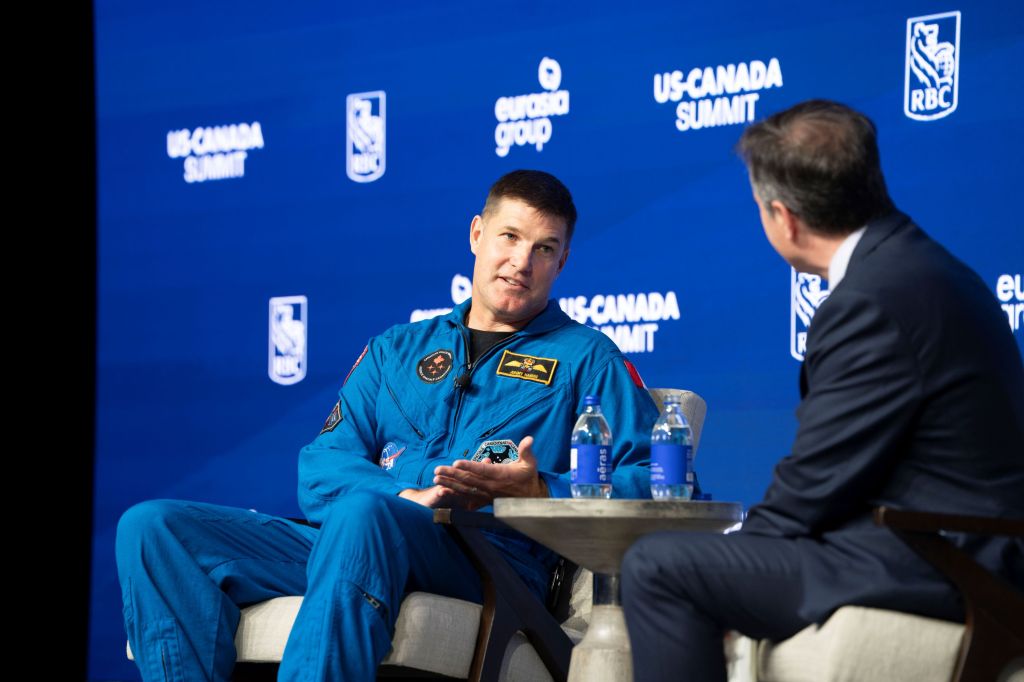
Countries are increasing spending rapidly, creating a 2.5x economic multiplier for space manufacturing and technology. But leaving the so-called final frontier to commercial firms may underestimate the geopolitical tensions up there. In the race to return to the moon, China is partnering with 11 nations, the U.S. with 60. Canada is in the latter coalition and contributing meaningfully. Hansen compared the challenge to the ethos of a space crew: “People who can point out what’s broken and stop there is not acceptable in our space culture.” Canada’s space ambition requires the same discipline—specific proposals, not just aspirations.

Canada is seeking to diversify its economic and security relationships, without undermining its integral relationship with the U.S. Industry Minister Mélanie Joly said Canada has trade agreements with 52 countries. Discussions with the EU are deepening—not just as a response to tariffs, but to create genuinely integrated Canadian-European companies, and align industrial policies. Michael Sabia, Clerk of the Privy Council, was equally clear: Canada’s U.S. strategy and its broader global strategy are mutually reinforcing. “We are not decoupling. We are diversifying.” On China, his framing echoed U.S. language precisely—de-risking, not decoupling—with clear guardrails defining where Canada can and cannot engage.
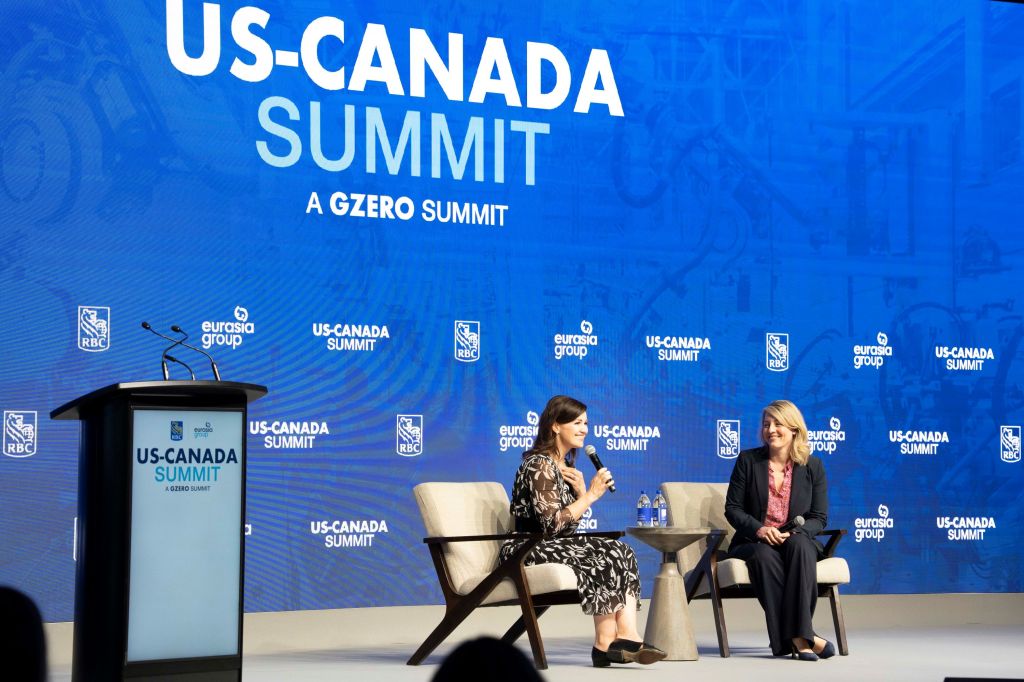
But diversification is not free, and the infrastructure required to redirect Canadian trade is largely not built yet. West Coast pipeline capacity remains critically constrained, limiting Canada’s ability to sell oil and gas at premium prices in Asian markets. Port infrastructure in Vancouver and other Pacific gateways—rail connections, bridge capacity, terminal throughput—lags badly behind the ambition of a serious Pacific trade strategy. And permitting timelines for new infrastructure projects remain a systemic bottleneck. Those are solvable problems. Sabia’s closing argument was that Canada holds a genuinely strong hand—low-carbon gas, food, fertilizer, critical minerals, AI capabilities, and a trust premium that flows from values and history. “This is not a time for national anxiety. This is a time for confidence.” 

Download the Report

I was in Houston this week for CERAWeek, the so-called Super Bowl of Energy, for a series of intense, and informative, discussions about the current global energy crisis. Last year, the forum was all ears as the new Trump administration laid out its plans for “energy dominance.” This year, the forum was all about the dominant energy crisis unleashed by the Iran war.

The prevailing view was the conflict — and dangers in the Persian Gulf — will continue for some time, and energy markets will struggle to find a new normal. Former Defence Secretary James Mattis, who has fought three wars in and around the Gulf, said the U.S. cannot declare unilateral victory. Even though Iran’s navy is destroyed, it can deploy anti-ship cruise missiles from its 1,000-kilometre coastline. That means a longer conflict than was first anticipated, and more economic reverberations as supply chains stay gummed up. Traffic through the Strait of Hormuz is down 70%, with 850+ tankers stuck in the crosshairs. It will take weeks just to move that traffic — one reason the IEA called this the “greatest global energy and food security challenge in history.”

The LNG market disruption is not a temporary shock. QatarEnergy’s CEO confirmed that about 17% of Qatar’s LNG export capacity will be offline for years, with billions of dollars in repairs required. LNG margins are already 200% higher on average for 2026 through 2028. New supply from Australia, Canada, and the U.S. will now just replace the losses, rather than add to supply growth. That means a return to pre-war LNG supply levels is unlikely before late 2027 at the earliest. Analysts at S&P Global Energy expect losses of up to 35 million tonnes of LNG in 2026 — enough to cover half of Japan’s annual imports.

The World Food Programme warned as many as 45 million more people could fall into acute food insecurity if the conflict doesn’t end soon — a crisis that rivals Russia’s invasion of Ukraine. One big reason: 30% of global urea trade comes out of Iran and Hormuz-constrained countries, and fertilizer exports from the Persian Gulf have dropped precipitously, driving up prices globally and threatening spring planting seasons. Bunker and cargo costs are up 4x in Europe, adding to the transport nightmare. Agriculture input prices have nearly doubled in Egypt. Fertilizer plants in India, Bangladesh, and Pakistan have had to stop production entirely as natural gas and oil prices spiked — and unlike in 2022, there are few alternatives. India cut output from three of its urea plants. Bangladesh shut four out of its five fertilizer factories.

The Strait is the only sea route for 93% of Japan’s oil imports, prompting Tokyo to begin releasing 80 million barrels of oil from its strategic reserves. Japan’s LNG buffer is considerably thinner — Japanese companies hold only about three weeks of LNG inventory, equivalent to the total volume of their Hormuz-dependent LNG imports. Taiwan and South Korea are as severely threatened. In South Asia, fuel rationing is well underway. Pakistan and Bangladesh rely on Qatar for roughly half of their LNG imports. Asian LNG spot prices have surged 143% since February 28.

Rising debt costs and higher import prices have always been a curse for developing countries, especially those that leveraged foreign credit and energy to stimulate growth. In several African economies, energy and transport account for 15-25% of inflation. The Asian Development Bank has identified the Philippines, Pakistan, and Sri Lanka as the most vulnerable in that region. Ripples will be felt in low-cost manufacturing belts, too, as input costs — petroleum-based plastics, for instance — rise. All that will put pressure on indebted countries to borrow more to subsidize consumers and industry, just as interest costs are rising again. In Uzbekistan, Egypt and Mongolia, fuel subsidies account for 28.3%, 28.0% and 11.9% of government spending, respectively. Those dependent on tourism, such as Kenya and Sri Lanka, may be further challenged.

It’s widely viewed that power demand from AI-driven data centres will continue to surge, and there won’t be enough gas to run them. Big Tech companies like Google and Microsoft are developing plans to use nuclear, even reviving mothballed plants in the U.S. But that will take years. Data centres now account for 4% of U.S. electricity, and projections are it’s heading to 12%. It’s not just a U.S. and Chinese phenomenon. Asian countries like the Philippines have ambitious data centre strategies, predicated on more imported gas to run them, but will now need that gas — at a much higher cost — to keep factories and the AC running. The supply-demand imbalance doesn’t compute.

The energy shock has put a new light on China’s ambitions to sell EVs to the world, especially the developing world — if those energy-dependent countries can find new ways to electrify their fleets. Currently about 60% of the world’s pure EVs are sold in China. Will the energy shock shift growth? That will take time, especially for countries facing a host of other challenges to build out electric infrastructure. Expect most countries to have both gas- and electric-powered cars for a long time — even the U.S. Fordmotor Co used the Houston forum to promote its strategy for a new electric pick-up truck, being developed at a skunk works plant in California. The truck’s appeal is its simplicity more than its energy needs. The new vehicles use a fraction of the components (it’s all battery) and a fraction of the internal wiring, making it far easier and cheaper to make. U.S. automakers are also learning from China on how to build vehicles as tech platforms. The biggest question in Ford CEO Jim Farley’s mind: How will Americans react? As Ford knows, cars are culture.

It’s early days — and lots of contingencies are emerging — but as much as 10 million barrels a day of production may be lost this year due to the conflict. That’s roughly 10% of global needs. There are plenty of oil fields that can replace that — just not quickly or efficiently.  Take Venezuela. Its recent increase of 250,000 barrels per day over 2026 represents less than 0.3% of global consumption. Neighbouring Guyana offers more hope, as does Brazil, Nigeria and even Libya. But all those together don’t get anywhere near the missing barrels. There was chatter  at CERAWeek about a return to Alaska drilling, North Sea exploration and even Norway’s Far North. Canadian production is expected to increase, too, including offshore opportunities in Newfoundland and Labrador. But most eyes are on Russia. It may have 80 million barrels of oil currently on the open seas, and a multiple of that ready to go.

Energy Minister Timothy Hodgson didn’t mince words. Canada will produce and export a lot more oil and gas, He even put numbers on it: 2.5 million more barrels a day of oil (a 50% increase) and 100 billion cubic feet of gas (double projections) by 2035. He told various audiences that Indigenous support has rarely been stronger for resource development, in part because most big resource projects now have indigenous ownership. Premier Danielle Smith told one audience an agreement between Ottawa and Alberta on carbon pricing is coming and will be critical to long-term contracts. It can also underpin plans for a massive investment in carbon capture and storage, something the Carney government remains insistent on. Behind closed doors, sovereign wealth funds, multinationals and state corporations lined up to advance negotiations for long-term contracts and equity stakes. A universal question among them: Can #Canada execute this time at speed and scale?

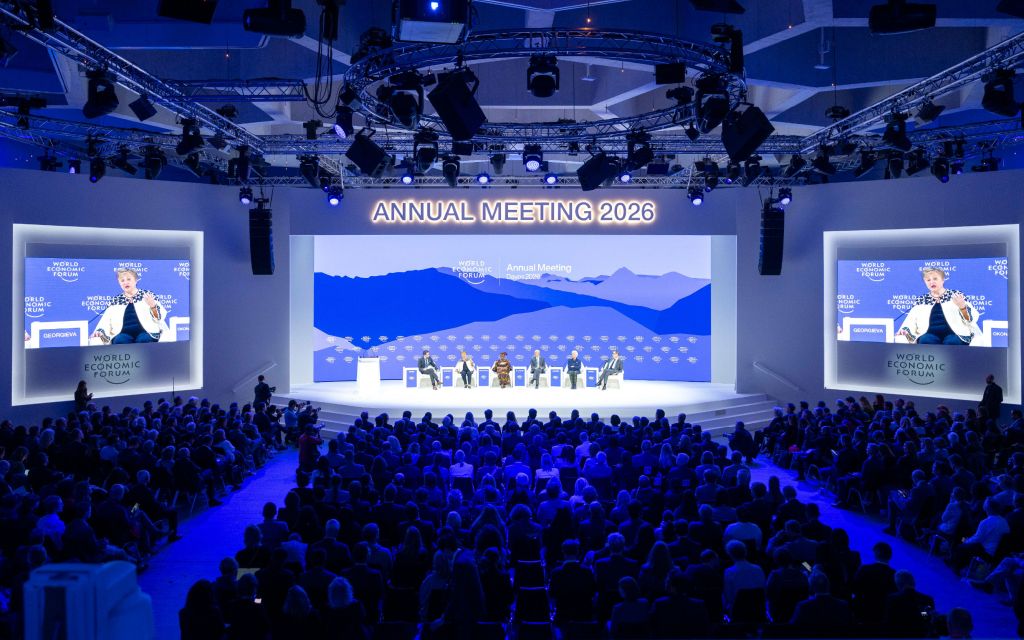
The World Economic Forum this year became a tale of two Davoses.

Inside the main Congress Centre, a record number of attendees, including 850 CEOs, 80 tech billionaires and founders, hundreds of ministers and 65 heads of government spent the week hearing about the decline of globalization and the inward turn of societies.

Outside, it was a very different world. On the town’s main promenade, you couldn’t walk 50 metres without feeling like you were in a mash-up of Wall Street, Silicon Valley and the United Nations, as countries from Brazil to Indonesia and companies from Tech Mahindra to Pinterest pitched themselves to the passing kaleidoscope of a crowd.

Mark Carney called this new environment one of “variable geometry.” Others called it a new age of “multi-alignment”—as if the global economy is becoming a bit more of a bartering and babbling souk than a tightly wired marketplace. By any name, the emerging world order, or disorder, seems as slippery and risky as the icy streets of Davos. Here’s some of what to look out for:

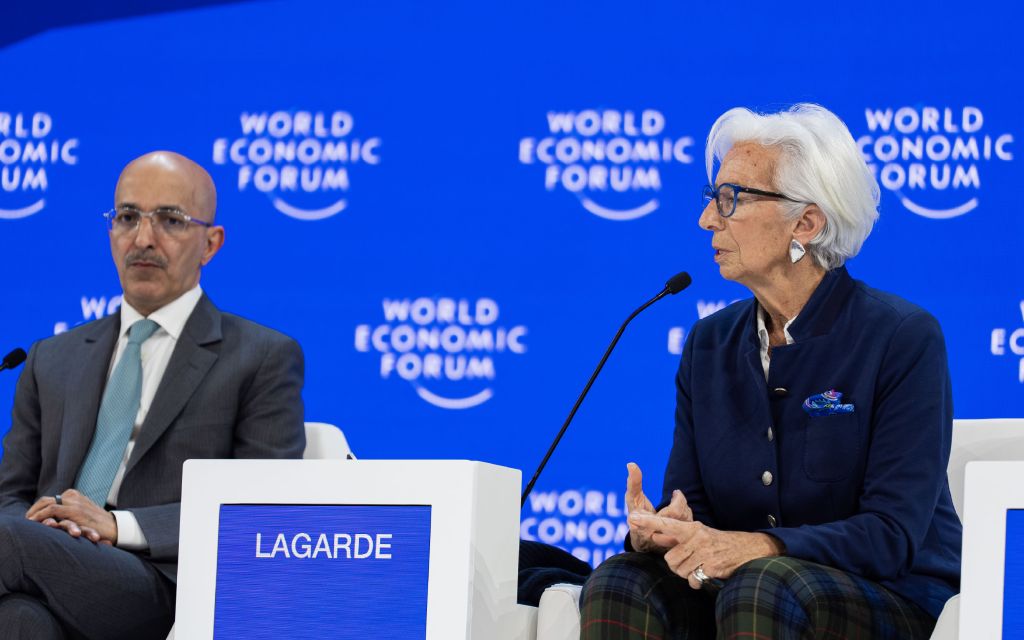
Last year, a day after his second inauguration, Donald Trump spoke by video to the Forum and promised a golden age for America. This time, he came in person to proclaim victory. With five cabinet secretaries and hundreds of American CEOs in tow, the President spent an extraordinary two days in the Swiss Alps projecting a 21st century version of American power. This is no stay-at-home superpower. In Trump’s vision, the world will trade and prosper more than ever, on America’s terms.  Close to three-quarters of global trade is still compliant with WTO rules. Inventory build-ups helped many companies escape the initial tariffs. A greater impact may come this year. But for the most part, “it’s still holding,” said Christine Lagarde, head of the European Central Bank, arguing the global economy is so intricate and intertwined even the U.S. cannot unravel it. Trump’s more mercantile Pax America is not just economic. He came with an unsolicited bid for Greenland that was rejected by his closest NATO allies. He left with a Board of Peace, supported by an unlikely collection of 19 countries with a combined GDP of $5 trillion, roughly equal to Germany. Only four (Albania, Bulgaria, Hungary, Turkiye) are in NATO, and only four (Argentina, Indonesia, Saudi Arabia, Turkiye) are in the G20. Will Trump be able to expand America’s reach without stronger partners? Or is this the new geometry of power?

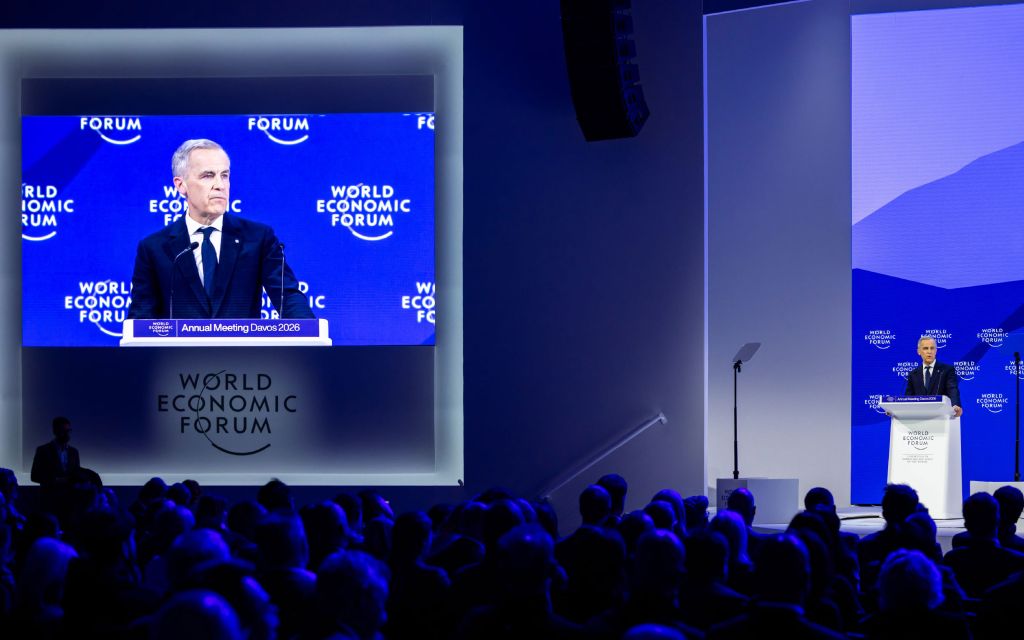
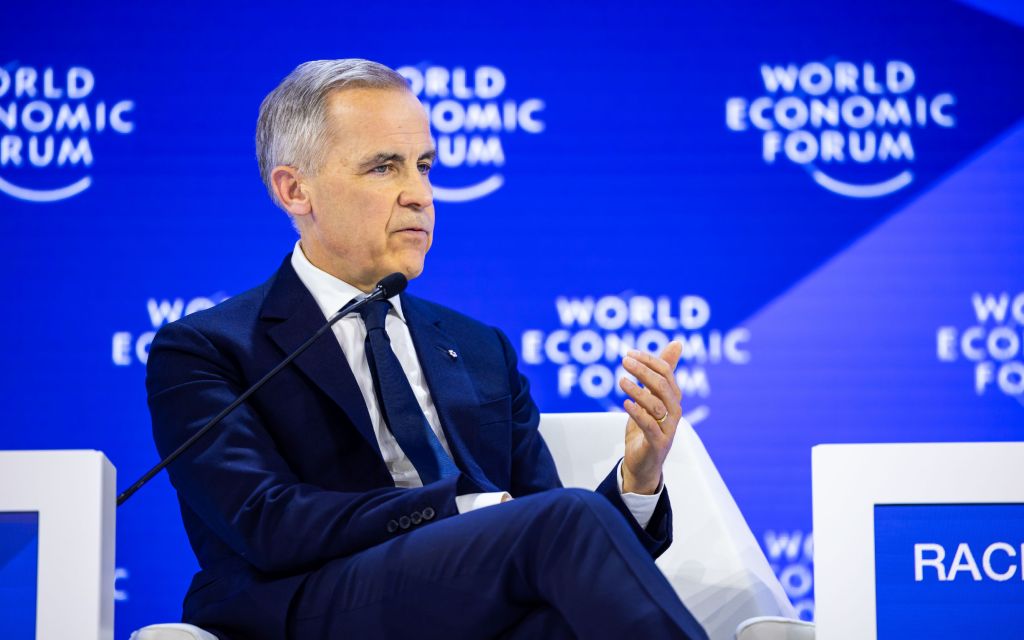
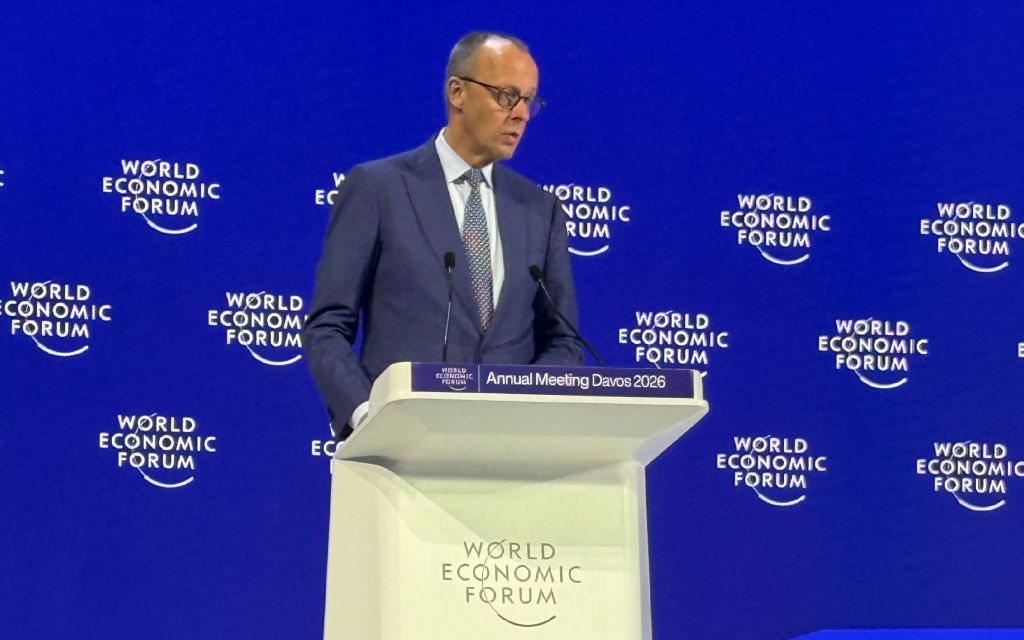
Mark Carney, long viewed as the quintessential “Davos Man,” gave a keynote speech that was widely celebrated for capturing the distraught mood of many there and crystallizing the desire for a new approach to international affairs. His tag line—“nostalgia is not a strategy”—resonated. Now he has to deliver on diversification. There’s no easy path. Canada’s closest allies in Europe are each struggling, economically and politically, weakened by the Ukraine war, immigration crises and a growing appeal of nationalism, which is now the biggest political force on the continent. Europe’s biggest economy, Germany, narrowly escaped a recession last year, after two years of decline. Chancellor Friedrich Merz called Europe “world champions of over-regulation” and at risk of losing its unity if it doesn’t reform. Canada will need more distant partners, too, particularly China and India, which the WEF estimates will account for nearly 40% of global economic growth over the next five years. Both emerging giants can be as tough as Trump when it comes to trade. The Persian Gulf beckons, too, with trillions of dollars of capital investment. But there, too, a new generation of economic partners have different political and legal systems—and social customs—to the neighbourhood where Canada grew up.

High above Davos, someone carved a message into a mountaintop glacier: “No King.” It was probably meant for the visiting U.S. President but equally could have been a message from European markets to the mighty greenback. King Dollar had a rough week, facing big questions as global trade winds shift, and countries and companies look to re-orient capital flows. The dollar still dominates 88% of global foreign exchange transactions, and 54% of global trade, which is why so many still cite TINA (There Is No Alternative). Or is there? The WEF opened to the startling news that Denmark’s largest pension funds had dumped U.S. treasuries in retaliation to the Greenland threat. A risk-off America vibe sent U.S. bond yields higher, reducing hopes for broader rate cuts. In moments like this, investors tended to stay in America, through real estate or stocks. This time, at least among Europeans, there was plenty of corridor chatter about a secular shift forming. One fund manager said his investors had asked him to sell down U.S. holdings. A few American tech executives said long-time European clients were cancelling orders. The euro, yen and Canadian dollar may play greater roles. The renminbi should gain prominence, although is years away from being a serious global alternative. Uneasy lies its head, but there’s still only one king wearing the currency crown.

The World Economic Forum was created in the 1970s to help Europe avoid the rise of socialism, and turn instead to free markets. A half century later, much of the West is again turning to the state to meet various economic ambitions—and the risks are evident. As countries, Canada included, seek to build back their militaries, build up their own technology foundations and become less reliant on the U.S.—home to roughly half the world’s financial capital—they are looking to leverage their own balance sheet and use other tools to direct capital to national priorities. These ambitions are so pronounced that many prime ministers and presidents seemed more like investment bankers working the Davos crowd. Advanced economies like Australia, Norway, Germany and South Korea do indeed have capacity to borrow more for investment, as do many emerging economic powers like Saudi Arabia. But capitalism is about more than capital; it’s about putting capital to work, with results. Singapore’s president, Tharman Shanmugaratnam, offered some sage advice, urging these new nation-state capitalists to be ruthless with investing, and with spending and regulation, too. Growth requires governments to focus on productive investments, including education, rather than redistribution—and a humble recognition that governments are inherently weak at building economic enterprises. If this new shot at state capitalism is to work, a new mindset will be needed, too.

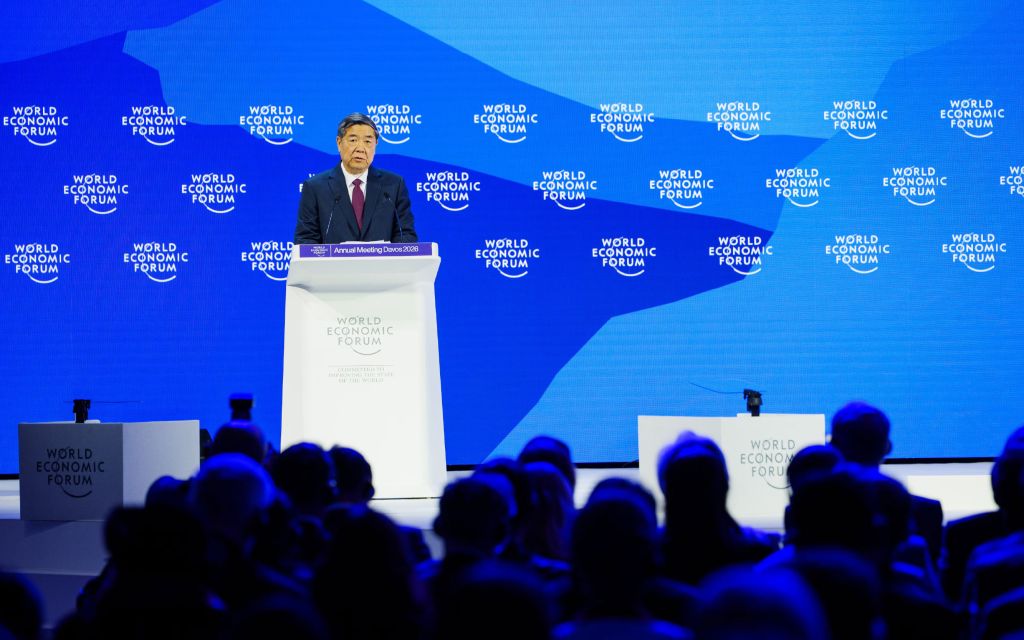
Right after Donald Trump was first elected President, Xi Jinping came to Davos, to offer up China as a global leader for an emerging age. In the ensuing decade, Beijing has delivered—in renewable energy, nuclear power, critical minerals, pharmaceuticals and AI. So much so that Xi no longer needs to be there. This time, while the U.S. and Europe shouted at each other, he sent one of his less powerful vice premiers, He Lifeng, to position their country as a defender of multilateral trade and “inclusive globalization.” China experts said Beijing is not missing a moment to quietly advance its two biggest priorities—reunification with Taiwan and AI supremacy. Xi sees AI as critical to China’s future, and DeepSeek 4, the next-generation AI model expected in February, will show how far China’s come. On that other front, it’s believed the Chinese military, which conducted naval exercises around Taiwan at New Year’s, is ready to take the island by force, if necessary, within a year, which would give it sway over the world’s semiconductor industry that is so essential to AI. Democratic Senator Chris Coons, who was at Davos, fears the U.S. Administration doesn’t appreciate the need for “a network of allies with core values” to contain China. We’ll get a clearer picture when Trump and Xi meet in April, but don’t expect a grand bargain between the hegemons. Best case, Coons said, may be a series of “small landing points” to keep the world in balance.

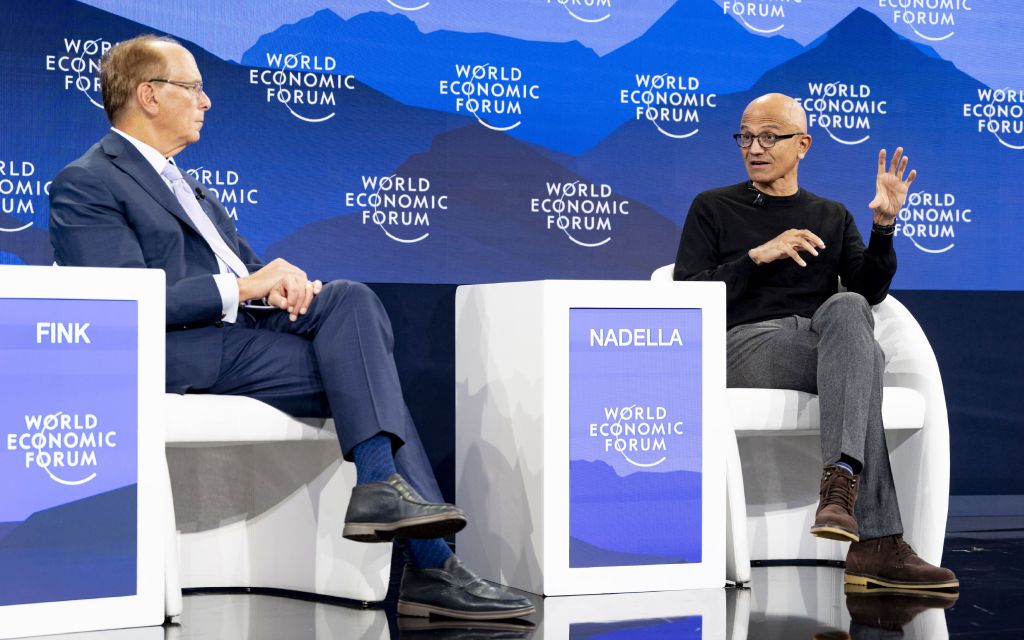
Data centres seem to be eating the world, electron by electron. But will the capital be there again in 2026 to feed their financial appetite? Data centre spending surpassed $500 billion last year, and when combined with broader electricity needs, according to McKinsey, may total $6.7 trillion over the next five years. The world has never seen an infrastructure boom like this. Data centre construction is now the single biggest contributor to U.S. economic growth; tech spending as a share of all investment is now running 50% higher than it was during the broadband boom of 2000, and triple what the U.S. spent on Interstate highways in the 1960s. Vacancy rates for data centres recently hit a record low of 1.6%, as developers bid up available spaces. “We may need more,” said Larry Fink, CEO of Blackrock. “If we don’t scale, China wins.” Equinix, a large data centre player, faces ten times the demand for every new unit they build. Land is no longer the constraint; energy is, as a medium-sized centre requires the energy of a small town. Such operations last year accounted for two-thirds of U.S. load growth, making them a new political target in boom states like Virginia and Ohio where electricity prices have soared. They’re also a growing concern in Africa and South-east Asia, the world’s fastest-growing regions, where countries have found themselves outbid for gas turbines and other power equipment.

The next energy crisis won’t be fueled by oil or gas; it will be strained by the world’s faltering electricity grids. Electricity demand globally is rising three times faster than total energy demand, driven by air conditioning and electric vehicles, as well as data centres. While 90% of Americans have access to air conditioning, the number is 20% in India, 18% in Indonesia and 5% in Nigeria—each with some of the world’s fastest-growing cities. Add to that the growing demand for EVs, which now account for a quarter of global car sales, up from 5% in just five years. Fatih Birol, head of the International Energy Agency, said the world will need 10,000 terra-watts of new electricity in the next decade, which is the equivalent of adding another U.S., Canada, Europe and Japan. Without any innovation breakthroughs, that would require 70% more copper, and a vast expansion of steel and critical minerals processing. Developments in large-scale battery storage and grid digitalization offer some hope, as most electricity systems still suffer a gross mismatch of supply and demand. But an unfortunate truth remains: it’s easier and faster to build power plants than it is to add transmission and distribution. Take this recent experience in Europe: the continent added 80 gigawatts of renewable energy supply only to find it didn’t have the capacity to transmit all that new electricity.

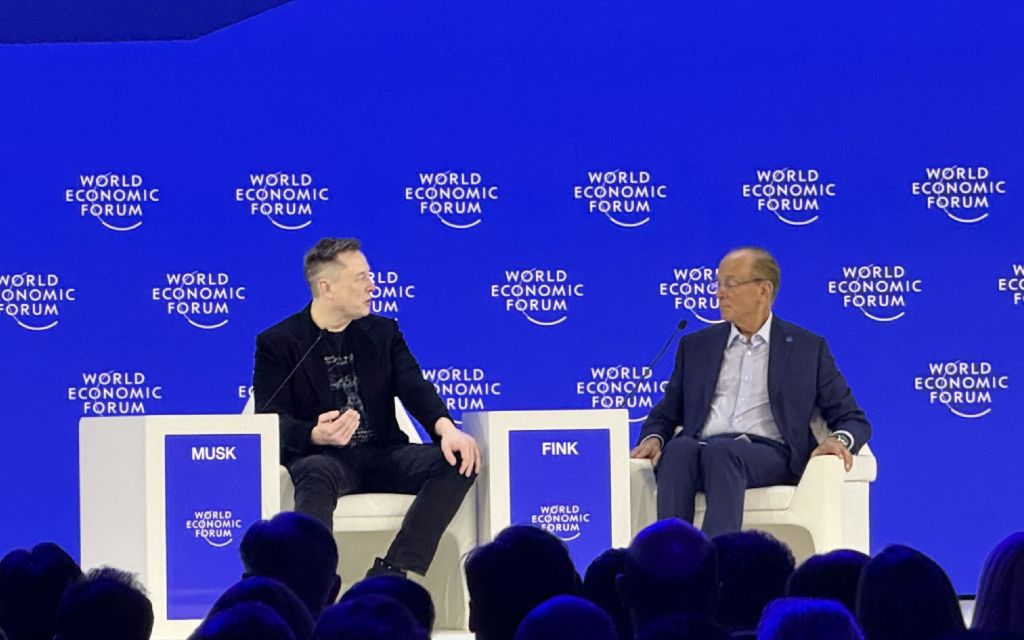
There were two vastly telling moments in Davos’s main Congress Hall, one speaking to scarcity, the other to abundance. Donald Trump went off script to lambaste renewable energy, especially wind which he said was for “losers.” A day later, Elon Musk used the same stage to profess a glorious future for renewables, especially solar which he said could power all of America if he had his way. Just give him a parcel of land, 160 kilometres by 160 kilometres, and tariff-free solar panels! Away from North America, renewables are still the driver of energy growth and have shifted from a “transition” source to a default for new supply in many markets. Europe reached roughly 50% renewable generation in 2024. In other fast-growing markets, renewables are increasingly seen as energy additions, not just replacements for fossil fuels. Falling battery costs (solar is down roughly 80% in India) and longer lifetimes (30–35 years) have helped shift economics from a simple cost per unit to a cost per lifecycle. But reliability remains a challenge, which will require more battery storage, pumped hydro, and hybrid round-the-clock systems. But that’s happening in places like India, which has installed 2.7 million rooftop solar systems and 3.1 million solarized pumps and has already hit its 2030 target for renewables to account for roughly 50% of non-fossil fuel energy.

AI has shifted from an experimental technology to foundational infrastructure—and now an operating system for companies and governments. The competitive advantage is not just model innovation; it’s diffusion and how fast firms can beat their competitors to transform. As diffusion accelerates, Anthropic co-founder and CEO Dario Amodei sees 2026 as the year when AI systems build AI systems, including within firms, in ways that could upend entire business models. Demis Hassabis, co-founder and CEO of DeepMind, said the advantage will go to “continuous learners” who track what models are doing and adjust strategies and workflows. Seizing that approach, most CEOs have taken AI ownership out of the tech department and parked it on their desk. A BCG survey, released at Davos, found that 72% of global CEOs see AI as a core part of their mandate, with half believing it will define their tenure. Companies plan to double AI spending this year, even though a 2025 MIT study found very few adopters had seen a financial return. David Sacks, the Silicon Valley guru who is Donald Trump’s AI czar, sees the need for leaders, in government, business and media, to dispel fears, and embrace the chance to disrupt and innovate. He cited another study that found 83% of Chinese are optimistic about AI, compared to 39% of Americans. Sacks worries that “a fit of pessimism” will result in the U.S. losing the AI race due to what he described as a “self-inflicted injury.”

There’s a new financial math for AI. It’s what Microsoft CEO Satya Nadella calls “tokens per dollar per watt”—basically the energy cost per unit of compute. Think of it as a kind of basic wage and productivity measure for AI. And the companies, and countries, that can drive down that unit cost will be positioned to win in the data economy. This new math may fundamentally change the nature of human work, too. Think of it as “data x energy x labour = success.” The C-suite consensus at Davos seemed to be that labour, like data and energy, will be needed even more. CEOs said the entry-level “job cliff” is overstated; the real problem is a widening skills mismatch, as most roles will require a re-bundling of tasks and skills. The winners will be the workers (and firms) that can integrate and operate with AI. This transformation is resetting corporate ladders, especially in professional services and governments, where basic tasks like document review, screening and modelling can be done by machines. New apprenticeship designs will be the hot HR need, to build judgement, context, and supervision skills. More model design and modification will be pushed to the frontlines, where employees can create small pieces of automation to transform their work. All this can flatten organizations, and give advantage to those with abundant data, cheap energy and AI-savvy teams.

Growing divisions in the world, and within countries, is a matter of trust. And we’re losing it. Stefanie Stantcheva, a Harvard economist, finds it’s especially acute for her generation—those under 40—who see a zero-sum world and their slice shrinking. She shared research at Davos showing how distrust now spans the political spectrum, with a wide range of millennials feeling other groups have captured government agendas through mainstream media, corporate influence and old-school politics. That tension will grow as aging voters in the West demand more income and health security, perhaps at the cost of economic and national security. The Edelman Trust Barometer, which surveys 34,000 people in 28 countries and is released annually at Davos, found societies sliding from grievance into insularity; seven in 10 people are hesitant or unwilling to trust those with different values, backgrounds, or information sources. Trust is also shifting away from institutions to “people like me,” neighbours, co-workers, and one’s CEO. Business is now seen as both most competent and most ethical, surpassing NGOs on ethics for the first time, while government and media remain the least trusted. Most starkly, optimism is fading: in many countries, majorities no longer believe they or their families will be better off in five years, citing economic anxiety, AI, misinformation, and global conflicts.

Download the Report

I sat down with former Australian prime minister Scott Morrison while he was in Toronto this week, to talk about that country’s bold bets on the space sector and what Canada can learn.

Morrison helped launch Australia’s space sector into a higher orbit, and is now active in the global sector, especially in the U.S. Here’s some of what he shared with me, as well as a group of Canadian space leaders and investors:

  • Space is “once again becoming a geopolitical contest,” echoing the 1950s–70s space race. Pretty much every aspect of intelligence and national security now has a space connection. 

  • Canada should see space as a way into the world’s most important military and security alliances. AUKUS (Australia-UK-US) is one of those groups, as is the Quad (US, Australia, India and Japan) and the Five Eyes intelligence network of the US, Britain, Australia, New Zealand and Canada. 

  • AUKUS is worth watching as it shifts attention from submarines and undersea dominance to orbital dominance. Space may be Canada’s opportunity to join an AUKUS2.

  • While NATO has been slow on space, that will shift. The Ukraine war — and the role of satellites and drones — shows where future battlefields lie.

  • The sector is projected to grow ~9% annually, heavily driven by semiconductors, satellites and global AI demand.

  • Combined, AI and space will be the defining mega-trends of the next 50 year, shaping global security, economics, and national capabilities.

  • A dedicated national space agency, with senior oversight from government, is essential for the sector’s growth, providing critical mass, coordination, and legitimacy.

  • Large private-sector players are essential, too, but public capital and international partnerships are required.

  • Launch leads to legitimacy. If a country can’t launch its own assets into orbit — right now, Canada can’t — it won’t be a leader. Australia is aiming to build the only near-equatorial launch site among the Five Eyes, making it more indispensable to intelligence partners. 

  • Don’t stop at launch. “The sexy stuff is rockets,” but real industry growth depends on infrastructure, logistics, testing, science support and service capacity.

  • Others are on the move. Japan is aggressively scaling its space ambitions, targeting 30 launches per year and leveraging tight state–industry coordination. New Zealand has Rocket Lab and a politically energized space agenda.

Here’s what Morrison says Canada needs:

  • A credible national space strategy with funding behind it.

  • A capability others need.

  • A willingness to invest politically and financially at the scale the US and Australia are committing.

  • A concrete capability that strengthens our alliances, including  space domain awareness, Arctic surveillance, satellite manufacturing, launch capacity, AI-enabled sensing and cyber integration.

  • A security-focused rationale, aligned with allied threat assessments — particularly those related to China.

“At the end of the day, this is a security initiative, not an industry development initiative. At home, governments will speak about employment and economic benefits. But in Washington, Canberra, London, Tokyo, or Wellington, the argument must be strictly: Here is the capability Canada brings to collective security.’”

This op-ed originally appeared in the Toronto Star


Canada has entered a new space age.

The Carney government announced a historic commitment of $528.5 million to European Space Agency (ESA) programs, all of which will return to Canadian companies, enabling them to build deeper partnerships with European space and defence projects and companies.

It also says to the world that Canada wants to be a serious space player again, and to partner with plenty of allies beyond the United States.

One big step for Canada, yes, but compared to the even larger new space investments that other countries are making, it is still only one small step for humankind. To be a major global space player again, Canada needs to do much more, and do it quickly. To thrive in this new space age, we will need far more private capital and entrepreneurs than we’ve ever seen in our country. We need to attract and keep space investors (and there’s far more than Elon Musk out there), and ensure they’re generating capital, ideas, technology and high-value jobs in Canada — something other emerging space powers, from India to Japan to Germany, are already doing.

Our new report, A Higher Orbit: How Canada can build and finance a bolder space strategy, recently published by RBC Thought Leadership, lays out this new space imperative for Canada. It can’t be overstated: our sovereignty, Arctic defence, tech capabilities and economic prospects are all at various degrees of risk. Indeed, at a time when Canada is looking north, west and east, we need to look up, too — with much more ambition.

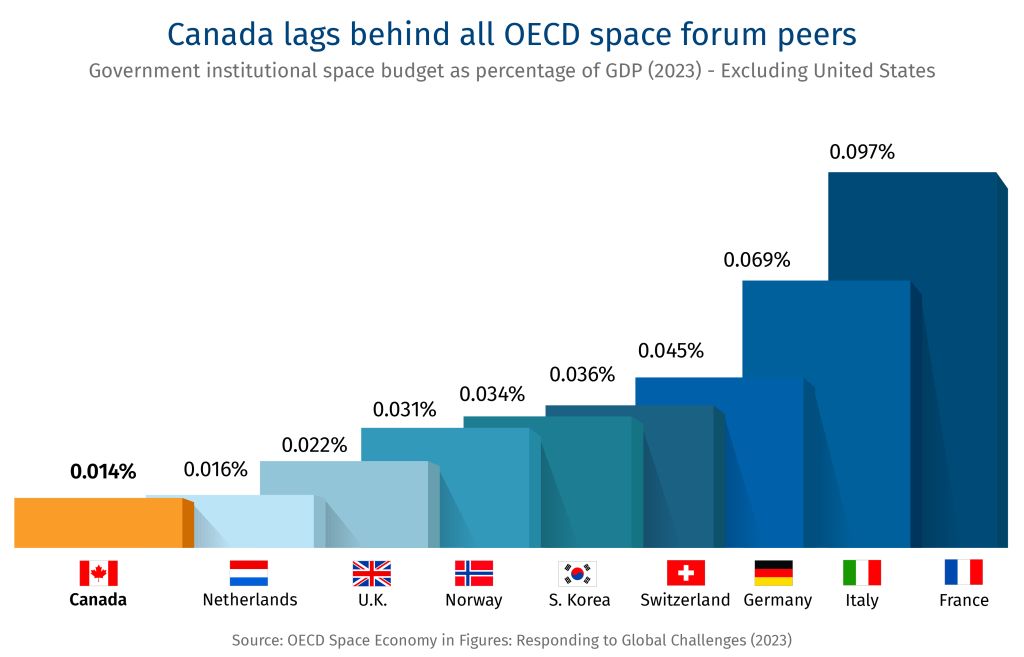
Let’s start by reconciling with the ground we’ve ceded. Canada was the third nation to go to space, in the 1960s, and for decades a pioneer and partner for our allies. Then we lost our way. Over the past decade, our space spending flatlined and were surpassed by numerous other countries.  Today, even the Netherlands spends a greater percentage of GDP on spacethan Canada.

Budget 2025 aimed to relaunch Canada’s space ambitions, quite literally. In addition to the ESA announcement, the budget allocated $182.6 million for domestic orbital launch capabilities, most likely to build two Atlantic Canada spaceports. Little else matters if we can’t launch our own rockets and vehicles into space, which is the case today. Until we do, we will be a passenger on SpaceX and other countries’ rockets — and beholden to their laws, timelines, and priorities.

Once we have Canadian controlled launch, we see a bold decade ahead in which Canadian satellites can join the front of the pack in earth observation and communications. Those will be our eyes and ears on the Arctic, and for Canadian interests everywhere. They also will be critical to our evolving security alliances and protecting our sovereignty. This is where elbows up needs to become heads up.

Beyond national defence, our research shows significant economic potential, touching pretty much every sector. The global space economy, led by the U.S. and China, is on course to triple in value to $1.8 trillion (US) over the next decade. Japan, Germany, India, South Korea and the United Arab Emirates are all gearing up national space programs to capture their share of that prize.

Corporate Canada needs to look up, too. As the saying goes, every company is now a space company. So, too, is every digital citizen. Whether you know it or not, your data travels, on average, 40 times a day through low orbit — and right now, that’s not secure as recent research indicates that satellites may be broadcasting up to half of their traffic through unencrypted channels.

Modelling from RBC Thought Leadership shows the need for roughly $12 billion in new capital for Canadian space ventures over the next decade, which in turn can generate more than $20 billion in annual industry revenue.

To get there, we will need a bolder strategy. That starts with a procurement pathway that says to the world what we’re willing to spend over the next five-10 years. If Canada commits 5 per cent of our enhanced 5 per cent NATO commitment to space, the government will be able to map out $7.5 billion a year in space spending — that’s enough to catapult Canada back into the peloton of advanced nations, less reliant on the U.S. and China. Without long-term commitment, global investors — the ones who can multiply that public investment — will not see Canada as a serious player.

Next, the upcoming Defence Industrial Strategy needs to lay out which sectors within space are top priotities. Much of this can be technologies that we are already excellent at – such as synthetic aperture radar and space robotics – but it will need to include new areas, such as counter-space systems, as well.

In addition to security and economic benefits, space monitoring technologies are critical to mitigating climate change, from melting ice conditions to changing water systems and shorelines. Quite urgently, space tech needs to play a leading role in our ability to predict, prevent and fight wildfires — a capability we can export to our allies, too.

Then there’s the Buy Canadian mandate. We can actually do more, and faster, in space than on Earth. We have globally respected companies, from big players like Brampton’s  MDA Space and Telesat in Ottawa to fast-growing innovators like Toronto’s Kepler and Montreal’s GHGSat, which can all scale more rapidly for global markets.

Recently, at SpaceBound, the annual forum organized by Space Canada, we were encouraged to hear Defence Minister David McGuinty and Industry Minister Melanie Joly share more of the government’s ambitions for space. Both ministers along with senior military officials carried that message to the Halifax Security Forum.

In Ottawa, we also convened a private roundtable with companies and investors who said much more needs to be done. Canadian investors — from private equity to pension funds — need to sharpen their space skills, as we’re seeing instutional investors do in the U.S. and Europe. Federal financial institutions like Export Development Canada and Business Development Bank of Canada need to make space a greater priority within their new strategies for defence finance. And our colleges and universities — long champions of space innovation — need to up their games in both the commercialization of research and training of a new generation of space pioneers.
The moment for that is now. When Jeremy Hansen joins the Artemis II mission to the moon this winter, he will be the first non-American to ever leave Earth’s orbit. It can be a defining moment, to all Canadians, to say to outselves and to the world: we’re going to make a lot more space for Canada. Just look up.


Compromise.

That’s how the world’s leading news organizations summed up COP 30, the United Nations climate conference that just ended in Belém, Brazil. A sampling;

“A climate compromise” — Le Monde (France)
“Mixed verdict” — The Times Of India (New Delhi)
“Fragile deal” — The New York Times
“Historic finance boost” — O Globo (Brazil)
“Progress on money, standstill on oil, gas, coal” — DER SPIEGEL (Germany)
“Vulnerable nations decry lack of fossil-fuel phaseout” — Al Jazeera Media Network (Qatar)
“Multitrao consensus, showcasing unity” — China Daily (Beijing)

The mutirão spirit, or working together, was as good as the conference could get, given it had compromise at every turn. Here’s what mattered most in the end:

  • Commitment to a Just Transition facility, aimed at supporting groups and communities most impacted by climate action

  • Commitment to triple adaptation finance, although no clear path to do so

  • 80 counties called for a roadmap to phase out fossil fuels, fewer than expected

  • New push for oceans-based solutions

  • New emphasis on “information integrity” to combat disinformation on climate

  • No significant agreements on deforestation, a setback for many given the summit’s location in the Amazon basin.

COPs (or Conference of the Parties who signed the UN climate framework) tend to end in a mix of commitment and disappointment. This one was no different — although given its milestone status and location in Brazil, home to the first Earth Summit in 1992, it fell short of most expectations. Perhaps that’s not surprising, given the state of geopolitics and the global economy.

Turkiye will host COP31 next year, while Australia will lead the negotiations. Both countries were vying for the lead role, and agreed to share the spotlight.

Another compromise!


John Stackhouse, Senior Vice-President, Office of the CEO, RBC

The global space economy is poised to nearly triple to US$1.8 trillion by 2035, making the value derived from orbital assets equivalent to that of some G20 economies.

Canada has an opportunity to grow its space economy to $21 billion by 2035 — a four-fold increase.

An estimated $12 billion in public and private capital is needed to spur this growth. Much of that can be leveraged through new procurement strategies.

Canada currently ranks last in public spending among 10 OECD Space Forum members as a percentage of GDP.  At the same time, the Canadian space industry generates $5 billion in sales revenue, which is 25% less than it did in 2014.

Canada’s total space budget is projected to increase 56% over the next decade. That includes a federal budget commitment of $180 million for launch capabilities, with two sites already under development in Atlantic Canada.

Canada can seize this moment by building a new space strategy around five key pillars: sovereignty, defence, technology, commercialization and climate.

The U.S., China, Japan, and Germany provide critical lessons for Canada — especially through strategic procurement, state scale and finance, as well as technical excellence.

Success depends on a more unified approach within government, procurement modernization, capital market activation, export market development and talent mobilization. These are interdependent levers but success requires simultaneous progress across all of them.

We’ve entered an ambitious new space age—and Canada needs an ambitious new space strategy. 

What’s at stake? Our sovereignty in a more divided world. Our prosperity in a new tech universe. And our relevance to allies when the “final frontier” is suddenly the next economic and strategic frontier.  

The global space economy is poised to nearly triple from US$630 billion in 2023 to US$1.8 trillion by 20351, making the value derived from orbital assets equivalent to that of some G20 economies. This transformation is not merely an economic opportunity. There’s a fundamental shift underway in how nations are mapping out their sovereignty and competitiveness, and it’s increasingly through space.

Canada has much of what’s needed to be a leader in this new age. When Jeremy Hansen heads to the moon next year, he’ll be the first non-American to leave Earth’s orbit. Our space researchers are widely seen as among the world’s best (and for a lot more than the Canadarm). And our strong capabilities in the AI economy, and perhaps soon the quantum economy, puts us where the planetary puck is going. 

Unfortunately, too much of Canada’s space ambition rests on past achievements and not enough on future commitments. And we’re at risk of losing altitude just as the global space industry is taking off. As of 2025, Canada is one of the only space-faring nations that can’t launch itself from its own soil even to low orbit. meanwhile, our digital lives increasingly flow through tiny satellites sent from Earth on American and European rockets.

Our private space sector is also nowhere near what Canada could support. The Canadian space industry generates $5 billion in sales revenue2–25% lower than 2014.3 And our space GDP is down 13%, with productivity running about one-third lower than the U.S. space sector. If trends continue, we project negative annual sales growth of just 1% a year over the coming decade, with industry revenue falling to $4.5 billon by 2035. 

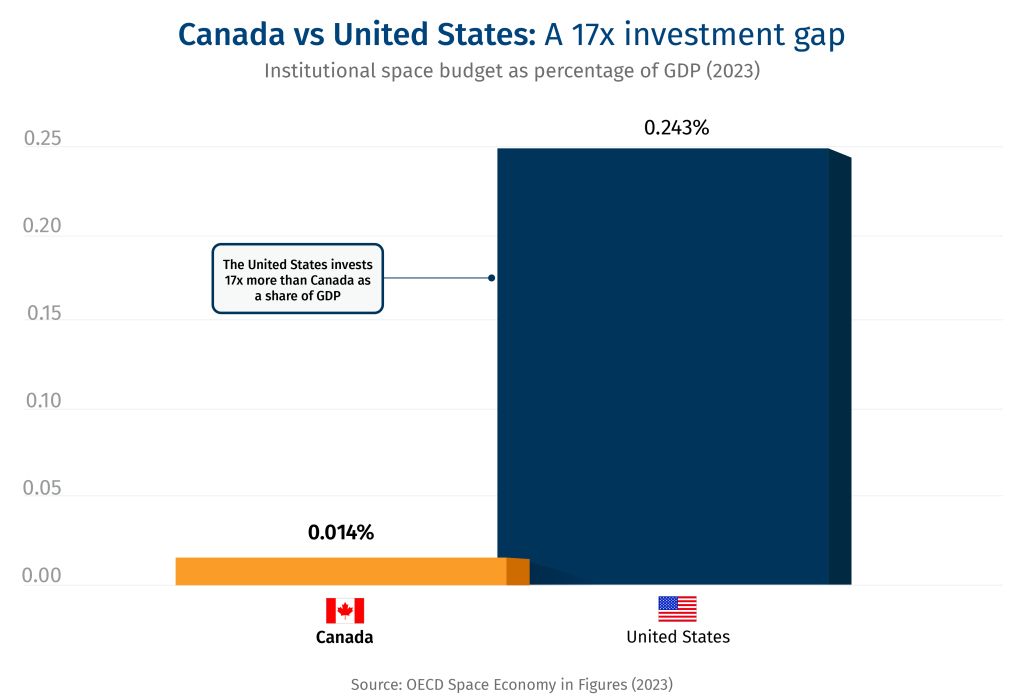
Then there’s the challenge of government spending. Canada currently ranks last in public spending among 10 OECD Space Forum members as a percentage of GDP4.  In a decade that saw SpaceX transform the space economy, and the U.S., China, India and Japan all land crafts on the moon, the Canadian Space Agency’s budget fell 18% from 20155—and at $414 million6 is a fraction of the OECD average.

Government institutional space budget as a percentage of GDP 2023 - Canada vs United States: A 17x investment gap

Canada lags behind all OECD space forum peers including Netherlands, U.K., Norway, South Korea, Switzerland, Germany, Italy, France

That’s starting to change, as Canada’s public space investments are again increasing. The total spending for Canada in space reached $549 million in 20247. The federal budget includes a commitment of roughly $180 million8 for launch capabilities, with two spaceports under development (Atlantic Spaceport Complex and Maritime Launch) and several ambitious rocket projects (Canada Rocket Company, NordSpace, Reaction Dynamics). It was also announced that Canada will ramp up its investment in European Space Agency programs by $528.5 million, which will boost R&D for Canadian-made technology, and Canada is the only non-European country partnered with the European Space Agency. 

Canada, the third nation in space after the Soviet Union and the U.S., also has some of the world’s leading satellite and robotics firms, led by Telesat Lightspeed (with nearly 200 satellites planned for orbit over the next two years), Kepler Communications (the first in the world to use lasers to connect Earth and space) and MDA Space (ranked the fifth most innovative globally by Fast Company). Plus, a new generation of innovators, including Mission Control and Canadensys. Our new NATO commitment of dramatically increased spending could spark a generational opportunity to invest in those companies, and many more, including through dual-use space capabilities.

Canada can seize this moment by building a space strategy around five essential pillars:

  • Sovereignty: Building a space industrial base

    An elevated sector requires much bigger Canadian companies, as well as a domestic infrastructure that starts with sovereign launch capabilities. It’s as fundamental as building and operating our own shipping ports.

  • Defence: Becoming an essential ally in the Arctic

    As NATO allies look to Canada for Arctic defence capabilities, we can be the most trusted non-American ally in space, while also being an integral U.S. partner in the defence of North America through our participation in initiatives like the Golden Dome.

  • Technology: Using satellites to secure a digital leap

    The race for AI and quantum will run through new constellations of satellites that Canada can continue to help build and operate. This will be critical to any sovereign tech stack, as is the ability to not only control and secure our data but to leverage it for our own objectives.

  • Commercialization: Breakthrough research and development

    Every company, whether they know it or not, is a space company. Space is embedded in our daily lives and fundamental to our economy, particularly in geolocation services and the transmission and storage of data. Canada should continue to be at the forefront of researching, developing and commercializing these essential technologies.

  • Climate: Protecting Earth from the sky

    Our ability to manage a changing climate, and reduce the impact of extreme weather, runs through space. That will be especially critical as we look to better manage wildfires and develop new ways to protect our changing coastlines and thawing tundra.

To advance this strategy, Canada can draw on plenty of lessons from recent transformations in the space sector, particularly models that embrace defence-oriented priorities while enabling private-sector leadership. The U.S. is the exemplar of recent space innovation and leadership. Following the 2003 Columbia disaster, in which all seven American astronauts onboard the space shuttle were killed, the U.S. pivoted its space strategy from “build and own” to “buy and use.”

Washington became an anchor customer, purchasing services from private companies. Launch costs have fallen 10-fold in some cases, while innovations like reusable rockets, satellite internet like Starlink, and low-cost in-space mobility have emerged. The results speak for themselves: SpaceX’s valuation reached US$350 billion in 20249, while defence-tech companies like Palantir and Anduril command valuations of US$330 billion10 and US$30.5 billion11, respectively.

Canada could use that public-private dynamic to reach similar heights. The current space sector contributes $3.2 billion to GDP12. Using McKinsey’s forecast of a US$755 billion global market by 2035 for ‘backbone’ applications,13 we forecast that, if it receives major investment. Canadian space industry revenue could grow to $21 billion annually by 2035—a four-fold increase.

A key engine propelling this sector growth needs to be Ottawa’s new commitment to dedicating 5% of our GDP to NATO defence spending and dual-use systems.14 Dedicating 5% (of the 5%) to space defence and dual-use systems could inject up to $7.5 billion annually into the Canadian space sector by 2035.15 But Canada also needs to generate more private capital, which will require strategic government spending coupled with a more market-oriented approach. By our estimates, the Canadian space industry will require nearly $5 billion in capital in the coming decade to maintain existing capital stock. In a more ambitious scenario, where Canada doubles its share in the global space market, the country would need $12 billion in space capital.

That strategy needs to recognize a rapidly changing strategic stratosphere, in which two techno-powers—the U.S. and China—are competing for supremacy. We can further use space as a low-orbit lab in which leading science and technology efforts, from computing to life sciences, are accelerating. And as an outer boundary and one of the first points of potential conflict, space will only become more important to national defence.

In this new sphere of influence, Canada can leverage our unique position as both the strongest American ally in space and the leading non-American space player. The choice before us seems clear: embrace ambitious space leadership or accept managed decline in a domain that will define economic and security outcomes for decades to come.

The strategic approaches adopted by the four leading space players—the U.S., China, Japan, and Germany with the context of the European Union—provide critical lessons as Canada looks to accelerate its space sector development.

The U.S. has fundamentally restructured its space industrial base through a major shift from traditional cost-plus contracting to commercial services procurement. NASA and the Department of Defense function as anchor customers, offering multi-year, fixed-price contracts that de-risk private investment. This model has enabled SpaceX to capture 52% of global launch market share16 —accomplished through a combination of purchase commitments and direct government funding.

The commercial crew and commercial cargo programs exemplify this approach: they procure services at multi-billion-dollar scales, creating predictable demand that attracts private capital.17 The success of these programs, as well as the ancillary result of Starlink’s billions in revenue, validates the commercial viability of this model, while the Starshield program demonstrates how these capabilities can also be adapted for defence applications.18 With around US$7 billion in annual venture funding19 flowing into the sector and International Traffic in Arms Regulations (ITAR) creating protected market conditions, American companies benefit from rapid iteration cycles and risk tolerance.

Without comparable governmental anchor contracts of between $500 million and $1 billion, Canadian firms remain constrained to tier-two supplier roles within American prime contractor networks—manufacturing components rather than integrated systems.20

China has pursued a contrasting model characterized by centralized planning and state capital deployment, though it has also begun to fund its own commercial players after seeing the success of the U.S. strategy. Between the Guowang and Qiafan constellations, China is planning to launch more than 25,000 satellites.21 These represent more than technical achievements; they constitute sovereign infrastructure investments. Through civil-military fusion doctrine, every capability serves dual-use purposes, while Belt and Road Initiative ground stations from Pakistan to Kenya to Argentina extend China’s space influence globally.22

This approach succeeds through cabinet-level coordination that aligns space development with foreign policy and industrial strategy. Provincial governments compete for space industry clusters, creating internal competition within a unified national framework.

By contrast, Canada’s space activities remain fragmented across the Canadian Space Agency, Innovation, Science and Economic Development Canada, the Department of National Defence, and Global Affairs Canada—each operating with distinct priorities and lacking ways to bundle demand into single orders for demand aggregation. This institutional fragmentation prevents the coordination necessary to focus on strategic priorities and national champions.

Japan, which has increased space funding 10-fold in three years, has evolved from a predominantly civil and science-focused space program to a comprehensive national defence-and-markets focused initiative. This transformation materialized through the expansion of defence space spending for the Space Strategy Fund, from its initial ¥300 billion (US$1.93 billion), to ¥1 trillion (US$6.5 billion) over ten years.23

This transformation resulted from reconceptualizing space as essential to national security. Japan’s keiretsu corporate structures facilitate this approach through crossholdings that provide patient capital insulated from short-term market pressures. Government-backed institutions including the Innovation Network Corporation of Japan (INCJ) and the Development Bank of Japan (DBJ) provide strategic financing where private markets fall short.

Germany has been undergoing a major shift through defence prioritization, adding a historic US$40 billion in military space capabilities by 2030—including unprecedented consideration of offensive counter-space systems.24 Germany already had a strong platform, being among the European Space Agency’s largest contributors, at €3.5 billion (US$4 billion) over three years.25 It also ranks third globally in space patents26 and hosts over 120 space start-ups.27 In 2022, German SpaceTech startups generated over €120 million in revenue across 16 deals.28

Germany’s regulatory evolution on space, while delayed, also shows pragmatic progress. As an example, in September 2024 Germany published key points for a future German Space Act. One part is a proposed €50 million liability cap with 10% revenue-based recourse limitations29 that could potentially provide more favorable terms for investment. This measured approach—balancing commercial enablement with public protection—offered a template for nations seeking to stimulate private investment without assuming unlimited liability. Note, it is possible that the EU draft Space Regulation (2025)30 will take priority and does not include a specific liability cap. In either case, Germany’s ability to maintain world-leading capabilities in synthetic aperture radar, optical systems, and small satellite technology, while working through regulatory complexity both internally and in the EU, proves that perfect institutional conditions need not be prerequisites for technical leadership.

For Canada, Germany offers one of the most relevant models: a G7 nation with federal complexity, strong technical capabilities, and allied commitments that must balance sovereignty with collaboration.

How others are picking up the pace in space

These brief profiles capture the high-level aspects of the space strategies of the UK, South Korea, New Zealand, Norway, UAE, and Australia.

Goal: Brexit-driven strategic autonomy in critical technologies

Strengths: Public capital unlocks private markets. Defence Space Strategy provides framework. UKSA-DSIT integration recognizes space-digital convergence

Assets: OneWeb stake (now Eutelsat). Harwell Space Cluster. Strong satellite manufacturing base

Budget: US$765M public investment catalyzed a US$2.89B space economy boost (3.8x multiplier)31

Key method: Strategic public investments and long-term strategy unlock private capital. Banking conservatism and ESG requirements can create constraints but this significant multiplier demonstrates good success

Lesson for Canada: Comparable Commonwealth economy demonstrates public investment can achieve significant leverage when tied to strategic imperatives like Arctic sovereignty.

Goal: Achieve launch independence through sustained development.

Strengths: Chaebol structure absorbs early losses. Political commitment survives failures. Methodical capability building over two decades.

Assets: KSLV-II (Nuri) operational launcher.32 Naro Space Center. 425 Project.33 Samsung and Hanwha industrial integration. Korea Aerospace Research Institute (KARI).

Budget: US$670M, with US$560M directed at R&D projects.34 Sustained funding through multiple administrations despite technical setbacks.

Key method: 20-year progression: sounding rockets → military35 and commercial36 satellites → launch vehicle. Each failure treated as learning investment not political liability.

Lesson for Canada: We possess everything South Korea spent 20 years building. Difference lies in sustained commitment and commitment to sovereign launch, now recently rectified.

Goal: Dominate responsive small satellite launch market.

Strengths: Regulatory innovation enables rapid iteration. Geographic isolation becomes launch advantage. Private sector leadership with government support.

Assets: Rocket Lab: 70+ launches, 2nd most frequent U.S. launcher. Mahia Peninsula private range. 120 launch opportunities/year. U.S. corporate structure.

Budget: US$59M in public spending, US$1.52B space sector revenue (2024).37 Minimal government investment, high private return

Key method: Special use airspace, streamlined licensing. <2-month contract-to-launch capability.38 First to use 3D printing and electric turbopumps to reduce costs.39

Lesson for Canada: Small nation can dominate global niche through regulatory agility and geographic advantage, and most importantly backing and building off the success of a single, world-leading space entrepreneur. Focus beats breadth.

Goal: Become Europe’s gateway to polar and SSO orbits.

Strengths: Arctic location optimal for high-value orbits. First operational continental European spaceport. Strong allied integration.

Assets: Andøya Spaceport operational. Isar Aerospace 20-year anchor tenant. U.S. Technology Safeguards Agreement. Arctic Satellite Broadband Mission with U.S. payloads.

Budget: US$208M40. US$36K spaceport investment.41 Additional US$20K for defence allocation.42

Key method: 18-month construction for the spaceport.43 German commercial anchor + U.S. military integration.44 30 launches/year capacity at full operation.45

Lesson for Canada: Arctic geography becomes strategic asset through infrastructure investment and allied partnerships. Execution beats deliberation.

Goal: High-value tech transfer and inspiration through prestige projects.

Strengths: Significant capital compresses development timelines. Every tech transfer includes mandatory training. Global talent acquisition at premium rates.

Assets: Hope Mars probe (2020). Mohammed bin Rashid Space Centre. KhalifaSat Earth observation. Partnerships with NASA, JAXA, Roscosmos.

Budget: US$443M in civil space investment. Silicon Valley salaries for global talent. Backing from the US$820M sovereign wealth fund.46

Key method:  Buy proven technology, build local capability. Prestige generates foreign investment and regional leadership.47 Now leveraged into domestic start-ups and space investment holdings.

Lesson for Canada: Rapid influxes of targeted capital on major, visible projects can result in meaningful tech transfer and national inspiration.

Goal: Leverage Southern Hemisphere position for Indo-Pacific leadership.

Strengths: Late entry avoids legacy constraints. AUKUS provides technology access. Geographic advantage for polar orbits and regional coverage.

Assets: Australian Space Agency (2018). Multiple launch site developments. Deep Space Communication Complex. SmartSat CRC.

Budget: US$25M (2024), with US$135M over 5 years (2023-2028).48 US$840M Modern Manufacturing Initiative includes a US$101M Australian Space Manufacturing Network.50 Additional defence space investments.

Key method: Focus on mining, agriculture, maritime applications. Allied integration through AUKUS.

Lesson for Canada: Partnerships with the U.S. and integration into strategic domains provides technology transfer and co-investment opportunities. As in the Indo-Pacific, so it can be in the Arctic.

We’re the country that sent a skylark to sing in space, built the arm that assembled humanity’s orbital outpost, and created the radar that sees through Arctic darkness.

1962
The skylark takes flight
1981
The arm that built the future
1995
The all-seeing eye
2025
The inheritance test
September 29, Vandenberg Air Force Base: Thor-Agena rocket carries 145kg of Canadian built satellite into orbitNovember 13, Space Shuttle Columbia: Canadarm unfurls above Earth, Canada wordmark blazingRADARSAT-1 launches: Canada’s synthetic aperture radar pierces clouds, darkness, Arctic storms60 years of excellence meets venture capital reality
Alouette 1 makes Canada the third nation in spaceThe impossible made routine: Many doubted a 6-degree freedom robotic arm couldn’t work in spaceGeography as destiny: Built for a country that’s half winter, all vast, mostly invisible from spaceBrain drain accelerates: Our roboticists design for Silicon Valley, our radar experts optimize for Arlington
Named for a French-Canadian folk song about a skylark, because even our satellites have culture410kg on Earth, but in orbit it juggled 100-tonne payloads with centimeter precision72-hour promise: Any corner of Canada mapped within three days, Arctic covered dailyCapital gap becomes critical: Technical excellence without financial fuel
The miracle: Built by a DND team when transistors were “just in their infancy” with “no textbooks and virtually nothing” to guide themThe nuclear connection: Born from CANDU reactor robots—Canadian ingenuity repurposed for the cosmos17-year marathon: Planned for 5 years, operated for 17. Another Canadian overachieverBudget commitment to domestic launch – need to rise to meet the moment
Designed for 1 year. Sang for 10. The little satellite that could—and didPerfect record: 90 missions, 5 shuttles, built the ISS, fixed Hubble. Zero failures.The crossroads question: Sovereign space power or sophisticated supplier
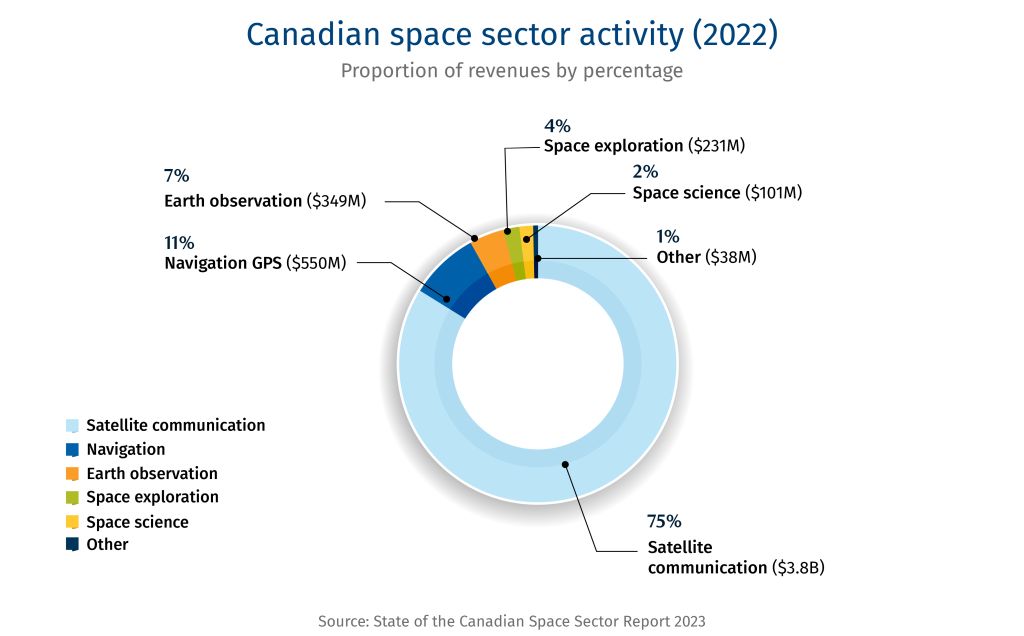
Canadian space sector activity - proportion of revenues by percentage

The following companies collectively employ more than 10,000 Canadians and generate more than $5 billion in annual revenue, with export rates exceeding 80%. They also demonstrate that Canada possesses the technical capability, manufacturing excellence, and commercial acumen to compete globally. What they lack is the scale of capitalization and anchor contracts their international competitors enjoy. With the proposed $12 billion capital injection by 2025 and defense spending increases tied to Canada’s new NATO commitment, these space firms could grow from successful niche players to global champions—creating the ecosystem that attracts and retains the next generation of space companies.51

  • Member of Canada’s fastest growing companies list, three years running

  • Built Canadarm, Canadarm2, and Dextre and now Canadarm3—establishing Canada’s robotics legacy

  • RADARSAT prime contractor, leading synthetic aperture radar technology

  • Developer of MDA Aurora, the world’s leading commercial Low Earth Orbit (LEO) digital communications satellite

  • Over 3,800 employees

  • Strategic relevance: Largest space company in Canada with a proven ability to execute complex programs and compete globally

  • Founded 2015, raised more than US$300 million in venture funding

  • Launching 10 optical data relay satellites in January 2026, building on the flight heritage of 23 previously deployed satellites, designed for compatibility with the U.S. Space Development Agency’s optical communications standards

  • First commercial company to demonstrate inter-satellite links in LEO

  • More than 175 employees

  • Strategic relevance: Kepler leads optical data relay technology globally and provides real-time connectivity, advanced on-orbit compute, and hosted payload services for mission-critical data

  • Developed Spacefarer™ platform used by NASA, and commercial operators

  • Delivered mission critical hardware and software for lunar rovers to customers on three continents

  • Launched Mission Persistence with SpaceX in June, Canada’s Giant Leap for AI in Space

  • Leaders in deploying AI at the edge, on the spacecraft itself, including for wildfire detection

  • Raised over $22 million in equity and non-dilutive funding

  • 35+ employees with deep space operations expertise

  • Strategic relevance: Software and operations expertise critical for managing complex constellation and lunar missions

  • Developing Spaceport Nova Scotia, located near Canso, which is designed as a multi-user, multi-mission launch complex

  • Active partnerships with small- and medium-lift launch providers for suborbital missions and ongoing discussions with Canadian and international orbital launch companies

  • Signed a U.S. Technology Safeguards Agreement, enabling U.S. launch providers and spacecraft partners to operate at the site using controlled American technologies

  • MDA Space made a $10 million strategic investment becoming an operational partner

  • The Company received a $10 million loan from Export Development Canada tosupport site development, launch pad completion, and operational readiness

  • Competitive access to polar and sun-synchronous orbits, offering inclinations from 45.1 to 90 degrees and safe downrange corridors over the Atlantic

  • Strategic relevance: Positions Canada to become a launch-enabled nation, capable of deploying and replenishing satellites from its own soil

  • Third-largest landing gear company globally; $800 million in revenue

  • 2,000 employees across Canada, U.S., UK, and Spain

  • Supplies Boeing, Lockheed Martin, Airbus, and many more OEMs

  • Export sales represent 90% of revenue

  • Strategic relevance: Precision manufacturing and systems integration capabilities directly applicable to spacecraft programs

  • Specializes in planetary exploration missions and systems, lunar rovers, science instruments, cameras, and lunar greenhouses

  • Developing LRM lunar rover for CSA and multiple lunar utility vehicles for NASA Artemis program and commercial customers

  • Leading the development of lunar greenhouses to produce food for astronauts on the Moon. Working with CSA, DLR, and NASA

  • Produce and sell computers, power systems, and cameras for lunar missions. Over 20 cameras now on lunar surface and another 200 currently in production, 100 of which are already ordered for various international lunar missions

  • Strategic relevance: Next-generation space robotics extending Canada’s legacy into lunar economy

  • Developing Canada’s first end-to-end responsive space launch system with vertically integrated capabilities

  • Tundra rocket (500 kg to LEO by 2028) and scales to Titan rocket (5,000 kg to LEO by 2032), designed as Canada’s first sovereign orbital launch vehicles

  • Building Atlantic Spaceport Complex (ASX) in Newfoundland & Labrador with operations starting in 2025

  • Manufacturing 3D-printed Hadfield & Garneau liquid rocket engines using Jet-A/SAF and LOx propellants

  • Terra-Nova satellite launching 2026 featuring NVIDIA GPU powered edge-AI for wildfire detection and wild field of view (WFOV) space domain awareness (SDA)

  • Strategic relevance: Dual-use SHARP defence program developing hypersonic capabilities and high-altitude missions for Arctic sovereignty using same hardware from Tundra rocket and engines

  • Leader in dedicated orbital launch services, rapid replenishment, and reconstitution of satellite constellations, with patented propulsion technology that simplifies propulsion architecture to ~12 parts compared to ~15K

  • $38M+ in total funding, including a $14M Series A (June 2025) and $10M grant from the Government of Quebec (June 2025)

  • Aiming for maiden suborbital launch in winter 2026; Aurora-8 launch vehicle targets the growing market of small satellites

  • Targeting first orbital launch attempt via pathfinder launch agreement with Maritime Launch Services to launch from Spaceport Nova Scotia in Q3 2028

  • Awarded €300K ($482K CAD) in NATO DIANA Phase II and awarded $776K from CSA SDTP for microthruster demonstration

  • Strategic relevance: Advances Canada’s sovereign launch capability and positions the country in the emerging suborbital and small-satellite launch markets

  • Founded in 1969, now one of the world’s largest satellite operators

  • Telesat Lightspeed LEO constellation: $6.5B investment for 198 satellites

  • Global broadband coverage with focus on enterprise, government, and mobility markets

  • Competing directly with SpaceX Starlink and Amazon Kuiper

  • ~750 employees

  • Strategic relevance: Demonstrates Canada’s ability to deploy capital for mega-constellations, critical for digital sovereignt

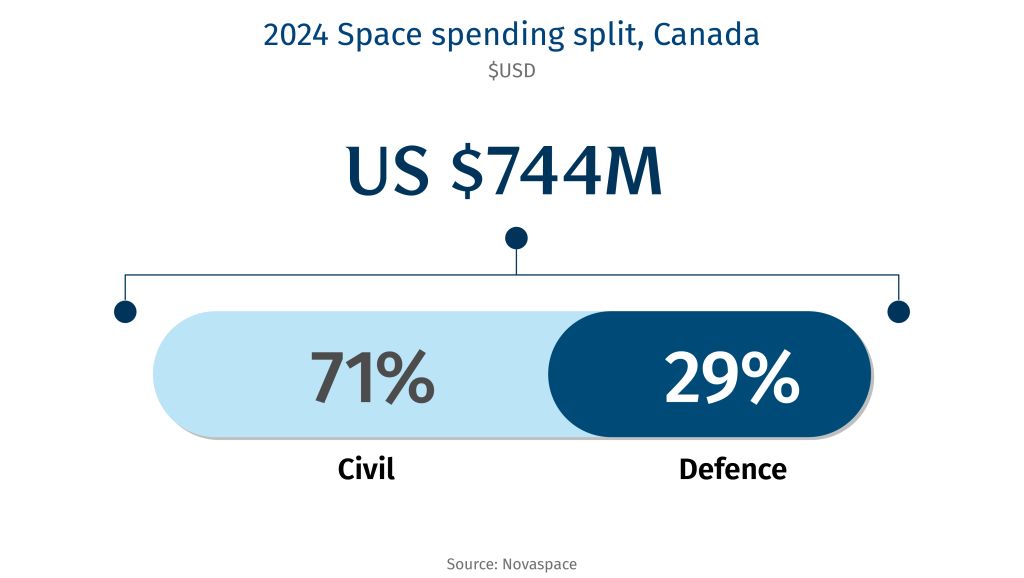
Canada needs to turn its pockets of space excellence into key pillars of a new global strategy. And the renewed focus on defence spending can be the launch pad. Defence spending currently represents 29% of Canada’s space spending and is poised to grow significantly as NATO commitments scale.52 This isn’t just budget reallocation; it’s a fundamental market transformation. Defence-driven procurement can facilitate anchor contracts and multi-year revenue certainty, which can help unlock private capital and enable Canadian space companies to achieve commercial scale.

Target capability by 2035: Strengthen our domestic space industrial base with a focus on sovereign launch capabilities and critical components where Canada has existing strengths.

Private capital, especially in the U.S. and Europe, has created a new generation of space companies. For example, deal flow in the U.S. space industry has more than doubled over the past decade and the value of those deals rose nearly four-fold.53 In the wider space industry, nearly US$50 billion flowed into space companies since 2015,54 growing on average 21% per year,55 with venture capital driving much of the action. The UK has become the second most attractive destination for space capital, as it has received 17% of this inflow.56 The industry is experiencing growth not seen since the Cold War space race, and dual-use and commercial capabilities are driving it.

In this global space race, Canada has many strengths but also some critical gaps. We have strong satellite manufacturing capacity, solid component production, but also fragmented supply chains and no domestic ability to get our own satellites to orbit. Canada is also under-equipped when it comes to testing facilities and national research centres. Decades of underinvestment in national space capabilities relative to our peers is starting to show. This industrial gap fundamentally limits our strategic autonomy and economic potential in a sector growing at 9% annually.57

New federal budget commitments will help, especially with the allocation of $182.6 million over three years for sovereign space launch capability.58 That’s a good start. But industrial competitiveness requires more to build a value chain: new ambitious missions and capabilities, advanced satellite and component manufacturing facilities, testing and validation centres, ground systems infrastructure, and perhaps two operational spaceports in the years ahead—NordSpace’s Atlantic Spaceport Complex and Maritime Launch’s Spaceport Nova Scotia.

The potential for economic transformation is proven. NASA’s shift from “build and own” to “buy and use” didn’t just reduce launch costs; it catalyzed an entire commercial space industry. The U.S. increased objects launched into outer space from 29 in 2011 to more than 2,200 in 202459 by empowering and buying national services from space entrepreneurs, and nurturing domestic manufacturing, supply chains, and service providers.

Modern space economics favour this comprehensive approach. The evolution of satellite technology shows dramatic cost changes. Commercial communications satellites in the 1990s cost $350-950 million (in today’s dollars), and can now be deployed for $150-500 million,60 with new small GEO satellites available for as low as $15 million.61 The transformation in small satellites has been even more remarkable: universities and emerging nations can now build and launch CubeSats as low as $150,000 total, compared to traditional satellites costing hundreds of times more.62 63

A robust industrial base that is increasingly funded through defence space spending could deliver defensive outcomes comparable to more naval destroyers or F-35s—but with far greater domestic economic multipliers through dual-use applications in communications, Earth observation, and climate monitoring.

2024 Space spending spilt for Canada between Civil and Defence

Annual capability by 2035: NATO-leading Arctic communications, positioning, surveillance systems; counter-space capabilities for deterrence

Space has fundamentally changed how nations project economic and military power. Advanced militaries now depend on satellites for communications, reconnaissance satellites gather intelligence and identify targets, and PNT constellations (including GPS) guide everything from precision munitions to drones.

Beyond these tactical capabilities, space remains central to strategic security. Early-warning systems that detect nuclear missile launches rely heavily on space-based assets. Starlink’s role in Ukraine grabbed headlines, but that’s just the beginning of how space systems are reshaping national defence.

At the same time, counter-space capabilities are proliferating rapidly. The U.S., Russia, China, and India have all destroyed their own satellites to demonstrate anti-satellite missiles.64 China and the U.S. are building extensive counter-space arsenals, including satellite proximity operations and refueling infrastructure. Russia has shown it can launch nuclear weapons into orbit that could wipe out most low-Earth orbit satellites with an electromagnetic pulse.65 The consensus is clear: any conflict between major powers will likely start with moves in space.

Canada needs advanced space capabilities for battlefield communications, intelligence gathering, target detection, and space control—including counter-space systems—if it wants to maintain sovereignty and deter adversaries. Our NATO and Five Eyes partners naturally expect us to take the lead on Arctic defence, where space systems are particularly critical given the massive territory and sparse population. Emerging Canadian firms like Dominion Dynamics are beginning to develop these critical capabilities domestically for Arctic sensing. Geography gives Canada a unique advantage: positioned far from potential conflict zones in Europe and the Indo-Pacific, we can contribute space assets to allied operations more effectively than ground, naval, or air forces.

With our small population and vast territory, staying tight with our “Five Eyes” – an alliance between Australia, Canada, New Zealand, the United Kingdom and U.S. – to share intelligence remains our best security strategy. Joining initiatives like the Golden Dome proposed by the US could strengthen these ties. The U.S.-led space-based missile defence architecture would integrate allied capabilities into a unified shield against hypersonic and ballistic threats. For Canada, participation could mean more than simply enhanced protection—it positions us as an essential partner in continental defence, potentially securing industrial participation and technology transfer for Canadian firms and ensuring our voice shapes the future of North American security architecture and supports broader Five Eyes capabilities.

Defence investments that fund new technology development consistently boost R&D spending and drive economic growth, as defence innovations built can often find commercial applications. But this economic spillover only works when we develop capabilities domestically rather than buying foreign systems. Canada needs to source from and co-develop with Canadian companies, structuring deals so these firms can scale domestically then globally. The U.S. has built massive companies this way—SpaceX ($350B+), Palantir ($330B), and Anduril ($30B)—through strategic national security contracts.

Annual capability by 2035: Quantum-secured satellite communications networks; sovereign positioning, navigation, and timing systems

Over the next decade, nations will secure economic and strategic advantage through technology. And three converging megatrends will reshape global power dynamics: the exponential growth of data as a strategic asset, the vulnerability of current encryption to quantum computing, and the critical dependence of commerce on satellite infrastructure. Nations that control secure satellite communications will hold the keys to digital sovereignty—those without independent capabilities will face strategic constraints.

Consider the scale of satellite dependence today. Maritime shipping, which moves more than $14 trillion in goods annually,66 depends entirely on satellite positioning and timing.67 Financial markets rely on GPS timing for transaction synchronization—an outage costs approximately $1 billion per day to the U.S. economy.68 The positioning, navigation, and timing services sector generated around US$280 billion in downstream revenues globally in 2023 from devices and services.69

The technological landscape of 2030 will be unrecognizable from 2020. As AI models become commoditized and universally available, competitive advantage will shift from algorithms to proprietary datasets. The companies and nations that can securely collect, transmit, and process unique data streams will dominate. Satellite constellations provide these unique vantage points—monitoring global supply chains, tracking economic activity, enabling autonomous systems—but only if that data can be secured.

Quantum computing presents both an existential threat and transformative opportunity. Current encryption methods protecting satellite communications, financial transactions, and military data will be vulnerable to quantum decryption within this decade. China has already demonstrated quantum satellite communications with their Micius satellite.70 The nation that deploys quantum-secured satellite networks first won’t just protect their own communications—they’ll become the trusted provider for allies seeking protection.

Meanwhile, the AI revolution demands unprecedented data transmission capacity and security. Training next-generation AI models requires massive datasets often collected from satellite imagery, IoT networks, and global sensors. The Smart Cities market encompassing these technologies is projected to reach US$1.4 to US$4 trillion by 2030,71 72 much of it dependent on secure satellite connectivity for IoT infrastructure. Control of secure satellite infrastructure is also likely essential for what many are calling sovereign AI.

Every Canadian AI company training models on proprietary data faces choices about data routing and storage. Our innovation ecosystem’s competitiveness depends partly on secure infrastructure that enables protection of intellectual property while maintaining global connectivity.

Canada’s position presents both opportunities and vulnerabilities. Our reliance on allied satellite infrastructure—while beneficial for interoperability and cost-sharing—creates potential single points of failure. It is wise to ensure resilience through diversification.

In scenarios of system degradation—whether from solar events, cyber attacks, or infrastructure failures—Canada needs assured access to positioning, navigation, and timing services. Our banks, power grids, and transportation networks all depend on precise timing signals. The economic risk compounds as Canadian companies in resource extraction, financial services, and advanced manufacturing transmit sensitive data through satellite infrastructure without sovereign alternatives. Additionally, a three-year study conducted by researchers at UC San Diego and the University of Maryland found that roughly half of geostationary satellite signals are transmitting sensitive data completely unencrypted, making them vulnerable to interception with basic equipment.73

Canada possesses unique advantages to become a global leader in secure satellite communications. Our quantum research leadership—through institutions like the Quantum Valley ecosystem in Waterloo, the $360 million National Quantum Strategy, and the additional $334.3 million announced in Budget 202574 75 combined with leading quantum companies like Xanadu, Photonic, and NordQuantique, position us to develop quantum-secured satellite networks ahead of most nations. Combined with our intentions on Arctic sovereignty, NATO obligations, and trusted middle power status, Canada has both capability and market opportunity.

The economic case is compelling. Telesat’s $6 billion Lightspeed constellation76 demonstrates private sector confidence in Canada’s ability to compete globally in satellite communications. Adding quantum security creates differentiation for nations seeking trusted alternatives—not to replace existing partnerships but to ensure resilience through diversity. With focused investment, Canada could build quantum-secured satellite infrastructure serving both domestic needs and allied nations seeking additional secure communications options.

Annual capability by 2035: World-leading research programs in strategic domains; 100+ annual student projects; 2-3 breakthrough technology demonstrations annually

When it comes to space research, nations are no longer competing for scientific prestige but for control of technologies that will define economic and strategic power. China is targeting a space-based solar power demonstration by 2035.77 The U.S. is pursuing nuclear propulsion for Mars missions.78 Japan is developing a lunar RV while offering quarterly ISS deployment opportunities that have enabled over 200 satellite deployments since 2012.79 These aren’t science projects—they’re strategic investments in future market dominance.

Canada’s research strengths uniquely position us for space technology leadership, but only if deployed strategically. Three Canadian quantum companies—Nord Quantique, Xanadu, and Photonic—advanced to DARPA’s Quantum Benchmarking Initiative finals, competing for US$316 million.80 The federal budget’s $334 million quantum investment provides capital to secure these headquarters in Canada.81 Our materials science and robotics expertise, hardened through Arctic operations, directly translates to lunar environments. Our mining sector is well-poised to extract critical minerals, and it is one of the strongest in the world. Our nuclear industry has CANDU reactor experience that could be applicable to space power systems.

Success requires fundamental shifts in how Canada approaches space R&D. Japan’s model of regular deployment opportunities reduces the gap between prototype and product. When investors know technologies can be validated within months rather than years, capital flows to innovative companies. Canada could establish similar quarterly launch opportunities, transforming research projects from academic exercises into commercial pipelines.

The implementation pathway is clear: commercial partnerships from day one, with industry co-investment in research programs. Mechanisms ensuring breakthrough IP remains in Canada. Structured programs that connect student projects to space missions could be a great start. Most critically, acceptance that moonshots require multiple attempts and a commitment to preparing both the public and politicians to accept some failures as part of the process of innovation and growth.

The economic case is compelling. When NASA commits to purchasing orbital and lunar delivery services, companies raise billions in private capital. When DoD funds quantum communications, startups achieve unicorn valuations. Canada can replicate this model with government as first customer, not final customer, creating markets that attract private investment.

The opportunity window may be narrowing. As space commercialization accelerates and the owners of platform technologies emerge, first movers will establish dominant positions. Canada has proven it can produce world-leading research. The next decade will determine whether we capture the value of our innovations or continue subsidizing competitors’ success.

Annual capability by 2035: AI-integrated Earth observation systems; operational climate monitoring for Canadian territory

Canada’s unprecedented 2023 wildfire season—burning 16.5 million hectares, seven times the historical average—demonstrates why climate monitoring has become economic infrastructure. The fires cost over $1 billion in suppression efforts across four provinces, contributing to $945 million in total insured weather losses.83 This crisis creates market opportunity: the global Earth observation sector will grow from $5 billion today to $8 billion by 2033,84 driven by nations requiring the same wildfire prediction, flood monitoring, and agricultural intelligence that Canada must develop for survival.

Space-based monitoring is an operational necessity. Twenty-six of 54 essential climate variables can only be measured from space.85 86 Canada’s unique geography—vast boreal forests, Arctic territories, prairie agricultural systems—creates monitoring challenges that, once solved, become exportable products for nations facing similar environmental pressures.

Canada’s Earth observation heritage provides a strong foundation. Earth observation represents 20-per-cent of Canada’s space expenditures (the second largest driver after satellite communications). RADARSAT’s synthetic aperture radar heritage made Canada a world leader in Earth observation—an advantage that evolved from defence requirements but found commercial markets in resource management, disaster response, and environmental monitoring. Start-ups like SkyWatch and GHGSat are also finding ways to derive and create value from earth observation products, as well as international customers.

Canada’s current Earth observation strategy explicitly recommends developing a dedicated program to “source commercial and international data”87 to complement sovereign capabilities. However, this recommendation was notably absent from the RADARSAT+ funding package announced in 2023.88 Canada could develop and fund a new initiative, analogous to NASA’s Commercial SmallSat Data Acquisition program, that focuses specifically on acquiring, evaluating, and integrating commercial and international Earth Observation data. Canada could also build off of NASA’s Earth Information Center initiative and work towards a national Climate Resilience Design Centre, enabled by space-data and AI.

AI could transform Earth observation from static imagery to predictive intelligence. Canada could build a world-leading Earth digital twin. It could enable algorithms to identify patterns that are harder for human analysts to discern. That could include early indicators of crop failure, illegal resource extraction, maritime trafficking, or military movements. This AI-driven Earth observation creates commercial export opportunities—data products and analytics services that allied governments, resource companies, and agricultural operations will pay for. Dual-use optimization is powerful. The same satellites that monitor wildfires and agricultural conditions can also provide military intelligence, border surveillance, and maritime domain awareness.

Canada could capture an estimated $21 billion of the global space market annually by 2035, creating new jobs and transforming our economy. Or we could watch from the ground as others claim the high frontier. The difference comes down to approximately $12 billion in capital investment and the political will to deploy it–and soon.

The are several strategic unlocks that Canada’s leaders could consider:

  • Canada’s space governance remains fragmented across multiple departments with no single point of accountability, deterring the private investment needed to scale the sector. One option is to have the National Space Council report directly to a senior minister or Clerk of the Privy Council, granting them authority to coordinate all federal space spending. This creates the focused leadership that capital markets require—mirroring how Japan’s Prime Minister provides oversight over the country’s national space agency.

  • NovaSpace, a global consultancy firm, diagnosed our core failure: we create “technology orphans”—innovations that win small government grants, then die without major customers.89 The Department of National Defence could break this cycle by committing to become a significant customer of Canadian space innovations and services and providing world-leading space defence capabilities for ourselves and for our allies in the process.

  • It is hard for companies to raise capital against one-time contracts, which is what Canada often offers. The Canadian Space Agency could address this by shifting from buying hardware to purchasing services, replicating NASA’s success, as outlined above. At the early stages, this could be similar to the US SBIR program (which Budget 2025 may create a version of, through ISED).90 Phased contracts would take companies from $200,000 feasibility studies through $1.5-million development contracts, on a pathway to commercialization towards $50-million deals, creating a proven pathway from innovation to market.

  • Canadian space companies also face challenges in “de-banking” for defence-related work and the country has venture funds that are often too small to scale champions. To navigate this, Export Development Canada (EDC) could consider establishing a dedicated Space Finance Division with expanded lending capacity, while Finance Canada could classify space as “strategic infrastructure” to unlock pension fund investment. EDC could also consider guaranteeing 80% of commercial loans, like how it did through BCAP during the pandemic. This could mobilize the billions needed to build Canadian champions.

  • Canada’s space exports grew 13% from 2020 to 2023, proving international appetite exists. Fast-tracking agreements with Five Eyes and NATO partners, combined with a dedicated Space Export Division within Global Affairs, could help position Canada as a trusted non-American option for nations seeking alternatives to U.S.-China dependency. An “Allied Space Preferred Partner” designation could also expedite approvals.

  • More than 40 universities and research centres participate in the Canadian space sector, and this is a strength that can be built on.91 At the same time, in the context of talent, Canada is facing significant challenges. The major reduction of international students may reduce our talent pipeline, and many of our traditional sectors including automotive are struggling amidst the trade war. Opportunities to unlock talent could include industrial retraining programs into the space and defence sectors, especially from hard hit areas of our economy. One opportunity is a U15-led, business-academia approach to space-driven technologies for earth science and climate resilience, including wildfire detection and management—something that can exported to NATO allies for dual use purposes. Further, national regulatory sandboxes and multi-year federally funded university space research institutes partnered with the CSA and DND that link space and defence procurement with post-secondary institutions and industry partners could create pre-qualified talent pipelines and accelerate security clearances.  

These unlocks—unified leadership, procurement modernization, capital market activation, export market development, and talent mobilization—are interdependent. Success requires simultaneous progress across all dimensions. International precedents, particularly NASA’s commercial programs and the UK’s space investment strategy, demonstrate that government market-making can catalyze private sector growth.

But the window is narrowing. First-mover advantages in quantum communications, Arctic surveillance, and other emerging space technologies have expiration dates measured in months and years, not decades. Furthur delay risks permanent relegation to consumer and tier-two status rather than being a producer and leader in the global space economy.

The path forward requires coordinated action across government, industry, and capital markets. Without executive-level leadership and the structural reforms outlined, Canada risks missing a generational opportunity.

At a time when we’re aiming east, west and north, instead of south, Canada also needs to look up—and aim higher, quite literally, with an ambitious space strategy.

Download the Report

Methodology

Data on the Canadian space economy is limited. The Canadian Space Agency (CSA) publishes an annual State of the Canadian Space Sector Report, including revenue, gross domestic product, employment and exports. Company-level data is available for publicly traded firms. Our method blended data from both sources to model sales revenue, GDP and capital expenditure across ‘baseline’ and ‘ambition’ growth scenarios. The calculations were made through a series of steps.

  • To forecast sales revenue and GDP to 2035 in the ‘baseline’ scenario, we derived the longest possible compound annual historical growth rate using CSA data (2014-2022), which we assume will govern the future growth of sales revenue (-0.8%) and GDP (1%) going forward.

  • To forecast sales revenue under the ‘ambition’ scenario, we assume Canada doubles its global market share by 2035, rising from ~1.1% of the global market in 2022 to 2% by 2035. In partnership with McKinsey & Company, the World Economic Forum projects the global space market ‘backbone’ applications (such as satellite, launchers, broadcast television, and GPS) will grow to US$755 billion by 2035,92 putting Canada’s share at $21 billion. This ambition scenario thus sees the space market grow 4x in 10 years.

  • To infer the capital required under a baseline and an ambitious scenario, we used data for publicly traded space firms. From 2020-2024, Canada’s publicly traded space firms had a capex-to-revenue ratio of 36% (on a weighted average basis). That figure was skewed by heavy investments from a few key firms that are unlikely to be repeated in the future, even under the ambition growth scenario. To better anchor the capex-to-revenue ratio, we included a few mature aerospace companies, which have much lower capital requirements. On a weighted-average basis, this brought the capex-to-revenue ratio down to ~10%.

  • Across the baseline and ambition scenarios, we multiplied annual sales revenue by 10% to determine the annual capex, aggregating the figures over 2025-2035 to determine the total capital required.

On the eve of Canada hosting the G7 Energy and Environment Ministers’ meeting in Toronto, John Stackhouse, Senior Vice President, Office of the CEO, RBC, delivered a keynote at the IEA Energy Innovation Forum 2025. He focused on three forces redefining how the world operates.  


As you all know, we live in a new era of urgency, in which ambitions are growing and horizons shrinking.

  • It took 15 years for the semiconductor to change the world

  • It took 5 years for the Internet to change the world

  • And it’s taken barely 15 months for Generative AI to change entire landscapes

I was reminded of these new forces of compression during a visit to Silicon Valley last week where a few major tech CEOs said the same thing: “Long term is now six months.”

Yes, we live in a time of unprecedented change and unprecedented compression. And we live in a world that’s being restructured, in our view, by three defining forces. These forces are converging to redefine how nations, markets and societies operate—and they are all connected by energy security.

The first mega force of the 2020s will not surprise any of you. It’s frontier technology

Roughly 45% of the S&P 500 today is comprised of AI Hyperscaler stocks. These hyperscalers are spending more than half a trillion dollars a year, collectively, and that’s rising. For 2025-2027, that could mean $1.5 trillion.

It’s a huge concentration of capital that towers over what now seems like a distant memory: the big capital swings that the U.S. Inflation Reduction Act unleashed just five years ago.

Energy is essential to that growth, as you don’t scale—let alone hyperscale—without a new quantum of energy. And it needs to be secure energy.

The second mega force are the growing geopolitical divisions over trade.

Global trade as a percentage of GDP grew steadily following the Second World War from 10% to reach roughly 60% at the onset of the Great Financial Crisis. It has since plateaued in the mid-50s. This likely falls further next year, with trade volumes expected to increase a meager 0.5% in 2026, much slower than global GDP growth of 2.6%.

We don’t see an end to globalization, but this new age of re-globalization will lead to further capital shifts and energy innovation, just as we saw a quarter century ago when China joined the WTO.

Why? Countries trading less will inherently need more of their own energy, or at least energy from a smaller range of suppliers. Bring on the innovation.

Third, we’ve entered a new security paradigm in which defence—including space—will make major claims on both public and private capital in this more fractured, uncertain and conflictual world. Increased defence and security needs are top of mind for most of our governments. And, as you all know, defence supremacy requires energy.

NATO countries are targeting spending on defence and security to be 5% of GDP by 2035. That’s an annual spend of $2 trillion–and this in rapidly aging societies that may have less productive capacity and greater social need.

This trio of global shifts—in technology, trade and security—will require capital and demand innovation. Critically, these forces point to a clear global need: low-cost, accessible, reliable energy.

You don’t have security in the 2020s without data, critical minerals and energy. Every major advancement in AI will rely on enormous computing power. By 2035, global data center power demand is expected to reach 1,600 TWh, that equals the current power needs of Germany, the UK and France.

Just this week, the U.S. government announced a massive partnership with Brookfield Asset Management, Cameco and Westinghouse Electric, to accelerate the deployment of nuclear power—in part because of America’s ambition of AI supremacy.

Nations and companies that secure abundant and ideally low-carbon power will own the digital future. I stress low-carbon power because renewables are still the cheapest form of electricity generation. Low-carbon power because nuclear is the most energy dense, and increasingly adaptable with the advent of SMRs. Low-carbon power because Big Tech remains committed to procuring affordable, reliable and clean over the medium to longer term. For the G7, low-carbon power can be a competitive advantage and key to a security agenda.

Nations that master the ability to generate, store and distribute these diverse power sources, locally, will also reduce security vulnerability. From drones, sensors and cyber defence–modern militaries are increasingly electrified and digitized. And in an economic environment that can feel more like a battlefield than a marketplace, energy self-sufficiency will reduce exposure to price shocks and geopolitical pressure. Nations that master next generation energy technologies—think large-scale battery storage, or carbon removal and storage—will govern the industries of the future.

This competition for those industries may be won by those that have secure, affordable access to data, energy, and critical minerals. And that competition will be shaped by the two great techno-powers, the U.S. and China. As I mentioned earlier, the new security imperative depends on three inputs—AI, energy and critical minerals. The U.S. has two of these three. China is well on its way to having three out of three. Through collaboration, the G7+ can have an overwhelming security of all three. But we need to be faster, faster and faster. Back to that Silicon Valley ethos of time.

For energy, faster means removing frictions in key inputs traded across our nations. And faster means removing our own internal frictions. Across the developed world, it simply takes too long to build major projects. We have not found a way to disrupt NIMBYISM.

If we do, removing these frictions can quicken development, reduce uncertainty, improve economics and unlock capital to move in both speed and scale. Faster, faster and faster.

This is what is needed to keep pace with the speed in which our energy systems are transforming. Systems that used to evolve over decades now need to reinvent themselves in just a few years.

Energy efficiency–the “first fuel”—has slowed in the past decade. Grid modernization, renewable integration and EV infrastructure must scale faster than any energy transformation in history. Supply chains for lithium, nickel and rare earths are being rebuilt in real time to reduce our dependence on China.

A collaborative approach to responsible resource development across the G7 could be streamlined, with common regulations, standards and financing to mobilize cross-border flows. But let’s not fool ourselves, retooling energy systems at breakneck speed is not cheap. Ten years ago, the economic conditions were, frankly, more accommodating.

  • Low-cost capital

  • More fiscal capacity for subsidies

  • More aligned policy support and favourable market conditions

All those made clean energy projects financially attractive and relatively low risk. Today, higher long-term interest rates, trade frictions, and inflationary supply chain pressures have made the same investment environment more challenging.

And that presents a dilemma. Sustainable energy investments for all of the above could require $2 trillion per year—globally. And that is at the heart of our collective energy innovation challenge. Venture Capital and Private Equity are needed to drive innovation and new technologies to proof of concept. But we’ve reached a point where demonstration projects are too expensive for traditional venture capital and too risky for mainstream capital. This is challenge known as the ‘missing middle’ of capital.

Yet this challenge, is an opportunity. While China has become a global trading nation and clean tech leader, the G7 still dominates capital flows. G7 currencies account for 85% of global foreign exchange volume and dominate the $12.3 trillion in global currency reserves. And a lot of that capital—public and private—is flowing toward these opportunities around security.

Just think of how much has changed in the past six months—a.k.a. the new long term.

First, governments are now investors. We’ve seen the Pentagon create what’s essentially a private equity arm–a firm signal that governments will take more active roles as procurers, capital allocators and resource captors to ensure their economic prosperity and energy and resource security.  The Canadian government is standing up a new Defence Investment Agency with similar ambitions and will likely be using key financing arms to direct more venture capital to defence, space and other strategic security needs.

Secondly, we’re seeing much more assertive and strategic approaches to procurement, including indications from some key allies to create strategic reserves of critical minerals, secure supply chains for energy infrastructure and strategic offtake agreements.

Thirdly, we have seen nations explore new ways to use their collective balance sheets. Here’s one example: RBC is one of 10 global banks that is helping to stand up a new entity called the Defense, Security and Resilience Bank, to facilitate capital expenditures across the defense industry–some of which could conceivably be earmarked for energy and mineral development.

This is all part of a new chapter of what some might call state capitalism—or at least the economically activist state. This will be important for the G7+ and others to, at least, monitor, if not coordinate. Especially in terms of how markets across our countries can align and connect to facilitate new capital flows to these growing strategic imperatives.

Governments can also bridge market failures specific to regulatory uncertainties, demand and financing of first-of-a-kind projects. They can procure, finance and invest.

For example, U.S. Defense Procurement Act Title 3 allows for funding of critical minerals. Here in Canada, public entities like the Canada Infrastructure Bank and Canada Growth Fund can be used to help build out the dual use infrastructure of energy, minerals and defence.

The same opportunity exists for business development banks and export finance agencies across the G7+, to help underwrite the risks of new energy ventures as part of a bigger security strategy. It’s these new approaches to finance—ideally through public and private sector cooperation—that can unleash new waves of capital for this new imperative of energy security.

And do it with Silicon Valley speed.

Consider this: In 2022, climate tech private equity and venture capital outraised defense tech at a scale of 7:1. In 2025, the two are essentially even. I think we can all guess how 2026 is shaping up.

For emerging climate tech ventures, tapping into this new paradigm of defence and security capital may be key to the next few years of global innovation. There isn’t time to wait to see how it plays out. Technology is moving fast. Geopolitics are shifting. And a new map of global security is taking shape. Energy and critical minerals will be the ink on that map, and the G7—and the innovators in this room—have the chance to help draw it.

An India-Canada reset is underway, and this time it will require a lot more than handshakes. 

Two years ago, Justin Trudeau sent relations between the two countries reeling. He publicly indicated the Indian government may have been involved in the murder of a Canadian Sikh activist, Hardeep Singh Nijjar, in Vancouver, creating the biggest bilateral crisis in decades. The two governments went on to expel diplomats, froze a range of visa services and suspended trade negotiations. Then came Trump, and a new age of America First that put every other foreign policy second.

This week, the Carney and Modi governments began in earnest a difficult rapprochement that will require some compromise by both. More importantly, it will require them to declare what their mutual interests (rather than shared values) are in an increasingly divided world.

Prime Minister Mark Carney himself opened the door to an interests-based policy when he invited Narendra Modi to the G7 in Alberta, in June. Modi, who was never enamoured with Trudeau, seized the olive branch.

The two governments quickly appointed new high commissioners, and re-engaged on security issues, particularly over the Nijjar case, which they both want to prevent from dominating bilateral relations. 

This week, Foreign Affairs Minister Anita Anand and her Indian counterpart S. Jaishankar met at the United Nations, ahead of a possible visit to India this fall by Anand. And Ottawa quickly moved to action, labelling India’s Bishnoi gang a “terrorist organization,” which will help both countries better police the concerning rise of Indian-based criminal activity in Canada.

All that is good news for those wanting to restore an active partnership, especially for trade and investment. But it won’t be a simple channel change back to a normalized relationship, as the two countries are on different economic, social and geopolitical wavelengths. They’ll have to find some strategic points of interest.

As Canada returns to India, it will need to navigate a more confident and independent power. Canada also needs to recognize that a decade of bilateral opportunities was either lost or fell short. And in that decade, India has changed significantly. 

It has achieved the highest nominal GDP growth among major global economies, while household incomes have nearly doubled, led by rural communities. As the world’s most populous country, India now sees itself as an economic and political power for the mid-century. It’s also quickly becoming one of the world’s most advanced digital nations, with its Aadhaar biometric ID system now covering more than 90% of the population.  

In that decade, Canada added—officially—500,000 people of Indian origin, making South Asia now the largest source of immigration. 

Those two dynamics—rising India and diverse Canada—will require a careful balance.

Carney, so far, has managed to rise above local politics to put Canadian interests at the centre of that balancing act. His government has signalled that a new chapter of India policy will focus first on economic issues, including better guardrails to ensure those interests are protected from diaspora politics.

A more interests-based policy will need to strengthen commercial ties, for both trade and investment. Over the past five years, India has become a strategic option for many Canadians (and others) shifting away from China, even as relations with India chilled and then froze, interest among major investors heated up. Between 2019-2023, Canadian pension funds directed 25% of their investment flows to India, up from 10% over the previous 15 years, as it overtook China to become the second largest destination for Canadian pension funds, behind only the U.S.

Ontario Teachers’ Pension Plan has been at the forefront, investing over the past year in the infrastructure (the National Highways Trust), vehicle finance (Kogta) and AI (Darwinbox). The Brookfield group has been equally active, buying up clean energy assets and telecom sites and, in late September, signing a $1 billion (US) partnership with GIC, a Singapore sovereign wealth fund, to manage more than five million square feet of office space in three major cities, Mumbai, Bengaluru and Hyderabad.

In trade, India has gone from Canada’s 16th largest partner in 2008 to 10th in 2015 to 7th last year.

The same can’t be said about Canada, which ranks only 30th for India. Bilateral trade reached $31 billion in 2024, including services, compared to $117 billion with China. The decline in international students—one of the largest sources of Indian revenue for Canada—will further slow that progress, as Canada’s perceived closed-door policy has tarnished our reputation across a generation of educated Indian youth.  

That’s not the only reason Canada’s quest to restart trade negotiations may require patience. An increasingly confident India—and confident Modi—will not compromise easily, especially over issues like intellectual property rights, which India has long viewed as a form of Western colonialism. 

Those differences aside, the two countries have unique and deep ties, largely through the Indo-Canadian population. Going forward, India will want a more mature relationship, based on interests, especially economic interests. Canada can pursue greater opportunities, too, from heavy oil and LNG to advanced manufacturing and space technologies. 

A renewed relationship will require both countries to recognize what they bring to each other. It can also stress what they can achieve through alliances and multilateral groups. Both Anand and Jaishankar rooted their UN addresses this week in the need for multilateralism in an America First world. India, as a rising second-tier power, and Canada, as a challenged middle power, can both find strength in collective efforts.

Fifty years ago, in 1975, India-Canada relations hit their lowest point after Indira Gandhi’s government tested a nuclear bomb the year before and then declared a State of Emergency. The relationship didn’t recover until Jean Chrétien travelled to India in 1996.

For both countries, too much is at stake for another long winter of discontent. 

The Trump administration’s sweeping AI Action Plan, released last week, moves the global AI race into a new realm. It’s no longer just a race between OpenAI and Google; it’s a geopolitical contest that the world’s greatest tech power is doubling down on, as it seeks to influence (and dominate) the digital decades ahead.

Canada will need to move fast.

Here’s what stands out to me in the Trump policy:

  • Jurisdiction. Big data (and AI) is inherently global and local. And now Trump wants to unshackle Big Tech from state-level regulations on AI. Mark Carney may soon face the same challenges with the provinces, as he tries to develop a “one economy” approach to so many things. Both Carney and Trump will face push back if and when the big platforms move into health and education data—seen to be subnational jurisdictions in both countries. But in very different ways, they will need to figure out how to balance individual, local, national and global, in an AI age.

  • Ideology. Trump is aiming to “de-woke” AI models. I’m not sure how you do that, especially if you want to avoid some kind of version of thought police patrolling algorithms. I’m not suggesting AI models shouldn’t be accountable to public standards, including free speech. We just don’t know how to temper what we’ve unleashed, other than to prosecute developers under the law, just as we do with other forms of speech. Whatever your view, the Trump policy begins a new chapter in the politicization of tech.

  • Investment. A gold rush is underway for data centres and will continue to draw billions of dollars. Trump is laser-focused on keeping and building them in the U.S. Canada can continue to feed that model with our energy, financial capital and data—or build our own competitive strategy. I recently talked with a major investor who is waiting (and waiting) for approval for a mega-billion-dollar Canadian data centre, while he’s moving ahead with similar state-side projects. Data waits for no government.

  • Sovereignty. This may be the most challenging one for Canada. The U.S. and Chinese models, and clouds, have become so big and powerful it’s hard to imagine other countries creating anything to rival them. But there’s a chance for Canada. We have global tech leaders, in OpenText, Shopify and Cohere, and some competitive advantages in our own data sets, especially in health care. Is there a moonshot opportunity to build a Canadian rival? And will that require the same sort of techno-nationalist policies we’re seeing emerge in the U.S. and Europe.

As America aims to dominate AI, Canada will need our own human ingenuity to thrive in this new digital order.