In this week’s edition: Signals from the U.S.-Japan deal, the cost of interprovincial trade barriers, and Trump sets his sights on supply management

  • U.S. President Trump, who celebrated a trade deal with Japan earlier in the week, ended the week saying that he wasn’t sure a deal with Canada would be reached–and that the U.S. may unilaterally impose more tariffs on its neighbour.

  • One‑third of Canadian firms expect tariff‑related cost spikes, down from two‑thirds last quarter, due largely to USMCA exemptions. And half of firms already face higher costs, yet many can’t pass them on, squeezing margins.

  • In a joint statement, Canada’s premiers call on the Carney government to “improve the overall trade relationship” with China.

  • Algoma Steel, which sells about 60% of its output to the U.S., is seeking between $400 and $600 million in tariff relief from Ottawa.

  • U.S. President Trump indicates that 15% is as low as the U.S. is willing to go on tariffs.

Tucked away in Japan’s trade deal with the U.S. was a US$550-billion pledge to create a sovereign wealth fund overseen by the U.S. President himself. Could that prove to be the blueprint for Canada and the EU, both of whom are angling to seal trade deals before Aug.1?

Details of the Japan fund are vague with both parties characterizing it very differently: The U.S. sees it as a 90:10 partnership in the U.S. taxpayer’s favour, with Washington dictating Japanese companies where to invest; Tokyo sees it as an investment pledge from Japan Inc. The U.S. is increasingly blurring the lines between creating an ecosystem that facilitates investments to what some are calling state intervention over business investments and activities. The most recent example: A US$400-million direct, China-style investment in rare-earth minerals company MP Materials by the Pentagon—a deal that has been criticized by industry competitors for its overreach.

The U.S. state creep poses a challenge for North American markets that are fair and free, but could start seeing U.S. federal-based entities coming to the fore—a new generation of government-backed entities that Western governments have criticized autocratic states for over the past several decades.

Canada has much to offer to the U.S. as an investor, but in the right circumstances. Canadian stock of U.S. foreign direct investment stands at US$812 billion, second only to Japan’s US$819 billion. In theory, more Canadian investments could be channeled into the U.S., structured to enrich Canadian domestic supply chains as well. The continued integration of Canada and the U.S., in public and corporate sectors, should result in positive spill-over effects for Canada in terms of investments, business activity and trade. There are also may be plenty of room for a slew of joint Canada-U.S. projects—in critical minerals, automotives, nuclear, fossil fuels and electricity, among others.

But if a joint fund of some description is on the table, it can’t be a blank cheque to Washington.
It’s crunch time for Canada, which is also facing 35% tariffs for all non-USMCA compliant goods if a deal is not struck (Both Carney and Trump have downplayed chances of a trade deal by Aug.1.) We may have to contend with 15%, which seems to be the going rate, as Europe appears to be resigning itself to that figure with Washington.

That could prove to be positive for Canada. 

Assuming the USMCA preferred treatment remains intact, Canada seems poised to garner a ‘best-in-class’ access to the U.S. market. A possible weighted-average effective tariff rate of 2-3% is attractive both in absolute and comparative terms, assuming a 15% universal tariff rate on only 10%-20% of non-compliant USMCA trade. Essentially that’s similar to most-favoured nation tariff rates (traditionally 2.5%).

In a week when Prime Minister Carney met with the Premiers, our Head of Thought Leadership Jordan Brennan reached out to Trevor Tombe, at the University of Calgary’s School of Public Policy, to discuss interprovincial trade barriers—and Trump.

Q: How much are interprovincial trade barriers costing Canada?
A: My research with collaborators suggests that Canada’s economy could increase by between 4.4% and 7.9% over the long-term—a gain of between $110 and $200 billion per year—if internal trade barriers are eliminated through mutual recognition policies. In specific sectors like trucking, these barriers add approximately 8.3% to freight rates, inflating business costs and reducing overall productivity. The smaller and generally lower income provinces, especially in Atlantic Canada, stand to gain far more than other provinces.

Q: What do you think the likely economic outcome of Bill C-5 will be?
A: Bill C-5 represents a significant federal effort to address internal trade barriers. However, we should be cautious about immediate GDP impacts. The $200-billion growth figure cited by some represents the upper end of estimates and assumes a massive levelling of trade barriers far beyond anything currently proposed. The real gains will come if provinces reciprocate with their own mutual recognition legislation, but we’re seeing considerable momentum in that regard.

Q: Prime Minister Carney seems to believe that removing internal trade barriers will offset the economic harm associated with Trump’s tariffs. How realistic is this belief?
A: The magnitude of interprovincial trade costs is larger than the costs of U.S. tariff disruptions but would take far longer to manifest. Over time, we could potentially more than compensate, but internal trade liberalization is not a sufficient short-term offset for immediate economic disruption.

Canada’s supply management has caught the eye of the Trump administration, again. Critics from south of the border are zeroing in on import quotas specifically for dairy products.

  • Canada’s supply management system is governed through import quotas, producer set prices, and production quotas for dairy, eggs, and poultry–a policy to guarantee farmers’ domestic market share and fair prices for products relative to farm inputs.

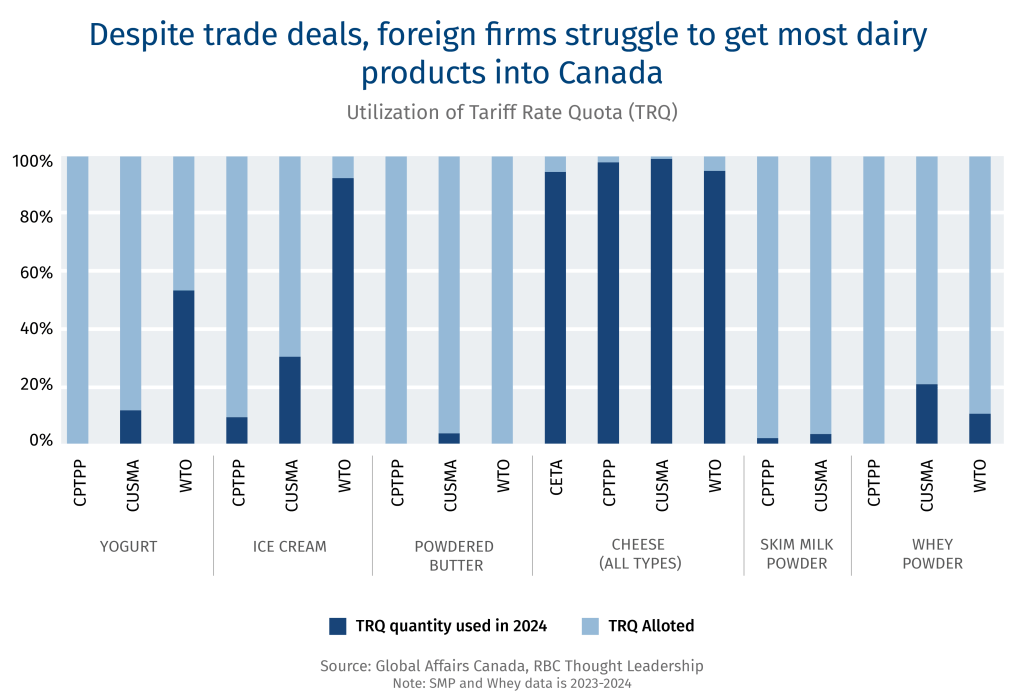
  • Import quotas are intended to limit imports within Canada’s supply management industries. In recent trade negotiations, however, Canada has made greater concessions. For example, in the Comprehensive and Progressive Agreement for Trans-Pacific Partnership (CPTPP) negotiations, Canada agreed to provide participating countries with an estimated 3.25% of Canada’s domestic dairy market.

  • As Canada-U.S.-Mexico-Agreement (CUSMA), the Canada-European Union Comprehensive Economic and Trade Agreement (CETA) and CPTPP are phased in over the next 10 years, Canadian foreign market access is expected to climb to roughly 10% of Canada’s dairy production.

  • But as Canadian processors hold most tariff import quotas, foreign importers have argued that they have limited access to Canada’s markets to fulfill their non-tariffed trade volumes negotiated in the agreement.

RBC Thought Leadership’s latest report, Supply Management Explained, explores the benefits and drawbacks of the system and its role in trade wars.

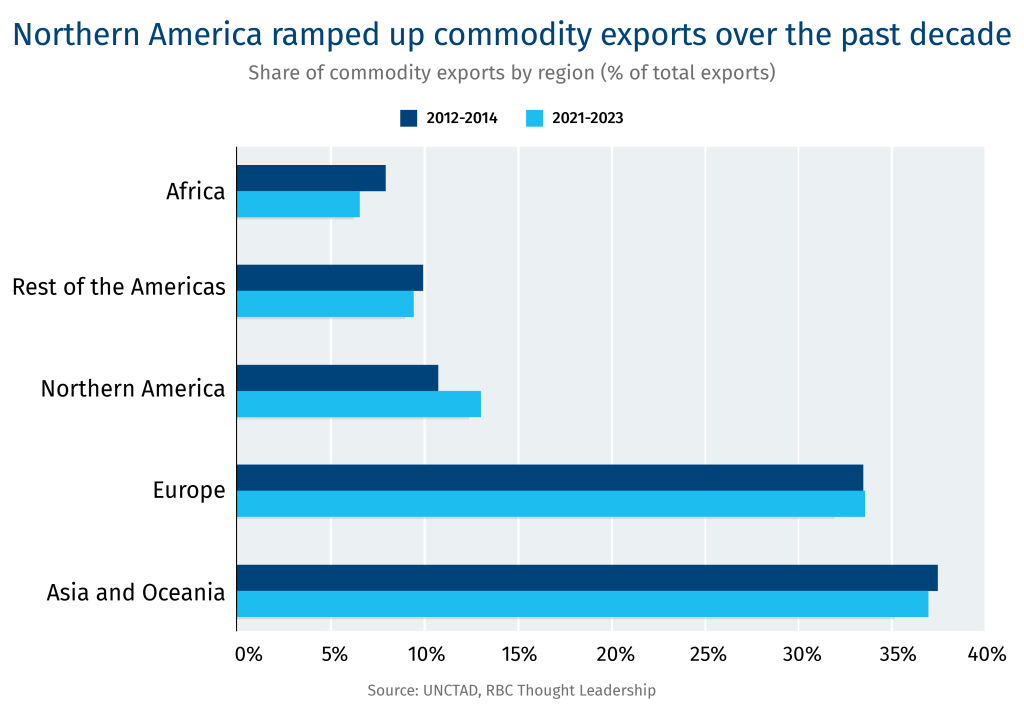
Canada and the U.S. ramped up their commodity exports over the past decade, as both countries leverage their resource riches. The latest report from UN Trade and Development (UNCTAD) shows the two countries—comprising ‘Northern America’—raised their combined commodity exports to 13.1% of the global total by 2023, from 10.8% a decade ago. Other regions barely grew or lost market share during the period.

Commodity concentration: Canadian commodity exports—energy, mining and agriculture, as defined by UNCTAD—accounted for 55.8% of its total commodity exports in 2021-23, compared to 53.3% between 2012-14. The U.S. has become even more reliant: the three commodities made up 35.5% of all American commodity exports during the period, up from 29.5%. As both have earmarked energy, ag and mining as export priorities, they could become more dependent on the three commodities—and their price volatility.

Agriculture rising: For Canada, agriculture was able to grow its export market share from 14.7% to 16.7%, with energy, at 17.4%, up only marginally. For the U.S., it was all about the shale evolution and LNG revolution.

Commodity contraction: Globally, commodity exports now account for 32.7% of all international trade in value terms, down from 35.5% a decade earlier.

Strive to diversify. Countries mainly exporting raw materials could miss out on the broader benefits of global trade, driven by diversification, innovation and value-added production. While that UNCTAD warning was directed at developing countries, it should not be lost on Canadian businesses looking to expand mining, energy and agriculture sectors.

“It’s not our objective to have an agreement at any cost.”

Prime Minister Mark Carney on negotiations with the U.S.


Contributors: Jordan Brennan, Shaz Merwat, Lisa Ashton, Reid Mckay, Yadullah Hussain, Caprice Biasoni

In this week’s edition: Four potential global trade scenarios, Canada’s agri-food rebound, and why copper is in the crosshairs

By Jordan Brennan, Head of Thought Leadership

What if the U.S. is no longer at the centre of the global trading system? That was one of the ideas explored at a Fields Institute-hosted roundtable I attended this week in Toronto.

The U.S. has wielded tremendous soft power through its custody of the global trading system for the better part of 80 years. That came to an end on April 2nd with President Trump’s ‘Liberation Day’ tariffs, according to one speaker. The speaker went on to claim that the end of American leadership would beget four possible scenarios:

  • World War Trade. This is a 1930s-style scenario where other countries follow the U.S. in ignoring WTO policies. Unless resolved in the coming weeks, Trump’s tariffs will likely provoke retaliatory tariffs from other countries in a tit-for-tat escalation. In one scenario, the trigger is Chinese retaliation against the anti-China provisions the U.S. is seeking from trading partners (e.g., the U.S.-U.K. deal attempts to lock China out of critical supply chains). This nightmarish scenario, thankfully, is the least likely.

  • Managed multi-lateral drift. This is the current base case. The world sees more protectionism from the U.S. and more liberalization everywhere else. The U.S. stands alone in violating the WTO rules, but everyone else plays nice. 

  • Fighting trade blocs. Further geo-political fragmentation leads to the creation of adversarial trade blocs. Within the blocs, there is some measure of cooperation and openness. Between the blocs, we see WTO non-compliance. Three main blocs will form: a U.S.-centric bloc with Canada and Mexico, a pan-European bloc, and a China-led bloc. Japan is a wildcard.

  • Re-globalization without America. This is the most likely scenario. The U.S. will become a more closed economy, trading less with the world. Given that the U.S. only accounts for 15% of global trade, this is not fatal to the international trading system.

It’s not clear what these scenarios would mean for Canada. With more than 75% of our merchandise exports headed to our American neighbours, it is difficult to imagine a future in which the U.S. does not remain Canada’s largest and most important trading partner.

It is possible, strangely, that Canada’s position with the United States is strengthened on a relative basis, given that U.S. tariffs on Canada may end up being considerably lower than those on America’s EU and Asian trading partners. Canada could end up trading more with the United States, not less, despite the tariffs.

It’s also possible, again unexpectedly, that foreign direct investment in Canada is strengthened—think auto—as countries that were happy to pay the ~3% most favoured nation tariff rate now face a 25% tariff wall and will therefore look to pick up spare capacity within North America to work around that wall.

What’s clear is that Canada needs a strong ‘Plan B’ and ‘Plan C’ in the current negotiations with President Trump. Free trade with the U.S. is the preferred outcome, but Canada needs a menu of options if we cannot secure a satisfactory deal.

  • Prime Minister Mark Carney acknowledged that a deal with the U.S. isn’t likely to result in the elimination of all tariffs.

  • Trump’s tariffs have raked in nearly US$50 billion for the U.S.—so far.

  • Mexican President Claudia Sheinbaum said she and Carney have spoken about Mexico and Canada increasing collaboration around trade.

  • A dozen EU nations are considering so-called anti-coercion instrument, that could include new taxes on big U.S. tech firms or investment restrictions, if a deal with the U.S. isn’t struck by Aug. 1.

Canada’s agri-food exports rebounded in May after plunging in April, with meat and seafood exports leading the way. New Statistics Canada merchandise trade data shows meat exports were up 13% in May—largely spurred by pork exports to Japan—while packaged seafood splashed up to 52.9% after a year-long decline.

Why that matters?

  • Commodities travel the path of least resistance, but adjustments can take time. Thanks to the CPTPP, Japan’s duty on Canadian fresh, chilled or frozen pork of 4.3% is gradually phasing out by April 2027, specifically for products that are “over-gate,” which is Japan’s minimum pricing system for all pork imports. Processed products like sausages that faced tariffs of up to 10% pre-CPTPP, are now fully phased out. Canadian prepared and preserved swine meat, including lunch meat, to the U.S. dropped from $4 million in January to $2.4 million in May, while the same category of exports to Japan rose from $3.2 million in January to $8 million in May.

  • Canada’s agri-food trade diversification efforts may not be that diversified, yet. The U.S. remains an important partner, especially for highly perishable products like greenhouse tomatoes. Yet, Canada’s agri-food exporters for many categories are on the move and looking to grow in markets where access is already strong, and logistics are in place, including Japan, Mexico, and South Korea. Further unlocks could be markets on the edges with high growth potential for Canada driven by expanded market access. For example, Columbia and Taiwan, both outside of Canada’s top 5 markets for beef and veal export, have grown in export value by 236% and 57%, respectively, between May 2024 and 2025.

Bottom line: With a tariff-free North America looking more unlikely, Canada continues to diversify its agri-food trading partners and appears to be focused on growing in existing tariff-free or low-tariff markets.

84

Percentage of Canadians who don’t expect the Trump administration to negotiate in good faith.

Copper is now a target of the Trump Administration’s AI-centered energy and resource security agenda, where the commodity’s utility as an electrical conductor makes it a priority for the transformers, transmission lines, and battery technologies that will underpin the buildout of AI infrastructure. By the end of the month copper imports into the U.S. could face 50% tariffs, the latest metal to become front and centre in a realignment of resource supply chains.

  • The U.S. imported 42% of its refined copper on average in the past four years. But with 5% of global reserves, there is scope to expand domestic production.

  • Canada occupies a relatively small share of global copper refining, responsible for 1.2% of refinery production in 2024, and approximately 0.8% of reserves.

  • Canada is a major supplier of copper to the U.S. in the form of ore and concentrate, refined copper, copper scrap, and copper matte and precipitate, and exports to Asia and Europe. Canadian exports to the U.S. were worth $4.8 billion in 2023.

  • The effect of the copper tariffs will be felt less in some provinces. B.C., for instance, hosts Canada’s largest copper mines but doesn’t export significantly to the U.S. But others could be more susceptible. Quebec hosts a copper smelter and a refinery and accounted for 80% of copper exports to the U.S. in 2024, according to data from Innovation, Science, and Economic Development Canada.

  • Canadian mines produced 508,000 tonnes of copper in 2023, and the country counted 14 copper deposits among its top 100 mineral exploration projects in 2024. Expanding Canada’s reserve base and bringing more Canadian copper to market, whether at home or abroad, will be important for achieving our energy and AI ambitions.    

Africa has long been a battleground for the China and the U.S. as they vie for economic and trade influence in the continent. The competition has only intensified as the two countries seek access to minerals, from gold to graphite. The U.S. is trying to break Chinese sway in the continent by brokering a peace between Rwanda and the Democratic Republic of Congo (DRC). Washington also recently wrapped up a U.S.-Africa Business Summit with US$2.5-billion investment commitment, that included US$1.5 billion towards a 1,150-kilometre transmission line from Angola to deliver 1.2 gigawatt electricity to power DRC mining sites. In return, the U.S. gets access to DRC’s natural resources that include two-thirds of global cobalt that power EV batteries. It’s also the largest supplier of tantalum–a critical metal used in capacitors–and the world’s second largest supplier of copper.

Africa could prove to be a new, thriving trading destination as Ottawa casts its export net wider. There are opportunities abound:

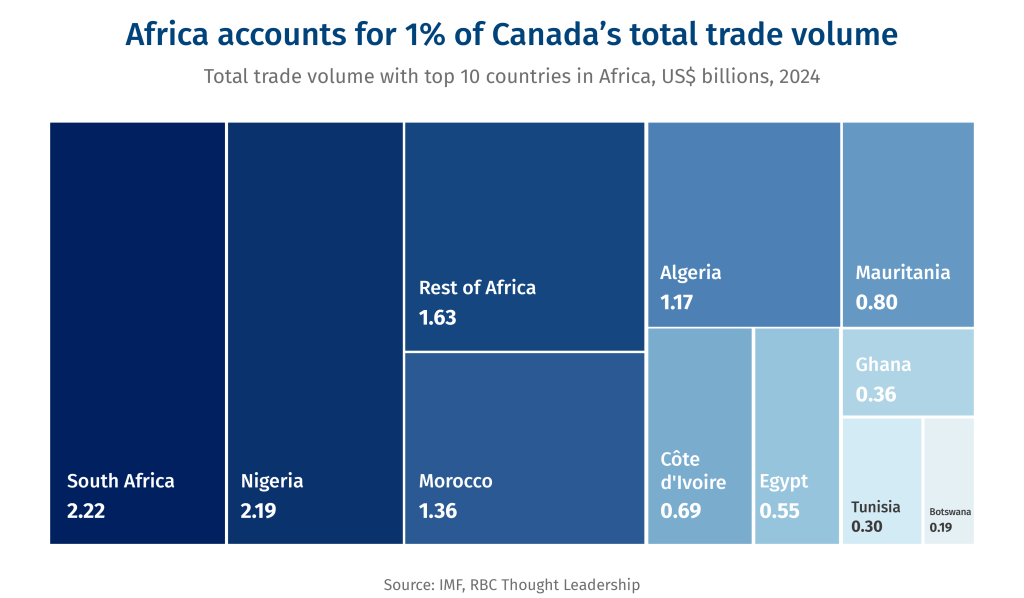
  • Canada-Africa trade has tripled over the past 25 years, but still accounts for a mere 1% of Canada’s total trade volume.

  • Canada could sell cleantech to a continent that remains heavily dependent on coal, especially in growing economies like South Africa. May be LNG, too.

  • Canada can also export mining equipment and clean extraction methods in resource-rich African nations.

  • Health-tech and pharma services could also boost digital health services, especially in the continent’s underserved regions. Edu-tech exports to a continent with the world’s youngest population could prove to be another winner.

  • Africa’s critical minerals supplies offer diverse range of inputs to EV battery supply chains, offering analternative to Chinese-controlled resources. 

“We’ve been clear from the get-go that supply management is off the table.”

François-Philippe Champagne, Canada’s Finance Minister, on the protections in place on dairy and agriculture not being part of the U.S/Canada negotiations. 

In this week’s edition: Trump’s 35% tariff threat, Canada seeks partners across the Pacific, and the Canadian chocolatier that’s benefitting from the U.S. boycott.

We seem to be in the Wild Wild West as Donald Trump’s latest 35% tariff threat against Canada disregards the July 21 deadline and disrupts the behind-closed-door negotiations underway.

The new deadline is August 1, by which date Canada has been asked to address several U.S. trade irritants, including supply management and the flow of fentanyl across the border. CUSMA-compliant goods crossing the border will “most likely” be exempt, said one U.S. official, in a volley of trade attacks on friends and foes alike that’s designed to confound and confuse—and lead to capitulation.

The latest threats from Washington have spurred the federal and provincial governments to look for new avenues of growth, seek new partners—east and west—, and rev up the dormant interprovincial trade engine.

Some Canadian policymakers were looking to do just that at the Calgary Stampede this week. The Greatest Outdoor Show on Earth, as it’s called, has become a blend of rodeo, carnival, and business fair, pulling in a million people a year.

Mark Carney and Pierre Poilievre were there, along with a gaggle of premiers and senior ministers. Ontario’s Doug Ford brought six cabinet members as he pushes ahead with his domestic trade agenda.

Here’s some of what’s at play as Canada looks for new trade streams:

  • A $100B energy package: Alberta and Ottawa are making progress on a big energy package that could include an oil pipeline to the West Coast, the Pathways project to capture carbon emissions, and room for expanded oil production. The Pipeline + Pathways package has a lot of political punch, but headline costs could be sobering. Add in the costs of expanding production, and the sticker could reach $100 billion. Now, that’s an investment over many years designed to deliver a multiple of that in economic growth and government revenue. But anything of that magnitude will require an explainer-in-chief.

  • New corridors: Pancake-flipping Ford and Alberta’s Danielle Smith also agreed to a feasibility study of new pipelines and rail lines between the two provinces, pledged to increase interprovincial trade of alcohol and vehicles, and push for nuclear energy development.

  • Pacific partners: International investors are very interested in Canada, as a relatively safe alternative to much of the world, including the U.S. But Japan and India wants to see action on regulatory reform, and more investment in export infrastructure. The biggest question is how quickly Canada can move on Indigenous consent for major projects.

  • Megaproject port side. ThePort of Vancouver is looking to boost its total capacity by 70% through the proposed Roberts Bank Terminal 2 Project. Canada’s main gateway has begun looking for a contractor to build the $3-billion project to boost trade with Asia.

A lot is at stake, and the country doesn’t have much time.

  • A federal red-tap review is under way to weed out rules that impede internal trade and business investments. Cabinet ministers are also being asked to find ambitious spending cuts amid Ottawa-wide belt-tightening.

  • Canadian firms, such as Purdys Chocolatiers, are reporting brisk domestic business as the U.S. brand boycott persists in the country.

  • Global trade surged in the first half of 2025, but slowing global economic growth pose risks for trade in the latter half, the UN warns.

  • President Donald Trump’s trade threats and actions now extend to copper, pharmaceuticals and Brazil. Around 14 countries also received tariff missives with the President’s classic sign-off: “Thank you for your attention to this matter!”

  • A cavalcade of small U.S. businesses and interest groups are filing cases against Trump’s litany of tariffs imposed under the International Emergency Economic Powers Act.

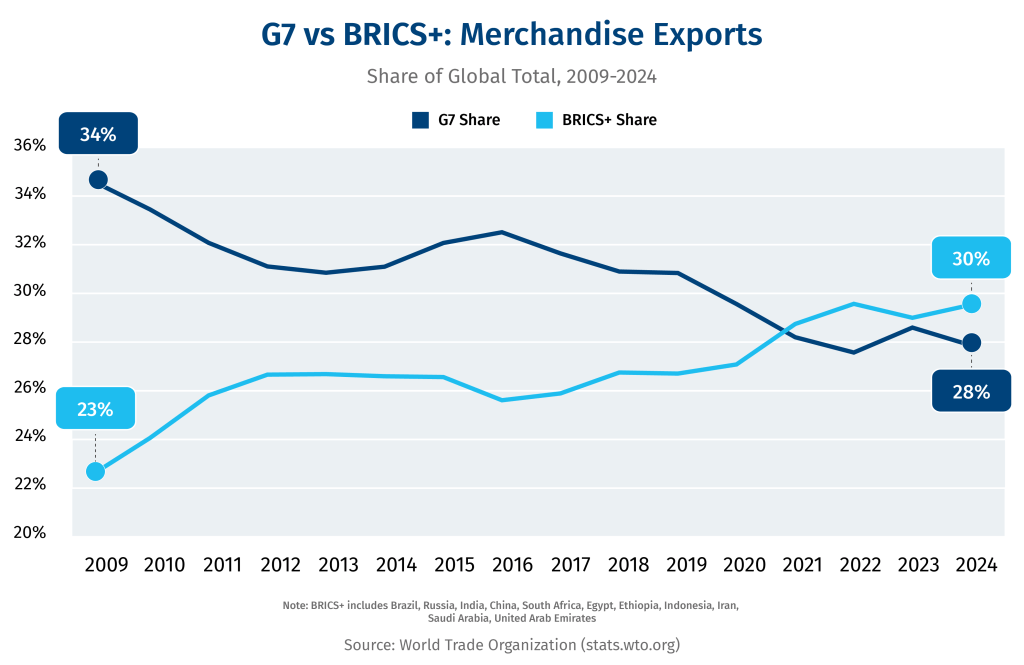
Multilateral cooperation is a delicate balancing act at the best of times. For half a century, the G7 skillfully juggled competing interests and represented the values of liberal openness, democratic governance, and pluralistic tolerance on the world stage. But with President Trump firing tariff missiles in all directions, including G7 partners, the BRICS+ bloc, seen as an emerging market counterweight to the G7, is quietly emerging as an attractive alternative for some nations.

The 11-nation group met in Rio de Janeiro last weekend. And while some have argued that the bloc lacks any basis for unity or cohesion apart from antipathy to the G7, the geo-economic coalition’s rising influence cannot be denied.

  • Formed in 2009, the bloc initially included Brazil, Russia, India and China, but now encompasses South Africa, Egypt, Ethiopia, Indonesia, Iran, and the UAE, with Saudi Arabia mulling over its membership. Together these countries account for more than a third of global GDP and nearly half of the world’s population. As a trading bloc, the BRICS+ eclipsed the G7 in merchandise exports in 2021, accounting for 30% of the global total.

  • Will Trump’s tariff war accelerate the G7’s relative decline? And will the BRICS+ be able to re-orient trade flows, proving to be a more influential voice for non-Western countries in multilateral governance? It’s too early to tell.

  • But the U.S. is already worried, with Trump threatening tariffs on countries aligning themselves with what he calls the bloc’s “Anti-American policies.”

  • Will Canada get swept up in the U.S.-BRICS cross-currents? Ottawa is already looking to reset ties with China and India—two founding members of BRICS. Foreign Affairs Minister Anita Anand, who is currently in Asia, says Canada is looking to wrap up free trade agreements with Southeast Asian nations—as soon as possible—, several of which are likely BRICS membership candidates.

  • As the Canadian government seeks relief from Trump’s tariff blitz, a longer-term trade strategy confronts the diminished status of G7 nations. How members of the BRICS+ fits into Canada’s trade future remains unknown, especially as Ottawa wants to avoid giving Washington any ammunition to blow up their fragile trade negotiations.

After decades of a unipolar world, the return of a multi-polar world is complicating Canada’s efforts to seek new trading partners.

11,000

The increase in the number of Canada’s trade-dependent manufacturing sector in June. Overall, the ecomony created 83,000 jobs, a figure that surprised analysts given the uncertainty around trade and investments.

As the North American auto industry reels under the weight of U.S. tariffs, the real story on autos may not be in Washington, but in Shenzhen, where Chinese electric vehicle (EV) behemoth BYD’s headquarters are located.

Ford CEO Jim Farley has been the most vocal about the need to “humbly accept” Chinese leadership in EV technology. The executive even imported Chinese EVs recently to test their build quality. Canada and the U.S. remain the only two major nations with no consumer access to Chinese vehicles—the U.S. imposes an almost 150% duty on new Chinese EV imports and Canada has a 100% tax—but Chinese cars are widely expected to come to North American shores at some point.

The almost-overnight success of BYD, which has ramped up production to four million units in just four years, is notable. The automaker surpassed Tesla last year as the world’s largest EV seller. BYD’s patented Blade battery is considered to be among the world’s safest and most affordable, while its autonomous driving system is deemed to be as good as, if not better than, Tesla’s. Most stunning? BYD’s EVs come at bargain prices—on average US$20,000 (C$27,400), less than half the cost of a new North American vehicle.

Whatdoes China’s enhanced automotive industrial capacity portend for Canada’s auto industry, which has been under strain for the better part of two decades? Provincial and federal governments invested heavily in the EV value chain, but with stalling EV sales (9% of total sales in Q1, 2025, compared to 18% in Q4, 2024) and paused or postponed production facilities (Honda, BASF, Northvolt to name a few), the soundness of Canada’s EV bet is being questioned. Pressure on Ottawa from some automakers to scrap the EV mandate could be another body blow to the nascent industry.

One thing seems certain: Americans, Canadians and Mexicans fighting with each other over auto production will not catalyze innovation—it would only accelerate China’s global EV lead.

Trade irritant, stable, costly, secure — these are just a few of the words currently being used to describe Canada’s supply management system, underscoring the renewed debate it’s attracting.

Supply management has faced scrutiny during nearly every major trade negotiation and economic downturn — and it’s poised to be a key discussion point in next year’s Canada-U.S.-Mexico Agreement (CUSMA) review.

The debate is no longer confined within agriculture’s siloed walls. Supply management touches many corners of Canada’s economy: from food prices and consumer choice to supply-chain jobs, trade diversification, and economic growth.

In RBC Thought Leadership’s latest report, Supply Management Explained, we take a closer look at the system’s benefits and drawbacks.

Read the full report here.

“We’ll fight against it. Period.”— Canada’s Trade Minister Melanie Joly, responding to Donald Trump’s threat to impose 50% tariffs on imported copper.

In this week’s edition: Prime Minister Mark Carney has marked his own red circle in the calendar: July 21; and what the latest trade data tells us about Canada’s export diversification strategy

After Independence Day comes Liberation Day 2.0

Happy 249th Birthday, America! Enjoy the fireworks over the long weekend, but markets are bracing for the more consequential American spectacle on July 9 when the 90-day pause on Liberation Day tariffs comes to an end. Will there be more pyrotechnics or a fizzle out?

The White House’s “90 deals in 90 days” ambition has turned into two American humble-pie, kinda partial deals with the U.K. and China, and another with Vietnam this week.
Will President Donald Trump extend the ceasefire, or will he launch a fresh volley of tariffs against allies like Japan, the EU and Canada?

“About 10 to 12 countries are very close to a deal,” said Joseph Lavorgna, an advisor to U.S. Treasury Secretary Scott Bessent, with another 20 negotiating in good faith. “And Secretary Bassett highlighted that many deals could be done by Labor Day.” Is that a tell that the administration is looking to push past July 9? Who knows.

While Canada has an eye on that date, Prime Minister Carney has marked his own red circle in the calendar: the July 21 deadline to conclude a security and economic deal with the U.S. To facilitate talks, Ottawa scrapped its digital services tax on Big Tech, which was an irritant to President Trump. Canada is now back in the “front of the line” in trade negotiations, assured Pete Hoekstra, U.S. Ambassador to Canada.

Strategically, it’s an open question if Canada is better off rushing to negotiate a bilateral deal with the U.S. or defer until the autumn. In such serial negotiations, first movers often set the pattern, so there may be an advantage to rush a deal with Trump. On the other hand, the president desperately wants the Federal Reserve to cut interest rates, which would lower interest payments on America’s ballooning public debt, lower debt-servicing costs and galvanize economic activity. Jerome Powell, Chairman of the Federal Reserve, is holding firm on rate cuts until the trade turmoil settles down. Come autumn, we will be in a countdown to midterm elections, which will put pressure on Trump to rev up America’s economic engine. Canada may be better off waiting until public pressure on Trump mounts. That is, if its own trade and economic data holds up.

While Trump recently said his administration has “all the cards” in its negotiations with Ottawa, Carney has a few aces up his sleeve, too.

  • Energy. Oil, natural gas, and electricity, etc.—Canada has it in abundance. The U.S. needs them all to help power its data centres and, presumably, an industrial revival.

  • Uranium. Canada, the world’s second largest producerof uranium,would need to figure prominently to power Trump’s plan to start construction of 10 large nuclear reactors by 2030, and expand U.S. nuclear energy from 100 gigawatt currently to 400GW by 2050.

  • Big Tech. Ottawa has just pulled its 3% digital services tax (that’s $3 billion in forgone revenue), gaining goodwill while keeping the option to re‑table it if talks stall.

  • Critical minerals. Canada produces or refines 21 of the 50 U.S.‑listed critical minerals—developing capacity at Saskatchewan’s new rare‑earth plant and Ontario’s Ring of Fire are poised to cement Canadian leadership in responsible critical minerals.

  • Counter‑firepower. A choice of last resort given potential costs for Canadian businesses, Finance Canada can mirror U.S. moves with tariffs on up to $155 billion of U.S. goods—a list was already drafted in February.

  • Friend‑shoring pitch. A bilateral supply‑chain roadmap under previous administrations argue deeper North‑American integration—EV batteries, semiconductors, green steel—as the surest hedge against both Chinese dominance and tariff chaos.

  • Supply management. Some agriculture and dairy concessions may be on the table as a compromise, as Ottawa finds a balance between appeasing Washington without upsetting the domestic audience.

The week that was

  • The Great Canadian booze boycott sent imports of U.S. alcohol plummeting 94% year-on-year to just $3 million in April. Some U.S. officials see removal of the boycott as part of the trade deal.

  • Ottawa scrapped all 53 federal exemptions in the Canadian Free Trade Agreement that were impeding interprovincial trade, just in time for Canada Day. Good, now dismantle the patchwork of provincial barriers, the Canadian Federation of Independent Businesses recommends.

  • Republicans killed the “revenge tax” from the so-called Big, Beautiful bill that passed yesterday. It was scrapped after G7 countries agreed to exempt the U.S. from an OECD-proposed global minimum tax—raising questions about the pact’s global-ness.

  • Speaking of free passes, the EU is proposing to exempt its steel and other heavy industries from its carbon border tax exports in the face of competition from foreign rivals.

  • Global LNG vessel deliveries shot up 60% to 67 units last year, taking the global fleet to 831, as LNG trade booms. Another 103 vessels are set to be delivered this year.

The big number

Windsor’s unemployment rate in May, as Ontario’s key auto-assembly hub reels from U.S. tariffs. The province’s overall unemployment rate stands at 7.9%.

Current trade sentiment: Diversify—and dread

Canada is recalibrating its international trade flows in response to U.S. tariffs, new Statistics Canada data shows. Following heavy drops in exports in April, there are some signs of a shift, but the outlook remains uncertain for Canadian industries. Most of the strategic sectors—iron, aluminum, lumber and pharmaceuticals—, that Trump has marked as strategic to the U.S. economy, saw declines.

  • On the bright side, exports edged up: Canada’s record $7.6 billion merchandise trade deficit in April narrowed to $5.9 billion in May, with overall exports up 1.1%, led by gold. Imports fell 1.6%.

  • But U.S.-bound trade continued to shrink. Tariff-induced declines in Canadian exports continued a four-month decline, dropping 0.9% in May.

  • The diversification drive is on. Canada is beginning to increase its exports to non-U.S. markets, which rose 5.7% in May—a record.

  • Tariff-hit sectors bore the brunt. May saw little relief among key sectors, following major export reductions in April. Exports of unwrought iron, steel, and aluminum alloys and products dropped 4.9% since April. Exports of lumber and sawmill products also declined 2.2%, while pharmaceutical fell 0.5%. However, motor vehicles and part exports rose 0.9%.

  • Lumber is staring down the barrel of steeper duties. Canadian softwood lumber exports to the U.S. could see duties jumping from 14.5% to 34.45% in July, unless a deal can be hashed out.

    CEOs of auto manufacturers met with Carney this week to discuss ways to protect the auto  supply chains from the trade war, and diversify trade relationships. And while Canada’s imposition of temporary tariff-rate quotas on steel mill products could provide short-term relief to domestic producers, several industries await more trade clarity.

    Also read: $125B Exposed: What’s at risk for Canada as Trump eyes 5 strategic sectors

Final Word

Canada is a “very difficult country to TRADE with, including the fact that they have charged our Farmers as much as 400% Tariffs, for years, on Dairy Products,”—U.S. President Donald Trump, as he takes aim at Canada’s supply management system.

Oh Canada, we’ve got ourselves a deal

  • At long last, and just in time for Canada Day, the federal government is taking steps to tear down interprovincial trade barriers.

  • Bill C-5, the Free Trade and Labour Mobility in Canada Act, has become law. And while removing federal barriers to interprovincial trade is a positive step, history suggests obstacles will remain.

  • ‘Special interests’ groups will mobilize behind the scenes to secure carve-outs from the legislation, which may undermine its effectiveness.

  • More challenging still is the commercial reality on the ground. As Canada’s experience in free trade shows, the mere lowering of tariff walls does not automatically boost trade flows. Canada liberalized trade with Europe and Asia, for example, but Canadian exports to these regions have not meaningfully increased.

  • So can we expect to see more Okanagan Riesling on shelves east of the Rockies? It’s probably too early to pop the cork and celebrate that victory.

  • Statistics Canada data shows that Canadians trade less with each other than they do with the rest of the world, in percentage terms. In the ’80’s, roughly half of Canada’s total trade was interprovincial. Following a series of FTAs, that proportion has dipped closer to a third.

  • Internal barriers may help explain why trade between provinces has lagged trade with the wider world. RBC Economics concluded earlier this year that estimates may differ about the economic gains associated with reducing internal trade barriers, but what seems certain is that free trade among the provinces is a pro-growth policy—particularly for the smaller provinces.

The week that was

  • In addition to having her term as Canada’s Ambassador to the U.S. extended, Kirsten Hillman was named Canada’s chief negotiator in trade talks with the U.S.

  • Complaints from U.S. manufacturers that China was limiting the release of rare-earth elements despite its trade truce with Washington prompted Beijing to promise on Friday that it would approve U.S applications. This comes a day after Trump announced that the U.S. and China had “just signed” a deal.

  • The U.K. unveiled a broader trade strategy focused on its £500 billion a year service exports sector and the desire to land deals with a range of partners, including the six-member Gulf Cooperation Council.

  • Trump threatened Spain with increased tariffs, after Spanish Prime Minister Pedro Sánchez rejected NATO’s new target of spending 5% of GDP on defence.

  • Donald Trump, at the urging of oil executives, is pushing to rollback climate laws as part of U.S.-EU trade negotiations.

The big number

Total value of U.S. exports in May, down 5.2% versus April – that’s the sharpest month-over-month decline since 2000

Global oil and gas trade just got risky—again

As Iran and Israel traded missiles and the U.S. bombed three of Tehran’s nuclear facilities, oil tanker rate premiums spiked 83%. And with major LNG exporter Qatar briefly getting ensnared in the crisis, another element of risk was added to the global oil and gas trade.

While oil tanker rates cooled off a couple days after the ceasefire, this volatility could remain a perennial issue hovering over global commodity production—and prices. Meanwhile, LNG tanker rates, due to re-routing and summer demand, remain elevated. By 2030, almost 25% of global LNG flows are expected to pass through the Strait of Hormuz, a critical oil and gas channel in the Middle East, based on Rystad data.

Canada has an opportunity to help de-risk global supply from both a geopolitical and a concentration of supply standpoint—a proposition valued by European and Asian buyers, as we highlighted in our recent report A G7+ Strategy for Natural Gas: Four Scenarios for Energy Security in the 2040s.

And Canada would soon become a bona fide member of the LNG exporters club.This weekend, LNG Canada awaits the arrival of likely two LNG carriers, including Puteri Sejinjang, a new 174,000-cubic-metre carrier, to pick up the first-ever shipment of gas from the West Coast facility.

Final Word

“Our strategic response to this new world can’t be based on nostalgia or post-imperial delusion, let alone any ideological or dogmatic attachment to one trading bloc or another.”
Douglas Alexander, U.K.’s Trade Minister

In this week’s edition: A critical minerals action plan, why trade diversification may not be a silver bullet and how tariffs are making food insecurity even worse

Noteworthy

By John Stackhouse

Mark Carney got out of the G7 alive. The Kananaskis summit could have been a trade wreck, but Donald Trump clearly had other things on his mind. That doesn’t mean Canada, or any of the other summiteers, can claim victory. Here’s why, and some of what we’re hearing: 

  • There was never going to be a Canada-U.S. agreement at the G7, for one simple reason: DJT was not going to announce something so important to his domestic agenda on foreign soil (unless, of course, he planted the Stars and Stripes with it.)

  • The ensuing suggestion of a 30-day window for a deal is aspirational. Anyone who has dealt with Trump knows he doesn’t stick to deadlines, and he uses time as a negotiating tool. That means don’t settle if you don’t have to. And now, the Carney team’s biggest concern is playing out, as POTUS gets distracted by events. A Middle East war, for instance.

  • Some on the Canadian side don’t mind that, thinking that a “rag the puck” strategy allows Canada to get to a fuller USMCA conversation in the fall.

  • But still other Canadians fear the worsening impact of countervailing tariffs. “Elbows up” sounds fine, until you elbow someone on your own team. Plain + simple: Canada is suffering more from the tariff war than the U.S. right now.

  • And the longer the uncertainty goes on, the more challenging it will be for Canada to attract investment.

  • Longer term, Canada remains in the crosshairs of Trump’s sectoral studies, which will only make it harder for our exports in his Core 5 categories: autos, steel/aluminum, lumber, pharmaceuticals and semiconductors.

  • As someone put it to Trade Zone: “When your negotiating partner is willing to be far more ruthless, you’re not in a good negotiating position.”

The week that was

  • The U.S. and Canada are looking to secure a deal within 30 days. If they can’t, Carney said, Canada will impose counter-tariffs.

  • Canada is cracking down on the dumping of cheap foreign steel to support domestic steel producers getting hammered by Trump’s 50% tariffs.

  • The volume of commercial trucks crossing into the U.S. from Canada is down more than 10% in each of the past two months compared to 2024. Meanwhile, trucks from Mexico to the U.S. were only down 2.8% in May (and 6.4% lower in April).

  • The U.K.’s Business Secretary said that efforts to get relief for steel exports to the U.S. will be wrapped into broader tariff negotiations, indicating that there is still a ways to go on the recently announced trade deal between the U.S. and U.K.

  • The U.S. Fed held rates steady and said it will watch the impact of tariffs closely this summer.

  • Housing starts in the U.S. hit a five-year low in May as tariffs hit imported construction materials.

  • Despite tariffs effectively shutting the U.S. out as a destination for its goods, China increased its overall trade surplus to US$500 billion so far this year—that’s up 40% YoY.

Minerals on the G7’s mind

G7 leaders unveiled a Critical Minerals Action Plan this week to counter non-market distortions, increase supply chain transparency, and reduce strategic dependency on Beijing. While light on specifics, some key items aligned with our report, The New Great Game:

  • Limit price distortions: G7 members committed to coordinated responses to supply disruptions and pledged improved market transparency and traceability. No explicit mention of a “China premium” or minimum price floor, as we noted, but positive developments, nonetheless.

  • Unlock financing: Encourage development banks, export credit agencies, and private capital to accelerate upstream investment in G7 countries and emerging market allies.

  • Supply-chain traceability, standard-setting and sustainability: A G7 roadmap due by year-end to create benchmarks to ensure responsible mining, environmental safeguards and labour standards.

Canada remains positioned as a central actor in mineral resources, with the potential to serve the growing needs of European and U.S. defence and new energy mineral needs—a natural advantage in trade talks with the U.S. and partners. Further efforts to strengthen the remainder of the value chain—building out refining capacity, for example—will complement Canada’s resource advantage.

Why trade diversification may not be a silver bullet

Diversifying trade partners, in the wake of the current trade war with the U.S., has become a hot topic. But while lowering tariff barriers is sound economics, this alone may not lead to higher export volumes.

The Harper conservatives pursued bilateral trade agreements with a range of countries and economic blocs, including Europe (CETA), Asia-Pacific (CPTPP), and a host of Latin American countries. And yet, just 4% of Canadian exports are EU-bound and 6% are shipped to CPTPP countries—ratios that remain unmoved over two decades.

Meanwhile, nearly 80% of Canadian exports are sent to the U.S. Canada’s reliance on a few key industries—energy, automotive and metals—further entrenches this dependence. Canada needs an integrated trade strategy that diversifies trading partners while boosting export competitiveness. And it makes the Carney-Trump 30-day deal deadline all the more important.

A trade war on food security

One in four Canadians are experiencing food insecurity—a level never seen before in this country. It’s an issue of affordability, and one that tariffs and the ongoing trade uncertainty, threatens to make worse.

  • Job loss and insecurity is forcing many to make difficult choices: Between January and May, Canada’s manufacturing sector lost 54,000 jobs and the country’s unemployment rate rose to 7%, the highest it’s been since 2016, excluding the pandemic.

  • Rising cost of living threatens to further deepen the food insecurity crisis. But it’s more than about jobs—over 60% of food-insecure households rely on wages or self-employment income to support themselves.

  • Supply chain disruptions impact food consistency and costs: In the U.S., tariffs are estimated to increase food prices by 2.6% in the short run, disproportionately impacting fruit and vegetables, that are expected to rise 5.4%.

In our latest report–Feeding the Crisis: The Tariff Toll on Food Insecurity–we lay out three potential solutions, all linked to Canada’s growth ambitions.

The Final Word

“If the current tariffs and counter-tariffs remain in place, past experience suggests pass through of about 75% of the costs of tariffs over roughly a year and a half.”
Bank of Canada Governor Tiff Macklem during a speech this week in St. John’s, Newfoundland.

In this week’s edition: Trade signals at the G7, why it’s so hard for steel and aluminum manufacturers to diversify from the U.S., and how long it typically takes to get a major trade deal done.

The week that was

  • Reports surfaced (here and here) that Canada and the U.S. have a working trade document, including details of a potential deal. No timeline yet.

  • With Mexico’s Claudia Sheinbaum and India’s Narendra Modi in Kananaskis for the G7,  could more trade talk with Canada be on the agenda?

  • According to the World Bank, we’re about to experience the slowest decade of growth since the ’60s–the result of uncertainty caused by tariffs.

  • While Trump celebrates a “done deal” with China after two days of negotiations, word from China is more muted—Beijing’s official news agency called it an “agreement in principle.” China is said to only be lifting restrictions on rare earth minerals exports for six months leaving open the possibility of future escalation.

  • In the next week or two, Trump plans to send letters outlining unilateral tariffs to many countries.

  • Tariffs have yet to generate the inflation jump in the U.S. that many expected. Just wait, say economists.

  • Dominican Republic has become a hot spot for U.S. companies seeking alternative manufacturing hubs. The country’s 92 free zones and proximity to the U.S. are two key factors.

Trade signals at the G7

While there may not be a major breakthrough with the U.S. on tariffs and trade at the G7, there are certainly a couple things to keep an eye on:

Critical Minerals: The U.S. trade war with China exposed major dependencies on critical and rare earth mineral supply chains, which Beijing dominates. To feed its lofty energy and tech ambitions, the Trump administration needs a reliable supply. Collectively, the G7 possesses massive untapped resource potential, and the capital needed to fund projects.

USMCA: Claudia Sheinbaum’s attendance will mark the first time since Trump’s inauguration that all three North American leaders are participating in the same multilateral meeting. This unlocks the potential for a sideline meeting to chart a course for the 2026 USMCA review and discuss ongoing efforts to combat the issue of fentanyl that remains the core justification for the U.S.’s IEEPA tariffs on Canada and Mexico.

Noteworthy

By Jordan Brennan

I was in Ottawa this week at Canada 2020, where the general sentiment among attendees was cautious optimism. The focus was on reigniting growth through nation-building projects. And while opportunities abound—in energy, mining, housing, infrastructure, AI—a rebooted operating model is needed. A few themes stood out:

  • Internationally, Canada is seen as a high-risk jurisdiction thanks to regulatory delays (i.e. impact assessments that can stretch over a decade) and political instability (think rising separatist sentiment in Alberta). It was noted that international investors routinely add a 20% risk premium to capital allocation decisions involving Canada. Then there’s the broad political discretion cabinet holds over major projects. To unlock capital at home and abroad, we’ll need more regulatory and political certainty. Could a national trade corridor strategy help reduce Canada’s perceived risk profile?

  • Building export infrastructure assumes we’ll develop the resources to fill it—but many projects remain stalled or cancelled. So how do we responsibly move resources from Canadian soil to global markets? Here, treaty rights and the duty to consult First Nations come into focus—not as a hurdle, but as a competitive advantage. Successful companies build full economic partnerships with First Nations early in the process—on everything from impact assessments, employment and procurement agreements and equity stakes. If we want more projects approved—and faster—this kind of partnership is essential.

  • Same goes with Arctic security. With the retreat of sea ice, the Northwest Passage is being contested by foreign powers in part because it dramatically shortens the shipping time between North America, Europe and Asia. As one panelist put it, there’s no better way to assert Canadian sovereignty in the north than by developing the region. That means infrastructure—digital and physical—as well as the jobs and skills tied to mineral development.

  • Another challenge is timing. While resource prices are set on volatile global spot markets, projects like LNG terminals or major mineral developments have multi-decade lifecycles. Development must be aligned with future demand patterns, yes, but we must also be hyper-focused on cost competitiveness. Forecasting global energy and mineral needs in 2050 is daunting, but essential if we’re to attract the patient capital needed for big projects.

Three questions…

With the U.S. doubling tariff rates on steel and aluminum, Jake Silverthorn on RBC’s Capital Markets Diversified Industrials team, helps us understand the current landscape.

Q: Why are Canadian steel and aluminum producers more impacted from U.S. tariffs than vice versa?
A: There is a structural difference between U.S. and Canadian markets. Canadian producers mostly operate in spot markets while U.S. producers use contract-based transactions, which makes it difficult for Canadian companies to effectively pass through tariff costs. Additionally, the tariffs have created a demand and pricing imbalance between the U.S. and Canadian markets.

Q: Why is it hard for Canadian producers to diversify away from the U.S. market?
A: Given high shipping costs, the U.S. represented the most profitable destination. Canadian producers have strategically placed their operations near U.S. ports to make shipping easier.

Q: What can Canadian producers do to maintain their U.S. market share?
A: To remain competitive with the domestic U.S. producers and maintain existing operations, Canadian producers are expected to absorb part of the tariff costs, impacting margins and cash flow.

Bottom line

917

The number of days a typical trade deal takes to complete from start to finish (The USMCA took 896 days). In April, Trump promised 90 deals in 90 days. With just a couple weeks remaining on that self-imposed deadline, the U.S. has signed 1 deal (U.K.) and has scored a tariff truce with China.

In this week’s edition: Canada-U.S. in two phases, Trump’s three recurring trade narratives, and how businesses are handling the uncertainty

Noteworthy

Ottawa played host this week to some high-profile guests, from a gaggle of U.S. senators to King Charles—plus the first session of Parliament in 161 days.

  • Five U.S. senators, including one Republican, met with senior government officials to reinforce the Canada-U.S. relationship. A two-phase deal is being considered.

    • Phase 1: The climbdown of Section 232 (steel, aluminum and auto tariffs on national security grounds) in exchange for an increase in Canada’s defence spending commitment, which explains the ‘Golden Dome’ missile system talk. There’s some optimism that this can be done before or during the G7 Summit—though time is running out as that begins in two weeks.

    • Phase 2: The broader renegotiation of CUSMA. Expect that to start as early as this summer and conclude just before the review deadline of July 1, 2026.

  • The economic and security agreement got a shout out in the King’s Speech from the Throne, as did Carney’s trade diversification priorities. The legislative agenda, and the work that will happen during the summer session of the House, will likely be more domestically focused, including fast-tracking projects in the national interest and resolving federal barriers to internal trade. Expect Canada-U.S. negotiations to happen in the background—as was the case with Minister Dominic LeBlanc’s meeting with Secretary Howard Lutnick and USTR’s Jamieson Greer last week.

The week that was

  • A day after the U.S. Court of International Trade ruled that Trump overstepped by using the International Emergency Economic Powers Act (IEEPA) to impose tariffs, a federal appeals court reinstated them, at least temporarily.

  • The sluggish labour market in China may get a whole lot worse: Nine million manufacturing jobs in China could be lost due to the trade war.

  • Clear Seas estimates that by 2040, if all planned projects pan out, there will be a 60% increase in ship traffic on Canada’s Pacific Coast. The main driver: LNG projects.

  • Japan’s biggest businesses are getting hammered, prompting the government to step up with a US$6.3 billion package to protect its economy.

  • Trade-related crime is spiking in the U.S. And it’s proving tough for the government to stop.

  • India is playing hardball with the U.S. on key commodities (rice, wheat, maize) and dairy.

  • A UN agency predicts that trade-war-induced instability will lead to seven million fewer jobs in 2025 than first predicted. And U.S. consumer demand is connected to another 84 million jobs. Canada and Mexico, with 17.1% of roles tied to the U.S., are the most exposed.

The view from Washington

Washington’s word of the week is TACO—Wall Street shorthand for “Trump Always Chickens Out.” A phrase that underscores growing skepticism regarding the White House’s resolve to maintain tariffs in the face of market pressures and retaliatory actions from trading partners. The reality is more complicated. To justify trade policies, the administration relies on a rotating carousel of narratives:

  • A negotiating tactic to achieve other foreign-policy objectives. The White House applies this reasoning when implementing fentanyl-related tariffs on Canada and Mexico and frequently uses it as a crutch to justify cancelled or postponed tariffs: mission accomplished, claim victory and move on. Tariffs are short-lived in this line of thinking, and often resolved or scaled back by minor concessions from the target nation.

  • An industrial policy lever. They’re meant to encourage firms to reshore supply chains and production lines, which aligns with Trump’s promise to restore U.S. manufacturing to its former glory through sector-specific tariffs on autos, steel, and aluminum. Under this reasoning, tariffs are all about pointing to new production plants and other significant investments.

  • A tool for government revenue generation. Although the hype around Trump’s External Revenue Service has died down (for now), this narrative dominated the first weeks of the administration’s trade policy strategy. When this is the goal, foreign countries have few carrots to offer that would change the President’s mind.

The challenge is discerning which justification Trump is leaning towards on any given day. When asked about TACO this week, the President embraced the negotiation narrative. The narrative may change next week as the administration’s battle in court over IEEPA tariffs continues.

Three questions…

With Andrew Skinner, RBC’s VP of Trade Finance.

Q: How are businesses diversifying—both in terms of sourcing and selling?
A: Two key observations: In April, we had a record number of customers and prospective new users of our RBC Global Connect tool, which provides resources such as best countries to buy and sell and other trade intelligence. Secondly, some clients have found better margin opportunities in Europe for products historically shipped to the U.S. And importers are ensuring resiliency of supply by finding new suppliers.

Q: How have things changed in the past couple of months for companies that have maintained their business with U.S. customers?
A:
Compliance with CUSMA rose to 50% in March from 33% in February. From client discussions, we expect this will be much higher now based on the noted estimate that 94% Canadian exports to U.S. are likely to comply. Clients have maximized U.S. inventory storage and distribution channels to meet short-term demand and minimize tariff impacts. They are also regularly reviewing timing of shipments and location of delivery to navigate U.S. tariffs. Some clients have been able to pass on higher tariff costs where alternative supply is unavailable, and demand persists. Others are pausing transactions to ensure certainty of pricing and demand, especially if they can’t cover tariff costs.

Q: What advice do you have for companies navigating the uncertainty?
A: We are encouraging clients to review their key buyer and seller trade cycle—order to payment, contract terms and documentation available—and identify opportunities to renegotiate terms. The aim is to maintain long-term relationships and avoid Back-to-School, Black Friday, and Christmas peak sales cycles disruptions. There are a range of solutions available to minimize payment risk, improve cash flow and enable cost/ return efficiencies as new markets, suppliers and buyers are being considered.

In this week’s Edition: On the ground in Canada’s “Pinnacles of Progressiveness,” How Trump’s ‘big, beautiful bill’ could impact Canada, and what major projects might be on the government’s fast-track list

Noteworthy

By John Stackhouse

This past week, I was in Quebec and B.C. — Canada’s “Pinnacles of Progressiveness” — to gauge how the conversation is shifting around resource development, particularly oil and gas exports. Here are a few of my takeaways:

  • In Quebec, which has generally opposed fossil fuel pipelines and LNG, Premier Francois Legault is expressing more and more support for a national East-West pipeline.

  • A senior Quebec official told me that more public pronouncements in favour of gas may come in the weeks ahead.

  • B.C. is about to become a global LNG player, which is why Premier David Eby is headed to Japan and Malaysia in the first week of June.

  • I spent time with the province’s Energy and Climate Solutions Minister Adrian Dix who says B.C. will continue to expand its electricity to power more LNG plants.

  • The LNG industry believes as many as six more LNG plants could be built, which would meet about 20% of the world’s projected growth in demand.

  • But the clock is ticking. I keep hearing people say that Canada has about an18-month window to get these major projects going.

Week in numbers

1

Number of times the word ‘trade’ was mentioned in the joint statement made by the G7 finance and central bank chiefs following three days of meetings in Banff, Alberta this past week. There wasn’t a single mention of ‘tariffs’ in the statement.

400

Companies in the S&P 500 that mentioned ‘tariffs’ in Q1 earnings calls

$1.5 billion

What Foxconn, Apple’s long-time supplier, is spending to build a production facility in southern India. Apple continues to shift production from China to India, which prompted Trump to end the week with a 25% tariff threat on iPhones not made in the U.S.

$3,500

One estimate on what an iPhone would cost consumers if it was made in the U.S. Another analyst landed on US$1,500, up about 25% from the current retail price. 

View from Washington

Trump’s “One, Big Beautiful” Bill includes several policies affecting cross-border industries and supply chains that grew out of Canada-US trade talks under Biden.

  • LOSER: North American electric vehicles. Four years ago, Canada and Mexico successfully lobbied for an expansion of the Inflation Reduction Act’s EV tax credit to include North American products. The bill would end the US$7,500 credit (US$4,000 for used EVs), eliminating a major consumer incentive for a cross-border industry already grappling with tariff-related price increases. And the resulting consumer demand slowdown bodes poorly for Canadian EV supply chain projects.

  • WINNER: Continental defence spending. Canada has expressed interest in joining Trump’s “Golden Dome” missile defence program, which gets a US$25-billion injection if this bill passes. Canada could integrate the acquisition of U.S. defence products into a broader Canada-U.S. trade agreement. Trump is a proponent of using defence sales to rebalance U.S. trade relations and said this week that Canada will pay its “fair share” if it joins.   

  • UNCLEAR: Canadian critical minerals. Critical minerals were a focal point of Canada-U.S. trade relations for several years; the countries even signed a Joint Action Plan on mineral supply chains in the final days of Trump 1.0. House Republicans have allocated an additional US$2.5 billion for critical minerals production. It’s too early to tell what impact that will have on Canadian critical minerals projects, which qualify for Pentagon funding through Title III of the Defense Production Act.

Major project list: What’s on the fast-track?

The upcoming discussions around a renewed economic and security agreement, and the broader imperative to diversify trade, cannot be advanced without expediting and realizing resource, energy and infrastructure projects.

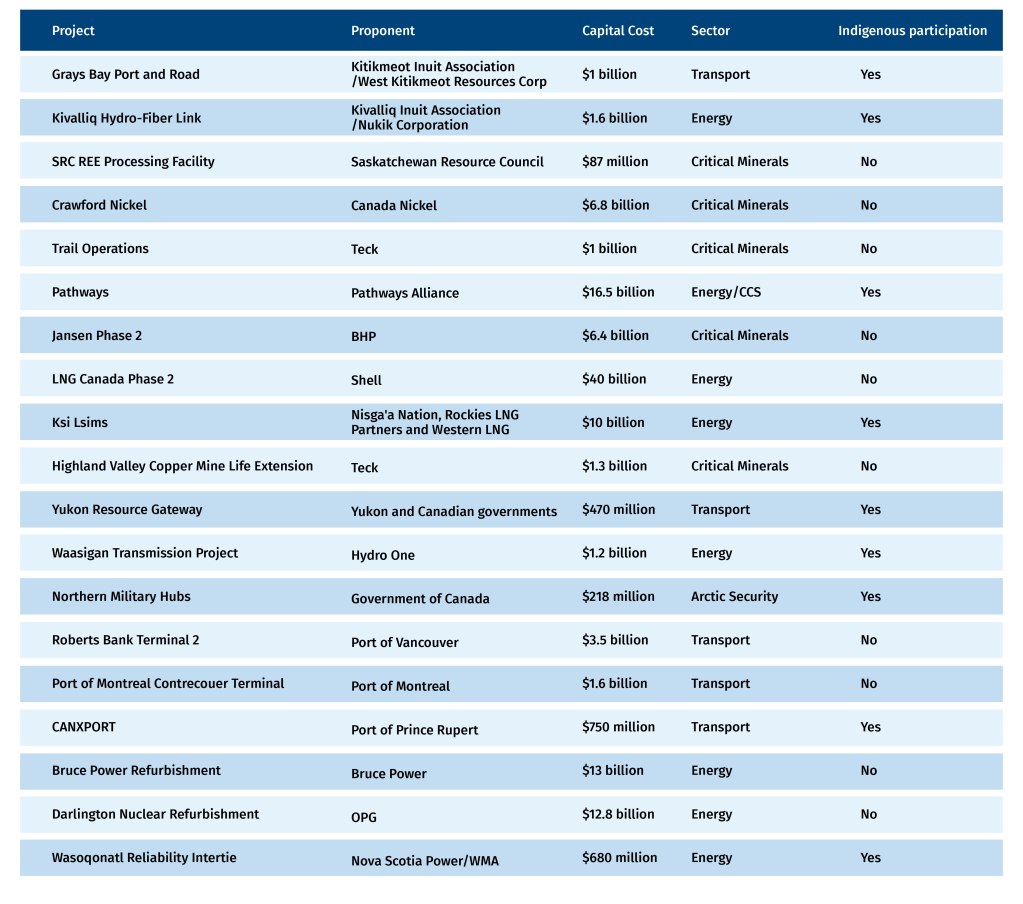
A big part of June’s First Ministers meeting in Saskatoon will be identifying nation-building projects the federal government has promised to fast-track in collaboration with provinces and Indigenous Nations. Besides regional and political considerations, a project list must cut across multiple sectors, contribute to important strategic objectives (including energy and Arctic security), and build Canada’s economic strength.

The 19 projects below help meet many of those objectives. They represent more than $120 billion in capital costs, covering major transportation, critical minerals, oil and gas, nuclear, carbon capture, utilization and storage (CCUS) and Arctic security infrastructure. They span the regulatory lifecycle-from pre-feasibility to under construction. Most if not all will require Indigenous partnerships. And they bolster Canada’s clean and conventional energy, trade diversification and Arctic security capabilities.

In this week’s edition: Carney picks his main trade and security team; trade signals from Trump’s Middle East tour; and what to expect during U.S.-China negotiations

Noteworthy

By John Stackhouse

I was in Ottawa this week for something called the B7—a gathering of business leaders from the constituent countries of the G7, whose governments will be meeting in Alberta in a few weeks. 

The most divisive issue: trade.

  • The mood was largely bearish. Despite the May bull run on markets, there’s a sense the democratic—i.e. free-trading—world is growing more divided. “Trade follows geopolitics” was how one speaker put it.

  • Europe is turning more inward, with a focus on its own economic security. Get ready for more industrial policy and state investing, which won’t help trade.

  • Canada is at a crossroads, needing to ease up on U.S. trade and expand trade with other markets, even as other markets get tougher to deal with. 

  • A new age of “plurilateralism” is emerging, in which constant and continuous dealmaking is the norm.

  • Some U.S. speakers urged Canadians to look beyond Trump’s attacks, saying the country is going through a bit of a mood adjustment. 

  • But for now, at least, the U.S. is looking to show some Elbows Up, American-style. 

  • Incoming ambassador Pete Hoekstra will give his first big briefing to POTUS next week and will highlight “outrageous” Canadian actions like removing American liquor brands and banning procurement from U.S. firms. 

  • Expect some media donnybrooks between Hoekstra, a blunt-talking former Congressman from Michigan, and Ontario’s blunt-talking Premier Doug Ford. 

  • New Industry Minister Melanie Joly may have to round out the line, as the three work to save the U.S.-Canada auto sector from further damage. 

  • One suggestion: they meet at the Gordie Howe Bridge, in tribute to the OG of Elbows.

How things are shaping up on the allimportant Canada-U.S. file

Carney has been clear that he’s the boss—and will run point on Canada’s relationship with the U.S. Still, his team will play a major role in a new economic and security agreement.

The Core 5: In selecting a main negotiating unit of Dominic LeBlanc, Anita Anand, David McGuinty, Francois Philippe-Champagne and Gary Anandasangaree, Carney opted for veteran ministers who collectively hold substantial clout and relationships in the Beltway. Expect this group to be supplemented by Melanie Joly, Minister of Industry, who holds considerable experience on the file, and will lead domestic negotiations with critical industries, including steel, aluminum and autos. And, in a lower-profile way, by Lisa Jorgenson, Carney’s recently appointed Senior Advisor on Canada-U.S. Jorgenson brings experience from Public Safety and Justice and will provide advice and behind-the-scenes coordination across political and bureaucratic levels.  

Committee shakeup: Trudeau’s Canada-U.S. Committee is out. And the ‘Secure and Sovereign Canada’ Committee is in. Chaired by McGuinty and Anand, the new committee has a couple noteworthy inclusions. Maninder Sidhu, Minister of International Trade, who is tasked with diversifying Canada’s trade away from the U.S., a key Carney promise. And Rebecca Chartrand, Minister of Northern and Arctic Affairs, a nod to the importance of Arctic security, one of the three legs of the economic and security pact.

Diplomatic and bureaucratic shuffle: The tenures of a few high-profile ambassadors—Kirsten Hillman in Washington, Ralph Goodale in London, and Stéphane Dion in Paris—are expected to end soon. Carney will likely prioritize a mix of experience, relationships, and political muscle, especially in filling the role in DC, as Hillman, well respected in Ottawa and Washington, leaves big shoes to fill. As for the public sector, Carney’s right hands in the Privy Council Office are Clerk John Hannaford and Deputy Clerk Chris Fox, who both hold a depth of experience on national security, energy and trade files. A broader public service shuffle could be in the offing as the PM looks for near-term results.

The week in numbers

7

Lawsuits filed against Trump and his administration challenging the ’emergency’ used to levy tariffs under the International Economic Emergency Powers Act. The U.S. Court of International Trade held a first hearing earlier this week.

150

Number of countries that Trump says want to negotiate a deal. Without the time to meet with them all, his administration will send letters to a list of leaders in the next couple of weeks simply telling them “what they’ll be paying to do business in the United States.”

1,000

Products marked as being impacted by tariffs at Loblaw. The grocery chain expects that number to climb to 6,000 in two months. Meanwhile, Walmart, which saw profits decline in Q1, announced it will be raising prices in the U.S. because of tariffs.

60 million

iPhones that Apple plans to produce from India for the U.S. market. While on his Middle East tour, Donald Trump blasted Apple’s CEO (“I had a little problem with Tim Cook”) for building iPhones in India despite committing US$500-billion in the U.S.

The view from Washington

Details of Donald Trump’s Middle East tour offer a glimpse into how ongoing and future trade talks, including with Canada, could play out:

  • Spend big on U.S. Defense products: Saudi Arabia ($142 billion) and Qatar ($3 billion) signed defense sales and procurement deals that range from general upgrades to information systems to new air and missile defense capabilities. The Trump administration might push the purchase of U.S. defense products in its future trade deals, which is particularly relevant for Canada given the White House’s record of criticizing Canadian defense spending. Trump could use the U.S.-Canada deal to push Canada to get to 2% defense spending more quickly through deals with U.S. defense firms. 

  • Don’t ignore Big Tech: Trump announced a $20-billion investment by a Saudi firm in AI data centers and related energy infrastructure in the U.S. And Qatar pledged $1 billion for a joint quantum technology venture between American Quantinuum and Qatari Al Rabban Capital. Data centres are particularly interesting in the U.S-Canada context because of Canada’s potential to be a strong partner (available land, renewable energy capabilities, cooler temperatures).

  • Creating sector-specific funds: The U.S.-Saudi Arabia deal included the creation of investment funds for energy ($5 billion), aerospace and defense ($5 billion), and sports ($4 billion). Investments in areas of shared interest could arise in other negotiations. The U.S.-Canada deal could include shared funds for energy, border security or continental defense.

3 questions…on U.S.-China negotiations

With Jasmine Duan, Senior Investment Strategist, RBC Wealth Management, in Hong Kong

Q: How do you expect markets and Asian economies to react and perform during the 90-day negotiation window?
A:
It will likely feature a mix of optimism and volatility. Markets may seek specifics on the agreement, which could lead to short-term volatilities.

Q: What signals will investors be looking for?
A:
Investors will watch for what terms were finalized between the two sides and what concessions or incentives each party will offer. It would be a good sign if the negotiation focuses on trade-related issues like market access and goods purchase, not domestic topics such as fentanyl or politics.

Q: What structural changes will drive the U.S.-China relationship beyond trade and tariffs?
A:
The trade talks have not addressed many structural issues such as how will the U.S. revive domestic manufacturing and reduce China’s trade surplus. We think near-term resolution remains unlikely but progress in establishing bilateral mechanisms to address issues like technological competition, climate goals, and crisis management, will be important to fostering a sustainable relationship in the long-term.