In this week’s edition: Lots of trade talk on the sidelines of the Asia Pacific Economic Cooperation summit and a generational investment in Canada’s competitiveness

By John Stackhouse

This week’s federal budget will aim to reorient Canada’s economy for a new global economic order, and that goes well beyond Donald Trump. 

The Canadian economy has been out of step with global trading and investment patterns for some time. Trump just shone a light on it. 

Consider trade itself. Global trade as a percentage of GDP reached a post-war peak of about 60%, coinciding with the Global Financial Crisis (itself an outcome of trade and investment imbalances). It’s since dropped to the mid-50s, and will likely come down a touch this year and next as the global economy slows. 

This doesn’t mean an end to globalization. It does indicate a re-globalization that—cue the budget signals—will lead to significant capital shifts. And they will be perhaps more significant than anything we’ve seen in 25 years, since China entered the WTO and became the new magnetic pole for global capital. 

This time, capital won’t flow to the lowest cost, mass producer. It will find the sources of strategic goods and resources, which would play well to the new Canadian pitch. Especially for energy, minerals, defence, space and food. 

Those strategic exports will be especially valuable to some of Canada’s key trading partners like South Korea and Germany, as they seek to reduce reliance on the U.S. and China. Moreover, big exporters like the Koreans and Germans will need more secure energy supplies if they’re going to be ready for a world of more modest trade in manufactured goods. 

I spoke about this new energy security paradigm last week at an IEA energy innovation forum, on the sidelines of the G7 energy ministers meeting in Toronto. You can read the full text here.

  • Prime Minister Mark Carney’s meeting with China’s President Xi Jinping this past Friday didn’t yield any major results but it was the first formal meeting between a Canadian Prime Minister and the Chinese President since 2017. Carney, who described it as a “turning point” for the two countries, also accepted XI’s invitation to visit China.   

  • Wanting more info on the state of Canada-U.S. relations, several Canadian Premiers are calling on Carney to host a First Ministers’ meeting. The last time the PM met with the premiers was August 6. 

  • A couple of days after U.S. President Donald Trump vowed he wouldn’t talk with Carney for some time, the two were placed directly across from one another during an eight-person dinner hosted by South Korea’s President. The PMO wouldn’t confirm if trade talk was on the menu but did say the World Series was a topic of conversation.

  • On Friday, Trump doubled down on his promise to not engage Canada in trade talks; which differed from the message sent from his Energy Secretary Chris Wright, who, while at the G7 Energy and Environment Ministers’ meeting, said the goal is for the two countries to get back to the table and cooperate more closely on oil, gas and critical minerals.

  • While it didn’t lead to a finalized trade deal, the meeting between Donald Trump and China’s Xi Jinping resulted in agreements on a few key items–including export controls on rare earths and chips.

  • The truce came on same day China’s factory activity numbers revealed its longest decline in nine years.

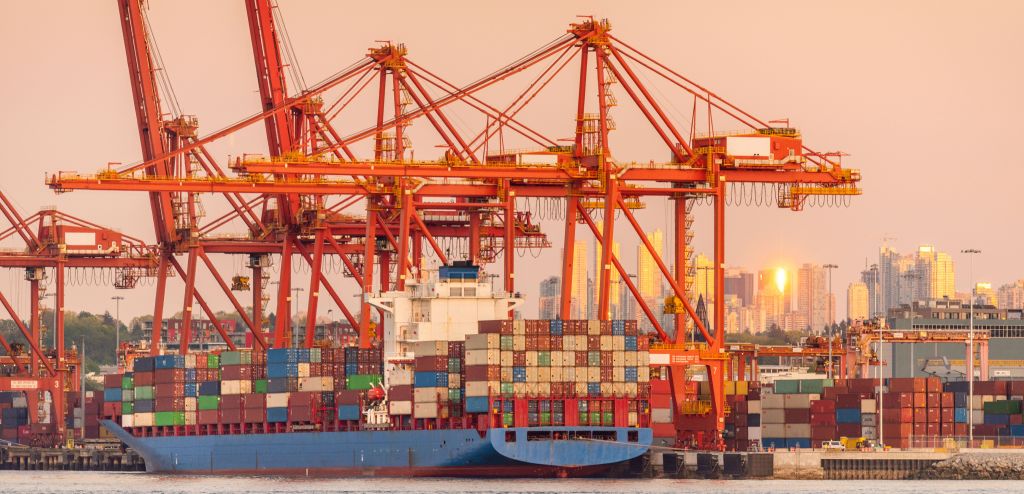
Canada’s prosperity depends heavily on how efficiently it can move goods to market—yet its largest ports have fallen behind the world’s best.

In the latest episode of Disruptors: The Canada Project, John Stackhouse spoke with Devan Fitch, Program Manager of the Roberts Bank Terminal 2. The long-planned project, at the mouth of Fraser River Delta, represents a generational investment in Canada’s competitiveness.

Here’s an excerpt from this week’s episode:

JS: Most Canadians probably take the Port of Vancouver for granted, even though if you look around, at least some of the stuff in your life passed through this port. Give us a sense, Devin, of the magnitude of the Port of Vancouver and what it means to the Canadian economy.

DF: If you take out of the equation all of the trade that we do with the U.S. and you think about the trade that we do with the rest of the world, $1 in every $3 of trade passes through the Port of Vancouver. That’s supporting businesses right across Canada. Consumers right across Canada. We happen to be located in Vancouver, but we are very much Canada’s port.

JS: As I understand it, the Port of Vancouver is the size, nearly, of the next five biggest ports in the country.

DF: That’s correct.

JS: And Roberts Bank will enable it to grow by another 30%. Is that correct?

DF: Yeah, somewhere between 20 and 30%.

JS: What does 30% bigger actually mean?

DF: In one fell swoop, it will increase capacity on the west coast of Canada by approximately one third. It will add 135 hectares of new waterfront trade enabling industrial land in one of the most industrial land constrained regions of North America. To give you a sense of scale of T2 – 12-million cubic metres of sand and 4-million cubic meters of manufactured rock. On the sand side, that’s about 2,500 Olympic sized swimming pools.

JS: Sounds enormous, but how does it compare to the world’s mega ports?

DF: It’s big for Canada. It is modest in size and scale compared to some of the largest ports around the world in Asia and Europe. But certainly a step function increase for Canada. It will provide capacity to move a $100 billion worth of trade goods every single year and support over 17,000 supply chain jobs across the nation.

JS: Give us a sense of how the port business is transforming and what opportunities there may be for Canada to move up in the competition leagues.

DF: Right now the world’s biggest container ships are about 24,000 twenty-foot equivalent units (TEUs). They’re applying their trade from Asia to Europe, and we see shipping lines cascading those large ships onto the North American routes as they age. We’re expecting as we move forward to see a significant increase in the size of ships, calling at the Port of Vancouver. Right now the average size is around 10,000 TEUs and we’re building Roberts Bank Terminal 2 to futureproof it to be able to accommodate ships as large as 24,000 TEUs.

Listen to the full episode here.


In this special season of Disruptors: The Canada Project, we’re crisscrossing the country and speaking to visionary leaders who are harnessing technology to take on Canada’s most-urgent challenges. Listen and subscribe wherever you get your podcasts.

In this edition: AI investments are partially masking the impact of the trade war on global growth – but Canada is missing out

By Jordan Brennan, Head of RBC Thought Leadership

The U.S.-Canada auto story just took another hit – or two.

On the tails of the Stellantis decision to move production of its Jeep Compass from Brampton to Illinois, this past week’s news is compounding:

  • General Motors announced it will end production of its BrightDrop electric delivery vans at the CAMI plant in Ingersoll, affecting 1,000+ jobs.

  • Paccar is laying off 300 workers at its plant in Sainte-Thérèse, Quebec ahead of U.S. heavy-truck tariffs.

What’s going on? You could interpret these shifts as proof that Trump’s “re-patriation” strategy is working. But dig deeper: both plants were already facing weakness. CAMI had encountered soft demand for BrightDrop vans; Paccar is turbo-exposed to U.S. heavy-truck demand and tariff risk. Brampton had a litany of problems over the years, including softening EV sales.

Where does this leave Canada? Our auto industry sits between two storms:

  • China is going all in on EVs—nearly half of all new car sales last year were electric.

  • The U.S. and EU EV market are stalling or retrenching—EV penetration in Europe fell to ~21% in 2024 from ~22% the year before.

  • The U.S. sits at just 10%. And that was before Trump’s One Big Beautiful bill shredded EV incentives.

This makes Prime Minister Mark Carney’s pending climate strategy even more consequential. Canada has three broad options:

  • Align with the U.S.: back off EVs and count on gas guzzlers to propel the industry forward.

  • Follow China: invest aggressively in next-gen batteries and hope EVs are the future.

  • Carve a middle path: incentivize hybrid adoption while infrastructure and consumer preferences catch up.

  • A 60-second ad, sponsored by the Ontario government and featuring former U.S. President Ronald Reagan disparaging the use of tariffs, prompted President Donald Trump to immediately cancel all trade talks with Canada. Premier Doug Ford’s government agreed to take the campaign off the air on Monday. But saying it wasn’t quick enough, Trump threatened an additional 10% tariff hike on Canadian goods.

  • Over the next 10 years, Prime Minister Mark Carney wants to double Canada’s exports to markets outside the U.S., boosting trade by $300 billion.

  • India invited Carney to New Delhi to meet with Prime Minister Narendra Modi. According to India’s new High Commissioner, a comprehensive free trade partnership between the two countries could result in $50-billion worth of trade annually, about double last year’s total.

  • An import ban on liquefied natural gas from Russia is part of a new package of sanctions agreed upon by the European Union countries..

  • President Trump will meet with his Chinese counterpart Xi Jinping next Thursday during the Asia-Pacific Economic Cooperation summit. This will mark the first meeting of the two since the U.S. President’s re-election.

By Farhad Panahov, Economist

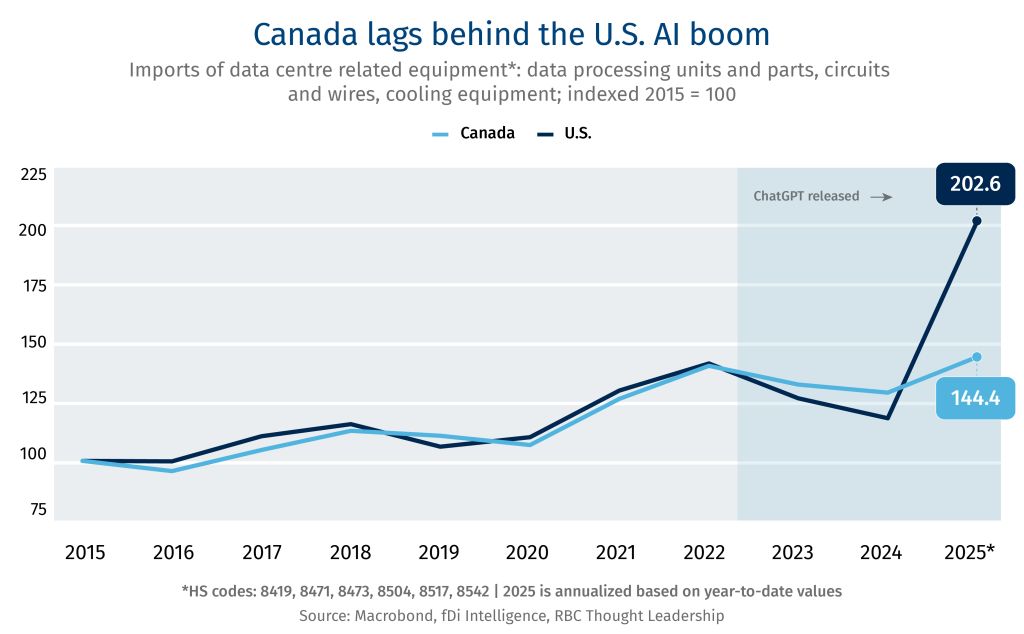
AI-related investments may have masked the impact of the U.S. trade war on global growth so far, the IMF notes in the latest World Economic Outlook. Since the release of ChatGPT in late 2022, U.S. firms have quadrupled data-centre construction spending to nearly US$40 billion. There are now 5,000 data centres dotted across the U.S. Imports of data centre related equipment is up 50% over the same period. Taiwan accounted for half of the growth when it comes to U.S. imports of digital processing units. Canada, as the chart below indicates, has remained on the sidelines of the AI boom despite a growing number of data centre applications. Demand for related equipment has shown only a small uptick in recent years.

By Lisa Ashton, Director of Agriculture Policy

Canada’s agriculture equipment manufacturing industry is caught up in the U.S. tariff blitz.

The industry, which generates $7 billion in annual revenues (more than double from a decade ago), plays a critical role in North America’s food production, providing farmers with the equipment to plant seeds, harvest crops, feed animals, milk cows, and operate an efficient farm business.1

The U.S. market dominates exports, accounting for 82% in 2024, which has so far remained unchanged in 2025.2 But there’s a shift under way. The tariffs have benefitted the domestic industry in some cases by raising domestic demand of Canadian-made products and reducing some input prices, including Canadian steel.3 But the industry is also facing risks of rising costs to produce equipment that has parts from both sides of the border. Manufacturers are wadding through compliance complexity, with U.S. tariffs on some parts such as tractor brakes and Canada’s counter tariffs on parts such as tractor tires.4 For farmers, this means potentially higher input costs for new equipment and parts to repair their existing equipment—forcing decisions on investments that impact agricultural productivity. The shifts come as the industry has already seen a growing trade deficit since 2020, more than doubling in size in 2024.5

Manufacturers are setting their eyes on new growth markets, while maintaining relationships with their U.S. customers and supply chain. A renewed commitment in 2025 to the Canada and Mercosur free trade agreement negotiations offers promise for Canadian agricultural manufacturers to expand their presence in Argentina, Bolivia, Brazil, Paraguay and Uruguay, where agriculture production is expanding, and on-farm mechanization is exponentially improving.

In this week’s edition: Is Stellantis the first domino to fall? And how Canada can strengthen its role in an REE-bifurcated world.

Is this the end of the auto pact?

By Jordan Brennan, RBC’s Head of Thought Leadership

Frustration is building in Canada’s auto sector. And concern.

Less than one week after U.S. Secretary of Commerce Howard Lutnick told a Canadian audience that “car assembly is going to be in America and there is nothing Canada can do about it,” Stellantis announced it will shift planned Jeep Compass production from Brampton to Belvidere, Illinois.

This looks like the fruits of America’s trade strategy, which aims to re-industrialize America through re-patriation of manufacturing capacity.

The fear: Stellantis is the first of many dominos to fall. 

Canada’s original managed trade in autos—the 1965 Auto Pact—tied duty-free access to production and value-added commitments in Canada, catalyzing continental supply-chain integration and shifting Canada from many low-volume domestic models to fewer, high volume North American models.

Today, Canada exports roughly nine-in-ten Canadian-made vehicles to the U.S. In any ordinary business, reliance on a single customer would be intolerable. But it appeared tenable through the Auto Pact and NAFTA eras. Today’s push to re-patriate Canadian auto jobs is a reversal of the 1965 logic. And it reminds us about our dangerous concentration risk.

In the face of the trade turmoil, Prime Minister Carney has pursued a strategy of patient diplomacy. What are Canada’s options if that doesn’t work?

The U.S. assembles 10-11 million vehicles annually, most of which are sold within the domestic market. Some 15% of American-made vehicles are exported. And in any given year, one-third of those exports are shipped to Canada, making us the largest export market. Closing the door on American imports would hit a channel equal to 7-10% of annual U.S. production.

Then there is the China angle. Beijing slapped a 75% provisional duty on Canadian canola in August. China’s ambassador has since proposed reciprocity—lifting canola and pork tariffs if Ottawa removes its 100% tariff on Chinese EV’s. Premiers Scott Moe and Wab Kinew have urged Ottawa to explore the proposal, which would intensify competition with Tesla, for example.

Other options include sectoral deals with Germany, Japan and South Korea. Think LNG offtake for defence procurement commitments—with auto-assembly mandates as part of the package negotiations.

While none of these options are great, Canada has leverage—as America’s top auto export market and a deeply integrated supplier base. This only works if used surgically. America’s real economic competition and strategic threat comes from China, not Canada. A grand bargain that locks in North American capacity and predictable market access remains the cleanest outcome. 

  • The Keystone XL pipeline is back in the conversation. This time at the negotiating table during the ongoing trade talks in Washington between the U.S. and Canada.

  • Setting a “new roadmap” for Canada-India relations. Foreign Affairs Minister Anita Anand met Indian Prime Minister Narendra Modi after a two-year diplomatic rift.

  • Canadian manufacturing sales fell 1% in August, while wholesale receipts dropped 1.2%, underscoring the impact of U.S. tariffs on key trade-exposed sectors.

  • Canada added 28,000 new manufacturing jobs in September—the increase was concentrated in Ontario and Alberta and partly offset the 58,000 manufacturing jobs lost between January and August.

  • Ikea responds to Trump’s new furniture tariffs with plans to boost U.S. production. Currently, only 15% of what the Swedish home furnishing giant sells in the U.S. is made there.

By Vivan Sorab, RBC Thought Leadership’s Senior Manager of Clean Energy

As China escalates its Rare Earth Element (REE) advantage over the United States with enhanced export controls that could have widespread impact on critical defense and semiconductor supply chains, Canada must strengthen its role in the REE supply chain.

The challenge? Canada has the resources, the capital, and the intellectual property to start building a supply chain but needs to mobilize at speed.

Funding: The tools to build a REE supply chain exist. Canada classifies REEs among its priority 6 critical minerals (alongside lithium, graphite, nickel, cobalt, and copper) to receive funding under a $1.5 billion carveout from the Strategic Response Fund. While funding has flowed for REE mining (e.g., commitments to REE projects in Labrador), Canada must accelerate deployment to processing and manufacturing of key REE-based products like magnets.

Guarantee Demand: U.S. government-backed price floors and offtake agreements for REE products are helping make REE projects more attractive to the private sector. Similar approaches in Canada could help step up a domestic supply chain.

Build Domestic Processing Capability: Canada has REE intellectual property on home soil. Kingston-based Cyclic Materials, a REE magnet recycler, is building a $25 million Centre of Excellence and is partnering with France-based Solvay to supply recycled REE oxides for further processing. By growing processing capabilities at home, Canada can strengthen its position.

By Jordan Brennan, Head of RBC Thought Leadership

There was a volley of compliments, smiles and backslaps between Donald Trump and Mark Carney during their meeting earlier this week, with the U.S. President telling reporters that Canada was going to walk away “very happy.” But optimism had come crashing down by the next day, with the U.S. Commerce Secretary Howard Lutnick telling a Toronto audience that “car assembly is going to be in America and there is nothing Canada can do about it.”

The view from the White House is that Americans don’t need Canada to assemble their cars. It’s difficult to know what to make of Secretary Lutnick’s remarks. Is it a genuine threat or “art of the deal” bravado in which Trump asks for the sun, the moon and the stars and ends up settling for the moon? Word on the street is that President Trump doesn’t like being told “America needs Canadian oil, steel, lumber” and so on.

A Canadian trade team remains in Washington to chase sectoral deals on steel, aluminum, energy and autos—a hallmark of what Washington now calls “managed trade.” With little material progress to date, and an American negotiating team that’s bogged down in bilateral deals with many other countries, it’s an open question if Canada will be able to secure meaningful sectoral agreements prior to the formal review of CUSMA next July.

It looks like “managed trade” is here to stay for now. But what does that mean?

In June, Trump doubled tariffs on Canadian steel and aluminum to 50%, up from the 25% rate announced in February. The impact was immediate. Canada produces roughly 13 million tonnes of primary steel annually, exporting half—and nine out of every ten tonnes goes to the U.S. Those flows are now drying up.

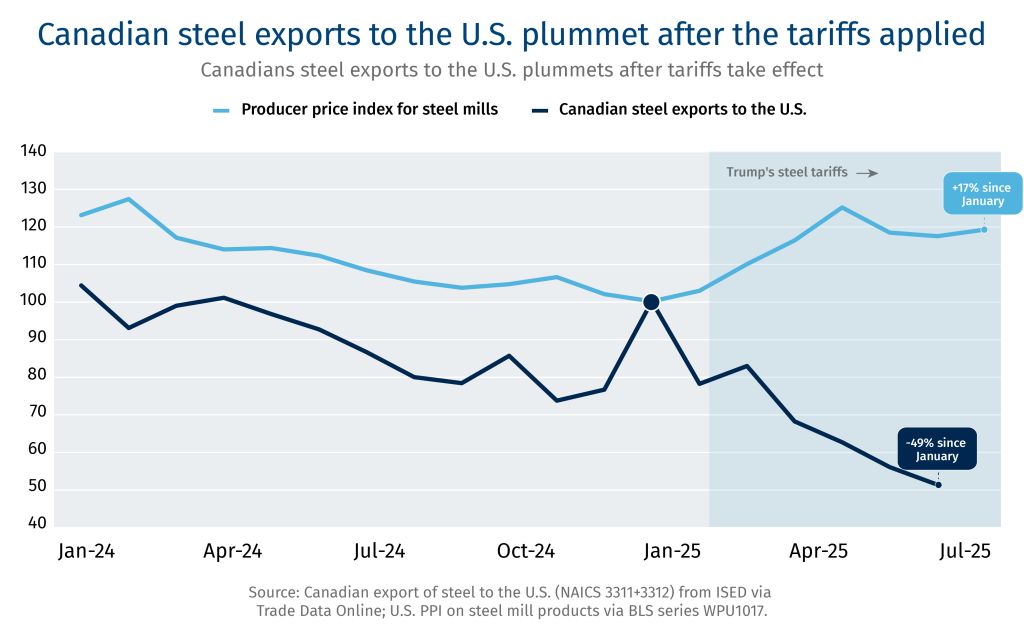
Steel prices tell the story. The chart below shows the value of Canadian steel exports to the U.S. and U.S. steel prices, both indexed to 100 in January 2025 to simplify the comparison. In the 12 months leading up to Trump’s tariffs, Canada’s steel exports to the U.S. and American steel prices both trended downward. Then came the trade war and the two series diverged—Canadian steel exports fell off a cliff while American steel prices marched north.

The new tariffs have reignited steel price inflation. With Canadian imports throttled, American producers are facing less competition and are quietly raising prices. U.S. steel imports from Canada are down 49% while steel prices are up 17% since January.

This is the face of managed trade. It isn’t about opening markets; it’s about organizing them. Under the free-trade order of the past four decades, governments agreed to minimal barriers and let consumer preferences, technology, and competition sort out winners and losers. Managed trade flips that logic. Governments pick strategic sectors, shield them from global competition, and steer investment through tariffs, quotas, and subsidies.

For Canada, the question isn’t whether we like it—it’s how we adapt to it. Ottawa looks ready to pivot, having announced a suite of sector supports in September. We need to learn to play by the new set of rules: identify national priorities, deploy capital strategically, and make reciprocity work in our favour.

Managed trade may be messy. But in this new era, it’s the only game on the field.

  • Donald Trump wants his team to “quickly land deals” with Canada. So said Canada-U.S. Trade Minister Dominic LeBlanc after the U.S. President met with Prime Minister Mark Carney in Washington. LeBlanc remains in Washington to continue trade talks.

  • China unveiled sweeping export controls on rare earths. Trump has threatened ‘massive’ tariffs on Beijing in retaliation.

  • Industry Minister Melanie Joly unveiled a three-point plan as part of an effort to counter U.S. tariffs. Itfocused on protecting jobs, creating new ones and attracting both investment and talent.

  • The U.S. has collected US$195 billion in custom duties during the 2025 fiscal year. That figure stood at US$77 billion in 2024.

  • Chips and other AI-related goods contributed nearly half of global trade growth in the first half of 2025, according to the World Trade Organization. The impact of tariffs is expected to really kick in next year—the WTO expects trade to grow a paltry 0.5% in 2026.

Mark November 5 in your diaries. That’s the day the U.S. Supreme Court will hear the case of President Donald Trump’s emergency tariffs under the International Emergency Economic Powers Act (IEEPA). The Department of Justice (DoJ) will be hoping to overturn a decision in May by the Court of International Trade that declared that Trump had overstepped IEEPA when he used the law against Canada and other U.S. trade partners.

The case combines three separate cases claiming Trump’s tariffs on Canada, China, Mexico and other trade partners are illegal. One was brought by Democratic state attorneys general, while the other two are from separate coalitions of small businesses.

Here’s what you need to know:

  • It’s “illegal”: The plaintiffs’ central argument is that the tariffs were never designed to deal with the specific U.S. grievances against Canada, Mexico and China over drug-trafficking.

  • Trump has been losing—so far: A three-judge Court of International Trade panel, a federal district judge in Washington, D.C., and the 11 active judges on the U.S. Court of Appeals for the Federal Circuit backed the plaintiffs in a 7-4 decision. The DoJ is hoping the Supreme Court will overturn the “incoherent” rulings.

  • The Supreme Court could go either way: The wins in lower courts could be overturned. It’s a “coin flip,” according to Scott Lincicome, a trade expert with the Cato Institute.

  • The White House has many other tools: Some analysts suggest the Supreme Court could side with the lower courts as the U.S. administration has many another avenues to replace the IEEPA tariffs, such as Section 232 of the Trade Expansion Act of 1962.

  • Refund bonanza: If the challengers are successful, it could spark a wave of legal battle over refunds of well over US$80 billion.

The Supreme Court ruling could come by the end of the year.

By Jordan Brennan, Head of RBC Thought Leadership

  • Mark Carney is going back to Washington next week. His agenda? Revive “security and economic” ties with the U.S., or at the very least bring some relief to Canada’s beleaguered steel, aluminum and auto sectors.

  • With security and economic front and centre, other likely topics at the Oval Office could include the Golden Dome missile shield program, something Donald Trump brought up as recently as this week, taking the opportunity to sting Ottawa with another “51st state” jibe. Could Carney push steel and aluminum’s importance as part of the defence collaboration with Washington?

  • Dominic LeBlanc, the minister responsible for trade with the U.S., sounded upbeat this week about making progress on some of our main pain points with the Trump administration.

  • The two partners also launched consultations last month on CUSMA ahead of the tripartite trade deal review. But what happens if the days of tariff-free access to the American market are permanently behind us?

  • It’s not far-fetched to suppose that Canada ends up with a U.K.-style deal, namely an across-the-board ‘market access’ tariff of 10%.

  • Trump slapped a 25% tariff on the non-U.S. content of automobile exports (the so-called ‘232’ or ‘national security’ tariffs) in March. Given that roughly 50% of the content of a Canadian-assembled vehicle comes from the U.S., Canadian autos have faced an effective tariff rate of about 12.5%. That’s close enough to the 10% market access tariff to warrant comparison.

  • Both sides are suffering: unemployment in Canada has ticked up since the trade war began, with the auto-producing municipality of Windsor suffering from the highest unemployment rate among Canada’s urban centres. South of the border, the manufacturing sector has shed 40k jobs over the past six months, with additional hits to primary and fabricated metal manufacturing.

  • Canadian softwood lumber producers got hammered with an additional 10% tariff. The new levy will be added to the current 35.16% anti-dumping tariff that the U.S. imposed on lumber imports from Canada this year.

  • The European Union is expected to announce a 50% tariff on steel imports next week, aligning the bloc with similar U.S. and Canadian measures.

  • At the request of UK Prime Minister Keir Starmer, U.S. President Donald Trump is said to be considering easing the 10% tariff on imported Scotch whisky.

  • South Korea’s foreign ministry revealed that Seoul will likely announce a new security agreement with the U.S. before finalizing trade talks.

An India-Canada reset is underway, writes John Stackhouse, and this time it will require a lot more than handshakes. 

On trade, India has gone from Canada’s 16th largest partner in 2008 to 10th in 2015 to 7th last year.

The same can’t be said about Canada, which ranks only 30th for India. Bilateral trade reached $31 billion in 2024, including services, compared to $117 billion with China. The decline in international students—one of the largest sources of Indian revenue for Canada—will further slow that progress, as Canada’s perceived closed-door policy has tarnished our reputation across a generation of educated Indian youth.  

That’s not the only reason Canada’s quest to restart trade negotiations may require patience. An increasingly confident India—and confident Modi—will not compromise easily, especially over issues like intellectual property rights, which India has long viewed as a form of Western colonialism. 

Those differences aside, the two countries have unique and deep ties, largely through the Indo-Canadian population. Going forward, India will want a more mature relationship, based on interests, especially economic interests. Canada can pursue greater opportunities, too, from heavy oil and LNG to advanced manufacturing and space technologies. 

A renewed relationship will require both countries to recognize what they bring to each other. It can also stress what they can achieve through alliances and multilateral groups.

Read the full column.

In this week’s edition: Carney’s U.K. visit, new Trump tariffs, and the potential impact of Canada’s new deal with Indonesia

By Jordan Brennan, Head of RBC Thought Leadership

  • Prime Minister Mark Carney is back in the headlines today, this time in London with U.K. Prime Minister Keir Starmer. At stake: trade diversification and the kind of economic and security alliances that will define the coming decade. No doubt the security situation in Europe forms part of the backdrop to the conversation, including Russia’s alleged incursions into NATO airspace.

  • This week’s meeting builds on talks from June. Back then, the development of the UK-Canada Economic and Trade Working Group got rolling, which will make recommendations on barriers to trade and critical minerals, among other topics.

  • Carney is in a strong spot to lead. With the global order splintering, new partnerships are required to foster security and prosperity. Critical minerals sit at the nexus of both. Secure and stable access to critical minerals is a pre-condition for economic dynamism and geo-political security in the 21st century. They not only underpin the defence industry—their applications span space exploration, clean technology, the digital economy, health care and much beyond.

  • Here’s the problem: NATO and allied countries lack a cohesive strategy. This is Carney’s opportunity to shine. The Canadian government could craft a critical minerals strategy in partnership with allied countries that secures supply chains while attending to the dangerous concentration risk posed by China.

  • As noted in a recent RBC Thought Leadership report, The New Great Game, China is way out in the front, controlling between 60% and 90% of refining capacity for lithium, cobalt, rare earths, and graphite.

  • Building on Canada’s abundant mineral resources, the strategy would leverage Canada’s strength as the global centre for mining excellence. From copper to cobalt, uranium to nickel, lithium to graphite, Canada possesses the raw materials that nourish frontier industries and the engineering and financing capabilities to drive product to market. 

  • The U.S. is taking bold steps in this space, too. Earlier this week, the White House announced it is seeking a 10% equity stake in Lithium Americas, a Vancouver-based company miner. Backed by a Department of Energy loan, Lithium Americas is developing what may become the largest lithium mine in the Western Hemisphere, built in Nevada.

  • As it happens, RBC hosted a delegation this week from Washington. Two dozen staff officials from Congress (from both sides of the aisle) and the Canadian Embassy explored the possibility of a critical minerals partnership between Canada and the U.S. Coupled with Washington’s positioning on Lithium Americas, enhanced cooperation on critical minerals might be one avenue to strengthen Canada’s trading relationship with the Americans.

  • Prime Minister Mark Carney will attend the ASEAN summit in October, amid talk of a potential trade deal between Canada and the Association of Southeast Asian Nations bloc at some point next year

  • Canada should consider making a “business case” to supply liquefied natural gas (LNG) to Germany, its ambassador suggested recently. Germany currently imports about 90% of it’s LNG from the U.S.

  • If an international pharmaceutical company isn’t building a manufacturing plant in the U.S., its drugs will have a 100% tariff levied on them starting October 1. Foreign-made heavy trucks (25%) and household furniture (30%) will also face new tariffs starting next week.

  • Trump promised U.S. farmers, who largely voted for him last November but have been hammered by his trade policy, relief by giving them “some of that tariff money.”

  • The American aerospace giant Boeing may soon land a massive contract with China—potentially a centerpiece of the ongoing U.S.-China trade talks.

  • Most countries are performing better than expected despite the pressure of tariffs, according to a new report from the OECD.

By Shaz Merwat, Energy Policy Lead

After four years of negotiations, Canada signed a Comprehensive Economic Partnership Agreement (CEPA) with Indonesia last week.

The deal is expected to increase Canadian exports by $447 million–a paltry 0.04% increase over current figures. Still, it provides Canada with a call option on Indonesia’s economic growth. The country is expected to become a Top 5 global economy by mid-century and a vast market for Canadian agriculture, food products, machinery, services and even nuclear technology.

The announcement follows on the heels of the Trump Administration’s reciprocal trade deal with Indonesia, moving quickly to secure valuable critical mineral market access and resources—notably nickel. Indonesia agreed to remove its export restrictions on ore, allowing raw and semi-processed nickel to be shipped to the U.S. for refining and keeping the supply chain out of Chinese-operated Indonesian smelters.

For Canadian miners, the nickel arithmetic is likely negative. According to BNEF, Indonesia’s production of Class 1 Nickel (the higher quality needed for batteries) is expected to reach 1.6 million metric tonnes by 2030, accounting for 52% of the global supply. This puts Indonesian supply in direct competition with Canada (240,000 metric tonnes by 2030) and allows for more tariff-free nickel flows to land in North America–positive for North American security of supply but possibly at the expense of Canada.

The U.S. trade deal with Indonesia is the more impactful and given the lack of domestic mineral resources in the U.S., diversification of resources is key. For Canada, the focus remains leveraging our shared national security interests and economic integration to become a de-risked source of supply; competitive advantages that are more challenging for other trade partners to replicate.  

In this week’s edition: The challenges that lie ahead now that CUSMA consultations have kicked off and what a redrawing of the critical minerals map would mean for Canada

By John Stackhouse

Mark Carney’s Mexican charm offensive—and successful visit with Claudia Sheinbaum—may soon seem like a happy vacation memory. The two countries return this weekend to harsher realities, especially in their shared as well as separate relationships with the United States. Here’s how it could play out:

  • The Trump administration has triggered a review of the Canada-U.S.-Mexico trade agreement, by launching public consultations. Canada is expected do the same this weekend, opening the door for 45 days of lobbying, teeth-gnashing and perhaps genuine reflection.

  • Expect the three amigos (2 amigos + 1 amiga) to then amass small armies of trade and industry experts to begin the more formal dialogue. The Canadian government is already recruiting people to speak with their American and Mexican counterparts, especially in energy, autos, steel, aluminum and lumber. They’re a little worried the Americans won’t show up anywhere near as well prepared and may even push for a quick (and perhaps flawed) deal. 

  • Mexico has taken a different tact, working with U.S. Secretary of State Marco Rubio on a range of non-trade issues like curtailing drug cartels. They’re hoping that will gain goodwill for the next round of trade talks, which for Mexico are not shaping up well. The U.S. has effectively banned hothouse tomatoes and is clamping down on remittances—all signalling tough times ahead for Mexico. 

  • The biggest issue for Mexico will be “rules of origin,” i.e. how to reverse the massive increase of Chinese investment and trade that turned Mexico into a side door to the U.S. market.

  • For Canada, early signals suggest Commerce Secretary Howard Lutnick and Trade Representative Jamieson Greer want to protect the foundation of a trilateral trade agreement, with special interest in Canada and enhancing two-way trade. Side agreements or subordinate deals under a North American umbrella could evolve. 

  • For Canada, the biggest existential concern remains autos, and Trump’s apparent desire to move as much Canadian production to U.S. soil. We’ll see if the American industry can persuade him of the economic logic of cross-border production.  

  • Would Canada accept a “market access” tariff of, say, 10% to secure some kind of second life for Canadian factories? 

  • Beyond autos, U.S. concerns continue to focus on dairy and digital. We all know the dairy challenge. On digital, U.S. tech platforms continue to complain about Canada’s treatment of online news. And yet, having compromised on a digital sales tax, the Carney government will be challenged to give again, especially since any concession would likely hurt struggling media and publishers. 

  • For the U.S., the biggest challenge may be more political. Does Trump push for a quick win on CUSMA? And then focus on the bigger challenges of China, India and Brazil? Or does his team work on deep and lasting changes to CUSMA, aiming to present a win ahead of next year’s midterm elections? 

  • Worth noting: Trump’s closest friends continue to suggest he’s open to tearing up CUSMA. Maybe bluster. Maybe leverage. But as the hard work begins, expect some hard challenges to continue to pop up.

  • Speaking at a Halifax Chamber of Commerce event, U.S. Ambassador Pete Hoekstra said he is disappointed by the “anti-American, elbows up” rhetoric from Canadians.

  • U.S. and Chinese officials gathered in Madrid for their fourth round of talks—to talk about TikTok.

  • In 2024, China imported US$12.6 billion worth of soybeans from the U.S. Last week: 0. A clear indicator that Beijing isn’t afraid to use agriculture as leverage with Washington.

  • Trained on 25 years of shopping data, Amazon is releasing a retooled AI agent to assist sellers with inventory decisions to manage the increased volatility caused by the trade war.

By Shaz Merwat, Energy Policy Lead

A pair of U.S. senators introduced the Restoring American Mineral Security (RAMS) Act, a bipartisan Senate Bill that would establish a Critical Minerals Security Alliance, granting duty-free access among trusted partners and require allies to match U.S. tariffs on Chinese supply.

Here are three implications for Canada:

  • Alliance membership comes with obligations. Canada would need to mirror U.S. tariff levels on Chinese minerals and strengthen enforcement against Chinese supply/transshipment. Heading into formal CUSMA renegotiations, the U.S. is looking again to allies to close the Chinese back door (note: Mexico increased tariff rates on a number of Chinese goods). Specific to minerals, shutting out Chinese supply is crucial for industry to scale. RAMS makes that firewall a requirement.

  • Capital will follow the club. Perhaps the most novel element is the U.S. plan to recycle tariff revenues from non-alliance imports into allied projects–20% specifically to support international critical mineral projects in member nations. Still, given our close minerals trade relationship (we are each other’s #1 minerals trade partner), Canada directionally wins from reinvestment in U.S. mineral projects. That could provide ‘cheap’ capital to Canadian miners—historically an obstacle for junior miners.

  • Preferential access is only useful if we scale. Duty-free treatment would give Canadian producers a cost edge into the U.S. market. But without faster project approvals and similar investments in accompanying transport infrastructure, we lose our advantage. It’s worth noting that there are two minerals projects in the first tranche of Prime Minister Mark Carney’s fast-tracked Major Projects list: McIlvenna Bay (copper and zinc) and the Red Chris mine expansion (copper).

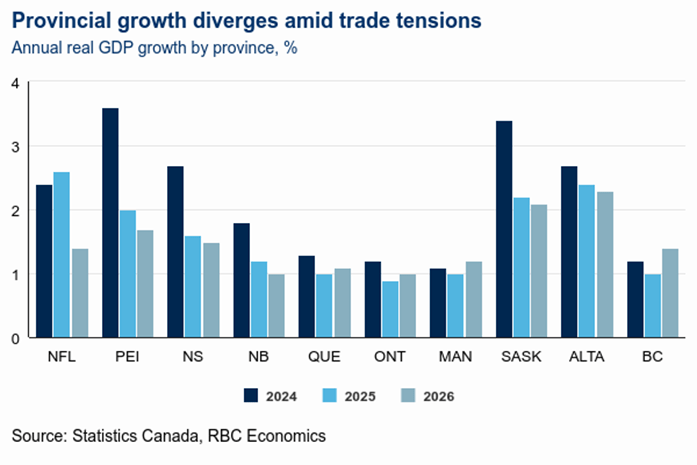
While Canada faces a national shock from its trade relationship with the United States, the provinces are facing differentiated trade shocks that are creating divergences in both growth and growth drivers, according to RBC Economics. Read the full report – Quarterly Canadian outlook: Low but positive growth ahead – RBC

In this week’s edition: Three areas where Canada and Mexico can deepen ties, how one smart idea can help alleviate canola farmers’ China challenge, and why infrastructure, not policy, may be holding us back.

By Jordan Brennan, RBC’s Head of Thought Leadership

Six months into President Trump’s trade war, with no deal in sight, Canada has good reason to deepen its partnership with Mexico. (And, based on a couple of recent trips south, the federal and Alberta governments agree).

Despite being Canada’s third largest trading partner, Mexico accounts for less than 4% of Canada’s global merchandise trade, the bulk of which is imports. In 2024, Canada shipped just $9 billion of goods to Mexico while importing $47 billion of Mexican goods.

Make no mistake, no country can displace the U.S. when it comes to trading significance for Canada. But we see three broad areas where Canada and Mexico can deepen ties.

  • Build Bridges & Infrastructure. Canada’s ‘Maple Eight’ pension funds, with north of $2 trillion in assets, are among the largest in the world and possess expertise in major infrastructure projects like pipelines, rail and port capacity. That’s what Mexico needs: patient capital with financing expertise. Canadian capital is a source of financial influence that could be leveraged to advance geopolitical and trade interests, and enhance commercial ties. Canadian Pacific Kansas City Rail’s investment in the Patrick J. Ottensmeyer International Railway Bridge—a $100M project launched earlier this year that deployed innovative technology to improve continental cargo mobility on the U.S.-Mexico border—is a case in point.   

  • Boost Bilateral Trade. Many of Canada’s export industries—from energy to steel and aluminum, copper, agri-food, softwood lumber, pulp and paper, and plastics—are products the 130-million strong nation imports. Enhanced trade flows, underwritten by the current CUSMA, could help several of our stressed industries find relief.

  • Unite On CUSMA. While the U.S. will remain the cornerstone of North American trade, both Canada and Mexico must prepare for the joint review of the CUSMA, which is officially scheduled for 2026 but may come sooner. Rather than being played against one another, which Trump has successfully orchestrated until now, diplomatic coordination between Canada and Mexico could affirm treaty mechanisms, ensuring duty-free access for CUSMA-compliant goods. Trade irritants in specific industries (think supply management) and trans-shipment for Chinese goods must be managed. With trade nested in a broader framework that includes border security, defence, infrastructure, and supply chain integrity, all three countries can be made better off by deepening their cooperation, ensuring balanced and mutually beneficial trade across the bloc.

  • China tariffs on Canadian canola seed exports have prompted calls on the government to limit imports of vegetable oil. Conservative Leader Pierre Poilievre is also demanding the Carney government cancel a $1-billion loan BC Ferries is using to buy Chinese-built vessels.

  • China also filed a lawsuit over Canada’s import restrictions on steel.

  • The Ontario government is introducing a $1 billion emergency loan program to qualifying businesses in the steel, aluminum, and auto sectors impacted by U.S. tariffs.

  • Trade war ripples start to show in U.S. wholesale prices, which were up 3.3%in June YoY, the biggest jump since February.

  • As it looks to reshore some of its manufacturing–and create 1,000 U.S. jobs–GE Appliances is investing $3-billion in its U.S. factories over the next five years.

By Yadullah Hussain, Managing Editor, RBC Thought Leadership

Canada’s canola crisis has deepened. Beijing’s 75.8% duty on Canada’s most valuable crop comes after its preliminary investigation found Ottawa provided subsidies and preferential treatment to its farmers.

The levy on canola seeds adds to Beijing’s 100% tariffs already in effect on Canada’s canola oil and meals. Back in April, the Canadian Canola Growers Association (CCGA) told us that farmers were freezing investments over fears that a tariff on canola seeds was the “big shoe to drop.” Chris Davison, President and CEO of the Canola Council of Canada, now believes the Chinese market is “effectively closed” to Canadian canola producers.

That’s another $4.5 billion of commodity trade disrupted and now in search of new, tariff-free markets, joining lumber, aluminum and steel.

Here’s how Canada’s canola crisis is playing out:

  • Squeezed by two economic giants: Could Beijing be trying to get Ottawa to remove the 100% tariffs on Chinese EVs, and 25% on Chinese steel and aluminum? Beijing will make a final call on canola seed duties in September. But Ottawa is in a bind as it had raised tariffs on imported aluminum and steel to appease Washington’s concern that countries, including China, were Canada as a backdoor to the U.S. market.

  • Meal plan goes awry: China’s canola meal imports from Canada whittled down to 32,506 tonnes in June—from 141,938 tonnes in June 2024—Statistics Canada data shows.

  • Oil turmoil: Canada’s canola oil exportsto China amounted to a big fat zero from China in June, industry data shows.

  • Seed money: Canada’s canola seed shipment to China had fallen to 237,897 tonnes by June 2025, compared to 651,080 tonnes during the same period last year.

  • Farmers want a cash injection: Farmers should not be asked to borrow their way through a crisis that’s not of their making, the CCGA states. Although that would only exacerbate Beijing’s concerns of Ottawa subsidizing the industry.

Beijing’s concerns of Ottawa subsidizing the industry.

  • Ease the pain: Boosting domestic demand and processing capacity of biofuels like Sustainable Aviation Fuel (SAF) presents one opportunity to diversify canola demand as a biofuel feedstock. According to Lisa Ashton, our Agriculture Policy Lead: “Canada should consider looking at other countries’ playbooks for expanding domestic biofuel markets and agriculture’s role in its growth.” Brazil, Japan, and Malaysia are all expanding processing capacity for biofuels including SAF and increasing required biodiesel and ethanol blends in convention fuels.

Jordan Brennan, RBC’s Head of Thought Leadership, recently connected with Trevor Tombe, at the University of Calgary’s School of Public Policy.

Q: What can the federal government do to lessen our dependence on the U.S.?
A: We face significant constraints. Canada’s ability to expand trade with other countries through trade agreements is largely exhausted. India and China, for geopolitical reasons, are unlikely prospects in the near term. Our limitation is not policy, but infrastructure. Geography remains a stubborn fact that requires substantial infrastructure investment. Expanding upon our rail and port infrastructure is a renewed priority federally but will take many years to move the needle.

Q: What do you see as the long-term impact of Trump’s tariff wars globally?
A: The uncertainty from tariff threats alone dampens investment. That itself may lead to a permanent reduction in Canadian productivity if investors perceive a higher level of risk in Canada due to uncertain market access in the U.S. Globally, if there’s one lesson from the 1930s, it’s that protectionist spirals deepen economic pain for all participants. While tariffs might temporarily boost some U.S. industries, the costs to global efficiency and consumer welfare would be substantial.

Q: Are there any new insights that challenge the prevailing wisdom about the broad-based benefits of free trade?
A: The fundamental case for liberalized trade remains strong. But it requires resources, production, and employment to shift across sectors and regions. Some of my work suggests between 1-2% of Canada’s workforce could migrate across provinces in response to eliminating internal trade costs. While these moves are productivity-enhancing for the overall economy in the long run, there are adjustment costs for individuals and some affected businesses impose significant short-term costs on those individuals.

Related: Read Brennan and Tombe’s discussion on interprovincial trade barriers.

Canada imported $43.4 million of distilled spirits from the U.S.—that’s down 62% June YoY. American wine imports were also down 67%.

  • Canada and Mexico agreed to increase collaboration in several key areas: from supply chains and AI to energy security and the digital economy.

  • Trump follows through on his threat to double tariffs on India to 50% for buying oil from Russia.

  • U.S. shipments of orange juice to Canada plummeted to a more than 20-year low in June, new data shows.

  • Japan says the Trump administration promises to fix an “extremely regrettable” tariff rate mistake connected to its deal with the U.S.

  • In a new survey, nearly 90% say tariffs have negatively impacted U.S. manufacturing and production.

  • Trump threatens to impose 100% tariffs on foreign semiconductors unless businesses promise to invest in the U.S.

  • As of midnight on August 8, new U.S. tariff rates came into effect on 90-plus countries.

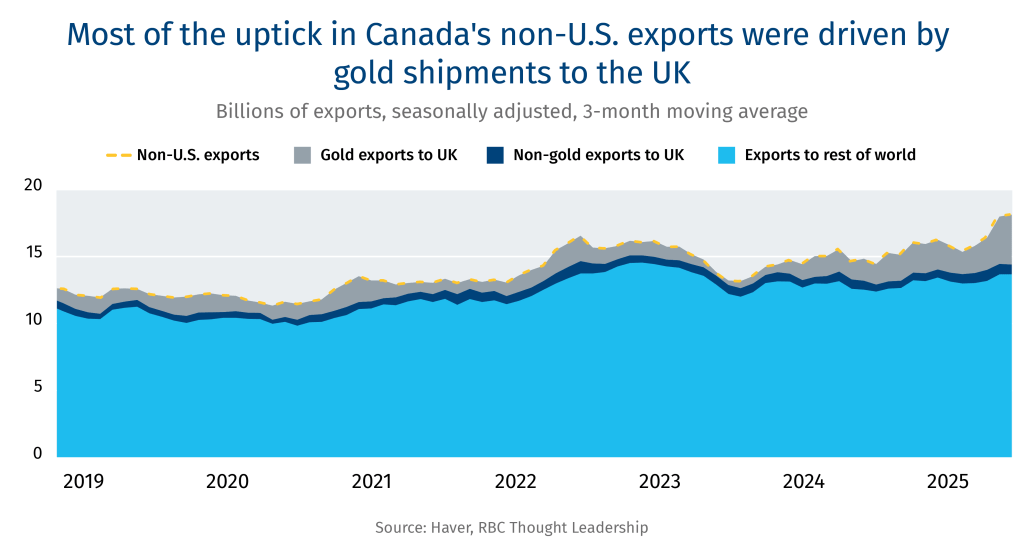
Despite Canada’s growing ambition to widen its pool of trading partners, the latest trade data indicates that diversification is challenging. Exports to countries other than to the U.S. were largely flat in the second quarter–the slight uptick in non-U.S. exports was primarily due to higher gold shipments to the U.K., which more than doubled in value compared to last year because of higher prices.


Nathan Janzen, Assistant Chief Economist with RBC Economics, provides some clarity amid all the chaos around trade.

Q: Can you attach a dollar figure on what U.S. tariffs are costing the Canadian economy?
A: Reduced economic growth on both sides of the border, much of that coming from the uncertainty around future trade policy, has frozen business investment decisions. Canada’s retaliatory tariff measures have been significant in some sectors, including increased tariffs on steel imports from countries other than the U.S., and are raising input costs for Canadian businesses.

But on a relative basis, tariffs have raised costs more in the U.S. than in Canada. Tariff revenues collected by the Canadian federal government, paid by Canadian buyers, rose about $2 billion from a year ago from March through May, which was 1.8% of the value of total goods imported over that period. And a significant portion of those revenues collected will be returned to businesses through a remission process. By comparison, U.S. tariff revenue collected, paid by U.S. buyers, increased $48 billion over that same period, and rose to 10% of the value of imports in June. That is the highest average U.S. tariff rate since the 1940s.

Q: How much has CUSMA shielded Canadian exports?
A: Canada’s pre-existing trade agreement with the United States has backstopped duty free access for the bulk of Canadian exports to the United States. About 90% of Canadian exports have continued to access the United States market duty free March through June and Canada has been left with the lowest average effective tariff rate of any major U.S. trading partner, even with the August 1 increase in the tariff rate to 35% on Canadian exports not compliant with CUSMA.

Maintaining that exemption for duty free trade under CUSMA is critical for Canadian exporters, but is also critical for Canada’s trade partners in the U.S.—Canada was the top export destination for 32 U.S. states last year, and the top import source for 22. The CUSMA agreement does not automatically expire until 2036, but critical negotiations to extend the agreement begin next year.

Q: Canada and Mexico agreed this week to collaborate more closely on trade. What opportunities do you see?
A: More Canadian trade diversification is great—that includes offshore opportunities but also increased trade with Mexico and between Canadian provinces. International trade in services has also been a growing share of both Canadian and global trade, and it is easier to diversify trade in something like professional services where geographic distance is less of a barrier.

But a huge share of trade flows in North America are in the heavily integrated manufacturing sector—and decades of free integration of Canada/U.S./Mexico supply chains means that the sector doesn’t really work without any one participant. U.S. tariffs on products like steel, aluminum, and copper raise input costs and reduce the competitiveness of that integrated North American manufacturing ecosystem relative to offshore production chains in Europe and Asia. It’s not possible to diversify that kind of trade in the short tern without significant, negative economic disruptions on both sides of the border.

US$12 billion

How much the trade war is said to have cost automakers—so far.


By Jordan Brennan, Head of Thought Leadership

The August 1st deadline came and went without a deal. As a result, the ‘fentanyl tariffs’ on Canadian exports to the U.S. are set to rise from 25% to 35%. This is in addition to sector-specific tariffs (referred to as ‘section 232’ tariffs), which include 50% on steel and aluminum, 50% on some copper products and 25% on the non-American content of finished vehicles.

From one perspective, the absence of a deal can be interpreted negatively. The chill on business investment, which is already chronically weak in Canada, will persist until the tariff war reaches some sort of binding resolution.

On the other hand, the absence of an agreement could be a sign that the Canadian negotiating team is bargaining hard. And with the USMCA backstopping the fentanyl tariffs, the effective tariff rate on Canadian exports will be far less than the 35% base rate.

RBC ran the numbers and found that more than 90% of Canadian merchandise exports to the U.S. are USMCA-compliant and therefore enter duty-free. For all the big, scary numbers, our best estimate is that the effective tariff rate on Canadian exports is about 5% but lower in practice. This reflects the skill and savvy of the Canadian negotiating team, in part, who secured the USMCA backstop, but it also points to the fact that American prosperity, especially in the purple states, is dependent on trade with Canada.


Take the auto industry. President Trump secured the White House, in part, because of support from blue-collar workers in the old rust-belt states who historically supported the Democrats but flipped Republican in 2024. The North American auto industry is built on a north-south axis, with supply chains connecting key producing states like Michigan, Indiana and Ohio with Canadian provinces.

There’s scant evidence that the tariff war, including the 232 tariffs on auto, are bringing auto jobs back to American factories. Recent data from the Bureau of Labor Statistics shows that manufacturing employment in general, and motor vehicle and parts manufacturing in particular, is down since Trump came into office. This inter-dependence puts Canada in a stronger negotiating position than we might be led to believe, given Canada’s dependence on trade with our American neighbours.

We will be watching things unfold in the coming weeks and expect that a deal of some sort will be reached. In the meantime, Trump’s negotiating teams struck a flurry of deals with key trading partners over the past 10 days, including the EU, Japan, and South Korea. Amidst the chaos and uncertainty, a pattern is beginning to emerge.

In exchange for preferential tariff rates, America’s trading partners are pledging large investments and purchases in the American market and are providing enhanced market access for American exporters, with select sectoral exemptions and carveouts. The ‘deals’ struck so far, which appear to be frameworks for negotiations, are distributed across three broad categories:

  • Close Allies: With the US-UK Economic and Prosperity Deal, the UK secured the most favourable terms to date, with a baseline tariff of 10%. Exemptions and carveouts mean the effective tariff rate could be lower than 10%. The deal focuses on agriculture, auto, aerospace, pharmaceuticals, with steel and aluminum facing higher rates.   

  • The Trading Core: The EU, Japan and South Korea, which are among America’s largest trading partners, have secured a baseline tariff of 15%, which puts them on an even-footing with one another. Again, exemptions and carveouts mean the effective tariff rate could be lower.

  • Everyone Else: Countries that do not secure preferential rates will be subject to an elevated baseline tariff or ad hoc tariff rate (e.g. 50% tariff on Brazil).

Deal or no deal, Canada faces significant headwinds. A multi-year productivity recession combined with tightened immigration, trade frictions, and elevated macro uncertainty mean there are difficult choices ahead for Canada’s political and business leaders.

  • On top of increasing Canada’s tariff rate right before his August 1 deadline, Trump levelled costly tariffs on a number of countries—including 39% on Switzerland.

  • Mexico gets a 90-day reprieve following a call between Trump and Mexican President Claudia Sheinbaum.

  • Transshipments—goods sent to the U.S. through other countries in an attempt to bypass country-of-origin tariffs—will now get hit with a 40% tariff. Experts say China will be hit hardest by the U.S. cracking down on indirect shipments.  

  • U.S. transport stocks suffer biggest dip since April; Dow Jones Transportation Average fell 7%.  

  • Ford, the second biggest U.S. automaker, says the trade deals with the EU, Japan and South Korea puts it at a serious disadvantage since most of its cars are made in America and it  relies on importing parts. In Q2 alone, Ford says tariffs cost the company US$800 million.

  • Fallout from the U.S.-EU trade deal leads to the worst week for the Euro since 2022.