Also in this edition: Tariff lawsuits ramp up, Canada-India relations are re-energized, and two economic giants strike the “mother of all trade deals.”

On the same day the International Monetary Fund released a report showing that the removal of internal trade barriers in Canada could result in a 7% boost in real GDP, an important discussion took place at the Canadian Club of Toronto.

Two of Canada’s top CEOs—Tracy Robinson of CN Rail and Max Koeune of McCain Foods—joined Sean Strickland of Canada’s Building Trades Unions for a discussion with the Business Council of Canada’s Goldy Hyder, on the big changes that Canada needs to make to infrastructure development, business regulation and immigration.

Here are some bottlenecks we need to fix—quickly:

  • Canada is among the worst in the OECD in days lost to labour disruptions. That means our connective tissue to the world—ports, rail, sea lanes—are MIA when the rest of the world is expecting us to be on time.

  • The TMX oil pipeline expansion took longer to permit than to build. Just one of many agonizing stories about our glacial speed of permitting and other approvals.

  • Despite massive shortages in the skilled trades, our provinces are bringing in paltry numbers through immigration. Who else is going to build all those big projects?

  • It’s easier regulation-wise to export food to the U.S. than between provinces. When will we get to the one economy idea?

What needs to be done?

Robinson said we need to review our approach to labour negotiations to ensure the economy doesn’t get shut down as often as it does, especially in a world when other countries are happy to see that happen.

Strickland pushed for better labour force planning, to ensure we’re recruiting the right people and right numbers for the right needs in our economy. We’ve talked about that for years. It’s solvable.

Koeune called for immigration reforms that would give permanent residency applicants a clearer view of how long it will take, and where their application is at. He called the system a “black box,” which I’ve heard from plenty of other employers in recent months.

We can’t take on the world if we don’t take on our own challenges first.

Elbows up, fine. Heads up, better.

–John Stackhouse

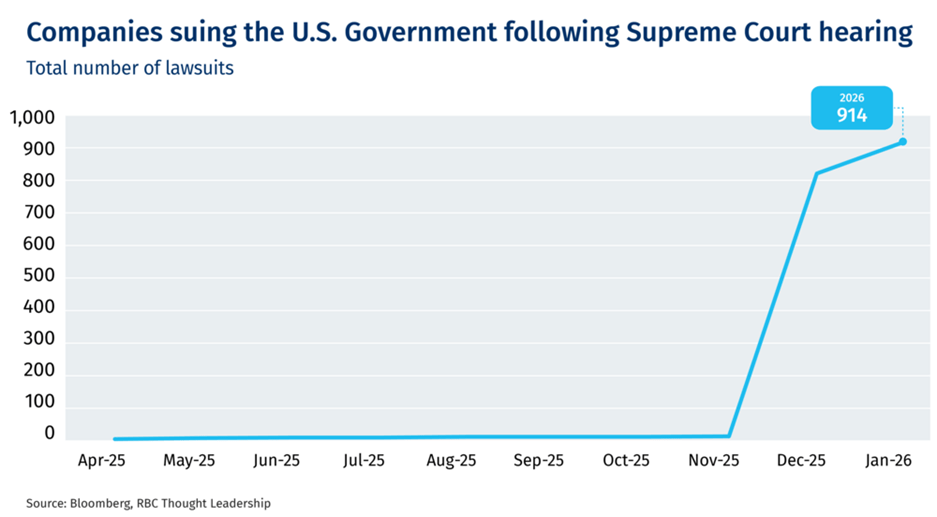
Companies suing the U.S. government following Supreme Court hearing

Since the Supreme Court’s November 5th hearing on the legality of U.S. tariffs, more than 1,000 companies, including Costco, Revlon and Ray-Ban, have sued the Donald Trump administration. The reason? If the highest court in the land strikes down the tariffs (verdict date unknown), the suitors hope to recoup some of the money they allege has been lost due to tariffs.

Record Canadian oil output finds new markets

  • Despite weak global prices, Canada’s oil industry is pumping record volumes and boosting exports to Asian markets, particularly China where sales more than quadrupled last year, as well as India and South Korea.  

  • Though most Canada’s oil exports still go to the U.S., the sector’s resilience, record output driven by expanded pipeline capacity, and growth in Asian markets, is boosting oil majors’ shares and strengthening the country’s economic diversification drive. Expect more calls for additional pipeline capacity, to sustain this trend.

Canada-India pursue apolitical, reliable energy trade

  • As diplomatic relations continue to improve, officials pledged that Canada would supply more crude oil, liquefied natural gas, and liquefied petroleum gas to India, and that more refined petroleum products will be sent the other way.

  • Energy minister Tim Hodgson noted that India represents the fastest-growing source of energy demand while assuring his counterparts “we will never use our energy for coercion.” The relaunch of a “ministerial energy dialogue” between Canada and India promises to facilitate greater reciprocal investment and collaboration in other areas including hydrogen, uranium, biofuels, batter storage, critical minerals, electricity, and AI.   

  • India’s High Commissioner to Canada said Prime Minister Carney will likely visit India in March, and that under his government no longer views Canada as the “younger brother” of the U.S.

India and EU agree “mother of all trade deals”

  • As Washington targets both with steep tariffs, two of the world’s biggest markets have agreed a trade deal that,  once in effect, will eliminate tariffs on more than 90% of goods, marking a new era in economic relations.

  • The two sides made no secret of the fact this breakthrough was catalyzed by U.S. trade policy, to soften the blow of tariffs and increase their economic autonomy. This will result in boosts to India’s export of manufactured goods and give the EU preferential access to a massive, growing market.

  • The EU is already one of India’s largest trading partners, and while India is only the EU’s ninth-trading partner, the EU predicts its exports there to double by 2032. Negotiations over an Investment Protection Agreement are ongoing.

–Thomas Ashcroft

To judge by Davos’s main promenade, globalization is alive and well. Yes, the U.S. took over a church and shop to celebrate America First. But there were far more storefronts promoting Brazil, Indonesia, the Philippines and Nigeria. India wrapped an entire hotel on the promenade, where thousands schlepped every morning from their crash pads to the Congress Centre, and back at night from dinners and nightcaps.

Is this a false spring, just like the mild week in Davos? Or the beginning of what Christine Lagarde called “Plan B” and a more diversified global economy?

The European Central Bank president told the closing session of the World Economic Forum that she “is not on the same page” as Mark Carney’s view of a global rupture—but does see an important diversification of trade underway.

According to the WEF’s own research, close to half of global growth over the next five years (2025-30) will come from Asia, with China accounting for 23% and India another 15%, while the U.S. will produce 11%. Combined, the G7 will account for only 18.5% of growth. 

If it feels like a new age of diversification, one should never forget the gravitational pull of the two economic superpowers, which over the past decade (and longer) have consumed much of the world’s capital and trade. Case in point: China now accounts for about 40% of published studies on drug research, while Europe’s share has dropped from 20% to 12%. Guess where most of the world’s drugs will come from in the 2030s.

With so much in flux, who will dominate the world’s future trade zones? I came away from Davos thinking three forces will help shape the answer:

1. Balance-sheet strength. We may be on the verge of some heavy government (and perhaps private sector) borrowing to underwrite all that’s needed for diversification—from new supply chains to infrastructure. Points to the U.S. for owning the world’s reserve currency, but a range of middle powers—Germany and Canada, among them—can borrow plenty on their own.

2. Artificial Intelligence. It’s sucking up much of the world’s private capital, and will determine a lot of trade outcomes as it (along with robotics) transforms production. Yes, the U.S. and China dominate, but if AI becomes available to all, like the Internet, advantage will go to those with energy to power all those learning algorithms and the entrepreneurial brains to put the results to work. The eight biggest U.S. tech companies have $18 trillion of equity value to leverage—and a lot more domestic energy than China or Europe.

3. Demographics. It’s the sleeper trend, as the West (and Far East) tumble over demographic cliffs. Even in an age of AI, trade still relies on humans to help make and ship things and humans to buy those things. Africa’s population is on course to hit 2.5 billion by 2050, when it will be home to 25% of the world’s working age population. 

Some shrewd advice I heard was for companies to think country, supplier and currency—and have an option for each. Call it a matrix of Plan Bs. Or what Carney termed “variable geometry.” 

It’s the new math.

John Stackhouse

Bank of Canada Q4 survey shows Canadian businesses continue to be negatively impacted by trade tensions, but some are increasing non-U.S. exports

  • 33% of Canadian firms reported they are strongly impacted by U.S. trade policies. A small but increasing share of businesses reported higher sales to non-US markets. Despite weaker sales to U.S. customers, most exporters to the U.S. have not diversified into other markets citing barriers like investment in specialized equipment, compliance with regulatory requirements, and transportation costs.

  • This signals, albeit modestly, that Canadian firms are willing to expand in other markets. However, immediate economic pressures are significantly constraining hiring, investment, and diversification efforts.

Canada agrees to new partnership with Qatar to cooperate on trade, investment, and defence

  • Canada and Qatar agreed to conclude FIPA negotiations, signed an MoU to establish a Joint Economic Committee (JEC), expand air services, and increase defence collaboration (including more exports from Canada’s defence sector).

  • This is the latest in a series of wins, following last week’s agreement with China, for the Canadian government’s diversification efforts. The value of merchandise trade between Canada and Qatar in 2024 was $325 million, leaving lots of room for growth.

European lawmakers delay Mercosur trade pact over legal concerns

  • EU ratification of this agreement, decades in the making, with South American economies has been postponed by lawmakers seeking an opinion from the European Court of Justice.

  • This is the latest hurdle in a protracted process, following pressure from European farmers, which could delay the trade pact by a further two years. However, German Chancellor Friedrich Merz called on the European Commission to provisionally apply the deal, which would create one of the world’s largest free-trade zones, covering over 700 million people, and ~20% of global GDP, in recognition of the current “geopolitical situation.”

 First Chinese order of Canadian canola in months comes following trade mission

  • Prime Minister Mark Carney’s visit to Beijing has led to a Chinese importer buying 60,000 metric tons of Canadian canola, the first cargo order of its kind since China halted imports in October. This comes as China is expected to lower tariffs on Canadian canola to 15%. Canadian agriculture minister Heath MacDonald encouraged Chinese investment in Canada’s agri-food sector this week, highlighting the potential for collaboration in domestic value-added processing and research.

  • Saskatchewan, Canada’s biggest canola-producing province and the province with the highest year-over-year growth in wholesale trade, is especially well positioned to capitalize. Premier Scott Moe (who was on the trip to China) has emphasized the benefits for his province and Canada’s agricultural industry more broadly.   

Thomas Ashcroft

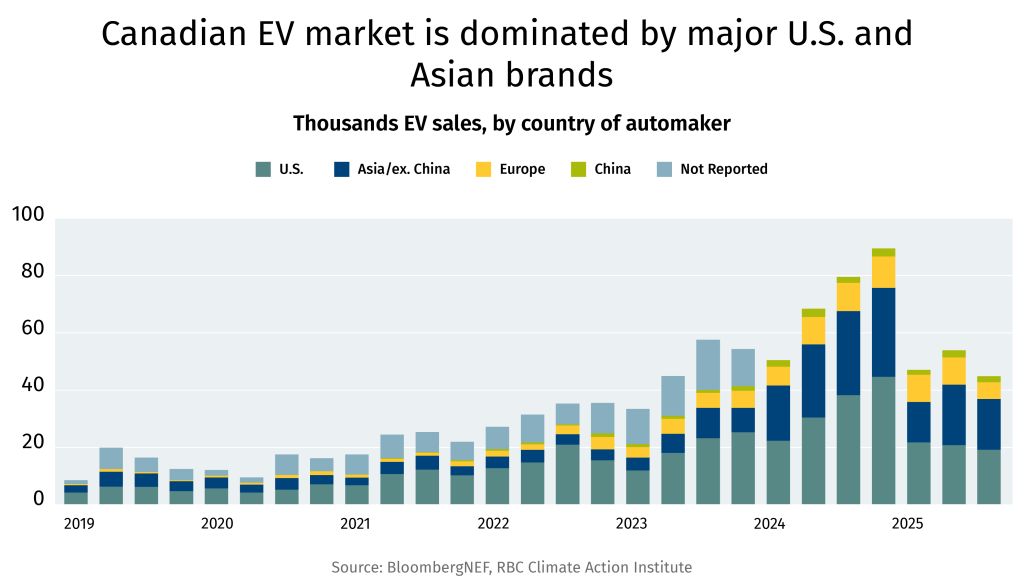
EV sales by country

Canada plans to allow 49,000 made-in-China EVs at much lower tariffs in return for easing levies on Canadian agricultural products. Here is what you need to know about the deal and its implications:

  • About half of the vehicles imported from China are expected to cost less than $35,000 by 2030. Average EV purchase price in Canada in 2024-25 was around $67,000.

  • Canadian EV sales were projected to remain largely flat in 2026 following a 30% decline last year. To size up Chinese imports, 49,000 would represent a quarter of Canada’s annual EV market. Ontario Premier Doug Ford is worried it could impact sales—and jobs—from existing manufacturers.

  • Europe’s strategy could serve as an alternative roadmap for Canada on autos: The continent worked with Chinese carmakers to level the playing field, and set targeted tariffs aimed at offsetting the impact of subsidies. Even with that, however, Chinese brands have captured 10-15% of the EV segment in Europe.

  • The Canada-China thaw comes ahead of critical CUSMA renegotiations that could disrupt the 80% of Canadian exports that enter the U.S. market tariff-free. Could it further complicate U.S.-Canada negotiations?

Farhad Panahov

By John Stackhouse

Tariffs don’t take a holiday and we can assume President Donald Trump won’t either.

Trump used his decorative holiday message to the nation this week to portray himself as a Santa Claus of trade:

  • Tariffs are one of his great achievements, saying it is bringing record investment to the U.S.

  • Tariffs will help pay for the “warrior dividend” to 1.45 million U.S. military personnel.

  • Tariffs are leading to lower prices.

We will see later in 2026 (hello, midterms) if Americans agree. But expect the President to charge into 2026 on a tariff high, even if, as expected, the Supreme Court rules that he’s overstepped his powers. How? The White House can quickly rebuild the tariff wall, using Section 122 and 301 powers that would keep tariffs in place, although the expected rate might drop from the current 16% average to perhaps 10%.

Three questions for the New Year:

  • Will countries look to retaliate, even with non-tariff barriers?

  • Can Congress afford to pass tax cuts and tariff cuts?

  • Can Canada afford to play for time?

Mark Carney seems resigned to the “no deal” scenario, and with it a long slog for CUSMA negotiations. The biggest near-term challenges will be around digital services, lumber and rules of origin for auto manufacturers, each with its own economic and political calculus:

  • expect the U.S. to continue to push for more concessions for online media, particularly for Meta, which could face blowback in Quebec where cultural protections (including subsidies for local media) will be a red line for an expected Parti Quebecois government in 2026;

  • expect the U.S., facing a soft housing market, to continue to hammer B.C. (and New Brunswick) with softwood lumber measures;

  • expect Doug Ford to push hard again for favourable access to the U.S. auto market for Ontario assembly plants. 

Canada is not likely to get all three. Which means Carney may spend the holidays thinking through the coal that Santa has in mind for 2026. 

14257: The Executive Order signed by U.S. President Donald Trump on April 2 that imposed a 10% baseline tariff on imports from all U.S. trading partners.

90: Countries slapped with a tariff rate above the baseline 10% on “Liberation Day.”

2: White House visits by Prime Minister Mark Carney. The most recent was in early October during which Trump called Carney a “good man” who is doing “a great job.”

75 million: Dollars spent by Doug Ford’s Ontario government on an anti-tariff ad campaign featuring Ronald Reagan, which prompted Trump to call off negotiations with Canada. Ford claims the ad clocked 12.4 billion views.

US$35 trillion: Estimated value of global goods trade in 2025. Trade volumes hit record highs even as geopolitics fractured supply chains—proof that globalization is rewiring, not retreating.

50,000: Fewer manufacturing jobs in the U.S. since the start of the year.

US$1 trillion: China’s record trade surplus despite tensions with the U.S. Beijing exported US$3.4 trillion worth of goods in the first 11 months of the year by finding, in part, new markets, including Africa (+26%), Southeast Asia (+14%) and Latin America (+7.1%).

5: The industries that accounted for 80%of tariffs the U.S. collected from Canada, namely auto (28.8%), aluminum (23.3%), iron and steel (12.7%), machinery (8.8%), articles of iron and steel (8.3%).

$70 billion: The United Arab Emirates’ investment pledge for Canada, focused on the development of critical minerals, energy, ports and AI.

US$226.4 billion: U.S. exports to Mexico between January and August—surpassing the US$225.6 billion goods shipped to Canada—marking the first time in 30 years Mexico overtook Canada as a top destinations for exports.

$200 billion: The estimated value of the Canadian Mutual Recognition Agreement, which eliminates all barriers to trading goods (except food) between Canadian provinces and territories.

3x: Increase in global trade-restrictive measures since 2019. Tariffs, export controls, and subsidies are now structural features of trade policy—not temporary shocks.

10%: The amount of lumber exports  (enough to build 75,000 homes) that Canada’s forestry industry is planning to re-route from the U.S. to the U.K. and Europe.

100%: U.S. reliance on imports for 16 critical minerals (including graphite), with more than 50% import dependence for another 29, including zinc, cobalt, and nickel.

$600 billion: Canada’s non-U.S. export goal by 2035, as outlined in the 2025 federal budget–doubling the current amount.

$50 billion: The potential value of a trade partnership between Canada and India, which have renewed relations this year.

$100 billion: The annual value of Canada’s agri-food exports. Roughly 60% was destined for U.S. markets.

$994.63: The amount the average family in Canada can expect to pay more in groceries in 2026, compared to 2025. The toll of tariffs is impacting domestic food security, with one in four Canadians experiencing food insecurity.

86: Percentage of goods the U.S. imported from Canada in September that were duty free.

51: Number of days gold prices closed higher than previous all-time highs due to heightened geo-economic uncertainty.

28%: The increase in coffee prices year-over-year.

19%: Decline in Chinese exports to the U.S. this year.

US$244 billion: Total tariff revenues the U.S. has collected (January to November 2025)

1 million bpd: The potential capacity of a West Coast oil export pipeline at the heart of an MoU between the federal government and Alberta that would expand Alberta’s oil exports to Asia.

US$7 billion: The massive hit Michigan’s Big Three automakers—General Motors, Ford and Stellantis—expect on their earnings in 2025 from U.S. tariffs.

Also in this week’s edition: How five tariff-exposed industries in Canada are faring

By Shaz Merwat, Energy Policy Lead

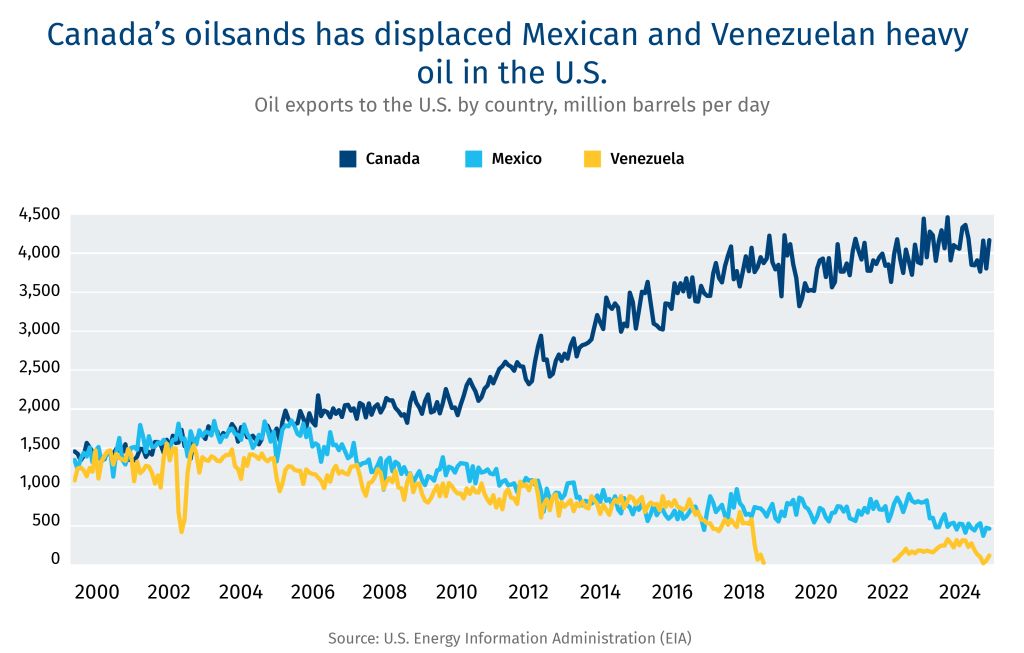
As U.S. President Donald Trump hosted Prime Minister Mark Carney and Mexico’s President Claudia Sheinbaum, energy issues loomed in the background amid U.S. concerns about structural deficits in heavy crude. Historically, Canadian barrels competed with Venezuelan heavy crude in key U.S. refining markets—primarily the U.S. Midwest and the Gulf Coast. While Venezuelan volumes have been largely absent for the past decade, shifting U.S. foreign-policy signals suggest that competition could re-emerge.

Why it matters — Trump cannot unwind two core U.S. dependencies

Despite efforts to reshape U.S. supply chains, Washington remains structurally dependent on two things it cannot easily substitute: Canadian heavy crude and Chinese rare earths. Heavy crude is foundational to U.S. refining capacity, and as it stands, the U.S. cannot easily replace Canadian supply: domestic production is overwhelmingly light, and heavy-crude alternatives from Mexico and Venezuela have structurally declined.

These twin constraints limit U.S. leverage and elevate the importance of stable, long-term supply partners. Alberta’s Memorandum of Understanding (MoU) arrives at a moment when U.S. policymakers must balance geopolitical objectives—such as renewed attention on Venezuela—with the reality that Canadian barrels remain irreplaceable in the refinery system.

By the numbers — the heavy-barrel shortfall

  • Mexico: U.S. bound heavy-crude exports have fallen from as high as ~1.7 mb/d in 2005-2006 to roughly ~0.40 mb/d today.

  • Venezuela: heavy-crude exports to the U.S. surpassed 1.5 mb/d in the early 2000s; today U.S. exports are ~0.1 mb/d.

  • Canada: The dominant exporter to the U.S., with around four million barrels of crude shipped south of the border daily. The Canada-Alberta MoU proposed 1 million bpd pipeline, plus 300,000–400,000 bpd from Trans Mountain together create a sizeable uplift in export capacity—primarily oriented toward Asia.

The bigger picture — if Venezuela returns, does Canada lose leverage?

A Venezuelan “return” would likely be slow, expensive and politically fragile. Refinery contracts, debt obligations and upstream infrastructure all require rebuilding. Even under a regime change, investors will demand decade-long stability before committing capital.

Mexico faces similar limits: Sheinbaum inherits state-owned Pemex’s declining production and mounting debt, meaning a rapid restoration of heavy-crude exports is unlikely.

This leaves Canada as the only credible, scalable source of heavy supply. The MoU’s accelerated timelines—carbon-pricing equivalency, methane rules and Pathways carbon capture, utilization and storage project—signal Ottawa and Edmonton are preparing for sustained output growth.

Bottom line — the MoU prepares Canada for a more competitive heavy-oil landscape

As Canada builds westward capacity through TMX and the proposed 1 million bpd pipeline, more barrels are positioned for Asia rather than the U.S. That shift inevitably forces U.S. policymakers to consider how they will secure heavy-crude supply in the coming decade—including whether to re-engage Venezuela in a more meaningful way.

For Canada, today, this is less of a challenge. The MoU ensures that, regardless of how U.S. policy evolves, producers have diversified market access and greater resilience. If Venezuelan volumes rise, Canada will have optionality; if they do not, Canada remains the primary supplier to U.S. refiners.

Either way, the middle of the next decade is shaping up to be a far more dynamic heavy-oil environment—and the MoU positions Canada to navigate it from a position of strength.

  • Canada entered the trade war in better shape than previously thought. StatsCan revised GDP for each of the past three years up by about half a point.

  • The Canadian government served automaker Stellantis a notice of default for shifting production of the Jeep Compass from Brampton, Ont., to Illinois despite receiving hundreds of millions in incentives in recent years. “Stellantis is on the hook,” said Industry Minister Mélanie Joly. “Defending these jobs means defending Canada’s economic backbone.”

  • While speaking to business leaders in Ottawa, Japan’s Ambassador to Canada Kanji Yamanouchi noted the role energy could play in future Canada-Japan relations. “If we need energy from a county which is difficult to trust or the country which we can trust,” he said, “it’s much better for us to have trade with a country with trust.”

  • Despite $500 million in government loans, Algoma Steel is laying off 1,050 workers from its plant in Sault Ste. Marie, Ont., in the face of “extraordinary and external market forces.”

The RBC Economics team did a deep dive this week: ‘Tracking the impact of U.S. tariffs on five targeted Canadian industries.’

Overall, we track moderately lower manufacturing production and employment in most of the highly tariffed sectors in Canada. These trends have also been much less volatile than international trade flow, that were heavily distorted around when tariffs were implemented (as U.S. importers front-ran purchases to build pre-tariff inventories in Q1.)

Selling prices among Canadian manufacturers have generally held up, with foreign buyers paying the bulk of initial tariff costs, but have led to declining U.S. corporate profits this year. We haven’t seen systemically higher U.S. consumer prices but still expect those will show up more significantly in 2026.

Here’s a breakdown of how five key Canadian industries have fared in their production, employment and selling prices, amid rising U.S. tariffs.

Read the full report here.

In a recent episode of DisruptorsJohn Stackhouse takes listeners to Quebec to meet former premier Jean Charest and Eric Desaulniers, founder & CEO of Nouveau Monde Graphite. Together, they explore how a new graphite mine at Matawinie and an integrated refining plant at Bécancour aim to connect the full chain from rock to anode material in one province—and what that could mean for Canada’s role as a trusted supplier of critical minerals to its G7 allies.

From China’s dominance in graphite refining to Quebec’s push for all‑electric mining fleets powered by hydro, this episode looks at how Canada can move from “quarry” to strategic partner in a re‑wired global economy.

By John Stackhouse

The much-pilloried Canada-U.S.-Mexico trade agreement was signed seven years ago this weekend—on November 30, 2018. A year later, it was amended to address rules of origin for autos, digital trade, IP, dairy and, who could forget, a sunset clause. 

We can all do the math. The December 10, 2019 amendments set in motion a 16-year term for the agreement, with a mandatory review every six years. Which means we’ll see more of a requiem than a birthday bash next week when Mark Carney is in Washington to help kick off the 2026 FIFA World Cup. 

But don’t bury CUSMA just yet.

Despite the U.S. President’s freeze on negotiations, officials from both countries are talking every day and laying the groundwork for what will be an intense 2026. Not many insiders seriously expect CUSMA to go away; they’re working on changes—modifications, enhancements, renovations, depending on your point of view—that will continue to change the fabric of continental commerce.

Here’s what’s worth noting about CUSMA and its first five years (as it didn’t come into effect until 2020):

  • Canada-U.S. trade in goods is up about 23%;

  • Canada remains the U.S.’s top customer, buying US$440 billion of goods and services in 2024, or 14% of America’s exports;

  • U.S. direct investment in Canada hit $684 billion last year, up from about $400 billion; 

  • Canadian direct investment in the U.S. has doubled to $1.3 trillion;

  • between 2020-2024, automakers announced nearly US$175 billion in new investment in North American production, as they reshored supply chains to meet those rules of origin.

  • Canada-U.S. energy and agri-food trade has also surged in the 2020s, thanks in part to the certainty delivered by CUSMA. Energy is our biggest export to the U.S. — by far — worth $170 billion in 2024, up 50% from 2018.  

That energy number may be the biggest message Carney takes to Washington. Not by coincidence, he locked arms this week with Alberta Premier Danielle Smith to state boldly to Canadians, and the world, that the country will be exporting a lot more oil to Asia. The U.S. government, and many U.S. shippers, would prefer that crude flow south. But now Carney, with Smith’s help, can exert more leverage in his Washington trade talks.

Canada always tried to keep energy (and water) off the main trade table, which is focussed more on manufacturing. But in this new age of energy security, it may be what Canada needs more than ever to bend the ball like Beckham.

  • Canada will slap 25% tariffs on about $10 billion worth of steel imports starting December 26, to support a domestic industry that has been battered by U.S. tariffs and cheap Chinese steel.

  • Canada Inc. is shrugging off tariffs. Operating profits of Canadian corporations rose 3.8% (the fastest pace of growth in two years) to $200 billion in the third quarter, according to Statistics Canada.

  • The U.S. will export a record 10.7 million tonnes (+40% YoY) of liquefied natural gas (LNG) in November, which is expected to drive down the price of gas in Asia and Europe over the winter.

  • Though relations remain chilly, Mark Carney confirmed that he spoke to Donald Trump this week—but he wouldn’t say if they talked trade. “I don’t want to over signal things…they haven’t re-engaged yet,” said Canada’s PM, who will be in Washington next week for a World Cup event alongside the U.S. President.

  • India is looking to both ramp up trade with Mexico and be spared the tariffs that President Claudia Sheinbaum plans to levy on a number of Asian countries.

In this week’s edition: The opportunities for Canada in Latin America and how Canadian exports of pulses provide valuable lessons when it comes to trade diversification

By John Stackhouse

Canada’s trade diversification menu seems to consist of East Asia and Western Europe, with a side dish of Middle Eastern and South Asian economies.

What happened to Latin America?

Sure, the prime minister and his senior team are all over Mexico — largely though as part of their North American trade strategy. The much bigger economic hemisphere south of the Rio Grande still beckons.

This week, the Canadian Council for the Americas published a significant policy paper on how Canada can position itself for the decade ahead in South America, Central America and the Caribbean. 

The region’s GDP is roughly $6 trillion, more than double Canada’s and more than double what it was 20 years ago. And yet Canadian exports in 2024 were a modest $18.6 billion, down nearly 11% that year as agri-food shipments got hammered by trade disruptions. 

Looking ahead, there are dozens of markets to consider, but just focussing on the Big Five—Brazil, Mexico, Chile, Colombia, Peru—would access a combined population of nearly 500 million people, half of them middle class.

We’ve spent the past 25 years negotiating and announcing Free Trade Agreements in Latin America. Most did much less than was promised. One illustration: we have $24 billion of investment in Chile, and less than $1 billion in exports. Now we need to be more strategic.

The CCA report suggests:

  • develop consortium approaches to infrastructure, to help fill the region’s $150 billion infrastructure gap

  • focus on energy (LNG), machinery, pipelines, digital systems, and mining technology

  • target machinery and equipment (buses, tunnelling equipment) for megaprojects

  • develop critical minerals partnerships, including processing

  • get more sophisticated with labour mobility, as we’ll need a lot more students, skilled workers, professionals and entrepreneurs from the region

  • step up as a security partner, helping with defence and security tech, including in space

An age of America First doesn’t need to mean Americas Last.

Check out the full report here.

  • Mark Carney wrapped up his visit to Abu Dhabi by announcing a $70-billion investment from the United Arab Emirates–the money is expected to go towards the development of critical minerals, energy, ports and AI.

  • U.S. Ambassador to Canada linked purchase of F-35s to trade talks. Pete Hoekstra said that Canada needs to “harmonize” with the U.S. on some key economic and military issues to get back to the negotiating table. He specifically referenced the federal government’s F-35 fighter jet review.

  • The U.S. exported more to Mexico than Canada for the first time in 30 years. New trade data showed that US$226.4 billion of American goods went to Mexico between January and August this year, compared to the US$225.6 billion worth that crossed into Canada. While the ongoing trade tensions between Canada and the U.S. is one factor, the gap has been narrowing for years.

  • The Canadian Mutual Recognition Agreement, which eliminates all barriers to trading goods (except food) between provinces and territories, was signed this week and takes effect in December. The government estimates that it could drive $200 billion worth of value.

  • The European Union is looking to Australia and considering a similar strategy to the one the U.S. has taken when it comes to critical minerals and rare earths: invest directly in the mining companies.

Services now make up nearly a quarter of Canada’s exports and have delivered 62% of total real exports growth since 2014. Services trade hold a key to diversification—they are less exposed to tariffs, more resilient to economic downturns, and are already more diversified with exports almost 50/50 split between U.S. and non-U.S. markets, compared to goods exports, 75% of which flow south of the border. (Read RBC Economics full report here).

By Lisa Ashton, Director of Agricultural Policy

Pulses, of which Canada is the number one exporter globally, is a powerful example of how Canada can deliver on its ambitions to diversify its trading partners beyond the U.S. It’s all about building the right trading relationships and investing in logistics and food-standard alignment where markets are growing.

Why it matters:

  • The 2025 federal budget outlines a plan to grow Canada’s trade with the world, including a goal to double Canada’s non-U.S. goods exports to $600 billion by 2035.

  • Specific to agri-food, the Canadian Food Inspection Agency (CFIA) is receiving funding to modernize it trade tools and work with trading partners to expand market access for Canadian agri-food products.

  • Diversification is easier said than done. The U.S. accounted for over 60% of Canada agri-food export value in 2024, making Canada the least diverse when it comes to trading partners among top agri-food exporters.

  • But Canada’s agri-food sector is staking its claim as a global leader in pulses. These pulses are destined for markets far beyond the U.S.

By the numbers:

  • Canadian pulses account for roughly 24% of global trade. For dried lentil and peas, Canada’s top markets include countries in South Asia and West Asia including India, Turkey, and the UAE as well as South America, including Columbia and Peru. Canada’s dried peas and lentils, examples of Canada’s pulses boom, export value in 2024 was nearly $4 billion.

  • The EU and Indo-Pacific are expected to increase annual consumption by 11% and 14%, respectively, over the next decade, providing growing market opportunities in Canada’s target markets identified in Budget 2025. 

  • To meet global demand, Canada’s pea and lentil production volumes have increased by roughly 73% and 393%, respectively, over the past 25 years. Pulses are an important crop in a farmers’ rotation, fixing nitrogen in soils, reducing the need for fertilizer application.

The bigger picture:

  • Global pulse consumption is expected to rise by 15% over the next decade.

  • Global production is led by Asia and Africa with annual growth in product at roughly 3%. India is the single largest producer accounting for 29% of global production with most of their production being used for domestic consumption. 

  • China is the largest importer of pulses, accounting for about 13% of global trade.

  • The U.S., Turkey and Ukraine follow Canada in exports of dried peas. But Canada, maintains a strong lead, exporting volumes that are 5 times that of the U.S.

Bottomline:

Canada’s approach to diversifying goods exports to non-U.S. markets can learn from the Canadian pulse experience of expanded domestic production, efficiently navigating international trade logistics, and diversification in growth markets where demand is expected to continue to rise. 

References: OECD-FAO: OECD-FAO Agricultural Outlook, 2025; OECD. OECD Agriculture statistics (database), 2025; UN COMTRADE. Trade Data, 2025.

In this week’s edition: North America’s Critical Minerals Moment — and Canada’s Strategic Role

By John Stackhouse

A few years ago, Saudi Arabia and Canada were barely on speaking terms. Now they’re exploring trade deals, investment opportunities and, if plans come together, a visit to the Kingdom next year by Mark Carney.

In the Age of Trump, they’re among a host of mid-sized powers that are looking to carve out a new economic and geopolitical path.

Here’s what could redefine the Saudi-Canadian relationship: energy, including renewables, nuclear and EVs; advanced manufacturing, including drones and satellites; AI and quantum; mining and critical minerals; and advanced education and health care. The two countries also have a lot of capital to deploy, and a lot of capital that they need.

The rapidly evolving relationship was on display earlier this month when Saudi Investment Minister Khalid Al-Falih spent a day in Ottawa, with Carney and a range of senior ministers, and then a day on Bay Street. Less noticed but also important was Alberta Premier. Danielle Smith’s visit to the region, including Saudi Arabia, to promote energy technology and investment.

Here’s some of what may be worth watching in the coming months:

  • Carney’s pitch for $1 trillion+ in new investment (most of it private capital) will need to include sources like Saudi investment funds and corporates;

  • Saudi’s ambitions to diversify its energy sector—Al-Falih mentioned green and blue hydrogen, green ammonia and EVs—could use a lot more Canadian technology, talent and investment. The visiting Saudis met with Ontario autoparts makers, hoping they might want to be part of the Saudi ambition to make 600,000 EVs a year;

  • Canadian manufacturers and producers, especially in agri-food, can be leading players in Saudi’s ambition to be a food hub for the Middle East and North Africa.

  • Ottawa is hoping to restart trade talks with India under a “new process,” said Canadian Trade Minister Maninder Sidhu. On a three-day visit to India, the Minister discussed critical minerals, clean energy, agriculture and artificial intelligence.

  • In an effort to lower grocery bills, U.S. President Donald Trump is working lower tariffs on items like coffee and bananas into deals with a handful of Latin American countries. 

  • The price of pasta from Italy, however, could skyrocket for Americans come January when the proposed 107% tariff on goods from 13 Italian companies is scheduled to begin.

  • Canada’s forestry industry is planning to re-route about 10% of wood (enough to build 75,000 homes) that would normally go to the U.S. to the UK and Europe.

  • Amazon and Microsoft threw their support behind the Gain AI Act, legislation that would require chip makers to satisfy U.S. demand before exporting to other countries, including China. Nvidia, which has been seeking access to the world’s second largest economy, view the act as an unnecessary intervention.

By Shaz Merwat, Director of Energy Policy

A recent submission to U.S. Trade Representative Jamieson Greer from the Coalition for North American Trade (CNAT)—co-chaired by former U.S. House Ways and Means Chairman Kevin Brady, Canada’s former NAFTA lead negotiator Steve Verheul, and Mexico’s Ken Ramos—positions CUSMA as one of the continent’s most powerful tools for rebuilding critical-minerals security.

Key details from the filing:

  • The U.S. remains 100 percent import-reliant for 16 critical minerals (including graphite) and over 50 percent reliant for another 29 such as rare earths, zinc, cobalt, and nickel.

  • Canada is the U.S.’s primary import source for indium, nickel, potash, tellurium, uranium, vanadium, and zinc—and the second largest for copper, graphite, niobium, and tungsten.

The CNAT submission argues the CUSMA’s tariff-free architecture and co-production model are the ideal platform to accelerate re- and near-shoring of critical-minerals supply chains—from exploration and permitting to processing, refining, and battery-grade materials. Integrating Canada’s resource base with U.S. manufacturing strength and Mexico’s processing capacity fills a gap in critical-minerals collaboration to date, with most of the focus on G7+ allies.

For Canada, the strategic opening lies in deepening trilateral integration—leveraging CUSMA to attract investment, expand value-added processing, and align upstream resources with the broader North American production system to build a fully regional critical-minerals platform.

By Shaz Merwat, Director, Energy Policy

Ottawa’s trade diversification push, laid out in part in the Federal Budget this week, could redraw North America’s energy map—and test its most important economic relationship.

Why it matters

  • The 2025 federal budget sets an explicit goal: double Canada’s non-U.S. goods exports to about $600 billion by 2035.

  • Mark Carney’s ASEAN tour last week reinforced that ambition, courting Asian partners and positioning Canada’s growth story squarely in the East.

  • Together, these moves turn oil and growing LNG exports into instruments of economic diversification and strengthening multilateralism within trade.

  • A removal of the oil and gas emissions cap opens the door to greater oil exports to Asia.

By the numbers

  • Roughly 75% of Canada’s exports flow to the United States.

  • In 2024, Canadian energy exports totaled $197 billion, with crude oil alone accounting for $147 billion.

  • About 91% of Canada’s crude exports remained U.S.-bound through the first seven months of 2025. Canada’s remaining crude exports–about 450,000 barrels a day, about 1% of Asian demand–ends up in Asia.

  • Asia’s oil-import demand i.e., India, China, Japan, and South Korea has climbed by more than 25% since 2015 to about 22 mb/d, driven primarily by China and India’s rapid industrial growth.

The bigger picture

  • Heavy crude’s staying power: Electrification is largely displacing gasoline – a light barrel – but not diesel, jet fuel or petrochemical feedstocks. That longevity gives heavy barrels strategic value.

  • Asia’s heavy-oil hub: China is sharply pivoting into petrochemicals, aiming to take Japanese and Korean market share. India, too, is expected to see oil imports grow 1.5 million bpd by 2035 as both countries seek steady supplies of heavy and sour crude. Today, that supply originates from the Middle East, Russia and Venezuela, creating an opening for a stable, Western entrant.

  • Investment and offtake matter: Canada’s oil expansion will come from oil sands growth. Long-term commitments–both investment and offtake – will be essential to anchor any future West Coast capacity. With CNOOC, Sinopec and PetroChina already in Canada, and better ties with India envisioned, how would renewed Asian capital be welcomed in Ottawa…and Washington?

  • Carbon and shipping constraints: Industrial carbon pricing, expectations for progress on progression on the Pathways carbon capture and storage project, a federal Tanker Ban and tighter International Maritime Organization (IMO) shipping regulations all hang in the balance, unanswered.

Bottom line

Canada’s bid to expand exports through a multilateral trade system could sit awkwardly beside Washington’s more bilateral instincts. For decades, U.S. policy has treated Canadian energy as a secure extension of its own supply chain. As Ottawa builds eastward links and asserts greater agency in global oil markets, it’s not only testing the flexibility of the North American partnership—it’s testing whether America will allow that independence to take shape.

  • The Liberal government’s federal budget earmarked billions of dollars in funding in response to the Trump Administration’s tariffs.

    • As part of the shift from “reliance to resilience,” the budget pledged $5 billion over seven years to create the Trade Diversification Corridors Fund.

    • And an additional billion dollars for an Arctic Infrastructure Fund with a stated goal, in part, of linking the Canada’s North to global markets.

    • The introduction of a $2 billion critical minerals sovereign fund, that would make equity investments, loan guarantees and offtake agreements with mining companies.

  • The Supreme Court case pertaining to President Trump’s use of the International Emergency Economic Powers Act to impose tariffs, including the fentanyl tariffs on Canada, kicked off. Even members on the bench from the conservative majority questioned the U.S. President unilaterally setting tariffs on imports. A decision is likely months away.

  • By approving measures to protect farmers, the European Union moved a step closer to the Mercosur trade deal, a massive agreement with South American nations that’s been a quarter century in the making.

  • Despite pressure from U.S. tariffs, Ontario projected a smaller deficit than expected in its fiscal update. The economic statement also promised a balancing of the books in 2027-28.

  • The U.S. Department of the Interior added silver and copper to its list of critical minerals paving the way for both to be included in future tariff policies.

“The U.S. footprint in global trade will be smaller. The world needs to adjust to that. It will be a bigger adjustment for us.”
Bank of Canada Governor Tiff Macklem, speaking at The Logic’s Summit this week.

In this week’s edition: Lots of trade talk on the sidelines of the Asia Pacific Economic Cooperation summit and a generational investment in Canada’s competitiveness

By John Stackhouse

This week’s federal budget will aim to reorient Canada’s economy for a new global economic order, and that goes well beyond Donald Trump. 

The Canadian economy has been out of step with global trading and investment patterns for some time. Trump just shone a light on it. 

Consider trade itself. Global trade as a percentage of GDP reached a post-war peak of about 60%, coinciding with the Global Financial Crisis (itself an outcome of trade and investment imbalances). It’s since dropped to the mid-50s, and will likely come down a touch this year and next as the global economy slows. 

This doesn’t mean an end to globalization. It does indicate a re-globalization that—cue the budget signals—will lead to significant capital shifts. And they will be perhaps more significant than anything we’ve seen in 25 years, since China entered the WTO and became the new magnetic pole for global capital. 

This time, capital won’t flow to the lowest cost, mass producer. It will find the sources of strategic goods and resources, which would play well to the new Canadian pitch. Especially for energy, minerals, defence, space and food. 

Those strategic exports will be especially valuable to some of Canada’s key trading partners like South Korea and Germany, as they seek to reduce reliance on the U.S. and China. Moreover, big exporters like the Koreans and Germans will need more secure energy supplies if they’re going to be ready for a world of more modest trade in manufactured goods. 

I spoke about this new energy security paradigm last week at an IEA energy innovation forum, on the sidelines of the G7 energy ministers meeting in Toronto. You can read the full text here.

  • Prime Minister Mark Carney’s meeting with China’s President Xi Jinping this past Friday didn’t yield any major results but it was the first formal meeting between a Canadian Prime Minister and the Chinese President since 2017. Carney, who described it as a “turning point” for the two countries, also accepted XI’s invitation to visit China.   

  • Wanting more info on the state of Canada-U.S. relations, several Canadian Premiers are calling on Carney to host a First Ministers’ meeting. The last time the PM met with the premiers was August 6. 

  • A couple of days after U.S. President Donald Trump vowed he wouldn’t talk with Carney for some time, the two were placed directly across from one another during an eight-person dinner hosted by South Korea’s President. The PMO wouldn’t confirm if trade talk was on the menu but did say the World Series was a topic of conversation.

  • On Friday, Trump doubled down on his promise to not engage Canada in trade talks; which differed from the message sent from his Energy Secretary Chris Wright, who, while at the G7 Energy and Environment Ministers’ meeting, said the goal is for the two countries to get back to the table and cooperate more closely on oil, gas and critical minerals.

  • While it didn’t lead to a finalized trade deal, the meeting between Donald Trump and China’s Xi Jinping resulted in agreements on a few key items–including export controls on rare earths and chips.

  • The truce came on same day China’s factory activity numbers revealed its longest decline in nine years.

Canada’s prosperity depends heavily on how efficiently it can move goods to market—yet its largest ports have fallen behind the world’s best.

In the latest episode of Disruptors: The Canada Project, John Stackhouse spoke with Devan Fitch, Program Manager of the Roberts Bank Terminal 2. The long-planned project, at the mouth of Fraser River Delta, represents a generational investment in Canada’s competitiveness.

Here’s an excerpt from this week’s episode:

JS: Most Canadians probably take the Port of Vancouver for granted, even though if you look around, at least some of the stuff in your life passed through this port. Give us a sense, Devin, of the magnitude of the Port of Vancouver and what it means to the Canadian economy.

DF: If you take out of the equation all of the trade that we do with the U.S. and you think about the trade that we do with the rest of the world, $1 in every $3 of trade passes through the Port of Vancouver. That’s supporting businesses right across Canada. Consumers right across Canada. We happen to be located in Vancouver, but we are very much Canada’s port.

JS: As I understand it, the Port of Vancouver is the size, nearly, of the next five biggest ports in the country.

DF: That’s correct.

JS: And Roberts Bank will enable it to grow by another 30%. Is that correct?

DF: Yeah, somewhere between 20 and 30%.

JS: What does 30% bigger actually mean?

DF: In one fell swoop, it will increase capacity on the west coast of Canada by approximately one third. It will add 135 hectares of new waterfront trade enabling industrial land in one of the most industrial land constrained regions of North America. To give you a sense of scale of T2 – 12-million cubic metres of sand and 4-million cubic meters of manufactured rock. On the sand side, that’s about 2,500 Olympic sized swimming pools.

JS: Sounds enormous, but how does it compare to the world’s mega ports?

DF: It’s big for Canada. It is modest in size and scale compared to some of the largest ports around the world in Asia and Europe. But certainly a step function increase for Canada. It will provide capacity to move a $100 billion worth of trade goods every single year and support over 17,000 supply chain jobs across the nation.

JS: Give us a sense of how the port business is transforming and what opportunities there may be for Canada to move up in the competition leagues.

DF: Right now the world’s biggest container ships are about 24,000 twenty-foot equivalent units (TEUs). They’re applying their trade from Asia to Europe, and we see shipping lines cascading those large ships onto the North American routes as they age. We’re expecting as we move forward to see a significant increase in the size of ships, calling at the Port of Vancouver. Right now the average size is around 10,000 TEUs and we’re building Roberts Bank Terminal 2 to futureproof it to be able to accommodate ships as large as 24,000 TEUs.

Listen to the full episode here.


In this special season of Disruptors: The Canada Project, we’re crisscrossing the country and speaking to visionary leaders who are harnessing technology to take on Canada’s most-urgent challenges. Listen and subscribe wherever you get your podcasts.

In this edition: AI investments are partially masking the impact of the trade war on global growth – but Canada is missing out

By Jordan Brennan, Head of RBC Thought Leadership

The U.S.-Canada auto story just took another hit – or two.

On the tails of the Stellantis decision to move production of its Jeep Compass from Brampton to Illinois, this past week’s news is compounding:

  • General Motors announced it will end production of its BrightDrop electric delivery vans at the CAMI plant in Ingersoll, affecting 1,000+ jobs.

  • Paccar is laying off 300 workers at its plant in Sainte-Thérèse, Quebec ahead of U.S. heavy-truck tariffs.

What’s going on? You could interpret these shifts as proof that Trump’s “re-patriation” strategy is working. But dig deeper: both plants were already facing weakness. CAMI had encountered soft demand for BrightDrop vans; Paccar is turbo-exposed to U.S. heavy-truck demand and tariff risk. Brampton had a litany of problems over the years, including softening EV sales.

Where does this leave Canada? Our auto industry sits between two storms:

  • China is going all in on EVs—nearly half of all new car sales last year were electric.

  • The U.S. and EU EV market are stalling or retrenching—EV penetration in Europe fell to ~21% in 2024 from ~22% the year before.

  • The U.S. sits at just 10%. And that was before Trump’s One Big Beautiful bill shredded EV incentives.

This makes Prime Minister Mark Carney’s pending climate strategy even more consequential. Canada has three broad options:

  • Align with the U.S.: back off EVs and count on gas guzzlers to propel the industry forward.

  • Follow China: invest aggressively in next-gen batteries and hope EVs are the future.

  • Carve a middle path: incentivize hybrid adoption while infrastructure and consumer preferences catch up.

  • A 60-second ad, sponsored by the Ontario government and featuring former U.S. President Ronald Reagan disparaging the use of tariffs, prompted President Donald Trump to immediately cancel all trade talks with Canada. Premier Doug Ford’s government agreed to take the campaign off the air on Monday. But saying it wasn’t quick enough, Trump threatened an additional 10% tariff hike on Canadian goods.

  • Over the next 10 years, Prime Minister Mark Carney wants to double Canada’s exports to markets outside the U.S., boosting trade by $300 billion.

  • India invited Carney to New Delhi to meet with Prime Minister Narendra Modi. According to India’s new High Commissioner, a comprehensive free trade partnership between the two countries could result in $50-billion worth of trade annually, about double last year’s total.

  • An import ban on liquefied natural gas from Russia is part of a new package of sanctions agreed upon by the European Union countries..

  • President Trump will meet with his Chinese counterpart Xi Jinping next Thursday during the Asia-Pacific Economic Cooperation summit. This will mark the first meeting of the two since the U.S. President’s re-election.

By Farhad Panahov, Economist

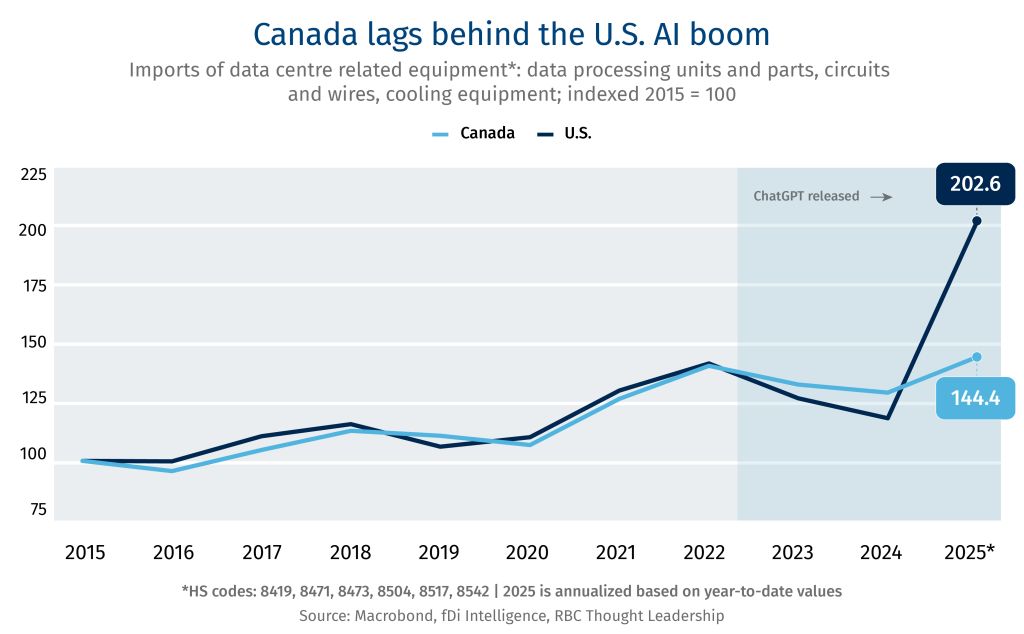
AI-related investments may have masked the impact of the U.S. trade war on global growth so far, the IMF notes in the latest World Economic Outlook. Since the release of ChatGPT in late 2022, U.S. firms have quadrupled data-centre construction spending to nearly US$40 billion. There are now 5,000 data centres dotted across the U.S. Imports of data centre related equipment is up 50% over the same period. Taiwan accounted for half of the growth when it comes to U.S. imports of digital processing units. Canada, as the chart below indicates, has remained on the sidelines of the AI boom despite a growing number of data centre applications. Demand for related equipment has shown only a small uptick in recent years.

By Lisa Ashton, Director of Agriculture Policy

Canada’s agriculture equipment manufacturing industry is caught up in the U.S. tariff blitz.

The industry, which generates $7 billion in annual revenues (more than double from a decade ago), plays a critical role in North America’s food production, providing farmers with the equipment to plant seeds, harvest crops, feed animals, milk cows, and operate an efficient farm business.1

The U.S. market dominates exports, accounting for 82% in 2024, which has so far remained unchanged in 2025.2 But there’s a shift under way. The tariffs have benefitted the domestic industry in some cases by raising domestic demand of Canadian-made products and reducing some input prices, including Canadian steel.3 But the industry is also facing risks of rising costs to produce equipment that has parts from both sides of the border. Manufacturers are wadding through compliance complexity, with U.S. tariffs on some parts such as tractor brakes and Canada’s counter tariffs on parts such as tractor tires.4 For farmers, this means potentially higher input costs for new equipment and parts to repair their existing equipment—forcing decisions on investments that impact agricultural productivity. The shifts come as the industry has already seen a growing trade deficit since 2020, more than doubling in size in 2024.5

Manufacturers are setting their eyes on new growth markets, while maintaining relationships with their U.S. customers and supply chain. A renewed commitment in 2025 to the Canada and Mercosur free trade agreement negotiations offers promise for Canadian agricultural manufacturers to expand their presence in Argentina, Bolivia, Brazil, Paraguay and Uruguay, where agriculture production is expanding, and on-farm mechanization is exponentially improving.