WP Menu

wp-menu

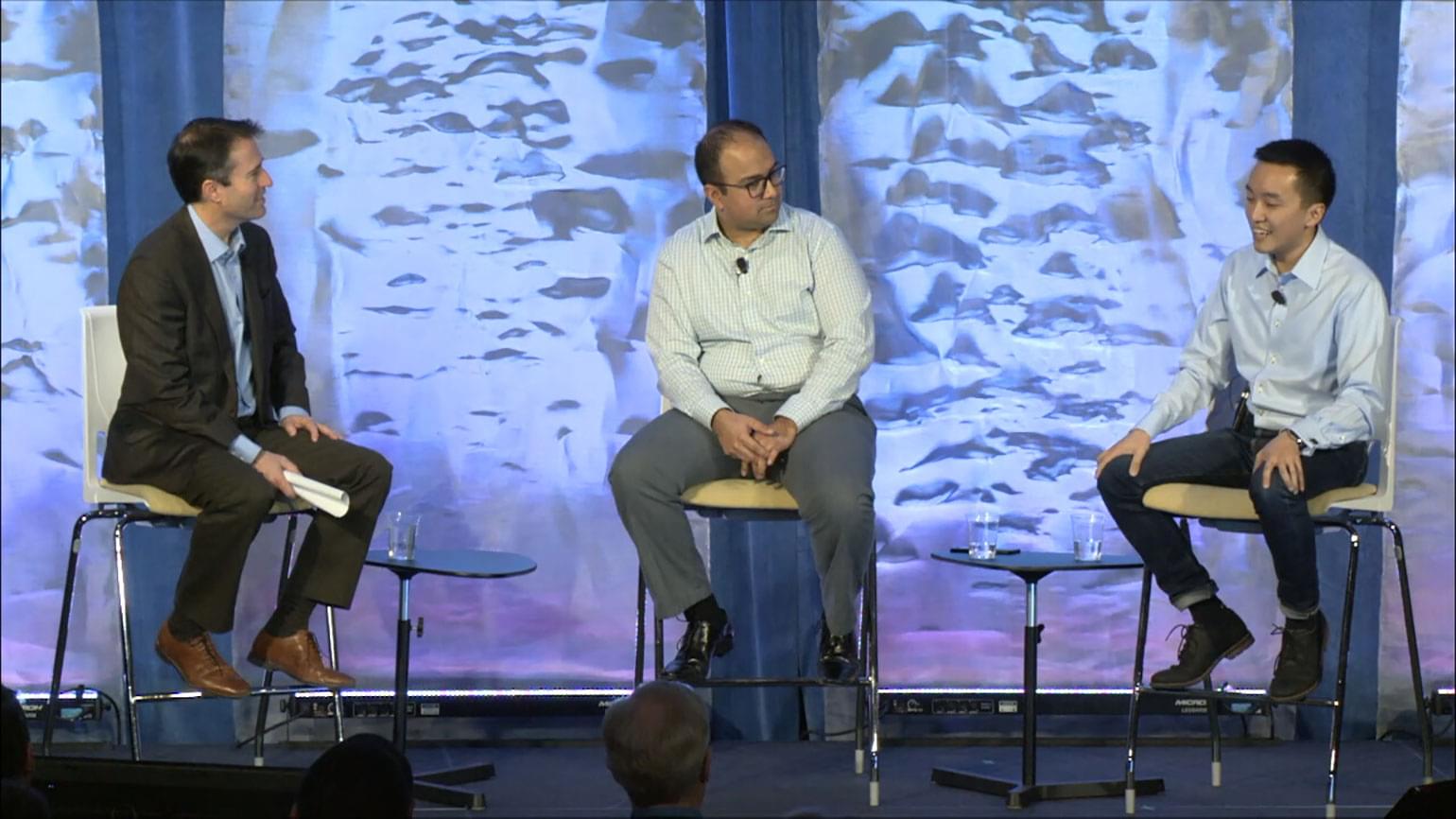
The latest RBCDisruptors looked at the state of entrepreneurship, how companies big and small can be more entrepreneurial, and how leading corporates can work better with startups.

Our guests were Hubdoc co-founder Jamie Shulman, Goldmoney Network founder Darrell MacMullin , and Laura Buhler, executive director of the C100, a non-profit group linking entrepreneurs in Silicon Valley and Canada. Here’s some of what they had to say:

1. Hire for Curiosity

Shulman built Hubdoc’s recruiting after taking stock of the characteristics of its most successful employees and looking for a common denominator.

“The one that popped up that we weren’t necessarily expecting was curiosity, being interesting and interested,” he said.

That led them to redesign their process in search of the most curious candidates.

The first round of their recruiting for sales staff is a simple sales call—but the potential employee has to call in and sell the company on their own product. The second round has nothing to do with sales: candidates have to come in and give a presentation about their passion, whether it’s fly fishing or the Dave Matthews Band.

2. Know Your Customer. Really Know Your Customer

The last stage of Hubdoc’s recruiting process focuses on something both Shulman and MacMullin said is key: knowing the customer.

Hubdoc asks new hires at all levels to spend a month doing customer support, to better understand their product and how the company works with customers.

“The biggest thing is they just learn how the customers and prospects are viewing our product, which is very different than how we were staring at it every day,” he said.

MacMullin said customer feedback is one of the most critical data sources for any business—and often the most underused. He gets a report every week about the top issues customers have reported. “We actually have someone that kind of straddles customer service and the product team that actually has a prioritized roadmap directly related to customer solutions.”

3. Be Ruthlessly Transparent

It’s no secret that communication is necessary condition for business success, and MacMullin said entrepreneurs have little room for error. “Most failures come down to misalignment of expectations or breakdown in communications.”

Goldmoney has had around three meetings in the last 12 months, MacMullin said, thanks to its use of the messaging software Slack for the majority of its internal communication. It’s efficient and helps people cut to the chase.

Shulman added, “Transparency often empowers people. People have a better sense of what they’re doing and what’s going on and how they can be a part of that.”

4. Boil Expectations, Not the Ocean

MacMullin said misaligned expectations come down to either timelines or resources, and can happen within a company or in a partnership between a small company and a big one.

“A lot of times, entrepreneurs are thinking, ‘oh I’m going to get a deal done with RBC and we’re going to be up and running and have a million customers in six months.’ Let’s be real here, that’s not going to happen.”

The challenge for hard-driving entrepreneurs, he said, is getting caught up in the final goal and not building the proper platform for success. It’s even more of a challenge when the product itself needs work to move from idea to execution.

“People tend to try and boil the ocean on a bigger project versus trying to figure out what the stages are,” he said.

5. Always Be Building Your Bench

The best organizations have accountable leaders, and the best startups identify and empower those people early on.

“There is a very clear level of accountability, a clear level of communication and a very real sense of urgency against the opportunity,” MacMullin said.

He said he tries to imitate a shared characteristic of all the best companies in any field: they not only seek out the best recruits, but they develop what they already have.

“That’s actually part of their culture is actually investing in their people, investing in their processes,” he said. “They’re always working on how they run meetings, how they get the right questions, how they get the right leaders to mentor the people on their teams.”

6. Time Is Money. Don’t Waste It

Shulman said dealing with slow-moving incumbents can be challenging for entrepreneurs.

“Large organizations often don’t appreciate the real resource constraints of entrepreneurial businesses,” Shulman said.

In one meeting, he said, so many people from a potential client showed up that the first 15 minutes was taken up with introductions.

“A large organization can send many people to several lengthy meetings over and over again, while entrepreneurs can barely sacrifice 30 minutes,” he said.

7. Build Fast, and Know When to Go Slow

MacMullin said that large organizations are great targets for entrepreneurs looking to score their first big client, but they can’t stake everything on a single source. He added that in the early going, many small businesses are still on their way from zero to one.

“Part of the balance is building your own value proposition,” he said. “It’s very difficult for a large company to actually see how they would implement that or justify a use case or meaningful proof of concept when you haven’t been able to do it yourself.”

It’s still important to reach out to established companies, he said, with the end goal of building relationships, rather than a one-time sale.

“We had the same type of thing,” he said, referring to Shulman’s story of the over-populated meeting. “But it wasn’t until we got to a certain stage, and the fact that we already nurtured and built that relationship over time, that was key.”

8. Tell Your Story (No One Else Will)

Buhler said there are lots of great stories of Canadian entrepreneurs changing the world, but the general public just doesn’t always hear about it.

“We think those stories need to be shared, because they inspire and help future entrepreneurs and they get the word out about the great things that are coming out of Canada,” she said.

The C100 is now capturing the many stories of Canadian entrepreneurs who have and continue to play key roles in the startup and venture community. One example is Geoff Lewis, who founded two companies before joining the US$3-billion Founders Fund venture capital group led by former PayPal CEO Peter Thiel.

“We have a thriving startup community, but we’re not always good at amplifying our stories,” she said. “We are hoping to change that so many more Canadian entrepreneurs can benefit from the knowledge and experience of others.”


WP Menu

wp-menu

Advances in artificial intelligence mean computers can now use machine prediction to learn and make decisions on their own, opening the door to a new wave of automation and the threat of computers taking over jobs or at least augmenting human capabilities in ways we can’t fully anticipate.

“This isn’t something that we want to look at five years from now, because it would be way too late,” says Noel Webb, founder of Karen.AI, a recruitment startup.

Webb was among a group of AI entrepreneurs who spoke at RBC Disruptors, a monthly forum on technology and how it’s changing the way we live and work.

He said advancements in AI could have such a broad impact that every company and government needs to have an AI policy.

“We’re at a really great fork in the road here,” Webb said. “The public education system came up back in the first industrial revolution. It’s been hundreds of years since we’ve had to take a look at what it means to have a future of work.”

Webb is part of the first cohort of NextAI, a venture initiative supported by RBC to startups in the field. He was joined on stage by other NextAI entrepreneurs: Shea Balish, founder of fitness-focused REP.ai, and Nima Shahbazi and Krista Caldwell, co-founders of food logistics startup Deepnify.

All four noted the benefits and drawbacks of AI. For consumers, it offers the possibility of an entirely new range of personalized services — including self-driving cars and automated personal assistants. For business, AI it offers the potential to improve operational efficiencies, predict consumer preferences and reduce human error.

Webb said AI can actually help humans by augmenting their skills.

His company’s software reads every single resume submitted for a job — he says companies receive 250 applications for every open position, on average — and uses advanced algorithms to sort and filter them. It’s far beyond keyword searching. He said Karen.AI’s software can even predict personality fits.

“The problem that we’re solving is basically an administrative task,” he said. “The recruiter can really focus on what they want to do best: actually interacting with humans and imparting that judgment.”

Balish, whose company uses AI to generate three-dimensional graphs from two-dimensional videos of athletes, said Rep.AI’s services can save physiotherapists and doctors time during the diagnostic process. Caldwell said Deepnify, which uses advanced AI to optimize logistics and cut waste for fresh food in grocery stores, allows grocery managers to focus on more important work.

Yet AI could also prove destabilizing, accelerating the ongoing process of automation that has affected manufacturing jobs and even broadening it to new forms of work previously thought safe, such as the image recognition algorithms now analyzing X-rays or the natural language algorithms helping lawyers build legal cases.

“There will be some job loss, but I think there will be new jobs created in the process,” Balish said. “It will create an immense amount of value within the economy, so the cost of a lot of things like your vegetables and your daily kind of needs is going to go way down.”

Rep.AI’s focus is athletics and the market for healthcare, and Balish said that improving health outcomes is one of the most promising areas of AI.

“The policies that will be put in place and the foresight that’s already being engaged by some of the top leaders in the world is on a positive trajectory,” he said. “But what I’m most excited about is mitigating human suffering, increasing flourishing.”

A new generation of AI research was kick-started in 2012 by a scientist working out of the University of Toronto, Geoff Hinton, and other Canadian researchers including University of Montreal’s Yoshua Bengio and Richard Sutton made key contributions. Now, their work is the basis for voice assistants like Apple’s Siri, the AI algorithms that beat world champions at games like poker and Go, and the self-driving cars already piloting around San Francisco streets.

WP Menu

wp-menu

The American filmmaker has 7.2 million subscribers on his YouTube channel, and his videos—most of which feature him as the narrator and star—have been viewed more than 1.6 billion times.

Neistat is one of a new generation of digital celebrities that have found a home on YouTube, which launched in 2005 and now posts more than 1 billion users around the world.

And his success, according to YouTube’s managing director of global brand solutions Debbie Weinstein, is a great example of the democratizing power of the platform.

“It’s a platform for anyone who has a story to tell to come and tell it,” she said. “And you can find huge audiences on YouTube.”

For much of its early years, YouTube’s slogan was “Broadcast Yourself.” The democratizing power of online video has transformed advertising, the entertainment business, and mobile communications—and could transform the way businesses interact with their customers.

A Changing Audience

Once a disruptor, YouTube—which is owned by Alphabet—has become a part of the mainstream media. It accounted for more than one-fifth of the mobile video watched in the US in 2016, and creators such as Lilly Singh and PewDiePie have become household names—especially among those under 21. YouTube has launched family-friendly versions of the site in some territories, using even stricter content controls than its work-safe default.

Older generations are also spending time on YouTube and other mobile video sites—they now account for one-third of all viewing time for Americans aged 50 to 64, according to Nielsen.

“What’s great about YouTube is that you can find whatever you’re into, there’s something for everyone there,” Weinstein told the crowd at an #RBCDisruptors event on May 31.

The Upside for Advertising

While networks like NBC, ABC and CBS like to talk about age- and gender-based demographics, YouTube is most interested in what its individual users actually watch. Two random users might be of wildly varying ages and backgrounds, but their love of acoustic Katy Perry covers makes them the perfect market to buy her latest single.

The company uses machine learning to build sophisticated recommendations based on a user’s browsing habits—and uses that same data to serve customized ads.

“What’s great about YouTube is that you can find whatever you’re into,” Weinstein said. “And with the signals you can capture in the digital world, you actually can find consumers at scale that are right for your business.”

Know Your Users

As the company and its audience have expanded, so too have its relationships with advertisers. Weinstein said the democracy of online video demands marketers be much more honest about who they are.

“It means that anyone can actually help amplify your message or detract from the message that you’re trying to tell the marketplace,” she said.

Weinstein said marketing firms need to know where their clients stand on social issues such as diversity hiring practices and environmental responsibility.

Dealing with the potential backlash is worth it for advertisers, though. The NFL’s annual Super Bowl championship game generates headlines with ads that cost US$5 million for a 30-second spot, but Weinstein points out that YouTube reaches a Super Bowl-sized audience every day.

Controversial Content

The latest controversy for the platform surrounds advertising and extreme content such as hate speech. More than 205 companies, including five of the top 20 US advertisers, said they were suspending or reviewing their YouTube ad spending in February and March of this year after reports that ads were being served on inappropriate content.

Weinstein said the company has reviewed and expanded its policies around extreme content, updated its AI-powered automatic monitoring, and instituted new controls for advertisers

“We take this really seriously and we’ve made a huge investment in terms of engineering and human resources,” she said. “Technology as a solution for democracy’s messiness is a hard thing.”

The Copyright Conundrum

In the early years, Weinstein says the company was “almost killed” by the challenge of copyright and intellectual property. Its solution to people uploading videos produced by others, be it TV shows or music videos, is a complex piece of software called Content ID that automatically detects copyrighted works and either removes them or credits the proper creator.

The company struck early deals with record companies, including Universal Music Group and Sony Music Entertainment’s VEVO partnership, to bring streaming music and official music videos to the platform. By some measures, it is now the largest streaming music service in the world.

“What we sometimes find happening is publishers, originators of content, make more money from people who actually rip off their IP, from the Content ID claim that they’re able to make, than from the original upload themselves,” she said.

Innovation in Immersion

YouTube has been less successful striking deals for video content, as subscription-driven rivals such as Netflix and Hulu have spent millions on the rights to critically acclaimed cable and network shows such as Breaking Bad and original shows including House of Cards.

“Many of these Golden Age of TV dramas are being created on Netflix or Amazon, which are actually behind a paywall,” Weinstein said. “If you’re an advertiser, and you want to surround that experience with your message and connect to those audiences, you can’t.”

That’s one of many reasons YouTube’s online power—it is the second most-visited site on the web—doesn’t protect it from disruption of its own business model.

The company is now imitating the approach of traditional networks by producing its own content—shows and creators that are meant to be more focused and advertiser-friendly than the anything-goes content of even its most on-brand stars.

It’s also investing in 360-degree videos, live video and virtual reality in order to add a previously unseen level of immersion to online video, and broadcast much of the recent Coachella music festival with its latest surround technology.

Weinstein said YouTube is tracking the way people watch online video, from desktops to mobile devices and now back to TV screens. The future will see a divergence in the kind of content YouTube tailors to each device, she said, and the company will work with marketers to tailor ads to anything from the biggest communal screens to the personal VR headsets.

“Imagine being in the front row of the concert, but really being in it,” she said. “We haven’t seen a lot of marketing yet exploring what will be possible.”


WP Menu

wp-menu

The New Artificial Intelligence

Artificial Intelligence has been around for decades, but is the hottest area of technology today because of vast improvements in computing power and data availability. For business, AI offers the potential to greatly improve operational efficiencies, predict consumer preferences and reduce human error, through self-teaching algorithms that can transform business models with unprecedented speed and certainty.
The promise of AI has led to a global surge in investment and a war for scarce talent that threatens to tilt the playing field in favour of a few nations and companies that have the money, datasets and computing power to win at scale. The Analysis Group estimates the global economic impact of AI over the next decade could be worth as much as US$3 trillion.
For Canada, once a leader in the field, the surge in AI has presented a national challenge. The Canadian government recently committed $125 million to a national AI initiative; Quebec added $100 million and Ontario committed another $50 million, largely to retain academic talent in the face of aggressive hiring by Google and Microsoft, among others. Despite these investments, only a fraction of Canadian companies have announced AI programs and the Canadian AI start-up space remains nascent. If Canada is going to remain competitive in the age of artificial intelligence, a more collective ambition will be needed.

AI, Defined

The most common approach to artificial intelligence is known as machine learning, a general term used for teaching computers to do things for which they are not explicitly programmed. One way to understand machine learning is as a very advanced form of pattern recognition, and AI researchers seek to teach computers to make inferences and predictions from those patterns.
One important subset of machine learning is called deep learning, where researchers build complex algorithms designed to mimic the reasoning process of the human brain. These so-called neural networks connect a huge number of small, simple processing units into a much larger whole. Take the common example of a cat picture. While no individual artificial neuron can understand what a cat looks like, a neural network can assemble the pieces and see the bigger picture.
Another growing branch of AI is reinforcement learning, an advanced form of trial-and-error reasoning that would be familiar to anyone who’s ever played the board game Battleship. These AI algorithms learn behaviour based on feedback from the environment, thanks to designers who build in rewards for proper actions. Think Pavlov’s dog—with a digital bell.

An Academic Head Start

Canada had an early lead thanks to three noted researchers: Geoffrey Hinton, from the University of Toronto; Richard Sutton, from the University of Alberta, and Yoshua Bengio, from the Université de Montréal. This trio has been able to draw the leading talent from around the world to Canada, researchers who are now training post-graduates who will in turn be teaching the next generation of AI talent.

  Montréal Toronto Edmonton
Basic researchers 11 6 11
Applied AI researchers 10 3 8
AI students 120 116 75
Estimated Total 140 140 107

To help retain and nurture academic talent, the federal government, Ontario and 30 corporate backers this year created the Vector Institute, a new AI research facility in Toronto that is seeded with $180 million over 10 years. The Montreal Institute for Learning Algorithms and the Alberta Machine Intelligence Institute follow similar models. But the research resources in other counties, especially the United States, tower over Canada’s. Former students and colleagues of Canada’s three AI leaders now lead AI divisions at Apple, OpenAI, Facebook and Google.

The Emergence of AI Superpowers

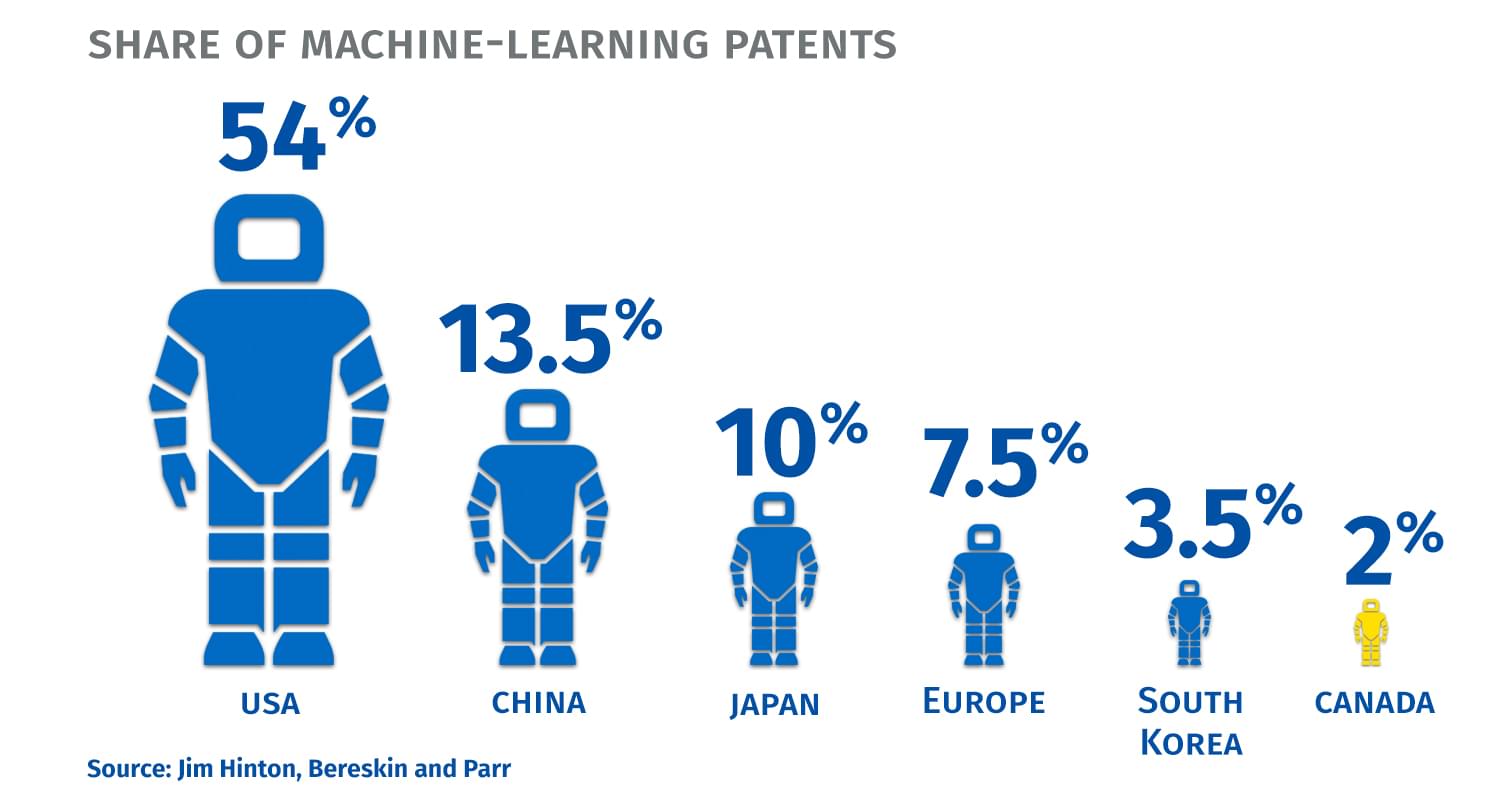
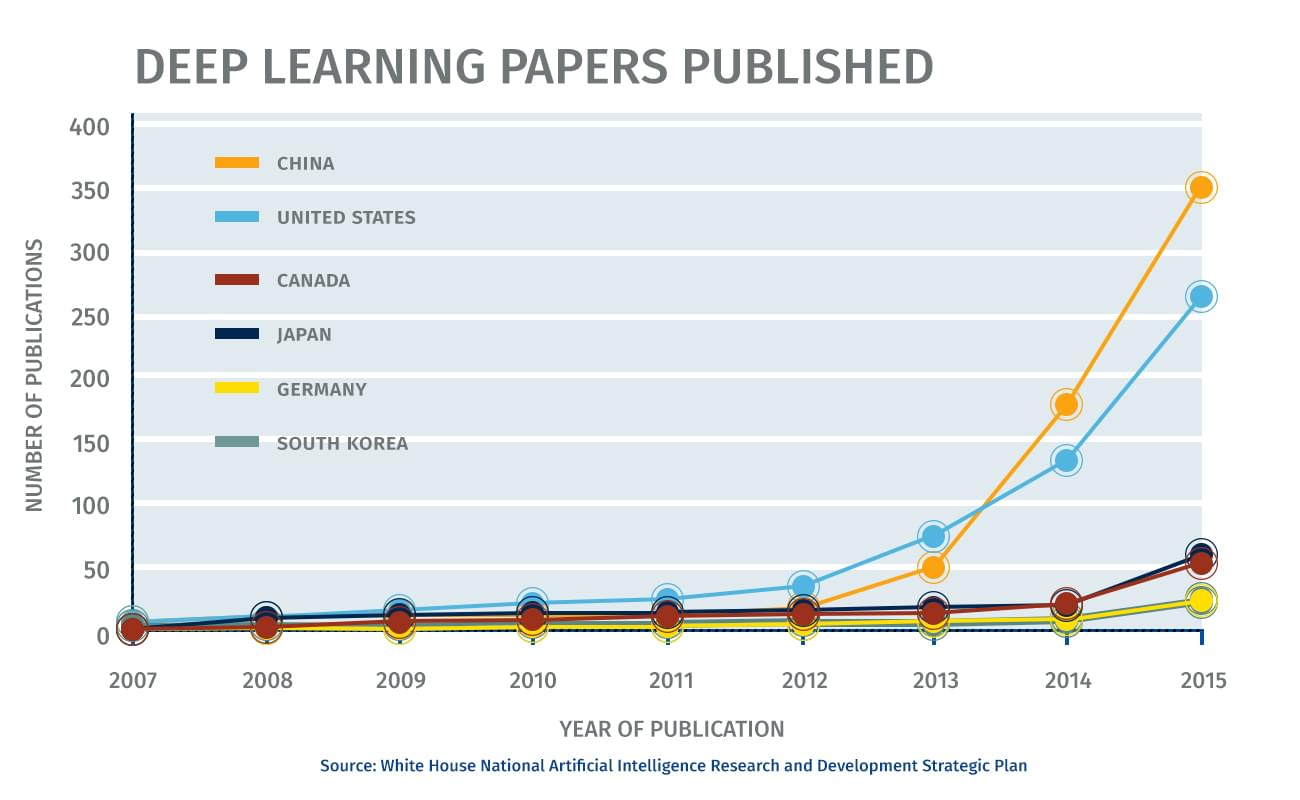
The concentration of AI research has grown sharply since 2012, with the United States and China emerging as AI superpowers.
Share of machine-learning patents
Deep learning papers published
Deep learning publications cited

The Start-Up Challenge

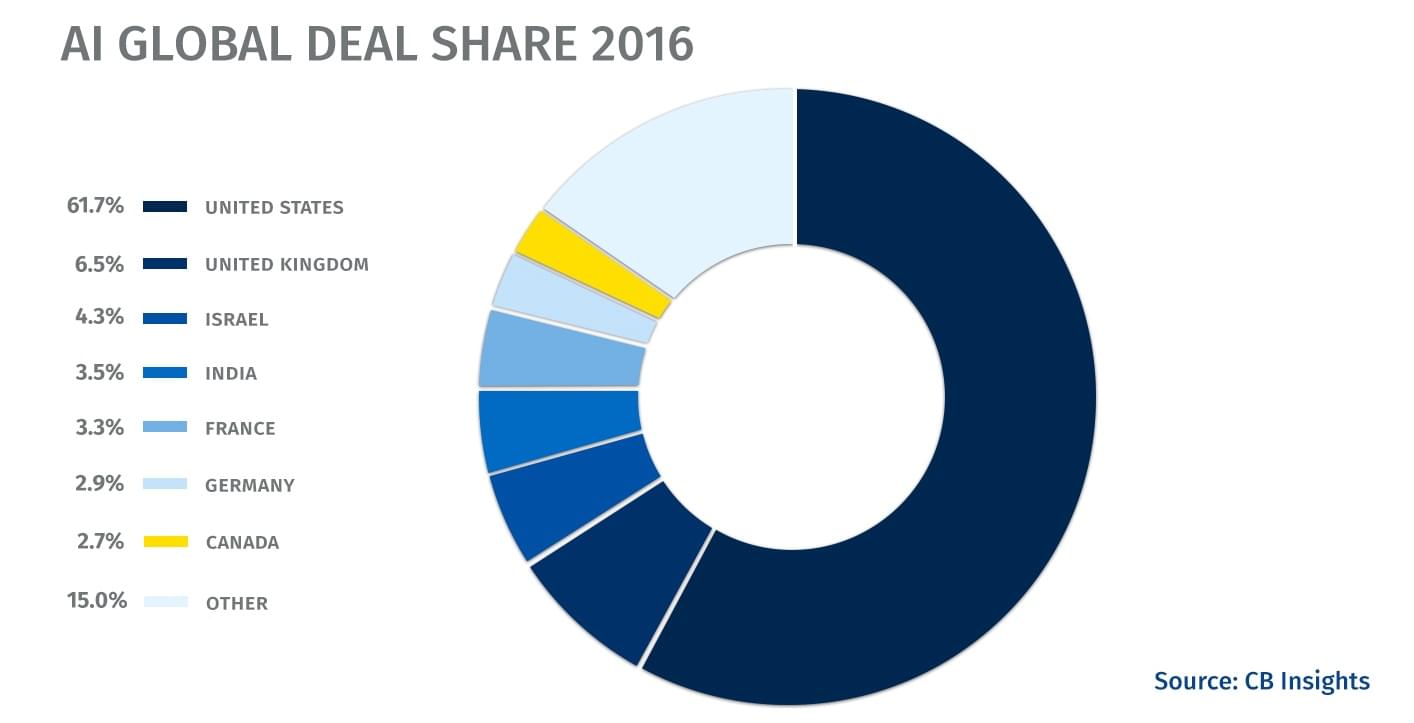
  • Around the world, 650 AI start-ups raised US$5 billion in 2016.[1]
    • The number of AI deals (funding rounds and exits) has increased more than fivefold since 2012
  • Canada accounted for 18 of the 658 AI acquisitions in 2015[2]
    • No Canadian company ranks in the top acquirers for AI startups

AI Global Deal Share 2016

The Corporate Challenge

American tech companies have put millions into Canadian AI. Microsoft pledged to invest $7 million in AI research in Montreal as part of its January 2017 purchase of machine language start-up Maluuba, while Google donated $4.5 million to MILA in 2016 and has opened labs in Montreal and Toronto. In May, Uber hired University of Toronto professor Raquel Urtasun to run a new Toronto AI lab focusing on driverless car technology.
Canadian companies have also invested in AI. NextAI, a partnership between RBC, Magna, BDC Capital and Scotiabank, was launched in 2016, with $5 million in initial funding to draw entrepreneurs to Canada to work on AI challenges. More than 20 Canadian companies have committed to funding the Vector Institute. Of the top 60 companies on the TSX, 22 have expressed interest in AI and 13 have publicly announced investments in AI. (See Appendix).
Between the federal and provincial governments, academic networks and partnerships including the Vector Institute and MILA, and commitments from private corporations, nearly $500 million has been committed to developing Canada’s artificial intelligence ecosystem over the past 18 months.
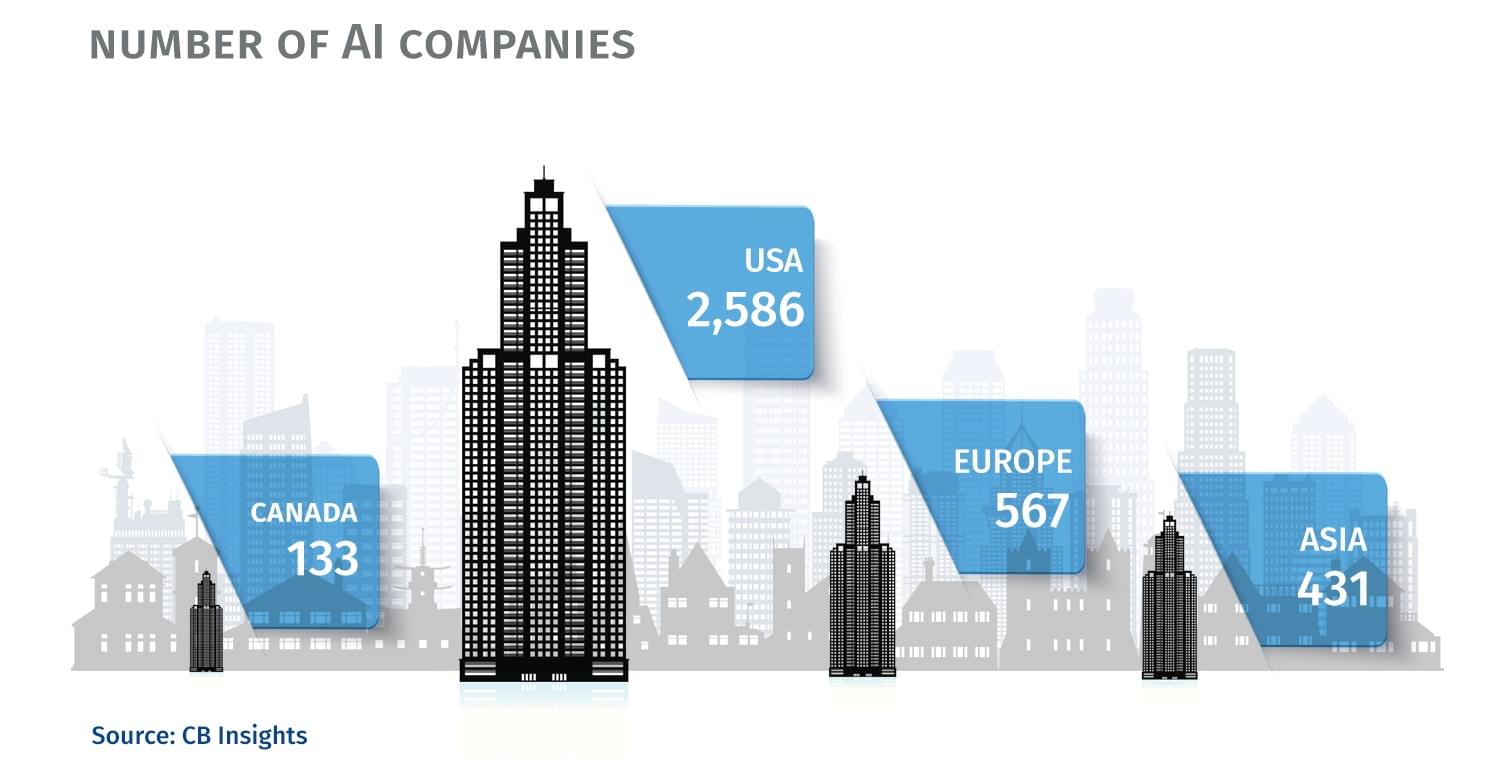
Number of AI Companies

Making Canada AI-Ready – 10 Ways for Government, Business and Academia to Build on Canada’s Success.

1. Create an AI Council to Guide Policy:
A private sector-led council could advise government on AI opportunities and challenges, and help track and benchmark Canada’s adoption of AI relative to global competitors.
2. Expand the AI Talent Pool:
Set an ambitious national target for both graduation levels in AI and related fields, and immigration levels for global AI talent.
3. Make the Workforce AI-Ready:
Equip students with AI-complementary skills, including work-integrated learning to ensure broad student exposure. This should include a focus on girls to ensure more gender balance in AI-related fields, including design, interface and impact.
4. Promote AI Across Business Sectors:
With business groups (Business Council of Canada, chambers of commerce), diffuse understanding of AI across organizations and encourage its adoption by all key sectors to build Canadian competitiveness.
5. Focus Research Funding on Commercial Innovation:
Ensure publicly-funded AI research focuses on commercial application— and require government funding agencies to better coordinate AI investments.
6. Develop an AI-Focused IP Strategy:
Modernize the IP regime to support the monetization and commercial scale-up of ideas in Canada, and to guard against activities (e.g. patent trolling) that stymie Canadian commercial innovation.
7. Leverage Our Data:
Establish a national data strategy, including a possible data bank for Canadian-owned companies and entrepreneurs to help them build scale in key areas.
8. Create a National Challenge:
Pool government and private resources, including data, to help Canadian firms, entrepreneurs and researchers use AI to solve grand challenges such as carbon emissions and hospital wait times.
9. Pursue an AI Trade and Investment Agenda:
Create a subject-expert AI representative in the federal government to work with multinational companies and investors. Apply an AI lens to trade negotiations. Review investment policies to consider the interests of Canadian firms.
10. Position Canada as a Global Leader in Advancing AI for Good:
Play a constructive role, through the G20 and multilateral organizations, to convene and build global awareness about the social, economic and cultural consequences of AI.

Appendix
Public AI interest and investment, TSX60 companies [5]
AI interest AI investment
1.     Bank of Montreal 1.     Bank of Montreal
2.     Bank of Nova Scotia 2.     Bank of Nova Scotia
3.     Barrick Gold Corporation 3.     BlackBerry Limited
4.     BCE Inc. 4.     George Weston Limited
5.     BlackBerry Limited 5.     Loblaw Companies Limited
6.     Canadian Imperial Bank of Commerce 6.     Magna International Inc.
7.     CGI Group Inc. 7.     Manulife Financial Corporation
8.     George Weston Limited 8.     Power Corporation of Canada
9.     Goldcorp Inc. 9.     Royal Bank of Canada
10.  Loblaw Companies Limited 10.  Sun Life Financial Inc.
11.  Magna International Inc. 11.  Telus Corporation
12.  Manulife Financial Corporation 12.  Thomson Reuters Corporation
13.  National Bank of Canada 13.  Toronto-Dominion Bank
14.  Power Corporation of Canada  
15.  Rogers Communications Inc.  
16.  Royal Bank of Canada  
17.  Sun Life Financial Inc.  
18.  Suncor Energy Inc.  
19.  Teck Resources Limited  
20.  Telus Corporation  
21.  Thomson Reuters Corporation  
22.  Toronto-Dominion Bank  
   
[1] The 2016 AI Recap: Startups See Record High In Deals And Funding. (CB Insights, Jan. 2017.)
[2] The 2016 AI Recap: Startups See Record High In Deals And Funding. (CB Insights, Jan. 2017.)
[3] The Geman Artificial Intelligence Landscape. Asgard.VC, February 2017.
[4] Worldwide Semiannual Cognitive/Artificial Intelligence Systems Spending Guide. (IDC, October 2016.)
[5] Factiva press search

As Senior Vice President, Office of the CEO at RBC, John Stackhouse is responsible for interpreting trends for the executive leadership team and Board of Directors with insights on how these are affecting RBC, its clients and society at large. Prior to this, John was editor-in-chief of The Globe and Mail (2009-14), editor of Report on Business, the newspaper’s national editor, foreign editor and its foreign correspondent based in New Delhi, India (1992-99).

WP Menu

wp-menu

GM Canada has a team of 750 software engineers in the Toronto suburb of Markham, working on what it calls “the future of mobility.” It also has ambitious plans to open a experimental centre in the city’s east end, where consumers will be able to test self-driving cars, electric bikes and any other innovation that runs on wheels.

For the auto giant, the Toronto innovation drive is designed to get it closer to consumers and better understand how they’re adapting to radically new car technologies — and how that innovation can lead to better communities, safer roads and a new business model for mobility.

“We’re redefining ourselves in terms of mobility, as opposed to cars, trucks and crossovers,” said GM Canada’s president Steve Carlisle.

GM is in a race with Uber, Alphabet, Tesla and other car companies to develop self-driving cars that are safe, reliable and affordable. Earlier this week, Uber Technologies announced a new Toronto research team led by University of Toronto professor Raquel Urtasun that will be tasked with “transforming transportation.”

For both GM and Uber, Toronto has everything they need: great universities, a strong startup ecosystem, five million people, terrible traffic and four intense seasons that can test every on-board instrument in a car.

“We’re blessed with abundant crappy weather,’ Carlisle said, “so we should invest in it and play a global role there.”

Carlisle was onstage at Roy Thomson Hall for RBC Disruptors, a monthly speaker series focussed on innovation and disruption.

After emerging from the great recession as a shadow of its former self, GM has picked four channels of innovation: self-driving vehicles, electric vehicles, connected vehicles and shared vehicles.

Carlisle said the company wants to think about share of data and share of kilometres driven, rather than just share of new car sales.

“We need to think in terms of not just selling vehicles — but selling kilometres and gigabytes too … The idea is to get our minds moving beyond market share and sales and into share of kilometres ridden and share of data used.”

He can see a future in which fewer cars are sold but they’re used more through shared ownership, or ride-hailing of autonomous-driving vehicles. The average car is used around four per cent of the time.

While that may lead to fewer vehicle sales for GM, Carlisle says the difference will be made up by servicing and parts, as vehicles being used more often will wear out faster. There will be new business models, too, such as paying per distance.

The company already has its own car-sharing business, Maven, that is trying to better understand how quickly consumers are willing to change habits.

GM is already gaining some revenue from new data models, such as prompting drivers, through its OnStar service, with special offers at restaurants or shops along a highway, based in part on a driver’s habits. It typically gets a share of sales connected to drivers, if they’ve opted to share their data.

Today’s vehicles already have as much as two million lines of computer code in them. Tomorrow’s vehicles will be wired more than a typical space vehicle, enabling GM to build relationships with a host of other service providers wanting to reach consumers while they’re in their cars.

While self-driving cars — and the ensuing changes to our cities — are still years away, Carlisle said they’re coming sooner than most people think.

The biggest challenge is in the marketplace. Take electric cars. Despite being on the market for more than a decade, they account for half of one per cent of total sales. The same resistance could hold true for cars that pilot themselves.

“We all want to reduce greenhouse gases, but we’re all consumers as well,” he said. “When do we make the leap to being a part of that solution instead of perpetuating the status quo?”

Even if self-driving cars gain currency, Carlisle doubts the love-affair that many owners have with their cars will die. Instead, many will buy second cars for pleasure driving, while using autonomous-driving vehicles and shared vehicles for mundane trips. “Everyone loves driving,” he noted. “No one likes commuting.”
 

WP Menu

wp-menu

You wouldn’t expect to find the masses inside the Beverly Hills Hilton, which MI Global takes over every May. But their concerns were everywhere, as 4,000 executives, entrepreneurs, asset managers, policy makers and government leaders gathered this week to consider a world in flux. Here’s what I took away:

1. Why the Market Likes Mnuchin

Steve Mnuchin was a Milken regular when he lived in LA and bought distressed banks for a living. Now that he’s Treasury Secretary and working for a populist president, he’s supposed to be an outsider. It didn’t look that way. Mnuchin was received like a conquering hero at Milken, at least by the finance crowd who cheered his plan for growth. Not inclusive growth or sustainable growth, like you hear in Canada. In the U.S., it’s just growth. To get to his promise of 3% growth within two years, Mnuchin laid out a plan for tax, regulatory and trade reform. He likes to call it “a jobs plan.” On top of the corporate tax cuts already announced, Mnuchin wants to cut the top personal rate from 39% to 35%, eliminate all deductions (other than mortgage interest and charitable donations), and reduce the standard tax return to a single page. The Beverly Hills crowd liked it. And the House Republicans? “They’re 80% in agreement.” As for the elephant in the room—a border-adjustment tax to cover the cost of other cuts—Mnuchin was blunt. “We don’t think it works in its current form.” No matter. He believes the tax cuts will generate enough growth to pay for themselves.

2. Why the Economy Doesn’t (Yet)

Markets are up double-digits since Election Day, and CEO confidence is at the highest level since 2004. No surprise, then, that the crowd waxed enthusiastic about Mnuchin’s message. But it was anxious enthusiasm, in the wake of flat economic numbers. “The market has priced in a lot of announcements. We now need to see action,” said Mohamed El-Erien, the uber-investor who is chief economic adviser at Allianz. He noted that bond yields have dropped this spring, while economic prospects continue to look muted. And no one seems to be pricing in the risk of a geopolitical event—North Korea, anyone?—or a financial mishap. “Optimism is off the charts but geopolitics is a real concern,” El-Erien said. Nor is the market factoring in the slowness of Washington. Take infrastructure: it could take years, not quarters, to see a shovel hit the ground. But for now, there’s lots of liquidity and few other places to put it to work.

3. 2017: Buy American, Hire American

Trump’s “Buy American, Hire American” motto is having an effect. “Everyone now wants to build factories in America, and hire American workers,” said Ross Perot, the Texas businessman who tried to scuttle NAFTA in 1992. “Cheap money, cheap energy is good for the world, and overall the world is relatively peaceful,” he said, arguing that U.S. economic growth could hit 4% this decade. The biggest constraint? Labour. Across the U.S., there are 3 million job vacancies. In Perot’s home town of Dallas, there’s a shortage of 19,000 construction workers. The man who ran for president to fight “the giant sucking sound” of Mexico is now the voice for a more open border. Yes, it really was Ross Perot who said, “We need to get our Mexican friends back.”

4. 2018: Buy Mexican, Hire Mexican?

The Mexicans may not want to be called friends, at least for the moment. The mood toward America is so hostile that a protracted NAFTA dispute could lead to an anti-American populist winning next year’s national election. “It is not a wise decision to take an open trade negotiation into any general election,” said Kenneth Smith Ramos, Mexico’s top trade envoy in Washington. He believes an “overarching agreement” on NAFTA must be in place by year-end, and thinks it’s possible by adapting parts of the Trans-Pacific Partnership. Seeing anything meaningful pass quickly through Washington would take a healthy imagination. So the U.S. Chamber of Commerce is counselling simple advice to Trump on NAFTA: “Do no harm.” That means do no harm to the 14 million U.S. jobs that depend on North American trade—or the countless industries that will be lobbying to protect or enhance their interests. Mexico’s biggest movie-chain owner, Alejandro Ramirez Magana, gave a sense of the harm that looms, both to Mexico and the U.S.: “Our biggest movies come from California, our popcorn comes from the Midwest, the cheese on our nachos comes from Wisconsin.”

5. Trading Friends, Trump-Style

Commerce Secretary Wilbur Ross spent his time at Milken praising China and slamming Canada. China, he said, had been greatly cooperative on trade since the Mar-a-Lago summit between Trump and Xi Jinping. Canada, on the other hand, had become “nasty” in its approach to softwood lumber negotiations. Another Trump adviser cautioned that Ross was playing to the White House, trying to restore ties with Steve Bannon after the two reportedly fell apart over Trump’s attempt to kill NAFTA in late April. But there’s no doubt the White House is furious over Canada’s handling of the softwood lumber dispute, especially British Columbia’s threat of a counter-measure against U.S. coal. Ross called out B.C. as “the source of more than half the problem.”

6. Rise of the Platforms

Forget Trump and his political platform on Twitter. A more powerful force may be the other social channels and the economic platform they’re building. For now, Facebook rules. But Greg Maffei, the CEO of Liberty Media, thinks the next content battle will be between Netflix and Amazon—and the prize will be data. More Americans have Amazon Prime than go to church once a month, he said. And they’re an upscale market, willing and able to buy what Amazon recommends. He sees Alexa as “a real Trojan horse in the consumer space,” because our voices—tone plus words—”will take data to a whole new level.” Netflix could be a different platform altogether. On a typical Saturday night, a quarter of us glued to a screen are glued to Netflix. Maffei thinks the company will evolve into a platform, selling products and offering social features, because it can’t resist. It has too much data on all of us. Facebook and Google will be there, too. Facebook has close to 2 billion users. And Google’s YouTube has 1 billion people a day watching its channels. Google’s Eric Schmidt said the most important factor in a video’s success today—consumer or commercial—is the recommendation engine. Attention, brands. If you want to reach consumers, you have a new gatekeeper to please, and its name is algorithm.

7. Rise of the Cars

The car of the future is here, and further off than you think. Richard Wallace of the Centre for Automotive Research thinks we won’t see a road full of self-driving cars any time soon. The companies now testing vehicles simply don’t have enough data across different climates, geographies and population centres to make a bet. A test mile in Montana, he said, is not the same as a test mile in Miami. Regulatory changes are slower, too. And then there’s the biggest innovation hurdle of all: human acceptance. “It might be 2040 before we see truly big change,” Wallace said. Kyle Vogt, the CEO of Cruise Automation, thinks test markets will emerge over the next five years but also doesn’t expect to see self-driving cars in every city and town any time soon. “Expectations are ahead of reality. We’re seeing a lot of interesting demonstrations. What we’re not seeing is the enormous amount of work that’s still required to take a proof of concept into a commercial mode.” Whenever the future car arrives, we can expect it to have more computing power than a space station. Peggy Johnson, the head of business development at Microsoft, said the software giant sees the car the way it once saw the desktop. As carmakers reprogram every nook and cranny, they’ll need Microsoft, she hopes, to make the vehicle smarter, safer and hyper-connected. She thinks the expansion of 5G networks, around the end of the decade, will transform our vehicles into entertainment centres, supercomputers and rolling offices, all in one.

8. The New Data Economy

Schmidt believes artificial intelligence is “the most important thing to happen in computer science in 50 years.” The combination of Moore’s Law (computing power doubling every two years) and new lodes of data has afforded companies in every industry the chance to completely change their operations. He cited the case of Google data centres, which consume massive amounts of energy to stay cool. Even after some of its best engineers had tried to optimize that energy use, AI cut the data centres’ energy use by a further 50%. Pedro Domingos, the University of Washington professor who wrote The Master Algorithm, said the AI race may not be won by industry leaders. He’s finding that the most successful players in machine learning—a branch of AI—are the ones applying it to dozens of very different challenges rather than a single problem. As with humans, it seems, machines may learn best through cross-disciplinary studies.

9. The New Skills Economy

Increasingly, humans will need to be generalists, leaving it to machines to be the specialists. We’ll also need to widen our peripheral vision, rather than sharpening our focus. No matter how much machines learn, though, humans will be needed to spot the exogenous. “Our job as humans will be to be captain of the ship. We will have more ships and bigger ships,” Domingos said. We’ll also need to work with learning machines, no matter what our job. “A third of all human work will be affected by AI,” said John Chambers, the executive chairman of Cisco. Masayoshi Son, the Japanese billionaire, believes “the smart robot is going to replace many of the jobs that exist today, mostly blue collar and routine jobs of white collar.”What will happen to humans? “We will have to think, create, interact, focus on feeling.”

10. America’s Social Crisis

Mike Milken says his conference is about “building more meaningful lives” —for a reason. A sixth of middle-aged men in America have dropped out of the workforce, and half of them are dependent on opioids and prescription medicines. The decline of steady work, stable families, safe communities, even service clubs was documented in the 2000 bestseller Bowling Alone. Nearly two decades later, has the dismantling of America’s social infrastructure driven us deeper into shell? Andrew Wilson, the CEO of Electronic Arts, said there’s a reason 250 million people a day play video games, and it’s not just for fun: “We are providing self-actualization.” Pervasive social isolation is leading to at least one unexpected shift. We’re returning to sports stadiums in big numbers. The NBA just enjoyed its best year ever for attendance, with a 92% sell-out rate. Better seats, better food, better in-break entertainment and better pace of play are driving sales. NBA commissioner Adam Silver sees another curious factor: the massive improvement in home entertainment systems. Those giant flat screens that are a gamer’s best friend are also helping the arena experience. Ironically, TV may be helping convince us to spend time and money to see sports live. The new arenas are both great marketing platforms, and production centres. Silver called them “giant TV studios,” serving 90% of the population who will never attend a game – and convincing the other 10% to pay a king’s ransom for a commoner’s game.

11. Boards, Revisited

Agriculture isn’t the only area to suffer from monoculture. The boards of corporate America still look as homogenous as a cotton field in Texas. Among Fortune 500 companies, only 25% of board seats—and 5% of chairs—are held by women. “Something has to change” said Denise Morrison, CEO of Campbell Soup.“It’s too slow.” Increasingly, diversity is considered an imperative for innovation, to ensure divergent views and lateral thinking are applied to corporations as they rely increasingly on machines for linear models. How to get there? N.V. “Tiger” Tyagarajan, the CEO of Genpact, argued that CEOs need to demand diversity, and it needs to be visible through metrics and connected to the bottom line. Shareholders can help, too. The California State Teachers’ Retirement System now demands diversity plans from its major company holdings. Note: 70% of its members are women.

12. 43, Revisited

Milken opened with an anxious cheer for the Trump economic agenda. It closed with a veiled warning from a man who knows what it’s like to be a reviled Republican President and win re-election. George W. Bush, the 43rd President, earned an extended standing ovation, from a very bipartisan crowd, for his defence of a compassionate, conservative America. Just days after Trump questioned Abraham Lincoln’s prosecution of the Civil War, Bush trumpeted Lincoln’s words—“all men are created equal”—as the moral foundation of America. He believes they should be the compass of American foreign policy, immigration, education and trade. As for Trump’s suggestion that a deal with the South could have been prevented the Civil War, Bush was clear: “We’d look more like Europe than the United States.” On Mexico, he was unambiguous: “I was raised in Texas. We were Mexico. The subject didn’t make me nervous. I always felt Latinos made Texas a stronger place.” On a border fence: “It’s really hard to build fences in parts of Texas. And ranchers don’t want federal government taking their land away from them” On promoting democracy in the Middle East: “People say, ‘how dare you say Muslims can self-govern.’ I say that’s what people used to say about Condi Rice’s ancestors.” On Vladimir Putin: “He is a zero sum thinker.” And on the power of rhetoric: “When the President says something about someone, he better mean it. Especially if it’s Vladimir Putin.” As the only President ever to run a marathon, Bush left Milken with a simple message: think and plan for the long run.

WP Menu

wp-menu

The launch of the Vector Institute last week is the latest in a series of public and private partnerships and investments around AI in Canada, including the RBC-supported NextAI accelerator program and a new Google office focused on AI development.

University of Toronto professor Geoffrey Hinton—known internationally for his work on neural networks—is the chief scientific advisor to the Vector Institute, and it was his groundbreaking research that helped kick-start the AI renaissance half a decade ago.

The AI pioneer was one of a small group of scientists at Canadian universities that kept the dream of machine learning alive when previous cycles of AI hype went bust. “It’s people in Canada who made it work,” Hinton said. “For 50 years, people in AI said this is nonsense, you’ll never make this work. Now that it works, they’re saying AI is great.”

AI’s possibilities are vast. In healthcare, AI programs are already helping doctors identify cancer and other anomalies on MRI and x-ray results. In business, customer service chatbots are helping book trips and resolve online disputes. And learning algorithms are already trading equities and optimizing portfolios at banks like RBC.

That explains the gold rush in AI: startups in the field raised US$5 billion last year, nearly 10 times the total for 2012. Despite Canada’s early lead in AI research, much of that money—and the brains behind AI—has gone south. Efforts are underway to reverse some of the tide.

On Thursday, University of Toronto president Meric Gertler compared the Vector Institute to the U.S. government’s early investments in what later became the Internet. “Its significance could not be understood at the time,” he said. “Today’s announcement represents a similar opportunity to drive innovation, job creation and long-term growth in Canada.”

The Vector Institute launch followed the March 22 federal budget, in which Ottawa announced $125 million for its Pan-Canadian Artificial Intelligence Strategy, some of which will support the institute.

Hinton himself joined California-based Google in 2013, becoming, at 64, the company’s oldest intern. Yann LeCun, a French researcher who did post-graduate work in Canada, was hired by Facebook to run its AI lab. University of Alberta professor Richard Sutton taught a cohort of students that went on to help build AlphaGo, the Google AI that has become unbeatable at the 2,500-year-old Chinese game of intuition and strategy. And Microsoft has now added University of Montreal professor Yoshua Bengio as an advisor after snapping up natural language processing startup Maluuba to boost its AI efforts.

How to halt the brain drain? Hinton said the best researchers have a few basic demands: access to vast amounts of data, enough time to pursue research ideas that might not work out, and to be surrounded by others with similar goals. “What the Vector Institute is going to give us is a big concentration of really good researchers with access to data and plenty of time to do research,” he said.

Earlier this year, RBC became one of the core sponsors for the NextAI accelerator program for AI entrepreneurs. The first cohort of 20 teams was finalized in early March. Last October, RBC opened the doors of its RBC Research in Machine Learning Lab, led by researcher and entrepreneur Foteini Agrafioti.

“The opportunities for new discoveries in the field of deep learning are very exciting, and the applications are endless,” Hinton said in the release announcing the launch of the institute.

John Stackhouse and Peter Henderson contributed to this piece.

WP Menu

wp-menu

Ever since IBM purchased his company in 2015 and folded it into the world of IBM Watson, Clayton has become something of a storm-chaser — virtually, at least. And on that day in mid-December, as he watched a record number of weather searches pour in, the CEO of Weather Company realized something more profound was underway.

Clayton’s company not only received millions of requests such as “how much will it snow today?” Using IBM Watson, his teams were able to gather enough data from phones across North America — and a range of monitoring stations — to predict the storm’s path, and then inform companies ranging from airlines to soup makers about the likely consequences.

“We had 42 billion requests of our infrastructure in one day,” Clayton says, comparing the record day to a typical Google day of 7-10 billion searches.

“The scale of it is mind-blowing. It’s so big you really almost can’t comprehend it.”

Welcome to the new world of weather, and as IBM has discovered, the new world of data. Little else drives human traffic on the Internet as much as today’s forecast. So whoever can make the best forecast is going to get the best information about millions of users: where they are, what else they’re searching and, based on sensors in their phone, what the weather’s like around them.

“We connect more sensors than anyone else in the world, but we’re still a secret story,” Clayton told the latest session of #RBCDisruptors, held in Toronto on Feb. 9.

For pretty much every connected business, the Weather Company illustrates a new frontier, where companies can provide content and experiences that are becoming so indispensible to their customers that they will gather a motherlode of data along the way. And with that data, and a lot of artificial intelligence that can make sense of it, those companies can tell their customers what they need to know — even before they need to know it.

Weather Company has a network of 2.2 billion sensors around the world, which update Watson every 15 minutes, and collects data from millions of smartphones, aircraft, buildings and automobiles.

Moreover, its mobile app is the fourth most downloaded worldwide, with 350 million daily users. When users agree to use the Weather Company’s services, they agree to share information from the barometric pressure sensors installed in their phones.

But it’s more than a forecasting tool. The artificial intelligence running in the background, through Watson, is able to make sense of that deluge of data in milliseconds.

“We think the more data we can get, the better our decisions and recommendations are going to be,” Clayton says. “But you do need those vast quantities of data to make good decision.”

Despite its name, only five per cent of Weather Company’s business is weather-related.

It helps airlines schedule and plan flights, manage fuel loads, and monitor their fleets. One result: it’s helped airlines cut turbulence in half over the last 10 years, saving millions of dollars in fuel.

Weather Company has also been able to help banks identify areas where ATMs and branches are needed — or areas where they are too plentiful — by tracking users based on their smart phone habits.

The company works with governments as well, helping guide policy on big decisions such as where to build nuclear power stations and other critical infrastructure. Governments, Clayton says, could even factor in his company’s data into military planning.

Building an evidence-based corporate culture and workforce is easier said than done.

Clayton’s company, which at one point was owned by NBC Universal, was focussed on content: weather forecasts, storm videos and local alerts to satiate the needs of cable viewers. But when the mobile phone revolution hit, he realized the company needed to change radically, too. The convergence of smart phones, cloud computing and sensors turned every consumer into a walking weather station — and in turn created a powerful geo-location service.

Since then, Clayton has turned Weather into a technology company that straddles both business and consumer. It’s developed emergency response systems for local governments, and flu trackers for health networks, all by tracking data flowing from a digital device and a user’s desire for weather reports.

One of his latest successes is Campbell Soup, a company whose fortunes rest heavily on the weather. To his surprise, Clayton discovered that a 10-degree fluctuation in temperature, whether in Manitoba or Miami, will lead to a spike in soup demand. “It’s the difference from normal that drives soup sales,” he says.

With that knowledge, IBM machines have been able to tell retailers what to plan for, and what to advertise. Using Watson, they’re also able to craft recipes and ping them to consumers on their phones, even before a weather event has hit.

“Volatility,” Clayton says, “drives our business.”


John Stackhouse and Peter Henderson contributed to this piece.

WP Menu

wp-menu

The seemingly simple science of finding things indoors doesn’t have a digital solution. Yet Liu’s efforts to solve that problem, and the emerging field of so-called smart building technology, are now pushing towards a bigger goal: saving the planet, one building at a time. Liu, a former University of Waterloo student and the founder of indoor mapping startup MappedIn, joined fellow entrepreneur Ritesh Patel, a University of Waterloo grad and founder of BuildScience, at the #RBCDisruptors event on Jan. 24 to talk about how a new generation of connected buildings are improving the shopping experience, cutting carbon emissions and increasing productivity for Canadians. Both Liu and Patel cite efficiency as a core purpose for their product—whether that’s the use of space or the use of resources. MappedIn uses data from property managers to build interior maps of shopping malls, airports, hospitals and more. Using the company’s data, mall owners can direct customers to the right store, airlines can get you to your flight on time, and hospitals can direct you to the right room to get the care you need. In the corporate world, MappedIn helps employees find one another, locate new desks in co-working spaces and spend less time searching for open meeting rooms. BuildScience offers a software platform that allows property owners to control all of their systems and sensors, like thermostats, security cameras and overhead lighting, through a single interface. The platform breaks down the data by floor and even by room, allowing managers to identify problem areas and inefficiencies as well as customize the environment for different uses.

Thinking through design

For years, Liu said, building management and indoor design was considered unimportant, and managers and architects didn’t think too deeply about how humans use the space around them. “In the past, space management was always done intuitively,” he said. “Now the digital visitor experience of a physical building, the digital assets of physical assets are suddenly very important to this large industry.” What changed, he said, is the rise of a different kind of consumer culture and a new knowledge of how buildings affect the environment. For years, the shared wisdom of supermarket designers everywhere was to put the most frequently purchased items—milk and eggs—as far from the entrance as possible, to entice customers along the way with impulse buys and irresistible deals. The same logic applied to department stores, where labyrinthine layouts encouraged browsing at a leisurely pace. “Every single bricks-and-mortar business has a user experience problem,” Liu said. “Consumers had all this choice and not much time. Now, the opposite is true.” With the rise of online shopping and other alternatives, he said, retailers want to make their spaces more efficient—and that’s where MappedIn comes in. The company can detail interior maps down to the products on the shelves, and stores can use that data to monitor how shoppers actually move through the space. The key for redesigning interiors, Liu said, is turning that data about customer behaviour and interior layouts into actionable insights. It’s about challenging conventional wisdom by crunching the numbers, like the Oakland Athletics did for baseball, and following where those insights lead. “We want to ask: how can you make this into Moneyball?” he said.

Building green

As consumer appetites have changed, so too has our knowledge of the impact of climate change. The Canada Green Building Council says buildings generate more than a third of Canada’s greenhouse gases, more than a third of our landfill waste comes from construction, and nearly three quarters of municipal water usage is in and around buildings. Patel said the BuildScience platform, because it ties together a building’s sensors and monitoring tools, helps clarify the importance, not to mention the business sense, of cutting energy use. “The best way to leverage our software is to measure what was previously unmeasured,” he said. “You can’t fix what you can’t measure.” By networking things like AI-controlled thermostats and lighting systems, he said, building managers can optimize their usage and cut costs and emissions for everyone. “There’s a lot of waste that occurs because somebody leaves a valve open,” Patel said. “It goes undetected until the utility bill comes in. It’s better if you can find out the day of.”

Smart prductivity

The benefits of smart buildings aren’t simply shorter shopping trips and lower emissions. With rich data, customizable spaces, and 24/7 monitoring, smart buildings can actually improve the work of those who use them. The latest LEED-certified green buildings already provide a boost to productivity. A UCLA study found a 16 per cent boost for green companies, and the World Green Building Council says its data shows a productivity boost of 18 per cent. Patients in green hospitals built with smart design have 8.5 per cent shorter stays. And a report from Dodge Data & Analytics says green buildings, whether new or renovated, command a 7 per cent increase in asset value over traditional buildings. Liu said every building manager’s challenge is boosting the productivity of their spaces, whether that’s measured in retail sales, sick days taken, or manufacturing output. Big companies have amalgamated offices and moved to initiatives such as flexible desk spaces and remote work, he said, but then need services such as MappedIn to help employees find each other. “They’ve gone from extreme asset inefficiency in terms of space allocation to human inefficiency in terms of collaboration,” he said. “There’s a middle ground, and we’re helping them figure it out.” Patel said helping to save the planet isn’t the most powerful message for selling his BuildScience platform. It’s that that the efficiency and productivity gains make business sense. He pointed to Calgary, where the oil bust has left a buyer’s market in terms of commercial space. “When it comes to marketing your space, making it green, making it customizable, making it more efficient and more productive for your employees is a selling feature,” he said. While flexible workspaces are the new norm, he said, humans are still most productive when they’re working together—and smart buildings are the best places to do so. “How we’ve prospered on this planet is collaboration and increased productivity just by being together,” he said. “Office spaces are still the best places to get work done together. And that’s why big companies like RBC will spend lots of money to rent property, because they believe it will help their employees be the most productive they can be and achieve the goals of the company.”
John Stackhouse and Peter Henderson contributed to this piece.

WP Menu

wp-menu

With a $5.5-million endowment, the new NextAI initiative — announced Wednesday in Toronto — aims to keep Canadians at the commercial core of the revolutionary new science of artificial intelligence. It’s a cross between a prize and a boot camp for AI entrepreneurs.

The NextAI partnership will bring together researchers, investors and business minds to build on the commercial ideas emanting from AI. It will partner with some of Canada’s leading schools.

“AI is a fundamental capability and tool that we need to harness across all industries for our long-term competitiveness, our long-term productivity,” McKay said at the kickoff event.

The idea emerged from an innovators’ retreat last summer hosted by McKay and Don Walker, the CEO of Magna International, that brought together some of Canada’s top executives and entrepreneurs to see what the country needs most. Both companies are now founding corporate partners.

The program is the first of its kind in Canada, and aims to bring global AI talent and entrepreneurs to Toronto, where they’ll work with corporate, academic and technology partners. Through a competitive selection process, the teams will receive up to $200,000 in funding, mentorship and office space to pursue commercial applications of artificial intelligence.

Since launching recruitment in late October, applications have come in from over 20 countries including Ecuador, Germany, India, Israel, Italy, Mexico and Scotland.

It was University of Toronto professor Geoffrey Hinton who kick-started the current AI boom in 2012 when he produced a new algorithm that clobbered the competition in an image recognition contest.

University of Alberta research Richard Sutton laid the research groundwork for the program that hepled a computer teach itself the ancient Chinese game Go, and then defeated many of the world’s top players. Universite de Montreal professor Yoshua Bengio has built his city into an international destination for AI researchers.

One of the core objective of NextAI is to reverse what some have already dubbed a “brain drain” of top AI innovators and scientists out of Canada. Even Hinton has taken a position with California-based Google.
“Somebody is going to come up with best solution, why not Canada?” asked Walker.

Unlike previous innovation initiatives , McKay said Canadian businesses will be at the forefront of AI research “We come up with some of the best ideas in the world. We just don’t scale well.”

He said banks have trust with consumers and high-quality data that are much more useful for optimization than that held by social media companies or other online providers.

Despite the humble Canadian beginnings of the current AI boom, building machine intelligence into the economy is now being discussed by businesspeople and politicians around the world.

McKay said the government has a role to play in terms of supporting the early-stage research and financing the development of centres of expertise.

“But a sustainable ecosystem needs the private sector bringing solutions to market,” he added.


John Stackhouse and Peter Henderson contributed to this piece.