WP Menu

wp-menu

In the coming decade, half of all jobs will be disrupted by technology and automation. Some will change dramatically. Others will disappear completely, replaced by jobs that are yet to be invented.

We are living through an era of radical change, with the latest advancements in artificial intelligence and automation transforming the way we work, even in unexpected fields such as law and customer service.

How will we prepare Canadian youth for the workplace of the future?

We discovered that the four million Canadian youth entering the workforce over the next decade are going to need a foundation of skills that sets them up for many different jobs and roles rather than a single career path. They will need a portfolio of human skills such as critical thinking, social perceptiveness, and complex problem solving to remain competitive and resilient in the labour market.

We found that Canada is shifting from a jobs economy to a skills economy, and yet employers, educators and policy makers are not prepared. Here are four things you need to know about the coming skills revolution and the future of work.

Disruption Is Accelerating

It used to be that the threat of automation was only for routine, repetitive forms of work such as assembly lines. Now, algorithms are building legal cases, replacing administrative assistants and taking customer service calls for major corporations. We’ve dealt with technology replacing jobs before, but this time it’s different.

More than a quarter of Canadian jobs will be heavily disrupted by automation in the next decade, and half will require a new mix of skills even if the job title stays the same.

That doesn’t mean those jobs are going away. The Canadian economy will create 2.4-million new jobs between now and 2021 — but almost all of them will require a different approach. The economy will be built on a mobile workforce, constantly learning, training and upgrading to meet the demands of a changing world.

Flexibility Is the Future

Change is coming fast, making it hard to know what jobs will look like a decade from now. We need a new way of thinking about job requirements. Developing human skills — things like critical thinking, judgment, and decision making — will empower young people to pivot between careers and across sectors even as job descriptions change.

We analyzed data on hundreds of different occupations and found that many jobs, even in disparate fields, are connected by a set of foundational skills. We grouped jobs based on similar skills into six clusters. By focusing on the skills required, it is surprisingly easy to pivot between seemingly unconnected roles. Musicians and paramedics might not seem to have a lot in common, but both jobs require high levels of focus, excellent analytical skills and attention to detail. It takes upgrading only four skills for someone to transition from dental assistant to graphic designer.

Of course, many transitions require investment in terms of time and money, but this presents an opportunity for educators and policymakers to offer new approaches to training and development.

Digital Literacy Is Essential

Digital fluency will be essential to all new jobs. This does not mean we all need to code like a Silicon Valley programmer. It’s an understanding of technology, of how to interact with computers, smartphones and whatever comes next, that will be essential. Soon, we will come to think about digital literacy like we do regular literacy: a prerequisite for nearly any job.

We Need to Prepare for the Future of Work

Job disruption is one of the most pressing problems facing Canada today. Without the right people and the right skills, the economy won’t work. If we can get Canadians, especially young Canadians, to tap into these skills foundations, our economy will be ready for the skills transition.

We need schools to teach and certify skills, governments to develop programs that support lifelong learning, and companies to hire for core skills over credentials. By building skillsets that allow them to move from job to job, young Canadians will be able to take advantage in a new economy where it doesn’t matter what you’ve done — it matters what you can do.

Read the full Report

Download Technical Appendix

Attention all Youth – Learn how you can be better prepared for the changing world of work.

WP Menu

wp-menu

https://youtube.com/watch?v=mO8TuUHYWaE%3Frel%3D0

our stories

Videos that showcase Canadian entrepreneurs changing the world. Learn and be inspired.

RBC has joined forces with the C100 to share stories of Canadian entrepreneurs and our connections with Silicon Valley. “our stories” is your inside track on what it takes to succeed as a global player. RBC and C100 will be sharing videos that showcase Canadians changing the world, provide real-life stories of successes (and failures) and advice on how to succeed as an entrepreneur.

RBC is committed to sharing Canadian technology, entrepreneurship and innovation stories to elevate the conversation at home and abroad. Sharing and highlighting content elevates the conversation around infrastructure, education, talent, regulation and resources needed for economic prosperity in Canada.

C100 is dedicated to giving back to the Canadian innovation economy and fostering the next generation of successful entrepreneurs and innovative companies in Canada. Showcasing Canadian business thought leaders in the San Francisco Bay area through storytelling sheds light on their successes, their challenges and their advice for those who are building global players based in Canada.

About the C100:

C100 is a non-profit, member-driven association of Canadian thought leaders in the San Francisco Bay Area committed to supporting and accelerating the innovation economy in Canada. The C100 represents a select group of experienced entrepreneurs, executives of leading technology companies, and venture capital investors.

WP Menu

wp-menu

Cool nights blanketed the Swiss village with six feet of snow while warm days turned its roads into waterways, creating enough ice and slush to produce the irony of Davos traffic jams. It was as if the weather gods had crafted the perfect metaphor for 2018: a planet and economy that are at once so hot and cold that its people are struggling to keep a grip.

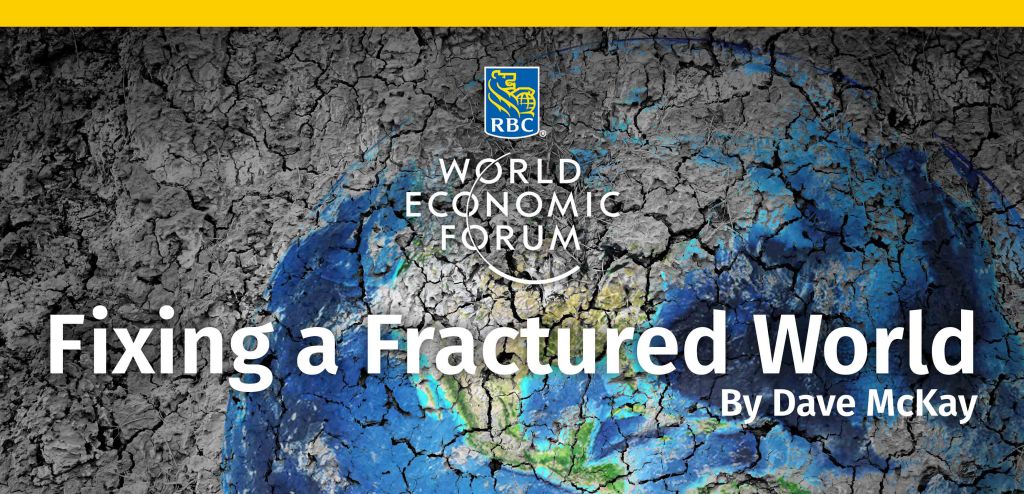
This was my third visit to the World Economic Forum, and the most valuable yet, as it underscored the frenetic pace of change today and how challenging it is to gain traction on the most pressing issues of our time—from the income stagnation that fueled the populist surges of 2016 to the outrages of sexual abuse that exploded in 2017 to the anxieties over technology grip- ping the globe in 2018. The forum’s theme put it aptly: “Creating a Shared Future in a Fractured World.” How do we do that? The mountaineers around Davos would tell you: have a good map, follow contours rather than straight lines, pace yourself, and move in teams. On the way up and on the way down.

Here are some of the issues I found most compelling at this year’s forum.

1. A Synchronized Recovery or Irrational Complacency?

The global economy has rarely looked so good. All but five of 192 countries tracked by the International Monetary Fund are growing—a record high. Unemployment in Canada and the U.S. is at a 40-year low. Europe is well into its recovery. And Asia is giving the world more synchronized growth than we’ve seen in decades. No surprise that stock markets are surging. One economist dubbed the mood “irrational complacency.” Trouble is, stocks have outpaced the economy for nine years running, which few would consider sustainable. Most of the economists at Davos felt that without recent rounds of fiscal stimulus—U.S. tax cuts and Canadian deficit spending, among them—we’d be heading for a correction this year.

So if we’re closer to the end of a cycle than the beginning, what could bring about a downturn? Business leaders at Davos spent a lot of time looking at threats to the expansion, including cyber-attacks, climate disasters and looming trade wars that could force surplus countries like China to stop financing the debts of others like the U.S. But they generally looked through political risks like the Korean standoff. Brazil got some attention, as it heads into a landmark election that may produce a populist government and exacerbate the country’s pension crisis. Italy, also in an election year, was highlighted for its fiscal challenges. But those concerns were not seen as threats to the global recovery. For the most part, the Davos crowd was bullish—and that alone could be cause for concern.

2. Donald Trump: From Political Apprentice to Davos Man

It was Donald Trump’s week at Davos. Even before his helicopter touched down, the president’s presence could be felt in pretty much every discussion, not least because he sent eight cabinet secretaries to project his “America First” agenda. A year ago, following Trump’s election, Davos felt like a post-trauma patient. This year, the crowd seemed to be coming to grips with him. U.S. tax reforms are popular with business. Trump also pushed an agenda—trade fairness and middle-class jobs— that wasn’t out of place in Davos. His advisors told business leaders they aren’t anti-trade; they’re just opposed to countries, particularly China, that don’t follow the rules (as seen by Washington). Their support for a new NAFTA was also clear. The president might still give six months’ notice of termination, but it seems the administration is angling for a deal with Canada and Mexico that would modernize the current agreement. On the final day, Trump’s signature soundbite—“America is open for business” —was what most of the crowd wanted to hear, even if they could do without some of the other stuff. Does that make Trump an internationalist? Hardly. But it wouldn’t be surprising to see him back.

3. Europe’s Back, for Now

Last year’s Davos was full of eulogies for the European project, and even for Europe’s history of liberal democracy. Elections in the Netherlands, France and Germany changed that. Emmanuel Macron took Davos 2018 by storm by projecting a 21st century vision for his country and the continent. The French president said he intends to cut taxes, reduce the size of government, reform pension plans and pour the savings into education and research to power innovation. It helps that the continent’s economy is growing again, thanks in part to cheap money.

But headwinds are never far away. The EU has to work out a divorce with Britain and simultaneously come to terms with its own contradictions, on the size of government, the freedom of movement and the restrictions on free trade in services, among many other issues. Mark Rutte, the Dutch prime minister who fended off a nationalist threat last year, fears the continent isn’t making the tough choices while it has strong leadership and an economic resurgence. His patience could be tested by Italy’s election in March, when the populist 5 Star Movement may have its best showing yet. As Bruno Le Maire, France’s economy minister, warned: without more growth, and jobs, the populists will be back, and stronger than before. “We have no choice,” he said, “but to succeed.”

4. China’s Presence: Less Talk, More Action

China was the star of last year’s Davos, with President Xi Jinping using the stage to project his ambitions for global leadership. The regime was much less visible this year, but no less influential. Xi’s top economic adviser, Liu He, outlined the government’s priorities: to reform state-run industries, cut poverty and reduce pollution. And on the last count, China-watchers were clear: Xi’s determination to fight climate change is serious, and stands to transform China and much of Asia. The massive, Chinese-led infrastructure project, the Belt and Road Initiative, is already setting new environmental standards for the region, and laying the ground for a seismic shift in global capital. China thinks the initiative can generate $2.5 trillion in trade within a decade, with new corridors connecting the Pacific Rim with both the Arabian Sea and the English Channel. 3 China’s ambitions for technology are just as impressive, except they’re not coming from government. Kai-fu Lee, the CEO of Sinovation Ventures, told the forum he’s invested in 45 new AI companies in China since 2015, as part of what he called an AI “arms race” with Silicon Valley. He said Beijing is committed to making China an AI leader by 2030, and has built a new generation of “amazing engineering schools” to feed companies like his. China’s advantage: fewer privacy restrictions, allowing businesses to access data in ways their Western competitors can’t.

5. Ecosystems, and the Rise of Digital Darwinism

Davos brings together governments, businesses, academics and activists from all corners of the world to share their experiences on emerging trends. This year, every conversation seemed to touch on concerns about the rapidly changing relationship companies have with their customers, and governments with their citizens. The best companies seemed to be trying to redefine their markets as ecosystems that they’re building with suppliers, partners and customers, using each other’s data to understand consumer needs. Jeff Schumacher, one of my favourite ecosystem thinkers at BCG Digital Ventures, predicted a new generation of specialty ecosystems— baby needs, for instance—that will require us to focus on our strengths and find others who can cover our weaknesses.

Data will make many of those decisions for us. Still unclear is whether producers and service providers will thrive in these new ecosystems, or be shaped by the so-called platform companies like Facebook and Amazon that act as intermediaries. Either way, consumers are winning, with more choice, more convenience, better prices and better experiences.

Smaller firms are thriving, too, especially those that can insert themselves in a fast-growing ecosystem. Perhaps it’s no coincidence that this year’s forum drew more small companies than ever. Just as the platform economy is disrupting old companies, it’s giving rise to many more new ones. This Darwinian shake-up could even lead to what’s being called a “splinternet”—a fractured digital world made up of many ecosystems rather than the global platforms that have dominated so far.

6. Big Tech, Little Government

The Silicon Valley tech giants used to be the cool kids at Davos. This year, panel after panel seemed designed to hold them accountable for a host of woes. Marc Benioff, the founder of Salesforce and a giant in the Valley, called for government regulations to rein in the search and social powerhouses. George Soros went further, lighting a firestorm at his annual Davos dinner by saying “social media companies exploit the social environment” in the same way oil companies used to exploit the natural environment. He singled out Google and Facebook as “utilities” that need to be taxed and regulated much more aggressively, and predicted a stronger EU would take the lead. France’s Macron echoed the sentiment, more diplomatically, by calling on other governments to join him in trying to set a new international tax standard for the digital economy. It’s unclear how that would be administered—and also what problems the Valley’s critics are trying to solve. Tax fairness? Excessive market share? Invasion of privacy? Abdication of media standards? Or something else? While there’s no clear response to the techlash, the Valley knows it has a problem and will have to engineer some solutions pretty quickly.

7. Cryptocurrency, Back to Earth

Cryptocurrencies and their underlying blockchain technology were among the hottest topics at the forum, but not entirely for the right reasons. By the end of 2017, there were nearly 1,400 cryptocurrencies in circulation—digital money, in effect— with a combined market cap of roughly $610 billion, up from just $18 billion at the start of the year. And at least 33 of them were valued at $1 billion or more. The big financial trend of 2017 didn’t have many fans at Davos, though. Larry Fink, the head of BlackRock, called them “an index of money laundering.” That said, we should not lose sight of the utility of blockchain technology, which could be used to improve financial systems.

The message from governments was unequivocal, that we should expect regulation. Both Steve Mnuchin, the U.S. treasury secretary, and Christine Lagarde, the managing director of the International Monetary Fund, expressed concern about the possible use of cryptocurrencies for money laundering and terrorist financing. How they’ll put the crypto-genie back in the bottle is a question they didn’t answer.

8. The Workplace Crisis

It wasn’t lost on Davos planners that of all the social forces since the last forum, the most profound was #MeToo. An explosion of revelations about workplace harassment, abuse and violence has shaken the world, and reset the leadership conversation. The forum had more women delegates (although still low at 21%) and all-female team of co-chairs, including the IMF’s Lagarde, IBM chief executive Ginni Rometty and Norwegian Prime Minister Erna Solberg.

Programs are one thing; changing culture is another. In his keynote, Prime Minister Justin Trudeau threw the challenge back to the audience, saying government and business leaders need to come to grips with the nature of many workplaces. While leaders typically use the forum to pitch their countries to investors, Trudeau opted for moralism over mercantilism. He urged the Davos crowd to “hire, retain and promote more women,” and for governments to pursue better family leave benefits, more investment in girls’ education and, perhaps most critically, a change in attitude around diversity. It’s good for business, he said. It’s also a Canadian advantage.

9. In Less We Trust

On the opening day of Davos, the annual Edelman Trust Barometer showed we live in a divided world of trust. It’s growing in the East and fading in the West, with Canada somewhere in between. But while most Canadians distrust government, our global brand for business is now the most trusted in the world, just ahead of Switzerland, Sweden and Australia. The Edelman barometer, which surveys 32,000 people in 28 countries, found that trust was down in 22 of them. Worst of the lot: the United States, which saw a 37% drop in trust across all institutions. In every business meeting I attended, the subject of public trust and corporate citizenship was front and centre. It’s no longer about social responsibility, or giving back. It’s about strengthening an organization’s role in its community, and being there for the long haul. That’s not easy when, in the digital space, most organizations don’t get to see their customers anymore, or vice-versa.

There are glimmers of hope, though, including a return of trust in expertise. In the Edelman survey, credibility measures for technical experts, financial industry analysts, journalists, business leaders and successful entrepreneurs are no longer in the red. One reason is a growing distrust of the tech platforms that were once seen as the great democratizer of expertise, and a spike in trust in the experts themselves. No one wants to lose the openness and connectivity of the Internet, but an appreciation of credentials wouldn’t be bad, either.

10. Robocalypse, Later

Business leaders are concerned about the threat of automation to their operating model—and their employees. They’re also not confident governments or the education system can help workers stay in front of the tidal wave of change that’s coming. We know technological disruption rarely reduces overall employment. But we also know that advances in AI and robotics will change the skills required in most jobs faster than we anticipate. Our workforces will need to be more nimble and adaptive than ever. Ruth Porat, Google’s chief financial officer, says 90% of new jobs in Europe require digital aptitudes, even though they’re in short supply. She says it’s not about coding. “It’s about spreadsheets and writing emails and making presentations.” Not always easy for a truck driver or cashier.

Rather than letting those employees go, some businesses are finding it cheaper (and smarter) to invest in a new trend called “radical retraining.” The challenge is that across the world governments have cut spending on education and training. David Autor, an economist at the Massachusetts Institute of Technology, thinks a massive investment in new education systems may be needed, just as the state college system was expanded at the turn of the last century to help youth displaced by mechanized farming. Yuval Noah Harari, the best-selling author of Sapiens: A Brief History of Humankind, thinks we need a more radical rethink of education and lifelong learning. If not, the social cost of the Fourth Industrial Revolution may be worse than that of the First, for a simple reason raised by Harari: “People fear something worse than exploitation. They fear irrelevance.” And that may be the greatest challenge of our time: to maintain and strengthen our human relevance as we turn to machines to do more and more for us. If we can’t get ourselves right, all the other challenges of Davos won’t get solved, either.

WP Menu

wp-menu

our stories

Videos that showcase Canadian entrepreneurs changing the world. Learn and be inspired.

RBC has joined forces with the C100 to share stories of Canadian entrepreneurs and our connections with Silicon Valley. “our stories” is your inside track on what it takes to succeed as a global player. RBC and C100 will be sharing videos that showcase Canadians changing the world, provide real-life stories of successes (and failures) and advice on how to succeed as an entrepreneur.

RBC is committed to sharing Canadian technology, entrepreneurship and innovation stories to elevate the conversation at home and abroad. Sharing and highlighting content elevates the conversation around infrastructure, education, talent, regulation and resources needed for economic prosperity in Canada.

C100 is dedicated to giving back to the Canadian innovation economy and fostering the next generation of successful entrepreneurs and innovative companies in Canada. Showcasing Canadian business thought leaders in the San Francisco Bay area through storytelling sheds light on their successes, their challenges and their advice for those who are building global players based in Canada.

About the C100:

C100 is a non-profit, member-driven association of Canadian thought leaders in the San Francisco Bay Area committed to supporting and accelerating the innovation economy in Canada. The C100 represents a select group of experienced entrepreneurs, executives of leading technology companies, and venture capital investors.

WP Menu

wp-menu

our stories

Videos that showcase Canadian entrepreneurs changing the world. Learn and be inspired.

RBC has joined forces with the C100 to share stories of Canadian entrepreneurs and our connections with Silicon Valley. “our stories” is your inside track on what it takes to succeed as a global player. RBC and C100 will be sharing videos that showcase Canadians changing the world, provide real-life stories of successes (and failures) and advice on how to succeed as an entrepreneur.

RBC is committed to sharing Canadian technology, entrepreneurship and innovation stories to elevate the conversation at home and abroad. Sharing and highlighting content elevates the conversation around infrastructure, education, talent, regulation and resources needed for economic prosperity in Canada.

C100 is dedicated to giving back to the Canadian innovation economy and fostering the next generation of successful entrepreneurs and innovative companies in Canada. Showcasing Canadian business thought leaders in the San Francisco Bay area through storytelling sheds light on their successes, their challenges and their advice for those who are building global players based in Canada.

About the C100:

C100 is a non-profit, member-driven association of Canadian thought leaders in the San Francisco Bay Area committed to supporting and accelerating the innovation economy in Canada. The C100 represents a select group of experienced entrepreneurs, executives of leading technology companies, and venture capital investors.

WP Menu

wp-menu

RBC was there, talking to some of the 1000+ young people in attendance, about what the former first lady — and her powerful message of equality and change — meant to them and their generation.

A truly unforgettable experience for youth from across Canada, Obama spoke from the heart about resilience, education and equality for girls, and left the audience feeling empowered and ready to be a generation of difference makers.

WP Menu

wp-menu

our stories

Videos that showcase Canadian entrepreneurs changing the world. Learn and be inspired.

RBC has joined forces with the C100 to share stories of Canadian entrepreneurs and our connections with Silicon Valley. “our stories” is your inside track on what it takes to succeed as a global player. RBC and C100 will be sharing videos that showcase Canadians changing the world, provide real-life stories of successes (and failures) and advice on how to succeed as an entrepreneur.

RBC is committed to sharing Canadian technology, entrepreneurship and innovation stories to elevate the conversation at home and abroad. Sharing and highlighting content elevates the conversation around infrastructure, education, talent, regulation and resources needed for economic prosperity in Canada.

C100 is dedicated to giving back to the Canadian innovation economy and fostering the next generation of successful entrepreneurs and innovative companies in Canada. Showcasing Canadian business thought leaders in the San Francisco Bay area through storytelling sheds light on their successes, their challenges and their advice for those who are building global players based in Canada.

About the C100:

C100 is a non-profit, member-driven association of Canadian thought leaders in the San Francisco Bay Area committed to supporting and accelerating the innovation economy in Canada. The C100 represents a select group of experienced entrepreneurs, executives of leading technology companies, and venture capital investors.

WP Menu

wp-menu

our stories

Videos that showcase Canadian entrepreneurs changing the world. Learn and be inspired.

RBC has joined forces with the C100 to share stories of Canadian entrepreneurs and our connections with Silicon Valley. “our stories” is your inside track on what it takes to succeed as a global player. RBC and C100 will be sharing videos that showcase Canadians changing the world, provide real-life stories of successes (and failures) and advice on how to succeed as an entrepreneur.

RBC is committed to sharing Canadian technology, entrepreneurship and innovation stories to elevate the conversation at home and abroad. Sharing and highlighting content elevates the conversation around infrastructure, education, talent, regulation and resources needed for economic prosperity in Canada.

C100 is dedicated to giving back to the Canadian innovation economy and fostering the next generation of successful entrepreneurs and innovative companies in Canada. Showcasing Canadian business thought leaders in the San Francisco Bay area through storytelling sheds light on their successes, their challenges and their advice for those who are building global players based in Canada.

About the C100:

C100 is a non-profit, member-driven association of Canadian thought leaders in the San Francisco Bay Area committed to supporting and accelerating the innovation economy in Canada. The C100 represents a select group of experienced entrepreneurs, executives of leading technology companies, and venture capital investors.

WP Menu

wp-menu

our stories

Videos that showcase Canadian entrepreneurs changing the world. Learn and be inspired.

RBC has joined forces with the C100 to share stories of Canadian entrepreneurs and our connections with Silicon Valley. “our stories” is your inside track on what it takes to succeed as a global player. RBC and C100 will be sharing videos that showcase Canadians changing the world, provide real-life stories of successes (and failures) and advice on how to succeed as an entrepreneur.

RBC is committed to sharing Canadian technology, entrepreneurship and innovation stories to elevate the conversation at home and abroad. Sharing and highlighting content elevates the conversation around infrastructure, education, talent, regulation and resources needed for economic prosperity in Canada.

C100 is dedicated to giving back to the Canadian innovation economy and fostering the next generation of successful entrepreneurs and innovative companies in Canada. Showcasing Canadian business thought leaders in the San Francisco Bay area through storytelling sheds light on their successes, their challenges and their advice for those who are building global players based in Canada.

About the C100:

C100 is a non-profit, member-driven association of Canadian thought leaders in the San Francisco Bay Area committed to supporting and accelerating the innovation economy in Canada. The C100 represents a select group of experienced entrepreneurs, executives of leading technology companies, and venture capital investors.

WP Menu

wp-menu

our stories

Videos that showcase Canadian entrepreneurs changing the world. Learn and be inspired.

RBC has joined forces with the C100 to share stories of Canadian entrepreneurs and our connections with Silicon Valley. “our stories” is your inside track on what it takes to succeed as a global player. RBC and C100 will be sharing videos that showcase Canadians changing the world, provide real-life stories of successes (and failures) and advice on how to succeed as an entrepreneur.

RBC is committed to sharing Canadian technology, entrepreneurship and innovation stories to elevate the conversation at home and abroad. Sharing and highlighting content elevates the conversation around infrastructure, education, talent, regulation and resources needed for economic prosperity in Canada.

C100 is dedicated to giving back to the Canadian innovation economy and fostering the next generation of successful entrepreneurs and innovative companies in Canada. Showcasing Canadian business thought leaders in the San Francisco Bay area through storytelling sheds light on their successes, their challenges and their advice for those who are building global players based in Canada.

About the C100:

C100 is a non-profit, member-driven association of Canadian thought leaders in the San Francisco Bay Area committed to supporting and accelerating the innovation economy in Canada. The C100 represents a select group of experienced entrepreneurs, executives of leading technology companies, and venture capital investors.