EN
EN 

Content Type: Article


- About 39% have no women.
- Only 11% have three or more females.
- Four out of five companies have no term or age limits for directors.
- And just 26% of open board seats last year were filled by women.
Despite years of advocacy, persuasion and occasional browbeating, Canada’s record on gender diversity and boards remains a slow crawl.
The diversity group Catalyst, at its annual Canada Honours Conference in Toronto this week, tried to tackle the problem. Here are some of the highlights:
Persistence Matters
Justin Trudeau made headlines around the world for his appointment of a gender-balanced cabinet in 2015. The real work actually began in 2012, when he was in third place and recruiting candidates. Katie Telford, the Prime Minister’s chief of staff, said it was a slog, not least because women tend to turn down offers a lot more than men do. She said Chrystia Freeland, now foreign minister, said “no” about a dozen times before throwing her hat in the ring. “Diversity doesn’t happen by accident,” Telford noted. “These things have to be intentional. There has to be a plan around it.” A lesson for corporate boards: If at first you don’t succeed …
Process Matters
It’s not just board selection; women are screened for jobs, loans and investment capital with questions designed by and for men. We shouldn’t be surprised by the results. “Women get asked preventive questions. Men get asked promotional questions,” argued Annette Verschuren, the business executive who’s on the board of four major companies, and three registered charities. Telford pointed to the word “experience” as a barrier in many selection processes, arguing it can be designed by the recruiter with a prototypical director in mind. “Too often,” Telford argued, “experience is a proxy for something else.”
Economics Matter
Too many business leaders feel the need to add women to their boards (and executive teams) for social or compliance reasons, rather than economic gain. In a knowledge-driven economy that thrives on teams and diverse thinking, gender balance is increasingly a smart business investment, and needs to be portrayed as such. “New ideas require new ways of thinking. It’s diversity-enabled innovation”, said Rahul Bhardwaj, president and CEO of the Institute of Corporate Directors.
Genders Matter
Gender diversity on boards is more than a women’s issue. Which is why men are being encouraged to do much more. They can start by finding more ways to help develop women for key operating roles, as those are the best springboards to board seats. Sponsorship is also key. Interestingly, Catalyst finds men who were sponsored early in their careers by women tend to promote diversity on their own teams later. And yet, despite many campaigns to increase sponsorship, Verschuren sees a key barrier, “Men are reluctant to sponsor women. It’s a trust issue. Business is built upon relationships, upon trust.”
Accountability Matters
In government, Telford has noticed how much change is driven just by the Prime Minister’s questions. Trudeau regularly chairs “stocktake” meetings with the federal bureaucracy to ask about progress in diversity. The county’s top civil servants are now showing up with plans. The same effect can work with boards, through ‘comply or explain’ rules. Trouble is, the social and economic cost of poor performance is not yet seen as significant in Canada. To help bend that, Trudeau is looking to speak out more — positively and critically — about Canadian companies and their progress (or lack thereof). The Liberals have also introduced legislation to require federally incorporated companies to explain their diversity policy to shareholders.
Inclusion Matters
Whether it’s in the board room or the lunch room, not enough corporate leaders talk openly about inclusion, and how to get a wide range of people leaning into conversations. “It’s not just about diversity,” argued Candice Morgan, Pinterest’s head of diversity and inclusion. She noted a New York consulting firm that achieved gender balance in its partnership ranks only to discover, in a survey, that half its female partners were ready to leave. They felt excluded from key decisions, including how the office operated and how the partners shared workloads. She said more boards and management teams need to talk about their differences, and what each person needs to contribute. “Talking about our differences is less comfortable than talking about what we have in common,” she said.
Action Matters
Ottawa and the provinces may be running out of patience. They’ve studied quota-based approaches to boards, most notably in Norway. The federal government would prefer to use moral suasion, in part because its legal powers are limited. It also knows smaller companies, largely in the resources sector, could move to the U.S. or elsewhere if rules are seen as too restrictive. But there are softer options, such as pushing boards to institute term and age limits. “We have left the door open to doing more,” Telford said.

Welcome to the digital frontline of the talent wars, where human resources is becoming the most critical element of any management group trying to win the innovation game. Who knew that the people, not the tech, would be the deciding factor.
Shopify, the Ottawa-based ecommerce company, has grown to 2,500 employees in just a few years, and is now discovering its success, in an Amazon jungle, depends heavily on every new hire.
And they certainly know how to hire well. Shopify was named the #1 Best Place to Work in Canada by Glassdoor — an award is based solely on feedback from employees.
It’s not so much what they can do, but how they will work with others. Passion, curiosity, self-awareness and an unusual mind all matter more than any technical skill. Growth mindsets and resourcefulness count for a lot, too.
As John-Michael McColl, Shopify’s head of talent acquisition puts it: “Interesting ideas come from the weirdest of places.”
I heard McColl and his colleague, Jace Meyer, talk recently about Shopify’s talent strategy, with the cheeky title, “Why HR will be the Most Exciting Place to Work this Decade (yes, for real).”
You’re Only as Good as Your People
The company is no longer looking for position players — individuals who may have a skill that’s in demand. Instead, it needs people who can play on teams, and be nimble enough to pivot (or perish).
It’s also looking for people who want retraining “all the time.” In other words, people who are always learning, always questioning, always contributing.
That makes HR a whole new ballgame.
At Shopify, human resources has been reimagined to hire for qualities over qualifications. What does that mean? People who know who they are — and are burning to build, to create more for the company, its customers and themselves.
The Un-Interview Interview
Shopify does that by turning the interview process on its head. Each new hire is screened by a panel of employees — about half of all staff are now involved — and put through four or five interviews. Only then does the company feel it knows the person more than their resume.
In fact, the company doesn’t even review candidates’ resumes in advance of their first interview. And don’t waste time rehearsing answers – come as yourself armed with what you know.
Off to Camp!
Then there’s onboarding. Every month, all new hires are sent to “RnD Camps,” two-week efforts that bring together new employees to learn the Shopify Way — “we get sh** done” — and are then put on teams of newcomers to solve on some of the company’s challenges.
Regardless of team, everyone participates and are encouraged to start a real Shopify shop during the week –- a real chance to become intimate with the platform.
Employees are always encouraged to experiment, take risks, and pursue the things they care about. Mess something up? Failure is embraced and learnings are shared with the rest of the team.
All of this not only makes new employees feel engaged from the get-go; they learn Shopify is willing to invest in their futures.
An extra benefit: emerging leaders run the camps and coach each team. Again, failure is encouraged. Fun is expected. “It’s like summer camp. When you’re seven, you’re not afraid to f- up,” says Meyer, Shopify’s education architect. “You’re asked to be silly. People need to feel safe, and that’s when they feel free to speak up.”
Want to hear more about Shopify’s culture and hiring practices? Join us for the next #RBCDisruptors: The future of e-commerce on Nov. 8. We’ll be joined by Shopify COO Harley Finkelstein. Tune in via Facebook Live and follow the conversation on Twitter using #RBCDisruptors.

Q: What is the one thing Canadian business need to think about when it relates to e-commerce and tapping into the global supply chain?
Harley: Canadian retail businesses that want to compete globally need to realize that customers are now in control. The customer decides where, when and what they want to buy, but most importantly, they decide how they make that purchase. The companies that will win in the future are the ones that build a truly channel agnostic strategy, allowing consumers to buy in whatever way is most convenient to them, and not how their retailer thinks they want to buy. At Shopify, we enable our merchants to reach any potential customers anywhere and everywhere.
Q: How do we continue to build more world-class businesses in Canada?
Harley: At Shopify, we focus on building for the long term. We are driven by our values, motivated by our teams, and are determined to take the path that leads to more entrepreneurs. By lowering the barrier to entry to start a business, we are making the making entrepreneurship more accessible and enabling people to more easily pursue their life’s work. To build more world-class businesses in Canada, we need to raise the level of ambition we all have, and continue to support each other along the way.
Q: What’s one success story that sticks out to you of a Shopify user?
Harley: One Shopify success story that I really love is Nora — a snoring solution intended for both those who snore and their sleep-deprived partners. The Toronto founders created the product to help their father stop snoring and to give their mother a peaceful night’s sleep. That’s the amazing thing about entrepreneurs — they see the gap in the market that no one else can. Whether it’s through personal experience or outside of their purview, they strive to fill the gap. They won our Build A Business competition in 2016 and are one of #OprahsFavoriteThings for 2017. These guys are just getting started and I can’t wait to see where they go.
Want to hear more from Harley Finkelstein? Join us for the next #RBCDisruptors: The future of e-commerce on Nov. 8 from 9 – 10 a.m. EDT. Tune in via Facebook Live and follow the conversation on Twitter using #RBCDisruptors.

Its innovation scene is starting to play more at the extremes. BC’s tech sector, with $14-billion in revenue and 100,000 employees, is the fastest-growing in Canada.
The city’s booming startup scene is ranked tops in Canada and 15th in the world. But it’s not growing enough world-scale companies, perhaps because too few are playing at the edges of innovation.
Diversity may change that. If we harness the twin powers of disruptive technology and diverse, inclusive thinking, we can help lead this century. And we can do it — we have to do it — through business, entrepreneurs, investors and risk-takers.
I delivered a keynote speech this week on, “How BC can become Scale-up Central” to the B.C. Business Council, at their fifth annual BC Business Summit. To read the full transcript, please click here.
Below are some key takeaways:
We Need More Gazelles
Unfortunately, half of Canadian start-ups rarely amount to much and don’t make it past the five-year mark. Worse, of every 100 businesses in our country, only two ever get to be so-called gazelles — companies that after five years still generate an annualized growth rate of 20% or better.
They’re the 10x-ers.
What makes them gazelles?
We’ve been thinking a lot about that at RBC, talking to clients across the country, in all sorts of sectors. We think it comes down to three business factors — and one trait: capital, talent and markets.
The trait is courage, the willingness to look at what you’ve built and accept that it’s nowhere near enough. We need to think about 10x growth, not 10%.
Scale Factor #1: Capital
When it comes to capital, there’s no shortage of it in Canada. VC investment is booming again, averaging about $300-million a month. Governments are making billions more available through low-interest financing, grants and tax breaks.
What we’re missing is smart capital and patient capital — money that comes with experience and savvy, and is willing to stay with a business for 7-10 years rather than the 3-5 year window that many investors look for.
It’s why we call it smart capital, because it depends on people as much as money.
Capital Is Nothing Without the Second Factor: Talent
Talent is a big reason the federal government chose Vancouver as a finalist in the national supercluster competition, for a digital technology hub led by Telus, Microsoft and the Business Council, among others. However, top talent is in shorter supply than ever, especially the talent needed to turn a local success into a global player.
We need to rethink some basics.
First is compensation. It’s not just big-ticket, US dollar salaries; it’s the equity that high-growth talent often demands and yet our entrepreneurs are often not in a position to grant.
Second is location. We need to fight for these people, the way our sports teams compete for their superstars. We need to make ourselves a talent destination.
Third is taxes. The best in the world, when it comes to building companies, can live anywhere in the world. They’ve done the math; we should, too.
But it’s not just superstars that we need. A gap exists at the entry level, too, where emerging talent is not given enough of a chance.
It’s why we believe that work-integrated learning (WIL) is needed as a national imperative, to seize on co-op students, apprentices and interns as catalysts of innovation.We need business, big and small, to step up to make that happen.
Which Takes Me to the Third Factor: Markets
Currently, only 12% of our small businesses, and 28% of our medium-sized ones, ship things out of the country.
And here’s a shocker: More than a quarter of the non-exporters see no benefit in even trying. Export activity is actually declining as a percentage of GDP — falling from 46% in 2000 to 30% in 2012.
We need to drastically shift our attitude when it comes to reaching a global customer base.
Fortunately, on the immediate horizon lies Cascadia, the region of Washington, Oregon, and British Columbia, that’s home to 16-million people and US$660-billion in GDP.
BC needs to access markets like China and India, even virtually. Our competitors are, for sure. Last year, Washington state sold more to China than to all of Canada.
BC the Bold
We believe Canadian companies need capital, talent and markets to grow. But more than anything, we all need more ambition.
BC has the chance to build even more world-leading firms here and will secure the province’s path of economic growth for another generation.
And there are few places better positioned than BC to scale that lead. With access to growing markets, outstanding talent and patient capital, the province can get there.
It may not be easy, but as Jack Ma, a scale-up guru in his own right, says, “Today is difficult. Tomorrow is more difficult. The day-after-tomorrow is beautiful.”

our stories
Videos that showcase Canadian entrepreneurs changing the world. Learn and be inspired.
RBC has joined forces with the C100 to share stories of Canadian entrepreneurs and our connections with Silicon Valley. “our stories” is your inside track on what it takes to succeed as a global player. RBC and C100 will be sharing videos that showcase Canadians changing the world, provide real-life stories of successes (and failures) and advice on how to succeed as an entrepreneur.
RBC is committed to sharing Canadian technology, entrepreneurship and innovation stories to elevate the conversation at home and abroad. Sharing and highlighting content elevates the conversation around infrastructure, education, talent, regulation and resources needed for economic prosperity in Canada.
C100 is dedicated to giving back to the Canadian innovation economy and fostering the next generation of successful entrepreneurs and innovative companies in Canada. Showcasing Canadian business thought leaders in the San Francisco Bay area through storytelling sheds light on their successes, their challenges and their advice for those who are building global players based in Canada.
About the C100:
C100 is a non-profit, member-driven association of Canadian thought leaders in the San Francisco Bay Area committed to supporting and accelerating the innovation economy in Canada. The C100 represents a select group of experienced entrepreneurs, executives of leading technology companies, and venture capital investors.
The hours are taxing, the material often dreary, and the comp, at least among growth firms, questionable. Not to mention the stress from regulators, the ire of shareholders (activist ones, especially) and some occasional public wrath.
Who Needs It?
Not everyone, for sure. Which is one more reason we need to figure out why Canada is falling short on board diversity. Demand is one side of the problem; supply is the other, and often negated.
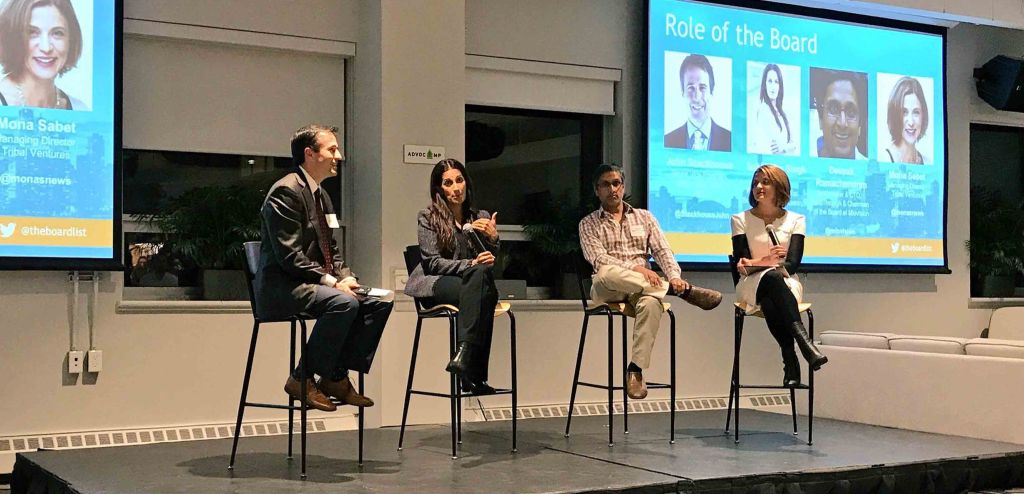
To better understand the supply side challenges of board diversity, I led a discussion on, “The Role of the Board” last week with theBoardList, a Canadian-run group from Silicon Valley that RBC supports to curate private lists of board-eligible women for different sectors and markets, including Canada. Joining me were Sukhinder Singh Cassidy, theBoardlist’s founder; Deepak Ramachandran, a prominent venture capital and tech investor; and Mona Sabet, managing director of Tribal Ventures, an M&A advisory firm in the Valley.
So, how can we help more women get to the board list?
Here’s some of what they had to say:
1. Why Join a Board? (Hint: It’s Not the Money)
Cachet aside, boards can be excessive taxes on directors’ time, with weekends and evenings going to prep time, and meetings eating into your day job. For most directors, the benefits make it worthwhile — and it’s not about money or status. Singh Cassidy highlighted the personal fulfillment she finds in helping companies grow, adding jobs and building communities, and helping entrepreneurs succeed. Ramachandran finds board work “exercises a different part of the brain.” Not only does he help entrepreneurs; he finds start-up boards grow his network and expand his influence beyond any one company.
2. What Do Start-Up Boards Look For?
Most directors start with start-up companies and growth firms. Beware: the boards of young, fast-growing companies aren’t just there for the ride. They have to pull their weight plus more, guiding and challenging the CEO while helping firms navigate the strategic landscape, without the resources of bigger firms. Think rowing scull, not racing yacht.
3. What Skills Are Needed Most?
Effective board members open doors to key business partners, and try to bring specialized knowledge — finance or marketing, usually — to the table. Specialists are most in demand, especially if they can help an audit committee. Oddly, human resources less so. This is particularly strange in light of the general sentiment that talent is a company’s most important asset.
4. Do You Look the Part?
Boards tend to look for new members to fit a certain bill. Perhaps they want a digital thinker. Or someone with social values, or political connections. But don’t think your resume tells the whole story, at least not well. Singh Cassidy said to start by looking at your online headshot (because that’s what search committees and head hunters will see). Do you look digital?
5. Can You Play the Part?
Even if you’re a position player — the coveted specialist — it may not be enough. A company big enough to have a strong board is big enough to have strong position players — and they’re in management. They don’t need another sales veteran. What they do need is a big thinker, with a curious mind, unafraid to show authority. Are you a thought leader in your field? Have you written or given TED Talks about topics that will excite the room? When a board comes calling, they’ll want to know as much about your influence as your experience. Make sure you have some.
6. Soft Hands or Sharp Elbows?
While we push rightly for diversity, boards also need to work as one unit (sculling, remember.) They need to foster debate, but then present as a united front. And they must come together around the ultimate litmus test: the hiring and/or firing of a CEO. “Boards are supposed to question the CEO, which isn’t fun,” Sabet told the room. It’s not an environment that tends to welcome lone wolves, or outliers. It’s a group that needs people who can manage conflict, not add to it. Good boards have lots of debate, and need people who can land the debate without a crash-and-burn. Are you one of those? Can you negotiate, probe, critique and communicate? These same qualities are all the rage in the labour market. Boards are no different.
7. Who’s Singing Your Song?
Everyone’s got a rap or two against them. Perhaps it’s moodiness, or an inability to warm up a room. When the search gang digs into your story — and they will — have you established a positive narrative with your network to overshadow any naysaying?
8. It’s Not About You (Alone)
Boards are looking for a missing piece to a puzzle. Just because you’re not that piece doesn’t reflect poorly on you as a candidate, it’s just that you may not add the exact qualities they need to make the group whole. Whether it comes down to experience or personality, you may not be the right person. And guess what, they may not be right for you either. “Every Board that wants you, you may not want. Go where the culture fits,” Singh Cassidy said.
9. Can You Connect With the CEO?
Boards can be full of contradictions. They’re there to keep the CEO, and management, in check. They’re also a CEO’s best source of wisdom, contacts and encouragement, especially for growth firms. “The CEO is looking for someone they can learn from,” Sabet said. She finds women, too often, don’t market themselves as CEO counsellors, instead relegating themselves to the role of position player. Reality is, that’s usually the job of management — or the armies of consultants they can hire.
10. How’s Your Network?
Too many people think they will be recruited for boards solely based on their own merits and experience. In reality, it takes a lot more hustle than that. Are you actively networking with CEOs or other board members? Will you be top of mind — any mind — when an opening emerges? And is your story sufficiently known, so people won’t scratch their heads wondering who you are?
Remember, board selection is not like any other recruitment exercise. It’s about team building, balancing power, personal brands and collective wisdom. And a lot of hard work. But find the right fit, and you’ll be hooked.
our stories
Videos that showcase Canadian entrepreneurs changing the world. Learn and be inspired.
RBC has joined forces with the C100 to share stories of Canadian entrepreneurs and our connections with Silicon Valley. “our stories” is your inside track on what it takes to succeed as a global player. RBC and C100 will be sharing videos that showcase Canadians changing the world, provide real-life stories of successes (and failures) and advice on how to succeed as an entrepreneur.
RBC is committed to sharing Canadian technology, entrepreneurship and innovation stories to elevate the conversation at home and abroad. Sharing and highlighting content elevates the conversation around infrastructure, education, talent, regulation and resources needed for economic prosperity in Canada.
C100 is dedicated to giving back to the Canadian innovation economy and fostering the next generation of successful entrepreneurs and innovative companies in Canada. Showcasing Canadian business thought leaders in the San Francisco Bay area through storytelling sheds light on their successes, their challenges and their advice for those who are building global players based in Canada.
About the C100:
C100 is a non-profit, member-driven association of Canadian thought leaders in the San Francisco Bay Area committed to supporting and accelerating the innovation economy in Canada. The C100 represents a select group of experienced entrepreneurs, executives of leading technology companies, and venture capital investors.
our stories
Videos that showcase Canadian entrepreneurs changing the world. Learn and be inspired.
RBC has joined forces with the C100 to share stories of Canadian entrepreneurs and our connections with Silicon Valley. “our stories” is your inside track on what it takes to succeed as a global player. RBC and C100 will be sharing videos that showcase Canadians changing the world, provide real-life stories of successes (and failures) and advice on how to succeed as an entrepreneur.
RBC is committed to sharing Canadian technology, entrepreneurship and innovation stories to elevate the conversation at home and abroad. Sharing and highlighting content elevates the conversation around infrastructure, education, talent, regulation and resources needed for economic prosperity in Canada.
C100 is dedicated to giving back to the Canadian innovation economy and fostering the next generation of successful entrepreneurs and innovative companies in Canada. Showcasing Canadian business thought leaders in the San Francisco Bay area through storytelling sheds light on their successes, their challenges and their advice for those who are building global players based in Canada.
About the C100:
C100 is a non-profit, member-driven association of Canadian thought leaders in the San Francisco Bay Area committed to supporting and accelerating the innovation economy in Canada. The C100 represents a select group of experienced entrepreneurs, executives of leading technology companies, and venture capital investors.