

 EN


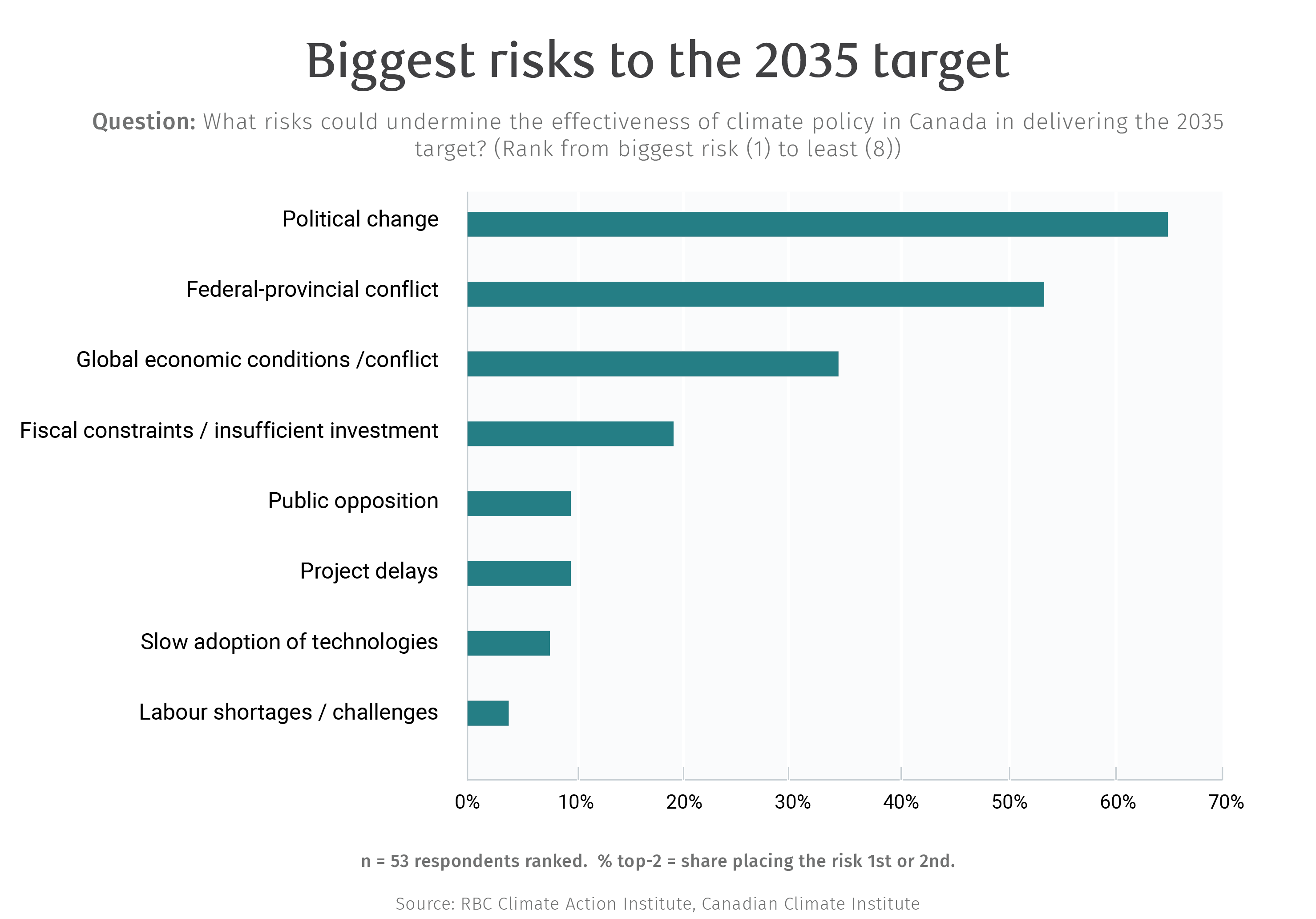
Politics—not technology adoption or project delays—is the biggest risk to Canada achieving its stated emissions goals. That’s the view of a majority of Canada’s climate experts in RBC Climate Action Institute and the Canadian Climate Institute’s inaugural survey on climate policy. The survey consisted of 65 climate experts between June 25 and July 24, 2026, spanning academia, advocacy, industry and finance, aimed to assess the state of Canadian policymaking through the lens of many who watch it closely.
Political winds have shifted since then, with changed leadership in British Columbia, a Democrat wave in the United States that has the potential to renew several low-carbon incentives, and a new federal budget from Ottawa that appears to bring climate competitiveness back as a central piece of Canada’s quest to boost capital and trade. Still, it’s early days for a change sentiment to trickle down into policy measures.
Among the panellists, there was broad consensus on the durability of Canada’s climate policies over the next 10 years: with 56% labelling it fragile or very fragile, nearly a quarter were neutral, while 17% felt it was durable.
There was also broad agreement that Canadian climate action needs to be balanced by the country’s ability to remain economically competitive: 86% of respondents believe international developments on environmental policy are relevant or very relevant to Canada’s climate trajectory. The finding confirms the broader reset already underway across global climate policy.
Here are some key highlights from the survey:
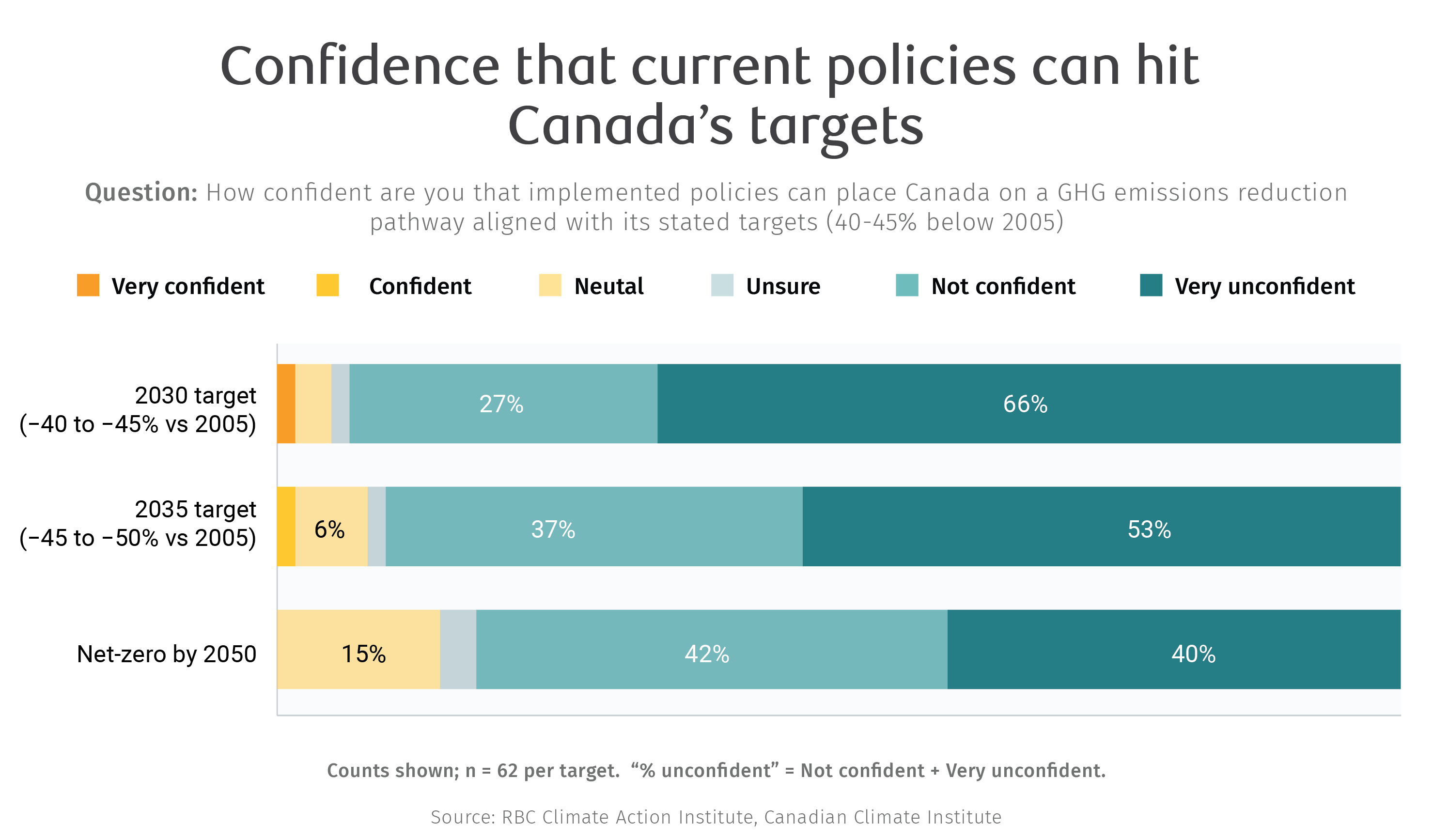
1. Experts are in a pessimistic mood. 73% believe federal government policy is “weaker” or “much weaker” than five years ago; only 14% think it’s stronger. Nine out of 10 panellists were either “not confident” or “very unconfident” that Canada would meet its 2030 GHG emissions reduction targets.
2. But some are still on the fence on 2050 goals. Around 18% were neutral or unsure about Canada hitting its net-zero targets.
How would you rate Canada’s current climate policy frameworks in their effectiveness at reducing GHG emissions?
n = 62. Source: Climate Action 2027: Government Tracker (fielded Jun 25 – Jul 24, 2026).
| Response | Count | % of n |
|---|---|---|
| Ineffective | 28 | 45% |
| Neutral | 16 | 26% |
| Effective | 12 | 19% |
| Very ineffective | 4 | 6% |
| Unsure | 2 | 3% |
| Total | 62 | 100% |
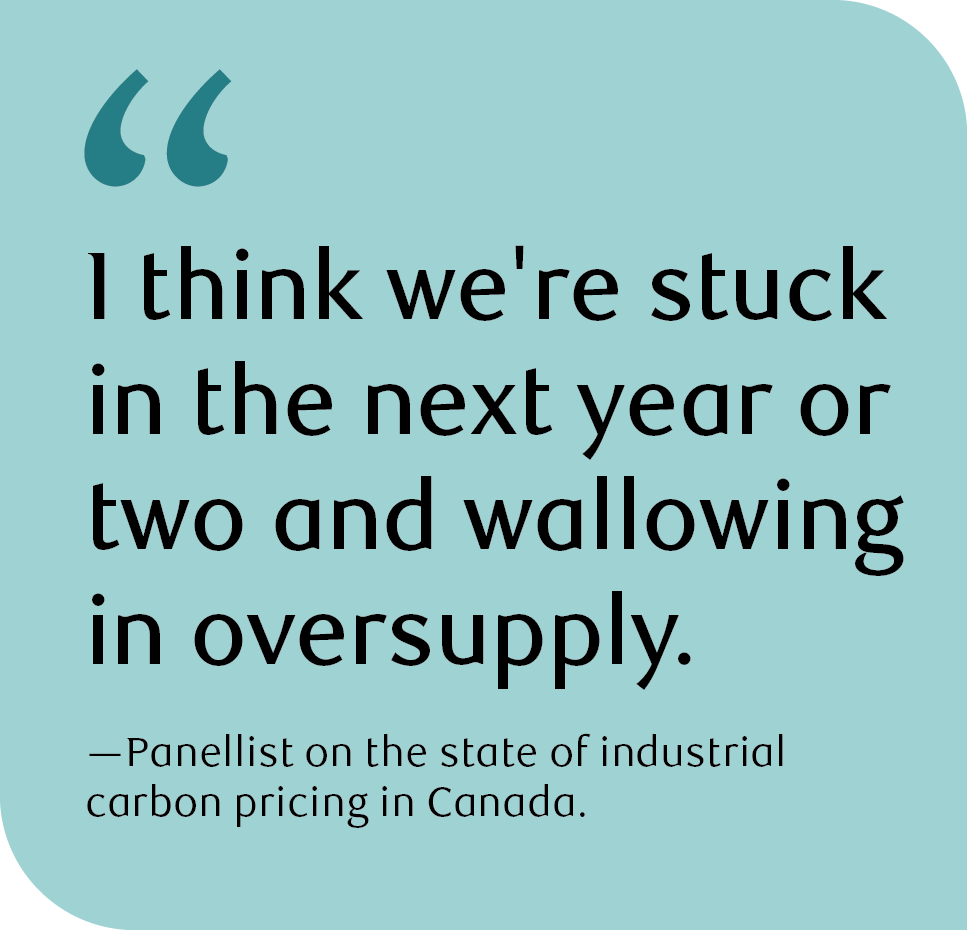
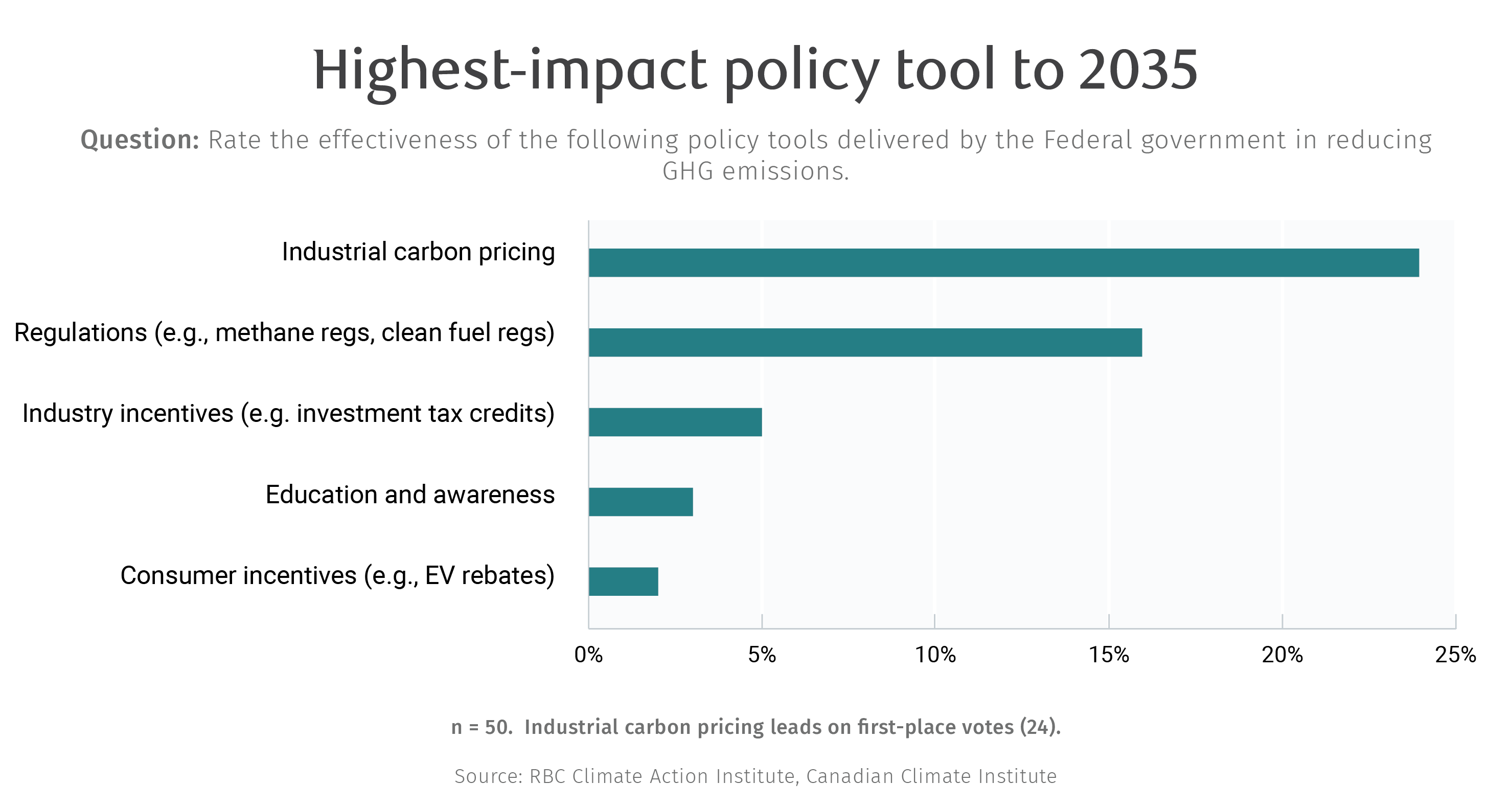
3. Industrial carbon pricing is seen as the most effective tool. It ranks among those surveyed as the single most effective federal policy for reducing emissions through to 2035, receiving 24 of 50 first-place rankings. Regulations were a distant second, while funding programs such as the scrapped consumer carbon pricing regime was ranked last.
4. Climate funding is seen as ineffective. Four in 10 experts expect only about 50-70% of announced federal climate funding to be fully deployed. Funding programs rank second last among federal policy tools.
5. Electricity, Canada’s seemingly emission-busting workhorse, is expected to lead emissions fight. It was chosen as best positioned to reduce emissions by 2035, receiving 32 of 55 first-place rankings. Transportation was ranked second.
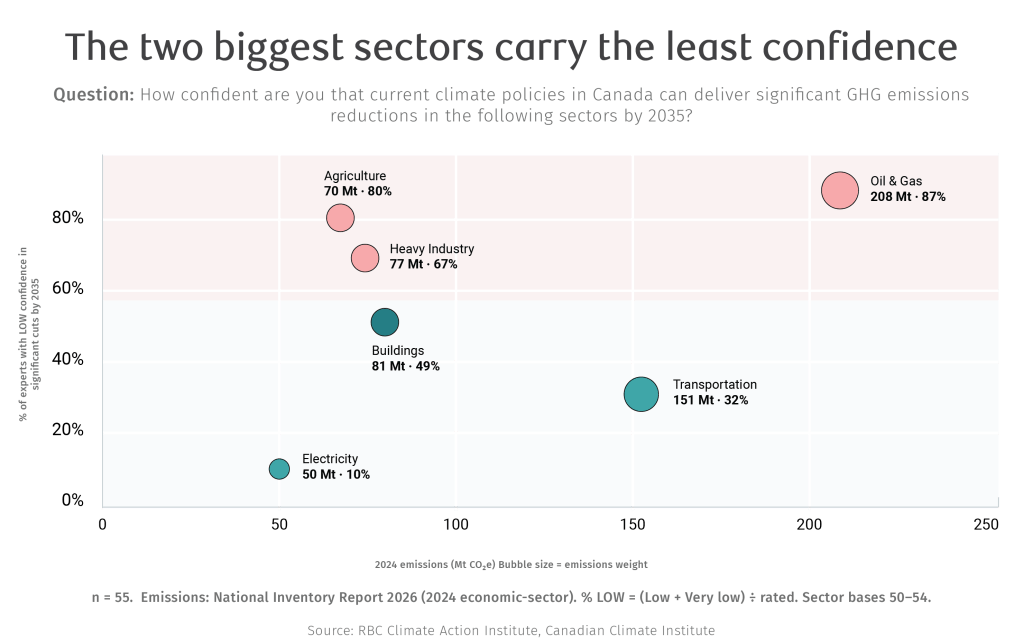
6. Expectedly, oil and gas came in last. The sector, which accounts for 30% of national emissions, garnered low confidence in meeting its targets by 2035 from 62% of the panel.
7. Alberta’s policy tools got tough grades: 61% labelled its industrial carbon pricing (TIER) regime as ineffective or very ineffective, 57% had similar views on the province’s funding programs, and 65% for consumer incentives. Regulations passed muster with 65% effective or neutral, while 61% felt industry incentives were either effective or neutral.
8. British Columbia’s industrial carbon pricing received strong praise. Two out of three respondents labelled it as effective, or very effective. Strong majorities felt B.C. regulations (83%), consumer incentives (77%) and funding programs (66%), industry incentives (55%) were robust.
9. Ontario scored a slew of “neutral” tick marks, veering on the negative. It was mostlyfor its industrial carbon pricing policy, regulations and funding programs, suggesting more policy upgrades are needed to boost provincial climate action. Bright spot: 44% picked its consumer incentives as effective.
10. Quebec is the climate A grader. The province’s industrial carbon pricing (92%), and consumer incentives (83%), scored the highest marks among the four largest provincial economies that account for roughly 80% of national emissions.
Government Pulse Check
The government pulse check is informed by quantitative and qualitative insights on government spending, government policy impact on GHG emissions trajectory, and climate policy experts’ perspectives on climate policy and its efficacy in Canada.
The RBC Climate Action Institute research team tracks annual government spending at the federal level and in the four largest provinces by gross domestic product to maintain tracking of government fiscal commitment to climate action.
To understand if government policies and spending are tracking towards 2035 and 2050 targets, the research team also considers the modelled projections of policy on GHG emissions scenarios to provide a directional, quantitative lens on policy efficacy in meeting GHG targets. These projections are produced each year by Environment and Climate Change Canada.
Finally, the research team surveyed an expert policy panel of more than 40 to glean additional detailed insights on the impact of current policies on Canada’s GHG emissions reduction targets. CAI solicited their views of policy efficacy (i.e., did it achieve its desired result), policy impact (i.e., broader consequences of policy–intended and unintended), policy durability (i.e., long-term stability of policy). This survey was conducted between June and August 2026.
The list of participants for the expert policy panel was curated by the Climate Action Institute and the Canadian Climate Institute and included academics, policy experts, former government officials and analysts. Key policy actions identified in the Government Pulse Check—such as carbon pricing, methane regulations and Clean Fuel Regulations, consumer incentives, industry incentives, funding programs and education and awareness—were deemed by our Climate Action team, in collaboration with external climate policy experts, to have a meaningful impact on the trajectory of Canada’s emissions.
Business Pulse Check
The business survey tracks year-over-year change in business leaders’ approach to climate action in their strategies, operations and products and services. The businesses are primarily focused on the six key sectors identified by the CAI Team as our focus areas, namely: Buildings, Agriculture, Oil & Gas, Transport, Heavy Industry, and Electricity.
The business survey is run by Kantar Canada Inc., a third-party vendor in June and July 2026 and attracts roughly 150 business responses.
Kantar Canada’s business survey is a self-administered online poll. It targeted vice-presidents and business leaders on a best-effort recruitment process. The survey was targeting complete responses from 100-150 companies.
Industry coverage included Buildings, Agriculture, Oil & Gas, Transport, Heavy Industry, and Electricity, with top up in ‘other’ industries.
Consumer Pulse Check
The consumer survey tracks year-over-year change in Canadian consumers’ perspectives, experiences and actions on climate change.
The consumer survey is run by a third-party vendor, Ipsos Canada, between June and July 2026 and collects roughly 2,000 individual responses from its Ipsos online omnibus in English and French across Canada.
This survey examines the views, experiences, and actions related to climate change among adults in Canada, the United States, and the United Kingdom.
All three countries were asked the same three questions, while respondents in Canada were asked an additional 11 questions.
The survey was conducted online between June 3–5, 2026 in Canada, June 8–9, 2026 in the United States; and June 12–16, 2026 in the United Kingdom.
Surveys were completed by adults aged 18 and older through the Ipsos I-Say Panel.
Results are considered accurate within a confidence interval (+/- percentage points), 19 times out of 20, compared to what would have been obtained if all adults aged 18+ had been surveyed. Sample sizes and confidence intervals are as follows:
CA n=2001 +/- 2.7
To allow for international comparisons, Ipsos ran select questions in the U.K. and U.S. to gleam insights from international consumers. These surveys run in June and July and collect roughly 1,000 responses each.
Sample sizes and confidence intervals are as follows:
U.S. n=1005 +/- 3.8
U.K. n=1122 +/- 3.6
Government Survey Acknowledgments
RBC Climate Action Institute would like to thank the Canadian Climate Institute and especially Dave Sawyer, Principal Economist, and Julia Kilpatrick, Vice President, External Affairs, for their collaboration on the survey.
We would also like to thank the following people for participating in the government survey:
-
Bentley Allan, Vice-President, Future Economy Transition Accelerator
-
Louis Beaumier, Directeur exécutif, Institut de l’énergie Trottier – Polytechnique Montréal
-
Vittoria Bellissimo, President and CEO, Canadian Renewable Energy Association
-
Michael Berends, CEO, ClearBlue Markets
-
Mel Cappe, Distinguished Fellow, Munk School of Global Affairs and Public Policy
-
Aaron Cosbey, Senior Associate, International Institute for Sustainable Development
-
Alison Cretney, Executive Director, Energy Futures Lab
-
Corey Diamond, Executive Director, Efficiency Canada
-
Simon Donner, Professor, University of British Columbia
-
Rachel Doran, Executive Director, Clean Energy Canada
-
Jason Dion, Chief Impact Officer, Clean Economy Fund
-
Brad Griffin, Director, Energy and Materials Research Group, Simon Fraser University
-
Michael Gullo, Vice-President, Policy, Business Council of Canada
-
Tyler Hamilton, Senior Director, Climate, MaRS
-
Robert Hornung, Independent Consultant, Net-Zero Advisory Body Co-Chair
-
Don Iveson, Principal, Civic Good
-
Robert Johnston, Director, Energy and Natural Resources, University of Calgary School of Public Policy
-
Jeremy Kronick, President and CEO, C.D. Howe Institute
-
Tamara Krawchenko, University of Victoria
-
Kwatuuma Cole Sayers, Executive Director, Indigenous Power Coalition
-
Na’im Merchant, Executive Director, Carbon Removal Canada
-
Andrea Moffat, Strategic Advisor, Addenda Capital
-
Normand Mousseau, Professor and Scientific Director, Université de Montréal and Institut de l’énergie Trottier, Polytechnique Montréal
-
Nancy Olewiler, Professor Emerita, Simon Fraser University
-
Martin Olszynski, Associate Professor, University of Calgary
-
Nicholas Rivers, Professor, University of Ottawa
-
John Robinson, Professor Emeritus, University of Toronto
-
Daniel Rotman, Executive Director, Equiterre
-
Aaron Schroeder, CEO, Brightspot Climate Inc.
-
Blake Shaffer, Associate Professor, University of Calgary
-
Chris Severson-Baker, Executive Director, Pembina Institute
-
Merran Smith, President, New Economy Canada
-
Roger Street, Green Templeton College, University of Oxford
-
Katie Sullivan, Global Managing Director, IETA
-
Tim Weis, Sr. Director, Industrial Decarbonization, Pembina Institute
-
Dan Woynillowicz, Principal, Polaris Strategy + Insight.
This article is intended as general information only and is not to be relied upon as constituting legal, financial or other professional advice. The reader is solely liable for any use of the information contained in this document and Royal Bank of Canada (“RBC”) nor any of its affiliates nor any of their respective directors, officers, employees or agents shall be held responsible for any direct or indirect damages arising from the use of this document by the reader. A professional advisor should be consulted regarding your specific situation. Information presented is believed to be factual and up-to-date but we do not guarantee its accuracy and it should not be regarded as a complete analysis of the subjects discussed. All expressions of opinion reflect the judgment of the authors as of the date of publication and are subject to change. No endorsement of any third parties or their advice, opinions, information, products or services is expressly given or implied by Royal Bank of Canada or any of its affiliates. This document may contain forward-looking statements within the meaning of certain securities laws, which are subject to RBC’s caution regarding forward-looking statements. ESG (including climate) metrics, data and other information contained on this website are or may be based on assumptions, estimates and judgements. For cautionary statements relating to the information on this website, refer to the “Caution regarding forward-looking statements” and the “Important notice regarding this document” sections in our latest climate report or sustainability report, available at: https://www.rbc.com/our-impact/sustainability-reporting/index.html. Except as required by law, none of RBC nor any of its affiliates undertake to update any information in this document.