

 EN
EN 

➔ How the proposed West Coast pipeline and Pathways project impact emissions
➔ Six energy transition trends triggered by conflicts
➔ Tired energy batteries get a new lease on life
Signals
Canada’s zero plastic waste agenda is a U.S. target. Lost in the flurry of blocked bridges and wider CUSMA uncertainty, zero plastic is another of Washington’s trade grievances against Canada. Will Ottawa be forced to backtrack on the program? It’s making a dent: Since the ban began in 2018, the Canadian shoreline cleanups have reported declines in targeted items (60% reduction in straws, 25% fewer bags), while microplastics in Great Lakes water have plummeted since the microbead ban, experts told a Senate Committee recently.
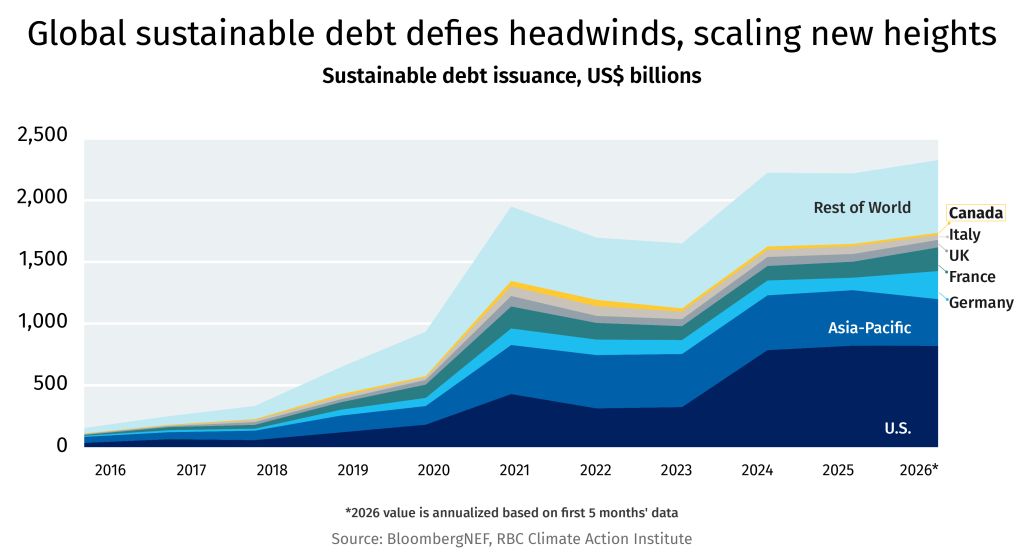
Global sustainable debt issuance hit a five-year high. Issuance reached nearly US$1 trillion in the first five months of 2026. Still, at US$216 billion issued in May, it only accounted for 4.6% of total global debt offerings in the month. Green and sustainability bonds and securitized social debt accounted for over three quarters of the issuance, according to Bloomberg New Energy Finance. Canada issued only 0.7% the global market from its 2022 highs when it captured 3.1% of issuance.
Retired electric vehicle batteries are getting a second life. Vancouver-based Moment Energy started what it describes as the world’s largest battery repurposing facility, converting retired EV batteries into stationary energy storage systems, with a target of one gigawatt-hour of production by 2030. Backed by Canadian and U.S. governments, the Amazon Climate Pledge Fund, and others, Moment aims to utilize the first generation of EV batteries that are set retire. While they may not have the juice to meet exacting automotive performance standards, they can be repurposed for grid storage.
The new Calgary Stampede for Canadian energy
A federal and Alberta-backed West Coast pipeline, an Alberta-Ontario Northern Shield corridor, Ottawa’s support for B.C. LNG—it seems to be a stampede for energy in recent days.
Then came Canada’s big action on climate change: five major oilsands firms agreed with the Alberta province and federal government to build the long-planned Pathways carbon capture and storage (CCS) project.
The developments could set the pace on emissions in the country, and be a leading indicator for how the slew of other major projects would require Canadian policymakers to balance economic development with their stated climate ambitions.
Energy Policy Lead Shaz Merwat examines the Pathways memorandum between the companies, Alberta and the federal government:
It was a one-two punch. Days before the Pathways announcement was the Alberta-to-B.C. West Coast Oil Pipeline (WCOP), to move up to a million barrels a day to the Pacific coast. But the same policy package that fast-tracked the pipeline is built upon the withdrawal of marquee federal tools that had been setting the timeline on oilsands emissions, most notably the proposed oil and gas emissions cap. What Ottawa kept was the funding: the 50% federal carbon capture, storage and utilization (CCUS) investment tax credit, stacked with Alberta’s incremental support. The “stick” was withdrawn, but the “carrot” stayed.
There appears to be an emissions file reset. The market-oriented federal government has stopped using regulatory timelines to force the pace and left the pace to the market—and to Alberta. Prime Minister Mark Carney has been unusually direct about the near-term costs: the changes, he said, will mean emissions would be “higher in the next few years than they were projected to be under the previous government’s plan,” calling the plan he inherited “too expensive” and “too divisive.” In effect, Carney rebooted the emissions file.
Pathways is the first project proposed under the rebooted climate regime. Five oilsands majors—operating as the Oil Sands Alliance—agreed to advance a scaled-back version of the Pathways carbon-capture project, with binding terms still to come. The commitments have been resized from what the alliance originally promised in 2021 (see table).
Oilsands Alliance’s Emissions Reduction Commitments
| Original | Revised | Revised % of original | |
|---|---|---|---|
| Initial Phase / Phase 1 | |||
| Total emissions reductions | 22 MT | 6 MT | 16 MT less |
| Emissions reductions, CCS project | 10-12 MT | 6 MT | 4-6 MT less |
| Emissions reductions deadline | 2030 | 2035 | + 5 years |
| Additional Phases / Phase 2-3 | |||
| Total emissions reductions | 46 MT | 10 MT | 36 MT less |
| Emissions reductions, CCS project | 28-30 MT | Undisclosed | 18-30 MT less |
| Emissions reductions deadline | 2050 | 2045 | – 5 years |
| All Phases / Phases 1-3 | |||
| Total emissions reductions | 68 MT | 16 MT | 52 MT less |
| Emissions reductions, CCS project | 40 MT | Min. 6 MT | 24-34 MT less |
| Emissions reductions deadline | 2050 | 2045 | – 5 years |
Source: Oilsands Alliance, RBC Capital Markets, RBC Climate Action Institute
The alliance’s total reduction commitment is now 16 metric tonnes (Mt) annually by 2045, against an original plan of roughly 68 Mt—and the original figure was always the narrow one, covering operational (Scope 1 and 2) emissions only, not the far larger volume released when the barrel is burned (Scope 3). Set against oilsands emissions of roughly 90 Mt per year, a 16 Mt commitment leaves most of the sector’s footprint outside any quantified plan.
Climate is a square peg for a round hole. The November Canada–Alberta MOU named its own objective as achieving net-zero emissions by 2050 while unlocking the growth of Alberta’s oil and gas—including the pipeline. So, the deal simultaneously declares a 2050 destination, enables higher near-term production and emissions, and resizes the sector’s flagship abatement project down by more than three-quarters—without publicly reconciling the three.
Canada’s 2050 net-zero goal remains intact. Net-zero-by-2050 remains legislated federally. Alberta still holds a 2050 goal, now worded as a carbon-neutral economy. The MoU keeps the ambition, even though it remains unclear at the company level.
So, is this bad for the climate? It depends on what you count as progress. The pipeline adds an estimated 15.5–18.2 Mt a year upstream through 2030 if it drives new output; offsets from rail-to-pipeline switching and displacing higher-emissions Asian crude bring the net closer to 10–12 Mt. The alliance’s 16 Mt nominally covers that—but nominally is working hard: the pipeline emissions are nearer-term (still likely 6-7 years away). The 16 Mt is an almost 20-year target in 2045 with no accompanying published bridge to net-zero by 2050. Under the old regime, progress meant distance to a target on a regulatory clock. Under the new one, the target stays on the books, but the clock belongs to the market, and the flagship project is sized to what’s deliverable now, not what 2050 requires. Whether that’s a slower road to the same place or a quiet exit remains unanswered. That ambiguity, more than any other number, is what’s new.
How the Ukraine war accelerated EU’s energy transition
Global emissions from the energy sector rose 1.1% in 2025, with the U.S. accounting for more than a third of the rise, according to the Energy Institute’s Statistical Review of World Energy, now in its 75th edition. Once published by BP Plc, it’s now published by the non-profit Energy Institute in partnership with consultants Ember, Kearney and KPMG.
The big takeaway: there is fragmentation of climate policies around the world, but renewable energy deployment is also accelerating at a scale that is reshaping entire energy systems.
Some key highlights from the report that speak to wider trends:
-
The sun is shining. Globally, solar energy achieved 30% growth in 2025, and its share of total power generation reached 8.7%–eclipsing wind (8.4%) for the first time and almost equalling nuclear’s share of 8.8%.
-
The U.S. is an emissions laggard: In absolute terms, the increase in U.S. emissions was four times greater than that of China. North America was also the only region to increase its carbon intensity of energy in 2025.
-
Ukraine war has already altered behaviour. The European Union saved €72 billion from avoided fossil fuel imports in the past four years, by deploying wind and solar in the aftermath of Russia’s invasion of Ukraine.
-
Battery capacity is expanding rapidly: Global battery capacity expanded by 66% to 302GW in 2025, as countries looked to cut reliance on fossil fuels. The accelerated deployment of wind and solar, plus supportive policy environments such as REPowerEU, meant that by 2025 the two sources generated 852TWh, more power than coal, gas and oil combined (760TWh).
-
China is insulating itself from periodic fossil-fuel disruptions. China’s road fuel demand is already plateauing and remains six times lower than the U.S. on a per capita basis, as the Asian country adopts electric vehicles.
-
Fossil fuel growth is decoupling from economic growth. In Europe, fossil fuel consumption has fallen by 15% over the past decade. In North America it has grown by 1%, but it masks a switching from coal to gas over the same period. It has fallen 4% in South and Central America, helped by renewables in major markets like Brazil.
Conversations
-
Investors are adjusting to the federal and provincial governments—and First Nations—playing more active roles in the energy business, noted John Stackhouse at the Calgary Stampede. This represents a new Canadian reality and signals the rise of state capital globally. The Calgary event, once a celebration of frontier-spirited free enterprise, is now more comfortable being a meeting ground for government and business.
-
Canada has entered a new smoke era, where elevated wildfire smoke exposure is becoming the new baseline, writes Dave Sawyer, principal economist at the Canadian Climate Institute, in a new briefing. His key finding: wildfires’ health costs are large, about $19 billion annually, driven primarily by accelerated mortality.
-
Can AI help decarbonize construction? That was Housing Policy Lead Stephanie Shewchuk’s key takeaway from a George Brown Polytechnic event. One approach: optimizing material use. Read Stephanie’s key insights here.
Curated by Yadullah Hussain, Managing Editor, RBC Climate Action Institute.
Climate Crunch would not be possible without John Stackhouse, Jordan Brennan, John Intini, Farhad Panahov, Lisa Ashton, Shaz Merwat, Vivan Sorab, Caprice Biasoni, Lavanya Kaleeswaran, Joelle Schonberg and Alicja Siekierska.
Have a comment, commendation, or umm, criticism? Write to me here (yadullahhussain@rbc.com)
Climate Crunch Newsletter
This article is intended as general information only and is not to be relied upon as constituting legal, financial or other professional advice. The reader is solely liable for any use of the information contained in this document and Royal Bank of Canada (“RBC”) nor any of its affiliates nor any of their respective directors, officers, employees or agents shall be held responsible for any direct or indirect damages arising from the use of this document by the reader. A professional advisor should be consulted regarding your specific situation. Information presented is believed to be factual and up-to-date but we do not guarantee its accuracy and it should not be regarded as a complete analysis of the subjects discussed. All expressions of opinion reflect the judgment of the authors as of the date of publication and are subject to change. No endorsement of any third parties or their advice, opinions, information, products or services is expressly given or implied by Royal Bank of Canada or any of its affiliates. This document may contain forward-looking statements within the meaning of certain securities laws, which are subject to RBC’s caution regarding forward-looking statements. ESG (including climate) metrics, data and other information contained on this website are or may be based on assumptions, estimates and judgements. For cautionary statements relating to the information on this website, refer to the “Caution regarding forward-looking statements” and the “Important notice regarding this document” sections in our latest climate report or sustainability report, available at: https://www.rbc.com/our-impact/sustainability-reporting/index.html. Except as required by law, none of RBC nor any of its affiliates undertake to update any information in this document.