

 EN
EN 

Climate change may have slipped on Canadians’ priority list, but it remains front and centre when it hits closest to home—most notably in the form of wildfires inflicting property damage, raising insurance costs and impacting health.
That’s one of the key findings of RBC Climate Action’s latest consumer survey, which polled 2,000 Canadians. The survey is part of the Institute’s third annual Climate Action report, which reviews Canada’s progress on its environmental goals. (The full report is out Tuesday, January 13.)
Concerns around climate change has ebbed and flowed in tandem with Canadians’ economic prospects. In last year’s Climate Action report, 14% of respondents reported climate change as one of their top three concerns, down from 26% in 2019. This is consistent with the general observation that climate change, while important, ranks below pocketbook issues such as the cost of living and job security. When the economy is strong and jobs are secure, people can ‘afford’ to prioritize climate action. In times of economic stress, climate change tends to be de-prioritized.
This year’s consumer survey, conducted by market research firm Ipsos, again finds Canadians focused more on the economy, jobs and personal finances. However, the frequency of extreme weather events ensures that environmental issues continue to simmer just under the surface.
Here’s what we heard in the survey:
-
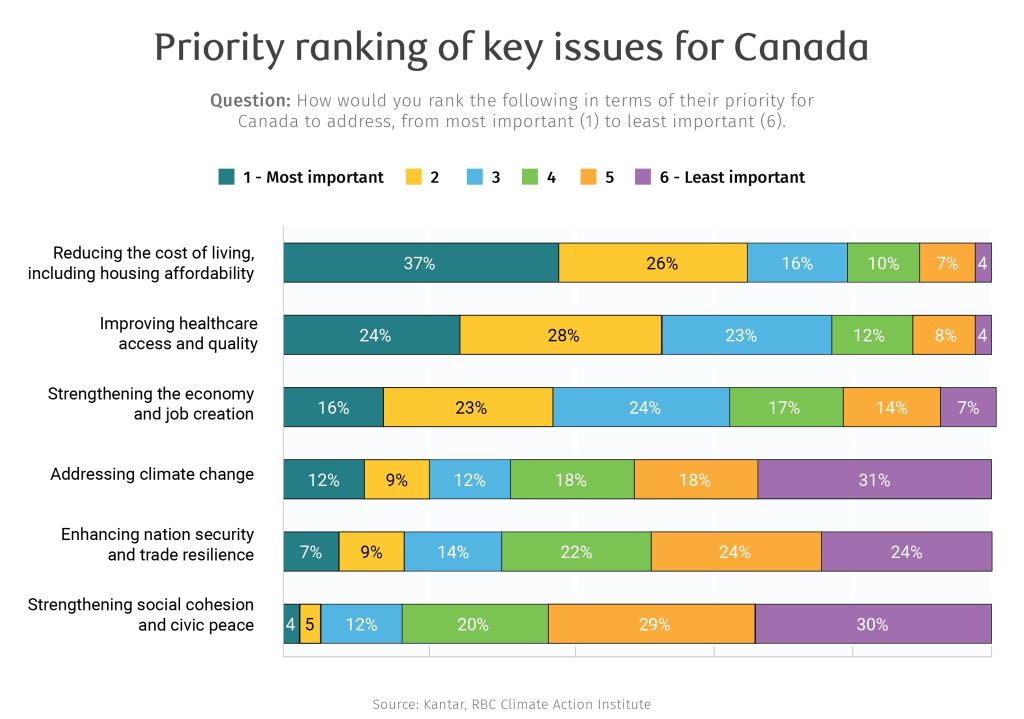
It’s about personal issues right now. Cost of living (79%), healthcare (75%) and economy and jobs (63%) were the top three challenges for most Canadians. Only 33% of respondents listed climate change as a top three issue. One-in-eight Canadians (12%) identified it as their top priority.
-
More than three out of five Canadians (67%) didn’t see climate change as a top three priority. It appears that climate change as an abstract concept is struggling to capture the attention of Canadians in the same way as the immediate impact of wildfire smoke or urban flooding does.
-
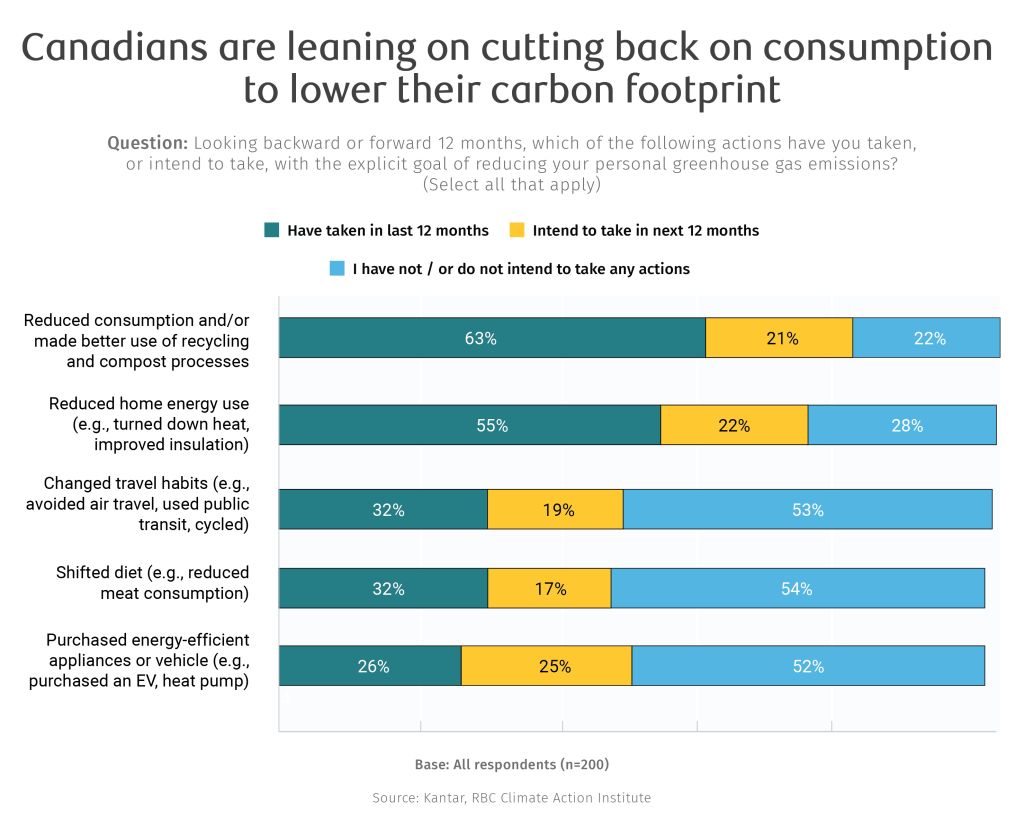
That does not necessarily mean climate inaction. Canadians are trying to reduce their carbon footprint in measures they can control: avoiding air travel and cutting meat consumption. Strong majorities either reduced or intend to reduce consumption or boost recycling efforts (84%), cut home-energy usage (77%), while roughly half changed or intended to change their travel habits (51%) and diets (49%).
-
Weather over climate: Around 60% of respondents would place greater emphasis on climate action if extreme weather events were even more frequent. Canada’s last three wildfire seasons were among the worst according to federal records dating back to 1970.2 As the survey suggests, the frequency and intensity has had an immediate impact on the quality of life for many Canadians.
-
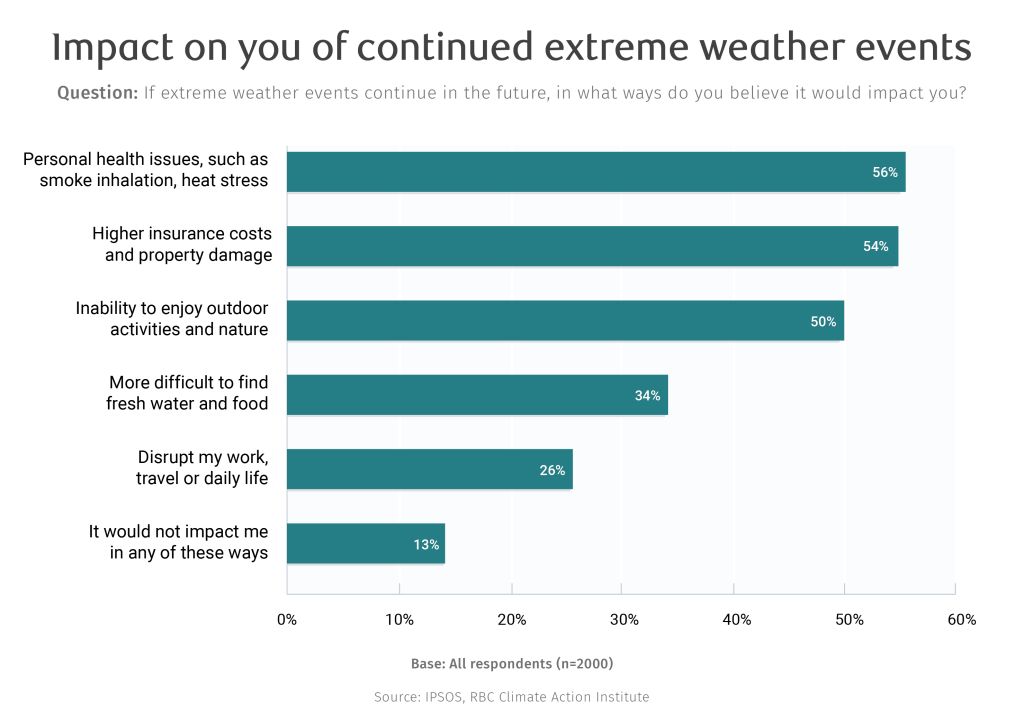
Canadians want wildfire-containment action: Personal health (56%), including smoke inhalation and heat stress, topped the list of concerns from wildfires, followed by property damage and insurance costs (54%), and the inability to enjoy outdoor activities and nature (50%).
The challenge for policymakers and business leaders will be to harmonize environmental goals with other priorities and ensure economic growth does not override climate priorities.
This article is intended as general information only and is not to be relied upon as constituting legal, financial or other professional advice. The reader is solely liable for any use of the information contained in this document and Royal Bank of Canada (“RBC”) nor any of its affiliates nor any of their respective directors, officers, employees or agents shall be held responsible for any direct or indirect damages arising from the use of this document by the reader. A professional advisor should be consulted regarding your specific situation. Information presented is believed to be factual and up-to-date but we do not guarantee its accuracy and it should not be regarded as a complete analysis of the subjects discussed. All expressions of opinion reflect the judgment of the authors as of the date of publication and are subject to change. No endorsement of any third parties or their advice, opinions, information, products or services is expressly given or implied by Royal Bank of Canada or any of its affiliates. This document may contain forward-looking statements within the meaning of certain securities laws, which are subject to RBC’s caution regarding forward-looking statements. ESG (including climate) metrics, data and other information contained on this website are or may be based on assumptions, estimates and judgements. For cautionary statements relating to the information on this website, refer to the “Caution regarding forward-looking statements” and the “Important notice regarding this document” sections in our latest climate report or sustainability report, available at: https://www.rbc.com/our-impact/sustainability-reporting/index.html. Except as required by law, none of RBC nor any of its affiliates undertake to update any information in this document.