


 Canada - EN
Transportation
Hybrids are on the charge
Climate Action Index: Transportation | 2019 = base year
-
Resurgent electric vehicles (EV) sales1 helped the index recover from last year’s retreat. EVs are projected to rebound to 230,000 sales in 2026, from 180,000 last year, boosted by reinstated $5,000 federal incentives and imports of cheaper Chinese-made vehicles.2 Still, EVs make up about 1 in 10 new car sales in Canada, in line with stagnating U.S. rates, and in contrast to advancing European peers.3 Adoption is a tale of two Canadas: British Columbia and Quebec are leading, while the rest of the country averages single-digit adoption rates.4
-
Affordability is shaping the transition. Hybrid electric vehicles, offering lower fuel consumption, have outsold battery and plug-in electric vehicles combined since 2025.5, 6 It’s too early to determine whether the spike in gas prices driven by the Iran crisis impacted EV adoption. The Strait of Hormuz blockade added about 50 cents per litre to gasoline prices at its peak—for context, the scrapped consumer carbon tax added 20 cents per litre.7, 8
-
Medium and heavy-duty vehicle electrification is in the slow lane. The incentives for Medium and Heavy-Duty Zero-Emission Vehicles (iMHZEV) program expired with over half of its $547.5 million budget unspent. Despite enabling the purchase of nearly 12,000 vehicles–half of which were electric trucks (such as the Ford F-150 and Chevrolet Silverado), the underutilization signals weaker commercial adoption momentum.9
-
Canada wasn’t the only country to re-evaluate its supply-side policies. The EU eased its CO2 automobile standards from a 100% emissions reduction by 2035 to 90% with an offset mechanism.10 The U.K. retreated from its sales mandate policy, only to reinstate it with more flexibility.11 The U.S. went furthest, repealing its greenhouse gas (GHG) vehicle standards by rescinding the 2009 endangerment finding,12 and stripping fuel economy rules of penalties.13 In Canada, the federal government pivoted from a sales mandate that required 100% of new car sales to be EVs by 2035 in favour of revised GHG emission standards for new vehicles, aiming for a 75% EV adoption rate by 2035 by targeting a 57% intensity reduction from 172 to 74 gCO2e per mile.14 Estimates from the15 Pembina Institute and the international Council on Clean Transportation suggest further tightening would be needed to reach that goal.16 Meanwhile, a government announcement in October froze the standard at its 2026 level, with annual tightening resuming in 2030, while restating the adoption goal.
-
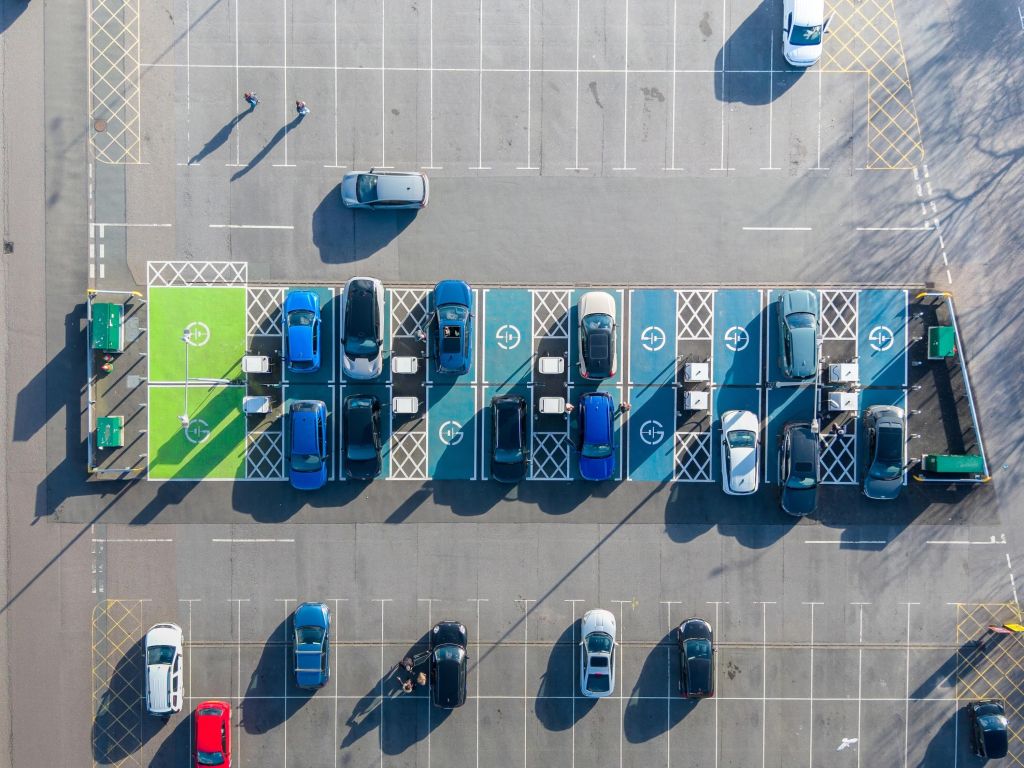
Charging is about three times cheaper than filling a gas tank in Canada.17 An estimated 800,000 EV owners rely on home chargers,18 while public charging has grown fourfold since 2019 to nearly 40,000 chargers.19 Ultra-fast chargers are also gaining ground, with their 250kW+ power output charging 300-kilometre-range batteries in 15-20 minutes. Their deployment doubled to 4,000 units last year and is projected to reach 5,500 by the year-end.20, 21
DOWN
-14%
Absolute emissions
2019–2024
DOWN
-10%
Emissions intensity
2019–2024
Case StudY
Plugging an EV infrastructure gap
One in 10 new vehicles sold in Canada by May 2026 came with a plug that can—in theory—be charged at home like phones.1
Except, that isn’t an available option for millions of Canadians living in condos or apartments without EV charging. Guelph, Ontario-based Skyline, a real estate owner, manager and developer with nearly 20,000 multi-residential units across Canada, didn’t want residents to hold back on a decision to switch to electric vehicles simply because charging wasn’t available at its buildings. As Fay Yachetti, Skyline’s director of optimization and sustainability, said, “EV charging is no longer a nice-to-have but a standard amenity that residents expect. EV charging protects our buildings’ competitiveness and long-term value, and advances our company-wide sustainability strategy.”
Ottawa’s support, through Natural Resources Canada’s Zero Emission Vehicle Infrastructure Program—a $680-million initiative aimed at federal government’s broader target to support deployment of 84,500 chargers, was key to getting the first wave of chargers off the ground for the company.2
The Challenge
Skyline’s effort addresses a major challenge: EVs are considered a useful technology to decarbonize road transport, a sector that accounted for 16% of global emissions in 2024, according to the Emissions Database for Global Atmospheric Research,3 and 22% of Canadian emissions.4
Over 70% of charging happens at home, according to a Canadian Automobile Association survey.5 Those with easy access to home charging are most likely to reap the convenience and saving benefits. The challenges are often two-fold: cost and scale.
Upfront capital can be a significant expense for building managers. Retrofitting existing parking can cost upwards of $10,000 per new charger, according to Skyline. Operating expenses, too, can be costly if chargers are left unused without adequate demand.
It would be a heavy lift: 70% of apartment units in the country that house about a quarter of Canadian households were built well before the first Tesla hit the road in 2008.6 7 Those buildings were designed for toasters, not for EV loads.
The Idea
Skyline charged ahead with a portfolio-wide approach to unlock scaled EV charging at its rental communities.
Integrating its 200-plus properties into one program allowed Skyline to negotiate for better pricing, prepare for government funding, and find the right technical partner. It also allowed the company to phase the rollout, rather than committing the full budget at once.
Phase One placed at least two chargers at the majority of properties Skyline operates. Phase Two used real utilization data from the first wave to optimize the rollout, adding chargers where demand warranted.
Skyline decided to price the charging at cost, with no margin on the electricity. “The return wasn’t on the chargers,” said Yachetti. “It was a more competitive, future-ready portfolio of apartment buildings.”
And now, it is exploring opportunities to generate revenue through Clean Fuel Regulations credits.
The initiative delivered 438,000 kWh of charging in 2025 by EV drivers, equivalent to annual emissions from 37 gasoline-powered passenger vehicles, according to Skyline.8 By June 2026, the company had installed 1,060 chargers and committed to incorporating EV charging in its new development designs going forward.9
The Obstacles
Charging is a highly digital process, requiring network connectivity to process payments and run diagnostics. Parking locations are usually connectivity blind spots, and Skyline found that many chargers simply couldn’t connect. Skyline responded by adding LTE network access at each affected site to boost connectivity.
Inspections brought a second challenge: some buildings couldn’t physically support the planned number of chargers without a major transformer upgrade. Skyline faced a choice: pour capital into infrastructure upgrades, or install only what it could carry and redeploy capital at a site where it could add capacity.
The Insight
Pick the right partners: You can’t optimize what you haven’t measured. Linking up with Swtch, a Toronto-based EV charging company specialized in multi-unit and commercial properties, provided the necessary analytics to balance matching the demand and limiting idle chargers. They also play a significant role in servicing and troubleshooting the chargers to minimize the downtime.
Public funding was the catalyst: Federal and provincial incentives made a rollout this size possible; Yachetti is candid that Skyline wouldn’t have deployed as many chargers without support from Natural Resources Canada and provincial incentives. But the longer-term impact goes beyond the funding: the company now sees charging as a standard element of its multi-residential development project plans.
An asset—and an amenity: Leveraging charging provides a competitive edge in attracting customers, and it doesn’t have to be treated solely as a cost item. Depending on the province that the chargers are located in, according to Skyline they can generate in the range of $0.25-0.30 per kWh in revenue by receiving Clean Fuel Regulations credits tied to emissions reduction.10
Skyline decided to price the charging at cost, with no margin on the electricity. The return wasn’t the chargers–it was a future-ready portfolio of apartment buildings.
Climate Action Index
-
We use the term EV in reference to battery and plug-in electric vehicles.
-
BloombergNEF; Electric Vehicle Outlook 2026; https://www.bnef.com/flagships/ev-outlook
-
BloombergNEF; Electric Vehicle Outlook 2026; https://www.bnef.com/flagships/ev-outlook
-
Statistics Canada; Table: 20-10-0025-01, New motor vehicle registrations, quarterly, by geographic level; https://www150.statcan.gc.ca/t1/tbl1/en/tv.action?pid=2010002501; British Columbia and Quebec accounted for 60% of EV sales during Jan-Aug 2026 while they only made up for 34% of total vehicle sales during the same period.
-
International Council on Clean Transportation; Hybrid vehicle technology developments and opportunities in the 2025–2035 time frame; https://theicct.org/wp-content/uploads/2025/02/ID-292-%E2%80%93-Hybrid-techology_paper_final.pdf
-
Statistics Canada; Table: 20-10-0025-01, New motor vehicle registrations, quarterly, by geographic level; https://www150.statcan.gc.ca/t1/tbl1/en/tv.action?pid=2010002501
-
BloombergNEF; Electric Vehicle Outlook 2026; https://www.bnef.com/flagships/ev-outlook; There is no clear relationship between fuel prices and EV sales or Google searches.
-
Based on daily average price in Canada from GasBuddy; https://www.gasbuddy.com/charts
-
Transport Canada; iMHZEV program statistics; https://tc.canada.ca/en/road-transportation/innovative-technologies/electric-vehicles/medium-heavy-duty-zero-emission-vehicles/imhzev-program-statistics https://open.canada.ca/data/en/dataset/d99abc15-afb0-471e-b2a2-8d00d8caac2d
-
European Commission; 2025 Automotive Package – Proposed revision of the Regulation on CO₂ standards for cars and vans; https://climate.ec.europa.eu/eu-action/transport-decarbonisation/road-transport/cars-and-vans_en
-
UK Department for Transport; Phasing out sales of new petrol and diesel cars from 2030 and supporting the ZEV transition: summary of responses and joint government response; https://www.gov.uk/government/consultations/phasing-out-sales-of-new-petrol-and-diesel-cars-from-2030-and-supporting-the-zev-transition/outcome/phasing-out-sales-of-new-petrol-and-diesel-cars-from-2030-and-supporting-the-zev-transition-summary-of-responses-and-joint-government-response
-
U.S. EPA; Final Rule: Rescission of the Greenhouse Gas Endangerment Finding and Motor Vehicle Greenhouse Gas Emission Standards Under the Clean Air Act; https://www.epa.gov/regulations-emissions-vehicles-and-engines/final-rule-rescission-greenhouse-gas-endangerment
-
The White House; Fact Sheet: President Donald J. Trump Announces the Reset of Corporate Average Fuel Economy (CAFE) Standards; https://www.whitehouse.gov/fact-sheets/2025/12/fact-sheet-president-donald-j-trump-announces-the-reset-of-corporate-average-fuel-economy-cafe-standards/
-
Office of the Prime Minister of Canada; Prime Minister Carney launches new strategy to transform Canada’s auto industry; https://www.pm.gc.ca/en/news/news-releases/2026/02/05/prime-minister-carney-launches-new-strategy-transform-canadas-auto
-
Pembina Institute; Strong vehicle emissions limits critical to Canada’s climate competitiveness; https://www.pembina.org/media-release/strong-vehicle-emissions-limits-critical-canadas-climate-competitiveness
-
The International Council on Clean Transportation; Does Canada’s announced greenhouse gas standard stringency align with its electric vehicle uptake projection?; https://theicct.org/does-canadas-announced-greenhouse-gas-standard-stringency-align-with-its-electric-vehicle-uptake-projection-jul26/
-
Based on assumed 25 kWh and 7.7 litres per 100 kilometres, and average price of electricity and gasoline of $0.15/kWh and $1.4/litre, respectively.
-
BloombergNEF; Electric Vehicle Charging Infrastructure Outlook Database; Projected value for 2026; https://www.bnef.com/interactive-datasets/2d6036da740005a7
-
Natural Resources Canada; Electric Charging and Alternative Fuelling Stations Locator; https://natural-resources.canada.ca/energy-efficiency/transportation-energy-efficiency/electric-charging-alternative-fuelling-stationslocator-map#/find/nearest
-
EVs per a public charger ratio is based on total BEV and PHEV fleet size and total public chargers based on data from BloombergNEF. Time to charge is estimated based assumption of 25kWh per 100 kilometres.
-
BloombergNEF; Electric Vehicle Charging Infrastructure Outlook Database; Projected value for 2026; https://www.bnef.com/interactive-datasets/2d6036da740005a7
Case Study
-
Statistics Canada; Table: 20-10-0085-01, New motor vehicle sales; https://www150.statcan.gc.ca/t1/tbl1/en/tv.action?pid=2010008501; EV sales made up 8.7% of total vehicles sales in 2025, and 10% in Jan-May of 2026.
-
Natural Resources Canada; Zero Emission Vehicle Infrastructure Program; https://natural-resources.canada.ca/energy-efficiency/transportation-energy-efficiency/zero-emission-vehicle-infrastructure-program
-
EDGAR (Emissions Database for Global Atmospheric Research) Community GHG Database, a collaboration between the European Commission, Joint Research Centre (JRC), the International Energy Agency (IEA); Transport sector emissions were 8.4 Gt CO2e of the total 53.2 Gt CO2e in 2024 based on the dataset; https://edgar.jrc.ec.europa.eu/report_2025
-
Environment and Climate Change Canada; National inventory report 1990 to 2024; https://unfccc.int/sites/default/files/resource/NIR%20EN%202026.pdf
-
Canadian Automobile Association; The Voice of the Canadian Electric Vehicle Driver, November 2024; https://www.caa.ca/app/uploads/2025/01/2024-PlugShare-CAA-Canadian-EV-Driver-Study_English.pdf
-
Natural Resources Canada; Comprehensive Energy Use Database, Residential Sector – Canada, Table 23: Apartments and Mobile Homes Housing Stock by Vintage; As of 2023, 72% of apartments housing stock was built prior to 2011 based on the data; https://oee.nrcan.gc.ca/corporate/statistics/neud/dpa/showTable.cfm?type=CP§or=res&juris=ca&year=2023&rn=23&page=0
-
Statistics Canada; Table 98-10-0233-01, Dwelling condition by tenure; ~29% of Canadian households lived ins build before 2010 in 2021, according to the data; https://www150.statcan.gc.ca/t1/tbl1/en/tv.action?pid=9810023301
-
Skyline; Sustainability Report 2026; https://www.skylinegroupofcompanies.ca/sustainability/2026-report/
-
According to Skyline.
-
According to Skyline.
Click here to view our methodology