View By Topics Or Author Page Link

view_by_topics_or_author_page_link

With industrial power demand rising, can small modular reactors help anchor a cleaner, always‑on system that will support the incoming AI Data Centre boom? 

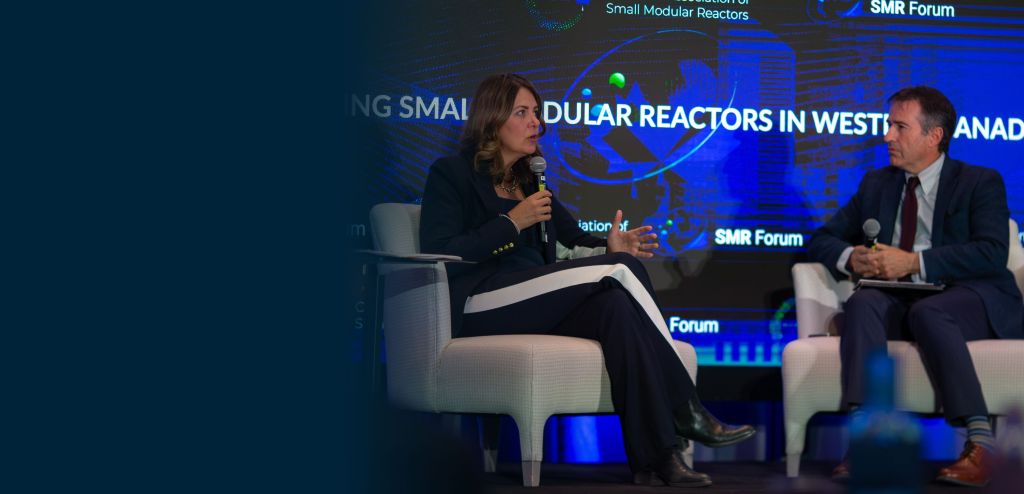
In this bonus episode of Disruptors, host John Stackhouse speaks with Premier Danielle Smith about the future of power in Alberta. They dig into reliability needs, “bring‑your‑own‑power” models, how to finance nuclear in an energy‑only market, and what collaboration between provinces could unlock. 

This conversation was recorded live in Edmonton at the 2025 SMR Forum. 

Listen on Apple Podcasts, Spotify or Simplecast

View By Topics Or Author Page Link

view_by_topics_or_author_page_link

After a season spent mapping Canada’s next big bets — ports and launchpads, power grids and AI data centres, battery belts and northern fibre lines — Disruptors: The Canada Project closes with a simple, urgent question: How do we actually build this?

In the season finale, host John Stackhouse sits down with Build Canada’s Daniel Debow and Lucy Hargreaves to explore how entrepreneurs, students and community leaders are trying to turn concern into action. They discuss Canada as an ongoing project, the shift from an operator mindset to a builder mindset, and the role that bold ideas, pragmatic policy and public-private collaboration can play in getting major projects over the line.

As trade routes are redrawn and competition for capital, talent, energy and compute intensifies, the episode asks what it will take for Canada to build — and keep — the critical infrastructure that underpins our sovereignty and prosperity, from coastal ports and Arctic corridors to AI-ready power and productivity-boosting agtech.

Listen on Apple Podcasts, Spotify or Simplecast

Building Canada: A new generation takes charge

John Stackhouse: [00:00:00] Hi, it’s John here. Welcome to Disruptors, the Canada Project, Alberta, Vancouver, Manitoba, Newfoundland, Nova, Scotia, Nunavut, Waterloo, Quebec, Saskatchewan. This season we’ve been crisscrossing the country, meeting with some of Canada’s brightest minds to learn how they’re tackling some of our biggest challenges.

Chris Avery: When President Trump came into power and tariffs were levied against Canadian goods, really amplified the need for us as a nation to diversify our Trade.

Janice Stein: Tech sovereignty would guarantee Canadians. Their core services and core data are free from coercion by outside powers.

Chris Avery: It’s important to know that Nunavut is relying a hundred percent by burning diesel.

Anne Raphaele: That is, I import into the territory mostly from the United States. Canada’s at a critical [00:01:00] moment for our economy and for our shared future.

The way, you may have gotten a sense of a new map of Canada being drawn. It’s not the one you memorized in grade school, but it’s a map of ports and launchpads of power grids and AI data centers.

And for that matter, battery belts and northern fiber lines. It’s a map of a new economic future, a bolder one, a more global one, a more innovative one. And it’s one that Canadians right now are shaping every day.

Jean Charest: The countries that will prosper in the future are the ones that are going to commit themselves to these added value products, and that’s exactly where Canada is going.

P.J. Akeeagok: When Canadians think about growth, we don’t always think about the architect, but we should.

Daniel Smith: We wanna ensure that we can meet the electricity demands of emerging sectors like data centers, artificial intelligence, and other technologies that depend on secure power. 24 7,

Chris Hadfield: we got the [00:02:00] landmass, we got the intellectual property, we got the education, we got the raw materials, we got the history.

John Stackhouse: We can do it here and sell it to the world. Those are just a few of the many ambitious Canadians we’ve heard from this season on disruptors, the Canada Project. It’s been eye-opening to explore some of the ideas and initiatives that Canadians are putting forward to meet this pivotal moment. As trade and supply chain disruptions collide with broader questions of climate security, economic advancement, and sovereignty.

Today as we wrap up our journey, we’re gonna zoom out several thousand feet, or maybe that should be several thousand meters to talk to Daniel Debo and Lucy Hargraves of Build Canada. They’re two of the many people behind what’s become a movement to get Canada building again, to turn big ideas into real world impact Build.

Canada is a network and really a movement that connects and amplifies entrepreneurs, creators, and innovators committed to a more prosperous Canada. [00:03:00] Daniel is a serial entrepreneur who you may remember from past episodes of disruptors. He’s chair of the Build Canada Board, and Lucy, who comes from a background in government, is the CEO.

Together, they bring deep experience in technology, innovation, entrepreneurship, policy and partnerships. In this episode, we’ll dig into what building the country really means. The ambition, the tools, and the challenges involved when citizens from coast to coast to coast say yes to shaping Canada’s future.

Daniel Lucy, welcome to Disruptors.

Thanks, John. Happy to be here. Thanks so much for having us, John.

We’ve had this amazing virtual CrossCountry tour hearing from all sorts of Canadians who are. Building amazing things from space launchpads to data centers, and I thought, who better to help wrap up that tour than the people behind Build [00:04:00] Canada?

Lucy, let me start with you and just give us a quick sense of what Build Canada is and what you’re setting out to do.

Lucy Hargreaves: Yeah, for sure. Thanks, John. For those of your listeners who don’t know, we’re a non-partisan, mission-driven movement focused on making Canada the most prosperous country in the world.

We’ve been around for almost a year now. And we started out sharing actionable, bold policy memos from Canada’s leading entrepreneurs and business leaders. And we’re also doing a lot more in person. And so bringing Canadians together around the country in city chapters and campus clubs. So what I’m seeing is like incredible passion for this idea of focusing on growth.

We’re growing kind of 10 to 15% week over week in terms of the size of our movement, rallying towards this sort of optimistic, bold vision of what Canada can be.

John Stackhouse: I wanna come back to that growth opportunity and also the growth that you’re capturing. It’s really impressive. But let me ask you both about where we’re at as a [00:05:00] country as we come to the end of a really extraordinary year, 2025.

Um, I think no one had. Forecast or certainly predicted it would play out the way it has. How are you feeling about the state of Canada as we wrap up this momentous year?

Daniel Debow: Cautiously optimistic. Rationally optimistic. I think it’s important to remember like Canada didn’t get here by accident. It’s a series of choices that we made and policy decisions that we made all along the way.

And I think what’s optimistic, as Lucy pointed out, is that Canadians understand that they have agency. They can choose which path they wanna take, and politicians understand this. When we started this experiment, right, like can we publish some policy memos to help guide and help inform and, and give ideas out there from Canada’s great entrepreneurs to both parties?

Uh, all parties. Actually, we did not expect to get the reaction that we got. We did not expect, I think actually Lucy. We did not expect to have to set up a full-time merch shop so people could [00:06:00] buy t-shirts that say giver on it. And that to me is really optimistic. That’s positive. It doesn’t mean there aren’t lots of things we have to get over, but boy, it tells me that Canadians want change.

And if you want politicians to change, they need to see a constituency. They need to see people want that. And I think that’s what we can see the beginnings of now. We can’t give up, we can’t stop. But boy, that that is a reason heading into the new year, to feel at least cautiously optimistic despite all the headwinds and challenges we face.

John Stackhouse: Give us the origin story of the Giver T-shirt and why it’s gone viral.

Daniel Debow: I’ve always loved that Canadian expression of giver, like, you’re behind the car, you’re in a ditch. Things suck. But Canadians, they rally. They just say, yeah, I know that this sucks, but we gotta go. So giver, give it your best shot and we’ll be okay.

I think that is a very good reminder. It’s a positive, optimistic view of what it means to be who we are, and it resonated,

Lucy Hargreaves: and I think it’s a really important point. We have to remember who we are. Canada [00:07:00] is a nation of builders. Like it was forged by explorers. People who were risk takers we’re a nation that discovered insulin.

We built a railroad across our country. We became a top global defense manufacturing hub during World War ii. So we have to remember and like remind ourselves that we’ve done ambitious things before and we can do them again, and that Canada is still very much a work in progress. We are a project, uh, still that is being built.

I think this is what resonates, especially with the young people who, you know, 18 to 35 year olds who are really gravitating towards the Build Canada movement is that they can be part of it, that they have agency and that they can actually get off the sidelines, get off the couch, get outta their house, and they can participate in this nation building project.

John Stackhouse: Tell us a bit more about the mindset that you’re. Challenging us all to develop, as I watch [00:08:00] what’s going on in the country, a lot of it is about building, but it’s frankly about other people building stuff somewhere else in the country. And that’s, that’s all very good. But there’s 40 million of us. And what kind of mindset do all of us 40 million need to aim for and develop to be a builder nation?

Lucy Hargreaves: There’s some principles, uh, that we sort of repeat over and over again. Bold, beat, safe growth is good. You can just do things. Doing things is better than complaining. It’s this kind of mindset that, you know, when you see a problem or you, you see an issue in your society or your community and you’re, you’re frustrated by it, that instead of complaining about that, you can actually take action.

And that’s what we encourage at Build Canada. And that’s kind of that. Mentality that we’re encouraging across the country, we can go for gold. And I think as a nation and as individuals, uh, many times we are satisfied with going for bronze or silver and not striving to be the [00:09:00] absolute best and to win.

Daniel Debow: We cannot wait for the government to solve every problem, right? People have to step up. That’s part of the ethos, and that’s just people saying, I, I don’t wanna sit around and complaint. I want to go do something. I wanna connect with my other Canadians and I wanna actually feel connected to other Canadians who do feel this way.

I’m not alone. I want it to grow. So I think that’s a big part of the mindset. I think there’s another part which is like, what does it mean to be a builder? And I think it’s a bias to action. You have to take a risk. You have to put yourself out there. Getting a bronze medal is as much effort as going for gold.

You might as well go for gold. Right? And reminding Canadians that they are actually amazing, can make great things, is a very powerful mindset that we can put in. We have to go be a force in the world. If you believe the world to harken back to a prior age needs more Canada, well then we have to go make it want what we have.

And that’s gonna be by becoming economically strong, it’s gonna be by becoming, uh, militarily strong. Like strength and sovereignty really are linked to those two things. They happen because of those 40 million [00:10:00] Canadians making individual choices every day to kind of act the way that we’re talking.

John Stackhouse: When you talk about Canada needing to be a force in the world, it takes me straight back to some of the builders we’ve met this season who are already trying to do that in very Canadian ways, in orbit, under the sea, and deepen the ground. They’re all trying to turn our unique advantages into things. We actually build own and export.

Rahul Goel: We already do such a great job as Canadians training our workforce. In fact, we train our workforce and it enables other countries to build their space programs. We have a massive exodus of talent, of capital, of sovereignty, of national pride.

So all of those factors led to the founding of North Space. The amazing thing about building capabilities in space is that it spans the entire spectrum. Highly specialized key roles that, you know, Canadians are really, really good at and creating opportunities. But at the end of the day, the retention is really the problem.

David Shea: One of [00:11:00] the great advantages that they have in Newfoundland when we talk about hardening technology, building technology, proving that it can work. If it can work off the coast of Newfoundland, then it can work anywhere. It is one of the harshest climates in the world. When you go out on the ocean, it is not long before you are in the middle of the North Atlantic.

Eric Desaulniers: We’re optimizing the usage of this hydro to be carbon neutral. So having the four reason to buy in Canada, great geology to start with two hours away. We have a great industrial park in big and core with sheep, hydro, and all reagents and all the the right area to develop this safely. And then we have the right talents and we have the customer now in our backyard who really need graphite and they really need to diversify from a single source in China.

John Stackhouse: Space launches, subsea, robotics, critical minerals, those are very different sectors, but you kind of get the pattern, Canadians trying to turn our geography, our geology, and our grit into a [00:12:00] real edge in the world. For all those builders, how are you seeing momentum grow to support them?

Daniel Debow: I think you had Rahul from Nord space on there. Um, I was an investor prior space company in Canada from the CDL. Honestly, most of the time when I talked about it, people were rolling their eyes like, what are you talking about? A Canadian space company? That’s not a real thing. And I just don’t see that now as people hear about North Space and what they’re doing, uh, similarly, there was no way you could start a defense company in Canada even five years ago, and now that’s a possibility.

And they’re moving very, very quickly. And what’s important is they’re doing it in partnership. Like I see all sorts of military folk who are quite interested in like a new way, a new approach of doing these things. Dan and I are very privileged to be able to have incredible conversations across the country with some of Canada’s leading entrepreneurs and innovators,

Lucy Hargreaves: I’m encouraged actually on the attention now being paid to major projects and all of [00:13:00] the possibilities in the natural resources sector.

Both in oil and gas, but also critical minerals and mining. I think it’ll take a while for that to change, but it does seem like through the work that the major Projects Office is, is doing, and a lot of the conversations specifically in the critical mineral space, that there’s some appetite to, you know, go faster there.

And it’s so inspiring to me that I actually see these people just, they’re just moving ahead, right? They’re not waiting for the government to create a new subsidy program or a grant program or a tax incentive. Like in many, many cases, they are builders and they are just focused on moving ahead and getting things done.

Daniel Debow: I actually am very encouraged when provincial or federal leaders reach out and say, well, what are these ideas you have about ai? What are these ideas about exporting more lentils and pulses? What are these ideas about how we can open up our export of natural resources? How can we build more homes? Like those are positive things.

I’m not saying it’s the end of the story, but that’s optimistic to me.[00:14:00]

John Stackhouse: Those are great companies you’ve referenced. Fast growing sectors that Canadians can really seize on space. We’ve, we’ve been doing research here at RBC on the potential of the space sector, and I’ve been able to speak with investors in Europe and the US particularly, who are so keen to invest more in Canada.

They see the talent and opportunity here and as a country, I don’t think we’ve got our heads fully around the idea of private capital. Driving stuff, but it is that private capital that really accelerates things. And part of that requires us to think through what you might call the reward function. So there’s of course, the expression, no risk, no reward, but if you have no reward, you’re not gonna get a lot of risk either.

We need arguably different reward functions for entrepreneurs and the people who, who back them. Tell us a bit about how you’re thinking about the [00:15:00] reward function. And what Canada needs to do to up our game on that front in the years ahead.

Daniel Debow: We want Canadian entrepreneurs, whether it’s the people who created Mike’s Hark Lemonade, or the people who create Lululemon, or the people who create Cirque de Soleil or Shopify’s, like, we need those folks.

Those are great and those are capitalistic, uh, profit seeking enterprises. That’s not a dirty word. That should be a positive thing. You know, entrepreneurs are human beings. They have the ability more than most actually to be mobile. And I think that the, one of the things we have to do is the reward function has to be that you are socially rewarded.

You are a good part of the country. That reward function really does matter because it’s a cycle of everyone’s psyche. You ask the beginning, what’s the mindset? I’m like, well, geez. The mindset has to be that these are Canadian heroes. Now we can’t just say nice things though. And have photo ops, we have to actually back it up.

John Stackhouse: Well, if I can just jump in quickly, I, I love your passion, number one, but also it’s so critical how you’re laying this out. That reward is both tangible [00:16:00] and intangible, and they’re both incredibly powerful and we need to lean into both.

Lucy Hargreaves: Yeah. This is not just about financial rewards, and as Dan said, we’re not just talking about the founders. We’re talking about like the early employees who also leave relatively stable jobs and, and go and try and start new things. So we should celebrate and reward that. Financially speaking, what I say is, you know, we always need to remind ourselves as a nation that we don’t exist in isolation. We operate in a global economy, and we have to think about our reward and incentive and tax structure in that context.

Entrepreneurs have options. Many of them, you know, are very mobile. They can make different choices. Highly talented employees of companies can make different choices. We have the US right there. There’s a whole big wide world out there. And so we, when we think about our tax incentives and rewarding risk takers, we have to think about it in that global context.

We published a number of memos on [00:17:00] this, specifically on capital gains tax. We, um, had a great memo from Matt Cohen who’s, uh, with Ripple Ventures, uh, looking at how we can make our capital gains rewards, uh, and system not just on par with the us but actually more competitive than what’s on offer in the us.

The US has this thing called QSBS. Which is essentially their capital gains structure for small businesses. It’s incredibly competitive. It has a much higher capital gains cap of 15 million per company. This is the key thing Per company. Yeah. Whereas our capital gains cap in Canada right now is around 1.5 million, whereas the US has this 15 million cap that can be stacked across multiple exits, and so that’s.

It might seem small to, to some people, but this is like a real meaningful difference maker in, uh, people’s decision making for how much risk they wanna take. And it’s also, um, from an investor’s perspective, often investors [00:18:00] are, you know, looking for Canadian companies and Canadian founders to relocate to the US so that the investors can benefit from the US capital gain structure There.

Daniel Debow: Of course the only reason people build companies isn’t just to make money, but it is part of the reason, and we are fooling ourselves if we don’t understand that. We have to create incentives for our best Canadians to stay here. We have to figure out a way to do that if we wanna get our most amazing Canadians who wanna do this.

Also wanna say, this isn’t just about tech people, right? This is about. The folks who are losing their jobs, unfortunately, we want some of them to go start drone manufacturing supply chain companies, people who are in manufacturing, building next generation humanoid robots. We need to create opportunities across our stacks, small businesses that this is something that they can, and really, the, the balance of keeping a job versus trying something, it becomes overwhelmingly better that you’re like, I wanna try something more in society.

But you’ve got to remember that innovation is not something entrepreneurs do outta the goodness of their heart. It is something that’s done because they want to win. They either wanna win new customers or market share, or they don’t wanna lose that from someone else who’s [00:19:00] coming to eat their lunch, and that’s a good function for society.

John Stackhouse: Let’s talk a bit about hustle in the public sector. I think one of the many things Mark Carney has done to rattle cages has been to set real deadlines that many people, from what I understand, say, oh, that’s impossible. We’ve seen this in the, uh, in the energy agreement with Alberta. Some pretty huge things have to be done by April 1st and July 1st, and as you know, that’s the way the private sector works.

You set deadlines and you manage the work accordingly. It’s one of the basic principles of project management, but there’s more to it. There’s a builder mindset versus an operator mindset, and that’s something you’ve both stressed through. Build Canada. Help us understand the difference between the two and how a builder mindset can help the public sector.

Lucy Hargreaves: The culture of the public service and the incentive structure in the public service is one that [00:20:00] reinforces a risk averse mindset to operating. They are incentivized to be a steady hand to avoid risk and to not take bold bets that might get themselves or the minister or prime minister of the day into trouble.

So. I think it is a bit of a shock to the system for many public servants to have a Prime Minister kind of come in and have these ambitious goals and deadlines. But I think it’s a good thing. I mean, I think having deadlines and focusing attention on the things that really matter. We have to focus on growth and make the main thing the main thing.

And it seems like this prime Minister is, uh, you know, attempting to make the main thing, the main thing, which is the economy and driving the public service towards that. You know, we’ve been talking about a lot the reinvigoration of the interchange program, uhhuh, which is now called the Build Canada Exchange Program.

Yeah. The budget of this year, they re have [00:21:00] rebranded to call the Build Canada Exchange Program. Is, is there a copyright issue there? Everyone should use it. There’s no, they should use it. If it works, they should use it well for it.

John Stackhouse: Tell us a bit about the Build Canada Exchange program ’cause it’s a neat innovation?

Lucy Hargreaves: Yeah, so the interchange program, build slash Build Canada interchange, so it’s been around for a number of years in the public service and, and has been designed to bring in. Private sector experts on sort of like a secondment basis into the public service. To, you know, help deliver programs or provide specific expertise and it, you know, sort of an exchange.

So the private sector sort of better understands public service. Public service can better understand perspectives, uh, from various different industries. And so now this rebranding is build candidate exchange. And so the Komen is to bring in 50, uh, private sector experts into the public service. Across a number of different sectors for a period of 12 to 18 months and have them do a rotation within, within the public service.

This idea that you recognize that, you know, there’s various [00:22:00] sectors where you need help and that the help exists in the private sector, and, and finding ways to bring those people in, give them the right authority, and really, you know, set up the structure for good collaboration and sharing. I, I think is, is a great idea.

And I’m excited to see that, you know, hopefully get implemented pretty rapidly in the next few months.

John Stackhouse: It’s exciting to see these kinds of innovative approaches where the public and private sectors actually learn from each other instead of talking past each other. And it also reminds us that public service doesn’t have to be a 40 year career.

It could be a tour of duty, a period in your life where you step in, help build something better for the greater good, and then bring that experience back out into the rest of the economy. All season on Disruptors, the Canada Project, we’ve seen how that orientation towards the greater good drives the long-term infrastructure work that will shape our future.

From food corridors on the prairies to ports on both coasts to hydro and fiber [00:23:00] lines into the Arctic. The decisions we make now will define what kind of country our kids and grandkids in Hara. Canada.

Tamara Vrooman: Canada is a country with a large geography, but a small population, and so we literally need connectivity and transportation infrastructure to make our country work, and we certainly need that infrastructure to connect our country to the world.

We have the component parts. They’re just not integrated in the way that they could be to allow for that speed and resilience that the international trade market is going to demand.

Devan Fitch: We’re the size of the next five largest Canadian ports combined in terms of the amount of commodities that we move, uh, through the Port of Vancouver.

The terminals that we’re looking at right here, they were also built many decades ago, and they just don’t simply have the birth depth that’s required. You couldn’t pull up next to the container terminal because it’s just gonna bottom out on the, on the birth face there. We have to be planning for what the trade infrastructure looks like in 2050 and 2060, not in [00:24:00] 2026.

Murad Al-Katib: If I was Prime Minister for a day, I would spend a hundred billion on trade infrastructure. It will pay for generations to come. Supply chains are all about connectivity. Each link has to be efficient. Data and technology will also make that more efficient. So let’s seize that opportunity.

John Stackhouse: We just heard the voices of Tamara Ruman, Devon Fitch, and Marad Al Kaip.

They’re just a few of the builders and shapers we’ve spoken to on this series. Daniel, Lucy, if you’re in your twenties today listening to all of that, the stakes, the infrastructure projects, the need to think long term, what would you actually do with it? What’s your message to those younger Canadians about the decades ahead and the role they can play?

Daniel Debow: First message is they should go to Build Canada do com and they should sign up. Yeah, join Build Canada newsletter and find a way to volunteer. I mean, I say that in a little in jest, but in reality. Yeah, because that’s a great first step. That’s what we want. Sign up. I was actually shocked how many people sign up just to learn about how the government works.

[00:25:00] They’re like, I didn’t know what a budget is. I didn’t know this stuff. But what’s the main message? I mean, I look, I have four young kids. Just because there are challenges, that does not mean that there’s no future for you. There’s no hope for you. You have to be kind of a rational optimist that yes, there are challenges, but you can pull this off.

I think the second message is exactly that, that you have agency, right? You are not necessarily a victim. You can make change in your own life, in your own community, your own family, with your own friend group, and in fact, you have, at least in the digital realm, you have access to tools that were like truly science fiction.

You know, 50 years ago, 25 years ago, right? You can see people building tools with ai, learning how to do things that run circlers around the folks of us on this call. The third thing is you can’t be quiet. You have to actually say that, I want this to be better. And so if you’re willing to step up and say, I think we can do things different around transit or around youth employment, or around any one of the issues that matter to you, you can do it.

They should not give up. I mean, I think that is the [00:26:00] key, key message I would have for those young people, that they have a right to fight like hell and to make the project what they think it should be, and they can define the future.

John Stackhouse: Canada is a project and we all have agency to help build it. That’s a great message.

Lucy, final word to you?

Lucy Hargreaves: Yeah, absolutely. I have three kids that are a little bit younger than Dan’s kids, I think, but I think about them a lot. I think about their future a lot, and I have the privilege of being able to talk to a lot of the folks who have been coming to our Build Canada events across the country.

So hundreds of people. They’re so energized and so optimistic about the future. And so my message to them really is recognize that you are part of this incredible journey that our nation is on, and that you have a role to play. Canada is going places. Don’t aim small, you know, think bold and take risks.

There are so many ways to show up. To get involved. That is what actually makes change at the end of the day is, is [00:27:00] multiple people across the country showing up and speaking up for the future that they want. So I would encourage folks to do that. We can all do more love. All these messages about building a better Canada.

John Stackhouse: To quote your website, people want to join up, go to build canada.com. Lucy, Daniel, thank you so much for being on disruptors and for helping to build Canada. Thanks, John, and thanks for, for this uh, series. It’s been great. Thanks so much, John. Appreciate it. As we close out this season of disruptors, I wanna leave you with a simple thought.

Canada’s future isn’t something that happens to us, it’s something that we build through the choices we make, the jobs we take on, the risks that we lean into, and the communities that we strengthen. Each of us has a role in shaping what comes next. Yes, the world is throwing a lot of disruption at us all at once.

But Canada has the geography, the resources, the global credibility, and the [00:28:00] traditions to turn challenge into opportunity. And Canadians have the ideas, the ambition, and the talent to do just that. That’s what we call the Canada Project Canadians working together. To innovate, to compete, and to build.

If you’re looking for inspiration, explore more nation building stories and ideas at rbc.com/thought leadership and revisit the episodes of Disruptors, the Canada Project, an RBC podcast on Apple or Spotify, or wherever you get your podcasts. Thanks for joining us on this incredible journey and for being a builder.

I’m John Stackhouse. See you in the new year.

John Stackhouse: [00:00:00] Hi, it’s John here. Welcome to Disruptors, the Canada Project, Alberta, Vancouver, Manitoba, Newfoundland, Nova, Scotia, Nunavut, Waterloo, Quebec, Saskatchewan. This season we’ve been crisscrossing the country, meeting with some of Canada’s brightest minds to learn how they’re tackling some of our biggest challenges.

Chris Avery: When President Trump came into power and tariffs were levied against Canadian goods, really amplified the need for us as a nation to diversify our Trade.

Janice Stein: Tech sovereignty would guarantee Canadians. Their core services and core data are free from coercion by outside powers.

Chris Avery: It’s important to know that Nunavut is relying a hundred percent by burning diesel.

Anne Raphaele: That is, I import into the territory mostly from the United States. Canada’s at a critical [00:01:00] moment for our economy and for our shared future.

The way, you may have gotten a sense of a new map of Canada being drawn. It’s not the one you memorized in grade school, but it’s a map of ports and launchpads of power grids and AI data centers.

And for that matter, battery belts and northern fiber lines. It’s a map of a new economic future, a bolder one, a more global one, a more innovative one. And it’s one that Canadians right now are shaping every day.

Jean Charest: The countries that will prosper in the future are the ones that are going to commit themselves to these added value products, and that’s exactly where Canada is going.

P.J. Akeeagok: When Canadians think about growth, we don’t always think about the architect, but we should.

Daniel Smith: We wanna ensure that we can meet the electricity demands of emerging sectors like data centers, artificial intelligence, and other technologies that depend on secure power. 24 7,

Chris Hadfield: we got the [00:02:00] landmass, we got the intellectual property, we got the education, we got the raw materials, we got the history.

John Stackhouse: We can do it here and sell it to the world. Those are just a few of the many ambitious Canadians we’ve heard from this season on disruptors, the Canada Project. It’s been eye-opening to explore some of the ideas and initiatives that Canadians are putting forward to meet this pivotal moment. As trade and supply chain disruptions collide with broader questions of climate security, economic advancement, and sovereignty.

Today as we wrap up our journey, we’re gonna zoom out several thousand feet, or maybe that should be several thousand meters to talk to Daniel Debo and Lucy Hargraves of Build Canada. They’re two of the many people behind what’s become a movement to get Canada building again, to turn big ideas into real world impact Build.

Canada is a network and really a movement that connects and amplifies entrepreneurs, creators, and innovators committed to a more prosperous Canada. [00:03:00] Daniel is a serial entrepreneur who you may remember from past episodes of disruptors. He’s chair of the Build Canada Board, and Lucy, who comes from a background in government, is the CEO.

Together, they bring deep experience in technology, innovation, entrepreneurship, policy and partnerships. In this episode, we’ll dig into what building the country really means. The ambition, the tools, and the challenges involved when citizens from coast to coast to coast say yes to shaping Canada’s future.

Daniel Lucy, welcome to Disruptors.

Thanks, John. Happy to be here. Thanks so much for having us, John.

We’ve had this amazing virtual CrossCountry tour hearing from all sorts of Canadians who are. Building amazing things from space launchpads to data centers, and I thought, who better to help wrap up that tour than the people behind Build [00:04:00] Canada?

Lucy, let me start with you and just give us a quick sense of what Build Canada is and what you’re setting out to do.

Lucy Hargreaves: Yeah, for sure. Thanks, John. For those of your listeners who don’t know, we’re a non-partisan, mission-driven movement focused on making Canada the most prosperous country in the world.

We’ve been around for almost a year now. And we started out sharing actionable, bold policy memos from Canada’s leading entrepreneurs and business leaders. And we’re also doing a lot more in person. And so bringing Canadians together around the country in city chapters and campus clubs. So what I’m seeing is like incredible passion for this idea of focusing on growth.

We’re growing kind of 10 to 15% week over week in terms of the size of our movement, rallying towards this sort of optimistic, bold vision of what Canada can be.

John Stackhouse: I wanna come back to that growth opportunity and also the growth that you’re capturing. It’s really impressive. But let me ask you both about where we’re at as a [00:05:00] country as we come to the end of a really extraordinary year, 2025.

Um, I think no one had. Forecast or certainly predicted it would play out the way it has. How are you feeling about the state of Canada as we wrap up this momentous year?

Daniel Debow: Cautiously optimistic. Rationally optimistic. I think it’s important to remember like Canada didn’t get here by accident. It’s a series of choices that we made and policy decisions that we made all along the way.

And I think what’s optimistic, as Lucy pointed out, is that Canadians understand that they have agency. They can choose which path they wanna take, and politicians understand this. When we started this experiment, right, like can we publish some policy memos to help guide and help inform and, and give ideas out there from Canada’s great entrepreneurs to both parties?

Uh, all parties. Actually, we did not expect to get the reaction that we got. We did not expect, I think actually Lucy. We did not expect to have to set up a full-time merch shop so people could [00:06:00] buy t-shirts that say giver on it. And that to me is really optimistic. That’s positive. It doesn’t mean there aren’t lots of things we have to get over, but boy, it tells me that Canadians want change.

And if you want politicians to change, they need to see a constituency. They need to see people want that. And I think that’s what we can see the beginnings of now. We can’t give up, we can’t stop. But boy, that that is a reason heading into the new year, to feel at least cautiously optimistic despite all the headwinds and challenges we face.

John Stackhouse: Give us the origin story of the Giver T-shirt and why it’s gone viral.

Daniel Debow: I’ve always loved that Canadian expression of giver, like, you’re behind the car, you’re in a ditch. Things suck. But Canadians, they rally. They just say, yeah, I know that this sucks, but we gotta go. So giver, give it your best shot and we’ll be okay.

I think that is a very good reminder. It’s a positive, optimistic view of what it means to be who we are, and it resonated,

Lucy Hargreaves: and I think it’s a really important point. We have to remember who we are. Canada [00:07:00] is a nation of builders. Like it was forged by explorers. People who were risk takers we’re a nation that discovered insulin.

We built a railroad across our country. We became a top global defense manufacturing hub during World War ii. So we have to remember and like remind ourselves that we’ve done ambitious things before and we can do them again, and that Canada is still very much a work in progress. We are a project, uh, still that is being built.

I think this is what resonates, especially with the young people who, you know, 18 to 35 year olds who are really gravitating towards the Build Canada movement is that they can be part of it, that they have agency and that they can actually get off the sidelines, get off the couch, get outta their house, and they can participate in this nation building project.

John Stackhouse: Tell us a bit more about the mindset that you’re. Challenging us all to develop, as I watch [00:08:00] what’s going on in the country, a lot of it is about building, but it’s frankly about other people building stuff somewhere else in the country. And that’s, that’s all very good. But there’s 40 million of us. And what kind of mindset do all of us 40 million need to aim for and develop to be a builder nation?

Lucy Hargreaves: There’s some principles, uh, that we sort of repeat over and over again. Bold, beat, safe growth is good. You can just do things. Doing things is better than complaining. It’s this kind of mindset that, you know, when you see a problem or you, you see an issue in your society or your community and you’re, you’re frustrated by it, that instead of complaining about that, you can actually take action.

And that’s what we encourage at Build Canada. And that’s kind of that. Mentality that we’re encouraging across the country, we can go for gold. And I think as a nation and as individuals, uh, many times we are satisfied with going for bronze or silver and not striving to be the [00:09:00] absolute best and to win.

Daniel Debow: We cannot wait for the government to solve every problem, right? People have to step up. That’s part of the ethos, and that’s just people saying, I, I don’t wanna sit around and complaint. I want to go do something. I wanna connect with my other Canadians and I wanna actually feel connected to other Canadians who do feel this way.

I’m not alone. I want it to grow. So I think that’s a big part of the mindset. I think there’s another part which is like, what does it mean to be a builder? And I think it’s a bias to action. You have to take a risk. You have to put yourself out there. Getting a bronze medal is as much effort as going for gold.

You might as well go for gold. Right? And reminding Canadians that they are actually amazing, can make great things, is a very powerful mindset that we can put in. We have to go be a force in the world. If you believe the world to harken back to a prior age needs more Canada, well then we have to go make it want what we have.

And that’s gonna be by becoming economically strong, it’s gonna be by becoming, uh, militarily strong. Like strength and sovereignty really are linked to those two things. They happen because of those 40 million [00:10:00] Canadians making individual choices every day to kind of act the way that we’re talking.

John Stackhouse: When you talk about Canada needing to be a force in the world, it takes me straight back to some of the builders we’ve met this season who are already trying to do that in very Canadian ways, in orbit, under the sea, and deepen the ground. They’re all trying to turn our unique advantages into things. We actually build own and export.

Rahul Goel: We already do such a great job as Canadians training our workforce. In fact, we train our workforce and it enables other countries to build their space programs. We have a massive exodus of talent, of capital, of sovereignty, of national pride.

So all of those factors led to the founding of North Space. The amazing thing about building capabilities in space is that it spans the entire spectrum. Highly specialized key roles that, you know, Canadians are really, really good at and creating opportunities. But at the end of the day, the retention is really the problem.

David Shea: One of [00:11:00] the great advantages that they have in Newfoundland when we talk about hardening technology, building technology, proving that it can work. If it can work off the coast of Newfoundland, then it can work anywhere. It is one of the harshest climates in the world. When you go out on the ocean, it is not long before you are in the middle of the North Atlantic.

Eric Desaulniers: We’re optimizing the usage of this hydro to be carbon neutral. So having the four reason to buy in Canada, great geology to start with two hours away. We have a great industrial park in big and core with sheep, hydro, and all reagents and all the the right area to develop this safely. And then we have the right talents and we have the customer now in our backyard who really need graphite and they really need to diversify from a single source in China.

John Stackhouse: Space launches, subsea, robotics, critical minerals, those are very different sectors, but you kind of get the pattern, Canadians trying to turn our geography, our geology, and our grit into a [00:12:00] real edge in the world. For all those builders, how are you seeing momentum grow to support them?

Daniel Debow: I think you had Rahul from Nord space on there. Um, I was an investor prior space company in Canada from the CDL. Honestly, most of the time when I talked about it, people were rolling their eyes like, what are you talking about? A Canadian space company? That’s not a real thing. And I just don’t see that now as people hear about North Space and what they’re doing, uh, similarly, there was no way you could start a defense company in Canada even five years ago, and now that’s a possibility.

And they’re moving very, very quickly. And what’s important is they’re doing it in partnership. Like I see all sorts of military folk who are quite interested in like a new way, a new approach of doing these things. Dan and I are very privileged to be able to have incredible conversations across the country with some of Canada’s leading entrepreneurs and innovators,

Lucy Hargreaves: I’m encouraged actually on the attention now being paid to major projects and all of [00:13:00] the possibilities in the natural resources sector.

Both in oil and gas, but also critical minerals and mining. I think it’ll take a while for that to change, but it does seem like through the work that the major Projects Office is, is doing, and a lot of the conversations specifically in the critical mineral space, that there’s some appetite to, you know, go faster there.

And it’s so inspiring to me that I actually see these people just, they’re just moving ahead, right? They’re not waiting for the government to create a new subsidy program or a grant program or a tax incentive. Like in many, many cases, they are builders and they are just focused on moving ahead and getting things done.

Daniel Debow: I actually am very encouraged when provincial or federal leaders reach out and say, well, what are these ideas you have about ai? What are these ideas about exporting more lentils and pulses? What are these ideas about how we can open up our export of natural resources? How can we build more homes? Like those are positive things.

I’m not saying it’s the end of the story, but that’s optimistic to me.[00:14:00]

John Stackhouse: Those are great companies you’ve referenced. Fast growing sectors that Canadians can really seize on space. We’ve, we’ve been doing research here at RBC on the potential of the space sector, and I’ve been able to speak with investors in Europe and the US particularly, who are so keen to invest more in Canada.

They see the talent and opportunity here and as a country, I don’t think we’ve got our heads fully around the idea of private capital. Driving stuff, but it is that private capital that really accelerates things. And part of that requires us to think through what you might call the reward function. So there’s of course, the expression, no risk, no reward, but if you have no reward, you’re not gonna get a lot of risk either.

We need arguably different reward functions for entrepreneurs and the people who, who back them. Tell us a bit about how you’re thinking about the [00:15:00] reward function. And what Canada needs to do to up our game on that front in the years ahead.

Daniel Debow: We want Canadian entrepreneurs, whether it’s the people who created Mike’s Hark Lemonade, or the people who create Lululemon, or the people who create Cirque de Soleil or Shopify’s, like, we need those folks.

Those are great and those are capitalistic, uh, profit seeking enterprises. That’s not a dirty word. That should be a positive thing. You know, entrepreneurs are human beings. They have the ability more than most actually to be mobile. And I think that the, one of the things we have to do is the reward function has to be that you are socially rewarded.

You are a good part of the country. That reward function really does matter because it’s a cycle of everyone’s psyche. You ask the beginning, what’s the mindset? I’m like, well, geez. The mindset has to be that these are Canadian heroes. Now we can’t just say nice things though. And have photo ops, we have to actually back it up.

John Stackhouse: Well, if I can just jump in quickly, I, I love your passion, number one, but also it’s so critical how you’re laying this out. That reward is both tangible [00:16:00] and intangible, and they’re both incredibly powerful and we need to lean into both.

Lucy Hargreaves: Yeah. This is not just about financial rewards, and as Dan said, we’re not just talking about the founders. We’re talking about like the early employees who also leave relatively stable jobs and, and go and try and start new things. So we should celebrate and reward that. Financially speaking, what I say is, you know, we always need to remind ourselves as a nation that we don’t exist in isolation. We operate in a global economy, and we have to think about our reward and incentive and tax structure in that context.

Entrepreneurs have options. Many of them, you know, are very mobile. They can make different choices. Highly talented employees of companies can make different choices. We have the US right there. There’s a whole big wide world out there. And so we, when we think about our tax incentives and rewarding risk takers, we have to think about it in that global context.

We published a number of memos on [00:17:00] this, specifically on capital gains tax. We, um, had a great memo from Matt Cohen who’s, uh, with Ripple Ventures, uh, looking at how we can make our capital gains rewards, uh, and system not just on par with the us but actually more competitive than what’s on offer in the us.

The US has this thing called QSBS. Which is essentially their capital gains structure for small businesses. It’s incredibly competitive. It has a much higher capital gains cap of 15 million per company. This is the key thing Per company. Yeah. Whereas our capital gains cap in Canada right now is around 1.5 million, whereas the US has this 15 million cap that can be stacked across multiple exits, and so that’s.

It might seem small to, to some people, but this is like a real meaningful difference maker in, uh, people’s decision making for how much risk they wanna take. And it’s also, um, from an investor’s perspective, often investors [00:18:00] are, you know, looking for Canadian companies and Canadian founders to relocate to the US so that the investors can benefit from the US capital gain structure There.

Daniel Debow: Of course the only reason people build companies isn’t just to make money, but it is part of the reason, and we are fooling ourselves if we don’t understand that. We have to create incentives for our best Canadians to stay here. We have to figure out a way to do that if we wanna get our most amazing Canadians who wanna do this.

Also wanna say, this isn’t just about tech people, right? This is about. The folks who are losing their jobs, unfortunately, we want some of them to go start drone manufacturing supply chain companies, people who are in manufacturing, building next generation humanoid robots. We need to create opportunities across our stacks, small businesses that this is something that they can, and really, the, the balance of keeping a job versus trying something, it becomes overwhelmingly better that you’re like, I wanna try something more in society.

But you’ve got to remember that innovation is not something entrepreneurs do outta the goodness of their heart. It is something that’s done because they want to win. They either wanna win new customers or market share, or they don’t wanna lose that from someone else who’s [00:19:00] coming to eat their lunch, and that’s a good function for society.

John Stackhouse: Let’s talk a bit about hustle in the public sector. I think one of the many things Mark Carney has done to rattle cages has been to set real deadlines that many people, from what I understand, say, oh, that’s impossible. We’ve seen this in the, uh, in the energy agreement with Alberta. Some pretty huge things have to be done by April 1st and July 1st, and as you know, that’s the way the private sector works.

You set deadlines and you manage the work accordingly. It’s one of the basic principles of project management, but there’s more to it. There’s a builder mindset versus an operator mindset, and that’s something you’ve both stressed through. Build Canada. Help us understand the difference between the two and how a builder mindset can help the public sector.

Lucy Hargreaves: The culture of the public service and the incentive structure in the public service is one that [00:20:00] reinforces a risk averse mindset to operating. They are incentivized to be a steady hand to avoid risk and to not take bold bets that might get themselves or the minister or prime minister of the day into trouble.

So. I think it is a bit of a shock to the system for many public servants to have a Prime Minister kind of come in and have these ambitious goals and deadlines. But I think it’s a good thing. I mean, I think having deadlines and focusing attention on the things that really matter. We have to focus on growth and make the main thing the main thing.

And it seems like this prime Minister is, uh, you know, attempting to make the main thing, the main thing, which is the economy and driving the public service towards that. You know, we’ve been talking about a lot the reinvigoration of the interchange program, uhhuh, which is now called the Build Canada Exchange Program.

Yeah. The budget of this year, they re have [00:21:00] rebranded to call the Build Canada Exchange Program. Is, is there a copyright issue there? Everyone should use it. There’s no, they should use it. If it works, they should use it well for it.

John Stackhouse: Tell us a bit about the Build Canada Exchange program ’cause it’s a neat innovation?

Lucy Hargreaves: Yeah, so the interchange program, build slash Build Canada interchange, so it’s been around for a number of years in the public service and, and has been designed to bring in. Private sector experts on sort of like a secondment basis into the public service. To, you know, help deliver programs or provide specific expertise and it, you know, sort of an exchange.

So the private sector sort of better understands public service. Public service can better understand perspectives, uh, from various different industries. And so now this rebranding is build candidate exchange. And so the Komen is to bring in 50, uh, private sector experts into the public service. Across a number of different sectors for a period of 12 to 18 months and have them do a rotation within, within the public service.

This idea that you recognize that, you know, there’s various [00:22:00] sectors where you need help and that the help exists in the private sector, and, and finding ways to bring those people in, give them the right authority, and really, you know, set up the structure for good collaboration and sharing. I, I think is, is a great idea.

And I’m excited to see that, you know, hopefully get implemented pretty rapidly in the next few months.

John Stackhouse: It’s exciting to see these kinds of innovative approaches where the public and private sectors actually learn from each other instead of talking past each other. And it also reminds us that public service doesn’t have to be a 40 year career.

It could be a tour of duty, a period in your life where you step in, help build something better for the greater good, and then bring that experience back out into the rest of the economy. All season on Disruptors, the Canada Project, we’ve seen how that orientation towards the greater good drives the long-term infrastructure work that will shape our future.

From food corridors on the prairies to ports on both coasts to hydro and fiber [00:23:00] lines into the Arctic. The decisions we make now will define what kind of country our kids and grandkids in Hara. Canada.

Tamara Vrooman: Canada is a country with a large geography, but a small population, and so we literally need connectivity and transportation infrastructure to make our country work, and we certainly need that infrastructure to connect our country to the world.

We have the component parts. They’re just not integrated in the way that they could be to allow for that speed and resilience that the international trade market is going to demand.

Devan Fitch: We’re the size of the next five largest Canadian ports combined in terms of the amount of commodities that we move, uh, through the Port of Vancouver.

The terminals that we’re looking at right here, they were also built many decades ago, and they just don’t simply have the birth depth that’s required. You couldn’t pull up next to the container terminal because it’s just gonna bottom out on the, on the birth face there. We have to be planning for what the trade infrastructure looks like in 2050 and 2060, not in [00:24:00] 2026.

Murad Al-Katib: If I was Prime Minister for a day, I would spend a hundred billion on trade infrastructure. It will pay for generations to come. Supply chains are all about connectivity. Each link has to be efficient. Data and technology will also make that more efficient. So let’s seize that opportunity.

John Stackhouse: We just heard the voices of Tamara Ruman, Devon Fitch, and Marad Al Kaip.

They’re just a few of the builders and shapers we’ve spoken to on this series. Daniel, Lucy, if you’re in your twenties today listening to all of that, the stakes, the infrastructure projects, the need to think long term, what would you actually do with it? What’s your message to those younger Canadians about the decades ahead and the role they can play?

Daniel Debow: First message is they should go to Build Canada do com and they should sign up. Yeah, join Build Canada newsletter and find a way to volunteer. I mean, I say that in a little in jest, but in reality. Yeah, because that’s a great first step. That’s what we want. Sign up. I was actually shocked how many people sign up just to learn about how the government works.

[00:25:00] They’re like, I didn’t know what a budget is. I didn’t know this stuff. But what’s the main message? I mean, I look, I have four young kids. Just because there are challenges, that does not mean that there’s no future for you. There’s no hope for you. You have to be kind of a rational optimist that yes, there are challenges, but you can pull this off.

I think the second message is exactly that, that you have agency, right? You are not necessarily a victim. You can make change in your own life, in your own community, your own family, with your own friend group, and in fact, you have, at least in the digital realm, you have access to tools that were like truly science fiction.

You know, 50 years ago, 25 years ago, right? You can see people building tools with ai, learning how to do things that run circlers around the folks of us on this call. The third thing is you can’t be quiet. You have to actually say that, I want this to be better. And so if you’re willing to step up and say, I think we can do things different around transit or around youth employment, or around any one of the issues that matter to you, you can do it.

They should not give up. I mean, I think that is the [00:26:00] key, key message I would have for those young people, that they have a right to fight like hell and to make the project what they think it should be, and they can define the future.

John Stackhouse: Canada is a project and we all have agency to help build it. That’s a great message.

Lucy, final word to you?

Lucy Hargreaves: Yeah, absolutely. I have three kids that are a little bit younger than Dan’s kids, I think, but I think about them a lot. I think about their future a lot, and I have the privilege of being able to talk to a lot of the folks who have been coming to our Build Canada events across the country.

So hundreds of people. They’re so energized and so optimistic about the future. And so my message to them really is recognize that you are part of this incredible journey that our nation is on, and that you have a role to play. Canada is going places. Don’t aim small, you know, think bold and take risks.

There are so many ways to show up. To get involved. That is what actually makes change at the end of the day is, is [00:27:00] multiple people across the country showing up and speaking up for the future that they want. So I would encourage folks to do that. We can all do more love. All these messages about building a better Canada.

John Stackhouse: To quote your website, people want to join up, go to build canada.com. Lucy, Daniel, thank you so much for being on disruptors and for helping to build Canada. Thanks, John, and thanks for, for this uh, series. It’s been great. Thanks so much, John. Appreciate it. As we close out this season of disruptors, I wanna leave you with a simple thought.

Canada’s future isn’t something that happens to us, it’s something that we build through the choices we make, the jobs we take on, the risks that we lean into, and the communities that we strengthen. Each of us has a role in shaping what comes next. Yes, the world is throwing a lot of disruption at us all at once.

But Canada has the geography, the resources, the global credibility, and the [00:28:00] traditions to turn challenge into opportunity. And Canadians have the ideas, the ambition, and the talent to do just that. That’s what we call the Canada Project Canadians working together. To innovate, to compete, and to build.

If you’re looking for inspiration, explore more nation building stories and ideas at rbc.com/thought leadership and revisit the episodes of Disruptors, the Canada Project, an RBC podcast on Apple or Spotify, or wherever you get your podcasts. Thanks for joining us on this incredible journey and for being a builder.

I’m John Stackhouse. See you in the new year.

View By Topics Or Author Page Link

view_by_topics_or_author_page_link

Artificial Intelligence is poised to reshape how value is created across Canada’s economy. To understand that shift, RBC Thought Leadership interviewed more than two dozen firms that are on the frontlines of building or deploying AI for Bridging the Imagination Gap: How Canadian Companies Can Become Global Leaders in AI Adoption. The report distilled the patterns that emerged from those conversations.

Building on that report, our series of case studies goes a level deeper. Here we follow how Manulife, a global insurer and asset manager, used generative AI as a catalyst to rethink how the organization learns, shares, and scales new ideas. The company’s experience shows that successful AI adoption is not a technology challenge alone—it’s a challenge of capability-building, governance, and empowering people to work differently.

Manulife, a global asset manager headquartered in Canada, saw AI as a chance to move beyond incremental efficiency gains and reimagine products and operations. Leadership judged the sector “too comfortable,” set a clear ambition to become a digital-customer leader, and treated OpenAI’s Large Language Model in 2022 as a tipping point. A hands-on executive session turned AI from a niche experiment into a CEO-level agenda item, signalling that real impact would require structure, governance, and integration—not one-off pilots.

Build absorptive capacity (infrastructure). Manulife created a multi-tier learning stack and embedded ~200 data science and machine learning experts, and used leadership rituals to grow the “stock of prior knowledge,” so new AI advances could be absorbed and embedded faster.

Institutionalize adaptive capacity (the engine). Leaders normalized copying—if one team built something useful, others reused it. This turned isolated wins into shared playbooks and spread improvements quickly. By embedding that habit, Manulife accelerated the cycle of adopt, invent, select, scale, building adaptive and innovative capacity together.

Balance speed and safety (governance by outcomes). Responsible AI principles, expanded model-risk frameworks, cross-functional review, and real-time telemetry treated fast iteration and strong oversight as complements, not one-off pilots

It was mid 2020. Jodie Wallis, then Manulife’s Global Chief Analytics Officer, had summoned the company’s top executives into a Toronto boardroom. She knew the meeting would mark a turning point: OpenAI’s breakthrough latest large language model (LLM), GPT1– 2 had just been released, and, at nearly 100 times stronger than its previous models, GPT-2’s implications stretched far beyond the technology itself. For Manulife, a 137-year-old insurer built on actuarial precision and risk discipline, the question was whether this new capability would be treated as a passing novelty, or as the spark for deeper change.

For years, AI at Manulife meant prediction and automation—underwriting models, fraud detection, lead scoring. Even as the frontier advanced with machine-learning models that could conjure hyper-realistic images, these applications still felt contained within the realm of “computer things.” They were useful and very impressive but safely bounded by expectation.

To Wallis, large language models like GPT shattered those boundaries. Designed for an iterative exchange, they created value not through a single output but through an unfolding dialogue—shifting the dynamic from command-and-response to something closer to collaboration. LLMs could now reason with a human-like cadence, inviting conversation rather than instruction. The breakthrough was not a more polished “answer,” but the model’s ability to so fluidly augment inquiry itself—generating new directions of thought and discovery.

That shift—from bounded tasks to open-ended discovery—was as unsettling as it was exhilarating. Wallis framed the moment with unusual candor: “Our industry has been too comfortable. This technology isn’t just another tool—it’s a fork in the road. We either harness it, or risk being reshaped by it.”

Around the table, reactions varied: curiosity, excitement, apprehension. The challenge was immediate. Should Manulife treat generative AI as an experiment at the margins, or as the new trajectory of the business itself? Wallis herself was convinced of the answer, but she also knew the technology was still raw—too raw, perhaps, for the boardroom to fully accept. The choice would force hard calls about strategy, governance, culture, and investment, all at the breakneck pace at which the frontier was advancing.

In such moments of technological upheaval, corporate boards look to figures like Wallis to distinguish passing trends from transformative forces. Unlike the technologist-soothsayers popular at the time, her task was consequential: to foresee how generative AI might reshape an institution built on actuarial discipline, and to ensure Manulife seized the opportunity rather than being undone by it. Frame the moment correctly, and new value could be unlocked; misjudge it, and the consequences could be existential.

But foresight alone would not suffice. Wallis knew no memo or slide deck could capture the implications of generative AI; words on a page risked being dismissed as abstractions. The only way forward was direct confrontation. To overcome that gap, one had to experience it themselves. Fortunately, the technology itself offered an answer—the opportunity to turn the crystal ball around and let skeptical peers glimpse inside for themselves.

So, she placed a tablet in front of each leader, preloaded with the latest OpenAI model, and invited them to test it—to ask it the questions they might otherwise have asked her. The room fell silent as screens lit up with blinking prompts. One by one, Manulife’s senior leaders began conversing with GPT-2, watching as it generated fluent answers in real time. The exercise was disarmingly simple, yet it shifted the atmosphere. Within minutes, the conversation had moved from “is this real?” to “what does this mean for us?”—the kind of pivot that months of memos and meetings could never have achieved.

It was Wallis’s decision—to make her colleagues experience the frontier for themselves—that created conviction at the top. But she knew conviction alone would not be enough. To matter, it had to be built into infrastructure, and then into the agility to adapt. With that boardroom experiment, Wallis set the flywheel in motion—conviction, infrastructure, adaptation—that would carry Manulife through one of the most profound technological shifts in its history. In doing so, Manulife joined a small group of financial giants positioning Canada at the forefront of AI transformation.

To understand how this journey unfolded, RBC Thought Leadership sat down with Jason MacDonald, Chief of Staff in the Office of the CEO, and Jodie Wallis—now the company’s Global Chief AI Officer—to explore how they and their colleagues steered a $72-billion insurer through one of the most profound technological shifts in its history.

Strong buy-in from senior executives is critical at the beginning of any transformative initiative. Wallis understood that leaders had to experience AI directly for themselves. In doing so, she was putting into practice what Everett Rogers’ diffusion theory had long shown: new ideas spread faster when they are trialable—safe to experiment with in low-risk conditions—and observable—when peers can see results firsthand. Together, these conditions turn abstract technology into something tangible enough to believe in.

That is exactly what unfolded in the boardroom. Once a few respected voices found the tool useful—asking follow-ups, reading fluent outputs aloud—trialability was satisfied: executives could experiment in a low-stakes, hands-on way. And because these experiments happened in public, observability took hold: colleagues could watch, compare reactions, and see the system working in real time. What could have been a solitary experiment quickly became a shared moment of discovery. Peer-to-peer reinforcement allowed skepticism to fall away and curiosity to spread, because the technology no longer seemed risky or abstract.

But conviction alone is not enough. To matter, it had to be translated into infrastructure that would let Manulife absorb and scale what leaders had seen. That is where absorptive capacity comes in.

A single demo, however persuasive at the individual level, fades unless an organization as a whole can metabolize what it saw into repeatable capability. That is the job of absorptive capacity—a firm’s ability to recognize the value of new information, assimilate it, and apply it to commercial ends—the infrastructure that makes later adaptation possible. Research on absorptive capacity, first developed by professors Wesley Cohen and Daniel Levinthal in the 1990s, highlights two foundations of that infrastructure:

Knowledge is cumulative and path-dependent—it builds fastest on what people already know, meaning prior knowledge is like scaffolding for future learning.

Breadth of knowledge expands absorptive reach—organizations with a wide base of prior knowledge can take in and apply new external ideas more effectively.

Absorptive capacity is about learning—building the knowledge base and routines to embed new tools. Adaptive capacity (discussed in Insight Three) is about changing—reconfiguring those routines when the frontier shifts and old paths no longer fit. Manulife needed both, but it started by deliberately building the absorptive infrastructure needed to allow the organization to learn. In doing so, Wallis’s team treated culture and skills as equal pillars to technology and designed a multi-tier learning stack:

AI 101 for anyone with an interest

advanced prompt-engineering and data-science for power users, and

tailored executive modules delivered with university partners.

They then wove AI into leadership rituals. At Manulife’s Global Leadership Conference, for example, executives showcased employee-built solutions to their peers, creating a common language of use cases and governance. The goal wasn’t just awareness; it was to give every layer of the company—front line to boardroom—enough context to recognize where AI was relevant and embed it in daily work.

In Cohen and Levinthal’s terms, Manulife was steadily increasing its stock of prior knowledge, so each new wave of technology could be absorbed and recombined faster. Wallis’s actions directly aligned with the two conditions they described: training and rituals made learning cumulative by building on what employees already knew, and broad participation across the workforce expanded the base of knowledge available to draw on. In an industry often criticized as “too comfortable,” this gave Manulife a distinctive edge: the ability to build on new tools and embed them into its routines in ways that accumulated advantage over time.

But infrastructure alone is not enough. Once that foundation was in place, the challenge became keeping momentum when the frontier shifted and old paths no longer fit. That required a different capability: adaptive capacity—the engine that keeps the flywheel turning.

When then-CEO Roy Gori warned that the industry had grown “too comfortable,” Wallis knew this complacency was dangerous in a domain where new AI models and applications were appearing at a breakneck pace, driven by massive new capital flows. Absorptive capacity had already given Manulife the infrastructure to learn and embed AI tools across the enterprise. The next challenge was agility: ensuring the company’s response to advancing technology was equally swift and dynamic. Adoption couldn’t be a one-off event; it had to become iterative. That insight set the stage for adaptive capacity—the engine that converts adoption into continuous reinvention.

Research underscores why this engine is critical. Prior adoption experience is the single strongest predictor of inventive capacity: organizations learn to invent by first copying. Yet when firms switch paths—moving to new models or methods —performance often dips before it recovers, as old mental models stop fitting the new approach. Adaptive capacity is therefore the discipline of riding out that trough and recovering faster, turning temporary disruption into cumulative learning. Manulife operationalized this discipline through a set of deliberate routines.

Adoption→ taking in new tools, practices, or patterns developed elsewhere, and embedding them into the organization’s routines.

Selection and Scale → filtering what works, embedding it into routines, and scaling proven solutions across the enterprise.

Invention→ creating original solutions internally, without relying on external patterns.

Manulife built this discipline deliberately. With a strong foundation of AI literacy embedded across the company, leadership worked to smooth adoption pathways by normalizing copying as a precursor to invention. Wallis instituted prompt-a-thons and leadership conferences where employee-built tools were showcased, creating a common language of value and risk. These rituals made it legitimate to borrow, refine, and scale what worked—ensuring adoption wasn’t confined to early enthusiasts but cascaded across the enterprise. In Cohen and Levinthal’s terms, this was about continuously increasing the firm’s stock of prior knowledge so that when a path switch came—whether a new model, platform, or application—the organization could absorb and apply it faster.

Secondly, Wallis deliberately designed for safe path-switching. A vendor-agnostic, cloud-ready stack allowed models to be swapped ‘even daily,’ making technology change a managed routine rather than a disruptive reset. Scaling decisions were tied to clear business outcomes—revenue lift, cost savings, risk reduction, or productivity—so that pivots created value rather than noise.

Finally, it embedded selection capacity—the discipline to prune weak ideas quickly and scale winners. Cross-functional forums and outcome-based funding kept the portfolio focused, so absorptive capacity compounded rather than leaked.

Together, these routines formed Manulife’s innovation flywheel: adoption experience generated invention; selection routines filtered the noise; flexible architecture enabled safe path-switching; and the loop restarted with each cycle stronger than the last.

From the outset, the company made responsible AI governance a design choice. In the absence of clear national rules, it created its own responsible AI principles and operating rules to ensure experimentation and deployment stayed aligned with ethical, privacy, and compliance obligations.

Manulife expanded its existing model risk frameworks to address GenAI’s unique challenges—vetting third-party vendors, monitoring outputs for bias or hallucinations, and requiring ongoing performance assessments for every model in production. A cross-functional governance committee reviewed use cases for ethical and privacy risks, aligning policies with evolving global guidelines. Governance was embedded as a living process, not a static policy.

Critically, Manulife treated fast iteration and strong oversight as complements, not trade-offs. Continuous model monitoring—tracking accuracy, drift, and usage—was used to tighten controls in real time. This outcome-based approach allowed models to stay in production as long as they met error and bias thresholds, and to be adjusted or pulled the moment they didn’t. Iteration was welcome, but never at the expense of trust.

This proactive stance enabled Manulife to scale GenAI quickly and responsibly, building confidence with compliance teams, customers, and policymakers, even in the absence of clear regulation. The broader lesson is that firms in sensitive sectors should not treat regulation as a brake. By self-imposing principles, operationalizing oversight, and demonstrating to regulators that innovation can be pursued responsibly, companies can get ahead of uncertainty. For policymakers, the takeaway is equally important: enabling real-time oversight and outcome-based guardrails may achieve safety faster than prescriptive, one-off compliance checks.

Within just a year of embracing generative AI, Manulife achieved broad-based adoption at a speed few incumbents match. Its proprietary assistant, ChatMFC, went from pilot to near ubiquity: within months, 40% of employees were using it monthly, and by early 2025, more than 75% of the global workforce was actively engaged with GenAI tools, training, or use cases. Adoption was not siloed to tech teams; it touched nearly every function, from sales and service to back-office operations.

The impact on productivity was equally striking. In call centers, AI tools shaved 30 – 40 seconds off average call times without lowering customer satisfaction. Across the enterprise, generative AI was no longer a side project—it had become embedded in the daily flow of work.

Customer-facing gains were even more visible. Newer advisors ramped up faster, using AI coaching to practice and refine interactions. Meanwhile, advisors reported that AI freed them to focus on client relationships, creating the unusual outcome of a technology initiative that delivered both efficiency and deeper human engagement.

At the strategic level, the flywheel was spinning. By mid-2025, Manulife had 35+ GenAI use cases in production and 70 more in queue. Early deployments alone contributed an estimated $4.7 million in benefits, while the broader digital transformation program (with AI at its core) yielded over $600 million in 2024 benefits—savings, new sales, and better risk outcomes. Looking ahead, the company projects a threefold return on AI investments over five years. These results affirm that Manulife’s design choices — hands-on executive engagement, outcome-gated scaling, perpetual-beta governance—transformed AI from novelty to institutional capability.

Numbers

$1.6T Assets under management
35MCustomers worldwide
$53BMarket Capitalization
$5.1BNet Income
38kNumber of employees
200Data scientists and engineers embedded across teams
$600mBenefits attributed to digital transformation (with AI as a core part) in 2024.
75+AI use cases deployed by the end of 2025
75%Share of Manulife’s global workforce engaged with GenAI

Download the Report

View By Topics Or Author Page Link

view_by_topics_or_author_page_link

Alberta is turning legacy power plants into launchpads for the AI economy — and testing a new model for how Canada powers intelligence at scale. At sites like Keephills and Sundance west of Edmonton, TransAlta is combining existing transmission, water and industrial land with new opportunities for data centres, under a provincial “bring your own power” framework.

In this episode of Disruptors: The Canada Project, John Stackhouse speaks with Premier Danielle Smith and John Kousinioris, President & CEO of TransAlta, about how Alberta is exploring that BYOP model for hyperscalers — and how a new Canada–Alberta energy MoU could pave the way for thousands of megawatts of AI computing power.

As AI drives unprecedented electricity demand, Alberta is testing whether legacy infrastructure can become a fast lane for new load — and whether Canada can manage an energy quadlema of reliability, affordability, sustainability and velocity. The stakes go beyond power: domestic compute capacity could become a strategic advantage for Canada in a more competitive, data-driven world.

Listen on Apple Podcasts, Spotify or Simplecast

Power to Compute: How Alberta is powering the AI age

Daniel Smith: We wanna ensure that we can meet the electricity demands of emerging sectors like data centers, artificial intelligence, and other technologies that depend on secure power 24 7.

John Stackhouse: That’s Danielle Smith, premier of Alberta from a conversation we recorded recently in Edmonton. Part of Alberta’s ambition is to export more energy to the world, but part of the strategy is also to harness that energy at home, to bring in more investment, and particularly to drive the new AI economy.

We’re all using AI pretty much every day and in many parts of our lives, and those data centers require energy. In fact, a lot of energy, which is where Alberta may have a big advantage. It’s got heaps of pretty much everything from renewables, like solar and wind to natural gas to emerging ambitions for nuclear package, all that energy together with an [00:01:00] expanded grid, and you can see the case that Alberta’s making to be one of North America’s leading data center hubs.

And not just for the American hyperscalers as they’re known, but for Canadians trying to build our own tech stack right here so that we’re not as reliant on foreign tech companies or exposed to the risks that we’re all seeing with foreign interference when it comes to our data. This new data economy is where Alberta and Canada really can have game.

But to do that, we’re first going to have to up our game.

Daniel Smith: And our approach is if you build your own power, we’re gonna say yes. If you want to hook to the grid, we’ll very likely build the transmission line for you. And we want to create an environment where we’re incentivizing them to build their own ’cause.

I think the hyperscalers are experts at to supply chain and logistics.

John Stackhouse: Those logistics are considerable. A single medium sized AI data center can draw as much electricity. As a small city, that’s a huge load to suddenly pull from the grid. When it comes to data and this new AI economy, there really is no room for glitches.[00:02:00]

If a site like this goes dark, the economy it supports goes dark as well. So like Daniel Smith said, the expectation is that private players, especially the hyperscalers, step up, invest in generation, and even sell surplus power back into the system. Yes, it’s big and it’s bold, but if you know this province, it’s also a very Alberta model.

Daniel Smith: One of the things we’re hoping to do is bring on AI data centers with a model that they’ll be able to help us out if they can do some behind the grid or behind the meter investment and power build more than they need and then be able to sell us the rest. We think that might be a low cost way of adding new power, but also giving them the reliability that they need.

We’re pretty smart human beings and I think we can figure it out and I, I think it’s important that we do. Especially when we talk about the challenge that we’re facing at manufacturing intelligence, that’s the next really exciting frontier, and I just want North America

to win that [00:03:00] race.

John Stackhouse: I’m John Stackhouse. Welcome to Disruptors the Canada Project. This season, we’re crisscrossing the country to meet the builders using technology to tackle Canada’s toughest problems, and along the way, sketch a blueprint for a stronger, more competitive nation.

Today’s destination, the Key Hills and Sundance Power sites just west of Edmonton, near the South shore of Wman Lake. These power plants belong to a company every Canadian should know. TransAlta was formed in 1911 and really represents the story of Canadian energy. It was once a powerhouse of coal. In fact, these plants used to be among Canada’s biggest.

More recently, it’s invested heavily in hydro and renewables, especially wind power in Western Canada, Ontario, parts of the United States, and even Western Australia. TransAlta is now investing more in natural gas, in part to power this new [00:04:00] AI economy. To find out how we’re going to deliver on the promise of AI power, we’re joined by John cus Norris, president and CEO of TransAlta, which owns and operates Key Hills and Sundance.

And is betting that Brownfield Power plants like these can be Canada’s blueprint for AI power, balancing, reliability, speed, and emissions in a world that suddenly needs a lot more electricity and may need it fast. John, thanks for being on Disruptors.

Happy to be here. John. Thanks for inviting me. Well, I’ve been so excited for this conversation, not only because we’re going to look deeper into AI and data centers, but also talk about some of the energy transformation that appears to be underway in Canada, and you and TransAlta are very much a part of that.

But John, let’s start with the big picture around ai. I mean, you can’t turn the corner these days without seeing some sort of hype expression around ai. How are you and TransAlta thinking about [00:05:00] the opportunity?

John Kousinioris: From our perspective, it’s sort of a once in a generation kind of opportunity for a company like ours to see a significant increase in demand for our product, which is electricity.

And what we’re particularly excited about is the ability of the province of Alberta to be a leading location for data centers. Certainly in the Canadian context, given all the natural attributes that we have in our part of the world, I think it’s gonna be critically important for our economy in the future.

To be able to have a significant domestic AI slash data center capability, and I’m, and I’m concerned about us falling a little bit behind when you look at some of the major clusters in the world, you know, you don’t see very many Canadian locations there because I think as you look forward. Having that just compute capability located in your country is gonna be critically important and I think important to support the great AI work that our researchers and universities and, [00:06:00] you know, our commercial enterprises have.

So it’s about marrying that cutting edge capability that we have as a country with actual processing capability within the country going forward and conveniently for us. It also increases the demand for power and creates another pillar in the economy. So very, very important.

John Stackhouse: There aren’t many places better situated than Alberta, both for its energy supply and also access to major markets, including the us.

I’ve read that there are 33 projects, I think, that have submitted applications to Alberta, and in total they would pretty much consume all the electricity that is now generated in Alberta. So how are you? Thinking about doing this in a stepwise, thoughtful manner, when, as you said, there’s other jurisdictions that are racing forward, including with a full kind of array of power sources

John Kousinioris: As you look at the rest of the country, what many people don’t realize is that pretty much in every [00:07:00] jurisdiction, or either short power or on the cusp of being short.

Power and Alberta for a bunch of reasons happens to be relatively long power at the moment. So we actually do have an element of excess supply and, and, and in fact, I’d say we presently have a bit of a supply and demand imbalance when it comes to power. So I think the government realized that and went about in its first phase, considering how much.

Data center load, could it bring into the province while ensuring reliability? And our system operator went ahead with the government that did that work and came up with a 1.2 gigawatt number, and then they went through a process of allocating that act. So, you know, we used to think of a three legged stool for our sector that needed to be imbalanced in order to be successful.

And that was sort of reliability, affordability, and sustainability. There’s a fourth leg now, and that’s velocity. Like it’s just speed to [00:08:00] power. How quickly could you get it? And if any one of those legs breaks, the stool ticks over. And so we’re really grappling with the velocity part of the equation. And so our vision at the moment really sees kind of three phases, I would say, John, to data center powering in Canada.

The first one would be to utilizing existing underutilized generation. Probably more with a natural gas fired feel to it. Replacing that generation in the 2030s with more efficient generation would be the second phase. And then in my view, the greening of that generation would then follow shortly thereafter in kind of a third phase as we develop solutions for data centers in the country.

And our bet is that it is in fact, you know, hyperscalers, the tech companies, they’re gonna drive, I would say generation. Breakthroughs, sort of the technological evolution in our space that will see the eventual, you know, greening of the solutions that they [00:09:00] need to be able to provide, but with the ability to provide that reliability which they need, which is super hot to be able to see it through.

John Stackhouse: That’s a great point about velocity. I haven’t heard it added to the trilemma as it’s often, uh, referred to with energy. I guess someone will call that a quad lema or something, uh, like that. But give us a sense of how fast the velocity is. How, how fast is this coming at us?

John Kousinioris: So speed to power is important.

And when you look at the parts of the world that I think have done well, places like PJM, and you look at North Virginia and all the locations that have occurred, you know, all the data center locations that have occurred there. I mean, in part that’s because they have the ability to be able to power them.

I think a lot of the proponents of, of data centers wanna be able to see that if, is it a two year time horizon, two and a half year time horizon. Be able to see their project developed, built on the ground within our processing units installed and and being [00:10:00] up and running and being able to scale out.

That’s a good point To maybe pivot to the Key Hills Project, and I’m hoping you can tell us more about what your vision and ambition is there. For those who don’t know. Key Hills used to be a big coal plant, right? Coal plant. That’s right. And now you’re looking to develop it into a natural gas facility to power AI data centers.

That’s

John Kousinioris: exactly right. And so it is a facility which is about 60, 70 kilometers west of the city of Edmonton, and you are right, it used to be a series of three interconnected power plants. Each one of which just to, to keep it simple, is about 400 megawatts in generating capacity. So it’s, I tend to think of it as about 1.2 gigawatts of generation.

We have. In that broader area and our Sundance facility is just west of there, about 40,000 acres of land that we own and, and these plants were built on top of a coal mine. So in many respects, it’s a reclamation operation where [00:11:00] all of the plants are off of coal. They’ve been converted to. Natural gas.

Gas or shut down or mothball over time. And so when we look at key hills, we see, um, reasonably efficient gas, fire generation. Our transmission interconnection is there, the workhorse is there. We have clinical natural gas supply, we have water rights and the ability to cool the data centers, which is critically important from all the existing infrastructure that we have there.

It’s a temperate. Climate. We have existing pooling ponds, for example. The land is there, we’ve re permitted the land. So it’s been zoned in an appropriate way for data center development. So we’re excited about all of the attributes that we have and the ability to actually permit our customers to locate and approximately to our, uh, generating facilities and be able to.

Meet their needs directly from those facilities there. Now, in the initial phase, they would be grid connected, so they’d be able [00:12:00] to get that reliability by being able to extract power from the grid. But it would be our facilities that would be powering the grid in that area to permit that to occur. And the other thing that we’re excited about the opportunity, excited about being able to repurpose existing.

Facilities to meet the need of a new industry and do it relatively quickly as we develop kind of new, more longer term generating solutions for the customers.

John Stackhouse: As I understand it, the electricity that you’ll produce out of your plants goes into the grid, and then the data centers draw from the grid. Pull from the grid, right?

Why then do they need to be located by the power facility?

John Kousinioris: Yeah, in this case. So I think what you’ll actually see in the future is they could, in theory, locate in Calgary as long as they procured power that was being provided to the grid to ensure that the grid maintained that level of reliability.

It’s just that where we are right now, you know, we were exploring potentially a behind [00:13:00] the fence solution we, where we would power them directly, for example. And it turned out that just having the land, because it can chew up quite a bit of land to be able to do the set at scale, potentially hundreds of acres of land, was good.

It’s proximate to the city of Edmonton, which is and, and U of A in particular is a bit of a hotbed for AI development. So locationally it is good, but to get the kind of reliability that they need, let’s say it’s a 99 point, you know, 9, 9, 9, 9, doing that behind the fence is challenging. I think.

Realistically, you need to be grid connected to get that level of reliability.

John Stackhouse: All of this is gonna require a lot of investment and confidence, uh, certainly in policy as well as in markets. And that was part of the thinking behind the memorandum of understanding between the federal government and province of Alberta that uh, we saw a Danielle Smith and Mark Carney sign.

A fair bit. In fact, pretty much all of the attention and debate around the [00:14:00] MOU has been around pipelines and having read the MOUA couple of times I was struck of how much other stuff is in there. Yeah. Including around electricity and specific mentions about. Ai. Yeah. You were involved in the conversations.

John, I wonder if you can give us a deeper sense of the strategic thinking behind that and how that matters to a company like TransAlta and also to the investors who you’re trying to draw more capital from For what we’ve been talking about.

John Kousinioris: I think to your point, John, a lot of kind of attention in the media has gone towards, you know, pipelines and just sort of more the up oil and gas flavor associated with it.

But, uh, certainly from our sector, the electricity sector in Alberta, the MOU is a monumental opportunity and shift for us in terms of our ability to be able to meet the needs of data centers. So what the MOU does is it recognizes the. The challenge [00:15:00] to being able to get reliable generation built in real time in a manner that is environmentally responsible, but also meets the needs of the AI data center opportunity.

And I think imperative that the country has, I think is critical. You can’t have one without the other. In our view. And I think the initial location for this industry pillar is, my expectation is the province of Alberta. And so it is a real enabler and then associated with that will be an appropriate pathway to net zero, which I think, as you would’ve seen in the MOU remains an element of the target that everybody is looking at a really robust carbon pricing regime and, and I think all of that is gonna result in a continual greening of the grid, certainly from an emissions intensity perspective, but it was so lucky in Canada, so blessed to have.

The natural resources that we have where you see a relatively [00:16:00] decarbonized grid, like 80, 84% of our electricity generation in Canada is emissions free. Whether it’s, you know, the nuclear that you see in Ontario to the hydro blessings that the province of British Columbia, Manitoba, Quebec have, I think that the country has really great green publicity generation credentials.

We’re talking about other jurisdictions that don’t have those resources like Alberta, Saskatchewan, and maybe some of the Atlantic provinces to be able to use natural gas to be able to, to meet the opportunity. So I, it, it was a really, um, I think, important piece of cooperation and candidly shows a lot, at least from our perspective, great vision and cooperation on the part of the province of, and the government of Canada.

Very impressed with what they’re doing to get our country going. It’s gonna be very important.

John Stackhouse: Tell us a bit more about how the extra natural gas production fits in with a pathway to net zero by 2050.

John Kousinioris: That’s a [00:17:00] great question. And look, in our company in many respects has been in the vanguard of decarbonization in Canada, if you go back 15 years or so, you know, TransAlta would’ve emitted probably in the range of 40 megatons of CO2 a year.

So think of that as 5% of Canada CO2 emissions. We’ve gone from 40 down to about eight. So just our company alone has contributed about 10% of Canada’s Paris commitment. From a decarbonization perspective, what we are focused on now, given you know, how much we’ve lowered emissions over overall the country in our sector, I think there’s other sectors that that still have work to do from a decarbonization perspective.

We think that feathering in. A responsible way, natural gas fire generation that is hyper efficient, like the new plants that we would be looking to build would replace or less efficient, more highly emitting plants. So I think that trajectory of emissions intensity would [00:18:00] continue to go down with time, and it would be our expectation that we would add renewables as well.

But we would need that natural gas fire generation from an affordability perspective today to provide that level of reliability that we need. Our team studies carbon capture, our team study storage. We continue to look at kind of all the technological work that is being done and do expect with time. As I said earlier in, in our discussion, we do expect the tech sector itself to continue to drive kind of innovation and decarbonization over time.

So we, we see the gas as having a role to enable the build out of the sector. We don’t think. Overall, it’ll end up changing the emissions profile of the credit overall that much. And over time we’ll continue to work on partner. Well,

John Stackhouse: you call the MOU monumental. What do we need to do now to not only ensure it’s affected, but to take advantage of this moment?

Bearing in mind the velocity challenge that you [00:19:00] keep mentioning.

John Kousinioris: I think what it’s gonna require is, um, the MOU kind of sets forth a vision. And it requires a bit of work to be done around carbon policy in the province of Alberta, which which has a short time frame. It’ll be sort of in q2, uh, 2026 kinda landing the existing carbon pricing and tier regime that we have in a way that would be acceptable to move things forward.

I mean, making sure that we’re clear about phase two of data center development in the province of Alberta, which we think will have a similar, if not quicker timeframe, to see how that will be played out will also be something. I think that will be important to see through and then it’s all go gonna be about execution.

Like it’s making sure that companies like ours begin riving with our customers, the kind of investment decisions that are necessary. Because I, you know, sometimes I think in Canada we tend to point fingers at the government, why don’t they do this? Or why don’t they fix this? I think this is rightly, I think, a [00:20:00] call by most levels of government to now look at industry and say, look, we will do our part.

Well, you kind of talks about directionally what we need to do from a regulatory perspective. We need you guys to step up too, and I think that’s something that we take pretty seriously in our company and will be a focus for us going forward.

John Stackhouse: TransAlta has been around for more than a century and has lived and succeeded through multiple generations of energy development in this country. John, as we move to close, I’m not gonna ask you to look out a hundred years, but maybe look out 10 years and give us a sense of what success looks like for TransAlta, for Alberta and for Canada.

John Kousinioris: You know, it’s funny you say that ’cause I, I almost sort of, you know, to surface swept and people ask me to kind of make that forecast and I’m, I’m reminded, I joined the company here in 2012 and in 2011 we commissioned our last coal plant, which was a billion and a half dollar investment people three.

[00:21:00] Expecting it to run on coal. I think it was until 2063. That plant is now on natural gas. It’s amazing how disruptive that has been and is gonna probably, you know, I’m not sure it’ll be running in its current trajectory past 2040. So it’s amazing how quickly it ends. What I see our company, if I were to look forward sort of 20 years, I see a company that continues to have a mixture of generation.

Natural gas fire generation, including new natural gas fire generation in the province of Alberta, will be in a place where it is beginning to evaluate and bringing on more renewables to be able to reduce the emissions profile of that generation as we go forward. We often talk about our convictions as a company when we look sort of long term.

Maybe that’s the best way to answer the question. So it is our belief that the demand for renewables generation will continue and accelerate over time. [00:22:00] It is our belief that the technological progress being made around storage and renewables will continue and they will become increasingly affordable over time.

We’ve had a bit of a hiatus in that. Costs have gone up pretty significantly, and I hope they, they start to, to come down again. It is our belief that carbon will become more expensive over time, but it’s also our belief that natural gas fire generation will have a critical role to play in electricity generation, certainly in our part of the world for many, many years to come as well.

So it’s sort of directionally, I think that gives you a bit of a sense on how we see things developing and kind of the way we think about making long-term investments.

John Stackhouse: And for Alberta and for Canada, what, what does success look like 10 plus years out,

John Kousinioris: I think success would look like having our country be considered one of the, you know, continuing on our path to decarbonization over time.

But at the same time, having [00:23:00] a vibrant data center, AI industry that centered initially in the province of Alberta, but also migrates to other parts of the country. And Canada is considered a leader. In that entire industry space, which is kind of nascent. And although we’re doing great in terms of kind of some of the primary work, I worry that we’ve slipped behind in the actual locations of the excellent process.

But I’m optimistic. I think we’ll get there

John Stackhouse: and if anyone can get the quad lema, if we’re gonna call it that, right? Uh, it’s gotta be the people of Alberta and the people of Canada. John, thank you for being on disruptors. Thanks so much, John. Be well. Canada is in the midst again of an important even existential debate about the role of energy in our economy and in our country.

And much of the debate has been focused on what many have called the energy trimmer of reliability, affordability, and sustainability. But as John stressed, [00:24:00] there’s a fourth variable that we need to pay more attention to, and that’s velocity speed. We all know how fast AI is growing in our lives and in our work, and we have to ensure that we have energy systems that grow and adapt at the same speed.

Otherwise, we’ll see our data and all the opportunities that go with it move to other countries. That’s the bet TransAlta is making at Key Hills and Sundance, that it can be one of the engines of Canada’s AI ambitions. It’s about energy security and energy sovereignty, because without those, we’ll continue to struggle for true economic sovereignty.

Even more so in the transnational world of AI and data on so many counts, Alberta already has a headstart. It’s got the land, the transmission systems, the cooling water, and the people who know how to build and run sophisticated energy systems. Those assets and that talent is ready to be scaled for the next wave of demand.

The challenges won’t be [00:25:00] easy. There are huge supply chain constraints for anyone trying to build a new power plant, whether it’s to get in queue for a gas turbine or find the steel and copper and other materials to build out a grid. We’ll also have to continue to get better and better at producing all this energy more sustainably.

If we’re gonna use more natural gas to power, more data centers will want to continue to find ways to capture the methane and other greenhouse gases that come with all that production. Alberta has long been a global leader in that. And by harnessing all these potential new investments, it can continue to be a technology leader for sustainable energy production.

And then there’s the talent challenge. Alberta, like so many other parts of Canada, is going to need more people and more skills to be a global leader in the data center economy. So the next time you use chat, GPT or perplexity, think about where all your data’s going. Where all the energy is coming from for the massive compute that is enabling this new information age.[00:26:00]

We can build most of that right here in Canada if we make the smart investments. Now

you’ve been listening to Disruptors, the Canada Project. Thanks for joining us on this journey across the country. And there’s more ahead. If you enjoyed this episode, please follow rate and leave us a review. It helps others discover the show. And if you wanna gain deeper insights into the ideas shaping Canadian business and the economy, visit rbc.com/thought leadership.

Join us next time as we meet more of the innovators and leaders helping Canada meet this moment boldly and on our terms. I’m John Stackhouse. Thanks for listening.

View By Topics Or Author Page Link

view_by_topics_or_author_page_link

Artificial Intelligence is poised to reshape how value is created across Canada’s economy. To understand that shift, RBC Thought Leadership interviewed more than two dozen firms that are on the frontlines of building or deploying AI for Bridging the Imagination Gap: How Canadian Companies Can Become Global Leaders in AI Adoption. The report distilled the patterns that emerged from those conversations.

Building on that report, the series of case studies go a level deeper: following one company’s journey through specific problems, pivots and opportunities, helps illustrates the strategic choices and policy conditions that turn technical promise into economic and societal value.

Internal validation matters. Schneider Electric proved AI’s value both internally and in customer offers. Starting with supply chain projects that freed up millions to invest in predictive tools that reduced downtime. This internal credibility gave the company the confidence to embed AI directly into products and services.

Governance can be an advantage. By treating the EU AI Act as a design specification rather than red tape, Schneider built compliance into its MLOps machine-learning pipeline. This not only eased adoption internally but also created a “trust premium” with customers.

Centralization drives scale. A 350-person AI Hub concentrated scarce expertise, standardized tools, and linked directly to executive decision-making, turning AI into a repeatable capability rather than scattered experiments.

Future readiness requires sovereignty and edge leadership. Focusing on trust and compliance, Schneider is positioning itself to thrive in a world where data localization and sovereignty increasingly shape industrial competition.

When most people picture electronics manufacturing, they think of smart chips, GPUs, CPUs and capacitors. But it’s the hidden circuitry under the hoods that makes our world hum efficiently : a lattice of switches, sensors, drives, control panels, and interconnected IoT systems that silently, safely and reliably switch on lights, move elevators and keep servers cool.

Schneider Electric, the 189‑year‑old French manufacturing group, is the giant behind that invisible architecture. With €38.2 billion in annual revenue,1 177,000 employees, and operations in more than 100 countries, it manufactures the circuitry and control systems that power buildings, factories, grids and data‑centres.

2Schneider has maintained operations in Canada3for more than 100 years, with roughly 3,000 individuals across 10 provinces. Its products are featured in 40% of residences and 50% of commercial buildings in Canada.4

Schneider’s value to the global economy is twofold: it supplies5 the hardware and software that makes modern life possible and shepherds one of the world’s most distributed industrial supply chains6.

Yet even Schneider was not immune to the pandemic’s shock waves. By late 2020, COVID-19’s stop-start demand swings left warehouses bulging with unsold stock while plants struggled for parts. Across a network of 162 factories7, roughly 300,000 stock-keeping units (SKUs)8 and around revenues fell 6.4% organically9 in the first quarter of 2020, year-on-year, putting billions at risk.

Faced with this disruption, Schneider had to decide whether to keep tweaking legacy systems or take a chance on machine learning. They chose the latter.  Starting small, at one its North‑American switch‑gear plants, Scheider’s AI team trained a gradient‑boost model on three years of order history, macro indicators and pandemic mobility data. Six weeks later, there were double‑digit gains in forecast accuracy, safety‑stock days fell by a third, and the pilot resulted in considerable savings. The result became the catalyst for further exploring AI capabilities, that delivered great results in the energy management space. The strategic move to scaling AI initiatives globally resulted in creating Schneider’s centralized AI Hub.  

How did Schneider Electric transform multiple AI pilots into a global capability, and lead in enterprise AI deployment? To find out, RBC Thought Leadership sat down with Cédric Bureau, Senior Principal Product Manager for Artificial Intelligence at Schneider Electric, to unpack four key strategies the company implemented while scaling its AI capabilities, and the insights they offer today.

It clicked when we saw an internal AI pilot’s results. We weren’t just solving problems—we were building something that offered new opportunities for us and our customers — Cédric Bureau

Internally, under Schneider’s AI-at-scale program, the company rolled out machine-learning models across supply-chain planning and the factory floor; computer-vision and vibration analytics began feeding AI information and predicting failures, lifting throughput and uptime, and enhancing energy efficiency. In parallel, Schneider put AI into everyday enterprise support tools—HR and engineering chatbots and copilots, and enhanced energy-efficiency software—so teams had working tools, not just pilots.

The step-change came when those capabilities moved into customer offers. An anomaly-detection model first used to monitor building thermal performance and detect abnormal energy use now powers Schneider’s bespoke EcoStruxure Building Advisor10, which flags abnormal consumption and tunes HVAC automatically. By shifting from manual, Excel-based reporting to AI-powered building energy modelling, customers have achieved measurable benefits—including considerable operating cost savings across 50 sites and 2–5% reductions in energy consumption.

The two tracks now reinforce each other. Schneider’s AI-at-scale strategy sets the playbook—how pilots move to shop floor, enterprise tools and into products—and a centralized AI Hub runs it, rotating experts across projects, standardizing tooling and governance, and building enterprise-wide AI know-how. That pairing makes the hand-off between AI development and the factory floor routine: models that prove themselves are industrialized, documented and shipped into offers, while product telemetry feeds fresh data back for the next round. Internal efficiencies realized fuel further R&D, with every factory win becoming a candidate feature in a future product.

Takeaway: Use the enterprise as a live test bed and consistently build both technology and human capabilities to innovate with AI. When an AI solution delivers value inside the business, it provides credibility and de-risks similar use cases. Being able to claim “we run this at scale ourselves”improves sales prospects with cautious customers.


“AI is now past the hype cycle inside the company—it’s part of daily work habits”—Cédric Bureau

Scattered pilots could never keep pace with a network of 162 factories across five continents. So, in late 2021, Schneider launched a global AI Hub11—across three locations: Boston, Paris and Bangalore. Within 12 months the hub grew to around 350 data scientists, machine learning operations (ML Ops) engineers, product managers and an in‑house compliance squad. To ensure the hub can move at pace with technology development trends, it’s headed by a Chief AI Officer who reports to the executive committee, ensuring strategic bets on AI are scrutinized at the C‑suite level.

By elevating AI initiatives into a standalone enterprise function, Schneider pulled them out of isolated IT corners and gave them the strategic visibility needed to reach production. This centralized, AI-first organizational design enabled four key advantages:

1. Hub-and-spoke coordination: The centralized AI Hub supplies the technical backbone—algorithms, data infrastructure, compliance tools and features a team of AI product managers, each dedicated to a set of business units to work with marketing managers with clear understanding of local and/or industry specific challenges. This split of roles prevents duplication, ensures solutions are tailored to operational needs, and speeds up the rollout of AI projects across the enterprise.

2. Paved-road development: All AI projects share the same basic set of tools and processes—like standard methods to gather data, store and organize models, and perform quality checks. Think of it like using a standard recipe: following it takes some extra work at the start, but once you’ve done that, making adjustments or improvements becomes simpler and faster. Because as these processes are consistent across Schneider, teams don’t have to constantly reinvent the wheel. Netflix and Spotify use a similar concept, calling it a ‘paved road’, meaning a clear, straightforward path that makes developing technology quicker, safer, and easier.

3. Talent attraction and retention: The AI Hub offers a compelling career path and collaborative environment. Schneider can recruit top AI talent from Big Tech companies and retain skilled experts significantly longer than comparable industrial organizations.

4. Built-in compliance capability: Schneider’s compliance experts are integrated within the AI Hub. Every AI project undergoes a standardized risk assessment and bias testing before deployment, ensuring adherence to regulations such as the EU AI Act and laying the groundwork for the ‘compliance-by-design’ approach detailed further in the case.

Schneider is not alone in this architecture. Bosch’s Center for AI and the Siemens AI Lab follow a similar hub‑and‑platform pattern

Takeaway: Success comes from treating AI as a core enterprise function—appointing clear leadership, concentrating expertise, and serving business units as internal clients.


While talent solved capacity; trust solved adoption. When Brussels drafted the world’s first horizontal AI law, Schneider decided regulation would be a design spec, not a hand‑brake.” —Cédric Bureau

When the draft EU AI Act first circulated, many industrial peers froze projects, waiting to see how onerous the rules would become. In contrast, Schneider’s AI Hub embedded a ‘compliance squad’—lawyers, data‑privacy officers, risk engineers—directly into ideation and sprint teams. Every new use‑case begins with a 10‑question risk‑rating questionnaire that maps potential AI applications to the Act’s taxonomy (minimal, limited or high‑risk). Proposals assessed as high risk trigger up‑front data‑anonymization, mandatory human‑oversight12 plans and bias‑test requirements before development begins.

Schneider’s AI deployment pipeline itself enforces the law. Schneider’s AI policy requires that all use cases undergo a two-stage compliance review. First, use cases are scanned for risks across ethics, design, IP, data security, and governance. Then, those risks are mapped into a treatment plan—identifying owners, setting mitigation actions, and tracking accountability—so that compliance is not just a checklist but a living process. This AI Policy ensures alignment with EU AI Act Articles 1013 (data & bias), 11 (technical documentation) and 14 (human oversight). Once a model is live, the platform’s monitoring dashboard logs performance drift and automatically opens an incident ticket if thresholds are breached, satisfying Articles 72‑73 of the act on post‑market surveillance.

By having compliance experts on the team, Schneider’s engineers treat concerns like bias mitigation, data anonymization, and cybersecurity—as design inputs, not obstacles. This is an organizational cultural shift—developers are guided to think about ethical/legal constraints from the start rather than scramble to retrofit fixes later.

These extra steps yielded  three commercial dividends:

1. Faster sales cycles :Clients in heavily regulated industries often demand proof of AI governance; handing them an ‘AI‑Act‑ready’ dossier trims procurement reviews.

2. Trust premium: Positioning Schneider’s solutions as ‘regulation‑ready’ differentiates them against rivals who still treat compliance as paperwork to be done later. 

3. Build once, comply everywhere: Treating EU standards as the floor cuts duplication across markets and future‑proofs the portfolio against new laws—Canada’s Bill C‑27 included. As it stands, Schneider maintains compliance with standards across the world, including the Institute of Electrical and Electronics Engineers (IEEE14), International Electrotechnical Commission (IEC15) and the Organisation for Economic Co-operation and Development (OECD16).

Take‑away: By baking the rulebook into the codebase and deployment processes, Schneider converts the cost of compliance into a strategic advantage.


“We knew we’d succeeded when operators started asking us for AI models, not because management pushed them, but because workers saw firsthand how they improved their jobs.” — Cédric Bureau

With Schneider’s talent (AI Hub) and compliance guardrails (compliance by design) in place, it established the four-gate funnel to manage ideas. Every AI use case, from factory forecasting to customer-facing microgrid control, flows through the same four stages. At each gate, a go/no-go decision is made based on business case and feasibility. Pet projects without ROI, or projects deemed too high-risk are stopped early. Winners move quickly, because approval chains, tooling, and documentation are built in from the start.

Gate 1: Data owners co-develop a one-page problem brief with the AI Hub—qualifying return on investment (ROI), carbon impact, and passing a 10-question risk scan. Key technical challenges are identified, and sandbox phase on masked data with built-in bias and robustness testing is done to evaluate feasibility and to assess the best technology to overcome such challenges.

Gate 2: A Minimum Viable Product development and real-life deployment. Plant operators co-design dashboards and evaluate the solution in as-close to real-life-conditions as possible. Critically, the funnel separates trying from scaling—preventing the common trap of endless proof-of-concepts.

Gate 3: Solutions are hardened for production: user interfaces, documentation, and business integration. Models are migrated onto the Hub’s MLOps platform, and the compliance team completes the EU AI Act technical dossier.

Gate 4: Live dashboards track ROI, drift, and incident logs. Red flags auto-escalate to both the site lead and AI product team. Some models retrain automatically based on performance thresholds.

Takeaway: Human-centric design extends through the development, implementation, and operational phases of AI applications—Schneider doesn’t treat business stakeholders as merely AI end-users. They’re co-owners of AI solutions.

This cultural strategy scales, too. As small tools proved helpful, trust grew. Engineers adopted AI as naturally as any other tool. Plant managers began expecting data-driven insights in meetings. Executives used AI dashboards to spot margin opportunities. The result wasn’t just tech fluency—it wasa mindset shift. People no longer see AI as opaque or threatening—they understood where it fits, and how it can help them do better work.

Internally, Schneider backed this shift with a firm-wide initiative to elevate the AI knowledge of all employees through awareness/training programs, regular data & AI webinars, and the publicly available AI at Scale podcast.

Schneider Electric has thrived under Europe’s regulation-first approach, aligning early with the EU AI Act and embedding compliance into its operating model. This strategy has given it a competitive edge: customers see its solutions as “regulation-ready,” and regulators view the company as a trusted partner.

But the future of regulation may expose the company to competing paradigms, in which the EU resides in the middle. In the United States, a market-led approach prioritizes rapid innovation, with looser rules and fewer documentation burdens. China, meanwhile, pursues a state-steered model, demanding tight government oversight and strict localization of data. Each system pulls global players in different directions, and supply chains are increasingly split along regulatory lines.

Numbers

€38.2 b 2024 revenue
€4.3 bNet 2024 income
177 000 Number of employees
162Number of manufacturing sites, globally
1836Year of founding, in Le Creusot, France
100+Number of countries Schneider Electric maintains operations in     
5%Portion of revenue invested in R&D
20,000Number of active, global patents
1stRanking in Corporate Knights Global 100 most sustainable corporations

Download the Report

View By Topics Or Author Page Link

view_by_topics_or_author_page_link

The world is investing billions in data centres and compute. Canada’s edge isn’t bigger boxes, it’s trust: rules enforced at home, private information secured under Canadian jurisdiction, and a clear path for enterprise data handling in the age of AI.

This week on Disruptors: The Canada Project, John Stackhouse takes us to Waterloo—a region that’s been building secure systems for decades—to show how Canada can build the foundation here and export trust with confidence.

Featuring:

Tom Jenkins – Chair of the Board, OpenText
Shannon Bell – EVP, Chief Digital Officer & CIO, OpenText
Janice Stein – Founding Director, Munk School, University of Toronto

What you’ll learn:
• How enterprise grade AI security is a Canadian export
• What type of data poses serious risk to foreign coercion
• Why trust is the most important technology trait Canada has

Listen on Apple Podcasts, Spotify or Simplecast

The Trust Advantage: How OpenText is Securing Canada’s Information Layer

Janice Stein: Sovereignty would guarantee Canadians that their core services and core data that are essential to the functioning of Canadian society are free from coercion by outside powers that matters in a world where great. Power competition is back and even more surprising, our neighbor to the South, which has been a trusted partner for so long, is no longer our cyber protections inside government are among the best in the world.

The. Encryption that protects the most fundamental government data, which other governments would like to access. The core health data that is so important to people in this country, as well as the data that is [00:01:00] embedded in core financial services. These are all things that affect Canadians every day of their life.

And we cannot take the risk that any outside power could use access to that data to coerce us.

John Stackhouse: That’s Janice Stein of the Munk School of Global Affairs and Public Policy at the University of Toronto. She’s a leading Canadian voice on security and tech governance. You just heard her define tech sovereignty plainly.

Keep core services and data free from coercion.

Janice Stein: We have to bring the private sector to the table with our government to work together and make decisions. What are the core things that we need to protect from coercion, and then we need to fund some infrastructure that will be ring-fenced with the consensus of Canadians and with the active participation.[00:02:00]

Uh, the people who make the tools that’s in the private sector, the people who use the tools, those are Canadian companies and Canadians and those who ensure the tools, and that’s our government. We all have to share a sense of urgency in a world that is just not friendly to Canada in the way

that it was.

John Stackhouse: I’m John Stackhouse. Welcome to Disruptors the Canada

Project. This season, we’re crisscrossing the country to meet the builders using technology to tackle Canada’s toughest problems. And along the way, sketch a blueprint

for a stronger, more competitive nation.

Today’s destination, Waterloo, Ontario.

For decades, this region helped Canada wire the world for secure mobile communications. Think back [00:03:00] to research in motion, AKA Blackberry setting the bar for enterprise grade trust on a global scale. Back then, most of us pushed far less data as a sense of scale. In 2003, global internet traffic was about 0.8 exabytes per month.

Today, estimates suggest roughly 0.4 zettabytes of data are created every day. I’ll save you the math. That’s about 500 times more every day than a whole month in 2003, and a lot of that flood is because of ai. Different measures, same signal. We’re operating at a completely new scale. Now, most people hear AI and think chatbots and productivity.

They also know it takes a lot of data centers to power up, and Canada is building them backed by clean power and billions in investment. But that’s not the whole story. Here’s something we all might take for granted. The real stakes are one layer down our information layer, who can see our [00:04:00] data, where it lives, and whether the rules are enforced in code.

Under Canadian law, our peers are already baking sovereignty into their tech stacks. Governed data residency, auditability as standard practice. Now we’re catching up, but we can leapfrog. Our guides today are Tom Jenkins and Shannon Bell of OpenText, a Waterloo born, globally deployed tech champion for 35 years.

Their teams have helped enterprises and governments govern data in code policy and keep critical systems running even on bad days in their world. The product is trust. Keys we hold, rules we encode and proof we can show. So Canadian organizations can scale AI under Canadian rules and export that standard to allies.

Tom and Shannon, welcome to Disruptors.

Shannon Bell: Thank you.

Tom Jenkins: Great to be here.

John Stackhouse: Tom, I wanna start with this question of tech sovereignty. You are one of Canada’s leading thinkers and voices on [00:05:00] this have been for many years. What does tech sovereignty mean to you?

Tom Jenkins: Tech sovereignty just simply means your ability to control your environment.

So in the case of sovereignty, in the analog world, that would mean control of your borders, control of the oceans that we live adjacent to. So in tech, it just simply means control of your technology environment.

John Stackhouse: I think we used to call it resilience, and we all had backup clouds, backup systems because things break.

But now there’s kind of a new challenge to resilience, which is foreign interference and wanting to have our own tech infrastructure while also working with and integrating with other tech infrastructures.

Tom Jenkins: That is the downside of globalization. We’ve all benefited throughout the world with globalization, but with globalization comes the ability.

To communicate things, whether it’s COVID or SARS or [00:06:00] whatever. The reality is when we’re part of the global community, we have to exist with both the good and the bad.

John Stackhouse: Shannon, you build a lot of this stuff. How hard is it for Canada and for Canadian companies to build our own tech stacks versus working with those global platforms that were in some ways an extension of that globalization era?

Shannon Bell: It’s a little bit like back to the future. So for years and years, for decades, we had to build data centers and infrastructure to run applications, and that was part of how every company ran. And with the advent of cloud services, it became very easy to leverage those services to drive faster paths to market.

And in the discussions around sovereignty, it’s really what do you need to control and why? How do you protect your data? And increasingly, data is becoming a differentiator for companies and for businesses. And so what are the pieces in the technology stack that are going to enable a business to [00:07:00] differentiate themselves, and therefore those are the pieces that you need to control.

John Stackhouse: And data is the essential input to ai. So as everyone thinks about ai, how it’s transforming our lives, but every business as well, take us further into that

Shannon Bell: For sure, so data is really, as you said, the power or the fuel for ai. And if you think about an enterprise, 90% of their data is sitting behind their firewalls, not in the public domain.

And so with the advent of ai, it’s been trained on everything that’s publicly available, and that’s being leveraged today through tools like Chat, GPT, and otherwise in the consumer domain. From an enterprise business perspective, it really is all of that data that they’ve accumulated over decades that is enabling them to identify and pinpoint trends, train AI models to drive intelligent agentic behavior that is helping them differentiate their business in the global markets.

So it’s really about that data [00:08:00] set, how businesses are using it to leverage, and what amount of that data they’re comfortable having in the public domain. Versus wanting to control it in a sovereign cloud type of environment. And so that’s really the discussion point.

John Stackhouse: I might’ve thought of data as kind of a global phenomenon.

My data lives, it transcends borders. But listening to you and others, I’m getting the sense that there are perhaps national boundaries around data and there may be more of that. Is that how we’re gonna think of the future of a bit more nationalistic or data within borders approach?

Tom Jenkins: Well, we’ve actually already thought that way.

There’s something called GDPR, which is the General Data Protection Regulation. At first arose, oh, about 15 years ago. As people started to realize, eh, it might not be a good idea to put somebody’s health results on the public web or to put their bank account or their tax form, people started to realize that even things [00:09:00] like open government, which on one hand sounds like a really good idea.

It’s actually not such a good idea if you can figure out which patient is for which doctor, you know, in Sault Saint Marie. And so data and data sets became a big point of focus for public policy about 15 years ago. And so this idea of GDPR basically started to say, if you have somebody’s information.

Then within that legal jurisdiction, so say in the case of Canada, that information’s gotta stay in Canada, can’t go outside of Canada. It has to be run on Canadian servers, and it has to be monitored, managed, governed, controlled, secured by Canadians. It allows a government within their jurisdiction to assure their citizens that the data is being protected, that there is good governance, it’s orderly, [00:10:00] and you know, some international player is not gonna run off with your data.

Data is sort of the stuff you put up in your attic in a box. And you go get your records when you need it, or you go get your photo album when you need it, and that sort of thing. Ai, well, that’s like being broadcast in the middle of a movie theater, in a shopping mall. You know that it’s highly, highly public.

And so GDPR is now starting to be adapted to deal with things like artificial intelligence.

John Stackhouse: But Tom, do those rules transcend easily into the age of generative ai? Isn’t our data now moving in all sorts of new directions that may be good, but were not the directions that we were thinking about 15 years ago.

Tom Jenkins: So the simple answer is absolutely, you’re right, John. That what we thought about in terms of, uh, fixed data, [00:11:00] think of the, the box of files up in your attic is very different from broadcasting that data through a generative ai. And, and you see the dilemma with generative ai. It’s a fantastic innovation.

AI was never intended to forget something. It can forget, by the way, but you have to start all over again. And that’s enormous cost, enormous time,

Shannon Bell: And I think it’s also important to differentiate consumer and enterprise. And so it’s amazing what consumers are willing to say on the internet or share on the internet and accept, but they hold enterprise and government to a much higher standard.

And so when you think about generative ai, what’s in the public domain? Yes. One piece of the puzzle and what people are willing to share with chat. GPT. Or exposed through their email or whatever. Facebook, other applications is one thing, but from an enterprise perspective, they’re much more cautious about what they [00:12:00] share because a lot of the data in the enterprise is what differentiates the business.

And so, you know, think of a simple example. Your, uh, technology company and your source code is your intellectual property. Are you going to put that on the internet? No, of course not. And so those are the types of things that there’s a higher degree of protection around. And so I think you always have to think about it in that domain.

What’s consumer is one vein and enterprise is a, is a different story.

John Stackhouse: Tom and Shannon, you’ve just written a book on some of these challenges.

Maybe tell us a bit about it.

Shannon Bell: Yeah, absolutely. I was privileged enough to work with, uh, Tom and David Fraser as well.

John Stackhouse: David Fraser being a former military leader in Canada and has spent a number of years now with OpenText and others.

Shannon Bell: Yeah. And an incredible leader, uh, that just brings great insights into the enterprise world as well. We worked on a book on enterprise AI and how you can leverage data to drive that from a sovereign cloud [00:13:00] perspective. So very much that enterprise angle and looking at all of the pieces of the puzzle that need to come together to drive agentic AI for enterprise.

Tom Jenkins: Perhaps the way to think of this term, enterprise ai, most, uh, of our listeners have played with chat BT or they’ve. Played with a variety of other chatbots, code, et cetera. What they may or may not realize is that all answers that they’re getting, let’s say, are from the public domain. So famously Chat, GBT was trained on Reddit and trained on Wiki and trained on various things that were part of the digital commons, if you will.

And as Shannon had mentioned earlier. That’s, uh, you know, roughly speaking between five and 10% of the world’s information. Most of it is behind the firewall or, and therefore enterprise. So an AI built from the [00:14:00] enterprise is using different information than you would’ve had in Reddit.

Shannon Bell: Yeah, absolutely. I think a great example where you’ve got information in the public domain and information in the private domain, and how the two intersect is think about when you’re going to file for a passport application.

You’re providing a lot of confidential sensitive data, and you’re providing that into the government and they’re processing it and they’re providing information back to you. And if you think about public domain information, some of your information lives in the public domain and they’ll use that to validate certain things about you.

And much of your data resides in the private domain. And so when we think about applying agentic AI to an example like that, we think about. What’s public information, what’s private information? So I might go on the government website and start the process of my passport application, validate certain things, but then my information is going to get handed over into that private domain where they’re going to run my, [00:15:00] maybe a criminal record, check my background, check my address, check all the verifications required.

References and so on in order to then correspond with me back in the public domain where all of that information needs to be stripped of anything that’s private or confidential. And so you get into this domain where you have agentic AI working across public and private domains, and that’s really where the magic happens.

As you start to think of the evolution of enterprise ai.

John Stackhouse: That’s a really great framing for where I hope we can take the conversation now in terms of what this means for Canada, but for Canadian enterprises, uh, be they public sector or private, we all know data is essential to every firm’s competitiveness, also essential to the efficiency and well-functioning of, uh, public sector operations as well.

But all of that needs to be seen anew in light of this new focus on sovereignty. So how do we think about these data challenges through the prism [00:16:00] of tech sovereignty?

Shannon Bell: I think there’s multiple pieces to sovereignty that you need to think about. So data sovereignty’s, one piece, operational sovereignty’s, another.

As an enterprise is looking at leveraging AI into specific use cases. The most critical piece that’s required to enable or build those use cases is subject matter expertise around the business. The business processes, the data itself, and so that is something you know that the business uniquely has and can build on and build as a differentiator, the ability to train and model those use cases.

And so we talk a lot about AI and. Its ability to potentially displace certain roles. I actually think it’s a phenomenal opportunity in Canada for us to be able to leverage the domain expertise that we have across different industries and use that to train and build a agentic AI use cases. We can do that here in Canada, which solves one of the sovereignty pieces.

The data is resident here in Canada, so you’re building use [00:17:00] cases and deploying and operating those inside of, and building out an expertise that’s not common across the industry today. And so those unique skills to build on top of business processes and data sets, the ENT frameworks are things that I think we can uniquely do here in Canada and build as a capability to differentiate across different industries.

Tom Jenkins: There’s also, uh, when it comes to sovereignty, John, a darker side to this, that we should be all very, very aware of. The simplest way to think of this, it, it’s a bit trite, but what is the difference between shutting off a power plant and bombing a power plant? There really is no difference because you’re depriving someone of the use of that plant.

This is part and parcel of what we talked about before with globalization. You get the good with the bad because, uh, on the one hand we get all this automation, we get efficiency, we get innovation, but now we’ve [00:18:00] got different governance problems. We have to make sure that citizens are protected, that the utilities that they count on are there and they’re properly controlled and governed, and that they’re safe.

It’s everything around us. We know if there’s a power outage, it’s very difficult to check out your groceries at the grocery store. It’s very difficult to get gas from the gas station. Electricity has permeated our lives and that electricity is run by tech, and so we have to think of sovereignty in in a completely new way now.

John Stackhouse: That’s a very good warning, Tom.

For years, those cyber threats have largely been malicious. They’ve been rooted in criminal gangs and maybe in some, uh, malicious state actors. But now we’re also into a new age where even friendly states and the United States might be among them. Might use [00:19:00] its reach through technology to influence or affect others, uh, including economic partners.

There is that expression, the Trump kill switch, which sounds alarming, but it does illustrate a challenge that we need to think ahead to that a superpower or even a power might be able to flip a switch and shut down parts of our economy or enterprises. How as Canadians should we be thinking about this rapidly evolving security paradigm?

Tom Jenkins: You have to take a hard noses approach to capacity versus intent. And, uh, you know, in the case of the Americans, we couldn’t have had and have a better ally anywhere in the world, but we as Canadians, we should be concerned when someone has the capacity to control things inside our country, that’s a different issue.

And, and it’s not about the Americans, [00:20:00] it’s about anyone, any third party actor. We shouldn’t allow anyone that is not elected. Buy our citizens to have control over our life because that’s the whole point of a democracy in a sovereign country.

John Stackhouse: So how do we build that invisible border? Do we need a Canadian cloud and is that even possible?

Shannon Bell: I think there’s a combination of approaches and I, I think we need to understand that the future of technology with respect to sovereign cloud is, is a hybrid approach. It starts with the foundation of understanding your data, where it is, where it resides, how it’s being moved, and that’s so critical because AI is transforming economies and because data is the fuel to the ai, it becomes really that piece of the puzzle that you must have control over.

Now that being said, a lot of the data that’s going to be critical for enterprise sits in their own domain. In order to build AI [00:21:00] models that make sense and can drive that economic advantage, we need to unlock that data that’s sitting in the enterprise. And that’s really where Sovereign Cloud becomes so critical.

And I think the important piece of it is being able to classify the data and know what is the truly protected data and having a solution to manage that versus the data that you can leverage in the public cloud and leverage the economies and efficiencies of scale in the cloud. That is why we think it’s so critical to really know and understand and build out that hybrid architecture so that you can protect the data that is truly business differentiating and protect the AI that you build from that data, and also leverage the benefit and economies of scale of the public cloud.

It’s hybrid,

Tom Jenkins: And the good news about this is the parts that have to be protected are actually really small. Think of your own daily life. Most of what we do is in the public domain. It’s really when you [00:22:00] go get a health checkup or you go to the hospital or you file your tax forms. These are important private things.

They’re actually a very, very small part of the overall picture, and so when we speak about hybrid, we’re actually only talking about a small fraction, might be less than 10% of what we do in the day, and the data that we keep and the interactions that we have, it’s actually a very small amount, but it’s a vital part.

Of our lives. It’s a vital part of who we are as people and as a country.

John Stackhouse: Tom, you’ve been a leader for years in terms of taking Canadian tech to the world. You get to travel the world and talk to tech thinkers and leaders. What are some of the leading countries thinking about now in this new security paradigm in terms of [00:23:00] tech sovereignty?

Tom Jenkins: Many of them have come to Canada and asked us for help as as a sort of third party, if you will.

And this so long tradition that Canada has had, many people don’t realize whether it’s the Canadian Mint, even the Canadian Post Office, for decades and decades, we provided the infrastructure to many other countries for their currency, for their mail service, simply because. We’re big enough that we can build our own and yet a middle power.

We’re not very threatening to anyone. We’ve had dozens of countries approach us and say, can you build us a sovereign cloud that has an independent stack that would not be subject to things like the United States Cloud Act and things like that. So many, many countries are on the same journey. They’re not as fast as we are in Canada [00:24:00] because we have so much of that infrastructure already.

They’re all asking the question, what does it mean to be sovereign in a digital world? And those are pretty profound questions for societies all over the world. The great benefit Canada has is because we’re right beside the United States, we have a huge technology community and an ability to build an entire sovereign cloud stack.

We have all the component pieces over many decades of development. Many other countries do not benefit from that. They do not have that deep technological heritage that we do.

Shannon Bell: And I would say that it’s not just a government question. And so there’s some interesting Gartner research out that actually talks about the fact that 50% of multinationals will have a sovereign cloud strategy in the next few years.

And I think that’s really important because when we talk about sovereignty and data [00:25:00] protection and AI sovereignty and so on. Yes, some of the discussion has started with governments, but it actually is a broader discussion across enterprise, and so we hear it from governments and we hear it equally from many of our largest customers around the world.

John Stackhouse: Tom, when you mentioned the history and positive legacy of the Mint and the uh, and Canada Post, I also thought of the role Canada’s played in decades past as a store of gold and many countries literally stored their gold in Canada because it was considered a safe place for that. Very different age today.

Are other countries and companies in those countries looking to use Canada as the place where they store their data or use as a critical base of infrastructure?

Tom Jenkins: Yeah, we’ve been heavy into those discussions over the last oh two quarters, like about last six months. And I have to say, John, it’s a combination of the two because this situation [00:26:00] specific.

If you are a large middle power, such as a Japan or a career, you already have a pretty substantial technology stack, and so you’re really looking to fill gaps. But if you’re a smaller country. Ireland, or you know Romania, small countries in the eu, small countries in Africa, south America, they have very little stack from which to draw upon.

So in that case, they’re looking for a complete set of capabilities from one country. But it all begins with the domestic telecom. Whatever is the domestic telecom it, it could be cable and wireless in the uk. It could be NTT in Japan. It could be France Telecom, Deutsche Telecom. You know, ev, everyone’s got a domestic telecom for the very same reason.

They wanted to be able to have sovereign control over their communications on behalf of their [00:27:00] citizens. I think you’ll find all of those stacks will begin. With that. So in our case in Canada, whether it’s Bell Canada or Telus or some of the other telecoms, I think you’ll see those sovereign clouds begin with the, let’s say, the part of the stack that a government regulates and society has control over.

John Stackhouse: You’ve both mentioned the competitive advantage of skills of talent, as well as a range of companies, including OpenText, including Cohere, which we’ve had on the podcast in the past. There’s also the intangible of trust. How much is trust a factor and an attribute for Canada?

Tom Jenkins: Oh, it’s the number one thing. No one should ever think that trust does not matter. It matters to all of us in our daily lives. Why do you use one bank instead of another? It’s based on your personal [00:28:00] experiences and how you trust that bank. Trust is absolutely paramount on this topic because it, it really goes to the heart of what you’re trying to protect.

I know that having done this for 35 years at OpenText, the number one thing that we sell is trust. They, our customers have to trust that we keep up in cybersecurity, that we keep up in a whole variety of different ways, and so trust is paramount. It’s more important than anything else.

Shannon Bell: And when you think of the size and scale of the networks, we operate, you know, over 80 data centers around the world, over 75 cloud landing zones.

You know, we deal with over 300 billion cyber events a month. I mean, we are managing 15 trillion annually in supply chain. Like trust is at the core of everything we do, and that is something that’s synonymous with being a Canadian company. [00:29:00]

John Stackhouse: We’ve talked through this series that we’re calling the Canada Project on all the opportunities for Canada, from defense and space to AgriFood to critical minerals, what we can provide to the world.

I’m so glad that we’re also talking about tech capabilities, about data and that, uh, competitive advantage of trust. As we move towards close in our conversation, what does Canada and what should Canadians be thinking about over the next couple of critical years to both maintain our sovereignty and build it, but also be more competitive and relevant in a rapidly changing world?

Tom Jenkins: Well, I’ve lived this world for pretty much my entire professional career, and I can tell you as a firsthand observer. Canadians are great at this. The reality is we have a fantastic heritage of doing this. OpenText is a good example. More than 50% of our revenues come from [00:30:00] outside of North America and we’re well received all throughout the world.

We were talking about trust. But it’s also quality. We’re competitive. We’re very good Canadians. We’re really tough on each other, and that’s good. That’s a good part of a democracy. But make no mistake, when we go abroad, we’re the very best in the world. We’re very good at many, many things. I think that the reexamination of our role in the world is a good thing for Canada, and I think Canada has a tremendous set of advantages.

It’s just that, uh, maybe we got a little complacent. Maybe we got a little too used to a single market. So I’m actually quite bullish on this. I think Canadians will do very well in the world. They just have to get out there and prove it to themselves.

Shannon Bell: And I think here at Home technology is an enabler for helping us solve some of the challenges.

You know, we talk a lot about workplace productivity and [00:31:00] efficiency in the market, and I think that leveraging ai, adopting and embracing ai, we’ve been a little slow as a country to do that, but I think that will be an unlock for our own economy as well. And it’s an area where we can develop differentiating skills in our workforce, uh, differentiators for our enterprise and for our government that then we can take globally.

So I, I think the two go hand in hand and we are very well positioned as long as we embrace technology to enable that.

John Stackhouse: So a new age with all sorts of opportunities as far not to be excited. Shannon, for those listening who run enterprises, who run organizations who are thinking about ai, what are a few of the critical things they can and should come to grips with?

Shannon Bell: I think for enterprises starting the journey, the most important thing is to start. Oftentimes we get overwhelmed by the. Magnitude of potential and don’t know where to start. And really starting the journey is key to actually starting to see some results. [00:32:00] And I always advise our teams internally and our customers start with the simplest use cases, the simplest use cases to start to understand, build literacy in the organization around AI and its potential.

Remove some of the fear and allow you to embrace change management. And once you start with those simple use cases, you can grow in complexity and start to see better outcomes. And understanding the baseline and don’t underestimate the change management as a part of that. It’s not just a technology problem, it’s a people in process problem.

John Stackhouse: Shannon, great advice for any team leader, any organizational leader. Tom, what does the country need to think about? When we look at the next few

Tom Jenkins: years, we are in a very, very competitive world and we shouldn’t make any apology for sticking up for ourselves. I think we should be buying Canadian, but we should be buying Canadian in a very competitive environment.

We, Canadians should demand the very best in the world [00:33:00] and demand that our Canadian suppliers do that, and that we create a competitive environment. In which we purchase Canadian goods and services and then use those goods and services to export to the world and to be able to turn around and export it.

We have to get out there. We have to change our attitude. We have to take more risk, put more capital to work and export. We used to do this, we used to do this in the 1950s. In the 1960s, after World War II Canada had a very strong place in the world and it executed all throughout the world. We can return to do that and be very welcome in the world, but it does require effort.

It does require a strong domestic base from which to do that. We’ve done it before. We can do it again.

John Stackhouse: What great messages for everyone get going. Embrace. Don’t be afraid. Help culture change [00:34:00] within your organization and get out there in the world. There’s nothing but opportunity ahead when you think like that.

Shannon and Tom, thank you for all your building with Open Text and for all your building for Canada. Thank you for being on disruptors.

Shannon Bell: Thank you, John.

Tom Jenkins: Thanks for having us.

John Stackhouse: What’s happening in Waterloo and across Canada’s data centre buildout isn’t just about racks and models. It’s about the information layer that keeps daily life running for decades. Secure communications help define this region to the world. The next chapter is bigger tech, sovereignty and proof that people can trust.

So personal data stays personal, and the switches for critical systems don’t sit in another country’s jurisdiction. Canada is in the midst of building a very different economy, new tools, new companies, new jobs. We need to safeguard it by setting the foundations here, run the rules in Canada, keep information in Canada, and keep a clear, [00:35:00] verifiable record of what our systems do across all the services that we rely on.

Build it here and we’ll hold the advantage that keeps on compounding trust. You’ve been listening to Disruptors, the Canada Project. Thanks for joining us on this journey across the country. And there’s more ahead. A link to Shannon and Tom’s new book, enterprise Artificial Intelligence Building: Trusted AI with Secure Data is in the show notes.

If you enjoyed this episode, please follow rate and leave us a review. It helps others discover the show. And if you wanna gain deeper insights into the ideas shaping Canadian business and the economy, visit rbc.com/thoughtleadership Join us next time as we meet more of the innovators and leaders helping Canada meet this moment boldly and on our terms.

I’m John Stackhouse. Thanks for [00:36:00] listen.

View By Topics Or Author Page Link

view_by_topics_or_author_page_link

For generations, Quebec has helped build Canada—through forestry and lumber, through agriculture, through hydro and aluminum, through aerospace and culture. Today, critical minerals are the next chapter in that nation‑building story.

In this episode of Disruptors: The Canada Project, John Stackhouse takes listeners to Quebec to meet former premier Jean Charest and Eric Desaulniers, founder & CEO of Nouveau Monde Graphite (NMG). Together, they explore how a new graphite mine at Matawinie and an integrated refining plant at Bécancour aim to connect the full chain from rock to anode material in one province—and what that could mean for Canada’s role as a trusted supplier of critical minerals to its G7 allies.

The conversation comes as NMG’s Phase‑2 Matawinie Mine is referred to Canada’s Major Projects Office (MPO) and identified as a “Major Project of National Interest”—part of the federal government’s expanded list of nation‑building projects intended for regulatory fast‑tracking. John gets an inside look at what that actually means: how the MPO works with project sponsors, regulators and communities; how it’s designed to streamline complex approvals; and why tools like this matter for turning critical‑minerals deposits into long‑term economic strength.

From China’s dominance in graphite refining to Quebec’s push for all‑electric mining fleets powered by hydro, this episode looks at how Canada can move from “quarry” to strategic partner in a re‑wired global economy.

Listen on Apple Podcasts, Spotify or Simplecast

Beyond the Battery: Inside Quebec’s Mine-to-Refine Transformation

Jean Charest: For generations, Quebec has a helped to build Canada, whether it be through the forestry industry, lumber, agriculture, hydro, aluminum, aerospace, and culture. We’ve never been just a a resource economy. In fact, Canada’s very much a knowledge based economy, blessed with natural resources. But our challenge is to be actually more than that.

There’s a lot of demand for our natural resources. Now, critical minerals is probably top of the list, and the real challenge is, are we going to be just supplying them as a raw product or will we be building and making the finished products that the world needs?

John Stackhouse: That’s Jean Charest, former Premier of Quebec, and a longtime champion of building value added industries around this province’s natural resources.

He’s watched Quebec move from aluminum and hydro into a new chapter, critical minerals like graphite, lithium, and nickel. They’re the building blocks of a whole new economy centered around electric vehicles, grid batteries, and a lot of defense systems that Canada and our allies are going to rely on.

Jean Charest: The countries that will prosper in the future are the ones that are going to commit themselves to these added value products.

And that’s exactly where Canada is going. Not just as the builder, but also as a trusted partner for every one of our partners elsewhere in the world. And for Quebec, this is the choice that we have in front of us.

John Stackhouse: The opportunity here is enormous. As the world electrifies from cars and buses to data centers and defense, demand for battery materials is exploding.

The real danger is that we remain content to mine, rock and ship it overseas while other countries capture the jobs, the technology, and the leverage that come from refining.

I’m John Stackhouse. Welcome to Disruptors: The Canada Project. This season, we’re taking you on a journey across the country to meet some of the visionaries who are using technology to tackle our most urgent challenges. And in the process, sketch out a blueprint for a stronger, more competitive Canada.

Today’s destination, Quebec from the forest near Saint-Michel-des-Saints to the industrial hub of Bécancour. This is where Canada is trying to build something we’ve never really had before in graphite. A complete mind to anode supply chain at home. Now, if you’re not up on your battery terminology, the anode is the negative side of a battery, the part that stores and releases energy, and in most lithium ion batteries.

Today, that anode is made from highly processed graphite, whether it’s EV factories in Ontario and the US Midwest grid batteries that backup up clean power or high-end applications in defense and aerospace. All of them depend on secure supplies, a battery grade graphite. Yet for all the talk of energy transition, here’s something that may surprise you.

China currently refines more than 90% of the world’s graphite into battery anode material, export controls or political shocks there can ripple through automakers and grid operators everywhere. If Canada wants to be more resilient at home and more reliable abroad, we can’t just be the quarry. We have to be part of the refining backbone too.

In this episode, we meet Eric Desaulniers, founder and CEO of Nouveau Monde Graphite, or NMG. His company is trying to do something truly ambitious. Develop a new mine at Matawinie just north of Montreal, and link it to a refining plant at  Bécancour, down the St. Lawrence near Trois-Rivières. For customers looking for reliable supply outside of China.

The Federal government’s major projects office has now designated NMG’s phase two as a major project and plugged it into a new G7 critical minerals push. Canada is also backing it up with innovative offtake agreements designed to de-risk private investment. If all this works, Quebec won’t just get a mine, it will get to occupy the cornerstone of a more resilient allied supply chain and provide a new kind of economic engine.

Eric, you’ve, uh, been in the news of late Ottawa, has put  Matawinie and  Bécancour on the major projects list and tied you into a G7 critical minerals push with government trying to aggregate demand there. What exactly did you say yes to with all that?

Eric Desaulniers: I’m super fortunate to have the word  Matawinie and the word graphite being, uh, now very important in Canada.

Basically, we accepted the invitation of the Canadian government to be part of this major project office. We already started some construction activities, and in our case, in critical minerals. The important next big step is project financing, and we are collaborating with many different governmental bodies.

We have already the some investment from Canada Growth Fund that are a shareholder. We have letter of interest from Export Development Canada, letter of interest from Indian Infrastructure Bank on the debt side. And now the Canadian government becomes our customers with this strategic, uh, stockpiling. So we’re interacting with the public service, we’re interacting with NRCan.

So as you can understand, all those organization, and I’m not talking about the provincial level, uh, Investissement Québec, who’s a great shoulders since a long time. So having somebody like Dawn Farrell and their team who knows exactly the needs of a major project to get it to the finish line is very helpful.

John Stackhouse: That’s probably helpful for a lot of listeners who have heard about the Major Projects Office, but don’t know exactly what it does.

Sounds like in this case, it’s a bit of a concierge for you, helping you expedite working with different layers of government.

Eric Desaulniers: That’s how I see it personally. It’s a concierge for whatever the major project needs to get it across the line. In our case, it’s more about financing and other project, probably it’ll be more about regulation or or permitting.

But we also have an angle of discussing with all other J seven countries and allied countries because our production will go also to those countries. So there’s also this higher level of coordination that, you know, we need a government. To have a credible body alongside us to, to discuss with all those parties.

John Stackhouse: Eric, let’s step back and walk through this moment for critical minerals. Mining, of course, has been part of Canada since Canada was created. We’re pretty good at it, but suddenly there’s this intense focus, if I can put it that way, on critical minerals. What’s so critical about these minerals in terms of that redirection of our economy?

Eric Desaulniers: So we all know graphite these days for lithium ion battery, uh, being a huge market growing and it’s a market that historically was only in Asia, and now we wanna do those battery here. So we need to make big mines for lithium ion battery. So that’s one aspect of it. But in specifically graphite, there’s about 15 different applications.

A lot of those applications, it’s not big volumes that are justifying a mine by themselves. So critical minerals are minerals that are most of the time are used in small quantities. And there’s countries in Asia that can have the scale to accumulate the demand for those minerals to justify mines Here we are market driven, so we, we need to have enough of an economic, enough of a attractive project for capital markets to get it going.

So there’s a lot of those minerals, graphite, one of them, where the demand of the western world is big. But it’s not big enough to justify making mines to compete at the pricing level that the, uh, Chinese country are doing it, you know, so this is really for graphite specifically, it’s different. We have one mine since 36 years now, and before that mine, there was another one in Quebec, Canada.

So since a hundred years Canada is the only supplier of graphite of the G7 countries, and, uh, currently 80% of the market for concentrate of graphite comes from China and a hundred percent of the converted product led active and on material for batteries. Now the demand has grown at 106,000 ton per annum to fulfill the needs of the Western world, not only for lithium ion battery, but also for all the smaller volumes.

Application like polys, like thermoplastic, like foil for e-dissipation. A lot of defense application in their dual uses. But all markets that may be buy 10 tons a year, 25 tons a year, and we need to bundle all those 150 different customers who really need it, and if it doesn’t flow, there’s huge impact on our economy.

So that’s how I see critical minerals. It’s minerals that maybe won’t be financed by themself there, but need governmental intervention because if those minerals are not flowing, there’s a huge impact on our economy.

John Stackhouse: And it’s critical that you are doing the refining as well, is that correct?

Eric Desaulniers: Yeah, and that’s the second I would say big reason for working with the government is we have demonstrated we can build those verticals. We build the full vertical to Panasonic energy, a very, uh, sophisticated and, uh, company who know exactly the respect. So we have demonstrated that we can do that. Our goal is to work with the large defense contractor of the world. We wanna work with Canadian government and we want to be there proposing them carbon solution more than just a concentrate. It’s not a concentrate that goes in the submarine. It’s a, it’s a transform, uh, material for sure.

John Stackhouse: We’ve talked about why graphite is critical. The next question is how you turn that into real jobs and real assets in Quebec. For NMG, that means linking the mine and the refinery and rethinking how a mine is powered.

At  Matawinie, they’re working with Caterpillar on an innovative all electric mining fleet using Quebec Hydro to run the trucks shovels and crushers that used to run on diesel. So why is power so critical?

Eric Desaulniers: As we know, Quebec is one of the cheapest hydro, uh, and clean as well. In North America, it’s still 25% of our costs.

It’s an energy intensive process. We are developing our mining to be all electric with the solution provided by Caterpillar. So we’re optimizing the usage of this hydro to be carbon neutral. So having I’ll, I call it the four reason to buy in Canada. Great geology to start with, two hours away, we have a great industrial park in big and core with sheep, hydro, and all reagents and all the the right area to develop this safely.

And then we have the right talents and we have the customer now in our backyard who really need graphite and they really need to diversify from a single source in China.

John Stackhouse: And for those who aren’t familiar with  Bécancour, maybe you can put it on a map for us.

Eric Desaulniers: It’s between, uh, Montreal and Quebec City, so maybe Trois-Rivières was the second oldest city, uh, in Canada after Quebec City, I believe, or in Quebec anyway, and it’s, uh, right midway between the two on the South Shore, and that’s a large industrial park that was created around the nuclear plant of Gentilly that is now decommissioned. So there’s a huge industrial park.

There’s a second largest aluminum smelter operated by Alcoa and Rio Tinto, and we are right across the street from, from these guys. So we have already GM POSCO, that are quite active in the, in the area. We have Rio Tinto in the Quebec government through the naca, uh, lithium project, also in the park. And we’re the anode side uh, uh, we have bought our land in 2019 before. It all starts so much, much good entry point, much better entry point at the time. Yeah,

John Stackhouse: So we’ve got the rocks, we’ve got the electricity, uh, we’ve got the processing facility and ecosystem, and we’ve got the markets through the G7. We also have talent and that’s, uh, that’s critical as well. What kind of skills do you need today and what will you need going forward?

Eric Desaulniers: There are skills that we have and there’s skill that we need to build on and, and develop. So as I’ve mentioned, since a hundred years, Quebec is mining graphite. So to start with, we have hired a lot of people from that other mine that has experience in graphite.

So our CFO, our main, uh, processing people know upside down. Now to run this, the processing for graphite only is happening in China. We cannot build a commercial plant before having one. So now we are very active working thanks to our friend at Panasonic introducing us the right suppliers who build plant for them in Asia before going there, understanding how it works, and make sure our engineers that are learning the right way to operate at scale, active annual material plant.

We have a lot of expertise in leaching, we, the purification is a leaching plant, so Rio Tin two has a, has a similar thing in sore. So there’s an ecosystem we need to go take advantage of the smart people there, but not be, uh, too much arrogant. And we need to be humble. We have stuff to learn from Asia. We need to be there, have the right partner like Panasonic, who will guide us through that and make sure we, we make a success on everything we do.

Everybody at NMG, we’re 120. We have maybe 35 engineers. Everybody’s super happy to work close to home. You don’t need to do fly in, fly out, go work in Africa or something like that. So we are very fortunate. Me the first that I can go at Christmas at the mine site and all my kids are super happy and I can bring all my family. It’s fun to develop a project in Canada. So we need to take advantage of that.

John Stackhouse: If you stop the story there, it would be a great Quebec industrial play, but this isn’t just about one province. It’s about how Canada fits into an allied supply chain at a time when export controls and geopolitics are reshaping who gets what. So how does a hundred thousand ton mine in Quebec stack up against what China can offer?

Eric Desaulniers: Yeah, in China there’s many, many operations. So in flight graphite today, maybe it’s 1.5 million ton, uh, a year in the world. But if you, you follow the growth they have in China, even though they are 80% of the market today for concentrate, they are a net

importer of graphite, they import everything they can from Africa for their big refining machines. So they are, they are building so much capacity for, uh, active anode material that they need more graphite that they can produce inside the country. So that’s really the, the situation out there. So here our market, like two years ago, I sold twice the production of the mine.

Two years ago, it was all dedicated for lithium ion battery because we had customer like Panasonic Energy, General Motors that were quite aggressive securing, uh, locally, uh, graphite. Now, more recently, we, uh, revised this strategy before getting to FID and that’s where 55% of our production will go in lithium ion battery

now, allowing us to diversify in those very strategic and other markets, like I’ve mentioned before, uh, refractory bricks, like the bricks you put in the steel foundry that are, are, it’s still today the biggest market for natural graphite. And then all the other, uh, 15 application I was talking about secured by the Canadian government and G7 countries to make sure we have the time to develop those verticals to support, uh, very important things in our economy.

John Stackhouse: That’s gotta change the way you build and manage a company to be working so deeply with governments, not just the Canadian government, but as you say, allied governments across the, uh, the G7.

Walk us through how your marketing and distribution strategy changes now that you’re so, uh, connected through the G7.

Eric Desaulniers: When you work with the credible shareholder to start with, from the private sector, it helps a lot. So, for instance, we have Mitsui as a shareholder, uh, since, uh, working with us since 2018.

So that’s a good example. Uh, you know, we have Panasonic now, but we are a pre-revenue company. We don’t have a long history like Rio Tinto of building mines and a big, big cash flow. So we need to bring partners on board to be very effective at the, at selling our message to the government. I think that’s the first step for, for Rio.

John Stackhouse: Longer term, when you think about allocating supply, you’ve got some pretty powerful, uh, and I’m assuming competing interests there. How are you thinking through whether your graphite goes to, uh, defense procure, the Pentagon being the biggest or an electronics manufacturer like Panasonic?

Eric Desaulniers: Yeah, so we have two things.

Uh, I would say three different things In our marketing strategy, we have long term offtake agreement. That’s what we have with Panasonic Energy. We need to deliver those 13,000 ton of active and old material. They require 25,000 ton of concentrate. So that’s about a quarter of the mine that is long-term full vertical that we do with Panasonic.

We have, uh, another off takes like, uh, with Traxxis. Traxxis is um, an established trading house who will represent us with a list of about 12 exclusive customer in the refractory markets. Then we have the Kenyan government and we built a similar structure with the Kenyan government where we have an offtake for a, for a certain volume at a fixed price for North American, uh, pricing.

And now what the government did is really to make, uh, the right instrument to get us. Going and construction so we can, uh, play ball the same way the market is working today, instead of asking to 150 different people to do long-term agreement. And in exchange of that, they will ask, uh, too much discount.

So it’s not good for a company so. The government is bridging and making an instrument that, quite frankly, at the end of the day, I think they will make money on because we will share 50 50 the upside, if we sell at a higher price in the, in the future, the company need to reimburse the loss before, uh, before getting a 50% of, uh, of profit.

So I think it’s a fair deal where taxpayer, at the end of the day, will most likely make, uh, a little bit of money.

John Stackhouse: So just to clarify that point, ’cause it’s really important, the taxpayer still has a risk on the downside, and that’s fine. You’re investing in a venture and an economic opportunity if you’re the government of Canada, but it’s mitigated by the company’s share of the losses.

Is that correct?

Eric Desaulniers: Yes, that’s one mitigation point. And the other mitigation point is the fact that since, uh, as I’ve mentioned 36 years, we have history for pricing. We have, uh, we know very well the customers, so there’s also this, we are not the, the fixed price given, it’s the current market price that is very much depleted by our friend in China.

So it’s a good starting point to start this instrument. So, the downside is protected by, uh, the government, otherwise, we would not be able to get going into construction. The bank won’t borrow us the money. However, as long as there’s no accumulated loss on the instrument, we will share 50 50 the upside.

John Stackhouse: This is a really good illustration of the new age that Canada and others are in. Uh, as you’ve been indicating, China has market dominance globally, both on the supply and in some ways on the demand side. So it can drive the market, it can flood the market if it wants, not just in, uh, graphite or lithium, but, uh, lots of other critical minerals, which has made it really hard for free market.

Mining operators around the world because it takes years or decades to get a payoff for the millions that it takes to build a a mine. And if you’ve got that price volatility, it gets pretty queasy. Uh, or it makes investors pretty, uh, pretty, pretty queasy. Now you’ve got this security of demand and pricing through these off takes and government supports that gives your investors, that kind of security so they can make these, uh, commitments. Exactly. Kind of a new, a new way of mining and mining finance in Canada.

Eric Desaulniers: I’m dreaming of a Canadian critical mineral exchange. Uh, that’s something in the future that could be very, uh, very interesting.

John Stackhouse: Take us deeper there. What’s needed for a Canadian critical minerals exchange?

Eric Desaulniers: How mining is financed, usually it’s true hedgings true futures. Because there is a, a liquid market given by the London Metal Exchange. Basically, you know, you have a gold price, everybody knows gold, that people play gold and in critical minerals, that’s a challenge. It’s all opaque. Driving, more visibility on pricing for everyone, we’ll help finance those critical minerals. This is what we asked the government said, gentlemen, you can finance all the project, but that’s not the goal. The goal is to attract private capitals in this and to attract private capitals, we need to have certainty on pricing and the right instrument. That not only, uh, the, the capital market will like, but also the debtor and also the, the taxpayer.

So not an instrument that, uh, government will lose money and subsidize to lead this process. So I think we found the right spot.

John Stackhouse: The G7, as you’ve referenced, is a really important and powerful counterweight to China in global markets, particularly for that security of demand. So the G7 is Canada, the US, some key Europeans, Germany, Britain, France, Italy, and of course Japan.

You’ve got deep ties with Japan that sounds like they are continuing to be constructive. The big question obviously in the G7 right now is the G1. It’s the United States and how cooperative it will be if it will do what’s in its interest, and then maybe take a different path if it’s not in its interest.

How are you thinking through that strategic uncertainty within the G7.

Eric Desaulniers: I think you, you raised a valid challenge. You know, we need to make sure we have instruments and we have dedication that will survive election, you know, and, and survive momentum in, in each of these democracy. We see the US government being very active now, very supportive.

They understand that they are in trouble if those critical minerals are not coming. So we have very positive discussion with the US government now that we have, under the leadership of Canada, made this instrument. US government made other deals. I think it’ll be very beneficial for both side of the the border to do a deal on critical minerals.

We’re neighbor at the end of the day. This is something that we’re looking forward to do in the near future. Continue our conversation with the US government alongside Japan and European countries.

John Stackhouse: As you said earlier, graphite is also essential to a lot of, uh, defense products, maybe aerospace stationary storage for batteries as well.

It’s not just EVs No. But over the next decade, how much is graphite an EV story still, or when will it become a non EV story?

Eric Desaulniers: Two years ago, we were 90% plus going in either EV or power storage, but anything lithium ion battery related, now we’re more going 55% of our production and that that I think will be the firm deal getting into construction.

So I think it’s a good ratio, 55 in batteries. 20 in refractory bricks and 25 in other strategic markets that are providing the best return. But those strategic market will require us to develop a value added product, as we will announce shortly. But there’s, not only concentrate, you can do expandable graphite, expanded graphite, graphene, all those different product because it’s, uh, as I’ve mentioned, 15 different strategic application, a lot of it defense related, that you need to work hard with your customer to do the right transformation.

So we will need this 25% remaining. A lot of work, a lot of value is there, and now the instrument from the government give us the time to develop these verticals. We are in Canada, we’re lucky, we have the, the, the smart engineers, the smart PhD, the right laboratory, the, the right, uh, security of supply. So the, the defense contractor need to buy locally.

It’s not like an option. They need to come and, and buy here. So we need to take advantage of that, but we need to work with them to do the, a useful product, not only concentrate, and we can do it. That’s the Canadian advantage. In Quebec, uh, we are fortunate with the geology, so I like to say we have the right geology, the right tools, like cheap hydroelectricity and the right talents to be very cost effective in this market.

We have the best graphite in the world in the ground. Probably the five best deposit in North America are located in Quebec, thanks to the Greenville Province, and we’re fortunate to have that.

John Stackhouse: What a great picture you’re painting of today and the, uh, the horizon that we’re looking at. Maybe Eric, as we wrap up, I can ask you to take us over the horizon.

It is, let’s say 2035, what’s the opportunity for Quebec and for Canada if we get all this right?

Eric Desaulniers: I thought when I started the company 2011 was, uh, was very far. It’s not that far away. So for a mining project, uh, 2035, in 10 years, we will be fully operating. And we will be like, the meta mine will be in the phase of probably of growth, potentially thinking about, uh, increasing capacity.

Because the goal is really to develop a lot of different verticals. So for our specific project, the main thing we need to develop is the, the growth in r and d, making sure we, uh, work with our customer developing new materials and explore all possibilities of graphene, for instance. That is at the end of the day, graphite transform product.

So this is really something that captivate our r and d team and myself to not only, uh, stay in the current market of active anode material and concentrate in what we know, but keep developing solutions using carbon that are useful for a lot of different things in our economy.

John Stackhouse: Wonderful. Well, Eric, congratulations on all that you’ve got going. It’s, uh, impressive and exciting for the company and for Quebec, but really important to where Canada is going.

Eric Desaulniers: Thank you for having me, John. Looking forward to keeping in touch and we’re super proud to

develop this project for Canada.

John Stackhouse: To build a more resilient economy and meet the demands of our allies. We’re going to need more people like Eric. Leaders who are willing to rethink old systems and take Canada beyond mining and shipping. But as Jean Charest reminds us, this isn’t just about one project or one province. It’s about building the industrial backbone, the power lines, refineries skills, and financing mechanisms that turn critical minerals into long-term prosperity.

We simply can’t keep planning our resource strategy, one mine at a time or one export deal at a time. We need to think like builders, not just exporters. Because the next frontier for Canada isn’t only in the rock under our feet, it’s in the systems that refine it here and connect us to a fast changing and increasingly uncertain world.

The opportunity for NMG and frankly for Canada isn’t just mining and technology, it’s global strategy. Canada has a unique advantage, clean power, trusted institutions, engineering talent, and a resource base that the world needs. The challenge. And yes, that opportunity is to turn all this into a durable edge.

So when our partners look for a reliable and critical supply, they think Canada. I’m John Stackhouse and you’ve been listening to Disruptors, the Canada Project, an RBC podcast. If you wanna hear the whole series, please subscribe wherever you get your podcasts and give us a five star rating that will help others find these stories and share them.

And if you wanna learn more about the Canada Project, head over to rbc.com/thought leadership. Join us next time as we continue our journey across the country in search of the innovators and leaders who’re helping Canada meet this moment boldly with their eyes fixed on the future and their feet firmly on Canadian ground.

View By Topics Or Author Page Link

view_by_topics_or_author_page_link

Across Nunavut’s Kivalliq region, communities and mine sites still rely on imported diesel for electricity and satellite links for basic connectivity. It’s expensive, carbon-intensive, and leaves a strategically vital part of Canada dependent on infrastructure we don’t fully control.

In this episode of Disruptors: The Canada Project with John Stackhouse, we travel to Nunavut to explore the Kivalliq Hydro-Fibre Link (KHFL) — a 1,200-kilometre, Inuit-led project that would connect Manitoba’s renewable grid and Canada-based broadband backbone to five Kivalliq communities and future mining projects. Led by Nukik Corporation under 100% Inuit ownership, KHFL is designed to deliver clean power, high-speed terrestrial connectivity, and Nunavut’s first physical infrastructure link to southern Canada.

Joining us are former premier P.J. Akeeagok and Anne-Raphaëlle Audouin, who unpack how this corridor could cut diesel use, reduce dependence on satellite networks, strengthen Arctic sovereignty, and create a new model for community-driven infrastructure in the North.

Listen on Apple Podcasts, Spotify or Simplecast

P.J. Akeeagok: When Canadians think about growth, we don’t always think about the Arctic, but we should. Nunavut has a place in this world and certainty is right here. Opportunity is right here. Nation building in Canada has never been completed. We built highways from the east coast all the way to the west coast, but now is our time to do the same in the Arctic.

P.J. Akeeagok: The Arctic is where sovereignty is tested and where the next gains in critical minerals could be unlocked. Nunavut is ready and Nunavut is ripe. A productive, a resilient Arctic is a national project. It means dependable energy, connectivity, and transportation delivered in ways that truly reflect Inuit rights, knowledges, as well as priorities.

John Stackhouse: That’s P.J. Akeeagok, the sixth premier of Nunavut, or as he’s known to pretty much everyone in the north PJ.

P.J. Akeeagok: With the announcement of the Iqaluit Hydro Project, we see the first of four nation-building pillars, taking shape: clean, reliable energy for our capital, anchoring sovereignty, resilience, and opportunity.

P.J. Akeeagok: Canada is starting to recognize the Arctic is essential to sovereignty and to our prosperity. Alongside the Kivalliq Hydro Fibre Link, Northern Transportation Corridors and Arctic Digital Backbone. These projects complete Canada’s unfinished work of nation-building. Our peers across the Arctic have invested steadily and acted with clear timelines.

P.J. Akeeagok: Canada could do the same. We need Canada to join us to treat the Arctic, not as a pilot, but truly as a pillar. Plan with indigenous leadership, financed with certainty and built to last. This is our moment to complete nation-building together. I’m John Stackhouse. Welcome to

John Stackhouse: Disruptors the Canada Project. This season we’re crisscrossing the country to meet the builders who are using technology to tackle our toughest problems. Along the way, sketch a blueprint for a stronger, more competitive nation. Today’s destination, Nunavut’s Kivalliq region.

John Stackhouse: The Arctic isn’t a postcard, it’s a pillar of Canada. For generations, our sovereignty has rested on a real presence in the north.

People living there, working there, raising families there. And beneath that land lies some of the world’s most important reserves of critical minerals, the inputs for batteries, grids, and the cleaner economy we keep talking about. Here’s something you might not know. Canada’s Arctic still runs on imported diesel and connects to the world through satellite networks that we don’t control.

John Stackhouse: That means high volatile power costs for families and businesses, and an internet that freezes when the bandwidth does. Meanwhile, across the Nordic Arctic in Norway, Sweden, Finland, Iceland, and Denmark, remote communities are tied into national grids and fiber backbones. In other words, they’ve wired their north and we haven’t, at least not yet and that matters.

John Stackhouse: When we don’t control the energy and connectivity that keep communities running, we create national vulnerabilities, economic, social, and strategic. That is no longer acceptable for a G7 country. An Inuit owned project aims to change that equation. The Kivalliq Hydro-Fiber Link, a 1200 kilometer corridor delivering clean electricity and true high-speed internet from Manitoba to none of it.

John Stackhouse: It can cut diesel, use and emissions and give families, schools, and businesses a line they can trust no matter the weather. And it does something bigger. It powers Canada’s next economy in the north critical minerals projects that need steady low carbon energy and real connectivity to hire locally, automate and compete globally.

John Stackhouse: Built for permafrost and 40 below. A nation building test we can actually pass. Our guest today is Anne-Raphaëlle Audouin CEO of the Nukik Corporation, the Inuit owned developer leading the Kivalliq energy and fiber build. With more than 15 years in major projects and indigenous partnerships, Anne Raphael focused on a simple goal, reliable power, and real connectivity that work in 40 below and that work for people who live there.

John Stackhouse: We started by asking Anne-Raphaëlle, what’s the pitch for this project?

Anne Raphaele: The project is called the Kivalliq Hydro-Fibre Link. It’s an ambitious Arctic project that intends to connect the Canadian Arctic to Southern electrical grid and fiber-optic network by connecting around the Churchill area, crossing the border into Nunavut, taking five communities off of diesel, plus active operating mines, and bringing full broadband connectivity into the territory.

Anne Raphaele: It’s important to know that Nunavut is very much relying on antiquated systems because a hundred percent of all the energy needs in the territory have to be met by burning diesel. So everyday life, everyday business, everyday government operations, everything functions by burning diesel. And most of the diesel we burn in the Arctic comes from foreign countries most years.

Anne Raphaele: It’s actually a hundred percent that all the diesel that is imported into the territory that comes from foreign countries, mostly the United States. And then on the connectivity piece, to give you the full picture. We rely mostly now on Starlink, which is amazing technology, but it’s not domestic technology..

Anne Raphaele: It’s number one driven by the people who have to really live under third world conditions in the north, which is unacceptable. And B, it’s really about national security because the Canadian Arctic in Nunavut is a real Achilles heel at this time. We’re heading into a wall with no energy or connectivity optionality whatsoever.

Anne Raphaele: When you look at the map of Sweden, Finland, Russia, Norway, they’ve built roads, they’ve built networks, they’ve built high voltage transmission lines, and they did that decades ago. Name me, one nation around the world that is powering a modern society solely on diesel. It just doesn’t exist.

John Stackhouse: Before we dive into the engineering behind this new project, let’s get our bearings. The Fibre-Link Corridor runs up the west coast of Hudson Bay from northern Manitoba. Near Churchill then follows the Kivalliq communities north before turning inland to Baker Lake or Qamani’tuaq, as it’s known in Inuktitut. The goal is simple. Connect household schools and clinics first, while giving local employers the reliability they need to plan and grow.

John Stackhouse: We asked Anne-Raphaëlle to walk us along the path from Churchill through places like Arviat, Whale Cove, Rankin Inlet, Chesterfield Inlet, and on to Baker Lake, and explain who gets connected first.

Anne Raphaele: The line would connect around Churchill, and so we would take that line, take it 1000 kilometers north, and address all the different hamlets along the way, which are five of them.

Anne Raphaele: Then take it inland West towards Baker Lake, which is the only inland community in the Kivalliq region and power existing mining operations, mostly Agnico Eagle mines mining operation, which is 20 kilometers off of Rankin Inlet.

John Stackhouse: Let’s ground this in everyday life so it’s easier to picture. Imagine the changes for a family, a school, and a clinic. Once the community can count on steady power and real broadband, rather than diesel and a satellite link.

Anne Raphaele: Day in and day out, you’re burning a diesel that is damaging your health. Those diesel plants weren’t built 50 kilometers out of the hamlets, they are right downtown, near schools, near hospitals, near homes. The diesel you burn in the Arctic is called Arctic grade diesel, and it is much more polluting, much more health affecting than regular diesel that you put in your car in maybe Toronto or Ottawa. Just because it has to resist some pretty harsh climatic conditions in terms of everyday life.

Anne Raphaele: It’s transformative. That’s the beauty of being connected to the grid as well, is now you’re not only connected to the next city, but you’re connected to the North American grid. The real benefit of North America is really a connected web, and the grid unfortunately is more connected north south, as in Canada US than it is north, south, as in, you know, Canadian to Canadian provinces and territories.

Anne Raphaele: We’ve been better neighbors to the US than we have to our own fellow Canadians. When I started working for Nukik Corporation four years ago, I could have never had even just a teams call without the camera on because the connectivity was so spotty. It has gotten much better with Starlink, but again, how resilient are we and how much can we say that we have a sovereign arctic if we rely on non-domestic assets and foreign owned technologies?  It’s just a slogan at that point to talk about arctic sovereignty in Canada.

John Stackhouse: Once Nunavut gets connected to the grid, a number of overdue systemic improvements suddenly become possible.

Anne Raphaele: The fibre it’s gonna power and allow telehealth to happen. Reduce medical evacuation. Now you have the ability to have a doctor online powered and supported by terrestrial fibre, as reliable as we experience anywhere else in the country, and then it’s transformational for education. People won’t have to leave the territory to have access to long-term education.

John Stackhouse: One corridor doing two jobs is part of the efficiency here. The same right of way that carries electricity, can carry the fibre that keeps clinics, classrooms, and local businesses online, while also supporting industrial operations.

Anne Raphaele: You have to run fibre optic anyways in a transmission line of this length. And in modern assets, high voltage, you typically nowadays run fiber optic for the maintenance and operation of your line. We are just going to bring more so that we can serve the communities, serve the businesses, serve the mines, and different, you know, broadband off-takers that, uh, maybe interested in, in the fibre optic.

John Stackhouse: It’s an ambitious and necessary idea, but the challenge lies in how you build efficiently across permafrost and 40 below.

Anne Raphaele: The project will be a technical feat, just, uh, just by its sheer realization because we’re talking of hundreds and hundreds of towers built into the tundra, into Nunavut, and into sections of it, into permafrost.

Anne Raphaele: The way to do it is to anchor it as much as possible and as deep as possible to use a certain type of transmission tower that resists to high winds, and that is designed to withstand those climatic conditions that tend to be quite extreme in the Arctic. It’s really gonna be groundbreaking, and we’ve never done it here in Canada.

Anne Raphaele: Other nations have done it in the seventies, in the eighties, they’ve made it happen. They were innovators of their days. But also it’s a technology that has so much proof of concept, right? The first transmission line commission in North America was commissioned, I think in 1889. There’s an ability to be innovators and to build the next chapter of your country with vision by leveraging the known expertise that is in your country.

Anne Raphaele: And we are builders in Canada. In the 1800’s, we built the Canadian railway, and at the time there were maybe 3 million people in Canada. We didn’t build it for 40 million Canadians, but the founders of Canada knew that the country was gonna grow, knew that this was the vision. And so, the innovation sometimes is not necessarily in the technology itself.

Anne Raphaele: I would say it’s in the leadership, in the vision, in believing in its people and saying, okay, we’re gonna embrace technology that is available now, purpose it to the needs of the terrain of the people, of the purpose, and make it happen over maybe sometimes very ambitious targets and distances. And just go for it.

John Stackhouse: Just go for it, it’s a clear imperative if ever there was one. Ultimately, this is a corridor story. Northern Manitoba and the Port of Churchill are part of the same ecosystem as the Kivalliq. If we do this right, we’ll have people, goods, data, and opportunity moving more reliably in both directions. So the big question then becomes how do Churchill and the Kivalliq rise together, and what does that pairing unlock for the region?

Anne Raphaele: You won’t see a port of Churchill that thrives without a Kivalliq region that thrives. You won’t see a port of Churchill that really taps into the full breadth of the value proposition of new inflow and outflow from the port without a Kivalliq region that becomes developed with, you know, new mines. There’s a modular home factory in Arviat.

Anne Raphaele: Those materials are gonna be barged in from Churchill. You cannot have and realize the full potential of the region without interlocking the two priorities in April of 2025. I was lucky enough to, I think, witness history in the making when Premier Kinew and Premier Akeeagok, together to sign a joint announcement on the creation of a strategic energy and economic corridor between their two jurisdiction.

John Stackhouse: We managed to dig out the CPAC recording of that historic signing. If you’re curious,

P.J. Akeeagok: uh, first off, it’s, uh, an honor to be here. Uh, always, uh, great to, to be able to work with you, uh, really as, as Canadians. Uh, it is. What a historic moment that we’re in. Uh, I just really wanna recognize the incredible leadership. Uh, that has brought us here. Uh, this has been the vision of many Inuit leaders that wanted to connect, uh, Southern Canada to the north and this is nation building, and so we’re very excited to be able to work with such a incredible partner. We already share many of our, uh, common interest from healthcare to education among others, but now to be able to look at what we could do together, uh, really excites me. So I’m very honored to be here and to be welcomed to your beautiful province.

Wab Kinew:
So welcome to Manitoba and lets put pen to paper.

Anne Raphaele: And that was done in the context of Premier Kinew repatriating, 500 megawatts of expiring hydro exports to the US and saying we’re gonna do a carve out and we are gonna do that, carve out for the Kivalliq Hydro-Fibre link and we’re gonna allocate 50 megawatt of that 500 to Nunavut.

Anne Raphaele: Nothing had ever been done like this before. We have some expiring contracts. We’d rather be good neighbors to our Inuit brothers and sisters rather than, you know, selling it to the US who are turning their back on us at this time during the trade dispute. So there were a lot of things happening, but I think it was really moving to be in that room when the two premiers signed the announcement and took the lead on saying, we are Indigenous leaders and we are gonna stand hand in hand and make history here.

John Stackhouse: I love this idea of close collaboration and sharing of priorities, and for a big infrastructure project like this, when it comes to cost versus value, what should Canadians know about jobs GDP and payback?

Anne Raphaele: Yes, the project capital cost is high, $3 billion, but you know, the benefits are proportionally as high $3.2 billion GDP contribution during construction alone, more than 15,000 person years of employment. Millions and millions of revenues in terms of taxes, payrolls, royalties.

The one thing to understand, at the end of the day, this is not a diesel displacement project. It’s not even a fiber project. It’s a critical and strategic infrastructure project, and it’s, it’s a critical differentiation because it transforms how you’re gonna approach the investment.

Anne Raphaele: It’s not that insurmountable to build infrastructure in the Arctic, and it is important to understand the mining potential, specifically in the Kivalliq region of Nunavut is world class. In that area, we’re sitting on all sorts of critical mineral in one of the largest greenstone belts that exists in North America that is still completely untapped.

Anne Raphaele: The uranium deposit is akin to what we’re seeing in the Athabasca deposits in Saskatchewan and potentially what could redefine what could be the economic engine of Canada.

John Stackhouse: So we need to call it what it is, strategic infrastructure that powers a new economic engine. Our Arctic peers in other northern countries made these bets decades ago. We can still catch up and on our terms. Inuit owned, cleaner, smarter commissioning is targeted for 2032. So we asked Ann Raphael to paint us the 10 year picture.

Anne Raphaele: 2032, we are planning on energizing the line, so a 10 year outlook. After commissioning, you’ll see more connected people bring more connected mindsets, more connected businesses. Businesses that start and stay and remain in the Arctic because now they’re connected to the fabric. They have a place to reliably power their operations. Not just mining. I think this will be a critical enabler of a lot of things, and that again, is the defining value of the project is that by investing in a project like the Kivalliq Hydro Fibre-Link, you send a clear message to the people who live there, that it’s not just about planting a Canadian flag and then claiming that we are Arctic sovereign, but it’s about telling those people that they matter.

Anne Raphaele: That they deeply matter, that their future matters. That yes, there are Canadians. They’re not just Canadians when we wanna assert our sovereignty, but that we believe in their future. We believe in their contribution, workwise and in other ways, and that we’re gonna give a future to their children.

John Stackhouse: We’ll give P.J. the last word.

P.J. Akeeagok: You know, it’s incredible to see the unity from coast to coast to coast in terms of our opportunity that we see as a country. The Arctic truly has what the world needs. We’ve made in true partnership with, in identifying four projects that really mean the criteria of what we could do to build a strong, resilient country.

P.J. Akeeagok: It means training and jobs that stay in the north and public service that works 40 below that open up markets, whether it’s the deep sea port in that can unlock incredible fisheries where we could supply the world. With our resources, whether it’s the Arctic security corridor or the Grays Bay Rode and Port Project that can allow us to become a super power in terms of supplying the world of critical minerals among many, or whether it’s the Kivalliq Hydro-Fibre Link that would connect Southern Canada to the Arctic for the first time and complete true nation building as we move forward.

John Stackhouse: For generations, the North has tested Canada’s resolve and defined our sovereignty. Families from Arviat to Baker Lake have built communities in 40 below, relying on foreign diesel and bandwidth we don’t control. The Kivalliq Hydro-Fibre Link corridor isn’t just about cleaner power and faster internet. It’s about ending that dependency so schools don’t suffer, clinics don’t close, and local businesses can plan for growth. This is strategic infrastructure. It unlocks world-class critical minerals under the Kivalliq.  Metals for batteries, grids, and industry on terms that keep more value in Canada and in the north. It strengthens a northern corridor anchored by Churchill, tying people goods and data to a future we build, not one we rent, and it moves us towards parity with other Arctic nations that wired their North years ago. The question isn’t whether Canada needs Arctic capability. It’s whether we’ll choose to build it at home with Inuit leadership and the certainty that turns plans into projects from the west shore of Hudson Bay to the rest of the country.

John Stackhouse: You can see how much opportunity there is for Canada if we wire it. You’ve been listening to Disruptors: The Canada Project. Thanks for joining us on this incredible journey across Canada. There’s much more ahead. If you’ve enjoyed this episode, please subscribe and leave us a review and five star rating.

John Stackhouse: It helps others discover the show and you can learn much more about this project and other RBC thought leadership initiatives at rbc.com/thought leadership. Join us next time. As we continue our journey across the country, in search of the innovators and leaders who are helping Canada meet this moment boldly with their eyes on the future.

John Stackhouse: I’m John Stackhouse, thanks for listening.

View By Topics Or Author Page Link

view_by_topics_or_author_page_link

Saskatchewan, long known for feeding the world, is now leading a revolution in ag-tech. With automation, machine learning, and AI-powered quality control, the province is redefining how food moves from field to port.  Agriculture is more than Canada’s heritage – it’s our future advantage. 

In this episode of Disruptors: The Canada ProjectJohn Stackhouse speaks with Kyle Folk, founder and CEO of Ground Truth Ag, whose technology automates grain grading — a process that once took hours, now done in minutes. He’s joined by Murad Al-Katib, CEO of AGT Food and Ingredients.  

It’s a story about turning information into prosperity, and about how Saskatchewan’s innovators are helping Canada feed a growing world while building a more resilient, sovereign economy. 

Listen on Apple Podcasts, Spotify or Simplecast

Feeding the Future: How Saskatchewan is Seeding Canada’s Ag-Tech Revolution 

John Stackhouse: Hi, it’s John here. If you’ve ever stood on the prairies, you know there’s a quiet ambition on those endless horizons. Generations of farmers and land keepers have looked at these horizons and also seen endless possibilities. They’ve learned to read the soil and spot opportunity in the earth itself. Now in the data flowing from it.

Murad Al-Katib: The future of agriculture will be those sensors and that data collection put to use to generate billions of dollars of economic output. And you know, there’s a ready market for our product, the emerging markets of the world. Population growth to 10 billion by 2050, and middle incomes rising in Asia to $33 trillion by 2030. Those are the drivers of the Canadian agricultural commercialization opportunity, and I believe it’s a generational opportunity, one that we must seize for the benefit of all Canadians.  So, we’ll feed food security of the world, and we’ll create economic wealth and benefits.

John Stackhouse: That’s Murad Al-Katib President and CEO of a AGT Food and Ingredients. It’s a homegrown Canadian success story and one of the world’s largest suppliers of pulses. If you’ve ever made lentil stew or split pea soup, you’ve probably tasted his work.

John Stackhouse: Murad keeps close tabs on the overall health of Canada’s agribusiness. Today we’re going to show you why we all should do.

Murad Al-Katib: I want Canadians to recognize that food systems are not something to take for granted, and that we have a responsibility to the world to provide quality food. So, we can alleviate 735 million people who are undernourished every day, and at the same time, we create wealth in our communities.

John Stackhouse: The opportunity here is enormous. As global agriculture shifts and new markets open, Canada is competing alongside major players like Brazil, Argentina, and Kazakhstan. The danger isn’t that we can’t meet this moment, it’s that we won’t, if we stop innovating, we’re not just falling behind on feeding the world, we’re leaving money on the table.

John Stackhouse: I’m John Stackhouse. Welcome to Disruptors the Canada Project. This season we’re taking you on a journey across the country to meet some of the visionaries who are using technology to tackle our most urgent challenges, and in the process, create a blueprint for a stronger, more competitive Canada.

John Stackhouse: Today’s destination, Saskatchewan. Whether it’s automated elevators or GPS guided tractors or climate-controlled storage facilities, or those incredible three kilometer long trains that you see on the Saskatchewan landscape, this sort of ag tech is what we’re going to need a lot more of in the years ahead. If Canada is going to produce more food for a growing and increasingly divided world. For all the technology that is helping farmers and AgriFood companies do so much more in this age. Here’s something that might shock you. We’re still grading grain the way our great-grandfathers did by hand, sample by sample.

John Stackhouse: As every Saskatchewan farmer knows, the global marketplace for their crops is getting well more rough and tumble. Whether it’s the United States or China or India, our trading partners are becoming more demanding and in some ways less reliable, which means we’re going to have to be more sophisticated and competitive than ever, like in so many other sectors.

John Stackhouse: Canada’s competitive edge in agriculture is going to require even more automation. In this episode, we meet Kyle Folk. He’s the CEO of ground truth Ag. To discover how our province that has helped feed the world for a century or more is building AI powered computer vision that can grade grain in minutes instead of hours.

John Stackhouse: Giving Canada the automated edge, we need to stay competitive in global food markets. I can’t think of anyone better to kick off this conversation than Murad. He’s based in Regina, where over the past two decades, he’s built a AGT from a startup to a global exporter to more than 120 countries. He served on multiple boards as well as the UN World Food Program’s Innovation Advisory Council.

John Stackhouse: Morad is a passionate advocate for AgriFood innovation, value added processing, and sustainability. He grew up in Saskatchewan, so I started by asking him what it’s been like to watch the Saskatchewan farmers of his youth change and innovate.

Murad Al-Katib: The transition and the transformation of agriculture. It’s been a, a very fascinating thing to watch over a lifetime.  Growing up in Davidson, Saskatchewan, a small, uh, rural community of 1200 people, every farmer would grow wheat. If I go back to my childhood in the late seventies and eighties, you know, we were predominantly known as the breadbasket of the world.

John Stackhouse: Of course, that breadbasket looks very different today, more diversity of crops for starters. Also, a lot more automation and technologies, helping farmers maximize yield and get their cross to market more efficiently. I asked Marad if there was a turning point, a moment when farmers began to think about data technology as central to how they work.

Murad Al-Katib: Farmers have been early adopters of technology. You know, I look at the stacking of technologies and that’s where we get to the kind of the precision farming innovation that we’re now implementing. It started with technologies on soil conservation, moisture conservation that really date back 40 and 50 years. I mean, remember, we’re growing these crops in soil conditions that are receiving less than 400 millimeters of annual rainfall and precipitation.

Murad Al-Katib: This is what in the world they would call desert agriculture. The technologies that have been developed over the last 20 and 30 years, leading up to things like precision farming, the use of sensors, data collection, decision support systems, all of that led to a dramatic improvement of the cropping systems and the yield while providing a carbon footprint that’s lower than any broad acre cropping system in the world.

John Stackhouse: Murad is talking about decades of evolution, but the next generation of farmers are taking that data-driven approach even further. I want you to meet Kyle Folk. He’s the CEO of Ground Truth Ag, and he’s here to talk about how Saskatchewan is transforming brain handling, giving Canada the automated edge. We need to stay competitive in global food markets.

John Stackhouse: Kyle, you and I were together a number of years ago, uh, I think before the pandemic in Regina, and I was always fascinated at your transition from, uh, farm kid to Ag Tech. Tell us what got you first interested in digital technology.

Kyle Folk: I left the farm after high school, became an electrician, and then in about 2009 or 10, John, I was back at the farm one weekend visiting and dad needed a hand, he wanted to get help setting up for a truck that was coming to haul, some canola way.  So we went to throw the auger in the bin and this wasn’t, uh, hopper bottom, it was the old flat bottom type and went to slide the auger in and it wouldn’t go in ’cause the grain had spoiled. And so that. Got me down this path of my first venture into Ag Tech and it was, uh, building a system that would be able to show farmers what their temperature moisture was in their bins so they could detect grain spoilage ahead of time.

Kyle Folk: And so that was pre-ground truth days, but that was my first foray into, into Ag Tech.

John Stackhouse: Tell us a bit about ground truth and what the ambition is.

Kyle Folk: Ground truth is really focused on automating the grain grading process. Growing up around the farm, the way that we were sampling grain and having it sent away to be graded was the same way that it is today and the same way it was 115 years ago. It’s a manual process. Grain graders take up to eight years to be fully trained, John. That’s because weather patterns or weather cycles just don’t even show up for up to eight years.

John Stackhouse: Grain grading is something that’s done, uh, around the world. What’s the advantage that you’re developing in Saskatchewan?

Kyle Folk: Grain grading. Yes, you’re right. It is done around the world since the early ninteen hundreds. The only thing that’s really changed when it comes to grain grading is the ability to do some non-visual assessments like protein, moisture, test weight, those kinds of things. There’s machines that can do that, but the large part of grain grading is visual.

Kyle Folk: And so it’s a human that has to make a judgment call on subjective elements. And so, you know, hard Red Spring wheat is one of the hardest, if not the hardest grains to grade in the world. Humans are expected to be able to determine that in a very short time period because as you know, the scale of farming is changing drastically, and the window for being able to make these assessments keeps closing, getting shorter and shorter.

John Stackhouse: Kyle’s story captures what’s happening across the prairies, a quiet revolution where people who grew up on farms are now using sophisticated data systems to solve problems, they’ve seen firsthand. They’re taking gaps in the system like spoiled grain or inconsistent grading and fusing them with capabilities like AI and computer vision. The result, agricultural tradition meets digital precision, and the opportunity isn’t just local, it’s national, and Saskatchewan innovators are already proving they’re up to the challenge.

Murad Al-Katib: When I chaired the national strategy table for agriculture and food for the government of Canada in 2019, we filed our recommendation saying that we believe that the ag sector in Canada can go from 45 billions of exports to 85 billion in exports.

Murad Al-Katib: We met that in the third year of the target. How many sectors of our economy can deliver $65 billion of tangible economic growth in a three year period while agriculture did that?

John Stackhouse: When you look at how quickly those targets were reached, you gotta wonder what’s changed. Was it innovation on the farm, new global demand, or something cultural in how we think about AgriFood as a high tech sector.

Murad Al-Katib: We’re doing more with less, which is ultimately the aim of technology and innovation commercialization. We, you know, are taking the same land base, the same seeded acres, and we’re dramatically increasing the production efficiency of that land. Your increasing competitiveness and productivity. We’ve been always viewed as a sleepy sector, one that is more traditional. Yet when I look at it, it’s leading in tech innovation. Agriculture is no longer the family farm. It is a technology innovation centric industry that is not only steady and reliable, but it’s growing and dynamic. Data and analytics will make us able to make better decisions. What we need to do is ensure that technology and innovation and the applications of those are gonna allow us to meet that consumer demand for clean, safe, reliable, trustworthy food.  So it’s an opportunity for a career. It’s an opportunity that is very, very exciting. And could it be more bullish on the agriculture sector in this country? It’s gonna be exciting over the next couple of decades.

John Stackhouse: Murad is talking about transformation at a national scale. Billions in growth as technology reshapes the entire sector. But that transformation starts with innovations like Kyle’s. Let’s see how ground truth works. Kyle, maybe paint a picture for us of what your technology looks like and how it operates.

Kyle Folk: Yeah, so grain samples we’ve talked about, you can pour ’em into Our bench top unit runs through, we utilize machine vision, so computer vision, and we utilize near infrared spectroscopy.  Combined with machine learning models, deep learning models, to be able to then assess that sample visually and non-visually, to be able to identify 50 plus visual characteristics in a matter of like sub five minutes for a human trained, just to identify what is the worst characteristic in that sample.

Kyle Folk: It takes about eight minutes on average. If you’re going to assess a sample for all the characteristics, it’s going to take you days, if not a week, to do that.

John Stackhouse: You’ve been at this for a while now. What have been the biggest breakthroughs and also what are you most up against right now?

Kyle Folk: Coming from the farm aspect, we always felt that we were subjected to all the risk and nobody else took on any risk in the process.

Kyle Folk: And you know, our grain buyers, although we had good relationships with them, they were doing what was best for them. And really, we’d wear all that risk. The biggest shocker for me was understanding and realization that the grain buyers are just doing the best that they can with all of the shortcomings that are in place.

Kyle Folk: As soon as I started talking to them and exploring this idea of ground truth and automating the grain grading process, it was very exciting to me and how interested they were in having something like this for themselves. Once we started building these models to grade the grain in a comprehensive way, John, not just a handful of characteristics, but all of them, it was a big, exciting milestone for us to hit to see this starting to work.

John Stackhouse: Kyle, maybe we can step back and better understand what this can mean for Canada.

Kyle Folk: The reason we can grow more today, John, is because we understand it. You can’t manage what you can’t measure. So with quality aspects, this has been relatively unmeasurable, inconsistent, at the field level, but once this technology becomes mainstream, John and farmers are able to understand in great detail what their quality is.

Kyle Folk: Then they can start to manage it better. The quality of grain that’s going to come out of Canada. Is only going to increase and be better. And so that will only position us better on a world stage. And to be honest, yes, I would say our supply chain is a little fragile from this perspective right now, but we still are one of the best in the world, if not the best.

John Stackhouse: How does that change the economics for, for the farmer?

Kyle Folk: When you harvest, you send one kg samples to two kg samples to your prospective buyers and they grade it. And this is a human making a judgment call. You send three samples to three different prospective buyers and you get three different results.

Kyle Folk: So what do you do with that as a farmer, if you had our unit at your yard and you could grade it immediately, you’d know what you could sell that for. You’d know what contract you could pick up. You’d know what premiums would be available to you. That’s a different mindset.

John Stackhouse: You’ve developed all of this in Saskatchewan, which is frankly one of the world’s leaders in so many aspects of ag tech, but you’re also up against a world that is getting better and better at this. What does Saskatchewan have as an ag tech leader, and what does it need to maintain or improve that position going into the 2030s?

Kyle Folk: You go to Silicon Valley, you go out for a coffee or a tea at a local coffee shop, you’ll see or hear people having conversations about tech startups. That same thing applies to Saskatchewan.

Kyle Folk: I can’t go to a rink without overhearing two farmers talking about the weather or talking about how their crop looks, or talking about pricing, talking about a contract. You are immersed when you’re in Saskatchewan. You’re completely exposed to agriculture, whether you like it or not. We definitely have an advantage when it comes to Ag Tech.

Kyle Folk: You know, five to 10 years down the line that we will be the powerhouse in technology for agriculture as much as we are just for agriculture as a whole. Because there’s no question I could see us being at the top.

John Stackhouse: What a great ambition, Kyle, thanks for being on disruptors.

Kyle Folk: Thanks for having me, John.

John Stackhouse: For these innovations to truly scale, they need to be part of something bigger. A resilient food system that feeds both ourselves and the world. I asked Murad what it’s going to take to keep Canadian Ag Tech at the front of the pack.

Murad Al-Katib: We still have hangovers from what I would call the old Canadian Wheat Board bulk grain handling economy that we had for so many years. We have to be planning for what the trade infrastructure looks like in 2050 and 2060, not in 2026.

Murad Al-Katib: If I was Prime Minister for a day, I would spend a hundred billion on trade infrastructure. It will pay for generations to come. Supply chains are all about connectivity. Each link must be efficient. Data and technology will also make that more efficient. So let’s seize that opportunity.

John Stackhouse: That’s the long game infrastructure that lasts half a century, not half a season. But Murad also sees shifts in global demand that are forcing us to think differently about what we produce. How we add value to it.

Murad Al-Katib: We have an opportunity to have a consumer base that’s completely different than the consumer base we have today. We continue to ship commodities around the world.

Murad Al-Katib: We’re not doing as good of a job on value added. We need to ensure the regulatory system allows, allows and encourages the development of food and food products. We have to remind people you don’t get more prosperity from redistributing the current wealth that you have. You get more prosperity in a nation by creating new wealth.

Murad Al-Katib: And new wealth is largely created by a customer abroad who is willing to purchase our product for a price and economics that make us able to not only compete, but to make a profit.

John Stackhouse: To meet the demands of global markets and complete agriculture’s transformation, we’re going to need more people like Kyle, who are looking at our systems with a critical eye and finding ways to make them more competitive. But as Murad Al-Katib reminds us, this isn’t just about gadgets and growth. It’s about building the infrastructure and intelligence that will feed the world and fuel Canada’s prosperity. We simply can’t keep planning our trade strategy one crop year at a time. We need to think like builders, not just producers, because the next frontier of agriculture isn’t just in the soil, it’s in the systems that connect us with a fast changing and increasingly fragmented world. The question now isn’t whether the technology works. The question is whether we can scale up fast enough to stay ahead. Canada has a unique advantage. A prairie culture that fuses innovation with practical farming experience. That’s what helps global ambition grow straight outta the soil. I’m John Stackhouse and you’ve been listening to Disruptors, the Canada Project, an RBC podcast. If you wanna hear the whole series, please subscribe wherever you get your podcasts, and better yet, give us a five star rating that will help others hear these stories and share them. And if you wanna learn more about The Canada Project. Go to rbc.com/thoughtleadership. Join us next time as we continue our journey across the country in search of the innovators and leaders who are helping Canada meet this moment boldly with their eyes fixed on the future.

View By Topics Or Author Page Link

view_by_topics_or_author_page_link

At the edge of Hudson Bay, the Port of Churchill is being revitalized — reconnecting the Prairies to global markets and strengthening Canada’s northern gateway to the world.

In this episode of Disruptors: The Canada Project, John Stackhouse speaks with Premier Wab Kinew, Chris Avery of Arctic Gateway Group, and Grant Barkman of Decision Works about how Indigenous ownership, modern rail infrastructure, and drone-powered innovation are reconnecting the Prairies to global markets.

As global trade routes shift and Arctic access expands, Manitoba is positioning itself as a northern link between the Prairies and the world — redefining how Canada moves goods, builds partnerships, and prepares for the future.

Listen on Apple Podcasts, Spotify or Simplecast

Premier Wab Kinew: Little old Manitoba is having a big moment, a wealth of critical minerals, a clean energy grid, access to tide water, a direct trade road to Europe, and hardworking people. I think we’re about to surprise a lot of people across Canada.

John Stackhouse: That’s Premier Wab Kinew, and he’s right. Manitoba is having a moment.

John Stackhouse: The world is changing. Supply chains are shifting, and Canada is realizing that sovereignty isn’t just about borders. It’s how we get what we produce to the rest of the world.

Premier Wab Kinew: Canada’s at a critical moment for our economy and for our shared future. In a time of tariffs and nation building projects, Manitoba is leading the way. We might just have a national unity project as well. In this moment, we’re going to be a game changer. When we build Manitoba, we not only make our province stronger, but we also make all of Canada stronger

John Stackhouse: As the world redraws its trade maps. Manitoba is positioning itself as Canada’s third coast connecting the prairies to global markets through the north. It’s a story of resilience, reconciliation, and reorientation for the country’s economy.

Premier Wab Kinew: Here at the heart of the continent. We’re building the critical infrastructure that connects our country and brings our goods to the world, but we can’t do it alone. Together with indigenous nations, with businesses, and with all levels of government, we can deliver more good jobs and a stronger economy for all of us.  Little old Manitoba making big things happen.

John Stackhouse: I’m John Stackhouse. Welcome to Disruptors the Canada Project. This season we’re crisscrossing the country to meet the leaders and innovators, making bold moves at a pivotal moment for all of Canada. In the process, creating a blueprint for a stronger, more competitive nation.

Today’s destination is Manitoba, the heart of the continent, where a new trade corridor is taking shape on the edge of the Arctic. The Port of Churchill has long been imagined as Canada’s northern gateway. Now it’s being rebuilt by indigenous and northern communities to give our exporters something they’ve never had before, A third coast to serve as a gateway to the world.

We’ll meet Chris Avery of the Arctic Gateway Group and Grant Barkman of Decision works to explore how in drone powered innovation have restored a critical Northern Rail link unlocking the Port of Churchill and giving Canada flexibility, independence, and a northern trade route to the world. This northern route depends on the Arctic Gateway Group, led by Chris Avery, who’s working with indigenous and northern communities to reconnect Canada to the world through the north.

John Stackhouse: Let me start with the Arctic Gateway Group. Tell us a bit about it and the ambition.

Chris Avery: Arctic Gateway Group owns and operates the Hudson Bay Railway, the Port of Churchill, and the Churchill Marine Tank Farm. We in turn are, um, owned by One North, which is a consortium of 29 First Nations and 12 Northern Manitoba communities. So largely indigenous owned. The Port of Churchill is the gateway for the vast resources of Western Canada to global markets in Europe, middle East, Africa, south America, even Latin America.

John Stackhouse: Churchill has been a dream of many visionaries for generations as a gateway. What’s different now that will allow you to do what others before you have not been able to achieve

Chris Avery: In an era where President Trump is applying tariffs to Canadian goods and talking about Canada as a 51st state, and Canada needing to look to diversify its trade, become a global energy superpower, and really assert our sovereignty in the North. Churchill now, once again, has become a strategic asset for Canada.

John Stackhouse: Take us deeper, Chris, into the tech transformation in infrastructure. You’ve got three legs of the challenge here, the rail across some pretty rugged terrain to get all the goods to the coast and the port itself. And then of course, the water between Churchill and those markets you referenced go, pretty far north. So multiple challenges on each of those fronts. How is technology helping you?

Chris Avery: About 50% of Canada’s geography has permafrost present, and as a result, much of our linear infrastructure, whether it’s roads or railways or pipelines, go through permafrost, and we are very adept at dealing with this.

Chris Avery: So more specifically for the Hudson Bay Railway, we utilize great technology to help us understand what’s happening in the ground. So for example. We have, uh, ground penetrating radars that are mounted onto our locomotives. And as the locomotives are traveling over our tracks, it’s gathering data on what’s happening in the ground underneath the tracks. You know, how frozen is it? How stable is the ground underneath. We also use drone technology that wasn’t available before to us. To fly over the tracks and really measure the geometries of the track and look at how level the track is and look and identify where there may be problems. So, whether you have overflowing rivers or ponds or beaver dams that are causing, uh, trouble away from the railway tracks, the drones are able to fly over and identify where there might be issues as well.

John Stackhouse: Keeping that railway open through permafrost and floods isn’t easy, but it’s vital. And now technology is giving Northern operators the tools to predict and prevent problems before they happen. One of the innovators helping Arctic Gateway do just that, is a Manitoba based company that’s taken drone inspection to a whole new level.  Meet Grant Barkman. He’s the president and director of flight operations for decision works.

Grant Barkman: We started decision works almost 20 years ago with the primary idea in mind that if people spend too much time making decisions, it slows the process of innovation down. It slows the process of project completion down. Effective decision making, meaning having all the right information at hand drives positive change faster, and ultimately leads to greater efficiency in the work processes that decisions are driving.

John Stackhouse: To reach Churchill, there’s really only one way in by rail. The Hudson Bay railway runs almost a thousand kilometers north from the Pas Transporting goods by rail in the north isn’t easy. Muskeg and permafrost mean that the ground under the rail line is literally shifting. Grant and his team at Decision Works were brought in to help the railway tackle a challenge unique to this remote line grant. And the team came up with a solution called Track Sense. It’s a unique rail infrastructure monitoring platform.

Grant Barkman: They’ve built a rail line essentially on top of a shifting foundation. It’s a constantly shifting foundation. So, the rail line itself does need to move. It needs to move laterally. It needs to move vertically.  They came to us and said, our biggest issue is that we work in the remotest environments in Northern Manitoba, and we must continually monitor our rail from a safety perspective, is there anything you can do to address that issue? Track sense provides them with a toolkit that allows ’em to do the same level of inspections, in some cases, even better quality inspections than they do today.  And do it very, very efficiently without disrupting any of the rail traffic that’s generating revenue. When a railway operator, like Hudson Bay Railway puts their crews out on the track to do manual inspection, they can’t be running revenue, earning stock at the same time. So capturing that same inspection data with a drone flying over the track, it provides them with not only the quality of inspections, but it also facilitates them earning revenue at the same time by running stock underneath us.

John Stackhouse: Monitoring the line in such a remote location is challenging. Grant says Track Sense uses the drones and predictive analytics to interpret images and complex data spotting problems before they become disasters.

Grant Barkman: Early indications, for example, of overland flooding, understanding water flow patterns and water basin data and so on, were able to predict well ahead of impacts affecting the railway infrastructure.  We’re able to predict the likelihood of a flooding event that could cause a major disruption to the infrastructure and therefore derailments are worse. So that’s an area that we are very dedicated to working on predictive capabilities wherever possible water, overland flooding is probably the most significant predictive issue that we are looking to resolve and looking to solve for all infrastructure owners, whether it be railways, highways, or whatever.  The other area is forest fire risk. So we can identify the relative risk of forest fire based on the forest fire fuel conditions that exist within any particular area. This is also a very significant predictor of future events. So, if we can see a high-risk area of forest fuel. We can also monitor that area more continuously identifying early identification of fires that can be responded quickly before they become out of control.

Grant Barkman: So that’s another very significant area. So hydrology and forest fire are the two biggest areas. The other one is just around trending and trend analysis on track itself. There are what we call areas of interest that are perennial problem spots that move regularly based on seasonality, based on temperature, based on water flow patterns, et cetera. So being able to more continuously monitor those areas, seeing trends developing and then responding. To those trends before they become significant issues, before they cause actual events like derailments and so on. Predictively and proactively, and these are some of our ongoing goals at Track Sense and working with partners to go even beyond that to say at a more macro level, let’s look at the combination of all these events and drive out a risk model, if you will.  For the entire network and say, where’s our highest risk of potential issue? Let’s proactively direct our limited crew resource, our limited human resource to those highest risk areas. I think looking at it holistically is probably the next major step that we’re going to take as we start to pull all these different incidents into track sense. Analyze them for relative risk and start presenting those back to the railway owners to say, here’s how you can proactively invest your maintenance budget, your maintenance dollars, your maintenance resources to drive the highest value in reducing risk within your railway network. In general, I think that’s where we’re going, and ai, generative ai and predictive AI is a very significant part of that.

John Stackhouse: As you heard, these high-tech drones are now mapping, measuring and predicting risks, turning large amounts of raw data into real-time decisions in the most remote areas, more data, more analysis, faster turnaround time, and that shift just isn’t about safety, it’s about keeping Canada’s Northern lifelines open year round, and the array of high-tech drones, grant and his team use are pretty impressive.

Grant Barkman: Vertical takeoff and landing fixed wing drones, which is a specialized area of drone tech. Wingra is the orange drone that you see. It’s what they call a tail sitter drone. It takes off and lands vertically, but transitions to horizontal flight. Very much like SpaceX. The SpaceX maneuvers, it’s a very cool drone to fly and it’s, uh, orange because orange is the color we can see the furthest as humans. It’s a very advanced survey and mapping drone. We also fly drones from a company called Quantum. Quantum has vertical takeoff and landing drones, but they take off and land in a horizontal orientation with tilt rotors or tilt propellers, so they take off vertically and then tilt the rotors forward to transition to horizontal flight

John Stackhouse: Five to 10 years out you have to wonder what will have in how we operate Northern Rail from a control room. Here’s grant’s prediction

Grant Barkman: Long range. Beyond visual line of sight operations and you know, we’ve been actively involved in that for a few years now. The regulation has changed or is just about to change such so that we can fly much longer-range flights from a central point. We don’t necessarily have to even have pilots on the ground in all these locations where drones are being utilized. We can fly them from a central point anywhere that we’re network connected effectively, we can operate drones remotely. So that’s a very significant change. Now, you combine that with some of the other technologies coming along, like Drone in a Box Solutions where you can put a drone in a location that itself recharges itself. It downloads its data or uploads its data, depending on what you’re doing, whether your flight planning or collecting the data from a flight. So, it has an independence, and you can launch that drone again remotely. So, we’re gonna see drone swarming becoming much more part of the strategy here. Drone swarming, meaning multiple drones, doing multiple jobs at the same time, but control from a single point.

Grant Barkman: So, it’s gonna become a much more efficient technology over the next five years. And then coupled a course with the advancements in ai, the advancements in real time object detection and ai. Along with onboard compute capability on the drone itself.

John Stackhouse: Visionaries like Grant and his team at Decision Works have taken a legacy piece of infrastructure and reinvigorated it through a combination of predictive analytics and drone technology. It’s a novel combination, but is Canada ready to scale this up?

Grant Barkman: Canada is leading in so many areas within the drone industry globally. We have some innovation in this country that is way beyond what people are seeing today, and a lot of that, again, is back to regulations, holding them back. Canada is already leading in several very key areas and can maintain that leadership position through smart investments, through leveraged investments, through collaboration and government, and regulators can play a very significant role in, uh, facilitating those kinds of collaborations. The wheels of government just move so slowly when it comes to approving new technology and innovation.

John Stackhouse: Manitoba is proving how technology can make some of the toughest infrastructure in the world smarter, safer, and more connected. If Canada can learn from this, if we can embrace new technologies with open arms and apply them across the north in a way that works closely with indigenous communities, imagine what that could unlock for Canada’s economy idea of the North 3.0. Here’s Chris Avery again from Arctic Gateway Group.

Chris Avery: What Churchill allows us to do is to diversify our trade beyond any one partner. So certainly, when President Trump came into power and tariffs were levied against Canadian goods and there were talks of 51st State, you know, it really amplified the need for us as a nation to diversify our trade and give ourselves optionality’s, another port option, aside from the ports and the borders that we have today. So, I think that’s a really important thing is the Port of Churchill and the Hudson Bay railway allows us to diversify our trade. Right now, it’s a us but if it’s not the US today, it could be something in Asia tomorrow or in another part of the world another time. So having that diversity of options for Canadian trade just makes a ton of sense.

Chris Avery: Credit to Premier Canoe in Manitoba and Prime Minister Carney for having visions of Manitoba truly being a maritime province. And I think if you look ahead 10 years from now. You’ll see the growth of Churchill and Northern Manitoba, truly as a gateway to other markets, including Europe, middle East, Africa, south America, and a gateway for the vast resources we have in Western Canada and Alberta and Saskatchewan and in Manitoba, and really leverage those resources for the good of the country

John Stackhouse: With better data and stronger rail Churchill isn’t just a port, it’s a proving ground for a new kind of Canadian infrastructure. And of course, none of it would be happening without participation and ownership by Northern First Nations. You mentioned the role of government and also there’s a foundational role for First Nations and indigenous communities.Walk us through the capital structure and the ownership model that you’ve been developing and what that may signal for other communities and provinces across the country that are looking to bring in all sorts of new capital to finance these sorts of projects.

Chris Avery: Maybe to answer that question, I might take a step back. This set of infrastructure with the port, the railway, the airport, you know, it’s a great set of infrastructure to facilitate our trade and also help us assert our sovereignty in the north. And more recently, given the geopolitical situation with the US, it has become even more important. And this set of assets was, you know, back in 96, was sold to American interests and the American interest owned the asset, but really didn’t invest properly into the asset, and it was neglected for decades. And that accumulated into the railway washing out in 2017 and it was washed out for 18 months, essentially cutting off the northern communities in Northern Manitoba, in central Nono it, which depended on Churchill for a lot of its supplies. So it was at that time that Canada bought the infrastructure in partnership with the Arctic Gateway Group, which is the indigenous owned organization, to take the ownership back from the Americans. So right now, Arctic Gateway Group, as I said, is owned by One North, which is a consortium of 29 First Nations and 12 Northern Manitoba communities, and it’s a unique form of indigenous economic reconciliation. Now you really don’t see anywhere else in Canada. In fact, we were, uh, recently at the First Nations Major Project Coalition in Toronto. Large organizations were talking about how they were looking for indigenous participation in their projects. And you know, when we got up, we sort of talked about how we’re already indigenous owned. We’re not a joint venture. We’re not partly or percentage owned by First Nations. We’re largely indigenous owned.

John Stackhouse: Churchill’s revival is about more than infrastructure. It’s economic reconciliation in action led by indigenous communities, unlocking new opportunities for all of Canada. What lets you move quickly now?

Chris Avery: We’re an operating port and operating railway in a set of infrastructure that already exists, whether you’re talking about the town site that can handle a large population to an airport, to the port and the railway itself. We’ve shipped 10,000 tons of critical minerals recently. We have a number of vessels coming in to supply the Nunavut region and the central, uh, Keal region in Nunavut. And we expect to have agricultural products moving through the port this year. So, this is very much a set of assets that already exist today, and now we can move at speed to really, fully leverage it for the benefits of today and to address the issues of our times today.

John Stackhouse: As the ship’s return to Hudson Bay, Churchill is once again showing how northern infrastructure can move at the speed of opportunity. When you think about the year or years ahead, what will be the biggest challenges?

Chris Avery: Some conversations that people have that says in three and a half more years, when President Trump is no longer in office, we don’t have to worry about this. So. Maybe some of the fears that I have is not seizing the moment and making sure that we’re prepared for the future and believing that things will come back to the way they were after three and a half years and so on.

Chris Avery: We will always be very strong trading partners with the us, but fundamentally, as the Prime Minister has said, and the Premier has said, the relationship has changed. And then as I said, you know, we have a trade deal with the US that may last or that may not last. We don’t know. And then if it’s not the US it could be something in Asia or other parts of the world. So having this optionality and having diversity of trade is really important for Canada.

John Stackhouse: Chris, you’ve just nailed the very purpose of our podcast series that’s looking at this phenomenal moment of economic transition and the whole excitement around Build, baby Build, which really should be labeled Innovate Baby Innovate, because that’s exactly what we must do. Nowhere more than in the north and the far north, as you’ve just explained we can do that with Rail. How is technology then transforming the port side of the operations and what you’ll be developing in Churchill?

Chris Avery: The port itself is almost over 80 years old, and it was a port of strategic importance for Canada back in the day when agriculture products were our primary exports. And of course that’s changed. Agricultural products is still a big part of our export. Other things have overtaken it, and maybe in the meantime, the port has been underutilized. The set of infrastructure that we have in Canada, the port, the railway that connects to the port to the rest of North America, an airport with a 9,200 foot runway in a town infrastructure that’s capable of supporting a lot more than its supports today. This whole set of infrastructure is now underutilized, but it’s now a strategic asset for our day and time today.

John Stackhouse: The Port of Churchill and the Hudson Bay Railway isn’t just about reopening a port; it’s about reopening possibilities from drones to data to indigenous partnerships. The Port of Churchill is redefining what it means to build a resilient nation, one that trades on its own terms and connects every coast. Churchill isn’t just Manitoba’s story, it’s part of Canada’s next chapter in sovereignty and trade. The rail line to Hudson Bay has weathered, floods, frost foreign ownership, and decades of neglect. But today, it stands as a reminder of what we can achieve when we bet on ourselves and each other as the world rethinks trade energy and sovereignty.  Canada’s third coast. Right here in Manitoba signals how Canada can adapt by thinking bigger, reaching farther, and looking north. This has been another episode of Disruptors: The Canada Project, an RBC podcast. If you want to hear our complete series on Canadian innovators who are helping Canada chart a new course, subscribe to Disruptors wherever you get your podcasts, and better yet, give us a five star rating. Visit rbc.com/thoughtleadership I’m John Stackhouse.  Thanks for listening.