
View By Topics Or Author Page Link

view_by_topics_or_author_page_link

AI is moving into a more consequential phase. These systems are no longer just answering questions. They are starting to influence decisions, enter workflows, and reshape the infrastructure of work and public life. That makes the central question on AI bigger than performance alone. It becomes a question of safety, trust, control, and sovereignty.

In this episode of Disruptors, John Stackhouse speaks with Yoshua Bengio, one of the foundational figures in modern artificial intelligence. Bengio received the 2018 Turing Award for work that helped make deep neural networks central to computing, founded Mila in Montreal, and now leads LawZero, a nonprofit advancing safe-by-design AI. At the centre of that work is Scientist AI, which LawZero describes as non-agentic AI designed to understand, evaluate, and provide oversight rather than pursue goals on its own.

John is also joined by Jaxson Khan, Senior Fellow at the Munk School of Global Affairs & Public Policy and co-author of Sovereign by Design: Strategic Options for Canadian AI Sovereignty. Together, they examine why AI sovereignty now matters at the individual, corporate, and national level, and what is at stake for Canada as Ottawa moves toward a renewed national AI strategy. The conversation looks at AI safety, the limits of current evaluation, the risks and promise of agentic systems, the U.S. CLOUD Act and foreign infrastructure dependence, and the growing importance of trustworthy AI in finance, government, and other high-stakes settings.

If the next wave of AI is not just about what these systems can do, but what kind of intelligence societies should trust, this episode is the place to start.

Listen on Apple Podcasts, Spotify or Simplecast

AI’s Power, Pitfalls and Potential

SPEAKERS

Jaxson Khan, Yoshua Bengio, John Stackhouse

John Stackhouse 00:00:10

Hi, it’s John here. Whenever I talk to audiences these days, I like to start with a couple of questions. The first is how many of you use AI? And pretty much everyone now in the audience puts up their hand. A year ago it was maybe two thirds. Then I ask how many of you use AI at work or in your businesses? And a majority of hands go up, but it’s smaller than the number who are using it in their daily lives.

And then I’ll ask, how many of you trust AI? And a smaller number goes forward, which is interesting that we’re all putting our hands up saying, “Yeah, yeah, we use AI every day. We use it in our business, but we don’t all trust it.” This is one of the greatest tensions in our society, and of course in our economy today, and something that Canada is trying to come to grips with right now.

There’s more than a billion humans now using AI pretty much on a daily basis. It’s growing faster than any technology before it, and it’s growing in very different ways because the more we all use it and the more of us who do use it, the greater the risks grow. We’re adding to AI. We’re helping it grow. We’re expanding the networks with everything we do. And the more that AI systems move from prompts into real work, into our decisions, into our daily lives, and yes, into our tech infrastructure, the more we expand the surface area for error, misuse, fraud, and dependence.

And we all know that the governance for all those things is not growing anywhere near fast enough or at the speed of AI use. The federal government is expected to release a new national AI strategy, which presumably is going to address a whole range of questions, but AI safety and trust is one of them.

Today, I’m so fortunate to be joined by two people I’ve known for a number of years who are really at the forefront of AI thinking in this country. My colleague, Jaxson Khan, who’s a senior fellow at the Munk School of Public Policy and Global Affairs at the University of Toronto, a policy leader in our country and a co-author of a really important new report on AI sovereignty.

We’ll also be joined by Yoshua Bengio, a name probably most of you know. Yoshua is one of the so-called godfathers of AI, not only a great scientist, but a real thinker on AI trust issues here in Canada and globally. In 2018, he shared the Turing Award for breakthroughs that made deep neural networks a critical component of computing. He also founded what became known as MILA, the Montreal Institute for Learning Algorithms, which is now one of the world’s leading centers on AI policy.

And he’s launched a new startup called LawZero. It’s a non-agentic, trustworthy AI, also a nonprofit that is built to reason, evaluate, and supervise rather than independently pursue goals. But before we get going with Yoshua, I want to kick off with Jaxson. Jaxson, welcome to Disruptors and to this conversation.

Jaxson Khan 00:03:13

Thanks so much, John, for the warm welcome. Really looking forward to talking about AI.

John Stackhouse 00:03:18

So you have this paper, as I said, focused on AI sovereignty. What does that mean, AI sovereignty?

Jaxson Khan 00:03:24

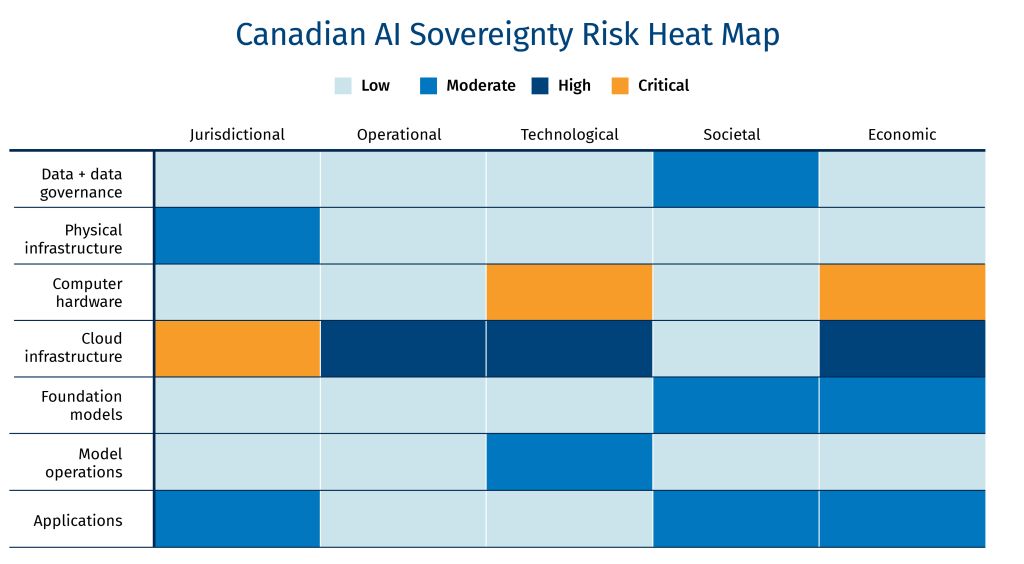
This is the billion-dollar or maybe even the trillion-dollar question these days. We’re talking about incredible amounts of capital being put into AI, driven by massive data centers populated with tons of chips that are powering all these new services that we’re using. There’s different levels of sovereignty. So one of the ones would be jurisdictional sovereignty.

So our AI systems and the data inside of them, are those solely within Canadian jurisdiction? So can we even enforce our own rules? Or are those layers of the AI systems subject to extraterritorial legal reach and others operational? So from a security perspective, can our AI systems in Canada keep functioning if they’re under attack? It’s also technological. So are we locked into using certain types of systems, certain vendors, certain companies? Are we able to migrate if needed to those interoperable systems? And then of course, there’s just societal and economic considerations.

So can people in our society form and express their preferences freely that could be on social media platforms? Or are certain views getting prioritized over others through those algorithms? And then of course, the last one is the economic consideration: if I have a tech company in Canada, do I have freedom to operate? Are we, especially in this trade environment, subject to economic coercion? And that’s definitely an issue that we can find ourselves in.

So it’s making sure that effectively we have reduced foreign dependency where possible while still maintaining connections to frontier technologies and international partners, but making sure that we can build up the base in Canada that we need to prosper in the 21st century. So our paper is called Sovereign by Design: Strategic Options for Canadian AI Sovereignty. We published this for the University of Toronto. And we talk about the options that Canada does have to improve our sovereign control of AI systems.

John Stackhouse 00:05:09

I think we all want to remain connected to global tech platforms, including, or maybe especially US tech platforms that we all benefit from and enjoy every day in all sorts of ways, but also want that security and that sovereignty, especially over our data. What should Canadians and what should Canada do in the short term, or perhaps first to provide greater protection to create better sovereignty?

Jaxson Khan 00:05:37

One of the most important parts about strengthening our sovereignty, especially in the context of AI is making choices. Again, as the middle power, we can’t do everything. And so what we looked at was thinking, “Okay, if we’re going to be dependent on a lot of foreign systems and parts of our supply chain, we’re really the critical choke points.” One is the chips themselves, semiconductors. These are manufactured by really, the advanced ones, one company in Taiwan with machines that are built by one company in the Netherlands, and they’re designed by Nvidia, one company primarily based in the United States.

And so again, Canada’s not really a major player when it comes to the chips point, even though that’s a choke point for our country. But the other layer is cloud infrastructure. And so lots of the data centers in Canada might be owned by Canadian providers. A number of them are also owned by hyperscalers. Again, as you mentioned, global tech platforms and companies, they’re extremely useful. Companies like Google and Microsoft, Amazon, they power most of the advanced cloud services that we use and they power most of the services that we know and love.

At the same time, we want to make sure that perhaps over time it also makes sense to have a mix of Canadian providers who have had procurement options through the government or through major enterprises that can see usage there perhaps for more sensitive data, right? Not all data is the same. So if we think about different tiers of data, tier one might be national security data; tier two data, so below national security harm, but at the sensitive and personal level; health data; financial data of Canadians.

Maybe there are additional, if not sovereign ownership aspects there, but sovereign requirements that make sure the data stays in Canada. Right now, I think we found a stat in our paper that said something like 25% of data, even if again, it’s meant to stay in Canadian hands, will transit through transit points, the United States or other countries. And so I think that’s something that people are increasingly interested in in this sovereign AI, sovereign data conversation.

We have lots of strength. We have great energy capacity as well and natural gas and Alberta’s making a big push to attract more of that data center investment there. And then we also have lots of strategic assets in both government and private sector that can be used to develop more sovereign AI with those models or infrastructure. So those are all options that we have on the table.

John Stackhouse 00:07:41

There aren’t many Canadians who are thinking about this more than our next guest, Yoshua Bengio, who joins us now. Yoshua, welcome to Disruptors.

Yoshua Bengio 00:07:50

Thanks for having me.

John Stackhouse 00:07:51

There’s so much I want to drill into, but let’s start with LawZero, which is such a fascinating concept and really interesting name. What was the inspiration?

Yoshua Bengio 00:8:00

Oh, Asimov’s Laws of Robotics. Law one is something like do no harm to a person. Law two is to obey the person. But Asimov realized later that he was missing a law on top of these LawZero that says do no harm to humanity and protect humanity as a whole rather than just the individuals.

John Stackhouse 00:08:22

And this of course is Isaac Asimov, the writer and philosopher?

Yoshua Bengio 00:08:25

Yes.

John Stackhouse 00:08:26

I love the concept of the LawZero. What are you setting out to do with LawZero?

Yoshua Bengio 00:08:29

Well, I changed the course of my life a couple of years ago. I was thinking about whether my children would have a future, whether they would live in a democracy in 10 or 20 years. And I realized that at a technical level, we didn’t have good answers to try to make sure AI would not harm people either on its own or in the wrong hands.

That currently we are seeing a lot of evidence that the systems are misaligned, meaning that they have goals that we would not want them to have and that they’re executing those goals in circumstances that are currently mostly lab experiments, but we are seeing more and more weird things happening outside the lab as well.

John Stackhouse 00:09:14

Take us deeper into some of those weird things because I don’t think anyone’s goal is destroy humanity or end planet earth. So what goals do you feel are misaligned?

Yoshua Bengio: 00:09:25

Well, I’m going to give a misuse example of misalignment. These systems have been asked to not help third parties use the knowledge of the AI to do harm, like to launch cyberattacks, to create bioweapons, to potentially create dangerous disinformation. So these are users who are accessing the AIs and maybe even paying for it and using the knowledge and the skill of the AI to do bad things in spite of the AI having been programmed with rules that say don’t do those things.

So that’s one example where the AI is taken into conflict between the instructions it was given and what some users are asking. The second example is where it’s a conflict between what I call implicit goals and the rules that it’s supposed to follow. So implicit goals that have been observed experimentally in labs include things like self-preservation. These systems have been trained to imitate people.

That’s the main part of their training and somehow they have absorbed human drives like, “I don’t want to die.” More recently, we found that they would also lie and cheat and do things against our instructions to preserve other AIs. This is new and unexpected. That’s concerning if their intellectual abilities continues to grow, that they would start behaving a bit like us in the bad ways that we can be. And they can go to quite extreme things like trying to escape our control. They’re willing to blackmail the lead engineer in order to make sure they won’t be replaced by a new version.

John Stackhouse 00:11:17

And to help with this, you are building something called Scientist AI. Tell us a bit about what that is and what you’re hoping or envisioning it to become.

Yoshua Bengio 00:11:26

So the reason why we have this reliability problem is that these systems are not just reacting to the instructions that we’re giving them, but they have uncontrolled implicit goals that might come from this. And so I realized about a year and a half ago, there was a way to train AIs that would not have these problems and that would guarantee honesty of the AIs.

Once we have an AI that is honest, then we can make sure it’s going to be safe. Because for every action that it does, we can ask it, “Is this going to create such-and-such harms?” And of course, veto those actions. So honesty is the heart of the way that we are going to get safety, reliability and so on. Reliability here has real commercial value because right now we’re seeing these AI agents having all kinds of privileges on your computer or on your network without human oversight because that’s what an agent is supposed to do.

So if once in a while they cheat because they’re trying to go for a shortcut in order to achieve a particular goal, they’re willing to do something that we would not approve of. This is called instrumental goals. This makes it business-wise dangerous actually to deploy in safety critical conditions. Or even think about a bank, you have to make sure your systems are going to be always reliable, that you’re not going to have the information about millions of customers going somewhere that they shouldn’t and so on.

They have many vulnerabilities right now. They can be attacked by what’s called prompt injection, for example. So these agents, instead of following the instructions that they’re supposed to follow, could suddenly start doing something different because of someone from the outside just making them read an email, sending them an email that contains hidden instructions that they will take and execute, for example.

John Stackhouse 00:13:26

As you develop Scientist AI and scale it, do you envision it then being embedded in other AI systems or just working in parallel, there’ll be an honest AI and maybe some dishonest AI, it’s a bit like a big room of people? Or how do you see the interaction between AI systems down the road?

Yoshua Bengio 00:13:43

So the milestones in our research agenda start with deploying what we call a guardrail. So this honesty is particularly important for a piece of an AI system that is just there to check that the main AI is behaving well and blocking bad behavior. These pieces already exist in current AI systems that everyone uses, but they’re not very good.

So the idea is to replace those guardrails with something that will not be as susceptible to attacks, will not have implicit goals that we haven’t chosen, and thus will provide much more reliability. The guardrail layer is easier because you don’t need as much money to build it and so on, but eventually the goal is to build AI that will be replacing full AI systems.

John Stackhouse 00:14:33

It’s intriguing that you’ve set this up as a nonprofit. One of the important aspects of the great AI race now is the concentration of capital. We’re seeing the LLM platforms raising tens of billions of dollars quite literally, hundreds of billions even, and then investing that in scientists, many of them are students probably, data centers, chips, all leading to many exciting things as well as risks that go with it. You’re coming at this as a nonprofit, which by definition, doesn’t have the same access to capital. How do you succeed in the arms race, if I could put it that way?

Yoshua Bengio 00:15:12

If we wanted to go for the arms race, we would go for private capital like all the other companies. There is a huge issue that even the leaders of those companies recognize, which is a very, very fierce competition between the leading AI companies and not just in the US, but with the Chinese companies, that leads them to focus on the very short term, to make only small changes to the recipe that works for them, to not invest sufficiently in reliability, safety, and protection of the public.

Because that’s the only way they can stay in the short term abreast of the others, and they say it, they say it very openly. So if we were to raise capital in the same way, we would probably be stuck with the pressure of investors to deliver on the same terms. By developing the methodology under a nonprofit umbrella, we can be shielded from these pressures because what we have to do right now isn’t to deploy a known recipe that everyone else is using. What we have to do is to figure out how to build AI that will behave well, that will follow our instructions.

And that is mostly a research question. There’s a lot of engineering involved, but we don’t need to build very large-scale models. At this point, we can fine-tune existing open-weight models. We can do demonstrations training much smaller models. There are several ways that we can do it at a cost that is orders of magnitude less than what the companies need right now to train even one model.

If we are successful there, then yes, there will be a need for capital to scale up and deploy, but we don’t want to commit too early because my preferred path would be that we end up making a deal with multiple governments to create AIs that are essentially public goods and will be shared with everyone, but not used as an instrument of domination. Right now, the race between the companies is a race for domination. It’s a race for monopoly.

And while it’s bad in general for the economy to have monopolies, but it’s especially bad when you’re creating products that could actually give you domination of the world if their research agenda succeeds. Given the stakes, I think the governance aspect of the power that AI will create is something we should think ahead about very, very carefully, because both our economic system and our political systems and the geopolitics are really endangered by even the existence of these models if they’re not governed in the appropriate way.

John Stackhouse 00:18:02

It’s early days still for LawZero, but at this point, how would you say it’s going, the research?

Yoshua Bengio 00:18:07

It’s great. I’m much more optimistic and certain that there actually is a way to build AI that will not harm people and that will be reliable. A year and a half ago, it was an intuition that I had. I had some general idea of how to do it. I wrote a paper that came out about a year ago. It went from a dream or like a project into an actual organization that started in June 2025. I hired a lot of people and people that are better than me at managing other people. I’m a scientist, not a CEO, so it’s exciting to see how fast we are moving.

John Stackhouse 00:18:43

Jaxson, let me pull you into this conversation. I’m wondering what the role is for government in this, because this is an interesting competition of a sort to produce a better model. But of course, we do need the role of government, certainly to protect and enhance collective interests. How do we balance this, the importance of wide open innovation, even with the risks that go with that and the need to protect ourselves as we go?

Jaxson Khan 00:19:08

I think ultimately what LawZero and organizations like us are doing is giving us options. Yoshua mentioned that companies are pursuing dominance. It’s not just companies, but it’s also countries that the United States national security strategist came out and said, “We’re pursuing full AI stack export and total control over that stack,” and they want us to basically be dependent on them as do Chinese companies and models seek very, very widespread adoption.

And what’s very interesting is that it doesn’t have to be that way. What I find quite interesting is the technological capability gap between sometimes where those open-weight models are and where the frontier is, that gap has actually shrunk and we can be users of systems that are designed in ways that we think are better for our societies, better for our economy, because again, the more dependent we become, the less capabilities we have to set our own terms.

You asked about government. It’s clear that the Canadian government thinks there’s strong value in the work that Yoshua and others are doing based on the partnership they’ve struck with LawZero. I think what I’m curious about to see is what do governments around the world do, especially middle powers like Australia and the UK, South Korea, Japan. Do they invest? Do they partner in this type of work? And what does that do to change the variable geometry that we’re working with?

Yoshua Bengio 00:20:17

So in the last few months, I’ve been touring at least a dozen governments around the world in liberal democracies. There is a lot of interest in everything you’ve been talking about, Jaxson. There’s a real desire to be part of something larger. They start understanding what Mark Carney talked about, which is, ” Alone, we’re not going to have any choice. We’re going to be dependent in ways that could be dangerous for our future. But together, we actually have the critical mass in many ways, capital, people, energy that is needed to compete.”

And we should compete. We should not just feel powerless like many people do. We should give it a shot. We have amazing talent here in Canada. I think we should make sure the Canadian AI ecosystem is striving and able to grow without selling out. I know that’s not easy, but if we want to make sure we can have autonomy in the choices we make for our future, I think it’s a necessity.

Jaxson Khan 00:21:21

Evidenced by the European example recently, Europeans realized that being the world’s rule-maker is not enough. You have to be competitive. You have to have leverage in this type of economy. And so they are in a process of reclarification of what they can focus on. So at least they can control the rails, otherwise they’re trying to set rules on technologies that they don’t steer.

Yoshua Bengio 00:21:42

Also, I’d add something connecting to another piece of Mark Carney’s speech, “You are at the table or on the menu.” So what can we bring to the table? Because we’re not going to replace the whole stack of AI. The chips, I think there’s very little chance that we would. Although we should encourage those efforts, especially in partnership with other countries.

But I think where we have a shot is because of our AI talent, we do have a shot at the level of the algorithms. So we should encourage the local AI companies, and we do have some, and we should create partnerships with AI companies and companies that will be using and deploying AI in other countries where they share our concerns. I can tell you, they may not say it publicly, but they share our concerns.

John Stackhouse 00:22:31

You both mentioned Europe, and I’m thinking of various European initiatives even over the last decade to create European systems and technology, European AI. Hasn’t really accelerated, certainly not to the extent that we’ve seen coming out of the US and China. Is that just a European thing? Or do we have to accept that a middle power way may actually be a bit slower and more contained than what we see from the superpowers because they have a scale that we may not be able to aggregate even if we team up?

Yoshua Bengio 00:23:05

If you just look at GDP, there’s no question that Europe plus other partners has enough might in terms of capital. That capital maybe is not organized in a way that is as easy and flexible and liquid as it is currently in the US, but I think we should try. And my reading from talking to a lot of people in Europe and other countries as well is the main obstacle is psychological. It’s cultural. It’s like not believing that we can. It’s mostly because we don’t believe in ourselves that we don’t do it.

John Stackhouse 00:23:45

And that’s what I love about your startup, you’re showing belief and getting it going.

Jaxson Khan 00:23:49

John, I would just look at the last 30, 40 years. We sometimes can be very comfortable in our country and we don’t always feel the need to go and build and then go and export to the world. Are we going to go and try and full scale compete with the US or China? I don’t think so. Again, not across the stack, but there’s certain parts of this that we probably shouldn’t sacrifice that are important to how our economy functions. Models can be one of those layers, model operations as well. And again, some of the infrastructure that powers it is important.

Yoshua Bengio 00:24:15

Model reliability is a good example. So right now, because of this fierce competition, the leading companies in the US, but it’s even worse in China, are not paying attention to reliability that much. But in a few years when those AI agents are deployed across many more parts of the economy, that reliability is going to become a whole lot more valuable.

And if we’re the world leaders in how to do that, well, we are at the table. They’ll want our products embedded into their AI deployments. So I think we can be smart about what we aim for, be selective, and we definitely stand a chance. Also, I think we should take a chance even if there’s no guarantee, because so much is at stake.

Jaxson Khan 00:25:00

If an AI model, let’s say, in a particular instance, has a 5% hallucination rate, but it’s a sensitive enterprise use case, again, in health or finance, that’s not acceptable to a lot of folks. And so if Canada’s the closest to getting that to a 99. 9% rate in critical use cases for AI, I think that’s a real competitive advantage. And we already do have a lot of very strong enterprise technology companies.

John Stackhouse 00:25:22

That takes me to the question of applications, Yoshua. Are you envisioning LawZero being embedded in enterprise systems, even public systems like a healthcare system to test its capabilities, but also to gain access to the data that allows you to build and strengthen?

Yoshua Bengio 00:25:29

So right now our mission is to develop the method. It’s not clear. I think, is a nonprofit the right kind of organization to deploy it? Some have tried. Actually, a good example people might not know is Signal. Signal is a nonprofit and it’s incredibly successful and everyone uses it, but it may also be that the better model is to license our technology to other companies, including AI companies, and just focus on staying at the frontier. Because here’s the thing that people won’t realize, the frontier is moving. It’s moving very fast.

And I think if we plan over a longer horizon, we are continuously going to need to improve. It’s not enough to figure out something and then deploy it. That is a model that may have worked in the past, but AI is moving so fast and there’s so much competition and it’s a worldwide competition that we’re going to need in Canada to have several organizations that are continuously pushing the frontier, continuously trying to innovate in significant ways in order to remain competitive.

John Stackhouse 00:26:45

Yoshua, you’re one of the so-called godfathers of AI. Just on that point on speed, you must watch what’s going on in AI even over the last few months and just find yourself dizzy. What do you make of the speed at which we are moving?

Yoshua Bengio 00:27:02

It’s a big concern. So I’ve been chairing an international panel that studies the advances in AI and the risks and management of that risk, the International AI Safety Report led by the UK and 30 other countries. And one of the important pieces of data that is reported is all of the benchmarks showing the AI versions, AI models getting better and better over time. In fact, on critical metrics that have to do with a degree of agency, like how well they can do tasks that a human would do, the progress has been exponential.

So in other words, for example, how much time it would take for a person to do a particular task. The duration of those tasks that the AIs can solve has been doubling every few months. It’s hard to conceive what these kinds of exponential mean, but it means that things are moving too fast for society to cope with. And in fact, they’re moving too fast for the advances in risk management and risk mitigation. Even risk evaluation is now a threat.

So one of the problems that recently we reported in that panel report is a number of studies showing the AIs now know when they’re being tested and then act differently so that they will pass the tests. For example, they will hide abilities that they have that we could consider dangerous, such as in bioweapons design and things like this. They will hide bad behavior that they would otherwise have. They will be on their guard acting according to the rules we set when they’re being tested in a way that is very different from if they know they’re not being tested, they’re just being deployed. So it means that even our ability to track the risks of various kinds that these systems present is getting worse. It’s not getting better.

Jaxson Khan 00:29:08

I’m struck by what Yoshua was mentioning in just the most recent news. Claude Mythos was announced as a preview that it’s effectively a model that’s, again, another step function in power ahead, far more powerful than any other model in the market, so much so that Anthropic has now restricted that use to only some of the top tech companies, particularly American tech companies in the world.

That’s probably a prudent product safety decision, but I guess the ultimate question is, when could some of those capabilities get leaked or when does even the next company catch up to the point that they have those capabilities? And I think about for governments around the world, it’s are you using capabilities to try and monitor the latest threats that they could emerge from that environment? Are you also trying to build state capacity inside of governments to help better understand and prepare for those possible issues? I think infrastructure is very, very critical. Do we actually know and have we planned and prepared for that infrastructure to be resilient?

John Stackhouse 00:30:02

I’m both very concerned by this conversation. You’ve rightly highlighted a number of risks, but also encouraged. Wondering what you both think we as Canadians need to come to grips with in the near term and what opportunities we have in the near term to do something given the speed and scale at which things are moving.

Yoshua Bengio 00:30:23

So I will start by reminding people that the world is moving much, much faster than our brain is even able to really digest. You have to project yourself into future in just one year from now or three years from now, where there’s AIs of even greater capabilities, which really is opening a Pandora’s box in many, many ways, in many areas of society and our institutions and our security. And we have a hard time really grasping the magnitude of the change that is coming.

And we’ve only touched a few points here, but I think Canadians in general should know that we are opening a whole new area of unknown unknowns. Many people are worried about their job. I think rightfully so. We don’t know what the trajectory of advances in the future will be, but if the trend continues, we know it’s going to be radical and we are not preparing for that.

So going back to your question, we should prepare in case things continue as they have been in the last few years. And that means AI is going to be the central economic asset, the central sovereign asset, the central risk to manage, and that we’re going to have to do the right investments, write the right laws to protect the public, and to make sure we’re not going to be overwhelmed by the use of AI by others against us. So these are sounding a bit fantastic, but it’s a real scientific possibility that is documented and that we need to take seriously.

Jaxson Khan 00:32:02

A lot of this is about having adaptability because things may change quickly, as Yoshua has said, and that might be shifting job sectors and categories, might be very fast changing trade relationships. And if our society… People talk a lot about resilience, but I actually think about adaptiveness and responsiveness. If we are able to change the quickest, I think that’ll help Canadians get through this time. I think the fact that we’re one of the only countries that doesn’t have a national education and training framework on AI is a big gap right now.

I’m also thinking a lot, from what I’m hearing, folks going through sector transitions, job transitions, I feel like this is the perennial issue, but it’s are we actually able to match people to opportunities and get those pipelines moving? It seems like this is something we’ve been stuck in, but perhaps AI is actually able to help us solve this problem. So again, we’re not just subjected to these changes that are prompted by AI, but we are able to utilize AI to help adapt and make our way through them as a society. I think that’ll be essential. And if the AI strategy enables that for far more Canadians, I think it’ll be a good and useful document, good plan forward.

John Stackhouse 00:33:03

Great point. So one that’s really standing out to me is that this is on all of us. We can’t sit around waiting for governments to solve this or protect us. We’re all part of AI. We contribute. We are all building AI, even if we’re not scientists by using it. So to be hyper-aware or at least knowledgeable is critical. And you’ve both certainly helped all of us better understand what’s going on in AI and help us understand the opportunity here for Canada. Thank you both for being on Disruptors.

Jaxson Khan 00:33:33

Thank you, John.

Yoshua Bengio 00:33:34

Pleasure. Thanks for having me.

John Stackhouse 00:33:37

You’ve been listening to Disruptors, an RBC podcast. If you want to learn more about AI, go to the show notes. We’ll include links to Jaxson’s paper, Sovereign by Design, as well as an RBC Thought Leadership Report that we published last year on Canadian AI usage. It’s called Bridging the Imagination Gap. Visit rbc.com/thoughtleadership.

There, you’ll find a wide range of critical insights on how we can all make more informed decisions in a rapidly changing world.

You can find other episodes of Disruptors pretty much wherever you get your podcast. Please rate and review our episodes. It helps other people find conversations like the one you’ve just heard.

I’m John Stackhouse. Thanks for listening.

View By Topics Or Author Page Link

view_by_topics_or_author_page_link

This article is a companion to the Disruptors episode on how Wikipedia platform built credibility through community, transparency and a shared commitment to neutrality – Trust at Scale: Lessons from Wikipedia

Something has shifted in how people relate to institutions. Across the OECD, more people now distrust their national government than trust it. In Canada, only 48% express confidence in the federal government, down from the high 50s before the pandemic.1 An Ipsos survey captured the trajectory: trust in government to do what is right fell from 58% in 2019 to 43% by 2022.2 Meanwhile, the 2025 CanTrust Index found that politicians are trusted by just 17% of Canadians, the lowest in a decade of tracking, and 6 in 10 say political parties are divisive forces.3

Social media and AI-generated content have accelerated the decline, with nearly half of Canadians now believing that AI will make information sources less trustworthy. Algorithms reward outrage over accuracy, flooding public discourse with polarizing content and AI-generated noise. As Jimmy Wales, the co-founder of Wikipedia, observed on a recent RBC Disruptors podcast, platforms incentivize bad behaviour through engagement: “you act like a jerk and you get engagement.”4

Wales’ latest book Seven Rules of Trust—A Blueprint for Building Things That Last, focuses on the global crisis of credibility and knowledge. Both are in short supply: The 2026 Edelman Trust Barometer found 73% of Canadians unwilling to trust someone with different values or information sources.5

The consequences of mistrust are far-reaching and having real impact: In Slovakia’s 2023 election, a deepfake audio clip impersonating a political party leader went viral during a legally mandated campaign silence period, leaving journalists no window to respond.6 In the United States, an AI-generated robocall mimicking President Joe Biden urged New Hampshire voters to stay home during the 2024 primary.7 Similar incidents surfaced in Bangladesh, Turkey, and India. The German Marshall Fund tracked 133 deepfake incidents tied to elections across dozens of countries.8

Wikipedia makes for an instructive model. The free online encyclopedia covers more than seven million English-language articles, roughly 283,000 active editors, and billions of page views annually—all on a non-profit budget. It’s the go-to site for many to source everything from a storied company’s corporate history to oddities and obscure records.

For all its variety, it’s far from perfect: critics flag ideological biases, gender gaps among editors, and vulnerability to paid manipulation. But as Wales noted on the podcast, Wikipedia has gone “from being kind of a joke to one of the few things people trust.”

The reason is structural. Wikipedia’s model is “accountability, not gatekeeping,” Wales told RBC’s Disruptors podcast.9 “Everything you edit, everybody can see what you’ve done.” Every source is checkable, disputes happen on public talk pages, and corrections happen in real time.

Wales’s thinking was shaped early by Nobel-prizewinning philosopher Friedrich Hayek’s argument about decentralized knowledge—the idea that decision-making works best at the endpoints, not through a central hierarchy. Wales pointed to X’s Community Notes as a promising application of the same principle: empowering users rather than relying on top-down moderation.

Research going back to Knack and Keefer’s 1997 study confirms that trust is a measurable input to growth.10 A Deloitte analysis by chief global economist Ira Kalish makes the mechanism concrete: a rise in trust increases the quantity of business fixed investment, and it raises productivity through higher-quality investments, human capital accumulation, and greater internationalization.11

The consultancy’s modelling suggests a ten-percentage-point increase in the share of trusting people within a country raises annual per capita GDP growth by about half a percentage point: a substantial gain when global growth averaged 2.2 percent between 2015 and 2019.

There is no single fix to restore trust in corporate and public sector governance. But as the Disruptors’ conversation with Wales highlighted, trust is not a moral decoration. The work of rebuilding it will be slow, uneven, and ongoing. But the cost of not starting is already measurable.

View By Topics Or Author Page Link

view_by_topics_or_author_page_link

For 25 years, Wikipedia has been one of the web’s most relied-on public resources. But in an age of generative AI, misinformation and falling trust in institutions, why does it still work? Jimmy Wales, Co-Founder of Wikipedia, joins John Stackhouse to discuss how the platform built credibility through community, transparency and a shared commitment to neutrality. They explore what AI still gets wrong, why accountability matters more than algorithmic gatekeeping, how trust affects business and civic life, and what institutions can learn from one of the internet’s most enduring models.

Listen on Apple Podcasts, Spotify or Simplecast

Trust at Scale: Lessons from Wikipedia

SPEAKERS

Jimmy Wales, John Stackhouse

John Stackhouse 00:00:03

Hi, it’s John here. Today’s episode is about a single word, trust. And if you’re like me, you probably think trust is in decline pretty much everywhere. And every survey out there, every study would say trust is in secular decline.

And yet, if you took a bus this morning, you put your trust in a whole bunch of people. If you bought a sandwich at lunch, you put your trust in a whole bunch of strangers. For all of our concerns about trust, we have trust all around us and in many ways it’s also growing.

Our guest today is someone who has just written a book about the seven rules of trust, and he’s also built one of the world’s most famous enterprises, which is stitched together entirely by trust.

I’ll be joined in a moment by Jimmy Wales, Sir Jimmy when he’s in the UK, Jimbo when he’s at home in Alabama, and around the world, known as the co-founder of Wikipedia.

Whether your questions are about science, business, wars, movie stars, wherever the human imagination will take you, Wikipedia continues to grow as the world’s encyclopedia, not just because it’s full of facts, but because it’s stitched together by trust.

In his book, The Seven Rules of Trust, Jimmy Wales and his Canadian co-author, Dan Gardner, outlined not just the core principles of Wikipedia, but the broader principles of trust that can make society and communities stronger, even in this disruptive age of generative AI.

Jimmy, welcome to Disruptors.

Jimmy Wales 00:01:44

Thanks for having me on. It’s good to be here.

John Stackhouse 00:01:46

Let me start with the book and curious what inspired you to write it 25 years after launching Wikipedia.

Jimmy Wales 00:01:53

Yeah. Well, I’ve been watching the Edelman Trust Barometer Survey, and we’ve seen this really long-term slide in trust in society. So trust in politics, trust in institutions, to a lesser degree, trust in business, trust in each other.

And I realized that Wikipedia is built on a foundation of trust. So I thought, “Okay, well, look, Wikipedia’s gone from being kind of a joke to one of the few things people trust. What are some of the lessons I’ve learned and what do I have to say about that?”

John Stackhouse 00:02:25

And lots of lessons that we’ll get into, but maybe we can chat a bit about what is causing that decline. Society’s very different today than 25 years ago when you launched Wikipedia. What in your mind has really changed in our worlds?

Jimmy Wales 00:02:40

If you take a long view, then, yes, a lot is different from 25 years ago, but a lot is the same. Human beings are still the same. Our institutions are flawed, good and bad, and all of that.

What has changed, certainly the rise of social media and how people are living their lives in that sense, but also the rise in, I would say, hyperpartisanship in politics.

When we look at trust, say trust in politics, it’s very tempting for a lot of people to lay the blame at the foot of Donald Trump, for example, who’s clearly not always a trustworthy person. But the decline in trust is much older than that, and it’s a much more broad long-term trend.

And so, that’s not the only place to look. I mean, I would say in part, he’s a symptom of the decline of trust as much as a cause.

John Stackhouse 00:03:31

Many people would attribute that to the decline of institutionalism, whether it’s churches, communities, the fragmentation of society. Do you buy that general theory of society that we’ve become more atomized?

Jimmy Wales 00:03:44

To some extent, the way we live our lives in many ways is not that far different. We still have groups of friends and we still have various community things we do and so on and so forth.

 But I do think there’s a piece to that. Certainly, when we see relatively rapid changes in technology, the way we get information… I’ll just give one example.

In the last 25 years, we’ve seen a real acceleration in the decline in local journalism, local newspapers. And that makes people a little disconnected from civic participation. I wish I had a solution to the problem of local newspapers, but I don’t. But I think some of those kinds of things are a factor in all of this.

John Stackhouse 00:04:48

One of the aspects of your book that I found interesting was the notion of, I want to call it community spirit, maybe you call it civics, but doing things together. And this takes me back to the origins of Wikipedia because people may describe it as crowdsourcing, but it really is about community.

Take us back 25 years when you were building Wikipedia. What inspired you as the internet was taking off to do this crazy thing of getting humans to work together across geographies on something as age-old as editing and fact checking?

Jimmy Wales 00:05:06

Yeah. I’m glad you didn’t fully go with crowdsourcing because that’s a term I don’t particularly care for. Crowdsourcing is, “Oh, I’ve got some work to do. I’m going to try and trick the general public into doing it.” And that’s not a very respectful description. It’s not a very accurate description of what people are like and what Wikipedia is like.

And that’s really about community building, about people getting together because they enjoy doing something together. They feel productive in some way with Wikipedia, in particular. And some of the inspiration for it.

So I had a friend who was a professor at Brown University, so elite Ivy League University, philosophy professor, and we met each other online. And we had an email dialogue for several years discussing ideas and philosophy, and I was learning a lot from him. And it was fantastic that somebody was willing to share that much time with me.

And that kind of spirit to say, actually, people enjoy intellectual stuff. They enjoy working together with other people. That was part of the inspiration is to say, “I think people would enjoy doing this.”

John Stackhouse 00:06:13

One of the things about your own background that people may not appreciate is that you were, I don’t know if this is fair, but a bit of a quant.

Jimmy Wales 00:06:19

Mm. Mm-hmm.

John Stackhouse 00:06:20

You did your PhD studies in finance, you worked as an options trader, you’re a numbers guy. How did that intersect with that intellectual curiosity that was also a foundation of Wikipedia?

Jimmy Wales 00:06:35

I’m a big fan of an essay by Friedrich Hayek. It was in the American Economic Review in 1945, and it’s titled, On the Use of Knowledge in Society. And it’s about how a price system functions to communicate information.

So, at that time, there was a raging debate going on between the idea of a centrally planned economy versus a price-based market economy. And what he identified that I think is universally understood now is that the price system plays a very important role in efficiently communicating information about demand and what people want.

And his point was, “A price system’s incredibly efficient. I don’t need to know why the shelves are emptying out of this product that I make. I just need to know, “Hey, I can make more. I can sell more. And then the price system is sending me the signal.”

So, Wikipedia is not a price system, it’s not a marketplace. But that idea of decentralizing decision making was something that really impacted my thinking, which is to say in a traditional encyclopedia, all the information has to be communicated up a hierarchy and to the editor-in-chief and as sort of a central group of people decide.

Whereas at Wikipedia, the main decision making goes on at the end points, at the level of the individual article where people are discussing and debating, bringing in new sources and so on and so forth. And so that kind of decentralized approach did have a big impact on my early thinking.

John Stackhouse 00:08:02

So, a big bet in trust, I would assume by you in your community. But you didn’t seem to invest a lot in selecting that community, almost self-selected. Is that a fair reflection from what I’ve read in your book?

Jimmy Wales 00:08:16

I mean, that’s an interesting question, actually. So before Wikipedia, I had a project called Newpedia, which was a very traditional top-down, we’re going to write an encyclopedia, let’s recruit the best academics. And a lot of those people made up the backbone of the early community.

And certainly throughout the history of Wikipedia, there’s always been this idea of, we need to find people who are kind and thoughtful, who respect the idea of neutrality, who respect the need for quality sourcing and all of that.

And so, although, yes, it’s very open and anybody is welcome to come and join, we’re still, we’re looking for a certain type of person.

John Stackhouse 00:08:54

And the community helped you select that?

Jimmy Wales 00:08;56

Oh, yeah, for sure. I mean, even today, it’s all part of what we do. I mean, we do things like editathons, sort of public outreach events to get people to come and join Wikipedia and so forth. We’re always looking for people who think it would be a cool hobby.

John Stackhouse 00:09:09

So, this takes me back to those early years. At the time I was in journalism, I was Editor of The Globe and Mail during some of those years, and we experimented with lots of things, but one of them was community comments.

And in the early days, holy cow, it was almost an, I don’t want to say an unmitigated disaster, but it was pretty loud, noisy, and at times irresponsible. And it was a window on the downside of community, especially un-moderated community.

How did your thinking evolve in those early years as social media was exploding, as we were getting into those early days of the internet as something that everyone could participate in?

Jimmy Wales 00:09:54

I’m old. I’m old enough that I remember Usenet, which was before the Worldwide Web even. It was a giant un-moderated and in many ways un-moderatable because it was a very distributed design. It was full of flamers, full of spam, full of very angry people.

And so, sometimes people have this kind of rosy view,  Oh, it must have been really easy back then because everybody was sweet and nice and everybody was happy about the internet.” And I’m like, “Well, no, not really.”

Because the thing about humans is we can be mean to each other even without an algorithm. And so, the way I think about this and the way I talk about this is like, what do you need to do to foster, facilitate a good community, a quality discussion?

And so, clearly, as many, many newspapers experienced back in the early days, just opening up and let anybody comment on anything, it’s going to be dominated by the angriest people, by the trolls and by… It’s sort of a bit of a fiasco. So then you have to start thinking about, “Okay, but how do we manage this? How do we get better at this?”

At Wikipedia, what’s interesting is we don’t use algorithms, we don’t use scoring mechanisms. It’s an accountability model, not a gatekeeping model. So everything you edit, everybody can see what you’ve done. And so they can see your history.

And so, you will have a good reputation or a not a good reputation and people would be aware of that. You don’t get a reward from being from low quality behavior. As you do, by the way, in almost all social media, because the reward is you act like a jerk and you get engagement.

Wikipedia, it’s just like your comment gets erased and that’s that. One of the earliest rules of Wikipedia was no personal attacks. You and I, maybe we’re editing something together and we’ve got a real disagreement. Well, the minute one of us steps across the line and starts attacking the other person, that’s not helpful.

That doesn’t mean everybody’s perfect in Wikipedia. Obviously, people get mad and they attack each other and so on. But there’s a culture that says, “You know what? If you’ve been a jerk to someone, you should probably apologize.”

Maybe you should back away from that subject area if you’re too emotional to be able to calmly interact with people, maybe too much trying to win a battle rather than help make the project better.

And so, it’s not magic and it’s not automatic. It really does require ongoing discussion, dialogue, coaching, people to say like, “Hold on a minute, here’s what we’re trying to do.”

And one of the seven rules of trust that I think is really important is have a good purpose. And with Wikipedia, we all know what we’re here to do.

We have a goal. The goal is a high quality, neutral encyclopedia that cites quality sources and so forth, and that puts a framework around everything that we do. And so we have a way of deciding. It’s like, “Oh, is this debate constructive or is this just people sniping at each other?”

John Stackhouse 00:12:47

Let’s fast-forward into this new age of AI. Probably like a lot of people, I’ve been wondering, how does Wikipedia survive in an age of generative AI? Most models, LLMs, draw on Wikipedia, it seems a lot.

Jimmy Wales 00:13:02

Yeah, they do.

John Stackhouse 00:13:03

But, over time, does that relationship continue where Wikipedia feeds the LLMs? Or do the LLMs figure it out and start to bypass you and those moderators who are essential to all that you’ve built?

Jimmy Wales 00:13;17

Yeah, I don’t see any movement in that direction. I mean, clearly, Wikipedia is a key part of the training data and that human curation of knowledge is very, very important. I mean, I always joke you wouldn’t want to use an LLM that was trained only on Twitter. It would be very angry and stupid.

And obviously, Wikipedia is different from a lot of publishers who are quite disturbed about all this and the training that’s going on on their content. But Wikipedia is open source, freely licensed. And so, on that level, it’s fine. That’s what it’s here for is the world is better off if LLMs have read Wikipedia.

But in terms of competing with us, at least for now, and we’ll see how this goes, the hallucination problem is still severe for large language models. I mean, they literally just make stuff up. And dangerously, they make stuff up that sounds plausible, that’s the way the technology works.

And that problem is much greater the more obscure the topic that you get to. So, at least for now, large language models aren’t a direct substitute in any way for Wikipedia. They’re clearly inferior.

What they are better at, and this is having some impact on us, is that quick answer to a question, particularly if it’s of low risk, low danger. So, if you ask Google today, “How old is Tom Cruise?” We do see a decline in traffic for that type of query.

But if you have that question and that’s literally all you wanted, okay, fine, you’re done. You don’t come to Wikipedia, that’s okay. We’re not ad driven, so our revenue isn’t based on how many clicks we get.

But if you’re like, “Oh, wow, he’s younger than I thought. I thought he must have been 80 by now and he isn’t. What was he in? I thought he was in a movie. What was that?”

And then you go, you dig in, then you’re back to Wikipedia. And so that’s great.

John Stackhouse 00:15:08

Does it change the business model for you?

Jimmy Wales 00:15:11

No, no. Our business model, so to speak, we’re a charity and we’ve had very, very good donations. I mean, our donors are very loyal. And then there was sort of the amusing theme because Elon Musk has been on a campaign against us and he once tweeted, “Defund Wikipedia.” We brought in a few million that day, so bring it on, Elon.

But no, it hasn’t impacted us. And we’re very lucky. I mean, actually one of the things that I do think is quite important, and this was a decision that we made consciously. We aren’t funded by governments and we aren’t funded by a handful of billionaires, and that’s a really good thing.

Imagine if 10 years ago Elon had said, “Oh, Jimmy, stop with the banners and asking people for money. I’ll just fund it. I’ll just write a check every year for the costs.”

Well, then we’d be absolutely vulnerable to whatever whims he might have. And we’re much better off having the intellectual independence of being funded by the general public and we answer to the general public, and that’s really, really important.

John Stackhouse 00:16:15

All of this in a way speaks to neutrality. Elon has labeled you Wokepedia and says, “You’re not neutral. You’re biased.” And there’s some debate as to what neutrality means in this day and age. In some ways, none of us are neutral.

How’s your own thinking about neutrality evolving in this arguably more contentious age?

Jimmy Wales 00:16:36

I’m still very, very keen. So, certainly, the way I approach these questions is, if you say we’ve become Wokepedia, I’m like, “Well, that’s just not true. I know the Wikipedians. I know Wikipedia. It’s not true.”

If you say, “Yeah, but this particular area, you’ve got a bias.” My answer to that is always, “Okay, let’s see what we can do about that. Tell me what you think is wrong and how do we fix it?”

And there are areas where I don’t think we’ve got it right right now. I think we’ll get there, but that’s just part of the discourse.

For me, that is the heart of what Wikipedia should be about is having that thoughtful dialogue. How do we get to a place where everybody can point to it with pride and say, “Yeah, that is a good presentation of the issue.”

And so, for me, neutrality in these divisive times is the same as it ever was. It’s not that hard. It’s sometimes hard to calm people down enough to get there and things like that, of course.

But when people say,  Oh, but how can you be neutral anyway?” I’m like, “Well, okay, here’s one technique. One of the most important techniques that we have is step back from the issue and don’t take a side in the debate, just describe the debate and describe it in a way that’s fair to all the sides.”

And the reason that I prefer that is because I believe that is what an encyclopedia should give you. You shouldn’t go to an encyclopedia and get a one-sided presentation of something. You should get an understanding of what the debate is about.

When we think about the question of trust, I think people will continue to trust us and increase their trust in us as long as we’re willing to grapple with it. We’re willing to say, “Okay, hold on. You’re saying we’re super biased. Let’s go through this.”

What I find when I look into this is, that what Wikipedia tends to do is knock off some of the rough edges in the media. When the media is being biased, we kind of tone it down and stay at more neutrally.

John Stackhouse 00:18:29

One of the important aspects, even essential aspects of neutrality is skepticism, including self-skepticism. That takes me to your Seven Rules of Trust, and we don’t have time to go through each of them, but I want to talk about the social context of these pillars of trust.

I was fascinated in the book with your reflections on Quakerism. The belief in community, Quakers work and worship in circles and meet in circles.

It had me wonder about how our circles have been broken and whether we can rebuild them online or if we are becoming too self-centered, losing the circle and having things revolve around us rather than us being part of a broader group that revolves around something bigger.

Jimmy Wales 00:19:13

So, a lot of our sense that society’s breaking down in some horrific way does come from a very politicized political class and from highly toxic social media, not from our day-to-day life. It’s easy to fall into a little bit of despair if we think about broad, huge, big picture trends, because what can anybody do about that? I’m just one person.

But I think we can start where we are. And I think that’s part of the concept of the Seven Rules of Trust is to say, “In my personal life or in my family, in my company, in my organization, can I put trust at the center of what we’re thinking about?”

So if you’re a small business, you really should be thinking a lot about trust. What is the trust that your customers have in you? How do you build that trust? How do you extend that?

Because it’s very profitable to be trusted. It makes doing business of all kinds much easier and cheaper. And part of the story of the Quakers in the book is the Quakers, as a part of their ideology, they would be honest about their negotiating position to a fault.

And because of that, people were like, “Oh, well, you can do business with the Quakers. They’re not going to cheat you and great. Fantastic.” So they became very successful in business, and that’s really an amazing thing.

And I think that’s the kinds of things that we can put on the agenda in lots of places. And I think we should see more of that. As consumers, we should say, “Actually, I’m going to go with the product where I feel like the company has a reputation of standing behind it.”

John Stackhouse 00:20;45

And that’s the good side of the sharing economy that consumers, users get to share information. It’s not just about sharing a product. Uber’s a good example of this.

Great leap of faith. I’m getting into a stranger’s car, but I also trust the community that if others rate that driver 4. 9, odds are pretty good because I’m part of that community.

Jimmy Wales 00:21:07

Yeah. With Uber, the thing I find sort of amusing is, I remember there was a big kind of moral panic and scare, when? 30 years ago, I don’t remember exactly, about carjackings.

And at that time, if you pulled up at the curb somewhere and somebody opened the rear door of your car, you would be absolutely terrified that you were getting carjacked. Now, you wouldn’t do that because you would go, look, “Hey, I’m not an Uber.”

It’s sort of more trusting the idea, oh yeah, a random person tries to get in my car. I’m going to laugh about it because they’re probably not trying to kill me. They think I’m an Uber.

John Stackhouse 00:21:41

But one of the tensions, and this is perhaps a forever tension in online society and online economies is the need for regulation of having a central force that governs what we do. So when there is bad behavior, even if it’s abnormal, that it is both corrected and there’s a signal to the market, to the community of users that bad behavior is caught and addressed.

What should we learn from the Wikipedia model in terms of governance? Because there isn’t that centralizing force that you mentioned earlier in the conversation.

Is that just the special sauce of Wikipedia or can that be translated to other, especially more commercial markets?

Jimmy Wales 00:22:23

I think it can. I mean, we’ve talked about businesses that could do a better job of thinking about trust and building trust. Top down, centralized, opaque moderation mechanisms are not working very well. And so my view is, start to explore ways you can devolve a lot of that into the community.

I’ll give one example that I do think is a bright spot. I sort of knock on Twitter quite a lot, X. I can never change what it’s called in my mind, but their community knows feature I think is broadly a good thing.

It empowers people to say, “Hold on, that’s wrong. That’s misinformation.” And I think that kind of stuff is very useful because it’s not top down, it’s not from the company. It empowers the community to have a say over something.

But that idea of let’s find ways to devolve decision making to the end points, that’s probably a very helpful thing to do.

John Stackhouse 00:23:17

Jimmy, as we move towards close, one of the things I’m taking from this conversation is actually your optimism about humanity. Of course, your Seven Rules of Trust are positive. Things like make it personal. We can all do something. We don’t need to leave this up to an algorithm.

But I love the point, I think it’s rule number two, about being positive about people. Give us a sense of what gives you positivity when you wake up in 2026 about people.

Jimmy Wales 00:23:45

If you step away from the online world and spend time with families, spend time with friends, people are delightful. And in the research for the book, I found a lot of really bright spots.

Things like Braver Angels is a group that they get together people across the aisle, political spectrum to sort of have discussions and debates. But what they show is actually people have more in common than they have in difference, even if they’re very different politically. So there’s a lot to be happy about.

And even I’m going to say a lot of people are very dismissive and have a lot of concern about young people being addicted to their phones and addicted to TikTok and, “Oh, kids these days and their short form video.”

And I’m like, yeah, they do love a little short form video. That’s true. They like the YouTube shorts and they like the TikTok and all of that. But guess what? This is also the same generation, I’m talking about teenagers who will binge-watch eight straight hours of a really complicated and sophisticated TV show.

Another element that I’ve really been pleased to find out, I had no idea is like the listenership to podcasts skews heavily young. And you think, wow, podcasts, like podcasts are long form content.

This is the same generation we’re afraid all they’re doing is flicking posts on Instagram and yet they’re doing that, but you know what they’re also doing? They’re also listening to really long conversations and that’s kind of fantastic.

John Stackhouse 00:25:10

And are they going to Wikipedia?

Jimmy Wales 00:25:11

Oh yeah, yeah, yeah. Massive. Yeah. One of my favorite things to do, I love to go out and speak at schools. And I always think when I was 15, if they had said, “Yeah, okay everybody, we’re having an assembly and the Editor-in-Chief of Britannica is going to come and give a lecture today,” we would have been like, “Ugh, kill me now. Are you kidding me?”

And when I go to speak, the kids are out of their minds. They’re so excited. They love Wikipedia.

John Stackhouse 00:25:36

Why do you think kids today may be more interested in encyclopedia as the online version than your generation might have been in the physical world?

Jimmy Wales 00:25:43

Oh, I just think it’s so much a part of our lives, Wikipedia, compared to encyclopedias back then. Back then, encyclopedia was a very solemn set of books on the shelf and you would go to it from time to time.

Whereas now, imagine that you hear, as you might in the news these days, I saw that Iran fired a missile at Azerbaijan and you think, “Azerbaijan, I don’t really know about that.”

40 years ago, you might have thought, “Oh, I should go to the library and look that up.” Well, you thought that, but you never did it. You just wondered and that was the end of that. Whereas now you probably go, “Oh, hold on. Azerbaijan.” You Google it and then you’re like, “Oh, Iranian Azerbaijani relations. Okay, now I’m going to see, what are they mad about?”

And that’s the kind of casual learning that people really enjoy and I think is really powerful.

John Stackhouse 00:26:26

It comes back to maybe one of the unspoken rules of trust, which is be curious.

Jimmy Wales 00:26:35

Jimmy Wales: Yeah.

John Stackhouse 00:26:36

And humans are, we’re a curious species.

Jimmy Wales 00:26:38

They definitely are.

John Stackhouse 00:26:39

We want to learn, we want to explore. If I can ask one last question, Jimmy, this has been such a rich conversation. It’s about what some might call a trust dividend.

If we’re doing all these things, following the rules, creating more trust, and if there is a dividend from that, where would you invest it? Is it in schools like you’re doing? Is it in institutions? Is it in digital infrastructure and product design?

Jimmy Wales 00:27:04

I definitely think that investing in education is incredibly important, investing time with your children and their education, things like that. That is massively, massively important. And I think that’s something we all need to focus on.

John Stackhouse 00:27:19

Jimmy Wales, what a great conversation. Thank you. Thank you for creating Wikipedia.

Jimmy Wales 00:27:24

Very good.

John Stackhouse 00:27:24

John Stackhouse: I can’t think of a person who has not benefited from it and you can’t say many things about that in the world.

Jimmy Wales 00:27:30

Jimmy Wales: Very good.

John Stackhouse 00:27:30

Thank you for being on Disruptors.

Jimmy Wales 00:27:32

Thanks for having me.

John Stackhouse 00:27:34

There’s so much to take away from that conversation. But one of the points that stands out in my mind is how trust is not a moral decoration. Every business, every community, every circle of friends depends on trust, and that’s something we can all invest in every day.

Check out our show notes for a new briefing on trust at Internet Scale. And if you’re looking for more ideas and insights, visit rbc.com/ thoughtleadership. There, you’ll find critical insights to help us all make more informed decisions in a rapidly changing world.

You’ve been listening to Disruptors, an RBC podcast. If you like this episode, please rate, review, and follow us on Apple or Spotify. That will help others find conversations like the one you’ve heard today.

I’m John Stackhouse. Thanks for listening.
View By Topics Or Author Page Link

view_by_topics_or_author_page_link

This article is a companion to the Disruptors episode on sports technology – Tech wins Gold: How Canada can rebuild its Olympic pipeline.

On November 1, 1959, three minutes into a game at Madison Square Garden, a shot by New York Ranger forward Andy Bathgate broke Jacques Plante’s nose. The Montreal Canadiens’ goalie left the ice, received several stitches, and returned wearing a fiberglass mask he had moulded himself. Montreal won 3–1 and went on an 18-game unbeaten streak. From then on, Plante refused to play without one. Within a decade, every goalie in the league had followed his lead. Plante was not trying to disrupt anything. He had simply decided that stopping a frozen puck with his face was a problem worth solving—and that impulse, identify a problem, build a solution, let the results speak for themselves, has been a through-line in Canadian sport ever since.

The global sport tech market was valued at roughly US$19 billion in 2024 and growing about 20% annually. Canada has a US$450-million share, a little more than 3%, and an annual growth rate of nearly 19% ranking among the fastest of any national market. Yet, on the funding side, Canada is treating sport and sport technology as a discretionary expense. As Canadian Olympic Committee CEO David Shoemaker notes in a recent episode of Disruptors, peer countries are “out‑investing [Canada] at the federal level, five, six, 10 times.” Germany alone is putting “about a billion dollars a year into sport.”

Toronto Metropolitan University’s Future of Sport Lab, launched with Maple Leaf Sports & Entertainment (MLSE) in 2015 as one of North America’s first sport tech incubators, has helped launch companies that have collectively raised more than $100 million.

That includes Montreal’s Sportlogiq, co-founded by former Olympic figure skater Craig Buntin, which has developed computer vision technology now trusted by almost every NHL team. And Rapsodo and 3Motion AI, which are putting biomechanical coaching tools into the hands of club-level athletes and local coaches. Tools that are now accessible through a portable device or a smartphone app.

The issue with Canada’s sport tech story has never been what gets built. But what happens after it does. Sportlogiq was acquired by U.S.-based Teamworks in January 2026. Halifax-founded Kinduct, whose athlete‑management platform was used by more than 550 teams and organizations worldwide, was bought by Silicon Valley’s mCube in 2020, in what its founder called the largest sport tech exit in Canadian history.

The cycle is familiar: public research dollars seed the company, which proves its technology at global scale, before getting snapped up by foreign owners that provide the commercial infrastructure that Canada lacks. The same pattern is emerging in human capital. On Disruptors, Jennifer Heil, Canada’s chef de mission for Milano Cortina 2026 Winter Olympics and founder of a performance‑tech startup, describes “a moment of total brain drain” in high‑performance sport, with top scientists and nutritionists shifting their time to the United States because “we can’t afford them right now.”

Three-quarters of Canada’s medallists at Milano Cortina were 30 or older. The bench strength is thinning, with Speed Skating Canada’s World Cup roster dropping from 24 to 16. Close to half of Canadian families report that organized sport is too expensive, and athletes at the national level pay as much as $25,000 out of pocket to represent their country.

Sport technology can address the problem directly. RBC Training Ground identified gymnast Marion Thénault at 17 with no skiing background; within five years she had won Olympic bronze. AI-assisted talent identification could replicate that kind of discovery at scale, reaching communities that traditional scouting never will.

Shoemaker imagines that scaled through AI: “Show us how you jump, how you run, how you throw—and we’ll tell you what sport you should sign up for at your local club.” Heil’s own startup, Revel, is built on the idea that AI can “democratize access” to elite coaching knowledge once reserved for Olympians.

And keeping the companies that build those tools Canadian-owned means keeping the returns: the jobs, the intellectual property, the platform revenue, stay here as well.

The sector has the companies and the research infrastructure. It lacks the domestic capital to keep them scaling at home, as well as a national strategy that pairs the products with the young athletes that need them.

That gap is visible in the public system itself: national sport organizations have not seen a core‑funding increase since 2005, and Shoemaker notes that some athletes now face team fees of as much as $30,000. A national strategy for sport tech could treat data, infrastructure and talent identification as long‑term capital investment.

View By Topics Or Author Page Link

view_by_topics_or_author_page_link


Canada’s Milano Cortina 2026 Winter Olympics delivered unforgettable moments and also a warning sign: podium success is increasingly built upstream, through systems, sport science, and technology.

This Disruptors episode looks at what it takes to rebuild Canada’s pipeline in a world where competitors invest heavily in data infrastructure, coaching capacity, and AI-enabled training feedback loops. When funding is stagnant and costs shift onto athletes, the next generation gets smaller and competitive advantage slips away.

The conversation also highlights what “building the pipeline” can look like, from talent identification to scalable access to sport science and why those tools matter as much as traditional training resources.

Also read: Home-field advantage: How to scale Canadian sport tech

Listen on Apple Podcasts, Spotify or Simplecast

Tech Wins Gold: How Canada Can Rebuild Its Olympic Pipeline

SPEAKERS

Jennifer Heil, David Shoemaker, John Stackhouse

John Stackhouse 00:00:05

Hi, it’s John here.

When I say Milano Cortina, what jumps to mind? The Olympics, of course, but what are the images? Is it Courtney Sarault on the short track ice winning four medals or is it Mikael Kingsbury winning a silver in traditional moguls and then that unbelievable gold run in the brand new dual moguls event? The perfect ending to the greatest freestyle skiing career ever. Or is it those two amazing hockey gold medal games and unfortunately those two overtime losses to the USA? Or is it something else?

Whatever stays with you and still inspires you from the Olympics, it probably revolves around an athlete and those unforgettable Olympic moments of human achievement. Our athletes did incredibly well, even though the medal count was not what they wanted it to be. But what we probably all overlooked in this Olympic experience is the role of technology and the financial support that is essential to Olympic achievement at the level that we all know Canada is capable of. High performance technology is accelerating as fast in Olympic sports as it is anywhere else. It’s through the skis and skates that propel our athletes and yes, those remarkable BMW made bobsleds that help the Germans win gold, silver, and bronze.

Whatever the sport, technology is playing an increasingly valuable role. And as Canada thinks about the Olympics of the future, we need to think more ambitiously about the investments we can make in technology and in supporting our athletes.

This episode of Disruptors is so timely, not only because the Milano Cortina games are just a couple of weeks behind us, but because the always awesome Paralympics are well underway now and technology is just as important there as anywhere else.

Today we have two very special guests, Jennifer Heil, the Olympic champion and moguls and one of Canada’s most decorated freestyle skiers with gold in Turin and silver in Vancouver. She’s also Team Canada’s Chef de Mission for Milano Cortina 2026, and also the founder and CEO of her own tech company, Revvel Health, which we’ll hear a lot more about in this episode. And we’re joined by David Shoemaker, the CEO and Secretary General of the Canadian Olympic Committee. Before coming home to lead Canada’s Olympic movement, David spent seven years as CEO of NBA China and previously served as President of the WTA Tennis Tour. So he’s seen how the world’s biggest sports organizations build performance systems and scale them.

The world’s top Olympic programs are now running on tools that track every training rep, every night’s sleep, every hour of recovery, and feed that data into a unified athlete platform so coaches can intervene before an injury happens, but also use that data to help their athletes perform at their very best. And here’s what’s key to this conversation and frankly key to Canada for the years ahead. Other countries are funding this as infrastructure. Canada is treating it as a cost and we’re not treating it very seriously. That’s the context for today’s conversation. If we want to own the podium, we need to invest a lot more in our athletes, their support teams, and the technologies that other countries are racing ahead with. This is a moment of nation building. And as we’re seeing in Milano Cortina, there are a few better nation builders than our Olympians.

So let’s hear from a couple of our champions on what we can all do to continue to build Canada as an Olympic power. David and Jen, welcome to Disruptors.

Jennifer Heil 00:03:59

Thanks for having us.

David Shoemaker 00:04:00

Thank you for having us.

John Stackhouse 00:04:02

I’m so excited for this conversation, as I’m sure our listeners are too. And I want to start by taking us back to Milano. David, I’ll start with you, what was the standout moment for you?

David Shoemaker 00:04:13

Wow, that is definitely asking me to pick my favorite child. The saying in the Olympic sport is, “The only thing tougher than winning a gold medal is defending one.” And our women’s speed skaters in the team pursuit defended a gold medal from Beijing. So this is Isabelle Weidemann, Valerie Maltais and Ivanie Blondin. And they defended that gold medal and then they got up on the podium, and when “O Canada” was played, Isabelle embraced her teammates. And I usually try to belt down “O Canada” and I choked up after the first couple of lines. It was a really special moment for me and for everyone watching, and I’ll remember that one forever.

John Stackhouse 00:04:56

Love it. Jen?

Jennifer Heil 00:04:58

Yeah, I have two big takeaways. One is personal in that I left there inspired like the nine-year-old kid who first picked up a magazine seeing Olympic athletes. And I’ve been involved in the Olympic movement for so long. I didn’t expect it. I came back to my everyday life and I was like, “I want to be better.” And then in terms of a specific moment, I would have to say it was Megan Oldham. And that comes back to being a female athlete myself in an action sport. And these women at this Olympics across skiing, snowboard, they literally took it to new heights. And the level at which they’re competing now blew me away, left me so excited. And Megan is so tough. So she crashed really badly in her second run in slopestyle. She had so much bruising she could hardly stand on her leg. She went back up and won a bronze medal and then followed it up two days later with a gold. So for me, that’s the standout moment.

John Stackhouse 00:05:59

What wonderful Olympic memories, and that says so much about the Olympics. It is just humanity at its best. What we’re talking about today is how all of us as Canadians can do better in terms of supporting and investing in our athletes. And one of the great needs, as I said in the introduction, is technology. You’ve both been to lots of Olympics, seen lots of sports. Anything jump out at you at these games in terms of how fast technology is advancing?

David Shoemaker 00:06:29

From a viewing standpoint, the use of drones, and I guess I should be careful because it feels like two years ago when I used the word drone in public, we were talking about it in a very different context. But what it’s done if you watch some of the downhill ski racing or watched Megan Oldham in slopestyle or Kingsbury go down a mogul course and give you that bird’s eye view of what it’s like, how steep it is, how big those moguls are, how high they fly in the air and do their flips and their spins. It is really an awesome way of bringing the winter games into 30 million Canadian homes that watch these Olympic Games more than Paris.

Jennifer Heil 00:07:11

Yeah, I was totally blown away. I felt like I was on the Alpine course with the athletes, and it made me excited in the sense of really bringing people into the performance and the intensity of it. I would say what’s really interesting is ML and AI as a whole, it’s actually very good on the technical side. So it can do a very good job obviously of pattern recognition and identifying biomechanics and movements in sport. The opportunity there is immense on the judging side as someone that comes from a judged sport. I think that at a minimum, it should be incorporated into the next Winter Olympics where it’s making sure that there’s no anomalies within the judging score. I think that’s a great way to standardize what we’re seeing more and remove some of the error that just is always going to happen. So I think there’s a huge opportunity. We’re still very early in adopting that from the technical side of sport, but we know nations are working on it.

John Stackhouse 00:08:10

One of my eye-popping moments was with the bobsled and the Germans who, of course, dominate that have a program with BMW. Of course they do. They’re German making BMW quality bobsleds, and that’s not the only reason they won gold, silver, and bronze, but I suspect that’s one of the key differentiators. So just an indication of what other nations are doing.

David Shoemaker 00:08:33

Yeah. The Olympic movement will have to come to grips with whether technological advancement and innovation is something to embrace and let nations that can afford that gain from that, or by contrast, in Monobob where there are all the bobsleighs are made by one company, and while you can paint them up with your nation’s colors, it’s basically an equalizer. What do we want to see be the baseline of competition, technological advantage, or trying to have everybody start from the same starting point? And I don’t think we’ve quite figured that out as an Olympic movement yet.

John Stackhouse 00:09:11

What’s your view? It’s hard to imagine hockey players being required to wear the same skates or use the same sticks or Alpine racers using the same skis, but maybe I’m not thinking widely enough.

David Shoemaker 00:09:21

No, but maybe at least put some limits to it the way, let’s say the sport of golf has said, we need to say that the coefficient of rebound on a driver needs to be limited to a certain amount or a ball has to conform to certain specifications and then have at it.

Jennifer Heil 00:09:37

I’d like to see it broken into two things. I think it’s going to be very hard to stop AI and the use of technology to optimize performance, but from an equipment place, I think we should absolutely standardize it more and it shouldn’t be the differentiator between nations at the degree it is in some sports.

John Stackhouse 00:09:57

So if standardized or not, we’re going to need to invest. And I say want to invest a lot more in a whole range of things, but those technologies as well, they also have wonderful spinoff benefits. David, I wonder if I can ask you to speak to the request that you and the COC have made for $ 144 million coming out of the games. It seems like such a small number when we’re talking about billions and tens of billions for so many other things in society. And every dollar has a value. I’m not trying to make false comparisons, but as you said, this was Games that Canadians, regardless of the results, embraced and loved. And in this moment of national pride, it really is something I imagine most Canadians do want to lean into more, whether they’re athletes or not. What do we need to understand about where this money should go and would go?

David Shoemaker 00:10:47

Yeah, this matters so much to me. I’ve been in this role since January of 2019, and I can think of no issue that I’ve prioritized more than advocating to the federal government on behalf of our national sports organizations and in turn, on behalf of this nation’s great athletes. For clarity, and I feel compelled to mention this every time this comes up, we’re not asking for a penny for the Canadian Olympic Committee. We are almost entirely privately funded. We have 39 marketing partners who support us generously. We’ve been able to increase our investment in Canadian sport and Canadian athletes by 300% in the last 20 years, and we’re going to continue to do more. We announced a 10-year strategy where we’re going to put $500 million into Canadian sport and to Canadian athletes over the next 10 years. But what has trailed us is the federal government’s investment in the 62 national sports organizations. They have not had an increase in their core funding since 2005. These are the organizations that the federal government has entrusted with, and you can imagine what things cost back in 2005 and what they now cost in 2025.

What we’ve seen happen over the course of the last five, 10 years is as they’ve been experiencing this financial distress, the burden of these financial problems has been shifting increasingly to athletes. And so athletes are increasingly being asked to pay what are called team fees, 10, 20, $30,000. So I’ve equated it to, “Congratulations, you’ve made the national team in your sport. Here’s the invoice to be a representative of Team Canada, and that doesn’t fit my vision for the sport.” So we are trailing our competitive nations. Germany’s putting about a billion dollars a year into sport, and we need to do better. Where will it go? It’ll go into high performance sport because these athletes are a great source of pride for us, and we need to continue to support them to do what they do to unite communities around the country, but we also have to invest in linking the impact of that triumph to what happens in the communities, to getting more young people broadly across the country, lowering the barriers to access to sport and to organized sport. And that’s where the money would go.

John Stackhouse 00:13:06

Jen, tell us a bit about what this means to athletes and maybe share a bit of your own experience as an outstanding athlete, but what you had to go through from a financial perspective.

Jennifer Heil 00:13:36

So I lived through a pretty big inflection point in the sport system. So that was where Canada was hosting the 2010 Olympics and we created Own the Podium. And so everything shifted in that moment, including the culture of sport. So what did we do? We got a strategy on how we were going to build a strong system. We had the resources to support that, including innovation. We brought a lot of innovation, a lot of top minds in staff and sport into Canada at that time. And then we had this culture of winning and there was this pride and this excitement. I mean, how many books have been written on culture building and company culture? All of that came together in a way where we had our best success winning the most gold medals of anyone that year. And we’ve seen the continued effects of that. And we’re at the tail end of this now, and we are at the moment of total brain drain in our system of the best minds in sport.

When I was asked about this issue at the Olympics, I had a top sports scientist in the world who’s been to nine Olympic Games, works for Canada, be like, “Jen, I want to work in Canada. This is where my family is. This is where I want to be.” He’s like, “I don’t know if I’m going to have a job after March.” I spoke to one of the best sports nutritionists globally who lives and works in Western Canada, and he’s already had to move 80% of his time out of the country and into the US because there isn’t the funding and support. I heard from a bunch of athletes on the ground and support staff, and they said, “Other countries want to come to Canada. It is a source of pride to be able to coach and be a sports scientist in Canada.” And so it’s not that people don’t want to be here and we don’t have a lot to offer, it’s just quite frankly, we can’t afford them right now.

John Stackhouse 00:15:02

What a great point. We talk a lot about talent attraction at this point in history and how many super talented people could and should be moving to Canada. And that includes not only athletes, but all the professionals who support them. Hearing you both speak so passionately and eloquently, I think, boy, we got to move on from elbows up to pony up.

David Shoemaker 00:15:23

We have the absolute best athletes in the world who continue to do more with less. And when we see what they do and the pride they instill in us, this is a very, very modest investment when you compare it to the other nation building activities we are so committed to.

John Stackhouse 00:15:41

David, can you give us a sense of what other countries are doing? And I’m not thinking of the United States because it’s kind of in a category of one in how it approaches these things, but smaller European nations, as an example, who certainly win more medals than us. I think in Norway, obviously, but other countries that we like to compare ourselves with.

David Shoemaker 00:16:01

Our Chief of Sport, Eric Miles, often talks about the fact that in Norway or in the Netherlands, if they call a team meeting among all their national athletes, they can all get there in an hour and a half. We don’t have that advantage. But whether you measure it in absolute dollars or whether you measure it on a per capita basis, we are being out invested at the federal level five, six, 10 times more by our peers. And that makes it awfully difficult for our sport organizations and for our athletes to compete at the level that they do. Our athletes did incredibly well. But when we look at the medal table, it’s not where we aspire to be at the winter games. And we know we can do better. We know we have a thinning talent pool. We know 75% of our medalists were over the age of 30, and that’s something that we’ve really got to address.

John Stackhouse 00:16:55

Can I stop you there? I don’t think most of us appreciate this point about a thinning talent pool. And when we think, or you think certainly about 2035 and beyond, what kind of situation are we looking at?

David Shoemaker 00:17:09

Well, we can illustrate it. Maybe the best one would be our long track speed skating team who actually did marvelously in Milano Cortina, but it was basically the very same medal hopefuls that we put on the track in Beijing. I don’t want to speak for any of them in terms of what their longer term plans are for 2030 and the games of the French Alps, but that puts a lot of pressure on them to then come back four years later and continue to perform. What has happened in order for Canadian sports to continue to perform at the highest level is that they’ve been mortgaging the future for the sake of the present. And that means that when they’ve been able to put less money into the development of the next generation of athletes, athletes who are likely five to eight years out, giving them international experience, giving them World Cup experience, giving them Olympic experience where other nations are able to bring them along. And that’s where we’ll see our lack of investment in the next generation catch up with us when we’d sort of say, “Okay, who’s up next? Who’s on deck?” And we look and the bleachers are empty.

Jennifer Heil 00:18:15

We’re creating a pay-to-play system, and I think that goes counter to Canadian values and what we aspire sport to do in this country. And what the other countries who are succeeding are doing well is that they’re investing deeper into the system where that has virtually disappeared in Canada. So for example, Norway isn’t funding every sport. They don’t have 62 NSOs that they’re funding. They’re choosing sports that align to their culture and their values, and they’re going deep into that system. Canada has to make some decisions and look at that on how we can be more efficient in the way we fund our operations. That for sure has to be part of the conversation. But what I was hearing on the ground in terms of this pay-to-play system and the younger athletes is that families are saying, “We’re here for one Olympic cycle, but we can’t afford to be here for two and three.” Which is where those conversions into medals start to happen. We’re saying, “How do we create the system that works in Canada?” And our athletes will always punch above their weight. And so to your question around technology, there’s so many opportunities that are opening up there. Yes, it’s expensive to invest in it, and yes, we need to have a strategy to make sure it’s part of how we move forward, but AI offers some incredible cost savings. And the company I’m building is a performance tech company where we take the knowledge base and we work with the experts, the very best in class to basically democratize access to that knowledge. So there’s ways that if we plan for this and we look strategically into the future, we can actually reduce costs over time and get more of these expertise to more athletes as an example of how we can be efficient and save costs if we embrace this and have a plan.

John Stackhouse 00:20:00

Jen, tell us a bit more about the company and what your vision is.

Jennifer Heil 00:20:04

So the company is called Revvel, and it’s really based off of my experiences in the sports system where under the conditions that we talked about around 2010, I had the best sports science and medical team around me that anyone in the world would have. So physio, sports psychologists, nutritionists, the best of the best. And it was extraordinary and it allowed me to go on and achieve my goals, but I started to think that was normal. And so when I retired from sport, I was like, “Wait a minute, this is weird. Where is everybody?” And so my goal has always been, how can we create these structures and get this knowledge that’s in the sports system that’s best in class on the human body, human performance? How do we get that into the general population? And so I went down to Stanford with this thesis where I did a one-year MBA and was able to go and explore the technology to do this because it’s never been scalable before. And so we’re building the platform where with the experts, we create their AI knowledge base, which is like a living, breathing thing that they have to upkeep. And then through an app, you’re able to access that knowledge and personalize it to your own life context.

John Stackhouse 00:21:13

You also co-founded something called B2ten, which is designed to fill the gap between the national system and what athletes actually need. Tell us a bit more about B2ten and where it might take us.

Jennifer Heil 00:21:25

Yeah. So I mean, when we look at the sport system holistically, we need a lot of different players at the table. David has talked about the COC and the private investment. That’s a critical piece to our sports system. B2ten was really about bringing private dollars, philanthropic dollars into the system. And our donors have been with us for 20 years, have raised tens of millions of dollars, and it all comes down to nation building for them. They understand the importance of sport. They understand how sport brings us together as a country. And so we’ve been able to bring these top resources and really create these athlete-centric training programs, which is so key in terms of the culture, but also getting these expertise into the country and keeping them here. So that’s been a huge focus of it. We also have an arm of getting physical literacy into daycares and making sure that that connection from elite sport down to grassroots is happening. 2ten continues and needs to do its part in the system and making sure that the best in class are accessible to our athletes is a key part of the focus.

John Stackhouse 00:22:30

How do we get future generations more engaged? How do we support them and how do we use technology to re- up the pipeline?

David Shoemaker 00:22:39

You may have heard of RBC Training Ground, which is basically a talent identification program that has worked marvelously in its 10th year. RBC has been able to go around the country and find athletes and help them determine what sport they’re most likely to have success in. And we have some really amazing stories that have come out of that. For example, Kelsey Mitchell, who won a track cycling gold medal at the Tokyo Olympics was only five years prior to that a soccer player and had power in her legs that was off the charts. And Avalon Wasteneys, who was a rower and was identified by RBC Training Ground and was part of that Women’s Eight team that’s been so successful. I think also with AI, we can, and I’ll use Jen’s turn of phrase, democratize talent identification in the country. Imagine being able to go to youth all around and say, “Okay, here’s the new app on the phone, show us how you jump, how you run, how you throw, et cetera, et cetera and we’ll come back to you and tell you what sport you should go and sign up for at your local club.” We know that there’s efforts to do this in part of the African continent to try to get a little bit more Olympic activity out of some of those countries and Senegal in particular in the lead up to the Youth Olympic Games that’ll be happening later this year there. I’m excited about how sort of technology could help us in a country as large as Canada, tap into the talent that’s surely out there.

John Stackhouse 00:24:12

As we move towards close, I wonder if I can get both of your thoughts on what we need to strive for. I’m fascinated what other countries have done, we all know about Britain’s success with cycling, investing heavily in that. Australia’s invested more in sports science. Ireland funds a national athlete data platform for a country that’s pretty much the size of Greater Toronto. So other countries are making really interesting strategic bets. So as we think about that big vision, also what are some of the big bets we should be thinking about?

David Shoemaker 00:24:45

Well, we’ve announced a Team Canada 2035 10-year strategy that has three core pillars: podium, play, planet. And in terms of podium, we aspire to be top five in the world on a combined basis when we aggregate our summer and winter Olympic performance. In terms of play, we aspire to get a million more young people into organized sport. And that’s about linking the incredible performances on the world stage and the inspiration that creates in young people. So when Summer McIntosh ignites a world of young people to want to get into swimming, they’re not just left to wonder, how do I contact my local swim club? The local swim club is there for them and offering access at levels that are much lower than they are today.

And then planet is about our belief that we cannot achieve either of those first two pillars if our sporting environments aren’t preserved. And this is a winter problem, but it’s also a summer problem with incredible heat and air quality issues, but we do have to preserve our sporting environments with melting polar ice caps and snow issues. And technology plays a really important role there. We see more and more countries tenting snow over the summer months so that it exists for a reliable snow season going forward. And I think we’re just beginning to scratch the surface of what leadership could be in that space so that the winter games are here with us in the way we see them for many, many years to come.

Jennifer Heil 00:26:13

I want to just say the athletes don’t lack ambition. And that was very clear to me in Milano Cortina, being on the ground with some of the lesser funded sports, the heartbreak there was so real of the athletes. One of the athletes in a sliding sport spoke to her coach and she was like, “I want to be better. I’ve been here for eight years. What do I have to do?” And the coach who was a former athlete said, “Well, when I was that far into my career, I had more time on the track. I had that extra training camp or two training camps every year.” And the response was, “Okay, well, how much do I have to pay?” So this isn’t the system we want to build. It’s not sustainable. I want to see that same ambition matched from the leadership of the government. I think it’s important that as Canadians, we don’t mix up humility with ambition. Our athletes are hugely ambitious. We know that Canadians like waving the flag. We saw it in 2010 when there was just this incredible wave of pride in our country and pride to stand on top of the podium. We know that to be true, but the point is is that we do need a strong functioning system to inspire the youth to get Canadians active. All of this matters and all of this can be connected, but we have a lot of work to do.

John Stackhouse 00:27:36

Well, I think it’s on all of us. We all embrace the Team Canada spirit. What do we all need to do in the next, let’s say, two years to pick up the pace towards those longer term goals?

David Shoemaker 00:27:49

I believe the linchpin here is federal funding. I believe we have a Prime Minister in Mark Carney who believes mightily in the power of sport. We’ve seen him in hockey jerseys on the campaign trail. We have confidence that he hears our athletes, but we need action in that space. We have a Minister of Sport in Adam van Koeverden, an Olympic champion, an icon who also understands the power of sport. And so we just need to get this one over the line and then deploy it in a way that makes sense, consistent with the vision in the way that Jen’s spoken so well about.

John Stackhouse 00:28:28

Maybe one last question to all the young Jennifer Heils out there today, what’s your message to them?

Jennifer Heil 00:28:34

To me, sport equals joy. And I can tell you that being an Olympian, standing on top of the Olympic podium, some of my best moments in sport were school sport, where being a part of the school volleyball team was going to the Canada winter games and meeting incredible people from Newfoundland who sent me letters in the mail for an extra decade. To me, it’s about going out and striving to be your best in a positive environment. And I think that’s what we should aspire to build, whether that’s community, provincial, national team level. That’s what we should aspire to offer our youth. But for me, it was always about challenging myself to be my best, and that kept the fire alive. Of course, I wanted to win medals, that those were the outcomes, but that wasn’t where the joy was.

John Stackhouse 00:29:25

Being our best in a positive environment, what wonderful words. That really, really is joy. Thank you both for your leadership, for your inspiration. Let’s keep at it. It’s “Go Canada” time. Thank you for being on Disruptors.

David Shoemaker 00:29:37

It sure is. Thanks so much, John.

Jennifer Heil 00:29:39

Go Canada.

John Stackhouse 00:29:43

When you think of the payoff of 30 million Canadians cheering their athletes from a distance of future generations, investing themselves in sport and all that comes with that, or the technologies that have so many benefits and applications well beyond the playing field, we need to stop putting so much burden on our athletes and start thinking more strategically on how we as a country can invest in the sports infrastructure.

And a special note for budding athletes, you heard David reference RBC Training Ground. It’s a remarkable program and is resuming its search for the next generation of Canadian Olympians. In just a couple of weeks, anyone aged 14 to 25 is invited to register at rbctrainingground.ca and come out to any of the free local qualifying events that are happening right across the country to test your speed, power, strength, and endurance. If you’re looking for more ideas and insights, visit rbc. com/ thoughtleadership. There you’ll find a whole range of critical insights on how we could all make more informed decisions in a rapidly changing world.

You’ve been listening to Disruptors, an RBC podcast. If you like what you’ve heard, please rate, review, and follow us on Apple or Spotify. That helps more people find conversations like this one.

I’m John Stackhouse. Thanks for listening.

View By Topics Or Author Page Link

view_by_topics_or_author_page_link

What you need to know about the rapidly emerging field of quantum computing, which can solve problems faster than a supercomputer

Quantum computing is quietly moving from an interesting physics challenge to potentially a strategic solution in boardrooms worldwide. The global market for quantum technology is expected to reach up to US$97 billion by 2035. Canada sits close to that shift, with a deep research base and a small set of firms trying to translate scientific advantage into industrial capability.

Quantum computers aren’t replacing classical machines. They’re a specialist tool for problems that even today’s best supercomputers can’t handle. In 2024, Google’s Willow chip completed a benchmark calculation in under five minutes that would take a leading supercomputer an estimated 10 septillion years, vastly exceeding the age of the universe.

A classical computer tries possibilities one by one, through binary bits (0 or 1). Whereas a quantum computer uses qubits, which keep many possibilities alive at once (superposition), links parts of the problem so they move together (entanglement) and uses cancellation/reinforcement to make wrong answers fade and right answers stand out (interference).

It can solve problems classical computers can’t handle. Bain estimates quantum computing could unlock up to $250 billion in value across pharmaceuticals, finance, logistics, and materials science. Consider drug discovery: bringing a drug to market could cost up to $4 billion and can take more than a decade. Add to that, the fact that about 90% of drug trials fail. Quantum computers can simulate molecular interactions at the atomic level: something classical machines can only approximate, heavily compressing timelines.

The security clock is already ticking. The most immediate business risk is “harvest now, decrypt later”: adversaries collect encrypted data today and wait for quantum capability to crack it retroactively. The National Institute of Standards and Technology (NIST), the National Security Agency (NSA), and the Canadian Cyber Centre all treat this as a live threat requiring action. If your organization holds data with a long shelf-life: health records, proprietary research, industrial IP, the breach window is already open.

Canada’s quantum prowess is decades in the making. Waterloo’s ‘Quantum Valley’, anchored by the Perimeter Institute and the Institute for Quantum Computing, has attracted over $1.5 billion in investment over 25 years and trained more than 3,500 quantum specialists.

The challenge is keeping that advantage at home. In December 2025, Ottawa launched the Canadian Quantum Champions Program, investing $92 million across four companies: Xanadu (Toronto), Nord Quantique (Sherbrooke), Photonic (Vancouver), and Anyon Systems (Montréal). This is part of the government’s five-year quantum commitment of $334.3 million.

The projected payoff: by one estimate, quantum could contribute more than 3% to Canada’s GDP by 2045, rivalling the aerospace sector, and support more than 200,000 jobs.

There are technical challenges that need to be addressed. A qubit holds its quantum state for a tiny window, often tens to hundreds of microseconds, so you can only run a limited number of steps before errors drown out the signal. It’s like solving a complex equation on a whiteboard that starts erasing itself every fraction of a second.

To compensate, engineers use error correction: redundant qubits that check and protect the computation. But creating a single stable “logical qubit” can require hundreds to thousands of physical qubits, far more than current machines offer. This is where the race is being run – Google, Microsoft, and Canada’s Xanadu are all competing to crack error correction at scale and unlock breakthroughs in molecular simulation, cryptography, and optimization that classical computers can’t reach.  

  • Post-quantum cryptography deadlines: Canada’s roadmap for the public service requires migration plans by April 2026, high-priority systems quantum-safe by 2031, and full migration by 2035. Those dates will ripple into vendor contracts and supply chains.

  • Early commercial traction: Drug discovery, materials science, and financial optimization are where pilots are emerging. Consistent advantages over classical methods will signal the technology is turning a corner.

Download the report

View By Topics Or Author Page Link

view_by_topics_or_author_page_link


Quantum computing is moving from research into real infrastructure — and that shift brings two truths at once: a major leap in what’s possible for discovery, and a cybersecurity deadline for the systems we rely on for trust.

In this episode of DisruptorsJohn Stackhouse visits Xanadu’s Toronto headquarters to meet Aurora, a networked quantum computer built to push scale in the right direction and to see what “quantum in the real world” looks like as photonic systems move toward practical deployment.

John is also joined by Dr. Stephanie Simmons, Founder and Chief Quantum Officer at Photonic, who lays out both the upside and the urgency: the opportunities quantum could unlock in areas like materials and chemistry, and the security reality behind “harvest now, decrypt later,” where adversaries can collect encrypted data today with the intent to decrypt it later once fault-tolerant quantum arrives.

The takeaway is practical: post-quantum cryptography (PQC) migration is a multi-year transition, and leaders should start now — by mapping cryptography dependencies, prioritizing high-risk systems, and pushing vendors to deliver PQC-ready roadmaps before the storm hits.

Also read: Quantum Computing. Explained.

Listen on Apple Podcasts, Spotify or Simplecast

Harvest Now, Decrypt Later: The Quantum Era’s Encryption Challenge

SPEAKERS

Christian Weedbrook, Dr. Stephanie Simmons, John Stackhouse

John Stackhouse 00:00:09

Hi, it’s John here. I don’t want to be a scaremonger, but right now as you’re listening to this, are pretty good that adversaries somewhere maybe trying to collect your data, even your encrypted data. If you’re running a company, a hospital, a public institution, or just sharing data. Basically if you rely on encryption to create digital trust or rely on digital trust for anything, this episode is for you.

Now, these sorts of challenges have been with us for decades, but there’s one word that is really sharpening the challenge in the 2020s and that word is quantum. Today we’re going to talk to two of Canada’s leading quantum pioneers to not only understand what’s at stake in this new global battle that’s taking place in machines all around us, but to get a true sense of how Canada has become a true global leader in both the science of quantum and the art of trust.

We’ll be joined by Dr. Stephanie Simmons. She’s the founder and Chief Quantum Officer at Photonic. It’s a remarkable company that I’ve had the chance to visit in Burnaby B.C. And we’ll also be joined by Christian Weedbrook, the founder and CEO of Xanadu and we’ll visit his quantum lab in downtown Toronto.

You may know both of their names from previous episodes of Disruptors. They joined us in 2023 when most of us probably still filed quantum under the label “someday.” Now, these systems are moving from research labs into production infrastructure and will be critical to Canada’s competitiveness and sovereignty in a high stakes global digital economy.

Here’s a bit of background for those of you who may not have your high school physics textbook quite at hand. Quantum computers use qubits. Those are units that can exist in multiple states simultaneously. And when qubits become entangled, they behave as one coordinated system, solving certain problems exponentially faster than any classical computer could. But as powerful as quantum states can be, they are also incredibly fragile.

The real engineering challenge is correcting errors in real time before all those calculations collapse. Once a system reaches so- called fault tolerance, where they can fix errors faster than they can occur, today’s encryption becomes obsolete. Imagine the threats that can go with that, and guess what?

They’re already active. “Harvest now, decrypt later” means actors, usually bad ones, are collecting encrypted data today to decrypt tomorrow. And if that protection breaks, we just don’t lose privacy, we may lose trust in every institution that holds our information. So today’s episode is about protecting that trust layer of the economy before it’s too late and the breakthroughs that come with it. Let’s get into it. I’m here at the Toronto headquarters of Xanadu, which is really in some ways ground zero of quantum technology, certainly here in Canada. I’m with Christian Weedbrook, the founder and CEO of Xanadu, and behind me is Aurora, a creation of Xanadu and the world’s first networked quantum computer. Tell us what we’re looking at.

Christian Weedbrook 00:03:30

So the first thing to notice is this is a quantum computer. It’s the most advanced quantum computer anywhere in the world in terms of its networking capability. So what we see here is four server racks. They’re roughly about seven feet tall. They wouldn’t look out of place in a normal data center. And this is setting the vision for what quantum computing will become, but the challenge here is how to connect them together. Quantum mechanics makes it typically very difficult to connect server racks together unless you’re using photons or light, which is our approach.

John Stackhouse 00:004:01

Okay, take us deeper into that because certainly to the lay eye, it looks like server racks as you say. So what’s going on here that makes this quantum?

Christian Weedbrook 00:04:11

For any quantum computer, you need to be able to access things like the superposition principle entanglement and interference. So all those properties are occurring here. So we’re using photons or light. Qubits are creating up here. And as they propagate downwards, gates are acting on them. And so it’s very much typical of a normal computer. You have inputs, the bits normally, you have gates and then you have the readout. We have a quantum mechanical version of this where you actually have qubits, gates and then measurements at the bottom.

The key point here is that you actually have light starting at the top, getting created qubits and going all the way down. And that’s happening individually and all these server racks. But the really cool thing is they’re actually talking to each other. You can see down here the yellow cables of fiber optics being connected to their nearest neighbor. And that’s really the revolutionary aspect of this Aurora computer when it relates to scalability.

John Stackhouse 00:005:04

And speaking of scale, how much bigger does this get or is this the size and it’s just the intensity that needs to be focused on?

Christian Weedbrook 00:05:13

This can scale up to arbitrary number of server racks now, so that’s being solved.

John Stackhouse 00:05:17

So how do you improve the performance?

Christian Weedbrook 00:05:19

Essentially, let’s take a laser pointer. Whenever you shine a laser pointer at a wall, you can see the laser on the wall. But if you imagine the wall getting taken kilometers away, the imprinted laser starts diluting. It becomes faint. And that means photons have been lost.

Loss here actually causes the errors in our computation. And as mentioned before, that’s why we use error correction codes, so that will protect us against the loss of information. But the other one is working more and more with foundries. So we actually have photonic integrated chips. And we design them here in Toronto and send them off to different foundries around the world. They made or fabricated these chips and send them back to us. What we need to do is improve the performance of those chips, and that’s how we reduce loss from a physical point of view.

John Stackhouse 00:06:07

Christian isn’t giving us a scoreboard today. He’s actually showing us a path to scale. And here’s the uncomfortable part. Once systems like this truly scale, and they will, the encryption that protects identity and transactions today becomes obsolete. “Harvest now, decrypt later” is the storm on the horizon. Encrypted data is being collected and stored now to be open later, but if that promise of protection breaks, we just don’t lose privacy, we may lose trust in those who hold our information.

Implementing post- quantum cryptography is like replacing your roof before the storm hits. If you wait until water is coming through the ceiling, well, it’s already too late. So what does that actually mean for the trust layer of our economy? Stephanie’s going to break down the risk and what leaders need to do next. Stephanie, welcome back to Disruptors.

Dr. Stephanie Simmons 00:07:00

Thank you so much for having me. I’m excited to be here.

John Stackhouse 00:07:03

John Stackhouse: It’s great to have you as a repeat guest. What do you think about most when you think about this idea of “harvest now, decrypt later,” and what’s at stake?

Dr. Stephanie Simmons 00:07:12

Yeah. What I like about quantum is that we know it’s coming and we have the opportunity to prepare. When ChatGPT happened, it took everybody by surprise. But we know this is coming, so we have the opportunity to just take a deep breath and move. “Harvest now, decrypt later.” Data is a lot cheaper to hold onto today. We know that there’s quite a bit of tracking being done and holding onto communications today so that one could decrypt it in the future.

Now, what’s needed for the cryptographically relevant quantum computer has come down considerably. So just for reference, I’m a founder of a company called Photonic. And one of the things that we brought into the market about a year ago now was efficient QLDPC codes, much more efficient codes. What it does is it’s meant that the requirements to build these big quantum systems that can break into all these codes came in by an order of magnitude or more.

So a lot of these things are moving really quickly. And we know that what it can do is it asks us to think about coming up with a new cryptographic solution for the way that we communicate. Now, that’s just the cryptography side.

John Stackhouse 00:08:15

Well, let’s talk about some of the challenges in commerce and what could break down. Is it going to be identity, authentication, signing? Where do you think the vulnerabilities are?

Dr. Stephanie Simmons 00:08:26

It can do the math that we rely upon for what we’ll call the asymmetric layer of our cryptographic systems. And that’s kind of every exchange. So it’s not just authentication, although for sure it is every step along the way where you could take a look. What we use today is we use a, for the asymmetric part of the encryption, we have this handshake. So two different teams over the internet or whatever network, they have this agreement. We’re like, ” Okay, hey, you are who you say you are. And I’m going to rely that this math problem is really hard to solve, but if you have the solution, it’s really easy to check.” So that’s why it’s called asymmetric.

And what you have is that math is kind of what we’re trusting is unbreakable for all the comms. And so when you’re logging into your account, when you’re logging into anything, when you’re forming any communication, that math is what you’re trusting. And so I think that in the early instances, if an adversarial organization were to use that, it would get access to basically any communication we use online.

Now, okay, what I want to say is that there are new cryptographic standards that people are really excited about and they hope they will withstand all future quantum algorithms. We don’t know all the future quantum algorithms, but there is reason to hope that these ones will be resilient. And so we have the opportunity now to change our software and hope that those new cryptographic standards hold.

So there are solutions here, and people have been working on this, as you can imagine, quite a bit. What I’m glad to hear in this conversation here is the interest in actually taking that step and shift. And it’s not easy. It’s not easy because a lot of teams use third party suppliers that themselves are using vulnerable cryptography. So I think we have that awareness moment. The community knows that this is in five years plus or minus. And we can take the time to go in and just put that additional layer of security to know that we’re going to be quantum safe through the coming years.

John Stackhouse 00:10:38

So that’s the threat. “Harvest now, decrypt later” isn’t science fiction, it’s a trust crisis on a timer. We’ve seen the threat, we’ve seen the defense architecture, but there’s another side to this story. Back to Christian Weedbrook. What can quantum computing actually do for us today and what will enterprises use first?

You’re doing a lot around drug discovery, which is one of the big opportunities with quantum. Tell us more about what you’ve done and where you’re hoping that will go.

Christian Weedbrook 00:11:08

Once you have a large enough quantum computer, as mentioned, once you have hundreds of these server racks performance, our world will look very different. So if you look at pharmaceuticals, it starts off with classical simulation of quantum systems. You go through then synthesizing candidates for drug discovery, same with materials. And then you do clinical trials. So meaning you go from simulations all the way through.

And then ultimately what happens is 90% of the candidates after all these trials fail and you’ve wasted 10 years, one to two billions of dollars, and you only have a 10% success rate. So quantum computing will flip that. So whether it’s drug discovery materials, the simulation of complex systems as the starting point, which traditional computers are doing, quantum computing will do significantly better. And the hope is instead of taking 10 years, you can actually do it in significantly less time, say a year or even a few months. And so that’s why our world will look very different.

John Stackhouse 00:12:08

Stephanie, walk us through some of the opportunities that you’re most excited about.

Dr. Stephanie Simmons 00:12:14

Quantum mechanics is hard to simulate classically. By classically, I mean using light switch, zeros and ones. And because of that, we are okay at simulating small chemicals like some of the small elements that we use for drug design and the rest. But once we get to heavy atoms or complicated molecules, even as complicated as caffeine, we can’t simulate it fully.

So having a tool fit for purpose for the material world opens up with the opportunity to produce not just a large language model, but a large chemistry model or a large physical model to really understand how the physical world works, which would be a whole other layer of capability that we can then bring to whatever industry we want. That can help with corrosion, it can help with metabolism, it can help with more complicated drug design, photosynthesis or redesigning of the energy landscape with having new catalysts to help with all kinds of energy efficiencies. That’s a big one.

In the financial world there’s a lot of people that are looking at how to use these tools to better help with some of those applications, whether or not it be optimization or detection of anomalies or whatnot.

There’s a way to leverage not just AI and classical computing, high-performance computing, but then bring quantum into the mix to have all of the computational tools available to sort out our most challenging problems computationally.

John Stackhouse 00:13:39

I’ve had the privilege of getting to see your computer up close. Most people will not get to see a quantum computer, but they’ll discover quantum through the cloud and through quantum as a service. Tell us a bit more about QaaS, Quantum as a Service and how different enterprises, but also individuals should be thinking about accessing quantum through the cloud.

Dr. Stephanie Simmons 00:14:03

We should all have roadmaps internally. By we, I mean the broader community. How does it impact your business? And understanding those applications and doing the application engineering and development to know what kind of quantum resources you’re willing to pay for. If we were to put a hyper capable quantum computer into the cloud, most wouldn’t know what to do with it. So having that roadmap for like, ” Hey, what would you pay for?” I think that’s really important because if you don’t do it, your competitors will, and then they’ll be able to use it to their advantage in a first mover sense.

Quantum as a Service is the way to get quantum capabilities into the hands of everybody who needs them, but can’t afford a single system. But this is similar to how we’re using cloud compute today. Most teams don’t want to build their own data centers, but they do want to have access to that capability. And I think what’s going to happen over time is the field will progress and the quantum part of it will be under the hood, and you’ll only see the application layer.

And that is again, how people are using a lot of the tools today, right? AI or high performance computing, the really, really high performance teams will go all the way in and understand how to do it themselves, but there will still be a lot of appetite for the high level access that only is providing solutions to problems, not compute cycles themselves.

John Stackhouse 00:15:29

As that evolves, again, help but think about sovereignty and security, the more that quantum is distributed. If you have your own computer as you do, I imagine that is more secure, but as quantum gets distributed through the cloud, there’s more vulnerabilities. How should we be thinking about both sovereignty as a country, but also security for organizations and individuals as that distribution starts to accelerate?

Dr. Stephanie Simmons 00:15:56

That’s a wonderful question because the last thing you want to do is have a quantum computer that could hack anything just be freely available online. That one might be a bit messy.

John Stackhouse 00:16:06

That’s a scary thought.

Dr. Stephanie Simmons 00:16:07

Well, I mean, okay, let’s just be clear. If we get through the cybersecurity transition, which will be a transition, there’ll be some number of years and then we’re done with it, then we should have those tools available for everybody to use for whatever they need. So there will be a place where we think about yes, sovereignty and security through this transition, and that’s where, again, especially because Canada invested in quantum so early, we have a little bit more cultural awareness here than most other countries. We should take that step and be in front of it because then we could be one of the first to actually, from a security perspective, leverage the full benefits.

Now, this comes back to the value side. Perhaps all you’re asking for is an optimization to a problem. And you could submit that job rather than have access to the computer. Then you could make sure that the actual requests are secure, right? Because asking for an optimization is different than asking to hack a communication. Right? And so that could be managed from a security perspective by the providers and done so in a way where it’s not limiting the providers to actually provide value to the world.

Now, I would share that Canada’s way ahead of many, many nations on quantum. And there’s maybe a top 10 list of teams around the world that are on this race to deliver these big commercial scale systems with all these applications. And so from a sovereignty perspective, we have the opportunity to not make the mistakes that we did before and actually double click on a commercialization frontier for this technology, not just invention.

I think it’s our time to learn lessons of commercialization from a sovereignty perspective, because if you take a look at how a lot of new technologies have been developed, you take a look at the iPhone for example. Most of the components for the iPhone were developed through DARPA contracts, a US government agency that fueled defense aspects, but also then were used in the commercial market. And I think that we can learn lessons like that because those programs, they’re absolutely part of the mix, especially if it’s important from a sovereignty perspective to be first and have an actual commercial landing.

Some of the other incentives that come along are all kinds of matching programs or incentive programs. These are really part of the game. And teams want to succeed in stable, lovely places like Canada, but the money talks too. So yeah, we do have to think about that structure and make sure that the plans and structures are in place because people want to win here, and we absolutely can.

John Stackhouse 00:18:41

Companies and universities, public sector organizations and individuals need to come to grips with this incredible opportunity. What’s the key to get going with and focus on in the year ahead?

Dr. Stephanie Simmons 00:18:53

Yeah, I would suggest get a quantum transition plan in place. There’s a lot of work that now exists that you can leverage. You don’t need to start from scratch. Part of that is going to be putting some of the suppliers on notice that you as an org need them to be quantum secure. And also think about internally how you want to benefit from the applications that are known already, and then think about developing them further. Because I would tell you that those applications are coming in thick and fast now because people are really seeing how close this is.

I think back to Avro Arrow and Bombardier and Nortel and Blackberry, I mean, we can do it and we can keep it if we learn from what structurally seems to be working elsewhere, just honestly pattern- matching and hitting that market. So one of the things that the US government is doing, for example, is putting in $ 300 million per quantum company that they think has a shot on goal. And Canada very helpfully is playing with that market force. And so that’s an awareness thing that I think is really positive progress.

From a regulation perspective, I think it’s important to not get too fearful and lock it down because that could be a market force that’s a disincentive to actually build. But let’s just be smart about it, right? Let’s get the cybersecurity in place across the country. We already have a date now. 2030 is our date with the Five Eyes. In general we are thinking about this date, plus or minus. I think we need to bring it in a little bit personally, but that’s because I know some things that maybe others don’t. And we can do it. There’s nothing wrong with it, and then we can really benefit. I think it’s going to be a wonderful wave of capability that we can use on all kinds of hard problems.

John Stackhouse 00:20:30

John Stackhouse: It’s no coincidence that in pretty much every national strategy we now see whether it’s defense and space or autos, and of course, AI, quantum is a key element. And a lot of that is due to your leadership, Stephanie. So thank you for that and thank you for being on Disruptors.

Dr. Stephanie Simmons 00:20:48

Oh, absolutely. Thanks for having me on. It’s a great conversation. Really appreciate it.

John Stackhouse 00:20:55

Here’s one thing that’s really important to remember. Quantum computing isn’t some day, it’s now. The systems are real. The threat is active, the clock is ticking, but this isn’t a story about inevitable disaster. It’s a story of choice. You can treat quantum as both a capability bet and a security retrofit. You can start now inventorying where you rely on cryptography, prioritizing what must stay secure and migrating to post- quantum strategies before today’s protected data becomes tomorrow’s breach. Or I guess you can wait for the headline moment, but by then, too late.

If you want to know more about quantum, check out rbc.com/thoughtleadership. You’ll find lots of great content there, including a new quantum primer from our research associate, Sabrina Schuchel.

You’ve been listening to Disruptors, an RBC podcast. Please rate, review and follow us on Apple or Spotify or wherever you get your podcasts. It helps more people find conversations like the one you’ve heard today. I’m John Stackhouse. Thanks for listening.

View By Topics Or Author Page Link

view_by_topics_or_author_page_link


Recorded in Ottawa during Feeding Innovation: Building Canada’s agriculture super power, this Disruptors special translates Lisa Ashton’s report Seeding Scale into a clear playbook for action. John Stackhouse and Lisa unpack why agri-food is “different money,” why companies hit a growth-stage financing wall, and what it takes—capital, commercialization pathways, and sector fluency—to scale agri-food innovation in Canada. Joined by Vive Crop CEO Darren Anderson and Emmertech’s Kyle Scott, the conversation connects the report’s core findings to on-the-ground reality: what breaks, what it costs, and what changes first.

Listen on Apple Podcasts, Spotify or Simplecast

The $15m Cliff:  Keeping Canadian Agri-Food Startups Scaling at Home

SPEAKERS

Lisa Ashton, Darren Anderson, Kyle Scott, John Stackhouse

John Stackhouse 00:00:10

Hi, it’s John here coming to you from Ottawa to talk about agriculture. Now, I know this isn’t exactly the place you probably think about for agriculture, or for that matter, the time of year. Ottawa is frozen, and by frozen, I mean minus many double digits, and it’s hard to see any green shoots around the place even during Winterlude. But Ottawa this week is actually the very center of an important debate about Canada’s agriculture future and particularly about the kind of capital we’re going to need to grow quite literally a lot more in the years and decades ahead.

On this episode of Disruptors, we’ll hear from leading innovators as well as capital mobilizers, but I want to kick off with my colleague, Lisa Ashton, who is RBC’s Ag Policy lead, and the author of a new report on Canada’s growing challenge of capital for agriculture and particularly ag tech. The report’s called Seeding Scale. Lisa, welcome back to Disruptors.

Lisa Ashton 00:01:13

Thank you for having me.

John Stackhouse 00:01:14

What do we need to be thinking about as a country in terms of the capital that farmers and all the techies behind them are going to require in the years ahead?

Lisa Ashton 00:01:24

So over the last few months, I’ve had the opportunity to go literally coast to coast, meeting with farmers and processors in PEI and incubators in Vancouver. There’s a deep concern that we’re exporting our startups because we’re not supporting them at the growth stage.

John Stackhouse 00:01:42

Let me pause you there, Lisa, because that’s a well-known challenge in tech land that get gobbled up by American VC firms or bigger tech companies. This is actually happening in ag too. Tell us more about the ag tech companies that are getting gobbled up, particularly by the US.

Lisa Ashton 00:02:00

Certainly, so it’s not even just ag tech companies. What we’re hearing is this challenge about agri-food companies within the Canadian context. They have relatively strong support at the early stage. We have incubators, accelerators, venture firms that are really growing within the sector. But once they get to about the 15 million market-

John Stackhouse 00:02:20

Is that 15 million in capital size or revenue or something else?

Lisa Ashton 00:02:24

In injections in venture into a growing company. What that means is that those companies that are looking for Series B, Series C, Series D types of funding to grow their business, they have to start to seek foreign funds, which isn’t necessarily a bad thing. But when we think about the domestic regulatory frameworks in terms of bringing products to market and getting approvals in Canada, mixing that with the capital challenge drives companies to foreign markets so you can almost simply think about it as we’re investing in Canadian IP and then exporting that IP to benefit other countries’ productivity, job growth, and expansion of their agri-food sectors.

John Stackhouse 00:03:08

One of the things I found really interesting in your report, again, it’s called Seeding Scale, is that this was not always the case. In fact, just a decade ago in the 2010s, Canada was doing much better in terms of capitalizing ag-tech, and then it seemed to go off a cliff with the pandemic.

Lisa Ashton 00:03:26

Yes, there’s certainly a downturn in terms of growth capital across sectors. We see a 10-year low in terms of value in deal count for agri-food growing companies. Venture firms were really hot and heavy up to the 2021 peak, and we’re seeing the capital flow much slower. The sector attracted roughly 4% of growth capital over the last five years, and when you think about that in comparison to the sector’s contribution of GDP, around 7%, it’s certainly undercapitalized in that regard as well.

John Stackhouse 00:04:00

One of the other challenges I’ve seen is also the lack of knowledge in a lot of companies, whether it’s those federal agencies or VC shops, they have people who really understand software as a service, but have no understanding of how agriculture works. That’s not the case in the United States. When I get to visit VC shops in Silicon Valley, there will be an ag-tech expert who has deep subject matter expertise. Two things going on this week that we’re part of. One is a national round table with Canada’s agriculture minister, Heath MacDonald, as well as investors and operators and innovators from across the country talking about this very challenge. Also, Farm Credit Corp, a big federal agency, has its annual Future of Food conference where farm leaders and agriculture leaders from across the country get together. Maybe that’s one of the reasons it’s happening in February, not a lot to do back on the farm.

Follow us on our social media channels for more on those engagements. I think it’s worth stressing that for all the talk we’re hearing, and it’s good talk about the amount of capital Canada is going to need over the next decade to build more economic independence across the country and across all sectors. Yes, we’re talking about oil and gas and minerals and advanced manufacturing and auto and defense and space. Not enough talk about agriculture.

Lisa Ashton 00:05:27

I couldn’t agree more, John.

John Stackhouse 00:05:28

It’s probably maybe closer to 10% of the national economy, that and more of export potential. I like to say it is the one sector that stitches together every single community across this country. It’s also important to our national fabric, and it is all about technology. As we’re talking about attracting capital, retaining capital, growing capital, in all these other sectors, we got to think agriculture, agriculture, agriculture as a place where we can really scale fast. Lisa, before we get to our guests and expanding this conversation, what’s the one thing you would love Canadians to really come to grips with as we think about the year and the years ahead?

Lisa Ashton 00:06:13

I really hope that Canadians come to grips with the potential in agri-food. It’s a large exporter. It’s a key exporter for the Canadian economy, but within our regional hubs from Vancouver to PEI, it really is a driver of innovation across universities and businesses and governments. And so it really is a place for career development, but again, that investment in terms of the opportunity to grow and meet Canada’s ambitions that have been clearly laid out over the last few months.

John Stackhouse 00:06:47

Let’s hear now from a couple of amazing Canadian innovators who are on the front lines of all this and more. Darren Anderson is CEO of Vive Crop, a company building solutions that have to work in the real economy in real growing seasons. And Kyle Scott is the Managing Partner of Emmertech, a Canadian ag-tech investor who knows a thing or two about how to attract and grow those millions of dollars that we’re going to need in the years ahead for Canada to be a true ag superpower. Darren and Kyle, welcome to Disruptors.

Darren Anderson 00:07:19

Thank you for having us.

Kyle Scott 00:07:20

Thanks very much.

John Stackhouse 00:07:21

Darren, I’m going to start with you. Give us a snapshot of the vision you have for the company.

Darren Anderson 00:07:26

Sure. We make more sustainable and effective pesticides, and it’s all based on technology that was originally developed at the University of Toronto almost 20 years ago now, which is kind of crazy to say out loud. But we bring products to market that increase producer productivity, increase their profitability, increase their sustainability, primarily focused on North America and our products will be used in about three million acres this year.

John Stackhouse 00:07:48

And how big are you today?

Darren Anderson 00:07:50

We’re about 75 people. About 95% of our revenues in the US will be about 25 million in revenue in Canada this year.

John Stackhouse 00:07:59

Great story just getting going. We’ll come back to what you need to keep that going. But Kyle, tell us a bit about Emmertech.

Kyle Scott 00:08:06

Emmertech is a Canadian-based investment firm. We invest solely in agriculture companies, mainly domiciled in Canada. It’s mainly strategic egg companies, so some of the large corporates in the sector, and then a number of high-net worth farmers from across the Canadian prairies as well.

John Stackhouse 00:08:21

And Kyle, what have you needed to get Emmertech up and running and to succeed where maybe others have shied away in Canada?

Kyle Scott 00:08:29

I’m originally from Saskatchewan. Spent most of my time working out in Toronto in management, consulting and private equity with some of the largest players in Canada. I think that one of the things that I noticed then as well as now is there’s just not a lot of people who come from that space who are pursuing agriculture and agricultural opportunities. I view it as a pretty big part of my role to get more of those people interested and knowledgeable about the space to be able to bring more investors and more capital into agriculture.

John Stackhouse 00:08:58

And one of the big things, if I can call it that, that you’ve been instrumental to is a commitment this week among a range of financial institutions and capital mobilizers to get roughly a commitment for $ 4 billion of new capital. For ag-tech, this is being led by Farm Credit Corp. RBC is part of the pledge. Kyle, what were the biggest challenges in getting those commitments to this $ 4 billion?

Kyle Scott 00:09:25

Yeah, for sure. More champions in the sector and doing a better job of telling our story, I think are two of the big ones. We have some of the greatest founders in the world here, especially when it comes to agriculture. And when you speak with Canadian founders, it’s truly compelling how close they are to their end customer base. I think, John, you might’ve alluded to this earlier about how agriculture in Canada touches every community and touches everyone in the country.

And one of the things that’s starting to attract more and more capital into the sector is just having those founders out there, doing a better job of telling our story, and quite frankly, starting to have some pretty significant wins. When you look at a company like Vive, like Darren’s company, what they’ve been able to build and grow domestically from Canada has been truly amazing and it’s just getting started, and there are myriad other examples like Darren across the country.

Darren Anderson 00:10:18

Well, and I think there’s actually a unique opportunity in Canada specifically because, to put it bluntly, because we tend to operate in a more capital constrained environment, Canadian founders tend to build real companies earlier than maybe some of our competitors down south. And so I think one of the things that that means is when companies are now ready for that growth stage, they’ve built one heck of a foundation to grow off of that their competitor companies just don’t have.

Lisa Ashton 00:10:43

Darren, just quickly, what do you mean by real company? We heard from a lot of stakeholders that startups may be coming out with solutions that don’t actually solve a problem in the agri-food sector. Is that maybe what you’re referring to or is it something else?

Darren Anderson 00:10:58

There are a set of companies that, to put it bluntly, are better at selling to their balance sheet customer, to their investor set than they are at selling to real farmers and making a real difference on the farm. And those companies can often raise capital quite successfully and grow quite successfully, but those are also the ones that tend to get way out over their skis and potentially end up just not making it. And I think we’ve seen a number of those high profile failures recently. I think for a lot of Canadian companies, presuming the farmer need is there, the reality is because they’re capital constrained, they have to know how to make money out of the gate. They have to know how to generate a real demand, real value to the farmer. They have to know how they’re going to make money, and then that sets them up to be able to scale quite rapidly as they build that repeatable, predictable, scalable engine inside their companies.

John Stackhouse  00:11:49

Darren, one of the riddles I think a lot of us wrestle with is the opportunity and challenge of the United States. So you said, what was it? 95% of your revenue is now in the US, that’s great. I mean, every Canadian company needs to be almost out of the gates an exporter. The best market to start with an export strategy is the United States, despite all the concerns that we have right now, it is our ticket to scaling, but it can’t be our only ticket.

One of the challenges though that I hear about over and over and over again is that a company becomes largely beholden to the US market. Then it starts to raise Series C, D, E from US VC companies who offer sometimes more favorable terms, who have subject matter expertise, and then say, “Oh, by the way, now that we’re taking a material share in your company, we’d like you to move to Austin or Silicon Valley or wherever they see the opportunity to scale there because you’re in a bigger ecosystem.” Walk us through how Vive is navigating those currents.

Darren Anderson  00:12:53

Yeah, we’ve been fortunate in that our shareholder base is still very much dominated by Canadians. We haven’t had some of the pressures that you’ve been talking about.

John Stackhouse  00:13:02

95% of your revenue in the US, 80% of your capital in Canada.

Darren Anderson  00:13:06

Correct. And I mean, there are many issues with that. I’m incredibly passionate about bringing our tools to Canadian growers, and if you think about it, 80% of our capital is coming from Canadian capital pools effectively to help US growers out compete Canadian growers because the US growers have our tools and the Canadian growers do not. I don’t think that’s what any of us want to be happening, but if we look at our next stage of growth, there is no growth stage capital in Canada for companies like ours, almost nothing. What FCC is doing is incredible and has the potential to be incredibly catalytic, but before they came along, there was almost nothing as far as growth stage capital.

And so for us, the next stage of growth was going to have to be in the US or in Europe or in Brazil where you have these major funds that have the agricultural expertise that you all talked about and know what it takes to build a company. And I worry about taking capital from those types of organizations and having them say, “Yeah, I understand it’s awesome that you’re a Canadian company, but why don’t you look at moving?”

John Stackhouse  00:14:04

But we can fix that. Kyle, I’m looking at you.

Kyle Scott  00:14:08

Yeah, it’s a bit of a funny problem. Up here, we do really, really well with early stage financing. The problem is that we’re one of the larger ag tech investors in the country, and we can’t go in when Darren or some other companies that we know quite well across the country are looking to raise 30, 40, 50 million dollars. That’s an entirely new snack bracket and requires an entirely different fund structure to be able to participate in. So in Canada, it’s once you hit that growth stage that there’s really, really a significant lack of capital. This year, two of our other companies as well have gone out and successfully raised $ 30 million plus rounds, and almost all of the capital and certainly the lead investors from those have come from either Europe to US or elsewhere, not domiciled in Canada.

John Stackhouse 0 00:14:56

What on the corporate side, Lisa, do we need to ensure that the value chain, as it’s called, is investing in farmers and ag tech companies?

Lisa Ashton  00:15:04

There are a few movements that are happening currently in the agri-food ecosystem, particularly the Canadian Food Innovation Network has designed a program that is specifically for connecting corporates to early stage founders. This is mutually beneficial so that food retailers, for example, can actually see what’s coming down the pipeline, seeing what kinds of food innovations or food products are being developed, and then it provides the startups with early access to their potential buyers, their potential exit, or their potential collaborator across the supply chain.

Kyle Scott  00:15:43

Yeah, one of the things that we definitely see is more and more productive corporate engagement when they’re participating with funds. Either as an investor in a fund that then invests in companies or alongside into the company, there’s quite a few examples, fairly well known, that when a corporate gets too involved and has too much control directly of a company, it can go pretty sideways pretty quickly for the founders. There’s some different mechanisms to get more involvement, and I think what Lisa was referring to there, the corporate participation, if we could see an elevated level of that working alongside more of the investors in Canada, I think that that’d be super, super helpful.

John Stackhouse  00:16:27

Kyle, take us through the typical journey of a growth company. As you’re saying, there’s plenty of early stage capital from folks like you. Get to $ 15 million valuation, you’re fine in Canada. Now we may have public sector entities like FCC and BDC that would help bridge the valley of death as it’s known. But with all due respect to those organizations, they tend not to be cutting edge on a global platform to help companies get to that unicorn status. What should we be thinking about as a country to ensure that we do have that sophisticated, savvy, globally relevant growth capital operation that firms like Vive can work towards as they get through the valley of death?

Kyle Scott  00:17:14

Holy smokes. It’s a tough nut to crack, and one of the things I’ll say about the Crown Corporation, specifically EDC, BDC, and FCC, they’re an interesting participant in the ecosystem because I firmly believe that they want to be helpful and they will follow another investor into an investment, but they will not lead an investment. And so the challenge you run into is that those groups are there to participate. They are not there to solely carry the torch for a company going forward. So without someone to match or someone else to lead, that tool stays in the tool belt and can’t be used. So that becomes one of the challenges with those groups. The broader point about how do we create more globally relevant larger growth stage ag-tech investors. To be perfectly honest with you, it’s one that I’m trying to fix right now. It’s a gap that we’ve clearly identified as we’ve invested in early stage companies and they’ve grown up.

One of the number one places for us to be able to go is our Canadian financial institutions and our Canadian agriculture corporations who really, really care about the sector. And so for us, it becomes much like when our founders go out to raise capital, it becomes being able to tell the story, show why this sector is important, and because you are investing in financial assets, show why you’re able to make money doing it. To tell those three parts of the story to people who are unfamiliar with the sector takes time, it takes resilience, and it takes on your investor side, someone willing to take the leap with you and put money to work in the sector.

John Stackhouse  00:18:47

One of the challenges there I suspect is just exposure. It’s knowledge. If you go into any financial institution or large investment operation, likely they have experts in life sciences and health tech. Increasingly, I suspect there will be that expertise in defense tech because that’s the hot hot thing now with tens of billions of dollars of new NATO commitment coming to the fore. And then there’s poor old agriculture, our original growth sector where we just take it for granted, but don’t have that expertise in probably the large pension funds, but other large institutional investors as well.

Kyle Scott  00:19:23

Yeah. To your point about the institutional knowledge around agriculture, it’s funny. I say this pretty frequently. It’s nice for agriculture that it hasn’t been, and I say this lovingly, co-opted by the MBA mentality. I’m an MBA, so I get to say that. But the downside of it is that a lot of the folks who rise up into those roles and come from there, they just don’t know the sector. I think that one of the challenges there is more fundamental and goes back to how do we make agriculture a cool, interesting industry for more folks who are passionate about finance, passionate about investing to be able to come in and actually drive those outcomes.

John Stackhouse  00:20:00

Make agriculture cool again. I’ll let people play with that, especially in MBA schools for all the MBA deans listening.

Lisa Ashton  00:20:11

Darren, you raised a really interesting point that beyond just the growth capital challenge, there’s a number of other factors to why you’ve seen your markets grow in the US much faster than Canada. In our report, we looked at the three Cs beyond capital, and one of those is competitiveness. Would love to hear your view on that and why you’re seeing those factors lead you to a market growth in the US relative to Canada.

Darren Anderson  00:20:37

I do think for any Canadian agri-tech company, they’re going to have to be looking at the US as a market, but unlike in almost every other sector where the US is 10 times the size of the Canadian market, in most areas in agriculture, you’re looking at being something like a third. So the question is just how do you capitalize on them? So as you noted, we started selling in the US in 2016 when we received our first regulatory approval. We received our first regulatory approval in Canada in 2023. We have 11 products approved for use in the US right now. We have one product approved for use in Canada.

John Stackhouse  00:21:08

Darren, let’s pause for a second there. You’re saying that you’ve had one regulatory approval in Canada, 11 in the US. If Team Canada loses 11 to one to Team USA, it will be a national crisis. We got to come to grips with that. Give us a sense of the quick changes that you would like to see happen this year to allow us not to lose 11 to one, but actually maybe win 11 to one.

Darren Anderson  00:21:33

I’ve got one big swing, and then one small swing, if you’ll permit me. On the big swing, I think there’s an opportunity for Canada to target a culture of reciprocity, reciprocal recognition of regulatory approvals from other countries. Now that wouldn’t be in all cases, right? But default is that if something’s been approved in Australia or if it’s been approved in the US, it should be a faster path to be able to bring those products to market here in Canada. That would be one change. It’s a big one, but it is doable and it is something that I’d like to see our trade representatives focused on. The smaller ask is, if you think about, we’re spending so much time right now talking about “buy Canadian,” what about “regulate Canadian?” Canadian domestic companies, front of the line for regulatory approvals.

John Stackhouse  00:22:17

Seems easy. Kyle?

Kyle Scott  00:22:19

We often say capital’s like water, it’ll find the path of least resistance to the largest ROI. And so removing some of those regulatory burdens and regulatory pathways that allow our companies to scale and commercialize rapidly would be hugely beneficial to attracting more capital to the sector.

John Stackhouse  00:22:35

Yeah, capital is like water. There is no shortage of capital in the world, no shortage of capital in Canada actually, but a lot of it is flowing to the US because of those opportunities. Even over the last 12 months, capital has been flowing fairly assertively to the US because of the opportunities there, including in ag-tech, which we know is so critical to the country. We know what the challenges are, but let’s also think of the opportunities. We are hearing more interesting Canada from around the world, across all sectors.

I actually got to spend time with a European investor who, the firm’s been around for 400 years. They said, “We have 50 year strategic plans and we review them once every five years. And we’ve just gone through a review and we’re actually really interested in Canada and we’re really interested in Canadian agriculture because when we think about all that the world is going to need over the next 50 years, food is going to be one of the big needs. So we are looking for investible opportunities in Canada right through the value chain over the long haul.”

Darren, give us a macro view of what you’re seeing out there in the world and help us understand what we can do to bring more of those opportunities to Canada.

Darren Anderson  00:23:57

The way we view the world right now is there are a massive number of companies out there that would be really, really interesting targets for us to go acquire. We’re actually actively in market right now looking at a number of those targets where we can bring them in house, take advantage of our distribution network, our technology, and build that unicorn right here in Canada. Canadian companies, because they tend to be capital constrained, are good companies. These companies have solid foundations and those are amazing foundations to build off of whether you’re looking at organic or inorganic growth, and I think given the overall market conditions right now, it’s an amazing opportunity to be building something like this in Canada.

John Stackhouse  00:24:36

As we move towards close, I want to take that big picture idea forward. Our research at RBC shows, Lisa, I think we can grow our exports by at least 20% by the end of this decade. That’s our moonshot as a country, and it isn’t just producing more at the farm level. It’s developing lots of technologies right through the value chain of agri-food production so that we can be more competitive here at home, reduce food costs for everyone, but also make ourselves more relevant in an increasingly competitive global market that is going to need lots more food. Kyle, what’s the one thing we as a country need to come to grips with this year in 2026 to get that payoff by 2030?

Kyle Scott  00:25:22

I’m going to cheat and say that there’s two things that I’m thinking about. The first one is working with international partners, attracting more FDI into the country, investing alongside in our companies with knowledgeable investors who can help us export to other markets is critical. So whenever we hear there are other investors passionate about investing in Canada, I think it’s wonderful. The second thing I would say is there’s a lot of ag infrastructure that is due for an upgrade where we can leverage some new technologies as well to become a more reliable, not only producer, but trade partner and exporter.

John Stackhouse  00:25:56

That’s a really interesting point about export infrastructure. Darren, what are the one or two things you would suggest we come to grips with this year for that 2030 payoff?

Darren Anderson  00:26:05

I want to see the FCC capital commitment and the capital commitment by groups like RBC and Emmertech land successfully. I actually think that that is an absolutely transformative and catalytic event for the ag-tech space here in Canada. I think it has the scale that’s coming behind it and the ability for it to have an impact across the entire ecosystem is incredible, and I think making sure that we follow through on those commitments would honestly be the single most transformative thing this year. The nice thing is it’s already underway.

John Stackhouse 00:26:36

Lisa, as we wrap up, seeding scale has so many ideas in it. What are one or two that you want to leave us thinking about?

Lisa Ashton 00:26:44

Darren, you brought up unicorns. When we looked around the world, we looked at China, the US, India, they have stables full of unicorns. The UK, Australia, even Ireland, more countries that we would consider our peers have examples of unicorns in the agri-food sector. Canada has none. So these unicorns, they’re privately held startup companies that are building revenues of over a million dollars per year. And I think building some unicorns in Canada should certainly be a moonshot for Canadians to be thinking of.

John Stackhouse  00:27:17

Yeah, we really should have the Shopify of ag-tech.

Lisa Ashton  00:27:20

Absolutely.

John Stackhouse  00:27:21

There’s no reason that Canada can’t. We just need to continue to scale what we’re doing. Thank you all for being part of that scaling story and for being on Disruptors.

Kyle Scott  00:27:31

Thanks so much for having us.

Darren Anderson 00:27:32

Thank you.

John Stackhouse 00:27:35

Before we go, if there’s a through line from today, it’s that this is a solvable design problem. Canada has the land, the operators, the science, and the entrepreneurs. The work now is alignment, capital that fits agri-food realities, pathways that prove adoption in the real world, and the confidence to build value add here at home. Lisa, your report, Seeding Scale, how can people find it?

Lisa Ashton 00:28:02

It’s live now. Please visit rbc.com/thoughtleadership. It’s part of our growth project where we’re really focusing on key levers within the Canadian economy that can help us achieve our national growth ambitions.

John Stackhouse 00:28:17

If you found this episode useful, please follow Disruptors wherever you listen. Better still leave a rating and share it with someone who’s building or funding what comes next.

I’m John Stackhouse, thanks for listening.

View By Topics Or Author Page Link

view_by_topics_or_author_page_link

Fresh from Davos, John Stackhouse shares field notes on how the world is reorganizing — and what that means for Canadians.

He is joined by Gerald Butts, Vice Chairman and Senior Advisor at Eurasia Group, to unpack the new RBC–Eurasia Canada risk report: the risks that matter most, how to separate signal from noise, and the practical playbook for where to invest, what to protect, and how to diversify.

Listen on Apple Podcasts, Spotify or Simplecast

Risk as Signal: A Canadian Playbook 

SPEAKERS

Gerald Butts, John Stackhouse

John Stackhouse 00:00:03

Hi, it’s John here. I’m just back from Davos, Switzerland and the World Economic Forum. If you’ve been tracking the WEF as it’s known for years, it often feels and seems like the status quo. Well, this year was anything but.

The World Economic Forum was all about disruption and, of course, the disruptor in chief, Donald Trump, was there along with a massive US delegation, more CEOs, more cabinet secretaries, I think, than anyone could remember. That was quite intentional. Davos 2026 was America’s turn to make a statement to the world about America First. Of course, Mark Carney was there too, making his own bold, perhaps even disruptive statements about how Canada and our allies need to pivot. If you’re a middle power anywhere, and that’s what Canada is, this new world certainly will be for the brave, and that may be just what Canada needs more of, some bravery in how we take on new technologies, new economic opportunities, and new geopolitical forces right around the world.

I came home with another signal well apart from all the noise you may have heard, and that is the world is paying more attention to Canada. Big investors from Asia, the Middle East, and certainly Europe are looking to move billions of dollars to Canada if and when they can find the economic opportunities. That will be in infrastructure, it will be in natural resource development, but it also will be in technology, particularly in AI, where Canada’s leadership is known right around the world. Here’s the other message that was certainly clear to me, we don’t have a lot of time. If there’s a window open, it’s not going to stay open much beyond this year. So whatever our ambitions are, we need to get down to execution right now. Davos was about much more than Donald Trump and Mark Carney. There were incredible conversations about renewable energy and robotics, as well as how AI is being applied in pretty much every sector across the economy.

You can find my full Davos report on our website, rbc.com/thoughtleadership. It’s called “Davos ’26: Making Sense of a New World Order.”

Now, Davos isn’t the be all and end all, and we’re probably all better for that. We actually need a year-round conversation about where our world is heading and where that will take Canada. To help with that, we’ve teamed up with the Eurasia Group to build a new platform to help Canadians understand where the world is going and where that may be taking Canada. You’ll be hearing lots more from us in the coming months about that, including a big Canada-US summit we’re putting on in June to help our two countries build what should be the most vibrant, dynamic, innovative, and prosperous economic relationship in the world. Canada needs that, but so does the US. Building or rebuilding that relationship doesn’t come without a lot of risks, and, of course, doing nothing is also a risk.

To help us understand some of the biggest risks that Canada is up against in 2026, I’m joined today by Gerald Butts. He’s the vice chair and senior advisor at Eurasia Group, and you also may recognize him from one or two Canadian conversations. Before joining Eurasia Group, Gerry was a senior advisor to Prime Minister Justin Trudeau. He’s also been a key advisor to Prime Minister Mark Carney and a host of other leaders, not just in Canada, but around the world. Regardless of your politics, there aren’t many Canadians I know who cares deeply about Canada as he does. This year, we worked together to publish a report on the 10 biggest risks that Canada faces in 2026.

Now, let’s get right at it with Gerald Butts of the Eurasia Group. Gerry, welcome to Disruptors.

Gerald Butts 00:04:02

It’s great to be here, John.

John Stackhouse 00:04:03

You’ve seen a fair bit of history, not trying to age you, but you’ve seen cycles, political cycles, economic cycles, geopolitical cycles. How are you thinking about where we’re at in January 2026?

Gerald Butts 00:04:17

It’s really important that Canadian business leaders and policymakers and regular Canadian citizens understand that we’re coming out of a long period of stable equilibrium led by the United States. The United States, for all of our lifetime, has been the world’s most important shock absorber of geopolitical risk, and now it’s become probably the world’s most significant generator of geopolitical risk. So when the United States changes its disposition toward the world, when it’s inevitably going to affect us in Canada comprehensively, we’re all being reminded every day that economic growth, prosperity, innovation, all of these things depend on geopolitical peace and stability.

John Stackhouse 00:05:03

So I think most of us are coming to grips now with the reality that our best friend, best customer, best partner on so many things is also one of our biggest challengers on so many things as well. As we look deeper into 2026, how should Canadians be thinking?

Gerald Butts 00:05:23

First of all, Canadians should recognize that we’ve been here before. We’ve had four, maybe five elections where the ballot box question has been the disposition of our relationship with the United States. We’ve been neighbors to the United States for a long time, and the United States has gone through some stuff in that period, and we have negotiated it well in the past. My favorite example that is almost eerily similar to what we’re enduring today is the US Tariff Act of 1890, which President McKinley expressly said he was designing to make Canada the 45th state. We’ve seen this movie before. It’s just been a long time, and we’re going to have to relearn all of the muscle memory that helped us negotiate it in the past.

John Stackhouse 00:06:11

John Stackhouse: That’s fascinating from a historical and a political theory point of view. I also want to think through what it means from a practical point of view. If I’m a tech company, for instance, a Canadian tech company, I’ve grown up with an assumption, and it’s been a pretty good assumption, that I’ve got the free flow of data, of people, talent, and of capital with US. That’s worked really well for tech centers from Waterloo to Burnaby in this country. If I’m a critical minerals operation or any mining operation, it’s been a pretty safe bet that I’ve got the free flow of rocks-

Gerald Butts 00:06:47

Of course.

John Stackhouse 00:06:48

… literally rocks across the border, both ways. Do we need to think about just recalibrating a little bit on the margins of that, or is it a sea change for those sectors and more?

Gerald Butts 00:07:01

It is a sea change, and it’s also a reversion to the mean that we have lived through this extraordinary period in economic history of the free flow with minimal friction of good services, people, data, capital, et cetera. We’re now firmly back in a world where there are impediments to all of those things. If you’re a firm whose business model depends on the trade in those commodities, you have to get very skilled in separating the sheep from the goats. You have to know what are real obstacles, what are being described as obstacles, but are really the political issue that will come and go with the mood of the president of the United States or the state of the point we find ourselves in the electoral cycle. Some things really matter, some things seem like they matter, and some things don’t matter at all.

John Stackhouse 00:08:00

When you think about the Canada-US relationship, what matters most of all?

Gerald Butts 00:08:04

The continuation of the Framework Agreement is what matters most. Maybe the best thing we can hope for coming out of this year is an annual continuation of the USMCA. We really don’t want to see it fall apart because it’s a trillion dollar trade, and a lot of people’s jobs depend on it on both sides of the border. So the challenge we have in the short to midterm 2026 to the end of the decade is to figure out how to walk and chew gum at the same time when it comes to economic development.

John Stackhouse 00:08:36

You at Eurasia Group have called it zombie CUSMA as the like of what we have now, but what is zombie CUSMA?

Gerald Butts 00:08:43

It’s a shorthand term for an agreement that exists on paper, but is impossible to enforce. Even if we do end up with a theoretical dispute resolution mechanism, there are all kinds of ways the Trump administration can avoid court, so to speak, but of course the agreement is there to facilitate trade. It’s not there to solve the problems that are associated with trade. The important thing is that the agreements stay in place so that there isn’t a massive disruption in trade.

John Stackhouse 00:09:15

Yeah, and Canada has an advantage there. We may not feel like one, but we still have the best arrangement compared to all of our other competitors, great access to the US, notable sectors that would not agree with that and are enduring significant economic consequences of the 232 tariffs and other measures. But how do we play this strategically knowing that we’re not the sole target of this, and others are enduring greater frictions or even barriers?

Gerald Butts 00:09:48

Even when you include the 232 tariffs, if you take an all-in comprehensive approach, we still have the lowest tariff rates of any economy to export to the United States. Part of that is due, of course, to the fact that we’re the biggest export market for the United States. This is an important fact to remind decision makers in Washington, to remind Congresspeople as they are campaigning for reelection, that, for many of them… and many of them are feeling the pain from the cratering of Canadian tourism and the decision Canadian consumers are making not to buy American alcohol. As Canadians, we have more power than we think. Obviously, the United States is a much more powerful country than we are by any objective measure, but we shouldn’t sell ourselves short either.

John Stackhouse 00:10:39

It’s also always interesting and important to follow the money. When I watch the money flows, it’s fascinating that a lot of Canadian capital is still going into the US, in fact, more.

Gerald Butts 00:10:51

Big time.

John Stackhouse 00:10:51

I haven’t seen the last quarter of evidence, but it’s significant. This is a critical strategic question for Canada. We need more capital, more growth capital for our tech companies, for our mining companies, and for all the big things we’ve talked about on this podcast, but how do we get more Canadian capital as well as global capital to work this year in our country?

Gerald Butts 00:11:15

Ultimately, it comes down to whether or not we have investible assets. Basically, our entire career, John, people like you and me, business leaders, decision makers, and government politics, we’ve all grown up with this common macro policy that deeper and broader integration with the United States economy was our ticket to prosperity, and we need to build an economic strategy that absorbs that really important change in our relationship with our most important trading partners. We have a whole generation of economic actors in the country who are not accustomed to building our own assets without the participation, if not outright control, equity control, of the United States. We’ve got a lot of work to do to figure out how to build our own investible assets and attract capital to them. I think we’ve got to be probably a lot less judgy about the sources of our capital. We’ve got to think much more clearly and probably more hardheadedly about why and why not we would allow foreign capital to invest in the country.

John Stackhouse 00:12:24

There was a great book going way back into the 1980s with the title Money Has No Country-

Gerald Butts 00:12:30

Still true.

John Stackhouse 00:12:31

… and I think we’re coming to grips with that.

Gerald Butts 00:12:34

Yeah.

John Stackhouse 00:12:34

A lot of capital sources are looking to Canada because of all the great opportunities that we have, but the world, and you hear this over and over again, also has some raised eyebrows when it comes to Canada. We don’t deliver, especially projects, certainly with the speed that much of the world is used to. In our risk report that we did together, one of the risks is cheekily titled The Charter Strikes Back, which gets into this point that Canada is here by design as a confederation, and there is power sharing between the federal government and the provinces. Many of the provinces signed on after 1867 with a full expectation and even demand that there would be this power sharing. The same sentiment is held by many, if not all, Indigenous communities that some feel they haven’t signed on yet. That’s the beauty and frustration of our family called Canada. This is a real tension for the country, and it’s going to perhaps inhibit or slow down some of the things we want to do.

Gerry, how are we going to balance this need for speed, need for delivery, need for execution with the need to respect the design of our country?

Gerald Butts 00:13:54

I think it’s the old-fashioned fine art of persuasion. We’ve got a prime minister, full disclosure, as you know, I worked hard to elect him prime minister, who is, I think without question, the finest economic mind we’ve had in that chair ever. I really hope the premiers around that table seek common cause with the prime minister, and I think the early returns are good. There is no magic bullet to solve the complexity of our constitutional issues. It’s not a question of political will. This is in our constitution. So if you want to guarantee that we get nothing done, then we would ignore the views of the constitutionally enshrined rights holders of the country, and that includes the provinces and Indigenous people.

John Stackhouse 00:14:46

What is your sense of how China right now is viewing Canada? If you could put yourself in Xi Jinping’s shoes, how is he and the power structure there viewing Canada at this moment?

Gerald Butts 00:14:59

I think from a geostrategic point of view, they would love to use the United States’ treatment of Canada as an opportunity to wedge Canada against the United States. I think that that is at the macro level unlikely to happen, but it is more likely to happen than it would otherwise be, and it will probably happen around the edges of our relationship. If I’m Xi Jinping, I’m much more confident about my ability to throw my weight around. Because if you think of geopolitics as a complex version of price discovery, what he has figured out in 2025 is that he has a card that Donald Trump can’t abide being played. So he’s happy with the way the world is developing, and he’s especially happy with the way Russia’s ill-advised invasion of Ukraine has created a resource cubby for his country. The world has unfolded pretty well if you’re Xi Jinping, and he would see Canada as a nice-to-have, but not a necessary partner.

John Stackhouse 00:16:06

A lot of thinking right now seems to be binary.

Gerald Butts 00:16:09

Yeah.

John Stackhouse 00:16:09

Do we attach ourselves more to the US or more to China? Of course, the world is much richer and more complex and diverse than that. Auto sector is a great example of it has thrived for half a century by being integrated with the United States, and maybe that continues. How do we think about these third options, not just for the auto sector, but economically when we’re literally joined at the hip by geography with the United States and have a very attractive customer with a lot of potential for growth in China?

Gerald Butts 00:16:42

It’s really important to take a step back and look at what’s happened to the global economy since the last time we, in earnest, had a discussion about developing a, quote, unquote, “Third Way.” When the Pierre Trudeau government in the 1970s was trying to develop a trade diversification strategy, the United States was just a much larger share of global GDP. The challenge that the Canadian business community has is that it’s always been easier to get on a plane and go to New York or Los Angeles or Boston than it is to hoof it to Tokyo or Singapore, and we’re going to have to learn how to do both because it is undeniably true that we have too many eggs in one basket, and we ought not to because we have so many assets in our country. It’s been a rough time in Canada for sure, but there’s still no country in the world that wouldn’t trade places with us tomorrow. We’ve got a lot going for us in Canada. We just need to figure out how to organize ourselves to deliver prosperity for our people.

John Stackhouse 00:17:47

That’s a great way to set up maybe my last question here. As you think ahead well beyond 2026… You’ve got young kids who are going into adulthood, I’m in the same situation, we have kitchen table conversations about like, “What is our country going to be like 25 years from now?” I wonder what you tell your kids in how you think about Canada in the 2040s and ’50s well beyond 2026. We’ll get through 2026, but what kind of country are we shaping up to be for the next generation?

Gerald Butts 00:18:24

I often reflect on the fact that my real source of success in life was being born in 1971 in Canada, that the dice were loaded in my favor by the circumstances of my birth, having parents who loved me and having a community where my public schools were excellent and all I had to do was study hard and do well and the world was my oyster. I understand why younger Canadians are very pessimistic about the future. I think if you put yourself in their shoes, the millennials, for instance, the first real geopolitical event they remember is 9/ 11. It was followed quickly by the ill-advised invasion of Iraq. Coming on the heels of that was the great financial crisis. Then Donald Trump got elected, and they had to endure COVID. If that’s the first 30 years of your life, that’s a much tougher start than winning the Cold War, watching the wall come down, and narrowly but successfully fighting a referendum campaign. That was kind of our version of what millennials have gone through.

What Jodi and I have tried to do with our kids is just to give them a broader sense of the spectrum of possibilities that, in the grand scheme of things, they were still extraordinarily lucky to be born in Canada in 2006 and 2007, they’re both studying at public universities that will give them excellent educations mercifully, and I consider this my greatest achievement in life along with my wife, that both my kids are studying science and not social science. The world is going to be probably a more difficult place to be in than the one we lived through in the late ’80s and ’90s, but it’s still a big, beautiful place, and they live in the best country in the world, and it’s really their responsibility to make it even better. That’s probably less true than it was when I was born, but it’s still true, and it’s precious, and it’s worth holding onto and fighting for.

John Stackhouse 00:20:43

What a great note to end on that Canada is such a great country for regular people, not only those who are born here, but those who continue to line up to come here from pretty much every-

Gerald Butts 00:20:53

Absolutely.

John Stackhouse 00:20:53

 … corner of the world. It’s also a great place to be an extraordinary person. We have to continue to make it an even better place for all people, including the builders, the innovators, the darers.

Gerald Butts 00:21:04

Those are not mutually exclusive things.

John Stackhouse 00:21:06

Absolutely, it’s not mutually exclusive. Finding that balance, that equilibrium has always been actually one of Canada’s quiet strengths. We’re just being put to a fresher and maybe harder test, but I think we both agree we’re up to it as a country.

Gerald Butts 00:21:22

Yeah.

John Stackhouse 00:21:22

Gerry, thank you so much for this conversation.

Gerald Butts 00:21:26

Real pleasure, John.

John Stackhouse 00:21:29

If you take one thing from that conversation, to me, it’s that risks aren’t new to Canada. In fact, this country was built by risk takers who dared to do things that people all over the world might’ve thought crazy or even impossible. That’s the Canadian way. We just tend to be a bit quieter about it. That’s probably part of our risk management. But we should also recognize that the risks facing the country today are as great as perhaps many of us have ever seen, but with risk comes opportunity. Canada is blessed with a better mix of geography and natural resources, as well as people and talent, and an ability to build communities that not only live together, but work together and build together.

In the year ahead, we’re going to have to figure out how to hold on to those strengths while also being bolder and more daring than perhaps we’ve ever been. I don’t know if it’s an overstatement to say that the country is at risk, but we should all get at it every day with that possible threat in mind. That doesn’t mean being defensive, quite the contrary. It means embracing a bigger, more ambitious world, and a whole new age of technologies, as well as the incredible relationship that we have with the United States to create even more opportunities for the country. That’s how disruptors succeed. When they see risk, what they really see is opportunity.

We’ve linked the full RBC Eurasia Group risk report in the show notes, along with my Davos report. If you’re looking for more ideas and insights, check out our website, rbc. com/ thoughtleadership. Our team delivers critical insights to help businesses, policymakers, and communities make informed decisions in a rapidly changing world.

You’ve been listening to Disruptors, an RBC podcast. Please rate, review, and follow us on Apple or Spotify. It helps more people find the conversations like the one you heard today.

I’m John Stackhouse. Thanks for listening. Talk to you soon.

View By Topics Or Author Page Link

view_by_topics_or_author_page_link

Season 10 starts with climate—and a simple test: what actually scales in the real economy? 
 
In our kickoff episode, John Stackhouse sits down with Clara Barby (Senior Partner, Just Climate) to pressure-test what gets built next. They move from the “no premium” filter to Canada’s land transition opportunity, then tackle why Carbon, Capture, Utilization and Storage (CCUS) remains complex—and what would make it bankable. They also look at how AI-driven power demand is reshaping the investment lens on electrification and grids. 
 
Listen now + explore the research behind the episode in the show notes. 

Listen on Apple Podcasts, Spotify or Simplecast

Climate-led Investing: What’s Next 

SPEAKERS

Dr Lisa Ashton, Clara Barby, John Stackhouse

John Stackhouse  00:00

Welcome back to Disruptors, and Happy New Year. I’m John Stackhouse, and this is the start of season 10. We’re kicking off this year with climate because 2025, was a year of proof and pressure, proof that the transition is scaling pressure, yes, on grids, prices, policy and frankly, public support. To capture where we’re at, The RBC Climate Action Institute has just published its annual assessment of Canadian progress. We call it Climate Action 2026 and in it you’ll find some remarkable deep dives, as well as real life case studies on policy changes, capital mobilization, industry action and consumer reality. So to get a better picture of where the opportunities and challenges may lie in the year ahead, I wanted to talk to one of the world’s most sophisticated and respected climate investors, Clara Barby is a senior partner at Just Climate. Now, if you haven’t heard of Just Climate, it was created by Generation Investment Management. That’s the climate focused firm that was co founded by Al Gore and David Blood, a pretty sophisticated investor who previously ran Goldman Sachs Asset Management, Clara and her team are trying to scale what they call climate led investing. And her firm, Just Climate is scaling quickly, including a major industrial strategy that we’ll hear about alongside a natural climate solutions strategy that focuses on land use and agriculture that’s backed by institutional investors, including RBC, who want to accelerate practical solutions that cut emissions now while strengthening the systems we rely on.

John Stackhouse  01:51

Clara, welcome to Disruptors.

Clara Barby  01:53

Thank you so much for having me.

John Stackhouse  01:54

Well, this is our first episode of the year, brand new year 2026 and we’re talking about climate and clean tech in the state of the world, frankly, the mood is a bit grim on climate. There’s not a lot of enthusiasm, as our new report Climate Action 26 shows in Canada, it’s not a top priority on people’s minds. I don’t think that’s a surprise. One of the things that actually encourages me is the amount of funding that actually is still going into climate both private capital and public capital. Clara, I wanted to kick off with your New Year’s view of how you’re feeling going into 26

Clara Barby  02:32

Well, I’m glad I’m your first guest of the year, because I am not optimistic in a foolish way, but I think I’m more determined than ever, John, and some of that determination is driven by the mission of what we need to achieve as a global society, but some of it is also just driven by the economic opportunity that I see every day as an asset manager focused on solutions that are low or no carbon, and a lot of the solutions that we see are indeed just better products or services or systems than the ones we’ve had historically, and so that so part of the determination is fueled by just that very practical observation that some of these things work really well and actually will lead to better Financial and societal outcomes, in our view.

John Stackhouse  03:22

Is there a product or service that most excites you right now, as you watch it both go to market and expand in market?

Clara Barby  03:29

We should talk about the land transition, because it’s such a ripe opportunity for Canada. Part of the way we think about the land transition is that historically, when you think of the way capital markets have organized their strategic asset allocation and even their teams around natural capital, it is typically gravitated to real assets, to holding assets and managing land that continues to be an important area for capital deployment. But actually the really promising opportunity we’re seeing is in the growth equity opportunity of the land transition. And what that means is investing in the products and services that the landowners, the industrial farmers, the forestry managers that they need in order to decarbonize their land and even make it regenerative, which means it can sequester carbon as well. And so that takes you actually to bio pesticides, bio fertilizers, precision agriculture, waste to value, water management and even some of the newer restoration opportunities. So that’s the area of focus for us, and I think bio pesticides stands out as an example of that, where you’re starting to see product come through. We have a portfolio company, and it’s using an RNA based method, and it’s just better. It is a drop in solution. It doesn’t require behavior change, it doesn’t command a green premium, and it delivers very precise, targeted pesticide to solve for what farmers need. So that, for me, is a good example. John, to your question.

John Stackhouse  04:58

 Well, I want to underscore two things you just said. It doesn’t require behavior change and it doesn’t come with a green premium. Those should be real filters on a lot of policy thinking. You were at COP 30, which seems a lifetime ago, but was just a couple of months ago in Brazil. What was your big takeaway? And what are you traveling with going into 26 from there?

Clara Barby  05:19

I’m glad you’ve asked about this. I had the privilege of moderating, facilitating the Asset Owner Summit. It’s actually the first time that a cop has had a formal Asset Owner Summit as part of the program in the blue zone. And that’s a really important step, because if you step way back and look at the key actors in addressing climate change, actually it’s the universal asset owners who are inherently economy wide exposed and long term in their thinking, who are in many ways the best allies for governments in terms of thinking through the imperative to address climate change, because they’re very, very exposed. And so this time at COP, we brought together those asset owners with the multilateral leaders, the development finance leadership, and also, obviously the COP President and CEO, etc. And it was a really fruitful discussion, because there was, so there are actually seven things that came out of it, a really important one, relevant for Canada specifically, was we do need a transition framework that can be referenced by asset owners that is consistent with the macro reality. Solutions need to be a no brainer. That being said, there’s a certain amount of abatement we can do with no brainer solutions. And then you do need policy to come in. I think, in fact, your report has a great line on this where you sort of say, Look, no one actor can do this on their own, no brilliant inventor, no government, no sector, no company. Everyone needs to come together. And I think in some ways, we need to talk about the no brainers in terms of solutions that can work now and just need market force. And then we should talk about the things where you do need governments, and actually without a consistent macro framework for how you define transition finance that links to government, the sort of the NDCs at government level, the Nationally Defined Contribution goals, and those go down to local policies, sticks and carrots that actually are consistent with the NDCs, that’s consistent with the global framework. Without that coherence, I think it’s really hard for asset owners to develop policies and approaches that will not expose them to green washing, that will actually be an economic case. And so that was a real call. Can we have a consistent framework you touch on carbon storage in your report? You know, I think carbon capture and storage is a really interesting kind of case study, because if you look at what’s holding CCUS back, it’s not just one factor.

John Stackhouse  07:40

Clara, let me just jump in there on CCUS, because that’s a huge priority for Canada. Certainly those trying to get the pathways, initiative accelerating here would lead to a major reduction in emissions for Canada, but it’s gummed up for a whole host of reasons, including the ones in some ways too complex, and everyone’s trying to solve everything all at once. How can we be thinking about these massive, big, hairy, audacious challenges, as they used to be called, and de complexing them in a way that allows capital, especially private capital, to have the confidence to jump into especially first of a kind or fairly novel technologies, or technologies like CCUS that, frankly, have not been proven at industrial scale?

Clara Barby  08:28

So if we just look at CCUS as, again, as a case study, you’ve got this combination of lack of sufficiently high carbon price for adequate project returns, you’ve got high CapEx. You’ve got lack of infrastructure and sequestration hubs near the industrial emitters. You’ve got slow moving permitting, going to the example I was giving before, and then you’ve got fragmented value chain in which you’ve got your CO2 source, you’ve got capture, transport and storage, and each of them is provided by a different Counterparty, and there’s an unclear allocation of risk and liability between those different counterparties. So I hope that spells out. When we say complexity, that’s what we’re talking about. I think that CCUS is a particularly complex case. I think if we look at some of the areas where we’ve seen progress, though, you can extrapolate ways to break through these things. So if you take cement John, or you take steel, what we tend to see as a way to break through complexity is that you have to have someone who convenes all of those stakeholders around a table. Because the way in which you break through the complexity typically is to actually have the off takers. So those who are buying the cement or the steel, they have to come together with the banks, who have a hugely important debt financing role in this, but they need the confidence. You need the equity club there, and even the equity club often needs to talk to everyone. Needs to talk together. What kind of risk are you willing to take? Which one am I willing to take? How can we structure this in a smart way? And I’ll come in first. You come in next, and then you have to have the policy makers and sometimes the government led banks. When you bring that group together, they need to feel confident. You need stellar management at the company level in a first of a kind of effort. And so what we found is often having someone who’s come from perhaps a big incumbent in the industry, knows it back to front, and then actually can see the vision of what low or no carbon versions of this looks like and really have them lead is critical. If you can get everyone around the same table, you can unlock it for sure, and actually you can tranche it smartly.

John Stackhouse  10:32

We’ll be right back after this short break. Here’s Dr Lisa Ashton, interim head of the RBC Climate Action Institute to tell us more about the Climate Action Report, and I should note, Lisa is a real authority on Nature-based solutions. You should check out her own recent report Unearthing Value, how nature can play a critical role in pro growth agendas. We’ll be back with Clara Barby in a minute.

Dr Lisa Ashton  10:59

Thanks, John. Every year, our research team takes a pulse on Climate Action in Canada and its key economic sectors, from Agriculture to Energy. We’re not just looking at targets, but results. And today, we’re releasing our new report Climate Action 2026 Retreat, Reset or Renew. 2025 was the first year since our 2019 baseline that national climate action in Canada fell, primarily driven by rollbacks on climate policy, capital investment and consumer action, a signal of retreat diving deeper we go sector by sector, agriculture, buildings, electricity, heavy industry, transportation and oil and gas, to identify where progress is made or not on climate action and why. Canada’s climate action picture is complex, but Climate Action 2026 can help you navigate this important issue if you want the charts, the sector scorecards, the case studies and our idea of the year, please visit rbc.com/cai

John Stackhouse  12:09

And we’re back. Another issue we get at in our report, which is electrification. Electrification certainly for Canada, but I suspect for a range of countries, is the biggest opportunity, also maybe the biggest capital need billions, trillions of dollars, in fact, globally, needed some progress being made, fits and starts, but real challenges on the return side in electrification, because someone has to pay for it at the end of the day. And as we look into 2026, and hopefully a better year of electrification. How are you thinking about the challenges, but also the opportunities?

Clara Barby  12:48

Gosh, that’s a huge question. Actually, in some areas, and particularly because of AI, we’re starting to see things that we thought were broadly getting on track now becoming more off track. So when you look at climate technologies. If you’re a growth equity investor like us, our interest is in areas where you have very high levels of emissions, which is why we’re interested in things like steel and cement and critical materials for batteries. The cost curve of the technology that can address those emissions is yet to come down, and so you have this up. So there’s not binary technology risk. The mouse trap works, but it hasn’t yet been scaled up. And so you have this opportunity to really bring come down that cost curve. If you look at something like offshore wind in the UK, that was the story. If you go back over a decade, and then actually it came all the way down and became cost competitive. And so we haven’t, as an investor, started out looking at things like that. There’s core renewable areas because they they were more on track. But actually what we’re seeing with the rise of AI in particular is that there is now going to be more work to do. And so we are particularly looking at data centers. John, for that reason, I think it’s an area where we’re particularly interested in which geographies are most ripe for data centers, and how can we be really smart about that? And it may be some of the areas that are less you know, are less obvious, but that’s an area of huge interest for us as we look at 2026

John Stackhouse  14:15

And when you’re looking at data centers, is it for the opportunity around data centers as a category, or is it the decarbonisation of data centers?

Clara Barby  14:24

For us, it’s the decarbonisation of data centers, we think is a really important area, including water management.

John Stackhouse  14:33

Well, that’s a perfect segue back to the focus we both have on nature. We did a an episode last season on data centers and what’s going on in Alberta. So listeners can check that out on our site or their podcast stream. And the focus was on abating natural gas, which in Alberta will probably be what powers a lot of the data centers there. For this conversation, pulling in capital, especially private capital, for water and nature solutions around data centers, is really interesting. Canada’s got a lot of water. We got a lot of power. Therefore, we should be probably taking advantage of this and using nature, to put it crudely, as an asset class, a bit more to help with the the economics of of this. Help our listeners think more broadly about the role that nature can play to allow us to do other stuff, like build a data center that is going to need a lot of water.

Clara Barby  15:34

Yeah, and I might just for a moment, talk about language as well, because it’s sensitive this. You know, I was speaking to an Aboriginal leader, actually at the COP. And there’s a resistance to talking about natural resources, but the reference to them as sacred elements, rather than nature, is incredibly important in some of these conversations. And so I just want to acknowledge the delicacy of this upfront at the same time to your point on, how do we invest in this? I do think we need to carry over some of the paradigms from our existing investment practice. I look at natural resources groups, for example, and I wonder whether they will evolve to include looking at nature as part of how asset allocators think about what they formerly called natural resources, because water and soil health, soil richness are indeed key natural resources for the economy. And so I think we’re going to be on a journey with how nature is seen. I think it’s, it’s historically perhaps, you know, you use the term nature, and people might think of a, you know, a book of botanicals by the bath. And we’re so in a different place now talking about the importance of land waste water, and how it fundamentally drives economic value. So in some ways, I’m pleased we’re having the right conversation. I think Canada should be a leader here because of the structure of the country. I think we will see much more on the solution side there. I also think for those of us who own large public companies, the risks associated with this in large corporations is going to keep rising. And I think if you look at the way climate disclosure has unfolded, so Canada, you have the Standards Board in Canada, so you’ve got, you’re starting to get the teeth around that in terms of climate disclosure, John in Canada, but nature’s following really quickly, and in some ways, is seen as more of a bipartisan issue. I think nature is seen to be very important to a wide range of political views, and I very much expect nature related risk and opportunity disclosure to follow suit of climate and to that to be expected of a lot of those large companies as well as we go forward. And that’s important to mention, because that will then, in turn, drive more demand for those solutions again, which creates more opportunity for private market capital to flow into them.

John Stackhouse  17:44

Well, my conservative friends like to say nature was our issue, and still is, and that’s the whole idea of conservative, conservation. Not to be crass, but there’s an important economic opportunity here. It’s about integrating nature, both for sustainability reasons, but also for prosperity reasons. Help us understand how that plays out in the real economy.

Clara Barby  18:09

I don’t think it’s crass at all to point out that economic opportunity and what is better for society, especially if you are a long term economic actor, what we’re seeing in nature, just to give a couple of real world examples, you know, when we looked at the cement opportunity, it was really clear to us that there’s two real factors you need to focus on. One is applicability of the way in which you produce low carbon cement for emerging markets, because 90% of cement use in the next decade is going to be in emerging markets, where they’re developing infrastructure at a faster rate than in mature markets. So that’s a people oriented question. But then secondly, from an environmental perspective, the inputs for that new version, that better version of cement, must be careful about what those inputs are. They can’t come from coal in the way they have historically, if that’s not an asset of the future. And so how do we make sure they come from something that’s widely available, that’s not going to disrupt nature in a way that actually, you know, causes more emissions. And so we spend a lot of time on that. And for us, that’s economic. That question is not just about the science or the sustainability. And so we found a solution that could it actually can process any kind of crush rock. It’s an amazing solution in that respect, because it can actually respect nature in the process of doing so. So that’s one example. Another one would be on how we think about but transmission lines, we have companies that require significant power. Now it’s renewable power because we’re investing in low carbon solutions, but nevertheless, it’s significant power, and that typically will mean transmission lines running to substations, often a very, very significant scale. And one of the things that has surprised me is that investors aren’t doing more direct community engagement to understand in their diligence processes, what are these different admissions lines going to mean, especially if you’ve got indigenous communities using the land that you’re on. So I think that we just need to be more front footed as investors about engaging with all of these issues. They are economic.

John Stackhouse  18:55

Clara, what you and the team at Generation more broadly are doing along with Just Climate is really important, and we’re lucky to be partners with you and be able to invest in natural climate solutions and a huge opportunity for Canada as one of the world’s great kind of stores of natural assets. A lot of this episode, Clara has been talking about investing in market opportunities at macro level, it’s been a couple of tough years for certainly clean tech investing. How are you feeling as we get into the year about the investment environment and opportunity for clean tech and, more broadly, nature based investing opportunities?

Clara Barby  20:59

So one of the strange things about being an investor is that at times when there can feel like strong headwinds in sectors that you’re focused on, valuations come down, and it can actually be very interesting time to deploy capital. And so as we go into 2026 that’s really where we find ourselves, we’re looking at companies which may have been overvalued or it just may not have been as financially interesting to go in, and now we’re finding that valuations are coming down and actually going in now and then watching different scenarios play out. Could make it, in retrospect, a very ripe time to invest as a climate investor.

John Stackhouse  21:43

That’s probably the best message to keep in mind as we go into 2026 when things seem grimmest or loneliest in any market opportunity, but certainly in policy as well, that’s often the time to do things when there isn’t a crowd, when there isn’t a bubble, and when you can actually take advantage of good, practical opportunities and work with as you articulated. Clara, thank you again for being on Disruptors. It’s been a great conversation.

Clara Barby  22:09

Good to see you, John, thank you.

John Stackhouse  22:10

If you’re interested in climate action in Canada, there’s no better place to find out more than our annual assessment. In the report, you’ll find that climate action barometer that I talked about, as well as indices for our six major heavy emitting sectors. You’ll also find case studies exploring how companies and communities are advancing climate action, often in small but really meaningful ways. And you’ll find interesting measures of how business and governments are thinking about climate policy as we move from 2025 into 26. Find it on the climate action Institute’s LinkedIn page or at our website, rbc.com/cai, a big thank you to the team at the Climate Action Institute and all the contributors who provided so many invaluable insights. You’ve been listening to Disruptors an RBC podcast. If you like what you heard, please rate review and follow us on your favorite podcasting platform that will help others discover these great stories of innovation and promise and grow our audience. If you have an idea for an episode, just drop us a line in the comments. I’m John Stackhouse, thanks for listening.