

 EN
EN 

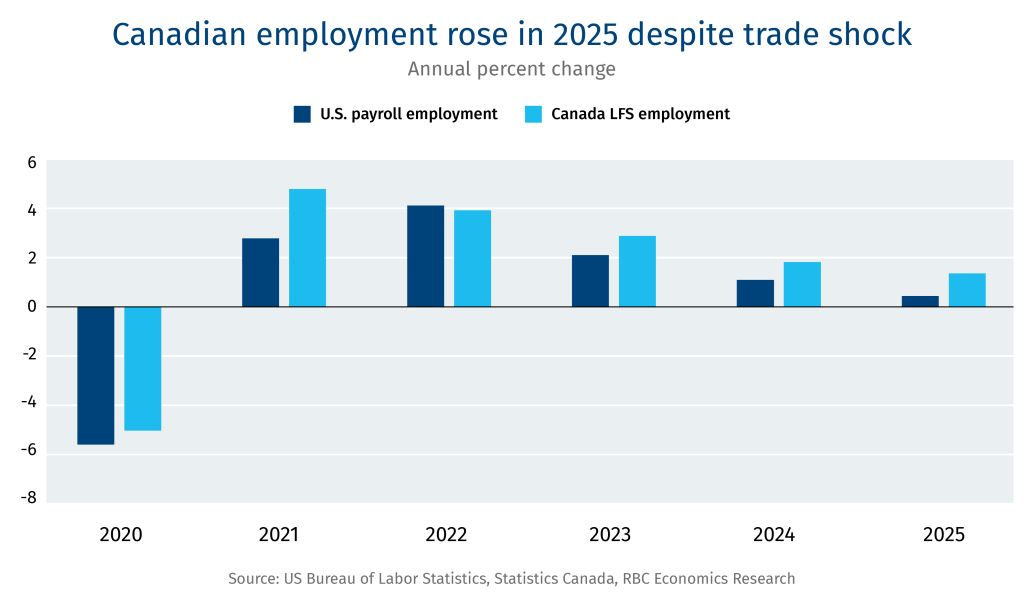
Despite trade tensions and heavy tariffs that hit many sectors, Canada added more jobs than the U.S. in 2025. While 68% of Canadian exports are headed for the U.S., only 12% of jobs are dependent on U.S. demand, according to RBC Economics research.
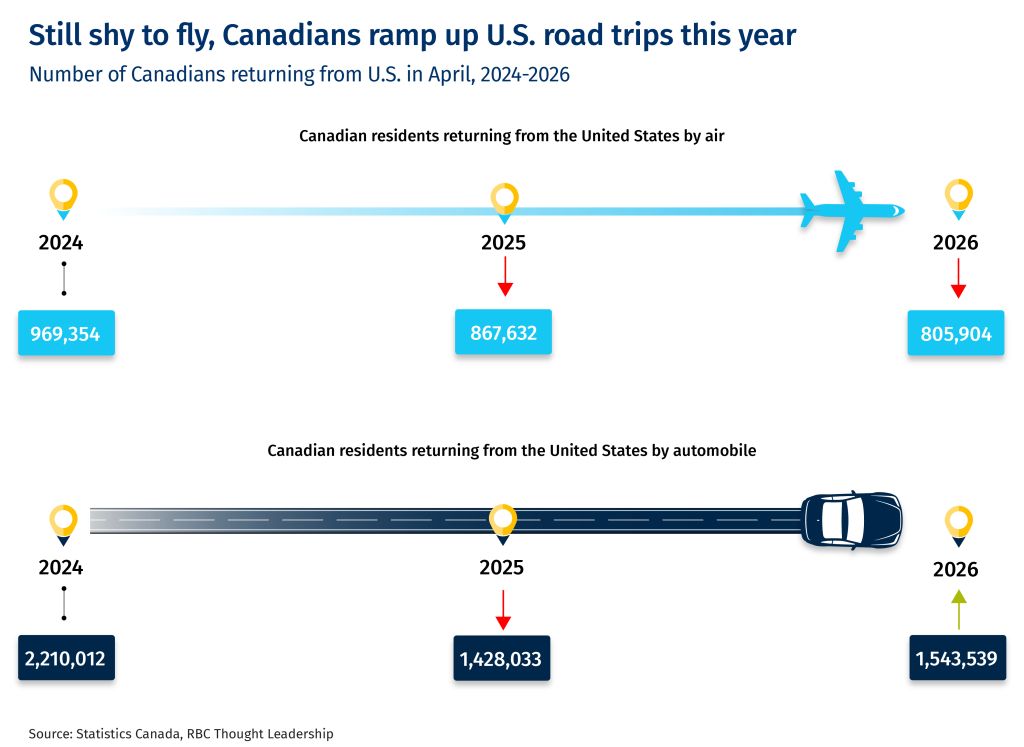
More Canadians travelled to the Unites States in April, marking the first monthly increase since January of last year. While the total was up, more people travelled by car, while air travel was still down compared to 2025.
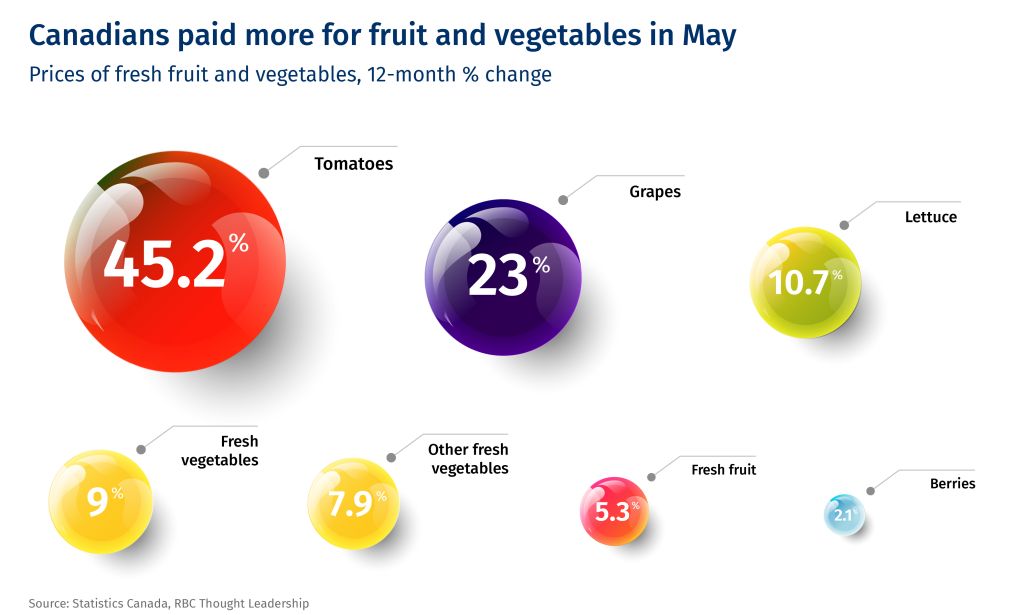
Rising grocery prices outpaced headline inflation for the 16th consecutive month in May, thanks to the higher cost of fresh fruit and vegetables. Tomato prices jumped 45.2%, due to supply contractions in Mexico.
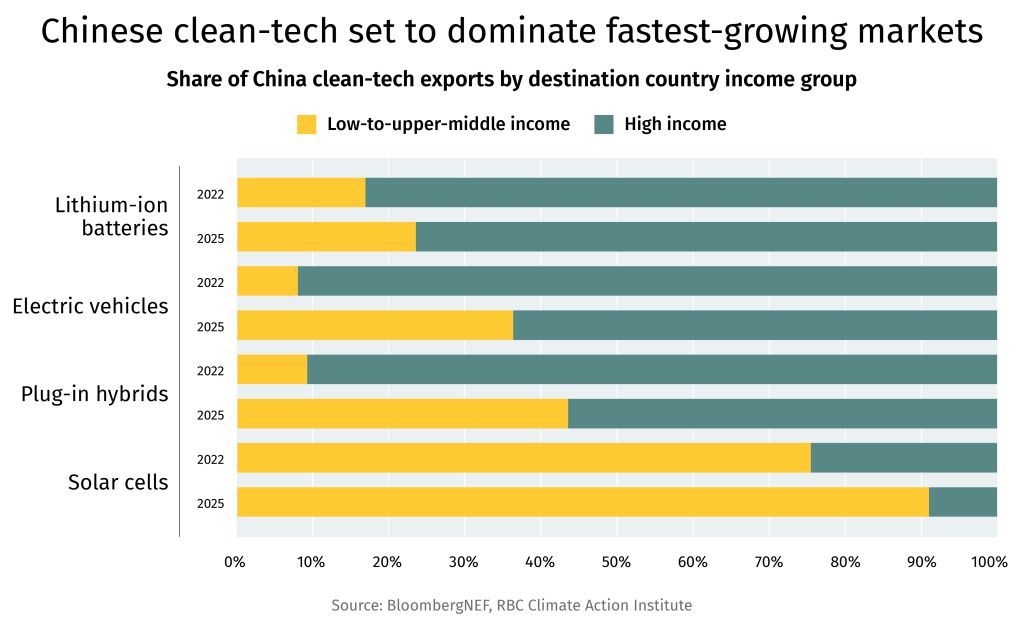
In many respects, it is China that’s leading the global energy transition. Emerging trade data highlights China’s often-underappreciated position in global clean energy supply chains, which has only accelerated with the Hormuz crisis.
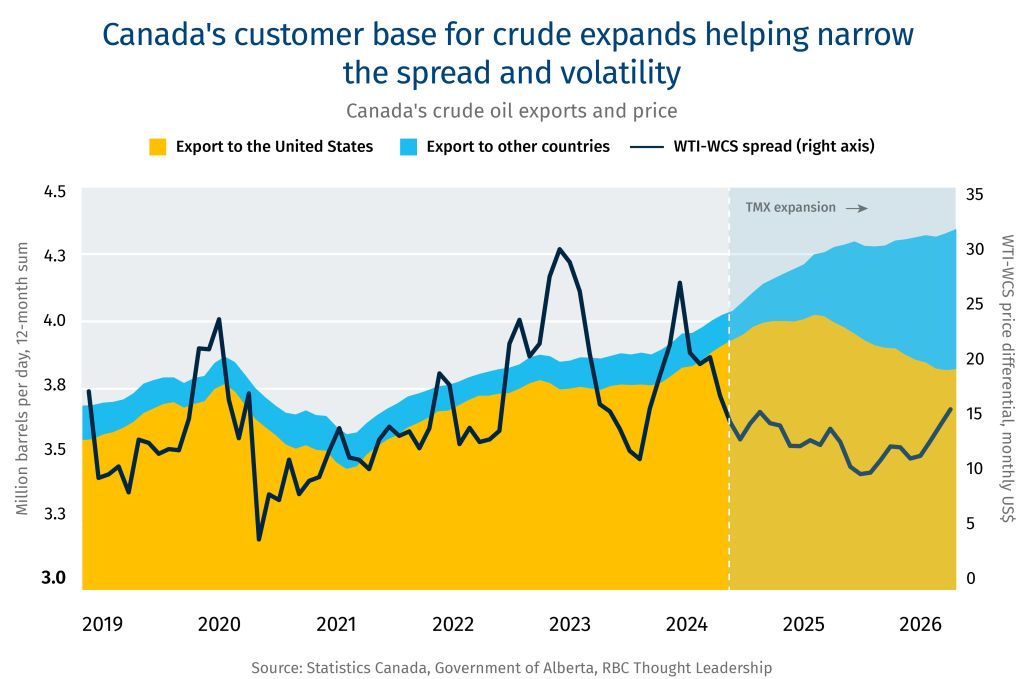
North America is an auto powerhouse: The U.S. brings manufacturing The Trans Mountain Expansion (TMX) has begun to transform Canada’s strategic position in the global oil markets. It has also narrowed discounts between Canada’s heavy oil benchmark (Western Canada Select) and the American index (Western Texas Intermediate). Each additional barrel shipped to Asia compresses the differential, improving producer profits.
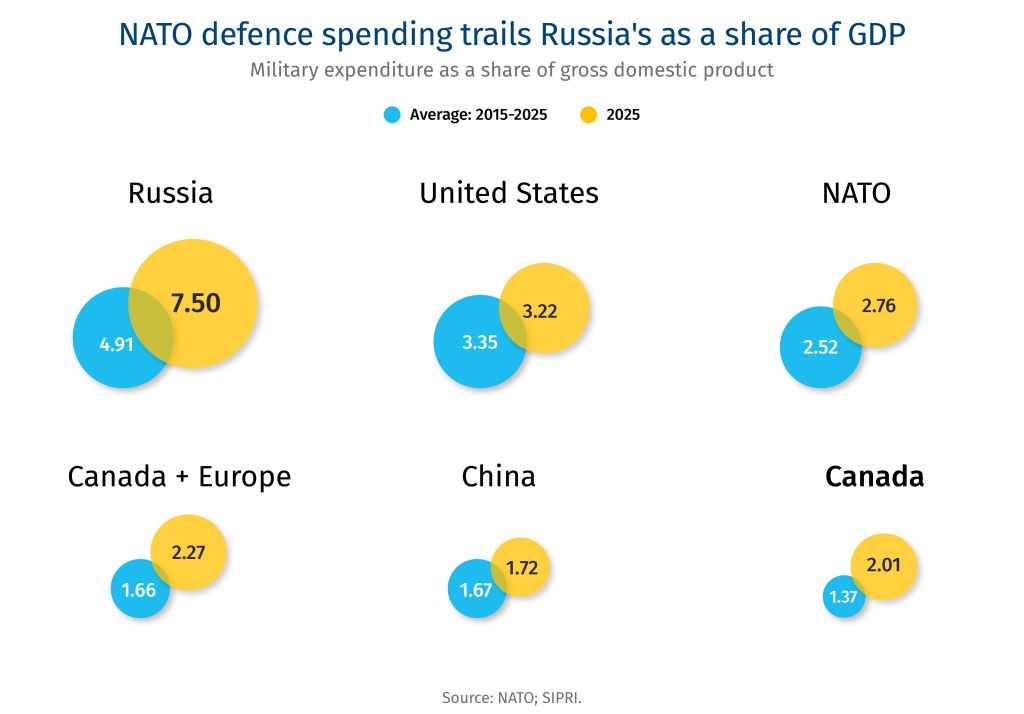
Global military expenditure reached US$2.9 trillion in 2025—the ninth consecutive annual increase. The U.S., China and Russia accounted for roughly half of that spending. However, the relative share changed dramatically: in 2000, Russia and China combined to spend a tenth of U.S. expenditure; today, they spend more than half that of the U.S.
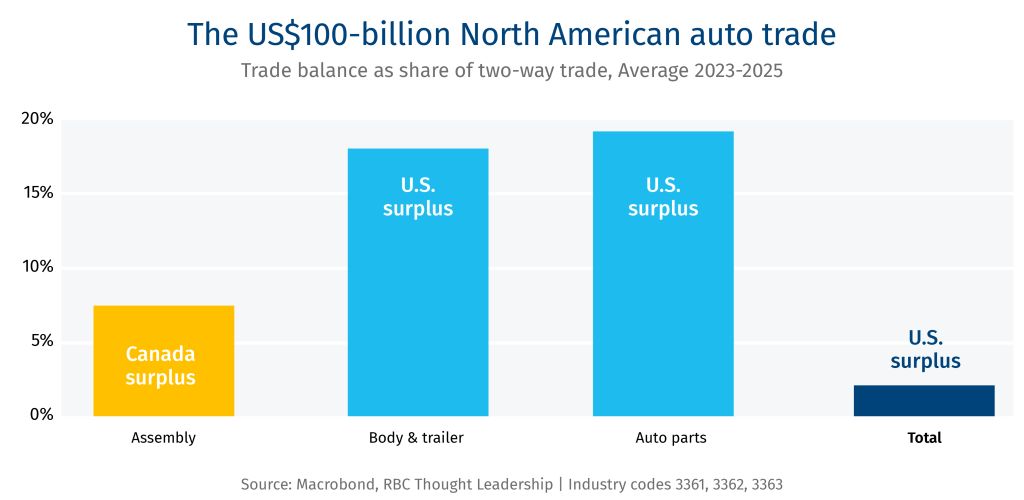
North America is an auto powerhouse: The U.S. brings manufacturing expertise, R&D infrastructure. Canada brings complementary assets: award-winning assembly plants, global calibre parts-makers and a tech cluster with capabilities in sensors, AI, lightweight materials, and autonomy.
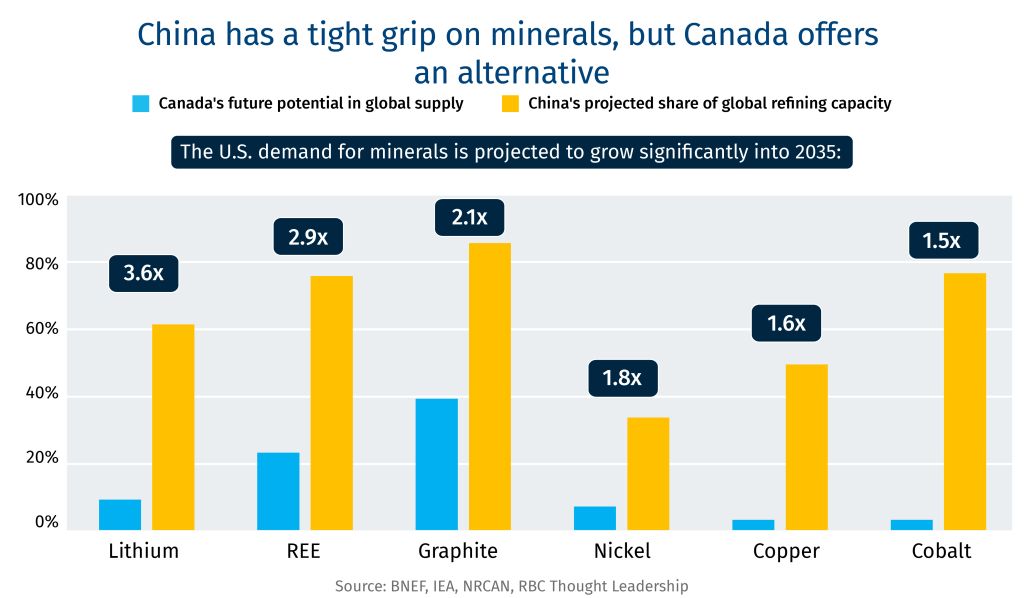
Chinese dominance in the refining and manufacture of critical minerals is the most direct threat to industrial sovereignty in North America. Canada can help break that dominance, with its world-class geology across cobalt, copper, gallium, germanium, graphite, lithium, nickel, tungsten and rare earths.
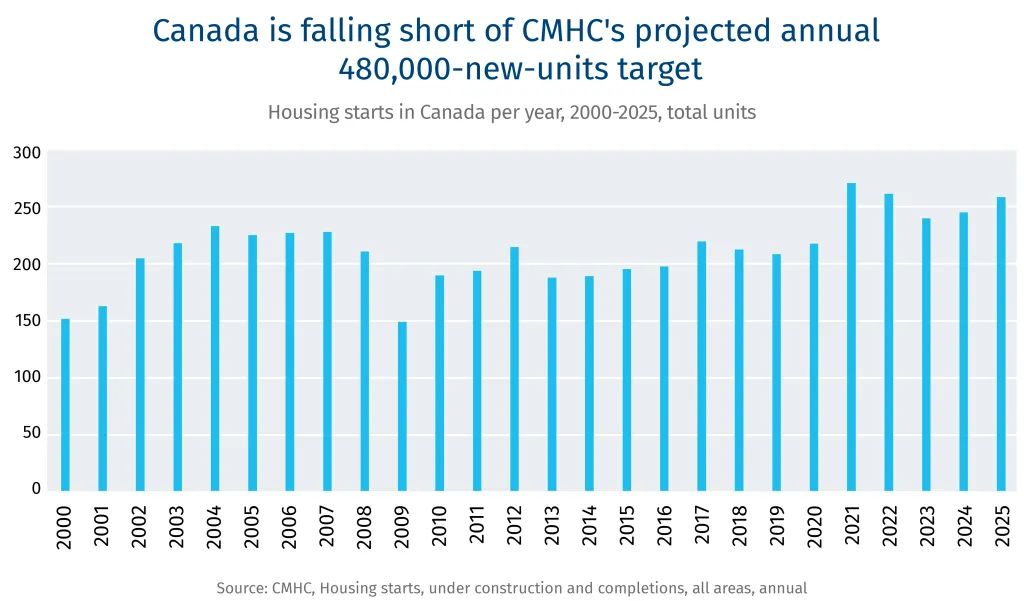
Modern Methods of Construction can help build Canadian homes 50% faster and 40% cheaper than traditional methods. Read A New Blueprint.
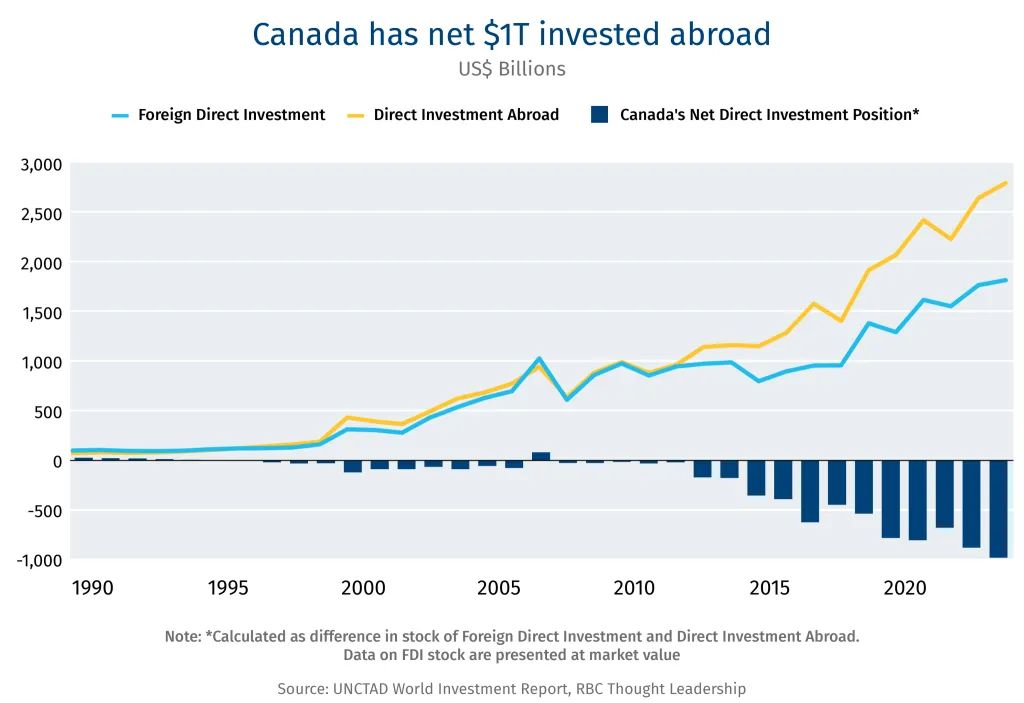
Over the past decade, Canada’s net outflow of investment exceeded $1 trillion, the most significant capital exodus in modern Canadian history.
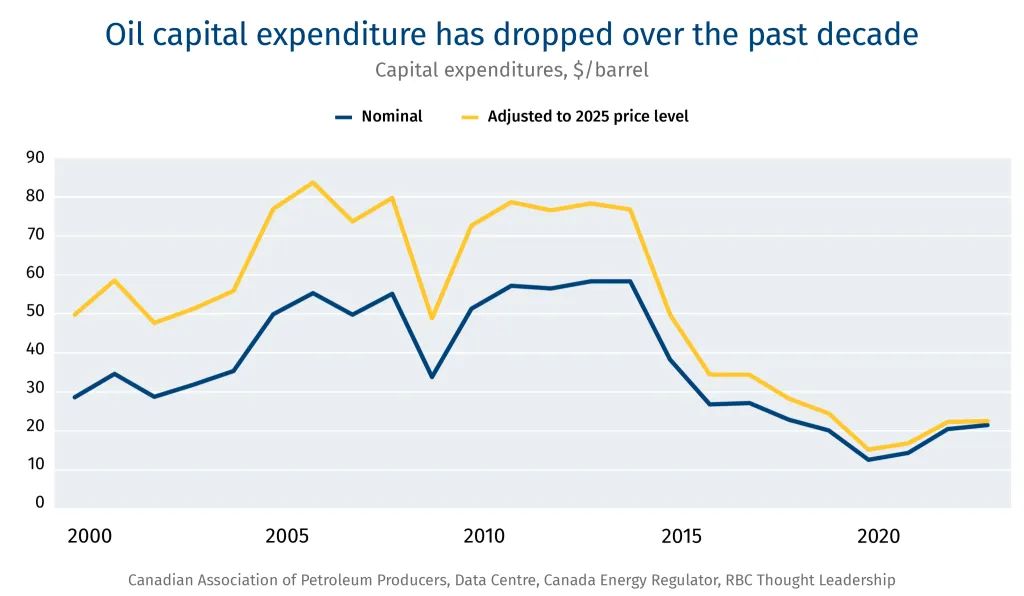
The Canadian oil and gas sector is poised for a potential upturn, driven by global demand for secure and stable supplies of oil and liquefied natural gas.
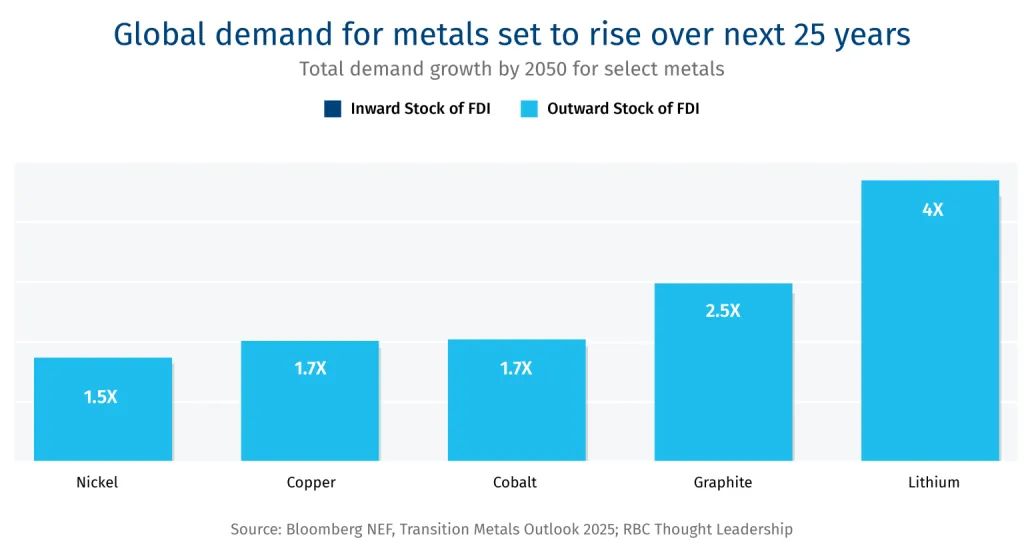
In Capital Gains we examine how Canada can emerge as a critical minerals’ supplier of choice for allies and partners.
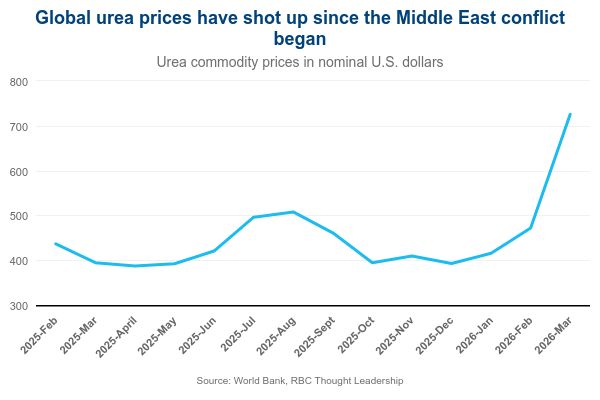
Shortages of fertilizers, such as urea, could have a damaging impact on groceries and food.
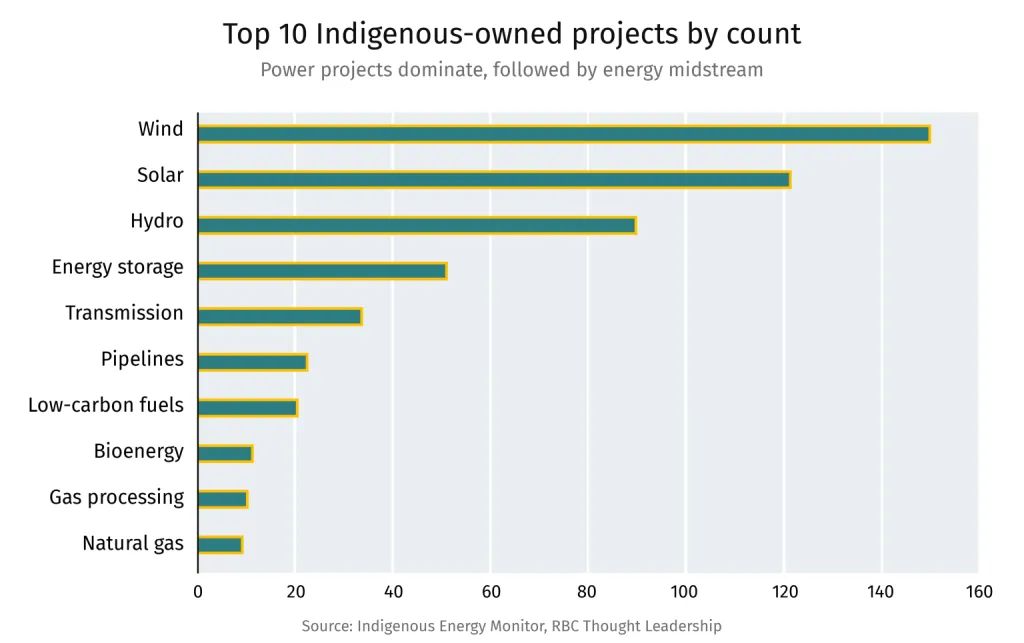
Over 80% of prior Indigenous equity transactions in Canada are in relatively low-risk power and utilities sectors. However, the next wave of Canadian projects, including those in natural gas and mining, would expect First Nations and proponents to assume more risk. Read Nations Building to explore the challenges facing Canada’s next wave of projects.
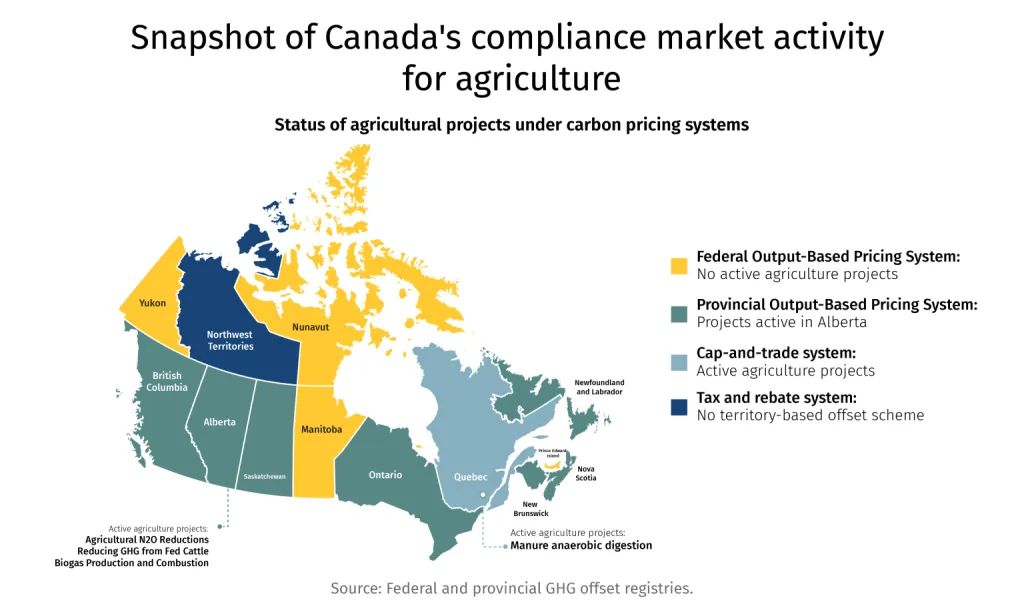
Fragmentation across Canada’s industrial carbon pricing system has led to several inefficiencies in the marketplace and held back development. Our report, Giving Farmers Credit, examines how it is one of the factors holding back climate action in the country’s agriculture sector.
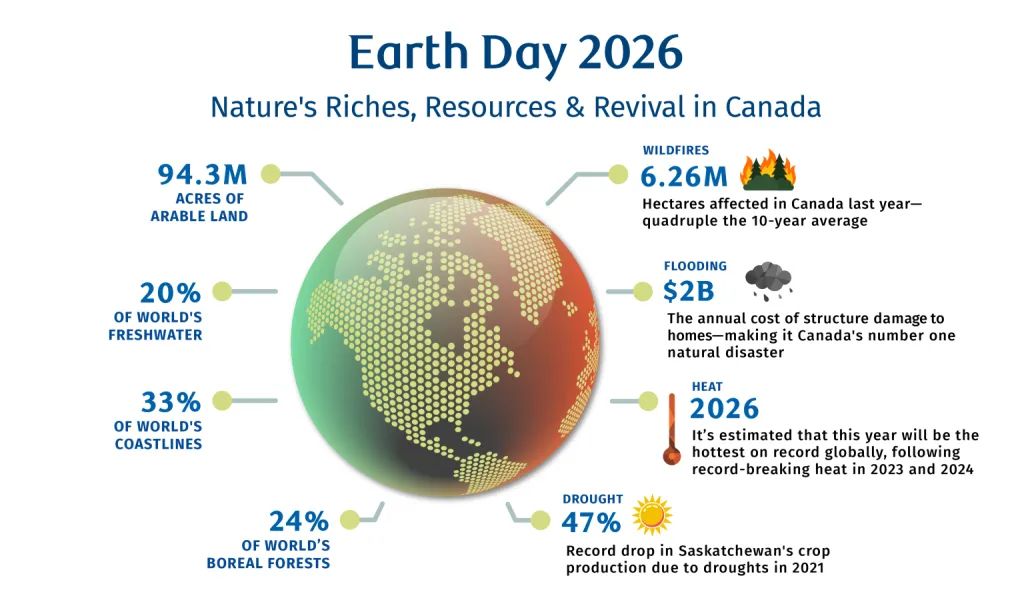
“Our power, our planet” was the global theme of Earth Day 2026. Indeed, clean power often lays the foundation of a cleaner economy. New research from RBC shows Canada’s electricity system needs an estimated $670 billion over the next 10 years to support the energy transition.
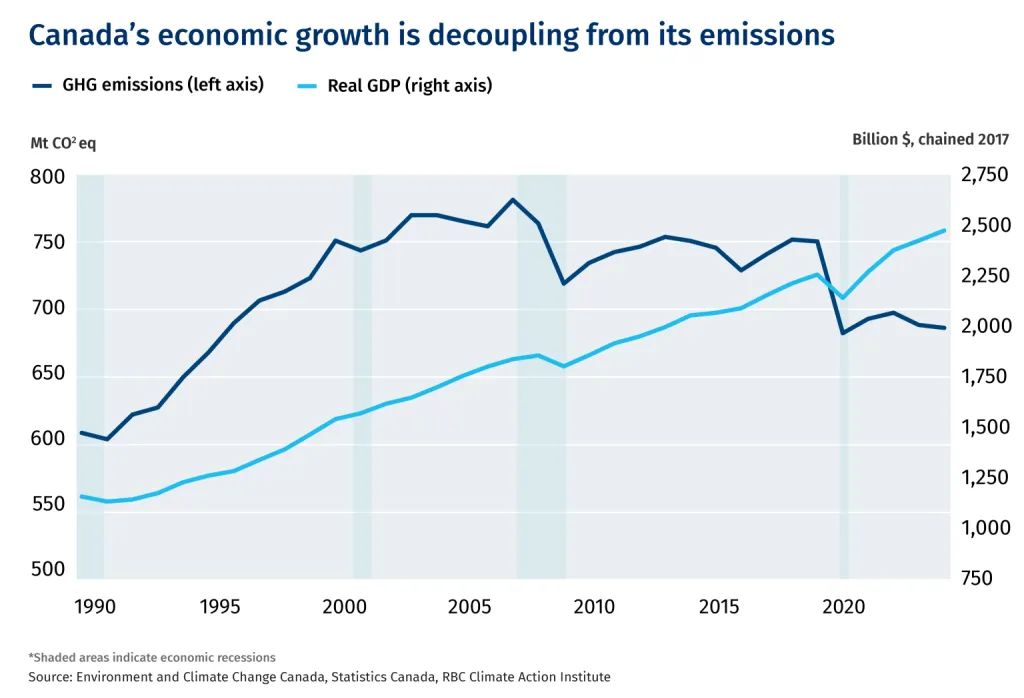
Like many of its peers, Canada has made progress in decoupling economic growth from emissions through increased renewable energy adoption, improved energy efficiency standards, and sectoral shifts toward services and technology. However, its decoupling drive remains a work-in-progress, particularly in emissions-intensive sectors.
Important Notice Regarding Information on this Website and Caution Regarding Forward-Looking Statements
The information on this website is intended as general information only and does not constitute an offer or a solicitation to buy or sell any security, product or service in any jurisdiction; nor is it intended to provide investment, financial, legal, accounting, tax or other advice, and such information should not to be relied or acted upon for providing such advice. Nothing herein shall form the basis of or be relied upon in connection with any contract, commitment, or investment decision whatsoever. The reader is solely liable for any use of the information contained herein, and neither Royal Bank of Canada (“RBC”, “we”, “our” and “us”) and its subsidiaries nor any of RBC’s affiliates nor any of their respective directors, officers, employees or agents shall be held responsible for any direct or indirect damage arising from the use of any information contained herein by the reader.
From time to time, we make written or oral forward-looking statements within the meaning of certain securities laws, including on this website, in filings with Canadian securities regulators or the U.S. Securities and Exchange Commission, and in other communications. Such statements are subject to our caution regarding forward-looking statements. Forward-looking statements on our website include, but are not limited to, statements relating to our economic and sustainability related objectives, vision, commitments, goals and targets as well as potential events and actions. By their very nature, forward-looking statements require us to make assumptions and are subject to inherent risks and uncertainties, which give rise to the possibility that our predictions, expectations or conclusions will not prove to be accurate, that our assumptions may not be correct, and that our objectives, vision, commitments, goals and targets will not be achieved. We caution readers not to place undue reliance on these statements as a number of risk factors – many of which are beyond our control and the effects of which can be difficult to predict – could cause our actual results to differ materially from the expectations expressed in such forward-looking statements. ESG (including climate) metrics, data and other information contained on this website are or may be based on assumptions, estimates and judgements. For cautionary statements relating to the information on this website, refer to the “Caution regarding forward-looking statements” and the “Important notice regarding this report” sections in our latest sustainability report, available at: https://www.rbc.com/our-impact/sustainability-reporting/index.html.
Except as required by law, none of RBC nor any of its affiliates undertake to update any information on this website.
All expressions of opinion on this website reflect the judgment of the authors as of the date of publication and are subject to change. We do not guarantee the accuracy of the information or expressions of opinion presented herein and they should not be regarded as a complete analysis of the subjects discussed. No endorsement of any third parties or their advice, opinions, information, products or services is expressly given or implied by RBC or any of its affiliates.
All references to websites are for your information only. The content of any websites referred to on this website, including via website link, and any other websites they refer to are not incorporated by reference in, and do not form part of, this website. This website is also not intended to make representations as to sustainability-related initiatives of any third parties, whether named herein or otherwise, which may involve information and events that are beyond our control.