

 EN
EN 


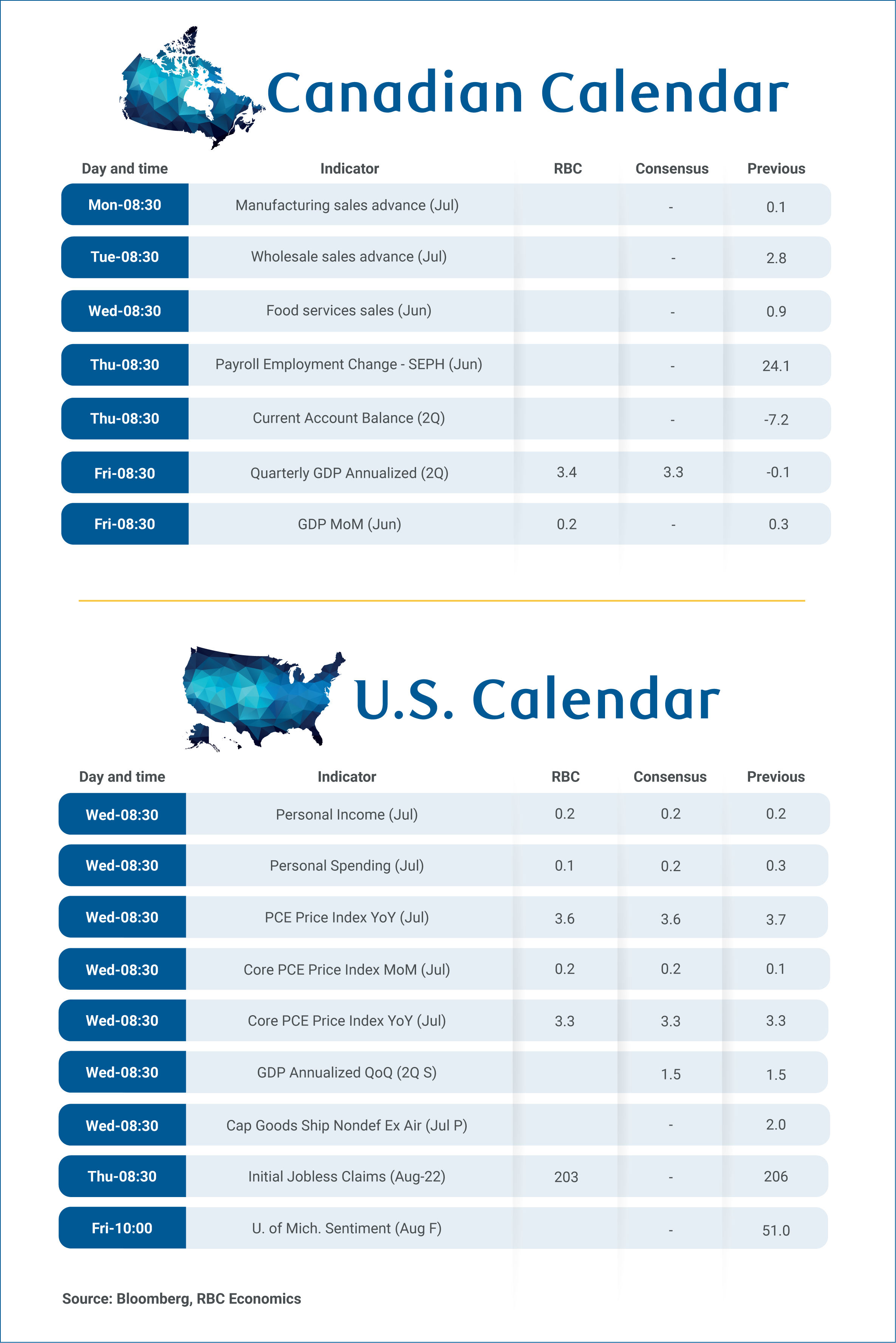
For the week of August 24th
Next Friday’s Canadian gross domestic product reports for June and Q2 are expected to confirm a strong rebound in economic activity following stalling growth over the winter.
Statistics Canada reports two different measures of real GDP based on monthly production and quarterly expenditure. The two estimates have diverged significantly in recent quarters including Q1 when the production estimate posted a small increase while expenditure saw a second consecutive small decline.
But, monthly GDP data has looked substantially better to date in Q2. We expect a 0.2% increase in June, in line with Statistics Canada’s earlier advance estimate to add to an almost full percentage point increase over April and May.
Monthly numbers have been highly revision prone, but track above 3% annualized growth in Q2 overall. A broad range of indicators have also largely confirmed the bounce-back in Q2 growth. Labour market data have firmed after a slow start to the year.
Some of that Q2 strength reflects a reversal of temporary weakness earlier in the year. Net trade likely made a substantial positive contribution as exports outpaced imports, led in part by a recovery in the auto sector following winter production disruptions.
But Q2’s improvement appears broader than the trade rebound. Our tracking of RBC cardholder transactions showed stronger consumer spending despite higher fuel costs during the quarter. A jump in equipment imports suggests business investment grew more strongly, and residential investment appears to have rebounded alongside improving home resales and housing starts, although housing activity remains soft with a gradual recovery.
The boost from auto production and net trade in Q2 is unlikely to be repeated in coming quarters. And, declining population is still expected to weigh on total GDP growth, while trade uncertainty and remaining product-specific tariffs are still a headwind for business investment.
Q3 growth looks steady so far
Still early indicators, including our tracking of consumer spending and firming in hours worked in July, have remained constructive early in Q3.
Details of the trade deal to prevent additional U.S. tariffs on imports from Canada threatened in July are still pending – with a deadline to finalize the agreement and avoid 50% tariffs on another subset of Canadian exports at midnight tonight (August 21st). But early reports suggest current tariffs on products like autos, steel and aluminum could be lowered. Plus, most Canadian trade maintains duty free access to the U.S. through CUSMA exemptions.
Aug. 24 update: The preliminary trade deal to prevent tariffs faltered at the last minute, and now 50% tariffs have now been imposed on about 5% of U.S. imports from Canada. We do not expect that will significantly alter Canada’s near-term growth backdrop, but will cause significant disruptions to targeted sectors. See more here.
We continue to expect growth to moderate from Q2’s strong pace, but remain positive over the remainder of 2026. That would be consistent with our base case forecast for a gradual cyclical recovery, including further improvement in per-capita growth even as elevated trade uncertainty remains a risk.
About the authors:
Nathan Janzen is an Assistant Chief Economist, leading the macroeconomic analysis group. His focus is on analysis and forecasting macroeconomic developments in Canada and the United States.
Abbey Xu is an economist at RBC. She is a member of the macroeconomic analysis group, focusing on macroeconomic forecasting models and providing timely analysis and updates on economic trends.
Explore the latest from RBC Economics:
Slowly but surely Canada’s housing market is turning around
Canadian inflation edges higher in July while underlying pressures remain contained
Share these insights with your network:
This article is intended as general information only and is not to be relied upon as constituting legal, financial or other professional advice. The reader is solely liable for any use of the information contained in this document and Royal Bank of Canada (“RBC”) nor any of its affiliates nor any of their respective directors, officers, employees or agents shall be held responsible for any direct or indirect damages arising from the use of this document by the reader. A professional advisor should be consulted regarding your specific situation. Information presented is believed to be factual and up-to-date but we do not guarantee its accuracy and it should not be regarded as a complete analysis of the subjects discussed. All expressions of opinion reflect the judgment of the authors as of the date of publication and are subject to change. No endorsement of any third parties or their advice, opinions, information, products or services is expressly given or implied by Royal Bank of Canada or any of its affiliates.
This document may contain forward-looking statements within the meaning of certain securities laws, which are subject to RBC’s caution regarding forward-looking statements. ESG (including climate) metrics, data and other information contained on this website are or may be based on assumptions, estimates and judgements. For cautionary statements relating to the information on this website, refer to the “Caution regarding forward-looking statements” and the “Important notice regarding this document” sections in our latest climate report or sustainability report, available at: https://www.rbc.com/community-social-impact/reporting-performance/index.html. Except as required by law, none of RBC nor any of its affiliates undertake to update any information in this document.

