

 EN
EN 


For the week of July 20th
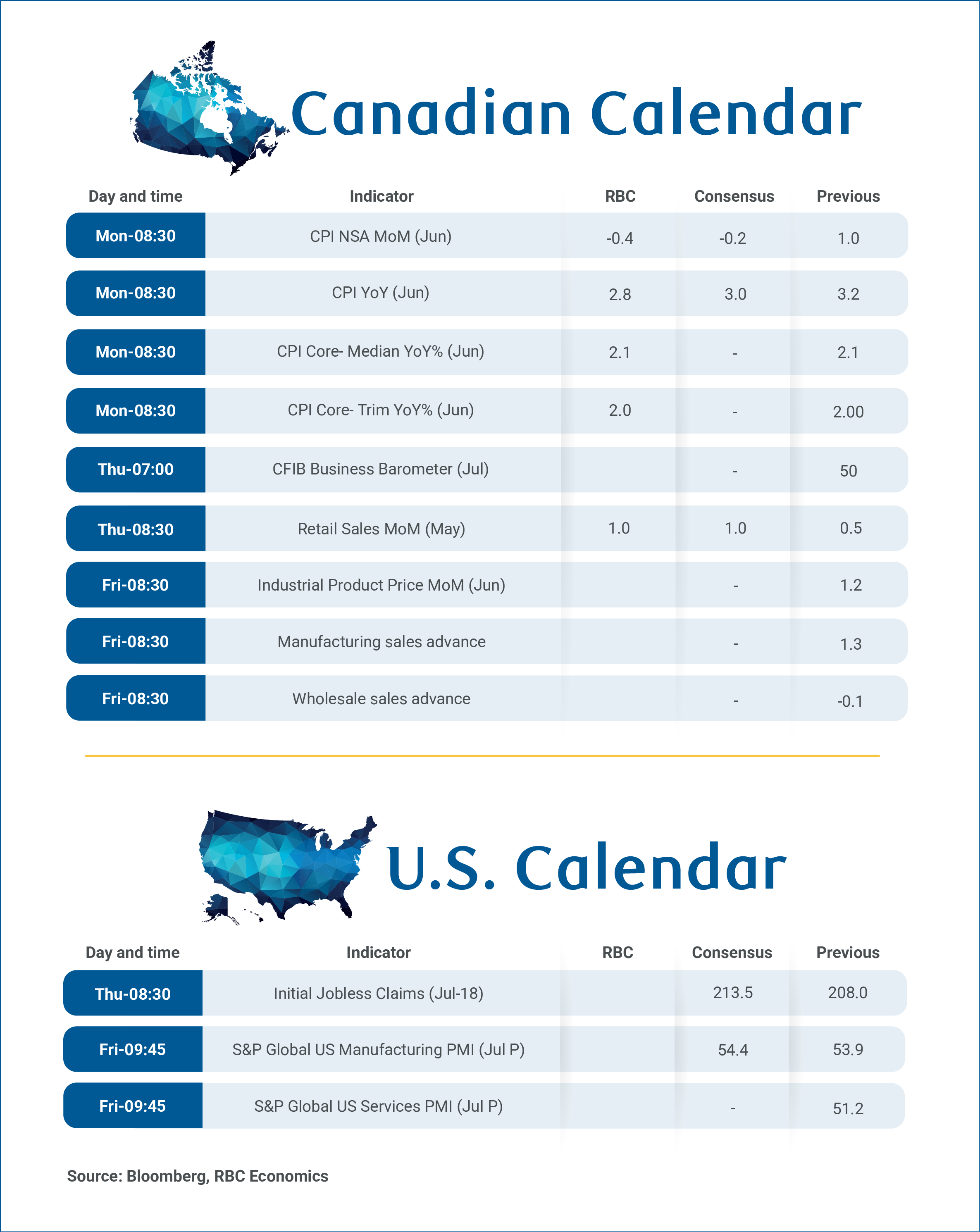
June’s Consumer Price Index report on Monday will provide an updated look at inflation trends following the Bank of Canada’s decision to leave interest rates unchanged for a sixth consecutive meeting.
We expect headline inflation eased to 2.8% year-over-year, down from 3.2% in May. Much of the moderation is expected to reflect lower energy prices in June with gasoline and fuel prices declining 10% and 6.3%, respectively, from May.
Energy prices are still expected to remain higher from a year ago, but their contribution to headline inflation should moderate. Food price inflation, meanwhile, is expected to remain firm at 3.6%, easing only modestly from 3.8% in May.
Outside of more volatile components, inflation pressures are expected to remain broadly stable. We expect inflation excluding food and energy to hold close to 1.6% y/y, little changed from May, while the BoC’s preferred core inflation measures are likely to remain consistent with inflation running near the 2% target.
Recent inflation reports have continued to point to a divergence between headline and underlying inflation with headline readings boosted by elevated energy prices, while broader price pressures have stayed comparatively contained.
That distinction is likely to remain central to the BoC’s assessment of the inflation outlook. Policymakers have emphasized they are focused on whether higher energy costs spill over into broader consumer prices rather than on the direct impact of commodity price movements.
To date, there has been little evidence of such second-round effects, supporting the central bank’s view that underlying inflation remains consistent with price stability. This is in line with both the BoC’s latest projections and our base case forecasts, which assume inflation will gradually return toward the 2% target over the forecast horizon while the central bank remains on hold through 2026.
-
Statistics Canada’s preliminary estimate points to a 1% increase in nominal retail sales in June, led by stronger sales at gasoline stations and higher motor vehicle purchases. After adjusting for price effects, we estimate retail sales rebounded by about 0.5%, consistent with our tracking that household spending stays resilient despite higher energy prices.
About the authors:
Nathan Janzen is an Assistant Chief Economist, leading the macroeconomic analysis group. His focus is on analysis and forecasting macroeconomic developments in Canada and the United States.
Abbey Xu is an economist at RBC. She is a member of the macroeconomic analysis group, focusing on macroeconomic forecasting models and providing timely analysis and updates on economic trends.
Explore the latest from RBC Economics:
Canada’s unemployment rate edged lower in June
Bank of Canada July meeting recap: steady stance and forecast revisions
Canada’s housing market takes another small step towards recovery
Share these insights with your network:
This article is intended as general information only and is not to be relied upon as constituting legal, financial or other professional advice. The reader is solely liable for any use of the information contained in this document and Royal Bank of Canada (“RBC”) nor any of its affiliates nor any of their respective directors, officers, employees or agents shall be held responsible for any direct or indirect damages arising from the use of this document by the reader. A professional advisor should be consulted regarding your specific situation. Information presented is believed to be factual and up-to-date but we do not guarantee its accuracy and it should not be regarded as a complete analysis of the subjects discussed. All expressions of opinion reflect the judgment of the authors as of the date of publication and are subject to change. No endorsement of any third parties or their advice, opinions, information, products or services is expressly given or implied by Royal Bank of Canada or any of its affiliates.
This document may contain forward-looking statements within the meaning of certain securities laws, which are subject to RBC’s caution regarding forward-looking statements. ESG (including climate) metrics, data and other information contained on this website are or may be based on assumptions, estimates and judgements. For cautionary statements relating to the information on this website, refer to the “Caution regarding forward-looking statements” and the “Important notice regarding this document” sections in our latest climate report or sustainability report, available at: https://www.rbc.com/community-social-impact/reporting-performance/index.html. Except as required by law, none of RBC nor any of its affiliates undertake to update any information in this document.

